


Abstract
In today’s AI-driven world, nurturing students’ capacity for independent, self-reflective learning is vital. They must build lifelong learning skills and develop personalized strategies through ongoing self-regulation. In this study, we employed a learning journal template to support self-regulated physics learning, highlighting the role of homework assignments designed to target different levels of cognitive domains. Our learning journal-supported approach aims to facilitate students’ preparation for lessons at home. Guided questions help students review the content covered in previous classes and reflect on the effectiveness of the instructional methods applied. The intervention focused specifically on the physics topic of dynamics, examining how students’ conceptual understanding and performance developed within this domain. The efficacy of this approach was tested among 7th- and 9th-grade students. Results indicate that the learning journal-based method, combined with structured homework, had a positive impact on students’ performance within the topic of dynamics.
1. Introduction
Expectations of knowledge are rapidly transforming, and researchers study how global changes shape them (Sanakuiev, 2022; Levin et al., 2025). Since personal change is in most cases slower than technological and social shifts, lifelong learning is essential for adapting to developments in daily life and work (OECD, 2025; Mejía-Manzano et al., 2022). According to Csapó (2004, 2010), effective learning in the 21st century is grounded in deep thinking and the development of competences.
As new forms of knowledge and skills emerge, supporting students in developing autonomous learning abilities is increasingly important in contemporary education (Schola Europaea, 2018). Withing the school environment, it is essential that students acquire the capacity for self-directed and self-regulated learning (Bjork et al., 2013) including the ability to assess their needs, reflect on their learning processes, and develop effective strategies—that is, the ability to learn how to learn.
At the same time, the rise of AI encourages reliance on technology over cognitive effort, potentially hindering students’ higher-order thinking and problem-solving skills (Zhai et al., 2024). According to recent research, the vast majority of student users do not reflect on the answers provided by AI but accept them without further inquiry, thereby reducing opportunities for critical and creative thinking and for regulating their own learning processes (Kosmyna et al., 2025).
In contrast, the method presented in this study fosters reflective learning in physics. Through guided learning journal activities, students review lessons, assess strengths and weaknesses, and identify strategies for successful learning. These skills not only enhance effective problem-solving but also foster independent and efficient learning that students can apply in their future studies (Dounas-Frazer & Reinholz, 2015; Griston & Wilcox, 2025). Through the development of autonomous learning abilities, students are better prepared to adapt and succeed in both their personal lives and the world of work (Schola Europaea, 2018).
The effectiveness of self-directed learning and engaging in metacognitive processes have a direct impact on students’ academic performance, influencing grades and overall academic outcomes (Kennedy & Arendale, 2023; Vecera & Levtov, 2025). Those students who engage in self-regulated learning are more effective in coping with higher-level scientific tasks (López Carrillo et al., 2024). However, in many cases, students do not acquire the methods and strategies necessary for effective learning (Vecera & Levtov, 2025).
The aim of this paper is to reflect on the challenges of self-directed and self-regulated physics learning and to support students in developing effective physics learning strategies through the use of a structured learning journal.
2. Background
2.1. Self-Regulated Learning Supported by Learning Journals and Homework Tasks
According to self-regulated learning (SRL), individuals set goals, monitor and evaluate their own behavior, and, upon detecting a mismatch between desired and actual performance, modify their activity accordingly (Kocovski & Endler, 2000; Turan et al., 2022; Kesuma et al., 2020).
Learning becomes self-regulated when individuals apply strategies, manage motivation, adjust effort, and adapt or modify tasks. Self-regulation is the control of goal directed actions through changes in cognition, emotion, behavior, and attention (Zimmerman, 1995). Self-regulation constitutes a comprehensive system of capabilities that enables individuals to manage their own behavior through interactive processes involving various control strategies—attentional, metacognitive, motivational, emotional, behavioral, and volitional (Boekaerts & Niemivirta, 2000). Marsh and Iran-Nejad (2013) even equate intelligence itself with the capacity for self-regulation.
The application of a learning journal is suitable for supporting students’ learning and self-regulation. The use of a learning journal provides students with an opportunity to summarize a lesson and reflect on it. Some educators expect brief reflective entries, whereas others require more extended writing that incorporates experiences and observations. Despite these variations, a common feature is that learning journals support students in critically examining their own learning processes, thereby contributing to the development of metacognitive skills (Hyttinen & Suhonen, 2022; Clipa et al., 2012). When writing the journal, students have the opportunity to consciously reflect on their learning processes and to create reflections on their own experiences (Hyttinen & Suhonen, 2022).
The journal emerged as an alternative to traditional writing, which demands ideas plus language skills. In class, journals help students reflect on learning and develop critical and analytical strategies (Bazir, 2016). It is important to note that writing (motor development) initiates cognitive processes and stimulates thinking, thereby supporting learning processes (Diamond, 2000; Mueller & Oppenheimer, 2014).
Self-regulation is an increasingly important metacognitive skill in learning, which requires metacognitive awareness and experience. It refers to processes that allow students to transform their mental abilities into performance skills (Saks & Leijen, 2019). Through its important role in thinking and problem solving, metacognition is necessary but not sufficient for academic success. A key component that supports students’ metacognitive awareness and experience is reflection. This should be supported with guiding questions and defined perspectives.
Metacognition—“thinking about thinking,” or regulating one’s own cognitive processes—is fundamental to learning and problem solving. Learners at all levels are more effective when they consciously plan, monitor, and evaluate their thinking (Mota et al., 2019).
Saks and Leijen (2019) examined the development of college students’ reflective skills based on their learning journal entries, that is, how and to what extent these skills change under guided, systematic reflection. The results indicated significant growth primarily at the levels of evaluation and justification.
Observing successive reasoning levels (pre-expectations, process-related and final evaluation) helps assess reflection depth. Clear guiding questions and prompts foster cognitive and metacognitive strategies. Learning journals enable dialogue where personalized teacher questions deepen reflection, build rapport, and strengthen performance and engagement (Saks & Leijen, 2019).
Hoffman et al. (2024) observed in their study that there is a correlation between well-considered, thoroughly written reflections and strong academic performance. Students who produced high-quality reflective work achieved higher grades.
Vecera and Levtov’s (2025) Three Ms framework highlights three essentials for effective learning: mindset, metacognition, and memory. Learners need a constructive mindset driven by intrinsic motivation, the ability to monitor and regulate their own learning, and strong memory processes that support durable, well-structured knowledge.
Home preparation for lessons and the completion of homework tasks also require self-regulated learning strategies and students’ conscious, independent engagement (Mota et al., 2019; Reinhard et al., 2022).
Differences in students’ willingness to engage in homework may also emerge across gender and age groups. Studies indicate gender-related differences in homework practices: while girls tend to show a higher willingness to complete homework (Wagner et al., 2008), the positive impact of homework on learning outcomes appears to be stronger among boys (Kalenkoski & Pabilonia, 2017). Based on previous research results, secondary school students spend an average of 15–60 min per day on schoolwork at home. Regarding the effect of age, studies are inconsistent: some show an increase in time investment, others do not. Time alone does not explain academic success. Students benefit differently from homework: some perform well with little effort, others struggle despite much time; pedagogy should emphasize effective strategies, motivation, and self-regulation (Wagner et al., 2008).
The learning process outlined in this study reflects on encouraging students’ development through independent, self-regulated learning and by using homework tasks that promote deep learning across multiple cognitive domains.
2.2. Theoretical Framework
Kolb’s (1984) experiential learning theory, a widely cited model, explains knowledge acquisition through transformation of experience. The model is based on a four-phase learning cycle, whose interdependent stages are concrete experience, reflective observation, abstract conceptualization, and active experimentation (Kolb, 1984; McLeod, 2025), which contributes to the formation of lasting knowledge (Watson et al., 2019).
In the first stage of the cycle, the learner gains direct experience, which provides a tangible basis for further cognitive processing. In the second stage, the learner reflects on the experience, analyzing possible contradictions between the experience and existing knowledge. In the third stage, interpretation is elevated to a theoretical level: the learner creates new concepts and connections through which the experience is organized into a coherent system of knowledge. Finally, during active experimentation, the learner tries out the acquired knowledge in real or simulated environments, which leads to new experiences and thus restarts the cycle (Kolb, 1984; McLeod, 2025).
The systematic incorporation of reflective practices—whether directed toward classroom processes or individual learning strategies—has similarly been shown to strengthen the development of metacognitive skills, to enhance students’ self-confidence, and to support the transfer of knowledge to new and unfamiliar contexts (Clipa et al., 2012).
In this study, we investigate the combined impact of learning journal use and homework completion on students’ physics learning. The learning journal template (shown in Table 1) was developed based on the theoretical frameworks and previous studies discussed above.
Table 1.
Guided questions of the learning journal—related to the individual phases of Kolb’s learning cycle.
After each physics lesson, students are asked to complete a structured learning journal template designed to guide reflective thinking. Its purpose is to encourage students to revisit and critically reconsider the material covered in class, identify their strengths and weaknesses, and recognize areas requiring further clarification or support.
In the concrete experience stage, students describe what has been learnt in class. It helps them to recall classroom tasks and methods and to reinforce knowledge and concepts. In the reflective observation stage, students have the opportunity to reflect on physics teaching methods and learning strategies.
The aim of the abstract conceptualization stage is to give the opportunity to students to identify areas that need further clarification, and it also supports later dialogue between student and teacher. In the active experimentation stage, students complete homework tasks, so that they apply learning in practice. Through the learning journal stages, students ask about unclear concepts, fostering dialogue with the teacher. They also evaluate which methods help them most, discovering effective strategies while giving teachers feedback that can guide instructional adjustments.
2.3. Cognitive Differentiation of Homework Tasks
In addition to writing a learning diary, students are given homework after each lesson. They complete tasks of varying degrees of difficulty in order to repeat, apply, and deepen the knowledge they have acquired in class. In 2004, Germany introduced the so-called operators for physics final exam tasks and three different difficulty levels (Kultusministerkonferenz, 2004). In 2013, these operators were categorized into a system (Kultusministerkonferenz, 2013), which shows strong similarities with the Bloom’s taxonomy (Bloom, 1956) according to the cognitive development levels.
The first level corresponds to knowledge and remembering. The second level contributes to comprehension, application and analysis. The third level expects evaluation and synthesis. The objective of basic reproduction (Level I) is the recognition and accurate recall of essential knowledge, including facts, concepts, definitions, and structures (Kultusministerkonferenz, 2004, 2013). Typical operators at this level involve naming, describing, representing, documenting, drawing, etc. The level of transformation and application (Level II) is concerned with understanding relationships, using knowledge in context, and organizing information. Typical operators at this level include application, analysis, deduction, estimation, calculation, determination, explanation, organization, verification, generalization, comparison, and summarization (Kultusministerkonferenz, 2004, 2013). The highest level (Level III) is represented by tasks requiring independent judgment and critical thinking. The aim is for students to extend, combine, and evaluate their acquired knowledge. The operators associated with this level include giving opinions, evaluating, discussing, justifying, formulating hypotheses, and interpreting (Kultusministerkonferenz, 2004, 2013).
Although a substantial body of literature addresses self-regulated learning supported by learning journals, research on self-regulated learning in physics remains limited and warrants further expansion. It is essential for students to become familiar with learning strategies that they can effectively apply during independent study. Reflective review represents a valuable tool in supporting the acquisition and development of such strategies. In this paper, we connect self-regulated reflective learning in physics with different levels of physics homework engagement. By doing so, we highlight how the selection of task types and levels, active and autonomous participation in problem solving, and reflection on the learning process collectively contribute to students’ cognitive development.
In our study, we examined the impact of the proposed learning journal-based method and different levels of homework tasks on students’ physics knowledge. The investigation was carried out in the topic of dynamics with 7th- and 9th-grade students, using experimental and control groups. Our investigation also aimed to determine whether the method is more effective for boys or girls—as the literature emphasizes differences between gender—and to identify at which grade level its application yields the most substantial benefits.
2.4. Research Questions
The following research questions were formulated based on the above-mentioned information:
RQ1. What is the effect of filling out a learning journal and completing homework assignments on students’ performance in the topic of dynamics?
RQ2. In which grade level (Year 7 or Year 9) did the method prove to be more effective?
RQ3. Is there a measurable difference in the results of boys and girls in the experimental group?
RQ4. Which cognitive levels (Level I, II, III) are supported by completing a learning journal and writing homework assignments?
3. Materials and Methods
3.1. Sample Selection
Given the specific characteristics of our research design, the paragraph begins with a detailed description of the sample selection process. More than 200 students—7th-graders and 9th-graders—participated in the study. During preparation for the dynamics topic, students used a structured learning journal and completed two homework tasks of varying difficulty levels (Level I and Level II, or Level II and Level III). Teachers reviewed journals, discussed student questions, and tracked regular use. Because participants came from different grades and schools, lesson numbers and methods were not standardized. Dynamics was taught according to each teacher’s style, with 7th-graders covering it in six to seven lessons and 9th-graders in twelve to thirteen.
To be included in the experimental group, students were required to complete at least 60% of the learning journals, while those with less than 40% completion were assigned to the control group. Students who completed between 40% and 59% of the learning journals were not assigned to any group. The students in the experimental and control groups attended the same classes, were taught by the same teacher, and received identical instruction. The only difference was that students in the control group did not complete the required independent work—namely, the learning journal entries and homework assignments. We anticipated in advance that each class would include some students who would not complete these tasks. Based on these considerations, the study employed a quasi-experimental design, as participants were not randomly assigned to groups.
3.2. Sample and Procedure
The study initially involved 272 students. A significant number of them could not be clearly assigned to either the experimental or control group due to a moderate level of learning journal completion, while others were absent during either the pretest or the posttest. Consequently, the final sample consisted of 212 students. A total of 101 seventh-grade (N7,exp. = 47, N7,cont. = 54) and 111 ninth-grade students (N9,exp. = 49, N9,cont. = 62) participated in the investigation.
A total of 8 schools and 6 teachers (one colleague teaches in 3 schools) participated in the research. The students attended either non-selective seventh-grade classes or selective ninth-grade secondary grammar school classes. Four of the participating schools are secondary grammar schools, while four are lower secondary schools.
Note: In our country, lower-secondary education lasts from Grade 5 to Grade 8. At the end of Grade 8, students must take part in a mandatory entrance examination process in order to continue their studies at an upper secondary school. The most successful students continue their studies from Grade 9 to Grade 12 in secondary grammar schools—which are more advanced level schools as vocational secondary schools or vocational schools. Students begin studying physics in Grade 7, and it is compulsory until the end of Grade 10.
Data collection followed ethical guidelines: headteachers informed parents and provided consent for anonymous data use.
Before starting the study, in order to ensure the smooth conduct of the research, the research leaders held two 45 min training sessions for the participating physics teachers, where they explained the purpose and process of the research, the research tools, and the activities expected of the teachers—teaching dynamics, keeping track of the journals and homework, and providing data about students’ socioeconomic background and performance on different tests (pre- and posttest).
Students completed a socioeconomic questionnaire and a pretest in dynamics of varying difficulty before the unit, which was repeated as a posttest at its conclusion. The test was designed to be solvable by both the younger and older participants while still presenting an appropriate challenge.
The seventh-grade sample (Table 2) included 101 students from 4 different schools, with 9–36 participants per school. One of the schools is located in the capital, two in a rural city and one in a village.
Table 2.
Distribution of 7th-grade participants according to group and gender.
Since inclusion in the experimental or control group was voluntary, it is worth mentioning that extra work at home was much less popular among the participating boys than among the girls (shown in Table 2).
Table 3 presents a summary of the results of the socioeconomic survey. The vast majority of students live in cities, and several live in villages. A total of 51 students could not state their mother’s education because they were not aware of it. It can also be seen that there is no clear preponderance of families with graduates: many mothers only have secondary education qualifications. The number of books follows a roughly even distribution. According to the results of the survey, the seventh-grade sample is on a broad scale.
Table 3.
Socioeconomic background of 7th-grade participants.
Our ninth-grader sample included 111 students from four different schools, with class sizes ranging from 23 to 37 students. Among these schools, one is located in the capital city, two in rural cities, and one in a town. The distribution of the participants according to group and gender can be seen in Table 4.
Table 4.
Distribution of 9th-grade participants according to group and gender.
Like seventh-graders, ninth-grade girls found journal writing more engaging than boys, which may improve their attitudes toward physics. Students came from various settlements, with smaller ones slightly overrepresented. Data show that children of university-educated mothers mainly attend secondary grammar schools, and most households own over 100 books. The socioeconomic background of the ninth-grade students included in the study is summarized in Table 5 and shows that we worked with a quite selective sample.
Table 5.
Socioeconomic background of 9th-grade participants.
3.3. Instruments
Both the younger and the older students worked on the same physics topic, albeit at different levels appropriate to their age and prior knowledge. The study was organized around the learning of dynamics.
As part of the study, data were collected on students’ socioeconomic background, their previous end-of-year grades in physics and mathematics, and their prior knowledge of dynamics. At the end of the investigation, students took a posttest.
Besides the socioeconomic status questionnaire mentioned above, we also asked students to report their previous end-of-year grades in mathematics and physics. Our goal was to investigate how these factors influence students’ performance on the pretest.
At the beginning of the project, all participating students completed a pretest designed to assess their basic knowledge and skills in dynamics. At the end of the study, students completed a posttest containing the same tasks as those in the pretest.
The tasks of the tests were designed to align with Bloom’s taxonomy (Bloom, 1956) and German science operators (Kultusministerkonferenz, 2013). Accordingly, the tasks of the pre- and posttest were classified into three levels of difficulty. The objective was to investigate how learning journal writing and regular homework assignments contribute to students’ performance in solving problems of varying difficulty levels. The test is presented in Appendix A. In Appendix A, we also indicate the difficulty level (Level I, II, or III) of each test item, allowing readers to see which cognitive domain the given task targets.
After each physics lesson, students answered learning journal questions (see Table 1) and completed homework. Teachers assigned two tasks (one Level II, plus Level I or III). Because the study spanned different grades and schools, teaching methods and homework were not standardized; instead, teachers prepared tasks aligned with their lessons, using the German operator system (Kultusministerkonferenz, 2013).
To support the teachers, we provided reference materials. The workbooks and problem collections available in our country include tasks corresponding to the suggested classification levels. These materials are not included here due to language limitations.
3.4. Data Analysis
Data were analyzed using the statistical software JASP (Version 0.95.4) (JASP Team, 2025). The internal consistency of the pre- and posttest was examined using Cronbach’s alpha (Cronbach, 1951) and McDonald’s omega (McDonald, 1999) values. The internal consistency of the preliminary knowledge assessment was already mapped out during our pilot investigation. Based on the pilot results, the reliability of the entire scale was adequate (α = 0.701, ω = 0.714), which indicates good internal consistency for pilot tests and acceptable for further research. There is no significant difference between the two values. Considering this, we made minimal changes to the test exercises and finalized their evaluation process together with the colleagues participating in the research in the form of a standard evaluation sheet.
We compared the prior knowledge of 7th- and 9th-grade students using the Mann–Whitney U test (Mann & Whitney, 1947). We also examined the correlations (Pearson, 1895) between the pretest results and several background variables, including the number of books at home, mother’s highest level of education, type of settlement, and students’ previous end-of-year mathematics and—where available—physics grade. We used the Mann–Whitney test to compare the experimental and control groups, as well as the pretest results of boys and girls.
The students’ posttest results may indicate the effectiveness of the applied method. We examined which factors influenced test performance in Grades 7 and 9, including students’ gender, prior knowledge as measured by the pretest, and group membership (i.e., whether the student belonged to the experimental or control group). A strong group effect would suggest that the method had a significant impact on learning outcomes.
To draw interpretable conclusions based on the data collected during the quasi-experimental study, particular attention was paid to factor analysis in the statistical evaluation. Specifically, we examined which factors influenced the outcomes (e.g., students’ prior knowledge, group membership, gender, etc.). The analysis was conducted using ANCOVA (Craig, n.d.) (the ANCOVA test applies Type III sum of squares), and the results were evaluated considering the partial eta squared values. We also examined how students performed on test items of varying difficulty levels and how the learning journal method and regular homework practice contributed to their performance.
4. Results and Discussion
4.1. Pretest Analysis
In our large-sample research, the internal consistency results for the preliminary test in the case of 7th-grade students showed good reliability for the entire scale (α = 0.823, ω = 0.853). The difference between ω and α values shows that the difficulty of the tasks appeared in terms of the students’ knowledge and skills. Omitting the more difficult (evaluation) tasks (1.5, 1.7 and 1.8) compared to the easier (reproduction) and medium (application) tasks would have increased the omega value to ω = 0.875, with an almost unchanged α = 0.827.
The internal consistency results for the knowledge assessment in the case of 9th-grade students indicated good reliability for the entire scale (α = 0.829, ω = 0.834). Omitting any question would have reduced the degree of internal consistency.
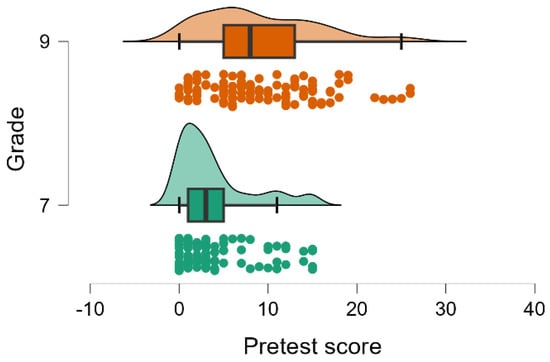
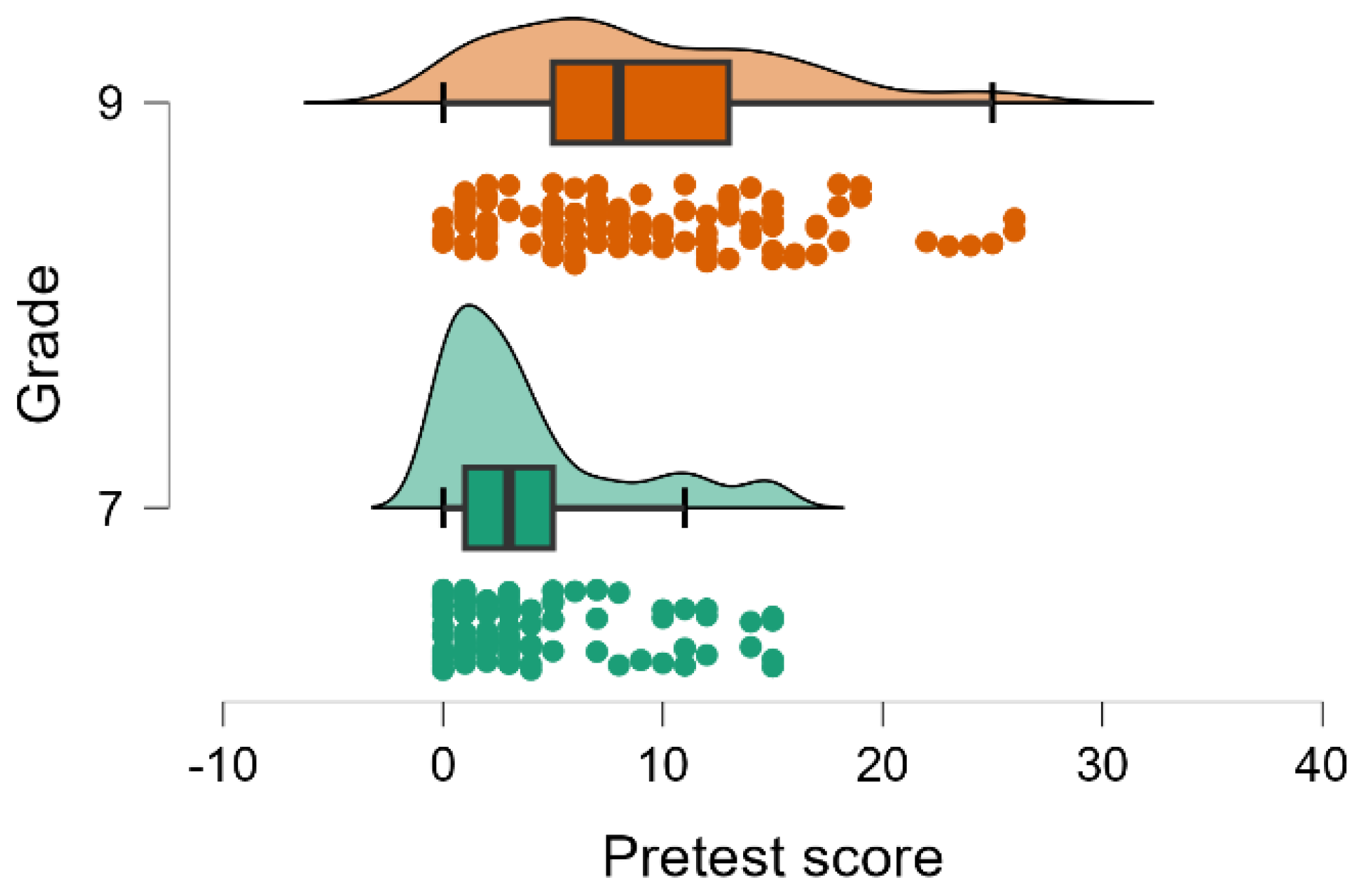
According to the preliminary results of the pretests, based on an independent two-sample analysis, the prior knowledge of seventh- and ninth-graders differed significantly (p < 0.001, Mann–Whitney test U = 2719.0, Shapiro–Wilk test W = 0.933, p < 0.001). The mean of scores for seventh-graders got was 3.851 (SD = 4.191), and the mean of scores ninth-graders achieved was 8.964 (SD = 6.382). The result (shown in Figure 1) is not surprising, as the 9th-graders had already learned basic dynamics before. In the following, we will analyze the data of the two grades separately.
Figure 1.
Raincloud plot of pretest results in Grade 7 and Grade 9.
4.2. Results of Seventh-Grade Students
Since physics begins in seventh grade, we were only able to ask about the previous year’s grade in mathematics. Here, a quite symmetric distribution emerges, with no unrealistic congestion at the higher end (shown in Table 6), as we will see in the case of ninth grade.
Table 6.
Distribution of previous year’s mathematics grades in 7th grade.
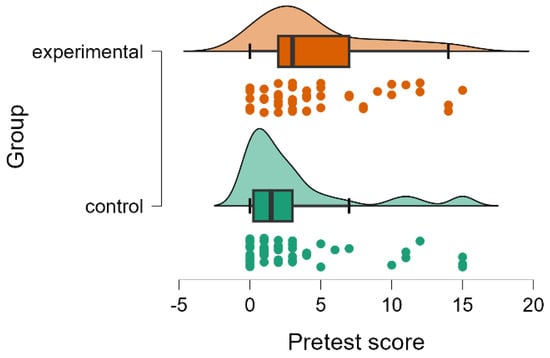
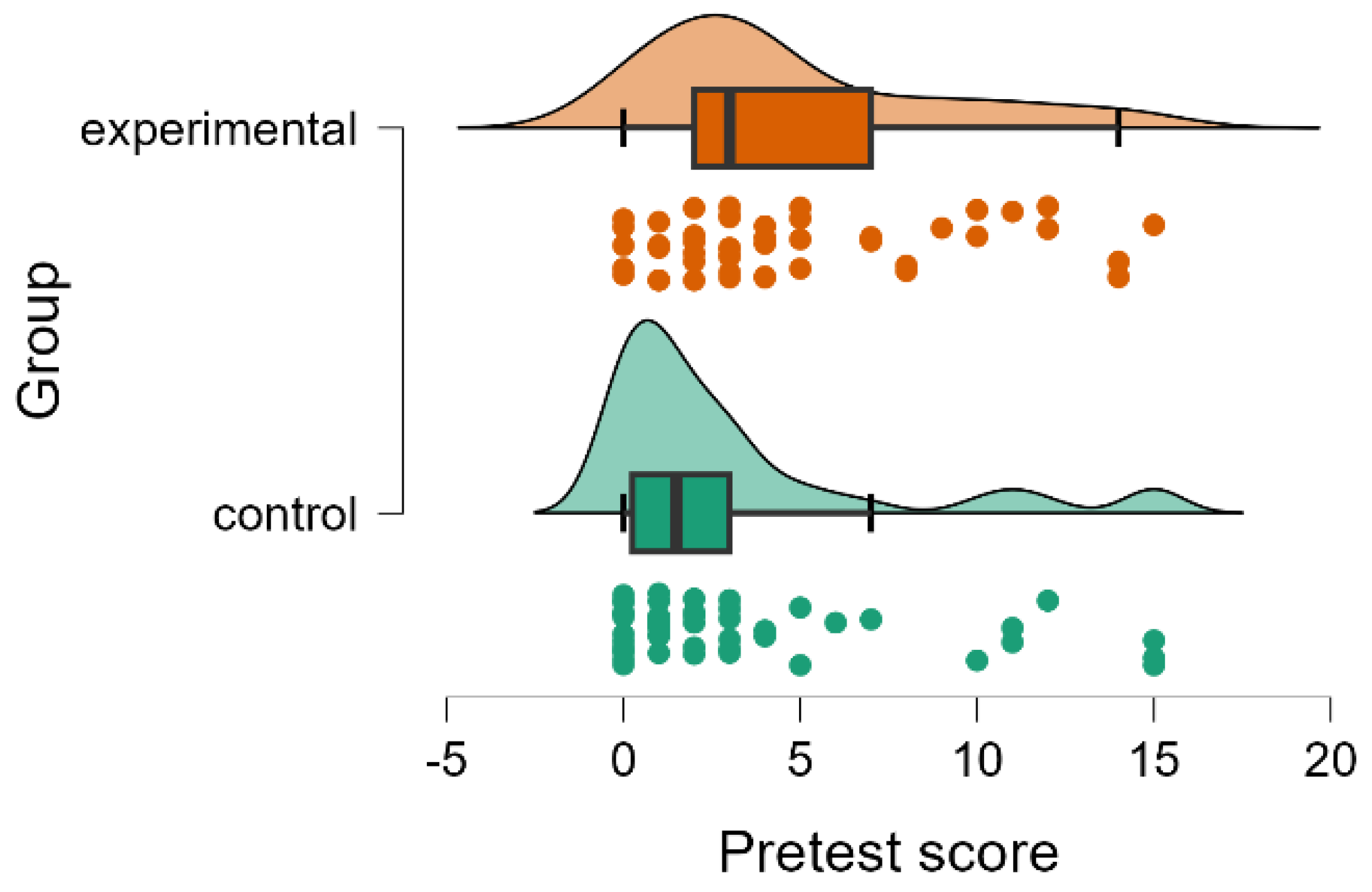
Based on the pretest data, a significant difference was found between the experimental and control groups in favor of the experimental group (p = 0.005, Mann–Whitney U = 860.5, Shapiro–Wilk W = 0.819, p < 0.001). The mean score of the experimental group was 4.702 (SD = 4.128), while that of the control group was 3.111 (SD = 4.142). Therefore, it is particularly important to apply the ANCOVA test in the subsequent analyses to control for the effect of group membership. The results indicate that students who were already more skilled were more willing to do their homework. The distribution of the scores is shown in Figure 2.
Figure 2.
Raincloud plot of pretest results in 7th grade.
We also examined whether boys or girls performed better on the pretest. There was no significant difference between them when assessing prior knowledge; in fact, the girls’ mean score was slightly higher than that of the boys. The mean score for boys was 3.788 (SD = 4.249), while for girls it was 3.918 (SD = 4.173). It is worth noting that this initial lack of difference disappears by ninth grade.
The study analyzed whether pretest performance was associated with aspects of students’ sociological background and last year’s mathematics grade. The results of the correlation analysis are shown in Table 7.
Table 7.
Pearson’s correlations of the sociological background and the pretest results (in 7th grade). * p < 0.05.
Although the data are largely incomplete (some students left multiple questions unanswered), a few observations can be made. Only the previous year’s mathematics grade showed a significant correlation with pretest scores (r = 0.273, p = 0.018). Interestingly, the number of books at home exhibited a negative, though non-significant correlation (r = −0.104, p = 0.367), while other studies show a strong correlation between number of books and students’ academic achievement (Guven, 2019; Heppt et al., 2022).
The reliability analysis of the posttests administered to the 7th-grade students continued to show good reliability (ω = 0.821, α = 0.791), indicating that the test successfully consisted of tasks with varying levels of difficulty, as intended for the research objectives.
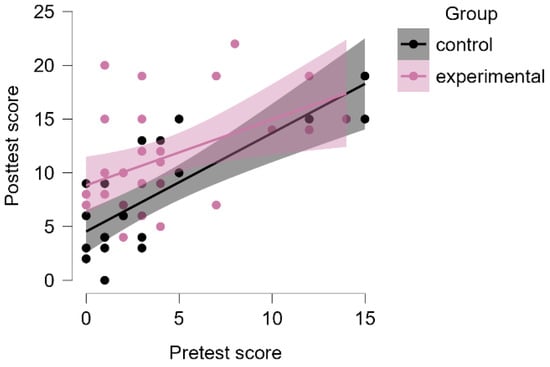
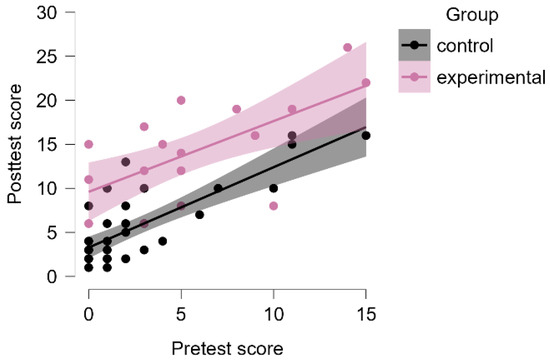
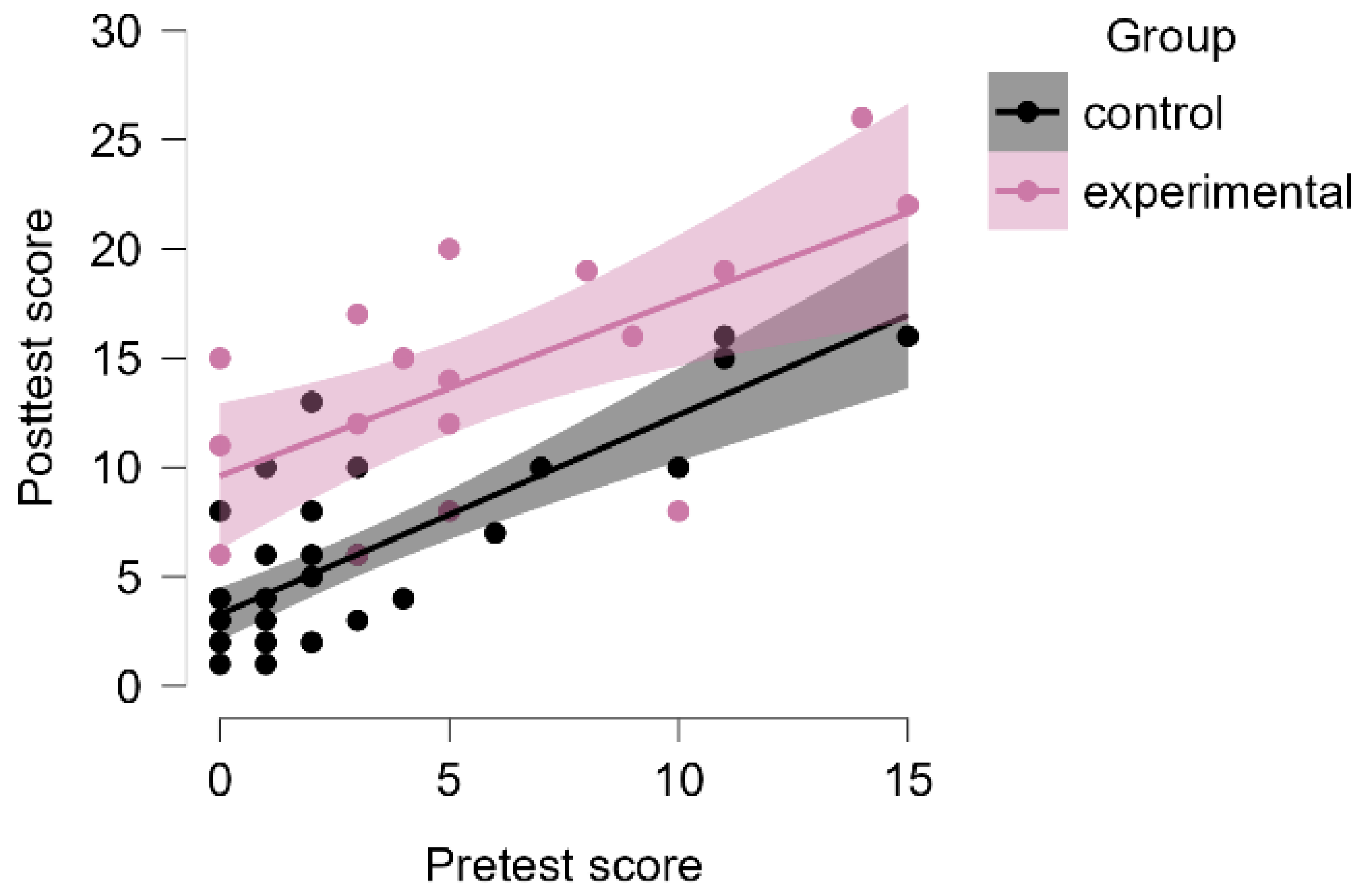
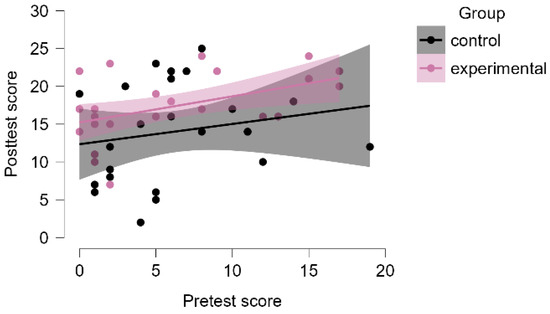
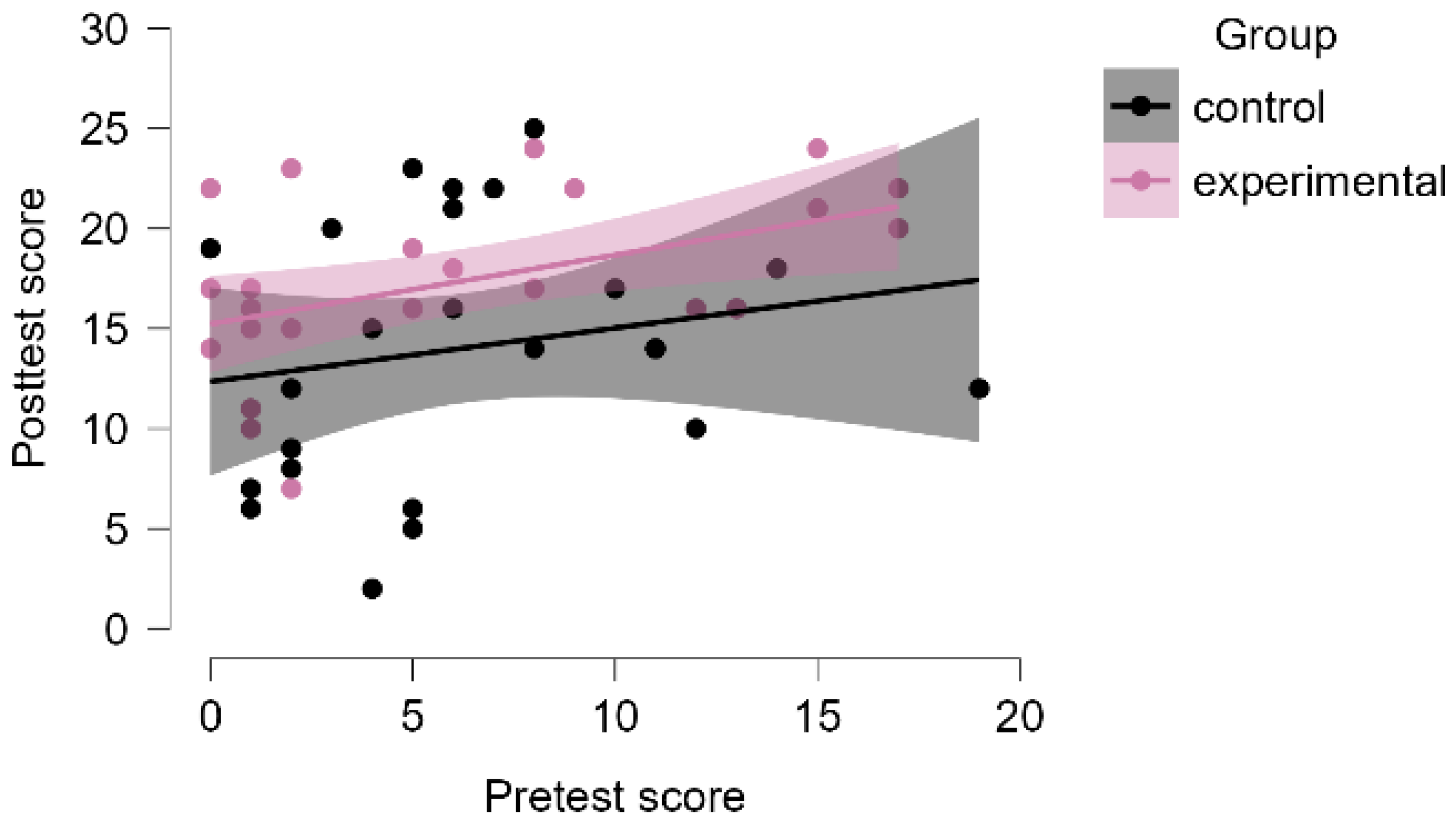
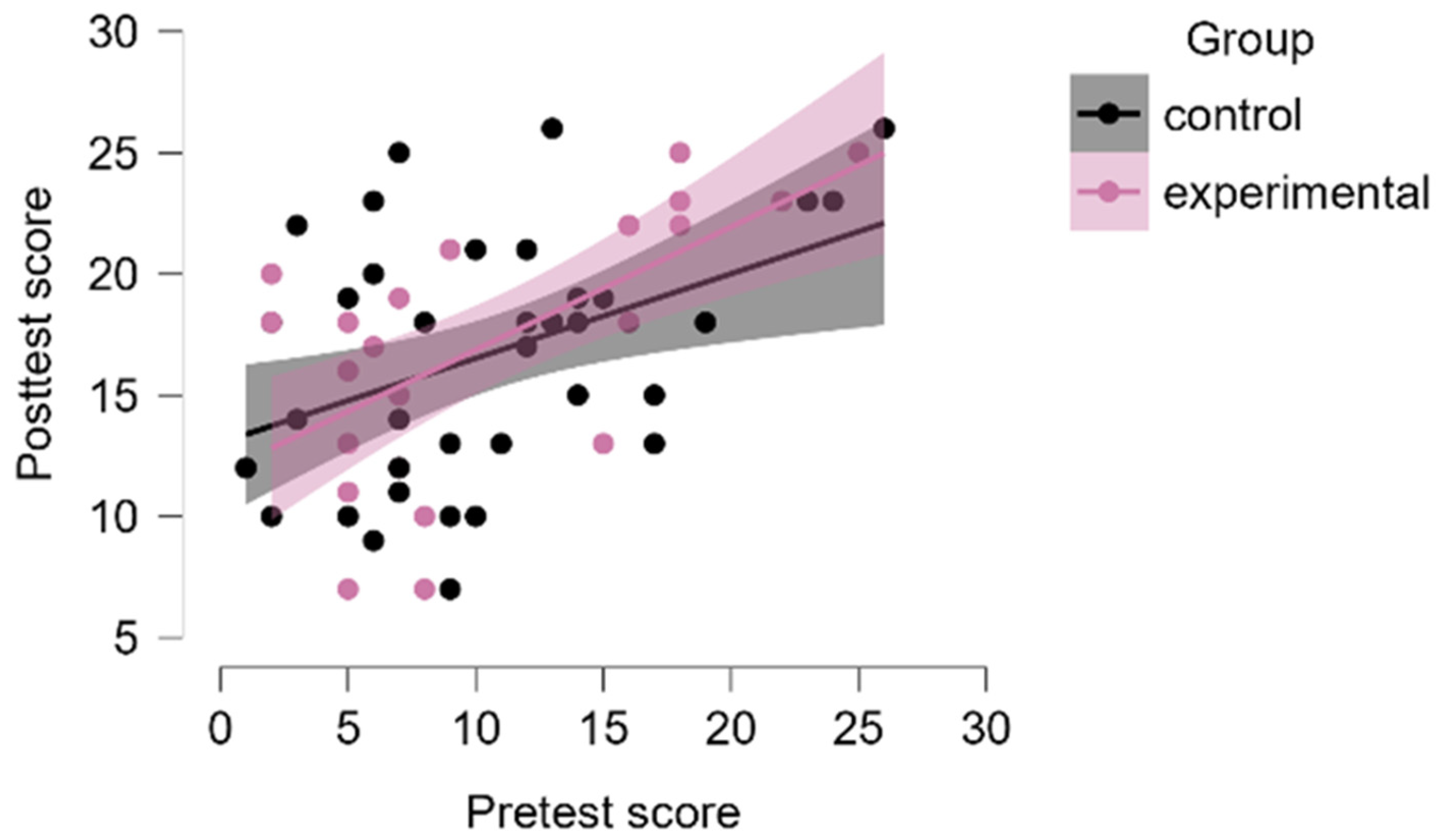
The posttest results of the 7th-grade students, broken down by group and gender, are presented in Table 8. The results are also shown in Figure 3 and Figure 4.
Table 8.
The posttest results of the 7th-grade students divided by group (exp./control) and gender (boy/girl).
Figure 3.
Pretest–posttest relationship with 95% confidence intervals for 7th-grade girls.
Figure 4.
Pretest–posttest relationship with 95% confidence intervals for 7th-grade boys.
According to the ANCOVA results, the main effect of group membership was significant in favor of the experimental group (F(1,96) = 33.730, p < 0.001, = 0.260), whereas the main effect of gender alone was not significant (F(1,96) = 0.018, p = 0.895). However, the group × gender interaction effect is statistically significant at a 6.4% significance level (F(1,96) = 3.513, p = 0.064, = 0.035), suggesting that the group effect might operate differently across genders, which warrants further investigation. The covariate representing pretest results showed a strong effect ( = 0.451) with a high significance (F(1,96) = 79.011, p < 0.001), confirming the necessity of controlling for it in the analysis.
When analyzing the girls’ results using ANCOVA, with pretest results controlled as a covariate, a significant difference was found between the experimental and control groups in posttest performance (F(1,46) = 6.734, p = 0.013, = 0.128) in favor of the experimental group, indicating a medium-to-large effect. This suggests that group membership had a measurable influence on the girls’ posttest outcomes.
For the boys, the same analysis revealed a highly significant effect in favor of the experimental group (F(1,49) = 32.83, p < 0.001), indicating a very large effect size ( = 0.401).
In the next phase of the analysis, we examined students’ performance on posttest items and development since the pretest across different levels of task difficulty (Table 9). The boys in the experimental group not only achieved the highest average results at all levels but also showed the greatest development.
Table 9.
Seventh-grade students’ posttest results and development for the different task types (disaggregated by gender and group).
To assess the effects of the intervention, we conducted an analysis of covariance (ANCOVA), controlling for gender and group membership (experimental vs. control) as fixed factors and pretest results as a covariate. Table 10 presents the ANCOVA results by gender for tasks of varying difficulty levels, followed by a brief interpretation.
Table 10.
ANCOVA test results by gender in 7th grade. The effect of group (applied method) on students’ performance of different level task types in the posttest and in development.
For the girls, beside the significant positive medium effect of being in the experimental group, we only found a positive significant medium effect at Level II. ANCOVA results for the Level I tasks show that the group membership had a medium effect (), although the p-value did not reach the conventional statistical significance (. The practice of keeping a learning journal, that is, the mandatory reflective review of the lesson content, effectively supported the acquisition of primarily factual (lexical) knowledge.
For boys, group membership had a significant effect at all difficulty levels. In all cases, the effect favored the experimental group. These findings align with previous literature, indicating that although homework completion is generally more common among girls, its developmental impact tends to be stronger for boys (Kalenkoski & Pabilonia, 2017).
4.3. Results of Ninth-Grade Students
The selectivity of Hungarian grammar schools is reflected in the distribution of grades in mathematics and physics at the end of the previous year in our sample. More than 74% of the participating students received the highest possible grade (5 or 5+) at the end of the previous year in physics, and the same proportion can be said for mathematics. About 21% of the students received a grade of 5+ (praise, excellent performance), while the proportion in mathematics was about 26%. The high previous year’s grades among our 9th-grade students are not surprising, due to our secondary grammar schools being selective.
The summary of the previous year’s final grades in mathematics and physics is presented in Table 11.
Table 11.
Distribution of ninth-graders’ mathematics and physics grades at the end of the previous year. Notes: *: insufficient, cannot proceed to the next grade; **: 5+: praise, only for excellent performance.
The ninth-grade experimental and control group results were compared using the Mann–Whitney test.
Based on the pretest data, there was no significant difference between the experimental and control groups (p = 0.775, Mann–Whitney test U = 1567.5, Shapiro–Wilk W = 0.942, p < 0.001). The average score of the experimental group was 8.959 (SD = 7.009), and the mean score for the control group was 8.968 (SD = 5.898).
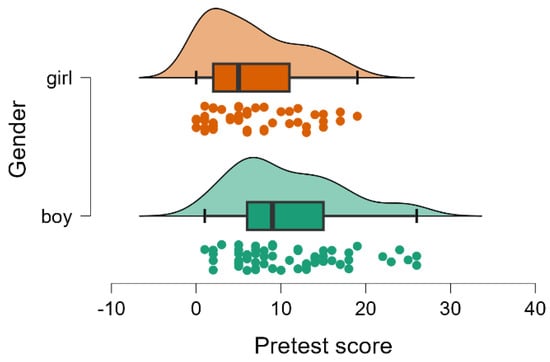
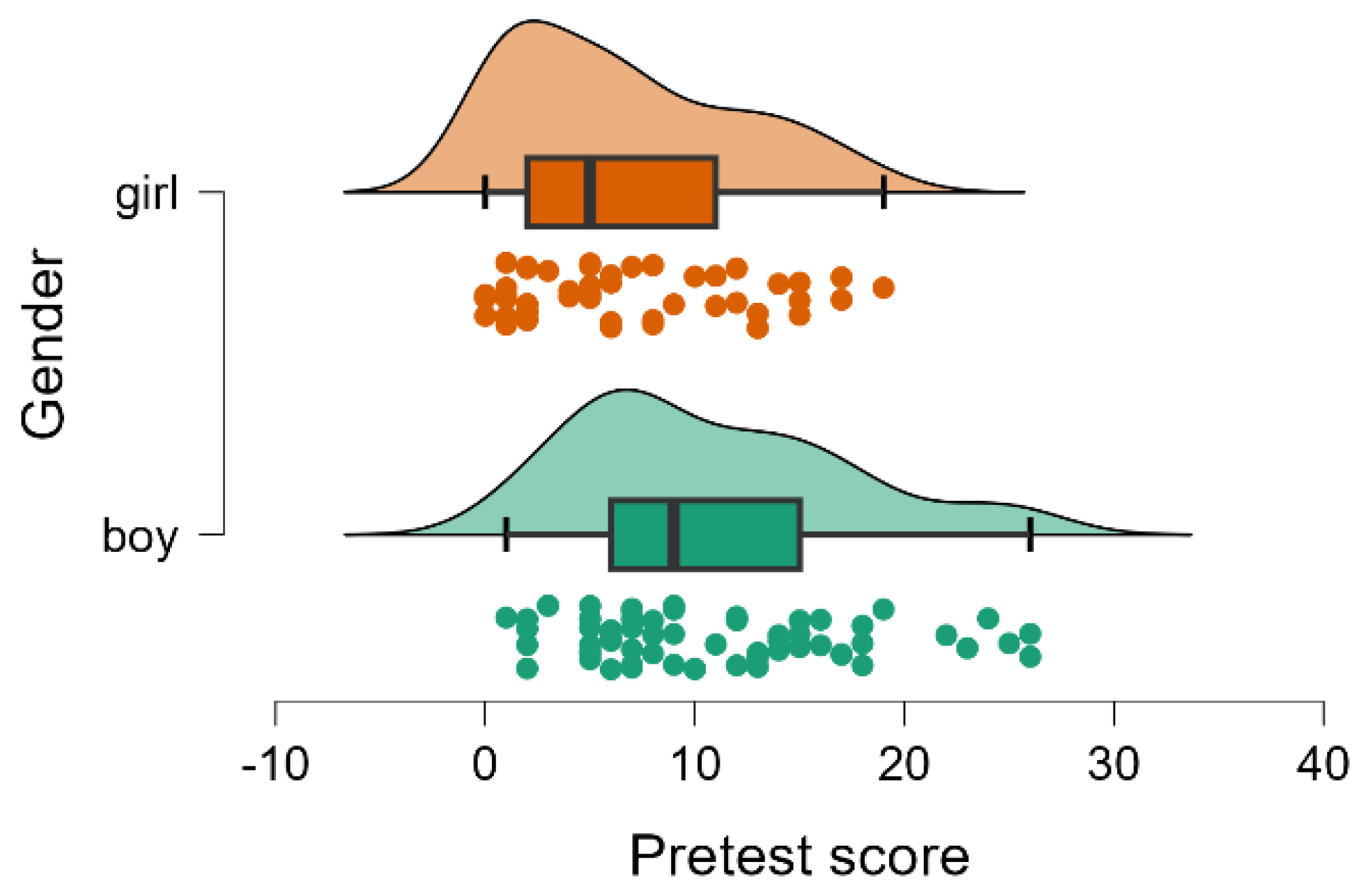
However, a significant difference was observed between boys and girls on the pretest assessing prior knowledge, favoring the boys (p < 0.001, Mann–Whitney U = 2127; Shapiro–Wilk W = 0.946, p < 0.001). The mean score for boys was 10.871 (SD = 6.48), while for girls it was only 6.551 (SD = 5.405). The results are shown as a raincloud plot in Figure 5.
Figure 5.
The distribution of pretest scores for 9th-grade students, separated by gender.
As presented in the analysis of the seventh-graders’ performance, we investigated whether pretest performance was associated with aspects of students’ sociological background. The results of the correlation analysis are shown in Table 12.
Table 12.
Pearson’s correlations of the sociological background and the pretest results (in 9th grade). ** p < 0.01, *** p < 0.001.
The correlation analysis clearly shows that the pretest scores were primarily associated with the students’ previous year’s grades in physics (r = 0.378, p < 0.001) and mathematics (r = 0.574, p < 0.001), despite the fact that these six-point scales (1–5 and 5+) effectively contained only three grades (4, 5, and 5+). In addition, significant correlations were also observed for the type of settlement and the number of books available at home. In our case, the number of books available at home—reflecting the family’s orientation towards culture and science, as well as the values transmitted from home—was closely associated with preliminary knowledge. In contrast to our 7th-grade results, the 9th-grade results are in accordance with results of different previous studies about socioeconomic background—especially number of books and academic achievement (Heppt et al., 2022).
The reliability analysis of the posttests administered to the 9th-grade students showed a lower but acceptable reliability (ω = 0.709, α = 0.697) compared to the 7th-grade students and to the pretest results.
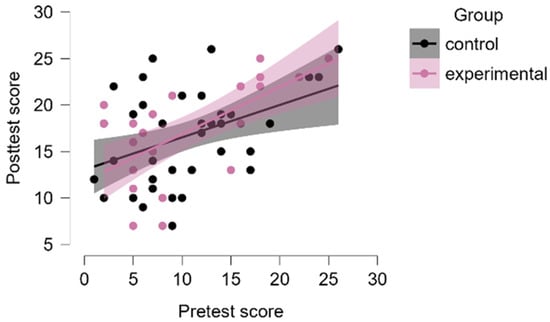
The posttest results of the 9th-grade students, broken down by group and gender, are presented in Table 13. The results are also shown in Figure 6 and Figure 7.
Table 13.
The posttest results of the 9th-grade students divided by group (experimental/control) and gender (boy/girl).
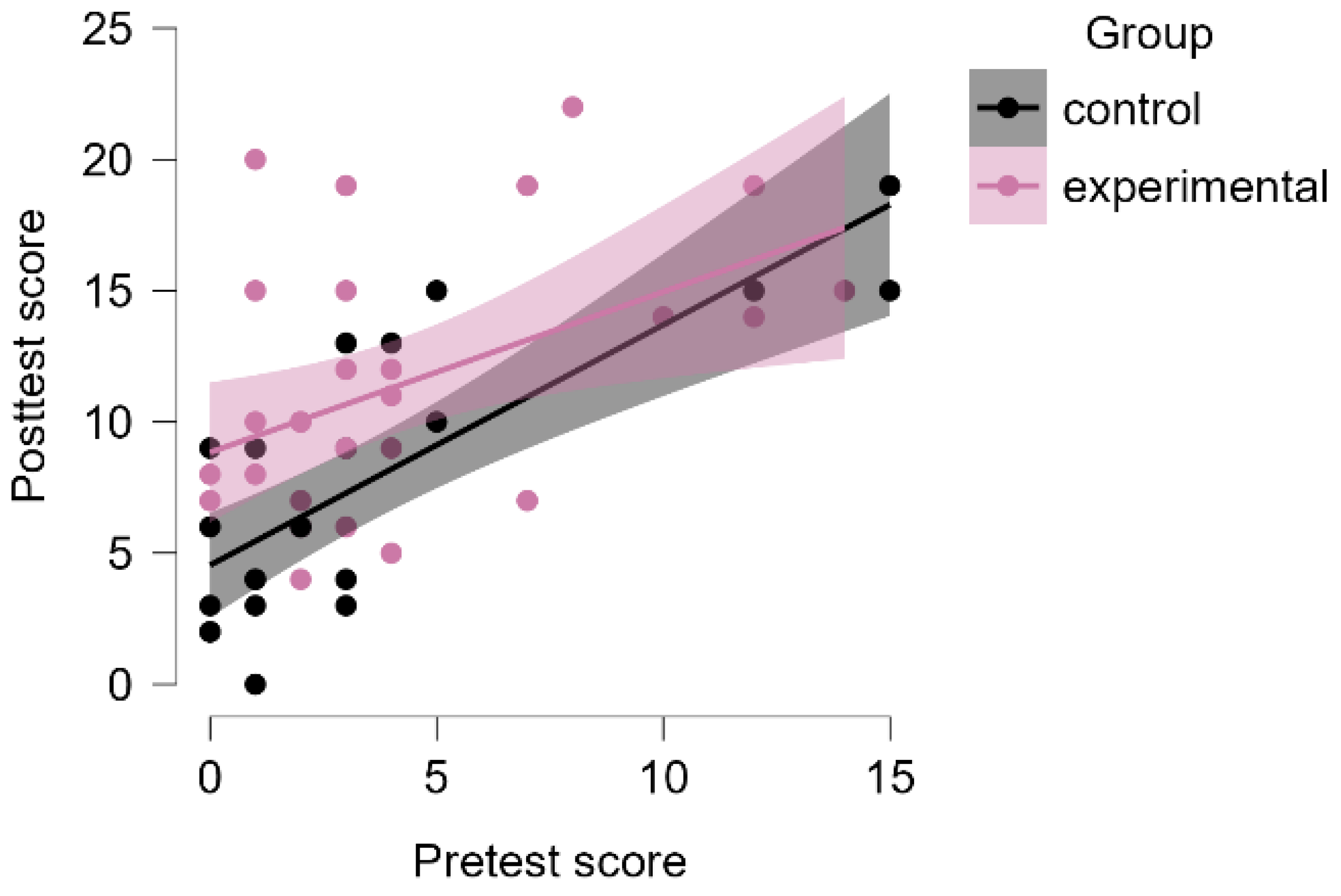
Figure 6.
Pretest–posttest relationship with 95% confidence intervals for 9th-grade girls.
Figure 7.
Pretest–posttest relationship with 95% confidence intervals for 9th-grade boys.
To interpret the posttest results, we conducted an ANCOVA test to examine differences between the experimental and the control group, controlling for prior knowledge (pretest results) and including gender as a fixed factor. The analysis revealed a significant effect of group membership in favor of the experimental group (F(1,106) = 4.312, p = 0.04, = 0.039), corresponding to a small-to-medium effect size. This indicates that participation in the experimental group moderately influenced posttest performance when the pretest result was accounted for. The main effect of gender was not significant (F(1,106) = 0.146, p = 0.703, = 0.001), and the group × gender interaction was also non-significant (F(1,106) = 2.299, p = 0.132, = 0.021). In contrast, the pretest result had a large and significant effect on posttest performance (F(1,106) = 25.380, p < 0.001, = 0.193).
Overall, these results suggest that unlike in the case of 7th-grade students, the impact of group membership—that is the effect of the applied method—was only moderate for ninth-graders, while the pretest score proved to be a decisive factor. The results suggest that the method was primarily beneficial for students who were already more hard-working. These students were presumably more motivated, as evidenced by their voluntary completion of the learning journal process despite the additional preparation required outside of class. Students who are already higher achievers often demonstrate greater responsibility, which in turn makes them more organized in managing their home study and homework tasks (Regueiro et al., 2025).
The relatively small effect of group membership—that is, the impact of the method—compared to the findings for seventh-grade students may be attributed to age-related characteristics of ninth-graders. At this stage, students tend to spend less time on homework (Regueiro et al., 2025), selectively prioritize subjects, and focus more on those that are relevant to their future educational goals. They no longer study for their teacher or their parents as younger students (Gillet et al., 2011). Consequently, students who are already higher-performing and more interested are more likely to become future graduates, placing greater emphasis on studying physics due to their aspirations for further education.
The data in Table 13 suggest that further analysis focusing on girls may be warranted. Conducting an ANCOVA for girls only, with pretest result included as a covariate, revealed a significant difference between the experimental and control groups in favor of the experimental group (F(1,46) = 5.068, p = 0.029, = 0.099). This corresponds to a medium-to-large effect size, indicating that group membership had a measurable impact on posttest performance for girls. In contrast, the same analysis for boys did not reveal a significant effect (F(1,59) = 0.183, p = 0.67, = 0.003).
In the next phase of the analysis, we examined how ninth-grade students performed on posttest tasks of varying difficulty levels (Level I, II, and III). Results are shown in Table 14. ANCOVAs were conducted to assess the effects of group membership and gender.
Table 14.
Ninth-grade students’ posttest results and development on the different task types (disaggregated by gender and group).
To assess the effects of the intervention, we conducted an analysis of covariance (ANCOVA), controlling for gender and group membership (experimental vs. control) as fixed factors and pretest results as a covariate. Table 15 presents the ANCOVA results by gender for tasks of varying difficulty levels, followed by a brief interpretation.
Table 15.
ANCOVA test result by gender in 9th grade. The effect of group (applied method) on students’ performance of different level task types.
For boys, ANCOVA revealed no significant effect of group membership at any difficulty level. Pretest scores, however, showed strong significant effects for Level I (F(1,59) = 35.207, p < 0.001, = 0.374) and Level III (F(1,59) = 20.179, p < 0.001, = 0.255).
For girls, the effect of group membership at Level I was not significant, alongside a strong effect of pretest scores (F(1,46) = 13.155, p < 0.001, = 0.222). At Level II, group membership did not reach conventional statistical significance (F(1,46) = 3.825, p = 0.057, = 0.077). Although the p-value (0.057) is slightly above the typical 0.05 threshold, the effect size ( = 0.077) suggests a moderate practical effect favoring the experimental group. Pretest scores had no significant impact (F(1,46) = 0.860, p = 0.359, = 0.018). At Level III, pretest scores showed a significant medium effect (F(1,46) = 4.392, p = 0.042, = 0.087).
The girls in the experimental group tended to show noticeable improvement across all levels, achieving relatively high average scores in Level I and II. While some previous studies have suggested that homework may benefit boys more (Kalenkoski & Pabilonia, 2017), our results are consistent with literature indicating that girls often demonstrate a greater willingness to engage with homework (Wagner et al., 2008). This approach could contribute to making physics more engaging for girls and supporting their participation in physics-related fields where they are traditionally underrepresented (Chan et al., 2024).
5. Limitations
As a limitation, it should first be mentioned that although our questionnaire—designed to work in both 7th and 9th grades—shows reliability values of around 0.8 or well above that in both the pretest for both classes and in the 7th-grade posttest, the value of only around 0.7 in the posttest for the 9th grade indicates that a test compiled slightly differently for the 9th grade may give more accurate results.
Another limitation is that both groups attended the same physics lessons. The division between the groups was clear as the control group rarely used learning journals. However, when experimental students shared reflective thoughts and clarifying questions, the whole class benefited from the elaborations and explanations. As the study focused on the impact of learning journals rather than teaching methods, the group selection remains justified. Since our study is quasi-experimental, it is possible that the students in the experimental group were those who were already more motivated, and that is why they spent more time engaging with physics in their free time. Using an engagement/motivation scale would provide an even more accurate picture of students’ motivational levels. In the present study, conclusions regarding the effects of the method are drawn based on the results of the ANCOVA factor analysis.
Another limitation of the learning journal method is that questions 3 and 4 of the journal template are not relevant for students who understood the material well during the lesson. This means that the method is more useful for students who have questions based on the lesson. In 7th grade, this observation is supported by the results shown in Figure 3 and Figure 4.
In most cases, the possibility of developing Level III cognitive skills is very limited in such a short experiment; developmental effects can only be achieved at a slower pace and over a longer period of time (Csapó, 2002).
A further limitation is that our 9th-grade sample was highly selective, consisting mostly of students from academically strong grammar schools, which may explain the weaker effects compared to 7th grade. A more heterogeneous sample with varied prior knowledge and school types might produce different results.
6. Conclusions
Our study focused on the effectiveness of learning journal-supported home preparation for physics lessons and the use of structured different-level homework tasks.
Our findings for RQ1 revealed significant differences in knowledge acquisition between the groups in favor of the experimental group at both grade levels. This may be partly attributed to the reflective use of learning journals and the continuous, cognitively engaging nature of the homework assignments. Additionally, factors such as the students’ motivation in the experimental group and the extra time and effort invested in learning may have contributed to the observed outcomes.
RQ2 examined the method’s effect across grade levels. Significant prior knowledge differences justified separate analyses. In 7th grade, the learning journal with homework had a stronger positive impact than in 9th grade. The 7th-grade sample was broad, while the 9th-grade sample came only from grammar schools, where the method proved less effective. Including more diverse school types might yield results closer to those in 7th grade. Further research is needed to determine whether differences between 7th- and 9th-graders stem from age or the selective 9th-grade sample. In addition, the difference in performance between the two grade levels may be explained by age-related characteristics and the resulting differences in motivation. Older students tend to focus more on their plans for further education and therefore spend less time preparing at home for subjects that are not part of their final examinations. Younger students, by contrast, are often motivated less by intrinsic goals and more by a desire to meet the expectations of their teachers and parents. Accordingly, motivation differs between the two age groups.
The third research question (RQ3) aimed to examine the effectiveness of the method with respect to gender differences. The learning journal was more popular among girls, suggesting potential for supporting their engagement in physics and STEM. Because the two grades differed, gender effects were analyzed separately. In 7th grade, boys showed a stronger overall benefit with no initial differences. In 9th grade, boys outperformed girls on the pretest, but this gap disappeared in the experimental group, where girls improved significantly. In the 9th grade, the experimental group membership had a positive medium effect for girls, but none for boys.
The fourth research question (RQ4) was also examined with respect to both grade level and gender. In 7th grade, the experimental group showed strong effects for boys across all knowledge levels, while for girls, only Level II was significantly impacted. In 9th grade, the method had no significant effect on boys but moderately improved girls’ performance in Level II tasks. Based on these findings, it can generally be concluded that the method proved beneficial for both genders. Overall, we see that the learning journal is more useful in the development of Level I and II, with the least effect seen in Level III.
While learning journals show overall positive effects, their impact in secondary school physics is not universally generalizable. Effectiveness depends on factors such as age, gender, prior knowledge, targeted content, and task difficulty. They proved especially beneficial for younger students (e.g., 7th-grade boys), but positive—though not always statistically significant—effects were observed across all groups, and it is important not to forget that learning journals may also support the development of metacognitive skills.
Author Contributions
Conceptualization, M.H. and D.S.; methodology, M.H. and D.S.; data curation, M.H.; formal analysis, M.H.; investigation, D.S. and M.H.; project administration, M.H.; writing—original draft preparation, M.H., D.S. and R.A.B.; writing—review and editing, M.H. and D.S.; visualization, R.A.B. and M.H.; and supervision, M.H. and D.S. All authors have read and agreed to the published version of the manuscript.
Funding
This work is supported by the Research Program for Public Education Development of the Hungarian Academy of Sciences (Project Number: SZKF-7/2022).
Institutional Review Board Statement
The authors state that the research was conducted in accordance with the principles embodied in the Declaration of Helsinki and in accordance with the requirements of Eötvös Loránd University Faculty of Social Sciences Research Integrity, Research Ethics and Data Management Policy (§5.1). All participants in the exchange and related research were volunteers and they were fully informed that anonymity is assured. No personal data were collected and processed during the research, and the identification of individuals is excluded. The study involved the secondary analysis of anonymized data.
Informed Consent Statement
Informed consent was obtained from all subjects involved in the study.
Data Availability Statement
Data are unavailable due to privacy.
Acknowledgments
We would like to express our gratitude to Ákos Szeidemann and Kristóf Tóth for their valuable insights that contributed to the development of the pretest used in this study. We also thank our colleagues who conducted the investigation with their students.
Conflicts of Interest
The authors declare no conflicts of interest.
Appendix A
Appendix A.1. Pre- and Posttest Used in Grade 7 and 9
| School: | My code: | ||
| The survey is anonymous. Please create your own identification code as follows: The first two letters of your first name, the number of your month of birth, the second and third letters of your place of birth, the last digit of your birthday. Example: János Minta, born in Budapest, 14 April 2003. Code: já04ud4 | |||
| Class | Your physics teacher’s code + serial number: | ||
- 1.
- About forces in general
- 1.1
- Name the possible effects of the forces. (3P, Level I)
- 1.2
- Describe what can happen when the forces acting on a body cancel each other out. (3P, Level I)
- 1.3
- Describe a phenomenon that can be achieved with a force of 1 N (newton). (3P, Level I)
- 1.4
- In most countries, seat belts are mandatory in cars. Explain why you think this is the case. (2P, Level II)
- 1.5
- David is standing ten steps away from Goliath when he begins to swing his sling. At which point should he release the sling’s cord so that the stone will hit Goliath? (The sling is being rotated in the direction indicated by the arrow.) Justify your answer. (2P, Level III)
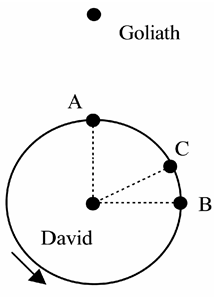
Source of the task: intermediate-level physics final exam, May 2009, Hungary. https://www.oktatas.hu/pub_bin/dload/kozoktatas/erettsegi/feladatok2009tavasz/k_fizmagyar_09maj_fl.pdf (1st part, task 11.accesed on 20 February 2026). The original image is modified with the use of ChatGPT 5.1 (OpenAI).
- 1.6
- Suppose that a body accelerates under the influence of a single force, which can be expressed by the following equation: i.e., force = mass acceleration . What can we say about the accelerating effect of this force if we triple the mass of the body? Justify your answer. (2P, Level II)
- 1.7
- A body weighing 5 kg will be transported to the International Space Station. How do you think the mass of the body and the weight of the body change compared to the state on Earth? Explain your answer. (3P, Level III)
- 1.8
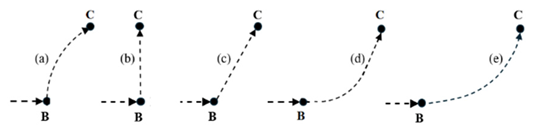
- The figure shows a rocket drifting in space from point “A” to point “B”. No external force is acting on the rocket. At point “B”, the rocket’s engines are ignited, producing a constant thrust perpendicular to the previous trajectory, until the rocket reaches point “C”. At this point, the engines are switched off.

- Which of the orbits shown in the figure best corresponds to the orbit of the rocket between “B” and “C”? Justify your answer. (3P, Level III)
- 2.
- The force of a spring
- 2.1
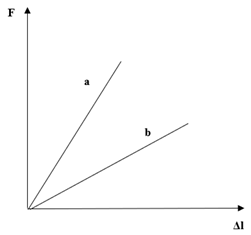
- When a spring is stretched, a force (the so-called spring force) arises in the spring. The graph shows the relationship between the spring force (F) and the extension (Δl) for two springs. Which line corresponds to the stiffer spring? Justify your answer. (3P, Level II)
- 2.2
- A spring is labeled as 12 N/cm.
- (a)
- Explain what this label means. (2P, Level II)
- (b)
- What force is required to produce an extension of 3.5 cm? (3P, Level II)
References
- Bazir, A. H. (2016). The role of writing diary in a classroom. International Journal of Research in Linguistics, Language Teaching and Testing, 1(1), 82–88. [Google Scholar]
- Bjork, R. A., Dunlosky, J., & Kornell, N. (2013). Self-regulated learning: Beliefs, techniques, and illusions. Annual Review of Psychology, 64, 417–444. [Google Scholar] [CrossRef] [Scilit]
- Bloom, B. S. (1956). Taxonomy of educational objectives: The classification of educational goals. Handbook I: Cognitive domain. Longmans. [Google Scholar]
- Boekaerts, M., & Niemivirta, M. (2000). Self-regulated learning: Finding a balance between learning goals and ego-protective goals. In M. Boekaerts, P. R. Pintrich, & M. Zeidner (Eds.), Handbook of self-regulation (pp. 417–450). Academic Press. [Google Scholar] [CrossRef] [Scilit]
- Chan, E., Di, D., & Ecklund, E. H. (2024). Scientists explain the underrepresentation of women in physics compared to biology in four national contexts. Gender, Work & Organization, 31(2), 399–418. [Google Scholar] [CrossRef] [Scilit]
- Clipa, O., Ignat, A. A., & Stanciu, M. (2012). Learning diary as a tool for metacognitive strategies development. Procedia—Social and Behavioral Sciences, 33, 905–909. [Google Scholar] [CrossRef] [Scilit]
- Craig, B. A. (n.d.). Analysis of covariance (ANCOVA). Department of statistics, Purdue university. Available online: https://www.stat.purdue.edu/~bacraig/notes514/topic10a.pdf (accessed on 20 February 2026).
- Cronbach, L. J. (1951). Coefficient alpha and the internal structure of tests. Psychometrika, 16(3), 297–334. [Google Scholar] [CrossRef] [Scilit]
- Csapó, B. (2002). A képességek fejlődési ütemének egységes kifejezése: A gamma koefficiens. Magyar Pedagógia, 102(3), 391–410. [Google Scholar]
- Csapó, B. (2004). Knowledge and competencies. In J. Letschert (Ed.), The integrated person: How curriculum development relates to new competencies (pp. 35–49). CIDREE. [Google Scholar]
- Csapó, B. (2010). Goals of learning and the organization of knowledge. Zeitschrift für Pädagogik, 56, 12–27. [Google Scholar]
- Diamond, A. (2000). Close interrelation of motor development and cognitive development and of the cerebellum and prefrontal cortex. Child Development, 71(1), 44–56. [Google Scholar] [CrossRef] [Scilit] [PubMed]
- Dounas-Frazer, D. R., & Reinholz, D. L. (2015). Attending to lifelong learning skills through guided reflection in a physics class. American Journal of Physics, 83, 881–891. [Google Scholar] [CrossRef] [Scilit]
- Gillet, N., Vallerand, R. J., & Lafrenière, M.-A. K. (2011). Intrinsic and extrinsic school motivation as a function of age: The mediating role of autonomy support. Social Psychology of Education, 15(1), 77–95. [Google Scholar] [CrossRef] [Scilit]
- Griston, M., & Wilcox, B. R. (2025). Motivating reflection in problem solving: Homework corrections in upper-division physics courses. Physical Review Physics Education Research, 21, 020113. [Google Scholar] [CrossRef] [Scilit]
- Guven, U. (2019). The effect of socioeconomic status on student achievement: A TIMSS study. In Contemporary approaches in education and social science. Old Publishing. [Google Scholar]
- Heppt, B., Olczyk, M., & Volodina, A. (2022). Number of books at home as an indicator of socioeconomic status: Examining its extensions and their incremental validity for academic achievement. Social Psychology of Education, 25, 903–928. [Google Scholar] [CrossRef] [Scilit]
- Hoffman, K., Williams, T. H., & Kephart, K. (2024). The use of guided reflections in learning proof writing. Education Sciences, 14(10), 1084. [Google Scholar] [CrossRef] [Scilit]
- Hyttinen, M., & Suhonen, J. (2022). Using the flipped classroom and learning diary to enhance learning in higher education: Students’ experiences of flipping the basics of law course. International Journal of Teaching and Learning in Higher Education, 33(3), 446–464. [Google Scholar]
- JASP Team. (2025). JASP Version 0.95.4 [Computer software]. Available online: https://jasp-stats.org/ (accessed on 20 February 2026).
- Kalenkoski, C. M., & Pabilonia, S. W. (2017). Does high school homework increase academic achievement? Education Economics, 25(1), 45–59. [Google Scholar] [CrossRef] [Scilit]
- Kennedy, J. V., & Arendale, D. R. (2023). Investigating metacognitive strategies and exam performance: A cross-sectional survey research study. Education Sciences, 13(11), 1132. [Google Scholar] [CrossRef] [Scilit]
- Kesuma, A. T., Harun, Zamroni, Putranta, H., & Kistoro, H. C. A. (2020). Evaluation of the self-regulated learning model in high schools: A systematic literature review. Universal Journal of Educational Research, 8(10), 4792–4806. [Google Scholar] [CrossRef] [Scilit]
- Kocovski, N. L., & Endler, N. S. (2000). Social anxiety, self-regulation, and fear of negative evaluation. European Journal of Personality, 14(4), 347–358. [Google Scholar] [CrossRef] [Scilit]
- Kolb, D. A. (1984). Experiential learning: Experience as the source of learning and development. Prentice Hall. [Google Scholar]
- Kosmyna, N., Hauptmann, E., Yuan, Y. T., Situ, J., Liao, X.-H., Beresnitzky, A. V., Braunstein, I., & Maes, P. (2025). Your brain on ChatGPT: Accumulation of cognitive debt when using an AI assistant for essay writing task. arXiv, arXiv:2506.08872. [Google Scholar] [CrossRef] [Scilit]
- Kultusministerkonferenz. (2004). Einheitliche prüfungsanforderungen in der abiturprüfung—Physik. KMK. [Google Scholar]
- Kultusministerkonferenz. (2013). Operatoren für die naturwissenschaftlichen fächer (physik, biologie, chemie). KMK. [Google Scholar]
- Levin, I., Semenov, A. L., & Gorsky, M. (2025). Smart learning in the 21st century: Advancing constructionism across three digital epochs. Education Sciences, 15(1), 45. [Google Scholar] [CrossRef] [Scilit]
- López Carrillo, M. D., Calonge García, A., & Lebrón Moreno, J. A. (2024). Self-regulation of student learning in a STEAM project. Education Sciences, 14(6), 579. [Google Scholar] [CrossRef] [Scilit]
- Mann, H. B., & Whitney, D. R. (1947). On a test of whether one of two random variables is stochastically larger than the other. Annals of Mathematical Statistics, 18, 50–60. [Google Scholar] [CrossRef] [Scilit]
- Marsh, G., & Iran-Nejad, A. (2013). Intelligence: Beyond a monolithic concept. Bulletin of the Psychonomic Society, 30(4), 329–332. [Google Scholar]
- McDonald, R. P. (1999). Test theory: A unified treatment. Psychology Press. [Google Scholar]
- McLeod, S. (2025). Kolb’s learning styles and experiential learning cycle. Simply Psychology. [Google Scholar]
- Mejía-Manzano, L. A., Sirkis, G., Rojas, J.-C., Gallardo, K., Vázquez-Villegas, P., Camacho-Zuñiga, C., Membrillo-Hernández, J., & Caratozzolo, P. (2022). Embracing thinking diversity in higher education to achieve a lifelong learning culture. Education Sciences, 12(12), 913. [Google Scholar] [CrossRef] [Scilit]
- Mota, A. R., Körhasan, N. D., Miller, K., & Mazur, E. (2019). Homework as a metacognitive tool in an undergraduate physics course. Physical Review Physics Education Research, 15, 010136. [Google Scholar] [CrossRef] [Scilit]
- Mueller, P. A., & Oppenheimer, D. M. (2014). The pen is mightier than the keyboard: Advantages of longhand over laptop note taking. Psychological Science, 25, 1159–1168. [Google Scholar] [CrossRef] [Scilit]
- OECD. (2025). OECD skills outlook 2025: Building the skills of the 21st century for all. OECD Publishing. [Google Scholar] [CrossRef] [Scilit]
- Pearson, K. (1895). Note on regression and inheritance in the case of two parents. Proceedings of the Royal Society of London, 58, 240–242. [Google Scholar] [CrossRef] [Scilit]
- Regueiro, B., Suárez, N., Valle, A., Nunez, J. C., & Rosário, P. (2025). Homework motivation and engagement throughout compulsory education. Revista de Psicodidáctica, 20(1), 47–63. [Google Scholar]
- Reinhard, A., Felleson, A., Turner, P. C., & Green, M. (2022). Assessing the impact of metacognitive postreflection exercises on problem-solving skillfulness. Physical Review Physics Education Research, 18, 010109. [Google Scholar] [CrossRef] [Scilit]
- Saks, K., & Leijen, Ä. (2019, July 15–18). Digital learning diary as a tool for enhancing EFL learners’ metacognitive reflection. 2019 IEEE 19th International Conference on Advanced Learning Technologies (ICALT), Maceio, Brazil. [Google Scholar]
- Sanakuiev, M. (2022). The value of knowledge in the age of globalization challenges: Philosophical and intellectual context. Futurity Philosophy, 1(2), 42–55. [Google Scholar] [CrossRef] [Scilit]
- Schola Europaea. (2018). Key competences for lifelong learning in the european schools (approved by the joint teaching committee by written procedure 2018/47). Schola Europaea. [Google Scholar]
- Turan, Z., Kucuk, S., & Karabey, S. C. (2022). The university students’ self-regulated effort, flexibility and satisfaction in distance education. International Journal of Educational Technology in Higher Education, 19, 35. [Google Scholar] [CrossRef] [Scilit] [PubMed]
- Vecera, S. P., & Levtov, A. H. (2025). Learning as a skill to be learned: A campus-wide framework to support student learning and success. Education Sciences, 15(7), 931. [Google Scholar] [CrossRef] [Scilit]
- Wagner, P., Schober, B., & Spiel, C. (2008). Time students spend working at home for school. Learning and Instruction, 18(4), 309–320. [Google Scholar] [CrossRef] [Scilit]
- Watson, M. K., Pelkey, J., Noyes, C., & Rodgers, M. O. (2019). Using Kolb’s learning cycle to improve student sustainability knowledge. Sustainability, 11(17), 4602. [Google Scholar] [CrossRef] [Scilit]
- Zhai, C., Wibowo, S., & Li, L. D. (2024). The effects of over-reliance on AI dialogue systems on students’ cognitive abilities: A systematic review. Smart Learning Environments, 11, 28. [Google Scholar] [CrossRef] [Scilit]
- Zimmerman, B. J. (1995). Self-efficacy and educational development. In A. Bandura (Ed.), Self-efficacy in changing societies (pp. 202–231). Cambridge University Press. [Google Scholar]

Disclaimer/Publisher’s Note: The statements, opinions and data contained in all publications are solely those of the individual author(s) and contributor(s) and not of MDPI and/or the editor(s). MDPI and/or the editor(s) disclaim responsibility for any injury to people or property resulting from any ideas, methods, instructions or products referred to in the content. |
© 2026 by the authors. Licensee MDPI, Basel, Switzerland. This article is an open access article distributed under the terms and conditions of the Creative Commons Attribution (CC BY) license.