


Abstract
Swedish heritage language teachers have diverse educational backgrounds, and collaboration with mainstream and special needs teachers often fails. Consequently, many heritage language teachers must independently assess and support students with special educational needs. This study explores how their educational background shapes their reasoning about such needs in multilingual students. All heritage language teachers in one Swedish municipality completed a questionnaire analyzed through content analysis and from a communicative-relational perspective. Findings show that teachers with Swedish teaching degrees describe students’ needs in nuanced ways, using specialized language while considering individual as well as didactic factors. Those with non-didactic degrees more often generalize groups who need support and attribute their needs mainly to individual factors.
1. Introduction
When students experience academic difficulties, special educational support needs to be implemented. To ensure that such interventions are effective, they should be preceded by thorough assessments. However, identifying special educational needs (SEN) is a complex undertaking. Numerous factors interact when students’ language and cognitive development diverge from expected trajectories (see, e.g., Chan et al., 2023), and these factors multiply when students also are multilingual (see, e.g., Choo & Smith, 2020).
Today, Swedish compulsory schools are characterized by linguistic diversity; according to the Swedish National Agency for Education (Skolverket, 2025a), 27% of all students in Swedish compulsory schools have an international background.
Research consistently identifies structural shortcomings in how teachers are prepared to meet the needs of multilingual students with SEN. Rather than pointing merely to isolated gaps in teacher knowledge, studies by Wang and Woolf (2015) and Brown and Campbell Ault (2015) highlight a deeper systemic issue: mainstream teachers often struggle to distinguish between language developmental issues and cognitive or learning disabilities. This suggests that assessment practices may reproduce inequities for multilingual learners. Similar patterns emerge among SEN teachers. Shelton et al. (2025) report that SEN professionals also feel insufficiently equipped to support multilingual learners, indicating that the challenge extends beyond individual preparedness to a broader institutional lack of coherent training and support structures. In other words, the problem is not simply one of teacher readiness but of an educational system that does not adequately integrate linguistic and special educational expertise. Proposed solutions, such as increased paraprofessional collaboration or the employment of multilingual SEN teachers, can be seen as compensatory strategies responding to fragmented responsibilities across educational contexts (Brown & Campbell Ault, 2015). Hatheway et al. (2015) further suggest that dual-language programs may help bridge this fragmentation by creating settings in which bilingual teachers and SEN teachers can coordinate their expertise to better address the needs of multilingual students with SEN. However, they emphasize that such collaborative structures remain underdeveloped and insufficient to meet current demands. Taken together, the research indicates that the core issue is not merely inadequate teacher training but the absence of systematic support for sustained professional development and cross-disciplinary collaboration. The growing population of multilingual students requiring special support, therefore, underscores the need for comprehensive and integrated models of teacher education and school organization—rather than ad hoc solutions—to ensure equitable and appropriate instruction.
A recurring problem in the assessment of multilingual students with SEN is the systematic exclusion of heritage language teachers from the evaluation process. Rather than a mere oversight, this omission reflects deeper institutional assumptions about whose expertise is considered legitimate in identifying learning needs. Studies show that heritage language teachers possess critical linguistic and cultural knowledge that could challenge monolingual norms embedded in assessment practices (see, e.g., Clark, 2018). Their role as mediators between students’ home languages, school languages, and cultural contexts (Vuorenpää & Zetterholm, 2020) positions them as essential contributors when students’ language or cognitive development diverges from expectations (Sparreskog, 2025). When their expertise is not integrated into assessment procedures, schools risk interpreting linguistic differences as evidence of disability. Rodríguez (2015) demonstrates how the absence of multilingual-sensitive structures increases the likelihood of misdiagnosis, a pattern that also appears in the Swedish context (Roux Sparreskog, 2024). This suggests that the problem is not only one of inadequate collaboration but of assessment systems that are themselves insufficiently calibrated for multilingual populations.
The persistent marginalization of heritage language teachers further reinforces this structural imbalance. Research indicates that they often occupy peripheral positions within schools (Avery, 2015) and have limited opportunities for collaboration with SEN teachers or mainstream teachers (Roux Sparreskog, 2025). As a result, they are frequently left to identify potential SEN in multilingual students independently, despite substantial variation in their formal training (Sparreskog, 2025). The Swedish National Agency for Education (Skolverket, 2025b) reports that only 42% of the heritage language teachers hold a university degree in didactics, with even lower proportions—between 10% and 47%—in major heritage language subjects such as Arabic, Somali, and Persian.
Despite growing linguistic diversity in schools, research at the intersection of multilingualism and SEN remains strikingly underdeveloped. Kilinc and Borowski’s (2025, p. 387) characterization of this area as “the intersection of disability and bilingualism” highlights not only a conceptual gap but also an epistemological one: the field has yet to fully theorize how linguistic diversity complicates dominant assumptions about disability, assessment, and learning. The scarcity of research, therefore, signals a broader need to interrogate how educational systems conceptualize and respond to multilingualism within special education frameworks.
Against this background, the present study examines how heritage language teachers’ professional backgrounds shape their interpretations of multilingual students’ possible SEN. Focusing on heritage language teachers is significant, as these teachers operate at the margins of mainstream schooling while simultaneously holding knowledge about students’ linguistic repertoires. Their perspectives, therefore, offer a unique vantage point from which to understand how SEN is constructed, negotiated, and potentially misinterpreted in multilingual contexts.
For this study, multilingual students are defined according to the criteria for eligibility for heritage language instruction, in other words, students who use a language other than Swedish in their daily lives or who belong to a national minority (Language Act, 2009). While these classes are intended to support the development and maintenance of students’ first languages, participation rates reveal uneven access in practice (Skolverket, 2018). In the 2024/25 school year, 28.5% of compulsory school students were entitled to such instruction, but only 55% participated (Skolverket, 2025a). By situating heritage language teachers within this broader structural landscape, the study aims to contribute to a more nuanced understanding of how SEN are perceived in multilingual contexts and to highlight the implications of teachers’ professional trajectories for these interpretations.
Purpose and Research Questions
Definitions of who qualifies for special educational support are, according to Skrtic (1995), highly dependent on teachers’ professional backgrounds. Biesta et al. (2015) link, among other aspects, the bibliographical dimension and educational values to teachers’ professional discourse. Likewise, Horn and Kane (2019) refer to this as “professionalized discourse” (p. 5) and distinguish between “discourse of common sense” (p. 23), “everyday talk” (p. 2), and “specialized language” (p. 14) or “specific professional terminology” (p. 19). A discourse of common sense refers to a prevailing cultural and linguistic orientation in teaching in which assumptions, interpretations, and statements are treated as self-evident truths rather than as ideas that require reflection or justification. This discourse is rooted in the belief that teaching is a matter of obvious experience rather than professional reasoning. In Horn and Kane, everyday talk refers to the informal, non-technical language teachers use that overlaps with laypeople’s speech, carries intuitive but imprecise meanings, and is embedded in common-sense interpretations of teaching rather than in analytic or professional frameworks. By specialized language, technical terms, professional terminology, and professional language, Horn and Kane, on the other hand, refer to technical, profession-specific terminology and conceptual frameworks intended to describe, analyze, and improve teaching practice with precision and shared meaning. They argue, however, that teachers’ language tends to flow between everyday talk and specialized language, incorporating technical terms that are discipline-specific. The risks associated with teachers relying on everyday language rather than precise professional terminology should not be underestimated. Such linguistic practices, shaped by limited opportunities for deeper reflection, can reinforce stereotypical interpretations and thereby contribute to educational inequities. The belief that more specialized professional terminology will automatically deepen teachers’ understanding assumes that language itself can reshape the educational systems. That said, Biesta et al. (2015) suggest that teachers’ ways of expressing themselves, their discourse, serve as an indicator of their achievement of agency.
The purpose of this study is to gain an in-depth understanding of heritage language teachers’ reasoning regarding multilingual students’ SEN. More specifically, the study aims to examine whether heritage language teachers’ educational backgrounds influence their descriptions of SEN among multilingual students. This will be addressed through the following research questions:
How do heritage language teachers describe multilingual students’ SEN?
How do heritage language teachers describe the ways in which they identify multilingual students’ SEN?
How does heritage language teachers’ educational background influence their reasoning?
2. Materials and Methods
This section outlines the procedures for data collection, ethical considerations, and analytical methods.
2.1. Data Collection
The material for this study was gathered through structured interviews in the form of questionnaires distributed to all heritage language teachers in a municipality in central Sweden. Using a cluster sampling approach, all heritage language teachers in a medium-sized Swedish municipality were selected. To maximize the response rate, I attended one of their workplace meetings. The municipality was chosen for its geographical accessibility and because the working conditions of heritage language teachers resemble those described in previous studies (Roux Sparreskog, 2025); that is, these teachers are employed by a central municipal unit and work as itinerant language instructors for students across the municipality. By collecting responses from heritage language teachers in a different municipality, the study aims to broaden the findings of earlier research (see Roux Sparreskog, 2025; Sparreskog, 2025). After presenting the purpose of the study and emphasizing the voluntary nature of participation to the 40 heritage language teachers present, the questionnaire was distributed in either digital or paper format. Of the 40 teachers, 33 chose to respond: 29 via digital means and four on paper. The paper responses were subsequently entered by the researcher into Microsoft Forms, the digital survey platform. In total, the respondents teach 26 different languages. These languages are listed alphabetically in Table 1.
Table 1.
Languages taught by respondents.
The user-friendly questionnaire consisted of ten questions in total, but only the responses to four of them were used in this study.
These questions are presented in Appendix A. The remaining responses formed the basis of another study (Roux Sparreskog & Dylman, 2025). Question 1 was designed as a closed question to provide background information on respondents’ educational qualifications. This served as the foundation for the initial categorization of results: (a) teachers with Swedish didactic training, (b) teachers with didactic training from other countries, and (c) teachers with a non-didactic higher education degree. Question 2, concerning the languages taught, aimed to complement the background information and was open-ended. Many heritage language teachers teach multiple languages or different varieties of a language; therefore, respondents could list all languages they teach. This enumeration ensured that teachers from diverse language groups were represented, thereby achieving what Perry (2011, p. 59) refers to as “a cross section of cases representing a wide spectrum.” The use of “naturally occurring clusters” (Denscombe, 2000, p. 22) also enabled most heritage language teachers in an entire municipality to participate in the study. The fact that heritage language teachers within a single municipality teach a wide range of languages is representative of this teacher group and has been observed in previous research (see, e.g., Sparreskog, 2025). Questions 3 and 4 were open-ended and inspired by prior research findings (Roux Sparreskog, 2025). Responses to these two questions form the core of the analysis in the present study.
2.2. Ethical Considerations
In accordance with the ethical guidelines of the Swedish Research Council (2024) participation in the study was entirely voluntary. After the respondents were informed about the purpose of the study and the voluntary nature of participation, they provided informed consent by completing the questionnaire. This information, emphasizing anonymity and voluntary participation, was reiterated in writing at both the beginning and end of the questionnaire. Heritage language teachers were given the opportunity to ask questions or withdraw from participation at any time during the data collection. To minimize non-response and allow respondents to clarify any uncertainties, I was present during the data collection process. While respondents completed the questionnaire, I remained in the room and approached them only if they requested assistance. To avoid any sense of pressure, I stood in a corner rather than moving around the classroom. Both digital and paper-based forms were used. No sensitive personal data was collected or processed, and respondents experienced no physical or psychological impact. Responses were anonymized, and no identifying information linked to individuals or the municipality was analyzed or presented. In this study, the respondents are referred to as HLT1, HLT2, HLT3, and so forth. According to the ethical principles of the Swedish Research Council (2024) language can sometimes be associated with ethnicity and therefore, considered sensitive personal data. To prevent this, languages are presented only as an aggregated list to illustrate linguistic diversity. Languages are not linked to individual teachers, nor are varieties or dialects specified, even when teachers reported teaching a particular variety of a language. For these reasons, an ethical review under the Swedish Ethical Review Act was deemed unnecessary.
2.3. Analysis
The data of the study, namely, the questionnaire responses, were analyzed using content analysis, inspired by Hsieh and Shannon’s (2005) four-step approach:
The researcher familiarized themselves with the responses by sorting them.
Initial coding schemes were created.
Codes were organized.
Codes were grouped into meaningful categories based on the theoretical framework.
First, the material was organized through a statistical summary of the respondents’ demographic information; that is, the questionnaire responses were sorted according to the respondents’ educational backgrounds (Step 1). Once the raw data had been compiled into charts and tables, three separate coding schemes were developed: one for responses from heritage language teachers with Swedish didactic training, one for those with didactic training from other countries, and one for teachers with non-didactic higher education degrees (Step 2). Since only one respondent held a non-didactic Swedish degree, his/her responses were merged with those of teachers without didactic training from other countries. These three coding schemes were then analyzed individually through content analysis. Codes were generated (Step 3) and subsequently consolidated into categories (Step 4). An example of a coding scheme and categorization is provided in the following Table 2:
Table 2.
Example of Category Formation.
In this study, responses were organized and analyzed through the lens of a special educational perspective, namely the communicative and relational perspective.
2.4. Theoretical Framework
Drawing on the communicative and relational perspective (hereafter KoRP), this study seeks to capture the complexity of factors reflected in heritage language teachers’ reasoning about multilingual students’ need for special educational support. The perspective is specifically applied to analyze the identified categories in relation to teachers’ educational backgrounds. KoRP is a special education framework developed from empirical studies focusing on students experiencing learning difficulties (see, e.g., Ahlberg, 1999, 2007a; Möllås, 2009; Rubin, 2013; Simeonsdotter Svensson, 2009) and rooted in sociocultural theory. It emphasizes participation, communication, and learning (Ahlberg et al., 2005), situating individual characteristics in relation to pedagogical, didactic, and educational policy contexts (Ahlberg, 2013). According to KoRP, learning occurs through interaction between individuals and the contexts in which they operate. Structural and actor-focused perspectives are therefore linked to didactic aspects. School difficulties are analyzed in relation to the context in which the student is situated. Connections between school, social practices, and the individual student, as well as conditions for participation, communication, and learning, are examined at individual, group, organizational, and societal levels (Ahlberg, 2007a, 2007b; Assarson et al., 2011). Complex networks of factors, explanations, and causes underlying students’ learning difficulties are interwoven, including pedagogical-didactic, psychological, sociological, and medical-neurological explanations (Ahlberg, 2013). In the present study, the analytical focus is on the following dimensions: pedagogical-didactic, individual, and structural-organizational factors.
3. Results
Following an initial overview of the respondents’ educational backgrounds, presented in charts and explanatory text, the analyzed data are introduced. Three subsections then follow. In each section, the responses were analyzed considering the theoretical framework, that is to say, pedagogical-didactic, individual, and structural-organizational factors. To determine whether didactic training influences heritage language teachers’ reasoning about students’ SEN, the responses are presented as follows: (a) teachers with Swedish didactic training, (b) teachers with didactic training from other countries, and (c) teachers with non-didactic higher education. Responses from teachers with non-didactic Swedish degrees were merged with those from teachers holding non-didactic degrees from other countries, as only one teacher fell into the former category. All the quotations are taken from the questionnaire responses and translated into English by the author. To avoid harm and to protect respondents’ identities, linguistic errors have been standardized to conventional English. Furthermore, respondents are referred to as HLT1 [heritage language teacher], HLT2, HLT3, and so forth throughout the study.
3.1. Educational Background
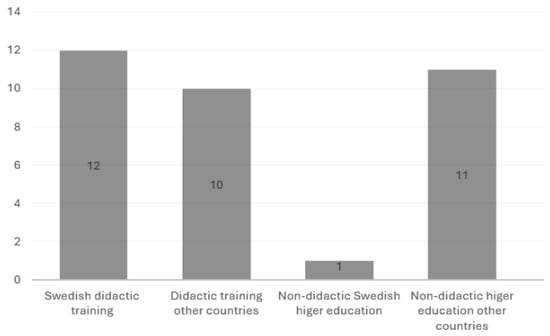
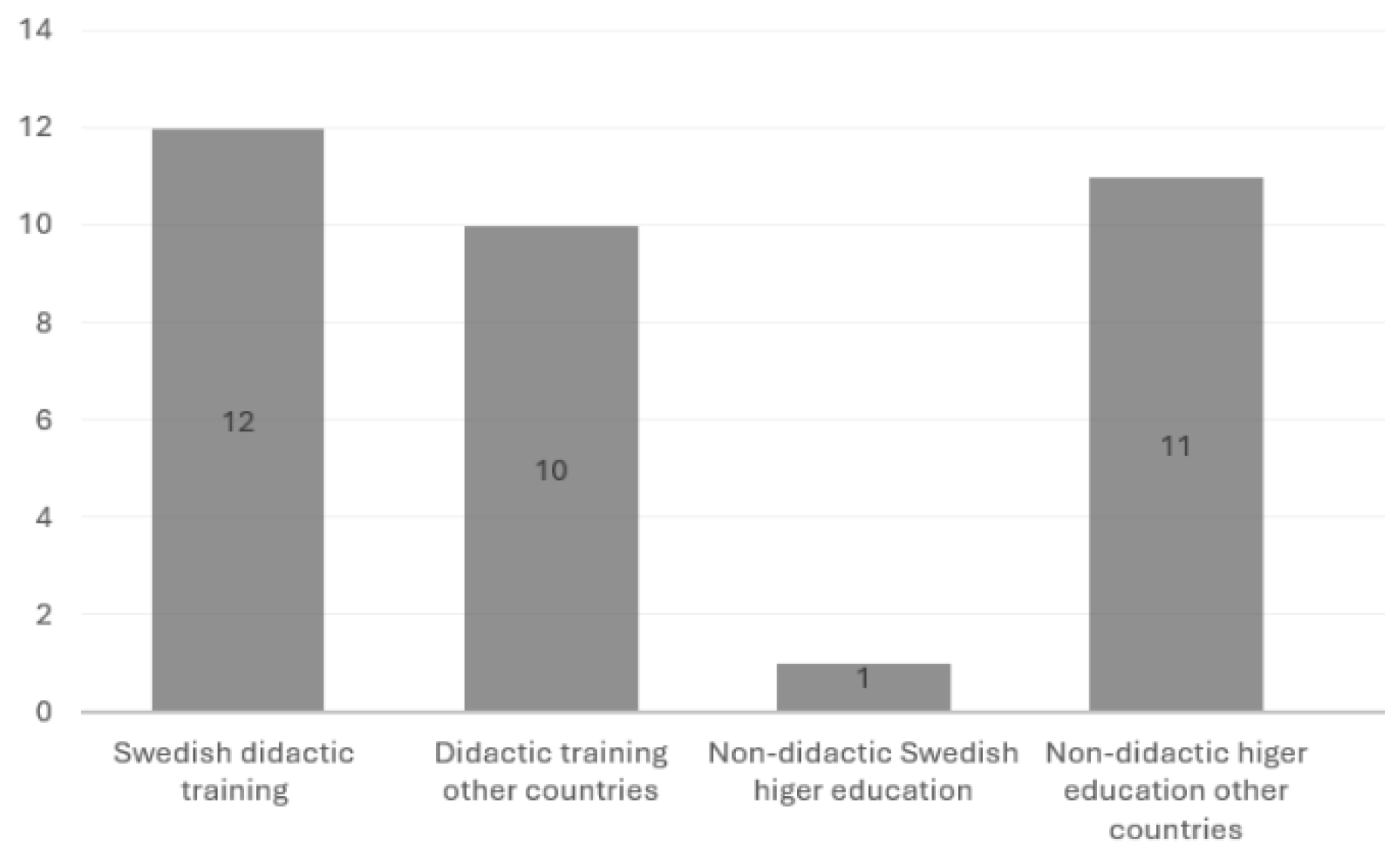
As shown in Figure 1, all respondents hold a higher education or university degree. The majority, 22 respondents (65%), have completed didactic training (35% in Sweden and 30% in another country). Only one respondent (3%) holds a non-didactic Swedish degree, while eleven respondents (32%) report having other higher education degrees obtained outside Sweden.
Figure 1.
Overview of the respondents’ educational backgrounds.
3.2. Teachers with Swedish Didactic Training Reasoning About Multilingual Students’ SEN
The following section presents the categories identified in responses from teachers with Swedish didactic training. These teachers mention a wide range of explanatory factors for their students’ SEN. They primarily identify students’ difficulties through classroom observations and comparisons with curricular expectations or peer performance, typically interpreting these challenges as individual deficits rather than context-dependent phenomena. Language-related issues, concentration problems, and limited task engagement are frequently cited as inherent student weaknesses. Most teachers conduct these assessments independently, with only occasional input from other staff. Structural factors, such as limited instructional time in heritage language classes, are rarely acknowledged.
3.2.1. Individual Difficulties Identified in the Classroom and Through Peer Comparison
Several teachers link the identification of students’ difficulties to classroom situations. As HLT15 states, “During lessons, you can observe what the student struggles with.” Difficulties and support needs are often detected by comparing a student’s current knowledge level with the expected level. HLT31 illustrates this: “Students who fall behind the knowledge level they are expected to have.” The expected level in the heritage language subject is outlined in the curriculum, suggesting that teachers are aware of age-related benchmarks. Teachers compare students’ current knowledge with the standards in the subject and with the skills of other heritage language learners. One teacher mentions participation in lessons, or rather, “[when the student] does not participate” (HLT 8), as an indicator of special support needs. Thus, difficulties are linked to the classroom environment and teaching context, reflecting a pedagogical-didactic dimension. The students are portrayed as unable to keep pace with the regular lesson and as requiring supplementary explanations beyond those provided to their peers, suggesting that their learning needs are positioned as divergent from the expected norm. The fact that they describe providing additional explanations suggests an awareness of the pedagogical–didactic dimensions of their teaching. However, several teachers combine these didactic explanations with individual ones, as HLT 15 notes: “[…] what the student struggles with.” Although difficulties are observed in the classroom, they are described as residing within the student rather than in the teacher’s didactics or organizational factors. The student is portrayed as deviating from classroom norms or failing to meet learning objectives. Their lack of knowledge is framed in relation to what peers master or what they are expected to master.
Other teachers describe only individual causes, such as concentration difficulties (HLT33 & HLT4) or challenges related to executive functioning: “difficulty starting work and completing it” (HLT27) or “cannot complete tasks” (HLT26). In addition to general learning difficulties, or as HLT27 puts it, “The student’s difficulty in learning”, language-related challenges are frequently mentioned (HLT4). Some teachers attribute these to multilingualism, such as “learning other and multiple alphabets” (HLT15). Several respondents note that a student’s proficiency in their first language serves as an indicator of potential difficulties: “Everything depends on how strong the student’s first language is” (HLT15). Difficulties with decoding in both Swedish and the first language are also mentioned: “Sometimes it’s about reading/decoding” (HLT15). General comprehension problems are cited as well: “[the student] does not understand what the texts are about” (HLT26). Language difficulties are thus described as stemming from challenges in the first language, second-language acquisition, or general linguistic vulnerability. These descriptions primarily reflect an individual perspective on causation. According to respondents, students require support because they have an inherent need for assistance.
Within this framing, the student is portrayed as deviating from established classroom norms or failing to meet predefined learning objectives. The student’s knowledge is evaluated relationally, either in comparison to what peers already demonstrate or in relation to what curricular standards assume they should master. Such comparisons implicitly position certain students as “out of place” within the instructional flow, reinforcing the idea of a homogeneous learner who aligns with the normative pace and mode of instruction. By locating the difficulty solely within the student, teachers’ interpretations risk foreclosing a more systemic analysis of how classroom practices, expectations, and institutional arrangements may inadvertently produce or exacerbate perceived learning gaps. As a result, the pedagogical and organizational conditions that could be adapted to better support learning remain unaddressed, while the student is rendered the primary site of explanation and intervention.
3.2.2. Identification Through Individual Assessments and Collaboration with Other Teachers
Most heritage language teachers report that they themselves identify students’ SEN. A few respondents note that they are alerted by other teachers, such as “through the subject teacher” (HLT5) or by teachers at the student’s primary school, as HLT10 explains: “Usually the schools notice first, and then at the first meeting [with the student] I conduct an assessment. Then I know.” Several teachers appear to use assessments to confirm suspicions about students’ SEN.
3.2.3. Structural and Organizational Factors Hindering Identification
Only one teacher mentions structural and organizational factors, noting that it is difficult to identify students’ SEN because heritage language instruction occurs only once a week: “There are not many opportunities to notice [difficulties], due to the lack of time and relationship” (HLT31). Limited instructional time thus seems to hinder relationship-building and, consequently, the identification of students’ needs. Surprisingly, only one teacher mentions these factors, given the usual organization of heritage language classes. One possible interpretation is that heritage language teachers meet their students and their siblings regularly over many years. Although they do not meet them frequently every week, this continuity may help foster strong teacher-student relationships, which in turn facilitate the identification of difficulties.
3.3. Teachers with Didactic Training from Other Countries Reasoning About Multilingual Students’ SEN
The following section presents the categories identified in responses from teachers with didactic training obtained outside Sweden. These teachers also mention a wide range of ways to identify students’ difficulties. However, individual explanations for students’ SEN dominate their descriptions. Pedagogical–didactic explanations and structural or organizational factors are only hinted at in connection with the learning of newly arrived students. They mainly attribute multilingual students’ SEN to individual factors, such as limited academic progress, weak first-language skills, or emotional disengagement, while rarely acknowledging pedagogical or contextual factors. Newly arrived students are seen as needing support due to structural challenges, that is, limited Swedish proficiency and unfamiliarity with the school system. These teachers typically identify difficulties independently through assessments and observations, though some report collaborating with mainstream teachers, SEN teachers, or other staff.
3.3.1. Individual Difficulties Identified Through Contextualization
Several teachers link individual difficulties to classroom situations. They describe this as follows: “If the student cannot manage basic tasks appropriate for their age” (HLT3) or “students who do not make progress in their learning” (HLT21). Students’ individual abilities are contextualized and compared with the knowledge of peers of the same age. When students fail to meet the learning objectives in the heritage language subject, they are considered to have SEN.
Individual factors mentioned by several teachers are often attributed to general learning difficulties: “When the student reads and writes and repeats again and again but makes the same mistakes” (HLT17) or “When you talk or discuss with the student, ask questions, and do not receive sufficient answers” (HLT29). These explanations appear primarily directed at the student’s deficiencies and difficulties, though they could also stem from pedagogical-didactic causes, which the teachers do not seem to acknowledge. Alternatively, “I explain again and again” (HLT17) may suggest that the teacher tried different methods without success; hence, the student is portrayed as failing despite instructional variation.
Another individual factor described is linguistic difficulties: “They do not have sufficient basic knowledge in their mother tongue” (HLT11). Even in these cases, the explanation lies at an individual level, namely, the student lacks adequate knowledge. Emotional aspects are also mentioned: “[…] I notice resistance from those who do not feel a connection to their homeland” (HLT18). These aspects are likewise framed as individual, namely, the student does not feel connected to their native country.
3.3.2. Difficulties Among Newly Arrived Students Attributed to Structural and Organizational Factors
Another category of students perceived as needing special educational support, according to HLT24, is “all newly arrived students.” Newly arrived students must learn both the Swedish language and the educational system, which seems to underpin the teacher’s reasoning. These students are described as unable to benefit from lessons in the same way as peers who have lived in Sweden longer. Such explanations may be interpreted as structural and organizational, that is, students are placed in Swedish classrooms without mastering the language of instruction. Alternatively, the difficulties may be understood from a pedagogical-didactic perspective: instruction is not sufficiently adapted to the needs of newly arrived students, as teachers often operate within a Swedish-language norm prevalent in many classrooms, or they must prioritize support for other students.
3.3.3. Identification Through Assessments
Teachers with didactic training from other countries also report that they usually identify difficulties independently. “Assessments and diagnostic results” (HLT9) and “own observations” (HLT25) are mentioned as methods for detecting difficulties and support needs. HLT25 even states that they initiated assessments of students’ difficulties by contacting classroom teachers and SEN teachers. Furthermore, HLT25 notes that Swedish language teachers, Swedish as a second language teachers, mentors, or parents sometimes reach out to inform them about a student’s needs. HLT25 also describes she/he was invited by a SEN teacher to a meeting about a student before the referral for assessment was submitted. Thus, several teachers with didactic training from other countries testify to collaborating before the assessment of multilingual students’ SEN.
3.4. Teachers with Non-Didactic Higher Education Reasoning About Multilingual Students’ SEN
The following section presents the categories identified in the questionnaire responses from teachers with non-didactic higher education. As noted earlier, a total of twelve respondents fall into this category. These heritage language teachers primarily describe individual explanatory factors, such as linguistic and general learning difficulties, behavioral challenges, and the fact that some students are newly arrived. These needs are commonly identified through reading and writing tasks, pre-tests, various diagnostic checks, and comparisons with peers. Several teachers additionally view newly arrived students as requiring special educational support due to their limited linguistic and cultural familiarity with Swedish schooling.
3.4.1. Individual Causes and Support Needs
Language-related difficulties are most frequently cited as the basis for multilingual students’ SEN. As HLT2 explains: “When students struggle in their mother tongue. If they cannot read or understand simple sentences.” HLT6, on the other hand, describes students “who do not know Swedish” as requiring special educational support. Both limited proficiency in L1 and L2 appear, according to these teachers, to indicate a need for support. HLT23 summarizes this as “students who need support when they have difficulty communicating.” To identify such difficulties, heritage language teachers report listening to students read or analyzing their writing. HLT19 is the only teacher who explicitly mentions a diagnosis, “students with dyslexia”, as a reason for support needs.
General learning difficulties are also cited as underlying causes of SEN. As HLT6 illustrates: “[students who] have difficulty learning different subjects.” Other examples include challenges in “following instructions” (HLT7) and “slower learning pace and reduced learning ability” (HLT16). Behavioral issues are mentioned by L2: “[students who] have difficulty adapting to school or the classroom,” as well as absenteeism: “[students who] do not attend lessons or do not complete homework” (HLT14). To identify the causes of these difficulties, teachers refer to “pre-tests” (HLT30) or other “tests of knowledge level” (HLT16). Several heritage language teachers compare students’ knowledge levels with those of other students in the classroom, as HLT7 illustrates: “When they do not keep up with other students in the classroom and need a little more time.”
3.4.2. Newly Arrived Students Require Special Educational Support
Heritage language teachers HLT2, HLT6, and HLT20 describe all “newly arrived” students as needing special educational support. HLT20 additionally includes “[multilingual] students born in Sweden.” Meanwhile, HLT22 argues: “I think every student needs special support when they are young. One student needs support to learn the subject, and another needs help to communicate. So, I think as a teacher I must provide support to all students.” This description reflects pedagogical-didactic factors. The teacher emphasizes the need to create appropriate learning situations for all students. As HLT22 states: “I must always have good communication with my students. That way, I can more easily identify when they need my help or support.” This teacher also describes pedagogical-didactic factors as a means of detecting individual or other difficulties.
4. Discussion and Conclusions
The purpose of this study was to gain an in-depth understanding of heritage language teachers’ reasoning regarding multilingual students’ SEN. More specifically, the study aimed to examine whether heritage language teachers’ educational backgrounds influence their descriptions of SEN among multilingual students.
Section 4.1 discusses the main findings by linking them to previous research, while Section 4.2 addresses the methodological considerations.
4.1. Discussion of Results in Relation to Previous Research
First and foremost, it is noteworthy that all respondents hold a higher education or a university degree. Moreover, the majority, 65%, have completed didactic training. This is a positive and somewhat surprising finding, as it exceeds the national average of 42% reported by the Swedish National Agency for Education (Skolverket, 2025b).
4.1.1. Individual Difficulties Often Identified in Classroom Contexts
Teachers with Swedish didactic training describe a wide range of factors that may place multilingual students in need of special educational support. This aligns with previous research (Chan et al., 2023; Choo & Smith, 2020). Individual difficulties, such as concentration challenges or language-related issues, are often identified in instructional settings. Participation and interaction, key components of KoRP (Ahlberg et al., 2005), are mentioned by several teachers with Swedish didactic training. These teachers further report identifying difficulties independently, for example, through assessments and comparisons with subject content and learning objectives outlined in the curriculum. They claim to detect students’ difficulties by comparing the individual with the context in which they operate (see Ahlberg, 2013). Identification also occurs through collaboration with other teachers, which is consistent with earlier findings (Brown & Campbell Ault, 2015; Hatheway et al., 2015).
However, it is noteworthy that only one teacher mentions structural or organizational barriers to identifying students’ SEN. No other teachers refer to such factors, even though previous research suggests that structural and organizational constraints often hinder heritage language teachers’ daily work (cf. Roux Sparreskog, 2025). In this study, however, these factors do not appear prominent, which raises questions. While the evidence is limited, one interpretation is that teachers with Swedish didactic training might feel more confident in identifying students’ needs or be modestly better prepared to address structural and organizational challenges.
Teachers with didactic training from other countries also report identifying individual difficulties, such as linguistic or emotional challenges, independently in classroom situations or through assessments and collaboration with other teachers. This, too, corresponds with Ahlberg’s (2013) assertion that individual characteristics should be analyzed in relation to the context in which the student is situated. These teachers, by contrast, focus heavily on individual linguistic difficulties, such as students’ proficiency in their first and second languages.
Although the teachers list several procedures for identifying students’ difficulties—such as “pre-tests,” “listening when they read,” “analyzing how they write,” and “communicating with students”—these practices are described schematically, without reference to the theoretical assumptions, interpretive criteria, or evaluative frameworks that underpin meaningful assessment. Furthermore, these teachers tend to conceptualize students’ difficulties as isolated attributes of the individual learner, rather than analyzing them in relation to the broader instructional, linguistic, or organizational context in which performance occurs. This individualizing orientation contrasts with the relational and contextual perspective emphasized by Ahlberg (2013), who argues that learners’ challenges must be interpreted through the interplay between the individual, the task, the learning environment, and the available pedagogical supports. Taken together, these patterns suggest that current identification practices risk conceptual underspecification (i.e., the absence of clearly articulated concepts and criteria), methodological fragmentation (i.e., reliance on isolated indicators rather than systematic triangulation), and contextual blindness (i.e., insufficient attention to the instructional and organizational conditions that co-produce learning difficulties). Such limitations may impede both the validity of interpretations about students’ needs and the design of pedagogically appropriate responses aligned with a didactic and relational framework.
4.1.2. Everyday Talk or Specific Professional Terminology
So far, the statements of these two groups of teachers do not differ significantly. However, a tendency toward more general descriptions can be observed among teachers with didactic training from countries other than Sweden. Teachers with Swedish didactic training provide more nuanced explanations and employ more established technical terms, which Biesta et al. (2015) refer to as professional discourse. They reason in what Horn and Kane (2019) call a professionalized discourse, using specialized language or specific professional terminology; for example, terms such as decoding appear. In contrast, teachers with didactic training from other countries and those without didactic training describe difficulties in more general terms, using everyday language. They write, for instance, about “when students read and write” or students who “cannot read or understand simple sentences.” This may simply reflect that teachers without Swedish didactic training have not yet acquired the professional language used in Sweden. It is possible that they would be more familiar with such terminology in their L1. Since Biesta et al. (2015) link the bibliographical dimension and educational values to teachers’ professional discourse, and, ultimately, to their achievement of agency, these discursive differences should be highlighted. Teachers with foreign didactic training and those without didactic training, moreover, make fewer and more vague references to curriculum documents and learning objectives in the heritage language subject. These teachers seem to compare students with their peers in the classroom, but neither learning goals nor subject content is mentioned in their descriptions of how they identify students’ difficulties and support needs. One interpretation of these results might be that this indicates that teachers with Swedish didactic training are more knowledgeable about the subject curriculum and learning objectives.
Another way to interpret the results might be that the difference merely stems from the fact that teachers without Swedish didactic training have not yet mastered the professional language in Swedish. Either way, the results suggest that when these heritage language teachers engage in dialogue with Swedish mainstream teachers or SEN teachers, traces of this everyday language are nonetheless likely to appear and may shape the assessment by leaving a discernible imprint on the interaction, potentially resulting in a more diffuse or less systematically articulated account of the student’s difficulties. Consequently, this could imply that these teachers’ less professionalized discourse is perceived as more informal by mainstream teachers and SEN teachers, which could, in turn, affect whether their perspectives are considered in assessments of students’ difficulties.
Additionally, given that instruction in any subject should be based on curriculum guidelines, the absence of such references in their reasoning is somewhat surprising. Teachers should be familiar with the subject-specific concepts and frameworks. The fact that this is not reflected in their descriptions is somewhat troublesome, as it might indicate potential gaps in their professional knowledge base and raises questions about the extent to which instruction is meaningfully grounded in the curriculum.
4.1.3. Do All Newly Arrived Students Require Special Educational Support?
Teachers with didactic training from other countries and those with non-didactic higher education also mention newly arrived students as a group in need of special educational support. The fact that teachers with Swedish didactic training do not mention newly arrived students raises the question of whether teachers with didactic training from other counties and those without didactic training encounter more newly arrived students. This could imply that the arrival of large groups of newly arrived students necessitates the recruitment of heritage language teachers without Swedish didactic training.
Unsurprisingly, newly arrived students are described as needing support. Moving to a new country and entering a new school culture and language of instruction entails challenges and requires time. What heritage language teachers describe can be compared to what Ahlberg (2007a, 2007b) refers to as social practice, which individual students must learn to participate in. Such support could potentially be provided through study guidance in students’ first language and does not necessarily need to be classified as special educational support.
The fact that teachers with Swedish didactic training do not mention this group may indicate that they have a clearer understanding of what special educational support should and should not include. Conversely, teachers with didactic training from other countries and those without didactic training may not fully grasp what special educational support entails. One teacher without didactic training even claims that all students need special educational support. This could suggest a misunderstanding or an overly broad interpretation of the concept. Naturally, all students should receive support tailored to their needs, but such support does not necessarily qualify as special education in nature.
4.2. Methodological Discussion
The subjective cluster sampling used in this study, namely, including all heritage language teachers in a single municipality, was well-suited to examine what Denscombe (2000) refers to as naturally occurring clusters. This approach captured responses from teachers with diverse cultural and linguistic backgrounds. The sampling frame encompassed all heritage language teachers in one municipality, increasing the likelihood of collecting relevant, comprehensive, and current information. Denscombe further suggests that between 30 and 250 respondents are needed for survey results to be considered reliable. In this study, 33 of the 40 heritage language teachers present completed the questionnaire. However, since employment conditions for heritage language teachers vary across municipalities, this must be considered. Further studies examining the professional backgrounds of heritage language teachers from several municipalities are therefore suggested. Consequently, the findings cannot be generalized to all heritage language teachers in Sweden but rather provide insight into teachers from one region. For this reason, the next step could be to conduct a larger-scale study examining heritage language teachers’ educational backgrounds and how these influence their reasoning.
Given that most heritage language teachers had a first language other than Swedish, this aspect warrants discussion. The researcher’s presence during data collection allowed respondents to ask questions and clarify uncertainties, which hopefully helped overcome potential language barriers. However, the methodological limitations of the study warrant more explicit consideration. Written questionnaires do not allow for follow-up probing, clarification, or exploration of implicit assumptions, and therefore, the data may only partially capture the complexity of teachers’ professional reasoning. Additionally, as the respondents were multilingual and possessed varying levels of proficiency in Swedish, their ability to articulate nuanced pedagogical or didactic reasoning in writing may have differed. This linguistic variability introduces a potential source of bias, as some respondents may have been more capable than others of expressing subtle distinctions in their reasoning.
A further limitation concerns the scope of the material analyzed. Although the broader questionnaire contained ten items, this manuscript focuses only on four of them. These items were selected because they most directly addressed teachers’ professional backgrounds and their interpretations of multilingual students’ SEN-related needs. The remaining items—reported elsewhere—addressed other thematic dimensions of the larger project and therefore fell outside the analytical focus of the present article. Nonetheless, the selective use of questionnaire items limits the comprehensiveness of the picture presented here. To deepen and triangulate the findings, future research should incorporate additional qualitative methods that allow for more dialogic and context-sensitive data generation. Semi-structured interviews or focus groups could capture more elaborate reasoning, while classroom observations or teacher-student interaction analyses would provide insight into how professional reasoning manifests in practice. Such methodological expansion would not only enrich the empirical base but also strengthen the validity of the claims regarding how heritage language teachers understand and interpret multilingual students’ special educational needs.
5. Summary and Implications
In summary, the findings of this study indicate that Swedish didactic training provides heritage language teachers with a professional foundation and professional terminology. Their descriptions appear more concrete, more specific, and more specialized. Teachers with Swedish didactic training also refrain from categorizing entire groups of students as requiring special educational support. Instead, they offer more nuanced statements and employ a more precise terminology by referring to steering documents and the subject curriculum. This may indicate a deeper understanding of what special educational support entails, or simply that they have acquired the professional language used in Sweden. Thus, they seem to differentiate between general support needs and SEN at various levels.
Moreover, several teachers with didactic training from Sweden or other countries report collaborating with other mainstream teachers or SEN teachers to identify students’ SEN. These findings suggest that teachers with didactic training may be more inclined, or more receptive, to collaborate with other teachers.
Assessing multilingual students for their SEN requires expertise in both special education and multilingualism. If assessments fail to consider both areas, there is a risk of misdiagnosis and, consequently, inappropriate support measures (see Rodríguez, 2015).
Funding
This research received no external funding.
Institutional Review Board Statement
Since the project does not handle any sensitive personal data, I did not apply for an ethical review. However, good research practice, recommended by the Swedish Research Council (2024), was meticulously followed.
Informed Consent Statement
Informed consent was obtained from all subjects involved in the study.
Data Availability Statement
The data presented in this study are available on request from the corresponding author. The data are not publicly available due to privacy restrictions.
Acknowledgments
Special thanks are given to the 33 teachers for sharing their time and their interesting experiences and thoughts. Thank you, Helana Darnell-Berggren, for your valuable comments on the manuscript.
Conflicts of Interest
The author declared no potential conflicts of interest with respect to the research, authorship, and/or publication of this article.
Abbreviations
The following acronyms are used in the manuscript:
| HLT | heritage language teacher |
| KoRP | communicative and relational perspective |
| SEN | special educational needs |
| SdT | Swedish didactic training |
Appendix A
Excerpt from the Digital Questionnaire (translated from Swedish)
You will remain anonymous, and your responses will be used solely for my research.
I have:
- ⚬
- A didactic higher education degree from Sweden
- ⚬
- A didactic higher education degree from another country
- ⚬
- Another higher education degree from Sweden
- ⚬
- Another higher education degree from another country
- ⚬
- No higher education degree
- I teach the following languages:Please specify your answer
- Which students do you consider needing special support?Please specify your answer
- How do you identify or notice that a student needs special support?Please specify your answer
If you are willing to participate in future studies, you may indicate this. However, you are NOT obligated to participate. You may decline or withdraw your participation at any time.
References
- Ahlberg, A. (1999). På spaning efter en skola för alla. IPD-rapporter 1999:08. Göteborgs Universitet. [Google Scholar]
- Ahlberg, A. (2007a). Specialpedagogik av igår, idag och i morgon. Pedagogisk Forskning i Sverige, 12(2), 84–95. [Google Scholar]
- Ahlberg, A. (2007b). Specialpedagogik—Ett kunskapsområde i utveckling. In C. Nilholm, & E. Björck-Åkesson (Eds.), Reflektioner kring specialpedagogik—Sex professorer om forskningsområdet och forskningsfronterna (pp. 66–84). Vetenskapsrådets Rapportserie. [Google Scholar]
- Ahlberg, A. (2013). Specialpedagogik i ideologi, teori och praktik- att bygga broar. Liber AB. [Google Scholar]
- Ahlberg, A., Målqvist, M., & Welin, A. (2005). Verksamhetsförlagd lärarutbildning och specialpedagogisk kunskap. Insikt 2005:1. Högskolan för Lärande och Kommunikation. Högskolan i Jönköping. [Google Scholar]
- Assarson, I., Ahlberg, A., Andreasson, I., & Ohlsson, L. (2011). Skolvardagens komplexitet: En studie av värdegrundsarbetet i skolans praktik. Stockholms Universitet. [Google Scholar]
- Avery, H. (2015). Teaching at the “edgelands” of school day: The organisation of mother tongue studies in a highly diverse Swedish primary school. Power and Education, 7(2), 239–254. [Google Scholar] [CrossRef] [Scilit]
- Biesta, G., Prestley, M., & Robinson, S. (2015). The role of beliefs in teacher agency. Teachers and Teaching, 21(6), 624–640. [Google Scholar] [CrossRef] [Scilit]
- Brown, J. E., & Campbell Ault, P. (2015). Disentangling language differences from disability: A case study of district-preservice collaboration. Journal of Multilingual Education Research, 6(7), 111–136. [Google Scholar]
- Chan, R. Y. Y., Wong, C. M. V., & Yum, Y. N. (2023). Predicting behaviour change in students with special education needs using multimodal learning analytics. IEEE Access, 11, 63238–63251. [Google Scholar] [CrossRef] [Scilit]
- Choo, A. L., & Smith, S. A. (2020). Bilingual children who stutter: Convergence, gaps and directions for research. Journal of Fluency Disorders, 63, 105741. [Google Scholar] [CrossRef] [Scilit] [PubMed]
- Clark, A. S. S. (2018). The intersection of race and language in special education: A study of the referral process of emergent bilingual students to the special education program [Doctoral dissertation, University of Southern California]. [Google Scholar]
- Denscombe, M. (2000). Forskningshandboken—För småskaliga forskningsprojekt inom samhällsvetenskaperna. Studentlitteratur. [Google Scholar]
- Hatheway, B., Shea, D., & Winslow, M. (2015). Dual language program meets integrated collaborative teaching. Journal of Multilingual Education Research, 6(8), 137–151. [Google Scholar]
- Horn, I. S., & Kane, B. D. (2019). What we mean when we talk about teaching: The limits of professional language and possibilities for professionalizing discourse in teachers’ conversations. Teachers College Record, 121(6), 1–32. [Google Scholar] [CrossRef] [Scilit]
- Hsieh, H.-F., & Shannon, S. E. (2005). Three approaches to qualitative content analysis. Qualitative Health Research, 15(9), 1277–1288. [Google Scholar] [CrossRef] [Scilit] [PubMed]
- Kilinc, S., & Borowski, N. D. (2025). Preschool educators’ perspectives and experiences implementing dual language bilingual education for emergent multilinguals with disabilities. Exceptional Children, 91(4), 377–395. [Google Scholar] [CrossRef] [Scilit]
- Language Act. (2009). Språklagen. (2009:600). Regeringskansliet. [Google Scholar]
- Möllås, G. (2009). “Detta ideliga mötande”: En studie av hur kommunikation och samspel konstituerar gymnasieelevers skolpraktik [Doctoral dissertation, Högskolan för Lärande och Kommunikation]. [Google Scholar]
- Perry, F. L., Jr. (2011). Research in applied linguistics: Becoming a discerning consumer. Taylor & Francis. [Google Scholar]
- Rodríguez, D. (2015). Bilingual special education: Investigating and implementing evidence-based practices in schools. Journal of Multilingual Education Research, 6(1), 2. [Google Scholar]
- Roux Sparreskog, C. (2024). Pedagogical collaboration for multilingual support in Swedish compulsory schools—Multilingual study guidance tutors’ perspectives. Language and Education, 38(5), 781–799. [Google Scholar] [CrossRef] [Scilit]
- Roux Sparreskog, C. (2025). Didaktiskt samarbete för stöttning av flerspråkiga elevers språk- och kunskapsutveckling [Doctoral dissertation, Mälardalens Universitet]. [Google Scholar]
- Roux Sparreskog, C., & Dylman, A. S. (2025). Promoting reading and writing development among multilingual students in need of special educational support: Collaboration between heritage language teachers and special educational needs teachers. Education Sciences, 15(8), 1016. [Google Scholar] [CrossRef] [Scilit]
- Rubin, M. (2013). Vem är Sofia? Perspektiv på relationell specialpedagogik i arbetet för språkutveckling och mångfald. In J. Aspelin (Ed.), Relationell specialpedagogik: I teori och praktik (pp. 143–162). Kristianstad University Press. [Google Scholar]
- Shelton, A., Hogan, E., & Fu, Y. (2025). Special education teacher educators’ focus on emergent multilingual learners in preservice literacy courses. Teacher Education and Special Education, 48(2), 145–162. [Google Scholar]
- Simeonsdotter Svensson, A. (2009). Den pedagogiska samlingen i förskoleklassen. Barns olika sätt att erfara och hantera svårigheter [Doctoral dissertation, Göteborgs Universitet]. [Google Scholar]
- Skolverket. (2018). Greppa flerspråkigheten—En resurs i lärande och undervisning. Skolverket.
- Skolverket. (2025a). Elever och skolenheter i grundskolan läsåret 2024/25. Skolverket.
- Skolverket. (2025b). Pedagogisk personal i skola och vuxenutbildning läsåret 2024/25. Skolverket.
- Skrtic, T. M. (1995). Deconstructing/reconstructing public education: Social reconstruction in the postmodern era. In T. M. Skrtic (Ed.), Disability and democracy: Reconstructing (special) education for postmodernity (pp. 233–273). Teachers College Press. [Google Scholar]
- Sparreskog, C. R. (2025). In between the fields of research of special educational needs and multilingual education–Swedish heritage language teachers’ perspectives on special educational needs in multilingual students. European Educational Research Journal, 14749041241308965. [Google Scholar] [CrossRef] [Scilit]
- Swedish Research Council. (2024). Good research practice. Swedish Research Council.
- Vuorenpää, S., & Zetterholm, E. (2020). Modersmålslärare så mycket mer än språklärare. In B. Straszer, & Å. Wedin (Eds.), Modersmål, minoriteter och mångfald: I förskola och skola. Studentlitteratur. [Google Scholar]
- Wang, P., & Woolf, S. B. (2015). Trends and issues in bilingual special education teacher preparation: A literature review. Journal of Multilingual Education Research, 6(1), 4. [Google Scholar]

Disclaimer/Publisher’s Note: The statements, opinions and data contained in all publications are solely those of the individual author(s) and contributor(s) and not of MDPI and/or the editor(s). MDPI and/or the editor(s) disclaim responsibility for any injury to people or property resulting from any ideas, methods, instructions or products referred to in the content. |
© 2026 by the author. Licensee MDPI, Basel, Switzerland. This article is an open access article distributed under the terms and conditions of the Creative Commons Attribution (CC BY) license.