Article

Scaffolding by Learning Support Assistants for Students with Autism

School of Education, University of Birmingham, Dubai P.O. Box 341799, United Arab Emirates
*
Author to whom correspondence should be addressed.
Educ. Sci. 2026, 16(3), 467; https://doi.org/10.3390/educsci16030467
Submission received: 30 December 2025 / Revised: 4 March 2026 / Accepted: 10 March 2026 / Published: 18 March 2026
(This article belongs to the Special Issue Special and Inclusive Education: Challenges, Policy and Practice)

Abstract

This instrumental case study investigates how learning support assistants (LSAs) understand their role and implement pedagogical strategies when working with autistic students in Dubai’s private education sector. Despite robust inclusive education policies, schools frequently emphasise academic achievement metrics, leading to reliance on LSAs for students experiencing learning or behavioural challenges. The research analyses LSA scaffolding practices through three theoretical lenses: repair, heuristic, and support functions. Through observations and interviews with six LSAs working in individualised and small-group contexts at a premier British-curriculum institution, the study identifies several patterns in the support practices of the LSAs. Results demonstrate that LSAs consistently apply intensive support without progressively reducing assistance or building student independence. Participant interviews revealed widespread assumptions about autistic learners’ ability to manage challenging academic work, directly limiting opportunities for growth. Pedagogical choices favoured managing student behaviour through external reward mechanisms rather than cultivating genuine learning engagement or developing autonomous problem-solving abilities. This research exposes disconnects between policy intentions, the scaffolding theory and classroom realities for learners with autism and their supporting educators.

1. Introduction

Dubai’s private education landscape comprises 18 different curricula and 215 private schools (KHDA, 2022). The local government entity responsible for regulating the growth and quality of this complex landscape is the Knowledge and Human Development Authority (KHDA). In 2017, the Dubai Inclusive Education Policy Framework (KHDA, 2017) was introduced to regulate inclusive provision in private schools and has compelled the entire UAE education system to increase inclusivity across all seven emirates (KHDA, 2017). The policy requires schools to meet the needs of all students, including those placed on level three support, through inclusive admissions, teaching, support, and assessment. Although this may be the stated intent, as is common globally, a power play over autonomy, accountability, incentives, and competition exists that weakens inclusive practices (Davis, 2013; Jones, 2013; Liasidou & Symeou, 2018). In the UAE, and in Dubai specifically, high value is placed on international benchmark scores, ratings, and competition between schools, as well as on an increasingly privatised education system (KHDA, 2025). These come at the expense of inclusion, a feature typical of neoliberal education systems, such as those in Dubai, where the service model of education creates stratified accommodations and supports for students (Balu et al., 2015).
To achieve these high-stakes goals, many private schools require parent-hired learning support assistants1 (LSAs) to ensure that students with high levels of academic or behavioural needs can meet curriculum demands. Given the increased focus on education in the UAE’s future-looking plans, such as Education 33, and its prominent place in the 2071 Vision, academic performance and placement on international league tables will continue to grow in importance. Scholars argue that standardised performance indicators lead to seeing learner diversity as a major threat (Liasidou & Symeou, 2018; Nieminen, 2023; Slee, 2018), which is in direct conflict with the KHDA’s inclusive policies. When neoliberal priorities, such as scores and performance, take precedence over inclusion, educators tend to view students who perform poorly less favourably, and the achievement gap widens, despite support mechanisms such as LSAs (Liasidou & Symeou, 2018; Mitchell & Sutherland, 2020). Research into the use of paraprofessionals in the classroom raises concerns that these models of education are not inclusive (Balu et al., 2015; Ferri, 2012). This paper examines the role of LSAs in high-performing Dubai-based private schools and their effectiveness in supporting students with autism in general education classrooms. To date, there has been little evaluation of the effectiveness of the work LSAs undertake for Dubai-based students. It is important to assess the effectiveness, given the substantial financial burdens placed on parents who must hire and pay for such supports to secure admission for a child with special educational needs (KHDA, 2017).

2. Systems of Support

The use of LSAs in the classroom has been associated with several problems identified by scholars worldwide (Hemmingsson et al., 2003; Valle & Connor, 2019). Issues include the presence of a ‘velcroed’ adult, which can lead to social exclusion by peers (Valle & Connor, 2019); teachers being less likely to engage with students with special education needs (Fernandes, 2021; Sharma & Salend, 2016); LSAs with limited experience, training, and curriculum knowledge becoming the primary educators (Mitchell & Sutherland, 2020). Given that the LSA qualifications and roles are ill-defined in policy (KHDA, 2017), there is a wide range of competencies, with many inexperienced LSAs serving as the primary educators for students with special education needs and disabilities (Sharma & Salend, 2016). There is an increasing number of private companies offering LSA training in Dubai and the wider UAE, but the focus and efficacy of these programs have not been reported.
Scaffolding. The issue of limited education and training for LSAs has a significant impact on how they support and promote learner independence. Scaffolding is a commonly recognised pedagogical approach that emphasises structured, temporary support to facilitate learners’ gradual movement toward autonomy (Stone, 1998). The quantity and types of scaffolding strategies differ not only across learners at varying developmental levels but also for the same learner over time; however, the ultimate goal is for these scaffolds to be developed in collaboration with the learner and temporary until students have internalised or mastered a skill (Puntambekar & Hübscher, 2005; Slavin, 2022; Stone, 1998). Decades of research have identified primary components of scaffolding as: feedback, hints, instruction, explanation, modelling, and questioning (Van de Pol et al., 2010; D. Wood et al., 1976); other research has refined and added closely related components such as contingency management and cognitive structuring (Tharp & Gallimore, 1988). Van de Pol et al. (2010) synthesised common scaffolding characteristics from a systematic review of teacher–student interactions, identifying three key components: contingency, fading, and transfer of responsibility. Contingency refers to moment-to-moment adjustments tailored to the learner’s understanding, often facilitated by diagnostic strategies such as questioning and monitoring (Shepard, 2005). As students become more proficient, support is gradually reduced (fading), transferring responsibility for learning to the learner (Van de Pol et al., 2010). While paraprofessionals frequently employ these strategies, Van de Pol et al. (2010) emphasize that scaffolding is only effective when applied contingently, progressing toward fading and learner autonomy; this notion remains the most important differentiator between effective and ineffective scaffolding.
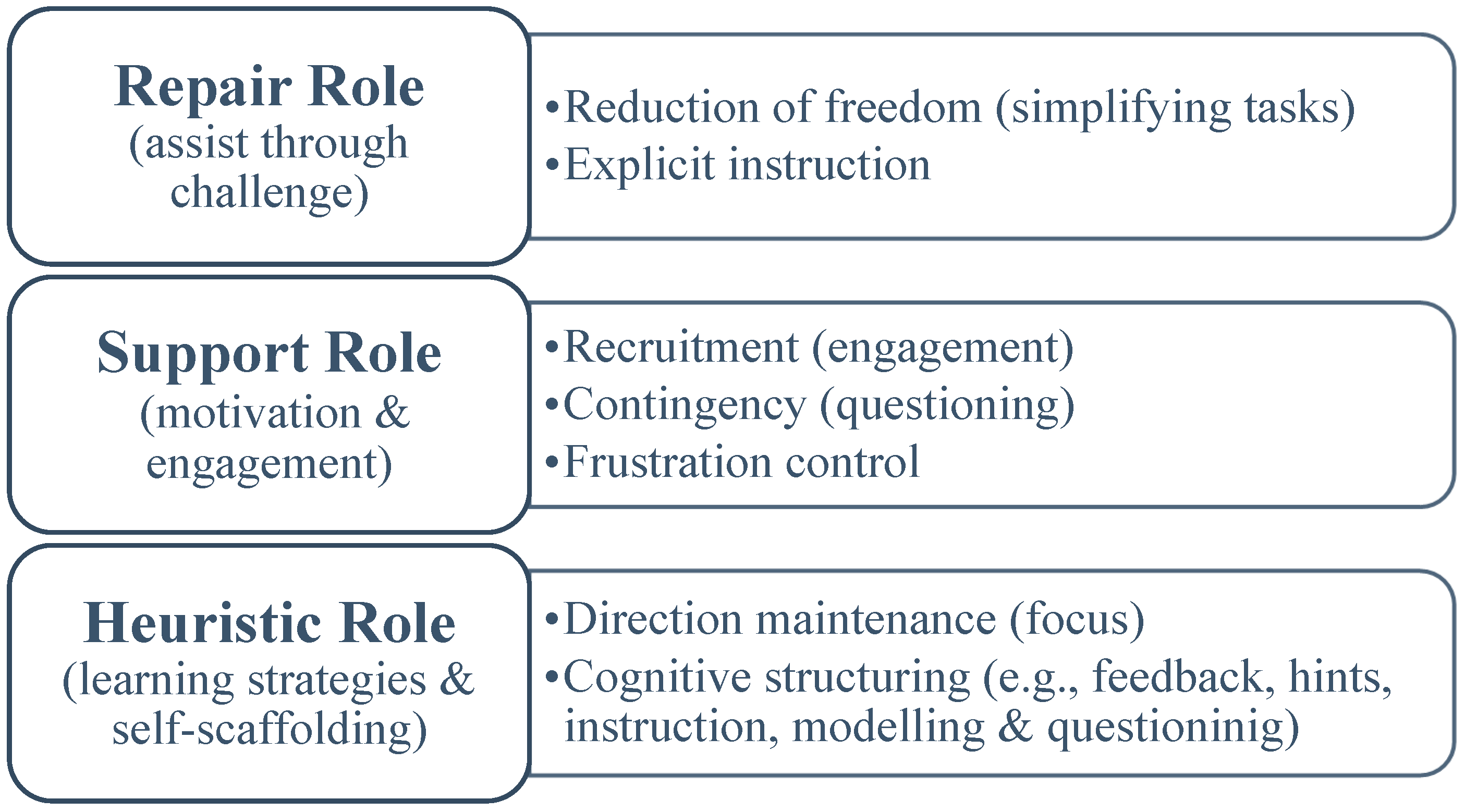
More recent literature on scaffolding has developed a more detailed model of interaction, which also informs this work. Radford et al. (2014) proposed a framework, grounded primarily in research on teaching assistants, which identifies three distinct yet interrelated functions. The support role encourages motivation and engagement by reassuring and guiding students and helping them remain attentive, whereas the repair function assists students when they encounter challenges with task work. Finally, the heuristic role encourages students to develop their own learning strategies or self-scaffold. Refer to Figure 1 for how previously identified components of scaffolding fall within each role. This framework reconfigures scaffolding intentions such as direction maintenance, recruitment, frustration control, reduction of freedom, and cognitive structuring into the three roles. It also integrates scaffolding techniques, such as feedback, hints, instruction, explanation, modelling, and questioning, into the heuristic role. Furthermore, in the heuristic role, Bosanquet et al. (2021) introduced a hierarchical framework that distinguishes between high- and low-level scaffolding strategies. High-level adult support strategies, such as correcting and modelling, involve structured adult assistance, while lower-support adult strategies, such as clueing and self-scaffolding, minimise external intervention.
Scaffolding for Autistic Students. While there is a plethora of evidence-based interventions for students with autism, there is a lack of research on how this knowledge translates into practice in schools, and little research that intersects with the above research on scaffolding or classroom assistants in mainstream settings (Guldberg, 2017; Hume et al., 2014). Given that students with autism are three times more likely to receive 1-1 support from LSAs than, say, students with developmental language difficulties (Dockrell et al., 2019; Lebenhagen & Dynia, 2024), this gap in the research is troubling. Firstly, the scaffolding framework supports a hierarchy of low-to-high adult-supported scaffolds, prioritising open-ended questions over closed ones to facilitate the transfer of responsibility (Bosanquet et al., 2021). This is problematic for students with autism who typically struggle with abstractions (American Psychological Association, 2013; Baron-Cohen, 2000; Happé & Frith, 2006). Secondly, all scaffolding strategies discussed so far have primarily focused on verbal communication, assuming that all student–teacher interactions are verbal, whereas autistic learners may use alternative communication (Lebenhagen & Dynia, 2024). Finally, within available research, LSAs for students with autism are often assumed to take on a behaviour support role with a frequent reliance on a system of praise, verbal and physical reminders, rewards, and consequences for showing ‘on-task’ behaviours (Brock et al., 2021). This neglects the need for academic supports, which would require scaffolding strategies to be applied within the support role as was originally proposed by Van de Pol et al. (2010). Schools in Dubai can and do require students with both academic and behavioural needs to have either a school or parent-hired LSA to fill support and education roles.
Ideally, effective scaffolding facilitates active learner participation through thoughtful calibration and contingency that is informed by the theory of task and knowledge (Puntambekar & Hübscher, 2005; D. Wood et al., 1976). However, because students with autism may struggle with pragmatic aspects of language or a tendency to focus intensely on personally significant details, and in the context of task work, this may interfere with comprehending the overall objective of the task or attending to the adult’s verbal instructions (Happé & Frith, 2006). Other theory of mind tenants propose that individuals with autism may struggle to comprehend others’ thoughts and feelings, as well as to anticipate their actions (Baron-Cohen, 2000). In the classroom, this may manifest as difficulties with comprehension or with recognising subtle hints or prompts embedded in teacher feedback and scaffolding (Tay et al., 2019). Furthermore, sustained attention during bidirectional exchanges, such as those between an LSA and a student with autism, may be challenging due to differences in sensory processing (Febriantini et al., 2021).
There appears to be a conflict in how certain practices, such as modelling, explaining, and visual supports, are perceived in scaffolding and autism literature. These are often categorised as high-support scaffolds in the theory and discouraged for potentially limiting transfer of responsibility (Bowles et al., 2018), whereas in autism literature, more structured supports—like modelling and guided practice—are foundational to effective instruction (Guldberg, 2010; Guldberg et al., 2011; Jordan, 2013; Singh et al., 2021). Many scaffolding techniques rely heavily on verbal dialogue, which may not align with the multimodal communication preferences of autistic students (Febriantini et al., 2021). Similarly, visual supports, such as diagrams, schedules, videos, or scripts, are widely endorsed in autism education due to autistic learners’ strong visual processing skills (Hume et al., 2014; Fletcher-Watson & Happé, 2019; Rentschler et al., 2024). These tools improve engagement and foster autonomy by reducing reliance on adult prompts. This contrasts with scholarly perspectives on scaffolding strategies, such as explaining and modelling, which suggest that active verbal participation is necessary to avoid being construed as merely supplying answers and thereby failing to foster independence (Bowles et al., 2018). This reflects a fundamental tension between the two fields: what is seen as overly directive in scaffolding literature is often viewed as essential in autism pedagogy.
While autistic students report experiencing school-based anxiety regularly, teachers often struggle to identify its causes (Cook & Ogden, 2022; Costley et al., 2021), leading to misinterpretations of behaviour (Fulton et al., 2020; Humphrey & Symes, 2013; Trembath et al., 2012). A myriad of causes, such as making eye contact, sound and authority, light stimuli distraction (Costley et al., 2021), common in classrooms, can heighten anxiety (McGillicuddy & O’Donnell, 2014) due to sensory processing differences (Fulton et al., 2020). Students with autism share that anxiety is felt and responded to in a bodily manner (Costley et al., 2021), and this may be the behaviour that is visible and open for misinterpretation as off-task (Solis et al., 2016). In Dubai, this is a reason for assigning, or even requiring, an individual LSA whose support is then focused on compliance behaviours, using systems of praise or over-scaffolding in an attempt to shield students from anxiety-inducing situations and subsequent behaviours (Adams & Emerson, 2021; Trembath et al., 2012). For younger students who have been required to have an ILSA from an early age, this may develop a dependence on school support systems, complicating the transfer of responsibility (Costley et al., 2021). Further, within the UAE, applied behaviour analysis (ABA) continues to be heavily ‘prescribed’ by doctors and is increasingly relied on with schools as a ‘treatment’ (Albanna et al., 2024; Al Fandi & Zaharudin, 2023). These interventions are grounded in principles of rewards and consequences, aiming to change a student’s behaviour and encourage compliance with expectations, and several promising claims regarding improvements in task independence and academic engagement (Beckman et al., 2019; Hampshire et al., 2016; Huffman et al., 2019). However, these approaches are often limited by their reliance on extrinsic motivation, their lack of generalisability across contexts, and the absence of clear evidence of any transfer of responsibility. While ongoing critiques in global research and advocacy by autistic individuals and scholars who highlight the promotion of neurotypical norms and prioritisation of compliance over inclusion (Scribner & Tracy-Bronson, 2024; Xu et al., 2017), this critical approach to ABA has yet to reach the UAE.
This research takes advantage of the unique, privatised education system in Dubai, which heavily relies on learning support assistants to provide education for students with special educational needs or disabilities, including students with autism. To better understand how systems of support are being employed by those working closest with students who have high academic and behavioural needs, this research aims to answer the following research questions:
  • How do learning support assistants define and understand effective scaffolding for students with autism?
  • What do learning support assistants do to scaffold the learning of students with autism effectively?
  • Do the practice and knowledge of learning support assistants in Dubai align with global literature about effective scaffolding?

3. Methods

The primary aim of this research was to explore the role and efficacy of LSAs supporting students with autism. The limited literature and research in both Dubai and on LSAs’ practices made an instrumental case study the most appropriate initial approach to an underrepresented topic (Baxter & Jack, 2008). While context is relevant, the findings aim to inform broader discussions of scaffolding theory in autism, an intersection that is rarely examined in depth. The case study design also aligns with growing calls in autism research for methodologies that place practitioner knowledge generated in classrooms on equal footing with academic theory (Guldberg, 2017). This study contributes to that agenda by foregrounding the perspectives of LSAs, a group frequently marginalised in discussions of educational effectiveness and often portrayed as underqualified (Petersson-Bloom & Holmqvist, 2022; Sharma & Salend, 2016; Symes & Humphrey, 2011). Due to ethical considerations and the specific focus of this study, student perspectives were not directly included. For this research, students’ reactions and engagement with LSA interventions were recorded passively to capture the dynamic, unfolding nature of scaffolding. In line with this, the British Educational Research Association’s (BERA) ethical guidance, Clause 17 (British Educational Research Association [BERA], 2018), permits the recording of interactions involving anonymised, non-consenting individuals if the primary subjects have provided informed consent. However, working with students is inherently social and bidirectional, and future studies should consider including student responses and experiences. Ethical approval was granted by the University of Birmingham-Dubai’s School of Education in December 2024.
Setting and Sample. A purposive sample of six learning support assistants was selected for this study, who currently support autistic students in one-on-one or small-group settings within the primary section of a premium British curriculum school in Dubai. All participants work in the primary years, during which more LSAs support autistic learners, thereby increasing the accessibility of data collection. Moreover, primary education lays the foundation for literacy and numeracy skills, typically requiring more instructional scaffolding from LSAs than in secondary education. All participants were female with varying experiences working with students identified as autistic. See Table 1 for an overview of each participant. Leslie, Sama, Uma, and Tess (pseudonyms) supported students on a 50% basis—primarily during key subjects such as English and mathematics. Susan worked in the school’s SEN classroom, which includes five students with autism, among others. Julian provided full-time 1:1 support for one autistic child. All students were verbal, had varying needs and abilities, and accessed the National Primary Curriculum. The selection process, driven by school leadership, may reflect a preference for staff deemed more competent or better aligned with the school’s image as a premium institution. These factors highlight the challenges of conducting research in school contexts, where institutional gatekeeping may influence who is represented.
Data collection and analysis. Observations were conducted during English and mathematics, as these contexts offer rich opportunities to observe task-specific scaffolding. Each LSA was observed once and observations lasted between 40 and 50 min. Observations were conducted prior to interviews to capture natural interactions and avoid leading participants via interview questions. Additionally, this enabled context-specific probing questions to be developed from observed practices and incorporated into the interview schedule. A structured observation form was used to record LSA–student interactions under three thematic roles—support, repair, and heuristic. An additional column was included to document strategies that indicated autism-specific awareness. Given the fast-paced nature of classroom interaction and the absence of video recording, the form was designed for rapid documentation and initial categorisation of LSA–student interactions. Observation notes considered not only what was said, but also how it was said, to add to the richness of the data.
Following the observations, semi-structured interviews were conducted to triangulate the observational data and further clarify the observed scaffolding practices. The interview schedule consisted of 12 questions, but then further tailored with specific probes derived from each observation. This structure ensured consistency across participants and adherence to the time limit while allowing room for elaboration. Interviews lasted 30–50 min, depending on the participant’s availability and the depth of discussion, and were conducted face-to-face in a quiet room to ensure comfort and confidentiality. All interviews were recorded and transcribed using the Otter.ai application. Observations and interviews were analysed together within each theme to produce a summary for each TA. All data were coded by the first author, and then observational and interview data underwent secondary analysis and validation by the second author.
Interview transcripts and observation notes were deductively coded based on the seven themes emerging from the literature review and further were inductively analysed for context. After all cases were analysed within-case, then cross-case analysis was conducted to consolidate individual insights and identify patterns across the seven themes in all six LSAs. This approach allowed for both individual narrative depth and possible insights relevant to school-level or wider educational contexts, Baxter and Jack (2008) note that within, between and cross-case analyses add clarity to case studies. This approach enabled both individual narrative depth and potential insights relevant to school-level or broader educational contexts. Coded observational and interview data were placed in custom developed Excel matrices to analyse data across both collection methods.

4. Results

The results are organised by scaffolding role, repair, heuristic, and support, with subsequent components of each role explored within that category. Where appropriate, additional data demonstrating autism or context-specific observations and commentary have been included. The results section focuses on cross-case analysis and includes both observational and interview data. Overall, it was clear that LSAs were using many high-scaffold techniques with little evidence of transfer of responsibility. There were limited opportunities to observe the repair role, and there is a lack of clarity around how the support role should be constructed when considering children with autism.
Repair role. The repair role is most evident when students have difficulty with task completion. Data from observations showed limited use of the repair role; however, follow-up interview data provided insight into LSA perceptions of student ability, which explains the absence of repair roles during challenge in the observations. The LSAs shared the view that autistic students cannot manage complex tasks independently and therefore tended to shield them from difficulty. As a result, the repair role, one that would have supported through challenges, was not regularly employed.
The absence of the repair role was most evident in adult questioning. Students were not provided with regular opportunities to develop their knowledge or skills; instead, when they encountered difficulties, LSAs modified work to ensure completion. For example, during an observation with Susan, the student was unable to answer a question, and to help them overcome this challenge, the student was presented with a simple closed-choice question:
LSA: Which sign, left or right?
Student: Left.
(LSA immediately moves away to attend to other students in her group).
(Susan, 5/5/2025)
Without follow-up probing questions, it was difficult to determine whether the student would be able to complete a similar task or answer a similar question in the future, or whether there was any transfer of responsibility. This scenario was repeated in another observation with Sama, where she worked out the problem when the student struggled to answer an open-ended question.
Follow-up interviews indicated that this strategy of closed questioning and providing the answers was driven by perceptions of students’ intellectual ability and academic capacity in the classroom. A shared perception across the interviews was that the students were unable to complete cognitively demanding tasks independently, citing inflexibility, difficulty articulating their thoughts, and lack of motivation. This reasoning is exemplified in the excerpts below:
So, if the teacher is giving an example, he would just use that immediately. So, there’s a little bit of an element of laziness as well. I would say, or just not the willingness. I wouldn’t say laziness, that’s labelling. But I would say the willingness to put in the effort wouldn’t be there.
(Uma, 8/5/2025)
So whatever they say, I have to say okay, all right. I am not forcing them…I cannot, like, I cannot ask her, like, twice, because she tantrums.”
(Susan, 15/5/2025)
Yeah, sometimes they can understand, but they don’t want to. They don’t want to do by yourself. They want us like, support.
(Susan, 15/5/2025)
These attitudes lead to shielding students from difficult tasks and to a perception that they are unable or unwilling, coupled with the potential for behavioural issues, indicating limited tolerance from both students and LSAs for instances of challenge where a repair role might be necessary.
A further possible link to student dependence on external help was unexpectedly identified in relation to the use of visual aids. All participants reported using visual aids, particularly whiteboards, to support student understanding, for example, “He needs visual and concrete things that can be seen and felt to learn better,” (Julian, 27/5/2025). Participants were observed using whiteboards, concrete objects, and visual guides with their students. In English, Julian mentioned using strategies such as fill-in-the-blanks and word banks when writing tasks posed a challenge. At no point did students actively request a visual cue, nor did they use one independently; it was provided to them by default by the LSAs, making it unclear whether students find value in visual aids.
On the rare occasions when the repair role was observed in practice, resistance to difficult tasks was common; the LSA addressed this by combining repair and support practices. This was particularly evident during timed tasks, which often provoked anxiety in the student, as Sama notes. When she had time, she employed a repair strategy coupled with several supportive measures, which the student responded to well, underscoring the importance of both roles when he faced a challenge.
LSA: Do we know how to calculate area? (repair)
    Take your time, don’t be in a hurry. (support)
Student: (working by themselves) Tadaa! Number 4 is hard
LSA: What happens when you do hard stuff? (support)
Student: Your brain grows.
LSA: Let’s try number 3, then go for a walk. (support)
Student: I’ve done 3, 4 is hard
LSA: We will try to give you credit for your effort. Area is tricky, but try (support)
(Sama, 29/4/2025)
As shown in this example, Sama demonstrates the repair role by supporting the student in reflecting on prior learning to address a difficult question. However, as she explains, this student is particularly sensitive to time constraints, so rather than continuing to support through the challenge, Sama shifts into a support role to ward off potential behaviours. This example also illustrates elements of metacognition, which is more pronounced in the heuristic role, thereby demonstrating the dynamic and fluid nature of scaffolding for students.
Heuristic role. The heuristic role is meant to support students in developing their own learning strategies or self-scaffolding. This can mean using both high- and low-level scaffolding strategies. High-level adult support strategies, such as correcting and modelling, involve structured adult assistance, whereas lower-support strategies, such as clueing and self-scaffolding, minimise external intervention (Blatchford et al., 2012; Sharples et al., 2016). The heuristic role is separated from the repair role, as it should involve more metacognitive prompts and focus on helping students develop independence in tasks.
During interviews, participants described several scaffolding strategies that were often used in their students’ task work. The LSAs did not always use the exact or formal scaffolding names and definitions, but during coding, actions or terms that were synonymous with the literature were coded accordingly. As in the repair role, while the LSA gave some autonomy to the student, independence was limited, and students were not often probed or challenged due to assumptions about their ability, time pressure, and behaviours. Throughout the interviews and observations, it was clear that LSAs relied heavily on variations of modelling and high-support scaffolds with students. The LSAs widely regard modelling as useful, as highlighted below during a maths lesson on area:
LSA: How do we figure it? (clueing)
Student: It’s so hard I don’t know.
LSA: Do we know how to calculate area? (clueing)
(Takes pencil and writes)
LSA: I’ll do this one (modelling/supply answer)
(Sama, 29/4/2025)
Just model them for, like, 1,2, or 3, questions, and they are good.
(Leslie, 5/5/2025)
The above examples show how modelling carries the risk of giving away the answer, especially when there are time constraints and behaviour concerns. While modelling can be useful for students with autism, without the transfer of autonomy, it has no cognitive demand on the student. Clueing and prompting are considered to promote greater pupil independence than modelling; however, even when LSAs tried these methods during observations, they ended up reverting to closed questions, highly prescriptive modelling, or providing the answer. For instance, in a lesson on similes, Uma prompted the student to formulate a sentence using “as brave as.”
Student: <reading question> Doesn’t make sense.
LSA: <re-reads question> Tell me something that is brave. (clueing)
Student: I don’t know, it doesn’t make sense
LSA: Who is brave in this class? (direct instruction)
Student: Table
LSA: Not a table, a person (clueing)
Student: I don’t know
LSA: <gives answer> (supply answer)
(Uma, 2/5/2025)
As with above, others moved rapidly from clueing to simply supplying answers, which holds true even for Uma, Tess, and Sama who showed the high usage of clueing questions. Again, the interviews reveal that LSAs generally perceive their students as struggling with comprehension when presented with open-ended questions.
They are lacking comprehension. And then at least for that specific sentence that he just read, he will be able to at least give me something from there, the focus is very less, we have to scaffold a bit, you know.
(Julian, interview, 27/5/2025)
Language, it’s tricky for him. So the concepts, again, like metaphors, rhetorical question, some of these, he will not be able he wasn’t able to understand. So breaking it down smaller and smaller…I would have repeated two to three times, and then maximum, and then I would give him options, and if all else fails, yes, I would give him an answer. In the end, in a mainstream classroom, he has to produce the work that’s the reality.
(Uma, 8/5/2025)
Uma’s reply is revealing, in that the goal for both the students and the LSAs is to ‘produce work’ this was apparent in the observations, as the LSAs provided close and continuous task support, ensuring that the work was done correctly within the constraints of the class time.
An interaction between Tess and her student demonstrated that there appears to be a high value placed not only on producing work but also on producing correct answers, rather than on students being given opportunities to struggle and learn from mistakes. Tess required her student to orally rehearse each sentence using before writing in their book; the student was stopped if they began writing without completing this step. The student frequently looked to her at the beginning of each sentence, and Tess would provide praise, a reminder, or a clue. This interaction indicates a high level of reliance and was observed in Julian and Susan’s interactions as well. Their students would frequently glance at the LSA before attempting to answer, and the students were generally rewarded by LSAs with a response that led to correct answers or structured clueing immediately after the glance.
Even when LSAs recognised their role as heuristic and attempted to use low-support scaffolds or techniques that enabled independent learning, these practices remained highly prescriptive and supportive. In one observation, Julian provided support through sentence-by-sentence reading of the material, gestures, word highlighting, and phonetic cues for the expected answer. Julian justified this approach during the interview, citing the students’ attention issues. Susan also employed a technique to silently articulate the initial phoneme of the target word. Students responded by guessing until they either reached the correct word or received additional phonetic clues. Leslie and Julian frequently used sentence starters and gestural cues to narrow the student’s focus to a specific line or word in the text. These gestures, such as pointing to the line where the answer was located, were coded as supplying answers, as they directed the student toward the correct response rather than transferring responsibility.
Thus, due to the close, highly scaffolded sessions observed, as discussed and reported, the provision of answers made it challenging to discern the transfer of responsibility to students. However, interview data related to the fading of support revealed an awareness of the importance of the transfer of responsibility, even if it was not happening in practice. Similarly, there was also awareness that learned helplessness might occur when students are provided with too much help and when not challenged enough in task work, as exemplified below:
I’ve seen that when I was working with them. Write it down for us. Write it down so we can write it down. What should I do next? You know? And the class teacher doesn’t have that time, so she has to model the paragraph, and they’re comfortable doing it.
(Sama, 8/5/2025)
If the child is dependent on the verbal prompts, because they are being robotic, that if no one will tell them …they will just stand there and wait. … They get used to hearing you saying before they can process.
(Julian, 28/5/2025)
Despite these acknowledgements, the LSAs in this study continued to provide answers and to heavily prompt students’ responses due to time constraints in the classroom and behaviour concerns, which are addressed in the support role.
Support Role. The support role is primarily concerned with providing encouragement and increasing students’ motivation. This has significant implications for students with autism, given that their preference for specific topics can mean they are unmotivated in general subjects, and the recent recognition of ADHD as a common co-occurrence with autism speaks to the need to help students with autism remain focused and motivated in the classroom (R. Wood, 2023). The observation and interview data collected and coded for the support role indicated that the LSAs both demonstrated and reflected on behaviour management practices. However, as shown in the data, this often created a barrier to students’ development of autonomy, and it was not always clear whether the LSAs’ and students’ understandings of behaviour and academics aligned. Respondents shared that students’ behaviour required considerable support to remain ‘on-task’ and most reflected that they had to frequently re-engage students who, in their estimation, were not paying attention.
“When I see that he’s not engaged, if he’s looking outside the window, not looking at the teacher, if he’s sitting with his pencil and not doing anything, when he’s feeling a bit agitated with his body, and he keeps rocking back and forth.”
(Uma, 8/5/2025)
“They’re distracted, they’re not doing anything… Yeah, because sometimes they are skipping the work. They don’t know the work. They are skipping the work because they always want a break.”
(Susan, 15/5/2025)
Other behaviours identified by the LSAs as off-task included students engaging in self-talk, correcting their own work, or rereading a passage before answering comprehension questions. Despite these being good metacognition strategies, Sama and other LSAs often viewed this self-talk as problematic, as exemplified below:
“They like to chat with me, so like, Hey, I’ve done question one, and now I’m going to go to question two. Did you see so that I saw that one? ..So I keep reminding you that you don’t need to tell me.”
(Sama, 8/5/2025)
This is not the only mismatch between the student’s approach to tasks and the LSA’s expectations. At another point, a student attempted to read a passage in response to the LSA’s open-ended questions during a comprehension task. However, the LSA repeatedly directed him to stop reading because she wanted him to answer her questions without referring to the text, even though his attempt to read it demonstrated independence in his work. (Leslie, 29/4/2025). Leslie was frequently observed attempting to keep a reading resource closer to her, resisting the student’s attempts to hold it. Her reasoning was “He just wanted to write the answers without reading the passage. Okay? And he’s going to write what he wants.” (Leslie, 5/5/2025). This adult control was an effort to ensure that the written answers were correct, viewing it as a behavioural, not an academic, issue.
There were other incidents demonstrating a clear hierarchy in the relationship with students, such as when Julian’s student began checking their own work and stated it was correct (though it was not). Julian then asked, “Who is the teacher—you or Ms. Julian?” The student appeared visibly upset, covered his face, and mumbled, “Paper is allowed.” (Julian, 2/5/2025). Rather than encouraging students to take ownership of their learning and to develop independence and autonomy, these students were seen as displaying off-task behaviour that hindered work completion.
To increase on-task behaviours, LSAs regularly reported and demonstrated the use of reward and consequence systems. Leslie and Julian were observed using reward and consequence charts, which were employed in traditional behaviour management, with statements such as ‘Once you follow instructions, you get one of the rewards’ (Leslie, 5/5/2025). Students showed little intrinsic motivation for completing work and frequently focused on the reward systems, which became the focus of many interactions about schoolwork as seen below in the example from a language arts lesson;
LSA: Hi (student name), what are we doing?
Student: comprehension. (reaches for token sheet) Can I have OT room?
LSA: Need to ask before you take it (takes the token back)
Student: (takes the token again) OT?
LSA: We’ll see when you have finished your work and OT room is free
LSA: before you start check for other characters
Student moves towards floor as though searching for something
LSA: I didn’t see any work, any attention, so no tick (reward)
Student sits up
(Leslie, 29/4/2025)
Similarly, there were many instances of adult-controlled breaks and adult-identified rewards, again indicating the hierarchy in the relationships. There were visible effects of using the rewards system; for instance, students refused to undertake further or more challenging tasks because the basic reward had already been earned, as shown in this interaction.
LSA: Do you want to try one more story?
Student: Why? It’s finished (looking at the token strip, stops work)
(Leslie, 29/4/2025)
It became clear from these interactions that students’ motivations were primarily extrinsic, and the tasks themselves held little value or interest for them. The support role was largely focused on compliance with adult expectations to complete work correctly during class time, and students had little autonomy or input into their learning.

5. Discussion

Drawing on scaffolding frameworks, this study examined LSAs’ roles and practices to determine how well they understand the principles of scaffolding and whether their practices align with scaffolding theory and recommendations, particularly for students with autism. There is a significant gap in the literature regarding how or to what extent LSAs working with students with autism in general education classroom settings effectively promotes inclusion, supports academics, or behaviour challenges. The overarching findings show that LSAs have limited knowledge of research-informed scaffolding practices, and the practices they employ do not align with the scaffolding goal of developing student autonomy. Several emergent themes around knowledge, attitudes, and normative classroom structures influenced the actions of the LSAs in this study.
Defining and implementing scaffolds. All participants in this study identified modelling, prompting, explaining, chunking, and simplifying as scaffolding strategies they perceived as effective. While the terminology employed by LSAs may not have aligned precisely with established scaffolding terminology, it is reasonable to infer, based on observations and their explanations during interviews, that their practices align with the scaffolding literature. At the same time, the majority of strategies employed fall under adult-led modelling, which broadly aligns with the existing autism literature, which supports explicit teaching methods, particularly modelling and explanation, as beneficial for autistic learners (Singh et al., 2021; Woolley, 2016). Modelling, in particular, was cited by participants as helpful for facilitating comprehension by providing context. However, according to scaffolding theory, adult-led modelling and correction, in other words, explicit instruction, is classified as highly scaffolded and thus potentially restrictive to the transfer of responsibility (Bosanquet et al., 2021; Sharples et al., 2016). This critique is significant: although modelling may aid understanding, it imposes minimal cognitive demand on the student and fails to promote their academic independence (Van de Pol et al., 2010). Consequently, the strategy may inadvertently hinder the student’s cognitive growth.
Although some participants acknowledged the existence of a hierarchy of scaffolding strategies, few demonstrated it in practice. While a minority of participants employed hierarchical modelling approaches, most began with low scaffolds (e.g., clueing). However, ultimately, all LSAs defaulted to supplying the answer, either through verbal cues or non-verbal gestures. This made it difficult to determine whether students were actively engaged in cognitive processing, and students did not demonstrate mastery or independence on tasks during the observations. This resonates with scaffolding literature, which consistently argues that scaffolding without responsibility transfer is ineffective (Sharples et al., 2016; Van de Pol et al., 2010). The key implication is that, while scaffolding strategies must be tailored to learners’ individual needs, their effectiveness must ultimately be measured by their capacity to foster autonomy. This view aligns with early scaffolding research, which classified the six scaffolding strategies—modelling, questioning, feedback, hinting, instructing, and explaining—as effective, provided they transferred responsibility (Van de Pol et al., 2010).
LSAs in this study reported that their students struggled with comprehension, a challenge that was particularly problematic for open-ended questions. Observations confirmed that, regardless of whether a hierarchical approach was employed, participants frequently reverted to the answer-provision mode. The EEF guidance report (Sharples et al., 2016) advocates for the use of open-ended questions, emphasising their role in fostering deeper cognitive engagement and independent reasoning (Sharples et al., 2016). However, comprehension is widely acknowledged as a challenge for many autistic learners (Happé & Frith, 2006; Singh et al., 2021), and difficulties in communication and social interaction remain key diagnostic markers of autism (American Psychological Association, 2013). These factors may partially explain participants’ beliefs that their students found open-ended questions particularly difficult and often responded with closed-ended questions or by providing answers quickly. Furthermore, the lack of follow-up questions to probe students’ reasoning meant that the observer or LSA could not determine whether the student was engaged in cognitive processing of the material or had achieved mastery of the concepts.
While transfer of responsibility was observable in lesson interactions, the broader concept of fading, referring to a gradual withdrawal of support over time, was accessible only through interviews. As fading typically occurs over extended periods, it is less amenable to moment-to-moment observation, which may account for the lack of observed behaviours. Participants did express awareness of the need to fade support to foster independence, and they demonstrated some understanding of learned helplessness, acknowledging its risks when excessive assistance is provided. However, their observed practices, marked by continuous, close-proximity task support, did not reflect these insights. Moreover, the study finds that the risk of dependence on readily available adult support is pervasive across all three roles, highlighting the need for targeted training in effective scaffolding techniques that demonstrate the transfer of responsibility rather than foster helplessness.
While LSAs employ a variety of scaffolding strategies in the heuristic role, some, such as modelling, explaining, and visual aids, appear to work particularly well for students with autism and differ somewhat from the current scaffolding literature. However, without an intentional transfer of responsibility, even well-intentioned supports, such as modelling or visual aids, risk fostering dependency. Thus, scaffolding must be reconceptualised not merely as support, but as a dynamic process centred on autonomy and fading of support. The interview data revealed a common perception among LSAs that autistic students are unable to complete cognitively demanding tasks independently. Such perceptions mirror those documented in prior literature, which has repeatedly shown that educators often underestimate the academic potential of autistic students (Han & Cumming, 2024; Nah, 2020; Perepa & Benson, 2024; Rodden et al., 2019). Participants also reported difficulty imagining their students managing academic tasks without their constant presence, reinforcing the belief that the LSA’s presence was indispensable. These views indicate a protective approach that seeks to shield students from difficult tasks. This phenomenon is well explained by the Pygmalion effect, in which educators’ low expectations influence student outcomes (Timmermans et al., 2018). In this case, LSAs’ beliefs about autism appeared to shape their scaffolding practices, particularly contingency. These finding echoes research indicating that educators’ beliefs about disability significantly influence instructional behaviour and that deficit-oriented beliefs may foster learned helplessness and restrict cognitive growth (Humphrey & Symes, 2013).
Autism-specific considerations. Alongside the beliefs that the students with autism are unable to independently complete or understand academic tasks, there were other core beliefs about behaviour and normative classroom practices that conflicted with good autism practice. It is recognised that emotional and physical regulation is critical for autistic learners, as it affects how they learn and focus (Costley et al., 2021; Holt et al., 2022; Jordan, 2013; Robertson & Baron-Cohen, 2017; Trembath et al., 2012). These regulatory needs are not peripheral but central to their learning processes. Accordingly, recognising and scaffolding self-regulatory behaviours would be integral to academic support. Notably, the study found only one participant who explicitly acknowledged the impact of factors, such as anxiety, on academic functioning. This renders the support role findings particularly compelling in the context of effective scaffolding.
Participants commonly employed adult-controlled reward systems to manage task-related behaviour. These reward systems are often grounded in behaviourist approaches, such as ABA, and are designed to minimise or eliminate behaviours that may be regarded as non-compliant or disruptive (Beckman et al., 2019; Hampshire et al., 2016; Huffman et al., 2019). Behaviours such as fiddling with objects, lack of eye contact, staring out of the window, and ‘not doing anything’ were signs of the student being off-task. However, a contrasting body of research positions some autistic behaviours as functional, self-directed regulatory strategies that assist students as coping strategies (Prizant & Fields-Meyer, 2022), for example to support their task concentration (Trembath et al., 2012; Costley et al., 2021; Holt et al., 2022), or to regulate anxiety and communicate needs (Costley et al., 2021; Jordan, 2013; Robertson & Baron-Cohen, 2017), provide comfort and predictability (Guldberg, 2020; Sainsbury, 2009). The behaviours mentioned by the LSAs in this study may well be functionally significant to the students during task time but were being overlooked. The observations showed an emphasis on compliance with neurotypical “on-task” behaviour enforced via extrinsic reward systems and adult-directed regulatory breaks. Continuous exposure to even low-level stimuli that may be perceived as traumatic by autistic individuals has been reported as harmful (Fulton et al., 2020), and in the context of this study, reward-based approaches that prioritise compliance and seek to change autistic behaviours may also be subjecting vulnerable students to this harm, however unintentional.
The study further observed that students declined to take on academic challenges once rewards were attained or exhibited only fleeting engagement when reminded of pending rewards. These patterns indicate that motivation, in such cases, may be more closely tied to conditioned reward systems than to intrinsic engagement with the learning task (Bowles et al., 2018; Radford et al., 2015). Furthermore, this extrinsic motivation may explain why participants felt the need to fade reward mechanisms. However, given the widespread use of such systems in current practice, it is unclear how students can become independent. Especially given that, when instances of potential self-scaffolding were observed, LSAs often viewed these strategies as problematic rather than as valid expressions of learning. This highlights a mismatch between students’ strategies and adult expectations, with students typically deferring to the LSA’s preferred approach, which was aligned with a classroom timetable and the correct answer, rather than developing autonomy and independent skills. Based on these findings and existing autism research (Costley et al., 2021; Holt et al., 2022; Prizant & Fields-Meyer, 2022; Trembath et al., 2012), the study raises the critically overlooked issue of recognising diverse expressions of engagement, learner development pace, and autonomy within general education classrooms, which needs more investigation in the context of scaffolding.

6. Conclusions

Against a backdrop of increasing inclusion policies and a growing reliance on paraprofessionals to facilitate students with special educational needs’ access to the curriculum, the study examined whether current scaffolding practices align with current theoretical models of scaffolding to promote inclusion as laid out in policy. The implications of this study pertain both to current educational practices and the theoretical underpinnings of scaffolding frameworks including those proposed by the EEF’s TA deployment guidance report. Firstly, the findings underscore the need for targeted professional development that equips paraprofessionals with both theoretical understanding and practical strategies to scaffold in ways that meaningfully support the transfer of responsibility to autistic students. Present scaffolding frameworks often promote a hierarchical model of support that does not necessarily reflect what works for autistic learners. A reorientation is needed, one that prioritises autonomy over a rigid progression of scaffolding types and recognises that certain strategies may be uniquely suited to the cognitive and communicative profiles of autistic students. Overall, the findings across the heuristic, repair, and support roles reveal a shared and persistent concern: the insufficient transfer of responsibility to autistic students during scaffolding interactions. Although strategies such as modelling, explaining, offering choices, reducing degrees of freedom, and employing visual aids were observed and recognised as beneficial, their implementation rarely followed a clear trajectory toward learner autonomy. This undermines a central tenet of effective scaffolding. Notably, the repair role was scarcely evidenced in practice. This absence represents a missed opportunity to present academic challenges and scaffold problem-solving in ways that encourage student agency. In the support role, the predominance of adult-controlled reward systems and the prioritisation of behavioural compliance over authentic engagement further constrained the development of independent learning behaviours. There is a need to understand autism from a related perspective rather than solely a behavioural one, and, within the context of scaffolding, that paradigm shift might make the difference in helping students achieve academic goals.
Crucially, across all roles, LSAs’ perceptions of autistic students—particularly the assumption that they are unable to engage with cognitively demanding tasks without adult intervention—appeared to shape pedagogical decisions in ways that risk fostering learned helplessness. These implicit beliefs limited the deployment of scaffolding strategies that support autonomy, highlighting the need to rethink both current scaffolding practices and the theoretical model envisioned by EEF’s TA deployment guidance report. These findings point to a broader tension between the intent of inclusive education policies and the actual practices that risk reinforcing exclusion. The deployment of LSAs, though intended to support access, may inadvertently contribute to learned helplessness when scaffolding is delivered without a sustained focus on the transfer of responsibility and the contingent fading of support, thereby further barring students from mainstream settings. The study highlighted how educators’ beliefs about autism and normative expectations of ‘on-task’ behaviour shape their scaffolding choices, often overlooking the legitimacy of diverse learning expressions and self-regulatory practices.

Author Contributions

Conceptualization, methodology, formal analysis, investigation, undertaken by M.S. with supervision provided by S.K.B.; writing—original draft preparation, M.S.; writing—review and editing, M.S. and S.K.B.; supervision, S.K.B. All authors have read and agreed to the published version of the manuscript.

Funding

This research received no external funding.

Data Availability Statement

Due to privacy restrictions and ethical restrictions tied to minor populations data is unavailable.

Conflicts of Interest

The authors declare no conflict of interest.

Note

1
While paraprofessionals work under various titles worldwide, in Dubai, they are commonly referred to as learning support assistants (LSAs) or Individual Learning Support Assistants (ILSAs). This paper will employ contextually appropriate language throughout.

References

  1. Adams, D., & Emerson, L.-M. (2021). The impact of anxiety in children on the autism spectrum. Journal of Autism and Developmental Disorders, 51(6), 1909–1920. [Google Scholar] [CrossRef]
  2. Albanna, A., Jarawan, E., Alhejailan, R., Boiangiu, M.-C., & Zeng, W. (2024). Early intervention for children with autism spectrum disorder in Dubai: A rapid review and policy option analysis. New Emirates Medical Journal, 5(1), e02506882265394. [Google Scholar] [CrossRef]
  3. Al Fandi, A., & Zaharudin, R. (2023). The effectiveness of Applied Behavior Analysis (ABA) strategies towards academic achievement, social interaction and communication among ASD students. International Journal of Academic Research in Business and Social Sciences, 13(6), 2114–2125. [Google Scholar]
  4. American Psychological Association. (2013). Diagnostic and statistical manual of mental disorders (5th ed.). APA. [Google Scholar]
  5. Balu, R., Zhu, P., Doolittle, F., Schiller, E., Jenkins, J., & Gersten, R. (2015). Evaluation of response to intervention practices for elementary school reading. NCEE 2016–4000. In International review of research in mental retardation. National Center for Education Evaluation and Regional Research. [Google Scholar]
  6. Baron-Cohen, S. (2000). Theory of mind and autism: A review. International Review of Research in Mental Retardation, 23, 169–184. [Google Scholar] [CrossRef]
  7. Baxter, P., & Jack, S. (2008). Qualitative case study methodology: Study design and implementation for novice researchers. The Qualitative Report, 13(4), 544–559. [Google Scholar] [CrossRef]
  8. Beckman, A., Mason, B. A., Wills, H. P., Garrison-Kane, L., & Huffman, J. (2019). Improving behavioral and academic outcomes for students with autism spectrum disorder: Testing an app-based self-monitoring intervention. Education and Treatment of Children, 42(2), 225–244. [Google Scholar] [CrossRef]
  9. Blatchford, P., Russell, A., & Webster, R. (2012). Reassessing the impact of teaching assistants: How research challenges practice and policy. Routledge. [Google Scholar]
  10. Bosanquet, P., Radford, J., & Webster, R. (2021). The teaching assistant’s guide to effective interaction: How to maximise your practice. Routledge. [Google Scholar] [CrossRef]
  11. Bowles, D., Radford, J., & Bakopoulou, I. (2018). Scaffolding as a key role for teaching assistants: Perceptions of their pedagogical strategies. The British Journal of Educational Psychology, 88(3), 499–512. [Google Scholar] [CrossRef]
  12. British Educational Research Association (BERA). (2018). Ethical guidelines for educational research (4th ed.). British Educational Research Association. Available online: https://www.bera.ac.uk/publication/ethical-guidelines-for-educational-research-2018 (accessed on 12 December 2024).
  13. Brock, M. E., Barczak, M. A., & Dueker, S. A. (2021). A randomized evaluation of group training for paraprofessionals to implement systematic instruction strategies with students with severe disabilities. Teacher Education and Special Education, 44(3), 206–220. [Google Scholar] [CrossRef]
  14. Cook, A., & Ogden, J. (2022). Challenges, strategies and self-efficacy of teachers supporting autistic pupils in contrasting school settings: A qualitative study. European Journal of Special Needs Education, 37(3), 371–385. [Google Scholar] [CrossRef]
  15. Costley, D., Emerson, A., Ropar, D., & Sheppard, E. (2021). The anxiety caused by secondary schools for autistic adolescents: In their own words. Education Sciences, 11(11), 726. [Google Scholar] [CrossRef]
  16. Davis, L. J. (2013). Disability, normality and power. In The disability studies reader (pp. 1–14). Taylor & Francis Group. [Google Scholar]
  17. Dockrell, J. E., Ricketts, J., Palikara, O., Charman, T., & Lindsay, G. A. (2019). What drives educational support for children with developmental language disorder or autism spectrum disorder: Needs, or diagnostic category? Frontiers in Education, 4, 29. [Google Scholar] [CrossRef]
  18. Febriantini, W. A., Fitriati, R., & Oktaviani, L. (2021). An analysis of verbal and non-verbal communication in autistic children. Journal of Research on Language Education, 2(1), 53–56. [Google Scholar] [CrossRef]
  19. Fernandes, L. (2021). Exploring student teachers’ perceptions, experiences, and attitudes towards working with Learning Support Assistants. Teacher Education Advancement Network Journal, 13(1), 17–25. [Google Scholar]
  20. Ferri, B. A. (2012). Undermining inclusion? A critical reading of response to intervention (RTI). International Journal of Inclusive Education, 16(8), 863–880. [Google Scholar] [CrossRef]
  21. Fletcher-Watson, S., & Happé, F. (2019). Autism: A new introduction to psychological theory and current debate. Routledge. [Google Scholar]
  22. Fulton, R., Reardon, E., Kate, R., & Jones, R. (2020). Sensory trauma: Autism, sensory difference and the daily experience of fear. Autism wellbeing CIC. [Google Scholar]
  23. Guldberg, K. (2010). Educating children on the autism spectrum: Preconditions for inclusion and notions of “best autism practice” in the early years. British Journal of Special Education, 37(4), 168–174. [Google Scholar] [CrossRef]
  24. Guldberg, K. (2017). Evidence-based practice in autism educational research: Can we bridge the research and practice gap? Oxford Review of Education, 43(2), 149–161. [Google Scholar] [CrossRef]
  25. Guldberg, K. (2020). Developing excellence in autism practice: Making a difference in education. Routledge. [Google Scholar] [CrossRef]
  26. Guldberg, K., Parsons, S., MacLeod, A., Jones, G., Prunty, A., & Balfe, T. (2011). Implications for practice from “International review of the evidence on best practice in educational provision for children on the autism spectrum”. European Journal of Special Needs Education, 26(1), 65–70. [Google Scholar] [CrossRef]
  27. Hampshire, P. K., Butera, G. D., & Bellini, S. (2016). Self-management and parents as interventionists to improve homework independence in students with autism spectrum disorders. Preventing School Failure: Alternative Education for Children and Youth, 60(1), 22–34. [Google Scholar] [CrossRef]
  28. Han, C., & Cumming, T. M. (2024). Teachers’ beliefs about the provision of education for students with autism spectrum disorder: A systematic review. Review Journal of Autism and Developmental Disorders, 11(3), 545–563. [Google Scholar] [CrossRef]
  29. Happé, F., & Frith, U. (2006). The weak coherence account: Detail-focused cognitive style in autism spectrum disorders. Journal of Autism and Developmental Disorders, 36(1), 5–25. [Google Scholar] [CrossRef]
  30. Hemmingsson, H., Borell, L., & Gustavsson, A. (2003). Participation in school: School assistants creating opportunities and obstacles for pupils with disabilities. Occupational Therapy Journal of Research, 23(3), 88–98. [Google Scholar] [CrossRef]
  31. Holt, A., Bounekhla, K., Welch, C., & Polatajko, H. (2022). ‘Unheard minds, again and again’: Autistic insider perspectives and theory of mind. Disability and Rehabilitation, 44(20), 5887–5897. [Google Scholar] [CrossRef]
  32. Huffman, J. M., Bross, L. A., Watson, E. K., Wills, H. P., & Mason, R. A. (2019). Preliminary investigation of a self-monitoring application for a postsecondary student with autism. Advances in Neurodevelopmental Disorders, 3(4), 423–433. [Google Scholar] [CrossRef]
  33. Hume, K., Wong, C., Plavnick, J., & Schultz, T. (2014). Use of visual supports with young children with autism spectrum disorders. In J. Tarbox, D. R. Dixon, P. Sturmey, & J. L. Matson (Eds.), Handbook of early intervention for autism spectrum disorders: Research, policy, and practice (pp. 293–313). Springer. [Google Scholar] [CrossRef]
  34. Humphrey, N., & Symes, W. (2013). Inclusive education for pupils with autistic spectrum disorders in secondary mainstream schools: Teacher attitudes, experience and knowledge. International Journal of Inclusive Education, 17(1), 32–46. [Google Scholar] [CrossRef]
  35. Jones, T. (2013). Understanding education policy. Springer. [Google Scholar] [CrossRef]
  36. Jordan, R. (2013). Autistic spectrum disorders: An introductory handbook for practitioners. David Fulton Publishers. [Google Scholar] [CrossRef]
  37. Knowledge and Human Development Authority. (2017). Dubai inclusive education policy framework. Available online: https://web.khda.gov.ae/en/Resources/Publications/School-Inspection/Dubai-inclusive-education-policy-framework (accessed on 1 September 2024).
  38. Knowledge and Human Development Authority. (2022, April 14). Latest statistics on Dubai’s private school sector—Spring Edition 2021–2022. Available online: https://web.khda.gov.ae/en/About-Us/News/2022/Dubai-private-schools-sector-records-highest-ever (accessed on 1 September 2024).
  39. Knowledge and Human Development Authority. (2025). PISA 2022 report: World class education in Dubai. Available online: https://web.khda.gov.ae/en/Resources/Publications/International-Assessments/PISA-2022-Report-World-Class-Education-in-Dubai (accessed on 1 September 2025).
  40. Lebenhagen, C., & Dynia, J. (2024). Factors affecting autistic students’ school motivation. Education Sciences, 14(5), 527. [Google Scholar] [CrossRef]
  41. Liasidou, A., & Symeou, L. (2018). Neoliberal versus social justice reforms in education policy and practice: Discourses, politics and disability rights in education. Critical Studies in Education, 59(2), 149–166. [Google Scholar] [CrossRef]
  42. McGillicuddy, S., & O’Donnell, G. M. (2014). Teaching students with autism spectrum disorder in mainstream post-primary schools in the Republic of Ireland. International Journal of Inclusive Education, 18(4), 323–344. [Google Scholar] [CrossRef]
  43. Mitchell, D., & Sutherland, D. (2020). What really works in special and inclusive education: Using evidence-based teaching strategies. Routledge. [Google Scholar]
  44. Nah, Y.-H. (2020). Pre-school teachers’ perceptions of challenging behaviours of students with autism spectrum disorder within inclusive settings. Advances in Autism, 6(3), 205–214. [Google Scholar] [CrossRef]
  45. Nieminen, J. H. (2023). Unveiling ableism and disablism in assessment: A critical analysis of disabled students’ experiences of assessment and assessment accommodations. Higher Education, 85(3), 613–636. [Google Scholar] [CrossRef] [PubMed]
  46. Perepa, P., & Benson, S. (2024). Mapping teachers’ preparedness to teach and support children on the autism spectrum in Ras Al Khaimah. Qasimi Foundation for Policy and Research. [Google Scholar]
  47. Petersson-Bloom, L., & Holmqvist, M. (2022). Strategies in supporting inclusive education for autistic students—A systematic review of qualitative research results. Autism and Developmental Language Impairments, 7, 23969415221123429. [Google Scholar] [CrossRef]
  48. Prizant, B. M., & Fields-Meyer, T. (2022). Uniquely human: Updated and expanded: A different way of seeing autism. Simon & Schuster. [Google Scholar]
  49. Puntambekar, S., & Hübscher, R. (2005). Tools for scaffolding students in a complex learning environment: What have we gained and what have we missed? Educational Psychologist, 40(1), 1–12. [Google Scholar] [CrossRef]
  50. Radford, J., Bosanquet, P., Webster, R., & Blatchford, P. (2015). Scaffolding learning for independence: Clarifying teacher and teaching assistant roles for children with special educational needs. Learning and Instruction, 36, 1–10. [Google Scholar] [CrossRef]
  51. Radford, J., Bosanquet, P., Webster, R., Blatchford, P., & Rubie-Davies, C. (2014). Fostering learner independence through heuristic scaffolding: A valuable role for teaching assistants. International Journal of Educational Research, 63, 116–126. [Google Scholar] [CrossRef]
  52. Rentschler, L. F., Hume, K. A., Wong, C., Plavnic, J., & Schultz, T. (2024). Use of visual supports with young children with autism. In D. R. Dixon, P. Sturmey, & J. L. Matson (Eds.), Handbook of early intervention for autism spectrum disorders: Research, policy, and practice (pp. 317–341). Springer Nature. [Google Scholar] [CrossRef]
  53. Robertson, C. E., & Baron-Cohen, S. (2017). Sensory perception in autism. Nature Reviews. Neuroscience, 18(11), 671–684. [Google Scholar] [CrossRef]
  54. Rodden, B., Prendeville, P., Burke, S., & Kinsella, W. (2019). Framing secondary teachers’ perspectives on the inclusion of students with autism spectrum disorder using critical discourse analysis. Cambridge Journal of Education, 49(2), 235–253. [Google Scholar] [CrossRef]
  55. Sainsbury, C. (2009). Martian in the playground: Understanding the schoolchild with Asperger’s syndrome. Lucky Duck Publishing. [Google Scholar]
  56. Scribner, S., & Tracy-Bronson, C. P. (2024). Inclusive pedagogy: Rethinking autistic students’ behavior using motor planning and sensory regulation. Review of Disability Studies: An International Journal, 19(3–4). Available online: https://rdsjournal.org/index.php/journal/article/view/1288 (accessed on 9 March 2026).
  57. Sharma, U., & Salend, S. J. (2016). Teaching assistants in inclusive classrooms: A systematic analysis of the international research. Australian Journal of Teacher Education, 41(8), 118–134. [Google Scholar] [CrossRef]
  58. Sharples, J., Blatchford, P., & Webster, R. (2016). Making best use of teaching assistants. Available online: https://discovery.ucl.ac.uk/id/eprint/10068445/1/Sharples_TA_Guidance_Report_MakingBestUseOfTeachingAssistants-Printable.pdf (accessed on 9 March 2026).
  59. Shepard, L. A. (2005). Linking formative assessment to scaffolding. Educational Leadership, 63(3), 66–70. [Google Scholar]
  60. Singh, B. D., Moore, D. W., Furlonger, B. E., Anderson, A., Fall, R., & Howorth, S. (2021). Reading comprehension and autism spectrum disorder: A systematic review of interventions involving single-case experimental designs. Review Journal of Autism and Developmental Disorders, 8(1), 3–21. [Google Scholar] [CrossRef]
  61. Slavin, R. E. (2022). Cooperative learning in elementary schools. In Contemporary issues in primary education (pp. 102–111). Routledge. [Google Scholar] [CrossRef]
  62. Slee, R. (2018). Testing inclusive education? In B. Hamre, A. Morin, & C. Ydesen (Eds.), Testing and inclusive schooling (pp. 170–179). Routledge. [Google Scholar] [CrossRef]
  63. Solis, M., El Zein, F., Vaughn, S., McCulley, L. V., & Falcomata, T. S. (2016). Reading comprehension interventions for students with autism spectrum disorders: An alternating treatments comparison. Focus on Autism and Other Developmental Disabilities, 31(4), 284–299. [Google Scholar] [CrossRef]
  64. Stone, C. A. (1998). The metaphor of scaffolding: Its utility for the field of learning disabilities. Journal of Learning Disabilities, 31(4), 344–364. [Google Scholar] [CrossRef] [PubMed]
  65. Symes, W., & Humphrey, N. (2011). The deployment, training and teacher relationships of teaching assistants supporting pupils with autistic spectrum disorders (ASD) in mainstream secondary schools. British Journal of Special Education, 38(2), 57–64. [Google Scholar] [CrossRef]
  66. Tay, H. Y., Kee, K. N. N., & Hui, S. K. F. (2019). Effective questioning and feedback for learners with autism in an inclusive classroom. Cogent Education, 6(1), 1634920. [Google Scholar] [CrossRef]
  67. Tharp, R. G., & Gallimore, R. (1988). Rousing minds to life: Teaching, learning, and schooling in social context. Cambridge University Press. [Google Scholar]
  68. Timmermans, A. C., Rubie-Davies, C. M., & Rjosk, C. (2018). Pygmalion’s 50th anniversary: The state of the art in teacher expectation research. Educational Research and Evaluation, 24(3–5), 91–98. [Google Scholar] [CrossRef]
  69. Trembath, D., Germano, C., Johanson, G., & Dissanayake, C. (2012). The experience of anxiety in young adults with autism spectrum disorders. Focus on Autism and Other Developmental Disabilities, 27(4), 213–224. [Google Scholar] [CrossRef]
  70. Valle, J. W., & Connor, D. J. (2019). Rethinking disability: A disability studies approach to inclusive practices (2nd ed.). Routledge. [Google Scholar] [CrossRef]
  71. Van de Pol, J., Volman, M., & Beishuizen, J. (2010). Scaffolding in teacher–student interaction: A decade of research. Educational Psychology Review, 22(3), 271–296. [Google Scholar] [CrossRef]
  72. Wood, D., Bruner, J. S., & Ross, G. (1976). The role of tutoring in problem-solving. Journal of Child Psychology and Psychiatry, and Allied Disciplines, 17(2), 89–100. [Google Scholar] [CrossRef]
  73. Wood, R. (2023). Autism, intense interests and support in school: From wasted efforts to shared understandings. In Mapping the field (pp. 332–352). Routledge. [Google Scholar] [CrossRef]
  74. Woolley, G. (2016). Reading comprehension intervention for high-functioning children with autism spectrum disorders. Australian Journal of Learning Difficulties, 21(1), 41–58. [Google Scholar] [CrossRef]
  75. Xu, S., Wang, J., Lee, G. T., & Luke, N. (2017). Using self-monitoring with guided goal setting to increase academic engagement for a student with autism in an inclusive classroom in China. The Journal of Special Education, 51(2), 106–114. [Google Scholar] [CrossRef]
Figure 1. Scaffolding Components within Radford et al. (2014) Framework.
Education 16 00467 g001
Table 1. Participant Demographics.
NameYears ExperienceNr. of Students with Autism SupportedCurrent Year GroupRelevant Qualifications
Leslie93Year 2Online autism-focused professional development
Sama84Year 6Emilio Reggio short courses
Uma610Year 4Learning Support Diploma
Tess133Year 2none
Susan15Years 4,5,6none
Julian1115Year 5ABA-qualified therapist
Disclaimer/Publisher’s Note: The statements, opinions and data contained in all publications are solely those of the individual author(s) and contributor(s) and not of MDPI and/or the editor(s). MDPI and/or the editor(s) disclaim responsibility for any injury to people or property resulting from any ideas, methods, instructions or products referred to in the content.