Article

Entrepreneurial Intentions Among Saudi Sports Education Students: Extending the Theory of Planned Behavior with Entrepreneurial Role Models

1
Department of Management, College of Business Administration, Princess Nourah bint Abdulrahman University, P.O. Box 84428, Riyadh 11671, Saudi Arabia
2
Business Administration Department, College of Business, Imam Mohammad Ibn Saud Islamic University (IMSIU), Riyadh 11432, Saudi Arabia
*
Author to whom correspondence should be addressed.
Educ. Sci. 2026, 16(3), 406; https://doi.org/10.3390/educsci16030406
Submission received: 30 October 2025 / Revised: 13 February 2026 / Accepted: 15 February 2026 / Published: 6 March 2026

Abstract

This study investigated the determinants of entrepreneurial intentions and behavior among Saudi sports education students using the Theory of Planned Behavior. The study employed a cross-sectional survey of 372 undergraduate and graduate sports science students from Saudi universities. It extended TPB by including entrepreneurial role models as an independent variable affecting TPB antecedents—attitudes toward behavior, subjective norms and perceived behavioral control and outcomes (ENTIs and actual entrepreneurial behavior, AEB). Data were analyzed using linear and hierarchical regression with mediation testing using bootstrapping. Results showed that all TPB antecedents significantly predicted ENTI, while only ENTI and PBC influenced AEB. ERMs were significantly associated with SNs but had no direct effect on ATB, PBC, or ENTI. Mediation analyses revealed that ATB and PBC partially mediated SNs’ effect on ENTI, whereas SNs fully mediated ERMs’ influence on ATB and PBC. These findings provide theoretical and practical insights by validating the extension of TPB with role models, challenging assumptions about ERMs’ direct effects, and highlighting the importance of fostering entrepreneurial culture in universities. Integrating exposure to positive ERMs can effectively translate students’ intentions into entrepreneurial behavior, supporting the development of sports entrepreneurs.

1. Introduction

Entrepreneurship is commonly recognized as a key engine of innovation, economic growth, and employment generation (Esmail et al., 2025; Reynolds, 1997; Shane & Venkataraman, 2000). It plays a dynamic role in renewing markets and tackling 21st-century social challenges, including poverty and unemployment (Acs et al., 2021). Accordingly, governments worldwide focus on university students, supporting entrepreneurial activities among students and graduates through various policy initiatives (Nabi et al., 2017). Despite increasing scholarly attention to students’ entrepreneurial intentions (ENTIs) (Aloulou, 2016b; Aloulou et al., 2024; Jemli, 2018; Krueger & Carsrud, 1993; Schlaegel & Koenig, 2014), significant gaps persist, particularly concerning how ENTIs are influenced within specific academic disciplines and cultural contexts.
This study addresses a critical gap in the literature by examining the ENTIs of sports education students in Saudi Arabia—a population that remains underexplored globally and is virtually absent in regional research (Ratten, 2020). Drawing on Ajzen’s theory of planned behavior (TPB) (1991), the research investigates not only the direct antecedents of ENTIs but also the underexamined role of entrepreneurial role models (ERMs) within the unique environmental and disciplinary setting of sports education.
Within the TPB framework, understanding the mechanisms of ERMs offers significant insights into how aspiring entrepreneurs can be effectively supported in pursuing their ventures. Grounded in Bandura’s (1977) social learning theory, ERMs highlight how individuals learn and are motivated by observing others. Research indicates that exposure to ERMs significantly affects ENTIs by altering attitudes toward behavior (ATB), subjective norms (SNs), and perceived behavioral control (PBC) (Bosma et al., 2012; Karimi et al., 2014). By demonstrating feasible routes to success, successful entrepreneurs can help moderate the perceived risks and reservations associated with launching a business, consequently increasing the confidence of potential founders (Obschonka et al., 2018).
Characterized by dynamism and competitiveness, the global sports sector exemplifies an industry that requires entrepreneurial proficiency. The contemporary sports market demands professionals with not only technical skills but also entrepreneurial competencies, such as creativity, innovation, and business insight (Ratten, 2020). In this context, sports universities face the challenge of adjusting their course offerings to prepare students for this evolving job market and to meet changing consumer expectations (Ball, 2005). This challenge is especially pressing in the Kingdom of Saudi Arabia, which is actively advancing a diversified economy and skilled workforce within its forward-looking Vision 2030 agenda (Saudi Council of Economic and Development Affairs, 2016). The sports sector has been recognized as a key domain for economic and social development, making the entrepreneurial preparedness of its future leaders a national priority.
However, existing literature has two main gaps. First, it does not address how TPB constructs function within the unique socio-cultural and institutional context of sports education. Second, it does not clearly explain why and how ERMs, especially those in close familial networks, influence entrepreneurial pathways in this context.
Therefore, this study extends the classic TPB model by treating ERMs as exogenous variables that influence its core antecedents—ATB, SNs, and PBC—and, in turn, ENTI and actual entrepreneurial behavior (AEB). The research aims to:
(1)
examine the impact of ERMs and TPB antecedents on ENTIs among Saudi sports education students,
(2)
assess the mediating role of these antecedents in the relationship between ERMs and ENTI, and
(3)
test the mediating role of ENTIs and PBC in the relationships of ERMs and TPB antecedents with AEB.
The remainder of this manuscript is structured as follows. First, we review the literature on entrepreneurship in sports, the TPB, and the role of ERMs. Second, we describe the methodology, including the sample and data collection procedures from Saudi sports universities. Third, we present the findings and a discussion, positioning them within existing scholarship. Finally, we conclude by stressing the study’s theoretical and practical implications and proposing directions for future research.

2. Literature Review and Hypothesis Development

2.1. Sports Entrepreneurship

The sports field is distinct from other educational and professional fields owing to its strong association with emotion, physicality, and a unique mindset. Sports practitioners are often characterized as physically and mentally hard-wearing, possessing personality traits marked by eagerness, competitiveness, and a strong capacity for seizing opportunities (Atilgan & Tükel, 2021). This diverse profile recommends that the entrepreneurial process in sports may be handled by unique antecedents, principally the role of social links and normative forces within this interdependent community.
The selection of the Saudi Arabian sports education sector as the empirical context for this study holds theoretical significance beyond its geographic uniqueness. This context provides a valuable framework for examining the development of entrepreneurial intentions (EI), as it exemplifies rapid, state-driven institutional transformation (Elshaer, 2023). Notably, it is characterized by a unique interplay of three forces that directly engage with the core concepts of the TPB.
First, the Quality-of-Life Program and Vision 2030 are introducing top-down regulatory changes that create new markets and legitimize entrepreneurship in the sports economy, enhancing the perceived viability of new ventures (Saudi Council of Economic and Development Affairs, 2016; Elshaer, 2023). Second, consumer identities and subjective norms are being reshaped by ongoing socio-cultural changes, especially regarding gender norms and mass participation (Liñán & Chen, 2009; Pfister, 2015). Third, the sector now operates within a restructured institutional ecosystem, where sports education balances the priorities of national development, academia, athletic performance, and commercial enterprise (González-Serrano et al., 2020; Roundy & Bayer, 2019).
The Saudi Arabian sports education sector represents a theoretically significant context for this study, offering more than mere geographical novelty. It functions as a dynamic natural laboratory in which rapid, state-driven institutional transformation directly engages the core constructs of the Theory of Planned Behavior (TPB). This environment is defined by a convergence of regulatory, cultural, and institutional forces. Top-down policy frameworks such as Vision 2030, reshape the regulatory landscape, create new markets, and legitimize entrepreneurship, thereby influencing students’ perceived behavioral control (PBC) and the perceived feasibility of entrepreneurial ventures. Simultaneously, significant socio-cultural shifts, particularly in gender norms and mass sports participation, are reconfiguring the subjective norms (SN) within students’ reference groups. This makes the sector an ideal setting to examine normative influence as a key mediating channel. Additionally, the sector operates within a restructured institutional ecosystem that integrates national development, academic, athletic, and commercial logics, which challenges and clarifies individuals’ attitudes toward the behavior (ATB). Therefore, this context enables the investigation of how TPB antecedents are activated and weighted within a transformative national project, advancing beyond simple model application to provide a contextually nuanced understanding of entrepreneurial intention formation.
This dynamic environment offers a strong opportunity to examine how individual-level TPB antecedents—attitudes, subjective norms, and perceived behavioral control—mediate macro-level institutional dimensions (regulatory, normative, and cognitive) (Aloulou, 2022; Anjum et al., 2020; Schlaegel & Koenig, 2014).
By clarifying the micro-processes of intention formation within a context of state-led entrepreneurialism and accelerated institutional change, this study is therefore positioned to contribute not only by filling a contextual gap but also by testing and potentially expanding the applicability of fundamental theories in a high-velocity, non-Western environment (Aloulou, 2022).
In this context, sports entrepreneurship is embodied in an individual’s ability to identify and exploit opportunities to establish new sports endeavors. Researchers describe this growing subfield through a dual lens: “entrepreneurship in sports,” which involves new venture creation, and “entrepreneurship through sports,” which uses sports as a channel for wider community development (Ratten, 2018, 2020).
An opening framework proposed by Ratten (2012) anchors the concept around three core components: opportunity recognition, dynamic capabilities, and entrepreneurial competence. It is defined as the process of establishing new enterprises and the innovative practices of existing companies within the sports sector.
Systematic reviews have advanced academic insight into this landscape. Recently, Pellegrini et al. (2020) conducted an analysis of 86 papers and proposed an integrated framework structured across four main clusters: (1) theoretical definitions and favorable individual factors, (2) the role of external environmental elements, (3) the critical educational aspect, and (4) the social influence of sports entrepreneurship.
This framework provides a methodical and practical tool for addressing the field’s density. The sector is noted for its unique dynamics, where a passion for sports converges with commercial opportunity, fostering sustained innovation in products, services, and experiences across these clusters (Sjödin et al., 2020).
Critically, the sector is characterized through a convergence of passion and entrepreneurial opportunity, propelling innovation within a highly normative social structure (Sjödin et al., 2020). This exceptional social structure fashions a critical context for our application of the TPB.
Building on this foundation, literature emphasizes subjective norms as the primary mediating factor. In sports entrepreneurship, collective identity, shared passion, and community-oriented value creation (Sjödin et al., 2020; Ratten, 2020) indicate that social approval and perceived expectations (SNs) are likely more significant immediate drivers of intention for this group compared to general entrepreneurship. This rationale underpins the main mediation hypothesis (H2b).
Additionally, sports students are generally more competitive, resilient, and team oriented. Their attitudes (ATB) are often linked to identity and passion, while their perceived behavioral control (PBC) may be influenced by physical and regulatory developments in the Saudi sports sector. Consequently, the Theory of Planned Behavior (TPB) is not only applied but also empirically tested in this context to determine how these factors are weighted and activated within this specific environment.

2.2. Sports Education Students and Entrepreneurial Intentions

A longstanding gap exists between the growing market demand for entrepreneurial competencies in sports and their structured incorporation into sports education curricula (Dinning, 2017; Ordiñana-Bellver et al., 2024).
Sports students’ career decisions are substantially influenced by their PBC and ATB (González-Serrano et al., 2018; Naia et al., 2017); however, conventional educational knowledge often fails to deliver the familiarity and skills necessary for successful venture creation (González-Serrano et al., 2021; Ratten & Jones, 2018). Accordingly, students recurrently perceive their entrepreneurial abilities as partial, which delays their self-confidence in pursuing entrepreneurial paths.
This emphasizes a critical gap: while students possess traits like adaptability and competitiveness (Atilgan & Tükel, 2021), they do not have a solid framework to convert these traits into entrepreneurial skills.
According to some research, relevant entrepreneurial skills and a propensity for venture creation can be fostered through practical, experiential learning, such as focused training and tutoring (Jones & Jones, 2014). As a result, there is a strong need for educational changes that move beyond theory to experiential learning, which has demonstrated the capacity to cultivate an entrepreneurial mindset (Nabi et al., 2017).
By examining the particular psychosocial drivers—attitudes, norms, and control beliefs—that can be addressed by such educational interventions, the current study fills this gap.

2.3. Theory of Planned Behavior as a Validated Theoretical Framework for Predicting Intention and Behavior

Rooted in social psychology, Ajzen’s (1991) TPB provides a framework for forecasting context-specific behaviors. Building on the initial theory of reasoned action (Ajzen & Fishbein, 1980; Fishbein & Ajzen, 1975), the TPB suggests that an intention to achieve a behavior is the most instantaneous and significant predictor of concrete behavior. This intention is shaped by the following three core antecedents: attitude toward behavior (ATB), subjective norms (SNs), and perceived behavioral control (PBC).
Owing to its accessibility, the TPB has been widely adopted as a methodological tool in entrepreneurship research to examine ENTI. Several studies have found it valuable to comprehend the antecedents of EI among student populations (Aloulou et al., 2024; D. A. Alrubaishi et al., 2019; Brestovci et al., 2023; Jemli, 2018). A key asset of the model is the introduction of PBC, which measures an individual’s perception of their ability to execute behavior based on accessible resources and opportunities.
Although it has been extensively validated in general entrepreneurship research (Aloulou et al., 2024; Schlaegel & Koenig, 2014), its application to particular contexts, such as sports education, requires specific justification.
We use the TPB in this situation for two main theoretical reasons that imply its central ideas might have a unique salience. First, the goal-oriented, competitive nature of sports is consistent with the cognitive processes of planned behavior, in which specific objectives (performance, winning) are routinely translated into disciplined action. This implies that students who participate in sports may be especially skilled at developing and carrying out strong intentions.
Second, and perhaps more importantly, a strong normative environment is created by the distinct social ecosystem of sports, which is defined by teamwork, hierarchical coach-athlete relationships, and a strong collective identity. Compared with students in less cohesive academic fields, the perceived anticipations of coaches, teammates, and sports administrators (SNs) are likely to have a greater impact on career intentions in such an environment. In a similar vein, PBC might be particularly rooted in the self-efficacy discipline, and resilience acquired through athletic training, but it might be hindered by a lack of experience in the business world.
As a result, the TPB is positioned not only as a general model but also as an appropriate lens for examining the unique social and intellectual processes at work in sports academia.

2.4. Theory of Planned Behavior Antecedents and Entrepreneurial Intention

Attitude toward behavior: According to Fishbein and Ajzen’s expectancy-value model (1975), an individual’s ATB is determined by relating a behavior to expected outcomes. Judging these results as positive or negative motivates or discourages the behavior. In essence, ATB provides a summary assessment of the desirability of taking explicit action.
Within the TPB, ATB is a vital antecedent determining ENTI. It illustrates the degree to which an individual grasps a positive evaluation of pursuing a business idea (Ajzen, 1991). In the context of entrepreneurship, it captures a person’s overall predisposition toward venture creation (Krueger et al., 2000).
Recent studies focusing on sports students highlight that ATB is a key predictor of their intention to start a business, stressing the need for instructional interventions that positively shape these attitudes (González-Serrano et al., 2021; Ratten & Jones, 2018; Barba-Sánchez et al., 2022).
In this study, we studied the direct effect of ATB on the ENTIs of sports education students. This addresses a crucial gap in the consideration of the psychosocial drivers of entrepreneurship in the academic sports populations and responds to calls for greater contextualization of ENTI models (Ratten, 2020; Barba-Sánchez et al., 2022).
For sports students, who commonly show traits such as resilience, the formation of a positive entrepreneurial ATB may be a key gateway between their intrinsic competitiveness and a specific career intention (González-Serrano et al., 2021). Therefore, we hypothesize:
H1a. 
ATB positively impacts ENTI.
Subjective norms: Subjective norms are a core concept of the TPB and highlight the importance of perceived social pressure from significant others or groups to engage in or avoid specific behavior (Ajzen, 1991). This pressure stems from an individual’s normative expectations about their social environment—particularly from “strong-tie” relationships such as family, close friends, and peers—and their motivation to meet those expectations (Ajzen, 2020).
Within entrepreneurship, SNs capture the extent to which an individual perceives that important others would support their decision to pursue an entrepreneurial career (Liñán & Chen, 2009). The effect of SNs on ENTI is extensively documented but complex. Supportive networks can offer inspiration and resources, while perceived disapproval can substantially weaken intentions (Autio et al., 2001; Fayolle et al., 2006).
The effect of SNs is particularly salient in collectivist cultures and in team-oriented environments such as sports. For sports students, whose social identity is regularly molded by coaches, teammates, and athletic communities, perceived approval from these “strong-tie” networks can be a powerful driver or inhibitor of entrepreneurial aspirations (Barba-Sánchez et al., 2022).
Given this strengthened sensitivity to social context, we theorize that SNs may serve as the primary cognitive filter through which external influences—namely, exposure to entrepreneurial role models—are processed and internalized. This foreshadows a potentially dominant mediating role for SNs in our extended model.
We argue that in comparable environments, SNs may not only directly affect ENTI but additionally function as a primary channel through which external influences, such as entrepreneurial role models (ERMs), are internalized. This leads to the following hypotheses:
H1b. 
SNs are positively related to ENTI.
H2a. 
SNs are positively related to ATB.
H2b. 
SNs are positively related to PBC.
Furthermore, we hypothesize that SNs influence ENTI indirectly by shaping ATB and PBC:
H2c. 
ATB mediates between SNs and ENTI.
H2d. 
PBC mediates between SNs and ENTI.
Perceived behavioral control: This constitutes a critical extension of the TPB beyond its antecedent—the theory of reasoned action—as it incorporates the role of non-volitional factors in behavioral execution (Ajzen, 1991). This concept replicates an individual’s perception of the ease or difficulty of performing a specific behavior, which is influenced by their assessment of available resources, opportunities, and potential impediments (Ajzen, 2020).
In the context of entrepreneurship, PBC reflects an individual’s self-confidence in their ability to effectively launch and manage a new venture; it encompasses self-efficacy and controllability (Fayolle & Liñán, 2014; Schlaegel & Koenig, 2014). Empirical research supports PBC as a vigorous predictor of ENTI, particularly among student populations (Fayolle et al., 2006; Nowiński & Haddoud, 2019).
This is further reduced by circumstantial factors, including the cultural environment, educational training, and exposure to entrepreneurship (Kolvereid, 1996; Liñán et al., 2011). Within the domain of sports entrepreneurship, recent studies have proposed that students’ PBC may be shaped exclusively by their athletic experiences, which often cultivate discipline, resilience, and goal-setting skills. However, in the absence of a specific business acquaintance, a gap between intention and action may emerge (González-Serrano et al., 2021; Ratten, 2020). Furthermore, Barba-Sánchez et al. (2022) found that sports students with appropriate entrepreneurship education meaningfully advanced PBC, highlighting the role of targeted curricular involvement. Based on this conceptual and empirical foundation, we posited the following hypothesis:
H1c. 
PBC is positively related to ENTI.
Moreover, we examined the mediating roles of ATB and PBC in the relationship between SNs and ENTIs. As SNs may influence ENTI indirectly by enhancing an individual’s attitudes and perceived capabilities and resources (i.e., PBC), we examined the following mediation hypotheses:
H2c. 
ATB mediates between SNs and ENTI.
H2d. 
PBC mediates between SNs and ENTI.
According to the TPB, ENTI and PBC serve as direct determinants of actual entrepreneurial behavior (AEB), with ENTI representing motivation and PBC reflecting capacity (Ajzen, 1991; Armitage & Conner, 2001).
In the sports sector, this translation may be especially dependent on PBC to overcome industry-specific barriers (Ratten & Jones, 2018). Thus, we hypothesize:
H3a. 
ENTI is positively related to AEB.
H3b. 
PBC is positively related to AEB.

2.5. Extending the Theory of Planned Behavior by Incorporating Entrepreneurial Role Models

Within entrepreneurship research, ERMs have become an important and growing area of study and are acknowledged as an essential source of human and social capital (Bosma et al., 2012; Acs et al., 2021). They offer ambitious entrepreneurs encouragement, real-world guidance, and motivational support through the visible demonstration of business journeys, ethical values, and professional activities (Bosma et al., 2012; Obschonka et al., 2018).
Literature distinguishes between proximal (e.g., family, teachers) and distal (e.g., famous athletes) models, noting that relatable models are most effective (Abbasianchavari & Moritz, 2021). For this study, we focus specifically on proximal ERMs within an individual’s direct social network (e.g., entrepreneurial parents, close family members). This operational choice is deliberate. While athlete-entrepreneurs or coaches are undoubtedly influential distal models, proximal family models represent the most direct and measurable source of normative influence and learning by observation within one’s primary social circle. Their exclusion from the main construct allows for a clearer test of the essential social learning mechanism within the family unit, which is often the earliest and most potent source of career socialization.
Grounded in Bandura’s (1977) social learning theory, the mechanism of ERMs operates through learning by observation. Individuals boost their entrepreneurial characteristics (e.g., self-efficacy, risk tolerance, and opportunity recognition capabilities) by identifying the behaviors and outcomes of successful role models (Bandura, 1977; Varamäki et al., 2016; Van Auken et al., 2006a, 2006b).
Within sports entrepreneurship, the recent literature accentuates the exceptional value of ERMs. For sports students, role models who have successfully transitioned from athletic careers to business endeavors are especially influential (González-Serrano et al., 2020; Ratten & Jones, 2018). Such models are perceived as highly trustworthy and relevant (Barba-Sánchez et al., 2022).
Critically, their influence is not monolithic; it is theorized to flow through the cognitive pathways defined by the TPB. Empirical investigations show that ERM exposure shapes ENTI by modifying its key antecedents (Karimi et al., 2014). Therefore, we propose:
H4a. 
ERMs are positively related to ATB.
H4b. 
ERMs are positively related to SNs.
H4c. 
ERMs are positively related to PBC.
H4d. 
ERMs are positively related to ENTI.

2.6. Mediating Roles of the Theory of Planned Behavior Antecedents Between Entrepreneurial Role Models and Entrepreneurial Intentions

Building on the integrated logic above, we argue that the primary mechanism through which ERMs affect ENTI is indirect, via the TPB antecedents.
Exposure to ERMs can increase the likelihood of developing supportive attitudes toward entrepreneurship (Abbasianchavari & Moritz, 2021). Furthermore, ERMs can boost perceptions of social support for entrepreneurial activities (Liñán & Chen, 2009) and strengthen confidence in entrepreneurial abilities by providing vicarious experience (Krueger et al., 2000).
Given the heightened importance of social networks in sports, and our earlier argument about SNs as a primary filter, we particularly anticipate a strong mediating role for SNs. This leads to a core theoretical proposition of this study: in the collectivist, team-oriented context of sports education, the influence of proximal ERMs on intention will be significantly channeled through the construct of subjective norms. Focusing only on family role models makes sense for undergraduate students, since their close family networks are their main social influences at this stage. This focus allows for a clearer look at how social learning works. Still, students usually meet professional role models like coaches or athlete-entrepreneurs later in their careers, so studying these influences over time would be a valuable next step. Thus, we hypothesize:
H5a. 
ATB mediates the relationship between ERMs and ENTI.
H5b. 
SNs mediate the relationship between ERMs and ENTI.
H5c. 
PBC mediates the relationship between ERMs and ENTI.

2.7. Research Model

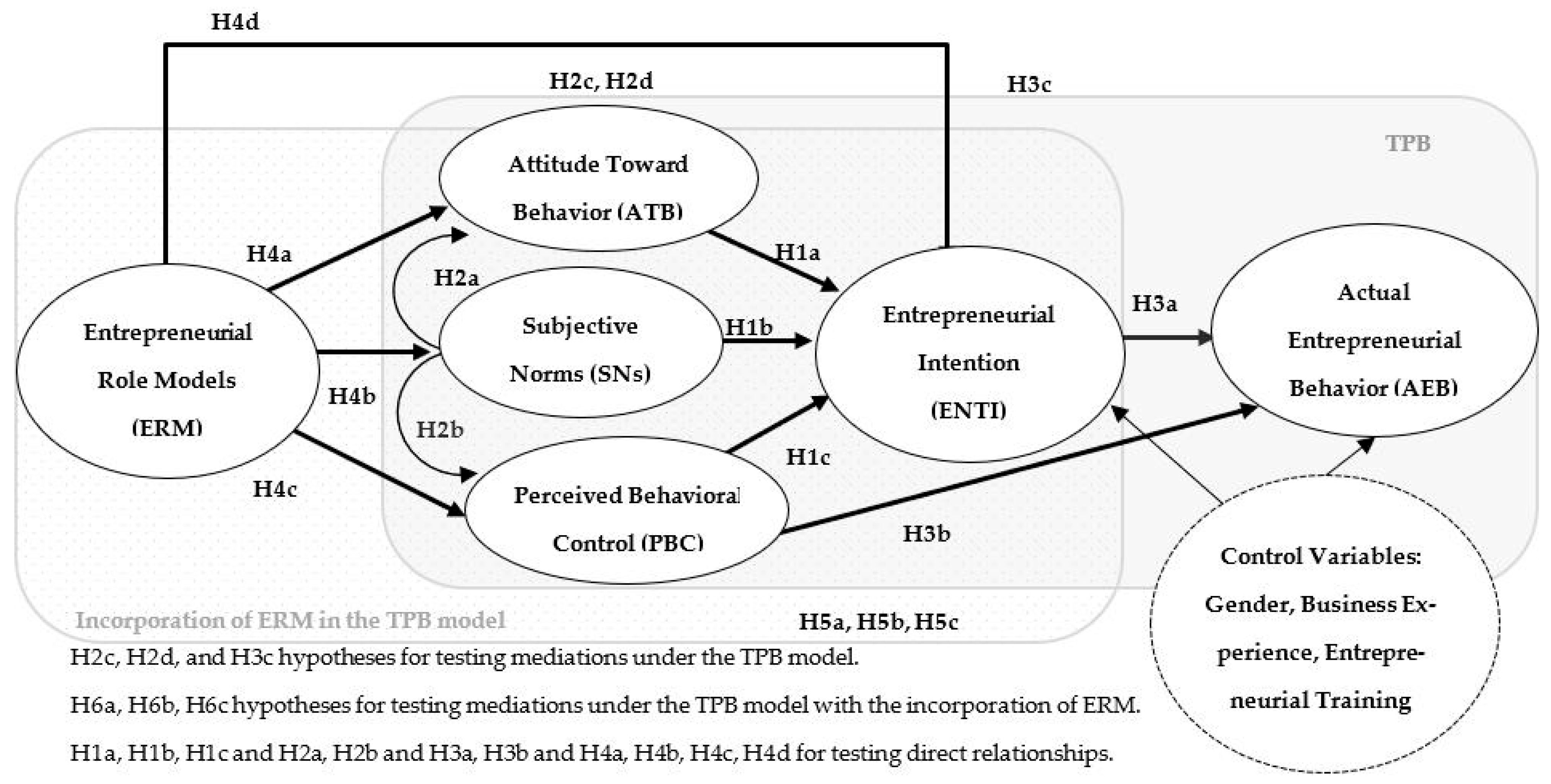
The proposed research model (Figure 1) demonstrated the impact of ERMs on TPB antecedents and ENTIs as well as the effect of these TPB antecedents on ENTIs and AEB. This model represented a mediation framework exploring the direct and indirect relationships between TPB antecedents and ENTIs in the context of this study.

3. Methods

3.1. Participants, Procedure, and Data Collection

We recruited university students and recent sports education graduates who had enrolled in public universities in Riyadh. Data were collected from November 2022 to May 2023 through an online survey administered via Google Forms. The survey’s link was converted to a QR code and distributed with the help of sports education colleagues across classes covering different levels of study. We targeted undergraduate and graduate students. The convenience sampling method was employed to recruit additional participants, with the assistance of the students. Informed consent was obtained from all participants, and their participation was assumed to be voluntary. Confidentiality of gathered data and anonymity of their responses were fully assured.
A total of 451 responses were gathered. Following the recommendations of Tabachnick et al. (2013), data were screened and purified. A total of 71 questionnaires were excluded owing to redundancy and incomplete information. Only eight observations containing outliers were identified. Thus, 372 observations were deemed suitable for running the model and testing the research hypotheses.
An overview of the sample’s demographic profile is provided in Table 1. More than 73% of the respondents were women. Approximately 83.3% were under 24 years old. More than 85% were undergraduate students. Less than 12% had a parent who was a business owner, and more than 26% had a friend or relative who owned a business. Only 18.5% had acquired business experience, and approximately 26% of them had entrepreneurship training.

3.2. Measures of Variables

We drew on studies that have validated the TPB constructs globally and in Saudi Arabia (Aloulou, 2015, 2016a, 2017; Aloulou et al., 2024; Engle et al., 2010; Jemli, 2018; Krueger & Carsrud, 1993; Schlaegel & Koenig, 2014). We extended the TPB intention model by incorporating an additional independent variable, ERMs. The TPB constructs were assessed on a 5-point Likert scale, ranging from 1 (“strongly disagree”) to 5 (“strongly agree”). All items were adapted from established studies to ensure reliability and validity.
Measuring actual entrepreneurial behavior: This variable is related to the intention to start a business rather than the outcome of having already established one (Ajzen, 1985; Aloulou, 2017; Kautonen et al., 2013). Two questions were used to assess the AEB across different commitment levels in line with the TPB (Ajzen, 1991; Fayolle & Liñán, 2014). The first question asked the following: “During the last semester up to now, have you started a business or considered starting a business alone or with others?” The second question asked the respondents to indicate their status by selecting one of the following options: (1) have not considered starting a business, (2) have considered it but taken no action, (3) have not started a business but have begun preparations and plan to launch one in the near future, and (4) have already started a business. These options can be combined into a single item to assess the AEB accomplished by the individual at the time of the survey, measured on a scale from 1 (first option) to 4 (fourth option) (Mean = 1.705; Standard Deviation = 0.569).
Measuring the theory of planned behavior variables: ENTI with six items (e.g., “I have very seriously thought of starting a firm”); ATB with five items (e.g., “Being an entrepreneur would entail great satisfaction for me”); SNs with three items (e.g., “If you decided to create a firm, would people in your close environment approve of that decision? How about your close family?”); PBC with six items (e.g., “If I tried to start a firm, I would have a high probability of succeeding”). These measures were adapted from Liñán and Chen’s work (2009) and validated in several studies in the Saudi context (Aloulou, 2015; Aloulou et al., 2024; Choukir et al., 2019).
Measuring entrepreneurial role models: We assessed ERMs using two items. The respondents indicated whether their parents, relatives, or close family friends had entrepreneurial experience. For computing the final variable, the first item, “parents as owners,” was actually coded to reflect exposure intensity, where 0 = neither parent is an entrepreneur, 1 = one parent is an entrepreneur, and 2 = both parents are entrepreneurs. This was combined with a second item, “relatives and close friends of the family as owners,” using a binary scale where 0 = nobody and 1 = yes. Consequently, the scores ranged from 0 to 3 (Mean = 0.701; Standard Deviation = 0.982). This coding approach highlights the role of parents as ERMs and the importance of having several ERM sources (Aloulou et al., 2024; BarNir et al., 2011; Choukir et al., 2019; Karimi et al., 2014; Fellnhofer, 2017). This method of coding enabled ERMs to be used as an independent variable in the study.
Control variables: Gender, educational status, business experience, and entrepreneurship training were used as the control variables. Gender can affect TPB antecedents and ENTI (Choukir et al., 2019). Several reviews and meta-analytic studies using the TPB framework have indicated that males generally demonstrate higher and more positive levels of TPB motivational factors compared with females (Schlaegel & Koenig, 2014). This suggests that males are more likely to pursue entrepreneurship than females.

3.3. Construct Validity and Reliability

The reliability of each construct was assessed using Cronbach’s alpha coefficient, and composite reliability (CR) was used to determine internal consistency. As exhibited in Table 2, the exploratory factor analysis results indicated good internal consistency across all TPB constructs. The factor loadings were all above 0.704, the explained variance exceeded 61.671%, and the Kaiser-Meyer-Olkin (KMO) values for each construct confirmed the data’s suitability for factor analysis. No problematic cross-loadings that necessitated item removal were found.
Cronbach’s alpha values ranged from 0.857 to 0.898. The CR values ranged from 0.900 to 0.924, and the average variance extracted (AVE) values ranged from 0.785 to 0.884. All constructs exceeded commonly accepted thresholds (α > 0.70, CR > 0.70), indicating satisfactory internal consistency. Convergent validity was assessed based on the factor loadings and AVE. The analysis confirmed that the items conformed to a normal distribution and accounted for most of the variance of their corresponding constructs. It is also noted that all constructs exceeded commonly accepted thresholds. Thus, based on these findings, convergent validity was established.

3.4. Matrix of Correlation and Discriminant Validity

A correlation analysis was performed to assess the strength and direction of the linear relationships between the independent, dependent, and control variables. As exhibited in Table 3, the results indicated significant positive relationships between most independent and dependent variables at the 0.01 significance level. Notably, significant positive associations were found between the TPB antecedents, intention, and actual behavior at the 0.01 level. Furthermore, ERMs demonstrated significant positive relationships with all main variables, except for ATB and PBC, at the 0.05 significance level.
Additionally, a negative and significant relationship was observed between gender, educational status, and business experience at the 0.01 significance level, as well as between gender and PBC at the 0.05 significance level.
Discriminant validity was established using two approaches: the conservative method (Fornell & Larcker, 1981; Table 3) and heterotrait–monotrait ratio (HTMT) method (Henseler et al., 2014; Table 4). Table 3 demonstrates that the correlations among the main variables were lower than the square root of the AVE for each variable, supporting discriminant validity. Similarly, Table 4 illustrates that the HTMT estimates, which measured the true correlations among the constructs, were below the 0.9 threshold, with the highest HTMT value being 0.722. These findings confirmed the establishment of discriminant validity.

3.5. Common Method Variance Bias

The common method variance bias was assessed using the Harman single-factor test in SPSS (21.0) by including all items related to the independent and dependent variables. The analysis extracted four factors with eigenvalues greater than 1.0, which explained 66.781% of the total variance. The first factor explained 40.964% of the variance (less than 50%), whereas the remaining three factors accounted for 25.817% of the variance. Based on these findings, we determined that the common method bias was not a significant concern because no single factor emerged as the primary source of variance (MacKenzie & Podsakoff, 2012).

3.6. Analytical Strategy

To examine the hypotheses, we employed a stepwise approach using hierarchical multiple regression in SPSS. Various regression models were developed to evaluate the impact of each predictor variable while accounting for the influence of other predictors.
A hierarchical multiple regression analysis was performed to investigate the direct relationships between the independent variable (ERMs), mediators (ATB, SNs, and PBC), mediator-dependent variable (ENTI), and final dependent variable (AEB). Additionally, the mediation effects were assessed using linear multiple regression methods.
Some hypotheses were evaluated using linear regression with t-tests for the regression coefficients and F-statistics to determine overall significance.
The mediation effects were analyzed using linear multiple regression techniques, in line with the procedures outlined by Baron and Kenny (1986) and further supported by the Sobel test (Hayes, 2013; Preacher & Leonardelli, 2001). The analysis includes unstandardized regression coefficients for the IV-mediator and mediator-DV relationships, along with their standard errors. The program assesses whether the IV’s indirect effect on the DV through the mediator is statistically significant using the critical ratio.
Hayes’s PROCESS Macro (Version 4.2) with Model 4 (Hayes, 2022) is used to confirm the results of the mediation analysis. The procedure estimates the effect of the independent variable (X) on the mediator (M) (path a), and the effect of the mediator on the dependent variable (Y) while controlling for X (path b). It also computes the direct effect of X on Y (path c′) and the indirect effect (a × b). Mediation is tested using 5000 bootstrap samples; an indirect effect is considered significant when the bootstrapped confidence interval does not include zero. Covariates can be included to isolate the unique effect of the focal predictor.

4. Results

4.1. Testing the Relationships Between the Theory of Planned Behavior Antecedents, Entrepreneurial Intention, and Behavior

The TPB antecedents had significant relationships with ENTIs (Table 5; model 1). The ATB significantly influenced ENTIs (β = 0.416, p < 0.001), followed by PBC (PBC, β = 0.257, p < 0.001) and SNs (SNs, β = 0.194, p < 0.001). Therefore, H1a–c were supported.
Furthermore, SNs had a positive and significant influence on ATB (β = 0.444, p < 0.001) and PBC (β = 0.373, p < 0.001; Table 6; ATB model 10 and PBC model 11). Thus, H2a–b were supported.
The findings demonstrated that ATB and PBC partially mediated the relationship between SNs and ENTI (Table 5; models 2, 3, and 4). The Sobel test for mediation was conducted for the main variables (ATB: 7.357, significant at p < 0.001; PBC: 6.305, significant at p < 0.001). With the inclusion of ATB and SNs in model 3 and PBC and SNs in model 4 of ENTI, SNs continued to have a significant relationship with ENTI but with a reduced β (0.277) compared with Model 2 (β = 0.496). Hence, H2c and H2d were partially supported.

4.2. Testing the Incorporating Entrepreneurial Role Models in the TPB

A significant relationship was observed between ERMs and SNs (β = 0.142, p < 0.001; Table 7, model 13). However, no relationship existed between ERMs and ATB (β = 0.068, p > 0.05) and between ERMs and PBC (β = 0.072, p > 0.05) (Table 7, ATB model 12 and PBC model 14). Moreover, there was a significant direct relationship between ERMs and ENTI (β = 0.146, p < 0.01, Table 5, model 5) without the intervention of any mediators.
Considering all variables (TPB antecedents and ERMs) in one ENTI model (Model 10), the effect of ERMs on ENTI was nonsignificant, implying that ERMs had an indirect effect on ENTI through only one of the TPB antecedents (SNs). As noted above, one condition was not satisfied (Table 7, models 12 and 14): there was no direct relationship between ERMs, ATB, and PBC. Consequently, H4a, H4b, and H4d were not supported; however, H4c was supported.
Therefore, ATB and PBC did not mediate the relationship between ERMs and ENTI (Table 5, models 7 and 8, Sobel test non-significant). However, only SNs fully mediated this relationship (model 6; Sobel test: 2.691, significant at p < 0.01). Hence, H5a and H5c were not supported, and H5b was fully supported.
A positive relationship was observed between ENTI and AEB (β = 0.448, p < 0.001) and between PBC and AEB (β = 0.391, p < 0.001; Table 8; models 15 and 16). Therefore, H3a–b were supported.
We also found that ENTI partially mediated the relationship between PBC and AEB (Sobel test for mediation: 5.62, significant at p < 0.001; model 17). Moreover, PBC had a significant relationship with ENTI, with a reduced β (0.201) compared with model 16 in Table 8 (β = 0.391). Therefore, H3c was partially supported.
Table 9 summarizes the outcomes of hypothesis testing. The results largely support the TPB framework, confirming the significant roles of ATB, SNs, and PBC in shaping entrepreneurial intentions and behavior. The findings also highlight the mediating influence of TPB antecedents, particularly the normative pathway linking ERMs to entrepreneurial intentions through SNs, while several direct ERM effects were not supported.

4.3. Supplementary Mediation Analysis Using Bootstrapping

4.3.1. Mediating Role of ATB and PBC in the SN-ENTI Relationship

The PROCESS macro (Model 4, Hayes, 2022) was used to confirm the mediating roles of ATB and PBC in the relationship between SNs and ENTI, while controlling for gender, academic status, business experience, and entrepreneurship training. The results reveal that SNs significantly predicted ATBs (β = 0.372, p < 0.001) and PBCs (β = 0.468, p < 0.001), explaining 24.9% and 30.7% of their variance, respectively. Entrepreneurship training also showed a positive effect on both ATBs (β = 0.299, p < 0.001) and PBCs (β = 0.453, p < 0.001). When predicting ENTI, ATB (β = 0.433, p < 0.001) and PBC (β = 0.218, p < 0.001) emerged as strong predictors, alongside a significant direct effect of SNs (β = 0.169, p < 0.001). The full model accounted for 50.2% of the variance in entrepreneurial intentions.
Mediation analysis bootstrapped with 5000 samples revealed a significant total indirect effect of SNs on ENTI (β = 0.263; 95% BootCI [0.192, 0.342]). Both mediators contributed significantly: ATB (β = 0.161; 95% BootCI [0.097, 0.237]) and PBC (β = 0.102; 95% BootCI [0.058, 0.150]). As the direct effect remained significant, the results indicate partial mediation, confirming that SNs influence ENTI both directly and indirectly through ATB and PBC.

4.3.2. Mediating Role of TPB Antecedents in the ERMs-ENTI Relationship

A multiple mediation analysis using PROCESS macro (Model 4) was conducted to examine whether ATB, PBC, and SN mediate the relationship between ERMs and ENTI, controlling for gender, academic status, business experience, and entrepreneurship training. The findings showed that ERMs did not significantly predict ATB (β = 0.050, p = 0.184) or PBC (β = 0.065, p = 0.147). However, ERMs showed a significant positive effect on SNs (β = 0.125, p = 0.006), indicating that exposure to entrepreneurial role models primarily shapes students’ perceived social pressure and approval toward entrepreneurship rather than their personal attitudes or control beliefs.
When predicting entrepreneurial intentions, ATBs (β = 0.433, p < 0.001), PBCs (β = 0.218, p < 0.001), and SNs (β = 0.161, p < 0.001) were all significant predictors. The full model explained 50.8% of the variance in entrepreneurial intentions. The direct effect of ERMs on ENTI was marginal and non-significant (β = 0.056, p = 0.052), suggesting the absence of a strong direct relationship.
Bootstrapped mediation results (5000 samples) revealed that the total indirect effect of ERMs on entrepreneurial intentions was not significant (β = 0.056; 95% BootCI [−0.010, 0.119]). Among the specific indirect pathways, only the mediation through subjective norms was significant (β = 0.020; 95% BootCI [0.002, 0.046]), whereas the indirect effects via ATBs and PBCs were non-significant.
Overall, these findings indicate that subjective norms fully transmit the influence of entrepreneurial role models on entrepreneurial intentions, while attitudes and perceived behavioral control do not serve as mediating mechanisms. This pattern reinforces the notion that ERMs operate mainly through social influence processes, consistent with the normative component of the TPB.

4.3.3. Mediating Role of ENTI Between PBC and AEB

A mediation analysis using PROCESS macro (Model 4) was conducted to examine whether ENTI mediates the relationship between PBC and AEB, while controlling for gender, academic status, business experience, and entrepreneurship training. The results revealed that PBC had a strong positive effect on ENTI (β = 0.468, p < 0.001), explaining 30.8% of the variance in ENTI. None of the control variables showed a significant effect at this stage. Thus, when predicting AEB, both PBC (β = 0.155, p < 0.001) and ENTI (β = 0.312, p < 0.001) were significant predictors, and the model accounted for 24.5% of the variance in AEB. The direct effect of PBCs on AEB remained significant after including ENTI.
Bootstrapped mediation analysis (with 5000 samples) revealed a significant indirect effect of PBC on AEB through ENTI (β = 0.146; 95% BootCI [0.101, 0.197]). Because both the direct and indirect effects were significant, the results indicate partial mediation.
Overall, these findings confirm the central assumption of the TPB that PBC influences AEB both directly and indirectly through ENTI, reinforcing the intention–behavior link in the context of sports education students.

5. Discussion, Implications, and Limitations

5.1. Discussion

This study investigated the factors influencing ENTI and actual AEB among Saudi Arabian sports education students, drawing on Ajzen’s (1991) TPB. By incorporating ERMs as a predictor of the TPB’s primary antecedents—ATB, SNs, and PBC—this study makes a significant contextual extension.
The TPB’s applicability in this particular educational domain is strongly supported by the empirical findings. According to well-established entrepreneurship literature, ATB has a significant and direct impact on ENTI (Kautonen et al., 2015; Liñán & Chen, 2009). This implies that encouraging a positive view of entrepreneurship as a desirable and feasible career path is essential for sports students. This relationship can also be explained by sports psychology principles. Goal-setting and positive self-talk, which are similar to building a strong ATB, are key to performance and can be used to support starting a business. PBC was also found to be an important, though somewhat weaker, predictor. This shows that confidence in handling business tasks remains a major challenge, even for people who are disciplined and goal-oriented (Aloulou, 2016a; Kautonen et al., 2013). Sports academic programs often focus more on technical and physical training than on business skills, which may lead to a gap between athletes’ self-confidence and their entrepreneurial PBC.
Particular attention should be paid to the substantial impact of SNs on ENTI. This finding is particularly noticeable in the team-oriented, hierarchical structure of sports education, where career identity is significantly shaped by peer, coach, and family approval (González-Serrano et al., 2021). The collectivist cultural fabric of Saudi Arabia amplifies this effect even more (D. Alrubaishi et al., 2021), making normative influences a critical channel for intention formation. More significantly, the discovery that SNs have a positive impact on both ATB and PBC indicates a social shaping mechanism; in this situation, supportive networks actively model entrepreneurial attitudes and bolster an individual’s confidence in their own abilities through encouragement and shared resources, rather than just applying passive pressure (Huang & Knight, 2017). This explains why, in contrast to the conflicting findings in larger meta-analyses, SNs may be a more accurate predictor in collectivist, high-social-cohesion environments (Armitage & Conner, 2001). This pattern is similar to how athletes develop their careers. For example, moving from amateur to professional is often shaped and validated by coaches, mentors, and the sports community. This suggests that entrepreneurial career changes in this group may follow a similar path.
The results reveal a main theoretical distinction: social norms (SNs) influence intentions both directly and by modelling attitudes and behavioral control. In contrast, role models (ERMs) act simply by altering SNs, operating purely as a social indicator within this context. This elucidates a periphery condition, proving that role models influence normative values, not personal cognitions, and function as a social signal rather than a direct cognitive driver.
With this context in mind, the study’s theoretical framework was designed to highlight the importance of normative mediation. The framework suggested that in the close-knit, team-based environment of sports education, which is further shaped by a collectivist culture, outside influences like ERMs are mainly understood through social expectations. In settings where group identity and following the lead of coaches, peers, or family are key, people are especially sensitive to what is considered normal or acceptable. So, the study proposed that role models act less as direct influences on attitudes or confidence and more as signals of what the group values. This led to the expectation that the ERM to ENTI relationship would be explained entirely by subjective norms, a hypothesis that was later tested and confirmed by mediation analysis.
A crucial domain-specific insight is highlighted by the important role of PBC in behavior prediction. Even though the connection between ENTI and AEB was confirmed, validating the TPB’s central hypothesis, intention alone is insufficient in the sports industry, where entry is frequently controlled by facility access, licensing, and competition with established entities (Ratten & Jones, 2018). Student’s perceived and real ability to overcome these industry-specific obstacles is crucial to turning intention into action. The challenge of turning intention into action is clear in the “dual career” model of athlete development, where people must balance both sports and academic or job responsibilities. In the same way, sports students might see entrepreneurship as something that competes with their athletic goals unless their programs help combine the two.
The role of ERMs is the most theoretically significant finding. The fully mediated normative pathway is indicated by the significant path from ERMs to SNs rather than altering ATB, PBC, or ENTI. This implies that the influence of a role model, even a close relative, functions mainly as a social signal within the close-knit social ecosystem of sports education. Rather than directly increasing perceived control or changing personal attitudes, it works to change the individual’s perception of what is socially acceptable and supported within their reference groups. By stating that the pathway of observational learning is context-contingent and that its main impact in highly normative environments is on normative beliefs, this enhances Bandura’s (1977) social learning theory.

5.2. Theoretical Implications

This study contributes to the literature by advancing beyond the general confirmation of established relationships and presenting a contextually refined theoretical perspective. Although prior research has robustly documented that exposure to Entrepreneurial Role Models (ERMs) influences entrepreneurial intentions (ENTIs) through the core antecedents of the Theory of Planned Behavior (TPB) (Bosma et al., 2012; Karimi et al., 2014), these mechanisms have typically been treated as universal. The present findings challenge this assumption and offer significant theoretical elaboration by demonstrating that the psychosocial process of learning from role models is fundamentally contingent upon the normative structure of the environment.
The most theoretically salient finding is the exclusive, fully mediated pathway from ERMs to ENTIs via Subjective Norms (SNs), with no direct effects on Attitudes Toward Behavior (ATB) or Perceived Behavioral Control (PBC). This result diverges from the more diffuse influence patterns reported in the broader entrepreneurship literature. It suggests that within the highly cohesive, team-oriented, and collectivist social ecosystem of sports education, characterized by strong in-group dynamics and shared identities, the influence of even proximate role models (such as family) functions primarily as a powerful normative signal. Instead of directly altering personal attitudes or self-efficacy beliefs, ERMs reshape individuals’ perceptions of what is socially sanctioned and valued within their critical reference groups.
This insight advances theoretical understanding in three key ways:
  • First, it specifies the boundary conditions of Social Learning Theory (Bandura, 1977) in entrepreneurial contexts. This study extends the premise that individuals learn through observation by demonstrating that what is learned and how it is cognitively processed—whether internalized as a personal attitude or perceived as a social expectation—depends critically on the normative strength of the social environment. The application of social learning is thus transitioned from a general principle to a conditional theory, wherein the mechanism of observational influence is context dependent.
  • Second, it refines the TPB by elucidating conditional antecedent dominance. The TPB posits that the relative weights of ATB, SN, and PBC can vary across behaviors and situations (Ajzen, 1991). Our study provides robust empirical evidence for this proposition within the underexplored domain of sports entrepreneurship, revealing that in tightly knit, normative settings, the SN pathway can become the predominant channel through which external social factors (like ERMs) exert their influence. This offers a more nuanced model for predicting intention formation in collectivist or high-group-cohesion cultures.
  • Third, it deepens the conceptual understanding of ERM influence’s mechanisms. By shifting the focus from whether ERMs matter to how and when they are most influential, this study provides a more precise theoretical perspective. The findings indicate that in certain environments, the primary utility of role models may not be to demonstrate procedural knowledge (affecting PBC) or to enhance desirability (affecting ATB), but rather to confer social legitimacy and reduce perceived normative barriers.

5.3. Practical Implications

Targeted strategies for sports education ecosystems are derived from the findings. Curricular integration needs to be more than just generic business modules. In order to improve personal relevance and ATB, pedagogy should make use of the sports mindset, framing venture creation through metaphors of competition, performance, and teamwork, and employing case studies of athlete-entrepreneurs. Institutions must consciously design normative support networks in order to fully utilize SNs.
In order to make entrepreneurial success clearly attainable and socially acceptable within the student’s own community, structured mentorship programs link students with alumni who have successfully negotiated the sports-business interface.
To convert intention into action, support must address domain-specific PBC. This requires providing resources like incubators with expertise in sports licensing and marketing, “sports-entrepreneurship” clinics, and facilitating access to seed funding and industry-specific networks to lower the tangible barriers unique to the sports sector.

5.4. Limitations and Future Research

The cross-sectional design and Saudi-specific, convenience-based sample (predominantly female and undergraduate) limit causal claims and generalizability. Future longitudinal and comparative studies, larger and more balanced samples, and randomized recruitment are needed to strengthen the robustness and applicability of the findings, including potential gender- and education-level differences in entrepreneurial cognition and behavior.
A key conceptual limitation is our focus on proximal familial ERMs. Future research should dissect the differential impacts of proximal (family, teachers) versus distal (elite athletes, coaches) role models. We posit that distal models may have a stronger inspirational effect on ATB, while proximal models are more potent in shaping SNs—a crucial distinction for program design. Thus, future research should employ multidimensional ERM measures that distinguish relational proximity, interaction frequency, and perceived influence to enhance construct precision.
A second key conceptual limitation is also our focus on AEB as an ordered behavioral continuum reflecting progression from non-consideration to active venture creation, a practice commonly adopted in entrepreneurship research with student samples. Future research could apply ordinal or categorical modeling approaches to further validate these findings to measure commitment in terms of startup activities.
Furthermore, incorporating domain-specific moderators such as athletic identity salience or competition level could reveal important nuances. For instance, does a stronger athletic identity amplify resistance to non-traditional careers, or does it provide a reservoir of discipline that enhances PBC? Exploring these questions will yield a more granular understanding of entrepreneurship in sports contexts.

6. Conclusions

This study validates the TPB in the context of Saudi sports education while critically refining its application. It reveals that within this socially dense environment, subjective norms act as a primary catalyst and the exclusive conduit for the influence of entrepreneurial role models. These insights argue for a shift from generic entrepreneurial training to context-embedded cultivation, where educational and ecosystem strategies are deliberately aligned with the social, psychological, and structural realities of the sports domain. Such an approach is essential for effectively unlocking entrepreneurial potential and contributing to diversified, knowledge-based economies.
The main contribution remains in outlining an explicit normative pathway: ERMs impact intentions not by largely boosting attitudes or perceived control, but precisely by changing perceived social norms, which in turn act as a key direct antecedent and a social shaper of other cognitive beliefs.

Author Contributions

Conceptualization, H.J., W.J.A. and A.H.A.; Methodology, H.J. and W.J.A.; Software, W.J.A.; Validation, H.J., W.J.A. and A.H.A.; Formal Analysis, W.J.A.; Investigation, H.J.; Resources, H.J. and W.J.A.; Data Curation, H.J. and W.J.A.; Writing—Original Draft Preparation, H.J. and W.J.A.; Writing—Review and Editing, H.J., W.J.A. and A.H.A.; Supervision, H.J. and A.H.A.; Project Administration, H.J. and A.H.A.; Funding Acquisition, H.J. All authors have read and agreed to the published version of the manuscript.

Funding

This work was supported and funded by the Deanship of Scientific Research at Imam Mohammad Ibn Saud Islamic University (IMSIU) (grant number IMSIU-DDRSP2601).

Institutional Review Board Statement

The study was conducted in accordance with the Decla-ration of Helsinki and approved by the Institutional Review Board of Princess Nourah bint Abdulrahman University, Riyadh, KSA (protocol code HAP-01-R-059 3 April 2022).

Informed Consent Statement

Informed consent was obtained from all subjects involved in the study.

Data Availability Statement

Data are available upon request from the corresponding author.

Acknowledgments

This work was supported and funded by the Deanship of Scientific Research at Imam Mohammad Ibn Saud Islamic University (IMSIU) (grant number IMSIU-DDRSP2601).

Conflicts of Interest

The authors declare no conflicts of interest.

Correction Statement

This article has been republished with a minor correction to the Funding statement and the Acknowledgments. This change does not affect the scientific content of the article.

Abbreviations

The following abbreviations are used in this manuscript:
AEBActual Entrepreneurial Behavior
ATBAttitudes Toward Behavior
ENTIEntrepreneurial Intention
ERMsEntrepreneurial Role Models
PBCPerceived Behavioral Control
SNsSubjective Norm(s)
TPBTheory of Planned Behavior

References

  1. Abbasianchavari, A., & Moritz, A. (2021). The impact of role models on entrepreneurial intentions and behavior: A review of the literature. Management Review Quarterly, 71, 1–40. [Google Scholar] [CrossRef]
  2. Acs, Z. J., Stam, E., Audretsch, D. B., & O’Connor, A. (2021). The lineages of the entrepreneurial ecosystem approach. Small Business Economics, 49(1), 1–10. [Google Scholar] [CrossRef]
  3. Ajzen, I. (1985). From intentions to actions: A theory of planned behaviour. In J. Kuhl, & J. Beckmann (Eds.), Action control: From cognition to behavior (pp. 11–39). Springer. [Google Scholar]
  4. Ajzen, I. (1991). The theory of planned behavior. Organizational Behavior and Human Decision Processes, 50(2), 179–211. [Google Scholar] [CrossRef]
  5. Ajzen, I. (2020). The theory of planned behavior: Frequently asked questions. Human Behavior and Emerging Technologies, 2(4), 314–324. [Google Scholar] [CrossRef]
  6. Ajzen, I., & Fishbein, M. (1980). Understanding attitudes and predicting social behavior. Prentice-Hall. [Google Scholar]
  7. Aloulou, W. J. (2015). Entrepreneurial intention among freshmen students—Application of the theory of planned behaviour in Saudi context. Journal of Enterprising Culture, 23(4), 473–500. [Google Scholar] [CrossRef]
  8. Aloulou, W. J. (2016a). Predicting entrepreneurial intentions of final year Saudi university business students by applying the theory of planned behavior. Journal of Small Business and Enterprise Development, 23(4), 1142–1164. [Google Scholar] [CrossRef]
  9. Aloulou, W. J. (2016b). Predicting entrepreneurial intentions of freshmen students from EAO modeling and personal background: A Saudi perspective. Journal of Entrepreneurship in Emerging Economies, 8(2), 233–253. [Google Scholar] [CrossRef]
  10. Aloulou, W. J. (2017). Investigating entrepreneurial intentions and behaviours of Saudi distance business learners: Main antecedents and mediators. Journal for International Business and Entrepreneurship Development, 10(3), 231–257. [Google Scholar] [CrossRef]
  11. Aloulou, W. J. (2022). The influence of institutional context on entrepreneurial intention: Evidence from the Saudi young community. Journal of Enterprising Communities: People and Places in the Global Economy, 16(5), 677–698. [Google Scholar] [CrossRef]
  12. Aloulou, W. J., Ayadi, F., Ramadani, V., & Dana, L. P. (2024). Dreaming digital or chasing new real pathways? Unveiling the determinants shaping Saudi youth’s digital entrepreneurial intention. International Journal of Entrepreneurial Behavior & Research, 30(2/3), 709–734. [Google Scholar]
  13. Alrubaishi, D., McAdam, M., & Harrison, R. (2021). Culture, convention, and continuity: Islam and family firm ethical behavior. Business Ethics, the Environment & Responsibility, 30(2), 202–215. [Google Scholar] [CrossRef]
  14. Alrubaishi, D. A., Lyons, R., Largey, A., & Alarifi, G. (2019). The entrepreneurial career intentions and behavior of KSA university students. GUESSS national report 2019: Kingdom of Saudi Arabia (KSA). GUESSS. [Google Scholar]
  15. Anjum, T., Farrukh, M., Heidler, P., & Díaz Tautiva, J. A. (2020). Entrepreneurial intention: Creativity, entrepreneurship, and university support. Journal of Open Innovation: Technology, Market, and Complexity, 7(1), 11. [Google Scholar] [CrossRef]
  16. Armitage, C. J., & Conner, M. (2001). Efficacy of the theory of planned behavior: A meta-analytic review. British Journal of Social Psychology, 40(4), 471–499. [Google Scholar] [CrossRef] [PubMed]
  17. Atilgan, D., & Tükel, Y. (2021). Sports college students and entrepreneurship: An investigation into entrepreneurship tendencies. International Education Studies, 14(6), 112–124. [Google Scholar] [CrossRef]
  18. Autio, E., Keeley, R. H., Klofsten, M., Parker, G. G. C., & Hay, M. (2001). Entrepreneurial intent among students in Scandinavia and in the USA. Enterprise and Innovation Management Studies, 2(2), 145–160. [Google Scholar] [CrossRef]
  19. Ball, S. (2005). The importance of entrepreneurship to hospitality, leisure, sport and tourism. Journal of the Hospitality, Higher Leisure, Sport Education and Tourism Academy Network, 3, 1–14. [Google Scholar]
  20. Bandura, A. (1977). Self-efficacy: Toward a unifying theory of behavioral change. Psychological Review, 84(2), 191–215. [Google Scholar] [CrossRef] [PubMed]
  21. Barba-Sánchez, V., Mitre-Aranda, M., & del Brío-González, J. (2022). The entrepreneurial intention of university students: An environmental perspective. European Research on Management and Business Economics, 28(2), 100184. [Google Scholar] [CrossRef]
  22. BarNir, A., Watson, W. E., & Hutchins, H. M. (2011). Mediation and moderated mediation in the relationship among role models, self-efficacy, entrepreneurial career intention, and gender. Journal of Applied Social Psychology, 41, 270–297. [Google Scholar] [CrossRef]
  23. Baron, R. M., & Kenny, D. A. (1986). The moderator–mediator variable distinction in social psychological research: Conceptual, strategic, and statistical considerations. Journal of Personality and Social Psychology, 51(6), 1173–1182. [Google Scholar] [CrossRef] [PubMed]
  24. Bosma, N., Hessels, J., Schutjens, V., Van Praag, M., & Verheul, I. (2012). Entrepreneurship and role models. Journal of Economic Psychology, 33(2), 410–424. [Google Scholar] [CrossRef]
  25. Brestovci, S. B., Zhushi, G., Krasniqi, B., Kryeziu, L., Bağış, M., Lajqi, S., Zeqiri, B., & Dedaj, Z. (2023). Sports university education and entrepreneurial intentions: Findings from Kosovo. Economic Alternatives, 29(1), 210–228. [Google Scholar] [CrossRef]
  26. Choukir, J., Aloulou, W. J., Ayadi, F., & Mseddi, S. (2019). Influences of role models and gender on Saudi Arabian freshman students’ entrepreneurial intention. International Journal of Gender and Entrepreneurship, 11(2), 186–206. [Google Scholar] [CrossRef]
  27. Dinning, T. (2017). Preparing sports graduates for employment: Satisfying employers’ expectations. Higher Education, Skills and Work-Based Learning, 7(4), 354–368. [Google Scholar] [CrossRef]
  28. Elshaer, I. A. (2023). Investment in the sports industry in Saudi Arabia and its impact on the quality of life of football fans. Journal of Law and Sustainable Development, 11(12), e2236. [Google Scholar] [CrossRef]
  29. Engle, R. L., Dimitriadi, N., Gavidia, J. V., Schlaegel, C., Delanoe, S., Alvarado, I., He, X., Buame, S., & Wolff, B. (2010). Entrepreneurial intent: A twelve-country evaluation of Ajzen’s model of planned behaviour. International Journal of Entrepreneurial Behavior & Research, 16(1), 35–57. [Google Scholar]
  30. Esmail, H. A., Wani, M. J., Attia, O. N., & Galal, H. E. (2025). Entrepreneurial dynamics and their impact on economic development in Saudi Arabia. Future Business Journal, 11(1), 99. [Google Scholar] [CrossRef]
  31. Fayolle, A., Gailly, B., & Lassas-Clerc, N. (2006). Assessing the impact of entrepreneurship education programmes: A new methodology. Journal of European Industrial Training, 30(9), 701–720. [Google Scholar] [CrossRef]
  32. Fayolle, A., & Liñán, F. (2014). The future of research on entrepreneurial intentions. Journal of Business Research, 67(5), 663–666. [Google Scholar] [CrossRef]
  33. Fellnhofer, K. (2017). The power of passion in entrepreneurship education: Entrepreneurial role models encourage passion? Journal of Entrepreneurship Education, 20(1), 58. [Google Scholar] [PubMed]
  34. Fishbein, M., & Ajzen, I. (1975). Belief, attitude, intention, and behavior: An introduction to theory and research. Addison-Wesley. [Google Scholar]
  35. Fornell, C., & Larcker, D. F. (1981). Evaluating structural equation models with unobservable variables and measurement error. Journal of Marketing Research, 18(1), 39–50. [Google Scholar] [CrossRef]
  36. González-Serrano, M. H., Moreno, F. C., & Hervás, J. C. (2021). Sport management education through an entrepreneurial perspective: Analysing its impact on Spanish sports science students. The International Journal of Management Education, 19(1), 100271. [Google Scholar] [CrossRef]
  37. González-Serrano, M. H., Valantine, I., & Campos, C. M. (2020). Sustainable sport entrepreneurship and innovation: A bibliometric analysis of this emerging field of research. Sustainability, 12(12), 5209. [Google Scholar] [CrossRef]
  38. González-Serrano, M. H., Valantine, I., Hervás, J. C., Pérez-Campos, C., & Moreno, F. C. (2018). Sports university education and entrepreneurial intentions: A comparison between Spain and Lithuania. Education + Training, 60(5), 389–405. [Google Scholar] [CrossRef]
  39. Hayes, A. F. (2013). Introduction to mediation, moderation, and conditional process analysis: A regression-based approach. Guilford Press. [Google Scholar]
  40. Hayes, A. F. (2022). Introduction to mediation, moderation, and conditional process analysis: A regression-based approach (3rd ed.). Guilford Press. [Google Scholar]
  41. Henseler, J., Ringle, C. M., & Sarstedt, M. (2014). A new criterion for assessing discriminant validity in variance-based structural equation modeling. Journal of the Academy of Marketing Science, 43, 115–135. [Google Scholar] [CrossRef]
  42. Huang, L., & Knight, A. P. (2017). Resources and relationships in entrepreneurship: An exchange theory of the development and effects of the entrepreneur-investor relationship. Academy of Management Review, 42(1), 80–102. [Google Scholar] [CrossRef]
  43. Jemli, H. (2018). Effect of entrepreneurship training on the entrepreneurial intention of students enrolled in Tunisian engineering schools. Market and Organization, 33(3), 145–171. [Google Scholar]
  44. Jones, P., & Jones, A. (2014). Attitudes of sports development and sports management undergraduate students towards entrepreneurship: A university perspective towards best practice. Education + Training, 56(8/9), 716–732. [Google Scholar] [CrossRef]
  45. Karimi, S., Biemans, H. J. A., Lans, T., Chizari, M., & Mulder, M. (2014). Effects of role models and gender on students’ entrepreneurial intentions. European Journal of Training and Development, 38(8), 694–727. [Google Scholar] [CrossRef]
  46. Kautonen, T., Van Gelderen, M., & Fink, M. (2015). Robustness of the theory of planad behavior in predicting entrepreneurial intentions and actions. Entrepreneurship Theory and Practice, 39(3), 655–674. [Google Scholar] [CrossRef]
  47. Kautonen, T., Van Gelderen, M., & Tornokoski, E. T. (2013). Predicting entrepreneurial behavior: A test of the theory of planned behaviour. Applied Economics, 45(6), 697–707. [Google Scholar] [CrossRef]
  48. Kolvereid, L. (1996). Prediction of employment status choice intentions. Entrepreneurship Theory and Practice, 21(1), 47–58. [Google Scholar] [CrossRef]
  49. Krueger, N. F., & Carsrud, A. L. (1993). Entrepreneurial intentions: Applying the theory of planned behavior. Entrepreneurship & Regional Development, 5(4), 315–330. [Google Scholar]
  50. Krueger, N. F., Reilly, M. D., & Carsrud, A. L. (2000). Competing models of entrepreneurial intentions. Journal of Business Venturing, 15(5–6), 411–432. [Google Scholar] [CrossRef]
  51. Liñán, F., & Chen, Y. (2009). Development and cross–cultural application of a specific instrument to measure entrepreneurial intentions. Entrepreneurship Theory and Practice, 33(3), 593–617. [Google Scholar] [CrossRef]
  52. Liñán, F., Rodríguez-Cohard, J. C., & Rueda-Cantuche, J. M. (2011). Factors affecting entrepreneurial intention levels: A role for education. International Entrepreneurship and Management Journal, 7, 195–218. [Google Scholar] [CrossRef]
  53. MacKenzie, S. B., & Podsakoff, P. M. (2012). Common method bias in marketing: Causes, mechanisms, and procedural remedies. Journal of Retailing, 88(4), 542–555. [Google Scholar] [CrossRef]
  54. Nabi, G., Liñán, F., Fayolle, A., Krueger, N., & Walmsley, A. (2017). The impact of entrepreneurship education in higher education: A systematic review and research agenda. Academy of Management Learning & Education, 16(2), 277–299. [Google Scholar] [CrossRef]
  55. Naia, A., Baptista, R., Biscaia, R., Januário, C., & Trigo, V. (2017). Entrepreneurial intentions of sport sciences students and theory of planned behavior. Motriz: Revista de Educação Física, 23(1), 14–21. [Google Scholar] [CrossRef]
  56. Nowiński, W., & Haddoud, M. Y. (2019). The role of inspiring role models in enhancing entrepreneurial intention. Journal of Business Research, 96, 183–193. [Google Scholar] [CrossRef]
  57. Obschonka, M., Hahn, E., & Bajwa, N. H. (2018). Personal agency in newly arrived refugees: The role of personality, entrepreneurial cognitions and intentions, and career adaptability. Journal of Vocational Behavior, 105, 173–184. [Google Scholar] [CrossRef]
  58. Ordiñana-Bellver, D., Aguado-Berenguer, S., Pérez-Campos, C., & González-Serrano, M. H. (2024). Exploring nature-based physical activity as a catalyst for sustainable entrepreneurial intentions in sport science students. Journal of Hospitality, Leisure, Sport & Tourism Education, 34, 100482. [Google Scholar] [CrossRef]
  59. Pellegrini, M. M., Rialti, R., Marzi, G., & Caputo, A. (2020). Sport entrepreneurship: A synthesis of existing literature and future perspectives. International Entrepreneurship and Management Journal, 16(3), 795–826. [Google Scholar] [CrossRef]
  60. Pfister, G. (2015). Assessing the sociology of sport: On women and football. International Review for the Sociology of Sport, 50(4–5), 563–569. [Google Scholar] [CrossRef]
  61. Preacher, K. J., & Leonardelli, G. J. (2001). Calculation for the Sobel test. Available online: http://quantpsy.org/sobel/sobel.htm (accessed on 13 December 2024).
  62. Ratten, V. (2012). Sport entrepreneurship: Challenges and directions for future research. International Journal of Entrepreneurial Venturing, 4(1), 65–84. [Google Scholar] [CrossRef]
  63. Ratten, V. (2018). Sport entrepreneurship: Developing and sustaining an entrepreneurial sport culture. Springer. [Google Scholar]
  64. Ratten, V. (2020). A gender perspective of sport-based entrepreneurship. In V. Ratten (Ed.), Sport entrepreneurship and public policy (pp. 103–115). Springer. [Google Scholar]
  65. Ratten, V., & Jones, P. (2018). Future research directions for sport education: Toward an entrepreneurial learning approach. Education + Training, 60(5), 490–499. [Google Scholar] [CrossRef]
  66. Reynolds, P. D. (1997). New and small firms in expanding markets. Small Business Economics, 9(1), 79–84. [Google Scholar] [CrossRef]
  67. Roundy, P. T., & Bayer, M. A. (2019). Entrepreneurial ecosystem narratives and the micro-foundations of regional entrepreneurship. The International Journal of Entrepreneurship and Innovation, 20(3), 194–208. [Google Scholar] [CrossRef]
  68. Saudi Council of Economic and Development Affairs. (2016). Saudi vision 2030. Available online: https://www.vision2030.gov.sa/ar/ (accessed on 20 March 2024).
  69. Schlaegel, C., & Koenig, M. (2014). Determinants of entrepreneurial intent: A meta-analytic test and integration of competing models. Entrepreneurship Theory and Practice, 38(2), 291–332. [Google Scholar] [CrossRef]
  70. Shane, S., & Venkataraman, S. (2000). The promise of entrepreneurship as a field of research. Academy of Management Review, 25(1), 217–226. [Google Scholar] [CrossRef]
  71. Sjödin, D., Parida, V., Jovanovic, M., & Visnjic, I. (2020). Value creation and value capture alignment in business model innovation: A process view on outcome-based business models. Journal of Product Innovation Management, 37(2), 158–183. [Google Scholar] [CrossRef]
  72. Tabachnick, B. G., Fidell, L. S., & Ullman, J. B. (2013). Using multivariate statistics (6th ed.). Pearson. [Google Scholar]
  73. Van Auken, H., Fry, F. L., & Stephens, P. (2006a). The influence of role models on entrepreneurial intention. Journal of Developmental Entrepreneurship, 11(2), 157–167. [Google Scholar] [CrossRef]
  74. Van Auken, H., Stephens, P., Fry, F. L., & Silva, J. (2006b). Role model influences on entrepreneurial intentions: A comparison between USA and Mexico. The International Entrepreneurship and Management Journal, 2(3), 325–336. [Google Scholar] [CrossRef]
  75. Varamäki, E., Joensuu, S., & Viljamaa, A. (2016). Starting up a firm or not: Differences in the antecedents of entrepreneurial intentions. Industry and Higher Education, 30(3), 239–249. [Google Scholar] [CrossRef]
Figure 1. Proposed model of entrepreneurial intentions using the TPB.
Education 16 00406 g001
Table 1. Respondents’ Demographic Characteristics (N = 372).
VariableDemographicsFrequency (n)Valid Percent (%) *
GenderMale9726.1
Female27573.9
Age (years)−2011831.7
+20 and −2419251.6
+244512.1
Educational StatusUndergraduate31885.5
graduate5414.5
Parent OwnerNo33088.7
Yes4211.3
Friend/Relatives OwnersNo27373.4
Yes9926.6
Business ExperienceNo30381.5
Yes6918.5
Entrepreneurship TrainingNo28977.7
Yes8325.8
* Some data were missing.
Table 2. Constructs’ Validity and reliability.
Construct# Items and CodingFactor Loadings% VarianceKMOCronbach’s AlphaCRAVESquare AVE
Dependent Variable
ENTIENTI10.76367.159%0.8640.8980.9240.6720.819
ENTI20.751
ENTI30.866
ENTI40.872
ENTI50.773
ENTI60.880
Independent Variables
ATBATB10.69264.441%0.8490.8570.9000.6440.803
ATB20.823
ATB30.800
ATB40.883
ATB50.804
SNsSNs1 0.91078.215%0.7200.8600.9150.7830.884
SNs20.856
SNs30.887
PBCPBC10.70461.671%0.8490.8740.9060.6170.785
PBC20.712
PBC30.825
PBC4 0.853
PBC50.829
PBC60.776
Source: Authors’ elaboration.
Table 3. Correlation Matrix and Discriminant Validity Assessment Using Fornell and Larcker (1981) Criterion.
MeanS.D.(1)(2)(3)(4)(5)(6)(7)(8)(9)(10)
(1) 0.740.440-
(2) 1.150.353−0.277 **-
(3) 0.2640.369−0.201 **0.124 *-
(4) 0.3180.3900.0390.113 *0.274 **-
(5) 0.70110.982−0.0230.0280.169 **0.050-
(6) 4.0680.629−0.0090.0550.0830.128 *0.122 *0.819
(7) 4.0070.604−0.0920.0140.121 *0.253 **0.0400.505 **0.803
(8) 3.8310.722−0.019−0.0280.0520.0060.125 *0.414 **0.371 **0.884
(9) 3.2820.741−0.129 *0.0370.123 *0.252 **0.0010.482 **0.482 **0.426 **0.785
(10) 1.7050.5690.055−0.076−0.0250.0340.0940.532 **0.334 **0.381 **0.369 **-
Notes: S.D. = Standard Deviation; ** Correlation is significant at the 0.01 level (2-tailed); * Correlation is significant at the 0.05 level (2-tailed); Diagonal elements (italic) are the square root of the AVE. Off-diagonal elements are correlations between constructs. (1) Gender, (2) Educational status, (3) Business Experience, (4) Entrepreneurship training, (5) ERMs, (6) ENTI, (7) ATB, (8) SNs, (9) PBC, (10) AEB.
Table 4. Discriminant Validity Assessment Using the Heterotrait-Monotrait (HTMT) Ratio Criterion.
ENTIATBSNsPBC
Entrepreneurial Intention ENTI
Attitude Towards Behavior ATB0.722
Subjective Norms SNs0.5770.530
Perceived Behavior Control PBC0.6280.5740.559
Table 5. Hierarchical regression models for predicting entrepreneurial intentions: Main antecedents and mediators (N = 372).
ENTI as Dependent VariableModel 1Model 2Model 3Model 4Model 5Model 6Model 7Model 8Model 9
βββββββββ
Control variables
Gender0.061−0.0020.0320.0500.012−0.0030.0460.0760.060
Educational Status0.0300.0330.0310.0320.0330.0330.0300.0320.031
Business experience0.0230.0460.0390.0200.0950.0420.0570.0330.020
Entrepreneurship training−0.0210.121 **0.0250.0270.146 **0.125 **0.0150.006−0.017
Mediating variables
ATB0.416 ***-0.493 ***---0.614 ***-0.416 ***
SNs0.194 ***0.496 ***0.277 ***0.318 ***-0.485 ***--0.184 ***
PBC0.257 ***--0.392 ***---0.542 ***0.256 ***
Independent variable
ERMs ---0.146 **0.0770.104 *0.107 *0.073
R Square (R2)0.5020.2780.4610.3850.570.2840.4120.3190.508
Adjusted R Square (R2)0.4930.2690.4520.3750.0440.2720.4020.3080.497
F Value52.49728.25152.04438.0524.44524.15242.56328.55346.765
Significance of F0.000 **0.000 **0.000 **0.000 **0.001 **0.000 ***0.000 ***0.000 ***0.000 ***
Durban-Watson1.9772.0192.0191.9511.9451.9452.0842.0121.976
VIF1.088−1.5981.047–1.1311.088–1.3321.088–1.4441.005–1.1321.026–1.1331.010–1.1351.011–1.1471.026–1.599
Sobel Test for mediation -7.357 ***6.305 ***-2.691 **1.3461.434-
Hypotheses H1a, H1b, H1c supported-H2c partially supportedH2d partially supported-H5b supportedH5a Not supportedH5c Not supportedH4d not supported
Comments Direct significant effects of TPB antecedents on ENTI-Partial mediation of ATB on SN-ENTIPartial mediation of PBC on SN-ENTI-SN Fully mediates the ERM-ENTI relationshipNo mediation of ATB on the ERM-ENTI relationshipNo mediation of PBC on the ERM-ENTI relationship-
*** p < 0.001; ** p < 0.01; * p < 0.05.
Table 6. Linear regression models for ATB and PBC as dependent variables (N = 372).
ATB and PBC as Dependent VariablesATB Model 10PBC Model 11
βΒ
Control variable
Gender−0.070 **−0.014
Educational Status0.005−0.057
Business experience0.013−0.028
Entrepreneurship training0.193 ***−0.089
Independent variable
SNs0.444 **0.373 **
R Square (R2)0.2490.307
Adjusted R Square (R2)0.2390.298
F Value24.29832.486
Significance of F0.000 **0.000 ***
HypothesesH2a supportedH2b supported
CommentsDirect effect of SN on ATBDirect effect of SN on PBC
*** p < 0.001; ** p < 0.01.
Table 7. Linear regression models for ATB, SN and PBC as dependent variables (N = 372).
ATB and PBC as Dependent VariablesATB Model 12SN Model 13PBC Model 14
βββ
Control variable
Gender−0.0560.031−0.118 *
Educational Status0.005−0.0010.002
Business experience0.0610.108 *0.114 *
Entrepreneurship training0.213 ***0.0450.259 ***
Independent variable
ERMs0.0680.142 **0.072
R Square (R2)0.0550.0370.108
Adjusted R Square (R2)0.0450.0240.096
F Value5.3702.7918.859
Significance of F0.000 ***0.006 **0.000 ***
HypothesesH4a not supportedH4b supportedH4c not supported
CommentsNo Direct effect of ERM on ATBDirect effect of ERM on SNNo Direct effect of ERM on PBC
*** p < 0.001; ** p < 0.01; * p < 0.05.
Table 8. Linear regression models for AEB as dependent variable (N = 372).
AEB as Dependent VariableModel 15 (Entry of ENTI)Model 16 (Entry of PBC)Model 17 (Entry of ENTI and PBC)
βΒβ
Control variable
Gender−0.0220.0310.003
Educational Status−0.046−0.032−0.043
Business experience0.0870.0870.074
Entrepreneurship training−0.004−0.042−0.041
Mediating variable
ENTI0.448 ***-0.345 ***
Independent variable
PBC-0.391 ***0.201 ***
R Square (R2)0.2190.1620.245
Adjusted R Square (R2)0.2080.1510.232
F Value20.50214.19619.727
Significance of F0.000 ***0.000 ***0.000 ***
Durbin-Waston1.9221.9581.958
VIF1.038–1.1321.081–1.1461.081–1.146
Sobel Test for mediation--5.62 ***
HypothesesH3a supportedH3b supported H3c partially supported
CommentsDirect effect of ENTI on AEBDirect effect of PBC on AEBENTI partially mediates the PBC-AEB relationship
*** p < 0.001.
Table 9. Summary of Hypotheses Testing Results.
HypothesesSupported/Not Supported
H1a. ATB positively impacts ENTI.Supported
H1b. SNs are positively related to ENTI.Supported
H2a. SNs are positively related to ATB.Supported
H2b. SNs are positively related to PBC.Supported
H2c. ATB mediates between SNs and ENTI.Supported
H2d. PBC mediates between SNs and ENTI.Supported
H1c. PBC is positively related to ENTI.Supported
H2c. ATB mediates between SNs and ENTI.Partially supported
H2d. PBC mediates between SNs and ENTI.Partially supported
H3a. ENTI is positively related to AEB.Supported
H3b. PBC is positively related to AEB.Supported
H4a. ERMs are positively related to ATB.Not supported
H4b. ERMs are positively related to SNs.Not supported
H4c. ERMs are positively related to PBC.Supported
H4d. ERMs are positively related to ENTI.Not supported
H5a. ATB mediates the relationship between ERMs and ENTI.Not supported
H5b. SNs mediate the relationship between ERMs and ENTI.Supported
H5c. PBC mediates the relationship between ERMs and ENTI.Not supported
Disclaimer/Publisher’s Note: The statements, opinions and data contained in all publications are solely those of the individual author(s) and contributor(s) and not of MDPI and/or the editor(s). MDPI and/or the editor(s) disclaim responsibility for any injury to people or property resulting from any ideas, methods, instructions or products referred to in the content.