


Abstract
This study co-designed and developed multimodal educational games in collaboration with parents and teachers to engage girls in STEM from early childhood onward. Recent studies examine the supportive and complementary role of digital educational technology, such as multimodal games, in engaging girls in STEM education during primary and secondary schooling. Different skills, such as computational thinking, mathematical and scientific skills, can be developed via simulations, models, narrative-rich videos, and digital games. However, there is limited research on how parents and teachers perceive how multimodal games can engage children, especially girls in STEM, in early years learning environments, both at home and in formal educational classroom play-based learning contexts. Employing a multi-case study approach, the study conducted focus group discussions (N = 10) with 15 parents and 15 teachers of children from birth to 8 years of age. The theoretical framework underpinning Bronfenbrenner’s socioecological lens guided the thematic data analysis, particularly acknowledging theoretical ideas that a young girl’s natural learning environment comprises parents, siblings, peers, and early childhood professionals (e.g., educators) who play an essential role in the development of a child’s early STEM engagement. Findings indicate the essential role of the pedagogue (both parents and educators), with multimodal technologies (games) acting as the third teacher, being critical in scaffolding girls’ early STEM education by capitalising on multimodal learning environments. Implications pertain to designing hands-on, multimodal games that enable children to engage seamlessly with science and mathematics concepts through a variety of design features, including problem-solving, doing, constructing, role-play, and gamification.
1. Introduction
As part of the School and Early Learning STEM (Science, Technology, Engineering, Mathematics) Initiatives, the Australian Department of Education, Skills and Employment (2021) invested AUD 64.6 million to enhance digital learning opportunities, particularly to increase girls’ engagement in STEM. Initiatives such as the ELSA programme (Early Learning STEM Australia, 2020) are among the few national programmes that capitalise on technology to engage digitally savvy young children, specifically through online educational app-based games. Nevertheless, early childhood (EC) educators and parents/carers from educationally disadvantaged backgrounds continue to face challenges in accessing high-quality, evidence-based digital resources to build children’s STEM learning trajectories from an early age.
Globally, there has been an increased need and demand for EC educators to become digitally and STEM competent, so they are able to offer girls pedagogically sound opportunities to engage in STEM-based play experiences (Organisation for Economic Co-operation and Development [OECD], 2025). For example, to bridge the various systemic challenges and barriers existing in current education systems that can offer quality STEM resources, the past 7 years of research capitalise on the benefits associated with the use of digital technologies such as robotics and educational games for kick-starting girls’ STEM engagement (Sullivan & Bers, 2019). Research-supported STEM resources, accessible through online platforms, are shown to potentially help bridge the STEM equity gaps for young children, especially for girls, to be exposed to STEM experiences early on (Department of Industry, Science and Resources, 2024; Early Learning STEM Australia, 2020; Education Services Australia, 2024). Regardless of familial demographics and backgrounds, such resources aim to nurture girls’ STEM-related learning repertoires (Grosch et al., 2022; Stephenson et al., 2022). Over the past five years, interventions for girls in STEM have increasingly moved from short-term awareness activities to sustained programmes that deliberately target STEM identity and belonging. However, these interventions predominantly cater to middle primary and high school teaching and learning contexts (Prieto-Rodriguez et al., 2022; Sáinz et al., 2022). Despite such studies reporting that STEM identity formation for girls begins from early years onwards, there are few or no studies that address early childhood contexts. Specifically, those that involve the perceptions of parents and educators with a view to providing STEM resources, such as digital educational games catering to girls’ interests and learning behaviours.
Recent research, such as that of Sullivan and Bers (2019) and Nikolopoulou (2022), has examined the supportive and complementary role of digital educational technology in early childhood STEM education to augment girls’ interest in engineering during early elementary years. For example, within digital play environments, when a girl child explores visual, tactile, and interactive games that engage haptic touch modalities, can create multimodal spaces for constructing new meanings, exploring inner states, and expressing imagined everyday science or numeracy concepts through action and communication (Veraksa et al., 2022). In this study, through a multi-case study research design, we investigate parents’ and EC educators’ perceptions and beliefs about technology use (digital games). We conceptualise that families, carers and EC educators play a critical role in creating a sustainable support structure to promote children’s STEM learning through educational games and technology-mediated play. Different skills, such as computational thinking (Papadakis & Kalogiannakis, 2022) and mathematical and scientific skills (Kewalramani & Veresov, 2021), can be developed through educational robotics (Aranda et al., 2022). Various digital representations, such as simulations, models, narrative-rich videos, and digital games (Larkin et al., 2022), have been highlighted in recent research on the integration of technologies into EC education. The essential role of the adult, both teacher and parent/carer, in a child’s early learning environment, and the importance of STEM engagement through play, have been identified as worthy of urgent research (Fleer, 2019). It has been found that when teachers plan and create environments rich in technologies, this influences the types of digital play children engage with, developing children’s understanding of new concepts (Aranda et al., 2022). Given the above rationale and need for quality online STEM resources, the current study aims to shed light on parents’ and educators’ perceptions of how digital games can engage girls in STEM in multimodal ways, across early years learning environments, including at home, in formal educational classrooms, and in play-based contexts.
1.1. Research Questions
This research aimed to advance our understanding of parents’ and educators’ perceptions of how digital games can engage girls in STEM in multimodal ways, from early childhood onward.
Specifically, the research questions addressed in this paper are as follows:
- What are parents’ and teachers’ perceptions and beliefs around the use of digital technologies, such as games, to engage young children, especially girls, in STEM?
- What are the multimodal features that can be considered and co-designed with parents/teachers to engage girls in STEM via online educational technologies?
1.2. Significance of This Study
In relation to the significance of this study, the need for exploration of games-based learning for girls is due to the lack of studies that bridge the gap in addressing STEM and gender equity. The stereotypes about the kinds of people and work involved in STEM being male-dominated have been prevalent across various cultural backgrounds (Sultan et al., 2024). Sultan and colleagues studied an all-girl technology camp in Sweden, showing that safe spaces enabled positive engagement with technology, thereby opening the door for girls to choose to participate in STEM. Thus, subsequently, technologies acted as a supplementary tool, augmenting the formation of girls’ STEM identities. Moreover, girls are typically seen with the connotation of caregiving duties in some cultures (Sáinz et al., 2022), exacerbating the inequities in STEM and keeping girls away from the sheer feelings of experiencing enjoyment via hands-on learning and play, engaging in multimodal ways of expressing their imagined science and math ideas (Stephenson et al., 2022). Subsequently, exposing girls to STEM experiences has become a lost opportunity, leaving them as a disadvantaged group of children and creating misalignments between their self-identity and belonging to STEM early on in their lives. This is worsened by the fact that, even from a very young age, gendered socialisation and stereotypes undermine girls’ confidence, interest and willingness to engage in STEM-related learning trajectories post-primary school (Xu et al., 2025). To tackle the status quo in STEM and gender equity issues, this study aims to shed some light on parents’ and educators’ perceptions and beliefs about how girls can be engaged in STEM via digital game-based experiences in an online learning environment.
2. Digital Learning Within the Australian Curriculum Policy Context
This study focuses on the Australian context; thus, we centre the following discussion on this context. The Australian Early Years Learning Framework (EYLF) Version 2.0 (Australian Government Department of Education, 2022), the main curriculum framework for Australian EC educators, emphasises building a foundation of children’s STEM knowledge and skills, including scientific experimentation, inquiry skills, and design and digital technology skills, as a curriculum priority for educators. Recently, Australia’s Chief Scientist and the Education Council’s National STEM School Education Strategy 2016–2026 report (Australian Department of Education, 2015) (currently under national consultation) stressed the importance of inclusive online STEM learning and related resources that address digital equity and the declining number of girls engaged in STEM-related careers. This aligns with preparing Australia’s future workforce (spanning both vocational and university education and training credentials). The report recommends ensuring that all students finish school with strong foundational knowledge in STEM disciplines and the digital skills needed for 75% of future jobs (e.g., mathematics, analytical thinking, digital literacy, and problem-solving). It then becomes critical to support parents and teachers at the forefront of the national priority agenda by providing them with access to high-quality, evidence-based online STEM resources to build confidence in early STEM engagement with children. Aligned with this perspective, this study co-designed and developed digital educational games in collaboration with parents and educators to engage girls in STEM from early childhood onward.
Theoretical Lens
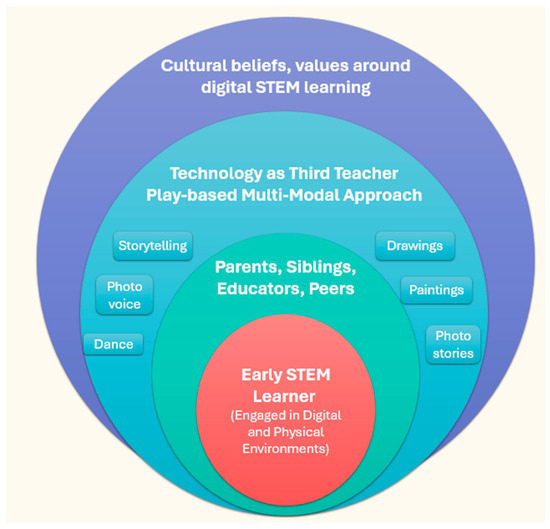
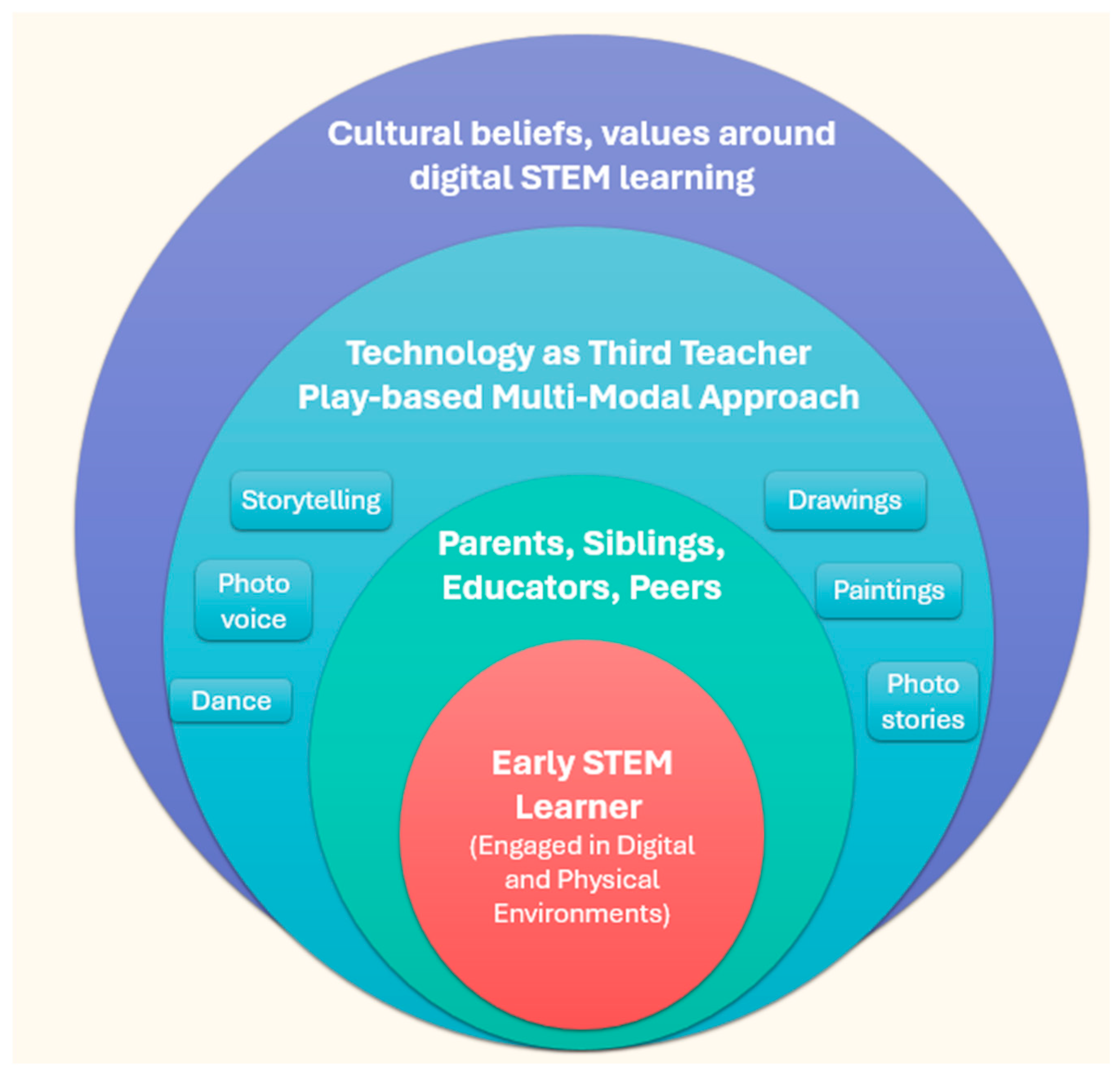
Bronfenbrenner’s (1978) socioecological lens suggested that all human activities, when investigated within a social and/or cultural context, operate in tandem to form a qualitatively unique understanding of the support structures available to a young child to thrive in their learning and development. The Bronfenbrenner socioecological lens acknowledges that a young child’s typical learning environment comprises parents, siblings, peers, and early childhood educators, all of whom play an essential role in shaping a child’s STEM engagement and learning. However, in the digital era, where babies/toddlers are first immersed in digitally constructed environments and play contexts, it is critical to understand how play-based learning philosophies can underpin such environments (Arnott & Yelland, 2020). These philosophies augment a girl’s STEM engagement and social-emotional development, allowing them to engage in scientific role play using physical materials as well as draw inspiration from quality digital tools. Environments (nested structures shown in Figure 1) constructed and facilitated by adults (parents, teachers, peers, and siblings in the microsystem) within the social and cultural context, as supports for learning, can be considered as the third teacher (Yufiarti et al., 2022). In the digital era, learning for a young girl occurs in a digital environment (mesosystem), and, as such, interconnections and interactions between the micro and mesosystems should be considered a significant tool for understanding children’s STEM engagement. Applying Bronfenbrenner’s concepts can help us think differently about how a girl’s individual learning in a broader social and cultural context (exosystem) can be affected by interactions between the individual and the different levels presented as nested structures.
Figure 1.
An ecological model to understand the role of multimodal games as a third teacher for children’s early STEM learning.
This study also draws on Vygotsky’s (1978) premise that when teachers intentionally use technology and digital tools to scaffold play through hands-on inquiry and project-based learning experiences with young children, technology can function as a “third teacher” within their learning environments, including home-based and formal schooling. This premise is useful for research exploring the socioecological realms for building young girls’ early STEM learning, particularly when technologies act as the third teacher and within a play-based multimodal approach (Arnott & Yelland, 2020). Multimodality, including storytelling, storyboarding, drawing, painting, sculpture, photovoice, photo story, dance, and drama, caters to a broad range of children’s abilities, enabling them to engage in STEM and express their ideas in diverse ways.
This study draws on considerations of participation and gender to examine how hands-on experiences provide best-practice STEM learning opportunities in early childhood. This study’s novelty lies in its consideration of how the integration of online platforms, digital games, and tangible multimodal materials provides valuable learning opportunities for young children. Linking real-life experiences and games aligned with everyday STEM activities, such as kitchens and the outdoors, has been demonstrated to be a valuable way to build STEM knowledge from an early age. To support this, in Figure 1, we conceptualise how the ecological model can be used to combine the concepts of environments, everyday connections, and multimodal interactions, with the child, as an agentic learner, at the centre of the ecosystem. The immediate environment refers to the social facilitators of technology for children, often parents, siblings, educators, and peers. However, instead of direct connections in the next level, it becomes the connections with technology-based learning as the third teacher. The outer level connects directly to how families’ and educators’ beliefs and values shape children’s engagement with technology.
3. State of the Art: How and Why Digital Educational Games Steer Girls’ Early STEM Engagement
There has been a recent upsurge in the use of digital games in early childhood education to enhance learning (Alotaibi, 2024). Digital, game-based learning can occur in an academic environment where activities promote cognitive processing, motivate learners through problem-solving tasks, and provide users with a sense of achievement (Gumbi et al., 2024). Activity concepts that challenge students to think and reflect and that focus on rewards are referred to as gamification (Gumbi et al., 2024). Digital educational games are one aspect of a range of games designed to engage and motivate children’s learning (Alotaibi, 2024). In addition to providing young children with enjoyable activities as part of EC education, digital game-based learning can promote cognitive, social, and emotional development (Alotaibi, 2024). Games that promote these forms of development have been observed to increase students’ social presence, encourage positive behavioural involvement, reduce negative social experiences (to some extent), and foster empathetic engagement (Singh & Sun, 2025). The skills associated with game-based learning have been recognised as building young children’s digital competencies, which, in turn, support lifelong learning, leading to calls to ensure that self-directed, digital game-based learning is incorporated into curricula and interventional education design (Gumbi et al., 2024). However, awareness of how to integrate multimodal games into curriculum, subject content, and assessment design remains limited (Gao et al., 2020), despite evidence that game-based strategies positively influence STEM pedagogy, particularly in early childhood and primary education (Behnamnia et al., 2024).
Strategies that incorporate game-based learning as part of a digital instructional model, particularly where science, mathematics and language are a focus, have been observed to have a significant positive impact on student academic performance (Behnamnia et al., 2024; Wang et al., 2022). Interactive electronic game-based learning also supports young children’s long-term skill development and knowledge retention beyond the classroom, and improves motivation, critical thinking, problem-solving competencies, and academic performance in a range of domains, including mathematics (Al-Hassan et al., 2025), science, coding, and artificial intelligence (AI) education (Singh & Sun, 2025).
Digital game-based learning has also been shown to enhance students’ STEM engagement, motivation, and conceptual understanding when integrated into teaching and learning settings (Gao et al., 2020). For example, students who played STEM games after explicit STEM instruction showed significantly higher learning outcomes and collaborative problem-solving performance than those who played without explicit instruction. Overall, no difference in cognitive load was found, yet children’s deepening understanding and application of STEM concepts can be linked to the experiential nature of digital game-based learning, which aligns with children’s prior knowledge and is relevant to their world (Chen & Chen, 2025). Fostering students’ positive motivation, improving academic achievement, and enhancing their engagement in digital game-based STEM learning rests heavily on their prior knowledge, education level, age, and experience with educational digital games (Ilić et al., 2024). Additionally, unlike traditional ‘online only’ games and those that do not include explicit teacher instructional strategies, these games tend not to affect student learning or STEM engagement.
Advancements in technology leading to expansions in the variety and quality of game-based STEM learning have seen standalone software proliferate into web-based platforms, mobile apps, and immersive virtual environments (Shamir et al., 2019). Touchscreen devices, such as tablets and smartphones, have provided greater access to educational games, and software developments have made games more interactive for young children. Technological advancements allowed for “greater customisation, adaptive learning experiences, and real-time feedback, tailoring the games to meet the individual needs and abilities of young learners” (Alotaibi, 2024, p. 2). Online educational game-based learning that allows children to draw on their inherent curiosity often engages them in deep, engrossing STEM learning experiences. Tailoring games to a young child’s unique needs and abilities is a prominent feature of many digital educational games, with opportunities to adapt them to different learning styles and preferences (Qian & Clark, 2016).
Limited access to appropriate technology and infrastructure continues to hinder the integration of game-based STEM learning, raising concerns about equitable learning opportunities (Greipl et al., 2020). For example, computers, tablets, or gaming consoles that provide access to game-based learning in EC education often require devices that may not be available or may offer limited access. Technical issues can hinder the effective implementation of game-based learning experiences, creating disparities in access and opportunities for young learners (Greipl et al., 2020). Furthermore, concerns exist regarding excessive screen time and its impact on young children’s health and well-being (Przybylski & Weinstein, 2019). Therefore, while game-based STEM learning offers significant benefits, it is essential to balance screen-based activities with developmentally appropriate experiences, including hands-on play, social interaction, and outdoor exploration (Alotaibi, 2024). The following section explains the research context and methods employed in the study.
Methodology and Participants
This qualitative study employed a multiple-case study design, involving focus groups with 15 parents and 15 teachers who participated voluntarily. Parents were from diverse cultural and socioeconomic backgrounds, and educators worked in EC contexts (Melbourne, Australia), teaching children from birth to 8 years. Table 1 and Table 2 outline a sample of the demographic details (8 out of 15) of parents and educators who participated in the study. This is because the data from these 8 participants provide a rich narrative and comparative analysis that sheds light upon the study’s research questions. It must be noted that, due to the nature of the current study being a small-scale study and to maintain the ethos of inclusivity, this study did not exclude parents who had boys. The focus group questions, facilitated online, mainly revolved around the context of focusing on girls. Parents of boys and educators who also had both girls and boys in their care and learning environments were invited to participate.
Table 1.
Demographic information of a sample of parent participants.
Table 2.
Demographic information of a sample of educator participants.
As outlined in Table 2, this study included educators who worked in early childhood (birth-5 years old children) and early primary settings (6–8 years old children) across high, medium and low socio-economic status areas of Melbourne, Victoria. Settings also included co-educational (both girls and boys) and only girls in educators’ classrooms. University ethics approval and permission to conduct research in early childhood and school contexts were obtained. Purposive sampling was used to select the parent participants. Purposive sampling is a widely used qualitative research technique for the case study method, with the rationale to identify and select information-rich cases that potentially allow sense-making of the research questions at hand and make the most effective use of targeted cases as datasets and resources. Additionally, case study research enables the identification and selection of individuals suited to the phenomenon being studied (Creswell, 2022), that is, parents’ and educators’ beliefs and perceptions regarding girls’ STEM education via digital technologies and game engagement, and perceptions of how STEM-related game concepts can steer girls’ early engagement. Using purposive sampling enabled the collection of in-depth information from a small number of participants. Ten focus group discussions were conducted, lasting up to 60 min over a period of 2 school terms, during which 15 parents and 15 teachers from 10 preschool and 5 early primary contexts participated. Data were collected in a hybrid format, including Zoom-based online audio recordings of the discussions and face-to-face discussions. During the focus groups, participants interacted with sample digital games that featured science and mathematics concepts to prompt reflection and feedback. The focus group discussions explored the following questions:
- What are some of the ways you engage your children in STEM? When and where does this occur? Consider both online and offline.
- Considering the girls in your care, what resources could potentially help to engage them in STEM? Could you provide feedback on how to improve some of the games and learning scenarios we have designed?
- What do you see as the STEM needs of young children when using online tools such as games?
4. Ethics Statement
The project was guided by principles of participatory research and involved data gathering from parents of children aged 0–8 years and educators from both early childhood and primary school contexts. Participation was voluntary, though parents were offered a gift voucher and schools a grant to account for their time. The EECERA Ethical Code of Practice (Bertram et al., 2024) informed the approach we adopted to data gathering from participants and the procedures we put in place, following Human Research Ethics protocols. The relevant university ethics and local authorities, including the Department of Education Victoria, approved undertaking the research. Participants were provided with Plain Language Statements outlining the research parameters, and all participants provided consent. Pseudonyms have been used for the settings, their respective educators, and parents. The ‘Settings Safe Internet Use Policy’ was always followed, and data is securely stored on password-protected university servers.
5. Data Analysis
Audio data was transcribed by the research assistant and reviewed by the research team, which included six academics. Themes were deduced through a systematic thematic analysis (Creswell, 2022) of perceptions and beliefs of parents and educators regarding the use of technologies, such as the design features of online games, e-storybooks, and animated videos, to engage young children, especially girls, in STEM. This was in line with the research aims and the theoretical understanding of social and ecological views and perceptions of parents and educators’ beliefs about how games can engage children in STEM, what kind of multimodal design features and activities might work or not work for children’s learning, and the conditions that can shape and motivate girls’ STEM interest development.
Strategies for Validity and Trustworthiness
First, each author independently analysed the data transcripts of all 10 focus groups involving 15 parents and 15 educators such that identifying codes aligned with the research questions and the study’s framework. The authors became familiar with the data by carefully reading and rereading the transcripts of interviews. Following member checking as a triangulation tool (Ary et al., 2010), the aim was to overcome the danger of biased understanding. Thus, produce valid, reliable data for this study and increase research rigour. Triangulation enabled the authors to identify themes to illustrate parents’ and educators’ perceptions of how digital games can engage girls in STEM, alongside revealing participants’ views on which design features can be considered and co-designed with parents/teachers to engage girls in STEM via online educational technologies. As such, maintaining the analytical rigour and reliability of the findings of the study is essential.
6. Findings
Below outlines some examples of the participant quotes (from the 15 educators and 15 parents) that were consolidated into the three main themes, which are analysed next.
Example quotes that informed the emerging themes.
- safety and protection for young children’s STEM online learning;
- parents and teachers’ positive perceptions of digital games;
- multimodal games and acting as scaffolders of hands-on learning experiences;
- enable problem solving, exploration and peer–peer social interactions.
In the following section, we present and analyse data that inform the three themes derived from our thematic analysis.
6.1. Theme 1: Parents and Teachers as Scaffolders of STEM Learning via Online Experiences
All 15 parents in this study highlighted the importance of having a narrative of gamification embedded as a coherent storyline that enhances hands-on interactions and social interactivity amongst their children (boys and girls playing together). However, contextual sensitivity was frequently identified during the application of game-based learning techniques. Parents in this study explained that they often used technology as a third teacher to support children’s STEM understanding and learning. Shanalee, parent of a 5-year-old girl and 8-year-old boy stated:
She [Shanalee’s daughter] uses kitchen items like flour. Loves construction, volcanoes, drawing. I focus on concepts as she [Shanalee’s daughter] shows interests. When prompted, I use You Tube videos and online games for her. But outdoor sensory play using mud, sticks, leaves and bugs is important. We play the ABC Kids iPad games. And then we all play with construction, blocks, picking apart wheels on cars to see how they work.
Shanalee has demonstrated that her children, both a boy and a girl, play with tangible household items, such as kitchen utensils, or outdoor materials, such as mud, and that both children engage in construction play as well as playing iPad games. This shows Shanalee as a parent who performs the role of a social actor, making STEM-based play available to both her children, enabling hands-on interaction and integrating technology as the third teacher. When parents embed such an approach can extend girls’ enjoyment of construction through tangible home-based materials and online games available on popular educational platforms such as ABC Kids. It seemed Shanalee acted as a scaffolder for STEM learning for both her children, making STEM accessible to her daughter through multimodal play experiences. Moreover, Shanalee is promoting cognitive processing by using digital games to support her children’s learning. This is in line with the study’s theoretical framing of how parents such as Shanalee link everyday experiences, such as exploration with kitchen items and sensory outdoor materials, along with digital games, to promote STEM-based learning for their girl children. When technologies are used with intentionality and in the context of hands-on multimodal experiences, technology can then be classified as a third teacher in children’s learning environments.
Another parent, Lin, shared her experience of effective game-based technology with her children:
I try to balance the type of activities they do with their hands-touch and feel, and combine that with online [experiences] is probably the best way of getting them involved in STEM. The best way to learn about STEM is to touch and experience those resources, but to scaffold that learning, I would use online learning, games, materials. For example, go out and explore shapes and sounds in the park, now they come home and watch a video or play a game to scaffold those learnings. But I’d balance the two.
Lin highlighted how she would use game-based technology to scaffold both her children’s learning (a 5-year-old girl and a 3-year-old boy). By responding to both her children with the same approach of building STEM skills and knowledge, Lin is demonstrating digital equity in a household environment, which can support STEM-related mindsets and futures for girls. She would start with the natural environment and further facilitate learning by using technology to elaborate on the observed concepts. Through her role as a parent (social facilitator), Lin illustrates her values of learning (cultural beliefs) and uses technology (third teacher) to support both her young girl and young boy’s STEM learning. Furthermore, through Lin’s actions, she can be seen to help develop her children’s digital competencies and foster empathetic engagement.
On the other hand, Eira, a parent of a young 6-year-old son, demonstrated strong beliefs about the importance of using educational games, stating:
My son can be very picky. He learns alphabet, shapes, construction, we don’t let him play anything without a learning outcome. 1–2 h on the weekend he gets to use a device but nothing after school on weekdays. He gets to play on an iPad. He is excited by logos, cars, drawing. Based on experience observing girls, they like unicorns, bracelets, not that we can categorise just for boys or girls, but perhaps that is one way of creating excitement—using something that excites them.
However, Eira believed that technology had a place in learning; she limited this third teacher to weekends only to ensure that STEM learning was more hands-on, rather than technology-driven. By limiting her son’s access to digital games, Eira may be reducing his options to deepen his conceptual understanding of STEM topics. This apparent tension may be seen as disengaging the child and inhibiting the motivation that occurs when children’s learning is known to be enhanced with digital technology.
Similarly, Erik, a father of a 4-year-old girl, had the view of using technology as the starting point for learning, a kind of platform for engagement. Erik reflected on how digital resources might support his child’s learning:
If there was some videos for the start, even if it was 2 min to kind of introduce them to what they’re about to learn. I think that would be a really great way to get them engaged in what they’re about to start doing. And it takes the pressure off the parents. So you know, having like that opening video, having key definitions of terms to clear up misconceptions, but how do you build in key definitions, simple key definitions for both the student and the parent? Because I know with one of the really cool things that are happening with Gen AI is that parents are actually using it to relearn concepts to help their child learn so how do we? You know whether it be a Chatbot on the site, whether it be game character to teach the science concepts and meaning and vocabulary.
Erik, as the social facilitator, used technology as a third teacher to engage his girl child’s interests to begin the learning sequence. He also suggested that technology such as GenAI can be used to support parents re-learning of concepts alongside their children. Erik’s views suggest that integrating AI tools, such as gamified characters and avatars with sound/movement features, into games may potentially motivate girls to listen to such characters and learn scientific concepts. This is an important finding, as parents such as Erik perceive that GenAI tools can be used for educational purposes via gamification and supplement science and/or math learning for girls. Hence, supporting the motivation for learning can be an important element which could influence academic performance and gendered socialisation for his daughter.
Teachers used games and technology similarly to parents in this study. Teachers tended to use the games and technology to engage children in learning and, at times, to assess their learning. These types of actions by teachers can contribute to higher learning outcomes for all children. Teachers acknowledged how the children enjoyed online STEM-associated games. Aisha used games and digital video platforms to engage both girls and boys, ensuring digital equity in her classroom so they could learn about the biology of animals and insects, stating:
I think STEM is a really important concept that’s often overlooked, but we are absolutely surrounded by it. I could see playing games in my Prep class on a big screen, getting a child to come up and find the animal or the bug in the game. Such online resources really helps educators see how they can engage with it in everyday learning.
Raina, a primary teacher, used online STEM activities to motivate student learning in a manner similar to parents, reinforcing the need for a balance between online and offline activity:
I think it’s good for it to have that element of the online factor and balance of offline activities as well. Because there’s not only digital technology outcomes that you have to tick off. The activity can be about designing and putting things together.
Ria, a primary school teacher, acknowledged that online digital games and resources were the future of education and were relevant to children’s evolving worlds, helping them be agentic in understanding their offline and online worlds and the choices they can make to do things together. Rather than resisting digital platforms, Ria embraced children’s use of online activities to foster problem-solving skills in young children. When asked about ways to engage girls in her classroom, Ria stated:
Having [a] games component in my teaching is the way of the future. Having games with problem-solving elements where kids going out to fix one of the satellites. By osmosis, children including girls learn things and get excited about games. And we as educators give them the STEM learning part.
Jinny, an EC teacher, often used digital games and platforms as the third teacher, emphasising their value in supporting learning and generating discussion prompts amongst the children, particularly for girls, that extend conceptual understanding:
I always love when there’s a video with the games they play. And have colours and the cute little pictures and stuff, as lots of such things can be acting as a teacher. I always really like when an activity has discussion questions to ask or to discuss just again as a teacher. Obviously, we do have an idea of what we want the kids to know. And we can, we can come up with extra questions. But it is good.
Another EC teacher, Reema, highlighted the potential of digital platforms to introduce learning through mini-lessons or videos and acknowledged gamification as an important pedagogical tool and a third teacher for supporting girls’ engagement and excitement in STEM.
I like the little graphics with the little alien character thingies. They would really respond to those characters, especially if there were some, for example, like a little mini lesson video that you did at the start with them in it.
Interestingly, technology was viewed by one EC teacher, Jenny, as a means of replicating natural environments, compensating for the absence of a playground and outdoor learning space:
We don’t have a playground here in our EC centre, so I had to actually get a video on my screen and show them that. And then we went outside and got bark. But we ended up getting using lots of things in the classroom rather than outside in nature, because we didn’t have any. We had big rocks, but not little rocks, and I was like, let’s not use the big rocks. But yeah, games that give children ideas about abstract concepts, scenarios they haven’t seen around them every day, they seem to really like it. And just having that I guess the activities at the end. I like to give them different options.
In Jenny’s description, she has found a way to bring the natural world and sciences into the EC classroom. Yet, this creates a tension, as much of the discourse regarding immersive nature-based learning experiences in early childhood seeks to highlight that the experience needs to be more about connecting with nature. Still, Jenny used digital platforms to show and teach about nature-based environments, such as rocks, using technology as digital representations and explicitly using the technology as a social facilitator to support learning.
Overall, games and online learning activities that sustain curiosity and independent exploration were an important element for most parents and teachers, which can be seen as a trigger to engage girls in STEM and to nurture their STEM-related interests. Encouraging sustained engagement, cognitive development, and educational achievement emerged as another critical consideration. Evidently, the findings analysed in this theme resonate with the study’s theoretical ideas about how the immediate real-world environment, together with parents (e.g., Shanalee, Lin, Erik) and educators (e.g., Reema, Ria and Jinny), act as scaffolders and social facilitators of technology (including GenAI tools). These are important considerations for girls to be given authentic, purposeful, and equitable opportunities to participate in STEM via multimodal experiences such as designing, drawing, making and to be able to express their imagined stories involving real-life materials and digital sources of inspiration.
6.2. Theme 2: Parents’ and Teachers’ Perceptions of Safety and Protection for Young Children’s STEM Online Learning
Most parents (11 out of 15) agreed that misalignment between STEM topics and a child’s interests or abilities leads to reduced participation, limiting opportunities for children and families to voice their ideas and exercise cultural agency. When this occurs, parents acting as social facilitators often struggle to use digital platforms. Use of these platforms then becomes a contradiction as the challenge underscores the importance of parents’ own digital literacy in enabling meaningful engagement with online games and activities. For example, Annie explained:
I am steering away from commercial videos that are trying to sell my kids stuff. I have to scan through to anticipate what questions are likely to come up. How long is the video? How funny is it? Slow-moving or too fast-paced? Does it look like it is a reputable website? What are the accents that my child can follow? Too many flashing colours are annoying. I tend to go for ones with gender diversity, all kinds of cultural diversity, clear explanations of things, age/stage appropriate. And if my child is going to [be] actively involved in answering a question like how does a volcano get so hot? Or is it sort of your spoon feeding you?
Nevertheless, all parents discussed, despite the contradiction that parents do not feel adequately equipped to use digital technology, they still raise safety as an important element when using digital platforms to support learning, particularly regarding their educational value for children. Stacey expressed her concern that some platforms may mislead parents by labelling content as ‘educational’ when, in reality, it serves primarily as a marketing tool to sell products:
Safety is a big thing; we’re still learning about online safety. Don’t con parents by saying it’s educational when it’s not. Make it fun! Having people vs animations, people are important. But occasional animations are good.
All parents and teachers also expressed how their children loved technology and learning by doing and playing games, especially in science and mathematics. Games can be an important resource, however, only when meaningfully and safely operated, leading to increased computational thinking and scientific skills. Any curated activities that are online and in the digital era need to be trustworthy.
Similarly, Raina, a primary teacher, stated:
Safety is important. Hard to keep kids away from tech as they grow older. This [online activities; games] is a great alternative.
Another EC teacher, Aisha, expressed her concerns about the safe use of online resources.
Videos need to be enjoyable. It needs safety language. The sorts of adverts coming up. Think about the presenter, kids can get hooked onto a presenter and build a connection more than an animated character.
Overall, parents and teachers concurred that digital platforms needed to add educational value and support children’s learning, without commercialisation or ineffective elements that distract from learning. Both parents and teachers found it important to invest time in ensuring the value of the multimodal resources, rather than only online-based ones, and the ones they used to assist children’s learning. In essence, all the parents and educators resonated with the idea of having a combination of safe use of online games/videos that supplement learning and not simply replace everyday routine learning experiences. However, some apparent misgivings among parents highlight alternative interpretations of the merits of multimodal and digital resources. Although it was also clear from the findings that when parents and educators create rich technological environments that have the potential to act as the third teacher (e.g., culturally and gender-diverse animated characters in videos and animations), they help girls be included. Parents also acknowledged that it is important to understand and develop new science and maths concepts for their girl children, equally as important for their boy children. However, there were tensions in relation to finding the optimal balance between the use of games and videos to support learner-centric and hands-on learning. This signifies the current study’s important theoretical premise of how meaningful integration of tangible multimodal materials, together with technologies that include culturally and gender-diverse portrayals of characters, can serve as an organic stimulus for girls’ STEM engagement.
6.3. Theme 3: Importance of Social Learning Interactions Through Online Learning
All the participants agreed that it is important to link online games to other aspects of learning. The social aspect was seen as very important, with educational online activities that are interactive and playful, enabling girls to express their ideas and become motivated in STEM learning. For instance, Shyma, parent of a 5-year-old boy and a 2-year-old girl, likes to use digital resources that
Have lots of colours and animals for girls. Girls like to look after things as well like caring. [A] child can write or draw their favourite finding as part of the story or game. Have to be age-appropriate. What my 5-year-old can do is different to my 2-year-old.
Shyma is relating to what girls find engaging and how multimodal resources can attract and support the development of girls’ STEM knowledge. For example, in the above quote, she stated that games that embed ideas and narratives can hook girls into embodying and expressing a caring demeanour. Thus, it can make girls naturally curious about everyday science concepts, such as learning more about animals. Shyma also identifies age-appropriateness as important when engaging with digital resources, as it enhances the effectiveness of engagement and helps girls express their imagined ideas to peers/siblings through drawings. Through this understanding, Shyma is highlighting the role of intuitive games that tell stories and present scenarios as a social facilitator of learning for her children, ensuring engagement with appropriate digital STEM resources.
A father, Goldie, parent of a 5-year-old girl, explained:
I would encourage my kids to do something like building or drawing rather than watching YouTube videos. Add in graphics into the games specifically for girls like little animals and people/children especially for engaging girls. Have a character taking through the game or story scene will be more engaging for my daughter.
In the above quote, Goldie preferred that his child be active when using digital resources rather than just passively watching. This may create tension for many families, as many digital platforms can lead to sedentary behaviours and the need for children to observe. So, while parents value learning through online activities, the game should also allow children to seamlessly apply the idea from the digital world to real-world contexts. For example, a social character as a narrator (within a gamification-style scenario) can be more engaging for girls.
An early childhood educator, Mary, stressed the importance of colours, sounds, and animals, which can potentially encourage STEM among girls. Mary also focused on activities similar to the ideas Goldie expressed earlier.
Design games to be age-appropriate, design features to be around having lots of colours and animals for girls, such as farm animals. Having the farm animals narrative this is probably more for foundation needs for preschoolers [who] encounter problem scenarios that they’re thirsty and so on fosters empathetic engagement.
Similarly, Jinny, another EC educator, expressed that intentional activities were important for learning STEM concepts; however, they should include a social element through role play where girls are also ‘heavily involved’ and ‘present’ with other children:
Games give you intentionality when talking to the children [girls] about science concepts. But again, the game should not sit alone. It should have constructing, measuring, social interactions to support role play amongst the children [girls].
In a way, Jinny is expressing that digital resources can foster social connectivity to enhance social presence and serve as a third teacher, encouraging girls to collaborate to design something or solve problems. This is in line with how social interactions can be fostered via multimodal technologies such as games where science and maths-related real-world artefacts can be used to create virtual objects in a computer simulation, and girls can be given the opportunity to control such virtual objects within the realm of their socio-ecological interactions whilst also being able to take part in hands-on scientific and mathematical explorations.
Another primary teacher, Jess, suggested that science concepts can be designed into the game scenario and the narrator as a ‘socially present’ character:
Maybe a game like a rocket launcher from the start so that they understand the basics of Physics. Games are kind of a model to involve kids in building that stuff. Maybe a drag and drop game.
Jess continued by suggesting that games that incorporate science-based learning concepts can be a useful learning tool. For example,
Have scenarios like what is needed for the plant to grow? The photosynthesis, the chlorophyll, all the sunlight rays. The character can tell a narrative. How it grows the tree. They can tell the life history of the tree, how it grows. They can grow their own plants, flowers because you can measure some something grow. How much water is enough for growing the tree like that, so they understand how much water is that concept of how much water is needed. For plant growth and saving water also.
In this theme, the adults agreed that children are savvy, watching YouTube videos and playing games such as ABC games on their iPads. Educators concurred that games and online technologies, such as e-storybooks and videos, should incorporate cultural and social components (aligning with our study’s theoretical idea of capitalising on girls’ social and cultural contexts) when implementing a game-based learning approach. When catering to girls’ interests and building their STEM belonging, games should encompass social and emotional (e.g., caring for animals and plants) scenarios and narratives with a structure that appeals to girls and enables active involvement, the communication of imagined ideas to peers/siblings, diverse exploration, dramatic adventures, and knowledge construction.
7. Discussion
This study reported on the importance of using games to teach fundamental concepts (e.g., physics in a rocket game), promote problem-solving skills, and the use of feedback mechanisms (e.g., quizzes). Findings also highlight that, in an EC context, the focus should be on learning STEM in everyday life, engaging contexts and being inclusive of girls becoming creative problem solvers and designers. These ideas, coming from parents and educators to integrate broad conceptual knowledge with relevant pedagogical knowledge, and the parental emphasis on technological knowledge, are consistent with the role of the adult in a girl’s social environment alongside peers and siblings.
When considering the notion of the ‘third teacher’, the study reports that parents and teachers see the function of digital game-based learning as scaffolding, serving as an add-on tool to broaden STEM experiences for their female children. These experiences may revolve around engaging children, both girls and boys, in an equitable manner, providing explanations or allowing further exploration of ideas and skills, as articulated by parents of children who have girls. In this way, games can become a multimodal tool and replicate or augment the experiences that previously might have been conducted either offline and in the real world via playing games, drawing, and/or reading books. This is consistent with modern socio-technological ideas, such as the SAMR (Substitution, Augmentation, Modification, Redefinition) model advocated by Puentedura (2014). This model reflects the use of technology in place of the original experience (e.g., substitution, exploring images of bugs from a book but using the technology to explore digital photographs of why bugs and insects change colours), with increasing levels of enhancement (augmentation) and restructuring (modification) until the technology-based experiences are transformed in ways that would not be possible without the technology (redefinition). In terms of using digital games and related online experiences as a third teacher, parents and teachers were suggesting the need for experiences that are appropriate for early years children, including substituting real-world, hands-on, and sensory activities (e.g., drawing) for technology-based versions (e.g., visuals, movement, sound, touch) that support multimodal interactions. These interactions would allow children to consolidate the science and mathematics concepts and skills they are exploring and learning. Other appropriate multimodal activities could be augmented with carefully designed games (e.g., construction), especially for girls, that allow additional features to be added to enhance the learning experience, from the real world (e.g., 3D representations of constructions, including multiple perspectives). While the SAMR model provides insights into how games could integrate technology with real-world activities, it focuses on technology rather than pedagogy.
In contrast to the SAMR model, the current study’s responses from teachers, combined with those from parents, emphasise the importance of a pedagogical approach within games. Together, game design based on the responses of parents and educators in this study would do well to focus on this knowledge to engage and teach children. However, the findings focus on parents’ and educators’ roles as gatekeepers of technology use in relation to what their children want, their interests, and the safety concerns of online environments, given the children’s young age.
In relation to the conceptualisation of technology as the third teacher, this study contributes new knowledge to the philosophical notion of play-based learning environments in early childhood education. Based on the findings of this study, it is recommended that to bring digital and gender equity in home-based and formal classroom environments, technology be integrated meaningfully through activities co-designed by teachers, parents and their girl children. Such collaboration can make everyday abstract science and mathematics concepts visible, providing children with opportunities to engineer, create, design, explore, experience, immerse, and tinker via gamification and simulations. Beyond cognitive engagement, use of technology enhances sociality (problem posing and problem solving, empathy generation, companion, mentor) for the child. Games that incorporate social components provide girls with a platform to do meaningful things with other people (peers/siblings, communities), scaffolded by parents/teachers/gamified characters/narrators. Games and other digital activities should not simply be about doing them but rather be seen as interactivity between the digital and interconnections, two-way communication with real-world people, where sociality acts as the mediator of learning. Only then does the technology act as the third teacher. This study makes an important contribution that argues against the popular myth that the digital is replacing the social.
In recent years, with the growing role of AI, children’s exploration of technology has become inevitable (Organisation for Economic Co-operation and Development [OECD], 2022). From a theoretical stance, digital STEM games and multimodal resources would enhance the role of the technology-mediated environment as a third teacher, giving children process agency rather than just serving as a replacement for the parents’ desires. With caution, this study by no means suggests replacing children’s physical world with virtually simulated environments and gamification. The role of technology is suggested to be complementary and encompassing child agency and allowing for sociality, whilst maintaining safety and child protection during the use of digital technologies and online environments (Australian Children’s Education and Care Quality Authority [ACECQA], 2025; Organisation for Economic Co-operation and Development [OECD], 2022).
In summary, our findings show that parents and teachers are choosing how to use the digital space and the roles they ascribe to it while exposing children to digital resources for science and mathematics learning. Amongst the many positives we observed, there were occasions where tensions and alternative interpretations arose, particularly around the benefits of children’s time spent in the digital space. Some parents saw it necessary to limit children’s time spent on digital devices. There remain ongoing concerns over safety, and in one instance, replacing time in natural environments with time in the digital world may contradict the benefits of being in the outdoors, an important element of Australian early years curriculum frameworks. All the participants agreed that it is important to link online games to other aspects of learning and to design age-appropriate games, with design features attractive to girls, such as lots of colours, animals, and girls’ embodiment of caring demeanours. Also important were the social interactions between the parents/teachers and amongst the learners themselves that should occur. The study also highlights the significance of factoring in child agency into game design. As a result, girls can exercise their own agency when making choices presented to them through digital and gamified resources and can organically move between the digital and real-world physical spaces. Interactive and playful online environments are seen to encourage social engagement among girls, enhancing their motivation to participate in STEM learning activities. For example, parents expressed that their children loved technology, learning by doing, and playing games, especially in mathematics. STEM games should be designed to enhance girls’ curiosity and to support the communication of scientific and mathematical ideas about their everyday world in multimodal ways. Teachers acknowledged that their children enjoyed online construction games, particularly because, in the digital era, children are savvy at watching YouTube videos and playing games, such as ABC games, on their iPads.
8. Limitations
A limitation of this study is that, given the early years research context, young children were not interviewed, and it is unclear whether their ideas would align with those of the adults interviewed. It can be argued that future research should consider student voice in game design, online, and/or multimodal learning environments, and this could be possible as AI continues to advance in education contexts. Agentic AI will likely be critical for learning in a digital, multimodal environment. Agentic AI refers to AI systems that are relatively autonomous and are context- and goal-dependent, meaning that it will be able to develop an understanding of the learner’s wants and needs and provide a series of relevant goals that would support learning using a variety of multimodal representations (Kostopoulos et al., 2025). The use of Agentic AI online would allow parents or educators to set initial goals for children, which would ensure that learning is relevant, sensitive to their learning needs and appropriately challenging. As children continue to explore new aspects of STEM as their capabilities and interests develop, they will be able to use AI to support their student agency in terms of future learning and decision-making (Chaaban et al., 2025).
It must also be noted that this study did not aim to compare and contrast the views of parents and teachers, nor did we intend to compare cultural groups. However, this has been noted as a study limitation and recommended as an avenue for further research via quantitative methods. Additionally, differences between genders have so far focused on higher education contexts (Møgelvang et al., 2024), which indicate that women are more concerned with ethical and critical thinking when using AI, especially in regard to text-related tasks, whereas men tend to use AI as a tool and in relevance to future careers. Future research would do well to explore how gender differences in the use of AI begin to change in the current generation of girls growing up with AI and games-based technologies, and how it can be utilised to support girls in developing their student agency and student voice.
9. Conclusions and Feed Forward
Research is grappling with effective ways to provide parents and educators with authentic, meaningful STEM learning resources that are inclusive and accessible to all, particularly to uplift girls’ STEM engagement. This study highlights that although parents and educators perceive hands-on experiences as the best practice for STEM learning in early childhood, scaffolding this learning requires integrating online platforms, digital games, and tangible multimodal materials. The rich STEM learning children gain from a young age is often linked to real-life experiences and games aligned with everyday STEM activities, such as kitchen and outdoor activities. Teachers and parents are vital conduits for children’s STEM learning by employing engaging activities that connect with children’s interests and incorporate playful, enjoyable experiences.
The role of the adults as social facilitators is critical. It is therefore important to provide professional learning resources and opportunities that equip parents and teachers to support their children’s STEM learning trajectories through meaningful, multimodal, play-based learning approaches and the domestication of online educational technologies. Designing multimodal game-based learning technology training that fosters educators’ interest and enhances their knowledge can play a pivotal role in transforming the learning environment and inspiring future generations of girls to pursue STEM studies and careers. For example, professional learning for teachers could support them in integrating multimodal games and online learning materials into the curriculum, subject content, and assessment design. Such professional learning initiatives could encompass capacity building for both in-service and preservice teachers, focusing on integrating multimodal games that align with the curriculum, sociocultural educational contexts, and teaching content and learning goals. These initiatives should also include hands-on activities and support teachers’ decision-making in selecting games and online activities, as well as in designing and implementing gamification features that best facilitate children’s learning objectives.
The outcomes of this study should challenge the reader and, more broadly, designers of multimodal learning environments to consider that resources, including but not limited to AI-integrated digital games, virtual simulations, animations, and video games, are developed with an orientation towards what engages girls’ participation. Facilitating greater opportunities for young girls, in particular, is one way to address the longstanding imbalance that girls have experienced when enthusiastic about participating in STEM learning. To end this paper, we provide several key recommendations derived from this study that are meritorious to supporting young girls’ connections to and uptake of the forms of multimodal STEM learning resources that were seen as valuable in this study.
We recommend that the online learning environment itself should act as an enabler of young girls’ choices of multimodal learning methods. This could be achieved by facilitating opportunities for young girls to create artefacts/representations that are meaningful to them. Those same multimodal learning platforms should cater to girls with varying abilities, offering easy, medium, and challenging levels; be culturally inclusive; and ensure multimodality without overlooking how digital learning platforms can be beneficial for users from diverse cultural and ability groups. Within the platforms themselves, a range of game-based activities should be designed to provide opportunities for girls to become agentic STEM learners and contributors, and the use of online games and tangible materials should be incorporated into meaningful real-world learning contexts. Games embedded into multimodal learning platforms should incorporate problem-solving tasks and a narrative-organised structure that promotes girls’ imagination and cognitive development. Adopting these recommendations will make important inroads in supporting young girls’ lifelong passion for and engagement in STEM.
Author Contributions
Conceptualization, S.K.; Methodology, S.K.; Validation, S.K., G.R., C.S., G.A. and L.H.; Formal analysis, S.K.; Investigation, S.K., G.R. and C.S.; Resources, G.A., L.H. and L.X.; Data curation, C.S.; Writing—original draft, S.K.; Writing—review & editing, S.K., G.R., C.S., G.A., L.H. and L.X.; Project administration, C.S. All authors have read and agreed to the published version of the manuscript.
Funding
This research was funded by the Invergowrie Foundation, grant number 2022.
Institutional Review Board Statement
The study was conducted in accordance with the Declaration of Helsinki, and approved by the ethics committees of Deakin University (protocol code 2023-330, 14 December 2023) and the ethics committees of Swinburne University of Technology (protocol code 9003, 14 February 2024).
Informed Consent Statement
Informed consent was obtained from all subjects involved in the study.
Data Availability Statement
The original contributions presented in this study are included in the article. Data sharing is not applicable due to ethical restrictions.
Conflicts of Interest
The authors declare no conflict of interest.
References
- Al-Hassan, O. M., Alhasan, L. M., AlAli, R. M., Al-Barakat, A. A., Al-Saud, K. M., & Ibrahim, N. A. (2025). Enhancing early childhood mathematics skills learning through digital game-based learning. International Journal of Learning, Teaching and Educational Research, 24(2), 186–205. [Google Scholar] [CrossRef] [Scilit]
- Alotaibi, M. S. (2024). Game-based learning in early childhood education: A systematic review and meta-analysis. Frontiers in Psychology, 2(15), 1307881. [Google Scholar] [CrossRef] [Scilit] [PubMed]
- Aranda, G., Campbell, C., Ferguson, J., & Speldewinde, C. (2022). Introducing digital technologies into play-based learning in early childhood. In S. Papadakis, & M. Kalogiannakis (Eds.), STEM, robotics, mobile apps in early childhood and primary education (pp. 525–551). Springer. [Google Scholar] [CrossRef] [Scilit]
- Arnott, L., & Yelland, N. (2020). Multimodal lifeworlds: Pedagogies for play inquiries and explorations. Journal of Early Childhood Education Research, 9, 124–146. [Google Scholar]
- Ary, D., Jacobs, L. C., Sorensen, C., & Razavieh, A. (2010). Introduction to research in education. Engage Learning. [Google Scholar]
- Australian Children’s Education and Care Quality Authority [ACECQA]. (2025). Safe use of digital technologies and online environments. Available online: https://www.esafety.gov.au/educators/early-years-program (accessed on 30 November 2024).
- Australian Department of Education. (2015). National school STEM education strategy 2016–2026. Australian Government. Available online: https://www.education.gov.au/australian-curriculum/support-science-technology-engineering-and-mathematics-stem/national-stem-school-education-strategy-2016-2026 (accessed on 30 November 2024).
- Australian Government Department of Education. (2022). Belonging, being and becoming: The early years learning framework for Australia (V2.0). Available online: https://www.acecqa.gov.au/sites/default/files/2023-01/EYLF-2022-V2.0.pdf (accessed on 30 November 2024).
- Behnamnia, N., Kamsin, A., & Hayati, S. (2024). Impact of digital game-based learning on STEM education in primary schools: A meta-analysis of learning approaches. Innoeduca, 10(2), 113–140. [Google Scholar] [CrossRef] [Scilit]
- Bertram, T., Pascal, C., Lyndon, H., Formosinho, J., Gaywood, D., Gray, C., Koutoulas, J., Loizou, E., Vandenbroek, M., & Whalley, M. (2024). EECERA ethical code for early childhood researchers. European Early Childhood Education Research Journal, 33(1), 4–18. [Google Scholar] [CrossRef] [Scilit]
- Bronfenbrenner, U. (1978). The social role of the child in ecological perspective/Die soziale rolle des kindes in ökologischer perspektive. Zeitschrift für Soziologie, 7(1), 4–20. [Google Scholar] [CrossRef] [Scilit]
- Chaaban, Y., Jung, S. G., Medina, J., Azem, J. Y., Salminen, J., & Jansen, B. J. (2025). Examining student teachers’ agency in an AI-supported learning environment: Q methodology research. International Journal of Artificial Intelligence in Education, 35, 4083–4107. [Google Scholar] [CrossRef] [Scilit]
- Chen, C. H., & Chen, C. H. (2025). The timing of digital games in STEM instruction: Effects on learning outcomes, collaborative problem-solving, intrinsic motivation, cognitive load, and learning behavior. Research in Science & Technological Education, 44, 1–20. [Google Scholar] [CrossRef] [Scilit]
- Creswell, J. (2022). Research design: Qualitative, quantitative, and mixed methods approaches (6th ed.). Sage Publications. [Google Scholar]
- Department of Education, Skills and Employment. (2021, September 16). National STEM school education strategy. Available online: https://www.education.gov.au/australian-curriculum/resources/national-stem-school-education-strategy (accessed on 1 March 2025).
- Department of Industry, Science and Resources. (2024). Pathway to diversity in STEM review final recommendations report. Available online: https://www.industry.gov.au/publications/pathway-diversity-stem-review-final-recommendations-report (accessed on 1 March 2025).
- Early Learning STEM Australia. (2020). A play-based STEM program for early years. Available online: https://elsaprogram.com.au/ (accessed on 1 March 2025).
- Education Services Australia. (2024). The Girls in STEM Toolkit (GiST): Evaluation report. Available online: https://www.thegist.edu.au/media/s2dlivyp/gist_summary_2024_web.pdf (accessed on 1 June 2025).
- Fleer, M. (2019). Scientific Playworlds: A model of teaching science in play-based settings. Research in Science Education, 49, 1257–1278. [Google Scholar] [CrossRef] [Scilit]
- Gao, F., Li, L., & Sun, Y. (2020). A systematic review of mobile game-based learning in STEM education. Educational Technology Research and Development, 68(4), 1791–1827. [Google Scholar] [CrossRef] [Scilit]
- Greipl, S., Moeller, K., & Ninaus, M. (2020). Potential and limits of game-based learning. International Journal of Technology Enhanced Learning, 12(4), 363–389. [Google Scholar] [CrossRef] [Scilit]
- Grosch, K., Haeckl, S., & Kocher, M. G. (2022). Closing the gender STEM gap-A large-scale randomized-controlled trial in elementary schools. CESifo Working Paper. Available online: https://www.ifo.de/DocDL/cesifo1_wp9907.pdf (accessed on 1 January 2026).
- Gumbi, N. M., Sibaya, D., & Chibisa, A. (2024). Exploring pre-service teachers’ perspectives on the integration of digital game-based learning for sustainable STEM education. Sustainability, 16(3), 1314. [Google Scholar] [CrossRef] [Scilit]
- Ilić, J., Ivanović, M., & Klašnja-Milićević, A. (2024). Effects of digital game-based learning in STEM education on students’ motivation: A systematic literature review. Journal of Baltic Science Education, 23(1), 20–36. [Google Scholar] [CrossRef] [Scilit]
- Kewalramani, S., & Veresov, N. (2021). Multimodal creative inquiry: Theorising a new approach for children’s science meaning-making in early childhood education. Research in Science Education, 52(3), 927–947. [Google Scholar] [CrossRef] [Scilit]
- Kostopoulos, G., Gkamas, V., Rigou, M., & Kotsiantis, S. (2025). Agentic AI in education: State of the art and future directions. IEEE Access, 13, 177467–177491. [Google Scholar] [CrossRef] [Scilit]
- Larkin, K., Lommatsch, C., Resnick, I., & Lowrie, T. (2022). The design and use of a digital tool to support the development of preschool children’s logical reasoning. Journal of Research in Technology Education, 55, 1080–1093. [Google Scholar] [CrossRef] [Scilit]
- Møgelvang, A., Bjelland, C., Grassini, S., & Ludvigsen, K. (2024). Gender differences in the use of generative artificial intelligence chatbots in higher education: Characteristics and consequences. Education Sciences, 14(12), 1363. [Google Scholar] [CrossRef] [Scilit]
- Nikolopoulou, K. (2022). Digital technology in early STEM education: Exploring its supportive role. In S. Papadakis, & M. Kalogiannakis (Eds.), STEM, robotics, mobile apps in early childhood and primary education: Technology to promote teaching and learning (pp. 103–115). Springer Nature. [Google Scholar] [CrossRef] [Scilit]
- Organisation for Economic Co-operation and Development [OECD]. (2022). How’s life for children in the digital age? Available online: https://www.oecd.org/en/publications/how-s-life-for-children-in-the-digital-age_0854b900-en.html (accessed on 1 March 2025).
- Organisation for Economic Co-operation and Development [OECD]. (2025). Reducing inequalities by investing in early childhood education and care (Starting Strong). OECD Publishing. [Google Scholar] [CrossRef] [Scilit]
- Papadakis, S., & Kalogiannakis, M. (Eds.). (2022). STEM, robotics, mobile apps in early childhood and primary education. Springer Nature. [Google Scholar] [CrossRef] [Scilit]
- Prieto-Rodriguez, E., Sincock, K., Beretta, R., Blackmore, K., Todd, J., Wanless, E., John, S., & Giacomini, A. (2022). Investigating the impact of an outreach intervention on girls’ STEM identity formation. International Journal of Gender, Science and Technology, 14(2), 183–206. [Google Scholar]
- Przybylski, A. K., & Weinstein, N. (2019). Digital screen time limits and young children’s psychological well-being: Evidence from a population-based study. Child Development, 90(1), e56–e65. [Google Scholar] [CrossRef] [Scilit]
- Puentedura, R. (2014). Building transformation: An introduction to the SAMR model [Blog post]. Available online: http://www.hippasus.com/rrpweblog/archives/2014/08/22/BuildingTransformation_AnIntroductionToSAMR.pdf (accessed on 1 March 2025).
- Qian, M., & Clark, K. R. (2016). Game-based Learning and 21st century skills: A review of recent research. Computers in Human Behavior, 63, 50–58. [Google Scholar] [CrossRef] [Scilit]
- Sáinz, M., Fàbregues, S., Romano, M. J., & López, B.-S. (2022). Interventions to increase young people’s interest in STEM. A scoping review. Frontiers in Psychology, 13, 954996. [Google Scholar] [CrossRef] [Scilit]
- Shamir, H., Pocklington, D., Feehan, K., & Yoder, E. (2019). Game-based learning for young learners. Online Submission, 5(3), 206–212. [Google Scholar] [CrossRef] [Scilit]
- Singh, M., & Sun, D. (2025). Evaluating Minecraft as a game-based metaverse platform: Exploring gaming experience, social presence, and STEM outcomes. Interactive Learning Environments, 33(7), 4272–4294. [Google Scholar] [CrossRef] [Scilit]
- Stephenson, T., Fleer, M., & Fragkiadaki, G. (2022). Increasing girls’ STEM engagement in early childhood: Conditions created by the conceptual PlayWorld model. Research in Science Education, 52(4), 1243–1260. [Google Scholar] [CrossRef] [Scilit]
- Sullivan, A., & Bers, M. U. (2019). Investigating the use of robotics to increase girls’ interest in engineering during early elementary school. International Journal of Technology and Design Education, 29(5), 1033–1051. [Google Scholar] [CrossRef] [Scilit]
- Sultan, U., Axell, C., & Hallström, J. (2024). Bringing girls and women into STEM?: Girls’ technological activities and conceptions when participating in an all-girl technology camp. International Journal of Technology and Design Education, 34(2), 647–671. [Google Scholar] [CrossRef] [Scilit]
- Veraksa, N., Veresov, N., & Sukhikh, V. (2022). The play matrix: A tool for assessing role-play in early childhood. International Journal of Early Years Education, 30(3), 542–559. [Google Scholar] [CrossRef] [Scilit]
- Vygotsky, L. S. (1978). Mind in society: Development of higher psychological processes. Harvard University Press. [Google Scholar]
- Wang, L.-H., Chen, B., Hwang, G.-J., Guan, J.-Q., & Wang, Y.-Q. (2022). Effects of digital game-based STEM education on students’ learning achievement: A meta-analysis. International Journal of STEM Education, 9(1), 26. [Google Scholar] [CrossRef] [Scilit]
- Xu, L., Sun, J., van Driel, J., Hobbs, L., Millar, V., Kewalramani, S., Richards, G., & Aranda, G. (2025). A conceptual framework for fostering gender equity in early years STEM education. International Journal of Science and Mathematics Education, 23, 2951–2973. [Google Scholar] [CrossRef] [Scilit]
- Yufiarti, Erik, Fidesrinur, Irma, R., & Garzia, M. (2022). Reggio Emilia’s philosophy approach: Environment as the third teacher in child potential development in ECEC institutions. International Journal of Multicultural and Multireligious Understanding, 9(6), 394–404. [Google Scholar]

Disclaimer/Publisher’s Note: The statements, opinions and data contained in all publications are solely those of the individual author(s) and contributor(s) and not of MDPI and/or the editor(s). MDPI and/or the editor(s) disclaim responsibility for any injury to people or property resulting from any ideas, methods, instructions or products referred to in the content. |
© 2026 by the authors. Licensee MDPI, Basel, Switzerland. This article is an open access article distributed under the terms and conditions of the Creative Commons Attribution (CC BY) license.