


Abstract
This quasi-experimental study employed Generalized Estimating Equations (GEE) to examine the longitudinal changes in intergroup perceptions following a targeted Hebrew language intervention on intergroup perceptions among 119 Arab citizens of Israel, segmented into high school students (HSS; adolescents) and pre-service Teachers (PSTs; young adults). Focusing on instrumental language acquisition as a form of positive intergroup contact, the research measured changes in self-efficacy in Hebrew, endorsement of democratic influence strategies, hope for peace, and common ancestry categorization (Semitic/Abrahamic) across two time points (pre/post intervention). Results indicated a robust positive association between the time of intervention and four of the five tested outcome variables, supporting the instrumental pathway hypothesis. Complex interactions revealed that participants identifying as Palestinian, who exhibited lower baseline hopes and categorization scores, demonstrated the sharpest increase in both hope for peace and Abrahamic categorization. Conversely, sensitivity to inequality diverged by group, dropping significantly among PSTs but increasing among HSSs. These findings highlight that while language intervention bridges ideological divides, its impact is shaped by the professional socialization inherent in teacher training. For PSTs, the combination of linguistic proficiency and emerging professional identity appears to mitigate feelings of marginalization, offering a constructive pathway for negotiating identity, status, and belonging.
1. Introduction
1.1. Context of Protracted Conflict and Language Asymmetries
The protracted Israeli–Palestinian conflict is characterized by profound political, social, and economic asymmetries, a context in which language plays a critical role in shaping intergroup dynamics. Hebrew functions as the dominant language of power, economy, and culture in Israel, while Arabic has been demoted from an official language to having a special status (Knesset, 2018). Consequently, for the Palestinian minority in Israel, Hebrew acquisition is simultaneously viewed as an essential prerequisite for educational attainment, employment mobility, and basic navigation of public life (Abbas & Mendel, 2022; Manor & Binhas, 2023), and yet, it is often treated with ambivalence or outright negativity (Gindi & Erlich Ron, 2025).
This dual perception means that the Hebrew language carries immense symbolic burdens for Palestinians in Israel. Learning it can be associated with necessary integration or, conversely, with assimilation and a subtle form of political submission (Suleiman, 2011; Or & Shohamy, 2016). Qualitative studies confirm this contradiction, revealing that while students recognize the practical necessity of Hebrew (“instrumental motivation”), many harbor emotional alienation or even perceive it as the “language of the enemy”. This affective barrier represents a critical challenge to meaningful social inclusion (Gindi & Erlich Ron, 2025).
1.2. Interventions for Shared Society: The Role of Hebrew Acquisition
Social psychological research has long established that contact between hostile groups, when structured under optimal conditions (e.g., equal status, common goals, institutional support), is one of the most effective means of reducing prejudice and enhancing positive intergroup attitudes (Allport, 1954; Pettigrew & Tropp, 2006). Language training programs inherently provide a structured environment for sustained, goal-oriented contact and interaction, generating practical opportunities for engagement that foster motivation (Gardner et al., 1985). Studies have shown a connection between majority language proficiency and the ability to critically examine democratic principles (Bonotti & Willoughby, 2022; Shohami & Tenenbaum, 2018). Research has shown that teaching the Arabic language promotes changes in attitudes toward shared living among Jewish citizens of Israel (Bandes-Yakov & Makhoul, 2013; Donitsa-Scmidt et al., 2004), but to the best of our knowledge no such evidence has been provided for teaching Arab citizens Hebrew.
This study is theoretically framed by the notion that an individual can transition from instrumental motivation to intrinsic or affective transformation (Charamba, 2022). Specifically, when the acquisition of Hebrew is driven primarily by career or academic necessity (instrumental motivation), successful mastery (measured by self-efficacy) is expected to transition into genuine positive sentiment toward the outgroup and broader shared society. This transformation is posited to occur by reducing psychological threat and replacing anxiety with competence (Gindi & Erlich Ron, 2025).
1.3. Study Aims and Contribution
Previous research has explored the correlates of Hebrew acquisition among Arab citizens (Abbas & Mendel, 2022; Manor & Binhas, 2023), but longitudinal, quasi-experimental evidence demonstrating the efficacy of instrumental language interventions in shifting complex, politicized attitudes remains scarce. Furthermore, it is critical to understand how these effects vary across distinct developmental and identity groups. This study investigates this gap by using a rigorous, repeated measures design employing Generalized Estimating Equations (GEEs) to assess the longitudinal changes associated with a language intervention across two cohorts: high school students (HSSs) and pre-service teachers (PSTs).
The contribution of this research lies in exploring the associations between instrumental competence (self-efficacy in Hebrew) and shifts in political and identity perceptions, specifically among groups defined by high baseline political tension. Crucially, it examines how these processes are dynamically affected by the unique socio-political climate following the acute escalation of the conflict after 7 October 2023. To systematically evaluate the hypothesized transition from instrumental mastery to intrinsic attitude change, the study addresses the following four research questions:
RQ1 (Intervention Effect): To what extent does a structured Hebrew language intervention correlate with positive changes in intergroup perceptions—such as hope for peace, endorsement of democratic values, and dual-ancestry categorization—over time?
RQ2 (The Instrumental Pathway): Is higher self-efficacy in the Hebrew language associated with more positive attitudes toward the outgroup and shared society, regardless of the specific intervention stage?
RQ3 (Developmental and Professional Context): Do the trajectories of attitudinal change differ between adolescents (HSSs) and young adults undergoing professional socialization (PSTs), particularly regarding their sensitivity to structural inequality?
RQ4 (Identity Moderation): Does self-identified national identity (Palestinian vs. Israeli Arab) moderate the effect of the intervention on political attitudes and the willingness to adopt superordinate ancestry categories?
2. Literature Review
2.1. The Interplay of Language, Instrumentalism, and Identity
The literature consistently suggests that linguistic proficiency in the dominant language is a critical factor in the economic and academic success of minority groups (Tahaucho et al., 2020). Studies focusing on the Palestinian citizens in Israel confirm a strong correlation between Hebrew mastery and improved employment opportunities, higher wages, and better academic outcomes (Marom, 2014; Tarabia, 2023). This pragmatic valuation has led to observations that the Palestinian public’s attitudes toward the Hebrew language itself are often more positive than their attitudes toward Jewish individuals (Atili, 1999), demonstrating a functional decoupling of the language as a tool from its emotional attachment to the dominant group.
However, the acquisition process remains psychologically complex because language is deeply intertwined with group identity (Altun, 2023). For Palestinian citizens of Israel, the decision to invest in Hebrew education triggers internal negotiations over national loyalty and cultural preservation (Amara, 2016; Klar et al., 2020). Successful language learning (indicated by high self-efficacy and performance) is hypothesized to resolve the tension between instrumental need and symbolic identity threat. This mechanism suggests that acquiring confidence in the outgroup’s language reduces anxiety and converts a perceived external burden into an internal, positive resource, thereby facilitating greater social openness and support for constructive intergroup relations (Raoofi et al., 2012).
2.2. The Role of Teacher Colleges in Bridging Cultural Divides
In the deeply divided landscape of Israeli society, where physical and psychological segregation often characterize the relationship between Jewish and Arab citizens, teacher training colleges serve as a rare and vital arena for cross-cultural engagement (aChord, 2023; Paul-Binyamin & Haj-Yehia, 2019). These academic institutions must transcend their traditional pedagogical mandates to function as active cultural mediators, transforming the campus into a shared space that challenges the prevailing ethnocentric narratives of the conflict. This necessity is underscored by findings indicating that while natural, unstructured contact remains limited and often reinforces existing power asymmetries, structured educational interventions can effectively reduce prejudice and foster intercultural competence and resilience among educators (Manor & Masry-Herzallah, 2025; Shapira & Amzalag, 2021). Furthermore, research suggests that for minority students specifically, these academic encounters are not merely social opportunities but critical mechanisms for negotiating status and belonging within the state, thereby aligning the goals of teacher education with the broader imperative of social cohesion and democratic resilience (Yablon et al., 2022).
2.3. Social Categorization and the Challenge of Superordinate Identity
The Common Ingroup Identity Model (CIIM) posits that recategorizing formerly antagonistic groups under a single, superordinate identity (e.g., “Israelis” or “citizens”) can reduce bias (Erlich Ron, 2025; Gaertner & Dovidio, 2014). However, in conflicts where identity boundaries are sacred or highly politicized, appeals to a common identity can be perceived as threatening to the minority group’s distinctiveness or status, thus provoking resistance rather than inclusion (Hornsey & Hogg, 2000; Spears et al., 1997).
A more nuanced approach involves promoting a dual identity structure, where the subgroup identity is maintained while embracing the superordinate one. This complexity is often studied through the lens of Bicultural Identity Integration (BII), which assesses the degree to which an individual perceives their two cultural identities as compatible or oppositional (Benet-Martínez et al., 2021). Research indicates that individuals experiencing high BII conflict are more likely to adopt political positions supporting collective action to advance their group’s status (Simon & Grabow, 2010; Wright, 2001).
2.4. Ancestry Framing: Semitic and Abrahamic Categorization
In the context of the Israeli–Palestinian conflict, two primary frameworks for establishing shared identity have been explored: Abrahamic and Semitic categorization. Abrahamic categorization emphasizes religious commonalities among Jews, Christians, and Muslims (Dickens, 2006; Kunst et al., 2014, 2019). While this framing has been shown to promote peace attitudes in some circumstances (Kunst & Thomsen, 2015), it risks triggering defensiveness due to historical, moral, or doctrinal objections, particularly among highly religious or fundamentalist groups.
In contrast, Semitic categorization appeals to the shared linguistic and ethnocultural ancestry of Hebrew and Arabic, both originating from the ancient Semitic language family (Huehnergard & Pat-El, 2019). Because this frame centers on language rather than theology, it is conceptually distinct and theorized to be less affectively charged or ideologically threatening. The premise is that highlighting linguistic commonality offers a pragmatic and potentially more acceptable basis for mutual recognition, serving as a symbolic bridge that maintains connection while preserving subgroup distinctiveness. This alignment with the core subject of the intervention, language mastery, suggests Semitic categorization may be a more readily internalized framework for inclusion.
2.5. Developmental Stage and Conflict Context
Adolescence is recognized as a pivotal period for the formation of coherent political and social identities (Erikson, 1963; Marcia, 1980). This developmental stage renders high school students particularly sensitive to socio-political environments. The current study examines adolescents as well as young adults, who are older and have already pursued higher education. This group of young adults represents a cohort that has typically navigated greater social integration and crystallized professional identities (Chen et al., 2022).
The data utilized in this study were collected after the acute escalation of the conflict following the 7 October 2023 massacre (Reis & Wald, 2024). Research shows that periods of high intergroup conflict typically intensify polarization, reinforce negative group norms, and depress hopes for reconciliation (aChord, 2024; Gindi et al., 2022; Harel et al., 2025). The effectiveness of the language intervention must therefore be assessed against a backdrop where identity salience and perceived threat are acutely elevated, presenting a test of whether instrumental learning can foster resilient positive attitudes, even during a sustained crisis.
2.6. The Research Gap
Existing research on Hebrew learning has either focused on policy (Manor & Binhas, 2023) or indicators of language acquisition (e.g., Abu-Rabiah, 2025). The innovation of this study is its robust, quasi-experimental design which moves beyond prior work. It models the simultaneous changes over time in linguistic self-efficacy, political attitudes, and dual-ancestry categorization. The study further enhances this by systematically comparing two distinct cohorts, adolescents and PSTs at different stages of social integration.
2.7. The Research Context
The study was conducted across two distinct Hebrew instruction programs for Arabic native speakers, each involving contact with Jewish peers or instructors, which is essential for investigating how language acquisition influences attitudes toward shared living. The study focuses on two distinct cohorts participating in specialized Hebrew language interventions. The first group comprises Bedouin high school students (HSSs) who received Hebrew training from Jewish volunteers (Manor & Binhas, 2023). This intervention consisted of weekly 90 min sessions over a six-month period, specifically designed to enhance communicative competence and spoken Hebrew as a means of reducing language anxiety. Notably, these sessions were conducted as a supplement to, and remained distinct from, the students’ formal school curriculum. In contrast, the second cohort consisted of pre-service teachers (PSTs) enrolled at a teacher education college, preparing for professional roles within Arabic-speaking schools. Unlike the HSS group, the intervention for PSTs was fully embedded within their academic framework, comprising two semester-long courses (four hours weekly) titled “Hebrew for Academic and Professional Purposes.” Furthermore, while the HSS intervention relied on informal contact with volunteers, the PSTs’ experience was characterized by structured professional socialization. This included instruction from both Arab and Jewish lecturers and routine, integrated contact with Jewish counterparts and faculty within the mixed college environment.
The decision to include both HSSs and PSTs in the same research is justified by their differing stages of social integration, which offer a valuable comparative opportunity. By examining these two groups, the study can evaluate if the maturation and professionalization characteristic of the PST stage, combined with their more institutionalized intergroup contact (aChord, 2023; Pettigrew & Tropp, 2006), moderate the changes in intergroup attitudes observed alongside Hebrew language mastery. This comparison moves beyond a simple assessment of language instruction to explore how developmental stage and sustained exposure interact with linguistic self-efficacy to produce affective change. Furthermore, focusing on PSTs is particularly relevant because they are future educators. A positive shift in their attitudes toward shared living, following successful Hebrew acquisition, has the potential to influence the school environment they enter, which is a key consideration for informing teacher training programs.
3. Methodology
3.1. Procedure
The study proceeded after securing necessary ethical and governmental clearances, specifically from the Institutional Review Board (#152-2025) and the Israeli Ministry of Education’s Chief Scientist (#13457 & #14176). In September 2024, researchers approached principals of several Arab high schools to initiate the study. Once principals agreed, the team secured parental informed consent for student participation. PSTs were approached in a large teachers’ college in Israel. Data was gathered at two points during the Israel–Hamas war: the initial collection (Time 1) was in November 2024, and the follow-up (Time 2) occurred in June 2025. Arabic-speaking research assistants distributed the Arabic-language questionnaires to both HSS and PSTs, providing cultural and technical assistance, such as explaining wording. The completion time for the questionnaires was around 10–15 min. While six high school students utilized their right to withdraw, all PSTs who started completing the questionnaires completed the study.
3.2. Research Design and Participants
The study employed a quasi-experimental design using repeated measures (Pre–Post) across two non-equivalent educational groups: high school students (HSSs) and pre-service teachers (PSTs). The intervention comprised a focused Hebrew language training program delivered over time.
Descriptive statistics for background characteristics are shown in Table 1 and Table 2. Data were drawn from 78 PSTs without drop-outs and 41 HSSs out of 104 who started (39.4%) but did not complete one of the questionnaires. Missing data were imputed based on a preliminary test of missing completely at random (MCAR; little test of missing at random: χ2 = 23.07, df = 22, p = .456) using the Monte Carlo Markov Chain (MCMC) for random value imputation.
Table 1.
Descriptive Statistics for Background Characteristics of Survey Participants.
Table 2.
Research Indicators, Descriptive Statistics, and Reliability.
The high school group (HSS, n = 41) was nearly gender-balanced but predominantly identified as Palestinian (68.3%). The PST group (n = 78) consisted entirely of women and predominantly identified as Israeli Arab (62.8%). However, no differences were found between the groups in terms of how often they meet with Jewish citizens or the grade in which they started learning Hebrew.
3.3. Measures
The study assessed six key variables over time, measuring both perceived individual competence in Hebrew and intergroup attitudes. Table 2 shows descriptive and reliability for research indicators, which include the number of items each indicator comprised, namely, self-efficacy in Hebrew, 7 items; preference for democratic influence, 3 items; hopes for peace, 7 items; sensitivity to inequality, 2 items; Semitic categorization, 4 items; and Abrahamic categorization, 4 items. Although reliability for two indicators was only fair, which was a result of a small number of items (3 and 2 items only), most indicators exhibited high reliability.
3.4. Analytical Strategy
The primary analytical strategy to account for the correlated nature of the repeated measurements was the Generalized Estimation Equations (GEE; Hardin & Hilbe, 2013), which were built to determine time (before versus post intervention) and group (PSTs versus high school students) and possible interaction effects. Specifically, we applied the normal distribution assumption with the identity link function and unstructured covariance matrix; that is, T1, T2 covariance was freely estimated. A robust standard error estimation was applied, such that the normality assumption was relaxed (Suktitipat et al., 2013). Post hoc multiple pairwise comparisons were tested to address the interaction results, where the Bonferroni correction was used to adjust for multiple comparisons. The Wald χ2 was used to test significance. To ensure the robustness of the findings, sensitivity analyses were conducted using alternative working correlation structures (e.g., exchangeable and autoregressive). The patterns of significant main and interaction effects remained substantively similar to those obtained with the unstructured covariance matrix reported below.
The GEE models tested five outcomes: (i) preference for democratic influence strategies (henceforth, advancing democracy); (ii) hope for peace; (iii) sense of inequality; (iv) Semitic categorization; and (v) Abrahamic categorization. In each model, we tested the effect of time (post versus pre-intervention); group effect (PSTs versus high school); Identity (Palestinian versus Israeli Arab); grade in Hebrew (reported by participants); intensity of meeting with Jews (rarely versus often); and self-efficacy in Hebrew. The next step included interaction terms with time.
4. Results
As shown in Table 3, a comparison between group was performed (two independent sample t-tests), which showed greater hopes for peace among the PSTs, and higher perceived Abrahamic categorization, in comparison to the high school students.
Table 3.
Research indictors, descriptive statistics by education level and t tests.
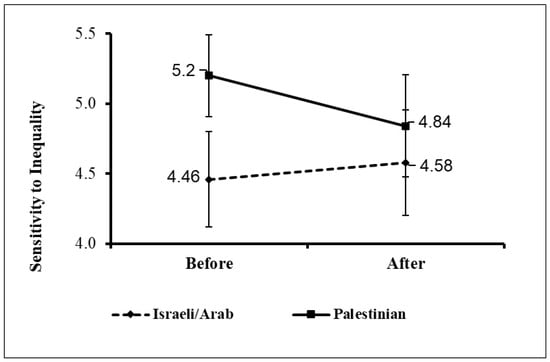
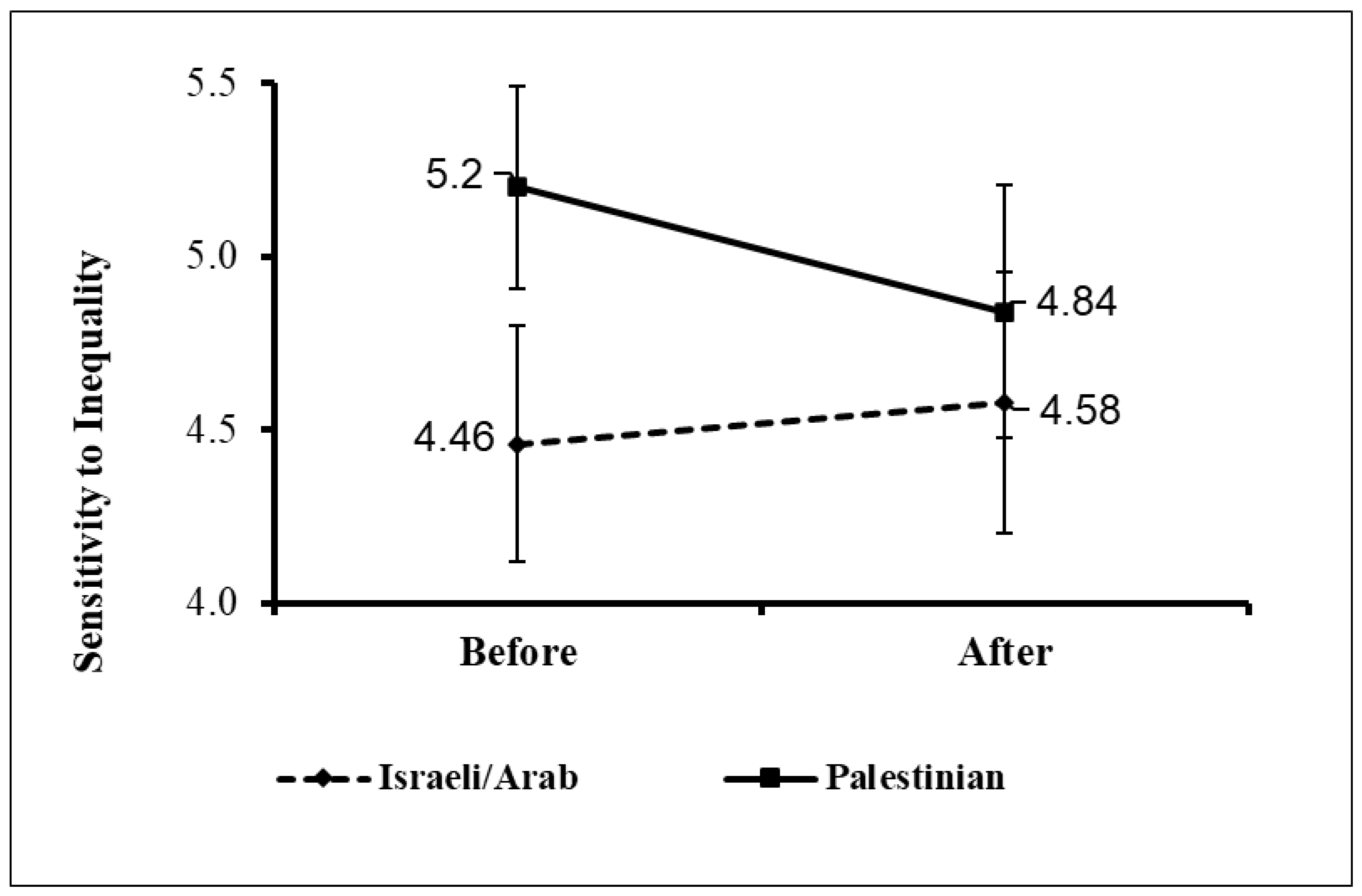
Main Effects: Table 4 provides GEE results, namely, main effects and interaction effects. Time (fixed) effect was found to be significantly positive for four out of the five tested outcome variables (legitimate ways to promote Arab citizens: b = 0.36, p < .001; hopes for peace: b = 0.24, p < .05; Semitic categorization: b = 0.43, p < .001; Abrahamic categorization: b = 0.37, p < .001). In other words, the post-intervention round was shown to be higher on average in key perceptions. However, sensitivity to inequality remained unchanged, across all participants. We found greater hopes for peace among the PSTs in comparison to high school students (b = 0.67, p < .001). Hopes for peace were lower among those who identified themselves as Palestinians (b = −0.36, p < .01). Two more effects were found to associate with hopes for peace; higher (self-reported) grades in Hebrew were positively associated with hopes for peace as well as self-efficacy in Hebrew (b = 0.17, p < .05; b = 0.28, p < .01, respectively). Self-efficacy in Hebrew was found to positively explain promotion of Arab citizens (advancing democracy), Semitic categorization, and Abrahamic categorization (b = 0.44, p < .001; b = 0.23, p < 0.05; b = 0.26, p < .05; respectively), which suggested that stronger self-efficacy in Hebrew was associated with higher levels of these outcomes. We found that those who identified themselves as Palestinians were more likely to sense inequality, but less likely to endorse Semitic and Abrahamic categorization (b = 0.51, p < .01; b = −0.38, p < .01; b = −0.50, p < .05, respectively). Starting Hebrew studies at a higher grade was associated with higher sensitivity to inequality (b = 0.29, p < .05).
Table 4.
GEE regression analyses to explain various outcomes and main and interaction effects.
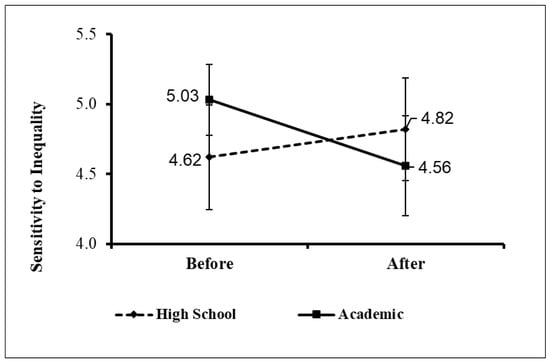
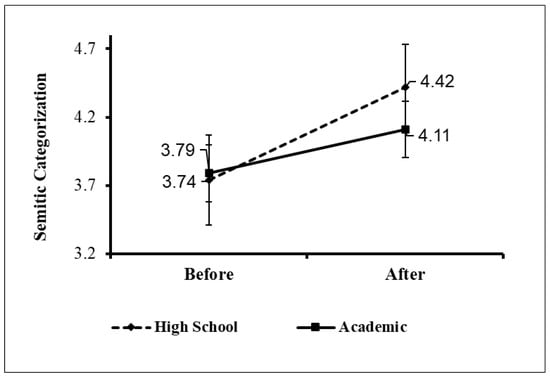
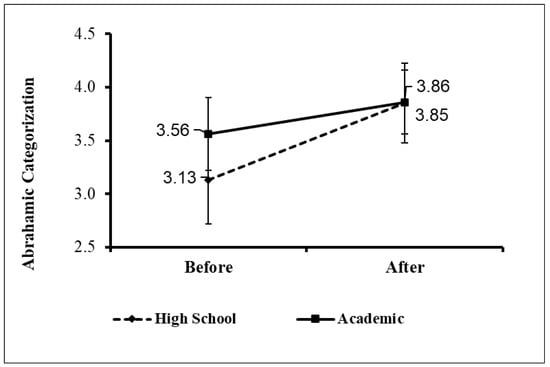
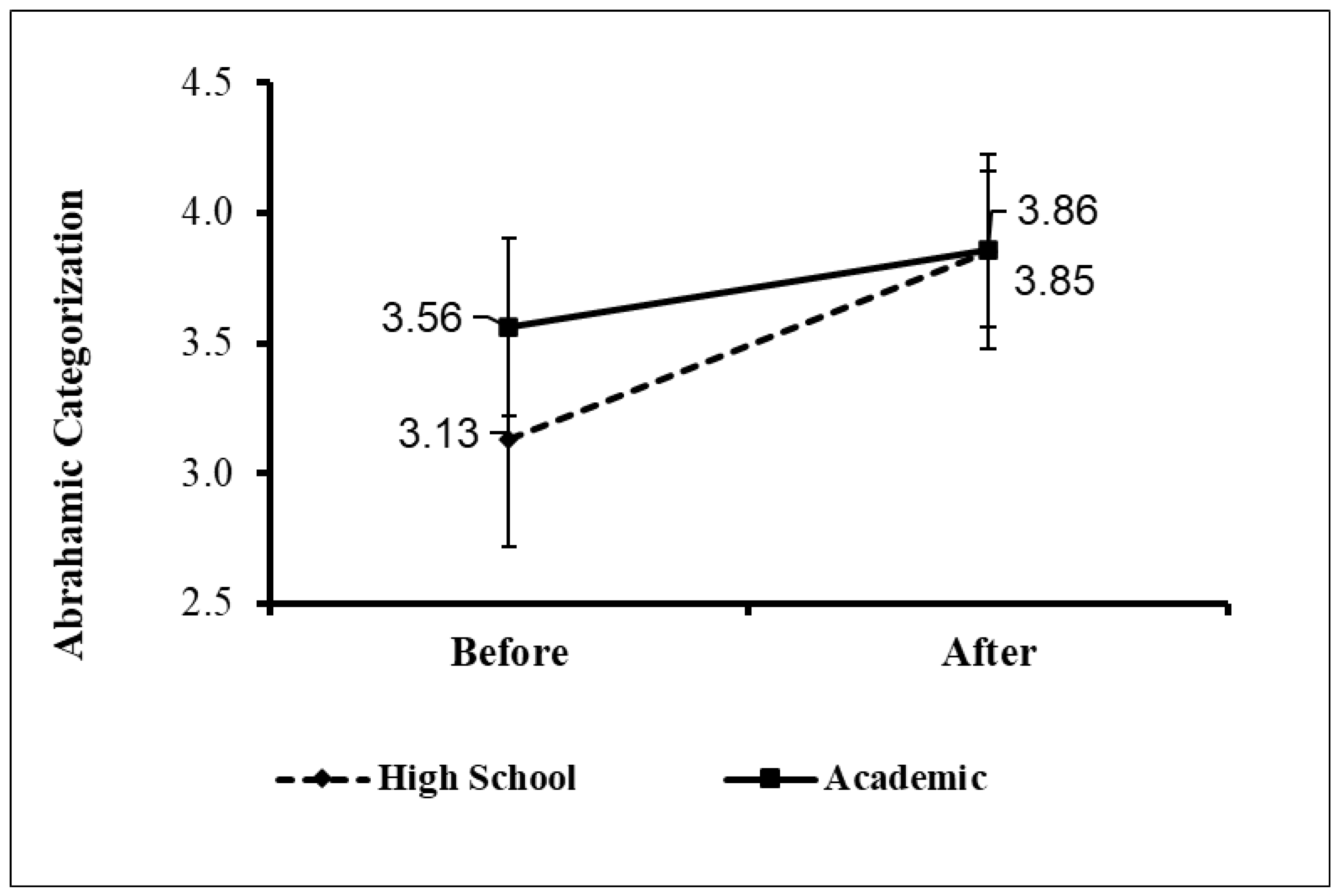
Interaction Analysis: As for the interaction effects, we found time by PST group to affect sensitivity to inequality and Semitic and Abrahamic categorization (Wald’s = 6.65, p < .01; Wald’s 3.24, p < .10; Wald’s 3.60, p < .10, respectively). Follow-up analyses were performed to assess the sources of these interactions (Figure 1, Figure 2 and Figure 3), namely, a test of, for example, whether one group made greater progress than the other at the outcome level. Interestingly, Figure 1 shows that sensitivity to inequality dropped among the PSTs, whereas this sensitivity increased for the high school students. PSTs who identified as Israeli Arabs kept their hopes for peace at a relatively constant level, whereas those identified as Palestinians showed an increase in their hopes for peace.
Figure 1.
Group by time on sensitivity to inequality: contrasting the decrease among PSTs with the increase among HSSs.
Figure 2.
Changes in semitic categorization scores over time comparing high school students and pre-service teachers.
Figure 3.
Education level by time effect on Abrahamic categorization.
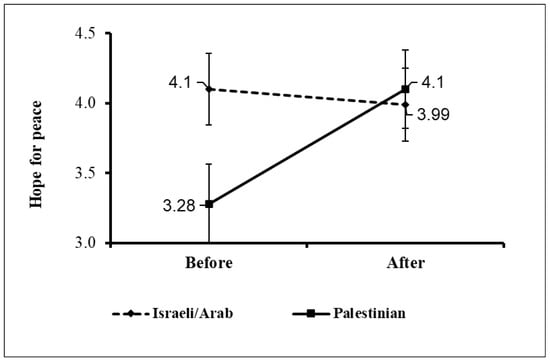
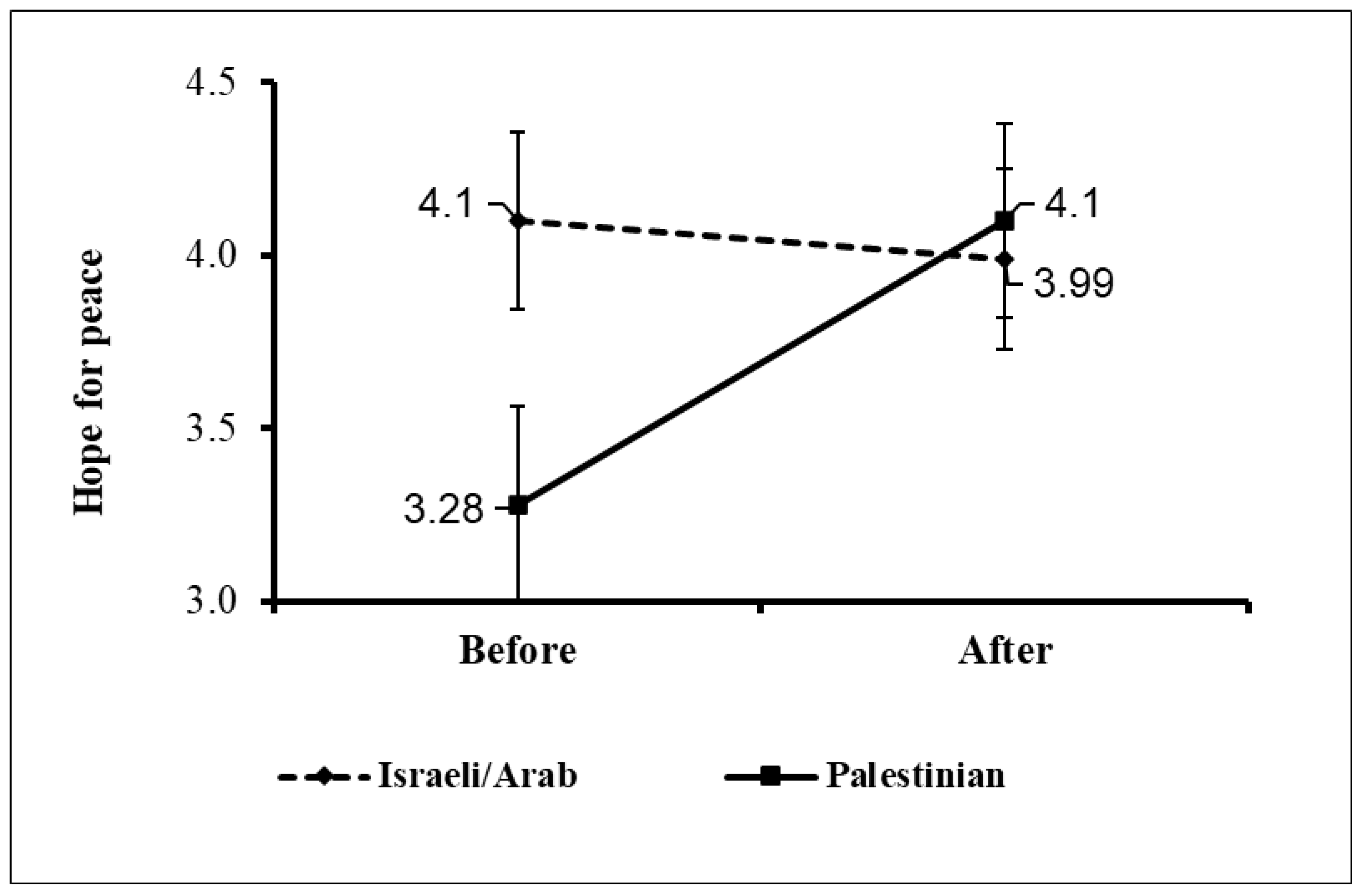
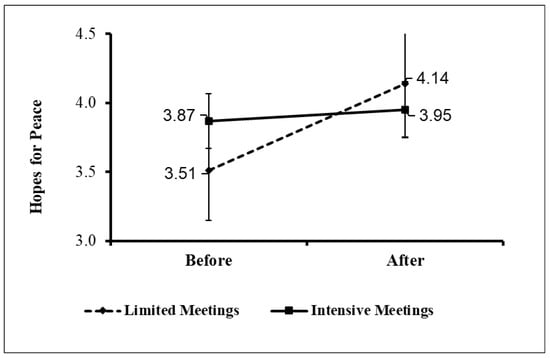
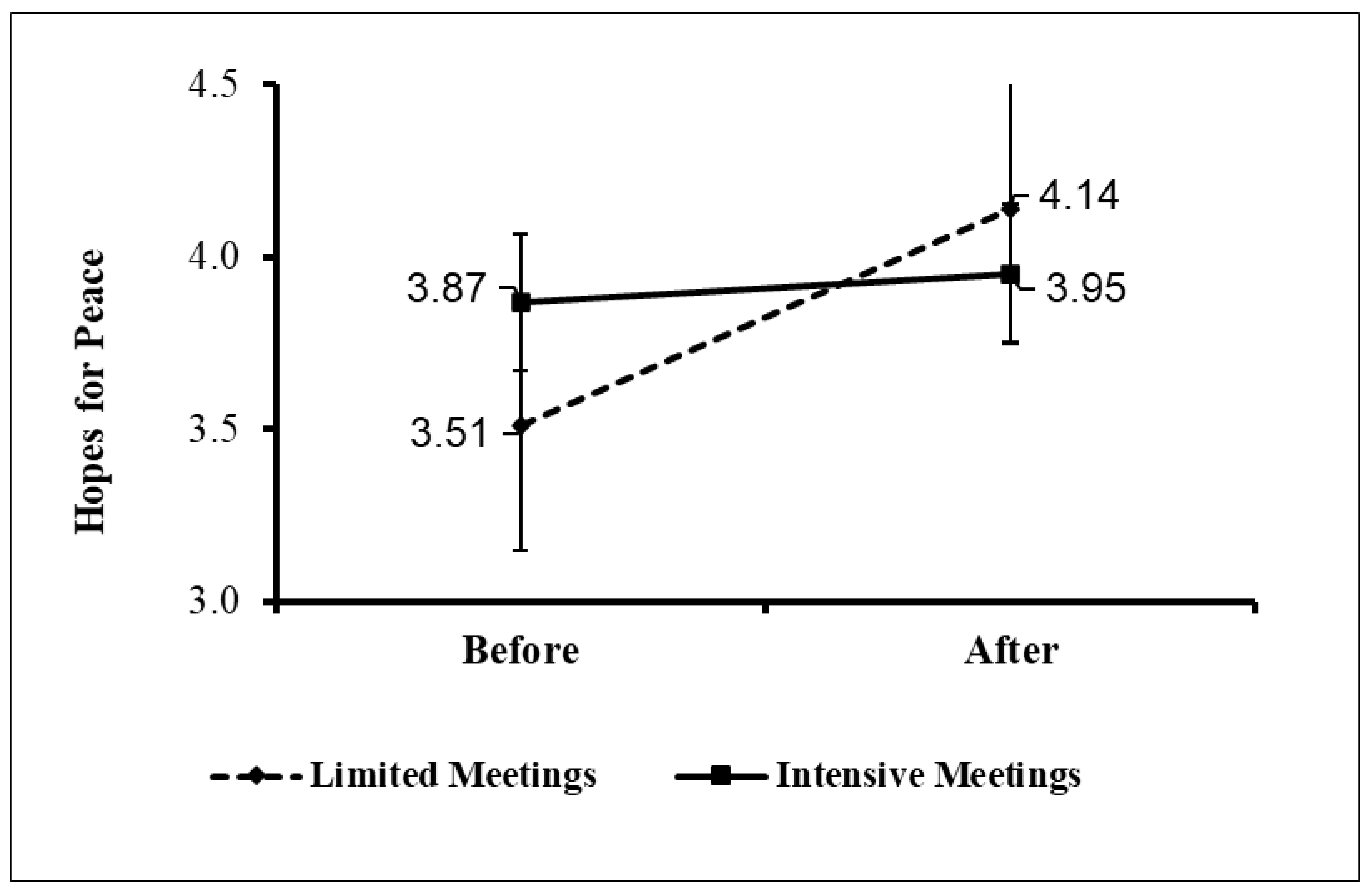
Figure 2 shows that high school students increased their use of Semitic categorization, while for the PSTs, this increase was much lower and similarly with respect to the Abrahamic categorization (see Figure 3), yet the end point rather than the starting point was similar for both education levels. Three interactions with time were found regarding identity, an interaction in explaining hopes for peace conditioned by perceived identity, Israeli Arab versus Palestinian (Wald’s = 16.46, p < .001), an interaction in explaining sensitivity to inequality (Wald’s = 2.78, p < .10), and in explaining the use of Abrahamic categorization (Wald’s = 7.78, p < .01). Figure 4, Figure 5 and Figure 6 present the sources of these interactions, respectively. In Figure 4, hope for peace remained unchanged for those who identified themselves as Israeli Arabs, but for those who identified themselves as Palestinians, these hopes grew with time. We found that for those who identified themselves as Palestinians, sensitivity to inequality decreased with time but was lower in both time periods for the Israeli Arabs (Figure 5). Finally, in Figure 6, the increase in the levels of Abrahamic categorization was relatively higher among those identified as Palestinians. Intensity of meeting with Jews was found to indicate hope for peace as well (Wald’s = 5.07, p < .05). Figure 7 shows that these hopes remained unchanged among students who met with Jews intensively.
Figure 4.
Longitudinal trends in hope for peace: divergent trajectories between Palestinian and Israeli Arab identifiers.
Figure 5.
Identity by time effect on sensitivity to inequality.
Figure 6.
Longitudinal increase in Abrahamic categorization: a comparison between Palestinian and Israeli Arab identifiers.
Figure 7.
Intensity of meeting by time effect on hopes for peace.
5. Discussion
The analysis of main effects provides robust evidence supporting the core hypothesis that a focused language intervention, acting as structured intergroup contact (Bandes-Yakov & Makhoul, 2013; Donitsa-Scmidt et al., 2004), successfully fosters positive attitudes even during a period of acute conflict. The significant positive time effect across four of the five outcomes, Preference for Democratic Influence Strategies (advancing democracy), hope for peace, Semitic categorization, and Abrahamic categorization, demonstrates that learning Hebrew for instrumental purposes can initiate a shift toward affective and ideological openness.
The finding that all measured indicators of reconciliation and constructive political engagement increased over time is particularly noteworthy given that the data collection spanned a period of national trauma and high polarization after 7 October 2023 (Reis & Wald, 2024; aChord, 2024). This suggests that structured educational programs based on mutual, practical goals provide a powerful mechanism for improving intergroup attitudes (Pettigrew & Tropp, 2006).
A detailed examination of the covariates highlights the role of perceived individual competence in relating to generalized attitude shifts. Self-efficacy in Hebrew was positively associated with all four variables that showed a positive time effect: democratic strategies, hope for peace, Semitic categorization, and Abrahamic categorization.
This pattern validates the instrumental-to-intrinsic hypothesis (Charamba, 2022; Gindi & Erlich Ron, 2025). When participants achieve linguistic proficiency, the internal conflict between the instrumental necessity of Hebrew and its symbolic political burden is partly reconciled (Amara, 2016; Klar et al., 2020). The acquisition of skill helps mediate the perceived function of the language from an oppressive requirement into a personal asset, thereby reducing alienation and increasing openness to the outgroup (Raoofi et al., 2012). This move can drive the shift toward perceiving commonality and supporting democratic engagement.
Interestingly, the overall positive effect of the intervention stands in contrast to the finding that intensive, unstructured meetings between Arabs and Jews did not significantly influence hope for peace over time. This comparison reinforces a core tenet of contact theory in conflict settings: the sheer quantity of contact is insufficient; the quality of the interaction, specifically when focused on achieving shared goals and building competence, is the critical factor for producing meaningful attitude change (Maoz, 2011).
The most complex and significant findings arise from the Time x Identity interaction effects, demonstrating that the political positioning of the participants contributes to the efficacy and magnitude of the intervention. Individuals identifying as Palestinian exhibited significantly lower baseline attitudes: lower hope for peace and lower endorsement of both Semitic and Abrahamic categorization. This baseline resistance is consistent with literature on Bicultural Identity Integration (BII) conflict, where strong minority identity (Palestinian) is linked to political polarization (Hong et al., 2000; Simon & Grabow, 2010).
However, the post-intervention results show that individuals identifying as Palestinian exhibited the most significant attitudinal change over time. Hope for peace remained unchanged for Israeli Arab identifiers but grew significantly for Palestinian identifiers. Similarly, the increase in Abrahamic categorization was relatively higher among those identified as Palestinian. It is important to note, however, that these identity categories are self-reported and likely fluid, particularly in the volatile post-7 October context. Rather than viewing ‘Palestinian’ or ‘Israeli-Arab’ as fixed traits, these findings suggest that the intervention interacts differently with participants’ current political orientation, offering a pathway to inclusion even for those prioritizing their national identity. This suggests that the structured, goal-oriented nature of the language intervention was associated with overcoming the initial layer of political resistance, despite the contemporary polarization. The mechanism here appears to align with the dual identity model, where a successful, pragmatic superordinate connection (language competence) allows for more integration of previously conflicting identities.
This suggests that the structured, goal-oriented nature of the language intervention was associated with overcoming the initial layer of political resistance, despite the contemporary polarization. The mechanism here appears to align with the dual identity model, where a successful, pragmatic superordinate connection (language competence) allows for more integration of previously conflicting identities (Benet-Martínez et al., 2021).
Furthermore, the data reveal nuances in how commonality frames are adopted. While HSS, relative to PSTs, showed a steeper increase in adopting Semitic categorization and Abrahamic categorization, the magnitude of change was greatest among Palestinian identifiers specifically for Abrahamic categorization. This is notable because Semitic categorization, based on linguistic roots (the intervention’s focus), was hypothesized to be the less threatening bridge. The pronounced change in Abrahamic categorization suggests that once linguistic proficiency lowers the barrier to affective trust, more difficult to bridge frameworks of commonality (shared religious ancestry) become accessible, potentially leading to a more comprehensive recategorization among the most initially resistant individuals.
The contrast between the PSTs and the HSSs holds significant implications, grounded in the importance of teacher colleges as multicultural sites w (aChord, 2023). These colleges provide a rare space for institutionalized contact that is endorsed by authority figures, a key condition for reducing prejudice (e.g., Pettigrew & Tropp, 2006). For the PSTs, the college environment functions not just as a place of learning, but as an anticipatory socialization stage where they begin to adopt the identity of a future state agent (Paul-Binyamin & Haj-Yehia, 2019). Unlike the HSSs, who view Hebrew primarily through a personal or political lens, PSTs are actively constructing a teacher professional identity that requires them to integrate their personal values with the institutional norms of the Israeli education system. This professional identity acts as a stabilizing superordinate identity (e.g., “we are all educators”), which can override narrower ethno-national divisions and mitigate the sense of intergroup threat (Gindi & Erlich-Ron, 2019). In this context, the divergent patterns observed between the two cohorts regarding sensitivity to inequality (Figure 1) necessitate a more rigorous conceptual distinction between system-justifying adaptation and heightened political awareness. For the PSTs, the significant decrease in perceived inequality may be interpreted through the lens of system-justifying adaptation. As these young adults undergo professional socialization within a state-sanctioned institutional framework, their emerging identity as future state agents likely prompts a shift toward institutional alignment (Gindi & Erlich-Ron, 2019).This process, coupled with increased professional agency and a belief in social mobility, may temporarily obscure the visibility of structural barriers as they prepare to navigate the system from within. Conversely, the HSS cohort, lacking this institutionalized professional pathway, appears to utilize their increased linguistic proficiency to develop a ‘critical consciousness’ or heightened political awareness (Bonotti & Willoughby, 2022; Shohami & Tenenbaum, 2018). For these adolescents, the Hebrew language serves as a tool to identify and articulate structural disadvantages rather than to navigate them through professional integration. This divergence underscores how the same linguistic asset can lead to either institutional adaptation or political sensitization depending on the individual’s developmental and professional context.
This finding is further complicated by the positive association between a higher grade in Hebrew and higher sensitivity to inequality. These results indicate that acquiring the language of the dominant group acts as a double-edged sword. For the PSTs, who are predominantly Israeli Arab identifiers and focused on immediate vocational advancement, language mastery reinforces their ability to navigate the system, potentially reducing their perceived sense of institutional barriers. In their context, the idea “I can speak Hebrew well, therefore I can succeed,” mitigates feelings of systemic disadvantage.
Conversely, for the younger HSS cohort, improved linguistic proficiency provides a clearer lens through which to perceive and articulate the persistent structural disadvantages and discrimination faced by the Palestinian citizens (Zeedan & Hogan, 2022). Language skills, while instrumental for mobility, heighten political awareness, aligning with the literature that suggests high proficiency in a majority language can empower minorities to better analyze and critique systemic inequalities. This political sensitization is likely amplified by the data collection occurring immediately after the 7 October escalation, where conflict brought intergroup hostility and asymmetrical power relations into sharp focus, bolstering the adolescents’ developing political consciousness (Amara, 2016).
6. Limitations and Future Research
The acute political timing of the data collection represents an external validity limitation. The study was conducted in the aftermath of the 7 October 2023 conflict escalation. This “history” effect likely magnified the salience of identity, political issues, and perceived threat, potentially generating volatile or amplified attitudinal responses that may not be sustainable or generalizable to peacetime conditions. Notwithstanding this, it is difficult to find peaceful times in Israel, without serious security events.
Second, the interpretation of these results must be balanced against several methodological constraints inherent to the study design. First, the research relies on a quasi-experimental, non-equivalent control group design. The two primary groups, HSSs and PSTs, differed significantly on critical baseline variables, including age, gender, and identity. Although GEE statistical modeling controls for these measured baseline differences (group effects), the lack of randomization makes the study susceptible to threats to internal validity such as selection bias and differential maturation effects. Furthermore, given the quasi-experimental nature of the design, causal terms such as ‘effect’ or ‘impact’ should be interpreted with caution. The observed changes reflect associations over time within the context of the intervention, rather than definitive causal outcomes derived from randomized trials.
Additionally, the findings regarding sensitivity to inequality must be interpreted with specific caution. This construct was measured using a two-item scale which exhibited relatively modest internal reliability (α = .57 at Time 1 and α = .65 at Time 2). Given these psychometric constraints and the overlapping conceptualizations of political awareness, critical consciousness, and perceived marginalization, these results should be viewed as exploratory. Future research employing more robust, multi-item scales is necessary to definitively distinguish between enduring ideological shifts and situational adaptations.
Finally, as with many studies in social psychology, all dependent variables relied on self-reported attitudinal measures. This introduces the potential risk of Common Method Variance (CMV). However, it is worth noting that the primary findings of this study rely on complex interaction effects (e.g., Time × Identity × Group) rather than simple correlations. Interaction effects are generally less likely to be artifacts of CMV than main effects are (Siemsen et al., 2010), lending some support to the validity of the interpretations.
Future Research Directions
Based on the complex pattern of results, future research should focus on three key directions. While this study suggests Semitic framing is effective, experimental research is needed to establish causality. Future studies should use a fully randomized experimental design to explicitly manipulate the framing of shared identity (e.g., Semitic linguistic roots vs. Abrahamic religious roots vs. neutral control) immediately prior to structured language contact interventions. This would test whether the linguistic, pragmatic frame offers a unique advantage in lowering affective threat and promoting successful dual identity integration.
Future studies would do well to track the high school cohort as they transition into teacher training and the workforce, broadening the scope to monitor the dynamic interplay between Hebrew proficiency and identity formation. A central question is how high linguistic self-efficacy interacts with Bicultural Identity Integration (BII) over time: does this combination empower constructive collective action, or does the intersection of competence and realized exclusion eventually drive participants toward withdrawal, apathy, or support for political radicalization (Simon et al., 2013).
7. Conclusions
This study provides evidence that strategic, instrumental interventions focusing on Hebrew language acquisition can serve as a resilient mechanism for improving intergroup attitudes among Arab citizens of Israel, even in the highly strained socio-political climate following the acute conflict escalation in late 2023. The significant overall positive shift in hope for peace, endorsement of democratic strategies, and adoption of common ancestry frames (Semitic and Abrahamic) confirms the change hypothesized under the instrumental-to-intrinsic pathway (Charamba, 2022; Gindi & Erlich Ron, 2025). The data demonstrate that increasing self-efficacy in the dominant language correlates with a reduction in threat and an increased willingness to engage with the outgroup constructively.
However, the findings reveal that the change is neither uniform nor politically neutral. The observed link between higher Hebrew proficiency and increased sensitivity to inequality underscores a divergence in how linguistic assets are utilized across different developmental stages. For the PSTs, mastery of the language appears to function primarily as a vehicle for professional mobility (Abbas & Mendel, 2022; Manor & Binhas, 2023), effectively diminishing their perception of structural barriers. Conversely, for the HSS cohort, this same competence seems to promote more critique, demonstrating the gaps between them and the Jewish population and sharpening their ability to identify and articulate systemic discrimination. Thus, proficiency in the dominant language can also serve as a potential factor in heightened political consciousness, particularly among adolescents navigating a polarized environment.
The theoretical implication is clear: language interventions, rooted in functional needs, offer a low-threat entry point for initiating dialogue and reconciliation. The practical imperative is that educational policy would do well to leverage this instrumental success, pairing language training with programs that guide the resulting political awareness toward empowered, constructive civil engagement. In this way, functional integration can be translated into resilient civic participation, laying the groundwork for a more robust and equitable shared future (Gindi & Erlich-Ron, 2019).
The implications of this study extend beyond language acquisition to the fundamental role of teacher education in a conflict zone. In the deeply divided landscape of Israeli society, teacher training colleges serve as a rare and vital arena for cross-cultural engagement (aChord, 2023; Paul-Binyamin & Haj-Yehia, 2019). For PSTs, this training experience serves as a powerful crucible, forging a professional identity that acts as a secure anchor and establishes a profound sense of connection to their future role. This newly acquired professional self, complemented by the concurrent mastery of language skills, offers a constructive pathway to mitigate the complexities of their BII (e.g., Erlich Ron, 2025).Consequently, these academic institutions must transcend their traditional mandates to function as active cultural mediators (Shapira & Amzalag, 2021), ensuring that language training serves not merely as a technical skill, but as a mechanism for negotiating status and belonging within the state (Yablon et al., 2022).
Funding
This research was supported by a grant from the Feldman Foundation, TX.
Institutional Review Board Statement
The study was conducted in accordance with the Declaration of Helsinki, and approved by Institutional Review Board of Beit Berl college (protocol code 129-2022 and date of approval: 30 March 2025).
Informed Consent Statement
Informed consent was obtained from all subjects involved in the study.
Data Availability Statement
The datasets generated and analyzed during the current study are not publicly available due to ethical and privacy restrictions, as they contain sensitive information regarding participants’ identities and political attitudes. Data may be made available from the corresponding author upon reasonable request, subject to approval by the institutional ethics committee.
Conflicts of Interest
The author declares no conflicts of interest. The funders had no role in the design of the study; in the collection, analyses, or interpretation of data; in the writing of the manuscript; or in the decision to publish the results.
References
- Abbas, F., & Mendel, Y. (2022). Hebrew studies amongst Palestinians in East Jerusalem: Not language of success, but ‘language of access’. Hebrew Studies, 63(1), 221–243. [Google Scholar] [CrossRef] [Scilit]
- Abu-Rabiah, E. (2025). Navigating language barriers: Hebrew proficiency and self-efficacy among Muslim Arab Bedouin students in Israeli higher education. Journal of International Students, 15(3), 71–90. [Google Scholar] [CrossRef] [Scilit]
- aChord. (2023). Returning to campuses after October 7th: Practical guidelines for creating a safe and inclusive academic environment. The Hebrew University of Jerusalem. Available online: https://www.achord.org.il/_files/ugd/e9f8ab_ab4c8cf8c6b445d4ba29ac88d549f850.pdf (accessed on 21 February 2025). (In Hebrew)
- aChord. (2024). Index for shared society progress in youth 2024, part B (ISSPY). Hebrew University. Available online: https://bit.ly/3AFu134 (accessed on 21 February 2025). (In Hebrew)
- Allport, G. W. (1954). The nature of prejudice. Addison-Wesley. [Google Scholar]
- Altun, M. (2023). The power of language: Exploring its significance in shaping perceptions, beliefs, and relationships. International Journal of Social Sciences & Educational Studies, 10(3), 362–366. [Google Scholar] [CrossRef] [Scilit]
- Amara, M. (2016). Language, identity and conflict: Examining collective identity through the labels of the Palestinians in Israel. Journal of Holy Land and Palestine Studies, 15(2), 203–223. [Google Scholar] [CrossRef] [Scilit]
- Atili, L. (1999). The relationship between attitudes toward the Hebrew language, its speakers and culture, and the peace process in the Middle East, and achievement in the Hebrew language in Arab high schools in Israel [Master’s thesis, Tel Aviv University]. (In Hebrew) [Google Scholar]
- Bandes-Yakov, A., & Makhoul, B. (2013). The “Ya Salam” curriculum: An evaluation study. Henrietta Szold Institute. Available online: https://www.nli.org.il/he/books/NNL_ALEPH003600188/NLI (accessed on 22 May 2024). (In Hebrew)
- Benet-Martínez, V., Lee, F., & Cheng, C. Y. (2021). Bicultural identity integration. In M. J. Gelfand, C. Y. Chiu, & Y. Y. Hong (Eds.), Handbook of advances in culture and psychology (pp. 244–284). Oxford University Press. [Google Scholar]
- Bonotti, M., & Willoughby, L. (2022). Citizenship, language tests, and political participation. Nations and Nationalism, 28(2), 449–464. [Google Scholar] [CrossRef] [Scilit]
- Charamba, E. (Ed.). (2022). Handbook of research on teaching in multicultural and multilingual contexts. IGI Global. [Google Scholar]
- Chen, Z., Sun, Y., & Jia, Z. (2022). A study of student-teachers’ emotional experiences and their development of professional identities. Frontiers in Psychology, 12, 810146. [Google Scholar] [CrossRef] [Scilit]
- Dickens, W. T. (2006). Frank conversations: Promoting peace among the Abrahamic traditions through interreligious dialogue. Journal of Religious Ethics, 34(3), 397–420. [Google Scholar] [CrossRef] [Scilit]
- Donitsa-Scmidt, S., Inbar, O., & Shohamy, E. (2004). The effects of teaching spoken Arabic on student’s attitudes and motivation in Israel. Modern Language Journal, 88(2), 217–228. [Google Scholar] [CrossRef] [Scilit]
- Erikson, E. H. (1963). Childhood and society (2nd ed). Norton. [Google Scholar]
- Erlich Ron, R. (2025). ‘Every place requires showing a different part of my identity’: Bicultural identity performance and frame-switching among Arab pre-service teachers. International Studies in Sociology of Education, 35(1), 87–110. [Google Scholar] [CrossRef] [Scilit]
- Gaertner, S. L., & Dovidio, J. F. (2014). Reducing intergroup bias: The common ingroup identity model. Psychology Press. [Google Scholar]
- Gardner, R. C., Lalonde, R. N., & Moorcroft, R. (1985). The role of attitudes and motivation in second language learning: Correlational and experimental considerations. Language Learning, 35(2), 207–227. [Google Scholar] [CrossRef] [Scilit]
- Gindi, S., & Erlich-Ron, R. (2019). Bargaining with the system: A mixed-methods study of Arab teachers in Israel. International Journal of Intercultural Relations, 69, 44–53. [Google Scholar] [CrossRef] [Scilit]
- Gindi, S., & Erlich Ron, R. (2025). “Mitoch shelo lishma ba lishma”: Arab youth’s attitudes toward the Hebrew language in relation to identity and attitudes toward shared society. Hamda’at, 18, 75–103. (In Hebrew) [Google Scholar]
- Gindi, S., Gilat, Y., & Sagee, R. (2022). Short communication—Students’ attitudes toward boundary-crossing teachers before and after the May 2021 violence between Israelis and Palestinians: A ripple effect? International Journal of Intercultural Relations, 91, 38–43. [Google Scholar] [CrossRef] [Scilit]
- Hardin, J. W., & Hilbe, J. M. (2013). Generalized estimating equations (2nd ed.). Chapman and Hall/CRC. [Google Scholar]
- Harel, T. O., Nir, N., Vandermeulen, D., Maoz, I., & Halperin, E. (2025). A threat to cohesion: Intragroup affective polarization in the context of intractable intergroup conflict. Journal of Conflict Resolution, 69(2–3), 491–517. [Google Scholar] [CrossRef] [Scilit]
- Hong, Y. Y., Morris, M. W., Chiu, C. Y., & Benet-Martinez, V. (2000). Multicultural minds: A dynamic constructivist approach to culture and cognition. American Psychologist, 55, 709–720. [Google Scholar] [CrossRef]
- Hornsey, M. J., & Hogg, M. A. (2000). Subgroup relations: A comparison of mutual intergroup differentiation and common ingroup identity models of prejudice reduction. Personality and Social Psychology Bulletin, 26(2), 242–256. [Google Scholar] [CrossRef] [Scilit]
- Huehnergard, J., & Pat-El, N. A. (2019). Introduction to the Semitic languages and their history. In J. Huehnergard, & N. Pat-El (Eds.), The semitic languages (pp. 1–21). Routledge. [Google Scholar]
- Klar, Y., Mar’i, A. A. R., Halabi, S., Basheer, A., & Basheer, B. (2020). Reactions of Arab-Palestinians in Israel toward an in-group member mixing Hebrew or English with Arabic. Journal of Language and Social Psychology, 39(4), 516–533. [Google Scholar] [CrossRef] [Scilit]
- Knesset. (2018). Basic law: Israel—The Nation State of the Jewish people. Available online: https://main.knesset.gov.il/Activity/Legislation/Laws/Pages/LawPrimary.aspx?t=lawlaws&st=lawlawsbasic&lawitemid=2073986 (accessed on 21 February 2025). (In Hebrew)
- Kunst, J. R., Kimel, S. Y., Shani, M., Alayan, R., & Thomsen, L. (2019). Can Abraham bring peace? The relationship between acknowledging shared religious roots and intergroup conflict. Psychology of Religion and Spirituality, 11(4), 417. [Google Scholar] [CrossRef] [Scilit]
- Kunst, J. R., & Thomsen, L. (2015). Prodigal sons: Dual Abrahamic categorization mediates the detrimental effects of religious fundamentalism on Christian–Muslim relations. The International Journal for the Psychology of Religion, 25(4), 293–306. [Google Scholar] [CrossRef] [Scilit]
- Kunst, J. R., Thomsen, L., & Sam, D. L. (2014). Late Abrahamic reunion? Religious fundamentalism negatively predicts dual Abrahamic group categorization among Muslims and Christians. European Journal of Social Psychology, 44(4), 337–348. [Google Scholar] [CrossRef] [Scilit]
- Manor, R., & Binhas, A. (2023). Teaching Hebrew as second language in Arab schools in Israel: Policy and identity politics. Language Problems and Language Planning, 47(1), 49–71. [Google Scholar] [CrossRef] [Scilit]
- Manor, R., & Masry-Herzallah, A. (2025). On language, identity, and conflict: Professional sense of coherence and hybrid identity formation among Palestinian-Jerusalemite Hebrew teachers. Pedagogy, Culture & Society, 1–23. [Google Scholar] [CrossRef] [Scilit]
- Maoz, I. (2011). Does contact work in protracted asymmetrical conflict? Journal of Peace Research, 48(1), 115–125. [Google Scholar] [CrossRef] [Scilit]
- Marcia, J. E. (1980). Identity in adolescence. Handbook of Adolescent Psychology, 9(11), 159–187. [Google Scholar]
- Marom, S. (2014). The importance of the Hebrew language for the integration and advancement of the Arab population in the labor market. Gedish, 14, 120–146. (In Hebrew) [Google Scholar]
- Or, I. G., & Shohamy, E. (2016). Asymmetries and inequalities in the teaching of Arabic and Hebrew in the Israeli educational system. Journal of Language and Politics, 15(1), 25–44. [Google Scholar] [CrossRef] [Scilit]
- Paul-Binyamin, I., & Haj-Yehia, K. (2019). Multicultural education in teacher education: Shared experience and awareness of power relations as a prerequisite for conflictual identities dialogue in Israel. Teaching and Teacher Education, 85, 111–121. [Google Scholar] [CrossRef] [Scilit]
- Pettigrew, T. F., & Tropp, L. R. (2006). A meta-analytic test of intergroup contact theory. Journal of Personality and Social Psychology, 90(5), 751–783. [Google Scholar] [CrossRef] [Scilit]
- Raoofi, S., Tan, B. H., & Chan, S. H. (2012). Self-efficacy in second/foreign language learning contexts. English Language Teaching, 5(11), 60–73. [Google Scholar] [CrossRef] [Scilit]
- Reis, S. P., & Wald, H. S. (2024). The Hamas massacre of Oct 7, 2023, and its aftermath, medical crimes, and the Lancet commission report on medicine, Nazism, and the Holocaust. Israel Journal of Health Policy Research, 13(1), 19. [Google Scholar] [CrossRef] [Scilit]
- Shapira, N., & Amzalag, M. (2021). Online joint professional development: A novel approach to multicultural education. Journal for Multicultural Education, 15(4), 445–458. [Google Scholar] [CrossRef] [Scilit]
- Shohami, A., & Tenenbaum, M. (2018). Innovative multilingual educational policy for Israel: Final summary report. Tel Aviv University, Haim and Joan Constantiner School of Education. [Google Scholar]
- Siemsen, E., Roth, A., & Oliveira, P. (2010). Common method bias in regression models with linear, quadratic, and interaction effects. Organizational Research Methods, 13(3), 456–476. [Google Scholar] [CrossRef] [Scilit]
- Simon, B., & Grabow, O. (2010). The politicization of migrants: Further evidence that politicized collective identity is a dual identity. Political Psychology, 31, 717–738. [Google Scholar] [CrossRef] [Scilit]
- Simon, B., Reichert, F., & Grabow, O. (2013). When dual identity becomes a liability: Identity and political radicalism among migrants. Psychological Science, 24, 251–257. [Google Scholar] [CrossRef] [Scilit]
- Spears, R., Doosje, B., & Ellemers, N. (1997). Self-stereotyping in the face of threats to group status and distinctiveness: The role of group identification. Personality and Social Psychology Bulletin, 23(5), 538–553. [Google Scholar] [CrossRef] [Scilit]
- Suktitipat, B., Mathias, R. A., Vaidya, D., Yanek, L. R., Young Hunter, J., Becker, L. C., Becker, D. M., Wilson, A. F., & Fallin, D. M. (2013). The robustness of generalized estimating equations for association tests in extended family data. Human Heredity, 74(1), 17–26. [Google Scholar] [CrossRef] [Scilit] [PubMed]
- Suleiman, C. (2011). Language and identity in the Israel-Palestine conflict. I.B. Tauris. [Google Scholar]
- Tahaucho, M., Kalisher, A., & Mushkelev, K. (2020). The return to knowledge of the Hebrew language in Arab society: Barriers to language acquisition and ways to remove them (Policy Paper 2020.06). Aharon Institute for Economic Policy. Available online: https://www.runi.ac.il/media/clcbpivi/policy-paper.pdf (accessed on 21 February 2025). (In Hebrew)
- Tarabia, E. (2023). The effect of Hebrew language proficiency on academic and social self-image, motivation and academic success of Arab students in the Israeli Academia. Journal of Namibian Studies History Politics Culture, 34, 1190–1211. [Google Scholar]
- Wright, S. C. (2001). Strategic collective action: Social psychology and social change. In R. Brown, & S. L. Gaertner (Eds.), Intergroup processes: Blackwell handbook of social psychology (Vol. 4, pp. 409–430). Blackwell. [Google Scholar]
- Yablon, Y. B., Iluz, S., & Hershkowitz, S. (2022). Simulation-based learning for rabbi-teachers dealing with conflicts in education. British Journal of Religious Education, 44(3), 315–324. [Google Scholar] [CrossRef] [Scilit]
- Zeedan, R., & Hogan, R. E. (2022). The correlation between budgets and matriculation exams: The case of Jewish and Arab schools in Israel. Education Sciences, 12(8), 545. [Google Scholar] [CrossRef] [Scilit]

Disclaimer/Publisher’s Note: The statements, opinions and data contained in all publications are solely those of the individual author(s) and contributor(s) and not of MDPI and/or the editor(s). MDPI and/or the editor(s) disclaim responsibility for any injury to people or property resulting from any ideas, methods, instructions or products referred to in the content. |
© 2026 by the author. Licensee MDPI, Basel, Switzerland. This article is an open access article distributed under the terms and conditions of the Creative Commons Attribution (CC BY) license.