Nudging Students to Success: Investigating the Impact of Educational Nudges on Student Engagement and Outcomes



Abstract
1. Introduction
1.1. Review of Educational Nudges
1.2. Summary of Nudge Research
1.3. Nudge Behaviour Linked to Concept of Mattering
1.4. Study Context and Rationale
2. Materials and Methods
2.1. Participants
- 73 students from year 1
- 91 students from year 2
- 28 students from year 3
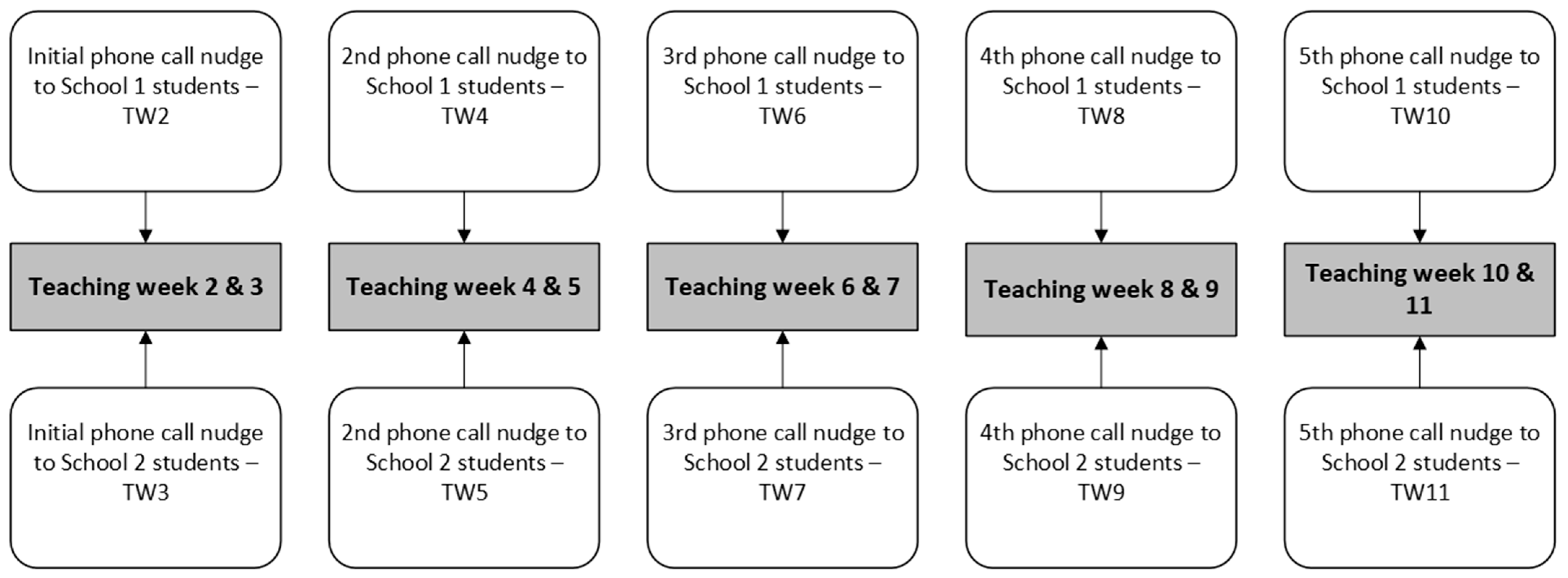
2.2. Procedure
- First contact—Ascertained underlying reasons for low engagement and motivated students to engage with the LMS. The initial contact enquired about the reasons for low engagement and provided an opportunity to tailor the appropriate nudge for the individual students, e.g., developing strategies including helping students to improve organisational skills, modelling the best way for independent learning via the use of a personalised study timetable, frequent reminders for ensuring they access LMS regularly to use the uploaded resources and/or complete formative assessments, signposting to relevant support service, and motivation were all employed.
- Second contact—Praised students for any achieved progress, supported students with personal development areas such as organisational skills, and directed students to module leader or relevant support services as needed.
- Third contact—Reiterated praise for achieved progress to enhance student confidence. Students were further encouraged and motivated to maintain engagement on the LMS platform.
- Fourth and Fifth contact—Praised students for progress and signposted to appropriate support services, specifically for assistance with exam skills and subject support as they prepared for end-of-module summative assessments.
2.2.1. Measures
- Independent Variable:
- No response: n = 23
- 1 response: n = 35
- 2 responses: n = 29
- 3 responses: n = 36
- 4 responses: n = 31
- 5 responses: n = 38
- Dependent Variables:
- -
- LMS engagement: Total time (hours) spent on LMS—the overall time recorded from the point of module enrolment up to TW 12, which marked the end of the module. Final LMS log data were captured in TW12, at the point of the final assessment, to evaluate changes in engagement and determine the relationship between nudge frequency and platform usage.
- -
- Academic Outcome: End-of-module grade (%)—used as a measure of academic performance. This provided a direct indicator of the potential academic impact of the nudge intervention.
2.2.2. Statistical Analysis
- Intervention
2.2.3. Student Free-Text Comments
2.3. Materials
3. Results
3.1. Impact of Nudge Intervention on LMS Engagement
3.2. Impact of Nudge Intervention on Academic Outcomes (Module Results)
3.3. Relationship Between LMS Engagement and Academic Outcomes (Module Results)
3.4. Inductive Content Analysis and Thematic Interpretation of Student Free-Text Comments
4. Discussion
4.1. Impact of Phone Call Nudges on Student Engagement and Outcomes
4.2. Relational Support and Academic Engagement: Discussion of Key Themes from Student Comments
4.3. The Role of Interpersonal Nudges in Fostering Engagement and Academic Success
4.4. Limitations and Directions for Future Research
5. Conclusions
Author Contributions
Funding
Institutional Review Board Statement
Informed Consent Statement
Data Availability Statement
Acknowledgments
Conflicts of Interest
Abbreviations
| LMS | Learning Management System |
| MS | Microsoft |
| STEM | Science, Technology, Engineering, and Mathematics |
References
- Azam, F., Shaheen, A., Irshad, K., & Ahmer, H. (2021, April 1–4). Nudging to improve: Impact of nudges on students’ progress and academic performance. International Conference on Medical Education (ICME 2021) (pp. 20–23), Yogyakarta, Indonesia. [Google Scholar]
- Banerjee, S., & John, P. (2024). Nudge plus: Incorporating reflection into behavioral public policy. Behavioural Public Policy, 8(1), 69–84. [Google Scholar] [CrossRef] [Scilit]
- Bar-Gill, O., & Cohen, A. (2021). How to communicate the Nudge: A real-world policy experiment (Harvard Law School John M. Olin Center Discussion Paper No. 1067, Harvard Public Law Working Paper No. 21-29). Available online: https://ssrn.com/abstract=3928705 (accessed on 8 August 2025).
- Beer, C., & Lawson, C. (2017). The problem of student attrition in higher education: An alternative perspective. Journal of Further and Higher Education, 41(6), 773–784. [Google Scholar] [CrossRef] [Scilit]
- Blumenstein, M., Liu, D. Y., Richards, D., Leichtweis, S., & Stephens, J. M. (2018). Data-informed nudges for student engagement and success. In Learning analytics in the classroom (pp. 185–207). Routledge. [Google Scholar]
- Bowden, J. L. H., Tickle, L., & Naumann, K. (2021). The four pillars of tertiary student engagement and success: A holistic measurement approach. Studies in Higher Education, 46(6), 1207–1224. [Google Scholar] [CrossRef] [Scilit]
- Brandt, A., Oskorouchi, H. R., & Sousa-Poza, A. (2024). The effect of SMS nudges on higher education performance. Empirical Economics, 66(5), 2311–2334. [Google Scholar] [CrossRef] [Scilit]
- Brown, A., Basson, M., Axelsen, M., Redmond, P., & Lawrence, J. (2023a). Empirical evidence to support a nudge intervention for increasing online engagement in higher education. Education Sciences, 13(2), 145. [Google Scholar] [CrossRef] [Scilit]
- Brown, A., Lawrence, J., Basson, M., Axelsen, M., Redmond, P., Turner, J., Maloney, S., & Galligan, L. (2023b). The creation of a nudging protocol to support online student engagement in higher education. Active Learning in Higher Education, 24(3), 257–271. [Google Scholar] [CrossRef] [Scilit]
- Carragher, J., & McGaughey, J. (2016). The effectiveness of peer mentoring in promoting a positive transition to higher education for first-year undergraduate students: A mixed methods systematic review protocol. Systematic Reviews, 5(1), 68. [Google Scholar] [CrossRef] [Scilit]
- Castleman, B. L., & Meyer, K. E. (2020). Can text message nudges improve academic outcomes in college? Evidence from a West Virginia initiative. The Review of Higher Education, 43(4), 1133. [Google Scholar] [CrossRef] [Scilit]
- Cohen, J. (1988). Statistical power analysis for the behavioral sciences (2nd ed.). Lawrence Erlbaum Associates. [Google Scholar]
- Cortinhas, C. (2025). Does nudging higher education students improve attendance and does it matter? A quasi-natural experiment. International Review of Economics Education, 49, 100317. [Google Scholar] [CrossRef] [Scilit]
- Czeisler, M. É., Wiley, J. F., Czeisler, C. A., Rajaratnam, S. M., & Howard, M. E. (2021). Uncovering survivorship bias in longitudinal mental health surveys during the COVID-19 pandemic. Epidemiology and Psychiatric Sciences, 30, e45. [Google Scholar] [CrossRef] [Scilit]
- Damgaard, M. T., & Nielsen, H. S. (2018). Nudging in education. Economics of Education Review, 64, 313–342. [Google Scholar] [CrossRef] [Scilit]
- Deci, E. L., & Ryan, R. M. (1985). Conceptualizations of intrinsic motivation and self-determination. In Intrinsic motivation and self-determination in human behavior (pp. 11–40). Springer US. [Google Scholar]
- Edwards, J. D., Barthelemy, R. S., & Frey, R. F. (2021). Relationship between course-level social belonging (sense of belonging and belonging uncertainty) and academic performance in general chemistry 1. Journal of Chemical Education, 99(1), 71–82. [Google Scholar] [CrossRef] [Scilit]
- Espada-Chavarria, R., González-Montesino, R. H., López-Bastías, J. L., & Díaz-Vega, M. (2023). Universal design for learning and instruction: Effective strategies for inclusive higher education. Education Sciences, 13(6), 620. [Google Scholar] [CrossRef] [Scilit]
- Fahd, K., Venkatraman, S., Miah, S. J., & Ahmed, K. (2022). Application of machine learning in higher education to assess student academic performance, at-risk, and attrition: A meta-analysis of literature. Education and Information Technologies, 27(3), 3743–3775. [Google Scholar] [CrossRef] [Scilit]
- Felten, P., & Lambert, L. M. (2020). Relationship-rich education: How human connections drive success in college. Jhu Press. [Google Scholar]
- Fewster-Young, N., & Corcoran, P. A. (2023). Personalising the student first year experience-an evaluation of a staff student buddy system. Journal of University Teaching and Learning Practice, 20(1), 1–29. [Google Scholar] [CrossRef] [Scilit]
- Flett, G., Khan, A., & Su, C. (2019). Mattering and psychological well-being in college and university students: Review and recommendations for campus-based initiatives. International Journal of Mental Health and Addiction, 17, 667–680. [Google Scholar] [CrossRef] [Scilit]
- Flett, G. L. (2022). An introduction, review, and conceptual analysis of mattering as an essential construct and an essential way of life. Journal of Psychoeducational Assessment, 40(1), 3–36. [Google Scholar] [CrossRef] [Scilit]
- Flett, G. L., Long, M., & Carreiro, E. (2022). How and why mattering is the secret to student success: An analysis of the views and practices of award-winning professors. The Interdisciplinary Journal of Student Success, 1(1), 5–33. [Google Scholar]
- Gallego, F., Oreopoulos, P., & Spencer, N. (2023). The importance of a helping hand in education and in life (No. w31706). National Bureau of Economic Research.
- Garbers, S., Crinklaw, A. D., Brown, A. S., & Russell, R. (2023). Increasing student engagement with course content in graduate public health education: A pilot randomized trial of behavioral nudges. Education and Information Technologies, 28(10), 13405–13421. [Google Scholar] [CrossRef] [Scilit]
- Graham, A., Toon, I., Wynn-Williams, K., & Beatson, N. (2017). Using ‘nudges’ to encourage student engagement: An exploratory study from the UK and New Zealand. The International Journal of Management Education, 15(2), 36–46. [Google Scholar] [CrossRef] [Scilit]
- Gravett, K. (2023). Relational pedagogies: Connections and mattering in higher education. Bloomsbury Publishing. [Google Scholar]
- Gravett, K., Taylor, C. A., & Fairchild, N. (2024). Pedagogies of mattering: Re-conceptualising relational pedagogies in higher education. Teaching in Higher Education, 29(2), 388–403. [Google Scholar] [CrossRef] [Scilit]
- Gunuc, S. (2014). The relationships between student engagement and their academic achievement. International Journal on New Trends in Education and Their Implications, 5(4), 216–231. [Google Scholar]
- Han, X. (2025). Associations between effectiveness of blended learning, student engagement, student learning outcomes, and student academic motivation in higher education. Education and Information Technologies, 30(8), 10535–10565. [Google Scholar] [CrossRef] [Scilit]
- HESA. (2025). Higher education student statistics: UK, 2023/24-Subjects studied. HESA. Available online: https://www.hesa.ac.uk/news/20-03-2025/sb271-higher-education-student-statistics/subjects (accessed on 9 January 2026).
- Hibbs, A., Hayman, R., Tomlinson, A., King, S., Kaiseler, M., Stephens, D., Timmis, M., & Polman, R. (2026). Pre-arrival confidence and perceived importance in UK sport students: A multi-institutional examination of gender, institution and programme differences. Social Sciences, 15(2), 70. [Google Scholar] [CrossRef] [Scilit]
- Hyseni Duraku, Z., Davis, H., Arënliu, A., Uka, F., & Behluli, V. (2024). Overcoming mental health challenges in higher education: A narrative review. Frontiers in Psychology, 15, 1466060. [Google Scholar] [CrossRef] [Scilit]
- Ilie, S., Maragkou, K., Brown, A., & Kozman, E. (2022). No budge for any nudge: Information provision and higher education application outcomes. Education Sciences, 12(10), 701. [Google Scholar] [CrossRef] [Scilit]
- Jones, C. S., & Bell, H. (2025). Unravelling sense of belonging in higher education: Staff and student perspectives at an English university. Trends in Higher Education, 4(3), 45. [Google Scholar] [CrossRef] [Scilit]
- Krause, K. L., & Coates, H. (2008). Students’ engagement in first-year university. Assessment & Evaluation in Higher Education, 33(5), 493–505. [Google Scholar]
- Krause-Levy, S., Griswold, W. G., Porter, L., & Alvarado, C. (2021, August 16–19). The relationship between sense of belonging and student outcomes in CS1 and beyond. The 17th ACM Conference on International Computing Education Research (pp. 29–41), Virtual. [Google Scholar]
- Kuzminykh, I., Ghita, B., & Xiao, H. (2021, August 21–23). The relationship between student engagement and academic performance in online education. 2021 5th International Conference on E-Society, E-Education and E-Technology (pp. 97–101), Taipei, Taiwan. [Google Scholar]
- Kyngäs, H. (2019). Inductive content analysis. In The application of content analysis in nursing science research (pp. 13–21). Springer International Publishing. [Google Scholar]
- Lawrence, J., Brown, A., Redmond, P., & Basson, M. (2019). Engaging the disengaged: Exploring the use of course-specific learning analytics and nudging to enhance online student engagement. Student Success, 10(2), 47–58. [Google Scholar] [CrossRef] [Scilit]
- Lawrence, J., Brown, A., Redmond, P., Maloney, S., Basson, M., Galligan, L., & Turner, J. (2021). Does course specific nudging enhance student engagement, experience and success? A data-driven longitudinal tale. Student Success, 12(2), 28–37. [Google Scholar] [CrossRef] [Scilit]
- McIntosh, E., & Nutt, D. (2022). The impact of the integrated practitioner in higher education: Studies in third space professionalism: Introduction and literature review. In The impact of the integrated practitioner in higher education (pp. 1–18). Routledge. [Google Scholar]
- Motz, B. A., Mallon, M. G., & Quick, J. D. (2021). Automated educative nudges to reduce missed assignments in college. IEEE Transactions on Learning Technologies, 14(2), 190. [Google Scholar] [CrossRef] [Scilit]
- Naughton, C., Garden, C., & Watchman Smith, N. (2024). Student belonging good practice guide. Available online: www.raise-network.com/_files/ugd/12e0cd_539f72c96f54437882abc7401fcd6794.pdf (accessed on 25 November 2025).
- Oreopoulos, P. (2020). Promises and limitations of nudging in education. Available online: https://www.jstor.org/stable/pdf/resrep60918.pdf?acceptTC=true&coverpage=false&addFooter=false (accessed on 15 July 2025).
- Page, L. C., Meyer, K., Lee, J., & Gehlbach, H. (2025). Conditions under which college students can be responsive to text-based nudging. Journal of Research on Educational Effectiveness, 1–29. [Google Scholar] [CrossRef] [Scilit]
- Peacock, S., & Cowan, J. (2019). Promoting sense of belonging in online learning communities of inquiry in accredited courses. Online Learning, 23(2), 67–81. [Google Scholar] [CrossRef] [Scilit]
- Plak, S., van Klaveran, C., & Cornelisz, I. (2023). Raising student engagement using digital nudges tailored to students’ motivation and perceived ability levels. British Journal of Educational Technology, 54(2), 554–580. [Google Scholar] [CrossRef] [Scilit]
- Prilleltensky, I. (2020). Mattering at the intersection of psychology, philosophy, and politics. American Journal of Community Psychology, 65(1–2), 16–34. [Google Scholar] [CrossRef] [Scilit]
- Prilleltensky, I., Dietz, S., Zopluoglu, C., Clarke, A., Lipsky, M., & Hartnett, C. M. (2020). Assessing a culture of mattering in a higher education context. Journal for the Study of Postsecondary and Tertiary Education, 5(1), 58–104. [Google Scholar] [CrossRef] [Scilit]
- Rehman, N., Huang, X., Mahmood, A., Abbasi, M. S., Qin, J., & Wu, W. (2025). Assessing Pakistan’s readiness for STEM education: An analysis of teacher preparedness, policy frameworks, and resource availability. Humanities and Social Sciences Communications, 12(1), 1–17. [Google Scholar] [CrossRef] [Scilit]
- Rehman, N., Mahmood, A., Andleeb, I., Iqbal, M., & Huang, X. (2023). Sense of belonging and retention in higher education: An empirical study across Chinese universities. Cadernos de Educação Tecnologia e Sociedade, 16(4), 1067–1082. [Google Scholar] [CrossRef] [Scilit]
- Sherr, G. L., Akkaraju, S., & Atamturktur, S. (2019). Nudging students to succeed in a flipped format gateway biology course. Journal of Effective Teaching in Higher Education, 2(2), 57–69. [Google Scholar] [CrossRef] [Scilit]
- Simpson, D., Pearson, B., Kelly, M., Mendum, I., Lockwood, A., & Fletcher, S. (2023). Buddy up! Student mentoring in a social work undergraduate programme. Social Work Education, 42(5), 747–768. [Google Scholar] [CrossRef] [Scilit]
- Singer, A., Montgomery, G., & Schmoll, S. (2020). How to foster the formation of STEM identity: Studying diversity in an authentic learning environment. International journal of STEM Education, 7(1), 57. [Google Scholar] [CrossRef] [Scilit]
- Sunstein, C. R. (2015). Nudges do not undermine human agency. Journal of Consumer Policy, 38, 207–210. [Google Scholar] [CrossRef] [Scilit]
- Sunstein, C. R., Reisch, L. A., & Kaiser, M. (2018). Trusting nudges? Lessons from an international survey. Journal of European Public Policy, 26(10), 1417–1443. [Google Scholar] [CrossRef] [Scilit]
- Tarmizi, S. S. A., Mutalib, S., Hamid, N. H. A., & Rahman, S. A. (2019). A review on student attrition in higher education using big data analytics and data mining techniques. International Journal of Modern Education and Computer Science, 11(8), 1–14. [Google Scholar] [CrossRef] [Scilit]
- Thaler, R., & Sunstein, C. (2008). Nudge: Improving decisions about health, wealth and happiness (p. 89). In Amsterdam Law Forum; HeinOnline: Online. Penguin Books. [Google Scholar]
- Thompson, F., Hodge, G., Edge, D., Howes, S., Jamison, C., Fisher, M., & Jones, A. (2025). Understanding the risk factors for student attrition across pre-registration nursing and midwifery programmes in a United Kingdom university: A sequential explanatory mixed methods study. Nurse Education Today, 145, 106503. [Google Scholar] [CrossRef] [Scilit] [PubMed]
- Timmis, M. A., Hibbs, A., Polman, R., Hayman, R., & Stephens, D. (2024). Previous education experience impacts student expectation and initial experience of transitioning into higher education. In Frontiers in education (Vol. 9, p. 1479546). Frontiers Media SA. [Google Scholar]
- Timmis, M. A., Pexton, S., & Cavallerio, F. (2022, December). Student transition into higher education: Time for a rethink within the subject of sport and exercise science? In Frontiers in education (Vol. 7, p. 1049672). Frontiers Media SA. [Google Scholar]
- Tomczak, M., & Tomczak, E. (2014). The need to report effect size estimates revisited. An overview of some recommended measures of effect size. Akademia Wychowania Fizycznego w Poznaniu. [Google Scholar]
- Weijers, R. J., de Koning, B. B., Klatter, E., & Paas, F. (2025). How do teachers in vocational and higher education nudge their students? A qualitative study. European Journal of Higher Education, 15(2), 282–300. [Google Scholar] [CrossRef] [Scilit]
- Weijers, R. J., de Koning, B. B., & Paas, F. (2021). Nudging in education: From theory towards guidelines for successful implementation. European Journal of Psychology of Education, 36, 883–902. [Google Scholar] [CrossRef] [Scilit]
- Whitchurch, C. (2015). The rise of third space professionals: Paradoxes and dilemmas. In Forming, recruiting and managing the academic profession (pp. 79–99). Springer International Publishing. [Google Scholar]
- Wilcox, P., Winn, S., & Fyvie-Gauld, M. (2005). ‘It was nothing to do with the university, it was just the people’: The role of social support in the first-year experience of higher education. Studies in Higher Education, 30(6), 707–722. [Google Scholar] [CrossRef] [Scilit]
- Yin, H., & Wang, W. (2016). Undergraduate students’ motivation and engagement in China: An exploratory study. Assessment & Evaluation in Higher Education, 41(4), 601–621. [Google Scholar]
- Zavaleta Bernuy, A., Ye, R., Tran, E., Sibia, N., Mandal, A., Shaikh, H., Simion, B., Liut, M., Petersen, A., & Williams, J. J. (2023, November 13–18). Do students read instructor emails? A case study of intervention email open rates. The 23rd Koli Calling International Conference on Computing Education Research (pp. 1–12), Koli, Finland. [Google Scholar]
- Zhai, Y., & Feng, Y. (2025). The phenomenon of “study buddy” among college students: Motivations and interaction patterns. Psychology, Health, and Behavioral Sciences, 2(1), 38–41. [Google Scholar] [CrossRef] [Scilit]


| Comparison | Median Difference * (h) | % Increase in LMS Engagement | Median (h) | Q1 (h) | Q3 (h) | IQR (h) |
|---|---|---|---|---|---|---|
| No response | 1.08 | 0.11 | 6.26 | 6.15 | ||
| No response vs. 1 response | 3.37 | 312% | 4.45 | 0.83 | 20.25 | 19.42 |
| No response vs. 2 responses | 2.85 | 264% | 3.93 | 2.29 | 14.63 | 12.34 |
| No response vs. 3 responses | 6.65 | 616% | 7.73 | 2.03 | 16.43 | 14.41 |
| No response vs. 4 responses | 4.20 | 389% | 5.28 | 1.85 | 19.45 | 17.60 |
| No response vs. 5 responses | 7.05 | 653% | 8.13 | 3.54 | 18.71 | 15.18 |
| Comparison | Difference in Module Result (%) * | % Increase in Outcomes | Median Score (%) | Q1 (%) | Q3 (%) | IQR (%) |
|---|---|---|---|---|---|---|
| No response | 25 | 0 | 47 | 47 | ||
| No response vs. 2 responses | 21 | 84% | 46 | 35 | 59 | 24 |
| No response vs. 3 responses | 20 | 80% | 45 | 26 | 62 | 36 |
| No response vs. 4 responses | 10 | 40% | 35 | 26 | 56 | 30 |
| No response vs. 5 responses | 26 | 104% | 51 | 31 | 62 | 31 |
Disclaimer/Publisher’s Note: The statements, opinions and data contained in all publications are solely those of the individual author(s) and contributor(s) and not of MDPI and/or the editor(s). MDPI and/or the editor(s) disclaim responsibility for any injury to people or property resulting from any ideas, methods, instructions or products referred to in the content. |
© 2026 by the authors. Licensee MDPI, Basel, Switzerland. This article is an open access article distributed under the terms and conditions of the Creative Commons Attribution (CC BY) license.
Share and Cite
Debrah, M.; Timmis, M.A. Nudging Students to Success: Investigating the Impact of Educational Nudges on Student Engagement and Outcomes. Educ. Sci. 2026, 16, 233. https://doi.org/10.3390/educsci16020233
Debrah M, Timmis MA. Nudging Students to Success: Investigating the Impact of Educational Nudges on Student Engagement and Outcomes. Education Sciences. 2026; 16(2):233. https://doi.org/10.3390/educsci16020233
Chicago/Turabian StyleDebrah, Michael, and Matthew A. Timmis. 2026. "Nudging Students to Success: Investigating the Impact of Educational Nudges on Student Engagement and Outcomes" Education Sciences 16, no. 2: 233. https://doi.org/10.3390/educsci16020233
APA StyleDebrah, M., & Timmis, M. A. (2026). Nudging Students to Success: Investigating the Impact of Educational Nudges on Student Engagement and Outcomes. Education Sciences, 16(2), 233. https://doi.org/10.3390/educsci16020233