


Abstract
Tertiary mathematics teaching is predominantly face-to-face, yet large, diverse cohorts and limited contact hours constrain opportunities for individually paced practice and timely feedback. We developed three bespoke, self-paced online numeracy modules, each targeting a specific mathematical concept and disciplinary context. Module design was informed by learning theory (constructivist, active learning, Universal Design for Learning, inclusive learning practices). We ran a qualitative pilot study to gain insight into user perceptions of modules in terms of engagement and perceived learning support, conducting semi-structured interviews with undergraduate science students (n = 11) and educators (n = 7). We applied thematic analysis to interview data, which generated the following insights. Students—many reporting high mathematics anxiety—responded positively, valuing low-stakes iterative practice, clear stepwise scaffolding, multimodal presentation, contextualized examples aligned to their course, and a supportive instructor voice. These features were described as reducing anxiety, reframing errors as part of learning, and supporting inclusion, despite prevalent math avoidance in the cohort. Staff feedback was more cautious, recognizing similar strengths but focusing on areas for improvement. We argue that bespoke, contextualized modules can augment face-to-face instruction by delivering individualized pacing and immediate feedback at scale, while contributing to the creation of an accessible, inclusive, supportive learning environment. Future work should quantify learning outcomes, track affective changes longitudinally, and isolate contributions of specific design features across diverse cohorts and disciplines.
1. Introduction
At university, many students struggle to engage with mathematics learning. Insufficient prior preparation and foundational knowledge in mathematics are significant barriers to student success and engagement (Suleiman et al., 2024). Structural and contextual challenges—including heavy course loads, limited access to resources, and suboptimal teaching methods—further contribute to reduced engagement and achievement in university-level mathematics (Hari Rajan et al., 2024; Suleiman et al., 2024). Additionally, affective factors such as negative experiences of prior math learning, low motivation and mathematics anxiety can undermine students’ willingness to engage and persist with challenging mathematical content (Canning et al., 2019; Daker et al., 2021; Khasawneh et al., 2021; Muenks et al., 2020; O’Leary et al., 2017; Thomas & Maree, 2022; Wong et al., 2024). Global syntheses and OECD PISA analyses show that mathematics anxiety—tension or fear that interferes with performance—is widespread and negatively associated with performance in 39+ countries, and that classroom climate and formative assessment can mitigate anxiety (Dowker et al., 2016; OECD, 2017). This anxiety drives avoidance of quantitative tasks and prospectively predicts both taking fewer Science, Technology, Engineering, and Mathematics (STEM) courses and earning lower STEM grades across four years, even after controlling for math aptitude (Ashcraft, 2002; Daker et al., 2021; Dowker et al., 2016). Limited engagement with mathematics therefore presents a major challenge to student achievement of learning outcomes in STEM courses.
These challenges intersect with equity concerns. In Australia and internationally, gaps in numeracy and STEM participation persist across gender and minoritized groups, mirroring broader socioeconomic and structural inequities (ACARA, 2021; Department of Industry, Science and Resources, 2024; Valero & Meaney, 2014). Practical barriers compound these challenges: national student-experience data show that health/stress, financial difficulty, workload, and paid-work responsibilities are among the most common reasons students consider withdrawing from tertiary education—constraints that can limit attendance at face-to-face sessions and suppress help-seeking (QILT, 2023). These barriers are especially pronounced for students from diverse backgrounds, including those who had weaker math preparation in school and/or come from disadvantaged socioeconomic contexts, both in Australia and globally (ACARA, 2021; Bowman & Denson, 2022; Sedlacek et al., 2025; Valero & Meaney, 2014), and/or live with disability or neurodivergent conditions.
Meta-analyses of TIMSS/PISA across 69 nations reveal small average gender differences in achievement but larger, variable differences in attitudes and affect linked to national gender equity indicators (Else-Quest et al., 2010; OECD, 2017). Further, the debated “gender equality paradox” reports lower female STEM degree participation in some countries with high overall gender equality, despite strong school performance, underscoring complex societal and motivational factors (Richardson et al., 2020; Stoet & Geary, 2018). Beyond gender, UNESCO’s global monitoring shows women still comprise ~35% of STEM graduates with little change in a decade, and regional data from Africa and Latin America highlight digital access, affordability, and infrastructure as persistent constraints that disproportionately affect underserved learners (UNESCO, 2024). Collectively, these affective, structural, and logistical barriers underscore the need for supportive, flexible interventions that help diverse learners re-enter mathematics learning with confidence.
In this context, online modules (incorporating active learning and feedback in a digital format) offer potential advantages as a learning tool. They provide a flexible and scalable mechanism for delivering self-paced learning content and immediate feedback to large, diverse cohorts (Martin et al., 2020). Online modules also lend themselves to the development of highly structured, step-by-step learning resources. For anxious or novice learners, as are commonly found in tertiary science courses, step-by-step guidance can reduce cognitive load and support learning by preventing “floundering” (Gula et al., 2015; Kirschner et al., 2006; Sweller et al., 2019). While sustaining student engagement and a sense of belonging in online settings remains a significant challenge in higher education (Muljana & Luo, 2019), meta-analyses show that online and blended formats yield outcomes equal or modestly superior to face-to-face when they incorporate interaction and cognitive supports (Bernard et al., 2014; Means et al., 2009).
There is substantial evidence for the benefit of online modules as learning tools in pre-university contexts (Q. Li & Ma, 2010; Cheung & Slavin, 2013); however, their use to scaffold numeracy development in tertiary STEM remains underexplored (Nguyen et al., 2021). Where modules have been utilized in math education, they are typically generic, commercially available products. This is despite evidence from school and tertiary studies that contextualization is essential for effective mathematical application (Haines & Crouch, 2001; Tallman et al., 2016; Verschaffel et al., 1994). Where processes are taught or assessed in context-insensitive ways, learners tend to adopt procedural, context-blind strategies that impede transfer, modelling, interpretation, and validation. In contrast, contextualization has the potential to enhance student engagement, increase relevance, and improve the achievement of learning outcomes (Arcellana-Panlilio & Dyjur, 2021; Madrazo & Dio, 2020; Osika et al., 2022).
We present an early-stage evaluation of bespoke, self-paced modules designed to support mathematics learning in an undergraduate biological science context. Unlike most prior studies, our modules are custom-built and contextualized to the disciplinary content and needs of our student cohort, representing a novel approach in tertiary math education. We explore the potential for tailored, numeracy modules to engage students, build confidence, and foster a supportive and inclusive environment—contributors to belonging (Whiteside et al., 2023)—in tertiary STEM learning.
2. Materials and Methods
2.1. Study Context and Design
This manuscript presents the first stage of a broader project exploring the scaffolded implementation of unit-tailored numeracy modules across a program. The broader project asks whether bespoke numeracy modules:
- RQ1. Improve tertiary students’ confidence and engagement with core numeracy (and, in later phases, mastery/learning benefit)?
- RQ2. Reduce student anxiety associated with numeracy?
- RQ3. Promote student awareness of numeracy as a tool to explore global diversity?
To investigate the impact of bespoke, online, self-paced numeracy modules on these outcomes (RQ1–3), three pilot modules were developed, collectively called Diversity in Numbers (DiN) modules. Each module focused on a numeracy concept that is core for undergraduate STEM education (unit conversions, t-tests, and correlations and regressions). Modules were made available to both staff and student study participants prior to interviews to gather feedback. We anticipated that participant numbers would be low based on previous experiences with similar student cohorts, and therefore adopted an inductive qualitative approach, using semi-structured interviews that enabled participants to share their perspectives in a semi-directed, exploratory manner. Qualitative methods are well established as appropriate and robust for exploring complex experiences and perspectives, particularly in contexts where low participant numbers are expected and where depth of insight is prioritized over breadth (Braun & Clarke, 2013; Mason, 2010).
In the present pilot study, we report qualitative findings on:
- RQ1: Students’ experiences of engagement and confidence while using the modules (mastery/learning gains were not estimated at this stage);
- RQ2: Baseline student attitudes to mathematics/numeracy and whether anxiety-support features were visible, acceptable, and/or valued;
- RQ3: Whether diversity/representation features were visible, acceptable, and/or valued by students.
Educator interviews were also conducted and presented to triangulate student accounts and to surface implementation or other factors associated with the adoption of numeracy modules in a tertiary math education context. Semi-structured prompts in participant interviews (perceptions of the modules, RQ1; mathematics histories, RQ2; experiences of diversity in science, RQ3; see Section 2.4) were selected to elicit data aligned to these aims.
2.2. Design Features of Numeracy Modules
Each numeracy module was developed as an H5P Interactive Book®, which consisted of scaffolded content presented in concise blocks, interspersed with active learning elements. Supplementary Figure S1 provides an example of how content for one numeracy module, on correlations and regressions, was structured. Across modules, content was scaffolded to build numeracy skills progressively, without assuming prior learning, from foundational concepts to the level required at the tertiary level for STEM units.
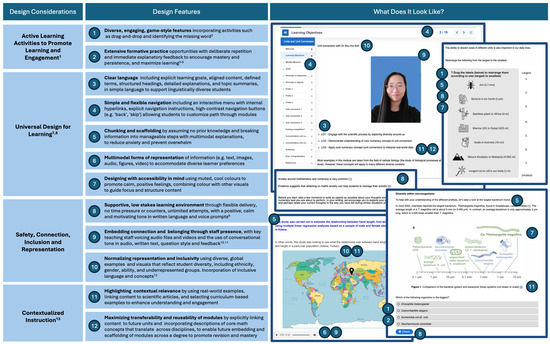
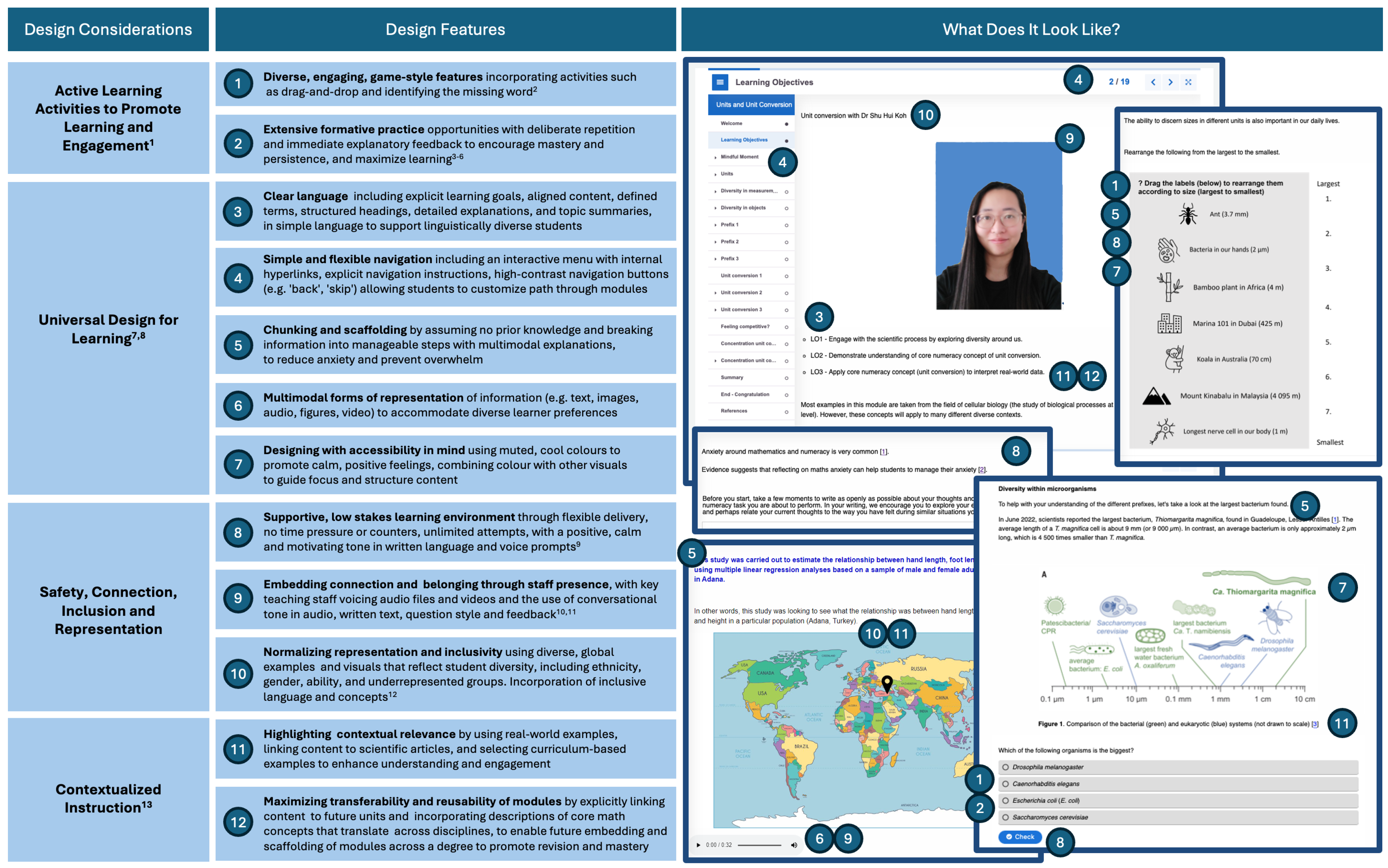
Four overarching design principles were applied in the development of numeracy modules: integration of active learning approaches, implementation of Universal Design for Learning (UDL) principles, incorporation of curriculum design elements to support learner safety and representation, and the contextualization of learning. These four design principles, and examples of specific module design features associated with each of these principles, are summarized in Figure 1.
Figure 1.
Overarching design principles and features of numeracy modules. Numbered design features (numbers in blue circles) correspond to examples illustrated and numbered on the accompanying images. 1 (Bonwell & Eison, 1991) 2 (M. Li et al., 2023) 3 (Mancenido et al., 2024) 4 (Bennett, 2011) 5 (Gikandi et al., 2011) 6 (Shute, 2008) 7 (Meyer et al., 2014) 8 (Yang et al., 2024) 9 (Rusticus et al., 2023) 10 (Kreijns et al., 2024) 11 (Costello et al., 2025) 12 (Duncan et al., 2023) 13 (Toan et al., 2025).
Consistent with the Interactive, Constructive, Active, Passive (ICAP) (Chi & Wylie, 2014) framework, we operationalized active learning as overt, cognitively engaged learner behavior elicited by the modules at the active (manipulation) and constructive (generation) levels. Active learning was implemented through inclusion of formative questions, presented using varied H5P® activity types, (e.g., drag and drop, fill in the blanks and find multiple hotspots; Figure 1: design features 1 and 2), Kahoot® quizzes, and multimodal delivery of content (incorporating text, images, lightboard videos and Vyond® animations; Figure 1: design features 5 and 6). These activities require students to manipulate content (active) and generate responses or self-explanations (constructive). Modules return immediate, tailored information in direct response to student actions (see question responses, Figure 1: design features 2 and 8). Formative questions provide immediate, detailed, alternative-specific explanatory feedback, so students know whether their personal response is correct and why/why not. Most item types provide students with the option to reattempt items without penalty. This design embeds timely, explanatory feedback at scale and provides students with certainty about their understanding of component concepts as they work through the module. The focus on active learning elements reflects constructivist learning theory and aligns with evidence that technology-supported, individual active-learning tasks can improve performance and engagement in higher-education settings even without peer discussion (Opre et al., 2024; Wiggins et al., 2017). Consistent with this aim, the modules did not include dialogic, peer-to-peer activities associated with ICAP’s interactive level. We adopt the contemporary view that active learning is a student-centered approach involving doing and thinking—not limited to group work (Chi & Wylie, 2014; Doolittle et al., 2023).
Drawing on Universal Design for Learning principles (Meyer et al., 2014) to maximize accessibility to learners with diverse needs, multiple forms of representation were incorporated, including text, audio (narrating the text) and video (with subtitles), although time constraints meant the level of incorporation of these features varied between modules. Simple and concise English was employed to support culturally and linguistically diverse students. Consistent formatting and explicit instructions on how to navigate through material were provided to further reduce the cognitive load of navigating through and transitioning between modules (Figure 1: design features 3–7).
Modules were designed intentionally to create a safe, supportive, inclusive online learning environment for diverse students, to promote success among diverse learners in the context of ongoing underrepresentation of diverse people in science (Department of Industry, Science and Resources, 2024). Module content was chosen to highlight and celebrate global diversity, and attention was given to creating a staff presence in modules through participation in embedded videos and the incorporation of a conversational style in module text (Figure 1: design features 8–10). Based on the findings of Ramirez and Beilock (2011), each module started with a brief written activity where students reflected on their thoughts and feelings about the numeracy content of the upcoming module, which is proposed to help with managing numeracy anxiety by encouraging students to articulate and reframe their thoughts and feelings before engaging with content.
Each module was designed for a particular course and disciplinary area (e.g., cell biology, physiology), to highlight the significance of math skills in a professional setting. Examples and active learning elements were drawn from relevant biological concepts covered in the course, to help students navigate new mathematical content and underline its relevance to their overall learning (Figure 1: design features 11 and 12). For example, a module on unit conversion for a cell biology course included exercises where students had to arrange biological structures (e.g., organelles, organisms) labelled with different units (e.g., microns, mm) in size order. Two of three modules (aimed at second-year courses) were framed around published scientific articles from their respective discipline areas, which were directly relevant to the content in the course for which the module was intended (see Supplementary Figure S1). In one example, students studying forensic anthropology were taught principles of correlation through the relationships between the length of specific bones and overall skeleton size, and the application of regression equations to estimate the stature of an individual from these measurements. While this contextualization was an important design feature, the core numeracy content in each module (e.g., descriptions of how to perform unit conversions) was written to be relevant across learning contexts, to enable future repurposing of modules in other courses, by retaining numeracy descriptions but incorporating new examples relevant to a different student cohort.
2.3. Participants
A total of 11 students and 7 staff from Murdoch University participated in interviews. Student participants were recruited through announcements posted on the learning management system of three biology courses (combined annual enrollment of ~800 students from BIO152 Cell Biology, BMS213 Forensic Anatomy and Anthropology, and BMS206 Biomedical Physiology) and a student online community site for the School of Medical, Molecular and Forensic Sciences. To contextualize the convenience sample, we note that cohorts in the three source courses are primarily on-campus (face-to-face) with extremely limited online study; domestic students represent the majority of students, with 15–25% international enrolment depending on the unit. Enrolments were female-skewed (~60–70% female) with most learners (60–70% depending on the unit) concentrated in the 18–23 age band. These unit-level characteristics are provided for context and should not be interpreted as the demographics of the interview participants. All enrolled students were provided with access to a dedicated learning management system project site containing detailed study information and a consent form. Interested students reviewed the online information and provided informed consent through a secure, survey-based link hosted on the project site. This recruitment and consent process was designed to minimize burden, preserve anonymity at the point of consent, and reduce perceived power imbalances between staff and students. All recruitment and data collection procedures followed the approved Human Research Ethics Committee protocol (2022/093). As several of the researchers in this study were also course coordinators, data analysis took place only after the release of results to avoid any perceived conflict.
Staff participants were recruited by email based on professional expertise in the domains of numeracy, numeracy anxiety, learning design, equity, diversity and accessibility, student learning and support, and/or STEM education.
2.4. Interviews
We aimed to conduct focus groups to capture multiple student perspectives within each session; however, scheduling constraints related to participants’ university and personal commitments meant that most data were collected through individual interviews. One of the nine student interviews consisted of more than one student (n = 3), while the remaining eight interviews were conducted one-on-one with individual participants, collectively referred to as the interviews (11 student participants in total). We acknowledge that individual interviews, while allowing for in-depth exploration of personal experiences, may limit the opportunity for participants to interact and build on each other’s perspectives as would occur in a traditional focus group setting. Staff interviews consisted of two groups (n = 3 and 4 participants, respectively).
Prior to interviews, student and staff participants were given access to numeracy modules for a minimum of 10 days. Interviews were conducted by a research assistant and supervisor (non-faculty third parties, not involved in teaching or module design) via Microsoft Teams® or in person in a computer teaching laboratory on campus, allowing participants to access modules during interviews if they wanted to. Interviews ran for approximately 90 min, and audio transcriptions provided to the research team were de-identified (between 11 and 23 pages per interview).
The interviews were conducted in a semi-structured format, encouraging participants to lead the discussion with the facilitator intervening only as needed to maintain flow and inclusivity. This format, particularly appropriate for an early-stage intervention (Kelly et al., 2010), encourages spontaneous accounts and allows issues to arise naturally from participants’ experiences that might otherwise be overlooked. Interviews were structured around three key domains: perceptions of modules, math history and experience, and experience of diversity in science. Supplementary Table S1 provides a complete record of interview topics and prompts.
2.5. Data Analysis
Interview transcripts were de-identified by an independent third party prior to analysis (including removal of participant names, courses, and staff roles) and tagged with unique codes. Thematic analysis followed the six-phase process described by Braun and Clarke (2013): (1) familiarization with the data; (2) initial coding; (3) searching for themes; (4) reviewing themes; (5) defining and naming themes; and (6) producing the report. Thematic codes were assigned by two members of the research team, who first independently read all transcripts, identifying common and salient themes using an open-coding approach. Codes were iteratively compared and grouped into higher-order categories, which formed the basis of the development of themes. Codes and supporting quotations were collated in a shared spreadsheet. Coding decisions and theme definitions were subsequently reviewed, iteratively refined, and confirmed by the broader research team to ensure consistency and rigor. During this phase, theme development was considered in the context of the study’s conceptual framework; active learning approaches; implementation of Universal Design for Learning (UDL) principles; incorporation of inclusive curriculum design elements and contextualization of learning. Codes and themes identified by the initial coders were assigned to the relevant design principles where appropriate; themes that did not align with this framework were presented independently in the results and discussion. Discrepancies were resolved through discussion and consensus (Braun & Clarke, 2013). Once themes were finalized, illustrative excerpts were selected to support each theme. Participant comments relating to minor technical issues (e.g., broken links, small errors) were excluded from analysis at this point. The analysis was conducted using Microsoft Excel® for data management and coding.
The research team’s positionality reflects a range of backgrounds and perspectives. Most members are trained in biological sciences, while one brings expertise in humanities with a particular emphasis on social justice in higher education. Some team members identify as part of the LGBTIQA+ community, and/or have lived experience of disability and/or neurodivergence. While most team members were educated in Australia, one member completed their education internationally, contributing a cross-cultural perspective to the research. We recognize that these intersecting identities and disciplinary perspectives shape our approach to research design, data analysis, and interpretation.
As university staff, we are institutional insiders, which affords us familiarity with the context and structures of higher education. We acknowledge the limitations this positionality carries, particularly when analyzing responses from students who are still developing their professional knowledge and identity, and who often self-identify as “outsiders” within the academic environment. Throughout the research process, we engaged in collaborative reflexivity, discussing how our backgrounds and experiences might influence our understanding of participant perspectives and the framing of our findings.
3. Results
Semi-structured interviews with undergraduate science students and tertiary educators explored the potential of self-paced online numeracy modules to support learning and engagement with mathematics. Discussion prompts directed reflections across three broad areas (mathematics histories and experiences, perceptions of the numeracy modules, and experiences of diversity in science); here, we present an analysis of student and staff responses that relate specifically to math learning.
3.1. Student Perceptions and Experience of Mathematics
Three overarching themes emerged in interviews with undergraduate science students (n = 11):
- Enduring anxiety and fixed self-perceptions limit student engagement with tertiary mathematics
- Math teachers and in-class learning environments have a profound, lasting, but often negative impact on engagement
- Self-paced online numeracy modules have the potential to support student enjoyment of and engagement with tertiary math learning
3.1.1. Enduring Anxiety and Fixed Self-Perceptions Limit Student Engagement with Tertiary Mathematics
In total, 8 of the 11 student participants in our study self-identified as having math anxiety, rating the intensity of their feelings at a 7 out of 10 or above (mean 7.2, 1 = no anxiety, 10 = highest anxiety). Student participants described a largely negative emotional response to mathematics (Table 1), similar to math learners in other contexts (Ashcraft, 2002; Dowker et al., 2016; Luttenberger et al., 2018). A history of math avoidance was common—students reported being overwhelmed by math and delaying or minimizing contact with mathematical tasks—with math anxiety both driving and reinforcing this pattern (Table 1, rows 1–3). Only a minority (3 of 11) of participants expressed generally positive experiences of math learning (Table 1, row 5), typically accompanied by an experience of high achievement in math.
Table 1.
The dominant student perception of math involves anxiety and avoidance associated with past learning experiences.
Of particular concern in a mathematics education context, most student participants in our interviews revealed fixed mindsets around mathematics (row 1, Table 2). Participants often used fixed categories to describe math skills (“there is a group that are very good in math and our group that are not good in math”; “a numeracy brain or a literacy brain”), ascribing their association with a particular group to factors outside of their control (“it doesn’t come to me naturally”; “third-generation with bad math skills”). Growth mindset accounts, emphasizing the importance of practice and persistence in math learning, were uncommon (row 2, Table 2). Several responses occupied a transitional space between fixed and growth mindsets—people were still described as being in a particular math “category,” but the potential for individuals to transition between categories was considered (row 3, Table 2). These responses typically described an automatic anxiety response to numbers that could be regulated under specific conditions (adequate time, structured practice, safe-to-fail context). Taken together, these results suggest that a core challenge in tertiary math education is convincing students that math can be learned.
Table 2.
Student math self-efficacy is mostly low to transitioning.
3.1.2. Math Teachers and In-Class Learning Environments Have a Profound, Lasting, but Often Negative Impact on Engagement
The influence of pre-university education on mathematics attitudes emerged strongly in our data (Table 3). Respondents with negative attitudes to math often described under-resourced learning environments; large classes, with low staff: student ratios that did not provide sufficient time, or individual flexibility, to support mathematics learning (row 1, Table 3). In these conditions, respondents with low math confidence described a downwards spiral of decreasing engagement and declining achievement—learners were reluctant to ask for help or engage in learning activities and so did not master content before the class moved on, finding it increasingly difficult to “catch up” over time (row 2, Table 3).
Table 3.
In-class experience of math has a lasting, often negative, impact on student confidence.
Teacher influence, negative or positive, emerged as the strongest individual driver of attitudes to mathematics among our respondents. Perceptions of math teachers as uncaring, unsupportive, or ineffective were common and associated with anxiety towards or disengagement from math learning (row 3, Table 3). Concerningly, some respondents described experiences of judgement or shaming by math teachers, with profoundly negative impacts on their self-confidence. Teacher impact was described as similarly potent in the positive direction—even a single, supportive teacher who connected with the student and responded to their individual learning needs and context could foster confidence and persistence around math learning (row 4, Table 3).
3.2. Self-Paced Online Numeracy Modules Have Potential to Support Student Enjoyment of and Engagement with Tertiary Math Learning
Alongside questions about attitudes to mathematics, participants in our semi-structured interviews were asked questions about module design and engagement, and about diversity content. Although participants were free to comment on any aspect of the modules they wished, student responses were highly positive overall (comments identified 91 strengths, 32 areas for development) and broadly aligned with major features of module design. To assist readers in considering implications for online math module design, we organize the Results around the features most salient in student accounts—elements that promote active learning, contextualization to course content, and Universal Design for Learning (UDL). However, we do not claim single-principal attribution; rather, we acknowledge the conceptual overlap among these features, reflected in individual comments that traversed multiple categories. For example, the quote “you can retry as much as you like, so I find that it would really help students who have that kind of anxiety” foregrounds iterative and formative practice and feedback (active learning) while emphasizing a safe-to-fail, supportive learning climate (safety and representation) that accommodates additional learning needs (UDL). While detailed comments are presented in Table 4 and mapped to the most relevant feature in that comment for clarity, readers are encouraged to note the intersection of features (brackets in Table 4) and interrogate this overlap as it applies in their own contexts.
Table 4.
Self-paced online modules can support tertiary math learning, confidence, and engagement. Key to attributions (used only for additional themes beyond the section heading): AL = Active Learning, UDL = Universal Design for Learning, S&R = Safety and Representation, CTX = Contextualization.
3.2.1. Incorporation of Active Learning Benefits Student Engagement and Practice
Active learning elements were consistently highly praised in student interviews and identified as particularly valuable for learners who found maintaining prolonged concentration challenging (Section 1, Table 4). The range of different active learning elements appealed to diverse students (individual students expressed preferences for different question types) and helped to challenge students while providing a sense of fun (Section 1.1, Table 4). Student participants also describe the learning-by-doing benefits of active learning elements; manipulating items or working with visual representations of concepts made concepts “click” and served as a welcome break from the “wordiness” of other learning materials.
Students also valued the opportunity to apply concepts to solve problems and receive immediate, detailed feedback (Section 1.2, Table 4). They recognized the benefit of iterative practice for their learning, particularly if that practice incorporated a range of different ways to apply their learning. Interestingly, students were broadly positive about the extensive feedback provided in the modules. Most respondents seemed open to receiving corrective feedback in this form, suggesting modules were helping to frame errors as a normal part of the learning process rather than an implication of deficit.
3.2.2. Students Recognise and Value Universal Design for Learning in Online Modules
It is perhaps not surprising that active learning elements, with their gamification properties, were highly popular among students. More unexpected was students’ explicit recognition of and appreciation for UDL features. The most frequently and deeply valued UDL feature was stepwise scaffolding of content. Learners valued materials that began at a basic level and gradually increased in complexity, with reasoning explained and the opportunity to revisit concepts incorporated (Sections 2.1 and 2.3, Table 4). Many participants in our interviews had expressed experiences of falling behind in pre-university mathematics education (Section 2, Table 3), which could explain why learning materials that do not assume prior learning were particularly highly valued. Indeed, most of the constructive criticism voiced by students called for more, or improved scaffolding (e.g., breaking up blocks of text, reducing the complexity of tables; italicized text, Section 2.1, Table 4).
Multimodal options for engaging with content (e.g., diagrams, text, video, audio) were praised by students, both as a source of personal engagement and as a support for peers with different learning needs (e.g., concentration and reading support via audio; reduced typing load for dyslexia; Sections 2.4 and 2.5, Table 4). Even the inclusion of relatively standard UDL features, such as clear learning outcomes and flexible, easy navigation were appreciated by students (Sections 2.2 and 2.3, Table 4). Our findings suggest that in the context of math education, where a significant proportion of students approach learning from a position of anxiety and low confidence, clear learning goals and the ability to easily move back and forth through material are important to help students check their learning without losing momentum.
3.2.3. Online Math Modules Have the Potential to Contribute to a Safe and Inclusive Curriculum
The potential of online learning modules to provide a safe, low-stakes, low-pressure learning environment emerged as a dominant theme in student interviews (Section 4.1, Table 4). In particular, students placed importance on being able to retry problems without penalty and work at their own pace, to reduce numeracy anxiety and encourage persistence. Creation of a safe learning environment was enhanced by the incorporation of staff presence (narration, encouraging feedback, Section 4.2, Table 4), which students perceived as supportive, mitigating the potential isolation of self-paced online study (Tse et al., 2022; Whiteside et al., 2023).
Deliberate inclusion of diverse perspectives (gender, global, indigenous) in modules showed some promise as a means of creating a sense of belonging in a mathematics digital learning environment—in the words of one student, “I don’t think people quite realize how important representation is… to be able to see someone like you… or someone that resembles you… in what you’re learning” (Section 4.3, Table 4). Six out of nine student respondents gave the diversity portrayed in modules a rating of 8 out of 10 or more (mean rating 7.3/10, n = 9; 1 = not diverse, 10 = extremely diverse). However, the potential challenges of this approach were also evident—one student disliked the explicit reference to different populations (e.g., ‘Korean women’) in the modules, and another student commented that this content was exclusive, rather than inclusive (Section 4.3, Table 4, italicized text).
3.2.4. Contextualization of Math Content in Online Modules Supports Comprehension and Engagement
The benefit of incorporating contextualized instruction into modules (e.g., providing examples related to microbes in a module in a biology course) was reflected in students’ comments that concepts made more sense when framed in real-world or discipline-specific contexts (Section 3.1, Table 4). Students reported that context increased attention and made abstract numeracy feel applicable and worth engaging with. Excitingly, from a course-design perspective, learners expressed a desire for modules to be utilized as on-demand refreshers that they could revisit when confused or when knowledge had faded and wanted modules to be available across units and early in science programs. Several students believed that previously challenging or unsuccessful course attempts could have had a different outcome if modules were available (Section 3.2, Table 4).
3.2.5. Overall Student Satisfaction with Online-Self Paced Math Modules Was High
Relative to students’ strong, negative, and often fixed perceptions of mathematics (see Section 3.1.1), overall student satisfaction with numeracy modules was unexpectedly high. When students were asked to rate modules overall quality on a 10 point scale, 6 of the 10 student respondents gave numeracy modules a rating of 8 out of 10 or higher (mean rating 7.9, 1 = lowest rating, 10 = highest rating), expressing confidence that modules would benefit their learning and the learning of others (“a nice way to learn”; “I think a lot of students would benefit from [the modules]; “I was very surprised… how much I enjoyed it, actually… they’re honestly really, really helpful”).
3.3. Staff Perceptions of Numeracy Modules
While staff acknowledged many of the same strengths identified by students (Sections 1–4, Table 5), they were more likely to identify deficiencies or opportunities for enhancement (53% of staff comments vs. 24% of student comments), noting 21 strengths and 24 areas for development (Table 5, italicized text). One unique theme among staff, not apparent in student feedback, was concern that references to mathematics anxiety within modules might inadvertently trigger or exacerbate anxiety (Table 5, row 5). These themes are considered in more detail below.
Table 5.
Educators tend to view online, self-paced math modules with caution, often focusing on opportunities for enhancement. Note: Tags indicate additional overlaps beyond the section heading, making visible where staff comments traverse Universal Design for Learning (UDL), Safely and Representation (S&R), and Contextualization (CTX). This mirrors the synthesis approach used in Table 4 for student quotes.
3.3.1. Active Learning & Interactivity
Similar to students, staff consistently described the active learning formats as engaging and varied (e.g., “I think they’re really engaging… just the way that they’re put together with all of that variation of different interactive sort of formats”; Section 1.1, Table 5). For something that’s intended to be self-paced, standalone… really well done, I reckon, and engaging”). Staff suggestions for improvement included a stronger initial ‘hook’ to strengthen engagement (e.g., “ULOs are not a hook… a dynamic video or engaging real-life story would capture [students]) and more explicit explanations of more complex mathematical concepts (e.g., “If I were a student, I would feel that I need a bit more explicit direction… it’s really challenging”).
3.3.2. Universal Design for Learning (UDL)
Educators broadly endorsed the navigation and pacing of modules (e.g., “very clear and self-paced”; seeing progress “I think that it really helps you to not feel so rushed… you know where you’re at and you feel like you’ve got good control over getting through it”), and shared students’ appreciation of multimodality (“where there’s audio, there’s still… moving images, and it’s presented in a way that’s easy to view”; Sections 2.1–2.4, Table 5). The main UDL-related concern voiced by staff participants related to sections where wordiness and/or complex vocabulary were perceived to be challenging for students. Educators suggested distinguishing between essential and nonessential text in modules (e.g.,” I did find them a little bit wordy. I found that there’s a lot of reading and sometimes I wasn’t sure if I absolutely had to read all of this stuff or if I could just cut to the numbers”, “I… got a bit bogged down in some of the complex vocab and I lost the math”) and addressing some gaps in captioning as potential improvements (captions were present in some videos but not consistently in all videos in each module).
3.3.3. Contextualization
Educators had mixed reactions to modules that framed mathematical content in scientific articles. Some participants found the context and scholarly framing valuable (e.g., “I found that the use of articles was really interesting… it showed… what’s going on in… research at the moment”), while others cautioned that mathematical concepts might be obscured by their framing in a scientific context (e.g., “the math got a bit lost in the science”; Section 4.1, Table 5). Both educator and student comments reflect varied opinions on the implementation and level of contextualization, the implications of which will be considered in the discussion.
3.3.4. Safety & Representation
Similar to student cohorts, educator comments (Sections 3.1–3.3, Table 5) praised the visible instructor presence in modules (e.g., “[in lightboard videos] it was like [the instructor] was actually talking to them. He was making mistakes along the way… speaking through his mental process in a way that made sense, and you could visualize it.”) and highlighted its role in providing a sense of support during module completion (e.g., “It really felt like somebody cared about how good I was at doing math”). Similar to other themes, educators suggested expanding instructor presence, for example, through the use of welcome videos to support engagement. Educator perceptions of representation and inclusivity were mixed. They noted the global diversity of examples, but concerns were raised that diversity did not emerge as a clear theme, and they recommended incorporating additional visible representation (e.g., more examples of diverse people speaking in videos).
3.3.5. Anxiety Framing and Support
Some staff raised the concern that anxiety prompts in modules (e.g., through reflective prompts at the start of each module) could trigger or exacerbate student anxiety (Section 5, Table 5). A number of suggestions were provided to mitigate this risk, including follow-up activities such as post-module check-ins (e.g., via Likert scales), mid-module anxiety touch points and links to anxiety support resources (“close the loop”).
While not directly relevant to the module design focus of the present work, where modules were designed for but not presented within a course context, it is worth noting that several staff remarks implicitly called for clearer integration with course aims. Suggested improvements included providing an upfront rationale for specific techniques (e.g., when, and why to choose a t-test) and ensuring scaffolding that avoids assumed knowledge jumps (e.g., SI abbreviations) and assigning a light marks weighting for module completion to signal importance and foster engagement across a cohort.
4. Discussion
Our findings echo a substantial body of STEM education research: most tertiary STEM students arrive with negative perceptions of and anxiety around mathematics, commonly rooted in prior experiences of math learning (Daker et al., 2021; Khasawneh et al., 2021; O’Leary et al., 2017). These affective barriers matter because they predict macro (course-level) and micro (activity-level) avoidance and under-performance in university STEM—even when math aptitude is accounted for (Canning et al., 2019; Khasawneh et al., 2021; Muenks et al., 2020). In our work, these negative feelings towards mathematics were frequently accompanied by a lack of self-efficacy—students commonly voiced beliefs that mathematical skills are fixed and determined by factors outside of their control. How can educators best support their students to overcome an aversion to mathematics and engage successfully with the challenge of tertiary learning?
Here, we explored the potential for bespoke, contextualized, inclusively designed numeracy modules to support tertiary students to (re)engage with math learning. Module design was informed by constructivist theory, emphasizing active learning, and by principles of universal and inclusive curriculum design, to explore whether established mechanisms for supporting learning would translate in a self-paced online context. Unexpectedly, students in our interviews were consistently, enthusiastically positive about the numeracy modules, despite those students holding generally negative attitudes towards math.
Active learning, including iterative practice and timely formative feedback, improves achievement and persistence in mathematics (Butler & Winne, 1995; Freeman et al., 2014). Online numeracy modules provide a mechanism to deliver active learning elements flexibly and at scale by embedding detailed feedback into active learning elements in modules. Active learning elements, and their associated feedback, were consistently and highly praised in our student interviews—students recognized the potential learning benefits of practice-feedback cycles and valued online resources that provide more exposure to these tools. Importantly, our data suggests that the incorporation of active learning activities into online modules had affective benefits beyond cognitive gains. The online, self-paced active learning elements, with their gamification qualities, seemed to create a low stakes learning environment that reduced anxiety and increased persistence, helping students to view errors as information rather than as evidence of personal deficiency. This change in framing is not trivial in cohorts where fixed beliefs about mathematical ability are common (Section 3.1.1, see also Boaler, 2015; Dweck, 2006).
In our hands, online numeracy modules also emerged as a scalable way to incorporate universal design into tertiary mathematics education. The rationale for implementing UDL is that inclusive, flexible learning environments providing multiple means of engagement, representation, and expression can accommodate and promote success among diverse learners (Dewi & Dalimunthe, 2019; Gaunt et al., 2025). Our student participants explicitly recognized and valued UDL features in numeracy modules, particularly stepwise scaffolding and multimodal content delivery. Students also appreciated explicit instruction elements in modules (e.g., structured progression and flexible navigation) and multimodal content delivery. This aligns with evidence from face-to-face (F2F) learning contexts that scaffolding reduces extraneous cognitive load and supports problem-solving in mathematics (Gupta & Zheng, 2020; Karabay & Meşe, 2025), while multimodal approaches enhance engagement and accessibility in online learning (Banihashem et al., 2025; Ruamba et al., 2025).
Educator opinions were broadly aligned with students in recognizing the benefits of active learning and UDL elements of modules. Indeed, a sizable proportion of educator sentiment around these themes was in support of expanding and/or strengthening these elements in the online modules, suggesting that the educators recognize their value for student learning and/or experience in an online, self-paced context.
Our approach differed from previous studies of online mathematics modules in a tertiary context in two important respects. First, we designed bespoke, contextualized modules to address a specific numeracy concept within a particular course. Second, we explored using online modules to support inclusion by making diversity visibly present in the learning materials (e.g., through global examples and inclusion of underrepresented perspectives).
Our design deliberately foregrounded contextualization—examples, datasets and practice questions were directly aligned with the broader course curriculum, as opposed to the more widespread use of commercially available math modules to support generalized math learning (Bowers & Kumar, 2015; Wang, 2023). Students repeatedly pointed to this contextualization as a reason the content “made sense,” suggesting that familiar contexts and direct relevance to course content made math concepts more approachable and helped students to see immediate relevance to assessment and broader learning goals. For higher-level contextualization, two of the three numeracy modules in this study were embedded within scientific journal articles to provide context and promote parallel development of numeracy and scientific literacy skills. While this approach was engaging for some students, it also increased the complexity of the modules, creating a barrier for others. These concerns were echoed by some educators reviewing the modules, who felt that framing math content in a scientific article obscured the central math learning outcomes and or added unnecessary challenge for students who would already feel challenged by mathematical concepts. These results suggest that educators considering implementing modules in their own context think carefully about the level of contextualization in the module. Lower-level contextualization (e.g., using biological examples of mathematical concepts) seemed broadly well received by educators and students, but higher-level contextualization (e.g., framing a mathematical concept within a published article) was overly challenging for some students and might be approached with caution, depending on the educational goals of the course and the level and mathematical confidence of the student cohort.
An exciting theme to emerge from this work was the potential for online modules to contribute to a supportive, representative learning environment. Both staff and students described the supportive atmosphere created by instructor presence in the modules (narration, lightboard demonstrations, encouraging tone in text feedback) and suggested a role for these elements in mitigating the isolation of self-paced study. Students also noted that hearing an instructor think aloud helped them to persist (Sections 4.1 and 4.2, Table 4). Although modules were presented outside a full course frame in this pilot, these findings suggest that a visible educator’s voice within online materials can help to support students to engage with challenging math content.
Responses to diversity and representation features were also broadly positive in both groups, with some caveats. Educators typically endorsed the intent but asked for more visible and explicit representation (e.g., diverse people speaking in videos) and clearer signaling of inclusivity across modules. Students generally recognized and valued the diversity elements as supporting belonging and relevance; however, their reactions were not uniform—some cautioned that specific population labels felt intrusive or exclusionary, and one noted that the English-only format limits accessibility. Our preliminary data suggest that intentional use of online modules has the potential to augment diversity and inclusion goals in a math learning context; however, on their own, such features are unlikely to be sufficient to develop a shared awareness of diversity and inclusion across a cohort.
Interestingly, educator concerns that attempts to normalize math anxiety in modules (e.g., through reflective exercises, based on the work of Ramirez and Beilock (2011) might prime or escalate student anxiety were not reflected in student responses; there was only a single student comment directly related to the anxiety reflection, which described the activity in positive terms. It is possible that staff concerns might have emerged in a larger student sample, but the anxiety normalization exercises appeared acceptable to the student cohort in our study. In either case, staff suggestions of strategies to mitigate the risk were constructive and feasible (e.g., providing links to support services, post-module check-ins) and could be implemented by educators looking to explore this approach.
This is a small, single-institution pilot with a modest sample (11 students; 7 educators). The intent was to gain insight into user experience and perception of the online modules for the purpose of design refinement and to guide the development of potential evaluation studies in the future. As an interpretivist pilot study, the dataset is not suitable for statistical generalization; the sample size and recruitment constraints mean findings are not representative of the broader cohort intended for the modules and are susceptible to sampling bias. We did not measure learning gains directly, nor did we examine longer-term impacts on engagement or math anxiety. Quantitative evaluations of module-supported instruction relative to F2F-only instruction, informed by student participant demographics (not collected here), would be needed to provide assurance of positive learning outcomes and to explore the relative contributions of different module design features (e.g., staff presence, contextualization) to outcomes for particular cohorts of learners.
Notwithstanding these limitations, consistent themes emerged in the data that may be informative for fellow educators considering the implementation of online, self-paced math learning in their own context. Incorporation of active learning and UDL elements into modules received widespread support from both student and educator participants. More unexpectedly, students in particular spoke about a sense of connection (with educators) and support when completing online modules. Light contextualization of math examples in course contexts also provided a point of connection for students, provided it was not at a level that interfered with the math focus of the module (see above).
Our data and discussion have been organized by themes aligned with design principles, to enable educators with an interest in incorporating a particular design principle (e.g., UDL) into their online teaching materials to easily identify specific strategies they could adopt in their own context. However, both our data (see theme cross-referencing in Table 4 and Table 5) and our personal experience when designing modules is that the four design features are highly interrelated and generate complementary positive outcomes for student learning and experience. For example, UDL content builds both accessibility and a sense of connection with students.
Taken together, our findings suggest a role for bespoke, contextualized modules as a complement to face-to-face math teaching. We propose that well-designed, contextualized math modules may support the scalable delivery of more consistent, accessible, feedback-rich math content in a tertiary STEM context.
Supplementary Materials
The following supporting information can be downloaded at: https://www.mdpi.com/article/10.3390/educsci16020203/s1, Figure S1: Example of module construction: Linear regression using forensic anthropology data. Images and data reproduced with permission from (Sanli et al., 2005); Table S1: Discussion prompts for interview moderators.
Author Contributions
Conceptualization, S.E., S.H.K., G.M., R.B. and N.W.; Methodology, S.H.K. and R.B.; Validation, S.E., N.C., S.H.K. and N.W.; Investigation, S.E., S.H.K. and N.W.; Resources, S.E., S.H.K. and N.W.; Data curation, S.H.K.; Writing—original draft, S.E., N.C., S.H.K., G.M. and N.W.; Writing—review and editing, S.E., N.C., S.H.K., G.M. and N.W.; Visualization, N.C. and N.W.; Supervision, R.B.; Project administration, S.E. and N.C.; Funding acquisition, S.E., S.H.K., G.M. and N.W. All authors have read and agreed to the published version of the manuscript.
Funding
Australian Council of Deans of Science, 2022 Teaching & Learning Grant.
Institutional Review Board Statement
This study was conducted in accordance with the National Statement on Ethical Conduct in Human Research and approved by the Human Research Ethics Committee of Murdoch University on 15 June 2022 (Approval 2022/093).
Informed Consent Statement
Informed consent was obtained from all subjects involved in the study.
Data Availability Statement
Many of the original contributions presented in this study are included in the article/Supplementary Materials. Further data supporting the conclusions of this article will be made available by the authors on request.
Acknowledgments
Janine Rix, Rebecca Gillis and Olivia Nelson are thanked for their excellent contributions to key stages of this project (literature review, J.R.; focus group facilitation, R.G; inductive thematic analysis, R.G, O.N). During the preparation of this manuscript, the authors used ChatGPT 5.0 for the purpose of refining manuscript text. The authors have reviewed and edited the output and take full responsibility for the content of this publication. All authors have read and agreed to the published version of the manuscript.
Conflicts of Interest
The authors declare no conflicts of interest.
Abbreviations
The following abbreviations are used in this manuscript:
| STEM | Science, Technology, Engineering, and Mathematics |
| UDL | Universal Design for Learning |
| LGBTIQA+ | Lesbian, gay, bisexual, transgender and gender diverse, intersex, queer, asexual/agender, plus other identities of diverse sexual orientations, gender identities, and sex characteristics |
| F2F | Face-to-face |
| PISA | Programme for International Student Assessment, |
| TIMSS | Trends in International Mathematics and Science Study |
References
- Arcellana-Panlilio, M., & Dyjur, P. (2021). Incorporating universal design for learning in disciplinary contexts in higher education. University of Calgary. [Google Scholar]
- Ashcraft, M. H. (2002). Math anxiety: Personal, educational, and cognitive consequences. Current Directions in Psychological Science, 11(5), 181–185. [Google Scholar] [CrossRef] [Scilit]
- Australian Curriculum, Assessment and Reporting Authority (ACARA). (2021). NAPLAN achievement in reading, writing, language conventions and numeracy: National report for 2021. Australian Curriculum, Assessment and Reporting Authority (ACARA). [Google Scholar]
- Banihashem, S. K., Gašević, D., & Noroozi, O. (2025). A critical review of using learning analytics for formative assessment: Progress, pitfalls and path forward. Journal of Computer Assisted Learning, 41(3), e70056. [Google Scholar] [CrossRef] [Scilit]
- Bennett, R. E. (2011). Formative assessment: A critical review. Assessment in Education: Principles, Policy & Practice, 18(1), 5–25. [Google Scholar] [CrossRef] [Scilit]
- Bernard, R. M., Borokhovski, E., Schmid, R. F., Tamim, R. M., & Abrami, P. C. (2014). A meta-analysis of blended learning and technology use in higher education: From the general to the applied. Journal of Computing in Higher Education, 26(1), 87–122. [Google Scholar] [CrossRef] [Scilit]
- Boaler, J. (2015). Mathematical mindsets: Unleashing students’ potential through creative math, inspiring messages and innovative teaching. John Wiley & Sons. [Google Scholar]
- Bonwell, C. C., & Eison, J. A. (1991). Active learning: Creating excitement in the classroom. 1991 ASHE-ERIC higher education reports. ERIC. [Google Scholar]
- Bowers, J., & Kumar, P. (2015). Students’ perceptions of teaching and social presence: A comparative analysis of face-to-face and online learning environments. International Journal of Web-Based Learning and Teaching Technologies (IJWLTT), 10(1), 27–44. [Google Scholar] [CrossRef] [Scilit]
- Bowman, N. A., & Denson, N. (2022). Institutional racial representation and equity gaps in college graduation. The Journal of Higher Education, 93(3), 399–423. [Google Scholar] [CrossRef] [Scilit]
- Braun, V., & Clarke, V. (2013). Successful qualitative research: A practical guide for beginners. SAGE Publications Ltd. [Google Scholar]
- Butler, D. L., & Winne, P. H. (1995). Feedback and self-regulated learning: A theoretical synthesis. Review of Educational Research, 65(3), 245–281. [Google Scholar] [CrossRef]
- Canning, E. A., Muenks, K., Green, D. J., & Murphy, M. C. (2019). STEM faculty who believe ability is fixed have larger racial achievement gaps and inspire less student motivation in their classes. Science Advances, 5(2), eaau4734. [Google Scholar] [CrossRef] [Scilit]
- Cheung, A. C., & Slavin, R. E. (2013). The effectiveness of educational technology applications for enhancing mathematics achievement in K-12 classrooms: A meta-analysis. Educational Research Review, 9, 88–113. [Google Scholar] [CrossRef] [Scilit]
- Chi, M. T., & Wylie, R. (2014). The ICAP framework: Linking cognitive engagement to active learning outcomes. Educational Psychologist, 49(4), 219–243. [Google Scholar] [CrossRef] [Scilit]
- Costello, R. A., Driessen, E. P., Kjelvik, M. K., Schultheis, E. H., Youngblood, R. M., Zemenick, A. T., Weber, M. G., & Ballen, C. J. (2025). More than a token photo: Humanizing scientists enhances student engagement. Proceedings B, 292(2039), 20240879. [Google Scholar] [CrossRef] [Scilit] [PubMed]
- Daker, R. J., Gattas, S. U., Sokolowski, H. M., Green, A. E., & Lyons, I. M. (2021). First-year students’ math anxiety predicts STEM avoidance and underperformance throughout university, independently of math ability. npj Science of Learning, 6(1), 17. [Google Scholar] [CrossRef] [Scilit]
- Department of Industry, Science and Resources. (2024). Pathway to diversity in STEM review: Final recommendations report. Department of Industry, Science and Resources.
- Dewi, S. S., & Dalimunthe, H. A. (2019). The effectiveness of universal design for learning. Journal of Social Science Studies, 6(1), 112–123. [Google Scholar] [CrossRef] [Scilit]
- Doolittle, P., Wojdak, K., & Walters, A. (2023). Defining active learning: A restricted systematic review. Teaching and Learning Inquiry, 11. [Google Scholar] [CrossRef] [Scilit]
- Dowker, A., Sarkar, A., & Looi, C. Y. (2016). Mathematics anxiety: What have we learned in 60 years? Frontiers in Psychology, 7, 508. [Google Scholar] [CrossRef] [Scilit]
- Duncan, V. L., Holt, E. A., & Keenan, S. M. (2023). Creating an equitable and inclusive STEM classroom: A qualitative meta-synthesis of approaches and practices in higher education. Frontiers in Education. [Google Scholar]
- Dweck, C. S. (2006). Mindset: The new psychology of success. Random House. [Google Scholar]
- Else-Quest, N. M., Hyde, J. S., & Linn, M. C. (2010). Cross-national patterns of gender differences in mathematics: A meta-analysis. Psychological Bulletin, 136(1), 103. [Google Scholar] [CrossRef] [Scilit]
- Freeman, S., Eddy, S. L., McDonough, M., Smith, M. K., Okoroafor, N., Jordt, H., & Wenderoth, M. P. (2014). Active learning increases student performance in science, engineering, and mathematics. Proceedings of the National Academy of Sciences, 111(23), 8410–8415. [Google Scholar] [CrossRef] [Scilit]
- Gaunt, L., Quane, K., Trewartha, B., & Porta, T. (2025, July 6–10). Universal design for learning for mathematics education. 47th Annual Conference of the Mathematics Education Research Group of Australasia, Canberra, Australia. [Google Scholar]
- Gikandi, J. W., Morrow, D., & Davis, N. E. (2011). Online formative assessment in higher education: A review of the literature. Computers & Education, 57(4), 2333–2351. [Google Scholar] [CrossRef] [Scilit]
- Gula, T., Hoessler, C., & Maciejewski, W. (2015). Seeking mathematics success for college students: A randomized field trial of an adapted approach. International Journal of Mathematical Education in Science and Technology, 46(8), 1130–1148. [Google Scholar] [CrossRef] [Scilit]
- Gupta, U., & Zheng, R. Z. (2020). Cognitive load in solving mathematics problems: Validating the role of motivation and the interaction among prior knowledge, worked examples, and task difficulty. European Journal of STEM Education, 5(1), 5. [Google Scholar] [CrossRef] [Scilit]
- Haines, C., & Crouch, R. (2001). Recognizing constructs within mathematical modelling. Teaching Mathematics and Its Applications: International Journal of the IMA, 20(3), 129–138. [Google Scholar] [CrossRef] [Scilit]
- Hari Rajan, M., Herbert, C., & Polly, P. (2024). Disrupted student engagement and motivation: Observations from online and face-to-face university learning environments. Frontiers in Education. [Google Scholar]
- Karabay, F. H., & Meşe, C. (2025). The effect of mobile scaffolding on academic achievement and cognitive load of third grade students in mathematical problem solving. Asia Pacific Education Review, 26(1), 227–246. [Google Scholar] [CrossRef] [Scilit]
- Kelly, S. E., Bourgeault, I., & Dingwall, R. (2010). Qualitative interviewing techniques and styles. In The SAGE handbook of qualitative methods in health research (Vol. 19, pp. 307–326). SAGE. [Google Scholar]
- Khasawneh, E., Gosling, C., & Williams, B. (2021). What impact does maths anxiety have on university students? BMC Psychology, 9(1), 37. [Google Scholar] [CrossRef] [Scilit] [PubMed]
- Kirschner, P. A., Sweller, J., & Clark, R. E. (2006). Why minimal guidance during instruction does not work: An analysis of the failure of constructuvist, discovery, problem-based, experimental, and inquiry-based teaching. Educational Psychologist, 42(2), 75–86. [Google Scholar] [CrossRef] [Scilit]
- Kreijns, K., Yau, J., Weidlich, J., & Weinberger, A. (2024). Towards a comprehensive framework of social presence for online, hybrid, and blended learning. Frontiers in Education. [Google Scholar]
- Li, M., Ma, S., & Shi, Y. (2023). Examining the effectiveness of gamification as a tool promoting teaching and learning in educational settings: A meta-analysis. Frontiers in Psychology, 14, 1253549. [Google Scholar] [CrossRef] [Scilit]
- Li, Q., & Ma, X. (2010). A meta-analysis of the effects of computer technology on school students’ mathematics learning. Educational Psychology Review, 22(3), 215–243. [Google Scholar] [CrossRef] [Scilit]
- Luttenberger, S., Wimmer, S., & Paechter, M. (2018). Spotlight on math anxiety. Psychology Research and Behavior Management, 11, 311–322. [Google Scholar] [CrossRef] [Scilit] [PubMed]
- Madrazo, A. L., & Dio, R. V. (2020). Contextualized learning modules in bridging students’ learning gaps in calculus with analytic geometry through independent learning. Journal on Mathematics Education, 11(3), 457–476. [Google Scholar] [CrossRef] [Scilit]
- Mancenido, Z., Gonsalkorale, K., Flynn, N., & Brosnan, J. (2024). The impact of context on evidence-based practices: A rapid literature scan on formative assessment, explicit instruction and mastery learning. Australian Education Research Organisation Limited. [Google Scholar]
- Martin, F., Drew, P., & Ritzhaupt, A. (2020, September 8). Bichronous online learning: Blending asynchronous and synchronous online learning. EDUCAUSE Review.
- Mason, M. (2010). Sample size and saturation in PhD studies using qualitative interviews. Forum: Qualitative Social Research, 11, 8. [Google Scholar]
- Means, B., Toyama, Y., Murphy, R., Bakia, M., & Jones, K. (2009). Evaluation of evidence-based practices in online learning: A meta-analysis and review of online learning studies. US Department of Education.
- Meyer, A., Rose, D. H., & Gordon, D. (2014). Universal design for learning: Theory and practice. Cast Incorporated. [Google Scholar]
- Muenks, K., Canning, E. A., LaCosse, J., Green, D. J., Zirkel, S., Garcia, J. A., & Murphy, M. C. (2020). Does my professor think my ability can change? Students’ perceptions of their STEM professors’ mindset beliefs predict their psychological vulnerability, engagement, and performance in class. Journal of Experimental Psychology: General, 149(11), 2119. [Google Scholar] [CrossRef] [Scilit]
- Muljana, P. S., & Luo, T. (2019). Factors contributing to student retention in online learning and recommended strategies for improvement: A systematic literature review. Journal of Information Technology Education: Research, 18, 19–57. [Google Scholar] [CrossRef] [Scilit]
- Nguyen, K. A., Borrego, M., Finelli, C. J., DeMonbrun, M., Crockett, C., Tharayil, S., Shekhar, P., Waters, C., & Rosenberg, R. (2021). Instructor strategies to aid implementation of active learning: A systematic literature review. International Journal of STEM Education, 8(1), 9. [Google Scholar] [CrossRef] [Scilit]
- OECD, Organisation for Economic Co-operation and Development. (2017). PISA 2015 results (volume III): Students’ well-being. Organisation for Economic Co-operation and Development. [Google Scholar]
- O’Leary, K., Fitzpatrick, C. L., & Hallett, D. (2017). Math anxiety is related to some, but not all, experiences with math. Frontiers in Psychology, 8, 2067. [Google Scholar] [CrossRef] [Scilit] [PubMed]
- Opre, D., Șerban, C., Veșcan, A., & Iucu, R. (2024). Supporting students’ active learning with a computer based tool. Active Learning in Higher Education, 25(1), 135–150. [Google Scholar] [CrossRef] [Scilit]
- Osika, A., MacMahon, S., Lodge, J. M., & Carroll, A. (2022, March 4). Contextual learning: Linking learning to the real world. THE Campus.
- QILT. (2023). 2022 Student experience survey: National report. Social Research Centre. [Google Scholar]
- Ramirez, G., & Beilock, S. L. (2011). Writing about testing worries boosts exam performance in the classroom. Science, 331(6014), 211–213. [Google Scholar] [CrossRef] [Scilit]
- Richardson, S. S., Reiches, M. W., Bruch, J., Boulicault, M., Noll, N. E., & Shattuck-Heidorn, H. (2020). Is there a gender-equality paradox in science, technology, engineering, and math (STEM)? Commentary on the study by Stoet and Geary (2018). Psychological Science, 31(3), 338–341. [Google Scholar] [CrossRef] [Scilit]
- Ruamba, M., Sukestiyarno, Y., Rochmad, R., & Asih, T. (2025). The impact of visual and multimodal representations in mathematics on cognitive load and problem-solving skills. International Journal of Advanced and Applied Sciences, 12(4), 164–172. [Google Scholar] [CrossRef] [Scilit]
- Rusticus, S. A., Pashootan, T., & Mah, A. (2023). What are the key elements of a positive learning environment? Perspectives from students and faculty. Learning Environments Research, 26(1), 161–175. [Google Scholar] [CrossRef] [Scilit]
- Sanli, S. G., Kizilkanat, E. D., Boyan, N., Ozsahin, E. T., Bozkir, M. G., Soames, R., Erol, H., & Oguz, O. (2005). Stature estimation based on hand length and foot length. Clinical Anatomy: The Official Journal of the American Association of Clinical Anatomists and the British Association of Clinical Anatomists, 18(8), 589–596. [Google Scholar] [CrossRef] [Scilit] [PubMed]
- Sedlacek, Q., Villa, A. M., III, Friend, M., Pérez, G., Dozier, S., Haeger, H., Lomelí, K., & Mejia, J. A. (2025). How representation matters: Conceptualizing systemic racism to develop diversity research agendas for undergraduate STEM education. Educational Psychology Review, 37(2), 49. [Google Scholar] [CrossRef] [Scilit]
- Shute, V. J. (2008). Focus on formative feedback. Review of Educational Research, 78(1), 153–189. [Google Scholar] [CrossRef] [Scilit]
- Stoet, G., & Geary, D. C. (2018). The gender-equality paradox in science, technology, engineering, and mathematics education. Psychological Science, 29(4), 581–593. [Google Scholar] [CrossRef] [Scilit]
- Suleiman, I. B., Okunade, O. A., Dada, E. G., & Ezeanya, U. C. (2024). Key factors influencing students’ academic performance. Journal of Electrical Systems and Information Technology, 11(1), 41. [Google Scholar] [CrossRef] [Scilit]
- Sweller, J., Van Merriënboer, J. J., & Paas, F. (2019). Cognitive architecture and instructional design: 20 years later. Educational Psychology Review, 31(2), 261–292. [Google Scholar] [CrossRef] [Scilit]
- Tallman, M. A., Carlson, M. P., Bressoud, D. M., & Pearson, M. (2016). A characterization of calculus I final exams in US colleges and universities. International Journal of Research in Undergraduate Mathematics Education, 2(1), 105–133. [Google Scholar] [CrossRef] [Scilit]
- Thomas, T. A., & Maree, D. (2022). Student factors affecting academic success among undergraduate students at two South African higher education institutions. South African Journal of Psychology, 52(1), 99–111. [Google Scholar] [CrossRef] [Scilit]
- Toan, H., Nguyen, T., Hai, T., Ngu, P., & Thao, T. (2025). Context-based learning in higher education 1992–2023: Trends and outstanding research areas from Scopus database. International Journal of Evaluation and Research in Education, 14(5), 4050–4065. [Google Scholar] [CrossRef] [Scilit]
- Tse, D. C., Lay, J. C., & Nakamura, J. (2022). Autonomy matters: Experiential and individual differences in chosen and unchosen solitary activities from three experience sampling studies. Social Psychological and Personality Science, 13(5), 946–956. [Google Scholar] [CrossRef] [Scilit]
- UNESCO. (2024). Girls’ and women’s education in STEM (global overview; 35% of STEM graduates). Available online: https://www.unesco.org/en/gender-equality/education/stem (accessed on 3 October 2025).
- Valero, P., & Meaney, T. (2014). Trends in researching the socioeconomic influences on mathematical achievement. ZDM, 46(7), 977–986. [Google Scholar] [CrossRef] [Scilit]
- Verschaffel, L., De Corte, E., & Lasure, S. (1994). Realistic considerations in mathematical modeling of school arithmetic word problems. Learning and Instruction, 4(4), 273–294. [Google Scholar] [CrossRef] [Scilit]
- Wang, M. (2023). Meta-analysis of the effectiveness of MyMathLab in college Algebra. Texas A&M University-Kingsville. [Google Scholar]
- Whiteside, A. L., Dikkers, A. G., & Swan, K. (2023). Social presence in online learning: Multiple perspectives on practice and research. Taylor & Francis. [Google Scholar]
- Wiggins, B. L., Eddy, S. L., Grunspan, D. Z., & Crowe, A. J. (2017). The ICAP active learning framework predicts the learning gains observed in intensely active classroom experiences. AERA Open, 3(2), 2332858417708567. [Google Scholar] [CrossRef] [Scilit]
- Wong, Z. Y., Liem, G. A. D., Chan, M., & Datu, J. A. D. (2024). Student engagement and its association with academic achievement and subjective well-being: A systematic review and meta-analysis. Journal of Educational Psychology, 116(1), 48. [Google Scholar] [CrossRef] [Scilit]
- Yang, M., Duha, M. S. U., Kirsch, B. A., Glaser, N., Crompton, H., & Luo, T. (2024). Universal design in online education: A systematic review. Distance Education, 45(1), 23–59. [Google Scholar] [CrossRef] [Scilit]

Disclaimer/Publisher’s Note: The statements, opinions and data contained in all publications are solely those of the individual author(s) and contributor(s) and not of MDPI and/or the editor(s). MDPI and/or the editor(s) disclaim responsibility for any injury to people or property resulting from any ideas, methods, instructions or products referred to in the content. |
© 2026 by the authors. Licensee MDPI, Basel, Switzerland. This article is an open access article distributed under the terms and conditions of the Creative Commons Attribution (CC BY) license.