


Abstract
This study investigates how teachers’ perceptions of their pedagogical responsibilities interact with professional development which aims to develop ambitious and equitable mathematics teaching practices. Drawing on case studies of two lower secondary teachers participating in a Norwegian professional development program, the study examines how teachers experience implementing ambitious and equitable practices into their own classrooms. Data consisted of interviews and teacher discussion and were analysed using a conceptual framework of pedagogical judgement, focusing on pedagogical actions, reasoning and responsibilities, and the interplay between them. The findings show how differences in teachers’ interpretations of pedagogical responsibilities towards students, mathematics learning, assessment, curriculum coverage, and classroom culture interacted with the ways in which they arrived at their pedagogical judgments. Discourses about student ability and local expectations and interpretations of commitments either supported or constrained their implementation of equitable mathematics practices. These findings suggest that effective professional development should prioritise working with teachers to notice students’ abilities and supporting them in navigating competing pedagogical commitments and responsibilities.
1. Introduction
The value of ambitious mathematics teaching has been highlighted by many researchers over the past two decades (e.g., Charalambous et al., 2023; Lampert et al., 2010; Yurekli & Stein, 2025). This approach, which positions all students as intellectual contributors in the classroom and promotes deep conceptual understanding through reasoning and problem-solving (Zahner et al., 2025), contrasts sharply with “traditional teaching” in which “the teacher is positioned as transmitter of mathematics content usually through direct chalkboard and teacher-centred instruction” (Valoyes-Chávez, 2019, p. 178). Valoyes-Chávez (2019) argues that teaching focused on developing computational skills and low-level mathematical thinking is one of the main factors preventing equity in mathematics, and that implementation of student-centred instruction with a focus on reasoning and problem-solving activities is a possible way to close the achievement gap.
While research tells us that the best mathematics classrooms are those in which students learn through engaging activities that focus on mathematical understanding, changing mathematics teaching remains difficult (Hiebert, 2013; Schoenfeld, 2022). Valoyes-Chávez (2019) argues that it is wrong to explain this in terms of teachers’ resistance to implementing change. Rather, she claims, change is shaped by the social, cultural, and contextual conditions of schools. Policy, social and cultural discourses influence teachers’ enactment of mathematics practices (Gutiérrez, 2012; Louie, 2018). In Norway, as in many other countries, performativity and accountability are increasing, particularly since the early 2000s when international comparisons such as the Programme for International Student Assessment (PISA) placed student performance and teacher competence on the public agenda (Elstad & Sivesind, 2010; Nortvedt, 2018). Although the Norwegian school system is grounded in a broad consensus around equality, inclusion, and democratic rights mandated by law (Bjerke et al., 2025; Education Act, 2023; Eriksen et al., 2024; Fasting, 2013), tensions and pressures within this system are increasing, as signalled by the introduction of performance-oriented language (Larsen et al., 2022). In this context, the success of a professional development program aiming to support development towards equitable and ambitious mathematics teaching is not just a question of individual teacher change but is also dependent on school context and the interpretation of wider policies.
From this perspective, the challenge is not to “fix” teachers, but to understand the resources and constraints that influence their work (Charalambous, 2026). Because efforts to change teaching can transform a local school into a site of struggle that both enables and constrains teachers’ actions (Valoyes-Chávez, 2019), these conditions are central to research on teachers’ professional learning. However, research on professional development in mathematics education has primarily focused on the effectiveness of programs and the design of professional development (Kennedy, 2016). Less attention has been paid to the processes through which teachers develop knowledge, beliefs, and instructional practices (Goldsmith et al., 2014). Similarly, Shure et al. (2025) highlighted a growing emphasis on teachers’ learning opportunities and called for more detailed accounts of how such opportunities support teacher learning.
In this paper, I explore the factors influencing teachers’ decisions as they attend a professional development program in ambitious mathematics teaching. I focus on case studies of two teachers from two different schools participating in the same professional development program in ambitious and equitable mathematics teaching. I draw on Horn and Garner’s (2022) conceptual framework of pedagogical judgement to understand how their perceived pedagogical responsibilities interact with the way in which they make decisions about their teaching practices.
2. Previous Research
Introducing new teaching practices in mathematics is not straightforward. For instance, Choppin et al. (2024) explored the demands, tensions, and resource implications of implementing ambitious mathematics teaching according to teachers, expert teachers, administrators, and external consultants at a school that had implemented an inquiry-based program focused on equity as part of a school-wide transformation five years before. Teachers reported that they experienced the new practices as difficult and time consuming because responding to and building on students’ thinking needed a deeper understanding of mathematics and required more time and effort in planning than their previous practice. A more general issue concerned teachers’ views of students’ perceived abilities and engagement with inquiry mathematics (Choppin et al., 2024). They expressed frustration and uncertainty about how they could support students who were struggling with demanding mathematics problems, and they reported that low attaining students did not participate in the activities because they were afraid of being wrong.
Teachers often worry about making life difficult for low attainers. In a study of grouping practices in England, Mazenod et al. (2018) examined teachers’ expectations of students in lower attainment groups. They found that teachers described low attainers as less independent than other students and expected them to need help to start and keep on track with tasks. They expressed concern about overstretching low attainers, emphasising a need to nurture them on emotional or moral grounds. They recognised the potential psychological damage of labelling as a result of grouping and felt they had to compensate for this and boost confidence by nurturing and protecting these students. Behind such care is a belief that low attainers do not have the ability to solve cognitive demanding tasks in mathematics, reflecting fixed ability views. Mazenod et al. (2018) argue that approaches that intend to nurture students will in some cases foster dependency and restrict the kind of teaching the students are exposed to and their opportunities for development.
Discourses such as those identified by Mazenod et al. (2018) are dependent on commonly held assumptions about students’ capabilities and their “rights” to be in the classroom. School mathematics has traditionally played a role in sorting and ranking students (Horn & Garner, 2022), with teachers often positioning students as deficient, thereby unintentionally excluding many from rich learning opportunities. Louie (2017) used the term culture of exclusion and found that this culture structured everyday instruction even among teachers who expressed commitment to equity. As a result, many classrooms are organized hierarchically, with teachers labelling some students as “strong” or “fast”, while others are seen as “weak” or “slow” (Horn, 2007). Horn and Garner (2022) argue that seeing all students as worthwhile mathematical thinkers is fundamental to using rich tasks successfully and fostering productive mathematical discourse in ambitious and equitable classrooms. This requires teachers to broaden their notions of mathematical competence. Being able in mathematics is more than simply doing fast and accurate calculations. By embracing multiple mathematical abilities, teachers can make space for more students to participate in their classrooms (Horn & Garner, 2022).
If they are to truly believe that all students belong in mathematics classrooms, teachers need to be able to notice, understand and respond to their students’ thinking (Jacobs et al., 2010; Lampert et al., 2010; Van Es & Sherin, 2002). Van Es and Sherin (2002) proposed three key aspects of noticing: identifying what is important, making connection between classroom interactions and the broader principles of teaching and learning mathematics that these interactions represent, and using what one knows about the context to reason about classroom interactions. Louie (2018) argues that in order to understand the challenges of learning to notice for ambitious and equitable teaching, it is necessary also to focus on the cultural and ideological influence of what teachers notice. She exemplifies this through an account of a teacher who challenged dominant notions of mathematics ability by publicly highlighting her students’ intellectual strengths. However, despite her awareness of the dominant discourse of mathematical ability, she doubted whether the brilliance she saw in her students was legitimate and worried that her version of mathematics instruction was not “real mathematics” (Louie, 2018). Discourses around who is or is not capable in a mathematics classroom perpetuated by colleagues’ discourse and standardized tests remained as influences. Cultural systems organize perceptions in particular ways, facilitating certain kinds of seeing and hindering others.
Together, these perspectives highlight that teaching is situated within social and cultural systems that shape teachers’ predispositions around their instructional practices. Gibbons et al. (2026) extend this line of inquiry by investigating what influences teachers’ judgement when facilitating classroom discussions in both mathematics and English language arts. Their analysis showed a complex interplay between responsibilities that influenced the decisions made by an elementary teacher during classroom discussions. In mathematics, she balanced a tension between her commitment to instructional goals related to the content area and a commitment to positioning all students as contributors. This research illustrates how teachers navigate multiple responsibilities that may compete with one another, prioritising some over others in response to the immediate needs of students and the classroom community (Gibbons et al., 2026).
These studies highlight how a range of contextual factors can enable or constrain the enactment of equitable teaching practices. The study described in this paper aimed to understand in further detail the interplay between teachers’ perceived commitments and how they influence their professional development towards ambitious mathematics teaching practices, with the following research question: How do teachers’ interpretations of their pedagogical responsibilities interact with their interpretation and take-up of professional development in ambitious and equitable mathematics teaching? I draw on Horn and Garner’s (2022) framework of pedagogical judgement to capture how teachers from two different schools make sense of their pedagogical rationales and obligations as they enact program recommendations.
3. Theoretical Framework
This research takes a situative view of teacher learning in practice, recognising the importance of political, social, and cultural contexts (Lave & Wenger, 1991). Horn and Garner (2022) describe the mechanisms of teachers’ learning as the development of pedagogical judgement and argue that “teachers’ pedagogical judgments go well beyond what can be captured in a concise, learnable template, especially since these decisions must make some sense within the logics governing particular teaching situations” (Horn & Garner, 2022, p. 58). They refer to pedagogical judgement as a form of teacher sensemaking: the ability to make both planned and in-the-moment decisions while balancing competing priorities and expectations. Pedagogical judgement shapes teachers’ decisions and practices across contexts and is informed by personal beliefs, students’ needs, colleagues’ perceptions, and school and policy demands. An ideal lesson is not the aim, because it is not achievable (Horn, 2020). Rather, as Horn and Garner (2022) acknowledge, the complexity of change in teachers’ practice is more than filling a knowledge gap or learning a new skill. Their framework takes the context in which teachers work into account and is useful in investigating how teachers’ perceptions of their pedagogical responsibilities and professional development interact when implementing new teaching practices in ambitious mathematics teaching.
Pedagogical judgement is conceptualized by Horn and Garner (2022) as an interplay between three interrelated components: pedagogical action, pedagogical reasoning, and pedagogical responsibility. Pedagogical actions include the decisions teachers make in their role as a teacher, both within and beyond of the classroom context. A single pedagogical action may be underpinned by different interpretations and rationales, which become visible in pedagogical reasoning. This reasoning reflects the interpretative processes through which teachers justify and make sense of their instructional choices, their pedagogical actions. Exploring teachers’ pedagogical reasoning involves studying the teachers’ narratives about their decision-making and what they see as a pedagogical dilemma and how they navigate them. It includes instances where teachers discuss the “why” behind their actions, sharing their understanding of teaching, learning, and students, and how they make sense of their instructional choices, the pedagogical actions.
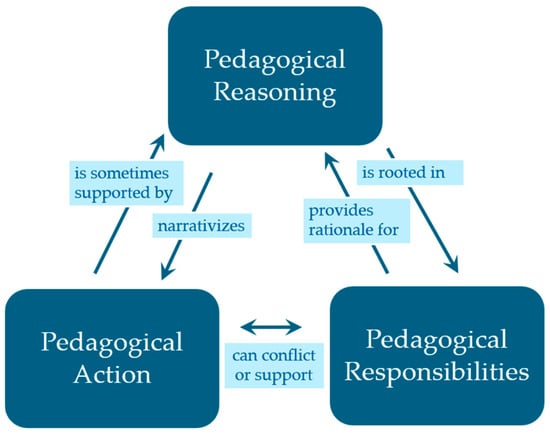
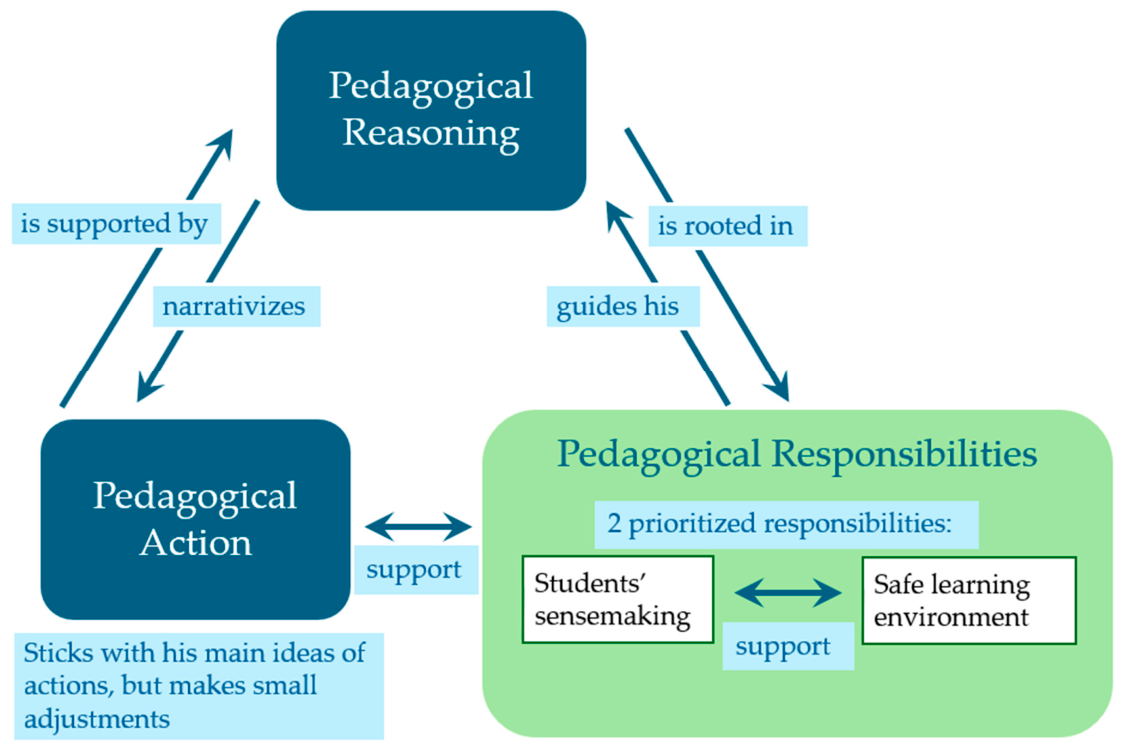
Pedagogical responsibility, in turn, describes teachers’ sense of their obligations, whether grounded in ethical commitments or shaped by contextual constraints (Horn, 2020). Teachers face expectations from students, parents, colleagues, administrations, policymakers, and even public opinion, and teachers make claims about their obligations. That is, they make sense of their pedagogical responsibility which describes to who or to what a teacher is beholden in the complex contexts of their work (Chen et al., 2021). Therefore, pedagogical responsibilities are highly personal (Horn & Garner, 2022). As illustrated in Figure 1, pedagogical actions are informed and sustained by pedagogical reasoning, while simultaneously being rooted in different pedagogical responsibilities, including how teachers connect their reasoning to the responsibilities of being a teacher. This framework offers a productive lens to explain teachers’ responses to pedagogical practices in particular contexts, not only to teachers’ actions, but to the reasons and perceived responsibilities that such actions reflect (Horn, 2020). It is of course a simplification of reality. Moral and institutional responsibilities may exist in tension, as teachers make decisions about the “right” pedagogical action (Chen et al., 2021). Because teachers feel beholden to multiple, and sometimes competing, pedagogical responsibilities, pedagogical judgement involves not only deciding what to do but also considering how different choices of actions may advance some responsibilities while constraining others (Gibbons et al., 2026).
Figure 1.
The components of pedagogical judgement, based on Horn and Garner (2022, p. 56).
This conceptual framework of pedagogical judgement enables a situated view. How teachers talk about actions and obligations are influenced by contexts such as school culture. Using this framework as a lens to understand teacher learning enables investigation of not just the “what” and “how” of teacher learning (the pedagogical actions), but also the “why” by identifying pedagogical reasoning rooted in pedagogical responsibilities. Using the framework to analyse the components and how they interact with each other enables a more detailed and nuanced image of the dilemmas and tensions teachers face when implementing practices introduced in professional development.
The connecting arrows in Figure 1 illustrate the dynamic and interrelated nature of pedagogical judgement. First, the arrow from pedagogical actions to pedagogical reasoning indicates that teachers’ actions are supported, or not supported, by their reasoning. Second, the arrow pointing the opposite way, from reasoning to actions, highlights teachers’ narratives about possible actions and how they may look like in their reasoning. Third, the arrow from pedagogical reasoning to pedagogical responsibilities, shows that reasoning is often rooted in teachers’ perceptions of their commitments and obligations. Opposite, how teachers make sense of their responsibilities can provide rationales for or against particular actions, which is an important part of their reasoning. Finally, the arrow between pedagogical action and pedagogical responsibility emphasises that actions can both support and conflict with responsibilities. Together, the arrows emphasize that teaching is not a linear process, but an ongoing negotiation among reasoning, actions, and responsibilities.
4. Material and Methods
This paper reports on a qualitative case study (Clark et al., 2021) of teachers participating in a professional development program focused on ambitious and equitable mathematics teaching in Norway. In the following section, the study context, participants, data collection, and the analytical framework will be outlined.
4.1. Study Context
The teachers participating in this study had all taken part in a national-level professional development program in Norway known as Mastering Ambitious Mathematics Teaching (MAM). This two-year 12 whole-day session professional development program aims to support in-service teachers to develop practices that engage with student thinking and reasoning in order to promote deeper understanding, enhanced learning, and increased student motivation. Based on the “Learning Teaching in, from, and for Practice” project (Ghousseini, 2017; Kazemi et al., 2016; Lampert, 2010), the MAM program was developed and contextualised for in-service teachers in Norway (e.g., Fauskanger & Bjuland, 2019; Wæge & Svingen, 2023). MAM is structured around a number of particular principles and practices (Ghousseini et al., 2015; Kazemi et al., 2016; Lampert et al., 2013). Major principles include understanding students as sense-makers, designing instruction for equitable access to learning, having a clear instructional goal, and knowing the students. In addition, the course focuses on four core practices: launching problems, using mathematical representations, facilitating student talk, and aiming towards a mathematical goal (Norwegian Centre for Mathematics Education, n.d.). Like its parent project, it consists of collaboration in cycles of enactment and investigation (Lampert et al., 2013). MAM-teachers were recruited by the headmasters at their respective schools, with 2–5 teachers participating from each school.
Unlike many professional development programs that involve only teachers and facilitators, this particular MAM program also included two local expert teachers who occupied an intermediary role facilitating communication between the instructors in the MAM program, the representants for the municipality, school leaders, and teachers attending MAM. These teachers had completed credit-bearing courses in mathematics education designed for Norwegian expert teachers. They were working four days at their own schools and one day a week for the municipality in an expert teacher position, mainly to strengthen the mathematics education in elementary and lower secondary schools in the municipality. They were attending the sessions at MAM as participating teachers, and between sessions, they also offered to visit the teachers in MAM while they were planning and teaching MAM instructions in their own classrooms.
4.2. Participants
The participating teachers were from three elementary schools and two lower secondary schools in a Norwegian suburban municipality. Two distinct categories of teachers were invited to participate in this study: First, all 8 MAM-teachers working at lower secondary schools were invited to participate: three teachers from Alstad lower secondary school and one teacher from Bergheim lower secondary school volunteered. Second, two expert teachers who were responsible for initiating the MAM program in the municipality were also invited, and they both volunteered.
This paper focuses on two teachers, Anne and Ben, chosen because of their very different interpretations of their pedagogical responsibilities, and the different tensions between different pedagogical responsibilities that arise in their stories and became visible through the analysis. Ben was chosen because his account was particularly contrasting to the other three teachers, represented here by Anne as a typical case. Anne has 3 years of teaching experience and works in a team with another participant from MAM (Ava) at Alstad school. Anne’s interpretation aligns with those of the other teachers at Alstad school who reported experiences similar to her. Ben has 5 years of teaching experience and works at Bergheim school in a team with Beate, one of the expert teachers in the municipality.
4.3. Data Collection
MAM is a two-year program, and data were collected by the author in the teachers’ second year of the program. Data collection began when 8 of the 12 whole-day sessions were completed. Semi-structured individual interviews covering teachers’ perceptions of their own learning and classroom practices in MAM were conducted with all four participating teachers and the two participating expert teachers. In addition, in session 11, the participants were told to share their experiences of implementing MAM principles with other MAM participants at their own school, and I asked the Alstad teachers for permission to join them during their discussion. They agreed, and I participated and audiotaped their 66-min discussion. All interviews and the observations of the teachers at Alstad were audio recorded and transcribed in their entirety in the original language (Norwegian). To get a broader perspective on the MAM course and different classrooms and practices, which contributed to my familiarity with the teachers and enhanced contextualization, I also observed both MAM sessions and the teachers’ classrooms. The data from the observations consisted of comprehensive field notes which I added to shortly after each session. During classroom observations, I was looking for small changes that the teachers described in the interviews, how they asked questions in the classroom, and I observed how they approached students’ learning. Although I did not formally analyse the MAM- and classroom observation data, I used these observations to inform my interview analysis and add to my understanding of the overall context that each teacher was working in.
I gained ethics approval for this project from the Norwegian Agency for Shared Services in Education and Research (SIKT), and participants gave active and informed consent. The participant information stressed that my purpose was to research teachers’ learning, and that I was not interested in evaluating their practices. All names and places in this article are pseudonyms.
4.4. Analytic Framework
To answer the research question, How do teachers’ interpretations of their pedagogical responsibilities interact with their interpretation and take-up of professional development in ambitious and equitable mathematics teaching?, transcripts of the six interviews and the observation of the teachers at Alstad talking about their MAM-related experiences with each other were analysed deductively using Horn and Garner’s (2022) framework. Preliminary analysis of the data involved the operationalisation of Horn and Garner’s (2022) pedagogical judgement as illustrated in Table 1, identifying references to pedagogical responsibility, pedagogical reasoning and pedagogical actions (Horn & Garner, 2022). For instance, when Anne says, “I have become better at talking about things rather than simply presenting them.”, she is referring to pedagogical actions, that is, what she does or does not do in her teaching.
Table 1.
Operationalisation of the components of pedagogical judgement (Horn & Garner, 2022).
Having identified these references, I analysed their occurrence within each interview as a whole, focusing on the relationships between them. I drew further on the framework and its use of connecting arrows, as outlined in the theoretical framework, to reflect on these relationships and what they told me about the nature of each teacher’s professional judgement within their particular contexts. Each reference was analysed by mapping the statements onto the arrows in Figure 1. This revealed which component of pedagogical judgement, and which direction of the arrows, were central in their reasoning, as well as where tensions occurred. To answer the research question, the teachers’ descriptions of pedagogical actions were analysed in relation to their interpretations of pedagogical responsibilities. For instance, Ben described a responsibility to teach mathematics in ways that made sense to students and this responsibility provided a rational for the pedagogical action of not doing all the talking himself: “how can I change this from being a lesson where I have to go through a lot? To let the students go through the same thing (…) but it’s the students who figure it out.” Throughout the analysis, coding decisions and interpretations were discussed regularly with a senior researcher, serving as a critical discussion partner in refining the analysis.
5. Findings
In the following section, I first describe Anne and how the analysis reveals the reasons for dilemmas and tensions she describes. Next, I focus on Ben, who interprets his pedagogical responsibilities differently from Anne, especially with regard to mathematics learning and student ability. His account, however, does not reveal the same tensions.
5.1. Anne
Anne says she is committed to the benefits of MAM because it allows students to see connections between mathematical topics:
But when we work with bigger tasks, where they have to use many different parts of the curriculum, they start to see the connections. And then mathematics makes a lot more sense. And it’s more fun.(Anne, individual interview)
She sees the advantages for high achievers in particular: “They grasp it too quickly and aren’t challenged enough. But with tasks where they can inquire a lot, you get them more involved, more engaged” (Anne, individual interview). On the other hand, when it comes to engaging all students, she worries about her “weakest students”: “I do struggle a bit with providing equal access, because I feel I don’t have enough time to follow up properly with the weakest students” (Anne, group discussion). She feels that they are often better off with single topics and practice tasks:
For the weakest students, it can often be easier to just have a small topic to focus on, along with tasks that are repetitive on exactly that topic they need to concentrate on now. That does make it easier. But it also makes it harder for them to see the connections.(Anne, group discussion)
Based on this statement, it appears that Anne feels an obligation to get the students through tests by ensuring that they practice key topics, even though they lose the possibility of making connections. In conflict with MAM practices and principles, her actions are driven by a pedagogic reasoning in that she is not convinced that low achievers can really do MAM tasks and benefit in the long run.
Other Alstad teachers seem to share Anne’s reservations. In the group conversation, Ava comments that “everyone sort of benefits from these open-ended tasks and thinks logically. And then I also think that, even though I completely agree, it is a bit naïve.” A second colleague believes that low attainers are only capable of following a procedure: “That’s what the very weakest students can manage to calculate. If you have an example on the board, and then you can use that example and just put in some different numbers into that example” (Colleague 2, group conversation). Anne’s concerns for the weakest students seem to be rooted in her worries about how they will feel when certain pedagogical actions like group work or classroom discussions expose their struggles:
And even if you work on building a positive classroom environment and try to make it safe, situations will still arise that are uncomfortable—for some students, at least. I think it often becomes more visible when we work with these kinds of tasks, that some students are really struggling. Compared to when they’re just working quietly in their own books—then they can kind of hide it. And it’s not necessarily better that way, but it can feel vulnerable when it becomes visible. Of course, it’s great if we manage to build an environment where that’s okay, and where everyone is just here to learn. But that’s a bit of a challenge in lower secondary school.(Anne, individual interview)
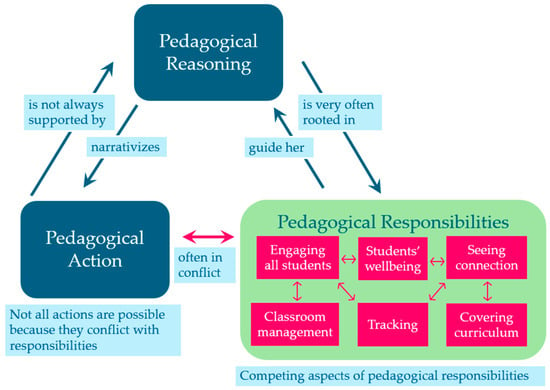
Applying Horn and Garner’s (2022) conceptual framework, Figure 2 shows how Anne sees these pedagogical actions as largely in conflict with (rather than sometimes supported by) her pedagogical responsibility for students’ wellbeing, particularly those who “struggle”. Her perception of this responsibility gives her a rationale for not letting students collaborate on open tasks. Her account reveals multiple competing aspects within her pedagogical responsibilities. Nevertheless, Anne recognises that MAM has led her to value talking to students more and letting go of some control:
Figure 2.
Anne’s narrative presented in terms of Horn and Garner’s (2022) commitments where competing aspects of her perceptions of pedagogical responsibilities are in conflict (illustrated in red), but central to her reasoning.
You have to let go a little when you want to work more ambitiously, and I actually enjoy that. (…) And I often find that when students are given that trust, they really rise to the occasion. So, it can actually be a bit of a relief for me too—not having to keep track of everything all the time. I go into one group to guide them, then out and into another group. You end up talking more with the students, having conversations where they can figure things out for themselves.(Anne, individual interview)
However, this reasoning is in conflict with her reasoning about the lower attainers’ welfare (as outline above) and is an example of the tension she expresses between what she wants to do and what she finds possible because of competing pedagogical responsibilities. Similarly, the analysis revealed a conflict between actions related to student centred teaching and the responsibility for tracking every student’s learning. While Anne is not able to track what every student is doing, she says she gains other insights into their thinking. She acknowledges the positive outcome from talking more with students, but she is still worried about tracking. There seems to be a conflict between the responsibility for tracking and the MAM action for sharing more authority with students in the classroom:
When it comes to assessment, it’s easier to evaluate the oral part, but you get less overview of the skills, like who managed which calculations. (…) So, in terms of assessment, the complete overview of who achieved what can disappear a bit. But at the same time, I get to talk to them much more, which gives me a different kind of insight into what they can do.(Anne, individual interview)
Although MAM brings some positive experiences of shared authority, the responsibility for tracking seems to make it difficult for her to teach this way. Likewise, she describes an obligation to ensure classroom management and to stay in control of everyone’s learning: “And with open tasks, there’s a bigger chance of chaos, and that some students fall behind, that I lose track of who has learned what” (Anne, individual interview). But chaos is not inevitable: “But with tasks where there’s more room to inquire, you get them more involved, more engaged. And that can actually lead to less chaos. So, it’s a bit of a double-edged sword” (Anne, individual interview).
Anne has mixed feelings about letting go of control and is quite conflicted in the end. The framework of pedagogical judgement helps us see how these conflicts arise, because there are tensions between different pedagogical responsibilities: (1) the responsibility for engaging all students in meaningful mathematics; (2) her responsibility for staying in control of her class; and (3) her responsibility for keeping on track with students’ learning.
Perhaps most powerful, however, is a tension around covering the curriculum. The responsibility for covering the curriculum is in tension with the MAM-related action of spending more time on each task, and Anne says that this is one reason she does not use the practices learned in MAM as often as she wants to: “Yes, I… do feel that now that I’m teaching eighth grade, the curriculum is quite extensive. There are so many competence goals” (Anne, individual interview). She identifies this as a particular problem in mathematics: “I do feel a much greater pressure to get through the curriculum in math than in science” (Anne, group discussion).
Figure 2 combines all these elements in Anne’s account and illustrates her thinking in general. Anne’s actions are frequently guided by the way she makes sense of her responsibilities as a teacher, and this is illustrated in green. When she talks about why she does or does not do certain actions in her practice as teacher, she starts with the responsibility she feels obligated to and uses that to guide her reasoning. Applying Horn and Garner’s framework reveals that problems occur to Anne because there are tensions located in her interpretations of pedagogical responsibilities. Competing aspects of perceived pedagogical responsibilities are in tension, but also because certain pedagogical actions advocated by MAM conflict with her sense of certain pedagogical responsibilities. As illustrated in Figure 2 with a large red arrow between pedagogical actions and pedagogical responsibilities, not all perceived responsibilities are in support of all actions advocated by MAM. This is evident when Anne talks about spending more time on each task and at the same time covering the curriculum or letting students collaborate in groups which conflicts with students’ wellbeing.
Zooming in on the lower right corner of Figure 2 (pedagogical responsibilities), it illustrates how competing aspects of Anne’s interpretation of pedagogical responsibilities lead to her tensions and dilemmas. Double-edged small red arrows represent a potentially conflicted relationship between different pedagogical responsibilities. Students’ wellbeing is placed in the middle because Anne sees it as a major obligation, and this forms a central driver in her pedagogical rationale. At the same time, it conflicts with the MAM principle of giving all students equal opportunities to engage in mathematics and seeing connections between mathematics topics.
5.2. Ben
Ben works in a team with one of the expert teachers, Beate, who he regards as the driving force behind how mathematics is taught at his school. He states that the practices used in the MAM sessions are similar to practices which were already in use at Bergheim before MAM: “Being open to discussion all the time, asking questions. It’s okay to make mistakes. And of course, that inquiry-based perspective. Looking for other strategies” (Ben). The analysis reveals that Ben has a close professional relationship with Beate. They collaborate on teaching two year 9 classes, and Ben says they discuss their lessons every day. He frequently uses “we” and “our” when talking about his teaching practice: “And that, actually, in our math teaching now, this is just a part of how we work” (Ben). Ben believes that every student has something valuable to contribute. He draws on his experience collaborating and discussing with Beate when he talks about their students and what they notice in the classroom: “And then you have other lessons where we think we’ve set the bar high, and they just… blow us away, right? They have so many thoughts and great discussions” (Ben). This echoes Beate’s emphasis on the classroom culture and the importance of noticing and valuing students’ contributions: “But I think it really comes down to teacher identity and how we view the students, the understanding that students are a resource, and that they are smart too” (Beate).
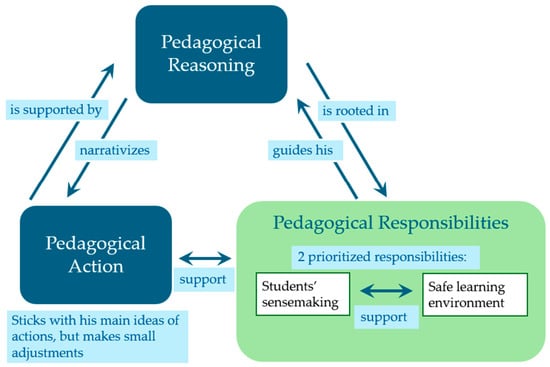
As illustrated in Figure 3, Ben seems to be concerned with two main commitments (bottom right corner) that are important to him: providing a safe learning environment and letting students make sense of mathematics themselves. These responsibilities are similar to those voiced by Anne, but he interprets them and the relationship between them differently. First, Ben talks frequently about letting the students do most of the talking and be the centre of what happens in the classroom: “What I mainly think about is that the students should be doing the learning. It’s not just about me doing the teaching” (Ben). He talks about his responsibility for letting his students learn mathematics by making sense of it themselves:
Figure 3.
Ben’s pedagogical judgement: students’ sensemaking and a safe learning environment are central to his reasoning and influenced by his experience with Beate.
So, for some lessons, I have to talk more. But then it’s about, how can I change this from being a lesson where I have to go through a lot? To let the students go through the same thing, the goal is still the same, but it’s the students who figure it out.(Ben)
Second, Bens’ actions seem to be frequently rooted in the importance of building what he describes as a safe learning environment for all students, and he has a clear sense of what actions this entails:
It’s okay to discuss, it’s okay to disagree, it’s okay to try, it’s okay to fail. We’re going to work with inquiry, we’re going to work on identifying misconceptions, and the students should be the ones talking the most.(Ben)
As Figure 3 illustrates, Ben thinks that building a safe learning environment is an important responsibility for the teacher and a necessary support for fulfilling his commitment to letting the students make sense of mathematics themselves. He argues that establishing this kind of learning culture must be built over time:
In principle, you should be able to do it with all groups, right? But everyone who has been a teacher knows that’s impossible. Because it takes time to establish this. That’s why I think it’s great that fourth grade is involved, sixth grade is involved, and lower secondary school is involved. It means we’re building a culture for how we want things to be in math lessons.(Ben)
When making judgements about his teaching practices, the analysis revealed that Ben values the responsibility for students’ sensemaking of mathematics as an important, and maybe the most important, commitment he has as a mathematics teacher. He does not explain student disengagement in terms of the failure of the students or the MAM approach but makes the point that it is important to be patient and keep working on his teaching. His colleague Beate also states that both the teacher and the students have to practice how they work together: “I think it’s a process in the classroom. You have to practice, and the students have to practice it” (Beate).
Ben recognizes that it sometimes can be challenging to engage all students: “If they’re not interested, or think it’s too easy, or just can’t be bothered. Because then you’ve kind of lost before you’ve started.” Yet, he is not put off when a lesson does not go well. He makes adjustments to his actions: “And then it’s just like, okay, fine, we’ll do a different kind of lesson, because it didn’t work today”. When he makes changes to his pedagogical actions, he still seems committed to keeping the students at the centre of the learning process (students’ sensemaking in Figure 3): “Sometimes it doesn’t work at all. Then you just have to manage to stick with it. And work on not… not taking all the space myself. It’s the students who should figure it out”.
Ben also says he recognizes the pressure of covering the curriculum, but again he considers his obligation to ensure students’ sensemaking as more important (lower right-hand corner of Figure 3). Giving students more time on each task is something he wants to work towards:
I find it challenging both to find time for the curriculum, but also because I want to correct misconceptions right away. Instead of letting the students discover their own misunderstandings. So that’s something I find difficult.(Ben)
This statement shows how Ben does not seem to worry about his students’ failure but focuses on not being too eager to help them find solutions and correct their misconceptions. MAM has brought Ben positive experiences of planning with others during the sessions:
… we plan well. And we anticipate most scenarios. What happens if a student says this? What happens if that answer comes up? What happens if someone brings up this topic? [In this way] You always have an answer.(Ben)
Even though he claims he takes lessons from this experience, he is aware that it is impossible to find time to do it so carefully for all of his lessons; he thinks that he will be better at it with practice:
And then it’s very much about making planning more efficient, in a way. Because when you’ve done it enough times—how many changes do you need to make for it to get even better?(Ben)
When Ben talks about his experience planning and discussion lessons for grade 9 with Beate, he says that they have made changes to the student assessments:
We’ve made some changes to assessment situations. (…) There’s much more conversation with the students, much more frequent feedback, so that they themselves can learn from their misconceptions or mistakes, which they can then correct quite soon afterward. (…) Instead of taking (…) six weeks, topic, big test, and then just moving straight on. So, we’ve divided it into much smaller chunks.(Ben)
In general, the analysis has revealed that Ben is dedicated to his students’ learning and wants to help them make sense of mathematics themselves, which is one of the MAM principles. He wants to work on his teaching, and he believes that it is possible to build a positive student-centred learning environment to all students over time.
6. Discussion
To answer my research question, How do teachers’ interpretations of their pedagogical responsibilities interact with their interpretation and take-up of professional development in ambitious and equitable mathematics teaching?, I have used Horn and Garner’s (2022) conceptual framework of pedagogical judgement to explore how Anne and Ben’s perceived pedagogical responsibilities have interacted with the ways in which they make decisions about ambitious and equitable teaching practices. This study shows how differences in teachers’ interpretations of pedagogical responsibilities related to students, mathematics learning, assessment, curriculum coverage, and classroom culture either supported or constrained their implementation of ambitious and equitable mathematics practices.
One major finding identified in the analysis is that their interpretation of pedagogical responsibilities impacts on what they are able to take away from a professional development program like MAM. Focusing on the relationship between the components of pedagogical judgement– pedagogical actions, pedagogical reasoning, and pedagogical responsibilities—the analysis has revealed how conflicts between and within the components lead to different kinds of issues for Ben and Anne. Applying the framework of pedagogical judgement enables us to zoom in on teachers’ sensemaking of pedagogical responsibilities. As Horn and Garner (2022) remind us, pedagogical responsibilities are highly personal, and it is evident how differently Anne and Ben talk about similar responsibilities. The clearest difference between the teachers concerns how they talk about lower attainers and how this influences their reasoning about their pedagogical responsibilities.
The case of Anne illustrates a common finding that teachers worry about issues such as accountability, tracking, and classroom management, and we know that making changes to mathematics teaching practices is not easy in this context (Hiebert, 2013; Schoenfeld, 2022). Analysing Anne’s statements using Horn and Garner’s (2022) framework give some insight into why these problems occur. She ‘believes in’ ambitious mathematics teaching, but she struggles to put it into practice on a daily basis because of competing responsibilities. In particular, discourses about students’ abilities and education policy demands are important drivers.
Both Ben and Anne talk about the responsibility for building a safe learning environment. However, this manifests itself differently. Ben believes that all students are capable of engaging with all forms of mathematics. While Anne worries about her “weakest students,” Ben is impressed by what his students can do. These differing perspectives shape their teaching: Ben thinks ambitious mathematics teaching is compatible with students’ well- being, whereas Anne is focused on students’ limitations. She questions whether she is right to push ambitious mathematics teaching on to her students and worries about exposing their struggles. As Mazenod et al. (2018) observed, teachers often worry about their low attainers and attempt to support them by adapting tasks to make them easier, working on the assumption that lower attainers are unable to do more challenging tasks. This assumption makes ambitious and equitable teaching impossible and restricts the range of mathematics available to students labelled as “weak” (Mazenod et al., 2018). While Anne seems to find it difficult to build a safe classroom culture for all her students, Ben adopts a different perception of student progress and emphasizes that it takes time.
One aspect of the conflict for Anne relates to the issue of tracking. She is concerned to keep track of what kinds of calculations her students can do at all times, revealing what kind of mathematics she considers important and how she perceives process. Although Anne says that she values what she learns from talking with her students, her concern also invokes traditional views of mathematics as a fixed body of knowledge and a focus on doing fast and accurate calculations (Horn & Garner, 2022). A tension between different pedagogical responsibilities with different views of what is important in mathematics troubles her. As pressure on accountability and performativity increases in Norway (Larsen et al., 2022), these issues will be exacerbated for teachers like Anne.
If the framework is applied to Ben’s account, it is obvious that he interprets his pedagogical responsibilities very differently, with the result that he does not experience the same tensions. The analysis reveals a different view of mathematical pedagogy, one that emphasises that all students have something to contribute in the mathematics classroom and that learning to work ambitiously is an ongoing process that both teachers and students must develop through practice. Like the teacher described by Gibbons et al. (2025), Ben appeared to be guided by one central pedagogical responsibility: positioning students as sense-makers. This responsibility shapes his reasoning and serves as a lens through which he balances other pedagogical responsibilities. The priority he assigns these responsibilities depends on the extent to which they supported or conflicted with students’ opportunities for sensemaking. This clear prioritisation may help explain why Ben’s trajectory appeared less conflicted than Anne’s.
As Louie (2018) reminds us, dominant ideologies about who are capable or not in mathematics are shaped by collective cultures at local schools. Statements from Anne’s colleagues at Alstad about students’ abilities indicate important elements of their school discourse. Anne wants to believe in her students, but like the teacher described by Louie (2018), Anne is likely influenced by a discourse of who is capable or not in mathematics. Given his collaboration with Beate, Ben probably has more opportunities to see what students can do and to reflect on this because of the strength of Beate’s voice about students’ abilities. This highlights the importance of recognizing teachers’ social and cultural experiences in professional development (Valoyes-Chávez, 2019).
7. Limitations and Implications
The insight these two teachers give us provides valuable perspectives on what informs teachers’ actions. It is likely that the tensions experienced by Anne are not unique to her case. However, it should be noted that this study has been primarily concerned with the perception of two teachers and is based on a limited amount of data collected over a relatively short period of time. Further research involving other teachers is needed to deepen our understanding of how pedagogical responsibilities shape teachers’ reasoning and practice across different contexts, professional backgrounds, and mathematical domains.
A major implication of this study’s findings is that a focus on noticing student abilities should have a more central role in professional development programs, for instance by making space for discussing and reflecting upon students’ contributions and solution strategies. Further research in various context is needed to support this claim. While part of the MAM approach is to give teachers supported experience with its techniques, there is a limit to what a professional development program can do. This is particularly the case when considering that experience gained in a professional development course does not necessarily connect to the discourses and contextual factors at local schools (Louie, 2018). Further research could explore how local school cultures and professional relationships contribute to the development of beliefs about students’ capabilities and, in turn, shape teachers’ professional learning and practice. A focus on culture in research on professional development can challenge a deficit view of teachers as well and help the field better understand the support that teachers need.
The contrasts between Anne and Ben raise important questions about why teachers make sense of their responsibilities in different ways. There are reasons to believe that factors such as mentoring relationships, exemplified by Ben and Beate, and the influence of school culture may play a role in shaping these teachers’ beliefs and practices. While the present study does not provide sufficient evidence to draw firm conclusions about these influences, it indicates directions for future research. Further studies could investigate more closely how mentoring, local school coaches, professional relationships, and school cultures contribute to differences in teachers’ reasoning and pedagogical judgement.
The stories of Ben and Anne illustrate how teachers navigate multiple, sometimes conflicting, pedagogical responsibilities. The analysis highlights how making decisions about teaching practices inevitably comes at the expense of something else. This study extends existing understanding of teachers’ actions by illuminating the responsibilities and considerations that underpin pedagogical decisions. These findings also have implications for professional development. If teaching involves continually negotiating competing commitments and responsibilities, professional development should support teachers in making sense of and navigating such tensions. Further research is needed to understand how such support can be most effectively designed and enacted to exercise professional judgement in complex classroom situations.
Funding
This research received no external funding.
Institutional Review Board Statement
The study was conducted in accordance with the Declaration of Helsinki and approved by SIKT—Norwegian Agency for Shared Services in Education and Research (reference number 287530, date of approval: 8 January 2025).
Informed Consent Statement
Informed consent was obtained from all subjects involved in the study.
Data Availability Statement
Data for the study are unavailable due to privacy restrictions and ethical reasons.
Acknowledgments
During the preparation of this manuscript, the author used Microsoft 365 Copilot GPT-5 chat for the purposes of language support, including vocabulary suggestions and synonym searches. The authors have reviewed and edited the output and take full responsibility for the content of this publication.
Conflicts of Interest
The author declares no conflicts of interest.
References
- Bjerke, A. H., Dalland, C., Mausethagen, S., & Knudsmoen, H. (2025). Negotiating performative and professional accountability in inclusive mathematics education in Norway. International Journal of Educational Research, 129, 102518. [Google Scholar] [CrossRef] [Scilit]
- Charalambous, C. Y. (2026). Shifting from a deficit to an asset-based perspective for all teachers: Why is it necessary and what might it entail? Journal of Mathematics Teacher Education, 29(1), 1–6. [Google Scholar] [CrossRef] [Scilit]
- Charalambous, C. Y., Agathangelou, S. A., Kasapi, E., & Christofidou, E. (2023). Learning to teach ambitiously: A multiple case study of practicing teachers’ experimentation with enablers and extenders. Journal of Mathematics Teacher Education, 26(3), 363–394. [Google Scholar] [CrossRef] [Scilit]
- Chen, G. A., Marshall, S. A., & Horn, I. S. (2021). ‘How do I choose?’: Mathematics teachers’ sensemaking about pedagogical responsibility. Pedagogy, Culture & Society, 29(3), 379–396. [Google Scholar] [CrossRef] [Scilit]
- Choppin, J., Green, C., & Zahner, W. (2024). Demands, tensions, and resources when implementing ambitious mathematics. Education Policy Analysis Archives, 32(17/18), 1–26. [Google Scholar] [CrossRef] [Scilit]
- Clark, T., Foster, L., Sloan, L., & Bryman, A. (2021). Bryman’s social research methods (6th ed.). Oxford University Press. [Google Scholar]
- Education Act. (2023). Act relating to primary and secondary education and training (LOV-2025-05-23-16). Lovdata. Available online: https://lovdata.no/dokument/NLE/lov/2023-06-09-30 (accessed on 20 March 2026).
- Elstad, E., & Sivesind, K. (Eds.). (2010). PISA-sannheten om skolen? [PISA-the truth about education?]. Universitetsforlaget. [Google Scholar]
- Eriksen, E., Solomon, Y., Bjerke, A. H., Gray, J., & Kleve, B. (2024). Making decisions about attainment grouping in mathematics: Teacher agency and autonomy in Norway. Research Papers in Education, 39(3), 379–399. [Google Scholar] [CrossRef] [Scilit]
- Fasting, R. B. (2013). Adapted education: The Norwegian pathway to inclusive and efficient education. International Journal of Inclusive Education, 17(3), 263–276. [Google Scholar] [CrossRef] [Scilit]
- Fauskanger, J., & Bjuland, R. (2019). Learning ambitious teaching of multiplicative properties through a cycle of enactment and investigation. Mathematics Teacher Education and Development, 21(1), 125–144. [Google Scholar]
- Ghousseini, H. (2017). Rehearsals of teaching and opportunities to learn mathematical knowledge for teaching. Cognition and Instruction, 35(3), 188–211. [Google Scholar] [CrossRef] [Scilit]
- Ghousseini, H., Beasley, H., & Lord, S. (2015). Investigating the potential of guided practice with an enactment tool for supporting adaptive performance. Journal of the Learning Sciences, 24(3), 461–497. [Google Scholar] [CrossRef] [Scilit]
- Gibbons, L. K., Kazemi, E., & Hintz, A. (2025). Examining a professional learning routine to support educators to learn teaching with and from students. Cognition and Instruction, 43(4), 389–417. [Google Scholar] [CrossRef] [Scilit]
- Gibbons, L. K., Prough, S., Memmolo, R., Wilhelm, A. G., & Manz, E. (2026). Facilitating classroom discussions across content areas: What influences an elementary teacher’s pedagogical judgment. The Elementary School Journal, 126(4), 693–719. [Google Scholar] [CrossRef] [Scilit]
- Goldsmith, L. T., Doerr, H. M., & Lewis, C. C. (2014). Mathematics teachers’ learning: A conceptual framework and synthesis of research. Journal of Mathematics Teacher Education, 17(1), 5–36. [Google Scholar] [CrossRef] [Scilit]
- Gutiérrez, R. (2012). Context matters: How should we conceptualize equity in mathematics education? In B. Herbel-Eisenmann, J. Choppin, D. Wagner, & D. Pimm (Eds.), Equity in discourse for mathematics education: Theories, practices, and policies (pp. 17–33). Springer. [Google Scholar] [CrossRef] [Scilit]
- Hiebert, J. (2013). The constantly underestimated challenge of improving mathematics instruction. In K. R. Leatham (Ed.), Vital directions for mathematics education research (pp. 45–56). Springer. [Google Scholar] [CrossRef] [Scilit]
- Horn, I. S. (2007). Fast kids, slow kids, lazy kids: Framing the mismatch problem in mathematics teachers’ conversations. Journal of the Learning Sciences, 16(1), 37–79. [Google Scholar] [CrossRef] [Scilit]
- Horn, I. S. (2020). Supporting the development of pedagogical judgement. Connecting instruction to contexts through classroom video with experienced mathematics teachers. In G. M. Lloyd, & O. Chapman (Eds.), International handbook of mathematics teacher education: Volume 3: Participants in mathematics teacher education (pp. 321–342). Brill. [Google Scholar] [CrossRef] [Scilit]
- Horn, I. S., & Garner, B. (2022). Teacher learning of ambitious and equitable mathematics instruction: A sociocultural approach (1st ed., Vol. 1). Routledge. [Google Scholar] [CrossRef] [Scilit]
- Jacobs, V. R., Lamb, L. L. C., & Philipp, R. A. (2010). Professional noticing of children’s mathematical thinking. Journal for Research in Mathematics Education, 41(2), 169–202. [Google Scholar] [CrossRef] [Scilit]
- Kazemi, E., Ghousseini, H., Cunard, A., & Turrou, A. C. (2016). Getting inside rehearsals: Insights from teacher educators to support work on complex practice. Journal of Teacher Education, 67(1), 18–31. [Google Scholar] [CrossRef] [Scilit]
- Kennedy, M. M. (2016). How does professional development improve teaching? Review of Educational Research, 86(4), 945–980. [Google Scholar] [CrossRef] [Scilit]
- Lampert, M. (2010). Learning teaching in, from, and for practice: What do we mean? Journal of Teacher Education, 61(1–2), 21–34. [Google Scholar] [CrossRef] [Scilit]
- Lampert, M., Beasley, H., Ghousseini, H., Kazemi, E., & Franke, M. (2010). Using designed instructional activities to enable novices to manage ambitious mathematics teaching. In M. K. Stein, & L. Kucan (Eds.), Instructional explanations in the disciplines (pp. 129–141). Springer. [Google Scholar] [CrossRef] [Scilit]
- Lampert, M., Franke, M. L., Kazemi, E., Ghousseini, H., Turrou, A. C., Beasley, H., Cunard, A., & Crowe, K. (2013). Keeping it complex: Using rehearsals to support novice teacher learning of ambitious teaching. Journal of Teacher Education, 64(3), 226–243. [Google Scholar] [CrossRef] [Scilit]
- Larsen, E., Møller, J., & Jensen, R. (2022). Constructions of professionalism and the democratic mandate in education: A discourse analysis of Norwegian public policy documents. Journal of Education Policy, 37(1), 106–125. [Google Scholar] [CrossRef] [Scilit]
- Lave, J., & Wenger, E. (1991). Situated learning: Legitimate peripheral participation. Cambridge University Press. [Google Scholar]
- Louie, N. L. (2017). The culture of exclusion in mathematics education and its persistence in equity-oriented teaching. Journal for Research in Mathematics Education, 48(5), 488–519. [Google Scholar] [CrossRef] [Scilit]
- Louie, N. L. (2018). Culture and ideology in mathematics teacher noticing. Educational Studies in Mathematics, 97(1), 55–69. [Google Scholar] [CrossRef] [Scilit]
- Mazenod, A., Francis, B., Archer, L., Hodgen, J., Taylor, B., Tereshchenko, A., & Pepper, D. (2018). Nurturing learning or encouraging dependency? Teacher constructions of students in lower attainment groups in English secondary schools. Cambridge Journal of Education, 49(1), 53–68. [Google Scholar] [CrossRef] [Scilit]
- Nortvedt, G. A. (2018). Policy impact of PISA on mathematics education: The case of Norway. European Journal of Psychology of Education, 33(3), 427–444. [Google Scholar] [CrossRef] [Scilit]
- Norwegian Centre for Mathematics Education. (n.d.). Ambisiøs matematikkundervisning [Ambitious mathematics teaching]. Matematikksenteret. Available online: https://www.matematikksenteret.no/utviklingssamarbeid/mam/ambisi%C3%B8s-matematikkundervisning (accessed on 10 March 2026).
- Schoenfeld, A. (2022). Why are learning and teaching mathematics so difficult? In M. Danesi (Ed.), Handbook of cognitive mathematics (pp. 1–35). Springer. [Google Scholar]
- Shure, V., Lehmann, M., Friesen, M., Roesken-Winter, B., & Prediger, S. (2025). Professional development research on promoting productive practices for teachers’ handling of typical tasks of mathematics teaching: A systematic review. ZDM—Mathematics Education, 57(4), 795–813. [Google Scholar] [CrossRef] [Scilit]
- Valoyes-Chávez, L. (2019). On the making of a new mathematics teacher: Professional development, subjectivation, and resistance to change. Educational Studies in Mathematics, 100(2), 177–191. [Google Scholar] [CrossRef] [Scilit]
- Van Es, E. A., & Sherin, M. G. (2002). Learning to notice: Scaffolding new teachers’ interpretations of classroom interactions. Journal of Technology & Teacher Education, 10(4), 571–596. [Google Scholar]
- Wæge, K., & Svingen, O. E. L. (2023). Teachers’ learning of ambitious mathematics teaching as changes in pedagogical discourse. Nordic Studies in Mathematics Education, 28(1–2), 79–98. [Google Scholar] [CrossRef] [Scilit]
- Yurekli, B., & Stein, M. K. (2025). Research-based design of coaching for ambitious mathematics instruction. Journal of Mathematics Teacher Education, 28(4), 925–952. [Google Scholar] [CrossRef] [Scilit]
- Zahner, W., Tenney, K., Pelaez, K., & Choppin, J. (2025). What is ambitious (mathematics) teaching? Clarifying a key concept in education research and practice. Journal of Education, 206(4), 352–367. [Google Scholar] [CrossRef] [Scilit]

Disclaimer/Publisher’s Note: The statements, opinions and data contained in all publications are solely those of the individual author(s) and contributor(s) and not of MDPI and/or the editor(s). MDPI and/or the editor(s) disclaim responsibility for any injury to people or property resulting from any ideas, methods, instructions or products referred to in the content. |
© 2026 by the author. Licensee MDPI, Basel, Switzerland. This article is an open access article distributed under the terms and conditions of the Creative Commons Attribution (CC BY) license.