


Abstract
As artificial intelligence (AI) continues to reshape higher education, traditional web-based methods of providing interested parties with academic and institutional information are increasingly being challenged. The current study provides empirical evidence surrounding young adult perceptions, information-seeking efficiency, and objective task performance when using AI-powered chatbots compared to traditional university websites. Guided by the Technology Readiness and Acceptance Model (TRAM), 299 participants were randomly assigned to complete information-seeking tasks using a traditional university website or an AI-powered chatbot. Following random assignment, participants using the AI-powered chatbot reported significantly greater perceived ease of use (p < 0.001), perceived usefulness (p < 0.001), and more favorable attitudes toward the technology (p < 0.001) than participants using the traditional website. Beyond these perceptual differences, participants using the chatbot completed the information-seeking tasks in approximately 38% less time and demonstrated overall task accuracy of 95.6%, compared with 78.5% for website participants, an increase of 17.1 percentage points. AI-powered conversational interfaces appear capable of improving not only perceptions of the information-seeking experience, but also the speed and accuracy with which institutional information can be located. Thus, higher education institutions are advised to consider conversational AI as a complementary support infrastructure while continuing to systematically evaluate both user perceptions and objective performance outcomes.
1. Introduction
Individuals often face an overwhelming amount of information as they navigate their academic journey. One such challenge is understanding how to successfully navigate their academic program (Feygin et al., 2022). They must locate and understand information about degree requirements, course policies, internship opportunities, student organizations, and other program-related resources.
Although much of this information is available through university websites, finding a specific answer can require navigating multiple pages, interpreting menus, and determining where the needed information is located. As universities continue to expand their digital services, the way this information is delivered has become an integral part of how students can succeed (Hawthorne et al., 2022).
The growth in computing power and artificial intelligence (AI) technology has made it possible to offer a different approach to this information-seeking process, AI-powered conversational interfaces. Rather than requiring users to locate information by navigating a website, conversational interfaces allow questions to be asked directly and users to receive responses through a query and answer process. Chatbots have increasingly been used in higher education to support students, provide educational content, and respond to administrative and frequently asked questions (Kuhail et al., 2023; Ramandanis & Xinogalos, 2023). However, universities have not yet fully realized the potential that this technology holds for students’ use and success (Peyton et al., 2025). This type of interface may make institutional information easier and faster to access, but its value depends on more than whether the technology can provide accurate information. Users must also find the interface useful, easy to use, and valuable enough to use again.
The perceptions, intentions, and acceptance of students using AI conversational interface technology have been the subject of most of the current research on educational chatbots (Baig & Yadegaridehkordi, 2024; McGrath et al., 2025). While recent information-seeking research has similarly looked at students’ use, preferences, perceived relevance, and satisfaction with AI information sources, systematic reviews of ChatGPT use in higher education have identified adoption, intention to use, perceived usefulness, and related acceptance measures as prominent areas of investigation (Lund et al., 2026). Although these results are significant, they do not adequately convey whether conversational interfaces enhance the actual information-seeking process. Given ongoing worries about the authenticity and dependability of AI-generated information, an interface may be seen positively in an information-seeking environment while still taking a long time to find information or generating inaccurate answers (McGrath et al., 2025). On the other hand, even when consumers’ opinions of the technology are more divided, an interface that enhances the speed and accuracy of information retrieval may nevertheless offer significant benefit. Therefore, a more comprehensive picture of how conversational interfaces compare to standard webpages can be obtained by looking at both perceived outcomes and objective information-seeking performance.
To address these concerns, the current study compares an AI-powered conversational interface that offers access to the identical program content with a conventional university program website. While performing the same information-seeking activities, participants were randomly allocated to utilize one of the two interfaces. The study assesses objective information-seeking performance using task completion time and task accuracy in addition to looking at perceived usefulness, attitude, behavioral intention, utilitarian value, hedonic value, and word-of-mouth intentions. By offering much-needed evidence about whether young adult participants evaluate the chatbot more favorably than the website, the current study adds to the body of literature.
1.1. Theoretical Framework
1.1.1. Information Seeking Theory
Information seeking is a goal-directed process in which individuals recognize a need for information and then identify and use available sources to address that need (Wilson, 1999). Individuals regularly engage in this process when looking for information about degree requirements, course policies, internships, student organizations, and other academic resources. The success of this process depends not only on whether the information exists, but also on how easily it can be located, accessed, and used.
Information-seeking research has long recognized that the source and system used to access information can shape the search process (Wilson, 1999). Users may choose among different information sources based on factors such as accessibility, effort, familiarity, and the likelihood that a source will provide useful or relevant information (Xu et al., 2006). Digital technologies have expanded these choices considerably. More recently, generative AI has added conversational systems to the information environment, giving users an alternative to traditional search engines, websites, and other information resources. Research with university students suggests that AI chatbots are becoming an increasingly significant part of their information-seeking practices alongside search engines and academic library resources (Lund et al., 2026).
The distinction between traditional websites and conversational interfaces is especially relevant in this context. Traditional webpages generally require users to navigate an existing information structure to locate relevant content, whereas conversational interfaces allow users to express an information need directly through questions and receive responses through dialogue (Peyton et al., 2025; Ramandanis & Xinogalos, 2023). Prior research comparing FAQ webpages with chatbot interfaces demonstrates that the interface through which students seek information can influence their experiences with the information-seeking process (Han & Lee, 2022). At the same time, efficiency alone does not establish that the information retrieved is correct. In the present study, task completion time and objective task accuracy provide two complementary indicators of how effectively an interface supports information seeking. Examining these behavioral intentions alongside users’ perceptions provides a broader assessment of the differences between traditional websites and AI-powered conversational interfaces.
Information seeking provides the context for examining whether participants can locate correct program information efficiently. Accuracy and completion time assess this performance, while the acceptance and value measures assess participants’ perceptions of the interface. The study does not directly test a specific information-seeking model. TRAM complements this perspective by addressing technology-specific perceptions and individual differences in technology readiness (C.-H. Lin et al., 2007). Information Seeking Theory and TRAM provide complementary perspectives for the current study. Information seeking focuses on obtaining needed information, while TRAM addresses users’ evaluations of the interface and differences associated with technology readiness.
1.1.2. Technology Readiness and Acceptance Model
The technology acceptance model (TAM) stems from Fishbein and Ajzen’s theory of reasoned action (TRA) and was developed to help explain why individuals accept or reject new technologies (Davis, 1989; Fishbein & Ajzen, 1975). According to the TAM, two of the most central tenets in technology acceptance are perceived ease of use (PEOU) and perceived usefulness (PU) (Davis, 1989; Venkatesh et al., 2012). PEOU refers to the extent to which an individual believes that using technology will require little effort, while PU reflects the belief that using the technology will improve the activity being performed (Davis, 1989). When users perceive technology as both useful and relatively easy to use, they are more likely to develop favorable attitudes toward the technology and intentions to use it in the future.
The TAM has been applied across a wide range of technologies and has also been used within the sport literature to better understand consumers’ acceptance of emerging technologies. For example, Kwak and McDaniel (2011) used the TAM to examine the adoption of fantasy sport technologies, while Ibrahim (2014) applied the model to the acceptance of fantasy sport websites. This work has demonstrated that the TAM can be useful for understanding technology acceptance within sport settings, including technologies that provide both utilitarian and hedonic benefits (Byun et al., 2018; Kwak & McDaniel, 2011). In the current study, this framework provides a basis for examining whether the type of interface participants use to seek sport management program information influences PEOU, PU, attitude toward use, and behavioral intention.
The study brings these perspectives together by examining how interface conditions relate to technology acceptance, perceived utilitarian and hedonic value, word-of-mouth intention, and objective information seeking performance. Optimism and innovativeness are examined as moderators of the interface effects on technology acceptance.
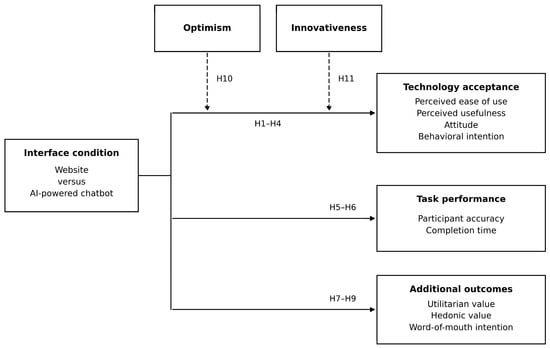
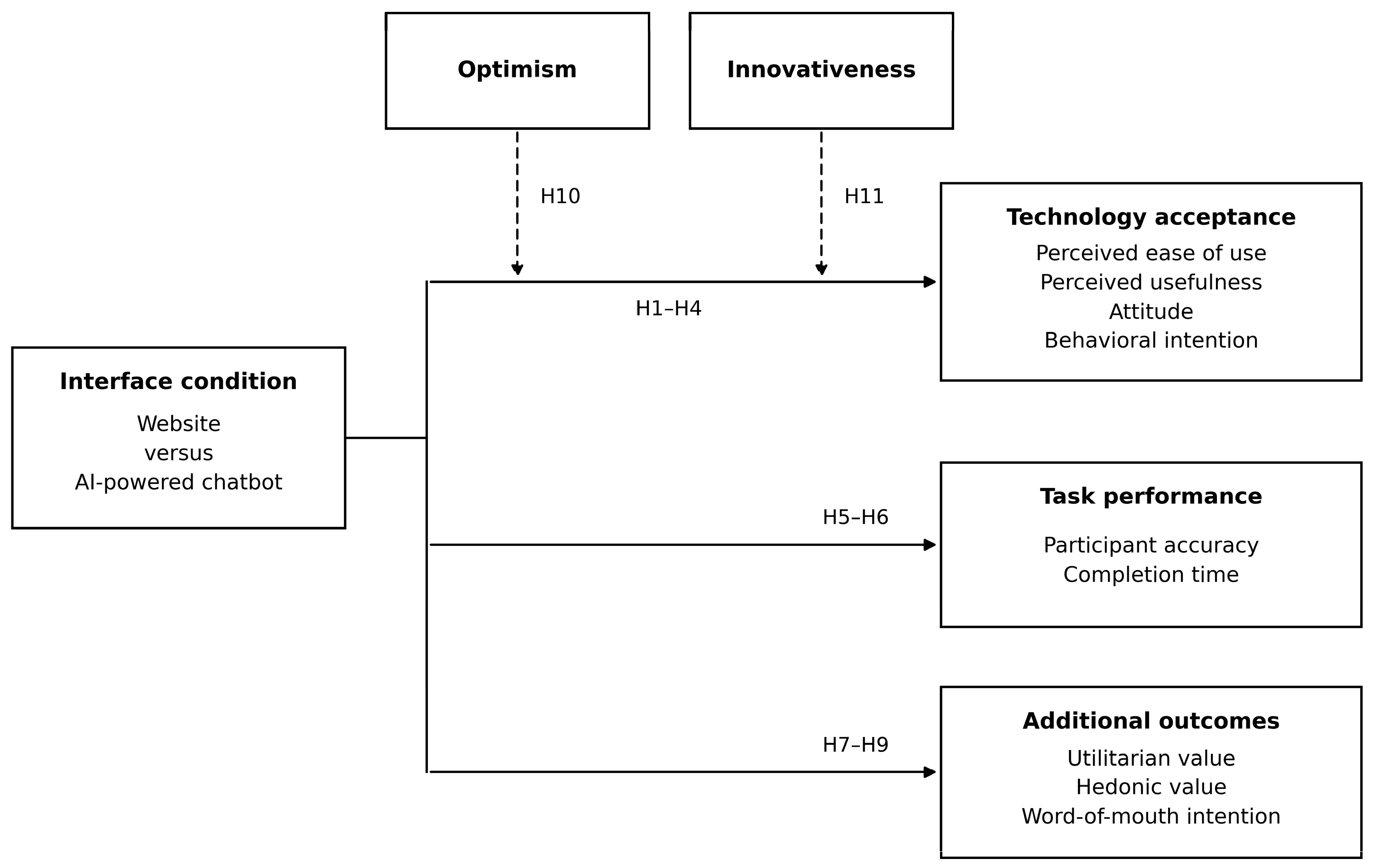
The difference between a traditional website and an AI-powered conversational interface provides an interesting setting in which to examine these outcomes. Traditional websites require users to navigate through pages and menus to locate information, while a conversational interface allows users to directly ask the system for the information they need. Because the chatbot reduces some of the navigation required during the information-seeking process, participants may view the interface as easier to use and more useful for completing the assigned tasks. These differences may also carry over to participants’ overall attitudes toward the interface and their intentions to use a similar system for future information-seeking tasks. The conceptual model for this study is available in Figure 1. Based on the TAM and the differences between the two information-seeking interfaces, the following hypotheses were developed:
Figure 1.
Conceptual Model of Interface Effects and Technology Readiness Moderation. Note. Solid arrows represent proposed interface effects. Dashed arrows represent moderation of the interface effects on the four technology-acceptance outcomes. Optimism and innovativeness were examined in separate models. Arrows depict hypotheses, not statistical significance or mediation.
H1.
Participants using the AI-powered conversational interface will report greater perceived ease of use than participants using the traditional website.
H2.
Participants using the AI-powered conversational interface will report greater perceived usefulness than participants using the traditional website.
H3.
Participants using the AI-powered conversational interface will report more favorable attitudes toward use than participants using the traditional website.
H4.
Participants using the AI-powered conversational interface will report greater behavioral intentions to use the interface for future information-seeking tasks than participants using the traditional website.
Although the TAM provides a useful framework for understanding perceptions and acceptance of a specific technology, it does not fully account for individual differences in how people approach new technologies. Some individuals attempt to avoid new technologies until their use becomes necessary, while others actively seek out opportunities to use emerging technologies (J.-S. C. Lin & Hsieh, 2007). Technology readiness (TR) was developed to help explain these differences and represents an individual’s general tendency to embrace and use new technologies (Parasuraman, 2000).
Parasuraman (2000) originally conceptualized technology readiness through four dimensions: optimism, innovativeness, discomfort, and insecurity. Optimism and innovativeness represent positive contributors to technology readiness, whereas discomfort and insecurity serve as inhibitors. Optimism reflects a belief that technology can provide individuals with greater efficiency, flexibility, and control. Innovativeness represents the tendency to be an early adopter or to view oneself as being at the forefront of technology use. Following previous technology readiness research that has focused specifically on these positive dimensions (Berger, 2009; Chung et al., 2015; Liljander et al., 2006), the current study examines optimism and innovativeness.
To account for these individual differences within the technology acceptance process, C.-H. Lin et al. (2007) combined technology readiness with the TAM to develop the Technology Readiness and Acceptance Model (TRAM). The two frameworks complement one another because the TAM focuses primarily on perceptions of a particular technology, whereas technology readiness reflects more general beliefs about an individual’s willingness to engage with technology. By combining these perspectives, TRAM provides a broader framework for understanding why users may respond differently when exposed to the same technological innovation.
1.1.3. Information-Seeking Performance and User Value
While technology acceptance provides an important indication of how users perceive and respond to an information-seeking interface, positive perceptions of a technology do not necessarily mean that technology improves the information-seeking process itself. Evaluations of interactive information-retrieval systems therefore benefit from examining behavioral measures of users’ actual search performance in addition to subjective perceptions of the system (Kelly, 2009). In the current study, participants were not simply asked to evaluate a website or chatbot. They were asked to use the assigned interface to locate specific information about a sport management program. As a result, the effectiveness of each interface can also be evaluated based on how successfully participants completed those tasks.
Two outcomes are particularly important in this context: accuracy and efficiency. Research on interactive information retrieval has treated both task-completion time and user effectiveness as important dimensions of system evaluation, while also recognizing that neither dimension alone provides a complete assessment of information-seeking performance (Cheng et al., 2010). An information-seeking interface has limited value if it allows users to locate information quickly but provides incorrect information. Similarly, an interface that consistently leads users to the correct information may still create challenges if locating that information requires considerable time and effort. Traditional graphical interfaces generally require users to interact with interface structures through actions such as scrolling, selecting links, and navigating among available options, whereas conversational interfaces allow interaction through natural-language dialogue (Følstad & Brandtzæg, 2017). Conversational information-seeking systems are specifically designed to allow users to communicate information needs through natural-language interactions rather than relying exclusively on conventional search and navigation processes (Zamani et al., 2023).
This distinction may have implications for both efficiency and effectiveness. Conversational search systems are intended to support users in resolving information needs through natural and efficient interactions, including the ability to ask questions and refine information needs through dialogue (Radlinski & Craswell, 2017). By reducing the need to determine where information is located within a website and allowing users to directly express an information need, an AI-powered conversational interface may reduce the effort and time required to locate specific information. Its ability to respond directly to the stated information need may also help users arrive at the relevant information needed to complete a task. Accordingly, the following hypotheses were proposed:
H5.
Participants using the AI-powered conversational interface will demonstrate greater objective information-seeking task accuracy than participants using the traditional website.
H6.
Participants using the AI-powered conversational interface will complete the information-seeking tasks in less time than participants using the traditional website.
Beyond completing an information-seeking task successfully, users may also evaluate an interface based on the type of value it provides. Consumer research has commonly distinguished between utilitarian and hedonic values. Utilitarian value is generally associated with the functional or practical benefits of an experience, whereas hedonic value reflects the enjoyment or experiential benefits associated with that experience (Babin et al., 1994). Research examining interactive digital environments similarly suggests that technology-based experiences can provide both utilitarian benefits associated with efficiency and convenience and hedonic benefits associated with the experiential qualities of the interaction (Childers et al., 2001). Although the two forms of value are distinct, an experience can provide both. This distinction is particularly relevant when considering an AI-powered conversational interface. The ability to ask a question and quickly receive relevant information may provide practical value, while the conversational and interactive nature of technology may also make the information-seeking experience more enjoyable. By examining accuracy and completion time alongside technology acceptance, the study assesses whether favorable interface evaluations go along with better information-seeking performance.
The current study provides an opportunity to examine both forms of value while participants complete the same information-seeking tasks using two different interfaces. If the chatbot makes it easier for participants to access the information they need, they may perceive greater utilitarian value from the experience. At the same time, interacting directly with an AI-powered conversational interface may provide a more engaging experience than navigating a traditional website. Based on these differences, the following hypotheses were developed:
H7.
Participants using the AI-powered conversational interface will report greater utilitarian value than participants using the traditional website.
H8.
Participants using the AI-powered conversational interface will report greater hedonic value than participants using the traditional website.
In addition to influencing users’ own perceptions and future intentions, experiences with technology can influence whether users are willing to recommend or discuss that technology with others. Word of mouth (WOM) has been examined across a variety of consumer contexts and can play an important role in shaping attitudes and behaviors toward products and services (Brown & Reingen, 1987; H. Kim & Song, 2010). Positive experiences with a product can generate WOM and influence subsequent consumer behavior (Kawakami et al., 2013).
Participants who have a more useful, efficient, or enjoyable experience with an AI-powered conversational interface may also be more willing to speak positively about the interface or recommend it to others. Therefore, the following hypothesis was proposed:
H9.
Participants using the AI-powered conversational interface will report greater word-of-mouth intentions than participants using the traditional website.
Participants who are generally optimistic about technology may be more likely to recognize the potential benefits of using a conversational interface for information seeking. Similarly, participants who consider themselves technologically innovative may be more receptive to interacting with an AI-based system than participants who are less inclined to adopt new technologies. Therefore, the advantage of an AI-powered conversational interface may not be the same for every user. Instead, its effect on technology acceptance may depend in part on the technology readiness of the individual using it.
Although TRAM commonly treats technology readiness as an antecedent of technology perceptions, prior research has examined optimism and innovativeness as moderators of relationships involving technology perceptions and behavioral responses (M. J. Kim et al., 2020; Rahim et al., 2022; Wang et al., 2017). Building on this work, the present study examines whether these readiness dimensions influence the strength of the experimental interface effect on technology-acceptance outcomes.
H10.
Optimism will moderate the relationship between information-seeking interface and technology acceptance outcomes, such that the advantage of the AI-powered conversational interface will be greater among participants with higher levels of optimism.
H11.
Innovativeness will moderate the relationship between information-seeking interface and technology acceptance outcomes, such that the advantage of the AI-powered conversational interface will be greater among participants with higher levels of innovativeness.
2. Materials and Methods
2.1. Participants
Participants for the current study were recruited through Prolific and received monetary compensation for their time. Current university enrollment was not assessed; therefore, participants were not necessarily university students. A total of 302 participants took part in the study. Three participants were removed prior to analysis because they did not complete the experimental information-seeking task as intended. One participant experienced a technical issue that prevented the assigned interface from loading, while two participants did not complete the information-seeking task. The removal of these three participants resulted in a final sample of 299. Out of those 299, 144 were assigned to the traditional website condition and 155 were assigned to the AI-powered conversational interface condition. The age range of participants in this study was from 18 to 25 years old, with a mean age of 22.9 years. This age range was selected to align with the traditional college-aged population, which has been characterized as adults aged 18–25 in U.S. higher education research (Acton et al., 2025). The sample had a relatively even gender distribution, with approximately 58% identifying as female and 42% as male. The sample included 51% identifying as White, 21% Asian, 13% Black, 9% Mixed Race, and 6% Other. As this sample was intended to target an age range representative of undergraduate students, undergraduate degrees and high school diplomas were the most common levels of education. See Table 1 for complete participant demographic information.
Table 1.
Sample Demographics.
2.2. Research Design and Procedure
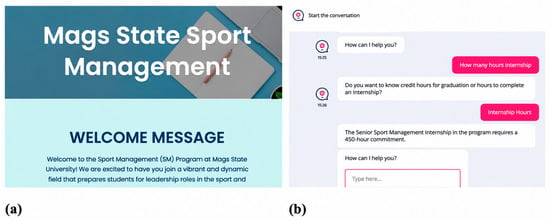
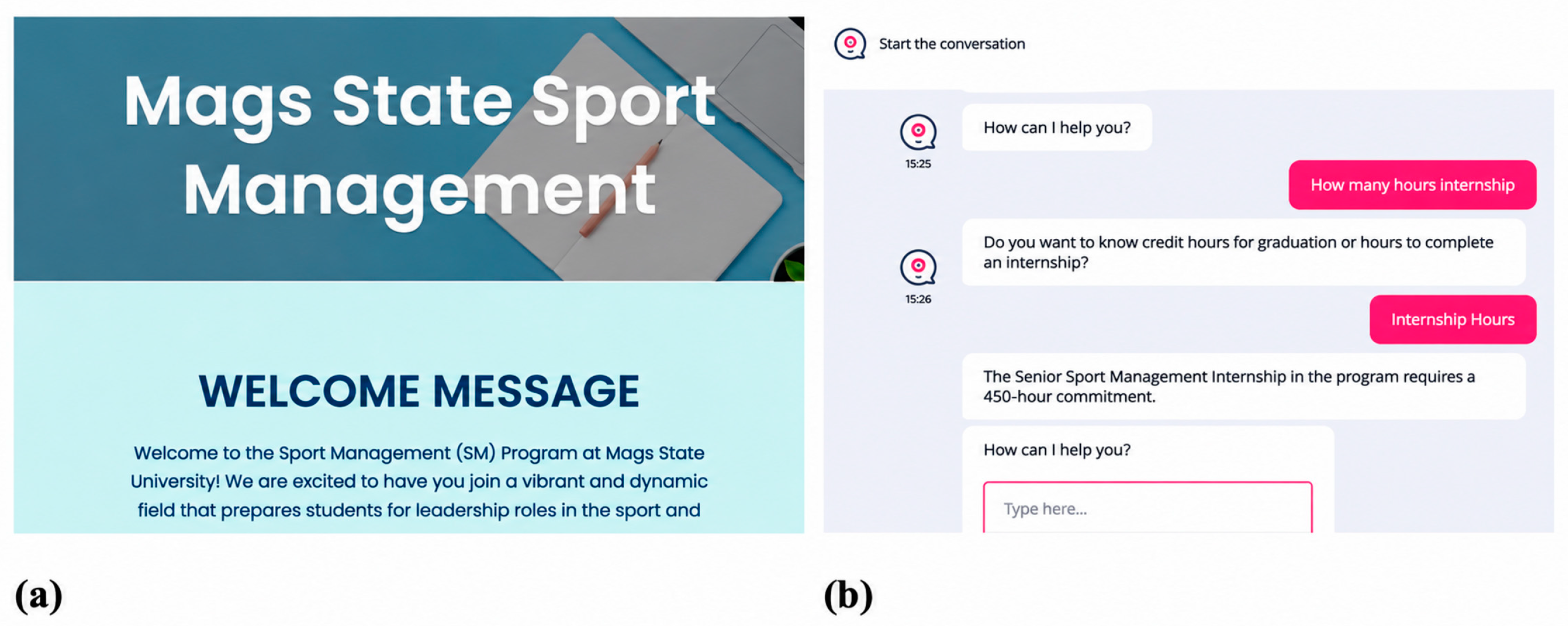
The current study utilized a two-group, between-subjects experimental design. This design was used to compare information seeking via a traditional website and an AI-powered conversational interface. Participants were randomly assigned to either the website condition or the chatbot condition. Participants in both conditions completed the exact same information-seeking tasks. This approach allowed for the examination of both how participants perceived the two interfaces and how well they performed when using them to locate specific information. Figure 2 provides an example of the website and chatbot interfaces used in the study.
Figure 2.
Panel (a) presents the traditional website used in the study, and Panel (b) presents the AI-powered conversational interface used in the study. Participants in both conditions completed identical information-seeking tasks using the interface to which they were randomly assigned.
Participants first received an overview of the study and instructions for completing the information-seeking tasks. Those assigned to the website condition used a traditional sport management program website, while those assigned to the chatbot condition used an AI-powered conversational interface trained on the same program information. Participants were asked to locate information related to five areas of the sport management program: internship requirements, the Sport Management Majors Club contact, the maximum number of attempts allowed per course, the appropriate contact for course overrides, and the number of credit hours required to complete the program.
Participants in the website condition used a working copy of a sport management program website, while those in the chatbot condition used a conversational interface developed with Landbot (https://landbot.io (accessed on 2 October 2025)). At the time of the study, Landbot was powered by OpenAI’s GPT-4o model. Study-specific PDFs were uploaded as the knowledge base, and the chatbot was configured to answer from these materials without external internet retrieval. Researchers can use Landbot to create a similar interface using uploaded documents and source-based response instructions. All chatbot participants used the same model and source material, and each began a new conversation. Information in both conditions remained unchanged throughout the study. Pilot testing identified no incorrect chatbot answers. Responses did not include source links.
Both interfaces were embedded on the interaction page containing the five information-seeking questions. The study and both interfaces were optimized for mobile and desktop use. The website supported searching through the browser’s Find function. Participants in both conditions received the five questions in the same order, and no time limit was imposed. The information-seeking task ended when participants submitted their answer to the final question.
Participants were not prevented from opening additional tabs or browsers or accessing external sources. However, the handbook and program information were created specifically for this study and were not publicly available online, limiting the usefulness of external searches for answering the tasks.
Before completing the assigned information-seeking task, participants completed the optimism and innovativeness measures through Qualtrics. After the task, they completed measures of technology acceptance, perceived value, behavioral intentions, and demographic characteristics. The study also included two objective measures of information-seeking performance. Task completion time was recorded to assess information-seeking efficiency, while participants’ responses to the five information-seeking questions were coded for accuracy to assess their ability to correctly locate the requested information.
Participation in the study was voluntary, informed consent was obtained prior to beginning the study, and responses were collected anonymously. The study received approval from the university’s Institutional Review Board (IRB-FY24-281).
2.3. Measures
Optimism and innovativeness were measured before the information-seeking task, while the evaluation measures were given afterward. Following the lead of C.-H. Lin et al. (2007) and Chung et al. (2015), items were adapted for the current study to assess technology acceptance and technology readiness within the information-seeking context. Perceived usefulness (PU; four items) and perceived ease of use (PEOU; four items) were adapted from van der Heijden (2004). Attitude towards use (three items) and behavioral intention (three items) were based on the work of Venkatesh et al. (2003). Items were modified where necessary to reflect the information-seeking interface used by the participant rather than the technologies examined in the original studies.
Technology readiness was measured using the two positive dimensions of optimism and innovativeness. Similar to the work of Chung et al. (2015), optimism (five items) and innovativeness (five items) were used to assess participants’ general readiness to engage with new technologies. Optimism focused on participants’ beliefs that technology can provide greater efficiency, flexibility, and control, while innovativeness reflected participants’ tendency to be among the first to adopt and experiment with new technologies. This approach is consistent with the more parsimonious application of technology readiness used in previous research and with the TRAM framework developed by C.-H. Lin et al. (2007).
The current study also included utilitarian value, hedonic value, and word-of-mouth intentions as outcome variables. Utilitarian and hedonic value were measured using Voss et al.’s (2003) Hedonic/Utilitarian (HEDUT) Attitudes scale. HEDUT consists of five items assessing utilitarian value and five items assessing hedonic value. Voss et al. (2003) conceptualized utilitarian attitudes as cognitively based and focused on the functional use of a product, whereas hedonic attitudes reflect the more emotional, experiential, and affective aspects of the consumer experience. In the current study, these measures were adapted to assess the utilitarian and hedonic value participants associated with their assigned information-seeking interface. Word-of-mouth intentions (WOM; three items) were adapted from Goebert and Greenhalgh (2020) and their investigation of augmented reality use within sport marketing. The items were adapted to reflect participants’ willingness to speak positively about and recommend the information-seeking interface to others.
All perceptual measures were assessed using 7-point Likert-type scales, with higher scores representing greater levels of the respective construct. The measures adapted from previous TRAM research have demonstrated strong reliability and validity. Chung et al. (2015) reported composite reliabilities ranging from 0.89 to 0.98 and C.-H. Lin et al. (2007) reported Cronbach’s alpha coefficients ranging from 0.90 to 0.96. The TRAM measures have also demonstrated construct, convergent, and discriminant validity (Chung et al., 2015; C.-H. Lin et al., 2007). In the current study, all nine multi-item measures demonstrated acceptable internal consistency, with Cronbach’s alpha coefficients ranging from 0.804 to 0.965 (see Table 2).
Table 2.
Internal Consistency Reliability of Study Constructs.
In addition to the self-reported measures, two objective measures were used to assess information-seeking performance. Task-completion time was measured in seconds, beginning when participants entered the interaction page and ending when they submitted the final answer to the five information-seeking tasks on that page. This interval included interaction with the assigned interface and entry of responses to the task questions. No idle time exclusions or timeout rules were applied; elapsed time could therefore include participant pauses. Objective task accuracy was determined from responses to the five information-seeking questions. This measure assessed the accuracy of participants submitted answers rather than the accuracy of the chatbot’s generated responses. Each response was coded as correct or incorrect based on the information contained within the sport management program materials, and accuracy was summarized across the five tasks to compare performance between the website and chatbot conditions.
During coding, correct numerical answers and either the correct name or email address for contact questions were accepted. Minor misspellings were accepted when the intended answer was clear. Answers that were not clear or were deemed ambiguous by the coders were coded as incorrect. During revision, the classifications were checked against these criteria. A second coder was used to verify answers. Coders were blind to participants’ experimental condition.
2.4. Data Analysis
Data were analyzed using IBM SPSS Statistics 31. Prior to testing the study hypotheses, internal consistency was assessed for each of the nine multi-item measures using Cronbach’s alpha. Composite scores were then calculated by averaging the items associated with each construct. All multi-item constructs demonstrated good to excellent reliability, with Cronbach’s alpha coefficients ranging from 0.804 to 0.965, exceeding the recommended minimum threshold of 0.70. Consequently, all items were retained for subsequent analyses.
Descriptive statistics and bivariate correlations were also calculated for the study variables. To evaluate the effectiveness of random assignments, the website and chatbot groups were compared on the baseline technology readiness constructs of optimism and innovativeness using Welch independent-samples t tests.
A one-way multivariate analysis of variance (MANOVA) was conducted using IBM SPSS Statistics 31. This was done to examine differences between the two information-seeking interfaces. The independent variable was interface type, with two levels (traditional website and AI-powered conversational interface). While the dependent variables were perceived ease of use, perceived usefulness, attitude toward use, behavioral intention, word-of-mouth intentions, utilitarian value, and hedonic value. A significance level of 0.05 was established for the analysis.
Following the omnibus analysis, Welch independent-samples t tests were used to examine differences between the two experimental conditions for the individual outcomes associated with H1–H4 and H6–H9. Welch’s test was selected because it does not require the assumption of equal variances across groups. Cohen’s d was calculated to provide an estimate of effect size for each comparison. Group differences and effect sizes were calculated as chatbot minus website.
Objective task accuracy (H5) was examined using mixed-effects logistic regression, with interface condition and task as fixed effects and a participant random intercept to account for repeated responses. An additional model included the interface-by-task interaction, evaluated using a likelihood-ratio test. Odds ratios, 95% confidence intervals, and predicted probabilities were reported.
Finally, moderated regression analyses were used to test H10 and H11. Groups were coded as 0 for the traditional website and 1 for the AI-powered conversational interface. Optimism and innovativeness were mean centered prior to creating their respective interaction terms with interface condition. Separate regression models were used to examine whether optimism and innovativeness moderate the effect of interface type on perceived ease of use, perceived usefulness, attitude toward use, and behavioral intention. Separate models were estimated to examine the moderation hypotheses for optimism and innovativeness individually. Previous research has examined these dimensions through separate regression models because of their correlation (Veisten et al., 2024) and through separate moderation comparisons (M. J. Kim et al., 2020). The present analyses therefore assess each dimension’s moderating relationship without establishing its contribution independently of the other. Significant interaction terms were used to determine whether the effect of the information-seeking interface varied based on participants’ levels of technology readiness.
3. Results
3.1. Preliminary Analyses
To evaluate the effectiveness of random assignment, Welch independent-samples t tests were conducted comparing participants in the website and chatbot conditions on the baseline technology readiness constructs of optimism and innovativeness. No significant differences were found for optimism, t(295.78) = 1.31, p = 0.190, d = 0.15, or innovativeness, t(294.44) = 1.03, p = 0.304, d = 0.12. These findings indicate that participants in the two experimental conditions were comparable in their technology readiness prior to using their assigned information-seeking interface.
Assumption checks showed that all seven outcomes departed from normality in both conditions (Shapiro–Wilk tests, all ps < 0.01). Box’s test indicated that the covariance matrices differed between conditions, M = 66.69, approximate χ2(28) = 65.03, p < 0.001. Three potential multivariate outliers were identified using within-group Mahalanobis distances (p < 0.001), and all were retained. The covariance matrices were nonsingular, and no within-group correlation exceeded 0.841.
A one-way MANOVA was then conducted to determine whether the website and chatbot groups differed across the seven perceptual outcomes. The overall multivariate effect of interface type was significant, Wilks’ Λ = 0.758, F(7, 291) = 13.24, p < 0.001, partial η2 = 0.242. Collectively, these findings indicate that participants’ perceptions differed based on the information-seeking interface they used. Individual differences between the website and chatbot conditions were examined through the analyses that follow.
3.2. Measurement Reliability and Descriptive Statistics
Internal consistency was assessed for each of the nine multi-item measures using Cronbach’s alpha. All measures demonstrated acceptable levels of reliability, with coefficients ranging from 0.804 for innovativeness to 0.965 for hedonic value. As shown in Table 2, each measure exceeded the commonly accepted 0.70 threshold, supporting the use of the composite scores in the subsequent analyses.
A confirmatory factor analysis using maximum likelihood estimation was conducted to assess the nine-factor measurement structure. Model fit indices were χ2(593) = 1379.41, p < 0.001, CFI = 0.926, TLI = 0.916, RMSEA = 0.067, and SRMR = 0.050. Standardized factor loadings ranged from 0.587 to 0.946, and composite reliability ranged from 0.819 to 0.965. Average variance extracted exceeded 0.50 for eight constructs but was slightly below this benchmark for innovativeness (0.477). These findings generally supported the proposed measurement structure, although some limitations remained. Factor loadings and construct-level results are presented in Table 1.
Descriptive statistics and correlations among the study variables are presented in Table 3. Overall, the technology acceptance and value measures were positively related to one another. Perceived ease of use and perceived usefulness were positively associated with attitude and behavioral intention, while utilitarian and hedonic value were also positively related to the primary technology acceptance outcomes. Optimism and innovativeness demonstrated positive relationships with several of the perceptual outcomes, providing further support for examining technology readiness within the information-seeking context.
Table 3.
Descriptive Statistics, Internal Consistency Reliability, and Pearson Correlations Among Study Variables (N = 299).
3.3. Main Effects of Information Seeking Interface
Welch independent samples tests were conducted to examine differences between the website and chatbot conditions across the study outcomes. Although normality and covariance-homogeneity assumptions were not fully met, the relatively large and similarly sized groups supported retaining the MANOVA as an omnibus analysis. Its results were interpreted cautiously alongside Holm-adjusted Welch comparisons. Reported p values for the seven subjective group comparisons and eight interaction tests are Holm-adjusted unless labeled otherwise.
Participants in the chatbot condition reported significantly greater perceived ease of use (M = 5.76, SD = 1.00) than those in the website condition (M = 4.91, SD = 1.32), t(266.36) = 6.24, p < 0.001, d = 0.73, supporting H1. Perceived usefulness was also significantly higher for the chatbot group (M = 5.31, SD = 1.25) than the website group (M = 4.77, SD = 1.28), t(294.13) = 3.72, p < 0.001, d = 0.43, supporting H2.
Participants using the chatbot reported more favorable attitudes toward use (M = 4.79, SD = 1.58) than participants using the website (M = 3.62, SD = 1.55), t(295.97) = 6.43, p < 0.001, d = 0.74, supporting H3. Behavioral intention was the only perceptual outcome that did not significantly differ between the two groups. Although behavioral intention was higher among participants in the chatbot condition (M = 5.00, SD = 1.52) than those in the website condition (M = 4.69, SD = 1.39), the difference was not one of statistical significance, t(296.95) = 1.90, p = 0.058, d = 0.22. Therefore, H4 was not supported.
Participants in the chatbot condition reported greater utilitarian value (M = 5.44, SD = 1.19) than those in the website condition (M = 4.98, SD = 1.39), t(282.57) = 3.07, p = 0.005, d = 0.36, supporting H7. Similarly, hedonic value was significantly higher for the chatbot group (M = 4.29, SD = 1.50) than the website group (M = 3.29, SD = 1.58), t(292.24) = 5.60, p < 0.001, d = 0.65, supporting H8. Finally, participants using the chatbot reported greater word-of-mouth intentions (M = 4.74, SD = 1.58) than participants using the website (M = 4.14, SD = 1.54), t(296.44) = 3.29, p = 0.003, d = 0.38, H9 is supported.
Task completion time was significantly different between the two conditions. Participants using the chatbot completed the information-seeking tasks in an average of 312.05 s (SD = 212.37), compared with 505.22 s (SD = 310.01) for participants using the website, t(250.64) = −6.24, p < 0.001, d = −0.73. In terms of real time, chatbot participants completed the tasks approximately 193 s, or 3.2 min, faster on average than those using the traditional website. This finding supports H6. Median completion times were 261.71 s (IQR = 162.51) for chatbot participants and 406.22 s (IQR = 305.39) for website participants. The difference remained significant after log transformation, t(296.90) = −8.13, p < 0.001. Mean differences and 95% confidence intervals are presented in Table 4.
Table 4.
Results of Welch Independent-Samples t Tests Comparing Website and AI-Powered Conversational Interface Conditions.
3.4. Objective Task Accuracy
The accuracy analysis included 1495 responses from 299 participants. Chatbot participants correctly answered 95.6% of the questions, compared with 78.5% for website participants. Chatbot participants had higher odds of a correct answer after accounting for task and repeated responses (OR = 7.84, 95% CI [4.95, 12.42], p < 0.001), supporting H5 overall. The interface-by-task interaction was significant, χ2(4) = 109.85, p < 0.001. This indicates that the chatbot was not uniformly better on all tasks. Task-specific estimates favored the chatbot on four questions and the website on the course override contact question. Predicted probabilities and task-specific odds ratios are presented in Table 5.
Table 5.
Objective Information-Seeking Task Accuracy by Experimental Condition.
3.5. Moderating Effects of Technology Readiness
Moderated regression analyses were conducted to examine whether optimism and innovativeness influenced the relationship between information-seeking interface and the four primary technology acceptance outcomes. Results of the moderation analyses are presented in Table 6. To address the potential of inflated Type I error, Holm adjustments were applied separately to the seven group comparisons and the eight tests of moderation. Regression results that include intercepts, main effects, model R2 and confidence intervals are available in Table 3.
Table 6.
Results of Moderated Regression Analyses Examining the Effects of Technology Readiness on User Outcomes.
Optimism significantly moderated the effect of interface type across all four outcomes. There were significant interaction effects found for perceived ease of use (B = 0.342, SE = 0.128, t = 2.67, p = 0.016), perceived usefulness (B = 0.615, SE = 0.133, t = 4.64, p < 0.001), attitude toward use (B = 0.708, SE = 0.161, t = 4.40, p < 0.001), and behavioral intention (B = 0.788, SE = 0.150, t = 5.27, p < 0.001). The chatbot–website difference in perceived ease of use, perceived usefulness, attitude, and behavioral intention became more favorable to the chatbot as optimism increased. Because of this result, H10 was supported.
Innovativeness scores did not significantly moderate the effect of interface type on perceived ease of use (B = 0.235, SE = 0.128, t = 1.84, p = 0.067). However, significant interaction effects were found for perceived usefulness (B = 0.449, SE = 0.136, t = 3.31, p = 0.004), attitude toward use (B = 0.552, SE = 0.166, t = 3.33, p = 0.004), and behavioral intention (B = 0.669, SE = 0.152, t = 4.39, p < 0.001). The chatbot–website difference in perceived usefulness, attitude, and behavioral intention became more favorable to the chatbot as innovativeness increased. H11 was partially supported. Innovativeness moderated the interface effect on perceived usefulness, attitude, and behavioral intention, but not perceived ease of use.
Conditional effects were examined (Table 2; Figure 1). All eight interactions were examined. Across the seven significant interactions, the estimated difference between conditions became more favorable to the chatbot as technology readiness increased. The innovativeness interaction with perceived ease of use remained not significant.
Regression checks indicated unequal residual variance and differences from normality in seven models. To check if these issues impacted the findings, the analyses were repeated using HC3 robust standard errors to account for unequal variance (Long & Ervin, 2000). The relatively large sample of 299 participants also provided some defense against the effects of nonnormal residuals (Schmidt & Finan, 2018). The maximum VIF was 2.11, and removing individual observations did not reverse the direction of any interaction. All observations were kept. The HC3 analyses with Holm adjustments supported the moderation conclusions.
4. Discussion
The purpose of the current study was to compare information seeking through an AI-powered conversational interface and a traditional website. The authors would argue that the most impactful finding of the current study is that the advantages of the chatbot extended beyond participants simply having more favorable perceptions of the technology. Participants using the chatbot found the interface easier to use, more useful, and reported more favorable attitudes, while also completing the information-seeking tasks more than three minutes faster and with greater overall accuracy than participants using the traditional website. Taken together, these findings suggest the chatbot was not simply a more appealing way to seek information; in most cases, it was also a more effective and efficient one.
At the same time, the findings were not universally in favor of the chatbot. Behavioral intention did not significantly differ between conditions, despite participants rating the chatbot more favorably across most of the other perceptual outcomes. Additionally, participants using the traditional website were more accurate on one of the five information-seeking tasks. Finally, the significant moderating effects of optimism and innovativeness indicate that the benefits associated with conversational AI may not be experienced equally by all users. The current study provides both theoretical and practical implications for the use of AI-powered conversational interfaces as information-seeking tools, each of which are further explored below, followed by a discussion of the limitations of the current study and suggestions for future research.
4.1. Theoretical Implications
The present study adds to the evaluation of technology acceptance with TRAM and objective information seeking performance. Chatbot users were faster and more accurate in their overall performance, also rating their experience more positively. The contribution goes beyond increased acceptance scores in showing that positive evaluations were accompanied by measurable task benefits. The study does not, however, show whether the differences in performance explain acceptance outcomes, and future research should explore such correlations.
Perhaps one of the most impactful findings of the current study was that the benefits associated with the AI-powered conversational interface extended across both perceptual and objective measures of information seeking. Participants using the chatbot reported significantly greater PEOU, PU, ATT, HED, and UT than those using the traditional website. At the same time, chatbot users completed the information-seeking tasks more quickly and with greater overall accuracy. These findings provide support for the use of technology acceptance frameworks when examining AI-powered conversational interfaces but also suggest there is value in moving beyond traditional self-reported acceptance measures when studying these technologies. In the current study, participants did not simply perceive the chatbot to be easier or more useful; for most of the information-seeking tasks, they were actually more successful when using it.
The findings related to PEOU and PU are particularly noteworthy when viewed through the lens of technology acceptance. Participants reported both significantly greater PEOU and PU when using the chatbot compared with the traditional website. This suggests the conversational nature of the interface may change the information-seeking process in a meaningful way. Rather than requiring users to determine where information is located within the structure of a website, the chatbot allowed participants to directly communicate what information they were seeking. This finding takes on additional importance when considered alongside the task completion results, as participants using the chatbot completed the information-seeking tasks more than three minutes faster on average. Collectively, these findings suggest that ease of use and usefulness in an AI information-seeking environment may extend beyond perceptions of the technology and reflect meaningful differences in the effort required to locate information.
While chatbot users reported significantly greater PEOU, PU, and ATT, and behavioral intention was directionally higher for the chatbot condition, the difference between the groups for behavioral intention did not reach the level of statistical significance. This finding is interesting given the important role behavioral intention has traditionally played within TAM and TRAM (Davis, 1989; C.-H. Lin et al., 2007). It is possible that evaluating an interface favorably after a single information-seeking experience is different from developing an intention to use that technology. Participants may recognize that a chatbot is easier, faster, or even more enjoyable to use without necessarily believing they will have the opportunity or need to use that particular interface again. Thus, the findings suggest that favorable evaluations of AI-powered conversational interfaces may not automatically translate into future usage intentions.
The current study also adds to the acceptance literature through the inclusion of hedonic and utilitarian values. Voss et al. (2003) distinguished utilitarian attitudes, which are primarily functional and cognitively based, from hedonic attitudes, which are more emotional, experiential, and effective. Participants using the chatbot reported significantly greater levels of both UT and HED than those using the traditional website. This is an important distinction as the chatbot was not simply viewed as the more functional information-seeking tool; participants also found the experience more enjoyable. Conversational AI may therefore occupy an interesting position in which the same interface can provide both utilitarian value through more efficient access to information and hedonic value through a more interactive information-seeking experience. Future research should further explore whether these dual benefits remain as conversational AI becomes more familiar to users and potentially loses some of its novelty.
Perhaps most important to the application of TRAM in the current context were the findings related to technology readiness. Optimism moderated the effect of interface type on all four technology acceptance outcomes, while innovativeness moderated the effects on PU, ATT, and INT, but not PEOU. In each of the significant interactions, the advantage associated with the chatbot became greater as technology readiness increased. These findings provide further support for the central premise of TRAM that individual differences in technology readiness play a role in how consumers respond to new technologies (Chung et al., 2015; C.-H. Lin et al., 2007). Simply providing users with the same technology does not mean they will respond to it in the same manner. Those who enter the experience with greater optimism toward technology appear particularly receptive to the benefits provided by an AI-powered conversational interface.
The lack of a significant moderating effect of innovativeness on PEOU is also noteworthy. One explanation could be that conversational AI, much like what occurred with smartphones, has become pervasive enough that being an innovative technology user provides little additional advantage in determining whether the interface is easy to use. Unlike emerging technologies that require users to learn new controls or interaction patterns, conversational interfaces rely on a behavior with which users are already extremely familiar: asking questions using natural language. Innovativeness may therefore become more important when users evaluate what technology can do and whether they want to use it, rather than whether they can figure out how to use it. This finding provides an interesting avenue for future TRAM research as conversational AI continues to become integrated into everyday information-seeking environments.
Finally, the objective accuracy findings add an important consideration to the theoretical examination of information-seeking technologies. Although the participants using the chatbot provided more accurate answers overall, it did not outperform the traditional website on every information-seeking task. Participants using the website were more successful when locating the appropriate contact for course overrides. This finding suggests that the effectiveness of an information-seeking interface may depend, at least in part, on the type and structure of the information being sought. While conversational interfaces may reduce the effort required to search across multiple pages or pieces of information, traditional websites may retain advantages when information is clearly organized or tied to a specific location within the website. Future research should consider not only whether one information-seeking interface is more effective overall, but also the types of information for which each interface is best suited.
4.2. Practical Implications
This study also provides valuable practical insights for universities and other organizations considering the implementation of AI-powered conversational interfaces. There has been tremendous interest in the potential of generative AI to change how organizations communicate with consumers, yet much less is known about how actual end-users respond when AI is placed directly into the information-seeking process. Findings from the current study are encouraging. Participants using the chatbot reported significantly greater PEOU, PU, ATT, HED, UT, and WOM than those using the traditional website. Perhaps more importantly from a practical perspective, these favorable perceptions were accompanied by better performance. Participants using the chatbot completed the information-seeking tasks more than three minutes faster and were more accurate overall than participants using the traditional website. Thus, the findings suggest there may be tangible benefits to providing users with a conversational alternative to navigating a traditional website.
These findings could be particularly useful for universities where websites have grown increasingly large and complex. Current and prospective students may be required to navigate across numerous pages, menus, and departmental websites to locate relatively basic information. The five tasks utilized in the current study illustrate this challenge as participants were asked to locate information ranging from degree requirements to organizational contacts and university policies. The chatbot provided users with the ability to bypass much of this navigation and directly ask for the information they needed. Considering the chatbot group completed the tasks more than three minutes faster on average, universities should consider whether conversational interfaces can be utilized to reduce some of the effort currently placed on users to understand the structure of an institutional website before they can locate the information they are seeking.
Participants using the traditional website were more successful when asked to identify the appropriate contact for course overrides. This is an important finding as speed and convenience provide little value if the information ultimately delivered to the user is incorrect. Perhaps certain types of information are better suited for conversational delivery than others. It will be important for organizations to understand which types of information should be delivered through conversational AI.
With that in mind, AI-powered conversational interfaces may currently be best suited as a complementary technology rather than a replacement for the traditional website. The website would continue to function as the primary location of institutional information, while the chatbot would provide another pathway through which users can access that information. This approach also provides an important safeguard when users want to verify information received through the chatbot. Universities implementing these systems should make it easy for users to move between the conversational response and the original source of information. In fact, providing links to the webpage or institutional document supporting a chatbot response may be particularly important when users are seeking information related to academic requirements, policies, deadlines, or other decisions where inaccurate information could have meaningful consequences.
From a consumer readiness perspective, findings from the current study also indicate organizations should be cautious about assuming all users are equally ready to interact with conversational AI. The difference between chatbot and website conditions changes as optimism and innovativeness increased. This is an important detail as organizations implementing AI may naturally design these systems around the individuals most interested in using new technology. However, those users may also be the people most predisposed to respond positively to technology. Universities serve populations with widely varying levels of technological readiness, making it important that conversational AI does not become the only pathway through which important information can be accessed. Maintaining both traditional and conversational information-seeking options may allow users to select the interface with which they are most comfortable.
Finally, findings related to HED and UT suggest the benefits of conversational AI may extend beyond simply getting users to an answer faster. Participants viewed the chatbot as providing greater functional value while also finding the experience more enjoyable. However, the findings of the current study suggest the focus should remain on improving the information-seeking experience rather than simply adding AI for the sake of having AI.
5. Conclusions
5.1. Limitations and Future Research
While the current study provides initial evidence on the use of AI-powered conversational interfaces for information seeking, there are several limitations that also provide opportunities for future research. First, the current study utilized information from only one university sport management program and asked participants to locate five specific pieces of information. This allowed the researchers to control the information available across the two conditions, but there is no question that websites vary considerably in their complexity, organization, and overall quality. Similarly, five questions cannot represent the wide range of information individuals may seek online. Thus, future research should replicate the current study across different universities, organizations, and information-seeking tasks to determine whether the advantages associated with conversational AI extend beyond the setting utilized here.
Participants were adults aged 18–25 recruited through Prolific. Although this range aligns with traditional college-aged students (Acton et al., 2025), current university enrollment was neither required nor assessed, so the sample should not be treated as a student sample. The findings may differ for enrolled or prospective students seeking personally consequential information at their own institution.
Interestingly, the chatbot was more accurate overall but was not more accurate on every individual task. This provides a particularly fruitful opportunity for future work. Are chatbots better at answering simple factual questions than questions requiring users to identify a particular individual or office? Does the complexity of the question impact the relative advantage of conversational AI? Would the chatbot advantage become greater as the complexity of the website or information-seeking task increase? Future research would be wise to utilize a wider variety of tasks to better understand when conversational AI provides the greatest information-seeking advantage and when traditional websites may remain more effective.
Participants were recruited through Prolific and completed assigned tasks about a program at one university. Their experience may differ from that of enrolled students seeking information at their own institution. Future research should examine whether these findings extend to enrolled students addressing their own academic information needs. The study compared the chatbot and website as systems. With that in mind, it is possible that the observed differences cannot be attributed solely to conversational interaction, as the underlying model and organization of information may also have contributed.
The current study was also limited to a relatively young sample ranging in age from 18 to 25. Given that the information-seeking task centered on a university academic program, this demographic was appropriate for the current investigation. However, the moderation findings demonstrate that the interface differences varied with technology readiness. Future research should consider more diverse populations based on age, technological experience, optimism, and innovativeness. Additionally, the current study only looked at between-group differences. Hence, each participant interacted with either the traditional website or chatbot, but not both. Future work could allow participants to use both interfaces and examine not only how they perform, but which interface they actually choose when both options are available.
Measurement invariance across conditions was not assessed. Therefore, differences in composite scores should be interpreted cautiously. Also, the AVE for innovativeness was slightly subthreshold and warrants caution when interpreting the findings of the moderation.
There are also several limitations that are specific to conversational AI interactions. There is a possibility that novelty and prior experiences using AI could have impacted user evaluations. Also, it is important to consider that responses could vary across conversation even if the source material remains the same. The study evaluated the system at a single point in time and did not assess performance as information changed or was updated. As information can change, it is important to have updated source materials, response checks, and access to human support if needed.
Finally, conversational AI is evolving at a pace rarely seen with previous communication technologies. The chatbot evaluated within the current study represents technology at a particular point in time, and both the technology and users’ familiarity with it will continue to change. Future research should therefore continue to investigate these interfaces as they become increasingly commonplace. Perhaps most importantly, findings from the current study suggest future work should move beyond simply asking whether consumers are willing to use AI and also consider whether the technology actually improves the task it was implemented to address. Combining traditional technology acceptance measures with objective measures such as accuracy, efficiency, and successful task completion may provide a more complete understanding of the future of AI-powered information seeking.
5.2. Conclusion
The current study provides evidence that an AI-powered conversational interface can improve information seeking performance specifically with the tasks and chatbot system tested. Chatbot participants reported more favorable perceptions on most measures and completed the tasks faster with greater overall accuracy. However, it is important to note that the website performed better on one task. These findings suggest that the benefits of conversational AI may depend on the type and structure of information being sought.
Understanding whether consumers are willing to use AI is important but understanding whether AI actually helps them accomplish the task at hand may be equally important. As conversational AI becomes increasingly integrated into websites and other digital environments, researchers and practitioners alike should continue to assess these technologies based not just on their novelty or acceptance, but on their ability to improve the information-seeking experience.
Author Contributions
Conceptualization, C.G. and J.D.J.II; methodology, C.G.; software, C.G.; validation, C.G.; formal analysis, C.G.; investigation, C.G.; resources, C.G.; data curation, C.G.; writing—original draft preparation, C.G. and J.D.J.II; writing—review and editing, C.G., J.D.J.II and K.-s.C.; visualization, C.G.; supervision, C.G.; project administration, C.G. All authors have read and agreed to the published version of the manuscript.
Funding
This research did not receive any specific grant from funding agencies in the public, commercial, or not-for-profit sectors.
Institutional Review Board Statement
The study was conducted in accordance with the Declaration of Helsinki, and approved by Kennesaw State Institutional Review Board (IRB-FY24-281, 2 June 2025).
Informed Consent Statement
Informed consent was obtained from all subjects involved in the study.
Data Availability Statement
Dataset available on request from the authors. The raw data supporting the conclusions of this article will be made available by the authors on request.
Conflicts of Interest
The authors declare no conflicts of interest.
References
- Acton, R. K., Cook, E. E., & Ugalde A., P. (2025). Political views and college choices in a polarized America (EdWorkingPaper No. 25-1280). Annenberg Institute at Brown University. [Google Scholar] [CrossRef]
- Babin, B. J., Darden, W. R., & Griffin, M. (1994). Work and/or fun: Measuring hedonic and utilitarian shopping value. Journal of Consumer Research, 20(4), 644–656. [Google Scholar] [CrossRef] [Scilit]
- Baig, M. I., & Yadegaridehkordi, E. (2024). ChatGPT in higher education: A systematic literature review and research challenges. International Journal of Educational Research, 127, 102411. [Google Scholar] [CrossRef] [Scilit]
- Berger, S. C. (2009). Self-service technology for sales purposes in branch banking: The impact of personality and relationship on customer adoption. International Journal of Bank Marketing, 27(7), 488–505. [Google Scholar] [CrossRef] [Scilit]
- Brown, J. J., & Reingen, P. H. (1987). Social ties and word-of-mouth referral behavior. Journal of Consumer Research, 14(3), 350–362. [Google Scholar] [CrossRef] [Scilit]
- Byun, H., Chiu, W., & Bae, J.-S. (2018). Exploring the adoption of sports brand apps: An application of the modified technology acceptance model. International Journal of Asian Business and Information Management, 9(1), 52–65. [Google Scholar] [CrossRef] [Scilit]
- Cheng, J., Hu, X., & Heidorn, P. B. (2010). New measures for the evaluation of interactive information retrieval systems: Normalized task completion time and normalized user effectiveness. Proceedings of the American Society for Information Science and Technology, 47(1), 1–9. [Google Scholar] [CrossRef] [Scilit]
- Childers, T. L., Carr, C. L., Peck, J., & Carson, S. J. (2001). Hedonic and utilitarian motivations for online retail shopping behavior. Journal of Retailing, 77(4), 511–535. [Google Scholar] [CrossRef] [Scilit]
- Chung, N., Han, H., & Joun, Y. (2015). Tourists’ intention to visit a destination: The role of augmented reality (AR) application for a heritage site. Computers in Human Behavior, 50, 588–599. [Google Scholar] [CrossRef] [Scilit]
- Davis, F. D. (1989). Perceived usefulness, perceived ease of use, and user acceptance of information technology. MIS Quarterly, 13(3), 319–340. [Google Scholar] [CrossRef] [Scilit]
- Feygin, A., Miller, T., Bettinger, E., & Dell, M. (2022). Advising for college success: A systematic review of the evidence. American Institutes for Research. [Google Scholar]
- Fishbein, M., & Ajzen, I. (1975). Belief, attitude, intention, and behavior: An introduction to theory and research. Addison-Wesley. [Google Scholar]
- Følstad, A., & Brandtzæg, P. B. (2017). Chatbots and the new world of HCI. Interactions, 24(4), 38–42. [Google Scholar] [CrossRef] [Scilit]
- Goebert, C., & Greenhalgh, G. P. (2020). A new reality: Fan perceptions of augmented reality readiness in sport marketing. Computers in Human Behavior, 106, 106231. [Google Scholar] [CrossRef] [Scilit]
- Han, S., & Lee, M. K. (2022). FAQ chatbot and inclusive learning in massive open online courses. Computers & Education, 179, 104395. [Google Scholar] [CrossRef] [Scilit]
- Hawthorne, M. J., Zhang, A., & Cooper, A. (2022). Advising undergraduate students: An exploration of how academic advising impacts student success. Research in Higher Education Journal, 41, 1–10. [Google Scholar] [CrossRef] [Scilit]
- Ibrahim, H. (2014). Technology acceptance model: Extension to sport consumption. Procedia Engineering, 69, 1534–1540. [Google Scholar] [CrossRef] [Scilit]
- Kawakami, T., Kishiya, K., & Parry, M. E. (2013). Personal word of mouth, virtual word of mouth, and innovation use. Journal of Product Innovation Management, 30(1), 17–30. [Google Scholar] [CrossRef] [Scilit]
- Kelly, D. (2009). Methods for evaluating interactive information retrieval systems with users. Foundations and Trends in Information Retrieval, 3(1–2), 1–224. [Google Scholar] [CrossRef] [Scilit]
- Kim, H., & Song, J. (2010). The quality of word-of-mouth in the online shopping mall. Journal of Research in Interactive Marketing, 4(4), 376–390. [Google Scholar] [CrossRef] [Scilit]
- Kim, M. J., Lee, C.-K., & Preis, M. W. (2020). The impact of innovation and gratification on authentic experience, subjective well-being, and behavioral intention in tourism virtual reality: The moderating role of technology readiness. Telematics and Informatics, 49, 101349. [Google Scholar] [CrossRef] [Scilit]
- Kuhail, M. A., Alturki, N., Alramlawi, S., & Alhejori, K. (2023). Interacting with educational chatbots: A systematic review. Education and Information Technologies, 28(1), 973–1018. [Google Scholar] [CrossRef] [Scilit]
- Kwak, D. H., & McDaniel, S. R. (2011). Using an extended Technology Acceptance Model in exploring antecedents to adopting fantasy sports league websites. International Journal of Sports Marketing and Sponsorship, 12(3), 43–56. [Google Scholar] [CrossRef] [Scilit]
- Liljander, V., Gillberg, F., Gummerus, J., & van Riel, A. C. R. (2006). Technology readiness and the evaluation and adoption of self-service technologies. Journal of Retailing and Consumer Services, 13(3), 177–191. [Google Scholar] [CrossRef] [Scilit]
- Lin, C.-H., Shih, H.-Y., & Sher, P. J. (2007). Integrating technology readiness into technology acceptance: The TRAM model. Psychology & Marketing, 24(7), 641–657. [Google Scholar] [CrossRef] [Scilit]
- Lin, J.-S. C., & Hsieh, P.-L. (2007). The influence of technology readiness on satisfaction and behavioral intentions toward self-service technologies. Computers in Human Behavior, 23(3), 1597–1615. [Google Scholar] [CrossRef] [Scilit]
- Long, J. S., & Ervin, L. H. (2000). Using heteroscedasticity consistent standard errors in the linear regression model. The American Statistician, 54(3), 217–224. [Google Scholar] [CrossRef] [Scilit]
- Lund, B. D., Teel, Z. A., Mohammed, Y., Jagathpally, A., & Wang, T. (2026). Artificial intelligence (AI) and information seeking: A comparative exploration of AI chatbots, search engines, and library resources as information sources among university students. Journal of Librarianship and Information Science. Advance online publication. [Google Scholar] [CrossRef] [Scilit]
- McGrath, C., Farazouli, A., & Cerratto-Pargman, T. (2025). Generative AI chatbots in higher education: A review of an emerging research area. Higher Education, 89, 1533–1549. [Google Scholar] [CrossRef] [Scilit]
- Parasuraman, A. (2000). Technology Readiness Index (TRI): A multiple-item scale to measure readiness to embrace new technologies. Journal of Service Research, 2(4), 307–320. [Google Scholar] [CrossRef] [Scilit]
- Peyton, K., Unnikrishnan, S., & Mulligan, B. (2025). A review of university chatbots for student support: FAQs and beyond. Discover Education, 4, 21. [Google Scholar] [CrossRef] [Scilit]
- Radlinski, F., & Craswell, N. (2017). A theoretical framework for conversational search. In Proceedings of the 2017 conference on conference human information interaction and retrieval (pp. 117–126). Association for Computing Machinery. [Google Scholar] [CrossRef] [Scilit]
- Rahim, N. N. A., Humaidi, N., Aziz, S. R. A., & Zain, N. H. M. (2022). Moderating effect of technology readiness towards Open and Distance Learning (ODL) technology acceptance during COVID-19 pandemic. Asian Journal of University Education, 18(2), 406–421. [Google Scholar] [CrossRef] [Scilit]
- Ramandanis, D., & Xinogalos, S. (2023). Investigating the support provided by chatbots to educational institutions and their students: A systematic literature review. Multimodal Technologies and Interaction, 7(11), 103. [Google Scholar] [CrossRef] [Scilit]
- Schmidt, A. F., & Finan, C. (2018). Linear regression and the normality assumption. Journal of Clinical Epidemiology, 98, 146–151. [Google Scholar] [CrossRef] [Scilit]
- van der Heijden, H. (2004). User acceptance of hedonic information systems. MIS Quarterly, 28(4), 695–704. [Google Scholar] [CrossRef] [Scilit]
- Veisten, K., Wangsness, P. B., Farstad, E., & Ydersbond, I. M. (2024). Will people prefer future travel with battery-powered airplanes? Transportation Research Part D: Transport and Environment, 126, 104013. [Google Scholar] [CrossRef] [Scilit]
- Venkatesh, V., Morris, M. G., Davis, G. B., & Davis, F. D. (2003). User acceptance of information technology: Toward a unified view. MIS Quarterly, 27(3), 425–478. [Google Scholar] [CrossRef] [Scilit]
- Venkatesh, V., Thong, J. Y. L., & Xu, X. (2012). Consumer acceptance and use of information technology: Extending the unified theory of acceptance and use of technology. MIS Quarterly, 36(1), 157–178. [Google Scholar] [CrossRef] [Scilit]
- Voss, K. E., Spangenberg, E. R., & Grohmann, B. (2003). Measuring the hedonic and utilitarian dimensions of consumer attitude. Journal of Marketing Research, 40(3), 310–320. [Google Scholar] [CrossRef] [Scilit]
- Wang, Y., So, K. K. F., & Sparks, B. A. (2017). Technology readiness and customer satisfaction with travel technologies: A cross-country investigation. Journal of Travel Research, 56(5), 563–577. [Google Scholar] [CrossRef] [Scilit]
- Wilson, T. D. (1999). Models in information behaviour research. Journal of Documentation, 55(3), 249–270. [Google Scholar] [CrossRef] [Scilit]
- Xu, Y., Tan, B. C. Y., & Yang, L. (2006). Who will you ask? An empirical study of interpersonal task information seeking. Journal of the American Society for Information Science and Technology, 57(12), 1666–1677. [Google Scholar] [CrossRef] [Scilit]
- Zamani, H., Trippas, J. R., Dalton, J., & Radlinski, F. (2023). Conversational information seeking. Foundations and Trends in Information Retrieval, 17(3–4), 244–456. [Google Scholar] [CrossRef] [Scilit]

Disclaimer/Publisher’s Note: The statements, opinions and data contained in all publications are solely those of the individual author(s) and contributor(s) and not of MDPI and/or the editor(s). MDPI and/or the editor(s) disclaim responsibility for any injury to people or property resulting from any ideas, methods, instructions or products referred to in the content. |
© 2026 by the authors. Licensee MDPI, Basel, Switzerland. This article is an open access article distributed under the terms and conditions of the Creative Commons Attribution (CC BY) license.