


Abstract
This study examines the relationship between character education and teacher flourishing by proposing a theoretical model and two psychometric instruments: the Character Education Scale (CES) and the Teacher Flourishing Conditions Scale (TFCS). In a cross-sectional survey of 518 teachers from nine schools in four countries, exploratory factor analyses supported a four-dimensional structure for the CES and a theoretically meaningful, though preliminary, two-dimensional structure for the TFCS, although its overall model fit was unsatisfactory (RMSEA = 0.16; TLI = 0.88). Both scales showed high internal consistency, which in the TFCS may partly reflect item redundancy. The findings provide preliminary evidence for the psychometric usefulness of the CES and support further development and validation of the TFCS, which in its current form assesses perceived school conditions supportive of teacher flourishing (leadership support and teacher climate). All CES dimensions showed moderate to strong positive Spearman correlations with both TFCS dimensions (ρ = 0.38 to 0.67), with the highest coefficients observed for mission alignment and visibility of character education. Within-school correlations were smaller but remained positive (ρ = 0.31 to 0.53). Teachers were nested in nine schools and several intraclass correlations indicated substantial clustering; therefore, these correlations and their confidence intervals are unadjusted for school membership and should be read as descriptive and exploratory. Because the design is cross-sectional and correlational and the participating schools were self-selected, these associations do not establish directionality and may not generalise to other school settings. The study offers an exploratory conceptual and operational framework that requires confirmatory testing in independent samples.
1. Introduction
A school culture that promotes character education fosters the integral formation and flourishing of students (Arthur, 2024; Arthur et al., 2015, 2016; Kristjánsson, 2020). Integral formation aspires to the full development of the person in accordance with his or her nature, which entails character education (Maritain, 1943). A school culture of character education enables students to develop good human qualities—virtues—that can be “caught, taught, and sought” and that contribute to their personal well-being and to the good of society (Arthur & Kristjánsson, 2022).
Many schools seek to promote character education even when they do not have a formally established programme for doing so (Fernández-Espinosa & López-González, 2024). Teachers themselves assume that character education is implicit in their educational work, regardless of the subject they teach, while also recognising that they need better preparation and an appropriate culture and organisational context (Adams et al., 2020; Fernández-Espinosa et al., 2025; Jubilee Centre for Character and Virtues, 2023).
Student flourishing is not independent of the flourishing of those who take part in the educational process, particularly teachers (Kristjánsson & VanderWeele, 2025). Teachers’ well-being and social and emotional competence are associated with the quality of their relationships with students and of the classroom climate (Day & Gu, 2014; Hascher & Waber, 2021; Jennings & Greenberg, 2009).
Although the importance of a school culture that fosters flourishing through character education is recognised, research on the variables that explain the relationship between school culture and teacher flourishing remains scarce (Kurrle & Warwas, 2025; Rehal & van Nieuwerburgh, 2022; Yulisinta et al., 2024). Identifying the most relevant variables and how they are related would help to promote the conditions under which teachers and students can flourish more fully at school.
We hypothesised that teachers’ perceptions of a school culture in which character education is intentionally promoted within the framework of integral formation would be positively associated with their perceptions of school conditions supportive of teacher flourishing. From a theoretical standpoint, teachers may flourish more fully when they participate in a school culture committed to the education of students in virtues. As a moral praxis, the teacher’s educational work perfects not only the student but also the teacher. The good of the teacher is intrinsically linked to the good of the student whom he or she educates: it is precisely by doing good for the student—by educating well—that the teacher flourishes as a teacher. This normative argument motivates the study, but it is not tested empirically here.
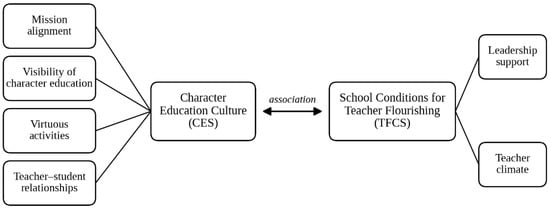
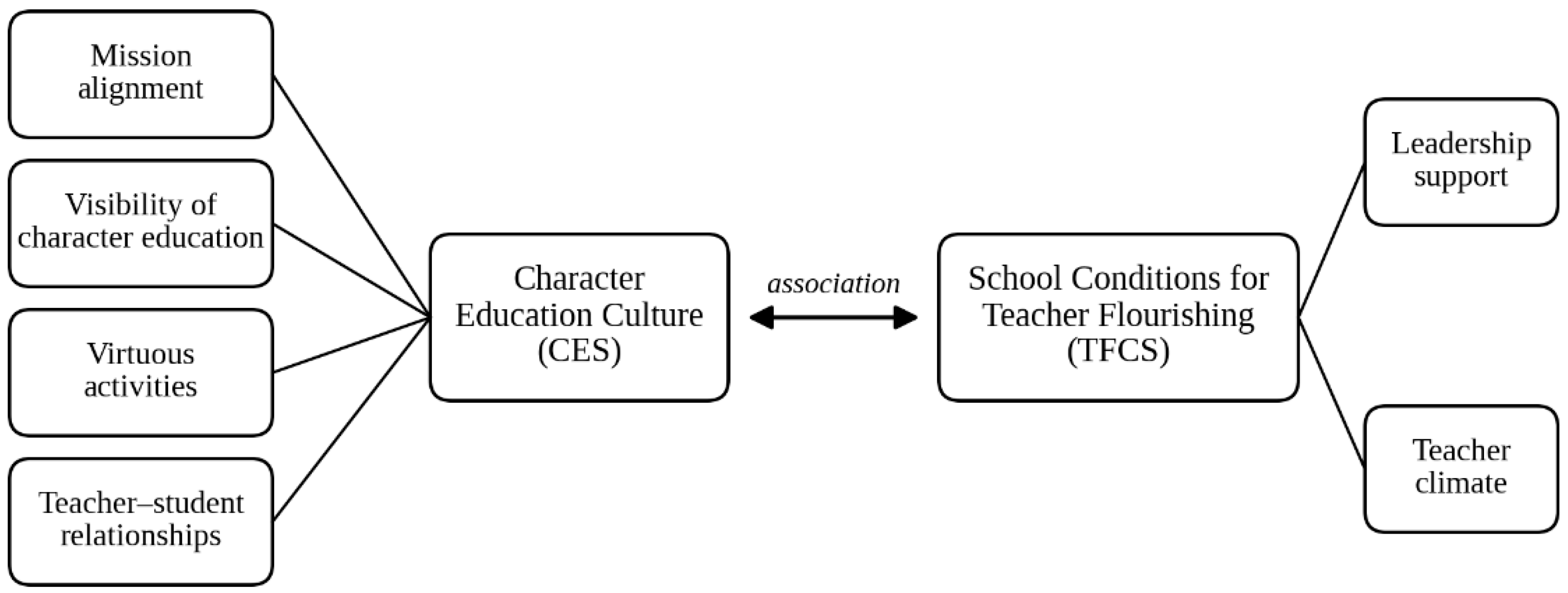
In line with this hypothesis, we propose a theoretical model that links key school culture variables in schools seeking to develop character education with teacher flourishing. The aim of this study is to identify the relationship between certain school culture variables and teacher flourishing within this model. To this end, two scales were designed: one measuring character education culture (CES) and another measuring perceived school conditions supportive of teacher flourishing (TFCS: Teacher Flourishing Conditions Scale). The CES includes four variables linked to character education: alignment with the mission, visibility of character education, virtuous learning activities, and teacher–student relationships. The TFCS measures two variables linked to teacher flourishing: leadership support and teacher climate. These two dimensions are understood here as organisational and relational conditions that support teacher flourishing, not as a measure of flourishing as a personal state (see Section 1.1). We assume that schools intentionally working to develop character education, particularly in the four dimensions assessed here, may provide conditions more favourable to teacher flourishing.
Despite the growing interest in both character education and teacher flourishing, limited research has examined the relationship between these two domains in an integrated manner, particularly through empirically grounded models that connect features of school culture with teachers’ flourishing. In addition, there is a lack of validated instruments in Spanish-speaking educational contexts that allow these constructs to be assessed in ways that are both theoretically informed and practically useful for school improvement. This study takes a first step toward addressing this gap by proposing a conceptual model linking selected dimensions of character education culture and teacher flourishing, and by offering an exploratory psychometric examination of two scales designed to assess these variables. In this way, the study aims to make a conceptual, methodological, and applied contribution to current research on character education and flourishing in schools.
Several instruments already assess teacher well-being or flourishing. The Teacher Subjective Wellbeing Questionnaire measures school connectedness and teaching efficacy (Renshaw et al., 2015); the Teacher Well-Being Scale assesses workload, organisational, and student-interaction well-being (Collie et al., 2015); and the PERMA-Profiler provides a brief multidimensional measure of flourishing for adults in general (Butler & Kern, 2016). These instruments focus on the teacher’s own state or on generic working conditions, and none of them refers to the character education culture of the school. On the school side, documents such as the Quality Mark guide (ACE, 2020) and the Jubilee Centre framework (Arthur & Kristjánsson, 2022) describe the features of a school of character, but they are accreditation or guidance tools rather than psychometric scales. The CES seeks to translate these features into a brief self-report measure, and the TFCS focuses on the organisational and relational conditions of teachers’ work that the literature links to teacher flourishing (Rehal & van Nieuwerburgh, 2022; Yulisinta et al., 2024).
The present study includes an exploratory factor analysis of the two scales and an exploratory correlational analysis of the dimensions assessed by both instruments. It offers findings that help to clarify the relationship between school cultures committed to character education and teacher flourishing, while also providing a preliminary psychometric basis for the assessment of these variables and the design of improvement actions.
1.1. Teacher Flourishing and Character Education
According to moral philosophy, flourishing—both of the student and of the educator—presupposes virtue (Kristjánsson, 2020; Kristjánsson & VanderWeele, 2025); it can be defined as “a state in which all aspects of a person’s life are good” (VanderWeele, 2017). At the same time, however, the exercise of virtue presupposes a dynamic of human action by which the person is directed toward a good that is the end of virtuous action (López-González, 2024). In the case of the teacher, action is directed toward the good of the student; it culminates in the perfection of the student and also perfects the teacher. With Hauerwas (1990), we may affirm that the proper end of our actions is the good, rather than happiness or flourishing. Virtues are flowers—using the conceptual metaphor underlying the term flourishing—that enable us to do good, which is the fruit (López-González et al., 2025). The scales do not measure this framework directly, but it shapes the model, particularly the CES dimensions of mission alignment and teacher–student relationships.
From a psychological perspective, teacher flourishing is usually understood as a state of overall well-being in which teachers experience happiness, life satisfaction, mental and physical health, meaning and purpose, character development, and positive social relationships (Xipell Font & Méndiz Noguero, 2025). Teacher flourishing requires a balance between personal well-being, authenticity, and favourable working conditions (Rehal & van Nieuwerburgh, 2022). In sum, teacher flourishing refers to the teacher’s emotional, psychological, social, and spiritual well-being as the result of the interaction between individual, relational, and organisational factors (Yulisinta et al., 2024).
In this study, we distinguish teacher flourishing from teacher well-being. Teacher well-being is usually studied as teachers’ positive feelings and functioning at work, often through specific domains such as workload, organisational, and student-interaction well-being (Collie et al., 2015; Hascher & Waber, 2021). Teacher flourishing is used here in a broader sense that, following VanderWeele (2017) and Kristjánsson (2020), also includes meaning and purpose, character and virtue, and good relationships, and that is tied to the excellence of teaching as a practice. Flourishing is therefore a property of the person, whereas leadership support and collegial climate are features of the school in which teachers work. The TFCS, in its current form, captures the second of these: the perceived organisational and relational conditions that, according to the literature reviewed below, support teacher flourishing (Cherkowski et al., 2020; Rehal & van Nieuwerburgh, 2022). It does not measure flourishing as a personal state, and this distinction guides the interpretation of the results.
There are other studies that, without explicitly using the term teacher flourishing, employ concepts linked to flourishing, such as teachers’ psychological well-being (Muñoz-Troncoso & Riquelme, 2025; Redondo-Trujillo et al., 2023). It is assumed that educational quality depends on teachers’ commitment and well-being; therefore, without emotionally healthy, motivated, and supported teachers, there can be no good education (Leithwood & Beatty, 2007).
Although many factors and personal traits influence teacher flourishing, it is particularly important that teachers find deep meaning in their work, establish enriching interpersonal relationships, and feel that the educational community recognises their work (Rehal & van Nieuwerburgh, 2022; Yulisinta et al., 2024), in line with Seligman’s (2011) general model of flourishing. Teachers’ job satisfaction is associated with the perception that their work is meaningful (Kern et al., 2014; Rehal & van Nieuwerburgh, 2022). Support from school leaders is also important, through constructive feedback, empathetic listening to teachers’ needs, social recognition, and the provision of opportunities for personal development (Yulisinta et al., 2024). Collective features of school life also matter: in a study of 350 teachers, Yurt (2022) found that collective teacher efficacy was positively related to job satisfaction and negatively related to burnout, and that job satisfaction mediated part of this relationship.
The study of leadership as a variable linked to flourishing is attracting growing academic interest (Adams et al., 2020; Kutsyuruba et al., 2021). Both school leadership and teacher leadership are ordered toward the flourishing of persons (Fernández-Espinosa & Dutmer, 2025; Fernández-Espinosa & López-González, 2023; Granville-Chapman et al., 2024). Good teacher leadership supports the flourishing of students and their virtues, but it also helps teachers themselves to flourish and to grow in virtue. The development of virtues is not simply one objective alongside flourishing; rather, it is constitutive of flourishing, which is in turn ordered toward the fruit consisting in a fulfilled life, in communion (Aquinas, 1990, STh I-IIae, q. 70, a. 1; López-González, 2024). Teacher flourishing is not merely an effect of good working conditions but is also related to the perception that one is “doing one’s job well” and making a positive contribution to students (Karakasidou et al., 2025).
It can therefore be expected that schools that promote students’ character education within a process of integral formation will also show conditions more favourable to their teachers’ flourishing.
However, few studies have examined whether schools of character help to foster teacher flourishing. A theoretical and practical teacher training programme on character education and socio-emotional competencies, of approximately 50 contact hours, showed positive results in terms of teachers’ self-efficacy, resilience, dedication, and enthusiasm, which are closely related to teacher flourishing (García-Álvarez et al., 2023). Teachers’ emotional competencies are also increasingly regarded as part of their professional repertoire: in a survey of 400 preschool teachers, Çakır and Dervişoğlu (2025) found that the use of emotional intelligence competencies at work, particularly self-awareness and empathy, differed by age and teaching experience. Another study found that teachers who applied positive education practices, which draw on positive psychology and character strengths, reported higher well-being, life satisfaction, and self-efficacy (Karakasidou et al., 2025).
There is evidence that whole-school positive education programmes, which draw on character strengths, can benefit teachers as well as students, and that their success depends on the school’s culture: the language used, how staff and students interact, and the school’s implicit norms (White & Kern, 2018). However, there is still a lack of clarity regarding which variables are involved in this relationship. The next section presents the model that underpins the present study, which relates school culture variables to conditions for teacher flourishing.
1.2. Model of the Relationship Between Character Education and Teacher Flourishing
The implementation of a character education programme affects multiple variables within school culture. We have selected four variables that we consider key: alignment with the mission, visibility of character education, virtuous learning activities, and teacher–student relationships. These four variables relate to what the school does to align with and implement a character education programme, whether formally or informally, and they can be perceived through a school diagnosis or measured with an instrument such as the CES.
Moreover, we have considered two key variables that describe the organisational and relational conditions of teachers’ work and that the literature links to teacher flourishing: leadership support and teacher climate. We assume that schools engaged in character education, particularly in the four dimensions assessed, may offer more favourable conditions of this kind, which the TFCS seeks to capture. Figure 1 presents the model followed in the present study as a conceptual association framework: it depicts the expected relationships between the two sets of variables but does not imply a causal direction, which the present cross-sectional design cannot test.
Figure 1.
Model of the Relationship Between Character Education Culture and School Conditions for Teacher Flourishing.
According to the model, character education, as a formative aim, is expected to be aligned with the institution’s mission and reflected in its policies and practices (Arthur & Kristjánsson, 2022; VanderWeele & Hinton, 2024). This alignment is not merely a matter of consistency in the school’s processes, routines, or daily activities but also extends to ensuring that teachers and the leadership team understand the meaning of the values and virtues promoted by the school, as well as their role as character educators.
Second, adequate visibility and communication of the virtues and values promoted by the school are expected (Hanafiah & Wahyuni, 2025). This includes both visual displays and the school’s usual communication channels.
Third, character education is expected to be integrated into the curriculum: not so much by teaching about the virtues as by carrying out cooperative learning activities, critical and creative thinking activities, and by challenging students with existential questions, all of which help awaken and root a virtuous character (Ciampa & Wolfe, 2021; OECD, 2021).
Fourth, the school is expected to promote positive interpersonal relationships among students and between students and their teachers. Establishing genuine connections between educators and students is key to student flourishing, and it is also related to teacher flourishing (Martela, 2024; Whitaker et al., 2024).
The two variables in our model that are linked to teacher flourishing, leadership support and teacher climate (understood as a relationship of trust, respect, and cooperation among teachers), have both received considerable attention in the literature. Leadership support may be perceived as a good interpersonal relationship between the teacher and his or her leader, but beyond the affective bond it also relates to respect for the professional domain, motivation for one’s own development, the fostering of a sense of belonging, and help in solving problems (Voelkel et al., 2024).
Furthermore, leaders’ flourishing can be expected to contribute to the flourishing of the whole organisation and to a climate of trust (Cherkowski et al., 2020). Relationships of trust, respect, and cooperation among educators are linked both to teacher effectiveness and to teacher flourishing (Fitzsimons et al., 2025; Meyer et al., 2020).
The objectives of the present study are:
- To explore the factor structure of the Character Education and Teacher Flourishing Conditions scales in a sample of Spanish-speaking teachers;
- To examine whether the empirical data are consistent with the prior theoretical dimensions of both scales;
- To assess the reliability of both scales;
- To explore the relationship between the dimensions of the Character Education scale and the Teacher Flourishing Conditions scale.
2. Materials and Methods
2.1. Participants
The sample consisted of 518 teachers from nine schools. Of the 633 teachers working in these schools, 518 took part, an overall response rate of 81.8% (range across schools: 66.7% to 92.5%). A total of 118 teachers (22.8%) were from Mexico; 188 (36.3%) were from Spain, 101 (19.5%) were from Argentina and 111 (21.4%) were from Chile. In general, 402 were women (77.6%) and 116 were men (22.4%). With regard to age, 10 teachers (1.9%) were between 20 and 24 years old, 66 teachers (12.7%) were between 25 and 30 years old, 142 teachers (27.4%) were between 31 and 40 years old, 158 (30.5%) were between 41 and 50 years old, 112 (21.6%) were between 51 and 60 years old, and 30 (5.8%) were 61 years old or older. Table 1 presents the remaining characteristics of the sample, including country, school, type of institution, length of time working in education, length of time in the current position, and educational level. The online form required an answer to every item, so there were no missing values.
Table 1.
Sample Characteristics.
2.2. Instruments
The CES was developed from the School of Character Quality Mark framework of the Association for Character Education (ACE, 2020), which describes a whole-school approach to character education organised around character caught, taught and sought, leadership and staff development, and parent and carer engagement. The initial pool of 60 items was generated by turning the framework’s components and progress descriptors into statements that teachers could rate with reference to their own school. The items were first designed as a diagnostic tool to support schools during the Quality Mark process and were later examined as a measurement scale in the present study. The four dimensions examined correspond to areas of the framework: alignment with the mission to the school’s virtues and values, its theoretical foundation and its leadership; visibility of character education to the physical environment, the website and communication with families; virtuous learning activities to character taught and sought; and teacher–student relationships to character caught through relationships, behaviour and role modelling.
The 25 initial items of the TFCS were written on the basis of existing measures of teacher well-being, in particular the Teacher Subjective Wellbeing Questionnaire (Renshaw et al., 2015) and the Teacher Well-Being Scale (Collie et al., 2015), and adapted to the organisational and relational conditions of teachers’ work, such as support from school leaders and relationships among colleagues.
Both item pools were reviewed by five experts who assessed each item for clarity, relevance to its intended dimension and adequacy for teachers. Items were reworded or removed on the basis of their comments. This review was qualitative, and no content validity index was computed.
Because the source framework and instruments were in English, the items were translated and adapted following the guidelines of Sousa and Rojjanasrirat (2011), including back translation. The final Spanish version was reviewed by two teachers in each of the four countries to check that its wording was understood in the same way. Where expressions differed between countries (for example, the terms used for school stages or for members of the leadership team), neutral wording that was understood in all four countries was adopted. The final items of both scales, in English and Spanish, are provided in Appendix A, Appendix B, Appendix C and Appendix D.
Both the CES and the TFCS are six-point Likert-type scales, ranging from 1 (strongly disagree) to 6 (strongly agree). The initial 60-item version of the CES was reduced to 16 items after refinement. The CES measures four dimensions: alignment with the mission, visibility of character education, virtuous learning activities, and teacher–student relationships. The initial 25-item version of the TFCS was reduced to 9 items. The TFCS measures two dimensions: leadership support and teacher climate.
2.3. Procedure
The scales were administered to teachers from nine schools in Argentina, Chile, Spain, and Mexico participating in a diagnostic and developmental process associated with obtaining the Quality Mark in character education. This process was carried out by the Centro de Educación en Virtudes y Valores at Universidad Francisco de Vitoria (CEV), in collaboration with the Association for Character Education (ACE) through its School of Character Quality Mark. As part of this process, CEV accompanied the schools by providing guidance and mentoring to school leaders and teacher character ambassadors who had voluntarily chosen to take part.
Data collection was conducted between January 2025 and June 2026 as part of an international collaborative project with schools linked to CEV (Fernández-Terol & Domingo-Segovia, 2025). The questionnaires were administered online through the Jotform platform (Jotform Inc., San Francisco, CA, USA; https://www.jotform.com) and included sociodemographic questions and an informed consent form. Ethical approval for this study was granted by the Ethics Committee of Universidad Francisco de Vitoria (UFV) (Approval No. 14/2024).
A non-probabilistic convenience sampling method was used. The inclusion criteria were: (a) being a teacher in one of the participating schools, and (b) voluntarily agreeing to participate by signing the informed consent form.
2.4. Data Analysis
To refine the CES, six successive exploratory factor analyses (EFAs) were carried out using unweighted least squares (ULS) for ordinal data and Oblimin rotation. In each EFA, descriptive statistics were obtained for each item, Bartlett’s test of sphericity was calculated to determine whether the items were correlated, the Kaiser KMO measure was used to assess whether the correlation matrix was adequate for factorization, multivariate normality was examined using Mardia’s test, and parallel analysis was used to verify the number of factors. The same procedure was followed for the TFCS, for which three EFAs were conducted. EFAs were conducted on the polychoric correlation matrix, and items were removed if their highest loading was below 0.30 or if they had cross-loadings of ≥0.30 on more than one factor (Hair et al., 2019). Scores for each dimension were calculated as mean scores. Since the dimensions did not meet the assumption of normality, Spearman correlations were calculated between the dimensions of both questionnaires. For each coefficient, a 95% confidence interval was computed with Fisher’s z transformation, using the standard error proposed by Bonett and Wright (2000) for Spearman correlations. Because eight correlations were tested, a Bonferroni-adjusted significance level was applied (α = 0.05/8 = 0.00625). Correlations were interpreted mainly by their magnitude and confidence intervals rather than by statistical significance alone, given that with N = 518 even small coefficients reach significance. Differences between dependent correlations were not formally tested; the ordering of coefficients is therefore reported descriptively. McDonald’s omega total (ωt) was calculated to assess reliability. Finally, the intraclass correlation coefficient, ICC(1), was calculated (Shrout & Fleiss, 1979; one-way random-effects model, single measurement), to assess the school-level effect across the different dimensions. For its calculation, the mean scores of the items in each subscale were used instead of factor scores because they do not depend on the specification of the factorial model or its estimation at each measurement occasion, which could compromise comparability across assessments in the absence of demonstrated invariance; and also, they correspond to the way the scale is commonly used in practice. The 95% CIs were obtained using the F distribution. To examine the role of clustering in the correlations, within-school correlations were computed on school-mean-centred scores, with 95% confidence intervals based on cluster-robust standard errors (CR2, with Satterthwaite degrees of freedom) and on a cluster bootstrap that resampled schools (5000 replicates). Discriminant validity between the two instruments was examined with heterotrait–monotrait (HTMT) ratios computed from polychoric correlations among items (Henseler et al., 2015).
Analyses were conducted in R (version 4.3.0) with the psych package. These confidence intervals and significance tests treat teachers as independent observations and are therefore unadjusted for school membership; given the clustering shown by the intraclass correlations, they are likely to be too narrow and are reported for descriptive purposes only.
3. Results
3.1. Character Education Scale (CES)
The descriptive statistics for the final factor structure of the CES are shown in Table 2.
Table 2.
Descriptive Statistics of the CES Items.
Bartlett’s test of sphericity yielded a statistic of 6510.11, with p < 0.001 and 120 degrees of freedom, indicating that the items were correlated in the population. The Kaiser KMO test yielded a value of 0.93, indicating that the correlation matrix was appropriate for factor analysis. Mardia’s test indicated that multivariate normality was not met, as problems were found in both skewness (b1p = 37.04) and kurtosis (b2p = 386.02), both with p < 0.001. Because the EFAs were based on polychoric correlations with ULS estimation, which does not assume multivariate normality, this test is reported only to describe the data. Parallel analysis recommended four factors for the EFA. Since this also made theoretical sense, the EFA was conducted with four factors, although this structure partly reflects the earlier removal of items. Table 3 presents the factor loadings, communality, uniqueness, and complexity of each item. The EFA-based fit indices (from psych::fa, not confirmatory indices) for this model were acceptable (CFI = 0.96; TLI = 0.94; RMSEA = 0.07; RMSR = 0.02). The total proportion of variance explained by the four factors taken together was 71%. Table 4 shows the correlation matrix among the four factors of the CES. Table 5 presents the Bartlett, KMO, and Mardia statistics, as well as the parallel analysis results for the six EFAs conducted. Reliability was ω = 0.89 for alignment with the mission, ω = 0.92 for visibility of character education, ω = 0.92 for virtuous learning activities, and ω = 0.79 for teacher–student relationships.
Table 3.
Factor Loadings, Communality, Uniqueness, and Complexity of Each CES Item.
Table 4.
Correlation matrix among the four factors of the CES.
Table 5.
Number of items, Bartlett’s test, KMO, Mardia, and parallel analysis for CES.
3.2. Teacher Flourishing Conditions Scale (TFCS)
The descriptive statistics for the final factor structure of the TFCS are shown in Table 6.
Table 6.
Descriptive Statistics of the TFCS Items.
Bartlett’s test of sphericity yielded a statistic of 4547.37, with p < 0.001 and 36 degrees of freedom, indicating that the items were correlated in the population. The Kaiser KMO test yielded a value of 0.90, indicating that the correlation matrix was appropriate for factor analysis. Mardia’s test revealed problems in both skewness (b1p = 14.06) and kurtosis (b2p = 149.03), both with p < 0.001, indicating that multivariate normality was not met. Parallel analysis recommended three factors, so both the three-factor and the two-factor solutions were examined. Table 7 shows the factor loadings, communalities, uniquenesses, and complexity of each TFCS item for the three-factor solution. The three-factor solution showed better fit indices than the two-factor solution, although its RMSEA (0.10) also indicated poor fit (CFI = 0.98; TLI = 0.95; RMSEA = 0.10; RMSR = 0.01). In this solution, the additional factor (Factor 2 in Table 7) was clearly defined by two cooperation items (CO1 and CO2), and one item (TC3) showed a cross-loading of 0.39 on that factor. The two-factor solution was nevertheless retained as a preliminary structure for three reasons: the items were written with two intended dimensions, and cooperation among teachers was conceived as part of teacher climate; a factor defined by only two items cannot be evaluated adequately in these data; and neither solution reached adequate fit. Table 8 presents the factor loadings, communality, uniqueness, and complexity of each TFCS item for the two-factor solution. Although the item loadings and reliability coefficients for the resulting dimensions were strong, the overall fit indices for this model were below conventional thresholds (CFI = 0.94; TLI = 0.88; RMSEA = 0.16; RMSR = 0.04). Accordingly, the two-factor solution should be interpreted as a theoretically meaningful but preliminary structure that requires further examination in future confirmatory studies. The total proportion of variance explained by the two factors taken together was 76%. Table 9 presents the Bartlett, KMO, and Mardia statistics, as well as the parallel analysis results for the three EFAs conducted for the TFCS. Reliability was ω = 0.95 for leadership support and ω = 0.92 for teacher climate.
Table 7.
Factor Loadings, Communality, Uniqueness, and Complexity of Each TFCS Item for the three-factor solution.
Table 8.
Factor Loadings, Communality, Uniqueness, and Complexity of Each TFCS Item for the two-factor solution.
Table 9.
Number of items, Bartlett’s test, KMO, Mardia, and parallel analysis for TFCS.
Finally, Table 10 and Table 11 present the Spearman correlations between the dimensions of the CES and the TFCS under the two-factor and the three-factor solutions of the TFCS, respectively.
Table 10.
Spearman Correlations Between CES and TFCS Dimensions.
Table 11.
Spearman Correlations Between CES and TFCS Dimensions for the three-factor solution.
Within-school correlations (Spearman, school-mean-centered scores) were positive in all cases and low to moderate in magnitude (ρ = 0.31–0.53), with 95% confidence intervals excluding zero under both cluster-robust standard errors (CR2) and cluster bootstrap (Table 12). The associations therefore persist within schools, although they are somewhat smaller, which indicates that part of the original coefficients reflected differences between schools. Because only nine schools were available, the CR2 intervals relied on low effective degrees of freedom (df = 4.2–5.5) and were correspondingly wide (e.g., ρ = 0.43, 95% CI [0.22, 0.65] for teacher–student relationships and leadership support.
Table 12.
Within-school Spearman correlations between CES and TFCS dimensions.
Table 13 displays the results of the ICC calculations across schools. The dimensions Visibility of character education, Mission alignment, Teacher climate, and Leadership support showed a substantial school effect: teachers within the same school responded similarly, and schools differed from one another. By contrast, for Virtuous activities and Teacher–student relationships, the school effect was small, and most of the variance reflected individual differences among teachers. Because of this clustering, the confidence intervals and significance tests reported in Table 10, which treat teachers as independent observations, are unadjusted for school membership and should be interpreted as descriptive.
Table 13.
Intraclass correlation coefficients (ICC) for the CES and TFCS dimensions, with 95% confidence intervals, using school as the clustering unit.
To assess discriminant validity between the two instruments, we computed heterotrait–monotrait (HTMT) ratios from polychoric correlations among items, consistent with the ordinal nature of the response scales, assigning each item to the factor on which it loaded most highly in the exploratory factor analyses (Table 14). All HTMT values were below 0.85, supporting the distinctiveness of the constructs (Henseler et al., 2015). These analyses do not account for the clustering of participants within schools, which we acknowledge as a limitation.
Table 14.
Heterotrait–monotrait (HTMT) ratios among the factors of the two instruments.
4. Discussion
The results of this study provide preliminary empirical evidence consistent with the initial hypothesis that teachers’ perceptions of a school culture oriented toward character education are positively associated with their perceptions of school conditions supportive of teacher flourishing.
Taken together, the exploratory factor analyses and the correlations between the dimensions of the CES and TFCS scales are consistent with the proposed theoretical model, although they do not confirm it, and they offer a first, exploratory approximation to the links between a school culture that promotes character education and teacher flourishing.
From a psychometric point of view, the results suggest that the CES shows a more robust factorial structure, while the TFCS should be interpreted more cautiously as an exploratory instrument with strong internal consistency but a less satisfactory overall model fit. In both cases, the selected dimensions are theoretically grounded and empirically meaningful; however, the evidence is stronger for the CES than for the TFCS in its present form. The very high omega coefficients of the TFCS subscales (0.92 and 0.95), together with loadings above 0.90 for several leadership support items, may also partly reflect redundancy in item content, which should be examined in future versions of the scale. Accordingly, the CES may be regarded as a promising tool for exploratory research and institutional reflection in Spanish-speaking school contexts, subject to further validation, whereas the TFCS requires further psychometric development and confirmatory validation before any applied use. Although the constructs analysed do not exhaust the complexity of either phenomenon, the selected dimensions provide a basis for future research. Any use in institutional processes such as the Quality Mark character education certification (ACE, 2020) should remain formative and low-stakes until further validity evidence is available. At the item level, TR3 had a low communality (h2 = 0.44) and VA1 a secondary loading of 0.25 on the teacher–student relationships factor, so both items should be reviewed. The correlation between mission alignment and visibility of character education (0.66) is also high, and future studies should test whether a single institutional factor fits equally well.
The final CES does not include dimensions on parent and carer engagement or on staff development, so it covers only part of the Quality Mark framework.
With regard to the substantive aims of the study, the first noteworthy finding is that all the dimensions of character education correlate positively with the two TFCS dimensions, with moderate to strong magnitudes (ρ = 0.38 to 0.67), although these coefficients are descriptive, as their confidence intervals are unadjusted for school membership (Table 10). None of the dimensions appears marginal within the model: both the institutional aspects (alignment with the mission and visibility of character education) and the relational and pedagogical aspects (teacher–student relationships and virtuous learning activities) are associated with the conditions for teacher flourishing assessed by the TFCS, and they may function in a complementary way within school contexts that are more favourable to teachers’ flourishing. This result is consistent with the theoretical framework and the academic literature that emphasise the relationship between teacher flourishing and organisational, relational, and personal factors (Lavy, 2020).
Descriptively, the highest coefficients were observed for alignment with the mission and visibility of character education, followed by teacher–student relationships and virtuous learning activities (Table 10). However, differences between these dependent correlations were not formally tested, and the confidence intervals for mission alignment and visibility overlap considerably. This pattern should therefore not be read as a hierarchy of importance among the dimensions.
These results may point to the importance of the institutional and symbolic framework within which teaching takes place. Rather than contradicting the relevance of relationships and activities directly oriented toward virtue education, these data suggest that such relationships and activities may be more strongly associated with the conditions for teacher flourishing when they are embedded in an explicit, coherent, and shared institutional project. This possibility implies an interaction that was not tested here and therefore remains speculative.
One possible interpretation is that alignment with the mission is relevant to teacher well-being and flourishing insofar as it helps teachers perceive their work as meaningful, aligned with shared values, and institutionally recognised (Collie et al., 2012; Skaalvik & Skaalvik, 2018). This alignment may help reduce the dissonance between personal and organisational expectations, while also reinforcing the vocational and moral meaning of the educational task, a central aspect in neo-Aristotelian approaches to flourishing (Kristjánsson, 2020). These mechanisms (perceived meaning, shared values, and reduced dissonance) were not measured in this study, so this interpretation remains a hypothesis for future research.
Complementarily, the visibility of character education appears to be meaningfully associated with the conditions for teacher flourishing, possibly because it makes explicit—in the school’s language, symbols, and communicative practices—that students’ moral and human development constitutes a priority aim, rather than an implicit or secondary addition (Arthur et al., 2015, 2016).
The differences between the correlations with leadership support and teacher climate are not extreme. This is consistent with the view that both dimensions describe closely related conditions for teacher flourishing, in which leadership, organisational climate, and professional relationships are interrelated (Gningue et al., 2022; Granville-Chapman et al., 2024; Qu, 2024). From this perspective, flourishing cannot be reduced either to structural conditions or to interpersonal dynamics, but rather requires the coherent articulation of both. This is also in line with evidence that collective features of the school, such as collective teacher efficacy, are associated with higher job satisfaction and lower burnout (Yurt, 2022).
In the present data, the intraclass correlations show that leadership support and alignment with the mission vary considerably between schools, which suggests that they reflect shared institutional features rather than individual perceptions alone; and within schools, teachers who perceived stronger alignment with the mission also perceived greater leadership support (ρ = 0.53). Both findings are consistent with the role that the model assigns to school leadership, although they do not show its direction.
These findings are in dialogue with previous research indicating that teacher well-being and flourishing are not associated solely with individual variables but also appear to be closely related to school culture, leadership, and the institutional recognition of the moral dimension of teaching. In this sense, the results of this study help to address a gap in the literature by offering an exploratory empirical model that explicitly links character education with teacher well-being and flourishing, two domains that have so far been studied largely separately (Kurrle & Warwas, 2025).
Finally, the study has several limitations. First, the exploratory nature of the design and the use of a heterogeneous international sample do not allow for adequate control of possible cultural or contextual differences in the understanding of the items; measurement invariance across the four countries was not examined, so it cannot be assumed that the scales operate in the same way in each country. In addition, because the sample was drawn from schools that had voluntarily entered a guided Quality Mark process supported by CEV, the findings should be interpreted as reflecting school contexts open to developing character education, rather than as broadly representative of schools in general. Teachers in schools already committed to character education may hold more positive views of their school’s culture, leadership, and climate, which may raise baseline levels of mission alignment and inflate the observed correlations relative to a broader sample. The predominance of private institutions (75.3%) further limits generalisation to public school settings. Public schools were represented by a single institution (n = 90 teachers, Mexico), a technological upper-secondary school; “public” therefore refers here to a very specific type of school, and the findings cannot be taken to reflect public schools in general, and differences between public and private schools could not be examined.
Second, both scales need confirmatory factor analysis in future research, and particular caution is warranted in relation to the TFCS, whose two-factor structure was retained on theoretical grounds despite parallel analysis suggesting three factors and fit indices that did not reach conventional thresholds (RMSEA = 0.16; TLI = 0.88). Both scales were refined and evaluated in the same sample, which increases the risk of capitalising on chance; the structures reported here therefore require replication through confirmatory factor analysis in an independent sample. The TFCS structure therefore remains unresolved: neither the two-factor nor the three-factor solution reached adequate fit, the two cooperation items may form a separate dimension, and the teacher climate scores used in the correlations include their content. Given the exploratory aim of the study, a split-sample cross-validation was not carried out; future versions of the TFCS should include additional cooperation items, and both scales should be tested with confirmatory factor analysis in an independent sample. In addition, content validity was assessed qualitatively by five experts, without a formal content validity index. A formal index should be computed in future refinements of the scales.
It would also be desirable to expand the model by incorporating other relevant variables—such as teacher self-efficacy, sense of purpose, or the development of professional virtues—and to complement the quantitative analyses with qualitative studies that would allow for a deeper interpretation of the results.
Third, the design is cross-sectional and correlational, so it cannot establish directionality or causal mechanisms. Both instruments were self-report measures completed by the same teachers in the same data collection, so common-method variance and general response tendencies, such as overall satisfaction with the school, may have inflated the associations. Future research should consider latent method controls or multi-informant data. Fourth, the 518 teachers were nested in only nine schools and therefore shared leadership, policies, and organisational culture; observations were not fully independent; the within-school correlations showed that the associations persist within schools (Table 12), but a multilevel model was not feasible with nine schools, and the confidence intervals and significance tests in Table 10 are unadjusted for school membership and likely to be too narrow; and the results describe individual perceptions rather than school-level characteristics. Fifth, several items showed high means and marked negative skew (Table 2), which suggests possible ceiling effects or social desirability. Finally, no external criterion measure of teacher flourishing was included, so the convergent and criterion validity of the scales could not be assessed.
Despite these limitations, the results obtained provide preliminary empirical evidence suggesting that schools explicitly and coherently committed to character education may be associated with conditions that are favourable to teacher flourishing. This finding has relevant implications both for future research and for the design of educational policies and practices oriented toward the integral development of school communities.
5. Conclusions
The present study provides preliminary empirical evidence on the relationship between character education and teacher flourishing, two constructs that, despite their growing presence in the educational literature, have rarely been analysed in an integrated way from an empirical and systematic perspective. Based on an explicit theoretical model and two purpose-built instruments, it contributes to both the conceptual development and the operationalisation of these constructs in school contexts.
The first contribution of the study is the proposal and exploratory examination of a theoretical model that articulates key variables of school culture linked to character education with central dimensions of teacher flourishing. The model makes it possible to conceptualise character education not only as a set of pedagogical practices directed toward students, but also as an institutional and relational framework of integral formation that is associated with the conditions under which teachers carry out their professional work and experience well-being, meaning, and recognition. In this way, the study is consistent with the idea that teacher flourishing is not an exclusively individual outcome, but a phenomenon closely related to the culture and leadership of the school organisation.
Second, the study makes a methodological contribution through the development and psychometric analysis of two specific scales: the Character Education Scale (CES) and the Teacher Flourishing Conditions Scale (TFCS). The results of the exploratory factor and reliability analyses indicate that the CES presents a more robust psychometric structure, while the TFCS shows promising internal consistency and theoretically interpretable dimensions, albeit with fit indices that suggest the need for further refinement and confirmatory validation. Accordingly, the current findings suggest that the scales may have potential for exploratory research and institutional reflection, subject to further validation; they should not yet be used as established tools for high-stakes evaluation. These scales may also translate complex and normatively dense constructs into observable variables, thereby helping to bridge the gap between theory and educational practice.
From a substantive point of view, the findings provide preliminary evidence that all the dimensions of character education included in the model are positively related to the conditions for teacher flourishing assessed by the TFCS. These associations are descriptive and exploratory, as they were not adjusted for the clustering of teachers within schools. This finding is consistent with the view that schools explicitly committed to virtue education may offer conditions more favourable to the well-being and integral development of their teachers. Descriptively, the highest coefficients were observed for institutional variables—such as alignment with the mission and the visibility of character education—but these differences were not formally tested and should not be read as a hierarchy of importance.
In terms of practical implications, and bearing in mind the correlational design, the results suggest that character education policies and programmes may be relevant not only for the moral development and flourishing of students, but also for the conditions in which teachers work. Designing coherent educational projects, making visible the values and virtues that guide school life, and strengthening the pedagogical and moral leadership of school leaders emerge as lines of action that future intervention studies could examine as ways of promoting healthier, more committed, and more sustainable educational communities.
Finally, although the study has limitations—among them its exploratory and cross-sectional nature, the self-selected sample of nine schools, and the need to conduct confirmatory factor analyses—the results open several lines for future research. Among these, particular emphasis should be placed on the confirmatory validation of the model in independent samples, tests of measurement invariance across countries, multilevel designs with a larger number of schools, the incorporation of new variables relevant to teacher flourishing, the analysis of contextual and cultural differences, and the development of longitudinal and qualitative studies that allow for a deeper understanding of the underlying explanatory mechanisms.
Taken together, this exploratory study suggests that teachers’ perceptions of character education culture and of school conditions supportive of their flourishing are related, and it offers two instruments that, once further validated, may help to study this relationship.
Author Contributions
Conceptualization, V.F.-E. and J.L.-G.; methodology, M.V.-G. and J.L.-G.; validation, V.F.-E. and J.L.-G.; formal analysis, M.V.-G.; investigation, V.F.-E. and J.L.-G.; resources, V.F.-E.; data curation, V.F.-E.; writing—original draft preparation, V.F.-E. and J.L.-G.; writing—review and editing, V.F.-E. and J.L.-G.; visualization, M.V.-G.; supervision, V.F.-E.; project administration, V.F.-E.; funding acquisition, V.F.-E. All authors have read and agreed to the published version of the manuscript.
Funding
This research was carried out as a project of the Centro de Educación en Virtudes y Valores and was funded by Universidad Francisco de Vitoria.
Data Availability Statement
The data that support the findings of this study are available at: https://doi.org/10.5281/zenodo.20266573.
Acknowledgments
The authors wish to acknowledge the Centro de Educacion en Virtudes y Valores for its sustained work with the participating schools throughout the process. We are also grateful to the schools involved in this study for their collaboration and commitment. We extend our special thanks to [Nicole Haddad, Agustina Zavalsa] and [Verónica Pérez] for their valuable contribution to the accompaniment and support of the schools during this process. During the preparation of this work, the authors used ChatGPT (OpenAI, GPT-6, 2026) to verify translation from Spanish to English. The authors reviewed and edited the output as needed and take full responsibility for the content of the published article.
Conflicts of Interest
The CES was developed within the Quality Mark accompaniment process carried out by CEV, with which some of the authors are affiliated, and the data were collected in schools taking part in that process. The authors declare no conflicts of interest.
Appendix A. Character Education Scale in English
Carefully read the following statements and indicate your level of agreement with them, where 1 = strongly disagree and 6 = strongly agree.
- I understand what the values/virtues promoted by my school mean.
- The management team knows the school’s values/virtues.
- The school’s mission is consistent with the practice of values and virtues.
- The school’s website has a section specifically dedicated to character education/virtues.
- The school’s values/virtues are visible in some common areas and classrooms.
- When walking through the school, the focus on character education is noticeable.
- We carry out initiatives to promote values/virtues in the school.
- These initiatives respond to a systematic and unified program.
- I consider that students respect me.
- Students maintain positive relationships with their peers.
- I have time to invest in developing encounter and accompaniment relationships with my students.
- In classes, I promote cooperative learning that does not just involve group work.
- In classes, I encourage students to research topics they are interested in and carry out projects.
- Through concrete proposals, I promote students to develop critical and creative thinking.
- I encourage students to ask deep and open questions.
- I complement theoretical knowledge with experiential activities that shape students’ character.
To obtain the scale scores, calculate the mean of the items in each dimension:
- –
- Mission alignment (MA1–MA3): items 1, 2 and 3
- –
- Visibility of character education (VC1–VC5): items 4, 5, 6, 7 and 8
- –
- Teacher–student relationships (TR1–TR3): items 9, 10 and 11
- –
- Virtuous activities (VA1–VA5): items 12, 13, 14, 15 and 16
Appendix B. Escala de Educación del Carácter en Español
Lee atentamente las siguientes afirmaciones y marca cuál es tu grado de acuerdo con ellas, siendo 1 = totalmente en desacuerdo y 6 = totalmente de acuerdo.
- Entiendo qué significan los valores/virtudes que promueve mi colegio.
- El equipo directivo conoce los valores/virtudes del colegio.
- La misión del colegio está en concordancia con la vivencia de los valores y virtudes.
- En la página del colegio hay una sección especialmente dedicada a educación del carácter/virtudes.
- Las virtudes/valores del colegio son visibles en algunas zonas comunes y aulas.
- Al caminar por la escuela, el foco en la educación del carácter se percibe.
- Realizamos iniciativas para promover valores/virtudes en el colegio.
- Estas iniciativas responden a un programa sistemático y unitario.
- Considero que los estudiantes me respetan.
- Los estudiantes mantienen relaciones positivas con sus compañeros.
- Tengo tiempo para invertir en desarrollar relaciones de encuentro y acompañamiento con mis alumnos.
- En las clases promuevo el aprendizaje cooperativo que no implique solo hacer trabajos en grupo.
- En las clases promuevo que los alumnos investiguen temas que les interesan y realicen proyectos.
- Por medio de propuestas concretas, promuevo que los alumnos desarrollen pensamiento crítico y creativo.
- Incentivo a que los alumnos se hagan preguntas profundas y abiertas.
- Complemento el conocimiento teórico con actividades experienciales que formen el carácter de los alumnos.
Para obtener las puntuaciones de la escala, se ha de calcular la media de los ítems de cada dimensión:
- –
- Concordancia con la misión (MA1–MA3): ítems 1, 2 y 3
- –
- Visibilidad de la educación del carácter (VC1–VC5): ítems 4, 5, 6, 7 y 8
- –
- Relaciones docente-alumno (TR1–TR3): ítems 9, 10 y 11
- –
- Actividades de aprendizaje virtuoso (VA1–VA5): ítems 12, 13, 14, 15 y 16
Appendix C. Teacher Flourishing Conditions Scale in English
Carefully read the following statements and indicate your level of agreement with them, where 1 = strongly disagree and 6 = strongly agree.
- In my school, there are spaces where teachers can connect and build relationships.
- My school provides concrete opportunities for collaboration with other colleagues regarding lesson planning and best practices.
- The staff room has a prevailing atmosphere of motivation and collaboration.
- Teachers maintain relationships of trust and mutual respect.
- My school is generally a beautiful and pleasant space.
- The management team consults my opinion on decisions related to my area of expertise.
- The management team offers help to solve difficulties and needs that we teachers bring up.
- My principals give me a sense of belonging to my school.
- My principals encourage me to use my talents frequently.
To obtain the scale scores, calculate the mean of the items in each dimension:
- –
- Teacher climate (TC1–TC5): items 1, 2, 3, 4 and 5
- –
- Leadership support (LS1–LS4): items 6, 7, 8 and 9
Appendix D. Escala de las Condiciones Para el Florecimiento Docente en Español
Lee atentamente las siguientes afirmaciones y marca cuál es tu grado de acuerdo con ellas, siendo 1 = totalmente en desacuerdo y 6 = totalmente de acuerdo.
- En mi colegio hay espacios donde los profesores podemos relacionarnos y generar vínculos.
- En mi colegio se brindan espacios concretos para la cooperación con otros colegas en lo que respecta a la planificación de clases y buenas prácticas.
- En la sala de profesores predomina un ambiente de motivación y colaboración.
- Los profesores mantenemos relaciones de confianza y respeto mutuo.
- Mi colegio en general es un espacio bello y agradable.
- El Equipo Directivo consulta mi opinión respecto de decisiones que están relacionadas con mi área de especialidad.
- El Equipo Directivo ofrece su ayuda para solucionar dificultades y necesidades que les planteamos los profesores.
- Mis directores me dan un sentido de pertenencia a mi escuela.
- Mis directores me incentivan a usar mis talentos con frecuencia.
Para obtener las puntuaciones de la escala, se ha de calcular la media de los ítems de cada dimensión:
- –
- Ambiente docente (TC1–TC5): ítems 1, 2, 3, 4 y 5
- –
- Apoyo directivo (LS1–LS4): ítems 6, 7, 8 y 9
References
- Adams, K., Lumb, A., Tapp, J., & Paige, R. (2020). Whole child, whole teacher: Leadership for flourishing primary schools. Education 3-13, 48(7), 861–874. [Google Scholar] [CrossRef] [Scilit]
- Aquinas, T. (1990). Summa theologiae: Vol. 24. The gifts of the spirit (E. D. O’Connor, Ed.; Ia IIae, pp. 68–70). Cambridge University Press. [Google Scholar]
- Arthur, J. (2024). Philosophies of catholic education: Linking neo-scholastic legacies and contemporary concerns. Routledge. [Google Scholar] [CrossRef] [Scilit]
- Arthur, J., & Kristjánsson, K. (2022). The Jubilee Centre framework for character education in schools. University of Birmingham. Available online: https://www.jubileecentre.ac.uk/wp-content/uploads/2024/12/The-Jubilee-Centre-Framework-for-Character-Education-in-Schools.pdf (accessed on 18 May 2026).
- Arthur, J., Kristjánsson, K., Harrison, T., Sanderse, W., & Wright, D. (2016). Teaching character and virtue in schools. Routledge. [Google Scholar]
- Arthur, J., Kristjánsson, K., Walker, D., Sanderse, W., & Jones, C. (2015). Character education in UK schools. Jubilee Centre for Character and Virtues. Available online: https://epapers.bham.ac.uk/id/eprint/1969/1/Character_Education_in_UK_Schools.pdf (accessed on 23 January 2026).
- Association for Character Education (ACE). (2020). ACE school of character quality marks: A practical framework for all educational settings [Internal document available to ACE members]. Association for Character Education. [Google Scholar]
- Bonett, D. G., & Wright, T. A. (2000). Sample size requirements for estimating pearson, kendall and spearman correlations. Psychometrika, 65(1), 23–28. [Google Scholar] [CrossRef] [Scilit]
- Butler, J., & Kern, M. L. (2016). The PERMA-profiler: A brief multidimensional measure of flourishing. International Journal of Wellbeing, 6(3), 1–48. [Google Scholar] [CrossRef] [Scilit]
- Cherkowski, S., Kutsyuruba, B., & Walker, K. (2020). Positive leadership: Animating purpose, presence, passion and play for flourishing in schools. Journal of Educational Administration, 58(4), 401–415. [Google Scholar] [CrossRef] [Scilit]
- Ciampa, K., & Wolfe, Z. M. (2021). Integrating character education into an elementary common core standards-aligned curriculum: A pilot study. Curriculum Perspectives, 41, 59–69. [Google Scholar] [CrossRef] [Scilit]
- Collie, R. J., Shapka, J. D., & Perry, N. E. (2012). School climate and social-emotional learning: Predicting teacher stress, job satisfaction, and teaching efficacy. Journal of Educational Psychology, 104(4), 1189–1204. [Google Scholar] [CrossRef] [Scilit]
- Collie, R. J., Shapka, J. D., Perry, N. E., & Martin, A. J. (2015). Teacher well-being: Exploring its components and a practice-oriented scale. Journal of Psychoeducational Assessment, 33(8), 744–756. [Google Scholar] [CrossRef] [Scilit]
- Çakır, T., & Dervişoğlu, H. (2025). Investigation of preschool teachers’ emotional intelligence level. International Journal of Modern Education Studies, 9(2), 697–720. [Google Scholar] [CrossRef] [Scilit]
- Day, C., & Gu, Q. (2014). Resilient teachers, resilient schools: Building and sustaining quality in testing times. Routledge. [Google Scholar] [CrossRef] [Scilit]
- Fernández-Espinosa, V., & Dutmer, E. (2025). Virtues for leadership for flourishing. In J. L. Ritchie-Dunham, K. E. Granville-Chapman, & M. T. Lee (Eds.), Leadership for flourishing (pp. 199–215). Oxford University Press. [Google Scholar]
- Fernández-Espinosa, V., & López-González, J. (2023). The effect of teacher leadership on students’ purposeful learning. Cogent Social Sciences, 9(1), 2197282. [Google Scholar] [CrossRef] [Scilit]
- Fernández-Espinosa, V., & López-González, J. (2024). Virtues and values education in schools: A study in an international sample. Journal of Beliefs & Values, 45(1), 69–85. [Google Scholar] [CrossRef] [Scilit]
- Fernández-Espinosa, V., Redondo-Corcobado, P., & Velázquez Gil, M. (2025). Perspectives and attitudes of teachers on character education in schools in the community of Madrid. Cogent Social Sciences, 11(1), 2556219. [Google Scholar] [CrossRef] [Scilit]
- Fernández-Terol, L., & Domingo-Segovia, J. (2025). Empowering student engagement: A case study of transforming schools through professional learning communities. European Journal of Education, 60(3), e12754. [Google Scholar] [CrossRef] [Scilit]
- Fitzsimons, S., Boag, L., & Smith, D. S. (2025). Understanding teacher educators’ quality of life: Insights from the PERMA model. Applied Research in Quality of Life, 20, 709–730. [Google Scholar] [CrossRef] [Scilit]
- García-Álvarez, D., Soler, M. J., Cobo-Rendón, R., & Hernández-Lalinde, J. (2023). Teacher professional development, character education, and well-being: Multicomponent intervention based on positive psychology. Sustainability, 15(13), 9852. [Google Scholar] [CrossRef] [Scilit]
- Gningue, S. M., Peach, R., Jarrah, A. M., & Wardat, Y. (2022). The relationship between teacher leadership and school climate: Findings from a teacher-leadership project. Education Sciences, 12(11), 749. [Google Scholar] [CrossRef] [Scilit]
- Granville-Chapman, K., Lee, M. T., & Ritchie-Dunham, J. (2024). The development of a new model of educational leadership: Leadership for teacher flourishing. Humanistic Management Journal, 9(2), 247–267. [Google Scholar] [CrossRef] [Scilit]
- Hair, J. F., Black, W. C., Babin, B. J., & Anderson, R. E. (2019). Multivariate data analysis (8th ed.). Cengage. [Google Scholar]
- Hanafiah, H., & Wahyuni, S. (2025). The influence of school policies, communication, traditions and environment in building the student’s character through school culture (case study: Elementary school students). International Journal of Innovative Research in Multidisciplinary Education, 4(7), 707–714. [Google Scholar] [CrossRef] [Scilit]
- Hascher, T., & Waber, J. (2021). Teacher well-being: A systematic review of the research literature from the year 2000–2019. Educational Research Review, 34, 100411. [Google Scholar] [CrossRef] [Scilit]
- Hauerwas, S. (1990). Happiness, the life of virtue and friendship: Theological reflections on Aristotelian themes. The Asbury Theological Journal, 45(1), 5–21. [Google Scholar]
- Henseler, J., Ringle, C. M., & Sarstedt, M. (2015). A new criterion for assessing discriminant validity in variance-based structural equation modeling. Journal of the Academy of Marketing Science, 43, 115–135. [Google Scholar] [CrossRef] [Scilit]
- Jennings, P. A., & Greenberg, M. T. (2009). The prosocial classroom: Teacher social and emotional competence in relation to student and classroom outcomes. Review of Educational Research, 79(1), 491–525. [Google Scholar] [CrossRef] [Scilit]
- Jubilee Centre for Character and Virtues. (2023). Character education teacher poll. Available online: https://www.jubileecentre.ac.uk/wp-content/uploads/2023/07/JubileeCentreTeacherPollExecSummary2023.pdf (accessed on 18 January 2026).
- Karakasidou, E., Raftopoulou, G., Raftopoulou, K., & Touloupis, T. (2025). Positive education in schools: Teachers’ practices and well-being. Psychology International, 7(2), 51. [Google Scholar] [CrossRef] [Scilit]
- Kern, M. L., Waters, L., Adler, A., & White, M. A. (2014). Assessing employee wellbeing in schools using a multifaceted approach: Associations with physical health, life satisfaction, and professional thriving. Psychology, 5(6), 500–513. [Google Scholar] [CrossRef]
- Kristjánsson, K. (2020). Flourishing as the aim of education: A neo-Aristotelian view. Routledge. [Google Scholar]
- Kristjánsson, K., & VanderWeele, T. J. (2025). The proper scope of education for flourishing. Journal of Philosophy of Education, 59(3–4), 634–650. [Google Scholar] [CrossRef] [Scilit]
- Kurrle, L. M., & Warwas, J. (2025). Teacher well-being—A conceptual systematic review (2020–2023). Education Sciences, 15(6), 766. [Google Scholar] [CrossRef] [Scilit]
- Kutsyuruba, B., Cherkowski, S., & Walker, K. D. (Eds.). (2021). Leadership for flourishing in educational contexts. Canadian Scholars’ Press. [Google Scholar]
- Lavy, S. (2020). A review of character strengths interventions in twenty-first-century schools: Their importance and how they can be fostered. Applied Research in Quality of Life, 15(2), 573–596. [Google Scholar] [CrossRef] [Scilit]
- Leithwood, K., & Beatty, B. (Eds.). (2007). Leading with teacher emotions in mind. Corwin Press. [Google Scholar]
- López-González, J. (2024). Dynamism of human action as a key to understanding virtue education. International Studies in Catholic Education, 18, 246–257. [Google Scholar] [CrossRef] [Scilit]
- López-González, J., Crespí, P., Obispo-Díaz, B., & Rodríguez-Barroso, J. (2025). Theoretical and methodological foundation of a self-perception scale on personal competencies and the cardinal virtues: An exploratory and pilot study. Journal of Beliefs & Values, 46(1), 101–114. [Google Scholar] [CrossRef] [Scilit]
- Maritain, J. (1943). Education at the crossroads. Yale University Press. [Google Scholar]
- Martela, F. (2024). Flourishing as the central aim of education: Steps toward a consensus. Theory and Research in Education, 22(2), 180–188. [Google Scholar] [CrossRef] [Scilit]
- Meyer, A., Richter, D., & Hartung-Beck, V. (2020). The relationship between principal leadership and teacher collaboration: Investigating the mediating effect of teachers’ collective efficacy. Educational Management Administration & Leadership, 50(4), 593–612. [Google Scholar] [CrossRef] [Scilit]
- Muñoz-Troncoso, F., & Riquelme, E. H. (2025). Teachers’ perceptions of classroom climate and wellbeing: The role of physical classroom conditions in Chile. Frontiers in Psychology, 16, 1567464. [Google Scholar] [CrossRef] [Scilit]
- OECD. (2021). Fostering students’ creativity and critical thinking. OECD Publishing. Available online: https://www.oecd.org/en/publications/fostering-students-creativity-and-critical-thinking_62212c37-en.html (accessed on 14 June 2026).
- Qu, G. (2024). Perceived school climate, collective teacher efficacy, self-compassion, and subjective well-being in Chinese university teachers: A mediation analysis. Humanities and Social Sciences Communications, 11(1), 1600. [Google Scholar] [CrossRef] [Scilit]
- Redondo-Trujillo, V., De Juanas-Oliva, A., & Rodríguez-Bravo, A. E. (2023). Factores asociados al bienestar psicológico de los docentes e implicaciones futuras: Una revisión sistemática. Revista de Psicología y Educación, 18(2), 107–117. [Google Scholar] [CrossRef] [Scilit]
- Rehal, B., & van Nieuwerburgh, C. (2022). Understanding the factors that contribute to educator flourishing. International Journal of Wellbeing, 12(2), 36–87. [Google Scholar] [CrossRef] [Scilit]
- Renshaw, T. L., Long, A. C. J., & Cook, C. R. (2015). Assessing teachers’ positive psychological functioning at work: Development and validation of the teacher subjective wellbeing questionnaire. School Psychology Quarterly, 30(2), 289–306. [Google Scholar] [CrossRef] [Scilit]
- Seligman, M. E. P. (2011). Flourish: A visionary new understanding of happiness and well-being. Simon & Schuster. [Google Scholar]
- Shrout, P. E., & Fleiss, J. L. (1979). Intraclass correlations: Uses in assessing rater reliability. Psychological Bulletin, 86(2), 420–428. [Google Scholar] [CrossRef]
- Skaalvik, E. M., & Skaalvik, S. (2018). Job demands and job resources as predictors of teacher motivation and well-being. Social Psychology of Education, 21(5), 1251–1275. [Google Scholar] [CrossRef] [Scilit]
- Sousa, V. D., & Rojjanasrirat, W. (2011). Translation, adaptation and validation of instruments or scales for use in cross-cultural health care research: A clear and user-friendly guideline. Journal of Evaluation in Clinical Practice, 17(2), 268–274. [Google Scholar] [CrossRef] [Scilit]
- VanderWeele, T. J. (2017). On the promotion of human flourishing. Proceedings of the National Academy of Sciences of the United States of America, 114(31), 8148–8156. [Google Scholar] [CrossRef] [Scilit]
- VanderWeele, T. J., & Hinton, C. (2024). Metrics for education for flourishing: A framework. International Journal of Wellbeing, 14(1). [Google Scholar] [CrossRef] [Scilit]
- Voelkel, R. H., Prusak, K. J., & Van Tassell, F. (2024). Effective principal leadership behaviors that enhance teacher collective efficacy. Education Sciences, 14(4), 431. [Google Scholar] [CrossRef] [Scilit]
- Whitaker, R. C., Dearth-Wesley, T., Herman, A. N., Benz, T. L., Saint-Hilaire, S. A., & Strup, D. D. (2024). The association between teacher connection and flourishing among early adolescents in 25 countries. Journal of Early Adolescence, 44(5), 600–623. [Google Scholar] [CrossRef] [Scilit]
- White, M. A., & Kern, M. L. (2018). Positive education: Learning and teaching for wellbeing and academic mastery. International Journal of Wellbeing, 8(1), 1–17. [Google Scholar] [CrossRef] [Scilit]
- Xipell Font, P., & Méndiz Noguero, A. (2025). Teachers’ meaningful work and human flourishing: Key drivers of quality in the educational process. Working Papers on Operations Management, 16, 1–18. [Google Scholar] [CrossRef] [Scilit]
- Yulisinta, F., Setiadi, B. N., & Suci, E. S. T. (2024). A comprehensive systematic review on the multifaceted factors influencing teacher flourishing. European Journal of Educational Research, 13(3), 1335–1351. [Google Scholar] [CrossRef] [Scilit]
- Yurt, E. (2022). Collective teacher self-efficacy and burnout: The mediator role of job satisfaction. International Journal of Modern Education Studies, 6(1), 51–68. [Google Scholar] [CrossRef] [Scilit]

Disclaimer/Publisher’s Note: The statements, opinions and data contained in all publications are solely those of the individual author(s) and contributor(s) and not of MDPI and/or the editor(s). MDPI and/or the editor(s) disclaim responsibility for any injury to people or property resulting from any ideas, methods, instructions or products referred to in the content. |
© 2026 by the authors. Licensee MDPI, Basel, Switzerland. This article is an open access article distributed under the terms and conditions of the Creative Commons Attribution (CC BY) license.