


Abstract
The use of technology in K-12 education refers to various technologies, methods of teaching, and different learning outcomes, but there is still a lack of firm evidence on all these issues. The study described in this article explores the literature from 2020 through 2026. This systematic review follows PRISMA 2020 and PRISMA-S and has led to an identification of 190 records, screening of 138 of them, and full-text analysis of 59 papers. As a result, the final dataset includes 35 sources, including 22 primary empirical studies, five implementation and methodical sources, and eight secondary or contextual ones. The most investigated technology group is augmented reality (n = 13), followed by virtual reality (n = 6) and digital games (n = 5). Academic outcomes were the most widely studied while social outcomes were investigated less frequently. Among the 22 primary empirical studies, 17 were classified as predominantly positive, 4 as mixed or neutral, and 1 as negative. These classifications describe the reported direction of findings rather than standardized estimates of effectiveness. Given the heterogeneity of study designs and outcome measures, and the absence of a completed design-specific risk-of-bias assessment, the findings should be interpreted as a descriptive evidence map rather than a quality-adjusted estimate of intervention effectiveness.
1. Introduction
Digital technologies now occupy a routine, rather than exceptional, place in school learning. Their forms are increasingly diverse: augmented and virtual reality can make spatial or otherwise inaccessible phenomena visible; games can organize practice around challenge and feedback; learning platforms mediate access, pacing, and assessment; and newer artificial-intelligence tools can support adaptation, design, or dialogue. The included literature reflects this range. Studies of augmented reality span primary science, mathematics, social studies, and geometry (Domínguez-Gutu et al., 2020; Yousef, 2021; Winarni & Purwandari, 2023; Athiyah et al., 2024), whereas immersive virtual reality appears in secondary science, STEAM, and mathematics (Pang, 2021; Liu, 2023; Shujuan, 2024; Harron, 2025). More recent work extends the field toward machine-learning-supported literacy, generative-AI project work, and mobile-assisted language learning (Pirmanto & Purnama, 2026; Hur et al., 2026; Wenji et al., 2026).
This development has complicated, rather than simplified, the main research question. A technology may be involved in a lesson without being the means of instruction that actually influences learning. For instance, it may enhance one aspect but not affect another one. For instance, in children’s geometry, mobile augmented reality may have been linked to more motivation and creativity, but that was not the same with positively impacting the geometry success (Yousef, 2021). Conversely, augmented reality supported science teaching or STEAM/blended approaches showed that there are some improvements in academic results or knowledge (Domínguez-Gutu et al., 2020; Winarni & Purwandari, 2023). These discrepancies are important because general statements claiming that technology is simply ‘effective’ say nothing about the teaching arrangement, outcome, and research methodology behind the claim itself.
It is crucial to know the difference between academic outcomes and social outcomes. Students’ academic outcomes are often expressed in terms of achievements, knowledge, literacy, comprehension, or task performance. On the other hand, students’ social outcomes involve different concepts, such as collaboration, communication, social skills, peer interaction, or participation in different activities. Some research merges these two groups of outcomes. For example, the process of Generative-AI-based project training was examined in terms of AI literacy, career skills, or team collaboration (Hur et al., 2026; Wenji et al., 2026). Some other research shows the ambiguous nature of the relationship between being in digital media and educational outcomes: social networking use does not correlate with GPA (grade point average), and the addictive type of use is associated with low results received in study, while preschool exposure to digital games is connected with self-control and social or life skills (Aquino-Blanco et al., 2026; Karaca et al., 2026).
Thus, pedagogy emerges as an essential layer of analysis that sits between technology and impact. Digital games can utilize scaffolding, task design, and evaluation mechanisms in addition to mere game mechanics (Sun et al., 2021; Tapia Peralta, 2025). Essentially immersive environments can expand experiential access to knowledge and simultaneously change the focusing patterns of both teachers and students (Erofeeva & Klowait, 2021; Liu, 2023). Similarly, mobile or platform-based learning can serve to enhance co-learning and students’ performance as long as it is designed consciously, whereas using technology in haphazard and unplanned manner may result in lack of connection and low educational outcomes (Moura et al., 2024; Falcao & Silva, 2025; Wenji et al., 2026). This points to the need of reviewing the evaluation schemes which would connect technology, pedagogy, research design, and outcomes.
The evidence base, as it presently stands is quite heterogeneous. The existing body of work from the years 2020–2026 comprise experimental and quasi-experimental studies, pre/post designs, observational and qualitative work, studies on technology development, and conference papers and secondary and contextual evidence. Although contextual sources can prove to be informative in terms of implementation, curriculum, or boundary conditions, they should not be treated as controlled estimates of student success. Some of the reference examples are from research on tool development and application evaluations, as well as broader reviews or contextual analysis (França & Da Silva, 2020; Assunção & Guedes, 2025; Sáez López & Bustamante, 2024; I. d. J. Silva et al., 2026). Without clearly established evidence, a descriptive review can unintentionally assign the same inference value to the sources answering the different questions.
In view of this, this paper employs a mix of systematic review methods with the evidence map framework of methods. The study adheres to the PRISMA 2020 reporting framework for reporting research search and selection processes, while for search reporting it follows PRISMA-S (Page et al., 2021; Rethlefsen et al., 2021). It follows then that the evidence map retains the link among elements including educational context, technology family, pedagogical design, research methodology, findings profile and direction of results. As far as the visualization of the results is concerned, Sankey diagrams are used not for showing the effect sizes as is the norm, but for providing a visual aid for understanding the evidence map results. The Sankey diagrams demonstrate the intensity of evidence accumulation and co-occurrence of categorical elements across different sources.
By addressing these four research questions, this review aims to characterize the available evidence while preserving distinctions among different research designs and evidence types. Although educational technologies have evolved rapidly, the literature on technology-supported learning in K-12 education remains heterogeneous in terms of technology families, pedagogical approaches, educational contexts, research designs, and reported outcomes. These variations make it difficult to interpret findings based solely on technology categories or to compare outcomes under the assumption that different measures represent equivalent indicators of effectiveness. Therefore, descriptive evidence mapping provides a systematic approach to examining the technologies and pedagogical approaches represented in the literature, identifying the academic, social, affective, and other complementary outcomes reported in primary empirical studies, and describing the direction of the findings. Furthermore, mapping the distribution and connections among educational contexts, technology families, pedagogical approaches, research designs, evidence types, and reported outcomes allows for a more comprehensive understanding of the structure and scope of the available literature. This approach also facilitates the identification of methodological and content-related gaps that may guide future research. Importantly, the descriptive synthesis and evidence maps distinguish primary empirical evidence from contextual and secondary sources, avoiding the assumption that heterogeneous studies provide directly comparable estimates of intervention effectiveness. Accordingly, the review addresses four research questions: (RQ1) Which technology families and pedagogical approaches are represented in the literature on technology-supported learning in K-12 education? (RQ2) What academic, social, affective, and other complementary outcomes are reported, and what is the direction of the findings in primary empirical studies? (RQ3) How are educational contexts, technology families, pedagogical approaches, research designs, evidence types, and reported outcomes distributed and connected across the included sources? (RQ4) What methodological and content-related gaps characterize the available evidence? These questions are addressed through descriptive synthesis and source-level evidence mapping.
2. Materials and Methods
2.1. Review Design and Reporting Framework
The present study was designed as a systematic review with structured evidence mapping. The reporting process follows PRISMA 2020 in the aspect of identification, screening eligibility, and inclusion, applying PRISMA-S principles in documenting the process of information retrieval (Page et al., 2021; Rethlefsen et al., 2021). The review has included studies and publications from the year 2020 through to 2026. No public registration number was reported in the submitted project files; however, the operational protocol was kept as a master document with version control to present research specifications that set out the review question, PICOS criteria, multilingual search modules, evidence routing rules, and Sancy codebook, thus not requiring manuscript revision at the current stage.
This review is purposefully wider than merely an intervention effectiveness review. It still holds three evidence levels: empirical primary studies, implementation/methodological evidence, and secondary/contextual evidence. The paper is focused on this structure in its interpretation process. The non-empirical sources used here can help explain the design, curricular decisions, or implementation conditions but do not qualify as alternative indicators of academic or social impacts.
2.2. Eligibility Framework and Review Scope
To be considered, evidence needed to be organized according to the PICOS logic framework. The important population was K-12 learners. One of the studies was preserved as a developmental boundary study, since its focus was on social consequences closely related to the review; however, it was not viewed as direct evidence of the K-12 efficacy. Likewise, sources coded as contextual/multi-level were preserved only for the purposes of map-making, implementation analysis, or interpreting the data. The technology was required to be relevant to education or at least useful in analytics for educational purposes, while the outcome needed to deal with students’ academic or social outcomes, or any complementary outcome such as motivation or engagement.
The operational definitions of the eligibility criteria, including the population, technological exposure, comparison conditions, academic and social outcomes, evidence types, and publication period, are summarized in Table 1.
Table 1.
Operational eligibility framework used for the systematic review and evidence map.
2.3. Information Sources and Search Strategy
The literature search identified 190 records from three sources: Crossref (n = 108), Scopus (n = 75), and CORE (n = 7). Searches were also conducted in SciELO and OpenAlex, but no records were retrieved from these sources. Semantic Scholar returned a limited number of results due to coverage and retrieval limitations. ERIC could not be incorporated into the search process because of limited resource availability to the research team. Accordingly, the final evidence corpus reflects the records retrieved through the sources that were accessible during the review rather than an exhaustive representation of all available literature on technology-supported learning in K-12 education.
The search strategy was structured into three complementary modules and implemented in English, Spanish, and Portuguese. Module A focused on school-age populations, educational technologies, and learning environments. Module B incorporated terms related to academic outcomes, including achievement and learning performance. Module C addressed complementary social outcomes, including collaboration, teamwork, peer interaction, communication, participation, citizenship, compassion, and interpersonal skills. Database-specific syntax was applied when appropriate, including the TITLE-ABS-KEY field specification in Scopus. The complete search strategies, information-source documentation, and corresponding PRISMA-S audit fields are provided in Supplementary Table S2.
The searches covered publications from 2020 to 2026. The exact timestamp of the final search execution was not preserved in the available audit export and therefore requires verification against the original search records before submission. The search documentation should be interpreted in light of the institutional and resource limitations affecting access to some information sources. These limitations may have introduced database coverage bias and should be considered when interpreting the comprehensiveness of the retrieved evidence.
2.4. Deduplication, Title/Abstract Screening, and Full-Text Assessment
A total of 190 records were identified through the information sources included in the search. Before screening, 45 duplicate records and 7 additional records removed for metadata-related or temporal reasons were excluded, leaving 138 records for title and abstract screening. At this stage, 79 records were excluded, while 59 reports were retained for full-text assessment. All 59 reports were successfully retrieved and evaluated for eligibility.
Following the initial full-text assessment, 21 reports were excluded for five documented reasons: ineligible population or context (n = 10), ineligible technological exposure (n = 4), ineligible document or evidence type (n = 2), absence of a relevant academic or social outcome (n = 3), and insufficient alignment with the review scope (n = 2). The remaining 38 sources were provisionally eligible. During a subsequent eligibility reassessment, three additional sources were removed, as recorded individually in the supplementary exclusion log: a higher-education resource outside the K-12 scope, an observational study of problematic social-network use without a clearly documented instructional technology intervention, and a preschool study. Thus, 24 exclusions occurred across the two stages, leaving 35 included sources: 22 primary empirical studies, 5 implementation/methodological sources, and 8 secondary/contextual sources. The supplementary workbook provides aggregate reason counts for the initial 21 exclusions and record-level details for the three reassessment exclusions.
The screening and eligibility assessment procedures followed the review workflow documented by the authors. However, the available records do not establish a complete audit trail of independent duplicate screening at every stage. Therefore, the review does not claim that all records were independently assessed by two reviewers. Eligibility decisions and subsequent reassessments were documented in the source-level records and supplementary exclusion log to the extent supported by the available documentation. The software used for reference management, duplicate identification, and record screening is specified in Section 2.9.
2.5. Data Extraction and Evidence Coding
Data were extracted using a structured source-level matrix designed to capture the bibliographic, methodological, contextual, and outcome-related characteristics of the included sources. The extracted information comprised bibliographic details, publication year, country or region, educational level, technology and technology family, pedagogical configuration, outcome descriptions and profiles, study design, sample characteristics, measurement instruments, main findings, direction of findings, and evidence role. When the full-text assessment provided more precise information than the initial extraction, the full-text interpretation was prioritized.
Technology families were classified into augmented reality, virtual reality, mixed or extended reality (AR/VR/XR), digital games and gamification, artificial intelligence or machine learning, platforms and learning management systems (LMS), online learning, mobile and digital applications, and social or collaborative media. Pedagogical configurations included game-based or gamified learning, technology-supported subject instruction, immersive or experiential learning, collaborative or project-based learning, development and implementation, platform-based, mobile or online learning, observational or contextual exposure, STEAM or blended approaches, adaptive or personalized learning, and other or unclear configurations.
For evidence mapping, each source received one canonical code per modeled analytical dimension. This coding framework supported consistent categorization and the construction of source–target–value tables representing relationships among educational context, technology family, pedagogical approach, study design, and reported outcomes. The coding structure was applied to preserve distinctions among the different evidence types rather than treating all included sources as equivalent empirical observations.
The source-level extraction matrix for the 35 included sources, including bibliographic information, educational context, technology family, pedagogical configuration, outcome profile, study design, and reported findings where available, is provided in Supplementary Table S1. The software used to organize the extraction matrix and manage the coding data is identified in Section 2.9.
2.6. Evidence Stratification and Methodological Appraisal
The final evidence corpus comprised 35 sources, classified into three evidence strata: 22 primary empirical studies, 5 implementation or methodological sources, and 8 secondary or contextual sources. This stratification was established to distinguish direct empirical evidence concerning educational outcomes among K-12 learners from sources addressing implementation conditions, technology development, curricular alignment, and broader contextual considerations. The three evidence categories were maintained separately throughout the descriptive synthesis to avoid treating fundamentally different types of evidence as interchangeable.
A formal design-specific risk-of-bias assessment was not completed for the included primary empirical studies. In particular, instruments such as the Cochrane Risk of Bias 2 (RoB 2), Risk Of Bias In Non-randomized Studies of Interventions (ROBINS-I), and the Mixed Methods Appraisal Tool (MMAT) were not systematically applied. Likewise, no overall methodological quality score was calculated across the heterogeneous study designs. This limitation restricts the extent to which the findings can be interpreted in terms of methodological rigor and confidence in individual study results. Consequently, the review presents a descriptive characterization of the available evidence rather than quality-adjusted estimates or comparative conclusions regarding intervention effectiveness.
2.7. Descriptive Synthesis and Sankey Evidence Mapping
The evidence was synthesized descriptively using absolute frequencies and percentages to characterize the distribution of technologies, pedagogical approaches, educational contexts, study designs, evidence types, and reported outcomes. No pooled effect sizes or meta-analytical estimates were calculated because of the heterogeneity of research designs, sample characteristics, technological interventions, and outcome measures across the included sources. Reported findings were classified according to their direction as positive, negative or neutral, or mixed, based on the interpretation of the outcomes presented in the original sources.
Three Sankey diagrams were developed to visualize source-level relationships among the analytical dimensions. Each included source contributed one flow unit to each modeled dimension for which it was classified. Consequently, ribbon widths represent the frequency of sources associated with each relationship rather than the number of participants, the magnitude of an intervention effect, or the strength of a causal association.
The diagrams illustrate connections among educational contexts, technology families, pedagogical approaches, study designs, evidence types, and reported outcome profiles. They were constructed using source–target–value tables derived from the evidence coding framework. The corresponding machine-readable data are provided in Supplementary Table S3, allowing the underlying source-level classifications and relationships to be examined. The software and version used to generate the descriptive analyses and Sankey visualizations are reported in Section 2.9.
2.8. Human Oversight and Use of Generative AI
Automated tools were used to support selected activities within the review workflow, including bibliographic record management, consistency checks, and figure preparation. The authors retained responsibility for the methodological decisions, interpretation of the evidence, and final content of the manuscript. Automated outputs were considered supportive resources and did not replace the researchers’ responsibility for evaluating the included sources and interpreting the findings.
The available documentation does not provide a complete operation-by-operation audit trail for all automated activities, nor does it establish independent duplicate screening at every stage. Accordingly, only screening, extraction, and verification procedures supported by the available records are reported. No specific role in eligibility assessment, data extraction, translation, or interpretation is attributed to generative artificial intelligence without documentary evidence. Any generative AI tools used by the research team, including their names, versions, purposes, and corresponding human verification procedures, should be disclosed when supported by the original records. These documentation limitations are considered when interpreting the reproducibility of the review process.
2.9. Software and Equipment
Various software tools were used to manage bibliographic references, select studies, extract and code data, conduct descriptive analyses, and visualize the results. Zotero (version 7.0.27, Corporation for Digital Scholarship, Vienna, VA, USA) was used to organize bibliographic references, manage records, and identify and remove duplicate entries. Additionally, Microsoft Excel 2016 (Microsoft Corporation, Redmond, WA, USA) was employed to screen and classify studies according to the established inclusion and exclusion criteria, as well as to extract, code, and systematize information in analytical matrices. Data processing, descriptive analyses, and the generation of visualizations were performed using R (version 4.5.1, R Foundation for Statistical Computing, Vienna, Austria), with RStudio Desktop (version 2025.09.1, Posit Software, PBC, Boston, MA, USA) serving as the integrated development environment. Additionally, SankeyMATIC (a web-based tool developed by Steve Bogart) was used to create Sankey diagrams to graphically represent flows and relationships among the analytical categories.
The source-level supplementary data extraction matrix and the correspondence tables linking source and target categories were organized and maintained in spreadsheet format. Finally, the study identification, screening, eligibility assessment, and inclusion process was illustrated using a flow diagram developed in accordance with the PRISMA 2020 guidelines.
3. Results
3.1. Study Selection
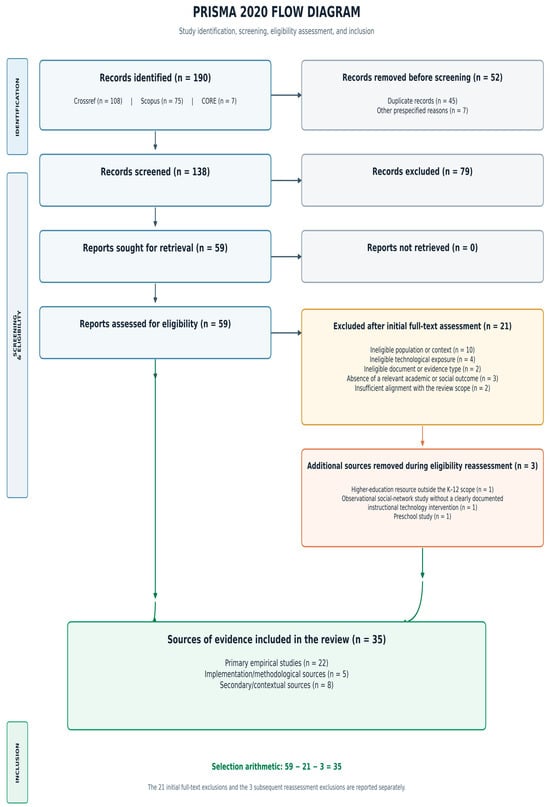
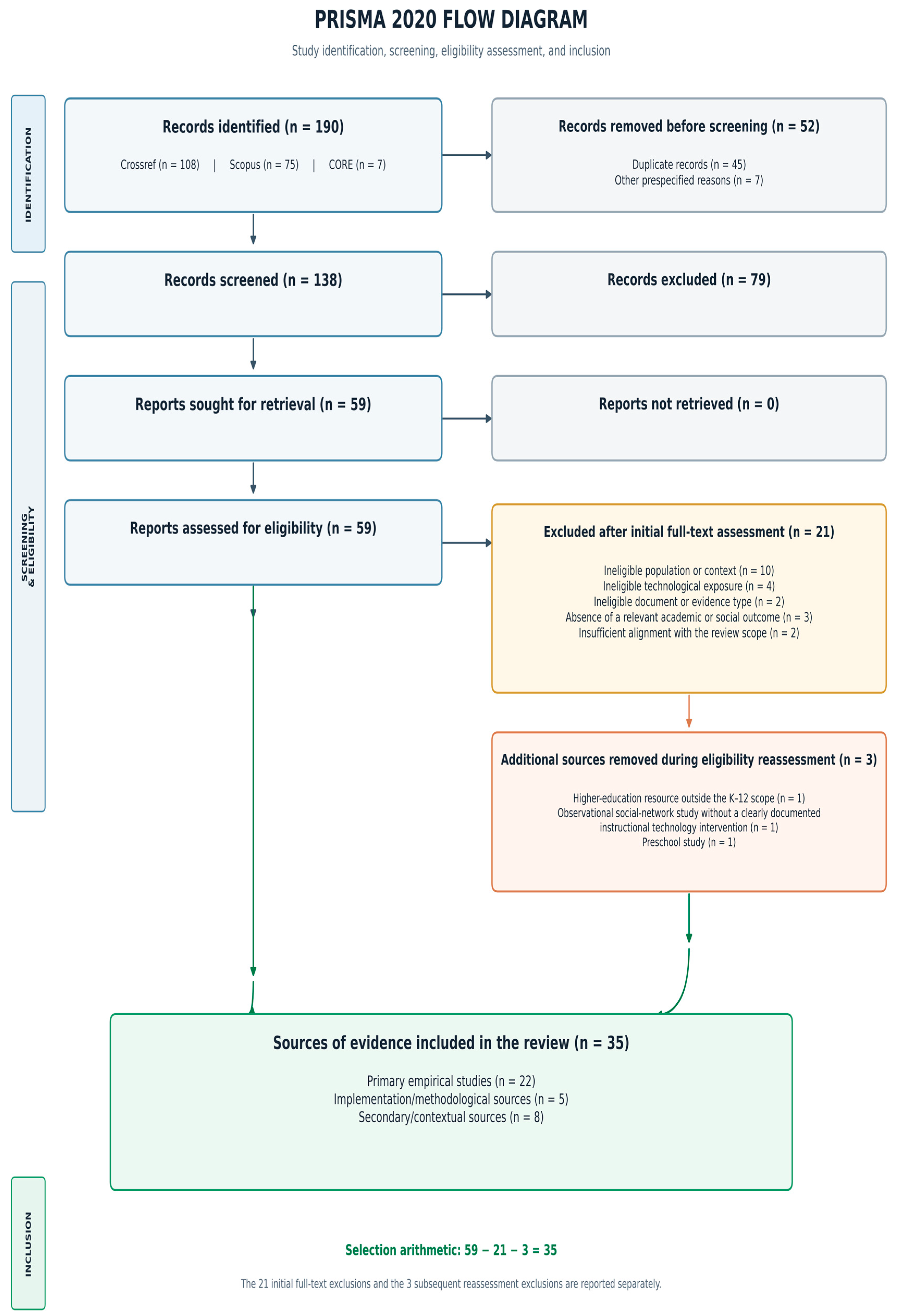
A total of 190 records were identified through Crossref (n = 108), Scopus (n = 75), and CORE (n = 7). Before screening, 45 duplicate records and 7 records removed for other prespecified reasons were excluded, leaving 138 records for title and abstract screening. Of these, 79 were excluded, and 59 reports were sought and assessed for eligibility at the full-text stage. No reports were unavailable for retrieval.
Following full-text assessment, 21 reports were excluded for five documented reasons: ineligible population or context (n = 10), ineligible technological exposure (n = 4), ineligible document or evidence type (n = 2), absence of a relevant academic or social outcome (n = 3), and insufficient alignment with the review scope (n = 2). The remaining 38 sources were provisionally eligible. During a subsequent eligibility reassessment, three additional sources were removed: one higher-education resource outside the K-12 scope, one observational study of problematic social-network use without a clearly documented instructional technology intervention, and one preschool study. Thus, 24 reports/sources were excluded across the initial assessment and subsequent reassessment, leaving 35 included sources: 22 primary empirical studies, 5 implementation/methodological sources, and 8 secondary/contextual sources. Figure 1 should distinguish the 21 initial full-text exclusions from the three reassessment exclusions.
Figure 1.
PRISMA 2020 flow diagram illustrating the identification, screening, eligibility assessment, and inclusion processes of the systematic review. Following the exclusion of 21 reports during the initial full-text assessment and 3 additional sources during eligibility reassessment, the final evidence corpus comprised 35 sources: 22 primary empirical studies, 5 implementation/methodological sources, and 8 secondary/contextual sources.
3.2. Characteristics of the Included Evidence
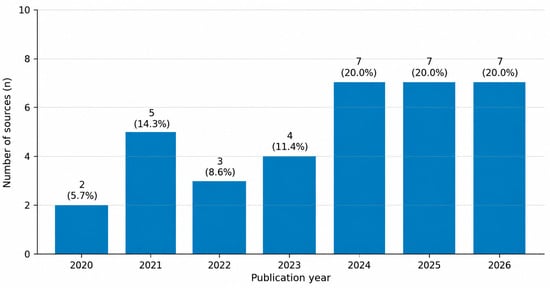
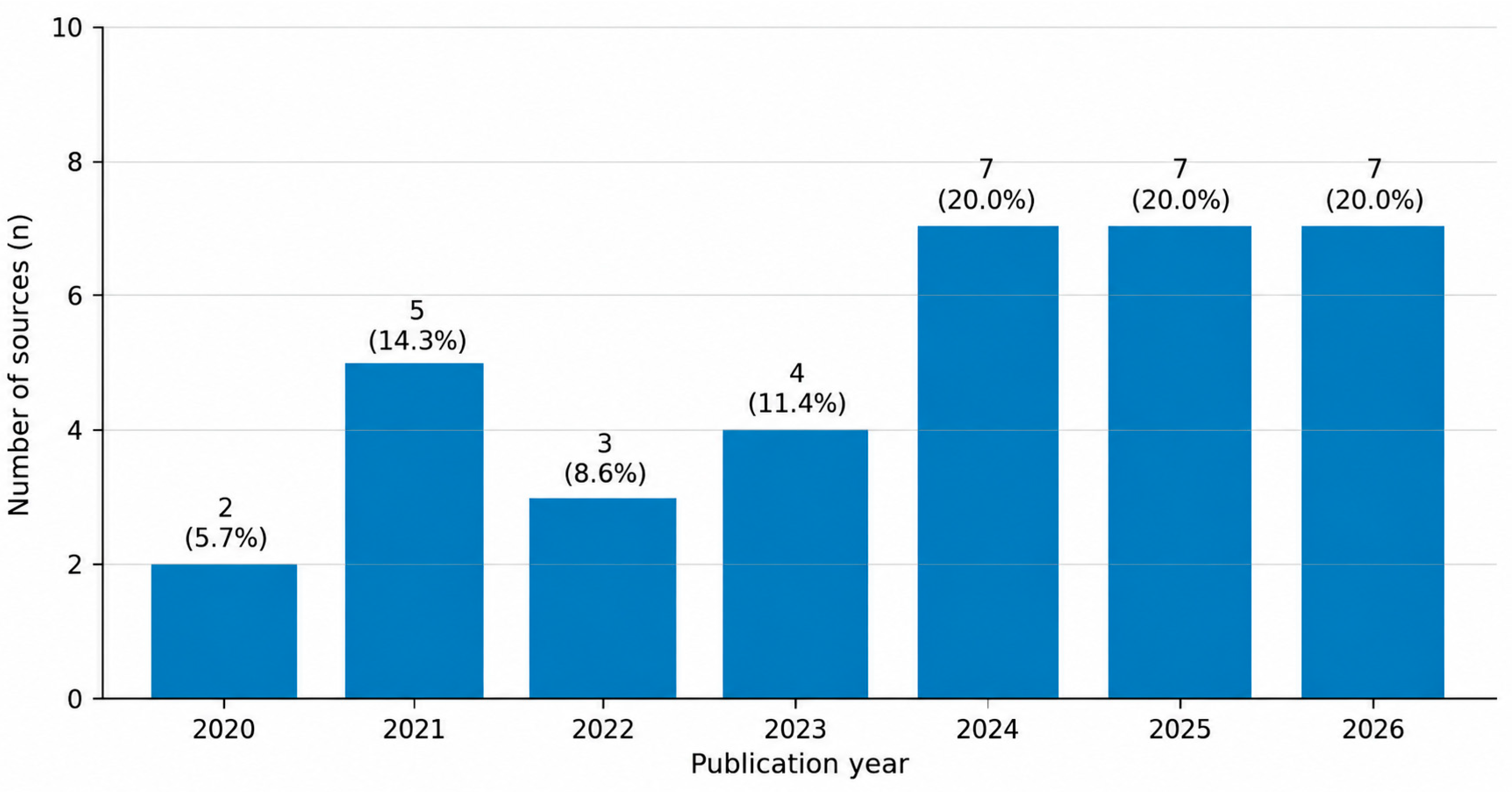
The final set included 35 sources published from 2020 to 2026, with more publications in the later years. In Figure 2, the sources are organized in chronological order. Regarding education level, 15 sources discussed primary education, 14 sources dealt with secondary education, five sources were related to contextual or multilayered settings, and one source concerned special or mixed K-12 education. No preschool sources made it to the final set as a result of eligibility checks.
Figure 2.
Publication-year distribution of the 35 included sources, presented in chronological order.
The descriptive distribution of the 35 included sources across educational context, evidence stratum, study design, outcome profile, and direction of findings is presented in Table 2.
Table 2.
Complete descriptive distribution of the final evidence corpus (n = 35).
Geographically, Brazil and Indonesia contributed the largest numbers of sources (n = 9 each), followed by Spain (n = 5) and China (n = 3). The remaining evidence was distributed across the United States, Latin American regional sources, Mexico, Egypt, Singapore, Russia, Ecuador, Türkiye, and multi-country or unreported contexts. This distribution indicates that the evidence map has an international scope, although the included sources are not geographically balanced.
3.3. Technology Families
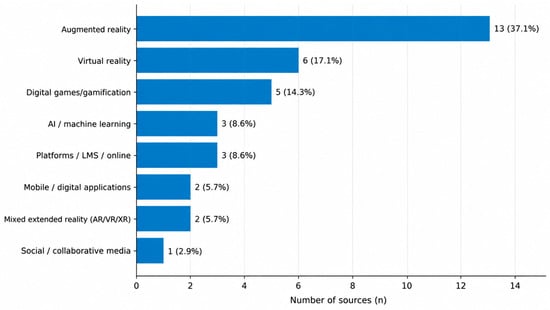
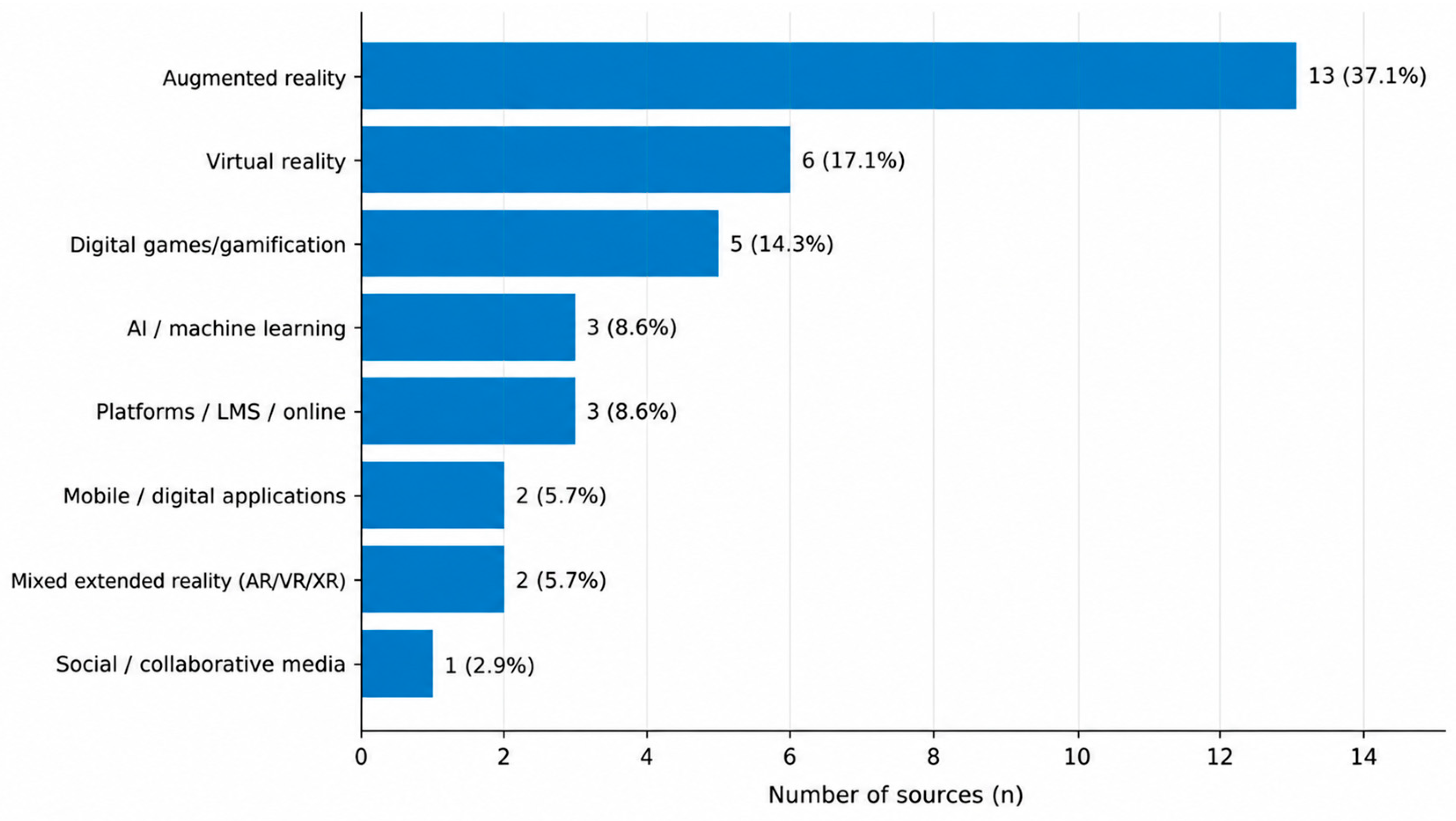
The technology distribution was revised to reflect the 35 sources retained in the final evidence corpus. Augmented reality remained the most frequently represented technology family, accounting for 13 sources (37.1%). Virtual reality was represented in six sources (17.1%), followed by digital games and gamification, with five sources (14.3%). Artificial intelligence or machine learning and platforms, learning management systems (LMS), or online learning each accounted for three sources (8.6%). Mobile or digital applications and mixed augmented, virtual, or extended reality (AR/VR/XR) accounted for two sources each (5.7%), while social or collaborative media was represented in one source (2.9%). Figure 3 presents the distribution of technology families across the final corpus.
Figure 3.
Distribution of technology families across the final evidence corpus (N = 35). Percentages are calculated using the total number of included sources. Mixed extended reality refers to sources combining or discussing AR/VR/XR rather than a single immersive modality.
The final 35-source technology corpus encompassed eight technology families, reflecting a diverse range of educational applications. Augmented reality was the most frequently represented family (n = 13, 37.1%), with the 13 sources identified in the extraction matrix including Domínguez-Gutu et al. (2020), Marín Diaz et al. (2020), Yousef (2021), Ayuso del Puerto et al. (2022), Syamsudin et al. (2022), Winarni and Purwandari (2023), Athiyah et al. (2024), Nafis and Fathurrahman (2024), Marques et al. (2024), Sáez López and Bustamante (2024), A. Silva and Oliveira (2024), Saki et al. (2025), and Ulwan et al. (2026). Widianto is a co-author of the Syamsudin et al. (2022) source and does not represent a separate study. Virtual reality accounted for six sources (17.1%), including Pang (2021), Herwin et al. (2022), Liu (2023), Shujuan (2024), Harron (2025), and I. d. J. Silva et al. (2026). Digital games and gamification accounted for five sources (14.3%), represented by Sun et al. (2021), Torres Mendoza (2023), Valentim and Campagnoli (2025), Lopes and Knoll (2025), and Tapia Peralta (2025).
Artificial intelligence or machine learning and platforms, learning management systems (LMS), or online learning each accounted for three sources (8.6%). The former included Campozano Alcivar (2023), Pirmanto and Purnama (2026), and Hur et al. (2026); the latter included Moura et al. (2024), Falcao and Silva (2025), and Chináglia (2026). Mobile or digital applications and mixed extended reality (AR/VR/XR) each accounted for two sources (5.7%). The mobile-application sources were Assunção and Guedes (2025) and Wenji et al. (2026), whereas the mixed extended-reality sources were Erofeeva and Klowait (2021) and Malya et al. (2025). Finally, social or collaborative media was represented by one source (2.9%), García San Frutos et al. (2021). These frequencies and percentages are based on the mutually exclusive technology-family coding in Supplementary Table S1.
3.4. Academic Outcomes
Within the full evidence corpus (N = 35), 13 sources reported academic outcomes exclusively, while 15 combined academic outcomes with affective (n = 8) or social (n = 7) outcomes. The remaining sources were classified as focusing exclusively on affective or engagement outcomes (n = 4), implementation-related or indirect outcomes (n = 2), or social outcomes (n = 1). Within the primary empirical subset (n = 22), 10 studies examined academic outcomes exclusively, seven addressed both academic and affective outcomes, and three addressed both academic and social outcomes. Two additional primary empirical studies focused exclusively on affective or engagement outcomes. No primary empirical study focused exclusively on social outcomes. These distributions refer to different analytical subsets and should be interpreted accordingly.
The academic scrutiny offers a mostly positive storyline within the augmentation of augmented reality, but not without certain divergences. Domínguez-Gutu et al. (2020) found that primary natural-science learning augmented reality resulted in a better academic performance than traditional instruction. Winarni and Purwandari (2023) mentioned that understanding improved in an AR-STEAM-blended setup and Athiyah et al. (2024) found there was more comprehension as well as recall in elementary science. On the other hand, there were no differences at geometric achievement in any of the case studies albeit the motivation and creative thinking did favor the AR condition found. This divergence is important because studies within the same technology family may report different outcomes. Findings should therefore be interpreted in relation to the educational context, intervention design, and specific outcome measured, rather than assuming that all interventions within a technology family produce equivalent results.
Virtual reality tells us the same thing. Studies by Pang (2021), Liu (2023), and Shujuan (2024) suggest that virtual reality positively impacts learning, creativity, flow, and engagement in secondary education. Liu’s mixed-methods study indicates the significant success of creative design and flow in the immersive regime. The literature on immersive learning raises other questions related to orchestration and attention management. Erofeeva and Klowait (2021) show that the use of extended reality and interactive display changes attention management in secondary STEM education, which is important from an educational viewpoint, though not an indicator of the achievement impact.
The latest studies on AI and mobile technologies extend the scope of outcomes achieved. Pirmanto and Purnama (2026) have shown that there is a substantial improvement in reading literacy skills within the experimental group with machine learning applications, compared to other groups. Hur et al. (2026) report the ability of students to utilize the knowledge relating to AI when conducting projects and work, as well as improvements in their professional skills with moderate changes in conceptual knowledge about advanced AI systems not being statistically proven. Wenji et al. (2026) state that the results in English language learning are considerably better when teaching through mobile-based outcomes-based pedagogical model with a focus on co-working and enthusiasm in study. Thus, it can be stated that new technologies are being tested for a much larger scope of outcomes rather than just knowledge acquired.
The included corpus also reports negative academic experiences associated with digital exposure. In the context of emergency remote education, Moura et al. (2024) reported negative assessments of online learning experiences. This finding illustrates that the educational implications of technology depend on the implementation context and the outcomes assessed. Accordingly, the evidence should not be interpreted as uniformly positive across technological modalities or educational settings.
3.5. Social and Affective Outcomes
Within the final evidence corpus, social outcomes were less frequently represented than academic outcomes. Seven sources reported both academic and social outcomes, whereas one source focused exclusively on social outcomes. Within the primary empirical subset, three studies examined both academic and social outcomes, and none focused exclusively on social outcomes. This distribution is relevant to RQ2 because it indicates that academic outcomes are represented by a broader body of evidence than exclusively social outcomes. However, the number of sources alone does not establish greater methodological reliability.
The research evaluating social aspects indicates numerous possibilities. Hur et al. (2026) discuss the role of teamwork, communication, and decision-making in an AI-based environment for learning via projects. Wenji et al. (2026) claim that there is greater collaborative effective learning which also goes along with succeeding in English in an approach with the use of mobile devices. Ayuso del Puerto et al. (2022) place the augmented reality into the context of inclusiveness learning with the use of projects and designs. The evidence also shows that virtual reality can be effective for recognition, communication, or social skill development in special education (I. d. J. Silva et al., 2026). These results have good prospects; however, their diversity makes the definition of a clear consistent idea of social achievements quite difficult.
Affective results are predominantly featured. There are four publications specifically dealing with affective or engagement results and eight works that analyze both affective and academic outcomes. Shujuan’s (2024) study presents post-intervention effects on cognitive, behavioral, and affective engagement in immersive VR mathematics as significant. Ulwan et al. (2026) demonstrate that there are considerable improvements in motivation after the intervention in elementary social studies, where students use AR-supported learning. Nevertheless, Yousef (2021) explains why both affective and academic results should be treated separately: motivation and creativity increase while academic achievements remain constant. Therefore, motivation, flow, enjoyment, and engagement should be analyzed as distinct outcome domains rather than treated as substitutes for academic achievement. Improvements in affective or engagement outcomes do not necessarily imply corresponding improvements in academic performance.
3.6. Technology-Pedagogy Configurations
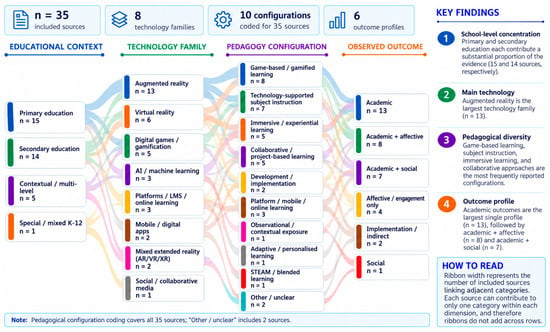
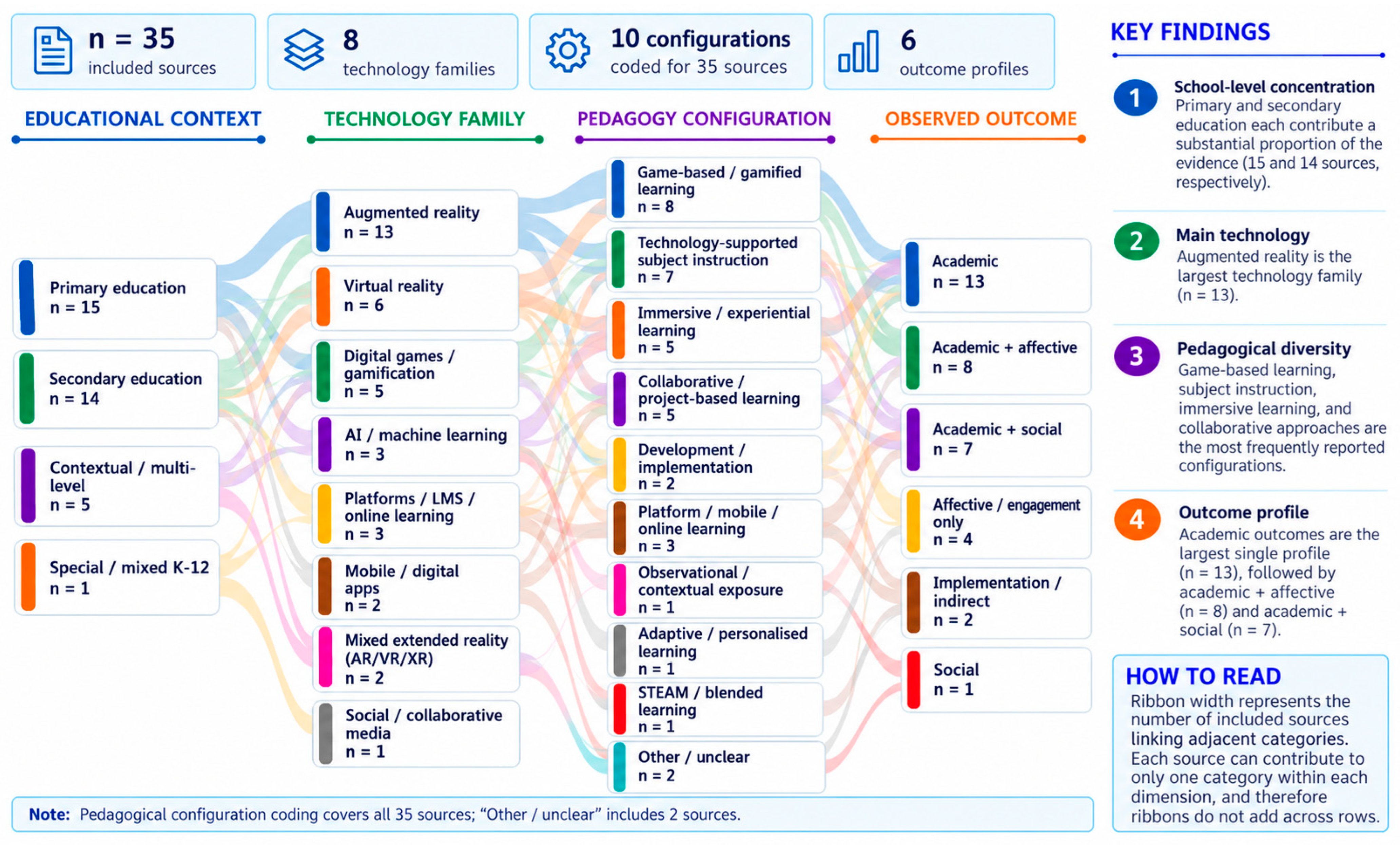
The pedagogical coding describes how technologies were incorporated into educational activities. Game-based and gamified learning was the most frequently represented configuration (n = 8), followed by technology-supported subject instruction (n = 7). Immersive and experiential learning and collaborative and project-based learning accounted for five sources each. Platform-, mobile-, or online-based learning accounted for three sources, while development and implementation approaches and other or unclear configurations accounted for two sources each. Observational or contextual exposure, adaptive or personalized learning, and STEAM or blended learning were each represented by one source. The ten mutually exclusive categories therefore sum to the final corpus of 35 sources. Figure 4 maps the relationships among educational context, technology family, pedagogical configuration, and observed outcome at the source level.
Figure 4.
Sankey evidence map linking educational context, technology family, pedagogical configuration, and observed outcome across the final evidence corpus (N = 35). Each source contributes one unit to each analytical dimension, and ribbon width represents source frequency rather than participant sample size or effect magnitude. Ten mutually exclusive pedagogical configurations are represented, including an “Other/unclear” category (n = 2).
Two patterns are noteworthy. First, augmented reality is not restricted to a single pedagogical configuration; it appears in subject-specific instruction, game-based learning, collaborative or project-based activities, development-oriented work, and STEAM or blended learning. Second, similar pedagogical configurations can occur across different technology families. Game-based approaches, for example, are associated with augmented reality, virtual reality, and digital games. These relationships support the interpretation that technology-supported learning should be examined through the interaction between technological tools and pedagogical approaches rather than through hardware or software categories alone.
3.7. Study Design and Direction of Findings
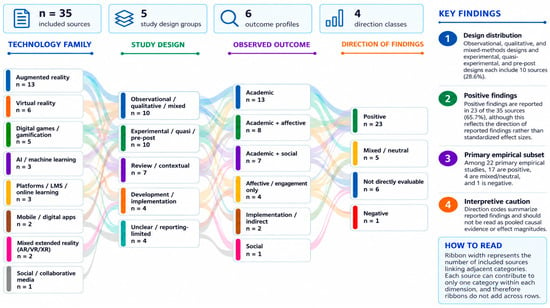
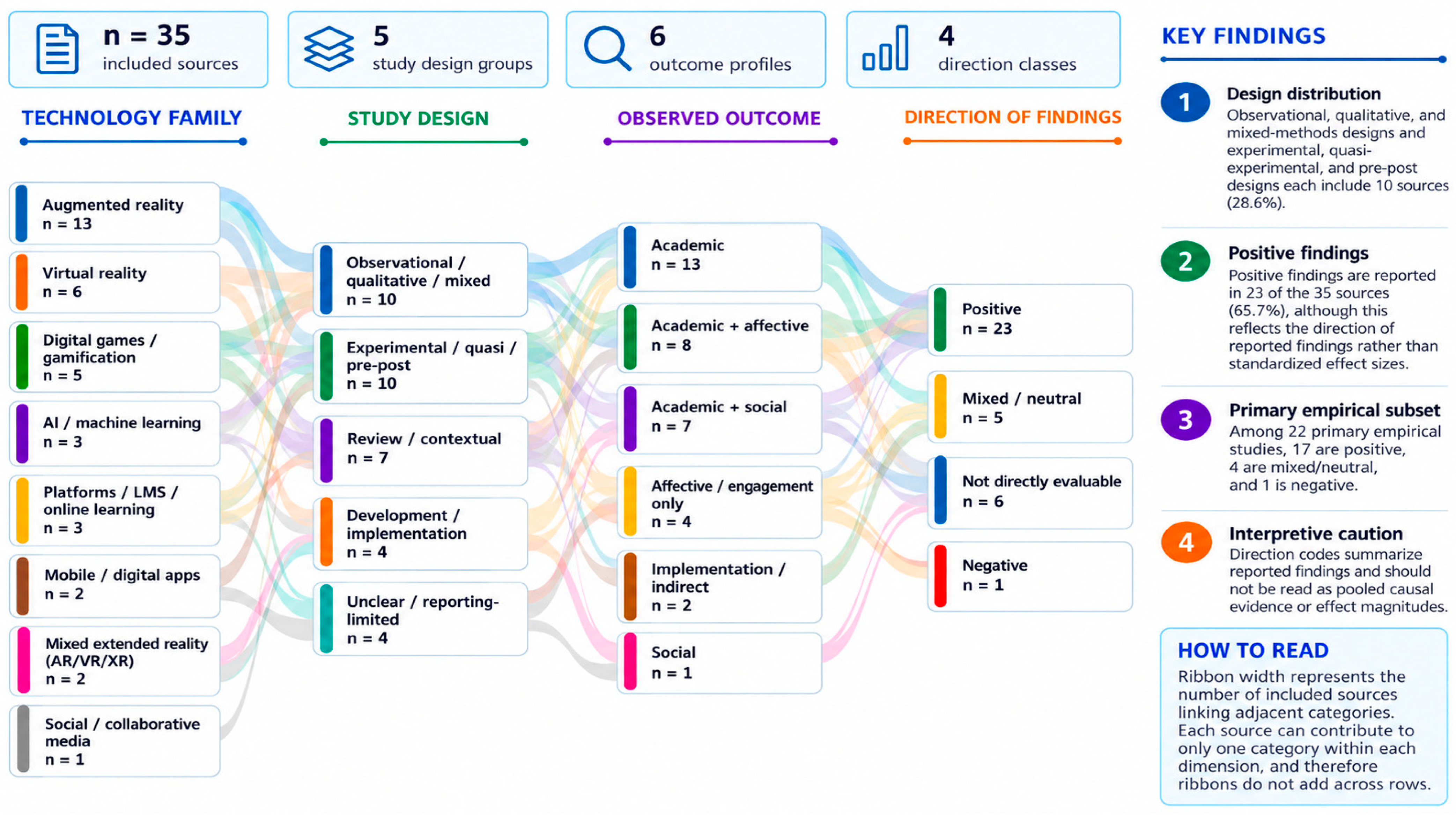
Observational, qualitative, and mixed-methods designs accounted for 10 sources, as did experimental, quasi-experimental, and pre–post designs. The remaining sources were classified as review/contextual (n = 7), development/implementation (n = 4), or unclear/reporting-limited (n = 4). Across the full evidence corpus (N = 35), 23 sources were coded as predominantly positive, five as mixed or neutral, six as not directly evaluable or insufficiently reported, and one as negative. These classifications describe the reported direction of findings at the source level and should be interpreted descriptively rather than as estimates of comparative effectiveness.
Within the primary empirical subset (n = 22), 17 studies were classified as predominantly positive, four as mixed or neutral, and one as negative. These results represent a narrower evidence subset than the full-corpus distribution. Moreover, the direction of findings does not indicate a uniform level of evidential strength: a statistically significant improvement, an observed association, and a consistent qualitative finding may all be classified as positive while differing in design, measurement, and inferential strength. Figure 5 maps the relationships among technology family, study design, outcome profile, and direction of findings. The diagram represents source-level classifications and co-occurrences, not pooled effect sizes or a quality-adjusted estimate of effectiveness.
Figure 5.
Sankey evidence map linking technology family, study design, outcome profile, and direction of findings. Direction is a source-level narrative code and must not be interpreted as a pooled effect size. Each source contributes one unit of flow.
A comparative descriptive synthesis of the technology families, including the total number of sources, the primary empirical subset, and the main interpretive findings, is provided in Table 3.
Table 3.
Evidence synthesis by technology family.
3.8. Evidence Strata and Evidence Gaps
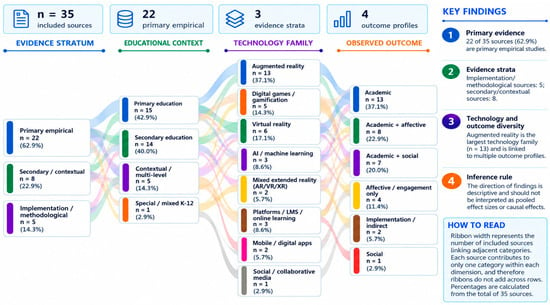
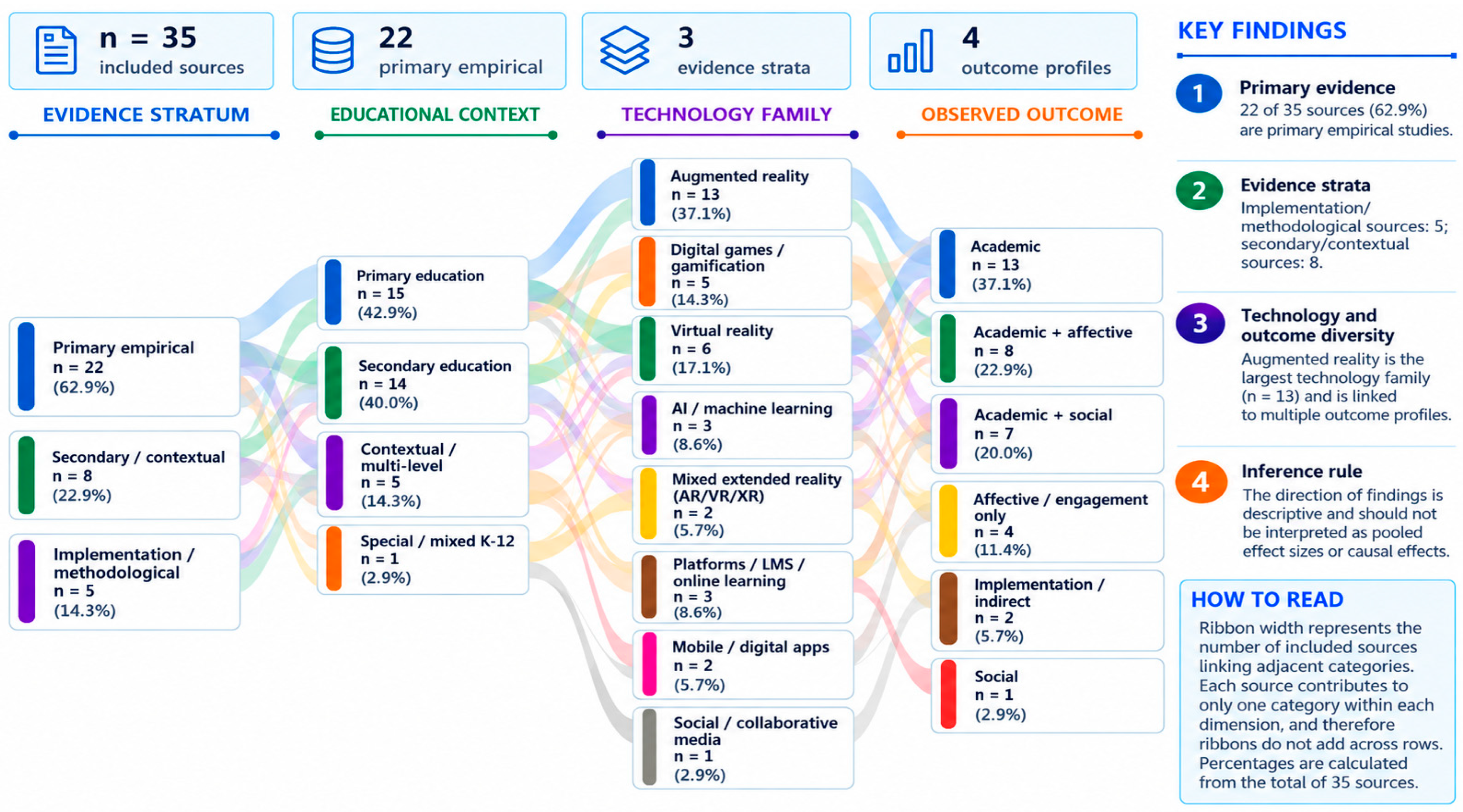
Figure 6 illustrates the distribution of evidence across the three evidence strata. Primary empirical studies account for 22 of the 35 included sources, while implementation/methodological sources account for five and secondary/contextual sources for eight. This distinction helps prevent contextual evidence from being interpreted as equivalent to direct empirical evidence of effects on K-12 learners.
Figure 6.
Sankey evidence map linking evidence stratum, educational context, technology family, and outcome profile. Each source contributes one unit to each analytical dimension for which it is classified. Ribbon width represents source frequency, not participant sample size or effect magnitude. Implementation/methodological and secondary/contextual sources inform the evidence map and its interpretation but should not be treated as equivalent to primary empirical evidence of effects on K-12 learners.
Several evidence gaps emerge from the analysis. Social outcomes are relatively underrepresented, particularly when the evidence is restricted to primary empirical studies. Artificial intelligence and machine learning constitute a small group, represented by only three sources. Adaptive or personalized learning is represented by a single source as a distinct pedagogical configuration. The geographical distribution is concentrated in Brazil, Indonesia, and Spain; consequently, the observed regional patterns may partly reflect the geographical coverage of the retrieved and included literature. In addition, some contextual and implementation-oriented sources provide useful information about technology design and implementation but do not report sufficiently detailed outcome data for an effect-oriented synthesis. These gaps identify priorities for future research and should be considered when interpreting the scope and limitations of the available evidence.
4. Discussion
4.1. Principal Findings
The review highlights a notable characteristic of the 2020–2026 literature: the understanding of technology-enhanced learning as a combination of technology, pedagogical methods, and learning results, rather than simply an analysis of online and offline teaching methods. While augmented reality has emerged as a leading area of research in this field, the results of studies in this field are not unified and can vary widely: some studies show improvement in learning performance, while others show learning facilitation and increased motivation and creativity, but no difference in learning achievement (Domínguez-Gutu et al., 2020; Yousef, 2021; Winarni & Purwandari, 2023; Athiyah et al., 2024). The same applies to the area of virtual reality—studies have found that the improvement in experiences varies without actually providing any answers to the questions regarding levels of attentiveness of students, classroom management, and what is understood by the term learning (Erofeeva & Klowait, 2021; Liu, 2023; Shujuan, 2024).
This trend offers a more cautious reading than what the phrase ‘technology enhances learning’ would permit. What is consistently noted throughout the study is that positive results appear wherever technology operates within a distinct pedagogical framework: be it scaffolding in game-based learning, curriculum-related subject teaching, experience-based learning, teamwork on a project, or adaptive feedback. For instance, Sun et al. (2021) refer to scaffolding in digital game-based mathematics, while Hur et al. (2026) and Wenji et al. (2026) refer to technology within a project-based or team teaching setting. The evidence map does not confirm that pedagogy acts as a mediator in the relation between technologies and outcomes; it shows that pedagogy is always included in the way technologies are used and assessed.
According to the evidence map, technology-supported education displays various combinations of technological tools, teaching models, educational environments, and effects seen as a result. The patterns identified in the evidence map can help identify new areas for further investigation, but they should not be regarded as evidence that any particular technology or teaching model is more effective than others. The sources differ a lot in the design, evaluation method, and reporting practices, and the review has not conducted a bias risk factor assessment. Therefore, implications for education should be considered to be interpretative and hypothesis-generating rather than saying something definite about intervention effectiveness.
4.2. Academic Outcomes Are Better Represented than Social Outcomes
The second finding addresses the discrepancy between academic and social evidence. Academic outcomes alone made up 13 out of 35 of the sources examined while an additional 15 combined academic outcomes with either emotional (n = 8) or social (n = 7) aspects. In contrast, outcomes exclusive to social results are limited to one source. The significance of this finding is that academic outcomes are better covered in research than social outcomes alone. This discrepancy has implications for research and public policy as it emphasizes the necessity of studying the social side of tech-enabled learning and warns against equating academic results with social ones. Collaboration, communication, participation, and social skills are often cited as reasons for using digital technologies, though rather seldom have their impact studied as thoroughly as academic results or literacy rate. Social outcomes, when included, are usually found only in complicated cases of learning such as project-based work or collaborative mobile learning, etc.
Preserving the distinction between affective and social outcomes must remain intact. Motivation, engagement, flow, and enjoyment can facilitate learning, but they do not mean academic success or social competence. For instance, the geometry results presented by Yousef (2021) demonstrate this idea well: positive motivational and creative results were obtained, but there was no achievement difference. Likewise, Shujuan (2024) observed a significant increase in cognitive, behavioral, and affective engagement with immersive VR mathematics, but these indicators should not be transferred to long-term performance automatically.
4.3. Emerging AI and Mobile Applications
AI and machine learning studies form a relatively small development in the evidence map. This cluster of research is formed of three sources, such as the adaptive reading study, research into generative AI project implementation, and examination of hybrid learning situations (Pirmanto & Purnama, 2026; Hur et al., 2026; Campozano Alcivar, 2023). An academic gain is detected in adaptive literacy, while generative AI results reveal a mixed research outcome—students employed AI concepts and reported an improvement in professional skills, but little conceptual knowledge has been gained (Pirmanto & Purnama, 2026; Hur et al., 2026). The findings demonstrate that instead of seeing whether AI works or not, it is more important to study its role in instruction, scaffolding of students, and outcomes of the process.
Mobile learning is an additional illustration. Wenji et al. (2026) investigated theory-based mobile-assisted learning that integrated academic motivation, achievement, and collaboration in a large secondary EFL sample. Meanwhile, Assunção and Guedes (2025) researched the instructional potential of digital technologies in ninth grade science, while not directly issuing an evaluation of technology impact. The fact that the studies combine different layers of evidence does not argue against the value of the corpus; on the contrary, this makes it necessary to deal with evidence routing.
4.4. Implications for Educational Design and Decision-Making
While the evidence map provides a number of useful aspects in terms of educational design, these should be seen as tentative implications rather than conclusions based on empirical evidence. The variety of the sources suggests that the choice of a particular technology should be assessed relative to the learning goal, educational context, instructional activity, and the outcomes expected. Rather than assuming that a particular technology is beneficial a priori, educators and researchers might consider whether its advantages fit for the specific educational and pedagogical tasks.
The aspects of the curriculum, teacher role, structure of educational activity, interaction, feedback, and evaluation become crucial for choosing a technology. However, the present review does not prove that these concepts can help improve educational or community outcomes on their own. To establish their contribution, research studies should be conducted, which would indicate the conditions of the study, teachers’ roles, duration of the study, access to technologies, etc.
Studies of future evaluations must separate academic success from engagement, cooperation, motivation, and other social outcomes. They should also implement appropriate methods of evaluating risk of bias and offer enough details for comparative evaluation on similar methodologies. Such a recommendation is based on the gaps and differences in methodologies outlined in the map and does not imply any quality-adjusted conclusions regarding the efficacy of the method.
4.5. Strengths and Limitations
A strength of this review is the explicit separation of evidence roles. The 35 included sources are not treated as a homogeneous pool. The 22 primary empirical studies carry the main inferential weight for learner outcomes, while five implementation/methodological and eight secondary/contextual sources are retained for design and interpretive value. The source-level Sankey tables also make the visual synthesis reproducible: every ribbon can be traced back to categorical codes in the extraction workbook.
Several limitations affect the interpretation of this evidence map. First, the search was constrained by the information sources that the research team could access and document. Crossref and Scopus supplied most of the identified records, whereas SciELO and OpenAlex yielded no retained records and retrieval through Semantic Scholar was constrained by coverage or rate limitations. Institutional access limitations also affected the feasibility of incorporating additional education-focused database coverage, including ERIC-related resources. In addition, the exact date of the final search could not be verified from the retained search documentation, limiting the temporal reproducibility of the search, particularly for publications from 2026. Consequently, the corpus should not be regarded as an exhaustive representation of all potentially eligible K-12 research.
Second, the included corpus combines primary empirical studies with implementation, methodological, secondary, and contextual sources. Although these evidence strata were distinguished during coding, their combined representation in the evidence map requires cautious interpretation. Researchers should exercise care when interpreting source frequencies and directions of findings, as implementation and contextual sources do not provide evidence equivalent to primary empirical studies of learner outcomes. Sources involving non-target educational populations should also be clearly identified as boundary evidence and should not be used to draw conclusions about the effectiveness of interventions for K-12 learners.
First of all, there was no risk-of-bias assessment of the design in the empirical studies discussed in the evidence map. Positive, mixed/neutral, and negative classifications only provide information about directions of the reported findings and do not allow estimating the extent of effectiveness, quality of methods used or confidence about the evidence.
All these limitations limit the scope of the results. The evidence map enables describing the spread of the existing literature, identifying unexplored outcomes, and formulating hypotheses for further research. It is important to conduct a more thorough and reproducible search that will allow stronger conclusions to be drawn about the effectiveness of the interventions.
5. Conclusions
The systematic review as well as the evidence map is referring to the range of empirical technology-supported learning research based on technological tools used, teaching methods utilized, as well as educational environment and academic, social, and affective outcomes achieved in K-12 education. Augmented reality turned out to be the most commonly utilized technology, and academic outcomes were represented more than social ones when studied separately. For this reason, these patterns describe the composition and characteristics of the identified publications, and not the relevance of the technologies studied.
The final results corpus includes 22 primary empirical studies, among which 17 are classified as predominantly positive, 4 as mixed or neutral and 1 as negative. Nevertheless, the classification shown is based on the direction of findings reported, meaning it should not be interpreted as a standard reference for intervention impact or any proof of the success of the method applied. The classification is limited based on the study design, measurement of outcomes as well as the way of reporting.
The evidence map indicates that technologies are used in a variety of pedagogical configurations—from instruction according to subject, game-based learning, immersive activities, and teamwork or project-based learning. The identified co-occurrence patterns suggest the need for further research into relationships between technology, pedagogy, learner context and assessment, but do not indicate the existence of causal mechanisms or that any pedagogical configuration might be preferable.
In future studies, academic and social outcomes should be examined systematically, teacher mediation and implementation contexts should be described in detail, and suitable methodology should be utilized. Comparative or quantitative reviews should be performed only when the studies being analyzed have similar interventions, designs, and outcomes. Overall, this review gives insight into research gaps and hypothesis creation instead of providing a quality adjusted conclusion about the effectiveness of technology in terms of academic or social results.
Supplementary Materials
The following supporting information can be downloaded at: https://www.mdpi.com/article/10.3390/educsci16111925/s1, the accompanying research package contains Table S1 (source-level coding of the 35 included sources), Table S2 (search strategy and PRISMA-S audit fields), Table S3 (machine-readable Sankey source-target-value tables).
Author Contributions
Conceptualization, O.M.-L. and M.T.V.; methodology, O.M.-L. and M.T.V.; software, L.O.-D.; validation, O.M.-L., M.T.V. and Z.H.-M.; formal analysis, O.M.-L. and Z.H.-M.; investigation, O.M.-L., M.T.V., L.O.-D., Z.H.-M. and S.B.-G.; resources, M.T.V. and S.B.-G.; data curation, L.O.-D. and S.B.-G.; writing—original draft preparation, O.M.-L., M.T.V. and L.O.-D.; writing—review and editing, Z.H.-M. and S.B.-G.; visualization, L.O.-D.; supervision, Z.H.-M.; project administration, M.T.V.; funding acquisition, M.T.V. All authors have read and agreed to the published version of the manuscript.
Funding
This research was funded by the Universidad Nacional de Trujillo (UNT), Trujillo-Peru, through the VIII Call for Science and Technology Projects at the Universidad Nacional de Trujillo with Public Funds from the Mining Canon (VIII Convocatoria de Proyectos de Ciencia y Tecnología en la Universidad Nacional de Trujillo con Fondos Públicos Provenientes del Canon Minero 2024). The APC was funded by the Universidad Nacional de Trujillo (UNT).
Institutional Review Board Statement
Not applicable. This study synthesizes previously published research and did not recruit human participants directly.
Informed Consent Statement
Not applicable.
Data Availability Statement
The source-level extraction matrix, search documentation, and machine-readable data underlying the Sankey diagrams are provided in the Supplementary Materials accompanying this article.
Acknowledgments
The authors acknowledge the use of automated tools for record handling and visualization support within the review workflow.
Conflicts of Interest
The authors declare no conflicts of interest.
Abbreviations
| Abbreviation | Meaning |
| AI | Artificial intelligence |
| AR | Augmented reality |
| CORE | Connecting Repositories |
| K-12 | Primary and secondary school education |
| LMS | Learning management system |
| ML | Machine learning |
| PRISMA | Preferred Reporting Items for Systematic Reviews and Meta-Analyses |
| PRISMA-S | PRISMA extension for literature searches |
| VR | Virtual reality |
| XR | Extended reality |
References
- Aquino-Blanco, A., Quiroz-Cárdenas, F., Montenegro-Espinosa, J. A., Martín-Calvo, N., Yañéz-Sepúlveda, R., Gutiérrez-Espinoza, H., Olivares-Arancibia, J., Rahmati, M., Stubbs, B., Smith, L., López-Gil, J. F., & Jiménez-López, E. (2026). Social networks, messaging apps, addictive use, and academic performance in adolescents: Findings from the EHDLA study. Italian Journal of Pediatrics, 52, 20. [Google Scholar] [CrossRef] [Scilit] [PubMed]
- Assunção, V. d. S., & Guedes, S. F. (2025). Ensino de ciências e tecnologias digitais: Um estudo de aplicativos para o ensino de ciências do 9° Ano. In Educação em perspectiva: Diálogos e práticas contemporâneas em tecnologia, formação docente, ensino e aprendizagem (Vol. 1). Editora e-Publicar. [Google Scholar] [CrossRef] [Scilit]
- Athiyah, N., Maula, N. N., Khobir, A., & Rini, J. (2024). Augmented Reality (AR) learning: Improving students memory in science learning at the elementary school Level. Madako Elementary School, 3(2), 152–164. [Google Scholar] [CrossRef] [Scilit]
- Ayuso del Puerto, D., Gutiérrez Esteban, P., & Castro Robles, M. P. (2022). Experiencia formativa virtual en realidad aumentada con el alumnado de educación primaria de un centro de atención educativa preferente. Edmetic, 11(2), 4. [Google Scholar] [CrossRef] [Scilit]
- Campozano Alcivar, J. E. (2023). Aprendizaje Hibrido 3.0, transformando la educación con inteligencia artificial y realidad virtual. Ciencia Latina Internacional. [Google Scholar] [CrossRef] [Scilit]
- Chináglia, J. P. F. (2026). Ambiente virtual no ensino contextualizado da língua espanhola: Utilização síncrona de ferramentas digitais na aprendizagem do idioma. In Tecnologias digitais e ensino da língua espanhola na contemporaneidade. Pimenta Cultural. [Google Scholar] [CrossRef] [Scilit]
- Domínguez-Gutu, J., Gordillo-Espinoza, E., Trejo-Trejo, G. A., & Constantino-González, F. E. (2020). Impacto de la realidad aumentada en el rendimiento académico de los estudiantes de educación primaria en la enseñanza de las ciencias naturales. Revista de Educación Técnica, 4, 1–12. [Google Scholar] [CrossRef] [Scilit]
- Erofeeva, M., & Klowait, N. O. (2021, May 17–June 10). The impact of virtual reality, augmented reality, and interactive whiteboards on the attention management in secondary school STEM teaching. 2021 7th International Conference of the Immersive Learning Research Network (iLRN), Eureka, CA, USA. [Google Scholar] [CrossRef] [Scilit]
- Falcao, G. C., & Silva, P. R. (2025). O impacto da recomposição da aprendizagem: Um estudo profundo de como a recomposição escolar pode melhor os níveis de desempenho dos estudantes da Ensino Fundamental II. Caderno Pedagógico, 22, e18270. [Google Scholar] [CrossRef] [Scilit]
- França, C., & Da Silva, T. (2020). A realidade virtual e aumentada dedicada ao processo ensino-aprendizagem de física: Socialização da concepção e validação do aplicativo RVA_360—Momento angular. Revista Brasileira de Ensino de Ciência e Tecnologia, 13(1), 142–169. [Google Scholar] [CrossRef] [Scilit]
- García San Frutos, M., Lauzurica, N., Germain, F., & Agulló, T. F. (2021). El uso de foros virtuales como herramienta para el aprendizaje colaborativo mediante la formulación de preguntas mejora el rendimiento académico, la adquisición de competencias y el aprendizaje activo. In Aplicaciones de las plataformas de enseñanza virtual a la educación superior. Dykinson, S.L. [Google Scholar] [CrossRef] [Scilit]
- Harron, J. (2025, April 23–27). How do varying levels of immersive virtual reality affect student performance in high school science? AERA Annual Meeting, Denver, CO, USA. [Google Scholar] [CrossRef] [Scilit]
- Herwin, H., Shabir, A., & Asriadi, A. (2022). Learning management system based on virtual reality technology in elementary school. World Journal on Educational Technology: Current Issues, 14(5), 1506–1517. [Google Scholar] [CrossRef] [Scilit]
- Hur, J. W., Bhuyan, J., Wu, F., Thomas, C., & Koong, K. (2026). Cultivating AI literacy among high school students through generative AI as a collaborative partner. Discover Education, 5, 805. [Google Scholar] [CrossRef] [Scilit]
- Karaca, N. H., Kaya, Ü. Ü., & Uzun, A. M. (2026). Lost in the game? Investigating the links between digital game addiction, self-regulation, social and life skills in preschoolers. BMC Psychology, 14, 305. [Google Scholar] [CrossRef] [Scilit] [PubMed]
- Liu, Y. (2023, May 4). Examining middle school students’ creativity and perceived learning through immersive virtual reality–based learning in STEAM lessons. 2023 AERA Annual Meeting, Chicago, IL, USA. [Google Scholar] [CrossRef] [Scilit]
- Lopes, H. C., & Knoll, G. F. (2025, November 5–7). Tecnologias digitais para uma aprendizagem ativa: Um jogo para o ensino de história. V Seminário Internacional em Ensino de Humanidades e Linguagens, Santa Maria, Brazil. [Google Scholar] [CrossRef] [Scilit]
- Malya, S., Puspawati, S., & Halimatussya’diah, P. (2025). Application of augmented reality and virtual reality google expeditions in social studies learning in junior high school. Mauve Journal de Leardu, 2(1), 37–47. [Google Scholar] [CrossRef] [Scilit]
- Marín Diaz, V., Morales Díaz, M., & Reche Urbano, E. (2020). Aprendizaje con videojuegos con realidad aumentada en educación primaria/Learning with video games with augmented reality in primary education. Revista de Ciencias Sociales, 26, 94–112. [Google Scholar] [CrossRef] [Scilit]
- Marques, C. D., Brum, Y. K., Batista, G. F., & Pereira, A. G. (2024). Aprendizagem colaborativa e taxonomia de bloom: O ensino por meio da realidade aumentada. Revista Ibero-Americana de Humanidades, Ciências e Educação, 10, 135–151. [Google Scholar] [CrossRef] [Scilit]
- Moura, E. P. G. D., Santos, M. J. S., & Stein, M. E. K. (2024). A percepção de adolescente sobre a aprendizagem escolar durante o isolamento social da COVID-19. Ensino em Re-Vista, 31, 1–22. [Google Scholar] [CrossRef] [Scilit]
- Nafis, N. L., & Fathurrahman, M. (2024). Development of digital learning media based on augmented reality to improve student learning outcomes of elementary school. Research and Development in Education (RaDEn), 4(2), 952–963. [Google Scholar] [CrossRef] [Scilit]
- Page, M. J., E McKenzie, J., Bossuyt, P. M., Boutron, I., Hoffmann, T. C., Mulrow, C. D., Shamseer, L., Tetzlaff, J. M., A Akl, E., E Brennan, S., Chou, R., Glanville, J., Grimshaw, J. M., Hróbjartsson, A., Lalu, M. M., Li, T., Loder, E. W., Mayo-Wilson, E., McDonald, S., … Moher, D. (2021). The PRISMA 2020 statement: An updated guideline for reporting systematic reviews. BMJ, 372, n71. [Google Scholar] [CrossRef] [Scilit] [PubMed]
- Pang, D. C. G. (2021, March 3–5). Immersive virtual reality (VR) classroom to enhance learning and increase interest and enjoyment in the secondary school science curriculum. International Conferences Mobile Learning 2021 (ML 2021) and Educational Technologies 2021 (ICEduTech 2021), Virtual. [Google Scholar] [CrossRef] [Scilit]
- Pirmanto, D., & Purnama, A. A. (2026). Integration of machine learning technology in digital learning media to improve elementary school students reading literacy. Ibriez Jurnal Kependidikan Dasar Islam Berbasis Sains, 11(1), 1–12. [Google Scholar] [CrossRef] [Scilit]
- Rethlefsen, M. L., Kirtley, S., Waffenschmidt, S., Ayala, A. P., Moher, D., Page, M. J., & Koffel, J. B. (2021). PRISMA-S: An extension to the PRISMA statement for reporting literature searches in systematic reviews. Systematic Reviews, 10, 39. [Google Scholar] [CrossRef] [Scilit] [PubMed]
- Saki, S., Usodo, B., & Santosa, E. B. (2025). Perception of school community towards the use of augmented reality digital media on students’ critical thinking in elementary school. In Social, humanities, and educational studies (SHES): Conference series. Universitas Sebelas Maret. [Google Scholar] [CrossRef] [Scilit]
- Sáez López, J. M., & Bustamante, P. S. (2024). Competencia digital y realidad aumentada en la enseñanza elemental. In La realidad extendida para explorar la educación geográfica, histórica y social. Dykinson, S.L. [Google Scholar] [CrossRef] [Scilit]
- Shujuan, G. (2024). Implementation of immersive virtual reality games and learning engagement for selected mathematical concepts among middle school students in Ganzhou City, China. International Journal of Social Science and Human Research, 7(6), 4395–4399. [Google Scholar] [CrossRef] [Scilit]
- Silva, A., & Oliveira, E. (2024). Uma análise do uso da tecnologia de realidade aumentada na aprendizagem de matemática no ensino fundamental. Lynx, 3, 1–14. [Google Scholar] [CrossRef] [Scilit]
- Silva, I. d. J., Nascimento, V. d. S., Silva, G. N. d. S. d., de Jesus, J. V. R., & da Silva, G. J. F. (2026). O impacto da realidade virtual nas habilidades sociais de crianças com TEA no ambiente escolar. Revista dos Mestrados Profissionais, 14, 161–173. [Google Scholar] [CrossRef] [Scilit]
- Sun, L., Ruokamo, H., Siklander, P., Li, B., & Devlin, K. (2021). Primary school students’ perceptions of scaffolding in digital game-based learning in mathematics. Learning, Culture and Social Interaction, 28, 100457. [Google Scholar] [CrossRef] [Scilit]
- Syamsudin, A., Athalia, Z., Putri, H., Widianto, M. H., & Ramadhan, R. (2022, November 4–5). Development of an augmented reality based educational game to aid elementary school learning using scrum. 2022 IEEE 7th International Conference on Information Technology and Digital Applications (ICITDA), Yogyakarta, Indonesia. [Google Scholar] [CrossRef] [Scilit]
- Tapia Peralta, S. R. (2025). Efectos del aprendizaje basado en el juego en el rendimiento académico en estudios sociales: Una experiencia en educación básica. Horizonte Académico, 5(1), 371–387. [Google Scholar] [CrossRef] [Scilit]
- Torres Mendoza, J. (2023). Efectividad de la tecnología educativa en la mejora del rendimiento académico de estudiantes de educación secundaria. Revista Boaciencia Educación y Ciencias Sociales, 3(1), 51–68. [Google Scholar] [CrossRef] [Scilit]
- Ulwan, M. N., Sopandi, W., & Supriatna, E. (2026). Effect of using augmented reality-assisted learning media on elementary school students’ learning motivation in social studies learning. Journal of Indonesian Primary School, 3(2), 14–25. [Google Scholar] [CrossRef] [Scilit]
- Valentim, F. A., & Campagnoli, K. R. (2025). Aprendizado interativo: Como os jogos digitais podem melhorar a interpretação de texto e a reescrita no ensino fundamental i. In Educação 5.0: Inteligência artificial e tecnologias digitais a serviço da aprendizagem. Arco Editores. [Google Scholar] [CrossRef] [Scilit]
- Wenji, D., Charmi, M., & Izadpanah, S. (2026). Development and evaluation of a mobile assisted pedagogical model to enhance academic enthusiasm learning and collaboration in EFL contexts. Scientific Reports, 16, 16243. [Google Scholar] [CrossRef] [Scilit] [PubMed]
- Winarni, E. W., & Purwandari, E. P. (2023). Augmented Reality with STEAM through blended learning for elementary school. International Journal of Social Science and Education Research Studies, 3(10), 2109–2113. [Google Scholar] [CrossRef] [Scilit]
- Yousef, A. M. F. (2021). Augmented Reality assisted learning achievement, motivation, and creativity for children of low-grade in primary school. Journal of Computer Assisted Learning, 37(3), 966–977. [Google Scholar] [CrossRef] [Scilit]

Disclaimer/Publisher’s Note: The statements, opinions and data contained in all publications are solely those of the individual author(s) and contributor(s) and not of MDPI and/or the editor(s). MDPI and/or the editor(s) disclaim responsibility for any injury to people or property resulting from any ideas, methods, instructions or products referred to in the content. |
© 2026 by the authors. Licensee MDPI, Basel, Switzerland. This article is an open access article distributed under the terms and conditions of the Creative Commons Attribution (CC BY) license.