


Abstract
Rapid advances in artificial intelligence (AI) are unsettling established ways of preparing teachers, pressuring higher education institutions to reform curricula faster than conventional degree structures allow. This study examines how one Chinese normal university initiated and implemented an AI-focused micro-credential program for pre-service teachers as an institutional response to these pressures. Drawing on Institutional Theory and Activity Theory, the case study combines document analysis, semi-structured interviews, a student satisfaction questionnaire, and comparative analysis of pre- and post-course lesson plans. Findings show that the program emerged from coercive, normative, and mimetic pressures emanating from national policy, professional communities, and peer institutions, and was implemented through cross-faculty collaboration, university–industry–school partnerships, and a phased curriculum progressing from technical application to pedagogical integration. Students reported high satisfaction, and their revised lesson plans showed stronger relative associations among AI-related technological, pedagogical, and content codes; however, the program encountered challenges including academic workload, learner heterogeneity, and limited hands-on practice. The study contributes to understanding early institutional adoption and organizational adaptation by examining how one university established an AI-focused initiative and adjusted its implementation arrangements during the first semester. Whether these arrangements become enduring institutional practices or similar dynamics arise in other national contexts requires longitudinal and comparative research. These insights offer change agents—teacher educators, university leaders, and policymakers—a case-based account of an initial institutional response to technological and policy pressure.
1. Introduction
As artificial intelligence (AI) continues to be integrated into classroom instruction, learning support, and educational administration, fostering teachers’ AI literacy has become a critical issue in teacher education worldwide (Guan et al., 2025; UNESCO, 2021). For pre-service teachers (PSTs), this issue is particularly crucial, as they must not only understand and apply rapidly evolving AI technologies but also effectively integrate AI with subject-matter knowledge, instructional design, and classroom practices to help students adapt to the learning demands of the AI era (Ng et al., 2021). Therefore, teachers’ AI literacy is no longer limited to the ability to use technological tools but has gradually evolved into a comprehensive competency that integrates technology, pedagogy, and subject knowledge (Dogan et al., 2025).
However, the rapid iteration of AI technologies is constantly reshaping the professional competencies required of teachers and posing new challenges to traditional teacher education systems (Zawacki-Richter et al., 2019). Compared to the pace of continuous updates in AI knowledge and tools, teacher education curricula typically rely on relatively stable disciplinary structures and training systems (Darling-Hammond, 2017). Curriculum adjustment cycles are long, and mechanisms for interdisciplinary collaboration are relatively limited, making it difficult to integrate AI-related content into the teacher training process in a timely manner (Celik et al., 2022). This structural lag means that the core challenge facing teacher education is how to establish a more flexible and sustainable training mechanism that enables higher education institutions to continuously respond to rapidly changing AI competency requirements.
In this context, a micro-credential (MC) offers a promising solution to these challenges. MC, as an emerging form of learning and credentialing, has attracted growing attention across education systems globally (OECD, 2023b). Its modular, flexible, and stackable nature enables institutions to update curricula more rapidly and facilitate cross-disciplinary integration (Varadarajan et al., 2025). The rapid evolution of AI knowledge and its inherently interdisciplinary nature make it increasingly difficult for conventional degree programs to keep pace with emerging AI-related competencies (Ma et al., 2025). An artificial intelligence education (AIEd) MC therefore offers a flexible mechanism for integrating AI knowledge and competencies into diverse professional preparation pathways, including teacher education, without requiring substantial changes to existing program structures (Shanmughan et al., 2024).
However, existing research on MC has largely focused on skill certification and employability, while paying less attention to how they are embedded in teacher education systems (Ahsan et al., 2023). Furthermore, MCs are often viewed as isolated training modules rather than an integrated mechanism linking institutional strategies, training programs, and teaching practices. This gap is consequential for higher education practice: without institutionally integrated models, AI learning remains peripheral to PSTs’ professional preparation, and universities lack empirical evidence on how to embed AI literacy into teacher preparation at scale.
To address this gap, this study draws on institutional theory and activity theory as analytical frameworks, with Technological Pedagogical Content Knowledge (TPACK) as a conceptual lens, to examine how AIEd MC connects macro-level institutional responses, meso-level program design, and micro-level teaching development, and what they imply for teacher education reform. Using a case study approach, the study examines the development, implementation, preliminary outcomes, and challenges of an AIEd MC program at a Chinese normal university, a teacher-training institution. Although situated in China, the study addresses a broader question of how higher education institutions organize and implement AI-related teacher education. China’s policy-driven context makes these institutional mechanisms particularly visible, offering broader analytical relevance beyond the national case. The research questions (RQs) are as follows:
RQ1: What factors drive the establishment of AIEd MC program for PSTs in higher education?
RQ2: How is the AIEd MC program designed and implemented?
RQ3: What initial outcomes and challenges emerge from the implementation of AIEd MC program?
2. Literature Review
2.1. Theoretical Foundation
This study integrates Institutional Theory, Activity Theory, and the TPACK framework to examine the institutional drivers, implementation mechanisms, and initial outcomes of the AIEd MC program. Together, these theoretical frameworks provide a coherent analytical structure linking institutional drivers, program implementation, and teaching development.
To answer RQ1, this study employs Institutional Theory as the core analytical framework. This theory posits that organizational behavior is driven by the pursuit of legitimacy, meaning organizations tend to adopt structures that are institutionalized and legitimated by their environment, thereby making organizations increasingly homogeneous within given domains (DiMaggio & Powell, 1983; Meyer & Rowan, 1977). This theory identifies three core mechanisms of institutional pressure: coercive pressure, stemming from political influence and the pursuit of legitimacy; mimetic pressure, arising from imitative behavior under conditions of environmental uncertainty; and normative pressure, originating from professional communities and industry standards (Fennell, 1980; Meyer, 1979). To deeply analyze the driving mechanisms behind the creation of AIEd MC by a normal university, this study examines coercive, mimetic, and normative pressures across policy, organizational, and professional contexts without treating these pressures as inherently corresponding to distinct levels of analysis (DiMaggio & Powell, 1983).
To answer RQ2, this study employs Activity Theory as the core analytical framework. Engeström (2014) argues that human activity is a complex system composed of interrelated elements, including the subject, object, tools, rules, community, and division of labor. This suggests that individual behavior is not simply a response to external stimuli, but rather a dynamic process shaped by the interaction of multiple factors. Using Activity Theory, this study systematically analyzes the implementation of the AIEd MC in the field of education, aiming to understand how various stakeholders in AIEd MC interact through tools and rules to drive the formation and adoption of this emerging educational model.
To answer RQ3, this study employed the TPACK framework to code and analyze students’ instructional designs before and after participating in the AIEd MC course. The TPACK model, proposed by Mishra and Koehler (2006), views teachers’ professional knowledge as an integrated construct comprising three core dimensions, including Content Knowledge (CK), Pedagogical Knowledge (PK), and Technological Knowledge (TK) and their four intersecting dimensions. Building on this approach, this study conducted coding and comparative analyses of pre- and post- lesson plans developed by PSTs (see Section 3.3.3).
2.2. Micro-Credentials in Higher Education
MC is a short-term, focused learning program designed to teach specific professional skills (OECD, 2023a). It is highly flexible, cost-effective, and tailored to learners’ needs (Alsobhi et al., 2023). Generally, MC offers learners personalized and engaging learning pathways, with digital credentials serving as proof of their learning achievements (Li & Ironsi, 2024). After completing MCs, learners receive digital badges or digital certificates as proof of their mastery of a particular knowledge system (Fedock et al., 2016). Meanwhile, graduates also expect to acquire learning skills through this short-term and efficient learning method (Varadarajan et al., 2023). MC has become an important tool for HE universities to enhance students’ employability and address lifelong learning needs (Ngoc Ha et al., 2026). However, the large-scale implementation of MC in HE remains in an exploratory stage (Pirkkalainen et al., 2023). Current research has explored the role of MC in HE from multiple dimensions, including defining their scope and characteristics (Ahsan et al., 2023), examining course design (Bruguera et al., 2026) and development models (Kumar et al., 2022), establishing quality assurance frameworks (Selvaratnam & Sankey, 2021), and demonstrating their empirical effectiveness in enhancing students’ job competitiveness (Yao et al., 2025).
Although previous studies have confirmed the effectiveness of MC in precisely matching future career skill requirements (Gamage & Dehideniya, 2025), their large-scale implementation remains in an exploratory phase (Peters et al., 2025).
A systematic literature review indicates that while research and implementation of MC surged globally between 2012 and 2022, confirming their effectiveness in enhancing student job readiness and aligning skills with labor market needs, challenges persist in practical application. These include students lacking prerequisite knowledge and subpar course quality (Thi Ngoc Ha et al., 2023). It is worth noting that existing research has largely focused on the European and American contexts, with a significant lack of systematic studies on the current implementation of MC in HE across Asian regions (Ahsan et al., 2023). In addition, although MC is often regarded as an effective tool for addressing skill requirements, it remains unclear how to establish standardized and systematic certification pathways for PSTs in the context of AI (Maina et al., 2022).
2.3. AI Education Micro-Credentials in Teacher Education
Teacher professional standards have begun to emphasize the human-AI collaboration ability (Holmes & Miao, 2023). To address this trend, the AIEd MC was developed to cultivate teachers’ human–machine collaboration skills. AIEd MC not only meets the needs of learners but is also regarded as the core driving force for the digital transformation of HE. Currently, some research has begun to explore how to design AIEd MC for students from non-traditional AI-related disciplines (Lu & Lin, 2025). Some universities have also begun to promote the implementation of AIEd MC. For example, the University of Southampton offers a Master’s program in AI (University of Southampton, 2026), while Carnegie Mellon University provides a Graduate Certificate in Managing AI Systems (Carnegie Mellon University, 2026). However, these practices primarily focus on upskilling for working professionals, rather than addressing the needs of students. Unlike students in other fields, PSTs’ AI literacy exhibits significant knowledge spillover and intergenerational transmission effects. Their understanding and application of AI not only influence their own professional development but also directly determine the digitalization level of future basic education. Recent work has begun to examine microlearning-based generative AI training for pre-service teachers (Kohnke et al., 2025) and co-designed AI microcredentials for in-service K-12 educators (Hutchins et al., 2025). However, current research lacks studies on the effectiveness of MC for PSTs. Given this gap, this study examines the implementation context, pathways, and initial outcomes of AIEd MC at a normal university.
2.4. Present Study
This study examines how a normal university uses an AI-focused micro-credential to respond to emerging professional demands in pre-service teacher education. Institutional Theory informs the analysis of the pressures behind program adoption, Activity Theory guides the examination of organizational design and implementation, and TPACK provides a lens for analyzing AI-related associations in written lesson plans. Bringing these perspectives together, the study addresses the three research questions stated in the Introduction: why the program was established, how it was designed and implemented, and what initial outcomes and challenges emerged. The case concerns the first semester of implementation rather than long-term institutionalization.
3. Methods
3.1. Research Context and Procedure
3.1.1. Program Context and Procedure
The AIEd MC program examined in this study is an experimental, multi-departmental collaborative initiative. It establishes a cross-disciplinary evaluation framework to develop a flexible, competency-based digital certification standard for PSTs at a normal university. The program was launched in March 2025, officially enrolled its first cohort in September 2025, and completed its first semester in December 2025.
3.1.2. Research Design
This study employed a qualitative single-case study design (Yin, 2018) to examine how a Chinese normal university developed and implemented an AI-focused microcredential program for PSTs. A single case was selected because the program provides an information-rich example of how a teacher education institution responds to emerging AI-related professional demands through an innovative credential initiative.
The case was bounded temporally, organisationally, and substantively. Temporally, it covered the period from the program’s launch in March 2025 to the completion of its first semester in December 2025. Organisationally, it focused on the program within one normal university and the cross-departmental collaboration involved in its development and implementation. Substantively, it examined the institutional processes, program implementation, and PST competency development. Following the first semester, multiple sources of evidence were collected through document analysis, semi-structured interviews, and lesson plan comparisons. Detailed information on data collection and analysis is provided in Section 3.4.
3.2. Participants
This study conducted semi-structured interviews with three key stakeholder groups: two administrators, including the leader of the Office of Academic Affairs (OAA) and the AIEd MC Program Leader; two AIEd MC instructors, each with over 10 years of professional experience; and 10 students enrolled in the AIEd MC program. Purposive sampling was employed to select the student participants based on their participation in the AIEd MC program and their willingness to participate in the interviews. The 10 students included 4 males and 6 females (M = 19.80, SD = 0.63), with majors spanning multiple disciplines, including Early Childhood Education, Physics, and Music. Ethical approval was obtained on 27 May 2025, from the Scientific Ethics Subcommittee of the Academic Committee of Shaanxi Normal University (Approval No. 202505032). To reduce possible response bias associated with instructor–student relationships, interviews were conducted by personnel who were not involved in teaching or grading the participating students. The research team subsequently collaborated on the coding and interpretation of interview materials. All participants provided written informed consent after receiving detailed explanations of the research purpose, procedures, and data confidentiality measures; participation was voluntary, with the right to withdraw at any time without penalty. All interview recordings, questionnaires, and lesson plans were de-identified, with identifying information accessible only to the research team and reported solely in aggregate or de-identified form.
3.3. Instruments
3.3.1. Interview Outline
This study conducted semi-structured interviews with administrators, teachers, and students involved in the AIEd MC program. The interviews with OAA leaders focused on the rationale and process for establishing the AIEd MC program, including the institutional motivations, development process, relevant policy documents, the role of the OAA in promoting implementation, and challenges encountered during implementation and how they were addressed. Teacher interviews focused on the design and delivery of the AIEd MC courses, as well as their perceived teaching outcomes and challenges. Student interviews explored their perceptions of the AIEd MC program, satisfaction with the courses, and difficulties or challenges encountered during their learning. The interview questions were adapted to the roles and experiences of different participants to capture their perspectives on the establishment, implementation, and initial outcomes of the AIEd MC program.
3.3.2. Students’ Satisfaction Questionnaire
A self-developed satisfaction questionnaire was used to assess students’ perceptions of the AIEd MC program. The item pool was generated based on the program’s learning objectives and was reviewed by two experts in educational evaluation for content relevance, representativeness, and clarity. Revisions were made accordingly to ensure that the items adequately captured the key facets of the learning experience. For the present analysis, five single-item satisfaction indicators were selected from the broader questionnaire: teaching attitude, teaching methods, learning resources, perceived learning outcomes, and assessment methods. Each item used a four-point response scale ranging from 1 (not very satisfied) to 4 (very satisfied), with higher scores indicating greater satisfaction. The questionnaire demonstrated excellent internal consistency, with an overall Cronbach’s α of 0.90 (Cronbach, 1951). As the instrument was developed specifically for this MC program evaluation, the present study emphasized expert content validity and internal consistency, which are appropriate psychometric indicators for a program-level formative evaluation. The questionnaire was administered anonymously after the final session; 47 of the 50 enrolled students responded, as three were absent on the administration day (response rate: 94%). No responses were missing for the five satisfaction items.
3.3.3. Coding Scheme of Students’ Lesson Plans
This study coded students’ lesson plans to examine changes in TPACK-related evidence in their written instructional designs. Drawing on Akyuz’s (2018) performative evaluation framework, we developed a coding scheme to assess TPACK as demonstrated in students’ lesson plans. The framework retains the core TPACK dimensions while refining the TK dimension to distinguish between general technological knowledge (TK-G) and AI technological knowledge (TK-AI). This refinement was motivated by the distinctive knowledge requirements associated with AI technologies, particularly generative AI and prompt engineering, which involve not only the operation of digital tools but also knowledge of AI capabilities, human–AI interaction, prompt design, and the evaluation of AI-generated outputs. The technology-related intersecting categories were retained to examine the links between AI, pedagogy, and subject knowledge within TPK, TCK, and TPACK; PCK was not coded separately in this technology-focused analysis. This approach allows the framework to capture AI-specific technological knowledge while maintaining the conceptual structure of the TPACK framework. Lesson plans were coded in their original textual sequence using meaningful segments, with multiple categories assigned where supported by a segment. Worked bilingual coding examples and rationales, together with the interview codebook and worked interview-coding examples, are available in the supporting data repository (https://data.mendeley.com/datasets/2x37kx55vf/1, accessed on 5 November 2026). The specific coding framework is presented in Table 1.
Table 1.
Coding Scheme for Students’ Pre- and Post-Participation in AIEd MC Courses.
3.4. Data Collection and Analysis
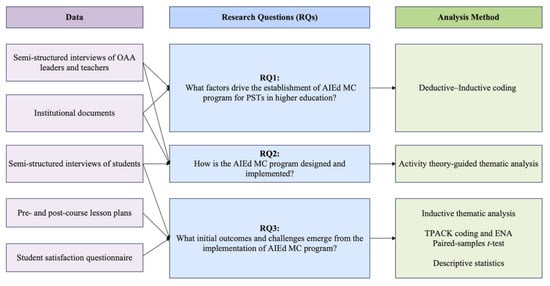
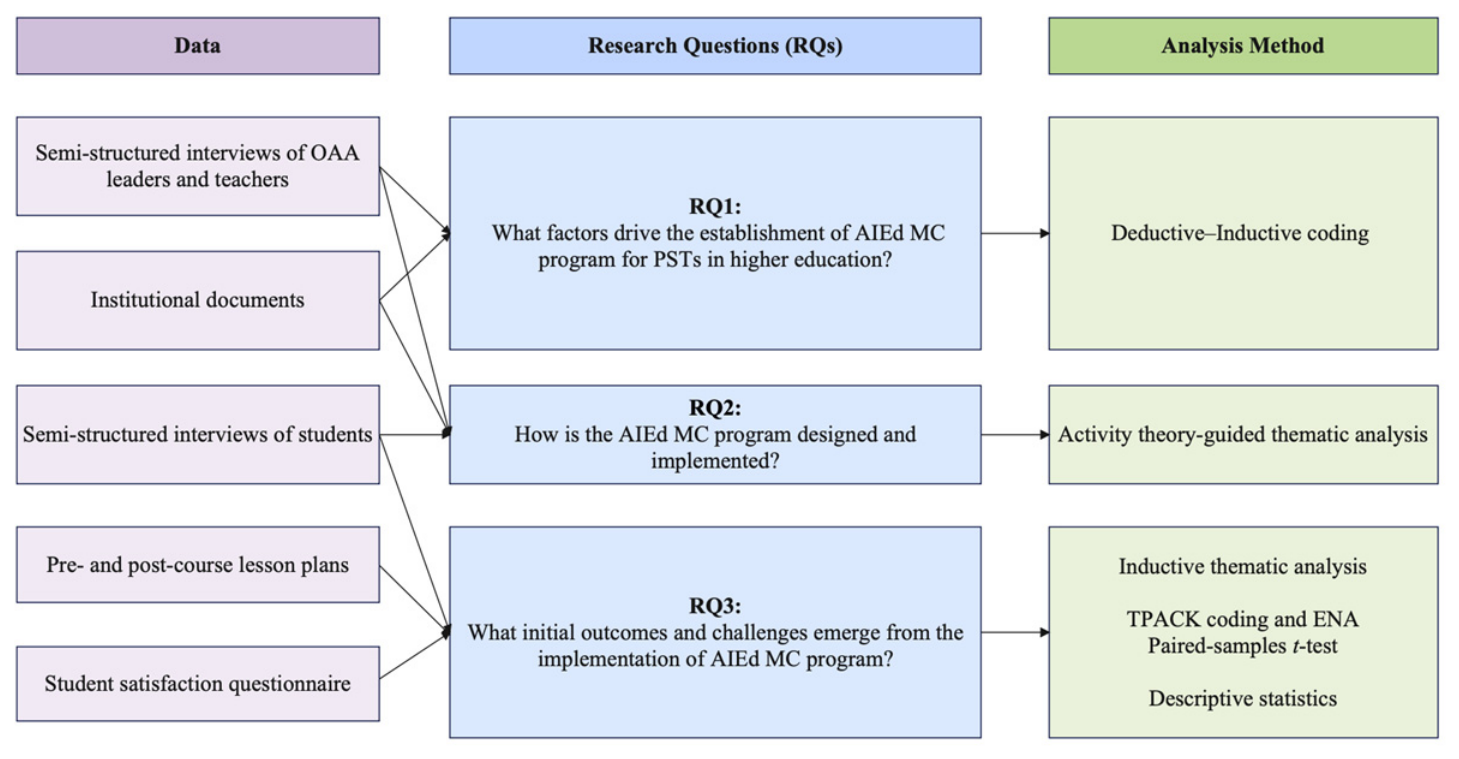
As shown in Figure 1, this study employed multiple learning analytic methods to address the research questions.
Figure 1.
The analytical framework of the research. Note: PSTs: pre-service teachers; OAA: Office of Academic Affairs; AIEd MC: Artificial intelligence education micro-credential; TPACK: Technological Pedagogical Content Knowledge; ENA: Epistemic Network Analysis.
To ensure data triangulation, research materials were gathered from multiple sources to capture a holistic view of the program’s implementation: (1) Semi-structured interviews: The researchers conducted one-on-one, semi-structured interviews with two leaders, two teachers, and 10 students. Each session lasted approximately 30 min and was audio-recorded with informed consent. All recordings were transcribed in Chinese using AI-assisted tools and manually checked for accuracy. Coding was conducted on the Chinese transcripts. Selected quotations were subsequently translated into English for reporting, and an English-language specialist reviewed the translations for linguistic accuracy and fidelity to the original meaning, consistent with recommendations for cross-language qualitative research (Squires, 2009; van Nes et al., 2010). (2) Institutional documents: A total of 11 formal programmatic artifacts were systematically retrieved and analyzed. These included official calls for MC applications, MC institutional management policies, AIEd MC program proposals, implementation schemes, and enrollment brochures. These documents provided a foundational basis for understanding the institutional logic (RQ1) and organizational design (RQ2) of the AIEd MC program. (3) Lesson plans: The study utilized a paired-sample design to track pedagogical development. Fifty participating students were required to submit an initial instructional design (pre-class lesson plan) at the start of the course and a revised version (post-class lesson plan) upon completion. This resulted in a total of 100 lesson plans for comparative analysis. The specific analysis phases are detailed below.
Phase 1: Institutional drivers (RQ1). A combined deductive–inductive coding strategy was used to identify the factors driving the establishment of the AIEd MC program. First, data from multiple sources were organized according to policy, institutional, and professional contexts. Independently of those contextual labels, Institutional Theory guided deductive coding of coercive, mimetic, and normative pressures, followed by inductive coding to identify specific institutional drivers and themes, such as strategic alignment and institutional agility. Interview transcripts were segmented into meaning-bearing units, each expressing a complete idea. Two researchers independently assigned coding categories to the same units, yielding Cohen’s κ = 0.91. Two researchers independently coded the same meaning-bearing units. Because each unit could receive multiple codes, each researcher recorded the presence (1) or absence (0) of every coding category for each unit. Cohen’s κ was calculated by pooling these paired unit-by-code judgments into a single 2 × 2 contingency table. Discrepancies were subsequently discussed and resolved by consensus.
Phase 2: Organizational implementation (RQ2). Thematic analysis (Braun & Clarke, 2006) was performed using Activity Theory as a preset framework. Research materials, including OAA leader interviews, teacher interviews, and documents, were mapped onto the six activity-system elements: subject, object, tools, rules, community, and division of labor, with closer attention to the latter three mediating elements. First, deductive coding mapped the activity system underlying the AIEd MC program. Subsequently, inductive analysis within each dimension identified specific themes. To ensure the accuracy of the organizational descriptions, preliminary findings were shared with OAA leaders for member checking, verifying that the mapped workflows aligned with institutional realities.
Phase 3: Initial outcomes and challenges (RQ3). This phase examined initial outcomes through a dual analytical lens. Epistemic Network Analysis (ENA) models and visualizes co-occurrences among coded elements (Shaffer et al., 2016). It was employed to compare associations among coded TPACK-related elements in the 100 paired lesson plans. Prior to ENA modeling, two trained coders independently coded a randomly selected subset of 20% of the lesson plans (10 pre-test and 10 post-test), yielding Cohen’s κ = 0.85. Inter-coder reliability was assessed using the same pooled binary-judgment procedure described above for interview coding. The coding units were text segments identified in the order of the original lesson-plan content, and both coders judged the same units against the coding framework; disagreements were resolved through discussion. Using the finalized codebook, one of the two coders then coded the remaining 80% of the lesson plans. To minimize bias, all lesson plans were coded in randomized order, and coders were blind to whether each plan was a pre- or post-test version. In webENA 2.0.7, each student’s lesson plan at each time point was defined as a network unit (group > student), and the same grouping defined the conversation boundary. A four-line moving window counted local co-occurrences among consecutive coding records within a single lesson plan; each record represented one code occurrence rather than a whole paragraph. Networks were compared using group means rotation on the first axis and singular value decomposition on the second. Because the 50 students contributed paired plans, paired-samples t-tests were conducted on their exported ENA coordinates rather than relying on webENA’s default independent-samples test. For implementation challenges, inductive coding was applied to student interviews. This analysis identified recurring barriers such as academic heterogeneity and cognitive load.
4. Results
4.1. What Factors Drive the Establishment of AIEd MC Program for PSTs in Higher Education?
4.1.1. Macro-Level: Coercive Pressures from National Policy
At the macro-level, the establishment of the AIEd MC program was strongly influenced by coercive pressures arising from national education policies and reform priorities. Interview data and institutional documents highlighted two major themes: (1) alignment with national policy priorities and (2) the integration of AI into broader educational reform.
First, alignment with national policy priorities: Interview data and institutional documents indicate that the AIEd MC program was closely aligned with national policies on educational digitalization and AI integration. Administrators emphasized the need for PST education to respond to national strategic priorities. Participants specifically referred to the Ministry of Education’s “Double Thousand Plan,” which promotes the development of 1000 MCs and 1000 vocational training courses to enhance student employability. The AIEd MC program was described as a concrete institutional response to this policy agenda. As one OAA leader noted, “We must ensure teacher candidates’ outcomes align with national ‘AI+Education’ policies and the modernization demands of basic education.” This policy alignment was further institutionalized in the AIEd MC Construction and Management Guidelines (hereafter, the “Guidelines”), which require the program to follow the standards and objectives of the MOE’s “Double Thousand Plan.” The Guidelines thus translated national policy requirements into an institutional framework for program development.
Second, the integration of AI into broader educational reform: Beyond responding to specific policy requirements, the university positioned the AIEd MC program within a broader agenda of AI-enabled educational reform. Administrators described AI not simply as a supplementary teaching tool but as part of a wider transformation of PST education. One OAA leader explained, “AIEd MC is merely an entry point; we have numerous complementary initiatives in smart pedagogy, digital textbooks, and clinical teaching practice.” This perspective was also reflected in institutional documents, which linked the AIEd MC program with other digital teaching initiatives. The program was therefore positioned as part of the university’s broader strategy for integrating AI into teacher education.
4.1.2. Meso-Level: Mimetic Pressures Within the University Field
At the meso-level, the establishment of the AIEd MC program was shaped by mimetic pressures arising from developments among peer institutions. Two themes emerged: (1) organizational agility in responding to uncertainty and (2) competitive positioning within the university field.
First, organizational agility in responding to uncertainty: The rapid evolution of AI created pressure for the university to develop more flexible mechanisms for updating teacher education. In the interview, the OAA explained that the university had referred to the practices of Beijing Normal University in developing its own MC program. As one OAA leader noted, “Traditional disciplinary training program revision cycles cannot keep pace with AI’s rapid evolution… AIEd MC enables us to ‘move fast in small steps.’” The program provided a flexible mechanism for introducing AI-related competencies without waiting for lengthy revisions to existing disciplinary programs. Article 13 of the Guidelines further specifies that the AIEd MC program “is not limited to existing disciplinary catalogs,” providing institutional space for flexible program development.
Second, competitive positioning within the university field: The university also considered the development of MCs by peer institutions when positioning its own program. One OAA leader noted, “Currently, some universities have already begun exploring MC models. We must act swiftly to ensure our continued leadership in PST education.” This evidence indicates that developments among peer institutions served as an important reference point for the university’s decision to establish the AIEd MC program, while also encouraging the university to develop a distinctive position in AI-supported teacher education.
4.1.3. Micro-Level: Normative Pressures from Professional Expectations
At the micro-level, the establishment of the AIEd MC program was also shaped by normative pressures associated with professional expectations and the evolving competencies required of PSTs. Three themes emerged: (1) competency development, (2) career competitiveness, and (3) integration of theory and practice.
First, competency development: The program was designed to align PST preparation with emerging professional competency requirements and to strengthen students’ AI literacy. One teacher explained, “When designing my course, I primarily referenced China’s teacher education competency standards and structured the curriculum content accordingly.” Article 8 of the Guidelines similarly requires the AIEd MC program to focus on “core competencies,” ensuring that course content addresses the development of AI-related competencies.
Second, career competitiveness: The program was also perceived as a means of strengthening PSTs’ employability and competitiveness. An OAA official explained, “Students worry about lacking competitive advantages in teacher recruitment and fear being replaced by new AI technologies. Upon completing AIEd MC courses, students receive MCs that are verifiable on the national academic certification platform. This proves highly beneficial for their employment prospects.” This finding suggests that emerging expectations in the teacher labor market contributed to the perceived value of AI-related credentials.
Third, integration of theory and practice: The program incorporated practical components to enable PSTs to apply AI-related knowledge in teaching contexts. One administrator explained, “When designing the MCs, practical training was set as the top priority. All courses within the MC program are required to include hands-on components to ensure students can apply AI knowledge in real teaching contexts.” Document analysis further confirmed that practical courses were an integral component of the program, reflecting the emphasis on applying AI knowledge to authentic teaching practice.
4.2. How Is the AIEd MC Program Designed and Implemented?
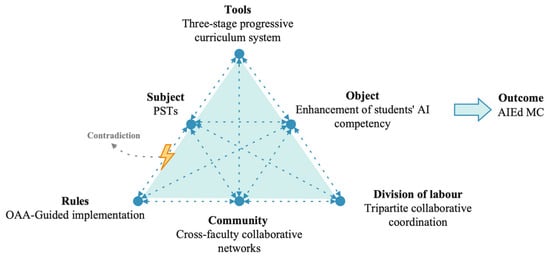
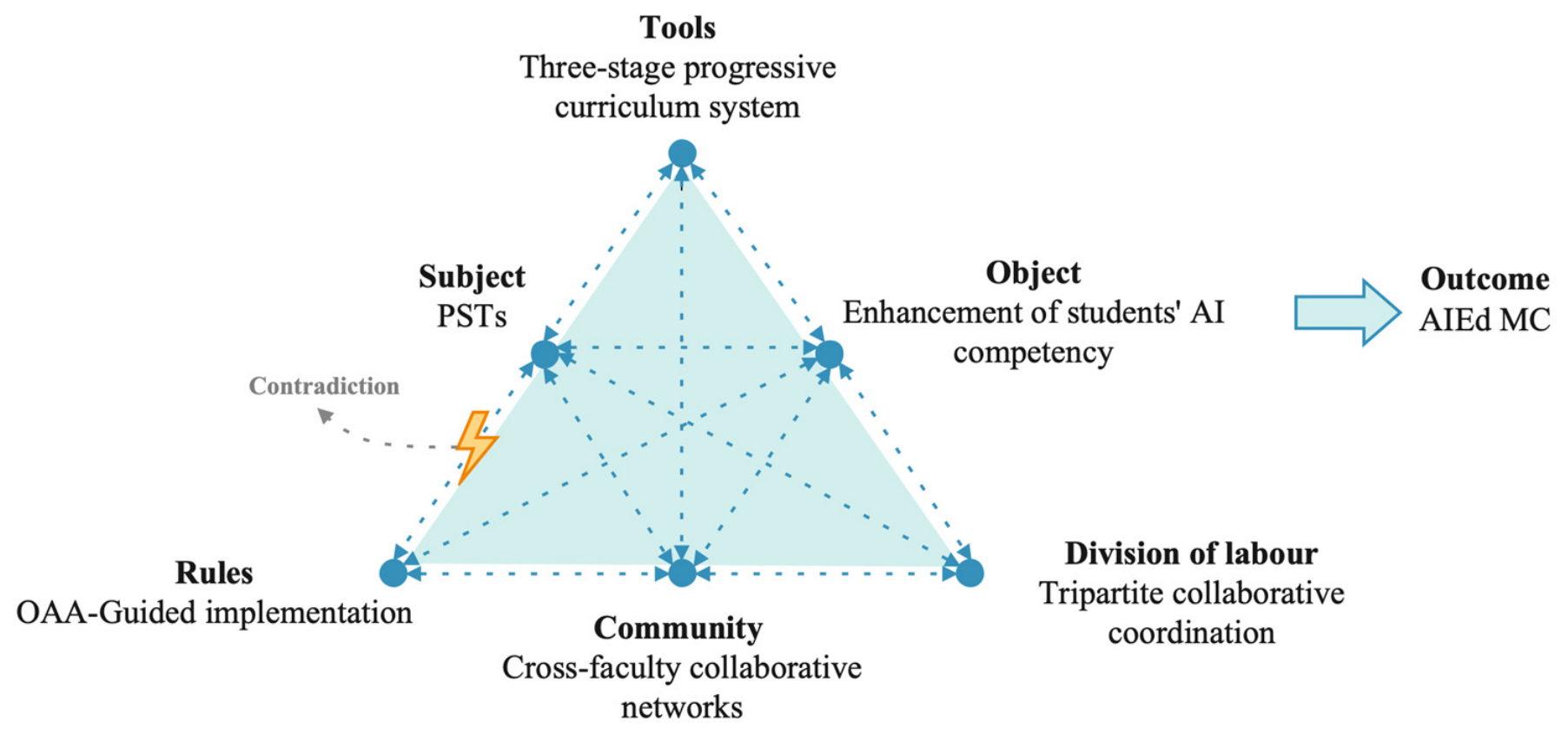
Based on Activity Theory, a thematic analysis of institutional documents and interview data was conducted, and the implementation was examined through the six activity-system elements shown in Figure 2.
Figure 2.
The Activity System of AIEd MC in a Normal University. Note: PSTs: pre-service teachers; OAA: Office of Academic Affairs; AIEd MC: Artificial intelligence education micro-credential; Solid blue arrows represent mutual connections among elements of the activity system. The lightning-bolt symbol together with the grey dashed arrow denotes contradiction (internal tension) within the activity system.
4.2.1. Subject, Object, and Outcomes
Document analysis reveals that the “subject” is explicitly defined as PSTs. Due to limitations in practical training environments and faculty resources during the initial implementation phase, the course capacity is currently limited to 50 participants. The “object”, meaning the shared purpose toward which the activity is directed, is the enhancement of students’ AI competency. The intended outcome is the attainment of the AIEd MC, which formally recognizes students’ achievement of AI-related competencies. The MC is verifiable through China’s HE Student Information and Credit System (CHSI).
4.2.2. Rules, Community and Division of Labor
Rules, community, and division of labor collectively structure the organizational arrangements through which the AIEd MC program is implemented.
Rules: OAA-Guided implementation. The system drives project implementation through policy guidance and resource allocation rather than administrative enforcement. The AIEd MC Application Notice issued by the OAA breaks from the traditional discipline-based approach to program design, stipulating that teaching teams from any academic background may apply to launch AIEd MC provided their proposals meet two criteria: “enhancing student competencies” and “aligning with societal needs.” To support this initiative, the OAA provides institutional safeguards including dedicated funding, teaching workload calculations, and course-hour fee incentives. The AIEd MC leader stated: “The OAA has provided policy support, formal recognition, and financial backing, making the college feel this initiative is both ‘worth pursuing’ and ‘achievable.’”
Community: Cross-faculty collaborative networks. The AIEd MC established a collaborative network led by the OAA, involving cross-faculty participation and partnerships with off-campus practice bases. This network includes the School of Education, the Teacher Competency Development Center, and the AIEd Training Bases. Institutional analysis indicates that the Guidelines clearly define principles for interdisciplinary collaboration and cooperation with social organizations. One teacher affirmed the effectiveness of this approach: “Inter-faculty collaboration is often difficult, but this time, under the OAA’s leadership, teachers genuinely achieved cross-faculty cooperation in offering courses.”
Division of Labor: Tripartite collaborative coordination. To break down isolated disciplines, the OAA established a triangular collaboration framework involving universities, enterprises, and K-12 schools. According to documents and interviews, enterprises are responsible for developing platforms that integrate AI tools and online course resources; K-12 schools provide practical training bases for pre-service teaching; while within universities, the School of Education and Teacher Competency Center jointly manage the delivery of course content. One teacher noted: “This division of labor frees us from tedious technical maintenance, allowing us to focus on course design and ensure AI technology is deeply integrated into teaching.”
4.2.3. Tools and Their Mediating Role: Progression from Technical Application to Pedagogical Integration
Through document analysis of the AIEd MC program, the curriculum was found to follow a phased and progressive structure, moving from technical application and resource development to instructional integration and practical application. The AIEd MC leader noted that the curriculum design incorporates the requirements of AI education while aligning with existing courses.
The first semester focuses on the “Resource level”, utilizing courses such as AI-based Instructional Resource Development and Virtual Reality Educational Applications to provide intelligent support for subject content. The second semester constitutes the “Instructional level”, where courses including Smart Hardware and Innovative Education and Theory and Practice of Human–Machine Collaborative Teaching are designed to reconstruct teaching interaction methods. The third semester represents the “Practical Level”, utilizing courses such as Educational Data Analysis and Visualization and AI-Driven Project-Based Learning Design and Practice to promote comprehensive curriculum integration. The design aims to facilitate students’ transition from technical application toward complex instructional decision-making capabilities, with the integrative capstone course positioned at the final stage of this progression.
4.2.4. Contradiction and Evolution: Restructuring Recruitment Logic
Contradiction serves as the key driving force for a system’s self-evolution within Activity Theory. Interviews revealed that during the system’s initial operation, conflicts arose between “rules” and “subjects.” Specifically, the original selection process involved a written exam followed by an interview, a multi-stage approach that created an excessive cognitive load that conflicted with PSTs’ existing academic pressures. This led to lower-than-expected enrollment, causing systemic imbalance. To address this issue, the OAA restructured its recruitment strategy, pivoting from a “selection-oriented” approach to an “experiential-oriented” model characterized by open enrollment without entry exams. Data from student interviews indicated this change effectively mitigated students’ psychological barriers. Consequently, the recruitment modification helped reduce this tension by bringing the rules of participation into closer alignment with students’ capacities and needs.
4.3. What Initial Outcomes and Challenges Emerge from the Implementation of AIEd MC Programs?
4.3.1. Analysis of Student Satisfaction
Descriptive statistics presented in Table 2 indicated relatively high overall satisfaction among the 47 respondents (M = 3.61, SD = 0.48). Teaching attitude received the highest mean rating (M = 3.70, SD = 0.55). These ratings describe students’ perceptions of the program rather than objectively measured learning outcomes.
Table 2.
Descriptive Statistics of Satisfaction.
4.3.2. Changes in TPACK-Related Associations in Students’ Lesson Plans
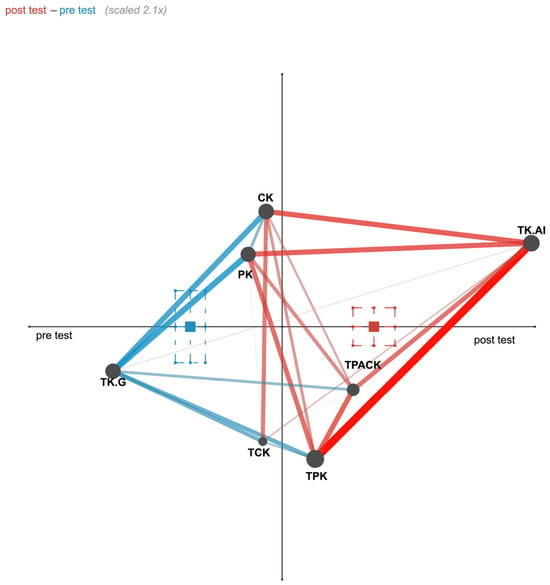
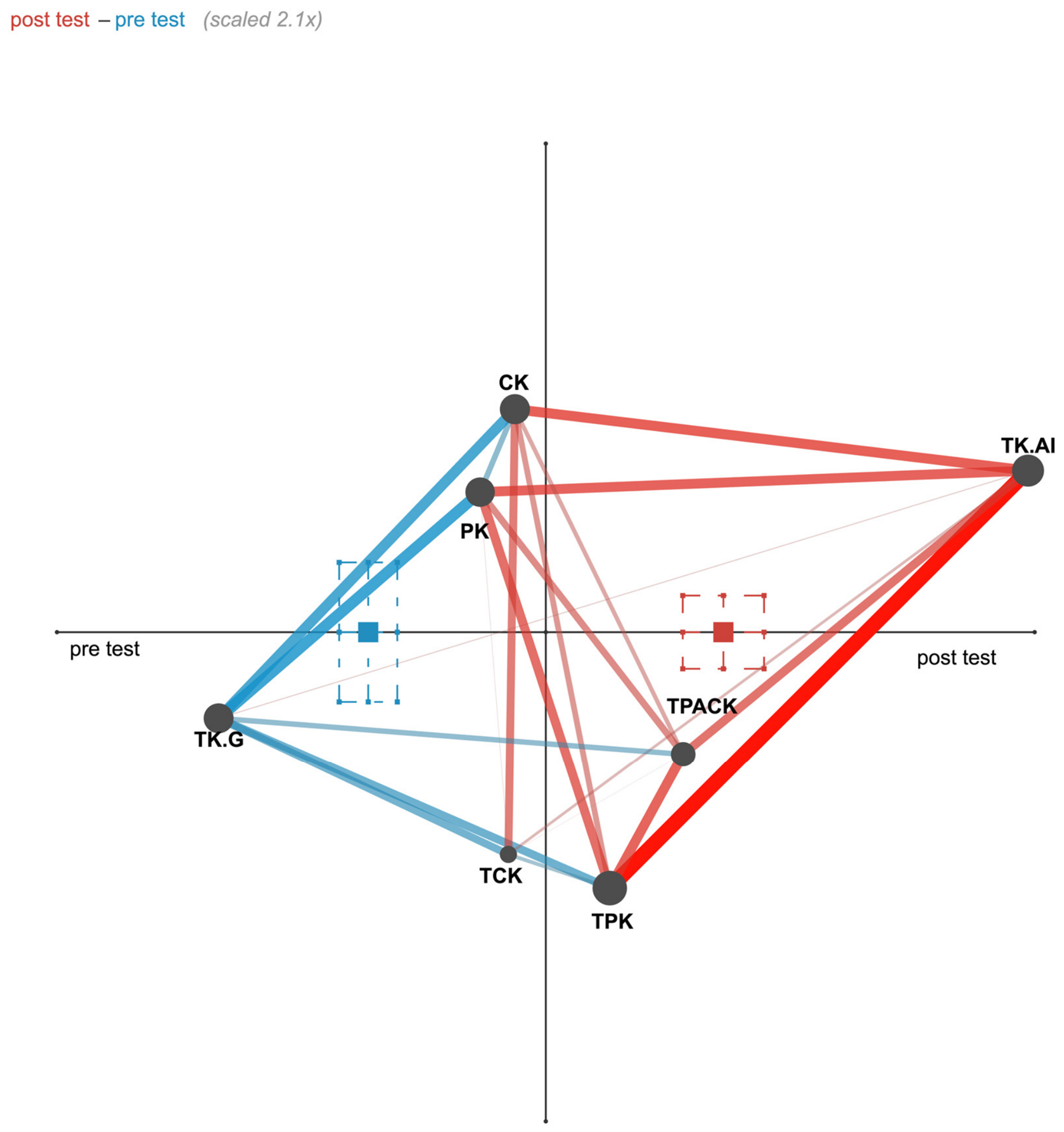
As shown in Figure 3, the subtraction diagram shows differences in the relative connections among TPACK-related codes in students’ lesson plans through the stark contrast between red and blue connections. On the left side of the network (pre-test), lesson plans exhibit relatively prominent general technology connections. Blue connections between TK-G and PK/CK were relatively stronger than in the post-test network, whereas TK-AI connections were less pronounced. This pattern describes coded associations in lesson plans and does not directly measure classroom teaching performance.
Figure 3.
Subtracted Network of Students’ TPACK-Related Codes: Pre-test (Blue) vs. Post-test (Red). Note: Dashed squares indicate confidence regions for group central points of pre-test and post-test networks.
In contrast, the dense red connections on the right side of the network (post-test) indicate relatively stronger AI-related connections in the post-test lesson plans. Notably, links involving TK-AI and both TPK and CK were more prominent than in the pre-test networks. The post-test network also showed relatively weaker connections involving TK-G and a difference in the TPK–TPACK association. These patterns describe relative code associations in the revised lesson plans collected after the first-semester resource-level courses. A paired-samples t-test on student-level ENA coordinates showed a difference on GMR1 (pre-test: M = −0.308, SD = 0.177; post-test: M = 0.307, SD = 0.248), t(49) = −13.84, p < 0.001, |d_z| = 1.96; no mean difference was observed on SVD2. Pearson and Spearman co-registration correlations were 0.97 for both axes, with variance proportions of 0.27 (GMR1) and 0.22 (SVD2). These results describe changes in coded lesson-plan associations and do not establish a causal effect on teaching ability.
4.3.3. Challenges
Based on interviews with students who enrolled in the AIEd MC courses during the first semester, this study identified several challenges that constrained students’ participation and learning experiences, despite their overall positive perceptions of the program. Four major themes emerged from the interview data: heavy academic workload, geographical barriers to participation, heterogeneity in prior knowledge, and limited opportunities for hands-on practice.
(1) Heavy academic workload. Students reported that the intensive coursework associated with their major programs made it difficult to allocate sufficient time to the AIEd MC courses. In particular, the practical assignments required substantial time and effort, creating difficulties in balancing MC requirements with their regular academic workload. As one student explained, “While studying the AIEd MC, I encountered numerous hands-on assignments that required significant time commitments.”
(2) Geographical barriers to participation. Students also identified the physical distance between campuses as a practical barrier to participation. Because the courses were offered at the old campus, students studying at the new campus often had to spend nearly one hour commuting each way. Some students therefore switched from in-person to online participation. Although online delivery provided greater flexibility, two students reported that it was less effective than face-to-face interaction, particularly because they could not access laboratory facilities for hands-on activities.
(3) Heterogeneity in prior knowledge. The open-admission policy broadened access to the AIEd MC courses but also resulted in considerable diversity in students’ academic and technological backgrounds. Students with computer science backgrounds generally perceived some course content as relatively basic, whereas those without relevant backgrounds reported greater difficulty understanding the material. For example, a Music major student explained: “Some classmates with computer backgrounds find the courses easy, but I personally find understanding the algorithmic logic behind large language models quite challenging, because I hadn’t encountered these technologies before.”
(4) Limited opportunities for hands-on practice. Insufficient opportunities for practical application emerged as another prominent concern. Although students appreciated the flexibility provided by online learning, they emphasized that theoretical instruction alone was insufficient for developing a deeper understanding of emerging AI technologies. One student noted, “Some theories are taught in great depth, but without hands-on practice, we forget them quickly after finishing the course.” Another student similarly expressed a desire for more face-to-face practical sessions: “We hope for more practical sessions, especially in operating new technologies like Generative AI, to deepen our understanding through hands-on training.”
5. Discussion
RQ1 asks: “What factors drive the establishment of AIEd MC program for PSTs in higher education?” In response, the results indicate that the establishment of the AIEd MC program reflected multiple institutional pressures and corresponding responses in policy, organizational, and professional contexts.
Institutional Theory identifies coercive pressure as one mechanism through which organizations respond to expectations in their environment (DiMaggio & Powell, 1983). At the macro level, coercive policy pressures prompted the university to establish the AIEd MC, thereby aligning institutional strategy with national education priorities. However, the findings suggest that policy compliance was not passive. The university actively interpreted national policy signals and embedded the AIEd MC within a broader agenda of AI-enabled educational reform, linking it to smart pedagogy, digital textbooks, and clinical teaching practice. The present case suggests that, during early adoption, institutional responses may involve local interpretation of policy demands as well as alignment with them.
Meyer and Rowan (1977) provide a perspective on organizational conformity and legitimacy. At the meso-level, mimetic pressures arising from peer institutions’ AI-related initiatives encouraged the university to adopt the MC as a flexible mechanism for adapting its PST education provision. Rather than simply replicating existing models, the university used the MC format to address the temporal mismatch between rapid AI development and slow curriculum revision cycles. In this case, reference to peer institutions appears to have informed a locally differentiated response to AI-related demands.
Research on teacher AI literacy situates professional learning in relation to the integration of AI into teaching (Ding et al., 2024). At the micro level, the findings reveal that normative pressures operated through both formal competency expectations and emerging labor-market signals. The program incorporated competency development, career-oriented credentialing, and practical training, thereby responding to changing conceptions of what constitutes a competitive and professionally prepared future teacher. The present case suggests that perceived employability expectations accompanied formal competency expectations in the rationale for initial adoption.
RQ2 asks: “How is the AIEd MC program designed and implemented?” Engeström’s (2014) Activity Theory directs attention to relationships among activity-system elements and the tensions between them. From this perspective, the first-semester evidence can be interpreted as an account of coordination and adjustment during early implementation, rather than proof of an activity-system effect. First, the OAA’s leadership and the tripartite division of labor reduced conflicts arising from interdisciplinary collaboration. By delegating technical maintenance to enterprises and practical fieldwork to K-12 schools, the university reduced non-teaching workloads for faculty, allowing them to focus on instructional design. In the present case, these accounts suggest that coordination among responsibilities and tool provision was an ongoing organizational process.
Second, Hooper and Rieber’s (1995) stages of technology integration provide a perspective on the designed progression from technical application to pedagogical integration. Within this design, the final course, AI-Driven Project-Based Learning Design and Practice, is intended to serve as an integrative moment in which previously separated tools, rules, and community elements converge. Because the present cohort had completed only the first-semester, resource-level courses when the post-test lesson plans were collected, the observed shift reflects the early stage of this progression rather than its culmination. Coordination among tools, rules, and division of labor provides one possible interpretation of the first-semester implementation context, but the design does not isolate its effect on the lesson-plan associations; whether the full transition unfolds as designed awaits the instructional- and practical-level courses in subsequent semesters.
Third, Activity Theory treats contradictions as a basis for change within an activity system (Engeström, 2014). In this case, the restructuring of recruitment rules, from a selection-oriented to an experiential-oriented model, represents a shift in contradictions rather than a final resolution. The initial tension between rules and subjects was alleviated, but open enrollment subsequently produced a new tension between the standardized curriculum and the diversified community of learners. This sequence suggests that alleviating one tension during early implementation may be accompanied by another, requiring further adjustment of rules and instructional support.
RQ3 asks: “What initial outcomes and challenges emerge from the implementation of AIEd MC program?” Meyer and Rowan’s (1977) concept of loose coupling provides a perspective on the relationship between formal adoption and implementation conditions. In this case, the results indicate that students expressed high satisfaction with the AIEd MC program, while ENA results showed differences in TPACK-related code associations in students’ written lesson plans: connections between TK-AI and both TPK and CK strengthened from pre- to post-test, suggesting more prominent AI-related associations in the revised lesson plans. These outcomes indicate that, within the first semester, the findings included both favorable self-reports and observable differences in students’ written instructional designs. However, this high satisfaction coexisted with significant challenges: geographical distance, heavy academic workload, heterogeneous prior knowledge, and limited hands-on practice. This tension may reflect a gap between the formal adoption of the program and the learning conditions available during its first semester. Students valued the credential because it aligned with emerging normative expectations, but the daily learning environment was not yet sufficiently restructured to support deeper engagement.
The open enrollment policy further illustrates this dynamic. While it accelerated uptake, it also produced learner heterogeneity that misaligned the standardized curriculum with students’ diverse needs. This is not merely an implementation problem; it suggests that the very flexibility promised by micro-credentials may, when embedded within existing curricular and administrative structures, become a new form of rigidity. Instead of adapting to learner diversity, the fixed course sequence and unified pacing reproduced the structural inertia that the MC was intended to overcome. This finding complicates the assumption that micro-credentials are inherently flexible: flexibility at the credential level does not automatically translate into flexibility at the instructional level.
These challenges are broadly consistent with concerns identified in the micro-credential literature (Wheelahan & Moodie, 2022), while some, particularly those related to campus location, reflected the specific institutional arrangements of the present program. In this case, campus location illustrates how access to flexible delivery can coexist with restricted access to practical facilities. These experiences suggest that geographical constraints not only affected students’ participation modes but also limited their opportunities for practical learning. The variation in prior knowledge also suggests a need for differentiated instructional support. Whether similar tensions arise in other open-access micro-credential programs requires comparison. These comments highlight a perceived gap between theoretical instruction and opportunities to apply newly acquired knowledge in authentic learning activities.
Future AIEd MC initiatives should therefore move beyond open enrollment toward differentiated instructional support and more practice-oriented learning opportunities, including AI learning assistant agents (Semerikov et al., 2025; Yan et al., 2025). Moreover, formal mechanisms for credit recognition and transfer are essential to reposition MCs from an “additive burden” to a “strategic optimization” of the existing curriculum (Wheelahan & Moodie, 2022). Without such mechanisms, micro-credentials risk remaining peripheral additions that generate enthusiasm but fail to achieve durable integration into teacher preparation. The central lesson is that institutional responsiveness to AI cannot be reduced to the creation of new programs; it requires ongoing attention to how those programs interact with existing organizational structures, learner diversity, and the practical conditions of teaching and learning.
6. Implications for International Teacher Education
Although this study is situated in a Chinese normal university, the findings identify possible design considerations for teacher education institutions responding to AI. Their relevance beyond this case depends on institutional conditions and requires comparative evaluation.
First, the case raises a question for comparative research about how universities translate external AI policy expectations into locally meaningful curricular responses. The present case suggests that the key organizational capacity is not mere compliance, but the ability to reinterpret external policy signals within a broader agenda of educational reform. This interpretive capacity may be particularly important when emerging technologies create new professional expectations that existing curricula cannot easily accommodate.
Second, the use of micro-credentials as a flexible organizational mechanism to bypass slow curriculum revision cycles suggests a design possibility for consideration in other settings. The underlying principle is to create shorter, stackable learning pathways that can be updated more rapidly than full degree programs. However, the capacity to enact such flexibility depends on institutional conditions. In the Chinese case, the Office of Academic Affairs played a central coordinating role; in less centralized systems, similar functions might need to be performed by teaching innovation centers, cross-faculty consortia, or quality assurance units. Thus, comparative work could examine whether different institutional bodies perform a similar coordinating function.
Third, the contradictions observed between open enrollment and instructional coherence identify a tension in this case that may also warrant examination in other AI-related teacher education settings. When participation barriers are lowered to accelerate adoption, learner heterogeneity increases, and standardized course structures may no longer align with students’ diverse needs. This indicates that flexibility at the credential level does not automatically produce flexibility at the instructional level. Institutions adopting AI micro-credentials internationally should therefore attend not only to credential design but also to the instructional structures through which they are delivered, particularly the provision of differentiated support.
Finally, the Chinese case is instructive because its strong policy environment made institutional adoption highly visible and relatively rapid, thereby bringing underlying tensions between policy signaling and pedagogical integration, between access and quality, and between flexibility and coherence, into sharper relief. Whether these tensions arise in other institutional and national settings requires further comparative research. For institutions considering similar initiatives, a practical implication is to examine how credential design fits their own organizational and instructional arrangements, rather than assume that the arrangements observed here will transfer directly.
7. Conclusions and Limitations
This study focuses on an AIEd MC program in TE, conducting an in-depth analysis across three dimensions: institutional drivers, organizational implementation, and initial outcomes. At the theoretical level, this study brings Institutional Theory and Activity Theory together to explain initial adoption and organizational adaptation in one teacher education institution. The findings do not establish enduring institutionalization. At the practical level, the findings suggest that MCs, as an agile institutional tool, show potential to bridge disciplinary boundaries and support AI-related subject-specific lesson planning. Although these findings are preliminary, they identify organizational arrangements and instructional needs for further evaluation in teacher education.
This study has two broad limitations. First, the evaluation period was confined to a single semester, providing a preliminary analysis of the program’s initial implementation. While the results are promising, the persistence of the observed planning patterns and their relevance to classroom practice remain to be established. Future research should conduct ongoing tracking extending into students’ internship or employment phases to examine how skills acquired through AI education courses are applied in frontline classrooms.
Second, this single-institution case is shaped by a specific policy and organizational context; its transferability requires further comparison. The absence of a control group prevents attribution of the observed lesson-plan differences to the program alone. Because the post-course plans were revisions of initial plans within an AI-focused course, increased AI-related content may partly reflect the task and course expectations rather than broader professional knowledge development. The small number of administrator and instructor interviews, together with the concentration of quotations from the OAA leader, limits the range of institutional perspectives represented. Although interviewers did not teach or grade participants, the research team’s involvement in coding and interpretation may still influence the analysis.
The questionnaire and student interviews rely on self-reported experiences. Survey administration after the final session may introduce social-desirability effects, while willingness-based interview participation may favor more engaged or satisfied students. These procedures cannot establish how prevalent the interview views were across the cohort. In addition, coding 80% of lesson plans by a single coder leaves possible coder-specific interpretation beyond the jointly coded subset. The evidence therefore concerns initial adoption, reported experiences, and written plans, rather than causal program effects, lasting institutionalization, or observed classroom teaching.
Author Contributions
Conceptualization, S.Z. and C.K.; methodology, S.Z. and C.K.; writing—original draft preparation, S.Z. and C.K.; writing—review and editing and supervision, Y.S.; funding acquisition, Y.S. All authors have read and agreed to the published version of the manuscript.
Funding
This anonymized version omits identifying details for peer review purposes. This work was supported by the National Social Science Foundation of China Youth Program in Education under Grant Number CCA240257.
Institutional Review Board Statement
Institutional Review Board Statement: The study was conducted in accordance with the Declaration of Helsinki, and approved by the Scientific Ethics Subcommittee of the Academic Committee of Shaanxi Normal University (protocol code 202505032, 27 May 2025).
Informed Consent Statement
Written informed consent was obtained from all participants involved in the study.
Data Availability Statement
The interview codebook, worked coding examples, and supporting analytical materials are available in the supporting data repository (https://data.mendeley.com/datasets/2x37kx55vf/1 (accessed on 5 November 2026). Requests for additional study materials may be directed to the corresponding author, subject to participant confidentiality.
Conflicts of Interest
The authors declare no conflict of interest.
References
- Ahsan, K., Akbar, S., Kam, B., & Abdulrahman, M. D. A. (2023). Implementation of micro-credentials in higher education: A systematic literature review. Education and Information Technologies, 28(10), 13505–13540. [Google Scholar] [CrossRef] [Scilit]
- Akyuz, D. (2018). Measuring technological pedagogical content knowledge (TPACK) through performance assessment. Computers & Education, 125, 212–225. [Google Scholar] [CrossRef] [Scilit]
- Alsobhi, H. A., Alakhtar, R. A., Ubaid, A., Hussain, O. K., & Hussain, F. K. (2023). Blockchain-based micro-credentialing system in higher education institutions: Systematic literature review. Knowledge-Based Systems, 265, 110238. [Google Scholar] [CrossRef] [Scilit]
- Braun, V., & Clarke, V. (2006). Using thematic analysis in psychology. Qualitative Research in Psychology, 3(2), 77–101. [Google Scholar] [CrossRef] [Scilit]
- Bruguera, C., Pagés, C., & Fitó, À. (2026). Tailoring micro-credentials for diverse learners: A qualitative study of motivations and course-design preferences in European higher education. International Journal of Lifelong Education. Advanced online publication. [Google Scholar] [CrossRef] [Scilit]
- Carnegie Mellon University. (2026). Graduate certificate in managing AI systems. CMU Online. Available online: http://www.cmu.edu/online/mais/ (accessed on 15 February 2026).
- Celik, I., Dindar, M., Muukkonen, H., & Järvelä, S. (2022). The promises and challenges of artificial intelligence for teachers: A systematic review of research. TechTrends, 66(4), 616–630. [Google Scholar] [CrossRef] [Scilit]
- Cronbach, L. J. (1951). Coefficient alpha and the internal structure of tests. Psychometrika, 16(3), 297–334. [Google Scholar] [CrossRef] [Scilit]
- Darling-Hammond, L. (2017). Teacher education around the world: What can we learn from international practice? European Journal of Teacher Education, 40(3), 291–309. [Google Scholar] [CrossRef] [Scilit]
- DiMaggio, P. J., & Powell, W. W. (1983). The iron cage revisited: Institutional isomorphism and collective rationality in organizational fields. American Sociological Review, 48(2), 147–160. [Google Scholar] [CrossRef] [Scilit]
- Ding, A. C. E., Shi, L., Yang, H., & Choi, I. (2024). Enhancing teacher AI literacy and integration through different types of cases in teacher professional development. Computers and Education Open, 6, 100178. [Google Scholar] [CrossRef] [Scilit]
- Dogan, S., Nalbantoglu, U. Y., Celik, I., & Agacli Dogan, N. (2025). Artificial intelligence professional development: A systematic review of TPACK, designs, and effects for teacher learning. Professional Development in Education, 51(3), 519–546. [Google Scholar] [CrossRef] [Scilit]
- Engeström, Y. (2014). Learning by expanding: An activity-theoretical approach to developmental research. Cambridge University Press. [Google Scholar]
- Fedock, B., Kebritchi, M., Sanders, R., & Holland, A. (2016). Digital badges and micro-credentials: Digital age classroom practices, design strategies, and issues. In Foundation of digital badges and micro-credentials: Demonstrating and recognizing knowledge and competencies (pp. 273–286). Springer International Publishing. [Google Scholar]
- Fennell, M. L. (1980). The effects of environmental characteristics on the structure of hospital clusters. Administrative Science Quarterly, 25(3), 485–510. [Google Scholar] [CrossRef] [Scilit]
- Gamage, K. A. A., & Dehideniya, S. C. P. (2025). Unlocking career potential: How micro-credentials are revolutionising higher education and lifelong learning. Education Sciences, 15(5), 525. [Google Scholar] [CrossRef] [Scilit]
- Guan, L., Zhang, Y., & Gu, M. M. (2025). Pre-service teachers’ preparedness for AI-integrated education: An investigation from perceptions, capabilities, and teachers’ identity changes. Computers and Education: Artificial Intelligence, 8, 100341. [Google Scholar] [CrossRef] [Scilit]
- Holmes, W., & Miao, F. (2023). Guidance for generative AI in education and research. UNESCO Publishing. [Google Scholar] [CrossRef] [Scilit]
- Hooper, S., & Rieber, L. P. (1995). Teaching with technology. In A. C. Ornstein (Ed.), Teaching: Theory into practice (pp. 154–170). Allyn and Bacon. [Google Scholar]
- Hutchins, N. M., Zhang, S., Barrett, J. R., & Israel, M. (2025). Empowering educators in AI: Insights from co-designing an AI microcredential with and for K-12 educators. Proceedings of the AAAI Conference on Artificial Intelligence, 39(28), 35186. [Google Scholar] [CrossRef] [Scilit]
- Kohnke, L., Zou, D., & Xie, H. (2025). Microlearning and generative AI for pre-service teacher education: A qualitative case study. Education and Information Technologies, 30, 21221–21248. [Google Scholar] [CrossRef] [Scilit]
- Kumar, J. A., Richard, R. J., Osman, S., & Lowrence, K. (2022). Micro-credentials in leveraging emergency remote teaching: The relationship between novice users’ insights and identity in Malaysia. International Journal of Educational Technology in Higher Education, 19(1), 18. [Google Scholar] [CrossRef] [Scilit] [PubMed]
- Li, W., & Ironsi, C. S. (2024). Efficacy of micro credential learning spaces in developing students’ twenty-first century skills: Towards graduate work readiness. Education and Information Technologies, 29(1), 1201–1216. [Google Scholar] [CrossRef] [Scilit]
- Lu, W., & Lin, C. (2025). How do artificial intelligence literacy constructs work—Based on a survey of university non-expert students. Education and Information Technologies, 30(10), 13779–13805. [Google Scholar] [CrossRef] [Scilit]
- Ma, Y., Su, Y., Li, M., Zhang, Y., Chai, W., Huang, A., & Zhao, X. (2025). Preparing students for an AI-driven world: Generative AI and curriculum reform in higher education. Frontiers of Digital Education, 2(4), 30. [Google Scholar] [CrossRef] [Scilit]
- Maina, M. F., Guàrdia Ortiz, L., Mancini, F., & Martinez Melo, M. (2022). A micro-credentialing methodology for improved recognition of HE employability skills. International Journal of Educational Technology in Higher Education, 19(1), 10. [Google Scholar] [CrossRef] [Scilit] [PubMed]
- Meyer, J. W. (1979). The impact of the centralization of educational funding and control on state and local organizational governance (Program Report No. 79–B20). Institute for Research on Educational Finance and Governance, Stanford University.
- Meyer, J. W., & Rowan, B. (1977). Institutionalized organizations: Formal structure as myth and ceremony. American Journal of Sociology, 83(2), 340–363. [Google Scholar] [CrossRef] [Scilit] [PubMed]
- Mishra, P., & Koehler, M. J. (2006). Technological pedagogical content knowledge: A framework for teacher knowledge. Teachers College Record, 108(6), 1017–1054. [Google Scholar] [CrossRef] [Scilit]
- Ng, D. T. K., Leung, J. K. L., Chu, S. K. W., & Qiao, M. S. (2021). Conceptualizing AI literacy: An exploratory review. Computers and Education: Artificial Intelligence, 2, 100041. [Google Scholar] [CrossRef] [Scilit]
- Ngoc Ha, N. T., Van Dyke, N., & Spittle, M. (2026). Micro-credentials in higher education: Perceived benefits for graduate employability and interest levels in micro-credentials for training employability skills. Studies in Higher Education, 51(7), 1447–1459. [Google Scholar] [CrossRef] [Scilit]
- OECD. (2023a). Micro-credential policy implementation in Finland, the Slovak Republic, Slovenia and Spain (OECD Education Policy Perspectives, No. 86). OECD Publishing. Available online: https://www.oecd-ilibrary.org/education/micro-credential-policy-implementation-in-finland-the-slovak-republic-slovenia-and-spain_c3daa488-en (accessed on 23 February 2026).
- OECD. (2023b). Micro-credentials for lifelong learning and employability: Uses and possibilities (OECD Education Policy Perspectives, No. 66). OECD Publishing. Available online: www.oecd.org/content/dam/oecd/en/publications/reports/2023/03/micro-credentials-for-lifelong-learning-and-employability_13dd81a9/9c4b7b68-en.pdf (accessed on 16 February 2026).
- Peters, M., Beirne, E., & Brown, M. (2025). Micro-credentials and their implications for lifelong learning–global insights and critical perspectives. Distance Education, 46(1), 1–7. [Google Scholar] [CrossRef] [Scilit]
- Pirkkalainen, H., Sood, I., Padron Napoles, C., Kukkonen, A., & Camilleri, A. (2023). How might micro-credentials influence institutions and empower learners in higher education? Educational Research, 65(1), 40–63. [Google Scholar] [CrossRef] [Scilit]
- Selvaratnam, R. M., & Sankey, M. D. (2021). An integrative literature review of the implementation of micro-credentials in higher education: Implications for practice in Australasia. Journal of Teaching and Learning for Graduate Employability, 12(1), 1–17. [Google Scholar] [CrossRef] [Scilit]
- Semerikov, S. O., Nechypurenko, P. P., Vakaliuk, T. A., Mintii, I. S., & Fadieieva, L. O. (2025). Differential effects of Moodle course design on student subpopulations: Advancing personalized learning in higher education. Smart Learning Environments, 12(1), 46. [Google Scholar] [CrossRef] [Scilit]
- Shaffer, D. W., Collier, W., & Ruis, A. R. (2016). A tutorial on epistemic network analysis: Analyzing the structure of connections in cognitive, social, and interaction data. Journal of Learning Analytics, 3(3), 9–45. [Google Scholar] [CrossRef] [Scilit]
- Shanmughan, P., Joseph, J., Brinda, N. S., Anitha, S. M., Anuja, C. S., & Jose, J. (2024). The AI revolution in micro-credentialing: Personalized learning paths. Frontiers in Education, 9, 1445654. [Google Scholar] [CrossRef] [Scilit]
- Squires, A. (2009). Methodological challenges in cross-language qualitative research: A research review. International Journal of Nursing Studies, 46(2), 277–287. [Google Scholar] [CrossRef] [Scilit] [PubMed]
- Thi Ngoc Ha, N., Spittle, M., Watt, A., & Van Dyke, N. (2023). A systematic literature review of micro-credentials in higher education: A non-zero-sum game. Higher Education Research and Development, 42(6), 1527–1548. [Google Scholar] [CrossRef] [Scilit]
- UNESCO. (2021). AI and education: Guidance for policy-makers. UNESCO Publishing. [Google Scholar] [CrossRef] [Scilit]
- University of Southampton. (2026). Conversion master’s in artificial intelligence. University of Southampton Online. Available online: https://www.online.southampton.ac.uk/artificial-intelligence-masters-courses (accessed on 25 February 2026).
- van Nes, F., Abma, T., Jonsson, H., & Deeg, D. (2010). Language differences in qualitative research: Is meaning lost in translation? European Journal of Ageing, 7(4), 313–316. [Google Scholar] [CrossRef] [Scilit] [PubMed]
- Varadarajan, S., Koh, J. H. L., & Daniel, B. K. (2023). A systematic review of the opportunities and challenges of micro-credentials for multiple stakeholders: Learners, employers, higher education institutions and government. International Journal of Educational Technology in Higher Education, 20(1), 13, (Correction in 2023, International Journal of Educational Technology in Higher Education, 20, 24). [Google Scholar] [CrossRef] [Scilit] [PubMed]
- Varadarajan, S., Koh, J. H. L., & Daniel, B. K. (2025). Institutional readiness for the implementation of micro-credentials in higher education. Distance Education, 46(1), 36–55. [Google Scholar] [CrossRef] [Scilit]
- Wheelahan, L., & Moodie, G. (2022). Gig qualifications for the gig economy: Micro-credentials and the ‘hungry mile’. Higher Education, 83(6), 1279–1295. [Google Scholar] [CrossRef] [Scilit] [PubMed]
- Yan, L., Martinez-Maldonado, R., Jin, Y., Echeverria, V., Milesi, M., Fan, J., Zhao, L., Alfredo, R., Li, X., & Gašević, D. (2025). The effects of generative AI agents and scaffolding on enhancing students’ comprehension of visual learning analytics. Computers & Education, 234, 105322. [Google Scholar] [CrossRef] [Scilit]
- Yao, W., Qian, S., & Xie, W. (2025). Exploring the effectiveness of micro-credentials in artificial intelligence teaching and learning: An empirical study based on AI+ X program in China. Cogent Education, 12(1), 2536528. [Google Scholar] [CrossRef] [Scilit]
- Yin, R. K. (2018). Case study research and applications: Design and methods (6th ed.). SAGE Publications. [Google Scholar]
- Zawacki-Richter, O., Marín, V. I., Bond, M., & Gouverneur, F. (2019). Systematic review of research on artificial intelligence applications in higher education—Where are the educators? International Journal of Educational Technology in Higher Education, 16, 39. [Google Scholar] [CrossRef] [Scilit]

Disclaimer/Publisher’s Note: The statements, opinions and data contained in all publications are solely those of the individual author(s) and contributor(s) and not of MDPI and/or the editor(s). MDPI and/or the editor(s) disclaim responsibility for any injury to people or property resulting from any ideas, methods, instructions or products referred to in the content. |
© 2026 by the authors. Licensee MDPI, Basel, Switzerland. This article is an open access article distributed under the terms and conditions of the Creative Commons Attribution (CC BY) license.