


Abstract
Pakistan has expanded teacher recruitment across its public education system over the past decade, yet policy and monitoring reports continue to document substantial rural, school-level, and subject-specific teacher shortages. In this article, I extend the concept of educational wastage to teachers, shifting attention from the loss of teachers to the loss or underuse of instructional capacity among formally employed teachers. I identify three forms of teacher wastage. Pre-deployment wastage occurs when appointment does not result in classroom instruction because teachers cannot take up or sustain placements, political influence directs placements away from school staffing needs, or teachers recorded as employed do not teach. Structural wastage occurs when teachers in schools are diverted from or misaligned with instruction through transfer instability, non-academic duties, or subject or grade-level misassignment. Erosive wastage occurs when teachers remain employed but lack adequate pedagogical preparation, induction, mentoring, or continuing professional support. Pakistan’s administrative systems track teacher positions, payroll, transfers, and attendance but provide limited evidence of whether employed teachers sustain classroom instruction. Illustrations from India, Nigeria, and Bangladesh suggest the framework’s relevance beyond Pakistan without claiming generalizability. Teacher wastage offers a basis for examining how education systems may retain teachers while losing instructional capacity.
1. Introduction
UNESCO estimates that 44 million additional teachers will be needed globally by 2030 to achieve universal primary and secondary education (UNESCO, 2024). Pakistan faces persistent teacher shortages within this global challenge (Naviwala, 2016; Rizwan & Taniguchi, 2022). International and national reports document shortages in teacher availability, unfavorable student–teacher ratios, and staffing gaps across rural districts and schools (Idara-e-Taleem-o-Aagahi, 2024; Pakistan Institute of Education, 2025; Rizwan & Taniguchi, 2022). To address these issues, provincial governments have conducted multiple large-scale teacher recruitment drives to fill vacant posts. In Sindh province alone, the government appointed more than 93,000 primary and junior elementary school teachers between 2021 and 2025 (Express Tribune, 2025). Despite these recruitment efforts, policy documents and monitoring reports continue to identify substantial rural, school-level, and subject-specific teacher shortages (Idara-e-Taleem-o-Aagahi, 2024; Rizwan & Taniguchi, 2022). Large applicant pools for public teaching positions indicate that the challenge is not a lack of candidates. In Sindh’s 2021 recruitment, more than 184,000 candidates took the test for about 23,500 primary teacher posts (Express Tribune, 2021). The unresolved question is why repeated large-scale recruitment drives have not translated into stable teacher staffing across schools and classrooms.
The problem persists in part because it is addressed as a shortage of teachers. Government responses have focused on filling sanctioned posts through recruitment. Yet teacher deployment, transfer instability, misassignment, and teacher turnover with slow replacement can continue to generate shortages inside schools (Ali et al., 2025; Siddiqui & Shaukat, 2021). The result can be a recurring policy cycle in which staffing gaps generate further recruitment, even when the system has not accounted for the instructional capacity lost among teachers already employed.
Rafiq (1996) approached a related problem through the concept of educational wastage. He analyzed waste in internal efficiency (student repetition and dropout), the underutilization of school capacity, and student–teacher ratios. His findings showed that schools and teachers could be available within the education system but remain underused, particularly in rural areas and girls’ schools. I extend this idea to the loss or underuse of instructional capacity among formally employed teachers and call it teacher wastage.
Teacher wastage takes three forms: pre-deployment wastage, structural wastage, and erosive wastage. Pre-deployment wastage occurs when appointed teachers do not reach functional classrooms because of inaccessible placements, political allocation, or ghost employment. Structural wastage occurs when teachers who reach schools are diverted from or misaligned with instruction through transfer instability, non-academic duties, or subject or grade-level misassignment. Erosive wastage occurs when teachers remain employed but receive inadequate pedagogical preparation, mentoring, or career support, which weakens their capacity for sustained classroom instruction.
Teacher wastage does not refer to every interruption in teaching activity. Illness, authorized leave, necessary administrative responsibilities, planned transfers, and normal adjustment required during the early years of teaching are routine conditions of educational work. Such conditions become relevant to teacher wastage when they produce recurrent losses in instructional capacity that arise from or are sustained by organizational and policy conditions within the education system. The distinction is therefore between a temporary reduction in teaching activity and a recurring system-level failure to convert teacher employment into sustained classroom instruction. From this perspective, teacher wastage makes visible a form of instructional capacity loss that conventional measures of recruitment, attrition, turnover, and retention can leave unexamined. An education system may add more teachers to its payroll while experiencing continued losses in the instructional capacity available to students. In this paper, Pakistan serves as the principal case through which the framework is developed and examined, while examples from India, Nigeria, and Bangladesh illustrate its possible relevance beyond Pakistan without establishing generalizability.
2. Locating Teacher Wastage in the Shortage Literature
A major line of research on teacher shortages draws on Ingersoll’s (2001) analysis of teacher turnover. Ingersoll (2001) argued that school staffing problems cannot be explained by an insufficient supply of qualified teachers alone. Schools may experience persistent shortages when teachers enter and leave at rates that exceed the capacity of schools to maintain a stable workforce. Organizational conditions, including administrative support, compensation, and teacher participation in decision-making, are associated with differences in turnover (Ingersoll, 2001). This perspective shifted attention from teacher supply alone toward the organizational conditions that shape teachers’ decisions to remain in or leave schools. Subsequent research extended this line of inquiry to induction and mentoring (Smith & Ingersoll, 2004) and to the role of pre-service preparation in beginning teacher attrition (Ingersoll et al., 2014). Teacher shortages, from this perspective, reflect both the supply of teachers and the conditions under which teachers are retained and deployed.
Teacher distribution introduces another dimension of the shortage problem. Cowan et al. (2016) argued that national data on teacher supply do not support claims of a general teacher shortage, even as staffing difficulties persist in specific subjects, such as STEM and special education, and in specific types of schools, such as rural schools and schools serving disadvantaged students. A national supply of teachers may therefore appear adequate while schools and classrooms experience shortages. The distribution of teachers, however, may not fully describe what happens to instructional capacity after teachers are recruited.
Both perspectives moved shortage analysis beyond simple counts of vacancies. They provide useful starting points for examining the Pakistani context, although the mechanisms through which teachers enter, move within, and remain in the public education system differ from those emphasized in the U.S. literature. In Pakistan’s public education system, teachers have limited control over school placement and transfer compared with the degree of individual mobility emphasized in Ingersoll’s (2001) analysis. Provincial and district education authorities determine teacher postings through administrative procedures (School Education & Literacy Department, 2021; Siddiqi, 2022). Transfers are mediated by administrative processes and, in some contexts, political influence (Ali et al., 2025; Siddiqi, 2022). Government teaching positions provide job security and social status that may keep teachers in their jobs even when working conditions are difficult (Siddiqi, 2022). Teachers may remain formally employed while placement, transfer, assignment, non-academic duties, or inadequate professional support reduce, interrupt, or misalign the instructional capacity available to students.
Teacher turnover captures movement out of schools or positions (Ingersoll, 2001), but it does not capture instructional-capacity losses that occur while teachers remain employed. Teacher attrition concerns departure from the teaching profession (Borman & Dowling, 2008). Teacher absenteeism concerns teachers’ absence from their assigned posts (Chaudhury et al., 2006). Out-of-field teaching concerns the assignment of teachers to subjects for which they have limited preparation or training (Ingersoll, 1999). Underutilization concerns situations in which available teacher or school capacity is not fully used (Rafiq, 1996). Teacher professionalization encompasses conditions associated with teachers’ professional status and practice, including credentials, induction, professional development, specialization, authority, and compensation (Ingersoll & Alsalam, 1997). Each concept identifies a distinct dimension of teacher employment and instruction. These dimensions are generally examined separately rather than as components of a common framework for examining whether formal teacher employment results in sustained classroom instruction over time.
The conceptual gap, therefore, is not a lack of research on teacher attrition, turnover, deployment, absenteeism, assignment, or professional support. These areas are well established. What remains underexamined is how instructional capacity can be lost or underused even when teachers are employed, assigned to schools, and physically present. Teacher wastage provides a way to examine this loss from appointment and placement through sustained classroom instruction.
3. Conceptual Approach and Evidence Selection
I extend the concept of educational wastage to teachers and develop the teacher wastage framework through a conceptual synthesis of peer-reviewed research, official education statistics, government policy documents, reports from international agencies, and selected media reports (Snyder, 2019; Torraco, 2005). Peer-reviewed research and official records were given priority, while selected media reports were used mainly to illustrate recent administrative cases not yet documented in academic research and to report official figures not available in published sources. The purpose is not to estimate the prevalence of each form of wastage but to bring together mechanisms that are usually examined separately and assess how they contribute to losses in instructional capacity. Pakistan is the main case, while evidence from India, Nigeria, and Bangladesh illustrates the possible relevance of the framework beyond Pakistan. The three forms of teacher wastage were identified by grouping documented problems according to when instructional capacity is lost or weakened, from teacher appointment through continued classroom instruction. These forms represent a conceptual interpretation of the available evidence and remain to be studied empirically.
4. A Typology of Teacher Wastage
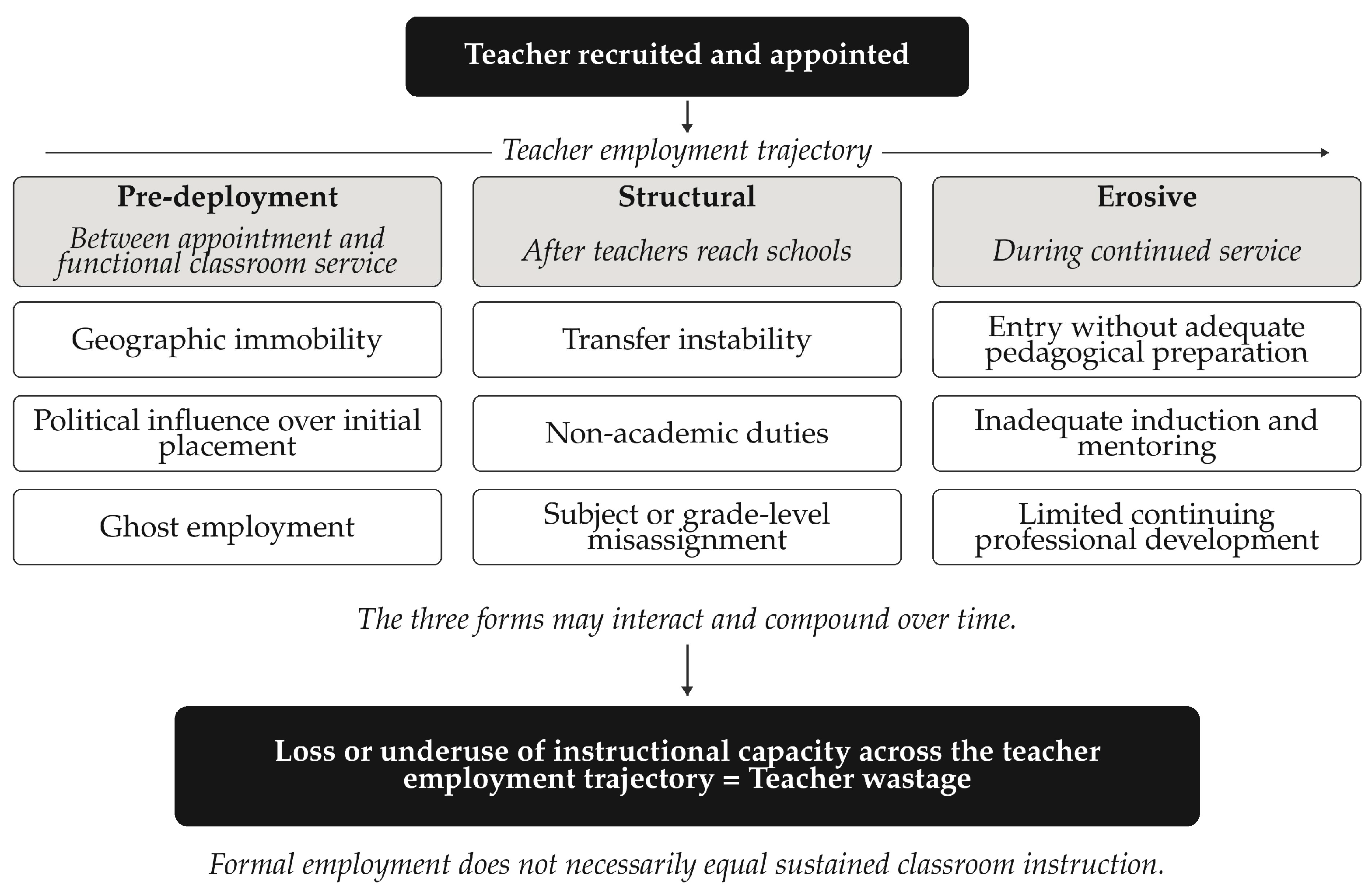
Three forms of wastage operate in Pakistan’s public education system (see Figure 1). Pre-deployment wastage occurs when appointed teachers fail to reach classrooms. Structural wastage occurs after teachers reach schools, when organizational arrangements disrupt, reduce, or misalign classroom instruction. Erosive wastage occurs when teachers continue working in schools but inadequate preparation or professional support weakens instructional capacity over time. The categories are organized by when instructional capacity is lost in a teacher’s trajectory, not by the nature of the mechanism producing the loss. The same mechanism can appear at more than one point. For example, political influence over postings may affect both initial placement and later transfer. The three forms are not mutually exclusive and may interact and compound over time.
Figure 1.
Three forms of teacher wastage are distinguished by when instructional capacity is lost or weakened from appointment through continued classroom instruction. Pre-deployment wastage occurs between appointment and regular classroom instruction. Structural wastage occurs after teachers reach schools, when organizational arrangements disrupt, reduce, or misalign instruction. Erosive wastage develops as inadequate preparation or professional support weakens instructional capability over time.
As noted in the Introduction, every education system experiences temporary losses in instructional capacity through illness, necessary administrative tasks, planned teacher mobility, and adjustment to new positions. Teacher wastage refers instead to recurrent instructional loss produced or sustained by how teachers are recruited, deployed, assigned, transferred, and supported. A teacher’s absence for several days because of illness is a routine interruption. A teacher’s repeated removal from classroom instruction for official non-academic duties is an organizational loss. Teacher wastage should be distinguished from instructional quality. Ineffective instruction alone does not constitute teacher wastage; it becomes relevant only when organizational or policy conditions systematically reduce, divert, misalign, or weaken the instructional capacity available to students. Table 1 clarifies how each mechanism produces instructional loss and identifies possible indicators for future research.
Table 1.
Mechanisms, Consequences, and Possible Indicators of Teacher Wastage.
Attendance records provide evidence of teacher presence. They do not establish what teachers do while present at school. A teacher recorded as present may be teaching, supervising an examination, completing administrative work, or engaging in another activity. Measuring instructional loss requires evidence of classroom activity. The Stallings Classroom Snapshot, for example, provides a structured approach for examining teachers’ use of instructional time, use of materials, pedagogical practices, and student engagement (World Bank, 2015a). The distinction between teacher availability and instructional activity is essential for empirical work on teacher wastage.
4.1. Pre-Deployment Wastage
Pre-deployment wastage occurs when teacher appointment does not result in sustained classroom instruction. In Pakistan’s public education system, teachers are recruited through provincial processes and posted to schools by education authorities (School Education & Literacy Department, 2021; Siddiqi, 2022). Teachers have limited control over their initial placement, and some appointed teachers may be unable to relocate to assigned schools because of transportation, safety, or socio-cultural constraints.
For many women, rural placements may involve safety concerns, restrictive social norms, and limited access to housing and transportation (Pak Alliance for Maths and Science, 2022; Siddiqui & Shaukat, 2021). These conditions can make relocation to assigned schools difficult or unsustainable. Pakistan’s government school system is largely separated by gender, with female teachers teaching in girls’ schools (Ghuman & Lloyd, 2010). Yet prevailing socio-cultural norms constrain women’s ability to relocate to rural areas where female teachers are needed. Schools in urban areas may have surplus teachers, while schools in rural and remote areas continue to operate with vacancies (Siddiqui & Shaukat, 2021). The system may record a successful appointment while the assigned school continues to lack regular classroom instruction.
In Sindh, the provincial government has attempted to address this problem by requiring newly recruited teachers to serve at their assigned school for the first three years of employment, which prevents transfers to other districts during this period (School Education & Literacy Department, 2021). The restriction appears intended to reduce immediate transfers from rural to urban locations. However, it does not address the conditions that make rural placements difficult to sustain. A teacher required to serve three years in a rural school without adequate housing, transportation, safety provisions, or professional support may report to the school but still experience conditions that weaken instructional capacity over time. The no-transfer policy may reduce immediate transfer-related losses while increasing vulnerability to irregular attendance and erosive wastage if these conditions remain unaddressed.
The second mechanism is politically influenced initial placement. Teacher postings in Pakistan’s public schools have been subject to sifarish, the use of personal or political recommendation, through which elected representatives may influence where teachers are placed after appointment (Ali et al., 2025; Siddiqi, 2022). Teachers with political connections may secure placements in accessible or urban schools, while schools without comparable political access may continue to operate with vacancies. Such patterns can reinforce an already uneven distribution of teachers, in which urban schools have surplus teachers while schools in rural and disadvantaged areas face shortages (Rizwan & Taniguchi, 2022; Siddiqui & Shaukat, 2021). Political influence over later in-service transfers is discussed under structural wastage.
The third mechanism is ghost employment. Pakistan’s education system has a documented history of ghost teachers, who are recorded as employed but do not report to their assigned schools or provide regular classroom instruction (Naviwala, 2016). A 2025 media report stated that the Sindh Education Department had identified approximately 5000 ghost teachers receiving salaries without fulfilling their duties (ANI News, 2025). A 2024 media report stated that inquiries by the Federal Investigation Agency and the department had found 157 Sindh Education Department employees living abroad while continuing to receive government salaries (Express Tribune, 2024). Biometric monitoring has increased the capacity to verify teacher presence (Rizwan & Taniguchi, 2022), although reported cases indicate that administrative systems may still be vulnerable to failures in verification and enforcement.
The three mechanisms differ in how they prevent appointment from resulting in regular classroom instruction. Geographic immobility concerns whether teachers can take up or sustain assigned placements. Politically influenced placement concerns how appointed teachers are distributed across schools. Ghost employment concerns whether teachers recorded as employed provide instruction. In each case, the system may record a teacher as appointed or employed while a school continues to lack regular classroom instruction.
4.2. Structural Wastage
Structural wastage occurs after teachers have entered schools and begun teaching, when organizational arrangements disrupt, reduce, or misalign classroom instruction. Three mechanisms are examined here: transfer instability, non-academic duties, and subject or grade-level misassignment.
Transfer instability interrupts teaching continuity within schools. Pakistan’s public school system has historically relied on provincial and district administrative processes for teacher transfers. Punjab introduced a points-based transfer policy in 2013 and moved the process online in 2018 (Siddiqui & Shaukat, 2021), and Sindh launched an online e-Transfer system for teachers in January 2026 (School Education & Literacy Department, 2026). These systems have changed how transfers are processed, but teacher movement can still be shaped by political relationships and administrative decisions (Ali et al., 2025; Siddiqi, 2022). Politicians have historically used teacher recruitment as a form of patronage, partly because teachers serve as polling staff during elections. Teachers with political patrons may be shielded from disciplinary action (Naviwala, 2016). Teachers who do not comply with the expectations of local political actors may be transferred to less developed areas (Siddiqi, 2022), and rationalization policies have moved teachers to other schools against their choice (Siddiqui & Shaukat, 2021). Such transfers can create conflicts for teachers and their families and affect the quality of teaching and learning (Siddiqui & Shaukat, 2021). The teacher remains employed, but instructional continuity may be disrupted at the sending school while the receiving school undergoes another period of adjustment.
Non-academic duties constitute a second mechanism of structural wastage. Public school teachers form one of Pakistan’s largest public workforces, outnumbering active-duty military personnel (Naviwala, 2016), and the country relies on their reach into rural communities for activities such as polio vaccination campaigns, population census enumeration, election duty, dengue campaigns, and work in disaster-affected areas (Nasreen & Naz, 2019). These are not occasional requests. They are recurring obligations that remove teachers from classrooms for days or weeks during the school year. Some are legally enforced. Under the Elections Act 2017, a teacher deputed as an election official comes under the “control, superintendence and discipline” of the Election Commission from the date of deputation until the name of the elected candidate is published in the official Gazette, and the Commission may impose penalties for misconduct notwithstanding any other law (Elections Act, 2017, s. 55). Naviwala (2016) reported an estimate that government teachers spend approximately one-quarter of the academic year on non-teaching activities. In a survey of 250 elementary school teachers in Sahiwal, Punjab, 72% agreed that these duties hindered syllabus completion, and 76% agreed that they diverted teachers’ attention from teaching (Nasreen & Naz, 2019). The cumulative amount of instructional time lost across the teacher workforce remains insufficiently documented.
Subject or grade-level misassignment is the third mechanism. Misassignment occurs when teachers are assigned to subjects or grade levels for which they have limited preparation or training (Ingersoll, 1999). Pakistan’s staffing structure creates additional challenges in schools where a single teacher is responsible for multiple grades and subjects. The Pakistan Institute of Education (2025) reports that 24% of public primary schools nationally are single-teacher schools, rising to 45% in Sindh and 41% in Balochistan. In these schools, teachers may be responsible for multiple subjects and grade levels simultaneously, often without preparation for multigrade teaching, as curriculum and training are usually designed for single-grade classrooms (Naviwala, 2016; Nawab & Baig, 2011). At the middle and secondary levels, shortages of subject specialists in mathematics, science, and English persist (Rizwan & Taniguchi, 2022), which may require general teachers to teach subjects outside their preparation or relevant qualifications. These conditions can place teachers in instructional roles that do not correspond with their preparation.
Across all three mechanisms, teachers may remain formally employed while the instructional capacity available to students is interrupted, diverted, or misaligned.
4.3. Erosive Wastage
Erosive wastage occurs when teachers remain employed and continue teaching, but inadequate preparation or professional support weakens the development and maintenance of instructional capacity over time. Teaching experience does not automatically produce improvement (Kraft & Papay, 2014). Professional learning depends in part on feedback, mentoring, and structured opportunities to develop practice (Darling-Hammond, 2017). When these forms of support are limited, teachers may continue teaching without receiving the assistance needed to strengthen their instructional practice. Unlike pre-deployment and structural wastage, erosive wastage develops gradually and may not be visible in attendance or staffing records.
In 2020–21, unemployment among Pakistani university graduates was 16.1%, more than twice the national rate of 6.3% (Ahsan & Khan, 2023). When provincial governments advertise thousands of teaching positions, the applicant pool includes both graduates trained for teaching and graduates from other fields who may enter teaching because employment opportunities in their original fields are limited. Entry from outside teacher education is not itself a deficiency. Such graduates may have strong subject knowledge, but subject knowledge and knowledge of teaching are not the same. Shulman (1986) described pedagogical content knowledge as the knowledge needed to represent subject matter in ways that make it accessible to learners. Recruitment examinations, however, may give limited weight to pedagogical knowledge. Sindh’s Recruitment Policy 2021, under which the province’s recent large-scale recruitment was conducted, specifies a 100-mark written test organized around subject content. Although the policy lists pedagogy, instructional planning, and learning environment among its stated aims, the mark distribution assigns all 100 marks to subject groups, and selection is based primarily on written-test performance. Professional teaching qualifications are credited only through a small number of additional marks after the test, with a four-year B.Ed. (Hons.) receiving four marks and a one-year B.Ed. receiving one mark (School Education & Literacy Department, 2021).
Such recruitment may bring into teaching what I term accidental teachers: graduates who enter teaching because preferred employment opportunities are unavailable, not because teaching was their first occupational choice. The career-choice literature identifies “fallback career” as one motivation for choosing teaching, though it is generally among the least endorsed (Watt & Richardson, 2007). In a survey of 346 Pakistani high school teachers, 53% reported entering teaching as a first choice and 47% as a lateral choice (Arshad et al., 2024). In Khyber Pakhtunkhwa, some male teachers described joining the profession because few other jobs were available (Siddiqi, 2022). These findings do not establish the prevalence or motivations of non-first-choice entrants across Pakistan. They do indicate that teaching is not the first occupational choice for some entrants. Such entry becomes relevant to erosive wastage when teachers begin without adequate pedagogical preparation and subsequently receive insufficient induction, mentoring, or continuing professional support.
Professional development shapes whether instructional capacity strengthens over time. Popova et al. (2022) reviewed 33 programs in low- and middle-income countries. Student learning gains tended to be larger when programs were linked to career incentives, focused on specific subjects, gave teachers opportunities to practice new skills, and began with face-to-face training. The same authors examined 139 government-funded programs operating at scale in 14 countries. Most of these programs offered few incentives to participate, little opportunity for practice, and limited follow-up after teachers returned to their classrooms. Access to professional development alone is therefore unlikely to be sufficient. Its content, opportunities for practice, and follow-up support also matter.
Teacher induction and professional development in Pakistan show several of these limitations. In Sindh, induction training for newly recruited primary and junior elementary school teachers was designed as a four-week program of 24 working days, including four days of micro-teaching or teaching practice (Sindh Teacher Education Development Authority, 2022). Research on professional development in rural Pakistan, however, indicates that teachers show limited interest in training or make few changes to their classroom practice afterward, partly because of weak monitoring and accountability (Nawab, 2020). A study of teachers from urban areas assigned to rural schools in northern Sindh reported limited support from stakeholders, negative attitudes among senior teachers, weak monitoring, and heavy workloads (Nawab et al., 2025). These conditions may leave new teachers with little structured guidance after induction.
The distinction between instructional time and instructional capability helps clarify how erosive wastage differs from the other two forms. Instructional time refers to the time teachers spend providing classroom instruction. Instructional capability refers to the knowledge and practice teachers bring to that instruction. Together, instructional time and instructional capability make up the instructional capacity available to students. Pre-deployment wastage removes both because appointed teachers do not begin regular classroom instruction. Structural wastage can reduce instructional time or place teachers in roles that do not match their preparation. Erosive wastage weakens or limits the development of instructional capability over time.
Provincial monitoring systems can track teacher attendance through biometric technology (Rizwan & Taniguchi, 2022). Such systems establish whether teachers are physically present at school but do not show the quality or development of their instructional practice. Promotion is tied largely to seniority rather than demonstrated instructional quality (Rizwan & Taniguchi, 2022). Teachers with substantially different levels of instructional practice may therefore progress through the system under similar promotion structures.
Research in U.S. contexts has documented how prolonged professional strain and difficult working conditions can contribute to teacher attrition (Craig, 2014; Singer et al., 2023). This relationship may operate differently in Pakistan, where public-sector employment is highly valued for its job security and associated benefits (Hyder, 2007). Recent evidence from newly recruited teachers in Sindh supports the relevance of job security to retention. In a study of 218 newly recruited teachers, Perveen et al. (2025) found that job security moderated the relationship between emotional exhaustion and intention to quit. Teachers with greater job security were less likely to intend to leave, even when their emotional exhaustion was high. Retention may remain stable even when the conditions needed to sustain and develop instructional capacity are poor.
Erosive wastage is more difficult to measure than pre-deployment or structural wastage. Pre-deployment wastage can be examined by linking appointment records to school attendance data, while structural wastage can be traced through transfer, duty-assignment, and teacher-assignment records. Erosive wastage requires longitudinal evidence about instructional practice, professional learning, mentoring, and support. Available evidence does not indicate that Pakistan’s education system collects such information systematically at scale.
4.4. Interactions Among the Three Forms
The three forms of teacher wastage do not operate independently. A composite example illustrates how documented mechanisms may interact from initial appointment through continued classroom instruction. Consider a female teacher recruited through a provincial examination and assigned to a rural girls’ school in a district she has never visited. She cannot find housing, transportation is limited, and she lives several hours from the school. Although she reports to the school, she cannot attend consistently. After three years, when her posting requirement ends, she secures a transfer through a political contact and moves to a semi-urban school. Her departure disrupts instructional continuity at the rural school. At the new school, she teaches English, mathematics, and science across three grade levels in one classroom. She received induction training when she was appointed but has had no classroom observation or mentoring since. The biometric system records her as present, but it does not capture that she is teaching multiple subjects and grade levels without preparation for multigrade instruction.
Each part of this example corresponds to a documented mechanism of teacher wastage. Difficulty sustaining the initial rural placement reflects pre-deployment wastage. The transfer and subsequent subject and grade-level misassignment reflect structural wastage. Limited induction, professional isolation, and the absence of mentoring contribute to erosive wastage. Throughout these changes, the teacher remains formally employed, while the instructional capacity available to students may be lost, interrupted, misaligned, or weakened. The recruitment of more than 93,000 teachers in Sindh does not necessarily mean that every appointment results in sustained classroom instruction.
5. Measuring What the System Cannot See
The teacher shortage problem in Pakistan is not simply a lack of data. Education management information systems often collect substantial data but remain underused (Nayyar-Stone, 2014). Provincial education departments have invested substantial resources in digital systems. In Sindh alone, the Sindh Education Management Information System (SEMIS) has conducted an annual school census since 1991 and tracks enrollment, teachers, and school infrastructure (Reform Support Unit, 2024). The Sindh School Monitoring System uses field monitors with biometric devices to check teacher attendance (Global Partnership for Education, 2017). However, available evidence does not indicate that these systems routinely link a teacher’s recruitment record with initial placement, attendance, transfer history, and classroom assignment. Nor does it indicate the existence of a system that tracks individual teachers from appointment through sustained classroom instruction.
This disconnection makes pre-deployment wastage difficult to identify. Detecting it requires knowing whether an appointed teacher reached the assigned school and began providing regular instruction. If an appointed teacher never reports, the post may appear as filled in recruitment records while the assigned school continues to experience a vacancy. Without linked records, the discrepancy may remain undetected. Detecting structural wastage requires information about how teachers’ working time and assignments change after they reach schools. Duties such as census work and election administration are assigned through official orders from district governments and school heads (Nasreen & Naz, 2019). However, available evidence does not indicate that these orders are aggregated into measures of instructional time lost at the school or district level.
Measuring erosive wastage requires longitudinal information about instructional practice, mentoring, professional development, feedback, and changes in teaching over time. Nayyar-Stone (2014) observed that education management information systems are often used for reporting, not for improving services. Current data systems do not appear able to determine how many of the 93,000 teacher appointments in Sindh between 2021 and 2025 resulted in sustained classroom instruction. Without that information, the next cycle of shortage will produce the next cycle of recruitment.
6. Teacher Wastage Beyond Pakistan
The teacher wastage framework developed in this article emerges from Pakistan’s institutional conditions, but the problem it addresses is not unique to Pakistan. Education systems across the Global South may recruit teachers at scale while school-level shortages persist (UNESCO, 2024). India, Nigeria, and Bangladesh provide three illustrative cases for considering the framework beyond Pakistan. These countries were selected because each has a large public education system, government-managed teacher deployment, persistent staffing challenges, and documented losses or uneven distribution of instructional capacity. The examples do not establish the framework’s generalizability across the Global South.
India provides a closely related example. Large investments in public primary education during the 2000s substantially improved school inputs, including student–teacher ratios (Muralidharan et al., 2017), and the Right to Education Act of 2009 set national student–teacher ratio requirements. Yet teacher absence remained substantial. In a nationally representative panel study of 1297 villages, Muralidharan et al. (2017) found that 23.6% of public school teachers in rural India were absent during unannounced visits. They found that reductions in student–teacher ratios were associated with increased absence among existing teachers. Teachers in India are assigned non-teaching duties such as election and census work, although an earlier study found that these duties accounted for only a small share of measured absence (Kremer et al., 2005). Muralidharan et al. (2017) estimated that reducing teacher absence through more frequent monitoring could be over ten times more cost-effective than hiring additional teachers at increasing teacher–student contact time. The example of India illustrates how losses among already employed teachers can limit the instructional gains expected from recruitment.
Nigeria presents Pakistan’s paradox in a starker form. A 2025 media report estimated that Nigeria had more than one million unemployed education graduates (Punch, 2025b). Yet the Universal Basic Education Commission (UBEC), the federal agency responsible for coordinating basic education in Nigeria, has reported a gap of 194,876 teachers at the primary level (Kola-Dare, 2024), while approximately 915,000 teachers serve nearly 32 million students in public and private primary schools (Punch, 2025a). Eighteen states reportedly failed to recruit a single teacher for five consecutive years between 2019 and 2024 (Punch, 2025a). Teacher recruitment has been criticized as politically influenced (WikkiTimes, 2025). The Deputy National President of the National Parent Teacher Association of Nigeria stated that there is no merit in the recruitment of teachers and urged the Teachers Registration Council of Nigeria to sanitize the system (Kola-Dare, 2024). Ghost teachers on government payrolls remain a reported problem. In Bayelsa State, for example, a government review found that 612 of the 7207 primary school teachers on the state payroll were ghost workers (Ripples Nigeria, 2021). The World Bank’s 2013 Service Delivery Indicators survey in four Nigerian states found that 13.7% of primary school teachers were absent from school and that, of those at school, about a fifth (19.1%) were not in class teaching (World Bank, 2015b). Staffing shortages have left many teachers handling multiple subjects and combining classes (WikkiTimes, 2025). UBEC’s 2022 National Personnel Audit found that 67.5% of public-school teachers had not attended any in-service training between 2018 and 2022 (Ojo, 2023). UBEC reported that the number of teachers in public primary and junior secondary schools declined by 21% and 19%, respectively, which it attributed partly to COVID-19 and to states neither recruiting new teachers nor replacing those who left service (Kola-Dare, 2024).
Nigeria illustrates how teacher shortages can persist even when large numbers of education graduates are seeking employment. Ghost teachers on government payrolls correspond to pre-deployment wastage, while assigning teachers to multiple subjects and combined classes because of staffing shortages represents structural wastage. The limited reach of in-service training points to erosive wastage.
Bangladesh offers a partial contrast. The country has recruited teachers at scale at the primary level, and about two-thirds of the 383,624 teachers in government primary schools in 2024 were women. The student–teacher ratio in government primary schools fell from 46:1 in 2010 to 28:1 in 2024 (Directorate of Primary Education, 2025). The Integrated Primary Education Management Information System (IPEMIS) allows the Directorate of Primary Education to monitor enrollment and teacher distribution across schools, so that shortages can be addressed through reallocation or recruitment (Jahan, 2026). Bangladesh illustrates how administrative data can be connected to school-level staffing needs and deployment decisions, although shortages persist.
These examples suggest that losses or uneven use of instructional capacity may arise through different mechanisms across education systems. India illustrates how teacher absence can reduce the instructional gains expected from recruitment. Nigeria illustrates how recruitment gaps, absence, misassignment, and limited professional support can coexist with shortages. Bangladesh illustrates how stronger connections between administrative data and school-level staffing needs may improve teacher deployment. These differences reinforce the importance of examining how many teachers an education system employs and whether those teachers reach schools, remain available for instruction, are assigned appropriately, and receive the support needed to sustain instructional capacity.
Ingersoll’s (2001) concept of the revolving door helps explain how teacher turnover can create persistent staffing problems when teachers repeatedly leave schools or the profession. Teacher wastage helps us understand how instructional capacity may be lost or underused even while teachers remain formally employed. The two perspectives identify different pathways through which education systems may experience persistent shortages in the instructional capacity available to students. As Kelchtermans (2017) argues, retention matters educationally when it keeps good teachers in teaching, not simply when it keeps teachers employed.
7. Implications
7.1. For Policy
Measuring teacher wastage would require Pakistan’s education data systems to capture four forms of information that are not currently integrated systematically. First, individual teachers would need to be tracked from appointment and initial placement through sustained classroom instruction. This would require linking recruitment, placement, attendance, transfer, and school-assignment records through a common identifier. Pakistan’s Computerized National Identity Card system could provide such an identifier, although technical, legal, privacy, and administrative requirements would need to be assessed before these records could be integrated. Sindh’s e-Transfer system, launched in January 2026, digitizes teacher transfers (School Education & Literacy Department, 2026). Available information does not indicate that it links transfer records with SEMIS, biometric attendance, or school-level staffing information. Linking these existing systems could allow the province to determine whether appointed teachers reach schools, remain there, and provide sustained classroom instruction. Second, education systems would need to account for instructional time, not only teacher presence. Official assignments to election administration, census work, and other non-academic duties could be recorded against individual teacher records and aggregated at school, district, and provincial levels. Third, transfer records could be used to identify patterns of teacher and school instability over three- or five-year periods. Fourth, measuring erosive wastage would require longitudinal information about instructional practice, mentoring, and professional development that biometric attendance cannot provide. Much of the information required to examine pre-deployment and structural wastage already exists in separate administrative systems. The principal need is to connect these records, whereas measuring erosive wastage would require additional forms of longitudinal evidence.
The analysis of accidental teachers has implications for recruitment. In Sindh, recruitment examinations emphasize subject knowledge while giving limited attention to pedagogical knowledge and classroom readiness (School Education & Literacy Department, 2021). Accidental teachers, who may enter without prior pedagogical preparation, may be more vulnerable to erosive wastage when induction, mentoring, and continuing professional support are limited. Recruitment processes that assess pedagogical readiness and identify individual training needs alongside subject knowledge could provide a stronger basis for preparation and support after appointment.
Sindh’s no-transfer policy for the first three years illustrates why retention measures alone may not resolve rural staffing problems. Requiring newly appointed teachers to serve at their assigned school for three years may increase staffing stability, but it does not address the conditions that make some rural placements difficult to sustain. This concern is especially important for female teachers, whose ability to reach or remain in rural schools may be constrained by transportation, safety, housing, and prevailing social norms (Nawab et al., 2025; Pak Alliance for Maths and Science, 2022). Policies intended to retain teachers in underserved schools need to address the conditions that make those placements viable. Without such support, recruitment and retention policies may increase the number of teachers assigned to rural schools without ensuring sustained classroom instruction.
7.2. For Research
The most immediate research need is longitudinal tracking of teacher cohorts from appointment through the first five years of teaching. The 93,000 teachers appointed in Sindh between 2021 and 2025 constitute an identifiable cohort for such study. Tracking their initial placement, attendance, transfers, school stability, classroom assignments, and instructional engagement could provide an empirical basis for estimating teacher wastage in Sindh. Instructional time-use studies across representative samples of schools could quantify losses associated with non-academic duties and other forms of structural wastage (Abadzi, 2009).
Research on teacher burnout and stress in Pakistan (Husain et al., 2016; Khalil et al., 2017) could be extended to examine how working conditions, pedagogical preparation, induction, mentoring, and continuing professional support shape instructional capability over time among both formally prepared and accidental teachers. Comparative studies could examine whether the distinction among pre-deployment, structural, and erosive wastage holds across education systems with different recruitment, deployment, and professional-support arrangements.
The Nigerian case raises an additional question beyond the boundaries of the present framework. What happens when qualified teachers are available for employment but governments do not recruit them despite continuing school-level shortages? Reports that several Nigerian states went five years without recruiting teachers while more than one million education graduates remained unemployed suggest a possible loss of instructional capacity before appointment occurs (Punch, 2025a, 2025b). Because the present framework begins with teacher appointment, this pre-recruitment problem requires separate conceptual and empirical examination.
8. Conclusions
Pakistan is not short of aspiring teachers, recruitment drives, or policies. What has been missing is a framework to understand why large-scale recruitment continues to coexist with persistent teacher shortages. This article proposes teacher wastage as one way to explain that paradox. Pre-deployment wastage prevents some appointed teachers from reaching the schools and classrooms where they are needed. Structural wastage interrupts, diverts, or misaligns the instruction of teachers who have already entered schools. Erosive wastage weakens instructional capacity over time when preparation and professional support are inadequate. A teacher may be appointed to an inaccessible rural school, struggle to remain there, transfer after several years, and continue teaching without sustained mentoring or professional support. Throughout this process, the system may continue to record the teacher as employed even as instructional capacity is lost, diverted, or weakened.
This article also identifies accidental entry into teaching as a potential risk for erosive wastage. Entering teaching because other employment opportunities are limited does not itself constitute wastage. The problem arises when teachers enter without adequate pedagogical preparation and then receive insufficient induction, mentoring, and continuing professional support. Recruitment systems that emphasize content knowledge while giving limited attention to pedagogical readiness may bring teachers into classrooms without identifying or addressing their preparation needs. Retention may remain stable while instructional capacity fails to develop as it could.
The examples from India, Nigeria, and Bangladesh suggest that the problem identified here may extend beyond Pakistan, although the mechanisms and institutional conditions differ across countries (Chaudhury et al., 2006; Muralidharan et al., 2017; UNESCO, 2024). Ingersoll (2001) highlighted staffing problems generated by teacher turnover. Teacher wastage identifies a different source of loss. Teachers may remain formally employed while the instructional capacity available to students is reduced, diverted, misaligned, or weakened. The typology remains a conceptual interpretation of the available evidence. Future research should evaluate whether the three forms can be measured reliably, how they interact, and whether they appear in similar ways across different education systems.
Pakistan can continue to recruit teachers at scale. Recruitment without wastage measurement risks becoming resource expenditure without accountability. Until such instructional loss can be measured, persistent teacher shortages will remain only partly explained.
Funding
This research received no external funding.
Institutional Review Board Statement
Not applicable.
Informed Consent Statement
Not applicable.
Data Availability Statement
No new data were created or analyzed in this study. Data sharing is not applicable to this article.
Conflicts of Interest
The author declares no conflicts of interest.
References
- Abadzi, H. (2009). Instructional time loss in developing countries: Concepts, measurement, and implications. The World Bank Research Observer, 24(2), 267–290. [Google Scholar] [CrossRef] [Scilit]
- Ahsan, H., & Khan, M. J. (2023). Disaggregating the graduate unemployment in Pakistan. Pakistan Institute of Development Economics. Available online: https://pide.org.pk/research/disaggregating-the-graduate-unemployment-in-pakistan/ (accessed on 25 April 2026).
- Ali, W., Rahman, A., Karsidi, R., & Baloch, N. (2025). Political elite influences on education in Pakistan’s least developed province: An elite theory analysis. Issues in Educational Research, 35(1), 20–41. [Google Scholar]
- ANI News. (2025, March 4). ‘Ghost teachers’ uncovered in Pakistan’s Sindh, receiving salaries without fulfilling duties. ANI. Available online: https://aninews.in/news/world/asia/ghost-teachers-uncovered-in-pakistans-sindh-receiving-salaries-without-fulfilling-duties20250304173908/ (accessed on 12 March 2026).
- Arshad, S. S., Aldawsari, R., & Zaman, S. (2024). Impact of teachers’ choice of teaching profession on their followership styles. International Journal of Instruction, 17(2), 721–734. [Google Scholar] [CrossRef] [Scilit]
- Borman, G. D., & Dowling, N. M. (2008). Teacher attrition and retention: A meta-analytic and narrative review of the research. Review of Educational Research, 78(3), 367–409. [Google Scholar] [CrossRef] [Scilit]
- Chaudhury, N., Hammer, J., Kremer, M., Muralidharan, K., & Rogers, F. H. (2006). Missing in action: Teacher and health worker absence in developing countries. Journal of Economic Perspectives, 20(1), 91–116. [Google Scholar] [CrossRef] [Scilit] [PubMed]
- Cowan, J., Goldhaber, D., Hayes, K., & Theobald, R. (2016). Missing elements in the discussion of teacher shortages. Educational Researcher, 45(8), 460–462. [Google Scholar] [CrossRef] [Scilit]
- Craig, C. J. (2014). From stories of staying to stories of leaving: A US beginning teacher’s experience. Journal of Curriculum Studies, 46(1), 81–115. [Google Scholar] [CrossRef] [Scilit]
- Darling-Hammond, L. (2017). Teacher education around the world: What can we learn from international practice? European Journal of Teacher Education, 40(3), 291–309. [Google Scholar] [CrossRef] [Scilit]
- Directorate of Primary Education. (2025). Annual primary school statistics (APSS) 2024. Ministry of Primary and Mass Education, Government of the People’s Republic of Bangladesh. [Google Scholar]
- Elections Act. (2017). Act No. XXXIII of 2017 (Pak.). Available online: https://pakistancode.gov.pk/pdffiles/administratorf21c97fb85cfdc593f840a4c008caa45.pdf (accessed on 16 April 2026).
- Express Tribune. (2021, October 21). Teachers’ passing criteria relaxed. The Express Tribune. Available online: https://tribune.com.pk/story/2325699/teachers-passing-criteria-relaxed (accessed on 12 March 2026).
- Express Tribune. (2024, August 27). Sindh education department orders action against 157 ghost employees. The Express Tribune. Available online: https://tribune.com.pk/story/2491401/sindh-education-department-orders-action-against-157-ghost-employees (accessed on 12 March 2026).
- Express Tribune. (2025, July 2). Sindh completes country’s largest hiring of teachers. The Express Tribune. Available online: https://tribune.com.pk/story/2553714/sindh-completes-countrys-largest-hiring-of-teachers (accessed on 12 March 2026).
- Ghuman, S., & Lloyd, C. (2010). Teacher absence as a factor in gender inequalities in access to primary schooling in rural Pakistan. Comparative Education Review, 54(4), 539–554. [Google Scholar] [CrossRef] [Scilit]
- Global Partnership for Education. (2017, February 13). Smart solutions to improve Pakistan’s education [Blog post]. Available online: https://www.globalpartnership.org/blog/smart-solutions-improve-pakistans-education (accessed on 12 March 2026).
- Husain, W., Gulzar, A., Aqeel, M., & Rana, A. U. R. (2016). The mediating role of depression, anxiety and stress between job strain and turnover intentions among male and female teachers. FWU Journal of Social Sciences, 10(1), 48–57. [Google Scholar]
- Hyder, A. (2007). Employment preferences and length of job queues in Pakistan: An update. Margin: The Journal of Applied Economic Research, 1(4), 383–401. [Google Scholar] [CrossRef] [Scilit]
- Idara-e-Taleem-o-Aagahi. (2024). Annual status of education report (ASER) Pakistan 2023: National (rural). ASER Pakistan Secretariat. Available online: https://aserpakistan.org (accessed on 16 April 2026).
- Ingersoll, R. M. (1999). The problem of underqualified teachers in American secondary schools. Educational Researcher, 28(2), 26–37. [Google Scholar] [CrossRef]
- Ingersoll, R. M. (2001). Teacher turnover and teacher shortages: An organizational analysis. American Educational Research Journal, 38(3), 499–534. [Google Scholar] [CrossRef] [Scilit]
- Ingersoll, R. M., & Alsalam, N. (1997). Teacher professionalization and teacher commitment: A multilevel analysis (NCES 97-069). U.S. Department of Education, National Center for Education Statistics.
- Ingersoll, R. M., Merrill, L., & May, H. (2014). What are the effects of teacher education and preparation on beginning teacher attrition? (Research report No. RR-82). Consortium for Policy Research in Education, University of Pennsylvania.
- Jahan, M. (2026, June 4). IPEMIS and the future of primary education. The Daily Star. Available online: https://www.thedailystar.net/opinion/views/news/ipemis-and-the-future-primary-education-4190151 (accessed on 24 June 2026).
- Kelchtermans, G. (2017). ‘Should I stay or should I go?’: Unpacking teacher attrition/retention as an educational issue. Teachers and Teaching, 23(8), 961–977. [Google Scholar] [CrossRef] [Scilit]
- Khalil, A., Khan, M. M., Raza, M. A., & Mujtaba, B. G. (2017). Personality traits, burnout, and emotional labor correlation among teachers in Pakistan. Journal of Service Science and Management, 10(6), 482–496. [Google Scholar] [CrossRef]
- Kola-Dare, D. (2024, July 18). Why shortage of qualified teachers in basic education is worrisome. The Nation. Available online: https://thenationonlineng.net/why-shortage-of-qualified-teachers-in-basic-education-is-worrisome/ (accessed on 12 March 2026).
- Kraft, M. A., & Papay, J. P. (2014). Can professional environments in schools promote teacher development? Explaining heterogeneity in returns to teaching experience. Educational Evaluation and Policy Analysis, 36(4), 476–500. [Google Scholar] [CrossRef] [Scilit] [PubMed]
- Kremer, M., Chaudhury, N., Rogers, F. H., Muralidharan, K., & Hammer, J. (2005). Teacher absence in India: A snapshot. Journal of the European Economic Association, 3(2–3), 658–667. [Google Scholar] [CrossRef] [Scilit]
- Muralidharan, K., Das, J., Holla, A., & Mohpal, A. (2017). The fiscal cost of weak governance: Evidence from teacher absence in India. Journal of Public Economics, 145, 116–135. [Google Scholar] [CrossRef] [Scilit] [PubMed]
- Nasreen, A., & Naz, A. (2019). Teachers’ time: Teaching practices along with non-academic additional duties of elementary school teachers. Pakistan Social Sciences Review, 3(1), 409–419. [Google Scholar] [CrossRef] [Scilit] [PubMed]
- Naviwala, N. (2016). Pakistan’s education crisis: The real story. Woodrow Wilson International Center for Scholars. [Google Scholar]
- Nawab, A. (2020). Monitoring and accountability in professional development of teachers in rural Pakistan. Journal of International and Comparative Education, 9(2), 77–89. [Google Scholar] [CrossRef] [Scilit]
- Nawab, A., & Baig, S. R. (2011). The possibilities and challenges of multigrade teaching in rural Pakistan. International Journal of Business and Social Science, 2(15), 166–172. [Google Scholar]
- Nawab, A., Sharar, T., & Fatima, Q. (2025). Working conditions in rural schools: An exploration of teachers’ experiences in Northern Sindh, Pakistan. Asia Pacific Education Review, 1–12. [Google Scholar] [CrossRef] [Scilit]
- Nayyar-Stone, R. (2014). Using national education management information systems to make local service improvements: The case of Pakistan (PREM notes No. 30). World Bank. Available online: http://hdl.handle.net/10986/18416 (accessed on 9 February 2026).
- Ojo, J. (2023, June 5). UBEC: Nigeria yet to attain 100% qualified teachers in primary schools. TheCable. Available online: https://www.thecable.ng/ubec-nigeria-yet-to-attain-100-qualified-teachers-in-primary-schools/ (accessed on 25 April 2026).
- Pak Alliance for Maths and Science. (2022). Teachers shortage: How and why teachers shortage is impacting girls’ enrolment in educational institutions (Whitepaper series No. WP-04). Pak Alliance for Maths and Science. [Google Scholar]
- Pakistan Institute of Education. (2025). Pakistan education statistics 2023–2024. Ministry of Federal Education and Professional Training. [Google Scholar]
- Perveen, Y., Raza, A., Khan, M. J., Matloob, S., & Jaboob, A. S. (2025). Burnout and beyond: Exploring how work environment, self-efficacy, and emotional exhaustion and job security drive quitting intentions among newly recruited teachers in Sindh, Pakistan. Psychology in the Schools, 62(9), 3638–3653. [Google Scholar] [CrossRef] [Scilit]
- Popova, A., Evans, D. K., Breeding, M. E., & Arancibia, V. (2022). Teacher professional development around the world: The gap between evidence and practice. The World Bank Research Observer, 37(1), 107–136. [Google Scholar] [CrossRef] [Scilit]
- Punch. (2025a, July 8). 915,000 teachers struggle to serve 31.7 million Nigerian pupils. Punch. Available online: https://punchng.com/915000-teachers-struggle-to-serve-31-7-million-nigerian-pupils/ (accessed on 25 April 2026).
- Punch. (2025b, July 20). Nigeria’s teacher shortage crisis [Editorial]. Punch. Available online: https://punchng.com/nigerias-teacher-shortage-crisis/ (accessed on 25 April 2026).
- Rafiq, M. (1996). Analysing educational waste in the Punjab schools. The Pakistan Development Review, 35(4), 581–592. [Google Scholar] [CrossRef] [Scilit]
- Reform Support Unit. (2024). Annual school census 2023–24. School Education & Literacy Department, Government of Sindh. Available online: https://rsusindh.gov.pk/asc.php (accessed on 25 April 2026).
- Ripples Nigeria. (2021, August 3). Bayelsa govt uncovers 612 ‘ghost teachers’ on payroll. Ripples Nigeria. Available online: https://www.ripplesnigeria.com/bayelsa-govt-uncovers-612-ghost-teachers-on-payroll/ (accessed on 25 April 2026).
- Rizwan, M., & Taniguchi, K. (2022, October 5). How to address the teaching challenge in schools across Pakistan. Asian Development Blog. Available online: https://blogs.adb.org/blog/how-address-teaching-challenge-schools-across-pakistan (accessed on 12 March 2026).
- School Education & Literacy Department. (2021). Recruitment policy 2021 (teaching and non-teaching staff). Government of Sindh. Available online: https://www.scribd.com/document/497836261/20210228104903418 (accessed on 16 April 2026).
- School Education & Literacy Department. (2026). Launch of e-Transfer system for teachers. Government of Sindh. Available online: https://eportal.sindheducation.gov.pk/ (accessed on 16 April 2026).
- Shulman, L. S. (1986). Those who understand: Knowledge growth in teaching. Educational Researcher, 15(2), 4–14. [Google Scholar] [CrossRef]
- Siddiqi, S. A. (2022). Contested identities; competing accountabilities: The making of a ‘good’ public schoolteacher in Khyber Pakhtunkhwa, Pakistan. RISE Political Economy Paper. [Google Scholar]
- Siddiqui, N., & Shaukat, S. (2021). Teacher mobility in Punjab, Pakistan: Stayers and movers within the public and private schools. Education Sciences, 11(7), 358. [Google Scholar] [CrossRef] [Scilit]
- Sindh Teacher Education Development Authority. (2022). Induction training manual for primary school teachers (PSTs) in Sindh. Government of Sindh. Available online: https://www.scribd.com/document/699550203/Induction-Training-Manual-2022 (accessed on 25 April 2026).
- Singer, E. A., Etchells, M. J., & Craig, C. J. (Eds.). (2023). Drawn to the flame: Teachers’ stories of burnout. Emerald Publishing. [Google Scholar]
- Smith, T. M., & Ingersoll, R. M. (2004). What are the effects of induction and mentoring on beginning teacher turnover? American Educational Research Journal, 41(3), 681–714. [Google Scholar] [CrossRef] [Scilit]
- Snyder, H. (2019). Literature review as a research methodology: An overview and guidelines. Journal of Business Research, 104, 333–339. [Google Scholar] [CrossRef] [Scilit]
- Torraco, R. J. (2005). Writing integrative literature reviews: Guidelines and examples. Human Resource Development Review, 4(3), 356–367. [Google Scholar] [CrossRef] [Scilit]
- UNESCO. (2024). Global report on teachers: Addressing teacher shortages and transforming the profession. United Nations Educational, Scientific and Cultural Organization. [Google Scholar]
- Watt, H. M. G., & Richardson, P. W. (2007). Motivational factors influencing teaching as a career choice: Development and validation of the FIT-Choice scale. The Journal of Experimental Education, 75(3), 167–202. [Google Scholar] [CrossRef] [Scilit]
- WikkiTimes. (2025, May 19). Nigeria’s silent crisis: Why schools are struggling to hire teachers. WikkiTimes. Available online: https://wikkitimes.com/nigerias-silent-crisis-why-schools-are-struggling-to-hire-teachers/ (accessed on 12 March 2026).
- World Bank. (2015a). Conducting classroom observations: Analyzing classroom dynamics and instructional time using the Stallings “classroom snapshot” observation system (User guide No. 97904). World Bank. [Google Scholar] [CrossRef] [Scilit]
- World Bank. (2015b). Education service delivery in Nigeria: Results of 2013 Service Delivery Indicator survey (Report No. AUS3446). World Bank. Available online: https://documents1.worldbank.org/curated/en/099511510072218372/pdf/IDU03d762d210e215040e70887c04b10c4a67a32.pdf (accessed on 25 April 2026).

Disclaimer/Publisher’s Note: The statements, opinions and data contained in all publications are solely those of the individual author(s) and contributor(s) and not of MDPI and/or the editor(s). MDPI and/or the editor(s) disclaim responsibility for any injury to people or property resulting from any ideas, methods, instructions or products referred to in the content. |
© 2026 by the author. Licensee MDPI, Basel, Switzerland. This article is an open access article distributed under the terms and conditions of the Creative Commons Attribution (CC BY) license.