


Abstract
Generative AI is a promising adjunct to blended learning, offering an innovative means to enhance academic performance. Its rapid diffusion has been accompanied by criticism and uncertainty, particularly regarding ethics and the potential displacement of human labor. A review of the existing research reveals persistent gaps in understanding AI use among students. This study therefore aimed to develop an integrated model to explain generative AI adoption across two distinctive time points. Employing a survey-based design, cross-sectional data were collected at two time points from college students at a local tertiary institution in Hong Kong. PLS-SEM Model testing showed that performance expectancy was the strongest and most persistent determinant of both intention to use and actual use across both data collections. Risk propensity had no effect at the outset, but at a longer usage time point, it was significantly related to intention and use through performance expectancy. Social influence exerted a direct and significant effect initially and later demonstrated both direct and indirect significant effects on intention and use via performance expectancy. The findings identify key determinants and enhance our understanding of the complex decision-making process involved in the use of generative AI.
1. Introduction
Generative AI is a promising adjunct to blended learning, offering an innovative means to enhance academic performance by clarifying complex concepts, facilitating the brainstorming of ideas and solutions to real-world problems, and delivering continuous, on-demand feedback that complements instructor support. However, this does not mean that there is no problem with its acceptance and use. For example, numerous school districts and universities have historically banned or blocked access to generative AI because of concerns over plagiarism, the impact on critical thinking skills, and the potential on inaccurate information (Johnson, 2023). In a more recent study, it was still found that institutions exert efforts to maintain academic integrity through prohibitive AI policies and detection systems to influence student behavior that leads to many students opting not to use AI at all, even for legitimate academic support (Marks, 2025). Research also revealed that students are not necessarily rushing to abuse AI where students seem to have strong views on cheating, high levels of concern about its role in education, and mixed opinions on its impact on their lives (Marks, 2025). Students think that it is risky to use AI as reports find that the main reasons putting students off using AI are being accused of cheating and obtaining false results or ‘hallucinations’ (Freeman, 2025). The focus in evaluating generative AI appears to be shifting from predominantly ethical considerations to greater attention on students’ risk perceptions and risk propensity. While numerous studies on ethical issues and ethical concerns with generative AI (e.g., Burriss et al., 2024; Farhi et al., 2023; Huang et al., 2025), there are rare studies on risk and, in particular,, risk propensity of the individual users. Moreover, prior studies called for a more holistic framework to capture the various perspectives in order to understand the complex decision-making process (e.g., Hemdanou et al., 2024; Nazaretsky et al., 2025; Zhao et al., 2024). Understanding there may be differences to the determinants over experience gained, investigating the sustainability of the determinants would not just be interesting, but also useful to provide a rich explanation to the acceptance decision making processes and to provide insights to devise implementation strategies at different time points (e.g., Annamalai et al., 2025).
Having discussed all of the above, understanding the use of generative AI would be both relevant and important. Therefore, this study aims to develop a more holistic framework to investigate the generative AI adoption issue. The research objective of this study is to explore the sustainable key determinants of generative AI adoption from a holistic perspective. The research questions include the following:
- RQ1: What are the different perspectives in explaining generative AI adoption?
- RQ2: What are the key determinants influencing generative AI adoption?
- RQ3: What are the relationships among these key determinants?
- RQ4: Are there any differences to the relationships among these key determinants and generative AI adoption at different usage time points?
This study is organized as follows. First, it describes the generative AI phenomena. Then, a literature review was conducted to identify key determinants of generative AI adoption in the past. Moreover, an integrated framework was developed, and a number of hypotheses were defined for testing. In the Materials and Methods section, the background, participants, data collection and data analysis are reported. In the Results section, the instrument validation and the model testing results are reported. The Discussion section explains the results and benchmarks them with prior studies. The theoretical contribution and the practical contribution are discussed, and limitations and topics for further studies are provided.
1.1. Literature Review
1.1.1. Technology Adoption
Technology adoption and acceptance have been extensively investigated over the past few decades as emerging technologies continue to enhance productivity, quality of life, and well-being. A Web of Science search for “technology adoption” returns 115,163 results, including 5714 peer-reviewed articles published between 2020 and 2024. The primary aim of this research stream is to explain the mechanisms and factors underlying technology adoption, typically examined at the individual level with intention to use or actual usage as the dependent variable (e.g., Berényi & Deutsch, 2023; Gong et al., 2025; Zhao et al., 2024).
A range of theoretical frameworks has been employed to study technology adoption, including the Technology Acceptance Model (TAM) (e.g., Geng et al., 2023; Metallo et al., 2022), the Unified Theory of Acceptance and Use of Technology (UTAUT) (e.g., Queiroz et al., 2021; Sorwar et al., 2023), and Technological Pedagogical Content Knowledge (TPACK) (e.g., Zhang et al., 2025). Extended and integrated models are also common, such as TAM combined with TPACK (e.g., Li, 2025) and UTAUT combined with TPACK (e.g., Mohammad-Salehi et al., 2021). In addition to these frameworks, studies frequently incorporate context-specific constructs to account for determinants relevant to particular domains. These contextually grounded constructs are discussed below.
1.1.2. Risk Propensity
Risk propensity is defined as an individual’s current tendency to take or avoid risks (Sitkin & Weingart, 1995, p. 1575) and is often treated as a stable dispositional trait. However, Sitkin and Weingart (1995) argue that risk propensity can change over time and is thus an emergent property of the decision maker (p. 1575). They attribute this changeability in part to the influence of past experience: as individuals accumulate experience, they may become less susceptible to contextual influences and more likely to exhibit adaptive, cross-situational consistency. Empirically, risk propensity is a strong predictor of risk-taking behavior (Müller et al., 2025). Because emergent technologies typically involve uncertainty and ambiguity, constructs such as risk propensity, risk perception, and risk attitude have been widely examined across technology contexts, including online shopping (Donthu & Gilliland, 1996), peer-to-peer file sharing (Xu et al., 2005), farming technologies (Brick & Visser, 2015), and auditors’ adoption of artificial intelligence (Bracci et al., 2025). At the organizational level, evidence from more than 400 small and medium-sized enterprises (SMEs) indicates that risk propensity affects firm-level technology adoption (Doe et al., 2022). In the fintech domain, risk propensity significantly influences Generation Z’s peer-to-peer borrowing decisions, with individuals reporting lower risk perceptions being more vulnerable to debt (Yuswandi & Hamdani, 2025). However, findings are not uniformly consistent. Some studies report no direct or indirect effects of risk propensity on behavioral intention. For example, in research on AI-assisted programming, attitudes positively predicted intentions to use ChatGPT, but risk propensity did not affect attitudes (Batac et al., 2024). Overall, risk propensity appears to be a plausible determinant of behavioral intention to use technology, but its effects may depend on contextual factors and may be mediated or moderated by other variables, suggesting potential confounding influences.
1.1.3. Social Influence
Social influence is defined as the extent to which an individual perceives that important others believe he or she should use a new system (Venkatesh et al., 2003, p. 451). Empirical evidence consistently highlights its central role in technology adoption. For preservice teachers, social influence emerged as the most significant positive predictor of behavioral intention to use artificial intelligence in lesson planning (Acquah et al., 2024). In the context of mobile platform applications, it directly and significantly shaped users’ continuance intention (Liu et al., 2023). Cross-cultural research on college students in Poland and Egypt similarly found that social influence significantly affected intentions to use generative AI. In healthcare, social influence was a main determinant of intention to use AI doctors across primary, secondary, and tertiary care settings (Uymaz et al., 2024). Within online learning, it positively and significantly predicted students’ intention to use Tencent Meeting/VooV Meeting for course participation (Qin & Yu, 2024). Beyond individual adoption, social influence—together with sales technology orientation—was identified as a key driver of social selling at the individual level, supported by organizational social media strategy, tools, and content (Terho et al., 2022). To sum up, social influence appears to be a plausible determinant of behavioral intention to use technology.
1.1.4. Performance Expectance
Performance expectancy—the degree to which an individual believes that using a system will enhance job performance (Venkatesh et al., 2003, p. 447)—has been widely examined across domains, geographies, and application types (e.g., Roy, 2024; Chi et al., 2022). It frequently emerges as a key determinant of adoption. For instance, it was among the most significant predictors of intention to use a biometric mobile payment system (Liébana-Cabanillas et al., 2024). Studies of autonomous delivery robots for meals and packages similarly found that performance expectancy influenced acceptance (Kaiser et al., 2024). In healthcare, performance expectancy directly predicted passive clinician resistance to implementing health information technology (E. D. Kim et al., 2023). In the context of mobile platform apps, it had a direct and significant effect on continuance intention (Liu et al., 2023). It also significantly shaped user acceptance of smart home voice assistants (Zhong et al., 2024) and was associated with both actual participation and continued engagement on video-conferencing platforms (Alajmi & Said Ali, 2022). Beyond behavioral intention, performance expectancy was positively related to satisfaction with AI-based digital assistants (Marikyan et al., 2022). Overall, empirical evidence supports performance expectancy as a central determinant of technology acceptance.
1.1.5. Indirect and Mediating Effects
Across diverse technological contexts, these three constructs frequently operate through indirect pathways rather than exerting purely direct effects on behavioral intention. Performance expectancy often functions as a central mediator, translating upstream factors (e.g., risk propensity, social influence, effort expectancy, task–technology fit, and literacy-related capabilities) into adoption-related outcomes. In several cases, indirect pathways attenuate or nullify direct effects, underscoring the importance of modeling mediation and moderation.
Evidence suggests that risk propensity shapes intention primarily via cognitive appraisals and attitudes rather than direct paths. For entrepreneurship, risk-taking propensity increases attitude toward behavior and perceived behavioral control, which in turn predict entrepreneurial intention (Mothibi & Malebana, 2025). In consumer technologies, higher risk propensity enhances perceived usefulness of voice assistants (Sestino et al., 2024), consistent with models where usefulness/performance beliefs mediate between trait risk and adoption.
Social influence is commonly significant but often weaker than core expectancy and attitude constructs. It can exert both direct and indirect effects depending on context. For instance, it had a weak direct effect on intentions to use biometric mobile payment (Liébana-Cabanillas et al., 2024), but in AI teaching preparedness, it operated directly and indirectly via professional development (Ayanwale et al., 2024). Indirect channels frequently run through performance-related beliefs: social influence affected clinician resistance only indirectly via performance expectancy (E. D. Kim et al., 2023) and was a critical antecedent of performance expectancy that ultimately shaped intention to use autonomous vehicles (Ribeiro et al., 2022). Similarly, null direct effects in nursing students’ intent to use AI-based healthcare technologies may reflect mediation through performance expectancy (Kwak et al., 2022).
Performance expectancy consistently shows both direct and mediating roles. It mediated the impact of task–technology fit on usage intention in BOPS contexts, whereas social influence was nonsignificant (S. Kim et al., 2022). In automated shuttles, performance expectancy and social influence directly predicted intention, with performance expectancy mediating effort expectancy’s effect on intention (Nordhoff et al., 2021).
In sum, risk propensity, social influence, and performance expectancy collectively influence technology adoption through a network of indirect effects, with performance expectancy frequently acting as the central conduit that translates upstream determinants into behavioral intention.
1.1.6. Short Run and the Long Run
Prior studies suggest that technology adoption is not static and change over time (e.g., Kolil & Achuthan, 2023). As users gain experience or receive training, the relative influence of key determinants can change. Sitkin and Weingart (1995) argue that risk propensity is an emergent, experience-sensitive property rather than a fixed trait. As individuals accrue experience, they become less susceptible to transient contextual cues and are more likely to display cross-situational consistency in risk-taking. This implies that early-stage variability in risk responses may stabilize over time. In a study of older adults’ smartphone acceptance before and after training, social influence significantly impacted behavioral intention only after the training (Yang et al., 2023). This suggests that once users share a common frame of reference (from training or early use), normative cues from peers, instructors, or caregivers become more actionable and influential. In the same study of older adults, performance expectancy predicted behavioral intention before training, but not after (Yang et al., 2023). Initially, beliefs about usefulness and performance gains drive intention because users anchor decisions on anticipated benefits. After training, as performance beliefs become more concrete (or variance in these beliefs narrows), their marginal impact on intention can decline, while social influence or habit takes on a larger role.
In sum, determinants of behavioral intention are dynamic: they may evolve with experience, become more salient following exposure or training, or diminish in influence as other factors assume prominence at a longer usage time point.
1.2. Model Framework and Hypotheses Development
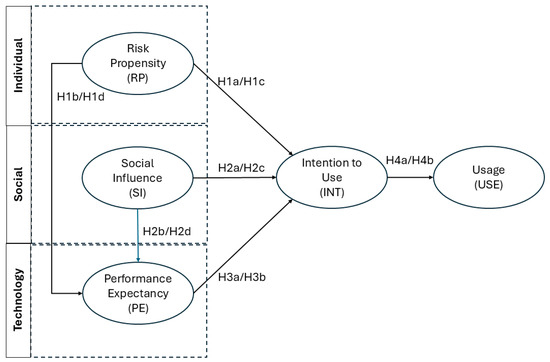
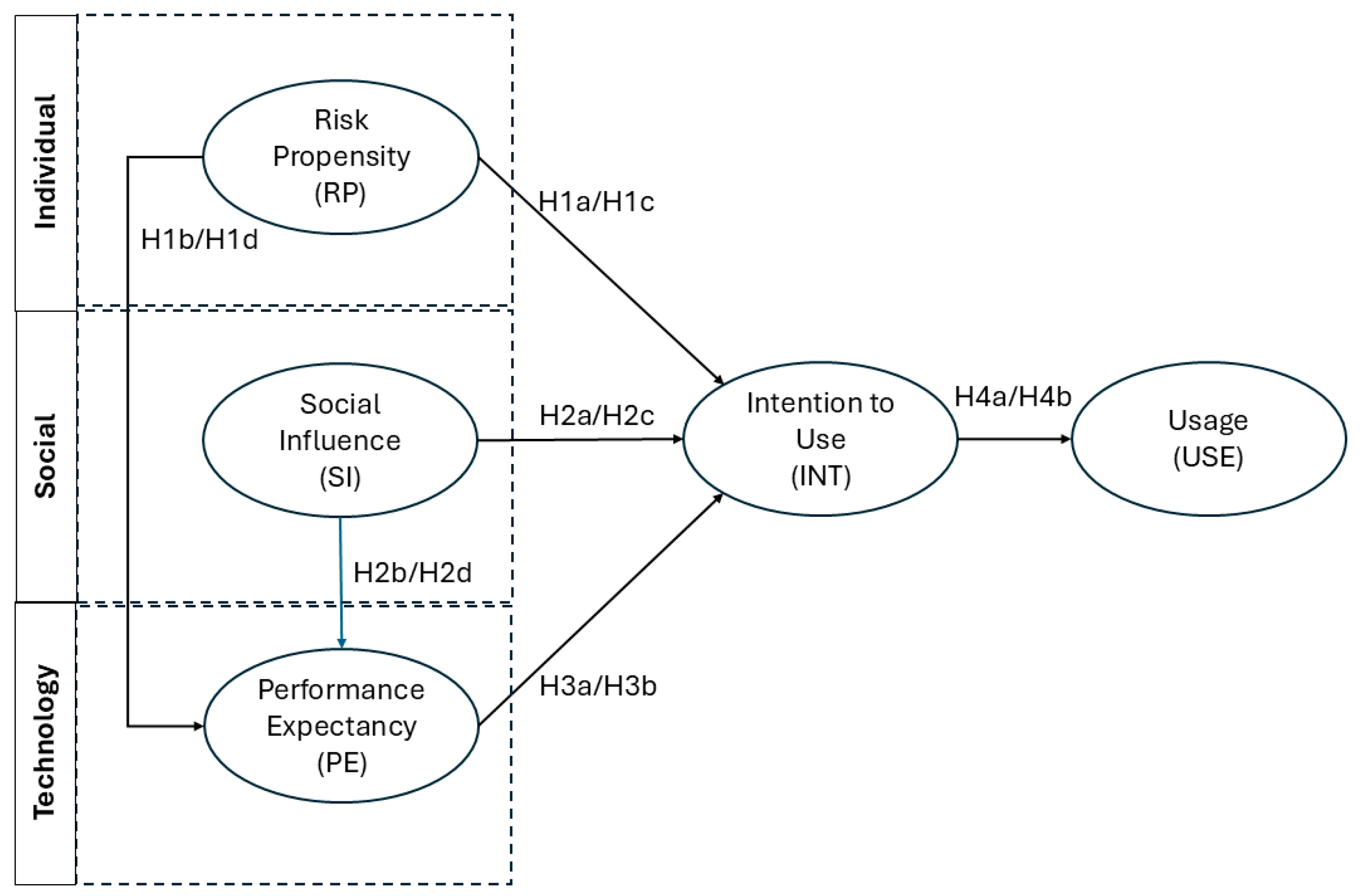
With the above literature review, an integrated model comprising individual, social and technology perspective was proposed to explain generative AI adoption by individual college students. The model framework was composed of key determinants of risk propensity (individual perspective), social influence (social perspective) and performance expectancy (technology perspective) to the behavioral intention to use and hence actual usage of generative AI by individual users (see Figure 1).
Figure 1.
An integrated generative AI adoption model framework.
1.2.1. Risk Propensity
Risk propensity—defined as an individual’s current tendency to take or avoid risk (Sitkin & Weingart, 1995, p. 1575)—is not fixed; it evolves with experience. The adoption of emergent technologies typically entails uncertainty and potential loss (e.g., security and privacy threats in early online purchasing and peer-to-peer file sharing). In the context of generative AI, from the individual perspective, students may anticipate both benefits (enhanced academic performance) and salient risks (accusations of cheating, inaccurate outputs), which can deter use (Freeman, 2025; Marks, 2025). In early stages, greater risk aversion (i.e., lower risk-taking propensity) should heighten the perceived downsides and suppress perceived benefits, leading to lower performance expectancy and weaker intention to use. At a longer usage time point, however, as users accumulate uneventful experience, uncertainty typically declines, usage becomes routinized, and the familiar option is reframed as the safer status quo. Under these conditions, risk-averse individuals may prefer continued use of the now-familiar system and come to perceive higher performance gains, whereas switching to alternatives (new tools or environments) is viewed as the riskier choice. This temporal rebalancing supports distinct short-run and long-run predictions. Therefore, we test,
Hypotheses (short run)
- H1a: Greater risk aversion is associated with lower behavioral intention to use generative AI.
- H1b: Greater risk aversion is associated with lower performance expectancy regarding generative AI.
Hypotheses (long run)
- H1c: At a longer usage time point, as experience accumulates, greater risk aversion is associated with higher behavioral intention to use generative AI.
- H1d: At a longer usage time point, as experience accumulates, greater risk aversion is associated with higher performance expectancy regarding generative AI.
1.2.2. Social Influence
Social influence is the perceived expectation of important others that one should use a particular system (Venkatesh et al., 2003, p. 451). College students are embedded in social networks comprising instructors, peers, and the broader campus community. Within these networks, behavior is shaped by normative pressures and identification processes: students align with valued referents, adhere to community norms, and comply with perceived expectations to maintain belonging and avoid dissonance.
Applied to generative AI, from the social perspective, when students perceive that significant others endorse or use these tools, they are more likely to form intentions to use them.
The influence of normative pressures is also likely to have cognitive consequences. To justify conformity and maintain self-consistency, students exposed to strong social influence may actively search for, attend to, and learn about the performance benefits of generative AI, thereby elevating their performance expectancy. At a longer usage time point, as students gain experience and usage becomes routine, the direct normative pressure can attenuate; intentions may be sustained more by habit and internalized evaluations than by explicit expectations. Nevertheless, social influence can continue to exert indirect effects by shaping learning opportunities, peer support, and shared practices that reinforce perceived performance gains. Therefore, we test,
Hypotheses (short run)
- H2a: Greater social influence is associated with higher behavioral intention to use generative AI.
- H2b: Greater social influence is associated with higher performance expectancy regarding generative AI.
Hypotheses (long run)
- H2c: At a longer usage time point, as experience accumulates, greater social influence is associated with higher behavioral intention to use generative AI.
- H2d: At a longer usage time point, as experience accumulates, greater social influence is associated with higher performance expectancy regarding generative AI.
1.2.3. Performance Expectancy
Performance expectancy—the belief that using a system will enhance one’s task performance (Venkatesh et al., 2003, p. 447)—is central to students’ technology adoption. For college students whose core activities include learning, information seeking, and solving everyday problems by applying course knowledge, generative AI can streamline key tasks. By enabling rapid information retrieval, idea generation, and interactive problem-solving, generative AI can increase efficiency relative to traditional methods (e.g., manual library searches and extensive reading). Accordingly, the more students perceive generative AI as useful for their academic tasks, the stronger their intention to use it.
Experience is likely to amplify this relationship. As students become more familiar with generative AI, they learn to formulate effective prompts, evaluate outputs, and integrate the tool into their study routines. These competencies can increase realized benefits, thereby strengthening the link between performance expectancy and intention at a longer usage time point. Therefore, we test,
Hypotheses (short run)
- H3a: Higher performance expectancy regarding generative AI is associated with higher behavioral intention to use generative AI.
Hypothesis (long run)
- H3b: At a longer usage time point, the positive association between performance expectancy and behavioral intention to use generative AI will be stronger than in the short run.
1.2.4. Intention to Use
Behavioral intention is a well-established proxy for predicting technology usage in adoption research (e.g., Gong et al., 2025; Zhao et al., 2024). Although some studies capture actual usage directly (e.g., Berényi & Deutsch, 2023), intention remains a robust antecedent of behavior: when individuals report stronger intentions to use technology, their subsequent usage tends to be higher. Applied to generative AI among college students, higher intention to use should translate into greater actual use. Moreover, this intention–behavior linkage is expected to be stable at a longer usage time point; accumulating experience may have different absolute levels of intention and usage, but not the positive association between them. Therefore, we test,
Hypotheses (short run)
- H4a: Higher behavioral intention to use generative AI is associated with higher actual usage of generative AI among individual students.
Hypothesis (long run)
- H4b: At a longer usage time point, higher behavioral intention to use generative AI remains associated with higher actual usage of generative AI among individual students.
2. Materials and Methods
2.1. Background
A local tertiary institution in Hong Kong began providing free, quota-based access to ChatGPT for all staff and students on 1 September 2024 (AY2024–2025), allocating 100 credits to each student and 200 credits to each staff member. This study investigated students’ usage patterns and perceptions of ChatGPT at the beginning of the initiative and again at the end of the academic year.
2.2. Subjects
The participants were students from a local tertiary institution in Hong Kong. In Stage 1, all students at the college were invited to participate via internal email. A total of 145 students completed the survey (44 male, 101 female), reflecting the institution’s overall gender distribution. Participants’ ages ranged from 17 to 49 years (M = 22.54). In Stage 2, one class offered in the summer semester was randomly selected. With the instructor’s consent, two research assistants invited all enrolled students to participate. A total of 111 students completed the survey (23 male, 87 female, 1 not specified). This class primarily comprised nursing students enrolled in a social media communication course, a field in which female students predominated. Their ages ranged from 18 to 27 years (M = 20.36).
2.3. Measurements
Previously validated scales were adapted for this study. Risk propensity was measured with two items (Xu et al., 2005); performance expectancy (four items), social influence (four items), and intention to use (three items) were drawn from Venkatesh et al. (2003) (see Table A1 in the Appendix A). All constructs were assessed using a 7-point Likert scale ranging from 1 (strongly disagree) to 7 (strongly agree). Self-reported usage was captured with a 7-point frequency scale ranging from 1 (never/rarely) to 7 (several times per day).
2.4. Data Collection
Data collection occurred in two stages. Stage 1 took place in October 2024, approximately one month after the institution launched its ChatGPT portal on 1 September 2024. An invitation email was distributed to all students via the internal mailing list, directing them to a survey hosted on Microsoft Forms. The survey opened with an informed consent page; participants who indicated agreement proceeded with the questionnaire. Completion time averaged about 10 min, as recorded by Microsoft Forms. The survey remained open for three weeks, during which two reminder emails were sent.
Stage 2 was conducted in mid-July (approximately ten months after the portal’s launch). With prior consent from the instructor, two research assistants visited a randomly selected summer-semester class. Students were provided with an informed consent form to sign and return, after which they completed the same survey administered in Stage 1. The survey took approximately 10 min to complete, and the research assistants collected the completed forms on site.
Ethical approval for the study was obtained from the College Research Ethics Committee in July–August 2024, prior to the start of the academic year.
2.5. Data Analysis
It began with a descriptive analysis to profile the sample. This included a detailed summary of participants’ demographic characteristics and patterns of ChatGPT usage. Then, a descriptive analysis of all determinants, alongside the computation of means and standard deviations were presented. Building on this foundation, the measurement model underwent rigorous evaluation to establish psychometric soundness, with procedures implemented to demonstrate both reliability and validity. Following confirmation of the measurement properties, the structural model was estimated and the hypothesized relationships were systematically examined using Partial Least Squares Structural Equation Modeling (PLS-SEM) (Hair et al., 2022). This analytic approach enabled robust testing of the proposed hypotheses and provided a comprehensive evaluation of the model’s explanatory power and path relationships.
3. Results
3.1. Descriptive Analysis of Respondents
System log statistics for ChatGPT usage (1 September 2024–31 August 2025). At the start of the 2024–2025 academic year (September 2024), 4457 students were enrolled. The institution provided all staff and students with access to ChatGPT via a customized online portal launched on 1 September 2024. According to the system logs, after three months of use (by 30 November 2025), there were 1223 student logins, with 865 distinct student users, and total credit consumption of 4793.05. Two students exhausted their full allocation of 100 credits, and 16 students used more than 50 credits. By the end of the academic year (31 August 2025), there were 1626 student logins and 1228 distinct student users, with total credits consumed of 10,656.11. Twelve students exhausted their 100-credit quota, and 48 students used more than 50 credits.
Survey participants. Data collection was conducted in two waves: October 2024 and July 2025. Stage 1 yielded 145 completed questionnaires, and Stage 2 yielded 111. The institutional gender distribution was 32.8% male and 67.2% female. Stage 1 closely mirrored this distribution, whereas Stage 2 was similar but showed a slight deviation from the overall population. Moreover, Stage 1 included a higher proportion of Year 1 students, whereas Stage 2 comprised more students in Years 2 and 3. This sampling issue is discussed further in the Limitations section. The table below summarizes descriptive statistics for respondent characteristics (see Table 1).
Table 1.
Descriptive analysis of respondents.
3.2. Instrument Validation
Table 2 presents descriptive statistics for all constructs—risk propensity (RP), social influence (SI), performance expectancy (PE), intention to use (INT), and usage—including means and standard deviations, Cronbach’s alpha, composite reliability (CR), and average variance extracted (AVE).
Table 2.
Descriptive analysis of variables.
Reliability denotes the degree to which a measure consistently captures the construct it is intended to assess; it reflects the proportion of true-score variance uncontaminated by measurement error (Hair et al., 2010). Multi-item scales typically yield more reliable estimates than single-item measures. Before conducting substantive analyses, scale reliability was evaluated using Cronbach’s alpha, treating values in the 0.60–0.70 range as the lower bound of acceptability (Hair et al., 2010; Nunnally & Bernstein, 1994). In this study, all constructs at both Stage 1 and Stage 2 exceeded 0.70, indicating satisfactory internal consistency. Additionally, composite reliability (CR), computed from the confirmatory factor analysis, was used to assess internal consistency; all constructs exhibited CR values above 0.90, supporting strong internal consistency (Bagozzi & Yi, 1988; Hair et al., 2010) (see Table 2).
With reliability established, validity was assessed. Validity refers to the extent to which a measure or set of measures accurately represents the target construct and is free from systematic or nonrandom error; it concerns how well the construct is captured by its indicators (Hair et al., 2010). Convergent and discriminant validity are two widely accepted forms of construct validity.
Convergent validity evaluates the degree to which indicators of the same construct are correlated. In this study, standardized factor loadings and average variance extracted (AVE) provided evidence of convergence: all item loadings on their intended constructs exceeded 0.80, and all AVE values were above 0.70, indicating that each construct explained more than 70% of the variance in its indicators. Taken together, these results support convergent validity (Chin, 1998; Fornell & Larcker, 1981; Hair et al., 2010) (see Table 2).
Discriminant validity assesses the extent to which conceptually related constructs are empirically distinct. Discriminant validity was evaluated using the Fornell–Larcker criterion (Fornell & Larcker, 1981; Henseler et al., 2015). For each construct, the square root of AVE exceeded its correlations with other constructs, and AVE values were greater than the squared interconstruct correlations (see Table 3), consistent with discriminant validity. To supplement these results, the cross-loadings matrix was inspected (Chin, 1998; Hair et al., 2022), which showed that each indicator loaded highest on its intended construct and substantially higher than on any other construct (see Table 4). Collectively, these findings demonstrate satisfactory discriminant validity of the scales.
Table 3.
Fornell-Larcker Matrix.
Table 4.
Cross-loadings Matrix.
In sum, both the reliability and validity of the scale were rigorously assessed and supported by the evidence.
3.3. Model Testing Results
In preliminary analyses, we assessed potential control variables (gender, age, social organization participation, and parents’ education level) and found no significant associations with intention to use.
Subsequently, structural model analysis and path coefficient estimation were conducted using PLS-SEM in SmartPLS 4.1.1. PLS-SEM was deemed appropriate because the study’s primary objective is prediction and theory development rather than strict theory testing; the model is complex, comprising numerous constructs, indicators, structural paths, and multiple mediations, for which PLS-SEM scales effectively, including hierarchical component models; and the sample size is small to moderate, aligning with PLS-SEM’s minimal distributional assumptions (Chin, 1998; Hair et al., 2022).
3.3.1. Overall Model
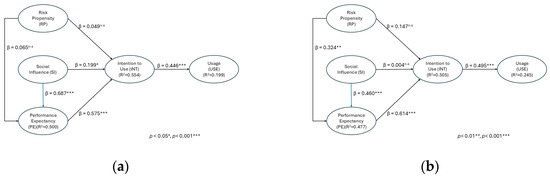
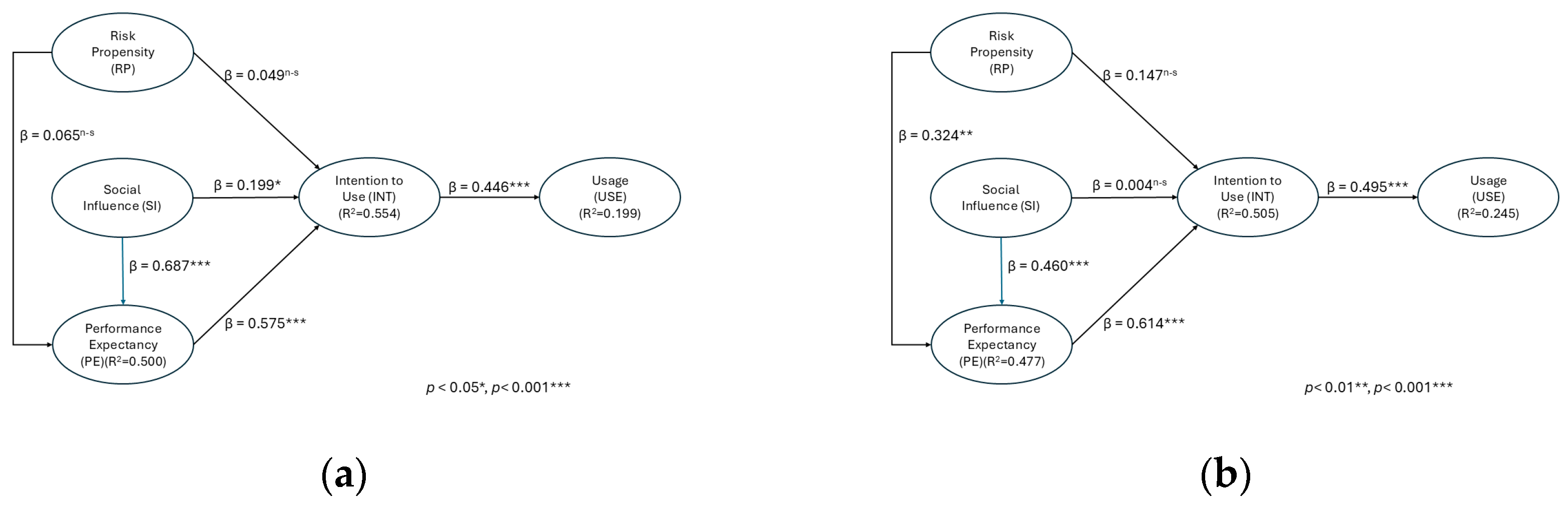
The model explained a moderate proportion of variance in Intention to Use at both time points (Stage 1: R2 = 0.554, adjusted R2 = 0.552; Stage 2: R2 = 0.505, adjusted R2 = 0.492), consistent with benchmark guidelines in PLS-SEM that classify R2 values around 0.50 as moderate and around 0.75 as substantial (Hair et al., 2022; Cohen, 1988) (see Figure 2a,b; Table 5). For Usage, explanatory power increased from Stage 1 to Stage 2 (R2 = 0.199 to R2 = 0.245), representing an absolute gain of 0.046 (approximately 23% relative improvement). While Usage remained at the weak-to-lower-moderate boundary (with 0.25 often used as the threshold for weak-to-moderate), such levels are typical in behavioral outcomes where variance is harder to explain than intentions. These results align with field norms in technology adoption research, where R2 values of approximately 0.40–0.60 for intention and 0.20–0.30 for behavior are commonly regarded as acceptable.
Figure 2.
Model testing results: (a) Stage 1; (b) Stage 2.
Table 5.
Summary of hypotheses testing.
3.3.2. Risk Propensity
At Stage 1, the direct paths from risk propensity to intention to use (H1a) and to performance expectancy (H1b) were not significant; thus, both hypotheses were not supported. Consistent with these null direct effects, the indirect effect of risk propensity on intention to use via performance expectancy (RP -> PE -> INT) was also non-significant (β = 0.037, ns), as was the total indirect effect on usage through intention (RP -> PE -> INT -> Usage; β = 0.038, ns).
At Stage 2, the direct effect of risk propensity on intention to use remained non-significant (H1c not supported), whereas the path from risk propensity to performance expectancy became significant (H1b supported; β = 0.324, p < 0.01). In line with this pattern, the indirect effect of risk propensity on intention via performance expectancy was significant (RP -> PE -> INT; β = 0.199, p < 0.01), as was the total indirect effect on usage (RP -> PE -> INT -> Usage; β = 0.171, p < 0.01).
3.3.3. Social Influence
At Stage 1, both H2a (social influence → intention to use) and H2b (social influence → performance expectancy) were supported, with significant path coefficients (β = 0.199, p < 0.05; β = 0.687, p < 0.001, respectively). Mediation analysis indicates partial mediation by performance expectancy: social influence had a significant direct effect on intention (β = 0.199, p < 0.05) and a significant indirect effect via performance expectancy (SI → PE → INT; β = 0.395, p < 0.001). The total indirect effect of social influence on usage through intention was also significant (SI → PE → INT → Usage; β = 0.176, p < 0.001).
At Stage 2, the direct path from social influence to intention to use became non-significant (H2c not supported), whereas the path to performance expectancy remained significant (H2d supported; β = 0.460, p < 0.001). In this stage, performance expectancy fully mediated the effect of social influence: the indirect effect on intention via performance expectancy was significant (SI → PE → INT; β = 0.282, p < 0.01), and the total indirect effect on usage through intention was likewise significant (SI → PE → INT → Usage; β = 0.140, p < 0.01).
3.3.4. Performance Expectancy
Across both Stage 1 and Stage 2, hypotheses H3a and H3b (performance expectancy → intention to use) were supported. The path coefficients were significant and robust at each stage: β = 0.575 (p < 0.001) in Stage 1 and β = 0.614 (p < 0.001) in Stage 2.
3.3.5. Intention to Use
Across both Stage 1 and Stage 2, hypotheses H4a and H4b (intention to use → usage) were supported. The path coefficients were significant in both stages: β = 0.446 (p < 0.001) in Stage 1 and β = 0.495 (p < 0.001) in Stage 2.
3.3.6. Independent Analysis on Risk Propensity
As a post hoc analysis, the independent effects of risk propensity on behavioral intention and usage was examined (see Figure 3a,b). At Stage 1, the direct effect of risk propensity on intention was significant (β = 0.251, p < 0.05). At Stage 2, this effect approximately doubled and strengthened (β = 0.503, p < 0.001). Correspondingly, the explained variance (R2) in intention increased from 0.063 at Stage 1 to 0.253 at Stage 2—an over fourfold increase—indicating a substantial rise in the proportion of variance in intention accounted for by risk propensity at a longer usage point of time. This is further discussed in the limitation section.
Figure 3.
Independent risk propensity model testing results: (a) Stage 1; (b) Stage 2.
4. Discussion
4.1. Key Findings
Key findings are summarized below:
- Model performance: The model showed moderate explanatory power for intention to use (Stage 1: R2 = 0.554, adjusted R2 = 0.552; Stage 2: R2 = 0.505, adjusted R2 = 0.492), consistent with PLS-SEM benchmarks (Hair et al., 2022; Cohen, 1988), and weak-to-lower-moderate but improving explanatory power for usage (R2 = 0.199 → 0.245; +0.046, ~23% gain), aligning with field norms that regard ~0.40–0.60 for intention and ~0.20–0.30 for behavior as acceptable.
- Individual factor—risk propensity: Overall, risk propensity shows no influence on intention or usage at Stage 1—either directly or via performance expectancy—indicating no short-run mediation; by contrast, at Stage 2, with the direct effect on intention remaining non-significant and the indirect pathways becoming significant, risk propensity’s impact on both intention and usage is fully mediated by performance expectancy.
- Social factor—social influence: The influence of social factors shifts from a combination of direct and indirect pathways at Stage 1 to a purely indirect pathway via performance expectancy at Stage 2.
- Technology factor—performance expectancy: Performance expectancy was a consistent and central determinant, exerting both direct and indirect effects on intention to use at both the initial stage and a longer usage time point.
- Behavioral linkage: Intention to use significantly predicted actual usage
4.2. Individual Factor—Risk Propensity
In the initial post-launch period (Stage 1), college students’ risk propensity showed no significant association with their intention to use generative AI, a result that contradicts the hypothesized relationship yet aligns with some prior work (e.g., Batac et al., 2024). This suggests that, early on, decisions to use generative AI were not shaped by students’ dispositional tendency to take or avoid risk; in other words, students did not perceive using generative AI as a form of risk-taking that would be moderated by their risk orientation. Such null findings may help explain the limited attention to risk propensity in earlier technology-adoption studies: if treated as a stable trait, risk propensity might appear irrelevant to adoption decisions.
Guided by Sitkin and Weingart’s (1995) conceptualization that risk propensity can evolve with experience, its role was examined at two distinctive time points. Although the direct effect of risk propensity on intention remained non-significant at Stage 2, the path from risk propensity to performance expectancy became significant, yielding a significant indirect (mediated) effect on intention and, in turn, on usage. This pattern is consistent with studies that identify risk propensity as a predictor of technology-related intentions (e.g., Bracci et al., 2025; Brick & Visser, 2015; Donthu & Gilliland, 1996; Xu et al., 2005). A plausible explanation is that as students accumulate experience, their risk-related assessments of generative AI—and their beliefs about its academic utility—become more favorable, thereby strengthening performance expectancy and subsequently intention. This temporal dynamic may also account for mixed results in the literature, as findings likely depend on the stage of users’ exposure and experience at the time of data collection.
Importantly, the absence of a direct effect on intention indicates that students do not adopt generative AI merely because they deem it “safe”; rather, adoption is driven by perceived performance benefits that develop over time. Practically, institutions seeking to increase adoption—especially among risk-averse students—should emphasize evidence-based best practices, training, and workshops that reinforce both the legitimacy and the academic usefulness of generative AI. These efforts can address salient concerns reported in recent surveys (e.g., fear of cheating accusations, misinformation, and potential harm to academic integrity and performance; Marks, 2025), thereby enhancing performance expectancy and, through it, intention to use. By shifting attention from general ethical concerns to the less-explored role of risk propensity and its evolution, this study advances understanding of student decision-making and offers actionable guidance for implementation strategies.
4.3. Social Factor—Social Influence
Prior empirical research consistently identifies social influence as a significant predictor of technology adoption (Acquah et al., 2024; Liu et al., 2023; Qin & Yu, 2024; Terho et al., 2022; Uymaz et al., 2024). In the initial phase of use (e.g., the first month), college students’ intention to use generative AI is positively associated with perceived social influence, aligning with the dominant findings in the literature. Over time, the direct effect of social influence on intention diminishes and becomes fully mediated by performance expectancy; that is, social influence affects intention only through its impact on perceived usefulness. This pattern is consistent with studies documenting indirect and mediating pathways to intention via other belief constructs (Liébana-Cabanillas et al., 2024; Ayanwale et al., 2024). Therefore, higher perceived social influence increases students’ performance expectancy (i.e., perceived usefulness) of generative AI, which in turn raises their intention to use and ultimately their actual usage.
These results provide significant practical implications. Institutions and instructors can shape students’ engagement with generative AI. In early stages, interventions that leverage social norms and peer endorsement may be effective. As time progresses, promotional efforts should pivot to demonstrating concrete benefits and providing guidance on how generative AI supports academic tasks, thereby strengthening performance expectancy and sustaining usage.
4.4. Technology Factor—Performance Expectancy
Performance expectancy—defined as the belief that a technology enhances task performance—has been repeatedly identified as a central determinant of technology adoption (Chi et al., 2022; Roy, 2024; Kaiser et al., 2024; Liébana-Cabanillas et al., 2024; Venkatesh et al., 2003). Consistent with this literature, the present study finds that performance expectancy robustly predicts both intention to use generative AI and hence self-reported usage across time. More importantly, the study demonstrates that performance expectancy operates as a key mediator within an integrated adoption framework: it transmits the effects of the individual trait risk propensity and the contextual factor social influence onto intention to use. In other words, risk propensity and social influence do not primarily drive intention through direct pathways; rather, they shape intention insofar as they elevate perceived usefulness, which then increases both intention and actual usage.
The mediating mechanism is straightforward. Individuals with higher risk propensity are more willing to experiment with novel tools, which provides opportunities to observe concrete performance gains (for example, faster drafting, clearer structuring, or more accurate summarization). These mastery experiences raise performance expectancy and, in turn, strengthen intention to use and subsequent usage. Thus, risk propensity motivates initial exploration, but it is the realized utility—captured by performance expectancy—that sustains adoption. Likewise, social influence—via peer endorsement, instructor modeling, or institutional norms—exposes learners to credible use cases, best practices, and vicarious evidence of benefits. Observing others achieve efficiency or quality improvements and receiving guidance that reduces uncertainty increases perceived usefulness; this elevated performance expectancy becomes the proximal driver of intention and behavior. Normative pressure alone is insufficient without clear signals of utility.
These findings suggest actionable strategies for educational institutions and instructors. Early interventions can leverage social endorsement to catalyze trial, but sustaining adoption requires systematically cultivating performance expectancy: provide discipline-specific use cases, structured practice with feedback, and transparent metrics of improvement (e.g., time saved, accuracy gains, output quality). Translating risk propensity and social influence into usefulness signals—through demonstrations, peer showcases, and curated prompt libraries—will more effectively promote ongoing use than risk assessment and normative messaging alone.
4.5. Theoretical Contribution
This study investigated an integrated model of generative AI adoption among college students. Drawing on a systematic literature review, we identified key determinants and assembled them into a testable framework. The results not only confirmed significant associations between these determinants and both intention to use and self-reported usage, but also illuminated the dynamics of the adoption process. Specifically, performance expectancy emerged as a central mediator through which both risk propensity and social influence exert their effects on intention and usage. Moreover, by analyzing two cross-sectional datasets collected ten months apart, the study documented temporal shifts in the strength and pathways of these effects. Collectively, these findings provide empirical support that advances technology adoption theory and contributes to the broader literature on AI adoption in higher education.
4.6. Practical Contribution
The study’s findings enrich our understanding of the generative AI adoption process and yield actionable implications for effective implementation. Regardless of individual differences in risk propensity or the strength of perceived social influence, performance expectancy emerges as both the principal determinant of adoption and the pivotal mediator through which these factors shape intention and use. Accordingly, implementation strategies should prioritize training that introduces best practices tailored to academic contexts, explicitly demonstrating what generative AI can do and how to use it to maximize learning benefits in a legitimate and proper way. Communication should likewise foreground safe and ethical use, offering clear guidance to ensure that AI supports—rather than undermines—learning outcomes and academic integrity, thereby alleviating students’ concerns about accusations of cheating and the propagation of false or misleading information when using generative AI.
4.7. Limitations and Future Research
This study has several limitations that qualify the interpretation of its findings. First, the design relied on two cross-sectional samples rather than a longitudinal panel; participants at Stage 1 (n = 145) and Stage 2 (n = 110) were different individuals, precluding within-person analyses of change and limiting causal inference over time. Although the two samples differed in gender distribution and year-of-study composition, both were drawn from the same institutional cohort in which ChatGPT was introduced simultaneously. Future research is recommended to employ a longitudinal panel design to corroborate these findings. Second, the modest sample sizes reduce statistical power, precision, and generalizability; future work would benefit from larger samples (e.g., over 200 per wave) to yield more reliable estimates and support more complex model testing. Third, the model may omit relevant individual-level determinants—such as self-efficacy and risk perception—identified in prior research, raising concerns about omitted-variable bias. Notably, an independent analysis revealed a significant direct effect of risk propensity on intention to use (β = 0.251, p < 0.05), suggesting that the integrated model may exclude important confounders or untested mediating pathways. Collectively, these observations indicate that the current framework is informative but incomplete. Future studies should employ longitudinal designs, increase sample sizes, expand the construct set to include potential mediators and moderators (e.g., trust, perceived risk, risk attitude, self-efficacy, anxiety), and compare alternative model specifications to determine whether the effect of risk propensity on intention is direct, indirect, or fully mediated through other constructs.
5. Conclusions
This study examines a timely and important issue: the adoption of generative AI by college students. On one hand, generative AI represents an innovative tool that can enhance academic performance by clarifying complex concepts, enabling brainstorming of ideas and solutions to real-world problems, and providing continuous, on-demand feedback that complements instructor support. On the other hand, many academic institutions enforce restrictive use policies and deploy AI-detection tools to deter misuse, aiming to prevent plagiarism, cheating, and the spread of misinformation—measures that may inadvertently discourage students from using generative AI altogether. Drawing on the prior literature, we developed and tested an integrated framework encompassing individual, social, and technological factors to identify the key determinants of adoption and to illuminate the complexity of students’ decision-making. The analysis revealed significant relationships among risk propensity, social influence, and performance expectancy with intention to use, which in turn was associated with actual usage. These findings contribute to the literature by advancing theoretical understanding of generative AI adoption and by offering practical implications for implementation within higher education.
Funding
This research received no external funding.
Institutional Review Board Statement
The study received the ethical review and approval by the Research Ethics Committee of TUNG WAH COLLEGE (protocol code REC2024216 on 28 August 2024).
Informed Consent Statement
Informed consent was obtained from all subjects involved in the study.
Data Availability Statement
Research data is available for sharing.
Acknowledgments
During the preparation of this manuscript/study, the author(s) used ChatGPT gpt-5-2025-08-07 model for the purposes of polishing the language. The authors have reviewed and edited the output and take full responsibility for the content of this publication.
Conflicts of Interest
The author declares no conflicts of interest.
Abbreviations
The following abbreviations are used in this manuscript:
| AI | Artificial Intelligence |
| PLS-SEM | Partial Least Squares Structural Equation Modeling |
Appendix A. Measurement Items
Table A1.
Measurement items.
References
- Acquah, B. Y. S., Arthur, F., Salifu, I., Quayson, E., & Nortey, S. A. (2024). Preservice teachers’ behavioural intention to use artificial intelligence in lesson planning: A dual-staged PLS-SEM-ANN approach. Computers and Education: Artificial Intelligence, 7, 100307. [Google Scholar] [CrossRef] [Scilit]
- Alajmi, M. A., & Said Ali, M. (2022). Video-conference platforms: Understanding the antecedents and consequences of participating in or attending virtual conferences in developing countries. International Journal of Human–Computer Interaction, 38(13), 1195–1211. [Google Scholar] [CrossRef] [Scilit]
- Annamalai, N., Bervell, B., Mireku, D. O., & Andoh, R. P. K. (2025). Artificial intelligence in higher education: Modelling students’ motivation for continuous use of ChatGPT based on a modified self-determination theory. Computers and Education: Artificial Intelligence, 8, 100346. [Google Scholar] [CrossRef] [Scilit]
- Ayanwale, M. A., Ntshangase, S. D., Adelana, O. P., Afolabi, K. W., Adam, U. A., & Olatunbosun, S. O. (2024). Navigating the future: Exploring in-service teachers’ preparedness for artificial intelligence integration into South African schools. Computers and Education: Artificial Intelligence, 7, 100330. [Google Scholar] [CrossRef] [Scilit]
- Bagozzi, R. P., & Yi, Y. (1988). On the evaluation of structural equation models. Journal of the Academy of Marketing Science, 16(1), 74–94. [Google Scholar] [CrossRef]
- Batac, C. A., Baroja, M. J., Caballero, D. J. D., Coloma, L. G., Tan, L. M., & Ebardo, R. (2024, April 26–29). Do human beliefs and traits influence the adoption of ChatGPT among programming students? 2024 10th International Conference on Computing and Artificial Intelligence (pp. 339–344), Bali, Indonesia. [Google Scholar]
- Berényi, L., & Deutsch, N. (2023). Technology adoption among higher education students. Vezetéstudomány/Budapest Management Review, 54(11), 28–39. [Google Scholar] [CrossRef] [Scilit]
- Bracci, E., Tallaki, M., & Ebua Otia, J. (2025). Propensity factors of artificial intelligence technology adoption by public sector auditors. Journal of Public Budgeting, Accounting & Financial Management, ahead-of-print. [Google Scholar] [CrossRef] [Scilit]
- Brick, K., & Visser, M. (2015). Risk preferences, technology adoption and insurance uptake: A framed experiment. Journal of Economic Behavior & Organization, 118, 383–396. [Google Scholar] [CrossRef] [Scilit]
- Burriss, S. K., Hutchins, N., Conley, Z., Deweese, M. M., Doe, Y. J., Eeds, A., Villanueva, A., Ziegler, H., & Oliver, K. (2024). Redesigning an AI bill of rights with/for young people: Principles for exploring AI ethics with middle and high school students. Computers and Education: Artificial Intelligence, 7, 100317. [Google Scholar] [CrossRef] [Scilit]
- Chi, O. H., Gursoy, D., & Chi, C. G. (2022). Tourists’ attitudes toward the use of artificially intelligent (AI) devices in tourism service delivery: Moderating role of service value seeking. Journal of Travel Research, 61(1), 170–185. [Google Scholar] [CrossRef] [Scilit]
- Chin, W. W. (1998). The partial least squares approach to structural equation modeling. In G. A. Marcoulides (Ed.), Modern methods for business research (pp. 295–336). Lawrence Erlbaum. [Google Scholar]
- Cohen, J. (1988). Statistical power analysis for the behavioral sciences (2nd ed.). Lawrence Erlbaum Associates. [Google Scholar] [CrossRef] [Scilit]
- Doe, J. K., Van de Wetering, R., Honyenuga, B., & Versendaal, J. (2022). Extended contextual validation of stakeholder approach to firm technology adoption: Moderating and mediating relationships in an innovation eco-system. Society and Business Review, 17(4), 506–540. [Google Scholar] [CrossRef] [Scilit]
- Donthu, N., & Gilliland, D. (1996). Observations: The infomercial shopper. Journal of Advertising Research, 36(2), 69–76. [Google Scholar] [CrossRef] [Scilit]
- Farhi, F., Jeljeli, R., Aburezeq, I., Dweikat, F. F., Al-shami, S. A., & Slamene, R. (2023). Analyzing the students’ views, concerns, and perceived ethics about chat GPT usage. Computers and Education: Artificial Intelligence, 5, 100180. [Google Scholar] [CrossRef] [Scilit]
- Fornell, C., & Larcker, D. F. (1981). Evaluating structural equation models with unobservable variables and measurement error. Journal of Marketing Research, 18(1), 39–50. [Google Scholar] [CrossRef] [Scilit]
- Freeman, J. (2025). Student generative AI survey 2025. HEPI Policy Note 61, Higher Education Policy Institute (HEPI). Available online: https://www.hepi.ac.uk/reports/student-generative-ai-survey-2025/ (accessed on 23 November 2025).
- Geng, L., Hui, H., Liang, X., Yan, S., & Xue, Y. (2023). Factors affecting intention toward ICT adoption in rural entrepreneurship: Understanding the differences between business types of organizations and previous experience of entrepreneurs. Sage Open, 13(3), 21582440231197112. [Google Scholar] [CrossRef] [Scilit]
- Gong, Y., Xu, C., Luo, S., & Lin, J. (2025). Modeling teacher education students’ adoption of large language models through an extended technology acceptance framework. Scientific Reports, 15(1), 32208. [Google Scholar] [CrossRef] [Scilit]
- Hair, J. F., Black, W. C., Babin, B. J., & Anderson, R. E. (2010). Multivariate data analysis (7th ed.). Pearson Prentice Hall. Available online: https://openlibrary.org/works/OL16979906W/Multivariate_data_analysis?edition=key:/books/OL22691711M (accessed on 1 November 2025).
- Hair, J. F., Hult, G. T. M., Ringle, C. M., & Sarstedt, M. (2022). A primer on partial least squares structural equation modeling (PLS-SEM) (3rd ed.). Sage. Available online: https://uk.sagepub.com/en-gb/eur/a-primer-on-partial-least-squares-structural-equation-modeling-pls-sem/book270548#:~:text=Other%20Titles%20in:,popular%20software%20package%20SmartPLS%203 (accessed on 1 November 2025).
- Hemdanou, A. L., Sefian, M. L., Achtoun, Y., & Tahiri, I. (2024). Comparative analysis of feature selection and extraction methods for student performance prediction across different machine learning models. Computers and Education: Artificial Intelligence, 7, 100301. [Google Scholar] [CrossRef] [Scilit]
- Henseler, J., Ringle, C. M., & Sarstedt, M. (2015). A new criterion for assessing discriminant validity in variance-based structural equation modeling. Journal of the Academy of Marketing Science, 43(1), 115–135. [Google Scholar] [CrossRef] [Scilit]
- Huang, D., Hash, N., Cummings, J. J., & Prena, K. (2025). Academic cheating with generative AI: Exploring a moral extension of the theory of planned behavior. Computers and Education: Artificial Intelligence, 8, 100424. [Google Scholar] [CrossRef] [Scilit]
- Johnson, A. (2023, January 18). ChatGPT in schools: Here’s where it’s banned—And how it could potentially help students. Forbes. Available online: https://www.forbes.com/sites/ariannajohnson/2023/01/18/chatgpt-in-schools-heres-where-its-banned-and-how-it-could-potentially-help-students/ (accessed on 23 November 2025).
- Kaiser, R., De Benedetto, S., Planing, P., & Müller, P. (2024). What will the delivery robots bring us tomorrow? International Journal of Consumer Studies, 48(5), e13093. [Google Scholar] [CrossRef] [Scilit]
- Kim, E. D., Kuan, K. K., Vaghasiya, M. R., Penm, J., Gunja, N., El Amrani, R., & Poon, S. K. (2023). Passive resistance to health information technology implementation: The case of electronic medication management system. Behaviour & Information Technology, 42(13), 2308–2329. [Google Scholar] [CrossRef] [Scilit]
- Kim, S., Connerton, T. P., & Park, C. (2022). Transforming the automotive retail: Drivers for customers’ omnichannel BOPS (Buy Online & Pick up in Store) behavior. Journal of Business Research, 139, 411–425. [Google Scholar] [CrossRef] [Scilit]
- Kolil, V. K., & Achuthan, K. (2023). Longitudinal study of teacher acceptance of mobile virtual labs. Education and Information Technologies, 28(7), 7763–7796. [Google Scholar] [CrossRef] [Scilit]
- Kwak, Y., Seo, Y. H., & Ahn, J. W. (2022). Nursing students’ intent to use AI-based healthcare technology: Path analysis using the unified theory of acceptance and use of technology. Nurse Education Today, 119, 105541. [Google Scholar] [CrossRef] [Scilit] [PubMed]
- Li, M. (2025). Integrating artificial intelligence in primary mathematics education: Investigating internal and external influences on teacher adoption. International Journal of Science and Mathematics Education, 23(5), 1283–1308. [Google Scholar] [CrossRef] [Scilit]
- Liébana-Cabanillas, F., Kalinic, Z., Muñoz-Leiva, F., & Higueras-Castillo, E. (2024). Biometric m-payment systems: A multi-analytical approach to determining use intention. Information & Management, 61(2), 103907. [Google Scholar] [CrossRef] [Scilit]
- Liu, C. T., Guo, Y. M., & Huang, S. R. (2023). The factors affecting customers’ satisfaction and continuance intention in platform-to-consumer environments: A case of mobile food ordering platforms. e-Service Journal, 15(1), 1–28. [Google Scholar] [CrossRef] [Scilit]
- Marikyan, D., Papagiannidis, S., Rana, O. F., Ranjan, R., & Morgan, G. (2022). “Alexa, let’s talk about my productivity”: The impact of digital assistants on work productivity. Journal of Business Research, 142, 572–584. [Google Scholar] [CrossRef] [Scilit]
- Marks, L. (2025, September). What 2025 generative AI trends reveal about student behavior? Turnitin Blog. Available online: https://www.turnitin.com/blog/what-2025-generative-ai-trends-reveal-about-student-behavior (accessed on 23 November 2025).
- Metallo, C., Agrifoglio, R., Lepore, L., & Landriani, L. (2022). Explaing users’ technology acceptance through national cultural values in the hospital context. BMC Health Services Research, 22(1), 84. [Google Scholar] [CrossRef] [Scilit]
- Mohammad-Salehi, B., Vaez-Dalili, M., & Heidari Tabrizi, H. (2021). Investigating factors that influence EFL teachers’ adoption of web 2.0 technologies: Evidence from applying the UTAUT and TPACK. Tesl-Ej, 25(1), n1. Available online: https://tesl-ej.org/wordpress/issues/volume25/ej97a/ej97a21/ (accessed on 1 November 2025).
- Mothibi, N. H., & Malebana, M. J. (2025). Entrepreneurship education, role models, and risk-taking propensity as predictors of entrepreneurial intention and behaviour: Evidence from TVET and university students in Gauteng, South Africa. Administrative Sciences, 15(10), 374. [Google Scholar] [CrossRef] [Scilit]
- Müller, W., Leyer, M., & Gaugel, M. (2025). Trust towards using autonomous taxis: Evidence from Germany. Transportation Research Part F: Traffic Psychology and Behaviour, 113, 357–373. [Google Scholar] [CrossRef] [Scilit]
- Nazaretsky, T., Mejia-Domenzain, P., Swamy, V., Frej, J., & Käser, T. (2025). The critical role of trust in adopting AI-powered educational technology for learning: An instrument for measuring student perceptions. Computers and Education: Artificial Intelligence, 8, 100368. [Google Scholar] [CrossRef] [Scilit]
- Nordhoff, S., Madigan, R., Van Arem, B., Merat, N., & Happee, R. (2021). Interrelationships among predictors of automated vehicle acceptance: A structural equation modelling approach. Theoretical Issues in Ergonomics Science, 22(4), 383–408. [Google Scholar] [CrossRef] [Scilit]
- Nunnally, J. C., & Bernstein, I. H. (1994). Psychometric theory (3rd ed.). McGraw-Hill. Available online: https://books.google.com.hk/books/about/Psychometric_Theory.html?id=r0fuAAAAMAAJ&redir_esc=y (accessed on 1 November 2025).
- Qin, R., & Yu, Z. (2024). Extending the UTAUT model of tencent meeting for online courses by including community of inquiry and collaborative learning constructs. International Journal of Human–Computer Interaction, 40(18), 5279–5297. [Google Scholar] [CrossRef] [Scilit]
- Queiroz, M. M., Fosso Wamba, S., De Bourmont, M., & Telles, R. (2021). Blockchain adoption in operations and supply chain management: Empirical evidence from an emerging economy. International Journal of Production Research, 59(20), 6087–6103. [Google Scholar] [CrossRef] [Scilit]
- Ribeiro, M. A., Gursoy, D., & Chi, O. H. (2022). Customer acceptance of autonomous vehicles in travel and tourism. Journal of Travel Research, 61(3), 620–636. [Google Scholar] [CrossRef] [Scilit]
- Roy, P. (2024). What drives the adoption of data analytics at Australian university libraries in the perspective of UTAUT2? The Journal of Academic Librarianship, 50(5), 102927. [Google Scholar] [CrossRef] [Scilit]
- Sestino, A., Amatulli, C., Peluso, A. M., & Guido, G. (2024). Integrating internet-of-things technologies in luxury industries: The roles of consumers’ openness to technological innovations and status consumption. Technology Analysis & Strategic Management, 36(11), 3577–3591. [Google Scholar] [CrossRef] [Scilit]
- Sitkin, S. B., & Weingart, L. R. (1995). Determinants of risky decision-making behavior: A test of the mediating role of risk perceptions and propensity. Academy of Management Journal, 38(6), 1573–1592. [Google Scholar] [CrossRef] [Scilit]
- Sorwar, G., Aggar, C., Penman, O., Seton, C., & Ward, A. (2023). Factors that predict the acceptance and adoption of smart home technology by seniors in Australia: A structural equation model with longitudinal data. Informatics for Health and Social Care, 48(1), 80–94. [Google Scholar] [CrossRef] [Scilit]
- Terho, H., Giovannetti, M., & Cardinali, S. (2022). Measuring B2B social selling: Key activities, antecedents and performance outcomes. Industrial Marketing Management, 101, 208–222. [Google Scholar] [CrossRef] [Scilit]
- Uymaz, P., Uymaz, A. O., & Akgül, Y. (2024). Assessing the behavioral intention of individuals to use an AI doctor at the primary, secondary, and tertiary care levels. International Journal of Human–Computer Interaction, 40(18), 5229–5246. [Google Scholar] [CrossRef] [Scilit]
- Venkatesh, V., Morris, M. G., Davis, G. B., & Davis, F. D. (2003). User acceptance of information technology: Toward a unified view. MIS Quarterly, 27(3), 425–478. [Google Scholar] [CrossRef] [Scilit]
- Xu, H., Wang, H., & Teo, H. H. (2005, January 3–6). Predicting the usage of P2P sharing software: The role of trust and perceived risk. 38th IEEE Annual Hawaii International Conference on System Sciences (p. 201a), Big Island, HI, USA. [Google Scholar]
- Yang, C. C., Liu, C., & Wang, Y. S. (2023). The acceptance and use of smartphones among older adults: Differences in UTAUT determinants before and after training. Library Hi Tech, 41(5), 1357–1375. [Google Scholar] [CrossRef] [Scilit]
- Yuswandi, A., & Hamdani, H. (2025). Influence of materialism, financial literacy, and risk perception on propensity to indebtedness among peer-to-peer lending users: A case study of generation Z in Tangerang City. Eduvest-Journal of Universal Studies, 5(9), 11848–11861. [Google Scholar] [CrossRef] [Scilit]
- Zhang, H., Wang, Z., Jiang, R., & Wu, H. (2025). Exploring the influence of technology-enhanced active learning environments on pre-service teachers’ TPACK and technology beliefs. Sage Open, 15(3), 21582440251359823. [Google Scholar] [CrossRef] [Scilit]
- Zhao, Y., Li, Y., Xiao, Y., Chang, H., & Liu, B. (2024). Factors influencing the acceptance of ChatGPT in high education: An integrated model with PLS-SEM and fsQCA approach. Sage Open, 14(4), 21582440241289835. [Google Scholar] [CrossRef] [Scilit]
- Zhong, R., Ma, M., Zhou, Y., Lin, Q., Li, L., & Zhang, N. (2024). User acceptance of smart home voice assistant: A comparison among younger, middle-aged, and older adults. Universal Access in the Information Society, 23(1), 275–292. [Google Scholar] [CrossRef] [Scilit] [PubMed]



Disclaimer/Publisher’s Note: The statements, opinions and data contained in all publications are solely those of the individual author(s) and contributor(s) and not of MDPI and/or the editor(s). MDPI and/or the editor(s) disclaim responsibility for any injury to people or property resulting from any ideas, methods, instructions or products referred to in the content. |
© 2026 by the author. Licensee MDPI, Basel, Switzerland. This article is an open access article distributed under the terms and conditions of the Creative Commons Attribution (CC BY) license.