


Abstract
While the international influence of the Programme for International Student Assessment (PISA) on education policy debates is well recognized, the degree to which PISA findings drive actual policy reforms and classroom practices remain debated. Using PISA as a case, this article examines how educational research is translated into policy responses and practices in German federalism, focusing specifically on immigrant students—a key group within German education reform discourse. It analyzes the reflection of PISA findings from the 2000, 2018, and 2022 assessments on immigrant student performance in the resolutions of the Standing Conference of Ministers of Education and Cultural Affairs, the process of implementation by the federal states (Länder), and the effect on school-level practice. Framed by research knowledge mobilization theory, the article investigates the relationships among research production, mediation, and usage, clarifying the interplay between educational research, policy, and practice in Germany’s federal system. Historical analysis exposes consistent gaps between research-derived recommendations and binding, actionable change at both policy and practice levels, often due to challenges in developing evidence-based and consistently applied policy measures across the Länder. The article concludes with practical recommendations for improving the impact of interdisciplinary, policy-oriented research on policy and practice, considering the complexities of Germany’s federal governance.
1. Introduction
The Programme for International Student Assessment (PISA) is one of the most significant international large-scale assessments, measuring the performance of approximately 690,000 15-year-old students from 81 countries and 22,000 schools every three years1, and providing crucial insights into global education systems. Results from large-scale assessments (LSAs) such as PISA generate valuable data on the effectiveness of national education systems. Consequently, PISA results often serve as catalysts for educational policy measures (EPM). For example, the reforms initiated in Germany following the first PISA study in 2000—frequently described as a “grand education reform” (Niemann et al., 2017)—were surprising given the traditionally deeply rooted historical legacies, the involvement of multiple stakeholders at various levels, and “reform-unfriendly” institutions characterizing the German education system and politics (Niemann et al., 2017). Given the observed decline in educational outcomes measured by PISA since 2012, alongside the varied approaches in policymaking over the past decade, it is important to critically reassess the effectiveness of research knowledge mobilization (RKM)—encompassing the production, mediation, and use of research knowledge—within the German context.
Using PISA as an illustrative case, this article examines the extent to which EPM are based on results from LSAs and aligned with educational practice (EPR), with a focus on immigrant students. Due to changing migration patterns, Germany currently has a higher proportion of immigrant students than traditional immigration countries such as the USA (OECD, 2023). The successful integration of immigrant students has thus become increasingly urgent, especially given the persistent and significant performance gap between students with and without migration background. Already in the second PISA survey cycle in 2003, Germany exhibited one of the largest performance gaps between these groups (OECD, 2004), and disparities based on origin remain largely unchanged as of 2022 (Lewalter et al., 2023). Furthermore, some inefficiencies in policymaking targeting immigrant students have been identified, an issue also acknowledged by the German Standing Conference of Ministers of Education and Cultural Affairs (KMK) in 2023 in response to the 2022 PISA results. Accordingly, the KMK decided to review concepts for teaching German as a second language (GSL) and to formulate joint strategies to facilitate the academic success of refugee and newly immigrated children within the German school system in an efficient and effective way (Kultusministerkonferenz, 2010a, 2024a).
Guided by the overarching research question of how educational research (ERE) translates into EPM and EPR, the article investigates the trickle-down effect of PISA results with an emphasis on policymaking aimed at immigrant students.2 Building on the topic’s clear policy relevance, prior research offers valuable theoretical concepts on ERE, educational policy (EPO), and EPR interactions alongside insightful analyses of PISA’s policy impacts (e.g., Niemann et al., 2017; Steiner-Khamsi & Waldow, 2018; Waldow & Steiner-Khamsi, 2019). Yet, a more systematic, categorical, and historical examination of this trickle-down effect—such as the one presented here—remains an underexplored opportunity. To address this gap, our case study builds on Levin’s framework of knowledge mobilization (B. Levin, 2011) and introduces the contexts of production (ERE), mediation (ERE/EPO), and utilization of research knowledge (EPR). This Framework of RKM is enriched with dynamics such as resonance (Wetzel, 2017; Vermaßen, 2023), externalization (Steiner-Khamsi & Waldow, 2018), and soft governance (Martens et al., 2013), which modulate the trickle-down process. It is further contextualized for Germany by mapping key national stakeholders (e.g., KMK) to the ERE, EPO and/or EPR spheres (see Figure 2).
Germany’s federal structure, involving multiple governance levels and autonomous Länder with education responsibilities, long-standing PISA participation, and significant use of PISA results in national education discourse, makes it an instructive case for investigating the process of RKM. Our case study thus offers a scientific contribution by systematically and categorically analyzing the trickle-down effect from ERE to EPM and EPR—addressing the research question: How does educational research translate into education policy and practice in Germany through the trickle-down effect of PISA results (cycles 2000, 2018, 2022), with a focus on policymaking for immigrant students? In doing so, it identifies key discrepancies and disruptions in stakeholder interactions, yielding insights potentially transferable to other contexts.
2. Conceptual Framework
2.1. Research Knowledge Mobilization
While various concepts and frameworks address the relationship between ERE, EPO, and EPR this article primarily draws on D. Z. Levin and Cross’s (2004) framework of RKM. Unlike theories focused on the policy cycle and policy implementation, or general knowledge utilization, RKM centers on the foundational theoretical question of how research knowledge is produced, disseminated, and utilized specifically within policy and practice contexts. Because this question is central to our investigation, the RKM framework offers the most relevant lens for analyzing the mechanisms linking research, policy, and practice throughout this study. The concept of RKM was developed by Levin in 2004 (D. Z. Levin & Cross, 2004) with the objective of strengthening the links between ERE, EPO, and EPR. The framework was specifically designed for the educational context and broadly encompasses the processes of transferring, sharing, and applying research-based knowledge across policy and practice domains. Its purpose is to bridge the gap between (educational) research, the policies that shape educational systems, and the practices implemented in classrooms and schools. By emphasizing collaboration and the active use of evidence, RKM seeks to ensure that educational decisions are informed by the best available research while being responsive to the local realities of teaching and learning (D. Z. Levin & Cross, 2004; B. Levin, 2011).
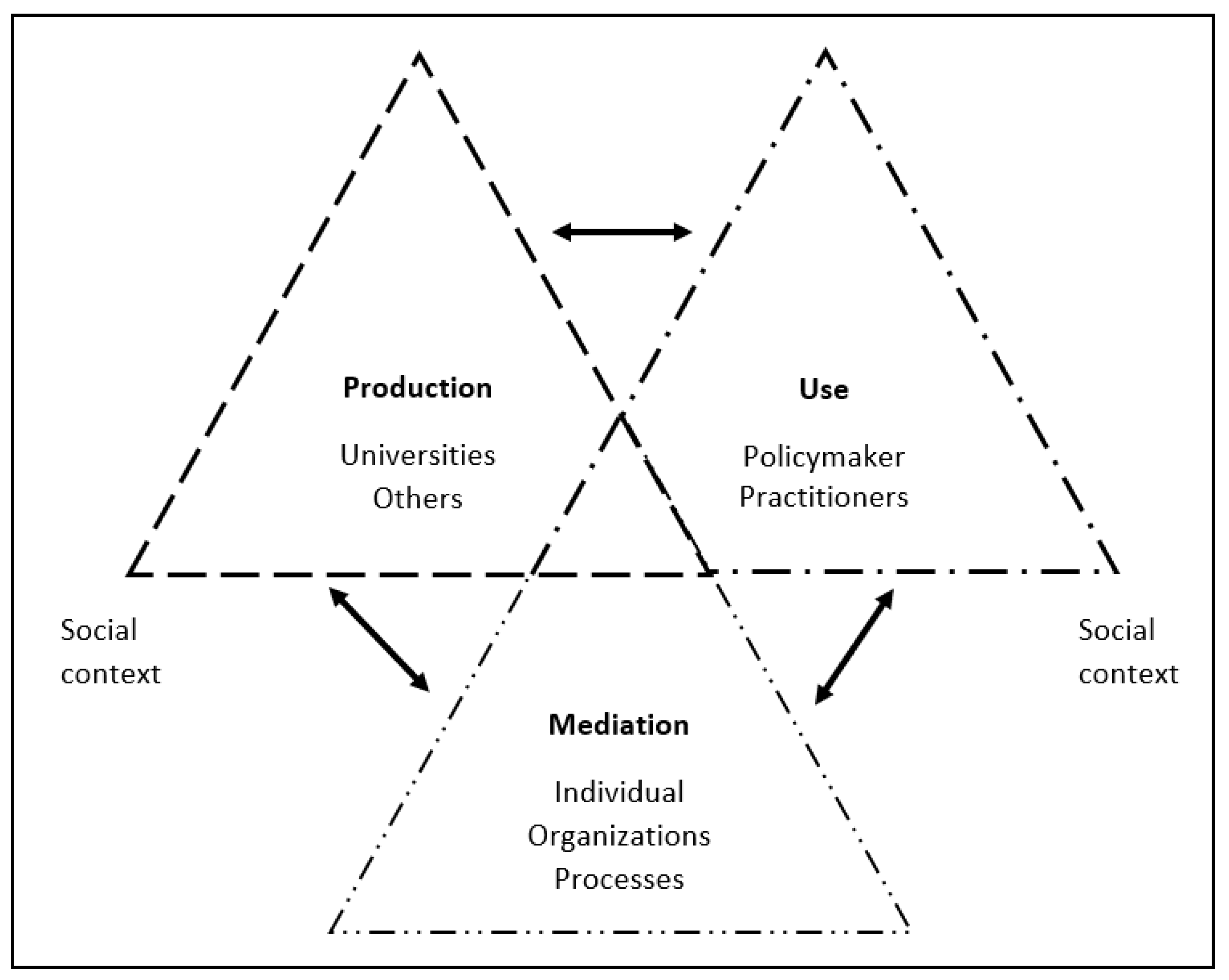
At the core of the RKM framework are three interconnected contexts: one where research is produced, another where it is used, and a third that encompasses the mediating processes between these two (see Figure 1). The bidirectional arrows in the framework illustrate the dynamic connections among these contexts. It is important to note that some stakeholders and organizations operate across two or even all three contexts. Moreover, multiple complex dynamics unfold both within each context and in the interactions between them.
Figure 1.
Own illustration based on Levin’s framework of RKM (B. Levin, 2011).
These dynamics that significantly influence the interplay between production, mediation, and use of research knowledge are discussed below, drawing upon Luhmann’s concept of resonance (Luhmann, 1988), the notion of externalization (Steiner-Khamsi & Waldow, 2018), and the idea of soft governance (Trubek et al., 2005; Martens et al., 2013) (see Figure 2).3 Considering that stakeholders within the respective contexts—such as policymakers or academic institutions—operate within different systems, across various hierarchical levels, and according to distinct rationalities, it is plausible that the potential for effective resonance and alignment among these contexts has not yet been fully developed.
Resonance, a central concept in Luhmann’s systems theory, refers to the idea that systems can only respond to events according to their own structural logic (Luhmann, 1988). Originally applied to global environmental challenges, Luhmann posits that the lower a system’s resonance capacity, the more rigid and ineffective it becomes at responding adequately to external inputs (Wetzel, 2017). When considered within the educational sector, this perspective highlights that a complex, autarkic and deeply rooted network of stakeholders determines, and can often limit, the degree to which an external event such as PISA (Tillmann et al., 2008) generates systemic impact.
This system’s theoretical perspective is complemented by the concept of externalization, which accounts for interactions among international, national, and federal stakeholders within the context of RKM. Externalization can be understood as a political act whereby systems create and reinforce national or federal boundaries, reasserting distinct identities to frame reform or change as a response to external pressure (Steiner-Khamsi & Waldow, 2018). Given that national education reforms in response to PISA require resonance, cooperation, and collaboration among diverse stakeholders, externalization suggests that the social constructs of the nation or federal state as unified actors may slow and sometimes even hinder reform efforts spanning multiple states within a federal system.
Closely related to externalization is the concept of soft governance, derived from political systems theory, which contrasts with hard governance by describing non-binding rules that nevertheless seek to produce practical effects (Trubek et al., 2005). In contrast, hard governance is characterized by legally binding rules and regulations that are enforceable through sanctions or penalties, reflecting a more hierarchical and command-and-control approach to policy implementation. Martens et al. (2013) characterize PISA as an ideal-typical example of soft governance exercised through international organizations, particularly the OECD. The OECD, on behalf of its member states, not only designs, implements, and coordinates PISA internationally but also formulates and issues non-binding recommendations for EPM.
In conclusion, the processual dynamics through which national education systems and structures respond to and engage with soft governance, externalization, and resonance remain historically, politically, and sociologically insufficiently explored. Although quantitative measurement of whether or to what extent these dynamics are at play is only partially feasible—and also not the focus of this analysis—our discussion enables informed inferences about their potential relevance (or lack thereof), which we elaborate in the conclusion. This gap in understanding calls for comprehensive investigation, with Germany serving as a particularly instructive case due to its federal governance structure, its long-standing participation in PISA, and the significant role that PISA results play in shaping national education discourse. Examining Germany thus yields insights into broader principles governing the interplay between international soft governance mechanisms and diverse, multi-level education systems.
2.2. Research Knowledge Mobilization in German Federalism
Building on the described interplay and dynamics among the various contexts of RKM, we have adapted B. Levin’s (2011) model to the specific landscape of German federal education. In this regard, Figure 2 represents both an extension and a national adaptation of Levin’s RKM framework. The extension primarily addresses the positioning of ERE, EPO, and EPR within the three core contexts of research production, mediation, and utilization. This national adaptation serves to identify nationally relevant stakeholders for each domain (ERE, EPO, and EPR), which then function as analytical units. Additionally, the dynamics outlined in Section 2.1 were incorporated as effective mechanisms influencing the interplay between ERE, EPO, and EPR.
Figure 2.
Simplified representation of the framework for RKM (based on B. Levin, 2011) using the example of Germany and the Pisa study.
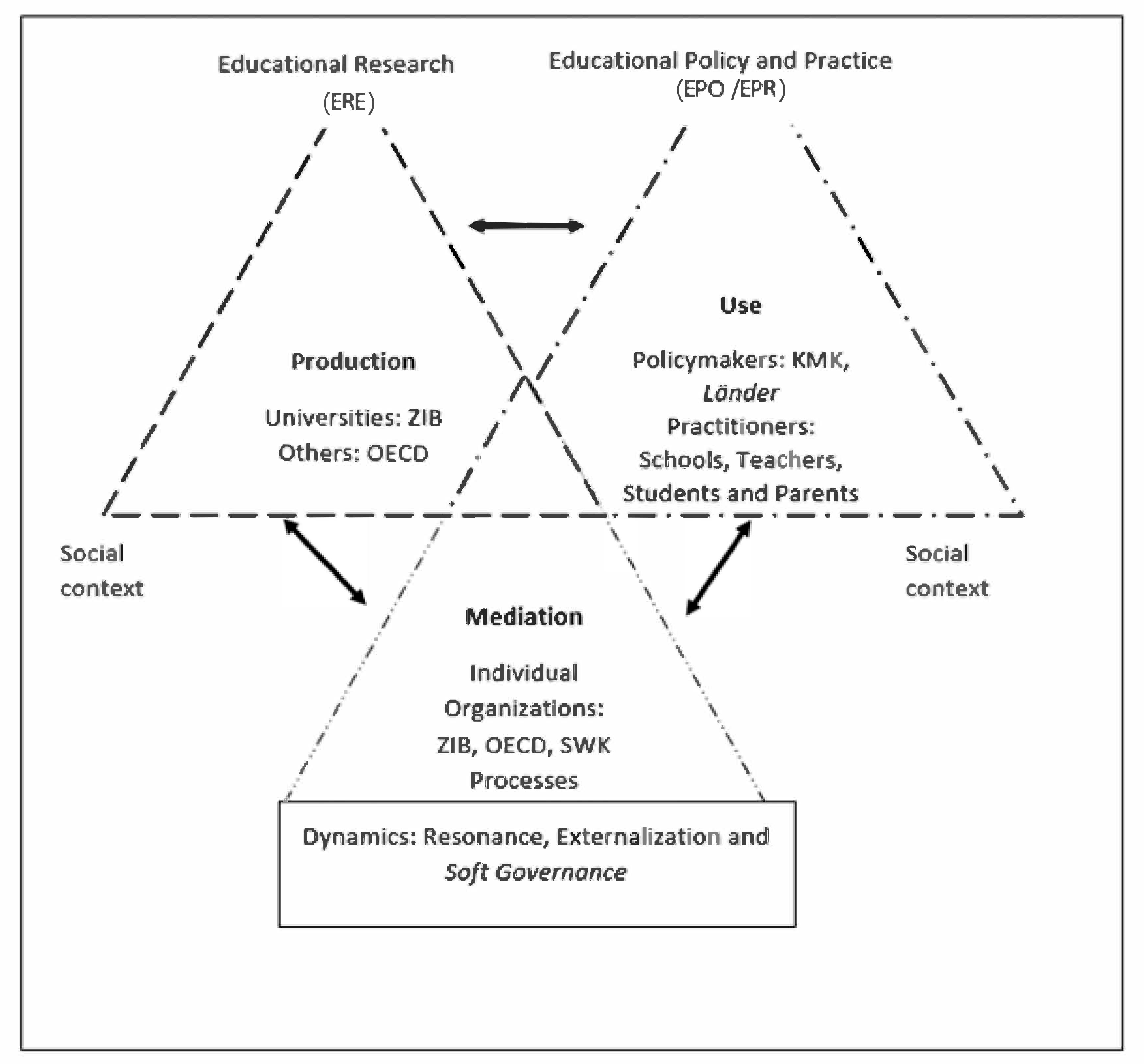
Regarding the selection of stakeholders, it should be emphasized that Figure 2 does not claim to be exhaustive. Rather, it presents exemplary and relevant actors according to their mandates and respective areas of expertise—ERE, EPO, and EPR. For instance, the OECD, as the commissioning body of the PISA study4, and the Center for International Student Assessment (ZIB)5, which currently serves as the national center responsible for PISA’s implementation and scientific research in Germany, are identified as key stakeholders within the ERE domain as those stakeholders are also officially entrusted with research and/or implementation of PISA. After several organizational changes in the early PISA survey cycles6, the ZIB was established to conduct PISA nationally since 2012 (Prenzel et al., 2013). In addition to the Technical University of Munich, numerous German universities, research institutes, and scholars engage with PISA data, generating valuable research knowledge.
Within this national framework, both the OECD and the ZIB are recognized as educational stakeholders involved in the production and mediation of research knowledge due to their central roles in the PISA study. Research findings and specific recommendations developed by the ZIB or the OECD fall under the mediation category, bridging ERE, EPO, and EPR, whereas purely descriptive research outputs are classified under ERE/production. This distinction carries practical implications for the analysis (see Table 1), where statements from these stakeholders are categorized according to either production or mediation of research knowledge.
Table 1.
Process-oriented framework of RKM within the German context using the example of PISA.
In addition to these stakeholders, the Standing Scientific Commission of the KMK (SWK) is acknowledged as a mediator of research knowledge in general. Although the SWK serves as a prominent scientific and independent advisory body to the KMK and acts as a link between ERE and EPO, it is excluded from this study’s analysis. The exclusion stems from the SWK’s sporadic publication of policy recommendations and the lack of transparent traceability between its advisory outputs and the KMK’s decisions and resolutions, particularly concerning second language support—a topic only addressed by the SWK in 2025 (Ständige Wissenschaftliche Kommission [SWK], 2025). Although the SWK is intended to serve as a central mediation body within the KMK, it has only been established recently, which helps explain why its influence on educational policy decisions is still limited. From a process-oriented perspective, SWK, ZIB, and the OECD are not identified as actors within the domain of EPM or EPR. Despite their involvement in policy-oriented tasks, within the national RKM framework these institutions are primarily associated with the mediation of research knowledge. Unlike the KMK and the Länder7, the OECD, ZIB, and SWK operate as scientific bodies whose outputs are rooted in scientific evidence, while KMK’s decisions and recommendations are political communications. Nevertheless, the KMK incorporates an approach of rational, evidence-based decision-making, aiming to integrate the best available research evidence alongside political and contextual considerations in its policy processes.
Regarding educational practice, practitioners are self-evident stakeholders. Concerning national and federal education policy, the KMK unites secretaries of education across all Länder with slightly differing portfolios. These portfolios refer to the specific areas of responsibility and tasks assigned to each state’s education ministers, which can vary between federal states and cover sectors such as general education, vocational training, higher education, teacher education, inclusion, digitalization, and language support, reflecting the decentralized and diverse structure of the German education system. Since 2024, the KMK has encompassed separate ministerial conferences for education, science, and culture, which independently address specific topics and represent their domains externally (Kultusministerkonferenz, 2024b). Coordination occurs through resolutions, recommendations, or agreements that provide a legally non-binding framework for the Länder. In line with the tradition of diversity and historical heritage in the German federal education system, detailed regulation is deliberately avoided to foster innovation and to account for Länder-specific characteristics (Kultusministerkonferenz, 2010b). The German Basic Law assigns education to the federal states (Artikel 30 GG), granting the Länder the final authority over the interpretation and implementation of EPM. Consequently, the actual establishment of educational laws takes place at the Länder level.
3. Methodological Approach and Analysis
This article analyzes the PISA cycles of 2000, 2018, and 2022 (see Table 1) to understand the effects and interactions between ERE, EPO, and EPR within the German context. It specifically considers the extent to which the production and mediation8 of research knowledge resonate within EPM and EPR. This investigation contributes to a better understanding of how the outcomes of the largest international comparative study on education—PISA—influence EPM and may lead to changes in EPR, as well as identifying potential discrepancies and disruptions during this process.
This article focuses its analysis within the framework of RKM by examining the effects and interactions of stakeholders involved in ERE, EPO, and EPR. The scope is narrowed specifically to PISA results concerning immigrant students in Germany, with a particular emphasis on 1st generation immigrant students. These students demonstrate significant competence gaps compared to non-immigrant peers in the European and particularly German contexts. In mathematics, non-immigrant students scored on average 59 points higher than immigrant students, which corresponds to the learning progress of approximately 1.5 school years (Lewalter et al., 2023). Importantly, 1st generation immigrant students—who make up the majority (63%) of the immigrant student population (Bundeszentrale für politische Bildung, 2025)—have been socialized outside Germany’s linguistic and cultural environment and therefore have a different educational history. This makes GSL concepts especially relevant for understanding EPM and its implementation in EPR for this specific group of students.
Methodologically, this qualitative case study—defined following Yin (2009) as the analysis of a temporally bounded phenomenon and its context using multiple data sources—traces PISA findings and their reception in EPM and EPR throughout the historical arc of the PISA cycles. The analysis of the trickle-down effect across the three PISA survey rounds is conducted on three levels: production (ERE), mediation (ERE and EPO), and use of research knowledge (EPR). Data collection focuses on the identified ERE stakeholders (ZIB and OECD), drawing exclusively on their official documentation of the respective PISA results while excluding the secondary literature. Given the emphasis on immigrant students, all relevant text passages are analyzed and classified by their attribution to research knowledge production or mediation: content describing performance and correlations between contextual factors and immigrant students’ performance is categorized as production, whereas statements with policy implications are classified as mediation. Furthermore, at the federal level, all KMK resolutions and recommendations explicitly referencing the respective PISA results post-publication are analyzed. At the Länder level, the analysis is confined to EPMs that explicitly cite PISA. At the EPR level, reliance is placed on secondary analyses examining the impact of PISA-triggered EPMs on EPR. In cases where no such secondary analyses are available for a given PISA cycle, the EPMs implemented at the EPR level are analyzed within the scope of the present study. Although data collection is not exhaustive, the limited number of scientific publications addressing EPM effects (stemming from PISA results) on EPR warrant note. Using the aforementioned criteria for data and document selection, the analysis proceeds to examine the alignment between ERE, EPO, and EPR.
The study investigates PISA results from three selected survey rounds: the first in 2000, chosen because it was the inaugural PISA cycle and revealed notable deficiencies in the German education system; the 2018 cycle, which marked the first significant decline in results; and the latest 2022 cycle, representing the most recent available data. In contrast, the intervening rounds (2003, 2009, 2012, and 2015) showed improvements in student performance, leading to virtually no new EPM initiatives—and thus rendering them unsuitable for this analysis.
In summary, the methodological approach—a qualitative case study focusing on selected PISA survey rounds and key actors across ERE, EPO, and EPR—aligns with established standards for qualitative research. Drawing on Lincoln and Guba (1985), who adapted quantitative criteria to the qualitative paradigm, this analysis satisfies credibility, transferability, dependability, and confirmability through measures such as data triangulation, thick description, and peer debriefing. Hence, our analysis—while intersubjectively comprehensible—does not claim to produce general or cross-context conclusions. Nevertheless, it offers indications of how research knowledge mobilization functions within a complex federal system, where certain aspects may also apply to other national contexts.
4. Analyzes and Results
4.1. PISA 2000: Finding the Minimal Consensus
When the first PISA study results were published in 2001, they triggered a massive public outcry, especially in Germany. Prior to this, international comparisons in education were almost nonexistent9. According to Niemann et al. (2017), Germany was largely unaware that its education system was inefficient and failed to provide equal opportunities for all students. The OECD report in 2004 further stated that Germany was failing to develop human capital adequately, depriving a large proportion of students of the academic skills necessary for optimal success in their careers.
The PISA 2000 results further revealed that students with a migration background—those whose parents immigrated and who thus were socialized without German as their 1st language—performed worse in reading than their non-immigrant peers, despite having completed the German school system (see Table 2). The Max Planck Institute, responsible for conducting and analyzing the 2000 PISA study, concluded that language competence is a critical factor influencing immigrant students’ educational success. They also highlighted that language deficits tend to have cumulative effects, meaning that students with insufficient proficiency in the language of instruction would also struggle to demonstrate competence in other subjects (Artelt et al., 2001).
Unlike the Max Planck Institute, the OECD report expanded the focus beyond language support, emphasizing that parental occupation strongly correlates with student performance. Children of parents in more prestigious jobs often have higher job expectations and awareness of career options. Consequently, the OECD recommended broadening occupational knowledge within the education system and providing support to parents with lower educational attainment (OECD, 2001).
In response to these findings, the KMK passed a resolution in 2003 defining seven fields of action. Two of these explicitly addressed students with a migration background (both 1st and 2nd generation immigrant students): enhancing language skills from preschool onwards and introducing measures to effectively support educationally disadvantaged students with migration backgrounds (Kultusministerkonferenz, 2003). Comparing these EPM with scientific evidence (ERE), language promotion was explicitly reflected in the KMK’s resolution. However, the OECD’s recommendation to broaden occupational knowledge and provide parental support was not included in the KMK resolution nor prioritized in implementation projects and measures (EPR).
Analyzing the impact of PISA 2000 on education policy reveals that alongside other reforms—such as mandatory learning progress assessments and the expansion of full-day schools—language support initiatives in primary education were successfully introduced in various states such as Bavaria, North Rhine-Westphalia, Hamburg, Thuringia or Baden-Württemberg (Baumert et al., 2002; Tillmann, 2015). Nonetheless, it remains unclear to what extent these EPM were developed specifically in response to the PISA results or whether they were pre-existing programs that were later justified by PISA findings (Tillmann et al., 2008). While research evidence (ERE) takes a nuanced and inclusive approach to second language acquisition for immigrant students, including the role of parents, EPM have primarily focused on improving language skills of immigrant students alone. In addition, education policy reforms have further narrowed these language support initiatives to primary education.
In summary, although the KMK’s (Kultusministerkonferenz, 2003) measures had a clear influence on policy reform, there was no comprehensive analysis of the scientific findings or recommendations. The KMK prioritized unity and agreeable measures while leaving out more controversial reforms, for instance regarding school structure (Tillmann et al., 2008). According to Tillmann et al. (2008), this situation explains why regional measures in preschool and primary education sectors gained prominence while important reforms in secondary education, including those in GSL, remained largely unaddressed despite their urgency. Consequently, 1st generation immigrant students’ PISA 2000 results remained particularly poor, and language support measures were only selectively initiated, mainly targeting primary education.
Table 2.
PISA 2000.
4.2. PISA 2018: Neglecting Structural Inequalities
The 2018 PISA survey was the first since 2000 to show a slight decline in student performance in Germany, but this negative development was not the central focus when the results were published (Reiss et al., 2019). Instead, the KMK stressed that Germany’s students still performed above the OECD average and that the proportion of high-achieving students had increased compared to 2009 (Kultusministerkonferenz, 2019). At the same time, PISA 2018 also revealed that, compared to other European countries, immigrant students in Germany have significantly lower skills in every tested subject: more than half of 1st generation immigrant students had only limited reading skills (OECD, 2019).
While the ZIB, as “knowledge producer”, highlighted this concerning skills gap between immigrant and non-immigrant students when publishing the PISA results—and clearly stated that this shows ongoing need for action to improve the education system’s ability to integrate (Reiss et al., 2019)—the KMK did not explicitly address immigrant students in its key communications following PISA 2018. The OECD also emphasized, alongside ZIB, that Germany has one of the highest shares of disadvantaged immigrant students, and that the largest performance gaps between immigrant and non-immigrant students were found in Germany and a small number of other countries (OECD, 2019). Notably, the OECD’s usual role as a mediator between experts and policymakers took a back seat in the 2018 results: although Volume V of the OECD’s PISA 2018 report (OECD, 2020) discusses effective education policies and successful schools, neither this volume nor any other publication on PISA 2018 directly addresses immigrant students as a target group of EPM, with the exception of the OECD working paper “The resilience of students with an immigrant background” (Cerna et al., 2021).
In contrast to PISA 2000, the ZIB acted as a more active mediator between experts and policymakers in 2018, not only presenting the numbers and competence differences between immigrant and non-immigrant students but also explicitly stating the ongoing need for action to improve the integrative capacity of the education system (Reiss et al., 2019). The KMK, however, took a more positive view of the 2018 results, emphasizing that student achievement in Germany remains above the OECD average. The KMK also pointed to initiatives such as “School Makes You Strong (SchuMaS)”10 and “Educating in Language and Writing (BiSS),” which aim to give targeted support to schools in challenging learning environments and to improve students’ language skills (Kultusministerkonferenz, 2019). Looking at policy implementation, both BiSS and SchuMaS have led to the development of numerous projects and strategies targeting language skills and everyday school life, adapted to the local needs of schools facing social disadvantages. As the successor to BiSS, BiSS-Transfer was launched in 2020, with the aim of bringing scientifically validated language education concepts into practice. However, those programs led by the KMK do not aim to change the education system at a structural level but instead focus on model projects. Reviews of BiSS-Transfer publications showcase numerous practical examples and effective methods aimed at improving the quality of teaching and learning. While the program primarily focuses on enhancing instructional practices and makes a valuable contribution towards strengthening language education and literacy, it does not address system-level recommendations and structural changes like increasing and determining the number of German language support hours for immigrant students or the consistent and comprehensive implementation and promotion of multilingualism, since such measures are beyond the program’s scope.
Thus, when assessing whether and how PISA results are mediated and used in policymaking, a discrepancy emerges: educational experts draw attention to a structural problem—the significant competence gap between immigrant and non-immigrant students—while policymakers focus on individual change in each school. Although BiSS and SchuMaS were not designed to provide comprehensive, systematic support for immigrant students, they do allocate project funds to individual schools and aim to disseminate best practices. Despite the poor results of immigrant students in Germany, systematic support for disadvantaged schools and students has not been implemented by policymakers. Interestingly, not only policymakers but also the public believe that, while differences in performance between immigrant and non-immigrant students are clear, funding should be evenly distributed instead of targeting disadvantaged groups (Wößmann et al., 2019).
By launching two major programs—BiSS and SchuMas—the KMK and the federal states have shown unity and responsiveness, even though the program designs do not address fundamental structural inequalities. These two programs served as important precursors to the Startchancen program, laying foundational work in language education and literacy promotion, even though their designs do not address fundamental structural inequalities. The sensitive nature of migration as a topic and the complex interplay between federal and state authorities in education make it difficult to achieve majorities and consistency at the KMK level. Political beliefs and state-level majorities largely determine the educational access and support offered to immigrant students, resulting in differing regulations concerning school attendance and variations in how immigrant students are integrated into schools—some states offer transitional classes, others immediate integration, and still others provide little information (Massumi et al., 2015). Systematic data collection on newly arrived students would be necessary to understand developments and compare the effects of different schooling concepts (Massumi et al., 2015).11
Overall, analysis of the PISA 2018 results within policymaking shows that the mediation and practical use of educational research results remain limited: while experts point to structural deficits, political responses continue to focus on individual, non-systemic improvements in schools (see Table 3).
Table 3.
PISA 2018.
4.3. PISA 2022: Expansion and Review of Existing Programs
While no concrete EPM were announced following the publication of the 2018 PISA results, and the skill gaps between immigrant and non-immigrant students received limited attention, the 2022 PISA results sparked much greater media focus on the continuing decline in student performance in Germany. The performance of immigrant students was also analyzed in detail. As an educational expert body, the ZIB reiterated that strong disparities persisted between immigrant and non-immigrant students in Germany. Furthermore, both the ZIB and the OECD showed that from 2012 to 2022, the mathematical competencies of immigrant students had significantly decreased (Lewalter et al., 2023; OECD, 2023). The OECD additionally pointed out that performance declines began even before the COVID-19 pandemic, suggesting underlying structural factors (OECD, 2023). This assessment can be positioned between production and mediation of research knowledge. The ZIB also linked these research findings to education policy by concluding that programs such as BiSS had not delivered hoped for improvements (Lewalter et al., 2023).
Unlike the 2000 cycle, the 2022 PISA study saw the ZIB clearly identify shortcomings and offer recommendations for education policy. Based on the relationship between students’ performance and their social and migration backgrounds, the ZIB recommended using established social and migration indices to revise funding distribution and introduce index-based resource allocation mechanisms (Lewalter et al., 2023). This strong emphasis highlights the necessity of implementing EPM. While the ZIB focused on structural change via redistribution mechanisms, the OECD suggested support measures aimed at removing barriers for immigrant students, such as providing tailored language support and high-quality early childhood education, avoiding concentration of immigrant students in underperforming schools (“school segregation”), offering additional support to immigrant parents, fostering diversity and inclusiveness in schools, and simplifying access to school selection information. The OECD further stresses that policy can significantly reduce disparities, as students with similar migration backgrounds show varying competence levels across countries (Schleicher, 2023; OECD, 2023).
The 2022 PISA results had a stronger impact on education policy compared to 2018. The KMK adopted a resolution calling on the Länder to review existing concepts for teaching GSL. Alongside strengthening core subjects, the KMK emphasized mandatory language assessments and, if necessary, mandatory language support prior to school enrollment. The Startchancen program, which aims to support schools with high proportions of disadvantaged students, is being extended nationally to 4000 schools (Kultusministerkonferenz, 2023a, 2023b). As the program only started in the 2024 school year, its effectiveness cannot yet be evaluated. Although the index-based school selection appears judicious, it remains questionable whether enrolling 4000 schools is sufficient to address systemic deficiencies in the education system. Analysis of responses to the PISA results reveals that the KMK plans to expand the Startchancen program and early language support but does not currently engage with other OECD proposals, such as providing support and guidance for immigrant parents.
In the educational practice realm, especially regarding the KMK resolution on revising GSL teaching concepts, analyses by the Mercator Institute (Massumi et al., 2015) highlight substantial variation in language support strategies and access regulations across Länder. The strategies, originating from a KMK resolution in 2010 aimed at supporting weaker students, also differ not only between federal states but also between schools, and many do not align with scientific recommendations. The variability raises questions about the comparability and systematic evaluation of these approaches. This example illustrates how federal structures may impact the effectiveness of evidence-based policy measures. Hence, Massumi et al. (2015) recommends not only implementation of support concepts but also establishment of minimum standards aligned with current research on second language acquisition.
This following section presents an example from one of the Länder, Bavaria, to illustrate how PISA results have influenced educational policy decisions at the regional level and what the consequences are for EPR. Specifically, it highlights the PISA-Offensive Bayern, a policy initiative aimed at strengthening foundational skills following poor PISA outcomes and discusses the practical implications and ongoing debates surrounding its implementation. The initiative aims to significantly strengthen basic skills in reading, writing, and mathematics by adding additional teaching hours in German and mathematics across all four grades of primary school. It also introduces flexible scheduling by combining arts subjects, mandates language tests, expands early childhood support, provides scientifically based diagnostic tools and innovative teaching materials, and offers extensive teacher training to foster targeted competency development. The goal is to provide better individual support to students and improve overall educational outcomes while maintaining a broad and holistic curriculum (Bayerisches Staatsministerium für Unterricht und Kultus, 2024).
While the “PISA-Offensive” clearly focuses on strengthening core competencies, it faces criticism for reducing time for creative and artistic subjects and for not sufficiently addressing teacher shortages (Radetzky, 2024; Mertens, 2024). Apart from that, it should be noted that Bavaria has already offered preparatory German courses (Vorkurs Deutsch) since 2013 along with compulsory language tests in daycare and pediatric check-ups. However, staffing shortages raise concerns about the consistency and quality of assessments and support, with available offerings declining in recent years (Wengert, 2024; Jerabek & Fünffinger, 2024). Thus, expanding early childhood support and introducing new compulsory language test raises questions regarding its necessity and practical implementation. Moreover, some aspects of the test design—such as mandatory kindergarten repetition for poor results or increased (immigrant) parental involvement in reading support—lack clear scientific backing; grade repetition is highly contested, as it may exacerbate skill gaps rather than close them. Increased parental involvement could unintentionally disadvantage immigrant families, contradicting OECD recommendations that stress school responsibility in supporting immigrant parents and promoting diversity and inclusiveness.
These findings illustrate discrepancies between research production, mediation, and implementation in practice. The KMK’s policy measures address only part of the recommendations from research actors (ZIB and OECD) aimed at reducing barriers for immigrant students. Meanwhile, practical examples such as Bavaria demonstrate how state-level implementations encounter design and content challenges that may limit effectiveness and real-world impact (see Table 4).
Table 4.
PISA 2022.
5. Conclusions and Recommendations
The interaction between ERE, EPO, and EPR in the context of the PISA results from 2000, 2018, and 2022 can be characterized by a dynamic yet complex relationship: vigorous practical initiatives and detailed analytical contributions from research stakeholders, policy responses from the KMK, and a broad interest in international comparisons that occasionally lack nuanced consideration of national-specific outcomes and existing structures. Using Levin’s framework for research knowledge mobilization (B. Levin, 2011) and drawing on the concepts of resonance (Wetzel, 2017; Vermaßen, 2023), externalization (Steiner-Khamsi & Waldow, 2018), and soft governance (Martens et al., 2013), this article integrates German national educational stakeholders into the framework by categorizing them within the domains of ERE, EPO, and EPR. Subsequently, it examines the scientific interpretation of PISA cycles 2000, 2018, and 2022, with a particular focus on immigrant students (primarily 1st generation) aiming to assess the influence of EPM on EPR and the role of ERE in transforming assessment outcomes into effective policy and practice.
The analysis reveals notable differences in how research knowledge is produced, mediated, and applied across these cycles. Importantly, persistent gaps in the coordination and interaction between ERE, EPO, and EPR emerge consistently across all examined survey rounds. This indicates sizable gaps in the exchange and integration processes among educational stakeholders, as visualized in the arrows of exchange in Figure 2, which appear less robust than their potential suggests. The stagnation in the trickle-down effect of PISA results on EPM and EPR can largely be attributed to political and structural barriers. These include the requirement for unanimity in KMK decisions and the absence of binding implementation guidelines for EPM at the Länder level. Such barriers obstruct effective and consistent policy implementation across the federal states. This can be understood as an effect of externalization and limited resonance: the barrier of unanimity itself can be seen as a product of externalization, while the federal states retain sovereign authority in educational matters and are perceived as distinct and decisive identities or institutions. Consequently, resonance between the KMK and the individual states remains limited. While valuable research knowledge is produced, the KMK, as the principal educational policymaking body, appears to incorporate findings from ERE only to a limited degree within its EPM. Additionally, the diverse implementation of these measures across the Länder further limits the overall effectiveness and coherence of educational improvements. At the same time, the analysis revealed that the OECD’s influence on educational policy monitoring (EPM) in Germany, exercised through mechanisms of soft governance, is only partially effective. Likewise, the KMK’s form of soft governance—manifested in non-binding resolutions and recommendations—has only limited impact on the EPM practices of the federal states, which ultimately retain the authority to decide which measures to adopt and how to implement them.
This opaque interplay between ERE, EPO, and EPR in Germany can be attributed to several factors, including dynamics of resonance and externalization. A central explanation lies in the historically entrenched federal structure of educational governance, which grants substantial autonomy to the Länder. This federal arrangement—together with allocation mechanisms such as the Königssteiner Schlüssel, which tends to advantage wealthier Länder—likely reinforces, or even amplifies, inequalities among different student groups. Nevertheless, the analysis also revealed considerable potential for improvement and reform, as will be outlined below. A promising example is the Startchancen program, which for the first time allocates funds according to a social-need index, thereby directing resources to schools operating in the most challenging contexts.
The following section presents the analysis results for each area (ERE, EPO, and EPR) and outlines recommendations to enhance the effectiveness of the trickle-down process.
5.1. Educational Research
The educational stakeholders within the realm of ERE analyzed in this study—primarily the ZIB and the OECD—offer detailed and differentiated insights into the academic performance of immigrant and non-immigrant students. They contextualize these findings by linking them to various influencing factors and provide targeted recommendations for the development of effective EPM. However, it is important to recognize that large-scale assessments like PISA primarily provide correlational data and do not establish causal relationships. Therefore, while monitoring results such as those from PISA are valuable, translating them into concrete and actionable policy interventions requires careful consideration of their limitations and complementary evidence from other research methods.
Moreover, despite the presence of SWK, a group of interdisciplinary experts responsible for issuing scientific statements on pertinent educational policy issues, challenges remain. Specifically, the selection of topics by the SWK and the limited transparency in tracing advisory outputs to the actual decisions and resolutions of the KMK seem to restrict the influence of ERE on policymaking. Similarly, analyses indicate that the practical implementation of KMK resolutions at the Länder level exhibits considerable variability, with the integration of scientific expertise sometimes being limited. Importantly, there is no binding obligation for the Länder to implement these measures, and consequently, many measures are neither evaluated nor is it even assessed whether they have been implemented at all. This lack of mandatory implementation and systematic as well scientific evaluation at the Länder level significantly limits accountability and hinders efforts to improve the translation of ERE in effective EPM.
To address these issues, it may be advisable for the education ministries of the Länder to establish dedicated scientific expert groups charged with overseeing the goal-oriented and impact-focused implementation of KMK resolutions; indeed, such expert groups already exist in some Länder, providing promising models for systematic and informed policy monitoring.
5.2. Educational Policy
First, it should be noted that EPM are not strongly aligned with the findings of ERE. Regarding the effectiveness of EPM, it would be advisable for the KMK to formulate minimum standards and clearer, more specific requirements for the implementation of its resolutions. Although the Länder retain sovereignty over education, it is worth considering—especially given the crucial role of educational outcomes for the national economy (Wößmann, 2007)—whether setting mandatory minimum educational standards at the Länder level might be politically, economically, and legally enforceable and necessary. Notably, nationwide educational standards were introduced as a direct response to the poor PISA results in 2000, effectively setting binding competence goals in core subjects. However, it appears that in other crucial fields—such as schooling and support of newly arrived immigrant students—similar minimum standards also need to be established to ensure equity and quality across all Länder.
Such standards could also mandate the establishment of a nationwide educational history register (Hertweck et al., 2023), enabling the consistent tracking of educational progress across different ages and institutions. This register could be linked to data from LSAs such as PISA to deepen understanding of learning trajectories.
With reference to immigrant students, thorough analysis of their educational paths has so far been hindered by the lack of consistent data on language proficiency and migration status at the Länder level. Since migration status constitutes the strongest explanatory factor for performance differences among 15-year-old students in Germany (Kultusministerkonferenz, 2024a), a robust scientific investigation of immigrant students’ educational trajectories is urgently needed.
5.3. Educational Practice
While discussions about competence orientation in schools or teacher professionalization are important, the critical issue at hand is the severe shortage of teachers, language support staff, and social workers already affecting schools. Of particular concern is the lack of multiprofessional teams at schools, which are essential to adequately address the diverse challenges, such as the heterogeneity of the student body, by bringing together the expertise of various educational, social, and therapeutic professionals. Any efforts or additional resources will likely fail if there is insufficient staff to maintain current school operations. Furthermore, generating data-driven insights into educational practices specifically for immigrant students remains virtually impossible. This is partly because the educational integration of newly arrived immigrant students is still an under-researched area and partly due to the scarcity or absence of data on schooling models and the language biographies of (immigrant) students.
Summarizing findings from ERE, the competence gap between immigrant and non-immigrant students remains alarmingly large. Teachers are often overwhelmed by growing classroom diversity, and shortages of teachers, language support personnel, and childcare workers—particularly in the preschool sector, which is of main importance for the educational integration/second language acquisition of newly immigrated children—disproportionately affecting immigrant families (Bock-Famulla et al., 2023).
For example, in 2023, only 22.3 percent of children under three with a migrant background attended daycare, whereas 76.8 percent of three- to six-year-olds with a migrant background had access to kindergarten, compared to 99.3 percent of children without a migrant background. Despite reforms in early childhood education, disparities between immigrant and non-immigrant children have increased in recent years (Geis-Thöne & Plünnecke, 2024). Whether these trends are driven solely by staff shortages or also by structural barriers remains unclear at this point.
Finally, it should be emphasized that, despite the findings and recommendations generated by ERE, the KMK and, by extension, political interests and majorities ultimately determine the degree to which educational policy measures (EPM) are politically endorsed and implemented.
Regarding the upcoming PISA survey in 2025, it aligns with the perspective of the Max-Planck-Institut für Bildungsforschung (2019) to shift focus away from Germany’s position in international rankings and instead prioritize addressing the country’s internal educational challenges. This includes concentrating on one of the most urgent educational policy issues: the effective integration of immigrant students.
Author Contributions
Conceptualization, L.T. and J.D.; methodology, L.T.; software, L.T.; validation, L.T., J.D. and S.G.; formal analysis, L.T.; investigation, L.T. and J.D.; resources, L.T.; data curation, L.T.; writing—original draft preparation, L.T.; writing—review and editing, J.D. and S.G.; visualization, L.T.; supervision, J.D. and S.G.; project administration, L.T.; All authors have read and agreed to the published version of the manuscript.
Funding
This research received no external funding.
Data Availability Statement
No new data were created or analyzed in this study. Data sharing is not applicable to this article.
Acknowledgments
The authors acknowledge the valuable support provided by artificial intelligence tools during the development of this study. Perplexity Pro was also employed for the purpose of text review.
Conflicts of Interest
The authors declare no conflicts of interest.
Notes
| 1 | These specific figures are drawn from the PISA 2022 study. From 2000 to 2022, PISA assessments were conducted every three years; starting in 2025, the assessment cycle will shift to every four years. |
| 2 | Methodologically, the trickle-down effect is examined by analyzing the evolution of PISA findings and their interpretation within EPM and EPR across the different PISA cycles. |
| 3 | Although the dynamics outlined above are not exhaustive, they were selected as constructs previously analyzed in PISA contexts and in interactions among international and national stakeholders, where they have been shown to come into effect. |
| 4 | The OECD governs the PISA study collectively through its member countries, which participate in decision-making via meetings of the PISA Governing Board. The member states decide on the design, content, and implementation aspects of PISA, ensuring a collective mandate for the assessment framework. Meanwhile, the OECD Secretariat acts as the implementation body and is able to influence the process and prioritites by setting specific emphases or operational directions within the agreed framework (OECD, 2025). |
| 5 | It should be added at this point that although the authors of this article are themselves members of the ZIB, they are not authors of the PISA 2000, 2018, and 2022 report volumes analyzed in this article and therefore there is no conflict of interest. |
| 6 | In 2000, for example, the Max Planck Institute for Human Development was entrusted with conducting the PISA study. For this reason, the Max Planck Institute is mentioned in the 2000 analysis instead of the ZIB. |
| 7 | Federal states of Germany. The Länder hold extensive autonomy and authority in the field of education. |
| 8 | Refers to the process by which information and insights generated through research are interpreted, adapted, and conveyed to various audiences (Gray et al., 2015). |
| 9 | Germany participated in TIMSS 1995 and its precursor studies in the 60ties and 80ties: But the studies focused only on scientific domains and did not yield the same public attention (Sälzer, 2016). |
| 10 | This is a joint initiative by the German state and the Länder to support schools in socially difficult circumstances (Schule macht stark). |
| 11 | The sovereignty of the Länder in educational matters also contributes to the fact that the data situation and definitions of terms in the context of schooling for immigrant students vary greatly from state to state and that there is no national database that would allow for tracking, without complicated conversions and data harmonization at the national level. |
References
- Artelt, C., Baumert, J., Klieme, E., Neubrand, M., Prenzel, M., Schiefele, U., Schneider, W., Schümer, G., Stanat, P., Tillmann, K.-J., & Weiß, M. (2001). PISA 2000 Zusammenfassung zentraler Befunde. Max-Planck-Institut für Bildungsforschung. Available online: https://www.pisa.tum.de/fileadmin/w00bgi/www/Berichtsbaende_und_Zusammenfassungungen/Zusammenfassung_PISA_2000 (accessed on 8 January 2026).
- Baumert, J., Artelt, C., Klieme, E., Neubrand, M., Prenzel, M., Schiefele, U., Schneider, W., Stanat, P., Tillmann, K.-J., & Weiß, M. (2002). PISA 2000: Die Länder im Vergleich. Max-Planck-Institut für Bildungsforschung. Available online: https://www.kmk.org/fileadmin/Dateien/veroeffentlichungen_beschluesse/unbekannt/1900_01_01-PISA-2000-Laender-im-Vergleich.pdf (accessed on 8 January 2026).
- Bayerisches Staatsministerium für Unterricht und Kultus. (2024). Lesen, schreiben, rechnen im fokus: Pisa-Offensive in Bayern. Available online: https://www.km.bayern.de/download/4-24-03/Rahmenkonzept_PISA-Offensive.pdf (accessed on 8 January 2026).
- BiSS Transfer. (n.d.). BiSS-Transfer—Bildung durch Sprache und Schrift. Available online: https://www.biss-sprachbildung.de/ (accessed on 8 January 2026).
- Bock-Famulla, K., Berg, E., Girndt, A., Akko, D. P., Krause, M., & Schütz, J. (2023). Länderreport frühkindliche Bildungssysteme 2023. Verlag Bertelsmann Stiftung. [Google Scholar]
- Bundeszentrale für politische Bildung. (2025, July 7). Bevölkerung mit Migrationshintergrund. Bundeszentrale für Politische Bildung. Available online: https://www.bpb.de/kurz-knapp/zahlen-und-fakten/soziale-situation-in-deutschland/61646/bevoelkerung-mit-migrationshintergrund (accessed on 8 January 2026).
- Cerna, L., Brussino, O., & Mezzanotte, C. (2021). The resilience of students with an immigrant background: An update with PISA 2018 (pp. 1–69). OECD Education Working Papers 261. OECD Publishing. [Google Scholar]
- Geis-Thöne, W., & Plünnecke, A. (2024, September 5). Kitakrise: Kinder ausländischer Eltern verlieren den Anschluss. Institut der deutschen Wirtschaft (IW). Available online: https://www.iwkoeln.de/presse/iw-nachrichten/axel-pluennecke-wido-geis-thoene-kinder-auslaendischer-eltern-verlieren-den-anschluss.html (accessed on 8 January 2026).
- Gray, M., Sharland, E., Heinsch, M., & Schubert, L. (2015). Connecting research to action: Perspectives on research utilization. The British Journal of Social Work, 45(7), 1952–1967. [Google Scholar] [CrossRef] [Scilit]
- Hertweck, F., Isphording, I. E., Matthewes, S. H., Schneider, K., & Spieß, C. K. (2023). Bildungsdaten: Datenlücken durch ein Bildungsverlaufsregister schließen. Wirtschaftsdienst, 103(11), 733–736. [Google Scholar] [CrossRef] [Scilit]
- Jerabek, P., & Fünffinger, A. (2024, September 14). Sprachtest-Pflicht kommt im Eiltempo: “Übers Knie gebrochen”. BR24. Available online: https://www.br.de/nachrichten/bayern/sprachtest-pflicht-kommt-im-eiltempo-uebers-knie-gebrochen (accessed on 8 January 2026).
- Kultusministerkonferenz. (2003). Kultusministerkonferenz fasst Beschluss zu vertiefendem PISA-Bericht. KMK. Available online: https://www.kmk.org/presse/pressearchiv/mitteilung/kultusministerkonferenz-fasst-beschluss-zu-vertiefendem-pisa-bericht.html (accessed on 8 January 2026).
- Kultusministerkonferenz. (2010a). Förderstrategie für leistungsschwächere Schülerinnen und Schüler. Available online: https://www.kmk.org/fileadmin/veroeffentlichungen_beschluesse/2010/2010_03_04-Foerderstrategie-Leistungsschwaechere.pdf (accessed on 8 January 2026).
- Kultusministerkonferenz. (2010b). Ländervereinbarung über die gemeinsame Struktur des Bildungssystems. KMK. Available online: https://www.kmk.org/fileadmin/veroeffentlichungen_beschluesse/2020/2020_10_15-Laendervereinbarung.pdf (accessed on 12 January 2016).
- Kultusministerkonferenz. (2019). PISA 2018: Deutschland stabil über OECD-Durchschnitt—Unser Anspruch muss mehr sein: Zukünftig weitere Anstrengungen nötig. KMK. Available online: https://www.kmk.org/presse/pressearchiv/mitteilung/pisa-2018-deutschland-stabil-ueber-oecd-durchschnitt-unser-anspruch-muss-mehr-sein-zukuenftig-weitere-anstrengungen-noetig.html (accessed on 8 January 2026).
- Kultusministerkonferenz. (2023a). Kultusministerkonferenz fasst Beschluss zu PISA 2022. KMK. Available online: https://www.kmk.org/aktuelles/artikelansicht/kultusministerkonferenz-fasst-beschluss-zu-pisa-2022.html (accessed on 8 January 2026).
- Kultusministerkonferenz. (2023b). Stärkung der Basiskompetenzen dringend notwendig—PISA 2022-Ergebnisse vorgestellt. KMK. Available online: https://www.kmk.org/aktuelles/artikelansicht/pisa.html (accessed on 8 January 2026).
- Kultusministerkonferenz. (2024a). Bericht zum Stand der Umsetzung der Förderstrategie für leistungsschwächere Schülerinnen und Schüler. KMK. Available online: https://www.kmk.org/fileadmin/veroeffentlichungen_beschluesse/2024/2024_04_25-Umsetzung-Foerderstrategie.pdf (accessed on 8 January 2026).
- Kultusministerkonferenz. (2024b). Neuausrichtung der Kultusministerkonferenz: Effizientere Strukturen für Bildung, Wissenschaft und Kultur. KMK. Available online: https://www.kmk.org/fileadmin/pdf/PresseUndAktuelles/2024/2024_06_25-Neuausrichtung-der-KMK.pdf (accessed on 8 January 2026).
- Levin, B. (2011). Mobilising research knowledge in education. London Review of Education, 9(1), 15–26. [Google Scholar] [CrossRef] [Scilit]
- Levin, D. Z., & Cross, R. (2004). The strength of weak ties you can trust: The mediating role of trust in effective knowledge transfer. Management Science, 50(11), 1477–1490. [Google Scholar] [CrossRef] [Scilit]
- Lewalter, D., Diedrich, J., Goldhammer, F., Köller, O., & Reiss, K. (2023). PISA 2022 Analyse der Bildungsergebnisse in Deutschland. Waxmann Verlag. [Google Scholar] [CrossRef] [Scilit]
- Lincoln, Y. S., & Guba, E. G. (1985). Naturalistic inquiry. Sage Publications. [Google Scholar]
- Luhmann, N. (1988). Die Wirtschaft der Gesellschaft. Suhrkamp Verlag. [Google Scholar] [CrossRef] [Scilit]
- Martens, K., Breiter, A., Idel, T. S., Knipping, C., & Teltemann, J. (2013). Das “PISA Phänomen”: Ein Plädoyer für einen interdisziplinären Ansatz zur Erforschung von Bildungsproduktion im Kontext von Large-Scale-Assessments. TranState Working Papers No. 175. Universität Bremen, Collaborative Research Center 597—Transformations of the State, Bremen. [Google Scholar]
- Massumi, M., Von Dewitz, N., Grießbach, J., Terhart, H., Wagner, K., Hippmann, K., Altinay, A., Becker-Mrotzek, M., & Roth, H. J. (2015). Neu zugewanderte Kinder und Jugendliche im deutschen Schulsystem. Mercator-Institut für Sprachförderung und Deutsch als Zweitsprache und Zentrum für LehrerInnenbildung der Universität zu Köln. [Google Scholar]
- Max-Planck-Institut für Bildungsforschung. (2019, December 2). Unstatistik des Monats: PISA-Ergebnisse sind international nur eingeschränkt vergleichbar. Max-Planck-Institut für Bildungsforschung. Available online: https://www.mpib-berlin.mpg.de/unstatistik-des-monats-pisa-ergebnisse-sind-international-nur-eingeschraenkt-vergleichbar (accessed on 8 January 2026).
- Mertens, A. (2024, April 24). “Brachial”–Kritik an Bayerns Pisa-Offensive. BR24. Available online: https://www.br.de/nachrichten/bayern/brachial-kritik-an-bayerns-pisa-offensive (accessed on 8 January 2026).
- Niemann, D., Martens, K., & Teltemann, J. (2017). PISA and its consequences: Shaping education policies through international comparisons. European Journal of Education, 52(2), 175–183. [Google Scholar] [CrossRef] [Scilit]
- OECD. (2001). Knowledge and skills for life: First results from PISA 2000. OECD Publishing. [Google Scholar] [CrossRef] [Scilit]
- OECD. (2004). How student performance varies between schools and the role that socio-economic background plays in this. In Learning for tomorrow’s world: First results from PISA 2003. OECD Publishing. [Google Scholar] [CrossRef] [Scilit]
- OECD. (2019). PISA 2018 results (Volume II): Where all students can succeed. OECD Publishing. [Google Scholar] [CrossRef] [Scilit]
- OECD. (2020). PISA 2018 results (Volume V): Effective policies, successful schools. OECD Publishing. [Google Scholar] [CrossRef] [Scilit]
- OECD. (2023). PISA 2022 results (Volume I): The state of learning and equity in education. OECD Publishing. [Google Scholar] [CrossRef] [Scilit]
- OECD. (2025). PISA 2025 technical standards. Available online: https://www.oecd.org/content/dam/oecd/en/about/programmes/edu/pisa/publications/technical-standards/PISA_2025_Technical_Standards.pdf (accessed on 8 January 2026).
- Prenzel, M., Sälzer, C., Klieme, E., & Köller, O. (2013). PISA 2012. In Fortschritte und Herausforderungen in Deutschland. Waxmann Verlag. [Google Scholar] [CrossRef]
- Radetzky, A. (2024, September 13). Das bedeutet die “Flexibilisierung” der Stundentafel in der PISA-Offensive wirklich. BLLV. Available online: https://www.bllv.de/vollstaendiger-artikel/news/bedeutet-flexibilisierung-stundentafel-pisa-offensive-wirklich-6145 (accessed on 8 January 2026).
- Reiss, K., Weis, M., Klieme, E., & Köller, O. (2019). Grundbildung im internationalen vergleich. Waxmann Verlag. [Google Scholar] [CrossRef]
- Sälzer, C. (2016). Studienbuch Schulleistungsstudien: Das Rasch-Modell in der Praxis. Springer. [Google Scholar]
- Schleicher, A. (2023). PISA 2022 insights and interpretations. OECD. [Google Scholar]
- Ständige Wissenschaftliche Kommission [SWK]. (2025). Sprachliche Bildung für neu zugewanderte Kinder und Jugendliche gestalten–Maßmahmen zur Förderung der Zielsprache Deutsch. Available online: https://swk-bildung.org/content/uploads/2024/12/SWK-2025-Stellungnahme-SprachlicheBildung.pdf (accessed on 8 January 2026).
- Steiner-Khamsi, G., & Waldow, F. (2018). PISA for scandalisation, PISA for projection: The use of international large-scale assessments in education policy making—An introduction. Globalisation, Societies and Education, 16(5), 557–565. [Google Scholar] [CrossRef] [Scilit]
- Tillmann, K.-J. (2015, June 19). PISA & Co.–Eine kritische Bilanz. Bundeszentrale für politische Bildung (bpb). Available online: https://www.bpb.de/themen/bildung/dossier-bildung/208550/pisa-co-eine-kritische-bilanz/ (accessed on 8 January 2026).
- Tillmann, K.-J., Dedering, K., Kneuper, D., Kuhlmann, C., & Nessel, I. (2008). PISA als bildungspolitisches Ereignis: Fallstudien in vier Bundesländer. VS Verlag für Sozialwissenschaften. [Google Scholar] [CrossRef] [Scilit]
- Trubek, D. M., Cottrell, M. P., & Nance, M. (2005). “Soft law,” “hard law,” and European integration: Toward a theory of hybridity. University of Wisconsin Legal Studies Research Paper No. 1002. University of Wisconsin Law School. [Google Scholar]
- Vermaßen, H. (2023). Die drei Dimensionen systematischer Resonanz: Resonanzfähigkeit, Resonanzen und Resonieren. In Die Resonanzfähigkeit des Wirtschaftssystems für die deutsche Energiewende: Strukturelle Voraussetzungen, Formen und Folgen gesellschaftlicher Koordinationsprozesse (pp. 31–34). Transcript Verlag. [Google Scholar] [CrossRef] [Scilit]
- Waldow, F., & Steiner-Khamsi, G. (Eds.). (2019). Understanding PISA’s attractiveness. Critical analysis in comparative policy studies. Bloomsburry Academic. [Google Scholar]
- Wengert, J. (2024, February 2). Sprachkenntnisse: Angebot an Deutsch-Vorkursen in Bayern sinkt. BR24. Available online: https://www.br.de/nachrichten/bayern/deutschkurse-migration-integration-sprachtests-sprachfoerderung-soeder-schule-spd (accessed on 8 January 2026).
- Wetzel, D. (2017). Resonanz in der Soziologie: Positionen, Kritik und Forschungsdesiderata. In T. Breyer, M. Buchholz, A. Hamburger, S. Pfänder, & E. Schumann (Eds.), Resonanz-Rhythmus-Synchronisierung: Interaktionen in Alltag, Therapie und Kunst (pp. 47–64). Transcript Verlag. [Google Scholar] [CrossRef] [Scilit]
- Wößmann, L. (2007). Fundamental determinants of school efficiency and equity: German states as a microcosm for OECD countries. (Paper No. 1981). CESifo Working Paper. Available online: https://ideas.repec.org/p/ces/ceswps/_1981.html (accessed on 8 January 2026).
- Wößmann, L., Lergetporer, P., Grewenig, E., Kersten, S., Kugler, F., & Werner, K. (2019). Was die Deutschen über Bildungsungleichheit denken. Ergebnisse des ifo Bildungsbarometers 2019. ifo Schnelldienst, 72(17), 3–17. [Google Scholar]
- Yin, R. K. (2009). Case study research. Design and methods (4th ed.). Sage. [Google Scholar]

Disclaimer/Publisher’s Note: The statements, opinions and data contained in all publications are solely those of the individual author(s) and contributor(s) and not of MDPI and/or the editor(s). MDPI and/or the editor(s) disclaim responsibility for any injury to people or property resulting from any ideas, methods, instructions or products referred to in the content. |
© 2026 by the authors. Licensee MDPI, Basel, Switzerland. This article is an open access article distributed under the terms and conditions of the Creative Commons Attribution (CC BY) license.