


Abstract
Saudi Arabia’s cereal imports are a cornerstone of its food security policy, driven by an arid climate, limited water resources, and persistently high domestic demand. This study employed the ARDL cointegration framework on data from 1992 to 2022 to explore the dynamic relationships among cereal imports (IMP), Gross Domestic Product (GDP), cereal production (PRO), and agricultural water use (WA). Descriptive analysis revealed a clear upward trend for cereal imports and GDP, contrasting with a downward trend for PRO and WA during the study period. This pattern reflects high import dependency, economic diversification, and water scarcity policies. The ARDL results confirmed a long-run equilibrium relationship, where GDP and agricultural water use showed a positive, significant relationship with cereal imports, while cereal production had a significant negative long-term impact on imports. Short-run dynamics were complex, suggesting that lagged increases in GDP and water use were associated with reduced imports, while cereal production had a positive impact on imports, which is attributed to the country’s low cereal self-sufficiency ratio and structural import dependence. The conclusion underscores the constraints of limited water resources, leading to greater reliance on cereal imports. The study recommends water-efficient agricultural strategies and adjusted import policies to enhance food security.
1. Introduction
Food security in arid and semi-arid regions is increasingly constrained by water scarcity, climatic stress, and growing demand driven by population growth and income expansion (FAO, 2025a; OECD/FAO, 2024). Saudi Arabia, among other prominent countries of the Arabian Peninsula, is characterized by extreme aridity and very limited water resources, which place pressure on its agricultural sector (Moossa et al., 2022). GCC countries face a severe water shortage that threatens the sustainable development of agricultural and industrial sectors. In 2030, water resources are predicted to reduce by more than 50% (Moossa et al., 2022). Saudi Arabia receives very low annual rainfall and features sandy, non-fertile soils that contribute to the poor agricultural output (Subahi & Bouazza, 2020).
Water scarcity in Saudi Arabia has driven the development of unique agricultural practices, including protected agriculture (e.g., greenhouses and hydroponic systems), with the goal of improving water use efficiency and crop productivity (Al-Khateeb et al., 2024). Despite these improvements, water withdrawal has increased dramatically, with consumption climbing from 17.79 billion m3 in 2008 to 23.83 billion m3 in 2018, drawn primarily from non-renewable groundwater (MEWA, 2020).
Agriculture accounts for over 80% of total water consumption in Saudi Arabia (Chowdhury et al., 2019; Ahmed et al., 2013; Alamri & Reed, 2019), with green fodder crops such as alfalfa and barley using approximately 67% of irrigation water (Ghanem et al., 2021). The cultivation of these water-intensive crops drives the over-exploitation of groundwater and accelerates the depletion of natural resources.
According to OECD/FAO (2024), the world cereals sector is projected to experience substantial growth between 2024 and 2033, with total utilization expected to rise from approximately 2.8 billion tons in 2024 to nearly 3.2 billion tons. This increase will be driven by production gains forecast to grow by 350 Mt, mainly due to improvements in productivity, while demand expansion is anticipated to decelerate as the use of feed and biofuels increases at a slower pace. Asia will account for 40% of the growth in production, and trade is projected to expand by 16%, with major exporters such as the Russian Federation for wheat and the United States for maize retaining predominant positions. In contrast, most African and Asian countries will have to place greater dependence on cereal imports, leaving them exposed to trade shocks and climate risks (OECD/FAO, 2024).
In 2023, the overall cultivated area for grains in Saudi Arabia was 331 thousand hectares, with a harvested area of 323 thousand hectares and production amounting to 1750 thousand tons (GASTAT, 2023). The Al-Jouf region was the main grain-producing area, with 62 thousand hectares of cultivated land. Furthermore, the wheat crop accounted for the largest share, representing about 63.4% of the total grain area and production throughout Saudi Arabia (GASTAT, 2023).
The water footprint of domestically produced cereals in Saudi Arabia is massive, ranging from 4274 to 4884 m3 per ton, which is 2.6 to 3 times the world average. This means that between 4.2 and 4.9 million liters of water are required to produce one ton of cereals in the arid climate (Odnoletkova & Patzek, 2023). In 2020, cereals accounted for 12% of global agricultural production by mass, yet consumed 24% of the water used for crops, highlighting the disproportionate amount of water required to produce them (Odnoletkova & Patzek, 2023).
The government pursued aggressive self-sufficiency policies in the early years, particularly for wheat, which led to a peak in production in 2011 (Kashifi et al., 2022; Kamal, 2014). However, the environmental cost was excessively high. Consequently, a major policy shift occurred, resulting in the cessation of domestic wheat production by 2016 in order to preserve water resources (Chowdhury et al., 2019; Alrobaish et al., 2021). This policy change is reflected in the data from Alamri et al. (2023), who recorded a 36.1 percent decline in the plant food production index (including cereals) between 1995 and 2019. Meanwhile, animal production experienced a substantial increase during the same period.
The contribution of the agriculture sector to GDP in Saudi Arabia remains relatively small, with an average of 4.4% reported in recent studies (Kashifi et al., 2022; Alamri et al., 2020; Alamri & Reed, 2019; Al-Sultan, 2002). Nevertheless, it could even drop to just about 2.5% (Kamal, 2014; Ghanem et al., 2024), affirming its place as a minor player within an oil-oriented economy (Ahmed et al., 2013; Rahman et al., 2022).
Research indicates that virtual water trade and foreign direct investment in food production may offer alternative strategies for addressing the Kingdom’s challenges (Grindle et al., 2015). Therefore, the importation of cereals is now considered a strategic necessity, as Saudi Arabia can import “virtual water” to compensate for high local water consumption, an approach that would be inevitable (Alamri & Reed, 2019; Kashifi et al., 2022).
The theory of food import demand emphasizes the role of income and prices in shaping a country’s reliance on imported food. In Saudi Arabia, limited agricultural output and high agricultural water use intensify this dependence, underscoring the structural drivers of food import reliance as highlighted in the broader literature (Alotaibi et al., 2023).
Economic growth influences food import patterns through income-driven demand effects. Rising incomes are associated with higher food consumption levels and dietary diversification, which can increase reliance on imports when domestic supply is limited (Rahman et al., 2022; Yousif, 2024). Several studies find a positive association between GDP growth and food imports in developing and resource-constrained economies, reflecting structural demand pressures rather than policy failure (Zakari & Ying, 2013). In Saudi Arabia, rapid economic expansion and population growth have reinforced cereal import dependence despite efforts to improve domestic agricultural efficiency (Al Naimi, 2022; Sadiq et al., 2020). This suggests that food imports respond not only to supply-side constraints but also to sustained demand growth. Sadiq et al. (2020) stated that Saudi Arabia is amongst the richest countries in the world with its oil and gas reserves, significant income from oil revenues causing a drastic change in food demand structure. Substantial economic strength of the country, evidenced by GDP (PPP) of $1.775 trillion in 2017, also ensures financial means to support substantial food imports and strategic agricultural investments in foreign countries, like those implemented by SALIC, noting its investments in Ukraine (Redko & Mahmood, 2020).
The Kingdom is advancing its economic diversification agenda under initiatives such as Vision 2030; however, balancing the pursuit of economic growth with sustainable water resource management and the security of food supply chains remains a considerable challenge (Ghanem et al., 2024; Abdalla, 2025).
The impacts of rising global temperatures are expected to intensify water scarcity, posing a serious threat to long-term agricultural sustainability. As of 2022, the country’s total agricultural imports stood at 29,375.9 thousand tons, with grains accounting for the largest share at 45.2% (General Agriculture for Statistics, 2022). Despite exporting substantial quantities of agricultural goods, the Kingdom remains heavily dependent on imports to meet its growing domestic food demand. This import reliance is further underpinned by a regulatory framework that enforces stringent food safety standards, overseen by the Saudi Food and Drug Authority (SFDA).
The trend of heavy reliance extended into the 21st century. During 2012, the imports encompassed a broad spectrum of goods; about 16.46 million tons of cereals were imported by Saudi Arabia, with barley constituting the largest share at 50%, followed by wheat (14.3%), maize (11.7%), and rice (7.4%) (Chowdhury et al., 2019). In 2016, cereals were the first imported commodity originating from Ukraine with 1442 million Saudi Riyal (SAR) (Redko & Mahmood, 2020).
An analysis of data from 1980 to 2017 shows that barley was the most dominant imported cereal, with an average annual volume of 4.86 million metric tons and the highest average budget share (0.328), followed by rice and wheat (Sadiq et al., 2020). This dependency underscores a persistent structural feature of Saudi Arabia’s food system: domestic production falls short of meeting cereal demand, a shortfall exacerbated by the country’s arid climate and deliberate water conservation strategies (Alamri et al., 2020; Rahman et al., 2022). Recent geopolitical disruptions, notably the Russia-Ukraine war, have further exposed the fragility of this import-reliant model, driving up prices and heightening food security risks (Ghanem et al., 2024). Moreover, Saudi Arabia’s import dependency extends well beyond cereals to encompass a wide array of food products, making imports a defining and enduring characteristic of the nation’s food security framework.
The economic cost of food imports is also high, as evidenced by the rapid growth in the food trade balance deficit, which has grown from 11.58 billion (SAR) in 1990 to reach an unprecedented level recorded at 72.98 billion SAR in the year 2021 (Ghanem et al., 2024). The agricultural import ratio of total imports also increased from 14% in 1990 to around 17% by 1995–2000, constituting an increase in dependency (Al-Sultan, 2002). This has led to 67% of the mass food supply balance being in imports, which places the national food supply in a very risky position depending on global market volatility (Sadiq et al., 2020; Odnoletkova & Patzek, 2023).
Accordingly, this study seeks to quantify the interactions among domestic cereal production, water use, economic growth, and cereal imports within a unified econometric framework.
In Saudi Arabia, several studies have examined food security challenges, focusing on either macroeconomic growth or resource scarcity in isolation. For instance, Alotaibi et al. (2023) highlight the role of water scarcity in constraining agricultural output, while FAO (2025c) provides descriptive statistics on cereal imports without econometric modeling. Similarly, Kashifi et al. (2022) explore the food-water-energy nexus but do not empirically link GDP and cereal imports. Furthermore, existing ARDL applications in Saudi food security research (e.g., Duwais et al., 2024) tend to emphasize oil revenues or general trade flows rather than cereal imports specifically. Therefore, this study attempts to fill that gap, employing an integrated econometric analysis (ARDL) that considers GDP (demand-side factor), domestic cereal production (supply-side factor), and agricultural water use (resource constraint) to detect short-run and long-run equilibrium relationships in Saudi Arabia’s cereal import dependence.
2. Methodology
The study primarily used secondary data covering the period 1992–2022, sourced from FAOSTAT (FAO, 2025b; Macrotrends, 2025) and the World Bank Water Data (2025). The dataset comprises the variables: cereal import value (IMP, measured in thousands of US$), gross domestic product (GDP, in billion US$), cereal production (PRO, in thousands of tons), and agricultural water use as a percentage of total water consumption (WA, percentage of water use). GDP and imports are both expressed in dollars to ensure comparability. It is common practice to use both GDP and imports expressed in U.S. dollars in an ARDL. Additionally, since Saudi Arabia has pegged currencies (Saudi Arabia’s riyal to the dollar), the effect of exchange rate fluctuations on series independently of domestic inflation will be minimized.
Descriptive statistics, including measures of central tendency and dispersion, were calculated to summarize the data set prior to econometric analysis. During the study period, as reported in Table 1, average agricultural water consumption in Saudi Arabia was approximately 86%, GDP averaged US$458 billion, cereal production averaged 2212 thousand tons, and cereal imports averaged US$3719 thousand. The standard deviations suggest considerable variation in GDP, cereal imports, and production, while agricultural water consumption exhibited relative stability over the period. Although agricultural water use fluctuated between 82% and 90%, this variation remains modest compared to other indicators, supporting the characterization of relative stability.
Table 1.
Descriptive statistics of the study variables.
2.1. ARDL Model
To examine both the short-run and long-run dynamics among cereal imports, GDP, cereal production, and agricultural water use in Saudi Arabia. The Auto-Regressive Distributed Lag (ARDL) cointegration framework was employed, which is well suited for small samples, distinguishing between short-run dynamics and long-run relationships (Bahmani-Oskooee & Ng, 2002, Lawal et al., 2016). The key advantage of the ARDL model is its applicability to mixed integration orders of I(0) and I(1) variables. However, it is invalidated if any variable is integrated of order I(2) or higher.
The cereal import function (Equation (1)) was specified as an interaction between demand-side (GDP) and supply-side constraints (domestic production capacity and resource availability).
The linear model for both the short- and long-run ARDL is written as:
where denotes intercept; refers to the first difference; indicate Long-run coefficients; signifies Short-run coefficients; p and q refers to the optimum Lags of cereal imports and the regressors respectively; IMP represents imports of cereals; GDP corresponds to Gross Domestic Product; PRO represent cereals production; WA stands for Water consumption and is the error term the optimal lags of tecpc and the regressors.
The short-run model, including the Error Correction Term, is as follows:
where represents the speed of adjustment, while stands for the error correction term.
Based on Pesaran et al. (2001), the bound test was employed to examine the existence of cointegration among the study variables using the F-test. The null hypothesis suggests the absence of long-run relationships, whereas the alternative hypothesis implies the existence of cointegration between the variables.
A calculated F-statistic exceeding the upper critical value at a given significance level provides evidence to reject the null hypothesis, thereby confirming cointegration among the variables. Conversely, if the F-statistic is below the lower bound critical value, the null hypothesis cannot be rejected, indicating that no cointegration exists (Pesaran et al., 2001; Alsarawi et al., 2023). The t-statistics represent the significance level of the lagged ECM term.
Diagnostic tests were conducted to verify the robustness of the model, including checks for serial correlation, heteroscedasticity, non-normality and parameter stability. In this context, autocorrelation was examined using the Breusch–Godfrey test. The test compares the null hypothesis of no serial error correlation against the presence of autocorrelation (Alsarawi et al., 2022). Heteroscedasticity was examined using the White test, which assesses whether the variance of the error terms is constant across observations. Testing involves regressing the squared residuals on the original explanatory variables, their squared terms, and their cross products. Rejecting the null hypothesis indicates the presence of heteroscedasticity (Farrar et al., 2025). Normality is tested using Jarque-Bera, while the Cumulative Sum Test (CUSUM) is employed to test model stability (Alsarawi et al., 2022).
All descriptive statistics and econometric analyses, including unit root testing, ARDL estimation, bounds testing, and diagnostic procedures, were conducted using Stata 15, which provided a robust platform for ensuring the accuracy and reliability of the estimated short-run and long-run relationships.
2.2. Augmented Dickey-Fuller (ADF) Test
To ensure that the variables are stationary, the Augmented Dickey-Fuller (ADF) test was used. It tests the alternative hypothesis of stationarity of the variable against the null hypothesis, which declares the variable to be nonstationary (Ajewole et al., 2020). The ADF tests were conducted with intercept and trend as appropriate. The change in variables was regressed on lagged values of variables given by the following equations:
= ADF coefficient to be estimated; = constant; = trend. t = time selected.
Comparing H0: X (nonstationary) with H1: X (stationary). The test’s critical values for the t-statistic are compared with the ADF test statistic (the t-statistic for the ADF coefficient. The acceptance of the ADF statistic’s H1 is greater than the critical t value if the series is stationary. The optimum lag length was determined using the Akaike Information Criteria (AIC) (Khim & Liew, 2004).
3. Results and Discussion
Results from both descriptive (trends and patterns) as well as quantitative analysis, such as unit root, bounds, ARDL short- and long-run results, and diagnostic tests, are presented hereafter.
3.1. Descriptive Trends and Patterns
Descriptive analysis provides an overview of the temporal behavior of cereal imports (IMP), gross domestic product (GDP), cereal production (PRO), and agricultural water use (WA), over the period 1992–2022. The results (Figure 1) reveal distinct long-term trajectories that characterize Saudi Arabia’s agricultural and economic dynamics during the study period 1992 to 2022.
Figure 1.
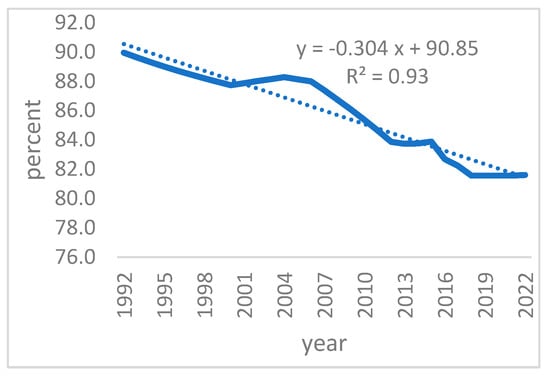
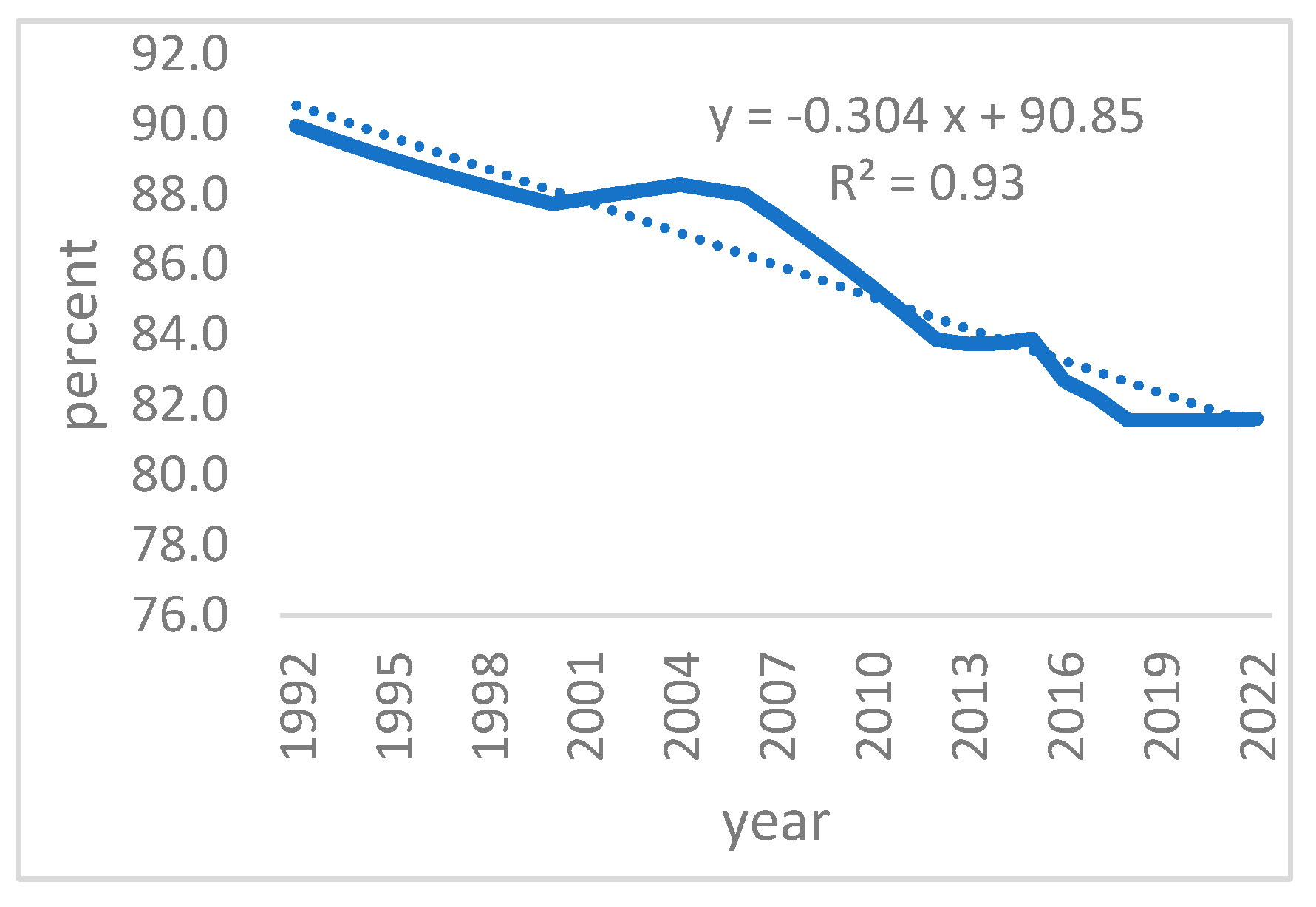
% water consumption in agriculture in Saudi Arabia (1992–2022). Source: calculated by the authors based on (World Bank Water Data, 2025). The figure illustrates a declining annual trend of 0.304 in agricultural water consumption in Saudi Arabia as indicated by the dashed trend line.
Figure 1 depicts a pronounced downward trend in water consumption in agriculture (WA) over time in Saudi Arabia, with an estimated annual decline of 0.304. This reduction can be attributed to the increasing scarcity of water resources in the Kingdom, alongside the historically high share of water allotted to the agricultural sector. This emphasizes the rapid expansion of water-intensive agriculture, threatening non-renewable water resources, as indicated by Kim and van der Beek (2018).
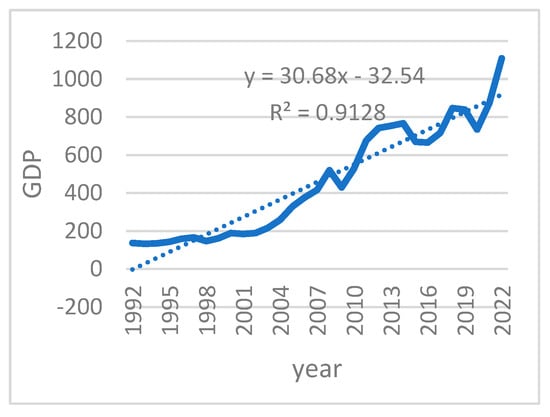
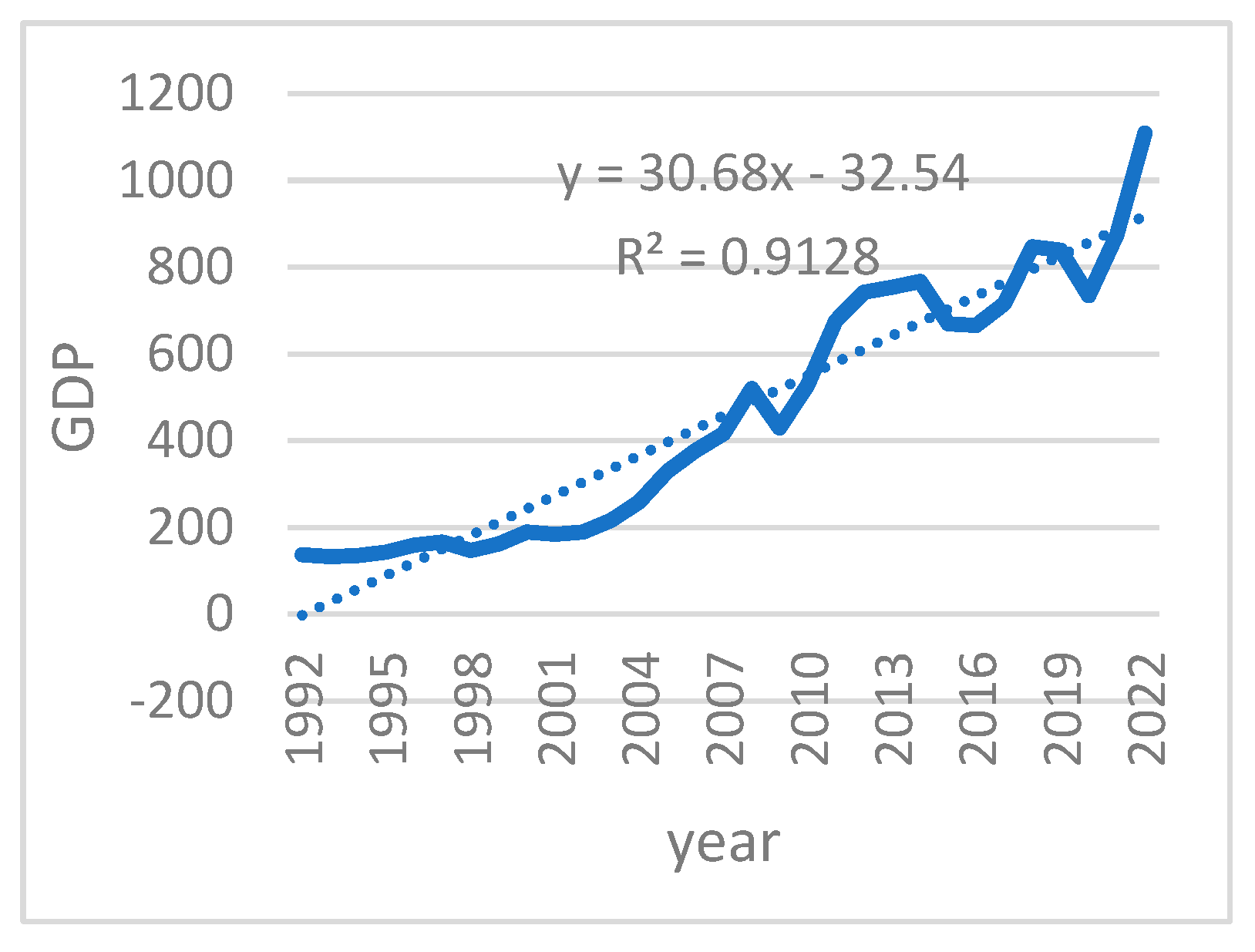
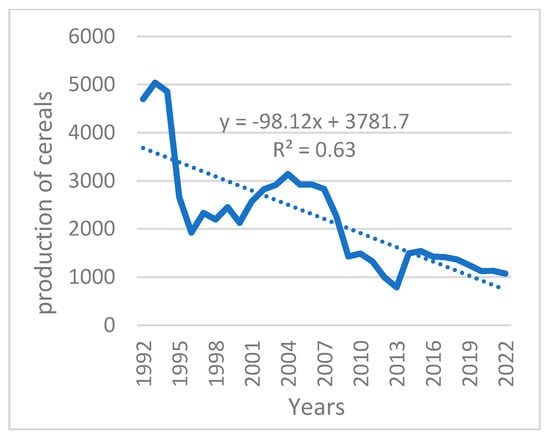
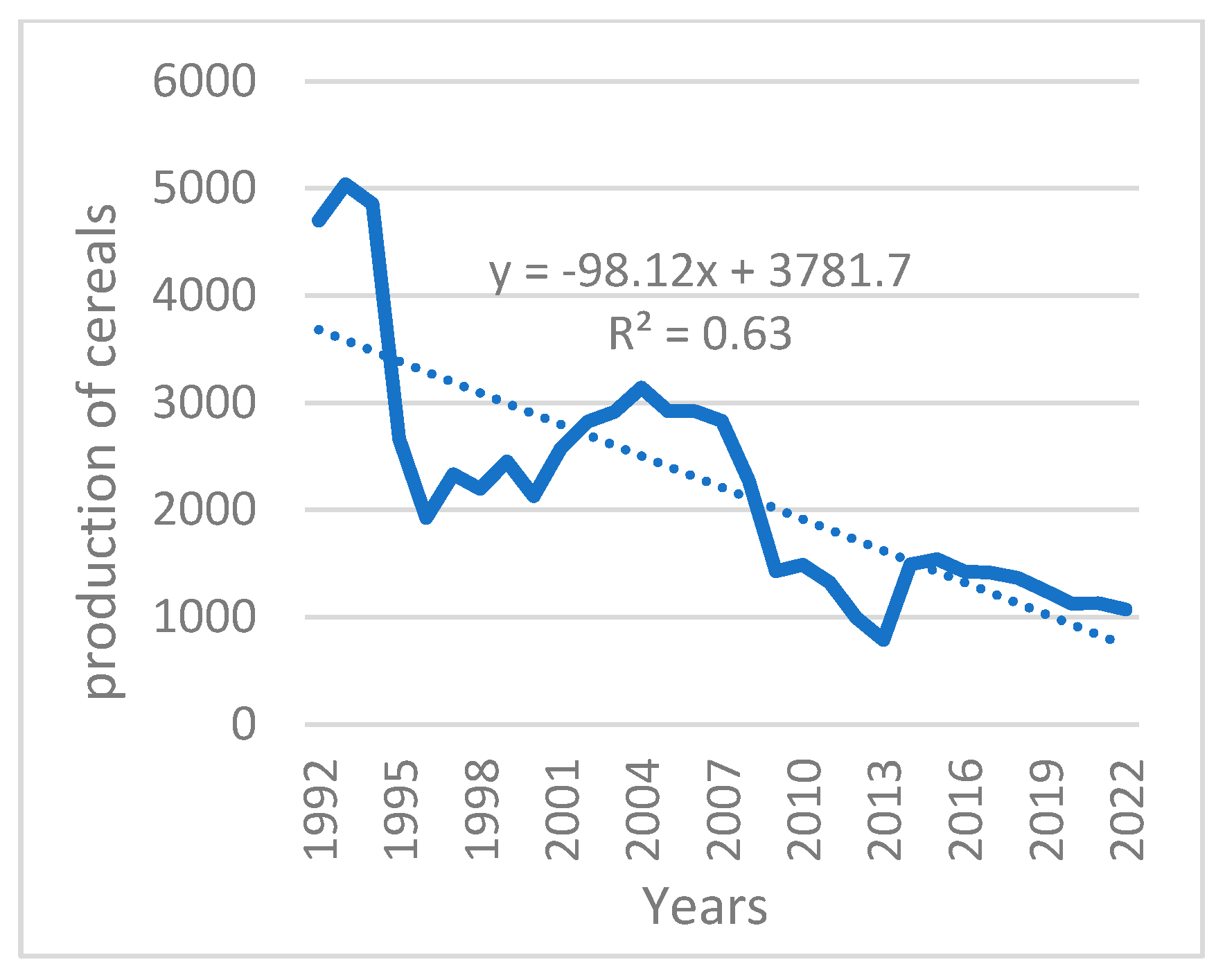
During the study period, Saudi Arabia’s GDP (Figure 2) exhibited a clear upward trend, reflecting government economic diversification policy under Vision 2030 (Al Naimi, 2022). In contrast, cereal production (Figure 3) shows a declining trend over the same period. Rady et al. (2016) pointed out that the downward trend is primarily driven by water scarcity, which has negatively affected wheat productivity and the total cultivated area in the Kingdom.
Figure 2.
GDP in Saudi Arabia (000 USD$) (1992–2022). Source: calculated by the authors based on (Macrotrends, 2025). The figure shows an upward annual trend of about 31 (000 USD$) in GDP confirmed by the dashed trend line.
Figure 3.
Cereal production in Saudi Arabia 1992–2022 (000 tons). Source: calculated by the authors based on (FAO, 2025b). The figure shows a declining trend of about 98 thousand tons in cereal production in Saudi Arabia during the study period confirmed by the dashed trend line.
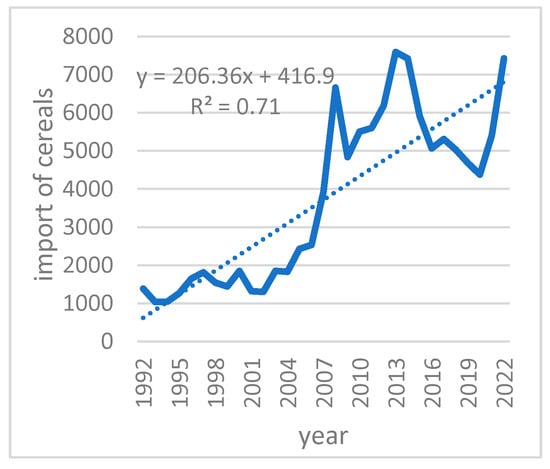
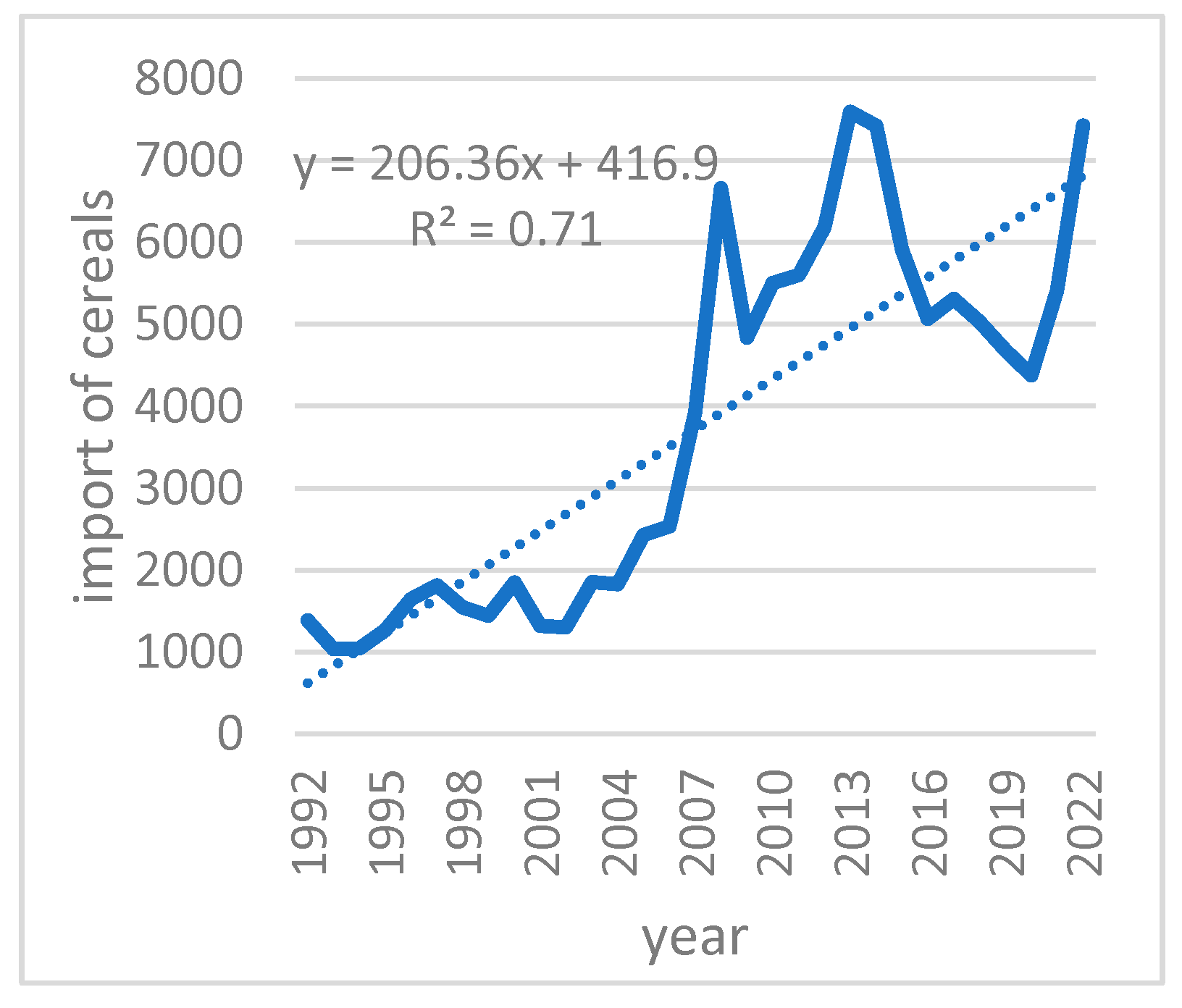
Figure 4 illustrates a steady upward trend in cereal imports, increasing by 206.36 thousand tons per year. This pattern is consistent with broader evidence of rising reliance on external food supplies, as reported by Chowdhury et al. (2019), that the total amount of Saudi Arabia’s agricultural products imported and exported/person/day was 1.6 and 0.08 kg, respectively, underscoring the country’s dependency on food imports. This escalating trend also aligns with the concept of virtual water trade. Chowdhury et al. (2019) estimate that in 2012 alone, Saudi Arabia’s crop imports embodied over 22,922 million cubic meters of virtual water, primarily from barley (44.5%), rice (15.1%), and wheat (13.7%).
Figure 4.
Cereal imports in Saudi Arabia 1992–2022 (USD$ Thousands). Source: calculated by the authors based on (FAO, 2025b). The figure reveals an increasing annual trend amounting to 206 thousand tons in cereal imports indicated by the dashed trend line.
3.2. Unit Root Test (Stationary Test)
To ensure the validity of the ARDL modeling approach, the stationarity of the variables was examined using the Augmented Dickey-Fuller (ADF) test (Ajewole et al., 2020). The results indicate that IMP, GDP, and PRO are stationary at levels I(0), while WA is not stationary at levels but becomes stationary after the first differencing (Table 2). These results justify the use of the ARDL bounds testing approach, which allows for a mix of I(0) and I(1) variables in the analysis (Bahmani-Oskooee & Ng, 2002; Alsarawi et al., 2023).
Table 2.
Augmented Dicky Fuller test results (ADF).
3.3. Bounds Test and Cointegration
The bound testing was applied to examine the existence of long-run relationships among cereal imports, GDP, cereal production, and water use. The null hypothesis assumes no cointegration, while the alternative hypothesis posits the existence of a long-run association. The results of the bound test, reported in Table 3, show that the computed F-statistic and T-statistic exceed the upper bound critical value at the 1% significance level, confirming the presence of a long-run equilibrium relationship among the variables.
Table 3.
Results of the bound test.
3.4. Gregory–Hansen Test for Cointegration
Gregory–Hansen Test for Cointegration was conducted to identify the structural break and its exact date. The model revealed that the absolute value of Zt is less than the critical value at 5%. This means that the break point (2016—observation 25) is not significant, i.e., there is no structural break (Salisu & Haladu, 2021).
3.5. Estimation of Long-Run and Short-Run Coefficients
The short-run and long-run coefficients were estimated using the ARDL model, after confirming the presence of cointegration. The optimum lags length were 2, 3, 2 and 2 for IMP, GDP, PRO, and WA variables, respectively, according to the Akaike Information Criterion (AIC).
The estimated long-run coefficients, presented in Table 4, reveal that both GDP and agricultural water use exhibit a positive and statistically significant relationship with cereal imports at the 1% level. Specifically, a US$1 billion increase in GDP is associated with a US$16.903 increase in cereal imports, holding other factors constant (coefficient in its original units of approximately 0.037). This result reflects the positive impact of economic growth on food demand as detected by Rahman et al. (2022). The result is also in line with recent research indicating that in Arab countries, income elasticities for food imports remain below unity (Mohammed & Almojel, 2025). In Saudi Arabia, this pattern is emphasized by water scarcity, making cereal imports a structural component of food security.
Table 4.
Gregory–Hansen tests for cointegration results with structural break (1992–2022).
The model results also indicate that a one-percentage-point increase in agricultural water use is associated with an increase of US$1283 in cereal imports. This relationship may reflect the reallocation of water resources away from water-intensive cereal production toward other agricultural activities, thereby increasing reliance on cereal imports, as also reported by Dolganova et al. (2019). Therefore, cereal imports would increase in the long run to compensate for the reduction of local production. The above results are supported by Napoli et al. (2018), who state that to reduce agricultural water consumption, the production of high-water-use, low-yield crops and livestock should be minimized. In line with the long-run relationship, the results reveal a significant negative long-run impact of cereal production on imports, where each additional ton of domestic cereal production leads to a decrease in imports of US$0.921.
The error correction coefficient was negative (−0.91) and statistically significant at 1%, indicating a rapid adjustment from short-run disequilibrium to long-run equilibrium. The model R2 value of 0.88 suggests that 88% of the variation in cereal imports is explained by the combined effect of the explanatory variables (GDP, cereal production, and water use in agriculture).
In the short run, the estimated model (Table 5) reveals a complex set of causal relationships among the variables. Results indicate a statistically significant reduction in cereal imports amounting to USD$10.0 thousand for every unit of increase in GDP lagged by two years. The negative relation between GDP and food imports in the short run may be attributed to the high dependency of countries with high GDP on food imports, as stated by Chernova and Noha (2019). Hence, positive short-run relations may not be detected for already highly food-import-dependent countries.
Table 5.
Estimation of long-run and short-run coefficients of ARDL (2,3,2,2).
Moreover, short-run results proved a marginally significant (0.052) positive relation between cereal imports and lagged two-year cereal production at the 5% level. The observed short-run positive relation is consistent with Saudi Arabia’s low cereal self-sufficiency ratio, where the impacts of increased output may only become evident over a longer time. Alamri and Reed (2019) show that the time interval of production sufficiency for wheat, barley, and poultry experienced significant declines by 38%, 99%, and 48%, respectively, between 1961 and 2016, indicating sustained structural dependence on external sources of food supply. Additionally, increases in short-term domestic production do not necessarily translate into immediate reductions in cereal imports, as Saudi Arabia remains a net importer of food commodities. This dependence increased following the Kingdom’s accession to the World Trade Organization, which expanded import flows and increased market openness, as indicated by (Yousif, 2024). However, the long-run results confirm that cumulated production growth ultimately contributes to a reduction in cereal imports, supporting the unidirectional causal relationship from domestic production to food aid and food imports as reported by Zakari and Ying (2013).
Furthermore, short-run results revealed a significant negative relationship between cereal imports and lagged two-year periods of water consumption in agriculture, indicating that an increase in water consumption, which implies an increase in production, would lead to a reduction in food imports. According to Alrwis et al. (2021), Saudi Arabia’s water resources are scarce; however, in order to satisfy the demands of the industrial, municipal, agricultural, and other sectors, these resources are always in demand.
Where D1 refers to the first difference of a variable; LD denotes the lagged difference of a variable, and L2D means the second lag of the difference variable.
3.6. Diagnostic Tests
The results of the Breusch–Godfrey test fail to reject the null hypothesis of no serial correlation (p value = 0.920), indicating no significant autocorrelation in the residuals.
The White test for heteroscedasticity reveals that the model exhibits homoscedasticity, as the computed chi-square value was greater than the 5% significance level. Additionally, the Jarque-Bera test shows that the probability associated with the chi-square statistic exceeded 0.05, indicating that the residuals are normally distributed (Table 6).
Table 6.
Autocorrelation, heteroscedasticity and normality tests.
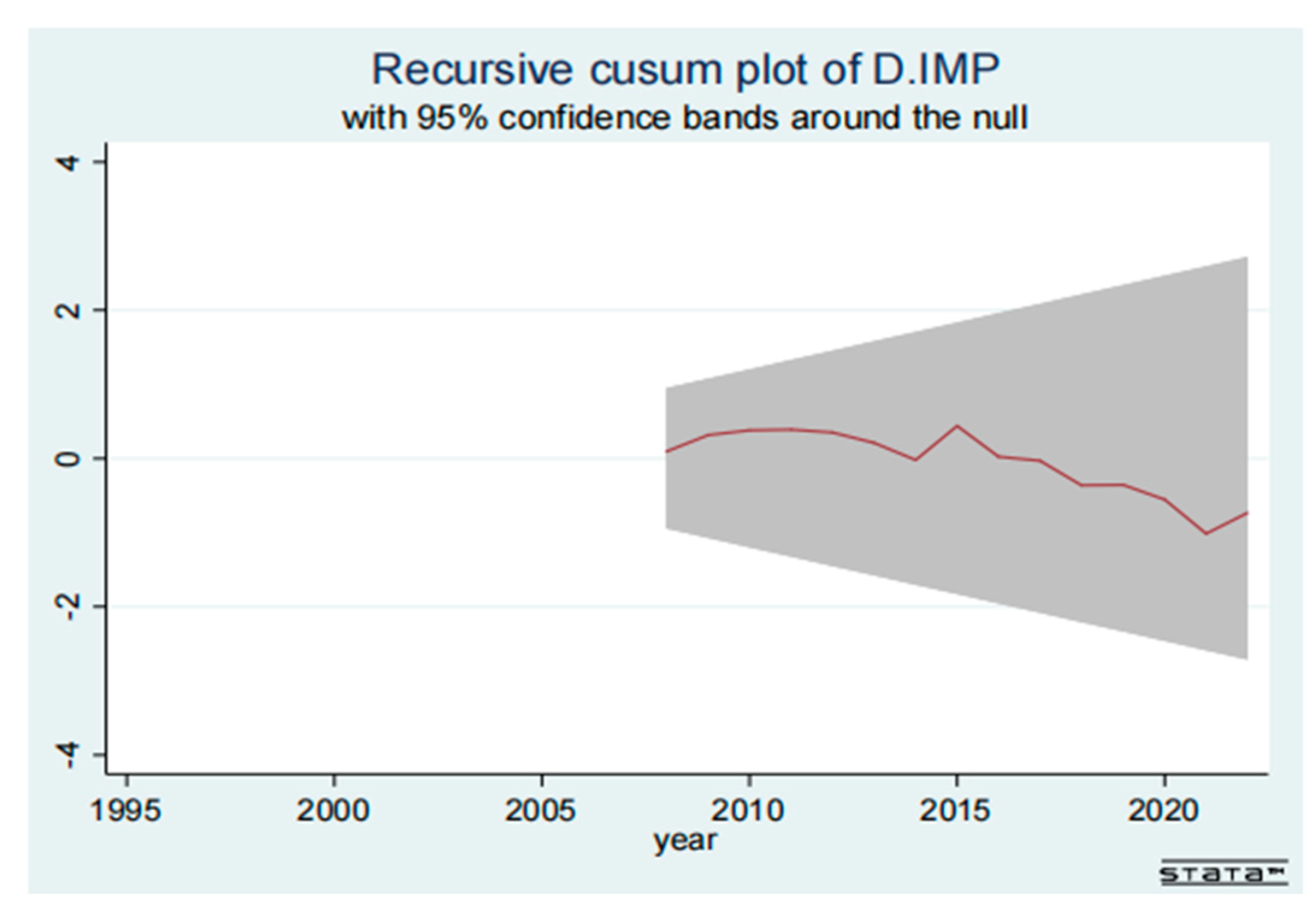
Moreover, the Cumulative Sum (CUSUM) test provides further evidence of model stability, with the estimated ARDL coefficients consistently remaining within the 5% critical bounds over the entire estimation period (Figure 5).
Figure 5.
CUSUM test results for ARDL model confirming model stability.
To sum up, these diagnostic results confirm that the model satisfies the key assumptions required for valid inference.
4. Limitations of the Study
First, the sample size is relatively small (31 annual observations), which may affect the power of the cointegration tests and the precision of the long-run coefficients. Although the ARDL bounds test can be applied to small samples, the results should still be interpreted with caution. Second, the authors conducted a series of additional tests and alternative specifications, including: (i) transformation of all continuous variables to natural logs to obtain elasticities; (ii) inclusion of total population as an additional demand-side variable; (iii) inclusion of a world cereal price index (where available). However, none of these alternative specifications produced superior results to the original model presented in this paper. The original model (with variables in their original units, as reported in Table 2, Table 3, Table 4 and Table 5) remained the most parsimonious, interpretable, and consistent with the underlying economic theory, given the data constraints. Third, the agricultural water use variable (WA) is measured as a percentage of total water consumption rather than absolute water withdrawal in cubic meters, because absolute data were not consistently available for the whole period. This limits the direct comparability of the coefficient magnitude. Fourth, the model assumes weak exogeneity of the independent variables, which is standard in import demand functions but does not fully account for potential reverse causality (e.g., high import dependence may influence domestic water policy). Fifth, the study focuses exclusively on cereal imports as an indicator of food import dependency, whereas food security encompasses multiple dimensions (availability, access, utilization, stability).
5. Conclusions
The study has examined the dynamic relationship between agricultural water consumption, cereal production, GDP, and cereal imports in Saudi Arabia using the ARDL framework supported by diagnostic tests. The descriptive analysis revealed structural patterns consistent with the Kingdom’s broader economic trajectory and resource use path: while GDP grew steadily under diversification policies, agricultural water use and cereal production showed downward trends, accompanied by a sustained rise in cereal import dependence.
The econometric results elucidate the complex interplay among the variables. The short-run dynamics reveal that lagged increases in GDP and water consumption are associated with reduced cereal imports, potentially reflecting temporary improvements in domestic supply buffer. Conversely, lagged cereal production has a positive impact on imports, reflecting Saudi Arabia’s low cereal self-sufficiency ratio and the complementary nature of domestic production and import flows within the food supply system. Import dependence remains structurally embedded, especially in light of the country’s water scarcity and its position as a net food importer.
In the long term, the results converge toward a different pattern: accumulated production contributes to reducing cereal imports, while rising agricultural water consumption ultimately leads to increased dependence on imports. This long-term shift underscores the constraints imposed by the Kingdom’s limited water resources and the need to align agricultural production decisions with water-saving and food security objectives.
Diagnostic tests, including the Breusch–Godfrey LM test, the White test, the skewness-Kurtosis normality test, and the CUSUM stability test, confirm that the estimated ARDL model meets key econometric assumptions, ensuring the reliability and robustness of the findings.
This study provides novel insights by distinguishing the short- and long-term effects of GDP, domestic grain production, and agricultural water use on Saudi Arabia’s cereal imports. It highlights the interaction between water use and import dependence, particularly through the lens of virtual water trade, and provides empirical evidence that can guide water-efficient agricultural planning and strategic import policies. The findings further strengthen the importance of integrating water resource management with food security in water-scarce regions.
6. Policy Implications
The empirical findings offer several concrete policy insights for Saudi Arabia’s food security strategy. First, the positive and statistically significant long-run relationship between GDP and cereal imports (coefficient = 16.903) suggests that as the economy expands under Vision 2030, import demand will continue to rise unless domestic production capacity is enhanced. Policymakers should therefore integrate food import planning into broader economic diversification strategies, ensuring that trade policies keep pace with income-driven demand growth.
Second, the negative long-run coefficient for domestic cereal production (−0.921) implies that each additional thousand tons of domestic production reduces cereal imports by approximately US$921 thousand. This indicates that investing in sustainable domestic production—particularly in water-efficient crops and technologies—can yield measurable import reductions. However, the short-run positive effect of production on imports (p = 0.052) highlights the need for sustained, long-term investment rather than short-term production boosts, as the benefits of increased output materialize only over time.
Third, the positive and significant long-run coefficient for agricultural water use (1283.452) implies that a one-percentage-point increase in the share of water allocated to agriculture is associated with a US$1283 thousand rise in cereal imports. This counter-intuitive result reflects the shift of water away from cereal production towards higher-value crops, a policy direction that implicitly increases cereal import dependency. To manage this trade-off, Saudi Arabia should pursue a dual strategy: (i) improving irrigation efficiency and adopting drought-tolerant cereal varieties to maintain or increase production with less water; and (ii) explicitly quantifying the “water-import trade-off” in national water accounting, so that decisions about water allocation between crops are made with full awareness of their import implications.
Fourth, the error correction coefficient of −0.91 indicates that 91% of any short-run disequilibrium is corrected within one year, reflecting a rapid adjustment process. This suggests that Saudi Arabia’s cereal import market is highly responsive to changes in domestic production and water use. Policymakers can leverage this responsiveness by designing timely interventions—such as strategic grain reserves or flexible tariff policies—that can be activated quickly when domestic production shocks occur.
Finally, the Gregory–Hansen structural break test (Table 4) confirmed that the 2016 wheat production phase-out did not constitute a statistically significant structural break, implying that the underlying relationships among GDP, production, water use, and imports remained stable despite the policy shift. This stability provides some reassurance that future agricultural policy reforms can be implemented without disrupting the fundamental import-demand structure, provided they are accompanied by complementary measures to manage the resulting import growth.
In summary, this study provides robust empirical evidence that dynamics in domestic cereal production and water resources exert significant and differentiated effects on cereal import behavior in the short run and long run.
Author Contributions
Conceptualization, N.A.E., A.A.E. and I.F.A.; methodology, N.A.E., A.A.E. and I.F.A.; validation, M.M.E. and A.E.A.; formal analysis, N.A.E., and A.A.E.; data curation, N.A.E. writing—original draft preparation, N.A.E., A.E.A. and A.A.E.; writing—review and editing, were carried out by all authors. All authors have read and agreed to the published version of the manuscript.
Funding
This study was supported by the Deanship of Scientific Research, Vice Presidency for Graduate Studies and Scientific Research, King Faisal University, Saudi Arabia [Grant No. KFU262266].
Institutional Review Board Statement
Not applicable.
Informed Consent Statement
Not applicable.
Data Availability Statement
Data derived from public domain resources listed in the reference section.
Conflicts of Interest
The authors declare no conflicts of interest.
References
- Abdalla, S. (2025). Forecasting cereal food production in the Kingdom of Saudi Arabia using the autoregressive integrated moving average model. Food Research, 9(2), 6–12. [Google Scholar] [CrossRef] [Scilit] [PubMed]
- Ahmed, G., Hamrick, D., Guinn, A., Abdulsamad, A., & Gereffi, G. (2013). Wheat value chains and food security in the Middle East and North Africa region. Duke CGGC. [Google Scholar] [CrossRef]
- Ajewole, K. P., Adejuwon, S. O., & Jemilohun, V. G. (2020). Test for stationarity on inflation rates in Nigeria using augmented dickey fuller test and phillips-persons test. IOSR-JM, 16(3), 11–14. [Google Scholar] [CrossRef]
- Alamri, Y., Alrwis, K., Ghanem, A., Kamara, S., Alaagib, S., & Aldawdahi, N. (2023). The economic nexus between energy, water consumption, and food production in the Kingdom of Saudi Arabia. Economies, 11(4), 113. [Google Scholar] [CrossRef] [Scilit]
- Alamri, Y., Reed, M., & Saghaian, S. (2020). Determinants of virtual water trade of cereal crops in Saudi Arabia. Iraqi Journal of Agricultural Sciences, 51(4), 1118–1127. [Google Scholar] [CrossRef] [Scilit]
- Alamri, Y., & Reed, M. R. (2019). Estimating virtual water trade in crops for Saudi Arabia. American Journal of Water Resources, 7(1), 16–22. [Google Scholar] [CrossRef]
- Al-Khateeb, S. A., Zeineldin, F. I., Elmulthum, N. A., Al-Barrak, K. M., Sattar, M. N., Mohammad, T. A., & Mohmand, A. S. (2024). Assessment of water productivity and economic viability of greenhouse-grown tomatoes under soilless and soil-based cultivations. Water, 16(7), 987. [Google Scholar] [CrossRef] [Scilit]
- Al Naimi, S. M. (2022). Economic diversification trends in the gulf: The case of Saudi Arabia. Circular Economy and Sustainability, 2(1), 221–230. [Google Scholar] [CrossRef] [Scilit] [PubMed]
- Alotaibi, B. A., Baig, M. B., Najim, M. M., Shah, A. A., & Alamri, Y. A. (2023). Water scarcity management to ensure food scarcity through sustainable water resources management in Saudi Arabia. Sustainability, 15(13), 10648. [Google Scholar] [CrossRef] [Scilit]
- Alrobaish, W. S., Vlerick, P., Luning, P. A., & Jacxsens, L. (2021). Food safety governance in Saudi Arabia: Challenges in control of imported food. Journal of Food Science, 86(1), 16–30. [Google Scholar] [CrossRef] [Scilit] [PubMed]
- Alrwis, K. N., Ghanem, A. M., Alnashwan, O. S., Al Duwais, A. M., Alaagib, S. B., & Aldawdahi, N. M. (2021). Measuring the impact of water scarcity on agricultural economic development in Saudi Arabia. Saudi Journal of Biological Sciences, 28(1), 191–195. [Google Scholar] [CrossRef] [Scilit] [PubMed]
- Alsarawi, F. M., Elbushra, A. A., & Abdalla, I. F. (2022). Nexus of macroeconomic indicators and meat consumption in Saudi Arabia: An ARDL approach. Universal Journal of Agricultural Research, 10(3), 240–248. [Google Scholar] [CrossRef] [Scilit]
- Alsarawi, F. M., Elbushra, A. A., & Abdalla, I. F. (2023). Impact of macroeconomic variables on food security in Saudi Arabia: Case study of poultry meat. Sarhad Journal of Agriculture, 39(2), 316–322. [Google Scholar] [CrossRef] [Scilit]
- Al-Sultan, M. M. (2002). Using econometrically estimated import demand systems to analyze domestic and international issues: A case study of Saudi Arabian agricultural imports [Ph.D. thesis, Colorado State University]. Available online: https://www.proquest.com/docview/304796431?fromopenview=true&pq-origsite=gscholar&sourcetype=Dissertations%20&%20Theses (accessed on 13 July 2026).
- Bahmani-Oskooee, M., & Ng, R. C. W. (2002). Long-run demand for money in Hong Kong: An application of the ARDL model. International Journal of Business and Economics, 1(2), 147–155. [Google Scholar]
- Chernova, V. Y., & Noha, V. I. (2019). A study of the characteristics of food import dependence of the countries. Amazonia Investiga, 8(24), 484–492. [Google Scholar]
- Chowdhury, S., Kabir, F., Chowdhury, I. R., & Papadopoulou, M. P. (2019). Importing and exporting agricultural crop products: An assessment of virtual water flow (VWF) in Saudi Arabia. Arabian Journal for Science and Engineering, 44(5), 4911–4920. [Google Scholar] [CrossRef] [Scilit]
- Dolganova, I., Mikosch, N., Berger, M., Núñez, M., Müller-Frank, A., & Finkbeiner, M. (2019). The water footprint of European agricultural imports: Hotspots in the context of water scarcity. Resources, 8(3), 141. [Google Scholar] [CrossRef] [Scilit]
- Duwais, A., Aziz, A., Alaagib, S. E. B., & Mahfouz, W. (2024). Study and analysis of the Saudi demand for imported Bananas fruit. Using the autoregressive and distributed Lag ARDL methodology. Egyptian Journal for Agricultural Economics, 34(1), 35–50. [Google Scholar] [CrossRef] [Scilit]
- FAO. (2025a). Country briefs—Saudi Arabia. Top of form bottom of form GIEWS—Global information and early warning system. Available online: https://www.fao.org/giews/countrybrief/country.jsp?code=SAU (accessed on 15 November 2025).
- FAO. (2025b). FAOSTAT data. Available online: https://www.fao.org/faostat/en/#data (accessed on 20 September 2025).
- FAO. (2025c). GIEWS country brief: Saudi Arabia. Food and Agriculture Organization of the United Nations. Available online: https://www.fao.org/giews (accessed on 29 June 2026).
- Farrar, T., Blignaut, R., Luus, R., & Steel, S. (2025). A review and comparison of methods of testing for heteroskedasticity in the linear regression model. Journal of Applied Statistics, 52(16), 3121–3150. [Google Scholar] [CrossRef] [Scilit] [PubMed]
- GASTAT. (2023). Agricultural statistics. Available online: https://www.stats.gov.sa/documents/20117/2435259/Agriculture+Statistics+2023EN.pdf/8540e6a0-299f-9b22-4482-bc06cbbc78d5?t=1734125989633 (accessed on 15 November 2025).
- General Agriculture for Statistics. (2022). Agriculture statistics publication. Available online: https://www.stats.gov.sa/documents/20117/2435259/Agriculture%2BStatistics-EN-2022.pdf/035ebe09-6806-2c20-a1c5-e11dc98bc1bf?utm_source=chatgpt.com (accessed on 29 June 2026).
- Ghanem, A. M., Al-Ruwis, K. N., Alqahtani, S. H., Al-Nashwan, O. S., Al-Duwais, A. M., Alnafissa, M. A., Alhashem, J., Kamara, S. A., Alaagib, S. B., & Aldawdahi, N. M. (2021). The economic dimension of directing treated wastewater to the production of green fodder in Saudi Arabia. Saudi Journal of Biological Sciences, 28(8), 4825–4832. [Google Scholar] [CrossRef] [Scilit] [PubMed]
- Ghanem, A. M., Alrwis, K. N., Alaagib, S. B., Aldawdahi, N., Al-Nashwan, I., & Ghanem, H. (2024). Effects of the Russian–Ukrainian war on the value of imports and the food trade balance in Saudi Arabia. Arab Gulf Journal of Scientific Research, 42(4), 1307–1318. [Google Scholar] [CrossRef] [Scilit]
- Grindle, A. K., Siddiqi, A., & Anadon, L. D. (2015). Food security amidst water scarcity: Insights on sustainable food production from Saudi Arabia. Sustainable Production and Consumption, 2, 67–78. [Google Scholar] [CrossRef] [Scilit]
- Kamal, A. (2014). Food security strategies in the Kingdom of Saudi Arabia. Available online: https://www.academia.edu/34377547/Food_Security_Strategies_in_the_Kingdom_of_Saudi_Arabia (accessed on 29 June 2026).
- Kashifi, M. T., Al-Ismail, F. S. M., Chowdhury, S., Baaqeel, H. M., Shafiullah, M., Tiwari, S. P., & Rahman, S. M. (2022). Water-energy-food nexus approach to assess crop trading in Saudi Arabia. Sustainability, 14(6), 3494. [Google Scholar] [CrossRef] [Scilit]
- Khim, V., & Liew, S. (2004). Which lag length selection criteria should we employ? Universiti Putra Malaysia: Economics Bulletin, 3(33), 1–9. [Google Scholar]
- Kim, A., & van der Beek, H. (2018). A holistic assessment of the water-for-agriculture dilemma in the Kingdom of Saudi Arabia. CIRS Occasional Papers No. 19. Available online: https://ssrn.com/abstract=3193849 (accessed on 29 June 2026).
- Lawal, A. I., Nwanji, T. I., Asaleye, A., & Ahmed, V. (2016). Economic growth, financial development and trade openness in Nigeria: An application of the ARDL bound testing approach. Cogent Economics and Finance, 4(1), 1258810. [Google Scholar] [CrossRef] [Scilit]
- Macrotrends. (2025). Saudi Arabia GDP 1960–2025. Available online: https://www.macrotrends.net/global-metrics/countries/sau/saudi-arabia/gdp-gross-domestic-product (accessed on 20 September 2025).
- MEWA. (2020). Statistical book. Ministry of Environment, Water and Agriculture. Available online: https://www.mewa.gov.sa/ar/InformationCenter/Researchs/Reports/GeneralReports/الكتاب%20الإحصائي%202020.pdf (accessed on 14 June 2026).
- Mohammed, R., & Almojel, S. (2025). Elasticities of food import demand in Arab countries: Implications for food security and policy. Sustainability, 17(14), 6271. [Google Scholar] [CrossRef] [Scilit]
- Moossa, B., Trivedi, P., Saleem, H., & Zaidi, S. J. (2022). Desalination in the GCC countries—A review. Journal of Cleaner Production, 357, 131717. [Google Scholar] [CrossRef] [Scilit]
- Napoli, C., Wise, B., Wogan, D., & Yaseen, L. (2018). Policy options for reducing water for agriculture in Saudi Arabia. In A. Biswas, C. Tortajada, & P. Rohner (Eds.), Assessing global water megatrends. Water resources development and management (pp. 211–230). Springer. [Google Scholar] [CrossRef] [Scilit]
- Odnoletkova, N., & Patzek, T. W. (2023). Water resources in Saudi Arabia: Trends in rainfall, water consumption, and analysis of agricultural water footprint. NPJ Sustainable Agriculture, 1(1), 7. [Google Scholar] [CrossRef] [Scilit]
- OECD/FAO. (2024). OECD-FAO agricultural outlook 2024–2033. OECD-FAO Agricultural Outlook. [Google Scholar] [CrossRef] [Scilit]
- Pesaran, M. H., Shin, Y., & Smith, R. J. (2001). Bounds testing approaches to the analysis of level relationships. Journal of Applied Econometrics, 16(3), 289–326. [Google Scholar] [CrossRef] [Scilit]
- Rady, H., Elmulthum, N., & Elnasikh, S. (2016). Water security status in Saudi Arabia: A threat for food security (2000–2014). Resources and Environment, 6(5), 89–94. [Google Scholar] [CrossRef]
- Rahman, M. M., Akter, R., Abdul Bari, J. B., Hasan, M. A., Rahman, M. S., Abu Shoaib, S., Shatnawi, Z. N., Alshayeb, A. F., Shalabi, F. I., Rahman, A., Alsanad, M. A., & Rahman, S. M. (2022). Analysis of climate change impacts on the food system security of Saudi Arabia. Sustainability, 14(21), 14482. [Google Scholar] [CrossRef] [Scilit]
- Redko, K., & Mahmood, M. (2020). Ukraine and Kingdom of Saudi Arabia: Establishing bilateral ones economic relations. Інвестиції: практика та дoсвід, 17–18, 69–75. [Google Scholar] [CrossRef] [Scilit]
- Sadiq, M. S., Singh, I. P., & Ahmad, M. M. (2020). Demand for imported staple food commodities in the Kingdom of Saudi Arabia. Journal of Agriculture and Environmental Sciences, 5(2), 64–80. [Google Scholar] [CrossRef]
- Salisu, A., & Haladu, A. I. (2021). Agricultural output, government expenditure and economic growth in Nigeria: A Gregory-Hansen cointegration test with structural breaks. European Scientific Journal, 17(41), 38. [Google Scholar] [CrossRef] [Scilit]
- Subahi, A. F., & Bouazza, K. E. (2020). An intelligent IoT-based system design for controlling and monitoring greenhouse temperature. IEEE Access, 8, 125488–125500. [Google Scholar] [CrossRef] [Scilit]
- World Bank Water Data. (2025). Available online: https://wbwaterdata.org/ (accessed on 20 September 2025).
- Yousif, I. E. A. (2024). Agricultural trade performance and food security in Saudi Arabia. In Food and nutrition security in the Kingdom of Saudi Arabia, Vol. 2: Macroeconomic policy and its implication on food and nutrition security. Springer. [Google Scholar] [CrossRef] [Scilit]
- Zakari, S., & Ying, L. (2013). The impact of Niger food imports and food aid on domestic food production: Cointegration and vector error correction approaches. Journal of Food, Agriculture and Environment, 11(3–4), 75–80. [Google Scholar]

Disclaimer/Publisher’s Note: The statements, opinions and data contained in all publications are solely those of the individual author(s) and contributor(s) and not of MDPI and/or the editor(s). MDPI and/or the editor(s) disclaim responsibility for any injury to people or property resulting from any ideas, methods, instructions or products referred to in the content. |
© 2026 by the authors. Licensee MDPI, Basel, Switzerland. This article is an open access article distributed under the terms and conditions of the Creative Commons Attribution (CC BY) license.