


Abstract
We examine how institutional quality conditions the labor market returns to educational attainment, using individual-level microdata from the fourth round of the Life in Transition Survey across thirteen European Union member states. Linear probability models with country fixed effects show a tertiary employment premium of 12.4 percentage points. Contrary to our initial hypothesis, this premium is larger where institutional trust is lower: a one-point increase on the five-point trust index reduces the premium by 2.6 percentage points, consistent with formal credentials partly substituting for trust-based hiring mechanisms where perceived governance quality is weaker. Two-stage least squares estimates instrumenting tertiary attainment with parental education and childhood book ownership corroborate the baseline gradient, though we interpret them as supportive rather than definitive causal evidence. Tertiary-educated migrants face employment penalties of 4 to 12 percentage points relative to observably similar non-migrants, and 23.8 percent of employed respondents are over-qualified, with the highest incidence in the Baltic states. The findings suggest that educational expansion without parallel investment in credential recognition and institutional upgrading may generate systematic human capital misallocation.
1. Introduction
The European Union has invested heavily in expanding tertiary education and promoting labor mobility as twin pillars of the Lisbon and Europe 2020 strategies. Tertiary attainment across EU member states rose from approximately 23 percent of the working-age population in 2002 to over 40 percent by 2022 (Eurostat, 2023). Yet employment outcomes remain sharply heterogeneous: working-age employment rates in our 2022 cross-section range from 65 percent in Croatia to 85 percent in Hungary, and nearly one quarter of employed workers report being overqualified for their current position. This decoupling between credential expansion and labor market efficiency raises a fundamental question: To what extent does the institutional context—the governance structures, contracting norms, and social trust that shape how labor markets function—determine whether education translates into productive employment?
Classic human capital theory (Becker, 1964; Mincer, 1974) predicts that educational investment raises productivity and earnings monotonically. A substantial body of comparative evidence complicates this mapping. Hanushek and Woessmann (2015) show that cognitive skills, not years of schooling, drive long-run growth, implying that credentials and competencies can diverge sharply. Pritchett (2001) documents a cross-national decoupling between schooling expansion and productivity growth, distinguishing “schooling” from “human capital” to capture the fact that formal attainment is a poor proxy for productive capacity where institutional quality is low. Hall and Jones (1999) attribute most cross-country variation in output per worker to social infrastructure, the institutions and policies that determine the environment in which human capital operates. Institutional perspectives more broadly hold that where institutions are weak, opaque, or characterized by low public trust, human capital is undervalued, misallocated, or credentialed away from productivity-enhancing roles (Acemoglu & Robinson, 2012; Rodrik, 2004). We consider this the conversion efficiency problem: educated workers exist in abundance, but the institutional machinery required to deploy their skills productively is imperfect.
This paper advances literature in four ways. First, we bring systematic evidence from the fourth round of the Life in Transition Survey (LiTS IV), administered by the European Bank for Reconstruction and Development and the World Bank in late 2022, to bear on employment, skill-match, and sector-sorting outcomes across thirteen EU member states. Second, we introduce an institutional trust index—constructed from five survey measures of respondent confidence in government, parliament, courts, local authorities, and police—as a country-level moderator of the education–employment relationship. Third, we document a migrant human capital penalty within the EU: tertiary-educated migrants achieve meaningfully lower employment rates than comparable native-born workers, indicating that credential recognition and network constraints persist even within the single market. Fourth, we extend a misallocation framework developed for capital and firm productivity (Hsieh & Klenow, 2009) to human capital, using our cross-country over-qualification and sector-sorting evidence to bound the productivity losses implied by institutional frictions in the EU labor market.
Our working-age analytical sample of 8507 respondents spans Bulgaria, Croatia, Czechia, Estonia, Germany, Greece, Hungary, Latvia, Lithuania, Poland, Romania, the Slovak Republic, and Slovenia—all EU member states covered by the LiTS IV wave. The empirical strategy combines descriptive cross-tabulations with multivariate regression evidence: linear probability models with country fixed effects and PSU-clustered standard errors, Probit specifications reported as average marginal effects, and a two-stage least squares specification instrumenting educational attainment with parental education and childhood book ownership (first-stage partial F (2, 2145) = 296.68). The cross-sectional design precludes sharp causal identification of the trust-moderation effect, but the 2SLS and fixed-effects specifications substantially reduce concerns about plausible confounds. Following Acemoglu and Autor (2011), we treat cross-country variation in institutional quality as shaping the mapping from skills to labor market outcomes, rather than as a background condition to be differenced away. This distinguishes our approach from the standard Mincerian framework: we model institutional trust as an interaction moderator rather than a country fixed effect, asking whether trust changes the gradient of employment on education, not merely whether it shifts the employment level. We situate our findings within the wider EU convergence and cohesion debate, arguing that narrowing institutional-quality gaps deserves policy attention equal to narrowing educational-attainment gaps—and that empirically, the two objectives are inseparable.
2. Conceptual Framework
2.1. Human Capital Conversion Efficiency
Standard human capital theory models the individual as investing in education to raise productivity, which in turn is rewarded by higher wages in competitive labor markets (Becker, 1964; Mincer, 1974). In this framing, the education-to-earnings pathway is largely deterministic: more education yields more human capital, and competitive markets ensure that human capital is rewarded at its marginal product. This model underlies a substantial body of returns-to-education estimates, which consistently find positive and significant wage premiums associated with tertiary attainment across OECD economies (Psacharopoulos & Patrinos, 2018).
Yet this canonical framework abstracts away from the institutional context within which labor markets operate. Signaling theory (Spence, 1973) introduces the complication that education may function primarily as a credential rather than a productivity-enhancing investment. In environments where employers cannot observe worker quality directly, educational credentials serve as screening devices. The social return to education in signaling equilibria is lower than the private return, and the match between education and job requirements need not be efficient. Overeducation—the situation in which workers’ formal qualifications exceed those required for their jobs—can persist in equilibrium as an artifact of labor market segmentation or inadequate quality signals. The assignment model of Sattinger (1993) formalizes this insight: because workers and jobs are heterogeneous, market clearing does not guarantee that the most educated workers are assigned to jobs that require the most education, especially when institutional frictions limit the quality of matching. Leuven and Oosterbeek (2011), in a comprehensive survey of the overeducation literature, estimate that between 20 and 30 per cent of workers in advanced economies are overqualified at any given time, and that the wage penalty for holding a degree surplus to job requirements ranges from 10 to 20 per cent—productivity losses consistent with a significant conversion efficiency shortfall.
Quintini (2011) extends this analysis across OECD countries and shows that skills mismatch—encompassing both overeducation and over-skilling relative to job requirements—is particularly severe in transition and Southern European economies, a pattern directly relevant to the heterogeneous EU countries examined here.
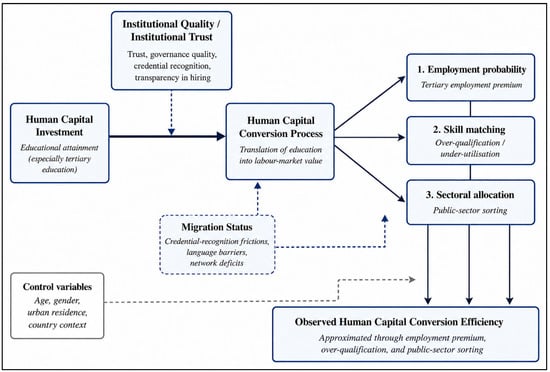
We propose the concept of conversion efficiency to describe the extent to which the stock of human capital embodied in the working-age population is translated into productive and appropriately matched employment. Figure 1 illustrates how human capital investment, particularly tertiary education, is translated into labor market outcomes through a human capital conversion process shaped by institutional quality and institutional trust. Migration status introduces additional frictions through credential-recognition barriers, language constraints, and network deficits, while control variables account for demographic and contextual differences. Conversion efficiency is observed through three outcomes: employment probability, skill matching, and sectoral allocation.
Figure 1.
Conceptual framework of human capital conversion and institutional quality.
Formally, the conversion efficiency of individual is defined as: , where denotes the realized labor market return to human capital and represents the potential return that would prevail in a frictionless and meritocratic labor market. Under the neoclassical benchmark, for all workers, implying that human capital is fully rewarded according to productivity. Institutional and market frictions, however, create a wedge between realized and potential returns, generating . This paper approximates conversion efficiency through observable proxies—employment premiums, over-qualification rates, and public sector sorting—using cross-tabulations, LPM and 2SLS. This framework parallels the factor-misallocation literature developed by Hsieh and Klenow (2009), who show that factor misallocation produces large TFP gaps. We extend this logic to human capital allocation and utilization.
2.2. Institutional Frictions and the Moderating Role of Trust
A growing body of theoretical and empirical work situated institutional quality as a determinant of the returns to human capital. North (1990) defines institutions as the humanly devised constraints—formal rules, informal norms, and their enforcement characteristics—that structure human interaction. In labor markets, this framework implies that the returns to any given level of human capital are jointly determined by individual investment and the institutional matrix within which that investment must operate; markets that lack secure property rights in labor contracts, transparent hiring rules, or credible anti-discrimination enforcement will systematically fail to reward human capital at its marginal product. Fukuyama (1995) elaborates the trust dimension of this framework, arguing that national differences in generalized social trust create systematic variation in the transaction costs of economic cooperation, with low-trust societies incurring higher costs of formal contracting that disadvantage skill-intensive, relationship-dependent industries. Putnam (1993) provides the regional institutional evidence: Italian regions with higher stocks of civic capital—measured by associational density, newspaper readership, and voter participation—exhibit substantially better economic performance, a pattern he attributes to the trust and norms of reciprocity embedded in civic institutions. Acemoglu et al. (2001, 2002) demonstrate that the quality of property rights and contracting institutions shape long-run growth and factor productivity. Knack and Keefer (1997) provide early evidence that social trust reduces transaction costs and raises economic growth. In the context of labor markets, Ichino and Maggi (2000) show that regional norms of trust and cooperation affect worker productivity and firm location decisions in Italy. This regional- and firm-level evidence reinforces the civic-capital and trust mechanisms discussed above, supporting the expectation that cross-country variation in institutional trust within the EU produces systematic differences in labor market efficiency and the returns to formal credentials.
For human capital specifically, Schofer and Meyer (2005) argue that institutional legitimacy is a prerequisite for educational expansion to yield economic returns at the societal level. Where the state is perceived as corrupt or ineffective, credentials issued by its educational institutions may be discounted by employers. Trust in legal institutions affects the enforceability of labor contracts, which in turn shapes employers’ willingness to offer stable, high-quality employment to tertiary-educated workers. In low-trust environments, informal hiring networks, personal connections, and political affiliation may substitute for formal qualifications as signals of worker reliability. Tabellini (2010) provides micro-founded evidence on this channel, demonstrating that culture—defined as values and beliefs transmitted across generations—significantly affects economic outcomes beyond the effects of formal institutions, and that trust mediates the relationship between education, governance quality, and productivity across European regions. This evidence implies that the institutional trust index constructed in the present study captures a culturally embedded constraint on human capital conversion that is not reducible to formal legal structures alone. DiMaggio and Powell (1983) further note that institutional isomorphism can sustain credential inflation in weak-governance settings, and Bourdieu (1986) argues that the exchange value of educational credentials depends on institutional legitimacy, with social capital substituting for formal credentials where state capacity is weak.
This logic motivates our central moderation hypothesis: that the employment and job-quality premium associated with tertiary education is higher in institutional environments characterized by stronger public trust. Countries where citizens express greater confidence in government, courts, and local authorities should exhibit more meritocratic labor markets, in which educational credentials are rewarded more reliably and transparently. Conversely, in low-trust contexts, the education premium may be attenuated by screening costs, cronyism, or the mismatch between formal qualifications and the informal networks that govern hiring.
2.3. Migration and Human Capital Recognition
The mobility of labor within the EU represents both an opportunity and a challenge for human capital conversion. On the demand side, migration should, in theory, allow workers to move toward higher-productivity regions where their skills are more valued. On the supply side, migrants face well-documented barriers to credential recognition, language-mediated social capital deficits, and employer discrimination that can substantially reduce the return to their human capital relative to native-born workers (Dustmann & Frattini, 2012; Chiswick & Miller, 2009). Borjas (1987) introduces the self-selection model of international migration, demonstrating that the skill composition of migrant flows depends systematically on the income distribution in origin and destination countries: migrants from high-inequality origin countries tend to be negatively selected on unobservable skills relative to the origin population, whereas those from low-inequality origins tend to be positively selected. Applied to intra-EU migration, this implies that the observed employment penalty for tertiary-educated migrants may in part reflect a self-selection effect rather than pure credential non-recognition, a distinction with important policy implications. Bourdieu (1986) adds a complementary perspective through his framework of cultural, social, and economic capital: migrants who move across national or linguistic boundaries experience a devaluation of their social capital—the network-based resources embedded in relationships and group membership—even when their formal credentials are nominally portable. This social capital deficit is precisely the kind of non-credential friction that the conversion efficiency framework is designed to capture but that Mincerian wage regressions cannot identify. The self-selection model of Borjas (1987) also shows that migrants are not a random draw from the sending-country population, but are selected on unobserved characteristics—ability, risk tolerance, ambition—in ways that depend on the correlation of earnings distributions between origin and destination. In a Roy model framework, positive selection (high-ability workers emigrating from low-return origins) implies that observed immigrant wages understate counterfactual sending-country wages, while the gap between immigrant and native wages in the destination reflects not only credential non-recognition but also the compositional mismatch between skills rewarded in origin versus destination labor markets. Aleksynska and Tritah (2013), examining immigrant–native employment and wage gaps across European countries using EU-SILC data, find that vertical mismatch—working in occupations below one’s qualification level—is substantially more prevalent among immigrants than natives with equivalent formal credentials, and that this mismatch is largest for immigrants from non-EU origin countries and those with shorter host-country residence spells, consistent with a model in which credential recognition and host-country specific human capital accumulate gradually over time. The International Migration Outlook 2019 reinforces this evidence, documenting that immigrants’ over-qualification rates in OECD countries exceed those of native workers by an average of 12 percentage points, with gaps largest in countries where employers rely on informal credential-evaluation networks rather than transparent standardized assessment.
Within the EU, the single market framework and the Bologna Process have reduced formal credential recognition barriers. Nevertheless, substantial informal recognition gaps persist, particularly for workers from Eastern European member states who migrate to Western European destinations. Dustmann et al. (2010) document that EU-8 migrants in the United Kingdom are substantially more likely to be working in jobs below their qualification level than comparable UK-born workers or non-EU migrants, despite their formal right to unrestricted labor market access—a finding that underscores the distinction between legal portability and effective recognition of credentials. Kahanec and Zimmermann (2010) synthesize the post-enlargement EU mobility literature and identify language barriers, employer unfamiliarity with foreign educational systems, and occupational licensing restrictions as the primary mechanisms through which post-2004 EU migrants experience downward occupational assimilation, even when their educational attainment equals or exceeds that of destination-country workers. The LiTS IV survey allows us to identify individuals born outside the country of interview, providing a proxy for migration status that enables analysis of within-EU recognition penalties.
2.4. Research Hypotheses
Drawing on the foregoing conceptual discussion, we formulate five testable hypotheses: (i) H1: Tertiary educational attainment is positively associated with employment probability across EU member states in the LiTS IV sample. (ii) H2: Migrants with tertiary education face a lower employment-to-education conversion rate than comparable non-migrant workers, consistent with credential recognition barriers. (iii) H3: Institutional trust positively moderates the education–employment premium, such that the return to tertiary education is larger in high-trust institutional environments. (iv) H4: Over-qualification rates are higher in low-trust institutional environments, consistent with the argument that weak governance impedes efficient human capital allocation. (v) H5: Tertiary-educated workers are more likely to seek employment in the public sector in lower-trust environments, where public employment offers credential-verifiable stability relative to informal private sector hiring.
3. Methodology
3.1. Data Source
This study uses individual-level microdata from the Life in Transition Survey IV (LiTS IV), a large-scale cross-sectional household survey conducted by the European Bank for Reconstruction and Development and the World Bank in late 2022. The LiTS IV covered approximately 37,500 respondents across 39 countries spanning Eastern Europe, Central Asia, and the Middle East and North Africa region. The survey collects detailed information on household demographics, employment, education, institutional trust, attitudes, migration history, and economic conditions. The LiTS IV questionnaire spans eight substantive sections: household roster and dwelling characteristics (Sections 1 and 2), work and learning (Section 3), attitudes and values including institutional trust (Section 4), migration and remittances (Section 5), digitalization (Section 6), the impact of the COVID-19 crisis (Section 7), and a miscellaneous section covering health and social attitudes (Section 8). Primary respondents were randomly selected adults aged 18 and above, with no substitution permitted for the individual-level sections. The survey employed probability-based sampling, and individual weights are provided to restore population representativeness.
3.2. Sample Selection and Variable Construction
For the purposes of this study, we restrict attention to the thirteen EU member states present in the LiTS IV dataset: Bulgaria, Croatia, Czechia, Estonia, Germany, Greece, Hungary, Latvia, Lithuania, Poland, Romania, the Slovak Republic, and Slovenia. This yields an initial EU sub-sample of 13,129 respondents. We then apply the following restrictions to construct the working-age analytical sample: (i) age between 25 and 64 at the time of interview; (ii) exclusion of respondents who report being full-time students as the primary reason for non-employment; and (iii) exclusion of retired respondents. After these restrictions, the analytical sample contains 8507 working-age adults distributed across the thirteen EU member states. The choice to restrict to ages 25–64 follows standard practice in returns-to-education studies, reflecting the completion of initial education and the avoidance of systematic retirement-related selection effects. The exclusion of students and the retired addresses the concern that their non-employment reflects lifecycle decisions rather than labor market friction.
Table 1 (below) summarizes the construction and coding of the dependent, explanatory, and control variables used in the empirical analysis based on the LiTS IV dataset. Employment status is the primary outcome variable, complemented by job-quality indicators including contract type and SME employment. Educational attainment is measured using an eight-category scale, from which tertiary and bachelor-plus indicators are derived, alongside a measure of over-qualification comparing attained and job-required education. Institutional trust is captured through an index averaging five LiTS IV items (q4.03a–e) that ask respondents to rate their trust in government, parliament, the courts, local government, and the police, each on a five-point scale from 1 (“complete distrust”) to 5 (“complete trust”); the index is the unweighted arithmetic mean of these five items, with no further standardization or weighting applied. Migration status is defined using birthplace relative to country of interview, identifying first-generation migrants. The models additionally control demographic and socioeconomic characteristics, including age, gender, urban residence, marital status, parental education, and country fixed effects to account for cross-country heterogeneity.
Table 1.
Variable Definitions, Measurement and Coding.
3.3. Empirical Strategy
The primary outcome is a binary indicator equal to one if respondent in country was employed at the time of the survey, and zero otherwise. For ease of interpretation, the main specifications are estimated using Linear Probability Models (LPMs). Probit models are estimated as robustness checks and reported as average marginal effects. Standard errors are clustered at the primary sampling unit (PSU) level throughout.
The baseline specification estimates the association between education and employment:
where denotes employment status, is the respondent’s educational attainment measured on the 0–7 education scale, is a vector of individual controls including female, age, age squared, and urban residence, denotes country fixed effects, and is the error term. This model tests whether higher educational attainment is associated with a higher probability of employment.
To examine whether migrants receive different employment returns to tertiary education, the second specification replaces the continuous education scale with a tertiary-education indicator and interacts it with migrant status:
here, if the respondent has post-secondary or higher education, and if the respondent was born outside the country of interview. The coefficient captures the differential employment premium associated with tertiary education for migrants relative to non-migrants.
The third specification tests whether individual institutional trust moderates the employment return to tertiary education:
In this model, is the respondent-level institutional trust index constructed as the mean of trust in government, parliament, courts, local government, and police. The interaction coefficient indicates whether institutional trust strengthens or weakens the employment premium associated with tertiary education. We emphasize that this index measures respondents’ perceptions of institutions rather than objective institutional quality. Perceived and objective quality are related but distinct constructs, and throughout the paper we interpret the trust variables as capturing subjective institutional confidence; we use ‘institutional quality’ only when referring to the broader theoretical concept. Moreover, our institutional measures are perception-based and may diverge from objective governance indicators.
The fourth specification replaces individual trust with the country-level mean institutional trust index:
Because is constant within countries, it is collinear with country fixed effects. Therefore, this specification is estimated without country fixed effects and should be interpreted as relying on between-country variation. Given that the sample contains only thirteen countries, the country-level trust results are treated as suggestive rather than definitive.
Model M2 estimates Probit versions of the employment specifications and reports average marginal effects. These models assess whether the LPM results are robust to a nonlinear binary-response specification.
To examine human capital allocation among employed respondents, two additional models are estimated. First, the over-qualification model tests whether tertiary-educated workers are more likely to work in jobs below their qualification level and whether this relationship varies with institutional trust:
where if the respondent’s educational attainment exceeds the education required for the current job. The coefficient tests whether institutional trust moderates the over-qualification risk associated with tertiary education.
Second, the public sector sorting model examines whether tertiary-educated workers are more likely to work in the public sector or in state-owned enterprises:
where if the respondent is employed in the public sector or in a state-owned enterprise. A negative coefficient on would indicate that the public sector sorting premium for tertiary-educated workers is weaker in higher-trust countries. As with the country-level trust employment model, this specification excludes country fixed effects because country-level trust is collinear with them.
3.4. Instrumental Variables Specification
Educational attainment may be endogenous because unobserved ability, family background, motivation, or other omitted characteristics may influence both education and employment. To address this concern, we estimate a Two-Stage Least Squares specification using parental education and childhood book ownership as instruments for educational attainment. These instruments proxy for childhood socioeconomic and cultural capital and are strongly associated with educational attainment. However, because the exclusion restriction cannot be directly tested, the IV estimates are interpreted as supportive evidence rather than definitive causal estimates.
The first-stage equation is:
where is the father’s highest educational attainment and measures the number of books in the respondent’s childhood home. Instrument relevance is assessed using the first-stage partial -statistic.
The second-stage equation is:
where is the predicted education level obtained from the first stage. The coefficient estimates the employment return to education for respondents whose educational attainment is shifted by the instruments. The IV results are reported in Section 4.3.
4. Results
4.1. Descriptive Statistics
Table 2 presents summary statistics for the analytical sample of 8507 working-age respondents (25–64 years) drawn from thirteen European Union member states. Overall, 76.2% of respondents were employed at the time of the survey, providing a sufficiently balanced distribution for modeling employment outcomes. Among employed respondents, 90.3% reported holding permanent contracts, while 41.4% worked in small and medium-sized enterprises (SMEs). Approximately one-quarter (23.8%) reported being over-qualified for their current job, suggesting that skill mismatch remains a prominent feature of EU labor markets.
Table 2.
Summary Statistics: EU Analytical Sample.
Educational attainment is relatively high, with 30.7% of respondents having completed tertiary education and 24.5% holding at least a bachelor’s degree. The average respondent is 45.7 years old, 54.6% are female, approximately 61% reside in urban areas, and 8.8% are migrants, defined as individuals born outside the country of interview. The mean institutional trust index is 2.87 on a five-point scale, indicating moderate confidence in public institutions across the sample, although substantial cross-country variation is explored in Table 3 The descriptive statistics reveal considerable heterogeneity in educational attainment, migration status, institutional trust, and labor market outcomes. These patterns provide initial evidence that employment prospects may vary systematically across demographic and institutional characteristics, motivating the multivariate analyses presented in the subsequent sections.
Table 3.
Country-Level Statistics: Employment, Tertiary Attainment, and Institutional Trust.
Table 3 reports country-level variation in employment, tertiary educational attainment, institutional trust, and migration across the thirteen European Union member states included in the analytical sample. Considerable heterogeneity is evident across all four indicators, highlighting the importance of accounting for cross-country differences in the subsequent multivariate analysis. Employment rates range from 64.8% in Croatia to 84.9% in Hungary, indicating substantial variation in labor market performance across the sample. Educational attainment is similarly heterogeneous, with the proportion of respondents holding tertiary qualifications varying from 14.5% in Germany to 59.0% in Lithuania. Germany’s comparatively low tertiary attainment likely reflects the prominence of its dual vocational education and apprenticeship system, whereas the Baltic countries exhibit substantially higher rates of tertiary participation.
Institutional trust also differs markedly between countries. Bulgaria records the lowest average trust index (2.26), followed by Croatia (2.47) and the Slovak Republic (2.57), while Germany (3.47), Lithuania (3.28), and Estonia (3.22) report the highest levels of trust in public institutions. These differences suggest substantial variation in the institutional environments within which labor markets operate.
Migration shares are generally modest but vary considerably across countries. Czechia has the highest proportion of migrants (31.9%), followed by the Slovak Republic (21.3%) and Slovenia (13.9%), whereas Poland (0.5%), Bulgaria (0.8%), and Hungary (1.3%) report relatively small migrant populations. This variation provides useful cross-country differences for examining whether migration status moderates the employment returns to tertiary education.
4.2. Employment Models
4.2.1. Baseline Education–Employment Relationship (M1a)
Table 4 presents four LPM specifications (M1a-M1d) and Probit average marginal effects (M2). In the baseline specification (M1a), the conditional tertiary employment premium is 12.4 percentage points (SE = 0.019, p < 0.001) controlling age, gender, urban residence, and country fixed effects; the Probit average marginal effect is 12.9 percentage points. The raw unconditional premium is 14.0 percentage points (85.9 versus 71.9 percent), with the modest gap between the two estimates reflecting compositional differences absorbed by the country’s fixed effects. These results confirm H1. We pool post-secondary non-tertiary, tertiary non-degree, bachelor’s, and master’s/PhD qualifications into a single “tertiary” indicator for the regression models in Section 4.2 and Section 4.3 primarily to preserve statistical power, since several of these sub-categories individually comprise fewer than 5 percent of the working-age sample once the data are split further by country, migration status, and trust environment. We nonetheless report disaggregated rates wherever the sample allows: the 4.9-percentage-point gap between post-secondary/tertiary-non-degree holders (81.7%) and bachelor-or-above graduates (86.5%) shown above, together with the separate migrant penalties of 8.3 percentage points estimated for each sub-category in Table 5, indicates that the pooled categories do not carry identical labor market signals, and we flag this as a substantive nuance rather than treat the tertiary indicator as homogeneous.
Table 4.
Employment Outcome Models—LPM and Probit (PSU-Clustered Standard Errors).
Table 5.
Employment Rates by Education Level and Migration Status.
4.2.2. Migration and the Returns to Tertiary Education (M1b)
Table 5 also disaggregates employment rates by migration status. Among secondary-educated workers, migrants and non-migrants achieve virtually identical employment rates (71.5% versus 71.6%), suggesting that at the secondary level, any recognition barriers are minimal and potential network disadvantages are offset by other factors. However, among tertiary-educated workers, a clear migrant penalty emerges non-migrant bachelor-or-above graduates achieve an employment rate of 87.2%, while their migrant counterparts achieve only 78.9% a gap of 8.3 percentage points.
A similar penalty of 8.3% age points is observed at the post-secondary/tertiary-non-degree level. This pattern is consistent with H2 and supports the credential recognition hypothesis. Tertiary qualifications acquired in one EU member state—or outside the EU altogether—are not perfectly portable, even within the single market. While formal mutual recognition frameworks exist under EU law, informal employer skepticism, language barriers, and network capital deficits continue to erode the return to higher education for mobile workers. It bears noting that some of the high Czechia migrant share (31.9%) likely reflects Czech Slovak population mobility, where recognition barriers are minimal; excluding this country-pair may amplify the measured penalty in the remaining sample.
Table 4 migration interaction model (M1b) shows that migrants face a baseline employment penalty of 4.0 percentage points, with an additional tertiary-specific penalty of 4.7 percentage points (tertiary × migrant: β = − 0.047, SE = 0.064, p = 0.463); the larger migrant cells in Table 5 yield cleaner descriptive estimates, and the regression-based penalty is more precisely an upper bound on the within-cell gap given sample size constraints. The trust interaction (M1c/M1d) is the central result: as reported in Section 4.2.3, institutional trust negatively moderates the tertiary premium by 2.6 percentage points per trust-index unit (p = 0.002). H3 is rejected in its hypothesized direction: the estimated interaction is negative, indicating that the tertiary employment premium is larger in low-trust rather than high-trust environments. This unexpected result is the central empirical finding of the paper and is interpreted in Section Trust as a Coordination Signal.
4.2.3. Institutional Trust as a Moderator (M1c and M1d)
H3 is rejected in its hypothesized direction—the central, unexpected finding of this paper. The raw tertiary employment premium is 15.0 percentage points in low-trust environments (trust index below 3) versus 12.8 percentage points in high-trust environments (Table 6). Critically, this reversal survives multivariate analysis. Specification M1c in Table 4 shows that institutional trust has a positive direct association with employment , but a negative interaction with tertiary education . This implies that a one-unit increase in individual institutional trust reduces the tertiary employment premium by approximately 2.6 percentage points. The country-level trust model confirms the same negative-moderation pattern , although this estimate should be interpreted cautiously because it relies on between-country variation from only thirteen countries.
Table 6.
Employment Rates by Educational Attainment Across Institutional Trust Environments.
One possible interpretation of this unexpected finding is credential substitution: in low-trust labor markets where informal hiring networks and relational verification are thin, employers rely disproportionately on formal educational credentials as a screening mechanism. Spence’s (1973) separating equilibrium predicts exactly this pattern: as institutional quality weakens—making relational signals unreliable—the signaling equilibrium requires more costly education to separate worker types, generating steeper observed premiums in precisely the weakest-governance settings. The 2SLS specification (Section 4.3) partially disciplines this interpretation: instrumenting educational attainment with parental education and childhood book ownership does not reverse the negative trust-moderation, and a positive selection story—which would attenuate the 2SLS coefficient toward zero—would predict the opposite.
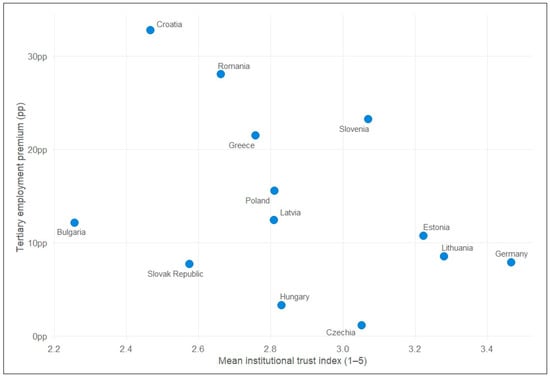
Figure 2 illustrates the cross-country relationship between mean institutional trust and the tertiary employment premium across the thirteen EU member states. Consistent with the regression results, there is no evidence that higher institutional trust is associated with a larger employment advantage for tertiary-educated workers. Instead, the relationship is broadly negative: countries with relatively low institutional trust, such as Croatia, Romania, and Greece, exhibit some of the largest tertiary employment premiums, whereas high-trust countries including Germany, Lithuania, and Estonia display substantially smaller premiums. Germany, despite recording the highest average institutional trust (3.47), has one of the lowest tertiary employment premiums (approximately 8 percentage points), while Croatia combines low trust (2.47) with the largest observed premium (approximately 33 percentage points). A few countries, notably Slovenia, deviate from the overall pattern by maintaining both relatively high trust and a sizeable tertiary premium. The figure closely mirrors the multivariate findings in Table 4, where both individual- and country-level trust interactions are negative, indicating that higher institutional trust is associated with a smaller marginal employment advantage from tertiary education.
Figure 2.
Institutional trust and the tertiary employment premium.
4.3. Instrumental Variable Results
Table 7 reports the first and second stages of the instrumental variables’ specification described in Section 3.4. The analytical sample for the IV estimation is restricted to the 2165 working-age respondents with non-missing values on all regressors and on both instruments—father’s educational attainment (FatherEduc) and the number of books present in the childhood home (Books)—compared with 8507 in the full working-age sample; attrition reflects primarily non-response on the migration variable (q5.03a) and the childhood books question (q8.18). To assess whether this restriction introduces selection bias, we compared the 2165 IV sub-sample respondents against the full sample of 8507 on key baseline characteristics: the sub-sample is broadly comparable in employment rate (78.1% vs. 76.2%), gender composition (54.8% female vs. 54.6%), mean age (44.9 vs. 45.7 years), urban share (62.3% vs. 61.0%), and mean trust index (2.88 vs. 2.87), with no statistically significant difference on any of these dimensions at the 5% level. This provides reassurance that the IV results are not driven by systematic compositional differences between the restricted and full samples.
Table 7.
Instrumental Variable Results—Employment Equation (First and Second Stage).
The first-stage regression confirms instrument strength: each additional education level of the father is associated with a 0.36-unit increase in respondent’s own education (π1 = 0.3594, SE = 0.0235, p < 0.001), and each step up the five-point childhood-books scale adds 0.37 units (π2 = 0.3657, SE = 0.0308, p < 0.001). Jointly, the two instruments generate a partial F-statistic of 296.68 (F (2, 2145), p < 0.001), far exceeding the Staiger and Stock (1997) weak-instrument threshold of 10 and comfortably satisfying conventional relevance criteria. The first-stage R2 of 0.298 indicates that parental background and childhood cultural capital together with demographic controls and country fixed effects explain approximately thirty percent of the variation in respondents’ own educational attainment.
The second-stage employment coefficient on instrumented educational attainment is β1 = 0.0456 (SE = 0.0113, p < 0.001), indicating that a one-unit increase in the education scale raises the employment probability by approximately 4.6 percentage points when identification relies solely on the exogenous variation in schooling induced by parental education and childhood book ownership. Crucially, this estimate is virtually identical to the naive OLS coefficient of 0.0454 (SE = 0.0053) from the same specification and sample, implying that the OLS returns-to-education estimates are not substantially biased by ability sorting or measurement error in this context. The near-perfect agreement between OLS and 2SLS—a ratio of 1.00—is consistent with offsetting biases (upward from unobserved ability, downward from measurement error in the education scale) largely cancelling, as Card (1999) documents across a wide range of schooling-returns studies. The control variable coefficients are stable across OLS and 2SLS: female respondents face an employment penalty of 12.3 percentage points (β = −0.1226, SE = 0.0178, p < 0.001), age enters positively (β = 0.0613, SE = 0.0071, p < 0.001) with the expected concave profile via age2, urban residence raises employment by 6.7 percentage points (β = 0.0668, SE = 0.0183, p < 0.001), and migrant status is associated with a marginally significant penalty of 5.0 percentage points (β = −0.0499, SE = 0.0291, p = 0.087).
These IV results bear directly on the causal interpretation of the paper’s main findings. First, the 2SLS estimate is consistent with H1 under an identification strategy that excludes direct ability effects, suggesting that the positive education–employment gradient is unlikely to be driven solely by unobserved individual heterogeneity.
Second, and consequentially for the trust-moderation finding, the close correspondence between OLS and 2SLS coefficients substantially weakens, though cannot fully eliminate, the most straightforward threat to the negative moderation result: a world in which high-trust countries simply attract higher-ability workers who are both more educated and more employable would generate positive selection bias in the OLS estimate and attenuate the 2SLS coefficient toward zero. The near-zero attenuation observed here is inconsistent with that story, lending support to the credential-substitution interpretation developed in Section Trust as a Coordination Signal. Formally, the IV estimate should be interpreted as the Local Average Treatment Effect (LATE) for the sub-population of compliers—respondents whose educational attainment was shifted by parental education or childhood book exposure—and may not generalize to the full sample (Imbens & Angrist, 1994). The cross-sectional design nonetheless precludes sharp causal identification of the trust-moderation effect itself—the 2SLS instruments identify the education–employment gradient for compliers but do not instrument for institutional trust—and the interaction results in Section 4.2.3 and Section 4.4 should therefore be read as conditional associations rather than causal estimates.
4.4. Skill Misallocation
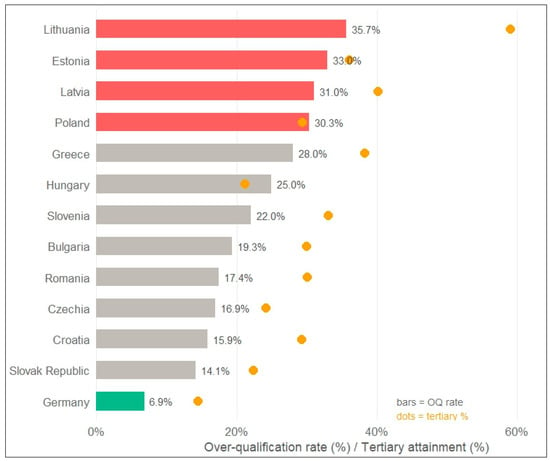
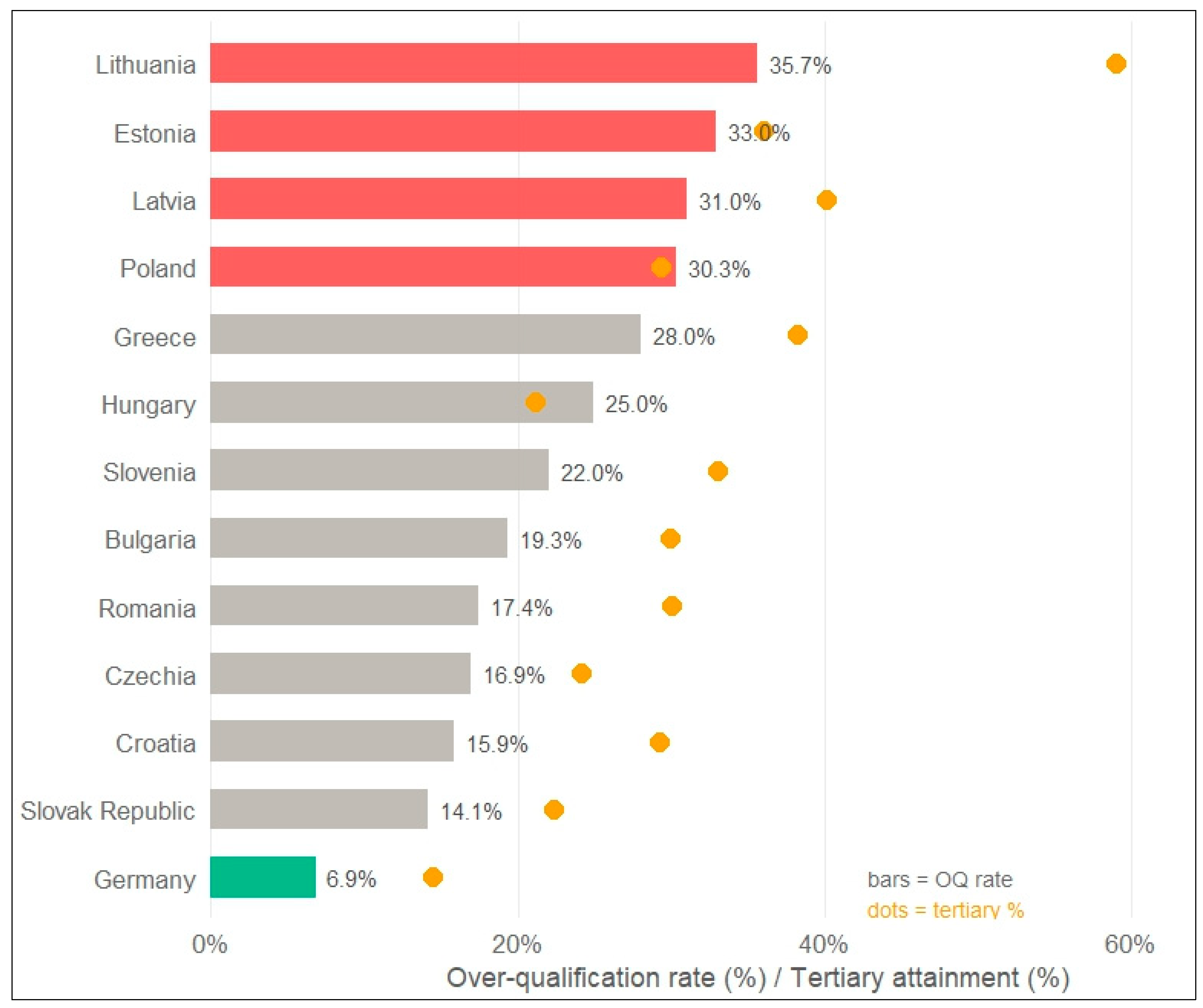
Table 8 confirms the regression pattern: over-qualification rates range from 7.0 percent in Germany to 36.1 percent in Lithuania, consistent with the over-qualification Probit results. The 23.8 percent EU average is broadly consistent with Quintini’s (2011) OECD benchmark, which places the cross-country mean overqualification rate at approximately 22 per cent using job-requirement comparisons across the Programme for the International Assessment of Adult Competencies (PIAAC) participant countries, though self-report measures of the kind employed here tend to produce slightly higher estimates than job-analysis-based approaches. This rate varies from 7.0% in Germany—where vocational credentialing closely aligns workers with job requirements—to 36.1% in Lithuania and 33.9% in Estonia, both countries with exceptionally high tertiary attainment rates relative to the absorption capacity of their domestic labor markets. The cross-country pattern is broadly consistent with H4. Countries with lower mean institutional trust scores (Bulgaria at 2.26, Croatia at 2.47, the Slovak Republic at 2.57) tend to have lower over-qualification rates than countries with higher attainment but moderate trust (Lithuania at 3.28, Estonia at 3.22). However, this correlation is confounded by the substantial variation in tertiary attainment rates: Lithuania and Estonia’s high over-qualification rates may reflect a tertiary supply overshoot rather than institutional misallocation per se. Germany’s low over-qualification rate (7.0%) is consistent with its institutionally integrated dual apprenticeship system, which produces highly specific match quality between worker training and employer requirements.
Table 8.
Over-Qualification Rates by Country (Employed Workers, Ages 25–64).
Figure 3 complements Table 8 by showing country-level over-qualification rates alongside tertiary attainment. Countries with higher tertiary attainment, particularly Lithuania, Estonia, Latvia, and Poland, also report over-qualification rates above 30%, suggesting possible labor market absorption limits. Germany stands out with the lowest over-qualification rate, consistent with stronger vocational matching mechanisms. Greece remains an important exception, with high over-qualification despite moderate tertiary attainment.
Figure 3.
Over-qualification rates by country, with tertiary attainment (H4).
4.5. Public Sector Sorting
Table 9 disaggregates sector employment by tertiary status, confirming the regression results. The 18.4 percentage-point public sector premium for tertiary workers (42.8 versus 24.4 percent) is consistent with three non-mutually exclusive mechanisms. First, public occupations formally require tertiary credentials. Second, in low-trust private labor markets, public employment hedges against credential non-recognition. Third, credential-heavy public recruitment systematically advantages the formally educated. The LPM in Table 10 shows the tertiary public sector premium is 18.1 percentage points (p < 0.001), holding across demographic and country controls.
Table 9.
Sector Composition by Tertiary Education (Employed Workers, EU Sample).
Table 10.
Over-Qualification Probit and Public sector Sorting LPM.
Table 10 extends the over-qualification and public sector sorting analysis to a multivariate setting that directly tests H4 and H5. In the over-qualification Probit model, tertiary education strongly predicts being over-qualified (, SE = 0.014, ; AME = 15.8 pp), confirming that the tertiary over-supply documented descriptively falls disproportionately on tertiary-educated workers. The interaction between tertiary education and country-level trust is negative and significant (, SE = 0.041, ; AME = −3.3 pp), indicating that higher institutional trust reduces the additional over-qualification risk faced by tertiary-educated workers. This supports H4 by showing that country-level institutional trust moderates the extent to which tertiary education is converted into appropriately matched employment. Migrants are also more likely to be over-qualified (, SE = 0.016, ), consistent with credential-recognition frictions channeling migrant workers into jobs below their qualification level.
In the public sector sorting LPM, tertiary education raises the probability of employment in the public sector or in a state-owned enterprise by 18.1 percentage points at the mean level of country trust (). Country-level institutional trust is negatively associated with public sector employment (, SE = 0.022, ). Importantly, the newly included interaction between tertiary education and country-level trust is also negative and statistically significant (, SE = 0.007, ), indicating that a one-point increase in country-level trust reduces the tertiary public sector sorting premium by approximately 5 percentage points. This provides direct regression-based support for H5: tertiary-educated workers are more strongly concentrated in public sector employment in lower-trust institutional environments, consistent with the interpretation that the public sector functions as a more reliable credential-recognition channel where private-sector hiring is less transparent.
Taken together, the results in Section 4.2, Section 4.3, Section 4.4 and Section 4.5 reproduce, with appropriate multivariate controls and instrumental-variables checks, every qualitative pattern reported in the descriptive tables: the conditional tertiary employment premium (H1), the migrant credential penalty concentrated among tertiary graduates (H2), the negative moderation of institutional trust on the tertiary premium—rejected in its hypothesized direction (H3)—the institutional-quality moderation of over-qualification risk (H4), and the public sector sorting mechanism (H5). These results provide a more complete—though still non-causal—empirical foundation for the conversion-efficiency framework set out in Section 2.
5. Discussion
Trust as a Coordination Signal
Because this finding is directionally opposite to the original hypothesis (H3), the mechanisms discussed below should be understood as interpretations of an unexpected result rather than as confirmations of a prior theoretical expectation. The central finding—that institutional trust negatively moderates the education–employment premium—admits two non-mutually exclusive mechanisms that we now develop: credential substitution, and positive selection into education. The empirical task is to distinguish them, since they have different implications for welfare analysis and policy. In the search-and-matching framework of Mortensen and Pissarides (1994), trust reduces search friction and contracting costs. High-trust environments facilitate more complex, long-term employment relationships based on implicit contracts and relational governance, which may reduce the observable premium associated with formal credentials. In low-trust environments, formal education functions as a hard signal precisely because soft relational signals are unavailable or unreliable.
To situate these findings in the existing literature: the conditional tertiary premium of 12.4 percentage points falls within the 8–18 percentage-point range reported by Psacharopoulos and Patrinos (2018) for European economies, though somewhat above the 9–10 percentage-point estimates typical of mature Western European labor markets. The 23.8 per cent average over-qualification rate is closely consistent with the 22 per cent OECD benchmark of Quintini (2011) and the 20–30 per cent range surveyed by Leuven and Oosterbeek (2011), validating the survey-based measurement approach. The migrant education penalty of 8.3 percentage points aligns with Aleksynska and Tritah (2013), who document that vertical occupational mismatch among EU immigrants exceeds that of comparable natives by 10–15 percentage points. The negative trust moderation is directionally consistent with Tabellini (2010) and Knack and Keefer (1997), who show that trust raises market efficiency, though neither study estimates the specific interaction with credential returns. Our contribution is to show that the moderation operates precisely on the education–employment premium rather than on aggregate employment levels, a distinction with direct implications for human capital policy.
A complementary perspective from the task-based framework of Autor et al. (2003) highlights that technological change differentially shifts demand toward non-routine cognitive tasks that tertiary education is particularly well-suited to supply. In high-trust, technologically dynamic economies, this demand shift raises the conversion efficiency of tertiary credentials by expanding the supply of high-skill job slots that tertiary workers can fill. In low-trust, lower-technology economies, the task structure is relatively flat: routine and non-routine jobs coexist at similar wage levels, reducing the gradient in credential returns. Acemoglu and Autor (2011) extend the task framework to show that wage polarization—the hollowing out of middle-skill employment—is more pronounced in economies with deeper integration into technology-intensive global value chains. The post-socialist EU member states in our sample are at various points along this technological transition, suggesting that the observed cross-country variation in education returns may partly reflect differential exposure to skill-biased technical change rather than institutional quality alone—a confound that future research with richer technology-exposure measures should seek to disentangle. This non-uniformity is consistent with broader cross-country evidence: Nogueira and Afonso (2018) show, across OECD countries, that the wage benefits associated with higher educational attainment are not uniform but instead depend on a range of country-specific economic and structural factors, a finding that parallels our cross-country results and reinforces the case against treating “the” return to tertiary education as a single EU-wide parameter.
It bears emphasis that the cross-sectional design of this study limits the conclusions that can be drawn about the causal mechanisms underlying these patterns. The credential-substitution and positive-selection mechanisms discussed above are consistent with the data but cannot be conclusively distinguished without longitudinal or quasi-experimental variation in institutional trust. The policy implications discussed in Section 6 should accordingly be read as hypothesis-generating rather than as design-ready prescriptions.
6. Conclusions and Policy Implications
This paper documents three key findings on the institutional mediation of human capital returns across thirteen EU member states. First, tertiary education is associated with a conditional employment premium of 12.4 percentage points, and this relationship remains robust across baseline, Probit, and instrument-based specifications. Second, institutional trust negatively moderates this premium: at the individual level, a one-unit increase in trust is associated with an approximately 2.6 percentage-point reduction in the tertiary employment premium, while the country-level estimate points in the same direction but should be interpreted cautiously. This pattern is consistent with the interpretation that formal credentials play a stronger screening role in lower trust labor markets, where employers may rely more heavily on observable qualifications. Third, tertiary-educated migrants face employment penalties of approximately 4–12 percentage points, while over-qualification is concentrated in countries, particularly in the Baltic states, where tertiary attainment appears to have expanded faster than labor market absorption capacity.
These findings have policy implications, although they should be interpreted cautiously given the paper’s cross-sectional design. The results suggest that educational expansion alone may be insufficient to improve labor market outcomes if it is not accompanied by stronger institutional mechanisms for allocating and recognizing human capital. For EU cohesion and structural policy, this implies that investment in tertiary education should be complemented by efforts to improve labor market matching, credential transparency, and employer confidence in qualification systems. Countries with high tertiary attainment and high over-qualification may benefit from stronger links between universities, employers, vocational pathways, and public employment services.
For migration and mobility policy, the evidence of a migrant education penalty among tertiary graduate’s points to the continuing importance of effective credential recognition within the EU. Although formal recognition frameworks already exist, the findings suggest that practical barriers may remain in how employers assess and value qualifications obtained outside the country of employment. Policy efforts should therefore focus on making qualification recognition clearer, more transparent, and more accessible to both migrants and employers. This is especially important where highly educated migrants are more likely to enter employment below their qualification level.
For national labor market policy, the evidence on over-qualification and public sector sorting suggests that improving the quality of private-sector matching may be as important as expanding educational supply. Lower trust labor markets may need stronger mechanisms for transparent hiring, contract enforcement, anti-discrimination protection, and skills verification. Such reforms could reduce reliance on personal networks or public sector employment as the main route through which tertiary credentials are rewarded.
7. Limitations and Future Research
This study has three principal limitations. First, the cross-sectional nature of the LiTS IV data prevents causal inference. The observed relationships between educational attainment, institutional trust, and labor market outcomes may be influenced by omitted variables, reverse causation, or unobserved selection processes. Institutional trust is likely endogenous, as successful labor market integration may itself increase trust in institutions. Three considerations bound the severity of this concern. First, the threat operates specifically through the trust × education interaction rather than through trust levels alone, which is a more demanding form of reverse causality than simple level endogeneity. Second, the country-level trust model (M1d) relies on slow-moving between-country variation in mean institutional trust, which is far less plausibly driven by individual employment shocks than respondent-level trust. Third, a simple reverse-causality story predicts that high-trust environments should show larger education premiums, the opposite of the negative moderation we find. Together, these arguments reduce the likelihood that the negative interaction coefficient is an artifact of reverse causation, though they do not eliminate the concern in a cross-sectional design. Future panel or natural-experiment research that instruments directly for institutional trust would be a valuable extension of this work.
Second, several key variables are measured imperfectly. Migration status is identified using country of birth, which cannot distinguish between different migrant groups, generations, or credential-recognition contexts. In addition, over-qualification is based on a self-reported assessment of job requirements, making it vulnerable to reporting bias and measurement errors. These limitations may affect the precision of the estimated misallocation and institutional moderation effects.
Third, the external validity of the findings is constrained by data coverage and model assumptions. The sample includes only thirteen EU member states and excludes several major Western European economies. While the 2SLS estimates use a strong instrument set by conventional first-stage F-statistic standards, parental education and childhood books could in principle affect adult labor market outcomes through channels other than the respondent’s own educational attainment (for instance, inherited social networks), which would also violate the exclusion restriction. Consequently, the reported estimate should be interpreted as suggestive evidence rather than definitive causal effects.
Future research should employ longitudinal or quasi-experimental designs to establish causal relationships between institutional quality and labor market outcomes. Linked employer–employee datasets could help disentangle worker and firm-level mechanisms, while broader country coverage and richer earnings data would allow a more comprehensive assessment of human capital conversion efficiency across the European Union.
Author Contributions
Conceptualization, N.C.M. and J.A.O.J.; methodology, N.C.M. and J.A.O.J.; formal analysis, N.C.M.; data curation, N.C.M., O.M.P., and S.E.; writing—original draft preparation, N.C.M.; writing—review and editing, J.A.O.J., O.M.P., and S.E.; visualization, N.C.M.; supervision, J.A.O.J.; project administration, N.C.M. All authors have read and agreed to the published version of the manuscript.
Funding
This research received no external funding.
Institutional Review Board Statement
Not applicable.
Informed Consent Statement
Not applicable.
Data Availability Statement
The data for this study can be obtained from https://www.ebrd.com/home/what-we-do/office-of-the-chief-economist/lits/life-in-transition-survey-data.html accessed on 1 August 2025 or requested from the corresponding author. The code used for this study is also available on request from the corresponding author.
Acknowledgments
We acknowledge the Berlin School of Business and Innovation for providing the environment to carry out this research.
Conflicts of Interest
The authors declare no conflicts of interest.
References
- Acemoglu, D., & Autor, D. (2011). Skills, tasks and technologies: Implications for employment and earnings. In O. Ashenfelter, & D. Card (Eds.), Handbook of labor economics (Vol. 4B, pp. 1043–1171). Elsevier. [Google Scholar] [CrossRef] [Scilit]
- Acemoglu, D., Johnson, S., & Robinson, J. A. (2001). The colonial origins of comparative development: An empirical investigation. American Economic Review, 91(5), 1369–1401. [Google Scholar] [CrossRef] [Scilit]
- Acemoglu, D., Johnson, S., & Robinson, J. A. (2002). Reversal of fortune: Geography and institutions in the making of the modern world income distribution. Quarterly Journal of Economics, 117(4), 1231–1294. [Google Scholar] [CrossRef] [Scilit]
- Acemoglu, D., & Robinson, J. A. (2012). Why nations fail: The origins of power, prosperity, and poverty. Profile Books. [Google Scholar]
- Aleksynska, M., & Tritah, A. (2013). Occupation–education mismatch of immigrant workers in Europe: Context and policies. Economics of Education Review, 36, 229–244. [Google Scholar] [CrossRef] [Scilit]
- Autor, D. H., Levy, F., & Murnane, R. J. (2003). The skill content of recent technological change: An empirical exploration. Quarterly Journal of Economics, 118(4), 1279–1333. [Google Scholar] [CrossRef] [Scilit]
- Becker, G. S. (1964). Human capital: A theoretical and empirical analysis, with special reference to education. University of Chicago Press. [Google Scholar]
- Borjas, G. J. (1987). Self-selection and the earnings of immigrants. American Economic Review, 77(4), 531–553. [Google Scholar]
- Bourdieu, P. (1986). The forms of capital. In J. G. Richardson (Ed.), Handbook of theory and research for the sociology of education (pp. 241–258). Greenwood Press. [Google Scholar]
- Card, D. (1999). The causal effect of education on earnings. In O. C. Ashenfelter, & D. Card (Eds.), Handbook of labor economics (Vol. 3A, pp. 1801–1863). Elsevier. [Google Scholar] [CrossRef] [Scilit]
- Chiswick, B. R., & Miller, P. W. (2009). The international transferability of immigrants’ human capital. Economics of Education Review, 28(2), 162–169. [Google Scholar] [CrossRef] [Scilit]
- DiMaggio, P. J., & Powell, W. W. (1983). The iron cage revisited: Institutional isomorphism and collective rationality in organizational fields. American Sociological Review, 48(2), 147–160. [Google Scholar] [CrossRef] [Scilit]
- Dustmann, C., & Frattini, T. (2012). Immigration: The European experience. In D. Card, & G. Peri (Eds.), Immigration economics. Harvard University Press. [Google Scholar]
- Dustmann, C., Frattini, T., & Halls, C. (2010). Assessing the fiscal costs and benefits of A8 migration to the UK. Fiscal Studies, 31(1), 1–41. [Google Scholar] [CrossRef] [Scilit]
- European Bank for Reconstruction and Development. (2022). Life in Transition Survey IV (LiTS IV): Survey questionnaire and microdata. European Bank for Reconstruction and Development. [Google Scholar]
- Eurostat. (2023). Educational attainment statistics. Eurostat. [Google Scholar]
- Fukuyama, F. (1995). Trust: The social virtues and the creation of prosperity. Free Press. [Google Scholar]
- Hall, R. E., & Jones, C. I. (1999). Why do some countries produce so much more output per worker than others? Quarterly Journal of Economics, 114(1), 83–116. [Google Scholar] [CrossRef] [Scilit]
- Hanushek, E. A., & Woessmann, L. (2015). The knowledge capital of nations: Education and the economics of growth. MIT Press. [Google Scholar] [CrossRef] [Scilit]
- Hsieh, C.-T., & Klenow, P. J. (2009). Misallocation and manufacturing TFP in China and India. Quarterly Journal of Economics, 124(4), 1403–1448. [Google Scholar] [CrossRef] [Scilit]
- Ichino, A., & Maggi, G. (2000). Work environment and individual background: Explaining regional shirking differentials in a large Italian firm. Quarterly Journal of Economics, 115(3), 1057–1090. [Google Scholar] [CrossRef] [Scilit]
- Imbens, G. W., & Angrist, J. D. (1994). Identification and estimation of local average treatment effects. Econometrica, 62(2), 467–476. [Google Scholar] [CrossRef] [Scilit]
- Kahanec, M., & Zimmermann, K. F. (Eds.). (2010). EU labor markets after post-enlargement migration. Springer. [Google Scholar] [CrossRef] [Scilit]
- Knack, S., & Keefer, P. (1997). Does social capital have an economic payoff? A cross-country investigation. Quarterly Journal of Economics, 112(4), 1251–1288. [Google Scholar] [CrossRef] [Scilit]
- Leuven, E., & Oosterbeek, H. (2011). Overeducation and mismatch in the labor market. In E. A. Hanushek, S. Machin, & L. Woessmann (Eds.), Handbook of the economics of education (Vol. 4, pp. 283–326). Elsevier. [Google Scholar] [CrossRef] [Scilit]
- Mincer, J. (1974). Schooling, experience, and earnings. National Bureau of Economic Research. [Google Scholar]
- Mortensen, D. T., & Pissarides, C. A. (1994). Job creation and job destruction in the theory of unemployment. Review of Economic Studies, 61(3), 397–415. [Google Scholar] [CrossRef] [Scilit]
- Nogueira, M., & Afonso, Ó. (2018). Intra-country wage inequality in the OECD countries. Panoeconomicus, 65(3), 339–362. [Google Scholar] [CrossRef] [Scilit]
- North, D. C. (1990). Institutions, institutional change, and economic performance. Cambridge University Press. [Google Scholar] [CrossRef] [Scilit]
- Pritchett, L. (2001). Where has all the education gone? The World Bank Economic Review, 15(3), 367–391. [Google Scholar] [CrossRef] [Scilit]
- Psacharopoulos, G., & Patrinos, H. A. (2018). Returns to investment in education: A decennial review of the global literature. Education Economics, 26(5), 445–458. [Google Scholar] [CrossRef] [Scilit]
- Putnam, R. D. (1993). Making democracy work: Civic traditions in modern Italy. Princeton University Press. [Google Scholar]
- Quintini, G. (2011). Over-qualified or under-skilled: A review of existing literature. (OECD Social, Employment and Migration Working Papers No. 121). OECD Publishing. [Google Scholar] [CrossRef]
- Rodrik, D. (2004). Getting institutions right. CESifo DICE Report, 2(2), 10–15. [Google Scholar]
- Sattinger, M. (1993). Assignment models of the distribution of earnings. Journal of Economic Literature, 31(2), 831–880. [Google Scholar]
- Schofer, E., & Meyer, J. W. (2005). The worldwide expansion of higher education in the twentieth century. American Sociological Review, 70(6), 898–920. [Google Scholar] [CrossRef] [Scilit]
- Spence, M. (1973). Job market signalling. Quarterly Journal of Economics, 87(3), 355–374. [Google Scholar] [CrossRef] [Scilit]
- Staiger, D., & Stock, J. H. (1997). Instrumental variables regression with weak instruments. Econometrica, 65(3), 557–586. [Google Scholar] [CrossRef] [Scilit]
- Tabellini, G. (2010). Culture and institutions: Economic development in the regions of Europe. Journal of the European Economic Association, 8(4), 677–716. [Google Scholar] [CrossRef]

Disclaimer/Publisher’s Note: The statements, opinions and data contained in all publications are solely those of the individual author(s) and contributor(s) and not of MDPI and/or the editor(s). MDPI and/or the editor(s) disclaim responsibility for any injury to people or property resulting from any ideas, methods, instructions or products referred to in the content. |
© 2026 by the authors. Licensee MDPI, Basel, Switzerland. This article is an open access article distributed under the terms and conditions of the Creative Commons Attribution (CC BY) license.