


Abstract
This study investigates the relationship between SME loans and economic growth in Kazakhstan using quarterly data covering the period 2010Q1–2025Q3. While the finance–growth nexus has been extensively studied, empirical evidence focusing specifically on SME credit remains limited, particularly for transition economies. To address this gap, the study employs the ARDL bounds testing approach to examine both short- and long-run dynamics, while FMOLS is used as a robustness check. Structural breaks are incorporated into the model based on Bai–Perron multiple breakpoint tests. The empirical findings reveal a positive and statistically significant long-run relationship between SME loans and economic growth. In contrast, short-run results indicate that the effect of SME loans is not statistically significant, suggesting that the growth impact of SME financing materializes over time rather than immediately. Among control variables, exports are found to have a strong and consistent positive effect on growth, reflecting the export-oriented structure of the Kazakh economy. Conversely, foreign direct investment exhibits a negative and relatively weak relationship with growth. Overall, the results highlight the importance of SME financing in supporting long-term economic growth while emphasizing the role of structural and external factors in shaping growth dynamics. This study contributes to the literature by providing country-specific evidence and offers policy-relevant insights for strengthening SME financing mechanisms.
1. Introduction
The relationship between financial development and economic growth has long been a central issue in economic research. The supply-leading hypothesis emphasizes the role of financial systems in fostering economic growth through efficient resource allocation, capital accumulation, and technological innovation (Schumpeter, 1912/1934; King & Levine, 1993). In contrast, the demand-following perspective argues that financial development primarily responds to the needs of the real sector, expanding as economic activity increases (Robinson, 1952). These competing views suggest that the finance–growth nexus is complex and context-dependent, varying across countries depending on institutional quality, financial structure, and stages of economic development. In this study, a clear conceptual distinction is maintained between financial development (referring to the functioning and efficiency of financial systems), economic growth (defined as the increase in real output), and economic performance (a broader concept encompassing overall economic outcomes), in line with the established literature.
Within this broader framework, small and medium-sized enterprises (SMEs) have emerged as key drivers of economic growth at both global and regional levels. SMEs account for the vast majority of firms worldwide and contribute significantly to employment generation, income distribution, and innovation. According to recent evidence, SMEs represent more than 90% of businesses and provide over 50% of employment globally, underscoring their central role in sustaining economic dynamism and resilience. In emerging and transition economies, SMEs are particularly important for promoting economic diversification and reducing structural dependencies.
Beyond their economic contributions, SME development is also closely linked to the achievement of the Sustainable Development Goals (SDGs). In particular, SMEs support inclusive and sustainable economic growth (SDG 8), foster innovation and industrial development (SDG 9), and contribute to poverty reduction (SDG 1) by generating employment opportunities and improving income distribution. By strengthening entrepreneurship and local production capacity, SMEs play a vital role in advancing sustainable development agendas.
Despite their importance, SMEs often face significant constraints that limit their growth potential, with limited access to finance being one of the most critical challenges. Financial constraints hinder SMEs’ ability to invest, adopt new technologies, and expand their operations. This issue is particularly pronounced in developing and transition economies, where financial markets are less developed and institutional inefficiencies persist.
Kazakhstan provides a particularly relevant context for examining these dynamics. As a resource-dependent and externally oriented transition economy, Kazakhstan has undertaken substantial efforts to diversify its economic structure and enhance the role of SMEs. SMEs account for a considerable share of employment and economic activity, contributing significantly to GDP and supporting economic resilience (Syzdykova & Azretbergenova, 2025). However, despite their increasing importance, SMEs in Kazakhstan continue to face structural challenges, particularly in accessing external finance.
The existing literature has extensively explored the relationship between SMEs and economic growth, often focusing on aggregate indicators such as SME output, firm numbers, or overall contribution to GDP. For instance, Syzdykova and Azretbergenova (2025) find that SME production has a positive and significant impact on economic growth in Kazakhstan. However, relatively limited attention has been paid to the specific role of SME financing—particularly credit—in influencing economic performance. This gap is especially relevant in transition economies, where financial intermediation mechanisms may not function efficiently and credit allocation remains uneven.
Addressing this gap, the present study examines the impact of SME loans on economic growth in Kazakhstan within a time-series framework that accounts for structural breaks and dynamic adjustments. By employing the autoregressive distributed lag (ARDL) bounds testing approach and supporting the analysis with fully modified ordinary least squares (FMOLS) estimations, the study provides robust empirical evidence on the SME credit–growth nexus.
This study contributes to the literature in three main ways. First, it focuses specifically on SME loans rather than aggregate credit measures, thereby offering more precise insights into the credit channel. Second, it captures both short- and long-term dynamics while accounting for structural breaks, providing a more realistic representation of economic relationships. Third, it offers policy-relevant implications by evaluating the effectiveness of SME financing in a resource-dependent transition economy.
The remainder of the paper is structured as follows. Section 2 presents the literature review and develops the theoretical framework. Section 3 describes the data and methodology. Section 4 reports the empirical findings. Section 5 discusses the results and their policy implications. Finally, Section 6 concludes the study.
2. The Impact of SME Loans on Economic Growth: A Review of the Literature
2.1. Theoretical Framework
The relationship between SME financing and economic growth can be understood within the broader framework of the interaction between the financial and real sectors. In this context, the direction of causality between financial development and economic growth has been extensively discussed in the literature, primarily through the demand-following and supply-leading hypotheses.
The demand-following hypothesis, originally proposed by Robinson (1952), suggests that financial development emerges as a consequence of economic growth. According to this perspective, the expansion of the real sector generates increased demand for financial services, leading to the deepening of financial markets. Gurley and Shaw (1967) further argue that economic growth stimulates the development of financial institutions and instruments, while Greenwood and Jovanovic (1990) highlight that financial systems evolve alongside economic activity, improving resource allocation as economies develop.
In contrast, the supply-leading hypothesis posits that financial development acts as a driving force behind economic growth. This view originates from Schumpeter (1912/1934), who emphasizes the role of financial intermediaries in facilitating innovation by channeling funds to productive investments. McKinnon (1973) and Shaw (1973) argue that reducing financial repression enhances credit availability, thereby stimulating investment and growth. Similarly, Pagano (1993) demonstrates that financial systems contribute to growth by increasing savings mobilization and improving the efficiency of capital allocation, while King and Levine (1993) provide empirical support for the positive role of financial development in fostering long-term economic growth through productivity and innovation.
Beyond these two perspectives, Patrick (1966) introduces a bidirectional causality framework, suggesting that the relationship between financial development and economic growth evolves over time. In early stages of development, supply-leading effects may dominate, while in later stages, demand-following dynamics become more prominent. This perspective is particularly relevant for developing and transition economies, where financial and real sectors tend to co-evolve.
Within this theoretical framework, SME loans represent a critical transmission channel linking financial development to economic growth. Access to credit enables SMEs to invest in capital, adopt new technologies, expand production capacity, and enhance productivity. These mechanisms contribute to economic growth through multiple channels, including increased output, employment generation, and improved resource allocation. At the same time, growing economic activity may increase the demand for SME financing, reinforcing the feedback loop between financial development and economic growth. Therefore, the SME finance–growth relationship is inherently dynamic and may vary depending on institutional quality, financial market development, and macroeconomic conditions.
Building on these theoretical arguments, and supported by the empirical literature, the following hypothesis is formulated:
H1.
SME loans have a positive impact on economic growth.
2.2. Empirical Literature
Although the relationship between SME loans and economic growth constitutes an important subfield of the financial development literature, existing empirical studies largely focus on aggregate credit markets, and research directly examining SME-specific financing remains relatively limited. One of the main reasons for this limitation is the lack of consistent, comparable, and long-term datasets on SME lending, particularly in developing economies. Nevertheless, the available empirical evidence generally suggests that SME financing has a positive impact on economic growth.
For instance, Ardıç et al. (2011), in their cross-country analysis covering 45 economies, find a positive relationship between the share of SME loans in GDP and per capita income, indicating that financial deepening is associated with improvements in welfare. Similarly, Alese and Alimi (2014), using cointegration and error correction models for Nigeria, document a long-run relationship between SME loans and economic growth, along with bidirectional causality in the short run. Empirical studies focusing on Turkey, such as Jenkins and Hussain (2014) and Sari (2023), also report a positive and statistically significant relationship between SME lending and economic growth. In the context of Egypt, Abdelgany et al. (2024) emphasize the role of financing in supporting sustainable growth and employment creation, while Oluremi and Maku (2024) and Olowookere et al. (2021) show that commercial bank credit contributes positively to economic growth in Nigeria. Emmanuel and Willie (2021) highlight that SMEs significantly contribute to growth through increased production capacity. Likewise, Watambwa and Shilongo (2021) find that SME financing positively affects GDP growth and income generation in Zimbabwe, although its effects on unemployment and poverty remain limited, suggesting that the relationship is not homogeneous across different dimensions.
Despite this broadly supportive evidence, the literature does not present a fully consistent picture. Some studies suggest that the impact of SME financing on economic growth is indirect, conditional, or limited. For example, Lindgren (2015) finds that access to SME credit does not directly increase per capita GDP growth but operates indirectly through labor productivity and total factor productivity. Similarly, Juminawati et al. (2021) emphasize the contribution of SMEs to economic growth but do not establish a clear direct effect of credit. These findings indicate that the transmission mechanisms between financial access and real sector performance are more complex than often assumed. Moreover, the limited effect of SME financing on employment, as reported by Watambwa and Shilongo (2021), suggests that credit expansion does not necessarily translate into job creation.
Cross-country and comparative studies further reveal that the impact of SME financing on economic growth varies depending on country-specific conditions. Keffala and Krichen (2025) show that SME debt financing has stronger effects in developed economies, while its impact in developing countries may be weakened by macroeconomic instability, particularly inflation. Their findings also indicate that credit interest rates may not always be statistically significant, suggesting that financing costs alone do not fully explain growth dynamics. Studies focusing on the European Union, such as Batrancea et al. (2022) and Batrancea (2022), highlight that bank lending, public support mechanisms, and alternative financing sources are key determinants of growth, pointing to the importance of diversified financial structures. Similarly, Brault and Signore (2019) demonstrate that credit guarantee schemes significantly affect firm performance, although these effects vary depending on firm size, age, and sector. Muliadi et al. (2020), in the case of Indonesia, show that investment loans influence growth indirectly through SMEs, while also emphasizing that macroeconomic constraints may limit the effectiveness of credit expansion. These findings collectively suggest that the relationship between SME financing and economic growth is not linear or automatic but depends on institutional and macroeconomic conditions.
In addition, the literature increasingly emphasizes the role of micro-level and institutional factors in shaping access to finance. Sohrabi and Mirali (2025) show that the interaction between firm characteristics and institutional structures determines financing outcomes, while Liu et al. (2022) highlight the importance of information asymmetry and financial structures in influencing SME investment decisions and growth performance. Amoah et al. (2022) and Omowole et al. (2024) emphasize that SMEs are key drivers of employment, innovation, and economic diversification, but that their contribution depends on the availability of an enabling financial and institutional environment. In this context, the role of financial technology (FinTech) and digital finance has become increasingly prominent. Bu et al. (2024) demonstrate that digital financial inclusion reduces financing constraints for SMEs and improves resource allocation, while Sanga and Aziakpono (2023) argue that FinTech mitigates information asymmetries and accelerates credit processes. Abu et al. (2025) further suggest that the combined use of public support mechanisms and FinTech solutions generates synergistic effects in SME financing. However, Crawford et al. (2024) note that significant gaps remain in understanding the effectiveness of state-supported financing mechanisms.
The heterogeneity of the SME finance–growth relationship is also evident across firm size and macroeconomic conditions. Özgün (2024) finds a unidirectional causality from growth to credit in micro enterprises, while identifying bidirectional causality for small enterprises, indicating that financing dynamics differ across firm sizes. Moreover, macroeconomic instability, particularly inflation—as emphasized by Keffala and Krichen (2025)—can weaken the impact of SME loans on growth, highlighting the context-dependent nature of this relationship.
In the case of Kazakhstan, existing studies confirm the importance of SMEs for economic growth but provide limited evidence on the role of the credit channel. Syzdykova and Azretbergenova (2025) find that SME output has a positive and significant effect on economic growth, while Seisenbayeva et al. (2025) highlight the contribution of SMEs to income growth and poverty reduction. Kazbekova et al. (2024) emphasize that SME development depends on financial incentives, investment, and innovation, whereas Zarubina et al. (2024) underline the importance of a multi-stakeholder framework for sustainable growth. Dosmagambet et al. (2018) show that SME financing in Kazakhstan is influenced by oil prices and financial system dynamics, affecting access to credit. Similarly, Tazhibayeva and Syzdykova (2026) highlight the role of exchange rates and oil prices in shaping SME performance. Lee (2021) notes that government-supported financing mechanisms can reduce regional inequalities but may not fully address scale-related constraints faced by SMEs. Bika et al. (2022) find that the impact of microfinance on SME development is limited and context-specific, while Chowdhury et al. (2021) emphasize the structural challenges faced by SMEs in Kazakhstan.
Overall, while the literature generally supports a positive relationship between SME financing and economic growth, there is no clear consensus regarding its magnitude, direction, and persistence. Important gaps remain regarding causality, short- and long-run dynamics, sensitivity to macroeconomic shocks, and country-specific differences. In particular, studies focusing on Kazakhstan tend to emphasize SME output or broader macroeconomic indicators, while empirical analyses directly examining the relationship between SME loans and economic growth remain limited.
Accordingly, this study addresses this gap by examining the relationship between SME loans and economic growth in Kazakhstan within a cointegration framework that captures both long-run equilibrium relationships and short-run dynamics. By doing so, it contributes to the literature by (i) providing empirical evidence on the credit channel of SME financing, (ii) clarifying the dynamic interaction between finance and growth, and (iii) offering country-specific insights for a resource-dependent transition economy.
3. Methodology
In this study, the impact of SME loans on economic growth in Kazakhstan is analyzed using quarterly time series data covering the period 2010Q1–2025Q3. The dataset consists of 63 observations, allowing for the joint examination of both short-run dynamics and long-run relationships among macroeconomic variables.
The data used in the analysis are compiled from official sources, namely the National Bank of Kazakhstan and the Bureau of National Statistics of Kazakhstan. To improve transparency and clarity, the variables used in the analysis, along with their definitions and data sources, are presented in Table 1.
Table 1.
Variables, Definitions, and Data Sources.
Definition of SMEs and SME Loans
In Kazakhstan, small and medium-sized enterprises (SMEs) are defined in accordance with national legislation based on criteria such as the number of employees and annual turnover. This study adopts the official classification provided by the Bureau of National Statistics.
SME loans (sme_loans) refer to the total volume of credit extended to SMEs by the financial sector. In line with the data reported by the National Bank of Kazakhstan, this variable primarily captures loans granted by second-tier banks, which constitute the dominant source of SME financing in the country. Therefore, SME loans in this study reflect formal bank-based financing rather than alternative or informal credit channels.
Since the main objective of the study is to analyze the effect of SME loans on economic growth in Kazakhstan, SME loans are included in the model as the primary explanatory variable. However, as economic growth is a multidimensional process, additional control variables are incorporated to account for external influences.
Exports are included as a determinant of growth through the external demand channel. The real effective exchange rate (REER) is used as an indicator of international competitiveness and external balance. In this study, the REER variable is expressed as an index with a base year of 2016 = 100. Foreign direct investment (FDI) is incorporated due to its potential effects on economic growth through capital inflows, technology transfer, and productivity spillovers.
Gross domestic product (GDP) is used as a proxy for economic growth. The natural logarithms of GDP, SME loans, exports, and REER are taken, allowing the estimated coefficients to be interpreted as elasticities. This transformation also stabilizes variance and improves the statistical properties of the series. However, since the FDI variable contains negative values, it is included in its level form without logarithmic transformation.
The baseline model of the study is specified as follows:
In the first stage of the analysis, the stationarity properties of the variables are examined using unit root tests. The findings indicate that lngdp, lnsme_loans, lnexport, and lnreer are integrated of order one (I(1)), whereas FDI is stationary at level (I(0)). This mixed order of integration justifies the use of the ARDL bounds testing approach.
The ARDL approach is particularly suitable in cases where variables are integrated of order I(0) and I(1), and it allows for the simultaneous estimation of short-run and long-run relationships within a unified framework. Moreover, it provides reliable results in small samples, which is an important consideration given the size of the dataset.
However, the Kazakh economy is characterized by sensitivity to external shocks, including fluctuations in oil prices, exchange rate volatility, and global financial conditions. These factors may lead to structural changes over time. To account for such potential regime shifts, the Bai–Perron multiple structural break test is applied.
The results reveal two structural breaks at the 5% significance level, corresponding to the periods 2014Q3 and 2019Q3. Dummy variables are constructed to capture these structural changes, and the ARDL model is extended as follows:
Within this framework, the existence of a long-run relationship is tested using the bounds testing procedure. Once cointegration is confirmed, the model is reparameterized into an error correction model (ECM) to capture short-run dynamics and the speed of adjustment toward long-run equilibrium. A negative and statistically significant error correction term indicates convergence to equilibrium.
To ensure the robustness of the long-run estimates, the Fully Modified Ordinary Least Squares (FMOLS) method is also employed. The FMOLS estimator corrects for potential endogeneity and serial correlation issues, providing consistent long-run coefficient estimates in cointegrated systems. In this study, FMOLS is used as a complementary approach to validate the ARDL results, with structural break dummies included in the estimation.
Overall, the methodological framework adopted in this study integrates multiple econometric techniques to account for mixed integration orders, structural breaks, and small sample properties. By combining ARDL and FMOLS approaches, the study enhances the reliability and robustness of the empirical findings.
4. Results
Table 2 presents the descriptive statistics of the variables. The findings indicate that the series generally exhibit a balanced distributional structure. The closeness of the mean and median values suggests the absence of pronounced asymmetry, while the standard deviation values indicate relatively limited volatility across the variables. In contrast, the FDI variable stands out due to its high variance and the presence of extreme values. The Jarque–Bera test results further confirm this distinction, showing that the null hypothesis of normality is rejected only for FDI. This situation can be explained by the fact that foreign direct investment in the Kazakh economy is largely concentrated in the energy and natural resources sectors and is subject to sudden capital inflows and outflows over time. Therefore, the irregular and jumpy distribution of FDI is considered a reflection of underlying economic realities rather than a feature of the data structure itself.
Table 2.
Descriptive Statistics.
Following the descriptive statistics, Table 3 presents the pairwise correlation coefficients among the variables used in the analysis. The results reveal strong and positive correlations between economic growth (GDP), SME loans, and exports, all of which are statistically significant at the 1% level. These high correlations can be explained by the structural characteristics of the Kazakh economy, where economic growth is closely tied to both credit expansion and external sector performance.
Table 3.
Correlation matrix.
From a financial perspective, the strong association between GDP and SME loans reflects a procyclical credit mechanism: during periods of economic expansion, improved business expectations, higher firm revenues, and stronger balance sheets increase both the demand for and supply of credit. Banks, facing lower perceived risk and improved liquidity conditions, expand SME loans. At the same time, increased access to finance enables firms to scale up production and investment, thereby reinforcing economic growth. This mutually reinforcing dynamic naturally generates high correlations between GDP and SME loans.
Similarly, the high correlation between GDP and exports can be attributed to Kazakhstan’s export-oriented growth structure, which is heavily influenced by commodity exports such as oil and natural resources. Periods of favorable global demand and commodity prices simultaneously boost export revenues and aggregate output, leading to a strong co-movement between exports and GDP.
The strong relationship between SME loans and exports can also be interpreted through trade-finance and production linkages, as firms engaged in export activities rely on external financing to support working capital and production processes. Therefore, increases in export activity are typically accompanied by higher demand for SME loans.
In contrast, the real effective exchange rate (REER) exhibits moderate and negative correlations with GDP, exports, and SME loans, which are statistically significant at conventional levels. This suggests that exchange rate appreciations may weaken external competitiveness, thereby adversely affecting export performance, economic activity, and credit demand.
The foreign direct investment (FDI) variable shows weak and statistically insignificant correlations with the other variables, indicating that FDI inflows in Kazakhstan are largely driven by sector-specific and long-term investment decisions—particularly in extractive industries—rather than short-term macroeconomic fluctuations.
Although relatively high correlation coefficients are observed—particularly among GDP, exports, and SME loans—these reflect underlying economic interdependencies rather than problematic multicollinearity. None of the coefficients approach perfect linear relationships, and additional diagnostic checks confirm that multicollinearity is not a serious concern for the subsequent econometric analysis.
The results of the unit root tests applied to determine the stationarity properties of the series (Table 4) show that the variables lngdp, lnexport, lnreer, and lnsme_loans are non-stationary in levels but become stationary after first differencing. In contrast, the fdi variable is found to be stationary in levels. These findings indicate that the variables in the model have different orders of integration, meaning that both I(0) and I(1) processes coexist. Therefore, the ARDL bounds testing approach, which offers a more flexible framework compared to traditional cointegration methods, is considered an appropriate methodological choice.
Table 4.
Unit Root Test Results.
Following the unit root tests, the results of the Bai–Perron multiple structural break test (Table 5) indicate the presence of two structural breaks at the 5% significance level. The break dates, 2014Q3 and 2019Q3, correspond to periods of change in the external and internal macro-financial conditions of the Kazakh economy. The first break period reflects the volatility in external balance and exchange rate dynamics driven by the decline in global commodity prices around 2014 and the regional economic slowdown. The second break, around 2019, indicates a period in which economic relationships were reshaped due to changes in financial conditions, credit expansion, and relatively shifting external financing flows.
Table 5.
Multiple breakpoint tests (Bai–Perron tests).
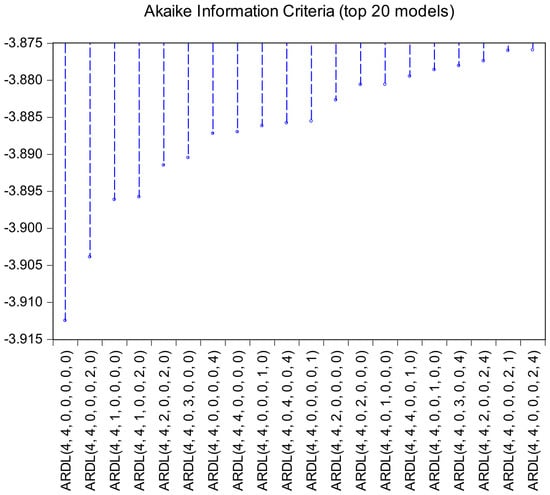
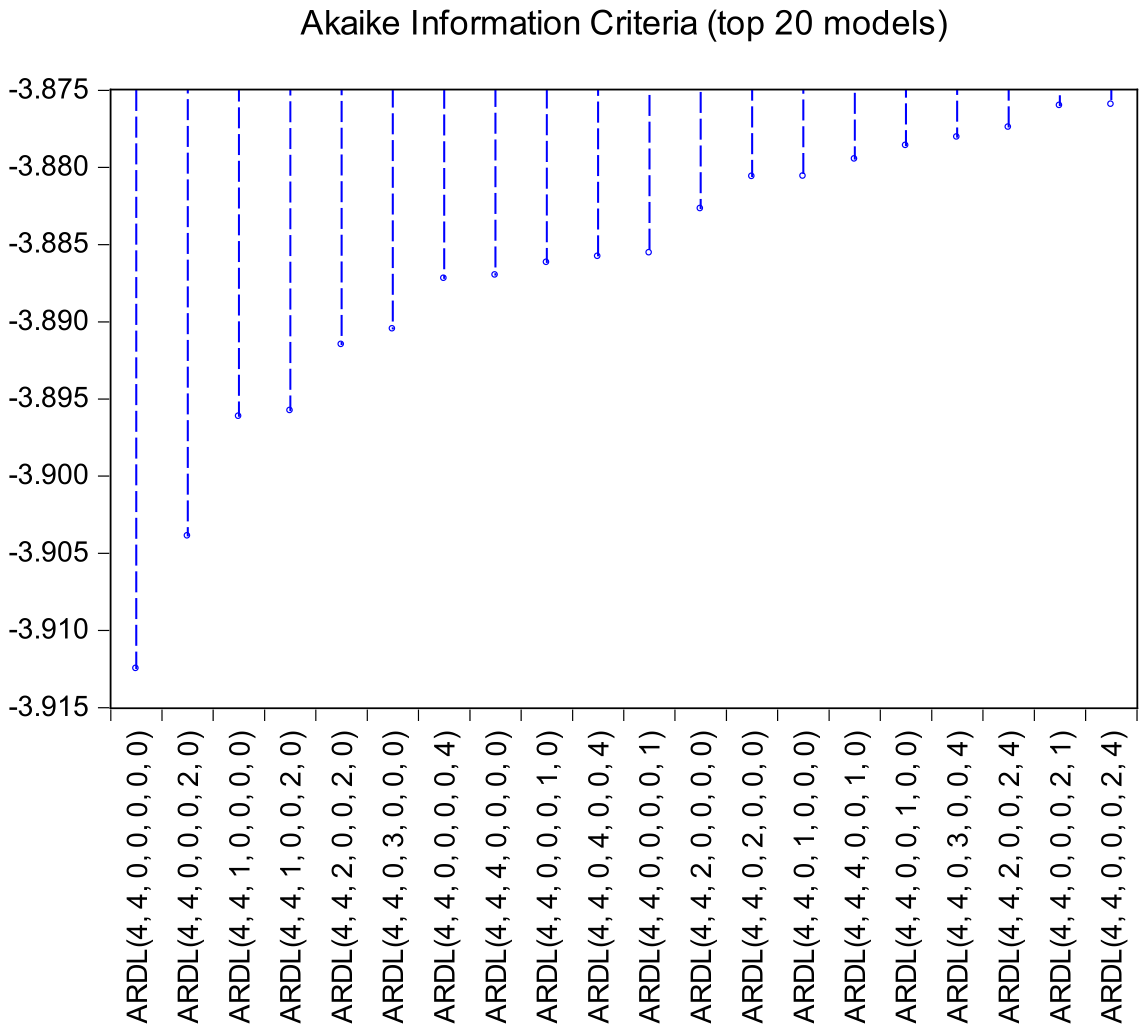
After incorporating structural breaks into the model, the Akaike Information Criterion (AIC) was used to determine the appropriate lag structure. As shown in Figure 1, the model with the lowest AIC value was selected as ARDL(4,4,0,0,0,0,0), and the analyses were conducted based on this specification.
Figure 1.
Selection of the ARDL Model.
The ARDL bounds test results used to evaluate the long-run relationship among the variables are presented in Table 6. The findings indicate that the computed F-statistic (7.401) exceeds the upper critical bounds (I(1)) at all significance levels. This result leads to the strong rejection of the null hypothesis of “no long-run relationship,” confirming the existence of a statistically significant cointegration relationship among the variables in the model. Accordingly, a long-run equilibrium relationship between economic growth and the explanatory variables, particularly SME loans, is validated, making the interpretation of long-run coefficients econometrically valid.
Table 6.
ARDL Bounds Test Results.
The long-run coefficient estimates (Table 7) suggest that growth dynamics in the Kazakh economy are primarily shaped through external demand and financial deepening channels. The positive and strong coefficient of exports (0.64) clearly reflects the externally dependent structure of growth, while the positive and statistically significant coefficient of SME loans (0.29) supports the main hypothesis of the study. This result indicates that SME financing contributes to economic growth; however, considering that the data represent end-of-period stock values, this effect is interpreted as reflecting the cumulative impact of financial expansion rather than direct credit flows. Although the real effective exchange rate is positive, it is not statistically significant, suggesting that the exchange rate channel may have a more limited or indirect effect on growth. The FDI variable exhibits a negative and weakly significant coefficient, implying that the impact of foreign direct investment on growth is not stable. Among the structural break dummies, only the 2019 period dummy is statistically significant, indicating a notable shift in growth dynamics during this period. Overall, the findings show that SME loans support economic growth in Kazakhstan, although this effect operates through a gradual and cumulative process by nature.
Table 7.
ARDL Long-Run Estimation Results.
The ARDL short-run estimation results (Table 8) indicate the presence of a strong adjustment mechanism in the model. The negative and statistically significant error correction term confirms convergence toward the long-run equilibrium. In the short run, economic growth exhibits a strong and significant response to its own lags, indicating a pronounced inertia in the growth process. Exports maintain a positive and significant effect in the short run, while the real effective exchange rate also plays a supportive role in growth. In contrast, the FDI variable shows a negative and weakly significant coefficient in the short run. The main variable of interest, SME loans, is positive but not statistically significant in the short run. This suggests that the impact of SME loans on economic growth does not generate an immediate short-term response, but rather remains limited in the short run, while becoming more pronounced and persistent over time when evaluated together with long-run results. This pattern is consistent with the delayed effects of SME financing on production, investment, and capacity expansion. Among the structural break variables, only the 2019 dummy is significant in the short run, indicating that period-specific effects also influenced short-term dynamics. Overall, the short-run results are consistent with the long-run findings and support the dynamic structure of the model.
Table 8.
ARDL Short-Run Estimation Results.
Post-estimation diagnostic tests (Table 9) indicate that the model is correctly specified. The Ramsey RESET test does not suggest any functional form misspecification, while the Breusch–Pagan–Godfrey and LM tests indicate the absence of heteroskedasticity and autocorrelation, respectively. In addition, the Jarque–Bera test shows that the residuals are normally distributed.
Table 9.
Post-estimation Results.
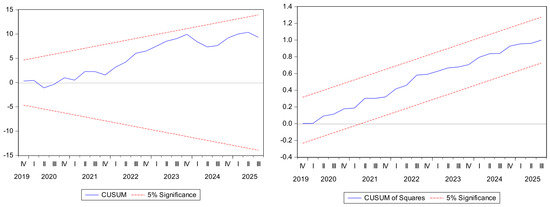
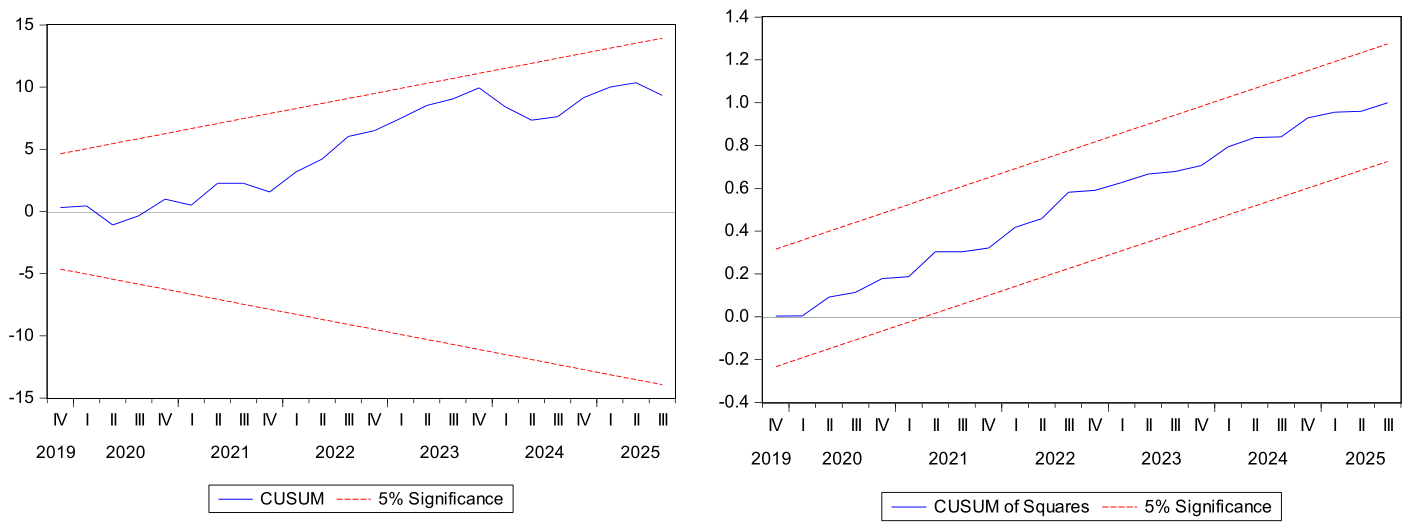
The CUSUM and CUSUMSQ test results used to assess model stability are presented in Figure 2. The plots show that the cumulative sums remain within the 5% significance boundaries in both tests. This indicates that the model coefficients are stable over the sample period and that there are no structural stability problems. Therefore, the estimated ARDL model parameters remain consistent over time, and the results can be considered reliable.
Figure 2.
CUSUM and CUSUMSQ Graphs.
To test the robustness of the long-run findings obtained from the ARDL estimations, the FMOLS method is employed as an alternative cointegration estimator. The FMOLS results are generally consistent with the ARDL findings (Table 10). In particular, the positive and strong coefficient of exports (0.56) confirms the relationship between growth and external demand dynamics, while the positive and statistically significant coefficient of SME loans (0.20) supports the main results. This finding confirms the positive relationship between SME financing and economic growth under an alternative estimation method. The real effective exchange rate is found to be positive and significant, while the FDI variable exhibits a negative and statistically significant coefficient. The significance of both structural break variables indicates that notable changes occurred in growth dynamics during these periods. Overall, the FMOLS results support the robustness of the ARDL findings and demonstrate that the long-run relationships are consistent across different methodologies.
Table 10.
FMOLS results.
5. Discussion
The empirical findings of this study provide robust evidence of a positive and statistically significant long-run relationship between SME loans and economic growth in Kazakhstan. This result is consistent with the supply-leading hypothesis (Schumpeter, 1912/1934; McKinnon, 1973; Shaw, 1973), yet the contribution of this study goes beyond confirming this conventional view by uncovering the underlying transmission mechanisms and context-specific dynamics through which SME finance affects growth in a transition economy.
From an economic standpoint, the long-run impact of SME loans can be explained through several mutually reinforcing channels. First, SMEs are typically more credit-constrained than large firms due to limited collateral, higher perceived risk, and informational asymmetries. As a result, an expansion in SME loans relaxes these constraints, enabling firms to increase investment in physical capital, adopt new technologies, and expand production capacity. Second, SME financing supports employment creation and income generation, given the labor-intensive nature of small and medium-sized enterprises. Third, access to finance improves firms’ ability to participate in supply chains and export markets, thereby enhancing productivity and competitiveness. These mechanisms collectively imply that SME loans do not merely increase liquidity in the economy, but rather translate financial resources into real economic activity over time, which explains the strong and positive long-run relationship observed in the results.
Importantly, the absence of a statistically significant short-run effect suggests that the finance–growth nexus operates through delayed and cumulative processes rather than immediate transmission. This finding is consistent with Lindgren (2015) and Juminawati et al. (2021), who emphasize that the effects of financial development materialize gradually as firms adjust their production structures, complete investment cycles, and realize productivity gains. In the context of Kazakhstan, where structural transformation and institutional development are still ongoing, such time lags are likely to be more pronounced. Therefore, the results highlight that SME loans should be interpreted as a long-term growth driver rather than a short-term stabilization tool, which also resolves the apparent tension between the study’s theoretical framework and empirical findings.
The strong and persistent impact of exports on economic growth further reflects the structural characteristics of the Kazakh economy, which is highly integrated into global commodity markets. Export revenues—largely driven by oil and natural resources—constitute a key engine of economic expansion. This has two important implications for interpreting the role of SME loans. On the one hand, favorable external conditions may amplify the effectiveness of SME financing, as increased demand stimulates production and credit utilization. On the other hand, the dependence on external demand introduces vulnerability, suggesting that the finance–growth relationship may be state-dependent and influenced by global economic cycles. This interpretation is consistent with Keffala and Krichen (2025), who argue that macroeconomic instability can weaken financial transmission mechanisms, particularly in commodity-dependent economies.
The results related to foreign direct investment (FDI), which indicate a weak and negative relationship with growth, provide additional insights into the structure of the Kazakh economy. Unlike SME loans, which are closely linked to domestic production and firm-level activity, FDI inflows in Kazakhstan are largely concentrated in capital-intensive extractive industries. These investments tend to generate limited spillover effects to the broader economy, particularly to SMEs, due to weak backward and forward linkages. Moreover, FDI is often driven by long-term strategic considerations and global commodity prices, making it less responsive to domestic economic conditions. This explains why FDI does not emerge as a stable or significant driver of growth in the empirical results, in line with the mixed evidence reported in the literature.
The findings for the real effective exchange rate (REER) suggest a context-dependent and indirect role in the growth process. The negative association between REER and key macroeconomic variables indicates that currency appreciation may reduce external competitiveness, thereby affecting exports and, indirectly, economic activity. However, the limited statistical significance of this relationship implies that the exchange rate channel operates alongside other dominant factors, such as commodity prices and financial conditions. This nuanced result aligns with Tazhibayeva and Syzdykova (2026), who emphasize the interaction between exchange rates, commodity dynamics, and SME performance.
Another important dimension of the analysis concerns structural breaks, particularly in 2014 and 2019. These periods correspond to major external shocks, including fluctuations in global oil prices and changes in international financial conditions. The significance of these breaks highlights the fragility and external sensitivity of the Kazakh economy, where both financial systems and credit dynamics are strongly influenced by global developments. This finding reinforces the argument that the effectiveness of SME loans as a growth driver is contingent upon the broader macroeconomic environment.
In addition to these macro-level insights, the results also have implications for the heterogeneity of SMEs. Although the empirical model does not explicitly differentiate between firm sizes within the SME category, economic theory suggests that the impact of finance may vary across micro, small, and medium-sized enterprises. Smaller firms are generally more financially constrained and thus may benefit more from increased credit availability, while medium-sized firms may be better positioned to translate financing into productivity gains and export expansion. Therefore, the aggregate positive effect identified in this study likely reflects a combination of differential responses across firm sizes, an issue that warrants further investigation in future research.
Overall, the findings confirm that SME loans play a meaningful role in supporting economic growth in Kazakhstan, but this relationship is neither uniform nor instantaneous. Instead, it is shaped by structural characteristics, external dependencies, and institutional factors specific to the economy. In this sense, the study supports Patrick’s (1966) framework of a dynamic and evolving finance–growth relationship, while also contributing to the literature by demonstrating that, in transition economies, the impact of SME finance is predominantly a long-run, context-dependent phenomenon.
6. Conclusions
This study investigates the relationship between SME loans and economic growth in Kazakhstan using quarterly data spanning the period 2010Q1–2025Q3. The empirical analysis provides robust evidence of a long-run equilibrium relationship among the variables. Both ARDL and FMOLS estimations consistently indicate that SME loans exert a positive and statistically significant impact on economic growth in the long run, while the short-run results remain statistically insignificant. These findings suggest that the contribution of SME financing to economic activity operates primarily through gradual accumulation and structural adjustment mechanisms rather than immediate effects.
These results are closely aligned with the theoretical framework and research expectations outlined in the earlier sections of the study. In particular, the findings support the view that financial development—through SME lending—enhances economic performance over time by relaxing credit constraints, enabling investment expansion, and fostering productive capacity. At the same time, the absence of short-run significance highlights the importance of temporal dynamics in the finance–growth nexus, reinforcing the argument that financial intermediation affects growth through persistent rather than instantaneous channels.
The conclusions also reflect the structural characteristics of the Kazakh economy. As a commodity-dependent economy, Kazakhstan’s growth trajectory is strongly influenced by external demand and global price fluctuations. This is consistent with the strong and significant role of exports identified in both the short and long run. In contrast, the relatively weak and negative impact of foreign direct investment suggests that FDI may not function as a stable and broad-based driver of growth, likely due to its sectoral concentration and sensitivity to external shocks. These findings further emphasize the importance of strengthening domestic financial channels—particularly SME financing—as a more sustainable and internally driven source of economic growth.
This study contributes to the literature in several important ways. First, it provides direct and dynamic empirical evidence on the SME credit–growth nexus in Kazakhstan, addressing a notable gap in country-specific research. Second, by focusing explicitly on the credit channel rather than aggregate financial indicators, the study offers a more precise understanding of how financial intermediation translates into real economic outcomes. Third, the incorporation of structural breaks enhances the robustness of the analysis by capturing shifts in economic conditions and policy environments. Overall, the findings extend the finance–growth literature by highlighting the long-run and structurally contingent nature of SME financing effects in emerging and resource-dependent economies.
From a policy perspective, the results underscore the strategic importance of SME financing in supporting sustainable economic growth. Policies aimed at improving access to finance, deepening credit markets, and enhancing the efficiency of financial intermediation should be prioritized. Moreover, given that SME loan data reflect stock values, the findings indicate that growth effects are associated with the accumulation and effective allocation of financial resources over time. Therefore, policy interventions should not only focus on increasing credit availability but also on ensuring that funds are directed toward productive and high-value-added activities. In addition, maintaining macroeconomic stability remains essential, particularly in an economy vulnerable to external shocks, as stability enhances the effectiveness of financial channels.
Despite its contributions, the study has several limitations. The analysis is limited to a single-country context, which may constrain the generalizability of the findings. Furthermore, the use of end-of-period SME loan data restricts the ability to capture short-run credit dynamics. The study also does not account for firm-level heterogeneity, such as differences in SME size, sectoral distribution, or credit access conditions, which may influence the observed relationships.
Future research could build on these findings by employing cross-country panel data to enhance external validity and provide comparative insights. The use of credit flow data would allow for a more refined analysis of short-run dynamics. Additionally, incorporating firm-level or sectoral data could help uncover heterogeneous effects across SME categories, particularly with respect to firm size. Finally, exploring emerging dimensions such as digital finance, FinTech applications, and public support mechanisms may provide further insight into the evolving role of SME financing in developing and transition economies.
In conclusion, this study demonstrates that SME loans play a significant and positive role in supporting economic growth in Kazakhstan, particularly over the long term. By explicitly linking empirical findings with theoretical expectations and situating the results within both the national economic structure and the broader literature, the study provides a more coherent and policy-relevant understanding of the SME finance–growth relationship.
Author Contributions
Conceptualization, G.A. and A.S.; Methodology, A.S.; Software, P.B.; Validation, G.A. and A.S.; Formal analysis, P.B.; Investigation, G.A.; Resources, P.B.; Data curation, G.A.; Writing—original draft, G.A. and A.S.; Writing—review & editing, A.S.; Visualization, P.B.; Supervision, P.B.; Project administration, G.A. and A.S.; Funding acquisition, G.A. All authors have read and agreed to the published version of the manuscript.
Funding
This research received no external funding.
Institutional Review Board Statement
Not applicable.
Informed Consent Statement
Not applicable.
Data Availability Statement
All data used in this study are obtained from publicly available sources. Specifically, the data are sourced from the [Bureau of National Statistics of Kazakhstan] (https://stat.gov.kz/en/) and the [National Bank of Kazakhstan] (https://nationalbank.kz/kz). These institutions provide official statistical and financial data for the Republic of Kazakhstan, which are publicly accessible and can be directly retrieved by researchers without restriction. Therefore, the dataset used in this study can be fully replicated using the same sources. All data were downloaded on 13 April 2026.
Conflicts of Interest
The authors declare no conflicts of interest.
References
- Abdelgany, M. F., Ahmed, D. S., & Nabi, A. M. A. (2024). SMEs facilitating financing and its effects on Egyptian economic growth. International Journal of Economics, Finance and Management Sciences, 12(6), 501–514. [Google Scholar] [CrossRef] [Scilit]
- Abu, N., da Silva, F. P., & Vieira, P. R. (2025). Government support for SMEs in the Fintech era: Enhancing access to finance, survival, and performance. Digital Business, 5(1), 100099. [Google Scholar] [CrossRef] [Scilit]
- Alese, J., & Alimi, O. Y. (2014). Small and medium-scale enterprises financing and economic growth in Nigeria: Error correction mechanism. European Journal of Globalization and Development Research, 11(1), 639–652. [Google Scholar]
- Amoah, J., Belas, J., Dziwornu, R., & Khan, K. A. (2022). Enhancing SME contribution to economic development: A perspective from an emerging economy. Journal of International Studies, 15(2), 63–76. [Google Scholar] [CrossRef] [Scilit]
- Ardıç, O. P., Mylenko, N., & Saltane, V. (2011). Small and medium enterprises: A cross-country analysis (Policy Research Working Paper 5538). World Bank. Available online: https://www.cgap.org/sites/default/files/researches/documents/CGAP-Small-and-Medium-Enterprises-Jan-2011.pdf (accessed on 1 April 2026).
- Bai, J., & Perron, P. (2003). Computation and analysis of multiple structural change models. Journal of Applied Econometrics, 18(1), 1–22. [Google Scholar]
- Batrancea, L. M. (2022). Determinants of economic growth across the European Union: A panel data analysis on small and medium enterprises. Sustainability, 14(8), 4797. [Google Scholar] [CrossRef] [Scilit]
- Batrancea, L. M., Balci, M. A., Chermezan, L., Akgüller, Ö., Masca, E. S., & Gaban, L. (2022). Sources of SMEs financing and their impact on economic growth across the European Union: Insights from a panel data study spanning sixteen years. Sustainability, 14(22), 15318. [Google Scholar] [CrossRef] [Scilit]
- Bika, Z., Subalova, M., & Locke, C. (2022). Microfinance and small business development in a transitional economy: Insights from Kazakhstan. The Journal of Development Studies, 58(1), 183–203. [Google Scholar]
- Brault, J., & Signore, S. (2019). The real effects of EU loan guarantee schemes for SMEs: A pan-European assessment (EIF Working Paper, No. 2019/56). European Investment Fund (EIF). Available online: https://www.econstor.eu/handle/10419/200212 (accessed on 1 April 2026).
- Bu, Y., Du, X., Wang, Y., Liu, S., Tang, M., & Li, H. (2024). Digital inclusive finance: A lever for SME financing? International Review of Financial Analysis, 93, 103115. [Google Scholar] [CrossRef] [Scilit]
- Chowdhury, D., Al-Alawi, A. N., Syzdykova, A., & Abubakirova, A. (2021). Attractiveness and difficulties of SMEs in Kazakhstan economy. Review of Applied Socio-Economic Research, 21(1), 89–98. [Google Scholar]
- Crawford, J., Cui, Z. Y. A., & Kewley, D. (2024). Government finance, loans, and guarantees for SMEs (2000–2021): A systematic review. Journal of Small Business Management, 62(5), 2607–2637. [Google Scholar]
- Dosmagambet, Y., Oskenbayev, Y., Taghizadeh-Hesary, F., & Mukan, M. (2018). Financial system and SME financing in Kazakhstan (ADBI Working Paper Series). Asian Development Bank Institute (ADBI). Available online: https://www.econstor.eu/handle/10419/222671 (accessed on 1 April 2026).
- Emmanuel, I. J., & Willie, E. E. (2021). Small and medium scale enterprises and economic growth in Nigeria. IAR Journal of Business Management, 2(1), 38–43. [Google Scholar] [CrossRef] [Scilit]
- Greenwood, J., & Jovanovic, B. (1990). Financial development, growth, and the distribution of income. Journal of Political Economy, 98(5), 1076–1107. [Google Scholar] [CrossRef] [Scilit]
- Gurley, J. G., & Shaw, E. S. (1967). Financial structure and economic development. Economic Development and Cultural Change, 15(3), 257–268. [Google Scholar] [CrossRef] [Scilit] [PubMed]
- Jenkins, H., & Hussain, M. (2014). An analysis of the macroeconomic conditions required for SME lending: The case of Turkey (Development Discussion Paper, 6). CRI-World. Available online: https://www.cri-world.com/publications/qed_dp_261.pdf (accessed on 1 April 2026).
- Juminawati, S., Hamid, A., Amalia, E., Mufraini, M. A., & Mulazid, A. S. (2021). The effect of MSMEs on economic growth. BIRCI Journal, 4(3), 5697–5704. [Google Scholar]
- Kazbekova, D., Petrova, M., Sushchenko, O., Belgibayeva, A., & Mitkov, M. (2024). Mechanisms of stimulation of small- and medium-sized entrepreneurship: The experience of Kazakhstan. Journal of Risk and Financial Management, 17(7), 257. [Google Scholar] [CrossRef] [Scilit]
- Keffala, M. R., & Krichen, A. (2025). Comparative analysis of SME financing impact on economic growth: Evidence from developed and developing economies. Review of Development Economics, 30, 1583–1599. [Google Scholar] [CrossRef] [Scilit]
- King, R. G., & Levine, R. (1993). Finance and growth: Schumpeter might be right. The Quarterly Journal of Economics, 108(3), 717–737. [Google Scholar] [CrossRef] [Scilit]
- Lee, K. J. (2021). Introduction of entrepreneurship development fund for startups and SMEs: Case of Kazakhstan. In Investment in startups and small business financing (pp. 233–261). World Scientific. [Google Scholar]
- Lindgren, E. (2015). Access to finance: SMEs effect on economic growth. Available online: https://lup.lub.lu.se/student-papers/search/publication/5473509 (accessed on 1 April 2026).
- Liu, Y., Dilanchiev, A., Xu, K., & Hajiyeva, A. M. (2022). Financing SMEs and business development as post COVID-19 recovery determinants. Economic Analysis and Policy, 76, 554–567. [Google Scholar] [CrossRef] [Scilit]
- McKinnon, R. I. (1973). Money and capital in economic development. The Brookings Institution. [Google Scholar]
- Muliadi, M., Darma, D. C., & Kasuma, J. (2020). MSMEs as mediation in the effects of investment credit, interest rates, and labor on economic growth. International Journal of Finance & Banking Studies, 9(2), 1–12. [Google Scholar] [CrossRef] [Scilit]
- Olowookere, J. K., Hassan, C. O., Adewole, A. O., & Aderemi, T. A. (2021). SMEs financing and sustainable economic growth in Nigeria. The Journal of Accounting and Management, 11(1). Available online: https://dj.univ-danubius.ro/index.php/JAM/article/view/855 (accessed on 1 April 2026). [CrossRef] [Scilit]
- Oluremi, D. O., & Maku, O. A. (2024). SMEs and Nigerian economic growth. International Journal of Small Business and Entrepreneurship Research, 12(5), 71–89. [Google Scholar] [CrossRef] [Scilit]
- Omowole, B. M., Olufemi-Phillips, A. Q., Ofodile, O. C., Eyo-Udo, N. L., & Ewim, S. E. (2024). The role of SMEs in promoting urban economic development. International Journal of Engineering Research and Development, 20(11), 1127–1144. [Google Scholar]
- Özgün, F. (2024). Toda-Yamamoto causality test between SMEs loans and economic growth: Evidence from Turkiye. Yönetim ve Ekonomi Araştırmaları Dergisi, 22(1), 24–44. [Google Scholar] [CrossRef] [Scilit]
- Pagano, M. (1993). Financial markets and growth. European Economic Review, 37(2–3), 613–622. [Google Scholar] [CrossRef] [Scilit]
- Patrick, H. (1966). Financial development and economic growth in underdeveloped countries. Economic Development and Cultural Change, 14(2), 174–189. [Google Scholar] [CrossRef] [Scilit] [PubMed]
- Robinson, J. (1952). The rate of interest and other essays. Macmillan. [Google Scholar]
- Sanga, B., & Aziakpono, M. (2023). FinTech and SMEs financing: A systematic literature review. Digital Business, 3(2), 100067. [Google Scholar] [CrossRef] [Scilit]
- Sari, S. (2023). The relationship between SME’s loans and growth in Turkey (2007–2021). İzmir İktisat Dergisi, 38(2), 358–374. [Google Scholar]
- Schumpeter, J. A. (1912/1934). Theorie der wirtschaftlichen Entwicklung. Duncker & Humblot. (English translation published in 1934 as The Theory of Economic Development. Harvard University Press). [Google Scholar]
- Seisenbayeva, A., Gumar, N., Sherimova, N., Pernebekkyzy, N., & Dzhakisheva, U. (2025). Assessment of SME loan portfolio quality in Kazakhstan. Eurasian Journal of Economic and Business Studies, 69(3), 66–80. [Google Scholar] [CrossRef] [Scilit]
- Shaw, E. S. (1973). Financial deepening in economic development. Oxford University Press. [Google Scholar]
- Sohrabi, R., & Mirali, F. (2025). A systematic review of financing small and medium-sized enterprises (SMEs) by banks: Global experience. Economics and Financial Policymaking, 2(1), 29–45. [Google Scholar] [CrossRef] [Scilit]
- Syzdykova, A., & Azretbergenova, G. (2025). Impact of SME output on Kazakhstan’s economic growth. Economies, 13(2), 38. [Google Scholar] [CrossRef] [Scilit]
- Tazhibayeva, R., & Syzdykova, A. (2026). The impact of the exchange rate and oil prices on SME manufacturing output in Kazakhstan. Economies, 14(5), 149. [Google Scholar] [CrossRef] [Scilit]
- Watambwa, L., & Shilongo, D. (2021). Impact of SME financing on economic growth in Zimbabwe (SSRN Working Paper). SSRN. [Google Scholar]
- Zarubina, V., Zarubin, M., Yessenkulova, Z., Gumarova, T., Daulbayeva, A., Meimankulova, Z., & Kurmangalieva, A. (2024). Sustainable development of small business in Kazakhstan. Economies, 12(9), 247. [Google Scholar] [CrossRef] [Scilit]

Disclaimer/Publisher’s Note: The statements, opinions and data contained in all publications are solely those of the individual author(s) and contributor(s) and not of MDPI and/or the editor(s). MDPI and/or the editor(s) disclaim responsibility for any injury to people or property resulting from any ideas, methods, instructions or products referred to in the content. |
© 2026 by the authors. Licensee MDPI, Basel, Switzerland. This article is an open access article distributed under the terms and conditions of the Creative Commons Attribution (CC BY) license.