


Abstract
This study investigates the impact of oil prices and exchange rates on the manufacturing output of small and medium-sized enterprises (SMEs) in Kazakhstan using data from the period 2000 to 2023, within the framework of the ARDL model. In the Kazakhstani economy, approximately 60% of SMEs operate in the wholesale and retail trade sectors, a factor that has been taken into consideration in interpreting the effects of macroeconomic variables on SME output. The results of the long-run analysis reveal that the exchange rate has a significant and strong positive effect on SME manufacturing output. Although oil prices do not directly exert a statistically significant influence on production output, the study identifies an indirect effect of oil revenues on SME output via the exchange rate channel. In the short-run findings, both exchange rates and oil prices are found to have significant effects on production output; in particular, oil prices exhibit a positive impact in the short term, which partially reverses in subsequent periods. The error correction term indicates a rapid adjustment back to equilibrium in the long run. These results highlight the high sensitivity of SME production performance in Kazakhstan to exchange rate fluctuations and underscore the indirect influence of oil prices through exchange rate movements. The study recommends enhancing the financial resilience of SMEs, minimizing exchange rate risks, and closely monitoring changes in energy prices. Furthermore, it suggests the development of policies aimed at promoting SMEs’ involvement in foreign currency-generating activities, as well as protecting enterprises in the wholesale and retail sectors against price volatility. In this context, the study makes a valuable contribution by providing a comprehensive evaluation of the effects of macroeconomic variables on SME manufacturing output.
1. Introduction
Small and medium-sized enterprises (SMEs) play a fundamental role in fostering economic growth, job creation, and innovation. In developing countries such as Kazakhstan, SMEs not only contribute to economic diversification but also serve a critical function in balancing the economy’s reliance on the energy sector. However, Kazakhstan’s economy, being heavily dependent on oil exports, is inevitably affected by fluctuations in global energy markets and changes in exchange rates. In particular, volatility in the US dollar exchange rate and fluctuations in oil prices exert both direct and indirect effects on the production output of SMEs.
The international literature has extensively examined the vulnerability of SMEs to economic shocks. Smallbone et al. (2012) examine how small and medium-sized enterprises (SMEs) in the UK were affected by the 2008–2009 global financial crisis. Their findings show that while many SMEs faced declines in sales, profits, and credit access, the effects varied significantly across sectors. Some firms relied on cost-cutting and efficiency measures to survive, whereas others adapted through innovation, diversification, and new market development. The authors highlight that resilience depends less on firm size and more on entrepreneurial flexibility, innovation capacity, and access to external support, emphasizing the importance of strengthening SMEs’ adaptive capabilities for future crises. Miklian and Hoelscher (2022) provide a conceptual review of the literature on how small and medium-sized enterprises (SMEs) respond to exogenous shocks such as economic crises, natural disasters, and pandemics. The study synthesizes existing research to identify the main mechanisms shaping SME vulnerability and resilience, including financial capacity, supply chain dependence, leadership behavior, and institutional support. It argues that while SMEs are often portrayed as fragile due to limited resources, many demonstrate adaptive resilience through innovation, social capital, and rapid decision-making. The review emphasizes the need for a multidimensional understanding of resilience that includes economic, social, and institutional factors, offering a framework to guide future empirical studies and policy design. Halim et al. (2017) analyze how inflation, interest rates, and unemployment affect SME performance in Malaysia. The results show that high interest and unemployment rates negatively impact SMEs, while inflation has a minor effect. The authors emphasize that macroeconomic stability and low borrowing costs are essential for SME growth. Udoh et al. (2024) investigate how macroeconomic variables influence SME performance and financing decisions in Nigeria. Using recent panel data, they find that inflation and high interest rates negatively affect SME growth, while exchange rate stability and access to finance support performance. The study concludes that sound monetary policy and improved financial inclusion are key to enhancing SMEs’ sustainability and contribution to economic development. Despite these contributions, there remains a lack of empirical research specifically addressing the combined impact of these two critical variables—exchange rates and oil prices—on SME manufacturing output in the context of Kazakhstan.
SMEs in Kazakhstan exhibit a heterogeneous structure, spanning sectors such as agriculture, oil and gas, automotive, and manufacturing. Their activities range from artisans producing agricultural tools for local markets, to coffee shops in small towns, internet cafés in city centers, and small-scale engineering or software firms serving global markets. The influence of SMEs clearly extends from rural to international domains. At the same time, Kazakhstan’s economy is highly dependent on oil prices, which underscores the importance of analyzing the effects of exchange rate fluctuations and oil price movements on the growth and productivity of SMEs in the country.
Despite the growing body of literature on SMEs and macroeconomic variables, there remains a limited number of studies that jointly examine the effects of oil prices and exchange rates on SME production output, particularly in oil-exporting developing economies. In the case of Kazakhstan, existing research has largely focused on macroeconomic indicators, financial systems, or overall economic growth, with relatively little attention given to the SME sector. Therefore, this study aims to fill this gap by providing empirical evidence on the combined impact of oil prices and exchange rates on SME production output in Kazakhstan.
This study seeks to address the following research questions:
- i.
- What is the relationship between oil prices and SME production output in Kazakhstan?
- ii.
- To what extent is the USD/KZT exchange rate associated with SME production output in Kazakhstan?
The study tests the following null hypotheses:
H1.
Oil prices have no statistically significant relationship with SME production output in Kazakhstan.
H2.
The exchange rate (USD/KZT) has no statistically significant relationship with SME production output in Kazakhstan.
The main aim of this study is to examine the short- and long-run relationships between oil prices, exchange rates, and SME production output in Kazakhstan using the ARDL approach, thereby providing empirical evidence on how key macroeconomic variables are associated with SME performance in an oil-dependent developing economy.
The findings indicate that the exchange rate has a strong and statistically significant association with SME production output in both the short and long run. In contrast, oil prices do not exhibit a statistically significant long-run relationship with SME output, although short-run dynamics are observed. The results further suggest that oil prices are indirectly associated with SME production through the exchange rate channel, highlighting the importance of exchange rate dynamics in shaping SME performance in Kazakhstan.
By addressing this relationship, the study contributes to the existing literature and provides insights for policymakers in developing strategies to mitigate the economic vulnerabilities of SMEs.
2. Literature Review
Building on the above discussion, the following section reviews the existing literature on oil prices, exchange rates, and SMEs. The relationship between the SME sector, oil prices, and exchange rates is multifaceted and varies depending on the region and economic context. In some cases, rising oil prices stimulate SME growth by boosting overall economic activity and investment; however, in other instances, they may lead to adverse outcomes such as increased operating costs and market instability. In Alberta, higher crude oil prices have been associated with an increase in the number of small businesses, supporting the natural resource hypothesis (U-Din & Sadiq, 2022). Nigeria’s content development legislation has opened pathways for SMEs in the oil and gas sector, potentially enhancing their contributions to GDP and employment (Aigboduwa & Oisamoje, 2013). In developing markets, oil price increases often lead to currency appreciation, which can benefit SMEs by reducing import costs (Turhan et al., 2013). Conversely, a study examining the negative effects of oil prices on SMEs found that in Nigeria, high oil prices increased transportation costs and triggered industrial actions that disrupted commercial activities, adversely impacting SMEs (Tende & Obumneke, 2014). Omolade and Ngalawa (2018) noted that oil price volatility in Nigeria caused inflationary pressures that negatively affected the manufacturing sector and, by extension, SMEs. Regarding volatility challenges, fluctuations in oil prices can create uncertainty, affecting profitability and investment decisions of micro-enterprises in regions such as Guimaras (Moralista & Martir, 2023).
Oladunni (2020) emphasizes that oil price shocks can adversely affect the non-tradable output sector and lead to a decline in SME sector performance. This decline underscores the need for a robust non-oil sector to mitigate exposure to oil price volatility. In their study, Moralista and Martir (2023) identified a moderately negative correlation between oil prices and the profitability of micro-enterprises within the SME sector, demonstrating that rising oil prices tend to reduce profitability, particularly impacting energy-intensive industries such as manufacturing and transportation.
Sanjo and Ibrahim (2017) found that the exchange rate significantly and negatively impacts the growth of SMEs in Nigeria, with lower exchange rates correlating with increased SME growth. They emphasize the importance of exchange rate stability in enhancing trade activities and competitiveness. In contrast, Lawal and Akanbi (2020) reported a positive but statistically insignificant long-term effect of the exchange rate on the performance of SMEs in Nigeria, indicating that exchange rate fluctuations do not substantially contribute to SME performance over time. Belghitar et al. (2016) highlighted that volatile exchange rates adversely affect the competitive environment for UK SMEs, causing reductions in stock returns during both appreciations and depreciations, with notable differences in exposure compared to larger firms. Ercan (2019) demonstrated that the SME sector in Turkey is significantly affected by high exchange rate volatility, leading to declines in commercial activities, sales reductions, and increased business interruptions, underscoring the vulnerability of business owners to adverse exchange rate movements regardless of their age. Simakova and Prazak (2024) emphasized that exchange rate effects on SMEs in the manufacturing sectors of Romania and Hungary may lead to opposing impacts on asset returns (ROA), contrary to macroeconomic expectations. Eklou (2023) found that volatility in the US dollar exchange rate negatively affects firm productivity, particularly among SMEs with low liquidity and high leverage. Young firms, often facing financial constraints, are especially vulnerable to these fluctuations, highlighting the critical role of financial frictions.
The SME sector is significantly affected by exchange rate fluctuations, as these changes impact international investment costs and corporate profits. Effective management of exchange rate exposure through financial practices is crucial for SMEs to mitigate risks associated with globalization (Bishev & Boskov, 2016). Since exchange rate volatility can influence profitability, SMEs face considerable exchange rate risks during internationalization. Managing these risks differs from large firms, focusing on both operational and financial hedging strategies to reduce risks and enhance market entry success (Badshah & Borgersen, 2020). Ma and Shen (2004) emphasize that exchange rate risk substantially affects the management of small and medium-sized enterprises (SMEs). They highlight the importance of adopting supply chain risk management tactics to mitigate this risk and improve the stability and efficiency of SMEs’ supply chains.
The SME sector is also notably impacted by exchange rate fluctuations because currency devaluation increases import costs, drives inflation, and reduces purchasing power, thereby creating financial challenges in securing financing and effectively managing operational costs for entrepreneurs (Ahmad et al., 2024). Local currencies have been proposed as a risk management tool to mitigate these risks and enhance the stability and welfare of SMEs (Bácsi & Herczeg, 2014). Lee (2019) investigates the impact of exchange rate risk insurance on SME exports in Korea, emphasizing that exchange rate volatility significantly affects export performance. The study provides empirical evidence supporting the promotion of such insurance as a means for SMEs to reduce these risks. Dang (2015) explores how exporting SMEs manage exchange rate risk, highlighting that their strategies are influenced by determinants such as the degree of internationalization, forex exposure, perceived forex risk, and the availability of critical resources within the SME sector.
When examining studies specific to Kazakhstan, Nurmakhanova (2020) highlights the country’s dependence on oil revenues, emphasizing that fluctuations in oil prices significantly impact the economy. This relationship affects the real exchange rate due to changes in local price levels, which in turn can influence the performance of the SME sector. Dosmagambet et al. (2019) provide empirical analysis using a structural VAR methodology, demonstrating that the credibility of the entire financial system in Kazakhstan is dependent on oil prices. Moreover, oil price volatility influences changes in the currency value, thereby affecting the financial conditions of SMEs. Zamanbekov et al. (2020) focus on the need for diversification and innovation, stressing their importance for SME development and their role in the economy.
For Nigeria, one of the developing oil-exporting countries similar to Kazakhstan, numerous studies have been conducted on this issue. Research on the performance of small and medium-sized enterprises (SMEs) in Nigeria demonstrates the decisive role of exchange rate volatility and macroeconomic instability in shaping sectoral growth. Udo et al. (2026) show that exchange rate devaluation and tight monetary policies exert adverse effects on SMEs’ cost structures, profitability, and investment capacity, and that the combined impact of these shocks undermines firms’ operational and strategic decision-making, thereby threatening their sustainability. Similarly, Alugbuo et al. (2023) and Sulaiman and Abubakar (2024) emphasize that SMEs dependent on imported inputs are more vulnerable to exchange rate fluctuations, leading to increased costs, deteriorating price stability, and constraints on long-term planning and investment decisions. Studies by Monday et al. (2017) and Obiukwu and Adurogboye (2025) further indicate that exchange rate depreciation and instability predominantly exert negative effects on SME performance, while theoretical advantages remain largely unexploited due to limited export capacity and structural vulnerabilities. Moreover, the interaction between oil and exchange rates plays a critical role in SME performance. Omolade and Ngalawa (2018) and Tende and Obumneke (2014) demonstrate that fluctuations in oil prices and sectoral dependence generate macroeconomic instability, thereby constraining the production, investment, and growth capacity of SMEs operating in the manufacturing sector. These studies also suggest that effective management of oil revenues can indirectly support SMEs through improvements in infrastructure and access to finance. Eromosele (2025) highlights that currency devaluation produces adverse effects—particularly for SMEs with limited export capacity—through rising costs and declining productivity, and underscores the importance of localized production and enhanced financial resilience.
Chinelo et al. (2025) analyze the impact of exchange rate fluctuations on SME sustainability in a developing economy. The authors demonstrate that small firms with import-dependent input structures face rising costs, shrinking profit margins, and financial planning difficulties under exchange rate volatility. Empirical findings indicate that exchange rate instability has a statistically significant and negative effect on SME performance; however, firms capable of managing exchange rate risk, increasing the use of local resources, and maintaining financial flexibility exhibit greater resilience. Consequently, the authors emphasize the necessity of ensuring macroeconomic stability, developing financial instruments to hedge against exchange rate risk, and strengthening firms’ strategic adaptability to support SME sustainability.
Simakova and Prazak (2024) examine the impact of exchange rate movements on the international trade performance of manufacturing SMEs in Central and Eastern European (CEE) countries. Their empirical analysis focuses on the effects of the real effective exchange rate and exchange rate volatility on exports and imports, revealing that SMEs are more sensitive to exchange rate fluctuations than large firms. The findings indicate that currency depreciation may stimulate exports in the short run; however, high exchange rate volatility creates uncertainty and constrains trade volumes. Furthermore, SMEs with limited access to financial instruments face difficulties in managing exchange rate risk, adversely affecting their external trade performance. Overall, the study highlights that ensuring exchange rate stability and improving SMEs’ access to hedging mechanisms are critical for enhancing their international competitiveness.
Finally, U-Din and Sadiq (2022) analyze the effects of changes in crude oil prices on small businesses (SMEs) in the Alberta province of Canada. The study evaluates the impact of oil price shocks on SME performance by accounting for sectoral differences, particularly comparing energy-related sectors with non-energy sectors. The findings reveal that increases in oil prices can generate positive effects for SMEs integrated into or indirectly linked with the energy sector through higher revenues and demand, whereas firms operating in non-energy sectors may experience negative outcomes due to cost pressures and declining demand. Additionally, oil price volatility is found to increase overall uncertainty, thereby negatively affecting investment decisions. In conclusion, the study underscores that oil prices present both opportunities and risks for SMEs, and that effective policy design and sectoral diversification strategies play a critical role in balancing these effects.
In conclusion, although oil prices and exchange rates are critically important for SMEs, their effects are often mediated by local economic conditions and structural factors, suggesting the need for context-specific policy responses. The existing literature also indicates that SMEs in developing and resource-dependent economies are highly sensitive to exchange rate volatility and oil price fluctuations. However, despite this growing body of evidence, there remains a limited number of studies that jointly examine these relationships in the context of Kazakhstan. Therefore, this study aims to fill this gap by providing empirical evidence on the combined impact of oil prices and exchange rates on SME production output.
3. The SME Sector in Kazakhstan: Oil Dependence and Exchange Rate Dynamics
The economy of Kazakhstan is predominantly based on the export of oil and natural gas. The country’s economic performance is highly sensitive to fluctuations in oil prices and exchange rate movements. This vulnerability significantly affects the operations and sustainability of small and medium-sized enterprises (SMEs), in particular.
Although SMEs constitute an important component of Kazakhstan’s economy, their activities are largely oriented toward local markets. However, due to the economy’s dependence on the oil sector, depreciation of the national currency—the tenge (KZT)—leads to increased import-dependent input costs and poses challenges for working capital management. Exchange rate volatility adversely impacts SMEs’ financial planning and investment decisions, thereby heightening uncertainty and risk within the sector.
Moreover, fluctuations in public spending driven by oil revenues threaten SMEs’ access to government support programs and the continuity of these initiatives. This situation restricts the growth potential of SMEs and poses a barrier to economic diversification. Therefore, in order to support the development of the SME sector within the Kazakhstani economy, it is imperative to implement policy measures aimed at reducing dependence on oil, ensuring exchange rate stability, and diversifying financial instruments.
The Government of Kazakhstan is committed to pursuing sustainable and balanced economic development by continuing to promote industrial diversification, with a particular focus on diversifying and expanding the SME sector. Small and medium-sized enterprises (SMEs) constitute the backbone of any economy and, as empirical evidence suggests, account for a substantial share of GDP in developed countries. For instance, in OECD countries, the contribution of SMEs to GDP ranges between 50–60%, while the proportion of the labor force employed by SMEs reaches up to 60% of total employment. In the economy of the Republic of Kazakhstan, the share of SMEs in GDP was 28.4% in 2018, increased to 32.8% in 2020, and reached 36.7% in 2023 (Table 1). According to the “Kazakhstan 2050 Strategy,” the goal is to raise the share of SMEs in GDP to 50% (Syzdykova & Azretbergenova, 2025).
Table 1.
Small and Medium-Sized Enterprises in Kazakhstan.
Small and medium-sized enterprises (SMEs) are characterized by high adaptability and the ability to swiftly respond to changing market conditions. SMEs tend to occupy in-demand market niches, thereby contributing to the structural transformation of the economy, increasing the production of goods and services that are in demand, rapidly implementing innovative ideas, and addressing employment challenges in areas where large-scale enterprises are less effective. The SME sector in Kazakhstan is significantly affected by the country’s heavy reliance on oil revenues and the volatility of the exchange rate (Syzdykova & Azretbergenova, 2024). This dependency creates vulnerabilities for SMEs that may lead to economic instability—particularly during periods of fluctuating oil prices—and negatively influence the overall business environment (Syzdykova & Azretbergenova, 2025; Syzdykova et al., 2021).
Kazakhstan’s economy is heavily dependent on oil, with approximately 50% of budget revenues derived from this sector. Fluctuations in oil prices directly impact fiscal stability and contribute to currency depreciation; for instance, the tenge lost 20% of its value in 2014 due to falling oil prices (Azretbergenova & Syzdykova, 2020). The dominance of the oil sector constrains the growth potential of SMEs, which struggle to innovate and diversify within a resource-dependent economic framework (Zarubina et al., 2024).
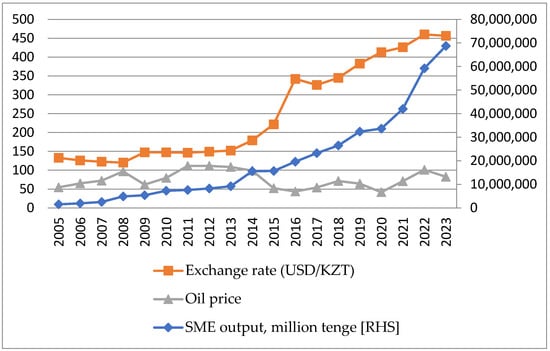
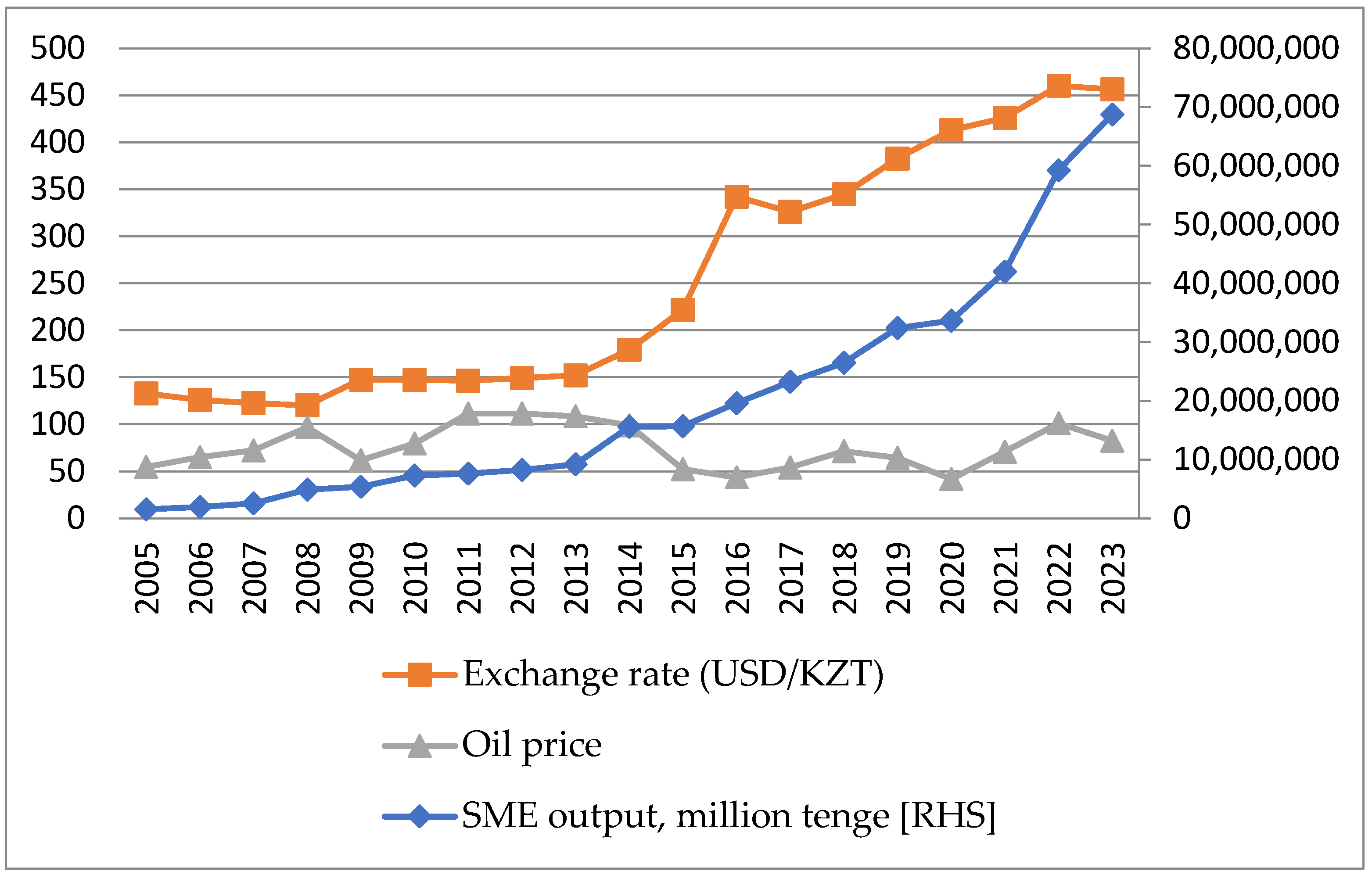
The real exchange rate is significantly influenced by oil price shocks, which can indirectly affect GDP growth and SME performance (Nurmakhanova & Kretzschmar, 2011; Nurmakhanova, 2020). SMEs face challenges in their pricing strategies due to exchange rate volatility, complicating their operations in both domestic and international markets. The absence of a stable economic environment hinders the development capacity of SMEs, which often lack the resources to swiftly adapt to rapid changes. Conversely, while the oil sector poses significant challenges, it also presents opportunities for SMEs—particularly in non-oil sectors—to innovate and develop new products. This transition is essential for fostering a more resilient economy capable of withstanding external shocks and promoting sustainable growth. The graph below illustrates the changes in SME production output, exchange rates, and oil prices in Kazakhstan over the period 2005–2023 (Figure 1). During this time, SME production output showed a consistent and rapid upward trend: while production output stood at approximately 1.5 million units in 2005, it reached 68.7 million units by 2023. This growth trend indicates an expansion in both the production capacity and operational scale of SMEs, in parallel with the overall growth of the Kazakhstani economy.
Figure 1.
SME Output, Exchange Rate, and Oil Prices in Kazakhstan (2005–2023).
Exchange rate data reveal a significant rise, particularly after 2014. In 2014, the USD/KZT exchange rate was 179.19, rising to 342.16 in 2016, indicating a substantial devaluation of the national currency. This depreciation may have both positive and negative effects on SME production: while higher import-dependent input costs can hinder production, increased foreign currency revenues or improved competitiveness of local production may support SME growth. The surge in exchange rates during the 2015–2016 period coincided with a sharp increase in SME production output, suggesting that domestic production gained a relative advantage over imports.
Oil prices, on the other hand, have experienced fluctuations, with relatively high levels observed during 2008 and the 2011–2013 period. Given that oil prices have a direct impact on oil-exporting countries like Kazakhstan, price increases may positively affect the financing and demand conditions for SMEs. Although oil prices declined after 2014—dropping to as low as $52.32 per barrel—the overall SME production output continued to rise after 2015. This suggests that SMEs possess growth potential in non-oil sectors, and that exchange rate increases may have contributed to the support of local production.
In summary, the dynamics between SME production output, exchange rates, and oil prices in Kazakhstan indicate that exchange rate appreciation has been a key driver of SME growth, whereas the effects of oil price fluctuations appear to be more complex and multifaceted.
4. Data and Econometric Methodology
The study analyzes Kazakhstan’s SME production output, oil prices, and exchange rates using time series data. This study employs annual time-series data from 2000 to 2023. Due to data availability limitations, particularly in Kazakhstan (as a developing country), and especially regarding SMEs, the analyses are confined to this specific sample period. The explanatory variables include oil price (OP) and exchange rate (ER). Annual data were obtained from various sources, including the National Bank of Kazakhstan and the Bureau of National Statistics. The mathematical formation of this theory is shown below:
In the analysis of the effects of these factors on economic growth, the Autoregressive Distributed Lag (ARDL) model developed by Pesaran and Shin (1995) and Pesaran et al. (2001) was selected. The reasons for choosing this method are that both short-term and long-term coefficients can be estimated simultaneously, long-term relationships between variables can be determined independently of the degree of stationarity, different lag numbers can be given to each variable in the model, and it can be applied to fewer samples (Narayan & Narayan, 2004). While all variables must be integrated to the same degree in traditional cointegration test methods, variables can be integrated to zero or first degree in the ARDL approach. However, none of the variables in the model should be integrated at two or more degrees (Pesaran et al., 2001). An estimation equation given in Equation (2) was created. This equation shows the long-term relationship.
Equation (2) shows the long-term relationship, and when the model is written as an error correction model (ECM), Equation (3) can be written.
When Equations (2) and (3) are used together, we can obtain Equation (4).
Equation (4) shows the model and , is valid. In addition, in our ARDL model, the long-term coefficients are determined by , , , respectively.
The ARDL framework used in this study captures short- and long-run relationships among variables. However, it should be emphasized that the analysis does not establish strict causal effects, and all interpretations should be understood as indicative of associations.
5. Results
5.1. Descriptive Statistics
Descriptive statistics for the variables included in the model are presented in Table 2. According to the results, the lnER variable exhibits positive skewness, whereas the other series display negative skewness. When comparing the kurtosis coefficients to the benchmark value of 3, it can be concluded that all series are platykurtic. Based on the Jarque–Bera statistic, which simultaneously evaluates skewness and kurtosis, the null hypothesis of “data are normally distributed” is accepted for all series at the 0.05 significance level. The standard deviation of the lnSME variable is higher compared to the other two variables, indicating that this variable exhibits greater volatility.
Table 2.
Descriptive Statistics.
5.2. Unit Root Test Results
While the ARDL method allows for the analysis of relationships among variables with different orders of integration, it requires that none of the variables be integrated in the of order two, I(2) (Narayan & Narayan, 2004). Therefore, it is crucial to apply unit root tests to the time series data and determine the stationarity levels of the variables. The unit root test helps verify the stationarity of our series and ensures the validity of the relationship between oil prices, exchange rates, and SME output in Kazakhstan.
Essentially, the null hypothesis assumes non-stationarity of the variables. A variable is considered non-stationary if the test statistic falls below the critical value at certain significance levels when taken in absolute terms. For this purpose, the Augmented Dickey & Fuller (ADF) test (Dickey & Fuller, 1981) was first applied in the study, followed by the Phillips–Perron (PP) test (1988) to compare the results. In both tests, the null hypothesis is the presence of a unit root, indicating that the series are non-stationary, while the alternative hypothesis indicates stationarity. Table 3 presents the ADF unit root test results.
Table 3.
ADF Unit Root Test Results.
The assumption of error terms being independent and having constant variance in the ADF test poses problems when both autoregressive and moving average components are present. Phillips (1987) and Phillips and Perron (1988) developed a unit root test that accounts for possible autocorrelation and heteroskedasticity in the error terms. To address issues related to autocorrelation and heteroskedasticity, as well as to obtain more reliable information regarding the stationarity of the variables, this study applies the Phillips–Perron (PP) test in addition to the ADF test (Table 4).
Table 4.
Phillips–Perron Unit Root Test Results.
When considering the stationarity test results from both methods, it is observed that all variables are non-stationary at their level values at the 1% significance level, but become stationary at their first differences, indicating they are integrated in the order of one, I(1). According to the obtained unit root test results, it is concluded that the variables share the same order of integration. Although the ARDL bounds testing approach does not require variables to be strictly I(0) or I(1), it allows testing of both short-run and long-run relationships among the variables.
5.3. ARDL Results
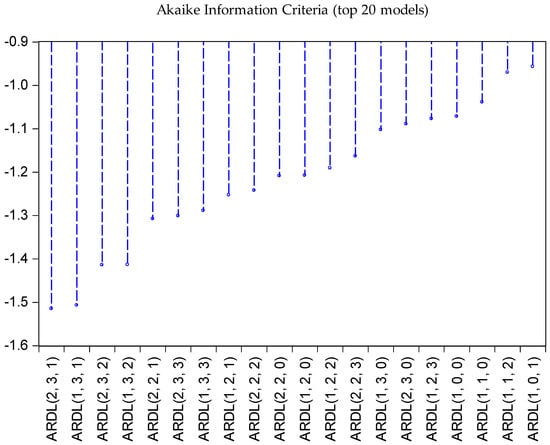
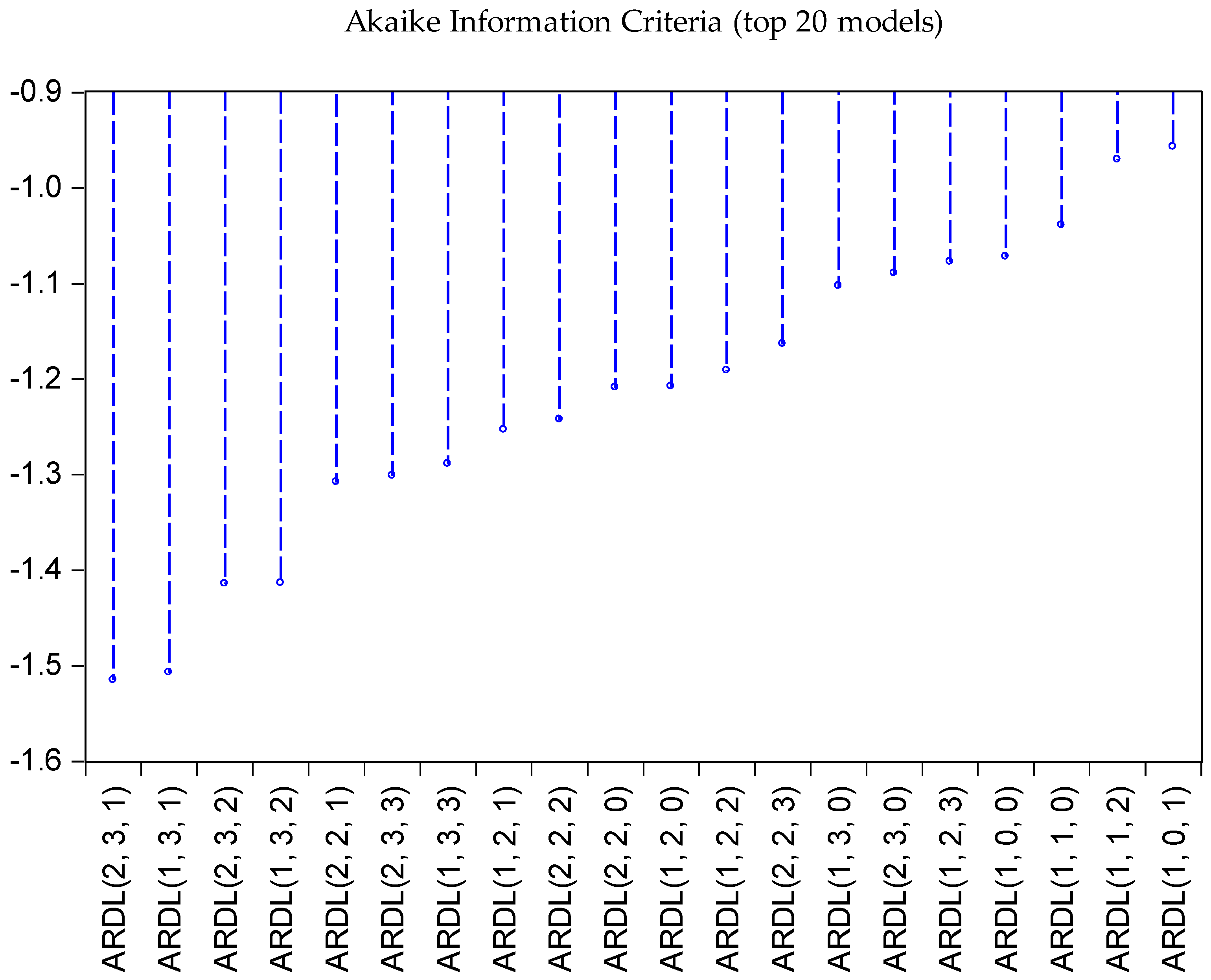
After determining the stationarity levels of the series, the existence of a long-run cointegration relationship among them was examined using the ARDL bounds testing approach. An iterative procedure was employed to identify the most appropriate ARDL model. Through this process, 32 different lag length combinations were tested, and the optimal model was selected based on the Akaike Information Criterion (AIC). As a result of the iteration, the ARDL (2, 3, 1) model was determined to be the best-fitting model (Figure 2).
Figure 2.
Selection of the ARDL Model.
The existence of a cointegration relationship among the variables is determined using the F-statistic values. The calculated F-statistic is compared with the lower and upper critical bounds provided by Pesaran et al. (2001). If the calculated F-statistic is below the lower critical bound, it is concluded that there is no cointegration relationship among the series. Conversely, if the F-statistic exceeds the upper critical bound, it indicates the presence of a cointegration relationship. In cases where the F-statistic falls between the lower and upper critical bounds, i.e., within the inconclusive region, a definitive conclusion about the existence of cointegration cannot be drawn. The ARDL bounds test results are presented in Table 5.
Table 5.
ARDL Bounds Test Results.
According to the results in Table 5, the calculated F-statistic value (9.519197) is greater than the upper bound critical value (6.36) at the 1% significance level determined by Pesaran et al. (2001). Therefore, the null hypothesis (H0) is rejected, and it is concluded that there is a cointegration relationship among the variables. It can thus be stated that there is a long-term relationship between SME production output, oil prices, and the dollar exchange rate. After confirming the existence of cointegration among the variables, the long-term relationships between them were examined. The estimated long-term coefficients are presented in Table 6.
Table 6.
ARDL Long-Run Estimation Results.
According to the long-run ARDL estimation results, the exchange rate (LNER) has a significant and strong impact on SME production output. The coefficient of the exchange rate is 2.0638, with a p-value of 0.0000. This indicates that, in the long term, a 1% increase in the USD/KZT exchange rate (i.e., depreciation of the Tenge) leads to approximately a 2.06% increase in SME production output. This result becomes even more meaningful considering that about 60% of SMEs in Kazakhstan operate in the wholesale and retail trade sectors. These sectors are directly affected by currency depreciation through both cost and pricing channels; as imported goods become more expensive, the demand for domestic products rises, positively influencing SME production volume.
The oil price variable (LNOP), on the other hand, is statistically insignificant (p-value: 0.9990). This finding suggests that oil prices do not directly affect SME production. However, given that Kazakhstan’s economy is heavily dependent on oil exports, oil prices are closely associated with exchange rate movements. When oil prices rise, foreign currency inflows into the country may increase, which is associated with changes in SME production output through an indirect exchange rate mechanism. It is important to note that these findings indicate statistical associations rather than strict causality.
The fact that the exchange rate has such a strong and significant effect supports the notion that oil prices influence SME production indirectly. In this context, exchange rate fluctuations play a critical role for SMEs operating in the wholesale and retail sectors, which are not directly tied to the energy industry but are highly sensitive to import prices, price pass-through effects, and consumption trends. This highlights the sensitivity of these enterprises to currency movements rather than implying direct causation. Therefore, both exchange rate policies and macroeconomic developments linked to energy prices indirectly shape the production performance of these enterprises.
According to the short-run ARDL estimation results (Table 7), both the exchange rate (D(LNER)) and oil prices (D(LNOP)) have significant and meaningful effects on SME production output. The coefficient of the exchange rate variable is 1.482, with a p-value of 0.0041. This result indicates that short-term increases in the exchange rate positively affect SME production output. Since most SMEs in Kazakhstan operate in the wholesale and retail trade sectors, exchange rate fluctuations directly influence consumption and trade volumes, leading to short-term increases in production activity. The positive effect of the exchange rate can be explained by the higher demand for domestic products resulting from the rising prices of imported goods, as well as by the competitive advantages gained by some SMEs through export activities.
Table 7.
ARDL Short-Run Estimation Results.
The short-term effects of oil prices are more complex. The current period oil price variable (D(LNOP)) is statistically significant and positive (coefficient: 0.560, p-value: 0.0145), indicating that rising oil prices increase SME production output in the short run. However, this effect reverses in the following period: the lagged oil price variable (D(LNOP(−1))) has a negative coefficient and is close to the statistical significance threshold (coefficient: −0.396, p-value: 0.0553). This suggests that while higher oil prices initially coincide with increased foreign currency inflows, potentially stabilizing the exchange rate and influencing demand, they may later be associated with changes in production costs and SME output. Particularly in logistics and supply chain activities—where energy costs are significant—this demonstrates that SMEs are sensitive to short-term fluctuations. These observations should be interpreted as statistical associations rather than causal effects.
The model’s error correction term (CointEq(−1)) is statistically significant, with a coefficient of −0.682 and a p-value of 0.0034. This indicates that about 68% of short-term disequilibria are corrected within the next period, and the system quickly returns to its long-run equilibrium. This finding supports the view that, despite short-term shocks, SME production output is primarily determined by long-term structural factors, meaning that the effects of variables such as the exchange rate and oil prices are temporary but significant.
In conclusion, while the exchange rate exerts a strong and consistent influence on SME production output in both the short and long run, the impact of oil prices emerges only in the short term and may change direction over time. This fluctuating influence of oil prices can be interpreted as an indirect transmission mechanism reflecting Kazakhstan’s dependence on oil revenues and their impact on the exchange rate. For SMEs operating in sectors with high price pass-through effects—such as wholesale and retail trade—these macroeconomic variables play a particularly decisive role.
Table 8 presents the model’s diagnostic test results. According to the Ramsey-Reset test, since the probability value is greater than 5%, the model is correctly specified. To test for the presence of heteroskedasticity and autocorrelation, the Breusch–Godfrey heteroskedasticity test and the Breusch–Pagan–Godfrey autocorrelation test were conducted. As the probability values for both tests are greater than 5%, no evidence of heteroskedasticity or autocorrelation was found. Additionally, the Jarque–Bera normality test was applied to verify whether the residuals are normally distributed, and since the probability value is greater than 5%, it is concluded that the errors in this model follow a normal distribution.
Table 8.
Post-estimation Results.
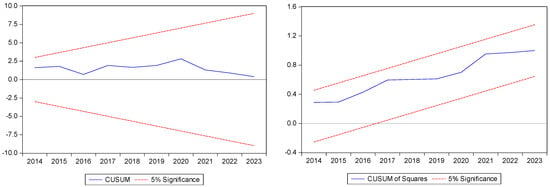
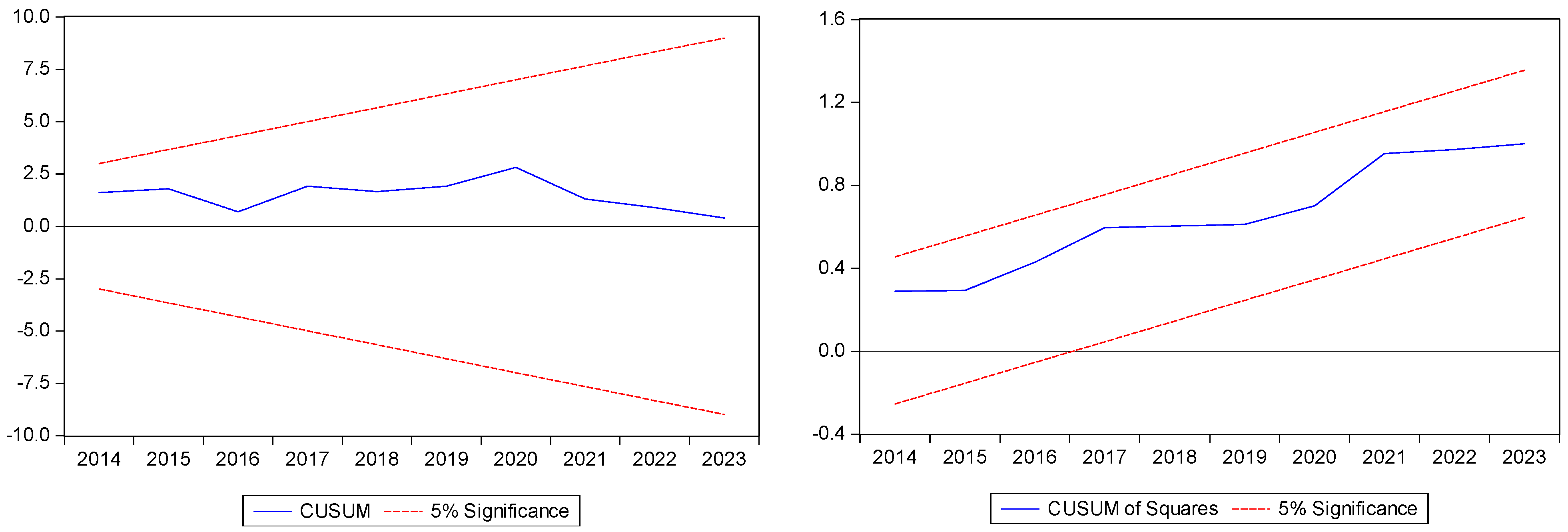
Furthermore, to examine the stability of the estimated ARDL model—or, in other words, to determine whether any structural breaks exist—the CUSUM and CUSUMSQ graphs, which use the squared recursive residuals, are presented in Figure 3.
Figure 3.
CUSUM and CUSUMSQ Graphs.
When examining the CUSUM and CUSUMSQ graphs in Figure 3, it can be observed that there are no structural breaks, and the long-run coefficients estimated using the ARDL bounds testing approach are stable.
6. Discussion
This study set out to examine the relationship between oil prices, exchange rates, and SME production output in Kazakhstan within the ARDL framework, with a particular focus on both short-run and long-run dynamics. The empirical findings provide important insights when evaluated in light of the research hypotheses and the existing literature.
First, the results indicate that the exchange rate has a strong and statistically significant association with SME production output in both the short and long run. Therefore, the null hypothesis stating that “the exchange rate (USD/KZT) has no statistically significant relationship with SME production output” is clearly rejected. This finding is consistent with a large body of literature emphasizing the sensitivity of SMEs to exchange rate movements, particularly in developing and import-dependent economies. Studies such as those by Sanjo and Ibrahim (2017) and Ercan (2019) similarly report that exchange rate volatility plays a critical role in shaping SME performance through its effects on costs, competitiveness, and market uncertainty.
However, the positive coefficient identified in this study contrasts with some findings in the literature that report negative effects of exchange rate depreciation on SMEs. This difference can be explained by the structural characteristics of the Kazakhstani economy. In particular, the dominance of SMEs in wholesale and retail trade implies a strong price pass-through mechanism, whereby rising import prices increase demand for domestically produced goods. Thus, exchange rate depreciation may, under certain conditions, stimulate local production rather than suppress it. This highlights the importance of country-specific factors in determining the direction of exchange rate effects.
Second, the results show that oil prices do not have a statistically significant long-run effect on SME production output. Accordingly, the null hypothesis stating that “oil prices have no statistically significant relationship with SME production output” cannot be rejected in the long run. This finding aligns with the broader literature suggesting that the impact of oil prices on SMEs is often indirect rather than direct. Studies such as Omolade and Ngalawa (2018) and Nurmakhanova (2020) emphasize that oil price fluctuations primarily influence macroeconomic variables—especially exchange rates—which in turn affect firm-level performance.
At the same time, the short-run results reveal that oil prices exert a significant but temporary effect on SME output, which diminishes or reverses over time. This dynamic supports the argument that oil price shocks operate through transmission channels rather than through direct production linkages. In the context of Kazakhstan, an oil-exporting economy, increases in oil prices are associated with changes in foreign exchange inflows and currency dynamics, which subsequently influence SME activity.
Taken together, these findings support the existence of an indirect relationship between oil prices and SME production output operating through the exchange rate channel. This result contributes to the literature by empirically demonstrating the mechanism through which resource dependence can shape SME performance in developing economies. It also reinforces the argument that macroeconomic variables should not be analyzed in isolation, but rather as part of an interconnected system.
From a broader perspective, the results highlight the structural vulnerability of SMEs in resource-dependent economies. Consistent with the literature (e.g., Miklian & Hoelscher, 2022; Eklou, 2023), SMEs are particularly exposed to external shocks due to limited financial capacity, high import dependency, and restricted access to risk management instruments. While exchange rate depreciation may create opportunities in terms of competitiveness, these benefits are not evenly distributed across firms and sectors.
Overall, the findings underscore the importance of macroeconomic stability—especially exchange rate stability—in supporting SME development. At the same time, they point to the need for a more nuanced understanding of how oil price fluctuations affect the real sector, particularly through indirect transmission mechanisms. In this sense, the study contributes to the broader debate on the role of resource dependence in shaping economic structure and firm-level performance in developing countries.
7. Conclusions
This study examined the relationship between oil prices, exchange rates, and SME production output in Kazakhstan over the period 2000–2023 using the ARDL approach. The empirical findings provide clear evidence that exchange rate movements are strongly and positively associated with SME production output in both the short and long run. In particular, the long-run estimates indicate that depreciation of the domestic currency is associated with a substantial increase in SME production. This result can be explained by the structural characteristics of the Kazakhstani economy, where a large proportion of SMEs operate in wholesale and retail trade, and where rising import prices tend to shift demand toward domestically produced goods.
In contrast, the results indicate that oil prices do not have a statistically significant long-run relationship with SME production output. However, short-run dynamics reveal that oil price changes are associated with temporary positive effects that may reverse in subsequent periods. These findings suggest that oil prices do not directly determine SME production performance but instead influence it indirectly through macroeconomic transmission channels.
More specifically, the results support the existence of an indirect mechanism whereby oil price movements are associated with exchange rate dynamics, and exchange rate changes are, in turn, associated with SME production output. Therefore, the relationship between oil prices and SME performance should be interpreted as indirect and association-based rather than causal. This finding highlights the importance of considering macroeconomic interdependencies in resource-dependent economies such as Kazakhstan.
Taken together, the results underscore the central role of exchange rate dynamics in shaping SME production performance, while also revealing the indirect and time-varying nature of oil price effects. These findings imply that SMEs in Kazakhstan are highly sensitive to currency fluctuations, both in terms of opportunities (e.g., increased competitiveness and demand for domestic goods) and risks (e.g., rising costs of imported inputs and financial uncertainty).
Based on these empirical results, several policy implications emerge. First, the financial resilience of SMEs should be strengthened against exchange rate volatility. Although currency depreciation may stimulate production through increased domestic demand, it can also impose significant cost pressures on firms that rely on imported inputs. Therefore, the development and wider use of financial risk management instruments—such as forward contracts, futures, and options—should be encouraged. In addition, foreign exchange risk insurance schemes and access to financial advisory services could help SMEs better understand and manage exchange rate exposure, while improvements in financial literacy would further enhance their capacity to cope with macroeconomic fluctuations.
Second, SME policies should be designed in an integrated manner with developments in energy and foreign exchange markets. Given that oil price fluctuations are indirectly transmitted to SMEs through exchange rate movements, policymakers should closely monitor energy market dynamics and incorporate these developments into broader macroeconomic and SME policy frameworks.
Third, SMEs with export potential should be actively supported and encouraged to engage in foreign currency-generating activities. Targeted financial incentives, export promotion programs, and improved access to international markets could enable SMEs to benefit more effectively from exchange rate movements and enhance their competitiveness.
Fourth, sectoral diversification within the SME sector should be promoted, particularly toward higher value-added and less import-dependent activities. Encouraging SMEs to move into more advanced production segments would contribute to building a more resilient economic structure and reduce vulnerability to both exchange rate volatility and commodity price fluctuations.
Finally, it is important to emphasize that the findings of this study reflect statistical associations rather than strict causal relationships. While the results provide robust evidence on the interaction between macroeconomic variables and SME production output, they should be interpreted with caution. Future research could extend this analysis by incorporating sector-level data, higher-frequency observations, and alternative econometric approaches to provide more detailed and causally oriented insights.
Author Contributions
Conceptualization, A.S. and R.T.; methodology, A.S.; software, A.S.; validation, A.S. and R.T.; formal analysis, A.S.; investigation, R.T.; resources, A.S.; data curation, R.T.; writing—original draft preparation, A.S.; writing—review and editing, A.S.; visualization, R.T.; supervision, R.T.; project administration, A.S.; funding acquisition, A.S. All authors have read and agreed to the published version of the manuscript.
Funding
This research was funded by the Science Committee of the Ministry of Science and Higher Education of the Republic of Kazakhstan (Grant No. AP19680610).
Institutional Review Board Statement
Not applicable.
Informed Consent Statement
Not applicable.
Data Availability Statement
The raw data supporting the conclusions of this article will be made available by the authors upon request.
Conflicts of Interest
The authors declare no conflicts of interest.
References
- Ahmad, H. H., Zain, N. A. B. M., & Shaari, M. S. M. (2024). Currency devaluation and business performance: The case of Muslim entrepreneurship in SMEs Malaysia. International Journal of Academic Research in Business & Social Sciences, 14(9), 1931–1942. [Google Scholar]
- Aigboduwa, J. E., & Oisamoje, M. D. (2013). Promoting small and medium enterprises in the Nigerian oil and gas industry. European Scientific Journal, 9(1), 244–261. [Google Scholar]
- Alugbuo, J. C., Eze, E., & Osuji, O. (2023, November 24–26). Exchange rate volatility and small and medium scale enterprises in Nigeria. Maiden Entrepreneurship Conference, Umudike, Nigeria. Available online: https://www.researchgate.net/publication/373945880 (accessed on 15 January 2026).
- Azretbergenova, G. Ž., & Syzdykova, A. (2020). The dependence of the Kazakhstan economy on the oil sector and the importance of export diversification. International Journal of Energy Economics and Policy, 10(6), 157–163. [Google Scholar] [CrossRef] [Scilit]
- Badshah, I., & Borgersen, T. A. (2020). Management of exchange rate risk in SMEs: Reflections on exchange rate pass-through and hedging of currency risk. SEISENSE Journal of Management, 3(6), 35–49. [Google Scholar] [CrossRef] [Scilit]
- Bácsi, J., & Herczeg, I. (2014). Local currency as a tool of risk management in the small and medium enterprises sector. Roczniki (Annals), 16(3), 18–23. [Google Scholar]
- Belghitar, Y., Clark, E., & Mefteh-Wali, S. (2016). The effect of floating exchange rates on SME performance. SSRN, 2754659. [Google Scholar] [CrossRef] [Scilit]
- Bishev, G., & Boskov, T. (2016). Are exchange rate exposure and hedging important for firm performances? Evidence for macedonian SMEs. International Journal of Information, Business and Management, 8(4), 34–46. [Google Scholar]
- Bureau of National Statistics of the Agency for Strategic Planning and Reforms of the Republic of Kazakhstan. (2025). Official statistics of Kazakhstan. Available online: https://stat.gov.kz/en/ (accessed on 15 January 2026).
- Chinelo, N. S., Uche, T. A. J., & Nkiruka, E. F. (2025). Exchange rate fluctuation and sustainability of small business enterprises in a developing nation. Journal of Economics and Finance Research (JEFR), 4(1), 1–15. [Google Scholar]
- Dang, V. (2015). An investigation of foreign exchange risk management by exporting small and medium sized enterprises [Doctoral dissertation, Open Access Te Herenga Waka-Victoria University of Wellington]. [Google Scholar]
- Dickey, D. A., & Fuller, W. A. (1981). Likelihood ratio statistics for autoregressive time series with a unit root. Econometrica: Journal of the Econometric Society, 49, 1057–1072. [Google Scholar] [CrossRef] [Scilit]
- Dosmagambet, Y., Oskenbayev, Y., Taghizadeh-Hesary, F., & Mukan, M. (2019). Oil price fluctuations, creditworthiness of the financial system, and SME financing in Kazakhstan. In Unlocking SME finance in Asia (pp. 139–162). Routledge. [Google Scholar]
- Eklou, K. M. (2023). Dollar exchange rate volatility and productivity growth in emerging markets: Evidence from firm level data. International Monetary Fund. [Google Scholar]
- Ercan, Ö. (2019). Coping with the exceptional economic problems in Turkey: A field survey on SMEs. Timisoara Journal of Economics and Business, 12(2), 109–126. [Google Scholar] [CrossRef] [Scilit]
- Eromosele, H. O. (2025). Currency devaluation and performance of small and medium enterprises (SMEs) in Nigeria. AKSU Journal of Management Sciences (AKSUJOMAS), 10(2), 99–114. [Google Scholar]
- Halim, F. A., Malim, M. R., Derasit, Z., Rani, R. M., & Rashid, S. S. (2017, September). The impact of macroeconomic variables on SMEs in Malaysia. In Journal of Physics: Conference Series (Vol. 890, No. 1, p. 012138). IOP Publishing. [Google Scholar]
- Lawal, K., & Akanbi, S. A. (2020). An analysis of long-run relationship between exchange rate and small and medium enterprises performance (SMES) in Nigeria: An ARDL perspective. International Journal of Management, Social Sciences, Peace and Conflict Studies (IJMSSPCS), 3(3), 337–348. [Google Scholar]
- Lee, S. Y. (2019). Exports of SMEs against risk? Theory and evidence from foreign exchange risk insurance schemes in Korea. Journal of Korea Trade, 23(5), 87–101. [Google Scholar] [CrossRef] [Scilit]
- Ma, L., & Shen, Z. (2004). Analyses of decision-making for exchange rate risk in supply chain management of small and medium-sized enterprises. Journal of Dalian University of Technology (Social Science), 25(2), 51–60. [Google Scholar]
- Miklian, J., & Hoelscher, K. (2022). SMEs and exogenous shocks: A conceptual literature review and forward research agenda. International Small Business Journal, 40(2), 178–204. [Google Scholar] [CrossRef] [Scilit]
- Monday, J. U., Obokoh, L. O., Ojiako, U., & Ehiobuche, C. (2017). The impact of exchange rate depreciation on small and medium sized enterprises performance and development in Nigeria. African Journal of Business and Economic Research, 12(1), 11–48. [Google Scholar] [CrossRef] [Scilit]
- Moralista, R. B., & Martir, E. M. (2023). Oil price volatility and business profitability: Evidence from the local market. Journal of Advanced Zoology, 44, 1602. [Google Scholar] [CrossRef] [Scilit]
- Narayan, S., & Narayan, P. K. (2004). Determinants of demand for Fiji’s exports: An empirical investigation. The Developing Economies, 42(1), 95–112. [Google Scholar] [CrossRef] [Scilit]
- Nurmakhanova, M. (2020). Oil and growth challenge in Kazakhstan. International Journal of Economics and Business Research, 20(1), 100–116. [Google Scholar] [CrossRef] [Scilit]
- Nurmakhanova, M., & Kretzschmar, G. L. (2011). Kazakhstan-The real currency and growth challenge for commodity producing countries. Journal of Business and Policy Research, 6, 87–105. [Google Scholar]
- Obiukwu, F., & Adurogboye, O. (2025). Effect of exchange rate fluctuation on the growth of SMEs performance in Nigeria (2013–2024). Lagos Journal of Banking, Finance and Economic Issues, 6(1), 102–114. [Google Scholar]
- Oladunni, S. (2020). Oil price shocks and macroeconomic dynamics in an oil-exporting emerging economy: A New Keynesian DSGE approach. CBN Journal of Applied Statistics, 11(1), 1. [Google Scholar] [CrossRef] [Scilit]
- Omolade, A., & Ngalawa, H. (2018). Oil price movements, exchange rate and Nigerian manufacturing sector growth: A short-run analysis. Investment Management & Financial Innovations, 15(3), 329. [Google Scholar]
- Pesaran, M. H., & Shin, Y. (1995). An autoregressive distributed lag modelling approach to cointegration analysis (Vol. 9514, pp. 371–413). Department of Applied Economics, University of Cambridge. [Google Scholar]
- Pesaran, M. H., Shin, Y., & Smith, R. J. (2001). Bounds testing approaches to the analysis of level relationships. Journal of Applied Econometrics, 16(3), 289–326. [Google Scholar] [CrossRef] [Scilit]
- Phillips, P. C. B. (1987). Towards a unified asymptotic theory for autoregression. Biometrika, 74(3), 535–547. [Google Scholar] [CrossRef]
- Phillips, P. C. B., & Perron, P. (1988). Testing for a unit root in time series regression. Biometrika, 75, 335–346. [Google Scholar] [CrossRef]
- Sanjo, O. M., & Ibrahim, M. O. (2017). The effect of international business on SMEs growth in Nigeria. Journal of Competitiveness, 9(3), 67–80. [Google Scholar] [CrossRef] [Scilit]
- Simakova, J., & Prazak, T. (2024). Assessing the impact of exchange rates on international trade in the manufacturing sector of CEE countries: A specific focus on SMEs. E&M Economics and Management, 27(3), 104–119. [Google Scholar] [CrossRef] [Scilit]
- Smallbone, D., Kitching, J., & Xheneti, M. (2012). Vulnerable or resilient?: SMEs and the economic crisis in the UK. In The Consequences of the international crisis for European SMEs (pp. 109–134). Routledge. [Google Scholar]
- Sulaiman, I., & Abubakar, A. (2024). Assessing the effect of exchange rate fluctuations on small and medium enterprises (SMEs) in Kaduna State. KASU Journal of Economics and Development Studies, 11(1). Available online: https://ssrn.com/abstract=6186399 (accessed on 15 January 2026).
- Syzdykova, A., Abubakirova, A., Chowdhury, D., & Al-Alawi, A. N. (2021). Attractiveness and difficulties of SMEs in Kazakhstan economy. Review of Applied Socio-Economic Research, 21(1), 89–98. [Google Scholar]
- Syzdykova, A., & Azretbergenova, G. (2024). Asymmetric effect of oil prices on Kazakhstan’s stock market index and exchange rate. International Journal of Energy Economics and Policy, 14(6), 15–23. [Google Scholar] [CrossRef] [Scilit]
- Syzdykova, A., & Azretbergenova, G. (2025). Analysis of the impact of SMEs’ production output on Kazakhstan’s economic growth using the ARDL method. Economies, 13(2), 38. [Google Scholar] [CrossRef] [Scilit]
- Tende, S., & Obumneke, E. (2014). Impact of petroleum on SMEs growth in Nigeria. International Journal of Entrepreneurial Knowledge, 2(2). [Google Scholar] [CrossRef] [Scilit]
- Turhan, I., Hacihasanoglu, E., & Soytas, U. (2013). Oil prices and emerging market exchange rates. Emerging Markets Finance and Trade, 49(Suppl. S1), 21–36. [Google Scholar] [CrossRef] [Scilit]
- U-Din, S., & Sadiq, U. (2022). Crude oil prices: A curse or a blessing for small businesses in Alberta? Economics and Policy of Energy and Environment, 1, 33–50. [Google Scholar] [CrossRef] [Scilit]
- Udo, S. S., Oweh, S. A., & Okey, O. J. (2026). An empirical analysis of the joint effects of exchange rate devaluation and monetary policy tightening on the performance of small and medium enterprises in Nigeria. Research Journal of Economics and Sustainable Development, 14(1), 42–67. [Google Scholar]
- Udoh, F. S., Sharma, A., Ajalie, S., Agama, E. J., & Inim, V. E. (2024). Macroeconomic variables on the performance of small medium enterprises; The financing decision in Nigeria. In International conference on business and technology (pp. 189–202). Springer Nature. [Google Scholar]
- Zamanbekov, S., Dogalov, A., Zamanbekov, D., Bildebayeva, A., Cheirkhanova, A., Bakirbekova, A., & Sikhimbayeva, B. (2020). Regional development of small and midsize businesses in the conditions of forming of innovative economy of Kazakhstan: A case study. Entrepreneurship and Sustainability Issues, 8(1), 618. [Google Scholar] [CrossRef] [Scilit] [PubMed]
- Zarubina, V., Zarubin, M., Yessenkulova, Z., Gumarova, T., Daulbayeva, A., Meimankulova, Z., & Kurmangalieva, A. (2024). Sustainable development of small business in Kazakhstan. Economies, 12(9), 247. [Google Scholar] [CrossRef] [Scilit]

Disclaimer/Publisher’s Note: The statements, opinions and data contained in all publications are solely those of the individual author(s) and contributor(s) and not of MDPI and/or the editor(s). MDPI and/or the editor(s) disclaim responsibility for any injury to people or property resulting from any ideas, methods, instructions or products referred to in the content. |
© 2026 by the authors. Licensee MDPI, Basel, Switzerland. This article is an open access article distributed under the terms and conditions of the Creative Commons Attribution (CC BY) license.