


Abstract
This study examines the heterogeneous effects of key macroeconomic determinants on economic growth in selected MENA economies using a pooled quantile regression framework. Unlike conventional mean-based approaches, this method captures variation across different segments of the conditional growth distribution. Using annual data for eight MENA economies over the period 2000–2023, the analysis evaluates how foreign aid, budget deficits, foreign direct investment, and trade openness are associated with growth under different economic conditions. The results reveal that foreign aid and fiscal deficits are more strongly associated with growth at lower quantiles, indicating greater relevance during low-growth episodes, while their effects weaken or become insignificant at higher quantiles. In contrast, foreign direct investment shows a stronger and more consistent positive association at higher quantiles, whereas trade openness is mainly significant at the lower end of the growth distribution. These findings provide distribution-sensitive evidence on growth determinants in structurally diverse MENA economies. From a policy perspective, the results suggest that macroeconomic strategies should be tailored to country-specific growth conditions rather than relying on uniform policy frameworks across the region.
1. Introduction
From a regional policy perspective, and despite sustained external support, economic growth outcomes across MENA economies remain difficult to explain using standard average-effect frameworks. In practice, growth patterns reflect structural disparities, fiscal pressures, and differences in integration into global markets. These differences are associated with variation in institutional capacity, macroeconomic governance, exposure to external shocks, and absorptive capacity across countries in the region. These features make the MENA region particularly suitable for examining heterogeneous growth responses (Burnside & Dollar, 2000; Kong et al., 2021; Al-Smadi & Barham, 2024). In this context, recent empirical contributions also emphasize that firm-level dynamics and institutional factors can shape macroeconomic performance and growth outcomes across countries (Bolatto & Pignataro, 2023).
From a conceptual standpoint, it is unlikely that key macroeconomic determinants of growth—foreign aid, budget deficits, foreign direct investment, and trade openness—operate uniformly across economies facing different growth conditions. In low-growth settings, external inflows and expansionary fiscal policies can help stabilize economic activity by easing financing constraints. However, their influence may diminish or change as economies move toward stronger growth phases and structural limitations become more binding (Alfaro et al., 2004; Rajan & Subramanian, 2008).
Within the present MENA dataset, a large share of empirical studies continues to rely on mean-based estimators that assume uniform responses across countries. The descriptive patterns observed in this study, however, point to substantial cross-country variation, suggesting that average-effect approaches may conceal important distributional differences and regime-specific dynamics, particularly in structurally diverse regions such as MENA (Canay, 2011; Machado & Santos Silva, 2019).
To overcome this limitation, the study applies a pooled quantile regression framework that allows the effects of foreign aid, budget deficits, foreign direct investment, and trade openness to vary across different segments of the conditional growth distribution. Using annual data for eight MENA economies over 2000–2023, the analysis provides distribution-sensitive evidence on how macroeconomic determinants are associated with growth under different economic conditions, revealing patterns that are not observable in conventional mean-based models (Tao et al., 2023; Hou et al., 2024).
From a theoretical standpoint, the analysis draws on classical and neoclassical growth frameworks that emphasize capital accumulation, savings–investment mechanisms, and productivity as central drivers of long-run economic performance. Early contributions highlight the importance of investment and fiscal conditions in shaping growth paths (Harrod, 1939; Domar, 1946), while later neoclassical models formalize convergence dynamics and diminishing returns (Solow, 1956; Swan, 1956). Subsequent extensions underscore the role of technological progress and institutional factors in sustaining long-term growth (Barro, 1974; Romer, 1986), providing the theoretical basis for including foreign aid, budget deficits, foreign direct investment, and trade openness in the empirical specification.
This study contributes to the literature by providing distribution-sensitive evidence on growth determinants in structurally diverse MENA economies using pooled quantile regression, offering insights beyond conventional mean-based approaches.
2. Methodology
2.1. Data and Variables
The empirical analysis relies on an annual panel dataset covering eight MENA economies over the period 2000–2023. Economic growth (GDPG) is measured as the annual percentage growth rate of real GDP and is obtained from the World Bank’s World Development Indicators (WDI) (World Bank, 2024a). Foreign aid (FA) is proxied by net official development assistance (ODA) inflows and is sourced primarily from the OECD–DAC Creditor Reporting System (Organization for Economic Co-Operation and Development, 2024), with supplementary information from the United Nations Office for the Coordination of Humanitarian Affairs (OCHA) Financial Tracking Service for conflict-affected economies (United Nations Office for the Coordination of Humanitarian Affairs, 2024). The budget deficit (BD) is measured as general government net lending/borrowing as a percentage of GDP and is obtained from the International Monetary Fund’s World Economic Outlook (WEO) database (International Monetary Fund, 2024). Foreign direct investment (FDI) is measured as net FDI inflows as a percentage of GDP and is sourced from UNCTADstat database (United Nations Conference on Trade and Development, 2024a), while trade openness (TOP) is defined as the sum of exports and imports of goods and services as a percentage of GDP and is obtained from the World Bank’s World Development Indicators (WDI) (World Bank, 2024b). All variables are expressed at annual frequency and harmonized to ensure cross-country comparability across the sample period.
To address data gaps in conflict-affected economies, supplementary data sources were utilized to ensure completeness and consistency. In particular, post-2011 observations for Syria’s budget deficit and foreign direct investment were supplemented with CEIC Data (2024) and official publications of the Central Bank of Syria (Central Bank of Syria, 2024), while post-2019 foreign direct investment data for Yemen were supplemented with data from the United Nations Conference on Trade and Development’s World Investment Report 2024 (United Nations Conference on Trade and Development, 2024b).
The use of mixed measurement units follows standard practice in macroeconomic analysis and is grounded in the economic nature and interpretation of each variable. Specifically, foreign aid (FA) and foreign direct investment (FDI) are measured in absolute terms (billions of U.S. dollars) because they represent external financial inflows that directly augment domestic resources in the economy. In contrast, budget deficit (BD) and trade openness (TOP) are expressed as percentages of GDP to capture their relative scale and macroeconomic significance within each country. This distinction enhances economic interpretability, ensures consistency with the existing empirical literature, and improves cross-country comparability by accounting for differences in economic size and structure.
This study covers eight MENA economies: Jordan, Egypt, Tunisia, Lebanon, Iran, Syria, Yemen, and Turkey. The sample selection is guided by both data availability and the objective of capturing structural heterogeneity across the MENA region, including a mix of relatively stable and conflict-affected economies. Furthermore, the selection of variables is guided by both theoretical considerations and prior empirical studies on growth determinants in developing and MENA economies, ensuring a parsimonious yet theoretically grounded model specification. The selected countries also differ in terms of economic structure, fiscal conditions, and exposure to external shocks, further supporting the relevance of a heterogeneous growth analysis.
While additional control variables such as institutional quality, inflation, and human capital are widely recognized in the growth literature, their inclusion is constrained by data availability and consistency across countries, particularly for conflict-affected economies. Therefore, the present study retains a parsimonious specification based on core macroeconomic variables that are theoretically grounded and comparable across the full sample period.
2.2. Empirical Framework and Model Specification
The empirical analysis applies a pooled quantile regression approach to examine how economic growth is associated with key macroeconomic determinants across different segments of the growth distribution. Instead of assuming identical effects across all observations, this framework permits the slope coefficients to differ across τ-quantiles, capturing potential heterogeneity in the estimated relationships. The baseline pooled quantile regression model is expressed as follows:
where Qτ(GDPG_t|X_{t − 1}) denotes the conditional τ-th quantile of GDP growth, and βn(τ) represents the vector of quantile-specific slope of the nth coefficient.
Qτ(GDPG_t|X_{t − 1}) = β0(τ) + β1FA(τ) FA_{t − 1} + β2BD(τ) BD_{t − 1} + β3FDI(τ) FDI_{t − 1} + β4TOP(τ) TOP_{t − 1} + ε_t
2.3. Justification for the Pooled Quantile Regression Approach
The analysis adopts a pooled quantile regression framework even though the dataset has a panel structure. The objective is to evaluate how economic growth relates to macroeconomic determinants across different segments of the growth distribution without estimating country-specific quantile trajectories. This specification emphasizes distributional heterogeneity rather than cross-sectional effects.
Given the sample of eight MENA economies observed over 2000–2023, the pooled specification is selected to keep the model parsimonious and to avoid excessive parameterization in a relatively small panel. Within this framework, slope coefficients are allowed to vary across quantiles of the conditional growth distribution while remaining common across countries at each quantile level.
Compared with fixed-effects quantile estimators, the pooled approach reduces the risk of incidental-parameter problems and limits overfitting when cross-country heterogeneity is pronounced. Recent methodological studies also indicate that pooled quantile inference can be appropriate in panel-type settings as long as the regressors do not exhibit I(2) behavior (Machado & Santos Silva, 2019; Tao et al., 2023; Galvao et al., 2024).
While the pooled quantile regression framework offers important advantages in capturing heterogeneous effects across the conditional growth distribution, it may not fully account for unobserved country-specific heterogeneity. This limitation is acknowledged and considered acceptable given the study’s focus on distributional heterogeneity and the constraints of the available sample.
3. Results
3.1. Descriptive and Graphical Analysis of Economic Indicators (2000–2023)
This section presents an overview of descriptive statistics and graphical patterns for GDP growth, foreign aid (FA), budget deficit (BD), foreign direct investment (FDI), and trade openness (TOP) across eight MENA economies during the period 2000–2023. Table 1 summarizes the main distributional properties of the variables.
Table 1.
Descriptive Statistics of Key Macroeconomic Variables (2000–2023).
The descriptive statistics in Table 1 indicate substantial dispersion across all five variables. GDP growth has a mean of 2.51% and exhibits a wide range, with pronounced negative skewness and high kurtosis. Foreign aid (measured in billion US dollars) shows a relatively low mean with strong positive skewness and excess kurtosis, indicating uneven inflows across years. The budget deficit (measured in percentage) records a negative mean of −5.71% of GDP and displays considerable variability. Foreign direct investment (measured in billion US dollars) is characterized by high dispersion and positive skewness, reflecting episodic inflows. Trade openness varies widely across economies but shows lower relative dispersion compared to the other variables.
Jarque–Bera test statistics reported in Table 1 indicate that all variables deviate from normality.
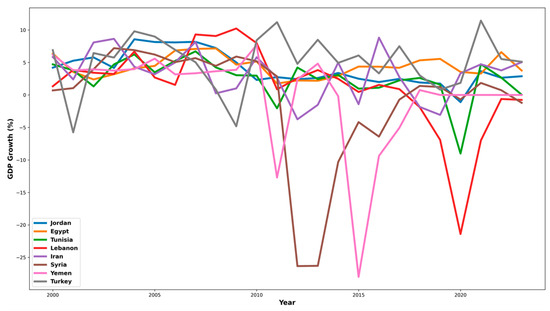
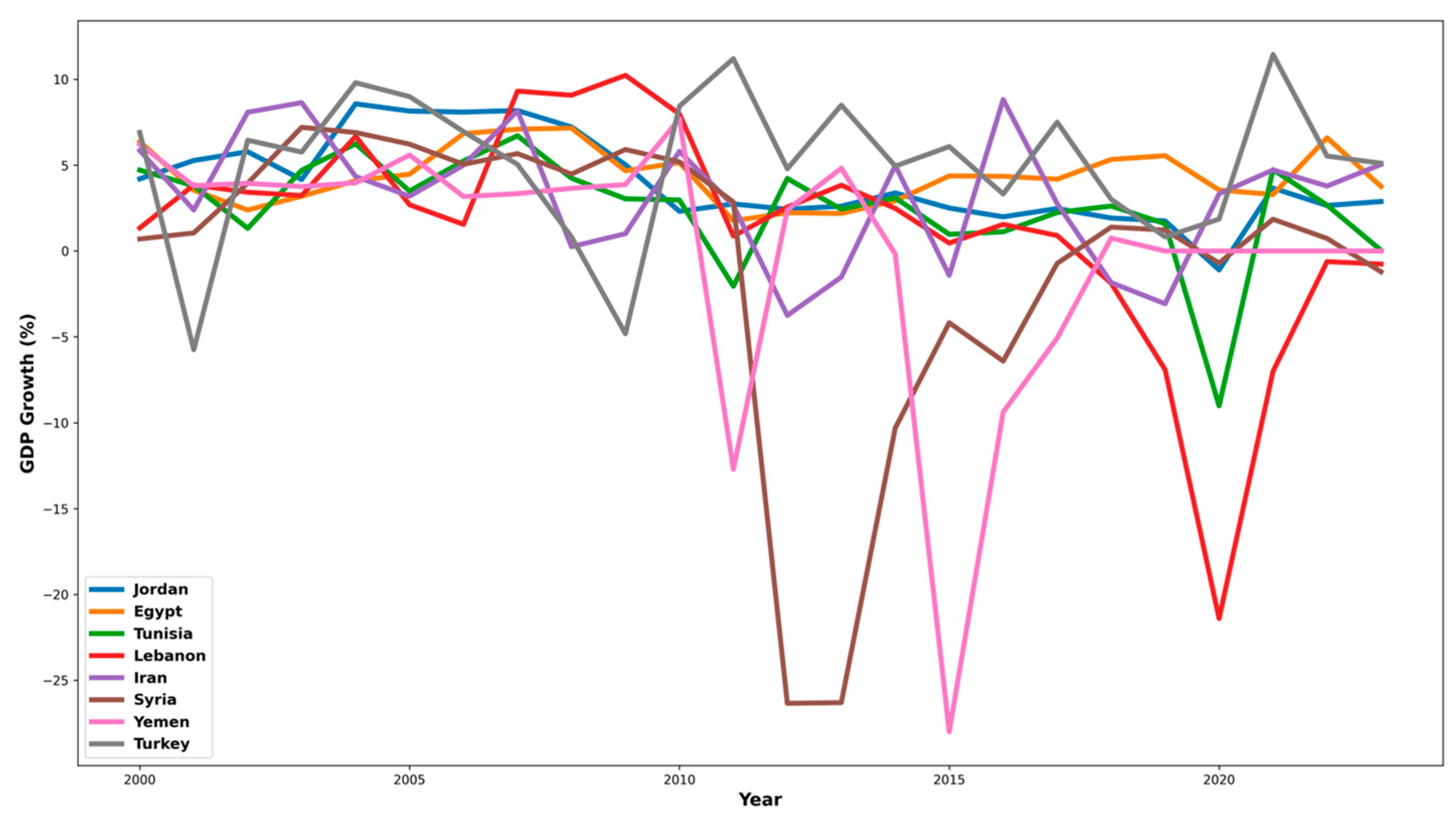
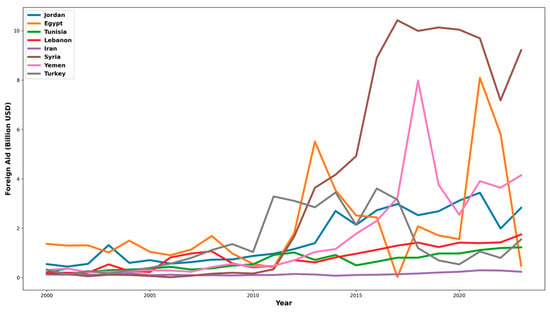
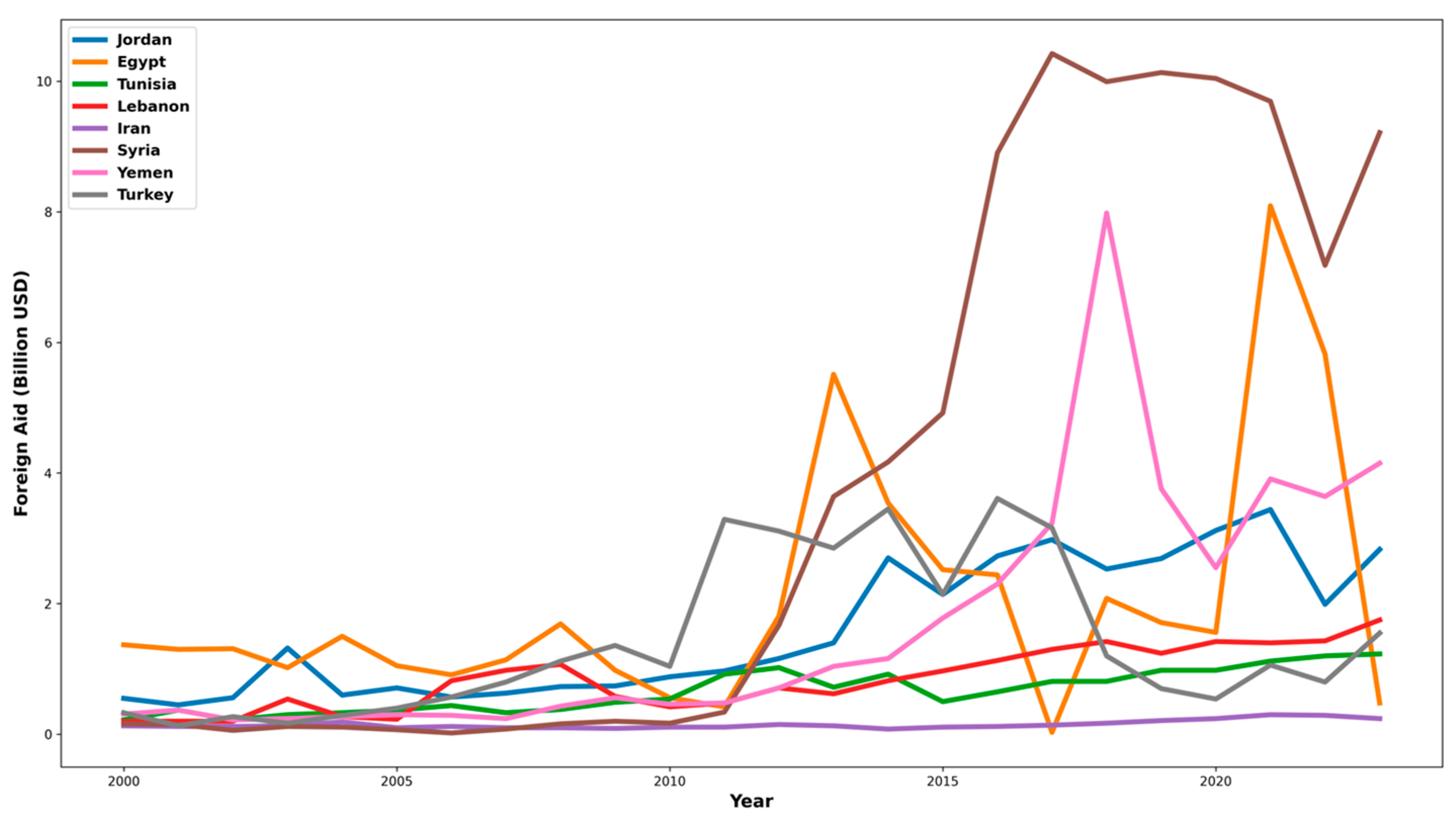
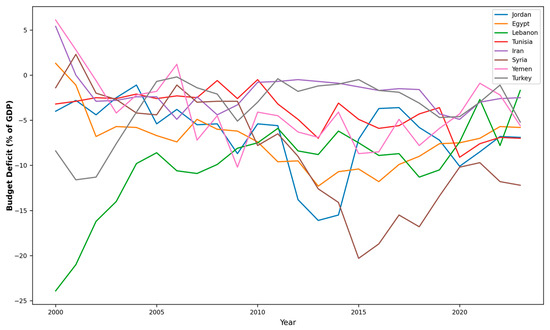
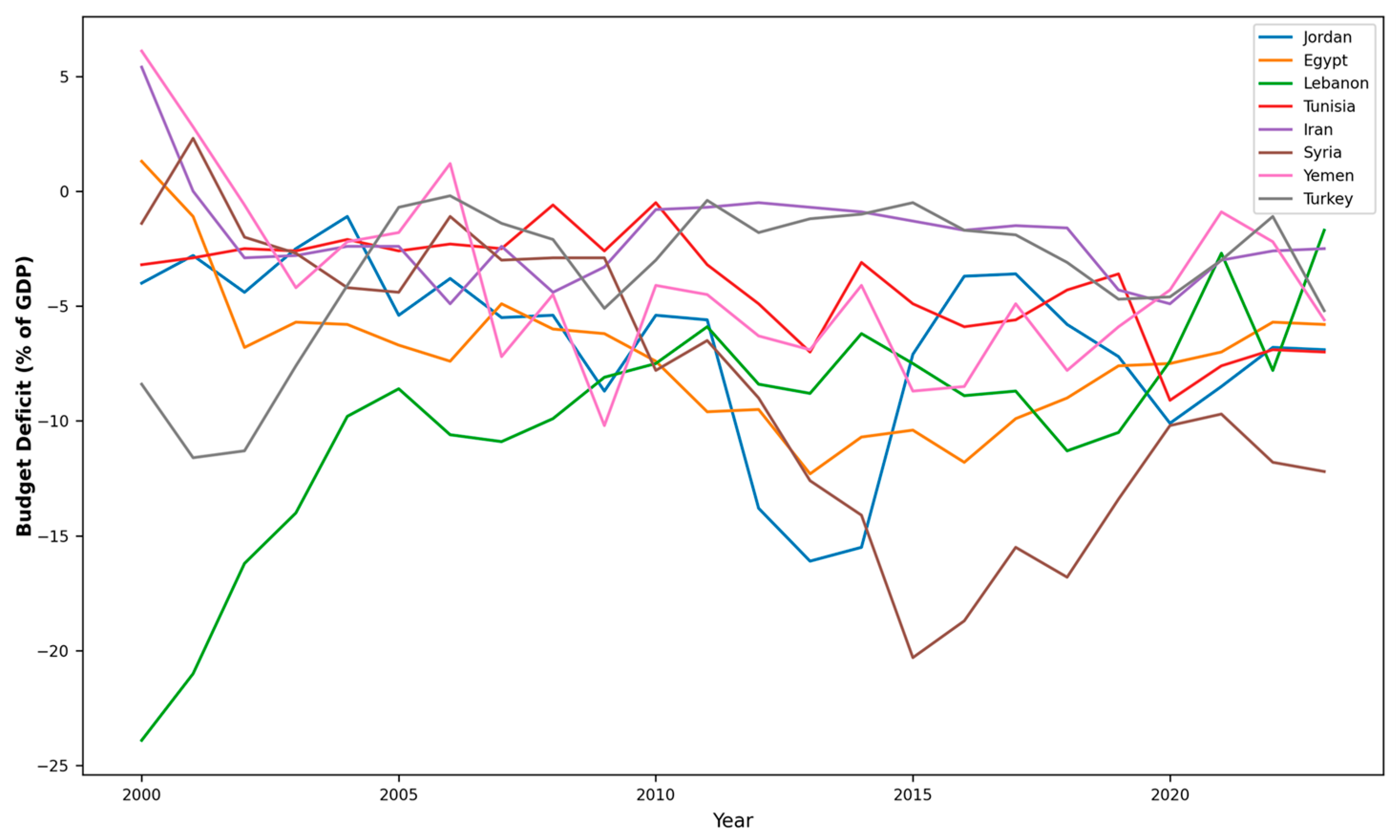
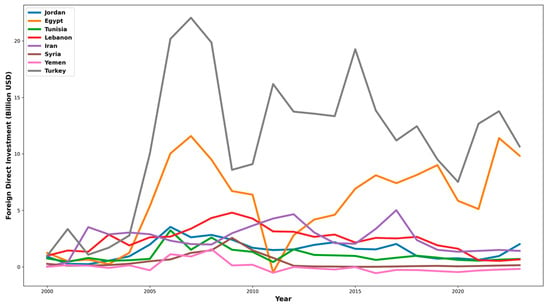
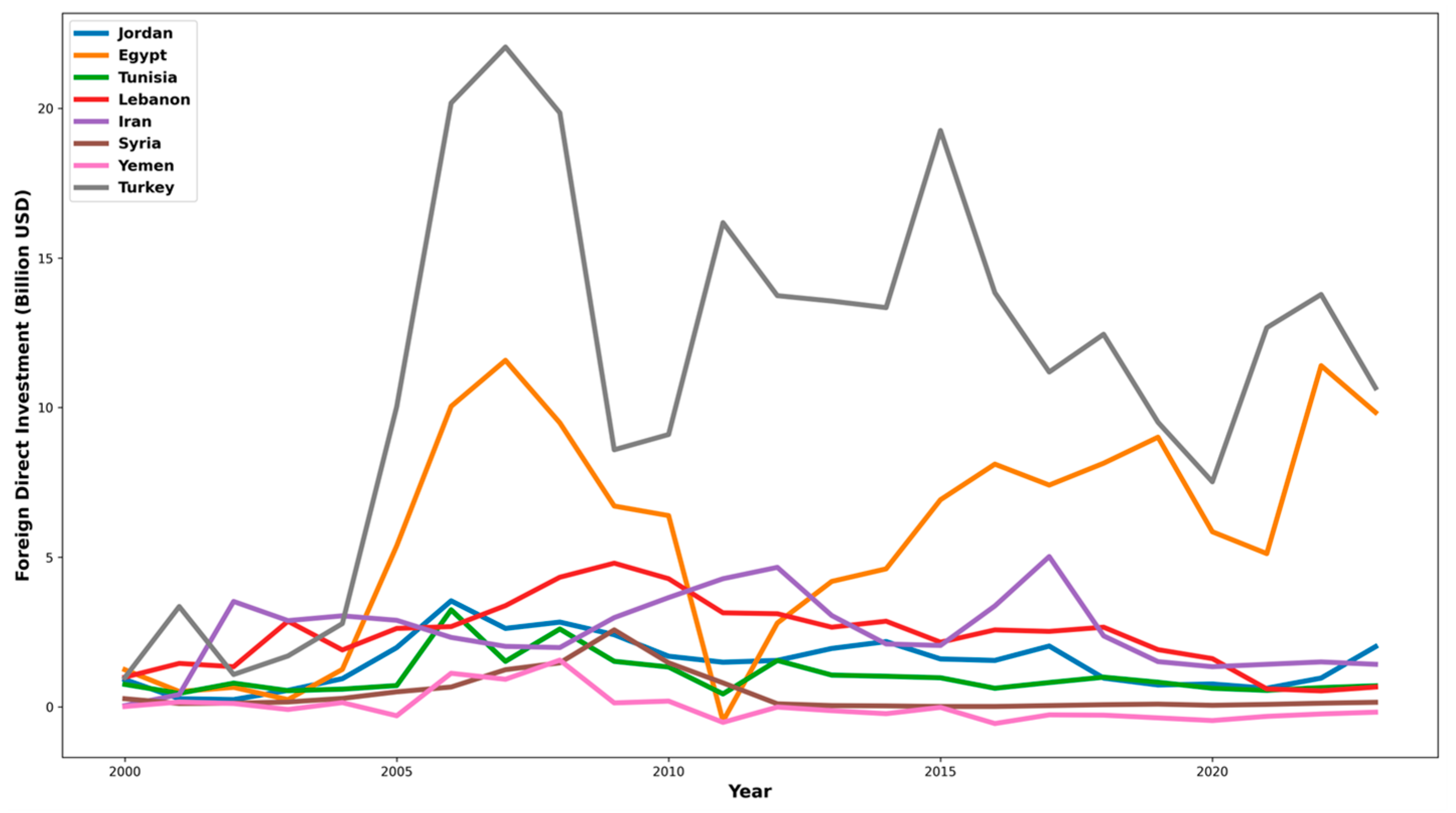
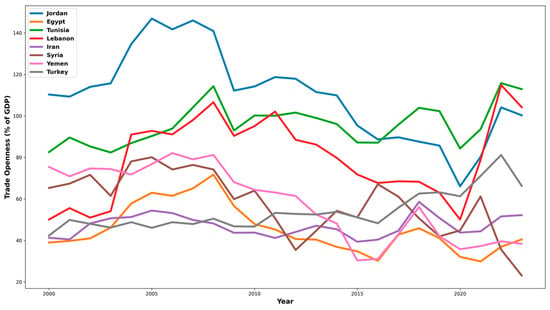
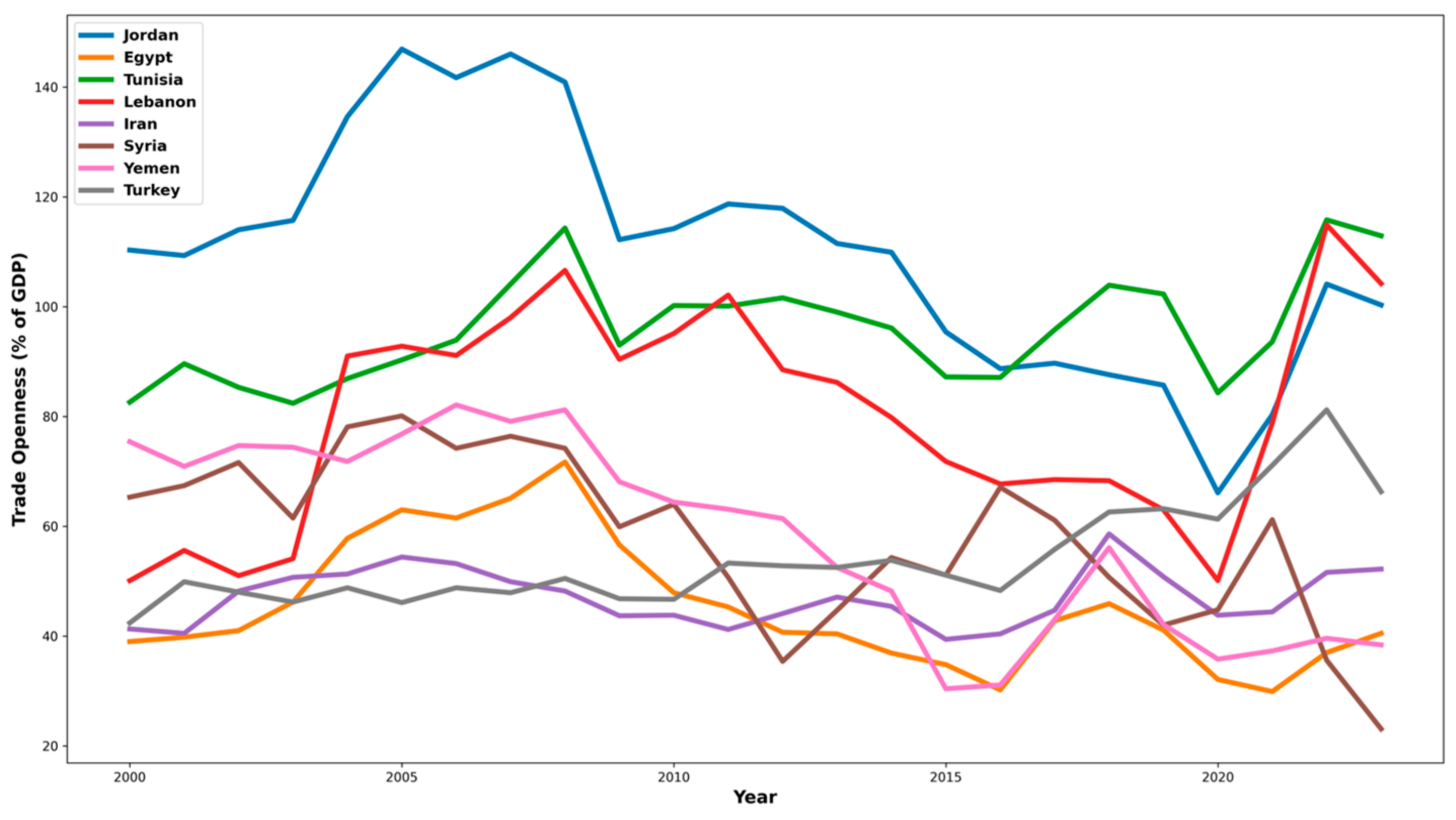
Figure 1, Figure 2, Figure 3, Figure 4 and Figure 5 report the time-series evolution of GDP growth, foreign aid, budget deficit, foreign direct investment, and trade openness across eight MENA economies over the period 2000–2023. The figures show substantial variation across countries and over time. GDP growth shows considerable fluctuations across the sample period, with sharp contractions observed in Syria, Yemen, and Lebanon, whereas Jordan, Egypt, and Tunisia follow relatively more stable growth paths. Budget deficit trends also vary noticeably, particularly in conflict-affected economies where persistent fiscal imbalances are evident. Trade openness differs across countries, remaining comparatively high in Lebanon and Jordan but lower in Iran and Yemen. Foreign aid inflows change over time, reflecting periodic increases in certain years, while foreign direct investment displays irregular movements, including occasional surges in Turkey alongside more volatile or limited inflows in other economies.
Figure 1.
GDP Growth Trends in Selected MENA Countries (2000–2023).
Figure 2.
Foreign Aid Trends in Selected MENA Countries (2000–2023).
Figure 3.
Budget Deficit Trends in Selected MENA Countries (2000–2023).
Figure 4.
Foreign Direct Investment (FDI) Trends in Selected MENA Countries (2000–2023).
Figure 5.
Trade Openness Trends in Selected MENA Countries (2000–2023).
The descriptive statistics together with the graphical patterns for 2000–2023 reveal notable differences across macroeconomic indicators in the eight MENA economies. GDP growth varies substantially, including periods of sharp contraction in some countries, while others experience relatively steadier growth trends. Fiscal conditions remain uneven, as reflected in persistent deficits observed in several cases. Trade openness, foreign aid, and foreign direct investment also exhibit clear cross-country variation over time. In addition, the distributional measures reported in Table 1 indicate pronounced skewness and kurtosis, and the Jarque–Bera statistics confirm that the variables deviate from normality.
3.2. Panel Unit Root and Stationarity Diagnostics
Unlike cointegration-based long-run estimators, pooled quantile regression does not rely on long-run equilibrium relationships or pre-testing for cointegration. Accordingly, panel unit root tests are reported solely as a diagnostic check to ensure that none of the variables exhibit higher-order integration. Recent methodological contributions show that quantile-based estimators remain well behaved when regressors are a mixture of I(0) and I(1), provided that no variable is integrated of order two (Machado & Santos Silva, 2019; Tao et al., 2023). Consistent with this requirement, the unit root results confirm that all variables fall within the I(0)–I(1) range, ensuring the validity of the pooled quantile regression estimates.
Although pooled quantile regression does not require strict stationarity conditions, recent methodological contributions emphasize the importance of ensuring that regressors do not exhibit explosive I(2) behavior, as higher-order integration can destabilize conditional quantile estimates. Quantile-based estimators remain well behaved when variables are a mixture of I(0) and I(1), provided that higher-order integration is absent (Machado & Santos Silva, 2019; Tao et al., 2023; Borgen et al., 2021). Panel unit root tests were conducted to examine the time-series properties of the variables. The results reported in Table 2 indicate that GDP and BD are stationary in levels, while FA, FDI, and TOP become stationary after first differencing. No variable is found to be integrated of order two.
Table 2.
Panel Unit Root Tests (2000–2023).
3.3. Pooled Quantile Regression Results
Table 3 reports the pooled quantile regression estimates for GDP growth across quantiles τ = 0.10–0.90. The results indicate that the relationships between economic growth and its macroeconomic determinants vary systematically across different points of the conditional growth distribution.
Table 3.
Pooled Quantile Regression Estimates of GDP Growth Determinants.
Foreign aid (FA) is positively and statistically significantly associated with GDP growth at the lower quantiles (τ = 0.10 and τ = 0.20). At higher quantiles, the estimated coefficients decline and become statistically insignificant or negative. These findings are broadly in line with earlier evidence suggesting that external inflows tend to play a more supportive role during weaker growth periods (Burnside & Dollar, 2000; Nzama et al., 2023), while their influence may diminish or become less favorable as economic performance strengthens (Rajan & Subramanian, 2008).
Budget deficits (BD) show a comparable asymmetric pattern. The estimated coefficients remain positive and statistically significant at the lower quantiles but lose significance toward the median and upper segments of the distribution. This outcome is consistent with studies indicating that expansionary fiscal policies may help stabilize output during downturns yet become less relevant under stronger growth conditions (Kong et al., 2021; Tao et al., 2023).
Foreign direct investment (FDI) presents positive and gradually increasing coefficients from the median toward the upper quantiles (τ = 0.50–0.90), suggesting a stronger association with growth in higher-performing regimes. The stronger association at higher quantiles is consistent with the view that the growth impact of FDI depends on absorptive capacity and institutional conditions, which tend to be more favorable in higher-growth regimes (Alfaro et al., 2004; Azman-Saini et al., 2010; Al-Jawarneh et al., 2024).
Trade openness (TOP) is statistically significant primarily at the lower quantiles, while its estimated effects weaken at higher quantiles. This pattern corresponds to evidence that openness contributes more to growth during early or fragile stages of economic development than in mature growth regimes (Frankel & Romer, 1999; Wacziarg & Welch, 2008; Kong et al., 2021).
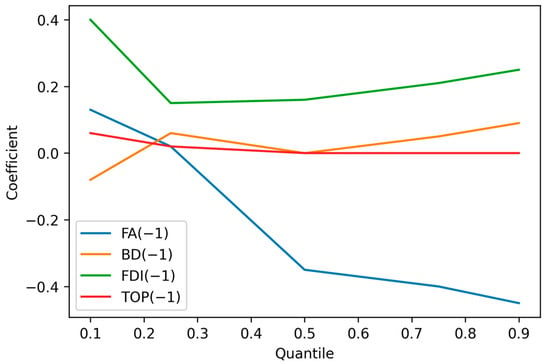
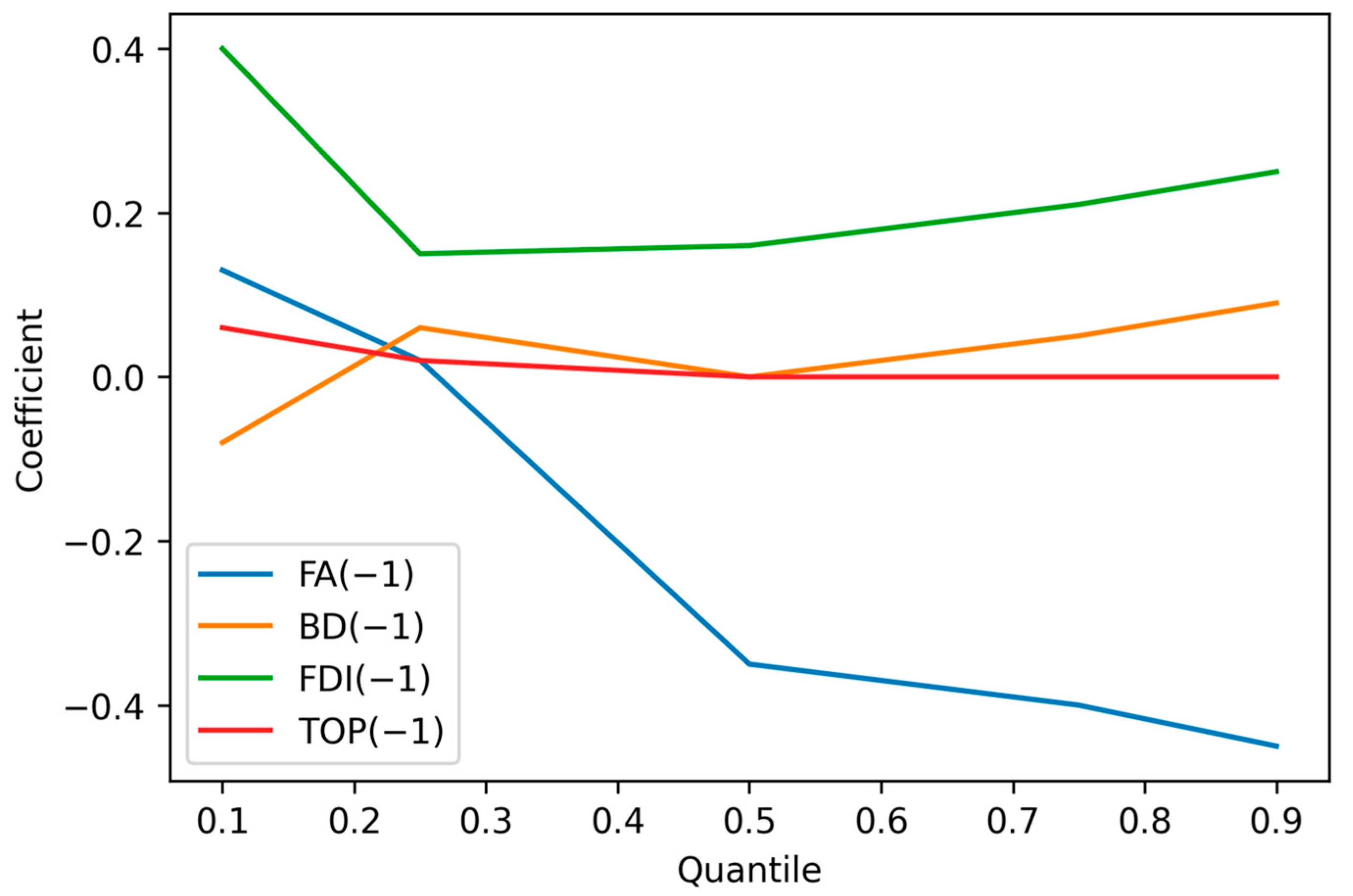
Figure 6 plots the estimated pooled quantile regression coefficients across the conditional growth distribution for τ = 0.10–0.90, corresponding to the estimates reported in Table 3. The figure shows how the estimated coefficients vary across quantiles for foreign aid, budget deficits, foreign direct investment, and trade openness.
Figure 6.
Pooled Quantile Regression Coefficient Estimates across Quantiles (τ = 0.10–0.90).
The coefficient path for foreign aid declines across quantiles, with higher estimates at the lower quantiles and lower or negative estimates toward the upper quantiles. Budget deficit coefficients are largest at the lower quantiles and decrease as quantiles increase. In contrast, foreign direct investment coefficients rise toward the upper quantiles. Trade openness exhibits relatively larger coefficients at the lower end of the conditional growth distribution.
3.4. Quantile Regression Equations (Pooled Model)
The pooled quantile regression specification reported in Section 2.2’s Equation (1) relates GDP growth to lagged values of foreign aid, budget deficits, foreign direct investment, and trade openness. The estimated coefficients differ across quantiles of the conditional growth distribution, indicating that both the direction and strength of the relationships vary across growth regimes.
The coefficients β0 to β4 specified in Equation (1) will show how the vector of slope for each determinant differs between low-growth and high-growth regimes. Lagged regressors are introduced to preserve temporal sequencing and to limit potential simultaneity concerns, following common practices in the quantile regression literature (Machado & Santos Silva, 2019; Tao et al., 2023).
For clarity, the pooled estimates reported in Table 3 are rewritten as explicit equations for selected quantiles as follows:
- τ = 0.10 Quantile Equation
GDPG_t = −8.6261 + 0.9470 FA(−1) + 0.6483 BD(−1) + 0.2062 FDI(−1) + 0.1054 TOP(−1)
At the lowest quantile, the estimated coefficients in Equation (2) show that all macroeconomic determinants are positively related to GDPG. The strong positive association of FA in this segment aligns with earlier findings suggesting that foreign aid can ease financing constraints and support basic economic activity in fragile environments (Burnside & Dollar, 2000; Aljonaid et al., 2022). Similarly, the positive roles of BD and TOP at this quantile are consistent with evidence documenting larger marginal gains from fiscal and external integration during downturns (Kong et al., 2021; Nzama et al., 2023).
The interpretation of Equation (2) focuses strictly on the positive coefficients β_FA(0.10), β_BD(0.10), β_FDI(0.10), and β_TOP(0.10) reported in Table 3 rather than on the negative intercept term.
- τ = 0.20 Quantile Equation
GDPG_t = −4.6541 + 0.3947 FA(−1) + 0.3415 BD(−1) + 0.1795 FDI(−1) + 0.0752 TOP(−1)
In moderately low-growth regimes, the estimated coefficients in Equation (3) remain positive but exhibit weaker magnitudes relative to the lowest quantile. The gradual reduction in coefficient magnitude as growth conditions improve is consistent with nonlinear patterns highlighted in the aid-effectiveness literature (Rajan & Subramanian, 2008) and in recent quantile-based applications to macroeconomic panel data (Tao et al., 2023). These results suggest that the contribution of accommodative fiscal conditions becomes less pronounced as economies transition toward stronger growth performance, in line with the evidence reported by Azman-Saini et al. (2010).
- τ = 0.50 Quantile Equation
GDPG_t = 2.7725 − 0.3651 FA(−1) + 0.0084 BD(−1) + 0.2079 FDI(−1) + 0.0076 TOP(−1)
At the median quantile, the coefficient on FA becomes negative and statistically significant, implying that foreign aid may be less supportive of productivity once economies reach more stable growth paths. This finding is consistent with Rajan and Subramanian (2008) and Boone (1996), who highlight potential dependency and allocation concerns in stronger-performing economies. At the same time, the positive FDI coefficient remains robust, reinforcing the argument that foreign direct investment inflows continue to play a meaningful role even when other determinants weaken (Alfaro et al., 2004).
- τ = 0.75 Quantile Equation
GDPG_t = 3.2357 − 0.3066 FA(−1) + 0.0117 BD(−1) + 0.2723 FDI(−1) + 0.0242 TOP(−1)
As countries transition toward higher-growth regimes, the negative association of foreign aid persists, as reflected in Equation (5). This pattern aligns with quantile-based evidence reported by Nzama et al. (2023). In contrast, both FDI and TOP regain modest statistical relevance at this stage, supporting the view advanced by Azman-Saini et al. (2010) that absorptive capacity and institutional conditions influence how effectively economies benefit from foreign capital and trade integration.
- τ = 0.90 Quantile Equation
GDPG_t = 6.4715 − 0.4437 FA(−1) + 0.0707 BD(−1) + 0.2745 FDI(−1) + 0.0121 TOP(−1)
At the highest quantile of economic performance, the estimated coefficients in Equation (6) indicate that FA is associated with increasingly adverse outcomes. This pronounced negative coefficient is strongly aligned with the dependency hypothesis documented in Boone (1996) and Rajan and Subramanian (2008) and confirms that foreign aid effectiveness is inversely related to growth regimes. Meanwhile, the persistent and significant influence of FDI at this quantile is highly similar to Alfaro et al. (2004) and Islam and Beloucif (2024), who identify FDI as a robust driver of growth under stable macroeconomic and institutional conditions.
Across all estimated equations, the coefficients display non-monotonic and asymmetric patterns that are partly consistent with existing studies and partly different from them. The downward shift in the role of FA and BD from lower to higher quantiles confirms the nonlinearities emphasized in earlier MENA and developing-country research (Burnside & Dollar, 2000; Rajan & Subramanian, 2008; Kong et al., 2021). Conversely, the monotonic strengthening of FDI’s effects toward upper quantiles is highly similar to the mainstream FDI–growth literature (evidence reported by Alfaro et al., 2004; Azman-Saini et al., 2010).
Taken together, these comparisons demonstrate the value of pooled quantile regression for capturing growth–regime heterogeneity in the MENA region (Machado & Santos Silva, 2019; Tao et al., 2023; Nzama et al., 2023).
3.5. Theoretical Linkage for the Quantile Regression Approach
In the context of the present MENA dataset, pooled quantile regression is adopted to capture distributional asymmetries that cannot be addressed by mean-based estimators. Pooled quantile regression builds upon the original contributions of Koenker and Bassett (1978) and is further developed in comprehensive treatments such as Koenker (2005). It provides a rigorous alternative to mean-based growth analysis. Unlike ordinary least squares estimators, which assume homogeneous marginal effects, quantile regression allows the associations between GDP growth and its determinants to differ across the conditional distribution. This flexibility is particularly relevant for the MENA region, where institutional settings, policy frameworks, and structural conditions vary across countries (Canay, 2011; Machado & Santos Silva, 2019). Recent methodological developments further extend quantile-based approaches to distributional and counterfactual analysis (Chernozhukov et al., 2013), and to the assessment of growth risks across countries (Clark et al., 2024).
From a macroeconomic standpoint, foreign aid (FA), budget deficits (BD), foreign direct investment (FDI), and trade openness (TOP) are unlikely to influence growth in a uniform manner. Early theoretical contributions suggest that aid may support expansion when it supplements domestic resources and alleviates liquidity constraints in weaker-performing economies (Burnside & Dollar, 2000; Rajan & Subramanian, 2008). Evidence on fiscal deficits similarly indicates that the growth implications of deficit-financed policies differ across economic regimes (Kong et al., 2021; Nzama et al., 2023).
Overall, the empirical findings are broadly consistent with these theoretical arguments. External financing and fiscal imbalances appear more strongly associated with growth at lower quantiles, whereas FDI shows relatively stronger links at higher segments of the distribution (Alfaro et al., 2004; Azman-Saini et al., 2010). The pooled quantile framework therefore captures variation in these relationships across the conditional growth distribution without imposing identical slope restrictions across countries. Quantile regression has also been widely applied in empirical macroeconomic and financial studies, including panel-based applications in financial performance analysis (Bortoluzzo et al., 2024). In addition, recent empirical contributions highlight the role of institutional and firm-level mechanisms in shaping economic outcomes (Bolatto & Pignataro, 2023).
While additional robustness checks, such as alternative measures of economic growth or the exclusion of conflict-affected countries, could provide further validation, the current specification maintains consistency in measurement and preserves the structural heterogeneity that is central to the analysis.
4. Discussion
The pooled quantile regression results provide strong evidence that the relationship between economic growth and its macroeconomic determinants varies noticeably across the conditional growth distribution. Rather than reflecting a single common growth mechanism, the findings suggest that policy-relevant variables operate differently depending on prevailing economic conditions. Such variation is consistent with the structural diversity observed across MENA economies, where differences in institutional capacity, exposure to external shocks, and fiscal structures shape growth outcomes (Canay, 2011; Tao et al., 2023).
These results also draw attention to the limitations of empirical approaches that assume homogeneous responses across countries and time. The quantile estimates show that policy variables associated with stronger growth at the lower end of the distribution do not exhibit comparable effects at higher growth levels. This regime-dependent behavior aligns with earlier studies highlighting nonlinear macroeconomic adjustments and asymmetric growth responses in developing and conflict-affected regions (Kong et al., 2021; Nzama et al., 2023).
At the lower quantiles, foreign aid, budget deficits, and trade openness demonstrate relatively stronger associations with economic growth. This pattern supports the view that external inflows and accommodative fiscal positions may play a stabilizing role in low-growth environments characterized by financing constraints and weak private investment (Burnside & Dollar, 2000; Rajan & Subramanian, 2008). Similar conclusions are reported in quantile-based studies showing that policy variables tend to exert greater influence during downturns and fragile growth episodes (Nzama et al., 2023).
At intermediate quantiles, the diminishing role of foreign aid and budget deficits suggests a gradual transition toward growth dynamics more closely linked to macroeconomic stability and institutional quality. Previous empirical work documents comparable shifts, emphasizing the importance of fiscal discipline and governance as economies move beyond low-growth regimes (Kong et al., 2021).
At higher quantiles, foreign direct investment shows the most consistent and positive association with economic growth. This outcome is in line with evidence indicating that the effectiveness of FDI strengthens in environments characterized by higher absorptive capacity and stable macroeconomic conditions (Alfaro et al., 2004; Azman-Saini et al., 2010). By contrast, foreign aid and deficit-financed expansion appear less supportive or even adverse in stronger-performing economies, reflecting concerns raised in the aid-effectiveness literature (Rajan & Subramanian, 2008).
Overall, the findings reinforce the idea that growth dynamics in the MENA region are regime-dependent rather than uniform. The distribution-sensitive perspective offered by pooled quantile regression complements earlier research emphasizing nonlinear and asymmetric growth responses across different stages of development (Canay, 2011; Tao et al., 2023).
These findings have important policy implications for MENA economies. The heterogeneous effects observed across different growth regimes suggest that uniform macroeconomic policies may not be equally effective across countries. Policymakers should therefore adopt more targeted and flexible strategies tailored to specific growth conditions rather than relying on one-size-fits-all policy frameworks.
5. Conclusions
Using the pooled quantile regression estimates presented in Table 3, this study examines how foreign aid, budget deficits, foreign direct investment, and trade openness are associated with GDP growth across different segments of the conditional growth distribution for eight MENA economies during 2000–2023. The findings indicate that the relationships between macroeconomic variables and growth vary across regimes rather than remaining constant across countries or over time.
The results show that foreign aid is more strongly linked to growth at lower quantiles, while its relevance weakens and may become negative toward higher parts of the distribution. Budget deficits follow a similar nonlinear pattern, with positive associations mainly observed under weaker growth conditions. In contrast, foreign direct investment maintains a relatively stable and positive relationship with growth at the median and upper quantiles, whereas trade openness appears more relevant at the lower end of the distribution. Together, these patterns suggest that the role of external inflows and fiscal conditions depends on prevailing macroeconomic environments.
These outcomes are broadly consistent with quantile-based studies indicating that the growth effects of aid and fiscal policy tend to be stronger during low-growth episodes and diminish as performance improves (Burnside & Dollar, 2000; Rajan & Subramanian, 2008; Nzama et al., 2023). At the same time, the results differ from conclusions derived from mean-based approaches that impose homogeneous effects across countries and growth regimes.
From a methodological perspective, the analysis underscores the value of distribution-sensitive approaches for examining growth dynamics in heterogeneous regions such as MENA. Allowing coefficients to vary across the growth distribution provides additional insight into how macroeconomic determinants relate to growth under different performance conditions, which may remain hidden in conventional mean-based models.
From a policy standpoint, the findings suggest that macroeconomic variables are associated with growth in different ways depending on countries’ positions within the growth distribution. Lower-growth economies tend to display stronger links with aid inflows, fiscal accommodation, and trade openness, whereas higher-growth economies exhibit closer associations between growth and foreign direct investment. These differences imply that policy priorities may vary across development stages rather than follow a single uniform framework across the region.
Finally, future research could extend this framework by incorporating explicit measures of institutional quality, governance, or political stability, as well as by examining sectoral compositions of foreign direct investment or applying country-specific and dynamic quantile panel methods. In addition, subgroup analyses—such as distinguishing between oil and non-oil economies—may further enhance understanding of structural heterogeneity within the MENA region. Such extensions may provide deeper insight into the mechanisms underlying the heterogeneous growth responses observed across MENA economies.
Author Contributions
Conceptualization and Methodology: M.O.M.A. and H.H.G.; Implementation of study and Formal investigation: M.O.M.A. and Y.L.; Writing—original draft preparation: M.O.M.A.; Validation, Formal Analysis and Visualization: M.O.M.A. and H.H.G.; Writing—review and editing: M.O.M.A., Y.L. and H.H.G.; Resources: M.O.M.A., Supervision: Y.L., H.H.G. All authors have read and agreed to the published version of the manuscript.
Funding
This research received no external funding.
Institutional Review Board Statement
Not applicable.
Informed Consent Statement
Not applicable.
Data Availability Statement
The data employed in this study were obtained from publicly accessible international sources, including the World Bank World Development Indicators (WDI) (https://databank.worldbank.org/source/world-development-indicators, accessed on 20 May 2025), the IMF World Economic Outlook (WEO) (https://www.imf.org/en/Publications/WEO, accessed on 20 May 2025), OECD-DAC (https://stats.oecd.org/, accessed on 20 May 2025), UNCTAD, UNOCHA (https://fts.unocha.org/, accessed on 20 May 2025), and CEIC Data (https://www.ceicdata.com/, accessed on 20 May 2025). The processed datasets can be made available by the corresponding author upon reasonable request.
Acknowledgments
During the preparation of this manuscript, the authors used ChatGPT (OpenAI, version GPT 5.3) solely for language editing, clarity improvement, and minor grammatical refinement. The authors take full responsibility for the originality, analysis, interpretation, and academic integrity of the work. No AI tools were used to generate research data, statistical results, or scientific conclusions.
Conflicts of Interest
The authors declare that there are no conflicts of interest.
Abbreviations
The following abbreviations are used in this manuscript:
| GDPG | Gross Domestic Product Growth |
| FA | Foreign Aid |
| BD | Budget Deficit |
| FDI | Foreign Direct Investment |
| TOP | Trade Openness |
| MENA | Middle East and North Africa |
References
- Alfaro, L., Chanda, A., Kalemli-Ozcan, S., & Sayek, S. (2004). FDI and economic growth: The role of local financial markets. Journal of International Economics, 64(1), 89–112. [Google Scholar] [CrossRef] [Scilit]
- Al-Jawarneh, A. S., Alsayed, A. R. M., Ayyoub, H. N., Ismail, M. T., Sek, S. K., Ariç, K. H., & Manzi, G. (2024). Enhancing model selection by obtaining optimal tuning parameters in elastic-net quantile regression: Application to crude oil prices. Journal of Risk and Financial Management, 17(8), 323. [Google Scholar] [CrossRef] [Scilit]
- Aljonaid, N. A. A., Qin, F., & Zhang, Z. (2022). The heterogeneous impact of sectoral foreign aid inflows on sectoral growth: SUR evidence from selected Sub-Saharan African and MENA countries. Journal of Risk and Financial Management, 15(3), 107. [Google Scholar] [CrossRef] [Scilit]
- Al-Smadi, A. A., & Barham, B. (2024). The threshold effects of public debt on economic growth in MENA countries: Do energy endowments matter? International Review of Economics & Finance, 89(B), 458–470. [Google Scholar] [CrossRef] [Scilit]
- Azman-Saini, W. N. W., Law, S. H., & Ahmad, A. H. (2010). FDI and economic growth: New evidence on the role of financial markets. Economics Letters, 107(2), 211–213. [Google Scholar] [CrossRef] [Scilit]
- Barro, R. J. (1974). Are government bonds net wealth? Journal of Political Economy, 82(6), 1095–1117. [Google Scholar] [CrossRef] [Scilit]
- Bolatto, S., & Pignataro, G. (2023). Entering the supplier base through certified management standards. International Economics, 174, 4–17. [Google Scholar] [CrossRef] [Scilit]
- Boone, P. (1996). Politics and the effectiveness of foreign aid. European Economic Review, 40(2), 289–329. [Google Scholar] [CrossRef] [Scilit]
- Borgen, N. T., Haupt, A., & Wiborg, Ø. N. (2021). A new framework for estimation of unconditional quantile treatment effects: The residualized quantile regression (RQR) model. SocArXiv Preprint. Available online: https://osf.io/download/60768976f2ad330625a74a2d/ (accessed on 20 May 2025).
- Bortoluzzo, A. B., Ciganda, R. R., & Bortoluzzo, M. M. (2024). Determinant factors of banking profitability: An application of quantile regression for panel data. Future Business Journal, 10(1), 56. [Google Scholar] [CrossRef] [Scilit]
- Burnside, C., & Dollar, D. (2000). Aid, policies, and growth. American Economic Review, 90(4), 847–868. [Google Scholar] [CrossRef] [Scilit]
- Canay, I. A. (2011). A simple approach to quantile regression for panel data. The Econometrics Journal, 14(3), 368–386. [Google Scholar] [CrossRef] [Scilit]
- CEIC Data. (2024). Macroeconomic indicators for Syria and Yemen (Budget balance and foreign direct investment series). CEIC Global Database. Available online: https://www.ceicdata.com (accessed on 20 May 2025).
- Central Bank of Syria. (2024). Annual statistical bulletin (Government finance and balance of payments tables; selected issues 2011–2023). Research and Statistics Directorate, Damascus.
- Chernozhukov, V., Fernández-Val, I., & Melly, B. (2013). Inference on counterfactual distributions. Econometrica, 81(6), 2205–2268. [Google Scholar] [CrossRef] [Scilit]
- Clark, T. E., Huber, F., Koop, G., Marcellino, M., & Pfarrhofer, M. (2024). Investigating growth-at-risk using a multicountry nonparametric quantile factor model. Journal of Business & Economic Statistics, 42(4), 1302–1317. [Google Scholar] [CrossRef] [Scilit]
- Domar, E. D. (1946). Capital expansion, rate of growth, and employment. Econometrica, 14(2), 137–147. [Google Scholar] [CrossRef] [Scilit]
- Frankel, J. A., & Romer, D. (1999). Does trade cause growth? American Economic Review, 89(3), 379–399. [Google Scholar] [CrossRef] [Scilit]
- Galvao, A. F., Parker, T., & Xiao, Z. (2024). Bootstrap inference for panel data quantile regression. Journal of Business & Economic Statistics, 42(2), 628–639. [Google Scholar] [CrossRef] [Scilit]
- Harrod, R. F. (1939). An essay in dynamic theory. The Economic Journal, 49(193), 14–33. [Google Scholar] [CrossRef] [Scilit]
- Hou, Y., Leng, X., Peng, L., & Zhou, Y. (2024). Panel quantile regression for extreme risk. Journal of Econometrics, 240(1), 105674. [Google Scholar] [CrossRef] [Scilit]
- International Monetary Fund. (2024). World Economic Outlook (WEO) database: General government net lending/borrowing (% of GDP). Available online: https://www.imf.org/en/Publications/WEO (accessed on 20 May 2025).
- Islam, M. S., & Beloucif, A. (2024). Determinants of foreign direct investment: A systematic review of empirical studies. Foreign Trade Review, 59(2), 309–337. [Google Scholar] [CrossRef] [Scilit]
- Koenker, R. (2005). Quantile regression. Cambridge University Press. [Google Scholar] [CrossRef] [Scilit]
- Koenker, R., & Bassett, G. (1978). Regression quantiles. Econometrica, 46(1), 33–50. [Google Scholar] [CrossRef] [Scilit]
- Kong, S., Peng, D., Ni, Y., Jiang, X., & Wang, Z. (2021). Trade openness and economic growth quality of China: Empirical analysis using ARDL model. Finance Research Letters, 38, 101488. [Google Scholar] [CrossRef] [Scilit]
- Machado, J. A. F., & Santos Silva, J. M. C. (2019). Quantiles via moments. Journal of Econometrics, 213(1), 145–173. [Google Scholar] [CrossRef] [Scilit]
- Nzama, L., Sithole, T., & Kahyaoglu, S. B. (2023). The impact of government effectiveness on trade and financial openness: The generalized quantile panel regression approach. Journal of Risk and Financial Management, 16(1), 14. [Google Scholar] [CrossRef] [Scilit]
- Organization for Economic Co-Operation and Development. (2024). OECD-DAC creditor reporting system (CRS): Net official development assistance (ODA), annual data by recipient country. Available online: https://stats.oecd.org/Index.aspx?DataSetCode=CRS1 (accessed on 20 May 2025).
- Rajan, R. G., & Subramanian, A. (2008). Aid and growth: What does the cross-country evidence really show? Review of Economics and Statistics, 90(4), 643–665. [Google Scholar] [CrossRef] [Scilit]
- Romer, P. M. (1986). Increasing returns and long-run growth. Journal of Political Economy, 94(5), 1002–1037. [Google Scholar] [CrossRef] [Scilit]
- Solow, R. M. (1956). A contribution to the theory of economic growth. Quarterly Journal of Economics, 70(1), 65–94. [Google Scholar] [CrossRef] [Scilit]
- Swan, T. W. (1956). Economic growth and capital accumulation. Economic Record, 32(2), 334–361. [Google Scholar] [CrossRef] [Scilit]
- Tao, L., Tai, L., & Tian, M. (2023). Quantile regression for static panel data models with time-invariant regressors. PLoS ONE, 18(8), e0289474. [Google Scholar] [CrossRef] [Scilit] [PubMed]
- United Nations Conference on Trade and Development. (2024a). UNCTADstat database: Foreign direct investment inflows. Available online: https://unctadstat.unctad.org (accessed on 20 May 2025).
- United Nations Conference on Trade and Development. (2024b). World investment report 2024. United Nations Publications. Available online: https://unctad.org/publication/world-investment-report-2024 (accessed on 20 May 2025).
- United Nations Office for the Coordination of Humanitarian Affairs. (2024). Financial tracking service (FTS): Humanitarian aid flows by country. Available online: https://fts.unocha.org (accessed on 20 May 2025).
- Wacziarg, R., & Welch, K. H. (2008). Trade liberalization and growth: New evidence. World Bank Economic Review, 22(2), 187–231. [Google Scholar] [CrossRef] [Scilit]
- World Bank. (2024a). World development indicators (WDI): GDP growth (Annual %). Available online: https://data.worldbank.org/indicator/NY.GDP.MKTP.KD.ZG (accessed on 20 May 2025).
- World Bank. (2024b). World development indicators (WDI): Trade openness (% of GDP). Available online: https://data.worldbank.org/indicator/NE.TRD.GNFS.ZS (accessed on 20 May 2025).

Disclaimer/Publisher’s Note: The statements, opinions and data contained in all publications are solely those of the individual author(s) and contributor(s) and not of MDPI and/or the editor(s). MDPI and/or the editor(s) disclaim responsibility for any injury to people or property resulting from any ideas, methods, instructions or products referred to in the content. |
© 2026 by the authors. Licensee MDPI, Basel, Switzerland. This article is an open access article distributed under the terms and conditions of the Creative Commons Attribution (CC BY) license.