


Abstract
This paper examined the joint impact of oil and gold prices on exchange rate volatility in South Africa. The study estimated EGARCH (2,1) and PARCH (2,2) models using weekly time-series data from 22 October 1989 to 28 December 2025. The exchange rate was measured as SA ZAR to US dollar, oil prices were proxied by global crude oil WTI futures, and gold prices were proxied by gold spot US dollar, with returns calculated for all variables. The empirical findings revealed that gold returns have a positive and statistically significant effect on exchange rate volatility in the PARCH specifications, while this effect is statistically insignificant in the EGARCH specifications. Furthermore, oil returns were found insignificant across most specifications and only significant in EGARCH model 3. Nevertheless, the oil returns coefficient remained negative across all specifications. The EGARCH model further revealed significant asymmetry parameters, suggesting that positive and negative exchange rate shocks do not exert the same influence on exchange rate volatility. The study recommends that policymakers focus on the stabilisation of financial accounts and gold and foreign exchange reserves in order to reduce the impact of gold price shocks on exchange rate volatility. Moreover, the study further proposes that policymakers should formulate prudent policies that promote non-commodity exports across various sectors and export diversification to the global market to reduce the reliance on commodity exports. The study further proposes leveraging the African Continental Free Trade Area (AfCFTA) to strengthen regional trade and development within the African continent.
1. Introduction
Exchange rate volatility refers to persistent fluctuations in the value of a country’s currency, creating uncertainty that can adversely affect inflation, investment decisions, and international trade. According to the South African Reserve Bank (SARB, 2024), South Africa recorded substantial oil imports and gold exports in its 2024 trade balance, highlighting the country’s dependence on imported oil and its position as a major exporter of gold. Consequently, fluctuations in global oil and gold prices are likely to influence exchange rate movements. Olamide et al. (2022) found that exchange rate volatility contributes to higher inflation, thereby constraining economic growth. Barguellil et al. (2018) further stated that exchange rate volatility is more harmful when a country uses a flexible exchange rate and has open trade. The relationship between commodity prices and exchange rate dynamics has been extensively examined using several theoretical frameworks, including the terms-of-trade and commodity currency hypotheses. The terms-of-trade hypothesis, as advanced by Amano and Van Norden (1998), posits that rising oil prices worsen the trade balance of oil-importing countries, leading to currency depreciation, whereas oil-exporting countries experience improvements in their trade balance and corresponding currency appreciation. Similarly, the commodity currency hypothesis suggests that the exchange rate of a commodity-exporting country tends to move in tandem with the price of its primary export commodity. Y. C. Chen and Lee (2014) demonstrate that this relationship is particularly evident in developing economies, where commodity exports constitute a significant share of export earnings.
The exchange rate is a key macroeconomic variable for both oil-importing and oil-exporting countries because of its close relationship with the current account balance, inflation, economic growth, and other macroeconomic indicators. Although South Africa is one of the largest and most industrialised economies in Sub-Saharan Africa, it remains highly vulnerable to external commodity price shocks due to its heavy reliance on imported crude oil. According to Sanusi and Kapingura (2022), this dependence exposes the economy to increases in global oil prices, which can contribute to exchange rate depreciation, slower economic growth, and rising poverty. As a net importer of oil, South Africa experiences a deterioration in its trade balance when international oil prices increase. Higher oil prices raise the cost of imports, increase the demand for foreign currency, and exert downward pressure on the value of the South African rand. Consistent with this argument, Wang et al. (2022) found a significant negative long-run relationship between oil prices and the South African exchange rate, indicating that increases in oil prices are associated with rand depreciation. Similarly, Salisu et al. (2021) demonstrated that while rising oil prices tend to appreciate the currencies of oil-exporting BRICS economies, such as Brazil and Russia, they have the opposite effect in oil-importing BRICS countries, including South Africa.
The adverse effects of higher oil prices extend beyond exchange rate movements. Sanusi and Kapingura (2022) reported that oil price increases negatively affect key sectors of the South African economy, including transport, manufacturing, and agriculture, owing to their high dependence on energy inputs. Furthermore, Umoru et al. (2023b) found that oil-exporting countries generally experience lower exchange rate volatility in response to oil price shocks because of increased export revenues, whereas oil-importing countries are more susceptible to exchange rate instability arising from higher import costs and deteriorating external balances.
Gold plays a significant role in global financial markets as both a portfolio diversification instrument and a safe-haven asset during periods of economic and financial uncertainty (Sanusi & Kapingura, 2022). Given that South Africa is one of the world’s leading gold exporters, fluctuations in international gold prices are expected to influence the value and stability of the South African rand through their effects on export earnings and foreign exchange inflows. Empirical evidence on the relationship between gold prices and exchange rate dynamics, however, remains mixed. Mpofu (2021) found a positive relationship between gold price volatility and exchange rate volatility, suggesting that increased uncertainty in the gold market contributes to greater instability in the exchange rate. Similarly, Rashid and Basit (2021), using a Generalised Autoregressive Conditional Heteroskedasticity (GARCH) model, reported that higher gold price volatility significantly increases exchange rate volatility. In contrast, Singhal et al. (2019) found that gold price movements exert only a limited influence on exchange rate fluctuations, indicating that the magnitude of this relationship may vary across countries and market conditions.
These findings can be interpreted within the framework of the commodity currency hypothesis, which posits that the currencies of commodity-exporting countries tend to move in tandem with the prices of their principal export commodities. In the South African context, where gold constitutes a major export commodity, increases in gold prices are generally expected to strengthen the rand through higher export revenues, whereas declines in gold prices may contribute to currency depreciation. South Africa is a developing economy characterised by its dual dependence on imported crude oil and exported gold. Although the country possesses abundant gold reserves, with major mining operations concentrated in the Gauteng and Free State provinces, it has limited domestic crude oil production and therefore relies heavily on imported oil to support industrial production, transportation, and broader economic activity. This dependence exposes the economy to fluctuations in international commodity prices, making the exchange rate particularly vulnerable to external shocks.
Exchange rate instability has been shown to adversely affect macroeconomic performance by increasing uncertainty, discouraging investment, and constraining economic growth (Barguellil et al., 2018). Consequently, understanding the joint effects of oil and gold price fluctuations on exchange rate volatility is of considerable importance. Given South Africa’s status as both a major gold exporter and a net oil importer, changes in the prices of these commodities can lead to either appreciation or depreciation of the South African rand through their effects on the trade balance and foreign exchange earnings. These exchange rate movements have important implications for inflation, investment, international competitiveness, and long-term economic growth (Amano & Van Norden, 1998; Y. C. Chen & Lee, 2014; Barguellil et al., 2018).
The primary objective of this study is to examine the joint impact of oil and gold prices on exchange rate volatility in South Africa over the period 1989–2025. The study seeks to contribute to the existing body of knowledge by addressing a gap in the literature through the application of the EGARCH and PARCH models to analyse the combined effects of oil and gold prices on the South African exchange rate. While previous studies have largely examined the effects of these commodities independently or focused on other economies, limited empirical evidence exists on their joint influence within the South African context. By providing robust empirical evidence on the relationship between commodity price and exchange rate volatility, this study aims to enhance understanding of the macroeconomic transmission mechanisms linking global commodity markets to exchange rate dynamics in a commodity-dependent emerging economy. The findings are expected to generate valuable policy insights for government institutions, monetary authorities, policymakers, and investors by informing the design of strategies aimed at mitigating exchange rate instability and strengthening macroeconomic resilience. Moreover, the findings may have broader relevance for other emerging and commodity-dependent economies facing similar external vulnerabilities.
2. Theoretical Literature
2.1. Purchasing Power Parity (PPP) Theory
One of the fundamental theories underpinning international economics is the Purchasing Power Parity (PPP) theory, which provides a framework for understanding the determination of exchange rates in the long run. The PPP theory posits that the exchange rate between two currencies is determined by the relative price levels of the respective countries, implying that identical goods should sell for the same price across countries once prices are expressed in a common currency. Consequently, changes in relative inflation rates are expected to induce corresponding adjustments in nominal exchange rates to maintain purchasing power parity. According to Dornbusch (1985), the relationship between exchange rates and relative price levels can be expressed mathematically as follows:
where is the exchange rate, while PD and PF represent the price of the domestic good and the price of the foreign good, respectively. This theory will help to understand how the import and export of commodities affect exchange rate behaviour. For example, an increase in oil prices will result in an increase in production and transportation costs, which will lead to an increase in consumer prices (Sanusi & Kapingura, 2022). According to PPP, an increase in consumer prices will lead to a depreciation in the exchange rate due to inflation caused by an increase in oil prices. Likewise, as PPP does not directly describe the short-run interrelationships of exchange rate volatility in financial markets, the study adopts this theory to comprehend the exchange rate adjustment processes, while the PARCH and EGARCH models provide the empirical framework for examining the short-run and time-varying volatility.
2.2. Commodity Currency Theory
Another important theoretical framework underpinning this study is the Commodity Currency Theory, which posits that the value of a country’s currency tends to move in tandem with the price of its principal export commodity (Y. C. Chen & Lee, 2014). The theory argues that changes in commodity prices influence export revenues, terms of trade, and foreign exchange earnings, thereby affecting exchange rate movements. It is particularly applicable to commodity-dependent economies whose export earnings are concentrated in a limited number of primary commodities. The Commodity Currency Theory is especially relevant to the South African context, given the country’s position as a major exporter of gold and a net importer of crude oil. In line with the theory, increases in international gold prices are expected to strengthen the South African rand through higher export revenues and increased foreign exchange inflows. Conversely, increases in international oil prices are likely to weaken the rand by raising import costs, deteriorating the trade balance, and increasing the demand for foreign currency.
Together, PPP and Commodity Currency theories provide a comprehensive theoretical framework for examining the relationship between commodity prices and exchange rate volatility. While the PPP theory emphasises the role of relative price levels and inflation in determining exchange rates, the Commodity Currency Theory highlights the influence of commodity price movements through trade and export performance. Accordingly, this study seeks to empirically assess the extent to which the predictions of these theories hold in the South African context, thereby contributing to a deeper understanding of the determinants of exchange rate volatility in a commodity-dependent emerging economy.
3. Review of Empirical Literature
Empirical studies examining the relationship between oil and gold price volatility and exchange rate dynamics in South Africa remain relatively limited. Existing research has primarily focused on the effects of oil prices, with comparatively little attention devoted to the joint influence of oil and gold price volatility on exchange rate behaviour. For example, Hlongwane (2022) employed the Autoregressive Distributed Lag (ARDL) model to examine the relationship between oil prices and the South African exchange rate over the period 1970–2021. The findings revealed a significant negative long-run relationship, indicating that increases in oil prices are associated with depreciation of the South African rand. Similarly, Hlongwane et al. (2022) investigated the impact of oil price volatility on exchange rate volatility using the Generalised Autoregressive Conditional Heteroskedasticity (GARCH) model. Their results corroborated the earlier findings by demonstrating that oil price increases exert a statistically significant negative effect on the South African exchange rate.
Mpofu (2021) examined the determinants of real exchange rate volatility in South Africa over the period 1986–2015 using time-series data obtained from the South African Reserve Bank (SARB). The study employed the Autoregressive Distributed Lag (ARDL) cointegration approach to estimate the long-run relationship among the variables, while the Generalised Autoregressive Conditional Heteroskedasticity (GARCH) model was used to capture exchange rate volatility. The empirical findings indicated a significant positive relationship between gold price volatility and exchange rate volatility, suggesting that increased uncertainty in the gold market contributes to greater instability in the South African exchange rate.
In a broader international context, Salem et al. (2024) argued that exchange rate volatility tends to intensify during periods of economic and financial crises, particularly in economies that are highly dependent on oil imports or exports. This finding underscores the importance of accounting for external commodity price shocks when analysing exchange rate dynamics, especially in commodity-dependent economies such as South Africa. Collectively, these studies provide evidence that rising oil prices contribute to exchange rate depreciation in South Africa. However, they focus exclusively on oil price dynamics and do not consider the potential joint effects of oil and gold price volatility. This omission represents an important gap in the literature that the present study seeks to address.
Donkor et al. (2022) assessed the correlation between oil price volatility and exchange rate volatility of oil-dependent economies before and after the 2008–2009 global financial crisis. Using a VAR and GARCH model, the study revealed a bidirectional causality between oil price volatility and exchange rate volatility. Salisu et al. (2021) investigated the exchange rate returns of the BRICS countries and showed that for BRICS countries that export oil, like Brazil and Russia, an increase in oil prices boosts the exchange rate. However, the opposite is true for BRICS countries that import oil, such as South Africa and China. This means that when the oil price increases, the exchange rate for South Africa depreciates. Y. Chen et al. (2022) further explored the asymmetric volatility spillovers and dynamic relationship between crude oil, exchange rate, and gold price in BRICS countries from 2005 to 2020. The study utilised the VAR-BEKK(DCC)-GARCH model and revealed that South Africa had a weak link between its exchange rate and gold markets.
Some studies have analysed the impact of oil and gold price volatility on the exchange rate in a broader context. Korley and Giouvris (2022) analysed the impact of oil price and oil price instability on the exchange rate in Sub-Saharan Africa and found that oil price and oil price instability shocks have a significant impact on the exchange rate of countries that do not produce oil by utilising a Markov switching model. This is the same as the findings reported by Salisu et al. (2021) for BRICS countries. Igbinovia and Ogiemudia (2021) employed the Granger causality test and the Vector Error Correction model and revealed that oil price has a long-run positive non-significant influence on exchange rate instability and a short-run negative non-significant influence on exchange rate instability in Nigeria. Based on the analysis of Umoru et al. (2023a), countries that export oil would experience small exchange rate instability due to a change in oil prices. Nonetheless, countries that import oil will experience the opposite of what is experienced by exporting countries. Mhlongo and Olaomi (2021) examined whether the instability of exchange rate, stock, and commodity markets is strongly and influentially connected and dependent on African economies. The study discovered that there is a time-varying covariance among them during the time of disorder.
Rashid and Basit (2021) assessed the empirical causes of exchange rate volatility in Asian economies by employing the GARCH model. The study showed that gold price volatility has a significant positive impact on the exchange rate, which means the higher the gold price, the higher the exchange rate instability. In Mexico, Singhal et al. (2019) reported that international gold prices influence stock prices positively, while oil prices influence them negatively. The findings also argued that oil prices negatively influence the exchange rate in the long run; however, gold prices did not have a significant effect on the exchange rate. Kumeka et al. (2022) examined the effect of COVID-19 on the interrelationship between oil prices, stock prices, and the exchange rate by employing a VAR model. Impulse response functions highlighted that a shock in the crude oil price caused a negative response in the exchange rate before COVID-19.
The existing empirical literature on the relationship between commodity price volatility and exchange rate volatility presents mixed and, at times, contradictory findings. These inconsistencies may be attributed to differences in country-specific characteristics, sample periods, data frequency, model specifications, and methodologies. Consequently, there remains no clear consensus regarding the nature and magnitude of the effects of commodity price volatility on exchange rate dynamics, particularly in commodity-dependent emerging economies such as South Africa. Against this backdrop, the present study seeks to provide robust empirical evidence on the joint effects of oil and gold price volatility on exchange rate volatility in South Africa by employing advanced econometric modelling techniques. By explicitly accounting for the volatility characteristics of financial time series, the study aims to generate more reliable and policy-relevant evidence that contributes to resolving the existing inconsistencies in the literature and enhances understanding of the transmission mechanisms linking commodity price fluctuations to exchange rate volatility.
4. Data and Methodology
This section outlines the research methodology employed to examine the impact of commodity price volatility on exchange rate volatility in South Africa. It describes and justifies the research design, data sources, variable selection, and econometric techniques adopted to achieve the study’s objectives. The study adopts a quantitative research approach using secondary weekly time-series data spanning the period from 22 October 1989 to 28 December 2025, obtained from investing.com (https://www.investing.com/). The variables included in the analysis are the South African exchange rate (South African rand against the US dollar), oil prices proxied by crude oil WTI futures, and gold prices proxied by gold spot US Dollar. The study used the percentage changes for all its variables. Exchange rate volatility constitutes the dependent variable, while oil and gold prices serve as the explanatory variables. The selection of these variables is motivated by South Africa’s economic structure as a major exporter of gold and a net importer of crude oil, making the exchange rate particularly sensitive to fluctuations in global commodity prices.
Given the volatility characteristics commonly exhibited by financial and macroeconomic time-series data, the study employs the EGARCH (2,1) and PARCH (2,2) models to estimate exchange rate volatility. The EGARCH model was proposed by Nelson (1991) to model time-varying volatility and leverage effects in volatility, while the PARCH model was introduced by Ding et al. (1993) by incorporating the power parameter in the variance equation to enable the conditional standard deviation to respond asymmetrically to bad and good news. The selection of these techniques is motivated by the need to model variables that exhibit persistence and asymmetric responses to positive and negative shocks, which may not be adequately captured by conventional symmetric GARCH models. Therefore, adopting both models will allow the study to analyse the leverage effect of oil and gold prices on the exchange rate under alternative specifications. Before model estimation, a series of preliminary diagnostic tests, including unit root tests and ARCH effect tests, are performed to determine the suitability of the EGARCH and PARCH specifications. Following model estimation, several post-estimation diagnostic tests, including the sign-bias test, the ARCH-Lagrange Multiplier (ARCH-LM) test, and the residual normality test, are performed to ascertain the statistical adequacy, validity, and robustness of the models. These diagnostic procedures ensure that the EGARCH model provides reliable and statistically sound estimates for analysing the relationship between commodity price volatility and exchange rate volatility in South Africa.
Model Specification
This section provides the econometric model specifications used to examine the joint and individual effects of gold and oil returns on exchange rate volatility. The fundamental mathematical form of the model can be succinctly represented by the following equation:
where represents the exchange rate, is an intercept, is the oil returns, and is gold returns. However, since this study utilised EGARCH and PARCH models to investigate the relationship between the variables, the model will be specified differently. The mean equation of this study can be specified as follows:
Equation (3) examines the joint effect of oil returns and gold returns on exchange rate returns, whilst Equations (4) and (5) analyse the individual effect of gold returns and oil returns on exchange rate returns, respectively. The mean equation specification is the same for either model. However, to investigate the impact of gold and oil returns on exchange rate volatility, the following EGARCH (2,1) conditional variance equation is specified by incorporating the study variables:
where is a conditional variance of exchange rate returns; is the intercept; are the asymmetric (leverage) parameters; are ARCH coefficients; and measure the effect of gold and oil returns on exchange rate volatility. Similarly, Equation (6) measures the joint influence of gold and oil returns on exchange rate volatility, whilst Equations (7) and (8) examine the individual effects of gold returns and oil returns, respectively. Furthermore, the PARCH (2,2) conditional variance equation can be specified as follows:
where are GARCH parameters, is the power parameter, and is the conditional standard deviation raised to the estimated power . Similar to the EGARCH specifications, Equation (9) investigates the combined effect of gold and oil returns on exchange rate volatility. Equations (10) and (11) analyse the isolated influence of gold returns and oil returns, respectively. Estimating these alternative models will allow the study to determine the robustness of the estimates across different specifications. If the models yield the same results, it will strengthen confidence in the results. However, obtaining different results will indicate that the effect of gold and oil returns on exchange rate volatility is sensitive to the model specification.
5. Analysis and Discussion of Results
This section provides a comprehensive analysis of the data and interprets the findings of the study. The primary objective is to empirically examine the impact of commodity prices on exchange rate volatility in South Africa using the EGARCH and PARCH models. The discussion begins with the pre-estimation tests, followed by a presentation of the empirical results derived from the estimated models. Additionally, diagnostic tests are conducted to verify the statistical validity and reliability of the results.
The Augmented Dickey–Fuller (ADF) unit root test results presented in Table 1 indicate that all variables of the study are stationary at levels, as they are statistically significant at all levels of significance.
Table 1.
Unit root test results. Source: authors’ estimation.
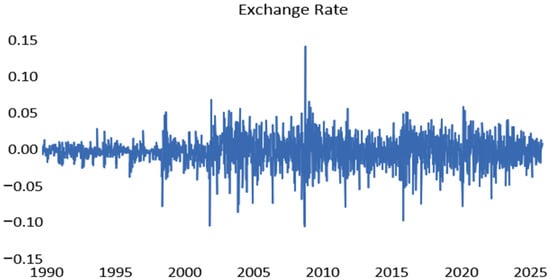
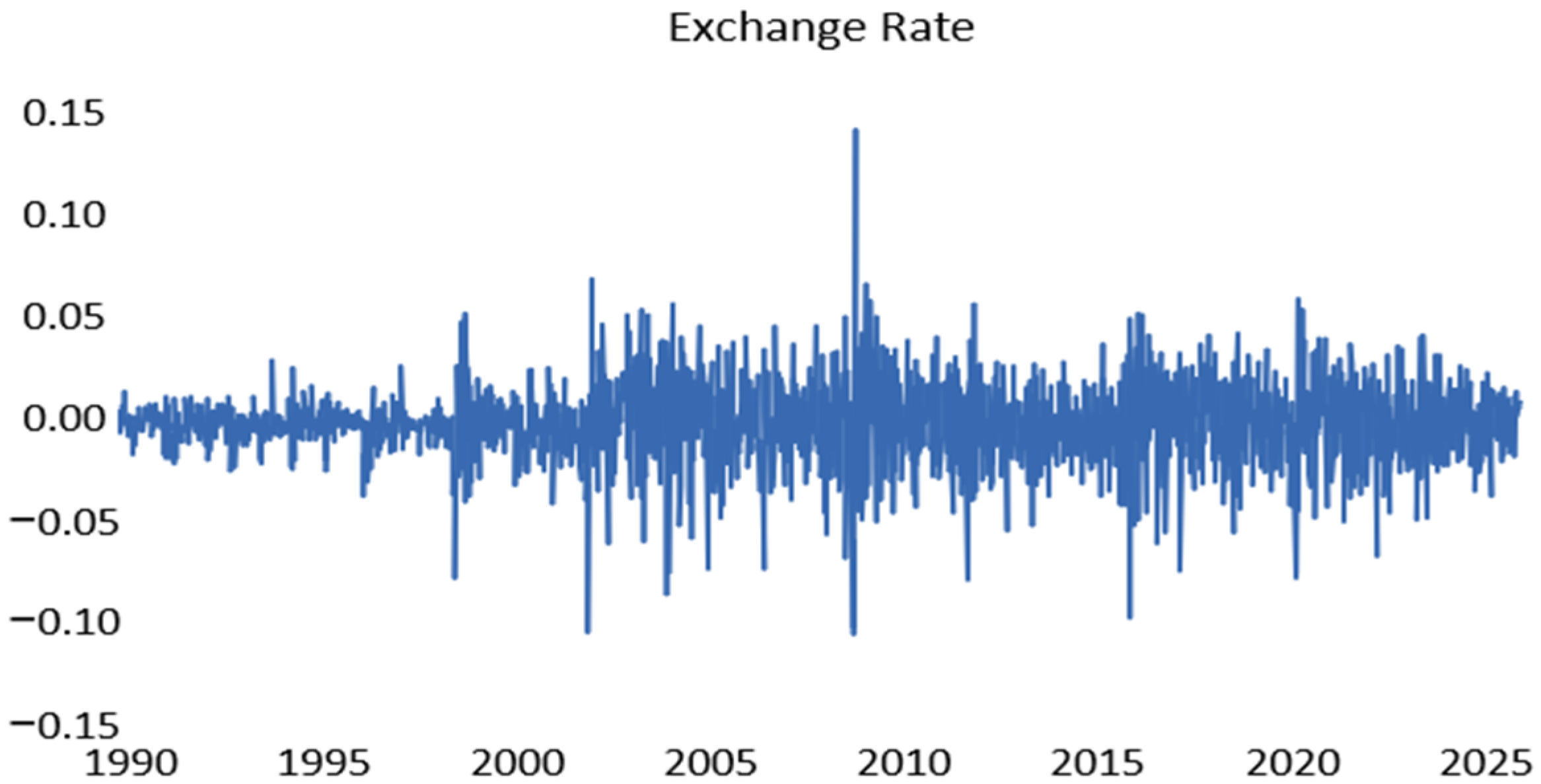
Figure 1 presents a graphical analysis of the volatility in exchange rate returns. The graph reveals significant fluctuations over time, indicating high volatility in exchange rate changes. Volatility clustering is evident, as periods of elevated volatility are followed by similar high volatility, while periods of low volatility tend to persist. This presence of volatility clustering supports the appropriateness of the EGARCH and PARCH models for this study, given their capability to capture both volatility clustering and heteroscedasticity. Additionally, an ARCH effect test will be conducted on exchange rate changes to further validate the presence of volatility.
Figure 1.
Graphical inspection of volatility. Source: authors’ results.
To formally test for the presence of the ARCH effect in exchange rate returns, an ARCH effect test was conducted using residual diagnostics (heteroskedasticity test). The results presented in Table 2 provide evidence of the ARCH effect in the exchange rate series. The null hypothesis of no ARCH effect is rejected, as the observed R-squared value of 94.78625 is statistically significant at the 5% level. This indicates that the variance of the exchange rate returns is time-varying and depends on past volatility. These findings further justify the application of the EGARCH and PARCH models in this study.
Table 2.
ARCH effect test for exchange rates. Source: authors’ results.
5.1. EGARCH and PARCH Model Results
This study estimated three specifications under both the EGARCH and PARCH models. The first model examines the combined impact of oil and gold prices on exchange rate volatility, while the second and third models isolate the effects of gold and oil prices, respectively. Specifically, the second model evaluates the relationship between exchange rate volatility and gold prices alone, whereas the third model focuses exclusively on the relationship between exchange rate volatility and oil prices. This will enable the study to provide a clearer and more nuanced understanding of both the joint and individual effects of commodity prices on exchange rate volatility in South Africa. Based on the Akaike, Schwarz, and Hannan–Quinn criteria, the EGARCH model with oil and gold prices included in both the mean and variance equations provides the best fit for the data. This indicates that oil and gold prices influence both the level of the South African exchange rate and its conditional volatility. As a result, this specification is employed as the preferred model for empirical analysis. The models are estimated using the EViews 14 software.
Table 3 presents the results of the mean equation for all estimated models. The specification of the mean equation was determined by examining the Autocorrelation Function (ACF) and Partial Autocorrelation Function (PACF) plots of the exchange rate return series. The correlogram indicated insignificant probability values for both ACF and PACF (see Appendix A). As a result, ARMA was not included in the mean equation. The study estimated EGARCH (2,1) and PARCH (2,2), as EGARCH (1,1) and PARCH (1,1) did not meet the post-diagnostic requirements. Starting with the gold returns, gold returns are positive and significant at all levels of significance across all models that include gold returns. This implies that increases in gold returns are associated with increases in exchange rate returns. Considering that the exchange rate is measured as the South African rand against the US dollar, the positive coefficient implies that a rise in gold prices is associated with a depreciation of the South African rand against the US dollar. On the other hand, oil returns are insignificant in all joint models and significant when considered independently. This suggests that oil returns’ effect on exchange rate returns is not robust when gold returns are included. Similarly, the positive coefficient of oil returns also implies that an increase in oil returns is associated with depreciation of the rand against the US dollar.
Table 3.
PARCH and EGARCH model results.
Table 4 below presents the variance equation results for all estimated models. The study included both gold returns and oil returns in the variance equation as exogenous variables to examine their effect on exchange rate volatility in South Africa. The PARCH models revealed a positive and significant ARCH (1) term across all three specifications of PARCH models. This suggests that previous shocks to exchange rate returns contribute significantly to current exchange rate volatility. The ARCH (2) term was found to be insignificant for PARCH models 1 and 2 and was significant for PARCH model 3. This implies that exchange rate volatility is also influenced by the shocks that occurred two periods earlier when oil prices are considered independently. Furthermore, all EGARCH models revealed a positive and significant ARCH (1) term at all levels of significance. This further confirms that previous exchange rate shocks significantly influence current exchange rate volatility. However, the ARCH (2) term was found to be insignificant across all EGARCH model specifications. This implies that there is no significant evidence that exchange rate shocks from two periods earlier influence exchange rate volatility.
Table 4.
EGARCH and PARCH variance equation results.
The GARCH (1) term was found positive and significant across all estimated models. However, the GARCH (2) term was found significant in PARCH models 1 and 2; other models did not include the GARCH (2) term. The estimated results indicate that exchange rate volatility is highly persistent. Specifically, all EGARCH and PARCH model 3 are the ones that show greater volatility persistence, as their estimates are close to unity. The asymmetry effect was also examined in exchange rate volatility. For the PARCH models, the first asymmetry term is statistically significant only in the oil-only specification and insignificant in PARCH models 1 and 2. However, the second asymmetry term is negative and statistically significant in all three PARCH models. This indicates that the volatility process contains significant asymmetric effects, implying that positive and negative exchange rate shocks do not have identical effects on subsequent volatility.
The EGARCH models revealed a statistically significant negative and positive asymmetry (1) and asymmetry (2), respectively. The negative coefficients of asymmetry (1) indicate that negative shocks exert a larger effect on exchange rate volatility than positive shocks of the same magnitude under the parameterisation of the EGARCH model. The exchange rate market responds differently to good and bad news.
In the PARCH models, results also show that gold returns have a positive and statistically significant effect on exchange rate volatility in both the joint and gold-only models at the 10% level of significance. This implies that a rise in gold returns is associated with an increase in exchange rate volatility. However, the coefficients of gold returns in EGARCH are statistically insignificant at all levels of significance in both the joint and gold-only models. Therefore, the EGARCH results do not provide sufficient statistical evidence that gold returns significantly influence ZAR/USD exchange rate volatility. On the other hand, oil returns are weaker, as their coefficients are small. In the PARCH models, the oil-return coefficients are −0.0036 in the combined model and −0.0031 in the oil-only model, and they are both insignificant at all levels of significance. This implies that there is insufficient evidence to conclude that oil returns significantly affect exchange rate volatility negatively under the PARCH specification. Similarly, in the combined EGARCH model, which is statistically insignificant. However, the oil-only EGARCH model showed statistically significant oil returns at the 10% level.
To address the potential structural break arising from the adoption of inflation targeting in South Africa, the study incorporated a dummy variable into each of the models estimated. The results revealed an insignificant dummy variable at all levels of significance across all the estimated models. Moreover, the signs and the significance of the coefficients of other explanatory variables remained the same after inclusion of the dummy variable. Consequently, the baseline models without the dummy variable are reported and discussed, as the results remain robust. Lastly, all PARCH model results revealed significant power parameter coefficients. The statistical significance of the power parameters also supports the use of the PARCH specification, as it indicates that the estimated power transformation contributes significantly to modelling the conditional volatility of the exchange rate.
5.2. Discussion of Results
The results presented in Table 3 represent the estimated PARCH and EGARCH mean and variance equation results. The coefficients measure the effect of gold and oil returns on the percentage change in the South African rand/US dollar exchange rate. In the mean equation, gold returns positively and significantly influence exchange rate returns. This suggests that an increase in gold returns is associated with a depreciation of the SA rand against the US dollar. The positive coefficient of gold prices is not consistent with the commodity currency hypothesis, which posits that countries’ currencies tend to move in the same direction as the price of the commodity that they export the most (Y. C. Chen & Lee, 2014). Given that SA is a major gold exporter, an increase in international gold prices should be associated with Rand appreciation due to increased export earnings. This may be because gold is often regarded as a safe-haven asset, and during times of global uncertainty, investors tend to buy more gold, driving up gold returns (Sanusi & Kapingura, 2022). However, at the same time, investors withdraw their investments, such as bonds, in emerging markets. This simultaneous outflow of funds and increase in gold prices may lead to Rand depreciation regardless of rising gold returns.
On the other hand, oil returns were found insignificant in all joint models and significant only when considered independently. This suggests that oil returns’ effect on exchange rate returns is not robust when gold returns are included. Similarly, the positive coefficient of oil returns also implies that an increase in oil returns is associated with depreciation of the rand against the US dollar. The positive coefficient of oil returns is consistent with the commodity currency hypothesis, as SA is a net importer of crude oil. An increase in international oil prices increases import costs and influences the country’s trade balance, consequently leading to the depreciation of the rand. This finding is consistent with Hlongwane (2022) and Hlongwane et al. (2022), who reported that increases in oil prices are associated with depreciation of the South African rand. Likewise, Salisu et al. (2021) found that oil-importing BRICS economies, including South Africa, experience currency depreciation following increases in oil prices.
Moving to the variance equation, the estimated coefficients analyse the volatility in exchange rate returns. The PARCH model results indicated a significant positive coefficient for gold returns on exchange rate volatility at the 10% level of significance in both the combined model and the gold-only model. This suggests that the gold market, which is economically important given South Africa’s status as a net gold exporter, is associated with increases in exchange rate volatility. These findings align with those of Mpofu (2021) and Rashid and Basit (2021), who reported a positive relationship between gold price volatility and exchange rate volatility using ARDL and GARCH models. In contrast, the EGARCH model results revealed the insignificant effect of gold returns on exchange rate volatility in both the joint and gold-only models. The empirical results indicate that the effect of gold returns on ZAR/USD exchange rate volatility depends on the volatility model adopted. Gold returns have a statistically significant positive effect under the PARCH model, but this effect is statistically insignificant under the EGARCH model.
Consequently, the PARCH model revealed a weak, insignificant negative effect of oil returns on exchange rate volatility in both the combined model and the oil-only model. This indicates that oil returns do not have a significant impact on exchange rate volatility. This contrasts with studies by Hlongwane (2022), Donkor et al. (2022), Korley and Giouvris (2022), and Salisu et al. (2021), which found that oil prices significantly affect the exchange rates of oil-importing countries. Umoru et al. (2023a) also noted that oil-importing countries tend to experience higher exchange rate volatility in response to oil price changes compared to oil-exporting economies. This might be caused by the SARB policy of protecting the value of the currency through protective measures against external shocks on the exchange rate using the monetary inflation-targeting policy. Similarly, the EGARCH combined model also showed a weak, negative, insignificant effect of oil returns on exchange rate volatility. This result is consistent with the findings of Igbinovia and Ogiemudia (2021) in Nigeria, who reported a negligible influence of oil prices on exchange rate volatility. However, the EGARCH model that only includes the oil returns revealed a significant effect of oil returns on exchange rate volatility at the 10% level of significance. The coefficient of oil returns remains negative across all the estimated models.
5.3. Post-Diagnostic Tests
5.3.1. Title ARCH Effects Test
To verify the validity of the PARCH and EGARCH model results, an ARCH effects test should be conducted following model estimation to test if there are no remaining ARCH effects. The ARCH effect test results presented in Table 5 indicate that the p-values for both the F-statistics and the ObsR-squared are greater than the 5% significance level. As a result, we fail to reject the null hypothesis of no ARCH effects in the residuals in both models. This suggests that the PARCH and EGARCH models have effectively captured the volatility clustering in exchange rate changes. The absence of remaining ARCH effects in the residuals confirms the robustness and validity of the model estimates.
Table 5.
Model 1 ARCH test after estimation. Source: authors’ results.
5.3.2. Analysis of GED Parameters
The study estimated all PARCH models under the GED assumption. For the EGARCH models, only models 1 and 3 were estimated using GED, while model 2 was estimated using Student’s t-distribution. This is because the estimation under the normal distribution failed to meet the normality test. This outcome is common in financial time series data, which often exhibit excess kurtosis and heavy tails. Table 6 shows that the estimated GED parameters are 1.4216 and 1.4163, and they are both significant at the 1% level of significance. Furthermore, the estimated GED parameters for other models, which are not reported here, were also found to be statistically significant at all levels of significance. This suggests that the distribution of the standardised residuals exhibits heavier tails than the normal distribution. Therefore, the utilisation of the GED is appropriate and provides a better fit for the models. The normality test results for the remaining models are provided in Appendix A.
Table 6.
GED parameters for PARCH and EGARCH model 1.
5.3.3. Sign-Bias Test
The sign-bias test of Engle and Ng (1993) was employed to evaluate whether the estimated models adequately captured the asymmetric volatility. The results presented in Table 7 indicate that both models adequately capture the leverage effects, as the joint-biased statistics are not significant at any level of significance. However, there is weak evidence of remaining positive bias for both models. This implies that the PARCH model 1 and EGARCH model 1 slightly under-capture how positive shocks affect exchange rate volatility. However, the model is acceptable, as the joint-bias test is insignificant at all levels of significance in both models.
Table 7.
Sign-bias test. Source: authors’ results.
5.3.4. Autocorrelation Test
The autocorrelation test was conducted for all estimated models to ensure adequacy of the model specification. Post-estimation diagnostic tests revealed that all models do not suffer from serial correlation, as the correlogram Q-statistics indicated insignificant p-values (see Appendix A).
5.3.5. Diagnostic Tests for Other Models
The diagnostic tests for other PARCH and EGARCH models were conducted accordingly and provided in Appendix A. The ARCH effect tests confirmed the absence of remaining ARCH effects after model estimation, implying that the EGARCH and PARCH models have effectively captured all volatility clustering in the exchange rate. However, the PARCH model 3 ARCH effect test indicated significant probability values at the 10% level of significance. This indicates weak evidence of remaining ARCH effects at the 10% level of significance. Similar to PARCH and EGARCH model 1, the Engle–Ng sign-bias tests for PARCH models 2 and 3 and EGARCH models 2 and 3 indicated the presence of positive sign bias at the 10% level of significance. This implies that there is remaining weak evidence of misspecification related to positive shocks. However, the joint-bias tests remain insignificant, indicating that the overall specification remains adequate.
6. Conclusions and Policy Recommendations
This study employed the PARCH and EGARCH models to examine the impact of commodity price volatility on exchange rate volatility in South Africa using weekly time-series data covering the period from 1989 to 2025. Three alternative specifications were estimated for each model: a model including both oil and gold returns, a gold-only model, and an oil-only model. The empirical results indicate that gold returns exert a statistically significant positive effect on ZAR/USD exchange rate returns across all model specifications. However, the variance equation showed that gold returns only significantly influence exchange rate volatility in the PARCH model at a 10% level of significance, and it becomes insignificant in the EGARCH model results. This indicates that the effect of gold returns on exchange rate volatility is model-dependent.
On the other hand, oil returns are statistically significant in the model that only includes oil returns but insignificant in the model that includes both oil and gold returns in the mean equation. In the variance equation, the results for oil are weaker, as oil returns are statistically insignificant in all PARCH models and in the combined EGARCH model. Although the oil-only EGARCH model reports a negative and statistically significant coefficient at the 10% level, this effect is not consistently observed across the alternative specifications. Therefore, the study does not find robust evidence of a systematic effect of oil returns on South African exchange rate volatility.
This finding further indicates that shocks to exchange rate volatility dissipate slowly and continue to influence future exchange rate movements over an extended period. Such persistence highlights the susceptibility of the South African foreign exchange market to prolonged periods of uncertainty following external shocks. The significant asymmetry parameters in the EGARCH models suggest that positive and negative exchange rate shocks do not exert the same influence on exchange rate volatility. This indicates that the South African foreign-exchange market responds differently depending on the direction of the shock. Overall, the findings highlight that oil and gold returns should not be viewed as the sole determinants of South African exchange rate volatility. Although PARCH results show a positive and significant relationship between gold returns and exchange rate volatility at a 10% level of significance, the absence of a significant relationship under EGARCH indicates that this relationship is not robust across alternative volatility models.
Based on the empirical findings, the study recommends that policymakers closely monitor developments in international gold markets, given the significant influence of gold returns on exchange rate volatility in South Africa under the PARCH model. Regular monitoring of global gold price movements would enable the timely implementation of appropriate monetary and macroprudential policy responses aimed at mitigating excessive volatility in the South African rand. Recognising that international gold prices are determined largely by global market forces and therefore lie beyond the direct control of domestic authorities, the study further recommends strengthening external resilience through the accumulation and prudent management of foreign exchange reserves. Adequate reserve buffers can enhance the South African Reserve Bank’s capacity to absorb external shocks, moderate excessive exchange rate fluctuations, and maintain confidence in the domestic currency during periods of heightened commodity price volatility.
In addition, the study advocates the implementation of export diversification strategies to reduce South Africa’s dependence on gold exports. Expanding the production and export of non-gold and higher-value-added goods would lessen the economy’s exposure to commodity price shocks, thereby reducing the sensitivity of the exchange rate to fluctuations in international gold prices. Such diversification would also enhance export competitiveness and strengthen long-term economic resilience. Furthermore, the study recommends leveraging the opportunities presented by the African Continental Free Trade Area (AfCFTA) to broaden South Africa’s export base and strengthen the resilience of the external sector. Increased participation in regional value chains and expanded access to African markets would enable South African firms to diversify both their export products and destination markets. Over time, this strategy could reduce the concentration of export earnings in a few commodities, improve the stability of foreign exchange inflows, and contribute to greater stability of the rand.
7. Limitations of the Study
Although the study made policy recommendations, we acknowledge its limitations. Firstly, the study attempts to address the potential problem of structural breaks, which might be caused by the adoption of inflation targeting in South Africa, by incorporating a dummy variable into the model. However, the dummy variable was insignificant across all estimated models, and the signs and significance of other study variables remained the same, although the coefficients changed slightly. Secondly, the study only focused on the effect of oil and gold returns and did not include other commodities that might play a significant role in the analysis of exchange rate volatility. Lastly, the study used ZAR/USD rather than the Nominal Effective Exchange Rate (NEER), which might provide a broader perspective on exchange rate volatility. Therefore, future studies must try to address the problem of structural breaks in another approach, incorporate more commodities, and use another proxy to measure the exchange rate.
Author Contributions
Conceptualization, L.N., B.P.M. and S.Z.; methodology, L.N. and S.Z.; software, S.Z.; validation, B.P.M. and S.Z.; formal analysis, L.N.; investigation, L.N.; resources, B.P.M. and S.Z.; data curation, L.N. and S.Z.; writing—original draft preparation, L.N.; writing—review and editing, B.P.M.; visualization, L.N.; supervision, B.P.M. and S.Z.; project administration, B.P.M. and S.Z. All authors have read and agreed to the published version of the manuscript.
Funding
This research received no external funding.
Institutional Review Board Statement
Ethical approval was not required for this study because the research relied exclusively on publicly available secondary data and did not involve human participants, personal information, or direct interaction with research subjects. The study was conducted in accordance with the applicable institutional research ethics guidelines and principles of responsible research conduct.
Informed Consent Statement
Not applicable.
Data Availability Statement
This study used secondary data available at https://www.investing.com/. Gold Spot US Dollar—XAU USD Historical Data—Investing.com (https://www.investing.com/currencies/xau-usd-historical-data, accessed on 3 August 2026); Crude Oil WTI futures—Crude Oil Futures Price Today (WTI)—Investing.com (https://www.investing.com/commodities/crude-oil, accessed on 3 August 2026); SA Rand against the US Dollar—ZAR USD|South African Rand US Dollar—Investing.com (https://www.investing.com/currencies/zar-usd, accessed on 3 August 2026).
Conflicts of Interest
This research and the authors have no conflict of interest.
Appendix A
Table A1.
ARCH-LM test for PARCH models 2 and 3.
Table A2.
ARCH-LM test for EGARCH models 2 and 3.
Table A3.
PARCH sign-bias test for models 2 and 3.
Table A4.
EGARCH sign-bias test for models 2 and 3.
Table A5.
Autocorrelation test for PARCH model 1.
Table A6.
Autocorrelation test for PARCH model 2.
Table A7.
Autocorrelation test for PARCH model 3.
Table A8.
Autocorrelation test for EGARCH model 1.
Table A9.
Autocorrelation test for EGARCH model 2.
Table A10.
Autocorrelation test for EGARCH model 3.
Table A11.
GED parameters for remaining models.
References
- Amano, R. A., & Van Norden, S. (1998). Oil prices and the rise and fall of the US real exchange rate. Journal of International Money and Finance, 17(2), 299–316. [Google Scholar] [CrossRef] [Scilit]
- Barguellil, A., Ben-Salha, O., & Zmami, M. (2018). Exchange rate volatility and economic growth. Journal of Economic Integration, 33(2), 1302–1336. [Google Scholar] [CrossRef] [Scilit]
- Chen, Y., Xu, J., & Hu, M. (2022). Asymmetric volatility spillovers and dynamic correlations between crude oil price, exchange rate and gold price in BRICS. Resources Policy, 78, 102857. [Google Scholar] [CrossRef] [Scilit]
- Chen, Y. C., & Lee, D. (2014). What makes a commodity currency. Department of Economics, University of Washington. [Google Scholar]
- Ding, Z., Granger, C. W., & Engle, R. F. (1993). A long memory property of stock market returns and a new model. Journal of Empirical Finance, 1(1), 83–106. [Google Scholar] [CrossRef] [Scilit]
- Donkor, R. A., Mensah, L., & Sarpong-Kumankoma, E. (2022). Oil price volatility and US dollar exchange rate volatility of some oil-dependent economies. The Journal of International Trade & Economic Development, 31(4), 581–597. [Google Scholar] [CrossRef] [Scilit]
- Dornbusch, R. (1985). Purchasing power parity. In The new Palgrave dictionary of economics. Palgrave Macmillan. [Google Scholar]
- Engle, R. F., & Ng, V. K. (1993). Measuring and testing the impact of news on volatility. The Journal of Finance, 48(5), 1749–1778. [Google Scholar] [CrossRef]
- Hlongwane, N. W. (2022). The relationship between oil prices and exchange rates in South Africa. Munich Personal RePEc Archive, North-West University. [Google Scholar]
- Hlongwane, N. W., Daw, O. D., Shogole, L., & Ribese, S. (2022). Exchange rate volatility and oil prices in South Africa. International Journal of Energy Economics and Policy, 12(3), 315–322. [Google Scholar] [CrossRef] [Scilit]
- Igbinovia, L. E., & Ogiemudia, O. A. (2021). Oil price and exchange rate volatility in Nigeria. Oradea Journal of Business and Economics, 6(1), 74–86. [Google Scholar] [CrossRef] [Scilit]
- Korley, M., & Giouvris, E. (2022). The impact of oil price and oil volatility index (OVX) on the exchange rate in Sub-Saharan Africa: Evidence from oil importing/exporting countries. Economies, 10(11), 272. [Google Scholar] [CrossRef] [Scilit]
- Kumeka, T. T., Uzoma-Nwosu, D. C., & David-Wayas, M. O. (2022). The effects of COVID-19 on the interrelationship among oil prices, stock prices and exchange rates in selected oil exporting economies. Resources Policy, 77, 102744. [Google Scholar] [CrossRef] [Scilit] [PubMed]
- Mhlongo, T. H., & Olaomi, J. O. (2021). Dynamic linkage amongst oil, gold, exchange rates and stock markets in Africa: Evidence from volatility of major African economies [Master’s thesis, University of South Africa]. [Google Scholar]
- Mpofu, T. R. (2021). The determinants of real exchange rate volatility in South Africa. The World Economy, 44(5), 1380–1401. [Google Scholar] [CrossRef] [Scilit]
- Nelson, D. B. (1991). Conditional heteroskedasticity in asset returns: A new approach. Econometrica: Journal of the Econometric Society, 59, 347–370. [Google Scholar] [CrossRef] [Scilit]
- Olamide, E., Ogujiuba, K., & Maredza, A. (2022). Exchange rate volatility, inflation and economic growth in developing countries: Panel data approach for SADC. Economies, 10(3), 67. [Google Scholar] [CrossRef] [Scilit]
- Rashid, A., & Basit, M. (2021). Empirical determinants of exchange-rate volatility: Evidence from selected Asian economies. Journal of Chinese Economic and Foreign Trade Studies, 15(1), 63–86. [Google Scholar] [CrossRef] [Scilit]
- Salem, L. B., Zayati, M., Nouira, R., & Rault, C. (2024). Volatility spillover between oil prices and main exchange rates: Evidence from a DCC-GARCH-connectedness approach. Resources Policy, 91, 104880. [Google Scholar] [CrossRef] [Scilit]
- Salisu, A. A., Cuñado, J., Isah, K., & Gupta, R. (2021). Oil price and exchange rate behaviour of the BRICS. Emerging Markets Finance and Trade, 57(7), 2042–2051. [Google Scholar] [CrossRef] [Scilit]
- Sanusi, K. A., & Kapingura, F. M. (2022). On the relationship between oil price, exchange rate and stock market performance in South Africa: Further evidence from time-varying and regime switching approaches. Cogent Economics & Finance, 10(1), 2106629. [Google Scholar] [CrossRef] [Scilit]
- Singhal, S., Choudhary, S., & Biswal, P. C. (2019). Return and volatility linkages among international crude oil price, gold price, exchange rate and stock markets: Evidence from Mexico. Resources Policy, 60, 255–261. [Google Scholar] [CrossRef] [Scilit]
- South African Reserve Bank (SARB). (2024). Annual report 2023/24. South African Reserve Bank. Available online: https://resbank.onlinereport.co.za/2024/ (accessed on 9 July 2025).
- Umoru, D., Effiong, S. E., Okpara, E., Eke, R. I., Iyayi, D., Nwonu, C. U., Obemeghie, M. A., Tizhe, A. N., & Eshemogie, K. (2023a). Oil-exchange rate volatilities and returns nexus. Corporate Governance and Organizational Behavior Review, 7(2), 325–337. [Google Scholar] [CrossRef] [Scilit]
- Umoru, D., Effiong, S. E., Ugbaka, M. A., Akhor, S. O., Iyaji, D., Ofie, F. E., Ihuoma, C. C., Okla, E. S., & Obomeghie, M. A. (2023b). Modelling and estimating volatilities in exchange rate return and the response of exchange rates to oil shocks. Journal of Governance and Regulation, 12(1), 185–196. [Google Scholar] [CrossRef] [Scilit]
- Wang, Y., Geng, X., & Guo, K. (2022). The influence of international oil price fluctuation on the exchange rate of countries along the “Belt and Road”. The North American Journal of Economics and Finance, 59, 101588. [Google Scholar] [CrossRef] [Scilit]

Disclaimer/Publisher’s Note: The statements, opinions and data contained in all publications are solely those of the individual author(s) and contributor(s) and not of MDPI and/or the editor(s). MDPI and/or the editor(s) disclaim responsibility for any injury to people or property resulting from any ideas, methods, instructions or products referred to in the content. |
© 2026 by the authors. Licensee MDPI, Basel, Switzerland. This article is an open access article distributed under the terms and conditions of the Creative Commons Attribution (CC BY) license.