


Abstract
This article develops the concept of cognitive infrastructure to capture a dimension of institutional performance that the incentive-focused tradition in institutional economics has largely neglected. Cognitive infrastructure comprises three dimensions: a stable unit of account, traceable causal links, and correctable feedback loops. When inflation reaches extreme levels, it destroys these conditions, dissolving the capacity of economic agents to perceive causal connections between their actions and their outcomes. Applying this framework to Javier Milei’s Argentine reform program, the article draws on Hayek and Eucken to show how monetary stabilization, deregulation, and currency competition restore the cognitive conditions for economic calculation, and on Popper and Soros to identify a structural tension this reconstruction generates. The cognitive infrastructure the reforms seek to rebuild is depoliticized in its ideal form. Its reconstruction has nevertheless been pursued through highly personalized political methods that may themselves reintroduce the unpredictability the framework is designed to eliminate. This tension, the article argues, is a structural feature of post-collapse institutional reconstruction that the open society tradition has not adequately theorized.
1. Introduction
In October 2023, as Argentines prepared to vote in the first round of a presidential election, the annual inflation rate reached 142.7 percent (Heinisch et al., 2024, p. 8). The figure is an abstraction. Its lived reality is the disintegration of the institutional conditions that enable economic agents to perceive causal connections between their actions and their outcomes. When prices shift unpredictably, they cease to transmit information. The link between effort and reward dissolves. Economic calculation becomes impossible. These conditions constitute what this article terms the collapse of cognitive infrastructure. The concept designates the institutional preconditions that enable economic agents to trace consequences back to decisions and to learn from error. When this infrastructure collapses, economic life loses the capacity to distinguish between a mistake and bad luck.
The institutional economics tradition has focused overwhelmingly on the incentive function of institutions. Scholars from Douglass North to Daron Acemoglu have analyzed how institutions lower transaction costs and channel self-interest toward productive activity (Acemoglu et al., 2001, pp. 1369–1370; North, 1990, pp. 3–5). This focus has generated powerful explanations of divergent development paths, but it leaves a prior question unexamined: what institutional conditions enable economic agents to form accurate beliefs about causal relationships in the first place? An institution can provide sound incentives while simultaneously impairing the cognitive conditions for economic calculation.
Recent work has begun to address this gap. Denzau and North’s shared mental models framework explains how agents construct interpretations of their environment under strong uncertainty (Denzau & North, 1994, pp. 3–4). Mantzavinos et al. analyze learning as the engine of institutional change through environmental feedback (Mantzavinos et al., 2004, pp. 76–77). Petracca and Gallagher, along with Kuchař, argue that markets function as cognitive institutions that scaffold economic reasoning (Kuchař, 2025, pp. 10–12; Petracca & Gallagher, 2020, p. 759). Vernon Smith distinguishes between the causal motives of action and the consequential outcomes that standard models prioritize (Smith, 2020, pp. 342–345). This article builds on these contributions but addresses a question they have not directly confronted. The shared mental models tradition assumes that agents operate within a learning environment where feedback, however imperfect, is available. None of these accounts systematically examines what happens when the learning environment itself is destroyed. When the monetary unit becomes a source of noise, and regulatory interventions sever causal links, the feedback signals required for learning become unintelligible. The distinction between a bad decision and a hostile environment dissolves.
The open society tradition, originating with Popper and developed by Hayek, comes closer to the problem. Popper defined the open society as one that “sets free the critical powers of man” (Royer, 2023, p. 466), characterized by “the degree of institutionalized critical scrutiny of political and societal practices” (Weinert, 2025, p. 1). Its commitments are procedural: piecemeal reform, falsifiable policies, corrigible decisions (Ingrams, 2020, pp. 322–323; Notturno, 2018, p. 19). What the tradition leaves implicit is that these commitments share a precondition. Critical scrutiny requires an intelligible economic world. Prices must convey information. Effort must be meaningful. If this precondition is destroyed, can it be reconstructed?
Javier Milei’s Argentine experiment provides a case for examining this question. Milei inherited an economy in which cognitive conditions had been dismantled by decades of inflationary financing and regulatory volatility. His response was a simultaneous program of monetary stabilization, regulatory abolition, and currency competition. The existing literature on Milei has been preoccupied with political classification: framing him as an authoritarian populist (Gervasoni, 2025, p. 161; Reis, 2025, pp. 15–17), a “tech-solutionist” (Borisonik, 2025, p. 1), representing “managerial populism” (Del Pino Díaz, 2024, pp. 13–14), or a hybrid “libertarian populist” (Heinisch et al., 2024, pp. 12–13), who is “populist enough to mobilize anger, but libertarian enough to unsettle Argentina’s entrenched Peronist/anti-Peronist divide” (Merke, 2026, p. 3). These categories describe his political style but do not explain the institutional problem his reforms address. They do not explain what connects abolishing the central bank’s monopoly, dismantling the regulatory state, and legalizing currency competition.
Semán and Welschinger come closest to this dimension. They identify an emergent political subjectivity among Milei’s base: mejorismo. This orientation is grounded in the impossibility, under chronic inflation, of understanding the relationship between effort and reward (Semán & Welschinger, 2025, pp. 494–495). This sociological insight points toward the cognitive dimension of Argentina’s crisis, but it lacks a theoretical framework. This article develops such a framework. It argues that Milei’s reform can be reconstructed as an attempt to repair the cognitive infrastructure of economic action. It further argues that this reconstruction encounters a structural tension that the open society tradition has not theorized: the political method of depoliticization may itself reintroduce the unpredictability that the cognitive framework is designed to eliminate. Section 2 develops the concept and its three dimensions. Section 3 analyzes monetary stabilization. Section 4 examines deregulation. Section 5 reconstructs currency competition. Section 6 identifies the reflexivity trap.
2. The Cognitive Functions of Institutions
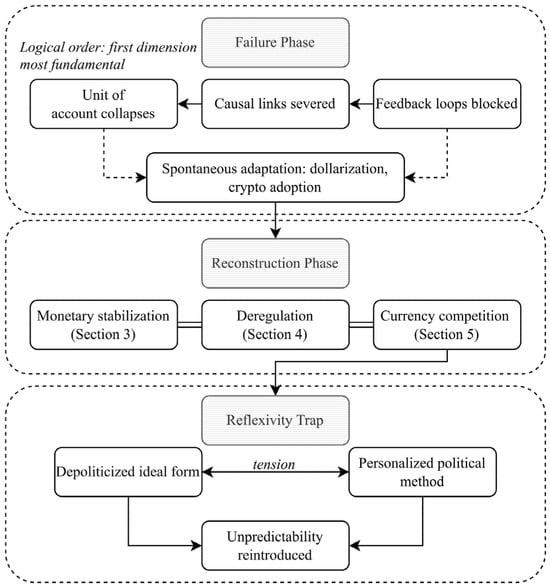
Figure 1 presents the argument’s overall structure: the failure phase, the reconstruction phase, and the tension the reconstruction generates.
Figure 1.
The dynamics of cognitive infrastructure failure and reconstruction.
The institutional economics tradition provides powerful explanations of why some societies prosper. Its core insight is that institutions shape incentives. Secure property rights encourage investment; competitive markets reward efficiency (North, 1990, pp. 3–5). Acemoglu et al. extended this framework, showing that differences between “inclusive” and “extractive” institutions are the cause of divergent outcomes (Acemoglu et al., 2001, pp. 1369–1370). This article does not dispute the importance of the incentive function. It argues that it is incomplete. Institutions also perform a cognitive function. They enable economic agents to perceive causal connections, trace consequences back to decisions, and detect error.
An institution can provide sound incentives while impairing cognitive conditions. A subsidy regime may successfully incentivize production at an acceptable fiscal cost. By distorting relative prices, however, it impairs the capacity of agents to perceive the real structure of scarcity. The incentive function succeeds, but the cognitive function fails. Vernon Smith’s experimental work illustrates this distinction. He shows that agents do not simply update on outcomes; their behavior is shaped by the models through which they interpret the situation (Smith, 2020, p. 345). Drawing on Adam Smith’s Theory of Moral Sentiments, the cognitive function of institutions concerns what agents can perceive and learn before any question of optimality arises (Smith, 2020, pp. 352–353).
The concept of cognitive infrastructure builds on recent work exploring the cognitive dimensions of institutions. Petracca and Gallagher define “cognitive institutions” as institutions without which some cognitive processes would not exist (Petracca & Gallagher, 2020, p. 747). Kuchař extends this to market competition, arguing that markets function as socially extended cognitive systems (Kuchař, 2025, pp. 10–12). The term “infrastructure” is used here in its functional sense, designating the conditions of operation. It does not imply that these arrangements are politically neutral. The cognitive function is a product of political contestation and can be deliberately degraded or repaired. This usage differs from structuration-theoretic accounts that emphasize the recursive interplay of agency and structure (Giddens, 1984, pp. 25–28) and morphogenetic approaches that distinguish analytically between structure, agency, and culture (Archer, 1995, pp. 165–168). Its distinctive contribution lies in specifying the dimension of institutional performance that concerns the intelligibility of economic action.
Cognitive infrastructure has three constitutive dimensions, logically ordered. The first is a stable unit of account. Economic calculation requires a value referent that does not fluctuate unpredictably. When the monetary unit is unstable, intertemporal comparisons become impossible, and profit and loss become ambiguous. Experimental evidence shows that different currency denominations affect price expectations, introducing perceptual noise that increases uncertainty (Ferrari & Lozza, 2005, pp. 320–321; Lunn & Duffy, 2015, pp. 1–2).
The second dimension is traceable causal links. Agents must be able to connect decisions to outcomes. Regulatory interventions sever these connections, breaking the learning process. Price controls, for example, prevent producers from observing the relationship between supply and market returns. The third dimension is correctable feedback loops. Even when causality is traceable, agents must have the capacity to act. Institutional rigidities that prevent adjustment render error detection useless.
These dimensions are interdependent and empirically observable through their consequences. A stable unit of account is reflected in the dispersion of relative prices and the gap between official and parallel exchange rates. Traceable causal links are reflected in the responsiveness of supply to price changes. Correctable feedback loops are reflected in the speed with which agents adjust production and entry. If monetary stabilization and deregulation restore these dimensions, these indicators should move in the predicted direction. If they do not, the framework’s application to Argentina is weakened.
This framework is further specified by Michel Aglietta’s typology of trust. Aglietta distinguishes three layers of confidence sustaining a monetary order: ethical, hierarchical, and routine (Olk, 2025, p. 1158). A stable unit of account depends on all three. When routine confidence erodes through inflation, agents lose the capacity to form reliable expectations. When hierarchical confidence erodes through currency manipulation, agents lose trust in the issuer. When ethical confidence erodes through expropriation, agents lose normative commitment to the monetary order. The Argentine case exhibits the sequential failure of all three.
The failure of cognitive infrastructure produces a syndrome of cognitive collapse with three indicators. First is the compression of temporal horizons. As Perelman observes of Argentine inflation, “the perception of time is transformed: as money rapidly loses its value, people try to make decisions quickly in relation to the near future” (Perelman, 2024, p. 54). Second is the transformation of price signals into noise; prices become artifacts of monetary expansion and no longer guide allocation. Third is the decoupling of effort from reward. Semán and Welschinger capture this in the frustration of young voters at “not being able to make their personal efforts yield the results of previous generations” (Semán & Welschinger, 2025, pp. 494–495).
This cognitive dimension has precursors in earlier social thought. Weber identified rational calculation, embodied in double-entry bookkeeping and predictable legal adjudication, as constitutive of modern capitalism (Weber, 2012, pp. 122, 156–159; 2023, p. 167). Keynes acknowledged that the knowledge base for investment is “very slight and often negligible” (Keynes, 1936, pp. 149–150), causing agents to fall back on “animal spirits” when uncertainty is extreme (Barnett, 2017, p. 383; Keynes, 1936, p. 161). Both understood that calculability is a fragile institutional achievement.
Friedrich Hayek provides the most direct precursor. He identified the “division of knowledge” as “the really central problem of economics as a social science” (Hayek, 1937, p. 49). The price system, he argued, solves this problem. It conveys “information… in coded form” so that “the competitive efforts of the market game secure the utilization of widely dispersed knowledge” (Hayek, 1990, pp. 136, 183, 237). Competition is “a procedure for discovering facts which, if the procedure did not exist, would remain unknown or at least would not be used” (Hayek, 2002, p. 9). However, Hayek analyzed the knowledge problem as a permanent condition. He devoted less attention to what happens when institutional degradation is so severe that it blocks cognitive functions entirely. This is the question Argentina faces.
Karl Popper’s epistemology provides a complementary starting point. Knowledge grows through conjecture and refutation, and the open society institutionalizes this method. But falsification requires a stable frame of reference. When the monetary unit is unstable and prices become noise, that frame dissolves. Hyperinflation produces cognitive closure. It dissolves the material that rational debate requires. Evaluable outcomes vanish, and correctable errors become impossible to identify.
The divergence between Hayek and Popper matters for the analysis that follows. Both inherited Hume’s critique of induction but drew opposite conclusions. Hayek accepted Hume’s limits of reason, requiring deference to evolved traditions. Popper rejected the retreat into habit, seeking to rescue reason through critical rationalism (Birner, 2014, pp. 9–10). This generates different standards for reform. By Hayek’s standard, the improvement of abstract rules is the proper object of reform. By Popper’s standard, reform should proceed through small, reversible changes testable as social experiments (Birner, 2014, p. 8). Milei’s experiment oscillates between these standards. The Hayekian dimension targets abstract rules. The Popperian dimension requires changes to be corrigible. The tension becomes visible when the scale of destruction rules out piecemeal approaches.
3. Monetary Stabilization and the Restoration of a Cognitive Frame of Reference
Section 2 identified a stable unit of account as the first dimension of cognitive infrastructure. In Argentina, by late 2023, annual inflation had reached 142.7 percent (Heinisch et al., 2024, p. 8), a figure that measures the disintegration of money’s capacity to function as a unit of account. This condition was the product of an institutional structure. Blejer argues that Argentina’s persistent inflation was a political survival strategy embedded in the Peronist social contract, linking organized labor and political mediation to a self-reinforcing inflationary dynamic (Blejer, 2025, pp. 14–18). Fiscal deficits required monetary emission. The resulting inflation functioned as a hidden tax on peso-denominated incomes, transferring purchasing power to the state.
Under this arrangement, the three layers of monetary confidence failed sequentially (Olk, 2025, p. 1158). Routine confidence was the first casualty, as the peso lost its capacity to serve as a yardstick for intertemporal comparison. Hierarchical confidence eroded as successive governments manipulated the currency for fiscal ends. Ethical confidence dissolved as money became a site of political expropriation. Olk describes the end state as a “permeated currency,” whose acceptance is contested even within its own territory (Olk, 2025, p. 1157).
Milei’s diagnosis of this condition is philosophically specific. His initial advocacy of full dollarization was moderated due to institutional limitations, and “he proposed a free-floating peso” instead (Zilla, 2024, p. 4). The core principle, however, remained constant: the value of money should be removed from the domain of political discretion. A standard stabilization program asks whether a given framework will produce lower inflation. Milei’s program asks a prior question: whether any framework that leaves the value of money subject to political decision can avoid reproducing the cognitive conditions that destroyed economic intelligibility.
This prior question belongs to the time-inconsistency literature. Kydland and Prescott showed that discretionary policy is time-inconsistent because private agents anticipate the temptation to create surprise inflation (Kydland & Prescott, 1977, pp. 473–474). Barro and Gordon demonstrated that reputational mechanisms support a rule only imperfectly (Barro & Gordon, 1983, pp. 101–102, 109–113). Rogoff showed that society can improve its position by delegating monetary authority to an agent with a stronger aversion to inflation (Rogoff, 1985, pp. 1169–1170, 1179–1180). These contributions establish the logic of commitment devices.
The cognitive infrastructure framework does not restate this logic; it extends it. Commitment devices are usually analyzed in terms of their effect on the inflation bias. Their cognitive effect is prior. A credible commitment to a non-discretionary rule removes the value of money from political bargaining. Once that removal is credible, agents can form expectations about the future value of the unit of account and test those expectations against outcomes. The unit of account becomes a stable frame of reference. The time-inconsistency literature explains why discretion produces inflation. The cognitive infrastructure framework explains why the resulting inflation destroys the conditions of economic learning.
This distinction maps onto a deeper philosophical one. Bentham’s utilitarianism concerns concrete calculations within a given framework, asking which policy produces the best outcomes (Bentham, 1948, pp. 1–2). Kant asked how ordered experience is possible in the first place, identifying a priori forms of intuition and categories of understanding as the preconditions for organizing experience (Kant, 2002, pp. 4, 85). The analogy with monetary stabilization is structural. A stable monetary framework is not a price. It is the condition under which prices can convey information rather than noise. The Kantian parallel clarifies why the depoliticization of money belongs to a different analytical level than the choice of a particular monetary policy (DiMaggio & Powell, 1983, pp. 147–149).
The open society tradition supplies the normative stakes. Critical scrutiny requires that members of society be able to account for their actions, a premise that presupposes agents can trace the consequences of their decisions. When inflation distorts calculation, this presupposition disappears. Monetary stability constitutes a guardrail of the open society. It prevents political power from manipulating the monetary yardstick, preventing a slide from an open society into a closed one (Esfeld, 2022, p. 5). It also gives Popperian critical rationalism an operational domain. A monetary framework that permits competitive testing satisfies the criterion of “intersubjective testability” (Shearmur, 1990, pp. 118–119). It makes loss a falsifiable proposition. An agent can say: I thought this would be profitable, and I was wrong.
An objection arises. If Milei’s monetary lock-in were based on sacred dogmas that accept no empirical testing, it would fall into the logic Popper critiqued in The Poverty of Historicism: treating a particular institution as the end of history (Popper, 1961, pp. 73, 128). However, what Milei’s reform prohibits is discretionary money creation, not the competitive testing of the monetary order itself. Currency competition allows participants to abandon the peso for alternatives. Milei’s framework proposes a depoliticized monetary order as a conjecture to be tested by economic performance (Watkins, 1997, p. 648).
The evidence through late 2026 is partially consistent with the framework’s expectations. Monthly inflation stood at 1.9 percent in September 2026, while annual inflation reached 33.4 percent and year-to-date inflation accumulated to 23.6 percent (Finanzas Digital, 2026). The gap between the official and parallel exchange rates narrowed to approximately 2.5 percent by late October 2026, after having touched a low of about 1.3 percent earlier in the month. A narrow parallel-market gap indicates that the price system is transmitting a single set of relative prices, which is what the framework predicts when the unit of account is stabilized. However, the persistence of annual inflation above 30 percent, contrary to earlier projections of single digits, confirms the framework’s own caveat: the restoration of the first dimension is a prolonged process, and initial stabilization does not guarantee immediate consolidation. The observable implications were satisfied in the period examined. They do not establish that the restoration is durable.
4. Deregulation and the Repair of Feedback Loops
Monetary stabilization addresses the first dimension. It does not ensure that agents can trace the consequences of their decisions back to those decisions. In Argentina, the second and third dimensions had been severed by regulatory intervention. Rent controls prevented owners from assessing the true return on their property. Foreign exchange restrictions blocked importers from calculating procurement costs. Each rule created a cognitive blind spot.
The structure of this regulatory failure can be clarified through Popper’s distinction between piecemeal and utopian engineering. The piecemeal engineer designs interventions to be reversible and corrigible, testing “model after model, continuously adjusting both his expectations and his machinery” (Lessnoff, 1980, p. 113). The utopian engineer claims an overall blueprint, making intervention irreversible. Argentina’s regulatory system was a paradigmatic case of the latter. Price control created scarcity; scarcity bred subsidies; subsidies entrenched the original distortion. The system devoured rationality through a blueprint that could hardly be withdrawn.
Milei’s deregulation dismantles the institutional obstacles that prevent learning. He halved the number of ministries and cut more than 33,000 public employees (Gervasoni, 2025, p. 145; Zilla, 2024, p. 6). These measures appear destructive through an administrative lens, but they remove the institutional noise that distorts feedback signals. Decree of Necessity and Urgency No. 70/2023 declared a public emergency, circumventing legislative procedures to drastically reduce state intervention (Gervasoni, 2025, p. 145).
The theoretical grounds lie in Hayek’s understanding of competition as a discovery procedure. Competition is “a procedure for discovering facts which, if the procedure did not exist, would remain unknown” (Hayek, 2002, p. 9). Prices are signals generated by countless individuals, not numbers set by bureaucrats. The price system’s significance lies in “the economy of knowledge with which it operates” (Hayek, 1945, pp. 526–527; see also Smith, 1982, p. 166). In Argentina, the knowledge problem took a destructive form: the feedback loops connecting decision to consequence had been severed at every point.
The most direct evidence of repair comes from the rental market. The repeal of the rental law in December 2023 removed restrictions that had led owners to withhold units. Elfert and Thomsen estimate the causal effect using a regression discontinuity design, finding a substantial revival of rental housing supply at the point of reform (Elfert & Thomsen, 2025, p. 8). They also find that nominal and real rents declined, contrary to expectations that removing price controls would produce sharp increases (Elfert & Thomsen, 2025, p. 9). Deregulation mobilized previously withheld units, absorbing excess demand and reconnecting the feedback loop between property decisions and market outcomes.
The financial system provides a further domain in which the feedback loop had been severed, and its omission from the original regulatory analysis would leave the cognitive argument incomplete. Financial intermediaries perform a function that is directly relevant to traceable causal links: they collect and process information about investment projects, and they allocate resources on the basis of that information (Konstantakopoulou, 2023, p. 1). When the system is shallow, this information function is impaired. Argentina’s private credit averaged approximately 16 percent of GDP between 1960 and 2024, and stood at roughly 13 percent in 2024 (Bebczuk et al., 2026, p. 2), far below the median of comparable economies. The near-disappearance of long-term peso credit impaired the traceability of returns. Fattal Jaef estimates that financial frictions of this magnitude impose a total factor productivity loss of about 13 percent (Jaef, 2019, pp. 1, 5–6). The deregulation program did not directly address financial depth. But the stabilization of the unit of account and the removal of the regulatory distortions that had crowded out private credit created conditions under which financial intermediation could begin to recover. The available data show that private credit has begun to expand from its historically low base, though it remains far below regional norms (BCRA, 2026, p. 20).
The repair of feedback loops is most visible in how deregulation returns the cognitive function of loss to society. In a functioning open society, loss functions as a cognitive right. When failure can be diluted by inflation, covered by subsidies, or bailed out by the central bank, the link between action and consequence is erased. Milei’s policies return loss to members of society. His governing premise is that every entrepreneur “is subject to consumer sovereignty,” and that “losses and profits depend purely and exclusively on the capacity and incapacity of the entrepreneur to adapt production to consumer demand” (Milei, 2022, pp. 162–163, Spanish in original). When state-owned enterprises’ losses are no longer automatically covered by taxpayers, loss transforms from an abstract number into concrete costs. When civil service positions cease to be risk-free, layoffs force people to confront their true opportunity costs. Hayek himself acknowledged that competition’s validity “can never be empirically verified,” since we cannot know in advance the facts we wish to discover through it (Hayek, 2002, p. 10). He insisted that the only permissible judgment is “from the bottom up,” comparing the market against what would be produced if competition were prevented (Hayek, 2002, p. 16). This is an epistemologically humble position. It does not claim the market is perfect. It claims that the market is the mechanism capable of systematically generating new knowledge. This restoration of loss as a cognitive signal is institutionalized through legal frameworks that enforce competition, such as the RIGI.
The Large Investment Incentive Regime (RIGI) illustrates the institutional dimension of this repair. Introduced in 2024, RIGI reduces corporate income tax from 35 to 25 percent, exempts capital goods imports from tariffs, and locks in preferential policies for 30 years with access to international arbitration. Over the preceding two decades, Argentine investment policy had been characterized by repeated changes in the fiscal treatment of mining exports (Marin et al., 2021, p. 47). This volatility made long-term economic calculation a gambler’s illusion. The grammar of RIGI is straightforward: the government offers to exchange self-constraint for investors’ trust. By late 2025, projects submitted under the regime totaled approximately 33.9 billion US dollars, of which about 15.7 billion had been approved (Panorama Minero, 2025, Section 1). These figures indicate investment intentions rather than completed investment. The cognitive significance lies in the design. The 30-year lock-in and the arbitration clause create a framework in which long-term returns can be calculated with reference to rules not subject to annual political revision. As Popper emphasized, “the problem of controlling the rulers, and of checking their powers, was in the main an institutional problem” (Popper, 1994, p. 339). RIGI binds the state to predictable rules, repairing the cognitive dimension of policy constancy.
The deregulation program finds its most systematic theoretical frame in Walter Eucken’s ordoliberalism. Eucken identified seven constitutive principles of a competitive order, including a functioning price system, the liability principle, and policy constancy (Eucken, 1992, pp. 83–86, 134–140, 171–176, 306–316). The liability principle ensures that economic agents bear the consequences of their own decisions rather than shifting losses onto taxpayers (Eucken, 1992, p. 316; Wörsdörfer, 2013, p. 302). It maps directly onto traceable causal links. Freedom of contract maps onto correctable feedback loops. Milei’s reforms map onto these principles. Abolishing price controls restores free prices. Halting subsidies to state-owned enterprises enforces the liability principle. RIGI’s 30-year lock-in exemplifies policy constancy.
This interdependence explains why shock therapy was chosen over gradualism. When all components of a system are already distorted, repairing one part at a time creates new tensions with unreformed sectors, generating pressure for reversal. Gradualism, under systemic distortion, can be self-defeating. Eucken’s framework provides the theoretical rationale for simultaneous reform. This reconnects to the Hayekian and Popperian standards. By Hayek’s standard, Milei’s alteration of abstract rules is justified. By Popper’s standard, simultaneous deregulation makes it difficult to isolate the specific contribution of each measure. This tension reappears in Section 6, where the reflexivity trap makes the Popperian concern more acute.
The cognitive function of loss must be distinguished from the moral claim of social Darwinism. Critics have charged that Milei’s radical rejection of social justice leads to a society in which the vulnerable are abandoned (Borisonik, 2025, p. 2; Fair, 2025, p. 97; Torme, 2022, pp. 62–65). This charge has force against Milei’s rhetoric, which occasionally echoes the Thrasymachean view that justice is whatever benefits the stronger. The epistemological reading developed here provides a different vantage point. Social Darwinism makes a moral claim: the strong deserve to prevail. The epistemological argument makes a cognitive claim: feedback must be legible for learning to occur. Milei’s rhetoric sometimes blurs this distinction. His policy practice, however, relies on legal structures to enforce competition, placing him closer to Hayek than to Rothbard. Hayek rejected “the dogmatism of the pure free market and recognizes the importance of having a legal framework to guarantee the effectiveness of competition” (Fair, 2025, p. 87). Likewise, Milei affirms the role of the minimal state as protector of the private sphere (Quiroga, 2025, p. 83).
The epistemological stakes of the deregulation project can now be stated precisely. Government regulation inserts a wedge into the causal chain connecting decisions to outcomes. Removing this wedge restores the cognitive conditions under which error can be seen and corrected. As Hayek insisted, “men will often achieve more than individual reason could design or foresee” (Hayek, 2012, p. 11; Vriend, 2002, p. 812). Popper shared this epistemological modesty: “The characteristic problems of the social sciences arise only out of our wish to know the unintended consequences” (Popper, 2002, p. 167). Milei’s deregulation can be given a unified interpretation: it repairs the mechanisms of decentralized trial-and-error learning.
5. Currency Competition and the Institutionalization of Spontaneous Adaptation
Section 3 and Section 4 analyzed the restoration of cognitive infrastructure through formal institutional reform. The Argentine case reveals a complication. Long before Milei’s reforms, economic agents had already begun to reconstruct their cognitive conditions through informal means. They had dollarized their savings and adopted cryptocurrencies at rates that placed Argentina among the world’s most active markets for digital assets (Rosales, 2026, p. 8). If agents were capable of learning under conditions of monetary collapse, does the framework’s emphasis on destroyed cognitive conditions overstate the severity of the problem?
The spontaneous dollarization of the Argentine economy is evidence for the framework, not against it. Ostrom’s distinction between formal rules and rules-in-use captures the dynamic. Formal rules designate the legal framework; rules-in-use designate the practices agents actually follow (Ostrom, 2005, p. 20). In Argentina, formal rules designated the peso as legal tender. Rules-in-use told a different story. Agents held savings in dollars, priced durable goods in dollars, and transacted through stablecoins pegged to the dollar. When the official unit of account becomes unusable, agents seek alternatives. The gap between formal rules and rules-in-use is itself a symptom of cognitive collapse.
Spontaneous adaptation could not institutionalize its own conditions. A dollarized savings account does not provide contract enforcement in dollars. A stablecoin transaction does not create a legal framework for currency competition. The informal dollar economy remained exposed to regulatory risk and political discretion (Olk, 2025, p. 1157). This leaves the economy in a state of monetary dualism. Contracts denominated in pesos are subject to different rules than those in dollars. Tax obligations are calculated in pesos while economic decisions are made in dollars. The result is a fragmented cognitive environment in which agents must translate between two incommensurable frames of reference.
Milei’s currency competition program resolves this fragmentation by institutionalizing the spontaneous adaptation. The proposal to abolish the central bank’s monetary monopoly transforms rules-in-use into formal rules. The dollar becomes a legal alternative rather than a parallel practice. This aligns the formal framework with actual practices, eliminating the translation costs that monetary dualism imposes. The cognitive frame within which agents calculate becomes the frame the legal system recognizes.
This reading connects Milei’s project to the shared mental models tradition. Institutional change occurs when shared mental models undergo punctuated shifts (Denzau & North, 1994, pp. 25–26). Entrepreneurs trigger such shifts by identifying inconsistencies between inherited ideological commitments and lived experience (Shughart et al., 2020, pp. 385–386). The inherited commitment was the Peronist monetary order, in which the peso symbolized national sovereignty and functioned as an instrument of distribution. The lived experience was the transformation of the peso into noise. Milei named the inconsistency and proposed the institutional alternative.
The cryptocurrency dimension of Argentine adaptation adds a further layer. During the initial phase of the crisis (2023–2024), trading volume in crypto assets exceeded 90 billion dollars, with over 11 million wallet holders (Rosales, 2026, p. 8). This adoption was driven by desperation rather than ideology. An exchange executive explained: “For Bitcoin and crypto, Argentina is the ideal ecosystem because it is a country with high inflation and decades of erosion of the trust of the traditional banking system and of institutions in general” (Rosales, 2026, p. 8). Most Argentine users treat cryptocurrencies as a complement to or replacement for US dollars (Luzzi & Sánchez, 2025, p. 471). Their preference for stablecoins far exceeds their interest in volatile Bitcoin. Their engagement “is primarily pragmatic, driven by a desire to address specific financial challenges” (Luzzi & Sánchez, 2025, p. 455). The pragmatic adoption of crypto assets confirms the cognitive diagnosis. When the official monetary framework fails, agents seek whatever instruments can restore their capacity to calculate. The choice of stablecoins over Bitcoin is itself revealing. Stablecoins peg to the dollar because the dollar, in the Argentine context, functions as the de facto unit of account. Crypto adoption is a means to access the dollar without going through the formal banking system.
This pragmatic adoption produced a further consequence that bears directly on the institutionalization question. The greatest advances occurred in services allowing access to convertible currencies. This pragmatic route led to recentralization. Exchanges like Decrypto and Lemon “played a leading role in integrating traditional payment systems like credit cards and online banking with cryptocurrencies,” with the result that “core values of decentralisation, anonymity, and anti-inflationary monetarism wither in the face of practicality and market expansion” (Rosales, 2026, p. 11). Spontaneous adaptation can restore the unit of account at the individual level. It cannot construct the institutional framework that makes the alternative monetary order stable and legally secure. Centralized exchanges emerged because they provided the regulatory interface that spontaneous adoption lacked. The institutionalization of currency competition is the necessary complement to spontaneous adaptation.
The comparative dimension extends beyond Argentina. Ecuador and El Salvador adopted the US dollar as legal tender following severe monetary instability (Connolly, 2025, p. 693; Silva, 2025, p. 179). Ecuador dollarized unilaterally and completely in 2000, eliminating the domestic currency (Connolly, 2025, p. 695; Villacis & Echeverria, 2025, p. 295). El Salvador adopted Bitcoin as legal tender in 2021 while maintaining the dollar, creating a formal dual-currency system closer to Milei’s proposal (Boos & Grigera, 2025, p. 1). Neither case produced the cognitive fragmentation observed in Argentina’s informal dollarization, because both aligned formal rules with rules-in-use through legislative action. A stable unit that exists only informally remains vulnerable to political discretion. The alignment of formal rules with rules-in-use is what converts adaptation into infrastructure.
This brings the analysis back to Aglietta’s framework. The three layers of monetary confidence do not rebuild simultaneously. Spontaneous dollarization restores routine confidence. Agents regain the capacity to form reliable expectations about value. It cannot restore hierarchical confidence, the confidence that an authority guarantees the payment system. Milei’s currency competition program attempts to rebuild hierarchical confidence on a new foundation. The state withdraws from its role as monetary monopolist and becomes the guarantor of a competitive framework. The old form depended on trust in the issuer; the new form depends on trust in the framework that permits choice among issuers. Table 1 summarizes the failure and reconstruction mechanisms.
Table 1.
Three layers of monetary confidence and their reconstruction in the Argentine case.
6. The Reflexivity Trap: Depoliticization and Its Political Conditions
The preceding sections established that cognitive infrastructure can be deliberately rebuilt. Monetary stabilization restores the frame of reference. Deregulation repairs the feedback loops. Currency competition institutionalizes spontaneous adaptations. Together, they reconstruct the preconditions for the decentralized learning that define Popper’s open society. Table 2 summarizes the sequence of this reconstruction.
Table 2.
Timeline of key events in Argentina’s cognitive infrastructure reconstruction.
The analysis has thus far bracketed a problem requiring direct examination. The cognitive infrastructure the reforms seek to rebuild is, in its ideal form, depoliticized. It removes key economic parameters from political discretion. The achievement of this depoliticization has nevertheless proceeded through highly personalized political methods. Emergency decrees bypass legislative procedures. Concentrated executive authority overrides institutional checks. The president’s social media presence moves markets. The political method of depoliticization contradicts the cognitive content of the depoliticized order.
This is a structural feature of post-collapse reconstruction. When cognitive infrastructure has been systematically destroyed, rebuilding it may require concentrating authority in ways that deviate from the procedural norms of the open society. The institutions that would ordinarily constrain executive power have been hollowed out by the same process that destroyed economic calculability. The legislature is captured by interests that benefited from the old inflationary order. The judiciary lacks capacity to adjudicate complex reforms. The bureaucracy depends on the regulatory regime being dismantled. Under such conditions, normal procedures no longer function.
The problem can be sharpened through the institutional analysis of the state of exception. Carl Schmitt’s central proposition is that the sovereign is he who decides on the exception (Schmitt, 2005, p. 5). In extreme crisis, ordinary legal procedures are suspended, and the sovereign’s decisions are not bound by everyday norms (Schmitt, 2005, pp. 6–13). Milei’s governance exhibits features of this logic. Decree of Necessity and Urgency No. 70/2023 declared a broad public emergency across economic and social affairs until December 2025 (Gervasoni, 2025, p. 145). The decree circumvents ordinary legislative procedures. In Argentina, executive decrees remain valid unless both the Senate and the Chamber of Deputies reject them (Zilla, 2024, p. 5). The threshold for institutional correction is high. Milei’s frequent use of this mechanism concentrates institutional change in the executive.
Popper’s response to the problem of concentrated power is well known. He rejected the question “who should rule” as the wrong question, turning instead to institutional design: how to organize political institutions so that bad rulers can be removed without violence (Popper, 1994, p. 118). The open society, in his account, is defined by the institutionalized capacity to dismiss rulers peacefully (Notturno, 2018, p. 11). Milei’s use of emergency decrees does not eliminate this capacity. Opposition politicians, independent journalists, and academics freely express criticisms of the administration. Congress has killed or modified many government-sponsored pieces of legislation (Gervasoni, 2025, p. 161). But the structural concentration of reform authority in the executive creates a vulnerability that Popper’s framework identifies clearly. The institutional capacity to remove a bad ruler depends on the continued functioning of the very institutions that crisis governance has weakened.
This is where the reflexivity analysis developed by George Soros becomes essential. Soros studied under Popper at the London School of Economics, but his subsequent work developed a dimension that Popper did not fully address. Popper’s epistemology separates subject and object. The observer proposes hypotheses, and reality confirms or overturns them. Soros argues that this model fails in the social sciences because participants are themselves part of the reality they observe (Cross & Strachan, 1997, p. 569; Soros, 1994, pp. 11–12; 2013, p. 310). When investors believe a bank will collapse and sell its stock, the falling price worsens the bank’s balance sheet, causing actual collapse. Belief does not merely predict reality. It participates in creating it. Soros distinguishes two functions of thinking. The cognitive function adjusts one’s interpretation of reality to the actual state of affairs. The participating or manipulating function changes the world to meet one’s objectives. “The two functions work in opposite directions and they create a feedback mechanism connecting perceptions and the actual state of affairs” (Soros & Kaletsky, 2013, p. 91; see also Beinhocker, 2013, pp. 331–332).
Milei’s experiment is a reflexivity amplifier. The highly personalized nature of his governance means the experimenter is inside his own experiment. The president’s statements do not only describe the economy; they change it. His cognitive function tells him Argentina needs currency reform. His manipulative function changes economic reality and perception, affecting the conditions for his next intervention. This is inherent in post-collapse reform undertaken through concentrated executive authority. The reformer must simultaneously act on the economy and shape expectations. The first requires accurately perceiving conditions. The second requires changing them. The tension can only be managed.
The LIBRA scandal of February 2025 provides an illustration of this reflexivity dynamic. On 14 February, Milei promoted the LIBRA token on his social media accounts. Within hours, its market capitalization reached approximately four billion dollars. Its price soared from 25 cents to 5.54 dollars before a few large investors withdrew nearly 90 million dollars, causing its value to collapse. Milei deleted the post and denied any association (Zeballos, 2025, p. 97). By 19 February, 86 percent of investors had suffered losses totaling approximately 251 million dollars (Zeballos, 2025, p. 97). An audit “reveals that the digital asset is classified as a SCAM,” with “approximately 80% of the tokens in a few wallets,” exposing the market “to manipulation” (Zeballos, 2025, p. 98). Sixty-one percent of respondents considered the incident an act of corruption, and 55 percent believed the president bore direct responsibility (Acosta, 2026, pp. 109–110).
The scandal illustrates the structural contradiction. The presidential tweet triggered a buying frenzy, interpreted as confirmation of endorsement. This attracted more buyers until the gap between price and value became unsustainable. Milei attempts to establish a stable cognitive framework for rational decisions. His mode of political communication reintroduces the unpredictability the framework is meant to eliminate. The trap has two horns. If reform proceeds through normal procedures, it will be blocked by embedded interests. Milei’s party held a minority in Congress at that time, which would not have passed the reforms voluntarily (Bagus & Ferrero, 2025, p. 439). If reform proceeds through exceptional measures, it establishes a precedent that the executive can override institutional constraints. This precedent remains available for illiberal purposes by a successor.
This dilemma illuminates a foundational disagreement in the open society tradition. Popper believed the transition to an open society occurs when we recognize our freedom to change institutions through critical reason. Hayek believed it occurs when we accept governance by abstract rules we should not try to change (Notturno, 2018, pp. 19–20). Popper emphasizes the capacity to revise; Hayek emphasizes the stability of the framework within which revision takes place. Milei’s project demands both. It demonstrates that institutions can be consciously remade. It simultaneously seeks to lock them into mechanisms that resist further alteration. This tension is built into the structure of post-collapse reconstruction.
The scope conditions of this tension can now be stated. The reflexivity trap arises when three conditions hold together. First, cognitive infrastructure has collapsed beyond the reach of normal procedures. Second, the repair requires measures the existing configuration would block. Third, the executive has political capital to override institutions but lacks a durable mechanism to bind successors. Argentina satisfies all three. Ecuador in 2000 satisfied the first and partially the second, resolving the third through complete dollarization that eliminated monetary discretion (Connolly, 2025, p. 695; Villacis & Echeverria, 2025, p. 295). El Salvador in 2021 satisfied the first and third but not the second, as the Bitcoin Law was adopted through ordinary legislative channels (Boos & Grigera, 2025, p. 1). The trap requires a reformer who must concentrate authority to dismantle the old order and cannot commit to relinquishing that authority once dismantling is complete.
The comparative political economy literature helps situate this condition. Yeyati and Filippini compare Milei’s program with previous exchange-rate-based stabilizations, identifying risks of real exchange rate appreciation, slow reserve accumulation, and weak investment (Yeyati & Filippini, 2025, pp. 1–4). These are macroeconomic risks. The reflexivity trap operates on the political dimension. Sturzenegger, the government’s deregulation minister, justifies the strategy by arguing that front-loaded reforms generate immediate benefits and that irreversibility depends on weakening blocking agents rather than building constraining institutions (Sturzenegger, 2026, pp. 1205–1206). This argument is coherent. It also illustrates the trap: the strategy that makes reform possible concentrates authority in the reformer.
The human costs of this experiment force the tension into visibility. The poverty rate climbed to around 57 percent in the early period of Milei’s administration, and child poverty reached 65 percent (Zilla, 2024, p. 5). More recent data show a decline. The World Bank estimates that poverty fell to about 38 percent in the second half of 2024 and to about 32 percent by mid-2025, while the Gini coefficient declined from 0.47 in the first quarter of 2024 to 0.43 in the first quarter of 2025 (World Bank, 2025). Rodríguez de la Fuente and Sosa confirm the decline from a peak of 55 percent to 37.8 percent, but describe it as circulatory poverty. The improvement is concentrated among workers in dynamic private sectors. Informal workers, public employees, and retirees remain vulnerable. Purchasing power deteriorated by roughly 24 percent for the general population and 35 percent for retirees (Rodríguez De La Fuente & Sosa, 2025, pp. 17–18). The decline in measured poverty is real, but fragile, and achieved at a cost concentrated on groups the cognitive framework does not directly address.
The distinction between structural and transitional poverty is analytically necessary but phenomenologically thin. An elderly person who lost heating does not experience poverty as transitional. The costs of reform are highly concentrated. Future benefits are dispersed and uncertain. RIGI investments may only generate employment in years. What distinguishes Milei’s experiment from gradualism is that it brings these costs to the surface rather than concealing them behind inflationary dilution. This is not a justification of suffering. It is a recognition that the visibility of costs is a precondition for evaluating them.
The comparative method articulated by Mantzavinos provides an appropriate evaluative frame for these costs. Mantzavinos argues that institutional assessment should proceed comparatively rather than ideally: we always start from a given institutional configuration, the “institutional a priori” and judge alternative rules against the values they are intended to serve (Mantzavinos, 2021, pp. 387–388, italics in original). Milei’s reforms need not be assessed against an abstract ideal. The relevant comparison is between the cognitive conditions under the inherited order and those emerging under the new configuration. The question is whether Argentina’s cognitive infrastructure is more capable of supporting decentralized learning than what it replaced. On provisional evidence, the answer is affirmative. The costs are real, but they must be weighed against the costs of the status quo ante, which were distributed across generations and concealed by the mechanisms that made them possible.
The open society is a wager that the strain of freedom can be borne. Milei’s experiment has placed that wager on the table. Whether it will be vindicated depends on whether the institutional repairs can be consolidated into a durable framework that survives the personal authority of the reformer who enacted them.
7. Conclusions
This article began with a question: when the institutional conditions that enable economic agents to perceive causal connections between their actions and outcomes are systematically destroyed, can they be rebuilt? The Argentine experiment under Milei provides a limit case for examining this question. The analysis developed the concept of cognitive infrastructure, a dimension of institutional performance separable from the incentive-focused frameworks dominant in institutional economics. It captures whether institutions enable agents to perceive the causal structure of the economic world. When this function fails, economic life becomes unintelligible.
Applied to Milei’s reforms, the framework reveals a coherent cognitive logic. Monetary stabilization restores a stable unit of account, as evidenced by the stabilization of monthly inflation at 1.9 percent and the narrowing of the parallel exchange rate gap to approximately 2.5 percent by late 2026 (Finanzas Digital, 2026). Deregulation repairs the feedback loops. The repeal of rent controls, for example, produced a substantial revival of housing supply and a decline in real rents, reconnecting property decisions to market outcomes (Elfert & Thomsen, 2025, pp. 8–9). The financial system, whose shallow depth had impaired the production and transmission of information about investment projects, began to expand private credit from a historically low base (Bebczuk et al., 2026, p. 2; BCRA, 2026, p. 20). Currency competition institutionalizes the spontaneous adaptations that emerged under conditions of collapse, aligning formal rules with the rules-in-use that agents had already adopted (Ostrom, 2005, p. 20; Rosales, 2026, pp. 8–11). Drawing on Hayek and Eucken, the analysis showed why the repair of these dimensions requires simultaneous rather than sequential reform. The interdependence of the three dimensions explains why partial reforms generate reversal pressures.
This reconstruction generates a structural tension. The cognitive infrastructure the reforms seek to rebuild is depoliticized in its ideal form. Its reconstruction has been pursued through highly personalized political methods that may themselves reintroduce the unpredictability the framework aims to eliminate. Drawing on Soros and Schmitt, the analysis characterized this as a reflexivity trap. If reform proceeds through normal procedures, it is blocked by embedded interests. If it proceeds through exceptional measures, it establishes a precedent available for illiberal purposes by a successor. The trap arises when cognitive infrastructure has collapsed beyond normal repair, the repair requires overriding institutional blocks, and the executive lacks a mechanism to bind its successors. The comparison with Ecuador and El Salvador demonstrates that this combination is a specific feature of post-collapse reconstruction, not a universal law.
The significance of the Argentine experiment lies in the tensions it forces to the surface. Popper emphasized the critical capacity to revise institutions; Hayek emphasized the stability of the rules within which revision takes place. Milei’s project demands both simultaneously. Whether the combination of institutional remaking and institutional locking represents a coherent response to systemic collapse or a performative contradiction is the question the experiment poses but cannot yet answer. The available evidence shows that the framework’s observable implications are satisfied in the period examined, and that the framework specifies what would count against it.
Three broader implications follow. First, the cognitive preconditions of freedom are not natural givens. They are fragile institutional achievements that can be destroyed and, under specific conditions and at considerable cost, rebuilt. Second, institutional reconstruction should be judged comparatively, against the conditions it replaces rather than against an abstract ideal (Mantzavinos, 2021, pp. 387–388). The relevant question is whether Milei’s reforms produce a cognitive environment more capable of supporting decentralized learning than the inflationary-regulatory order they displaced. On provisional evidence, the answer is affirmative. The costs are real, concentrated on groups the framework does not directly address, and must be weighed against the concealed costs of the status quo ante. Third, the reflexivity trap is not unique to Argentina. Any attempt to rebuild cognitive infrastructure after systemic collapse will face the same structural tension between depoliticized content and personalized methods. The open society tradition has treated this as a contingent political difficulty. The Argentine case suggests it is a structural feature of post-collapse reconstruction.
Milei’s reforms deserve to be taken seriously because they address a real problem: the destruction of the cognitive conditions of economic action. Whether they will succeed in rebuilding those conditions durably remains open. What the Argentine case demonstrates is that the attempt is intelligible, its logic is coherent, and its tensions are structural rather than incidental.
Author Contributions
Conceptualization, L.K. and Y.C.; methodology, L.K.; formal analysis, L.K.; investigation, L.K.; writing—original draft preparation, L.K.; writing—review and editing, Y.C. All authors have read and agreed to the published version of the manuscript.
Funding
This research received no external funding.
Institutional Review Board Statement
Not applicable.
Informed Consent Statement
Not applicable.
Data Availability Statement
The original contributions presented in this study are included in the article. Further inquiries can be directed to the corresponding author.
Acknowledgments
This article was developed as part of the Regimes, Institutions, Governance and Policies (RIGoP) research group at the Instituto de Ciências Sociais (ICS), University of Lisbon. We are grateful to Andrés Malamud in ICS for his valuable suggestions on how to strengthen the paper’s engagement with opposing views, and for his generous comments on the manuscript as a whole. This article was also developed as part of the research agenda of the Critical Horizons in Global Intellectual History (CRIGIH) Research Group, led by Ateş Uslu in the Department of Political Science and International Relations at Istanbul University. The final manuscript was completed while the corresponding author was at the Institute of Federalism, University of Fribourg, Switzerland. During the preparation of this manuscript, the authors used AI-based language assistance, GPT-5.4, for grammar checking. The authors reviewed and edited all outputs and take full responsibility for the content of this publication.
Conflicts of Interest
The authors declare no conflicts of interest.
References
- Acemoglu, D., Johnson, S., & Robinson, J. A. (2001). The colonial origins of comparative development: An empirical investigation. American Economic Review, 91(5), 1369–1401. [Google Scholar] [CrossRef] [Scilit]
- Acosta, M. (2026). El escándalo $LIBRA y la opinión pública argentina. Más Poder Local, (63), 108–120. [Google Scholar] [CrossRef] [Scilit]
- Archer, M. S. (1995). Realist social theory: The morphogenetic approach. Cambridge University Press. [Google Scholar]
- Bagus, P., & Ferrero, B. (2025). In defense of milei. Revista Procesos de Mercado, 21(2), 431–441. [Google Scholar] [CrossRef] [Scilit]
- Barnett, V. (2017). Keynes, animal spirits, and instinct: Reason plus intuition is better than rational. Journal of the History of Economic Thought, 39(3), 381–399. [Google Scholar] [CrossRef] [Scilit]
- Barro, R. J., & Gordon, D. B. (1983). Rules, discretion and reputation in a model of monetary policy. Journal of Monetary Economics, 12(1), 101–121. [Google Scholar] [CrossRef] [Scilit]
- BCRA. (2026). Informe de estabilidad financiera enero de 2026 (pp. 1–56). Central Bank of Argentina. [Google Scholar]
- Bebczuk, R. N., Galindo, A., & Sánchez, G. (2026). Financial deepening in Argentina: Diagnosis and policy recommendations. Inter-American Development Bank. [Google Scholar] [CrossRef] [Scilit]
- Beinhocker, E. D. (2013). Reflexivity, complexity, and the nature of social science. Journal of Economic Methodology, 20(4), 331–342. [Google Scholar] [CrossRef] [Scilit]
- Bentham, J. (1948). An introduction to the principles of morals and legislation. Hafner Publishing Company. [Google Scholar]
- Birner, J. (2014). Popper and hayek on reason and tradition. Philosophy of the Social Sciences, 44(3), 263–281. [Google Scholar] [CrossRef] [Scilit]
- Blejer, M. I. (2025). Understanding the persistence of inflation in Argentina: From Peron to Milei. Financial and Economic Review, 24(4), 5–21. [Google Scholar] [CrossRef] [Scilit]
- Boos, T., & Grigera, J. (2025). Two legal tenders, no currency. El salvador’s bitcoin adoption between world money and international money. Progress in Economic Geography, 3(2), 100045. [Google Scholar] [CrossRef] [Scilit]
- Borisonik, H. G. (2025). The rise of right-wing libertarianism and tech-solutionism: Argentina’s milei phenomenon in global context. NanoEthics, 19(3), 18. [Google Scholar] [CrossRef] [Scilit]
- Connolly, M. B. (2025). Dollarization in Ecuador: 2000–2024. Annals of Operations Research, 346(1), 693–701. [Google Scholar] [CrossRef] [Scilit]
- Cross, R., & Strachan, D. (1997). On george soros and economic analysis. Kyklos, 50(4), 561–574. [Google Scholar] [CrossRef] [Scilit]
- Del Pino Díaz, D. (2024). Javier Milei and managerial populism in Argentina: “The successful entrepreneur as a social benefactor”. Revista de Comunicación de la SEECI, 57, 1–21. [Google Scholar] [CrossRef] [Scilit]
- Denzau, A. T., & North, D. C. (1994). Shared mental models: Ideologies and institutions. Kyklos, 47(1), 3–31. [Google Scholar] [CrossRef] [Scilit]
- DiMaggio, P. J., & Powell, W. W. (1983). The iron cage revisited: Institutional isomorphism and collective rationality in organizational fields. American Sociological Review, 48(2), 147–160. [Google Scholar] [CrossRef] [Scilit]
- Elfert, M., & Thomsen, S. L. (2025). The impact of the chainsaw-liberation on the rental housing market in Buenos Aires. Available online: https://hdl.handle.net/10419/331671 (accessed on 26 October 2026).
- Esfeld, M. (2022). From the open society to the closed society: Reconsidering popper on natural and social science. Futures, 137, 102920. [Google Scholar] [CrossRef] [Scilit]
- Eucken, W. (1992). The foundations of economics: History and theory in the analysis of economic reality. Springer. [Google Scholar] [CrossRef] [Scilit]
- Fair, H. (2025). Monopolios capitalistas y rol del Estado. Rothbard, Hayek y Friedman en El camino del Libertario de Milei. Realidad Económica, 55(374), 73–110. [Google Scholar]
- Ferrari, L., & Lozza, E. (2005). Psychological consequences on prices expectations of the currency as a unit of account. Journal of Economic Psychology, 26(2), 313–325. [Google Scholar] [CrossRef] [Scilit]
- Finanzas Digital. (2026, October 13). Argentina cerró septiembre con una inflación de 1.9%. Finanzas Digital. Available online: https://finanzasdigital.com/inflacion-argentina-septiembre-2026-indec-ipc-acumulada/ (accessed on 26 October 2026).
- Gervasoni, C. (2025). Argentina 2024: El exitoso e inquietante primer año de milei. Revista de Ciencia Política, 45(2), 139–166. [Google Scholar] [CrossRef] [Scilit]
- Giddens, A. (1984). The constitution of society: Outline of the theory of structuration (1 Paperback ed., Repr). Polity Press. [Google Scholar]
- Hayek, F. (1937). Economics and knowledge. Economica, 4(13), 33–54. [Google Scholar] [CrossRef] [Scilit]
- Hayek, F. (1945). The use of knowledge in society. The American Economic Review, 35(4), 519–530. [Google Scholar]
- Hayek, F. (1990). New studies in philosophy, politics, economics and the history of ideas (Reprint). Routledge. [Google Scholar]
- Hayek, F. (2002). Competition as a Discovery Procedure. Quarterly Journal of Austrian Economics, 5(3), 9–23. [Google Scholar] [CrossRef] [Scilit]
- Hayek, F. (2012). Individualism and economic order (Paperback ed., [Nachdr.]). University of Chicago Press. [Google Scholar]
- Heinisch, R., Gracia, O., Laguna-Tapia, A., & Muriel, C. (2024). Libertarian populism? Making sense of javier milei’s political discourse. Social Sciences, 13(11), 599. [Google Scholar] [CrossRef] [Scilit]
- Ingrams, A. (2020). Administrative reform and the quest for openness: A popperian review of open government. Administration & Society, 52(2), 319–340. [Google Scholar] [CrossRef] [Scilit]
- Jaef, R. N. F. (2019). Financial frictions, allocative efficiency, and unemployment: A quantitative analysis for Argentina (pp. 1–19). World Bank. [Google Scholar]
- Kant, I. (2002). Theoretical philosophy after 1781 (H. E. Allison, & P. Heath, Eds.; 1st ed.). Cambridge University Press. [Google Scholar]
- Keynes, J. M. (1936). The general theory of employment, interest, and money (1st ed.). Cambridge University Press. [Google Scholar]
- Konstantakopoulou, I. (2023). Financial intermediation, economic growth, and business cycles. Journal of Risk and Financial Management, 16(12), 514. [Google Scholar] [CrossRef] [Scilit]
- Kuchař, P. (2025). Competition as socially extended cognition: A hayekian perspective on market knowledge and institutional evolution. The Review of Austrian Economics, 13, 1–23. [Google Scholar] [CrossRef] [Scilit]
- Kydland, F. E., & Prescott, E. C. (1977). Rules rather than discretion: The inconsistency of optimal plans. Journal of Political Economy, 85(3), 473–491. [Google Scholar] [CrossRef] [Scilit]
- Lessnoff, M. (1980). The political philosophy of karl popper. British Journal of Political Science, 10(1), 99–120. [Google Scholar] [CrossRef] [Scilit]
- Lunn, P. D., & Duffy, D. (2015). Perceptual noise and perceived inflation after the euro currency changeover. Journal of Behavioral and Experimental Finance, 7, 1–16. [Google Scholar] [CrossRef] [Scilit]
- Luzzi, M., & Sánchez, M. S. (2025). Crypto activists or rookie investors? How cryptocurrencies are shaping new forms of participation in finance among young argentines. Swiss Journal of Sociology, 51(3), 453–479. [Google Scholar] [CrossRef] [Scilit]
- Mantzavinos, C. (2021). Science, institutions, and values. European Journal of Philosophy, 29(2), 379–392. [Google Scholar] [CrossRef] [Scilit]
- Mantzavinos, C., North, D. C., & Shariq, S. (2004). Learning, institutions, and economic performance. Perspectives on Politics, 2(1), 75–84. [Google Scholar] [CrossRef] [Scilit]
- Marin, A., Stubrin, L., Murguía, D., Carreras, E., & Palacin, R. (2021). Innovación y competitividad en las cadenas de valor mineras: El caso de Argentina (pp. 1–75). Documento Para Discusión IDB-DP-892. Banco Interamericano de Desarrollo. [Google Scholar]
- Merke, F. (2026). Right-wing populism and strategic realignment: Argentina’s Milei experiment (pp. 1–20). Carnegie Endowment for International Peace. [Google Scholar]
- Milei, J. G. (2022). El camino del libertario (3a ed.). Planeta. [Google Scholar]
- North, D. C. (1990). Institutions, institutional change and economic performance (27. Print). Cambridge University Press. [Google Scholar]
- Notturno, M. A. (2018). Popper and hayek on democracy and open society. In System analysis in economics—2018 (pp. 1–26). SAE International. [Google Scholar] [CrossRef] [Scilit]
- Olk, C. (2025). Special on purpose: Complementary currencies in the hierarchy of money. Sustainability Science, 20(4), 1155–1167. [Google Scholar] [CrossRef] [Scilit]
- Ostrom, E. (2005). Understanding institutional diversity. Princeton University Press. [Google Scholar]
- Panorama Minero. (2025, October 24). RIGI: Projects reach US$ 33 billion in mining and energy. Panorama Minero. Available online: https://www.panorama-minero.com/en/news/rigi-projects-reach-us-33-billion-in-mining-and-energy (accessed on 26 October 2026).
- Perelman, M. (2024). Living with inflation in Argentina. Current History, 123(850), 51–55. [Google Scholar] [CrossRef] [Scilit]
- Petracca, E., & Gallagher, S. (2020). Economic cognitive institutions. Journal of Institutional Economics, 16(6), 747–765. [Google Scholar] [CrossRef] [Scilit]
- Popper, K. R. (1961). The poverty of historicism (3rd ed.). Harper & Row, Publishers. [Google Scholar]
- Popper, K. R. (1994). The open society and its enemies (One-Volume ed.). Princeton University Press. [Google Scholar]
- Popper, K. R. (2002). Conjectures and refutations: The growth of scientific knowledge. Routledge. [Google Scholar]
- Quiroga, F. A. O. (2025). Pensamiento libertario: Una sistematización teórica-política en torno a sus principales enemigos: La democracia y el Estado. Estudios sobre El Poder. Revista de Ciencia Política, 1(1), 73–91. [Google Scholar]
- Reis, G. S. (2025). Neoliberalismo y autoritarismo en las extremas derechas: Una comparación entre el fascismo de bolsonaro y el libertarismo de milei. Revista Cronos, 26(2), 8–25. (In Spanish) [Google Scholar]
- Rodríguez De La Fuente, J. J., & Sosa, M. L. (2025). Desigualdad y pobreza en tiempos de milei. Revista Sociedad, (50), 1–19. [Google Scholar] [CrossRef] [Scilit]
- Rogoff, K. (1985). The optimal degree of commitment to an intermediate monetary target. The Quarterly Journal of Economics, 100(4), 1169–1189. [Google Scholar] [CrossRef] [Scilit] [PubMed]
- Rosales, A. (2026). Curls, caves, and shadows: How cryptocurrencies thrive in (poly)crisis. New Political Economy, 31, 776–793. [Google Scholar] [CrossRef] [Scilit]
- Royer, C. (2023). Valuing diversity without illusions: The anti-utopian agonism of Karl Popper’s The Open Society and Its Enemies. The European Legacy, 28(5), 463–481. [Google Scholar] [CrossRef] [Scilit]
- Schmitt, C. (2005). Political theology: Four chapters on the concept of sovereignty. University of Chicago Press. [Google Scholar]
- Semán, P., & Welschinger, N. (2025). Milei, the transformation of the popular soul, and the crisis of understanding in social sciences. Journal of Latin American Cultural Studies, 34(4), 485–510. [Google Scholar] [CrossRef] [Scilit]
- Shearmur, J. (1990). Epistemological limits of the state: Reflections on popper’s open society. Political Studies, 38(1), 116–125. [Google Scholar] [CrossRef] [Scilit]
- Shughart, W. F., Thomas, D. W., & Thomas, M. D. (2020). Institutional change and the importance of understanding shared mental models. Kyklos, 73(3), 371–391. [Google Scholar] [CrossRef] [Scilit]
- Silva, P. P. D. (2025). The politics of capital mobility in dollarized economies: Comparing Ecuador and El Salvador. Review of International Political Economy, 32(1), 177–201. [Google Scholar] [CrossRef] [Scilit]
- Smith, V. L. (1982). Markets as economizers of information: Experimental examination of the “hayek hypothesis”. Economic Inquiry, 20(2), 165–179. [Google Scholar] [CrossRef] [Scilit]
- Smith, V. L. (2020). Causal versus consequential motives in mental models of agent social and economic action: Experiments, and the neoclassical diversion in economics. Kyklos, 73(3), 341–370. [Google Scholar] [CrossRef] [Scilit]
- Soros, G. (1994). The alchemy of finance: Reading the mind of the market (New). Wiley. [Google Scholar]
- Soros, G. (2013). Fallibility, reflexivity, and the human uncertainty principle. Journal of Economic Methodology, 20(4), 309–329. [Google Scholar] [CrossRef] [Scilit]
- Soros, G., & Kaletsky, A. (2013). A dialog with george soros. Business Economics, 48(2), 89–95. [Google Scholar] [CrossRef] [Scilit]
- Sturzenegger, F. (2026). Front-loaded stabilizations: Lessons from milei’s chainsaw reform program. Kyklos, 79(4), 1197–1212. [Google Scholar] [CrossRef] [Scilit]
- Torme, M. (2022). ¿Liberales? Acerca de la política y la teoría en los libertarios argentinos. Hic Rhodus. Crisis capitalista, polémica y controversias, (21), 59–72. [Google Scholar]
- Villacis, B., & Echeverria, W. (2025). The subordination of economic expertise: The case of the ecuadorian dollarization. Historical Social Research, 50(2), 256–299. [Google Scholar]
- Vriend, N. J. (2002). Was hayek an ace? Southern Economic Journal, 68(4), 811–840. [Google Scholar] [CrossRef] [Scilit]
- Watkins, J. (1997). Karl Raimund Popper 1902–1994. Proceedings of the British Academy, 94, 645–684. [Google Scholar]
- Weber, M. (2012). The protestant ethic and the spirit of capitalism (2001 by Roxbury Publishing Company). Routledge. [Google Scholar]
- Weber, M. (2023). General economic history. Routledge. [Google Scholar] [CrossRef] [Scilit]
- Weinert, F. (2025). The open society revisited. Social Sciences, 14(3), 118. [Google Scholar] [CrossRef] [Scilit]
- World Bank. (2025). Poverty & equity brief: Argentina. World Bank. Available online: https://documents.worldbank.org/curated/en/099329104212518903 (accessed on 26 October 2026).
- Wörsdörfer, M. (2013). Von hayek and ordoliberalism on justice. Journal of the History of Economic Thought, 35(3), 291–317. [Google Scholar] [CrossRef] [Scilit]
- Yeyati, E. L., & Filippini, F. (2025). Argentina’s latest stabilization (pp. 1–15). Brookings Institution. [Google Scholar]
- Zeballos, A. (2025). $ LIBRA: Anatomía de un cryptogate argentino. Revista Pensamiento Penal, 1(1), 96–99. [Google Scholar] [CrossRef] [Scilit]
- Zilla, C. (2024). Javier Milei’s ideology and policy: Libertarian populism in Argentina (pp. 1–8). No. 37. SWP Comment. [Google Scholar]

Disclaimer/Publisher’s Note: The statements, opinions and data contained in all publications are solely those of the individual author(s) and contributor(s) and not of MDPI and/or the editor(s). MDPI and/or the editor(s) disclaim responsibility for any injury to people or property resulting from any ideas, methods, instructions or products referred to in the content. |
© 2026 by the authors. Licensee MDPI, Basel, Switzerland. This article is an open access article distributed under the terms and conditions of the Creative Commons Attribution (CC BY) license.