


Abstract
Digital government reforms increasingly depend on whether public organizations can convert administrative data into reliable workforce decisions without weakening accountability. This study examines the early development of a human-centered digital human resource management (HRM) ecosystem in Kazakhstan’s civil service using four complementary sources: five focus groups, an anonymous survey of 12,562 civil servants, a foresight exercise, and a 2026 pilot involving seven public organizations. Because individual-level microdata are unavailable, the study is intentionally descriptive and exploratory. Reported survey percentages are converted into approximate counts, and the analysis uses transparent diagnostic measures for attitudes, AI exposure and demand, integration maturity, workload concentration, and scenario-based time savings. Robustness is assessed by varying the AI-readiness weights, distinguishing strict from conditional pilot passes, and evaluating bounded time-saving scenarios. Across the evidence, positive attitudes toward digitalization and interest in AI coexist with fragmented data, weak interoperability, uneven analytical capability, and concerns about trust and accountability. The pilot further indicates that process standardization, data integration, and shared-service redesign can generate operational improvements before higher-discretion AI is introduced. The study contributes a preliminary sequencing argument rather than a causal estimate: data and process integrity should precede analytics; analytics capability should precede higher-discretion AI; and human oversight should remain a governance condition throughout. The findings provide policy-relevant evidence for Kazakhstan and a testable framework for later validation in other public administrations.
Keywords:
digital economy; digital human resource management; civil service; artificial intelligence; HR analytics; public administration; Kazakhstan; shared services; data governance JEL Classification:
H83
1. Introduction
Digital transformation in government is often judged by visible outputs such as online services, national portals, mobile applications, registries, and interoperable platforms. These outputs matter, but they do not by themselves create administrative capability. A digital state also needs a workforce system that can recruit, develop, support, and retain people who work with increasingly data-intensive processes. Human resource management (HRM) is therefore part of digital-government capacity rather than a purely back-office function. This becomes especially important when analytics and artificial intelligence (AI) begin to influence decisions about people, because gains in speed and consistency must be balanced against accountability, explainability, and the protection of employee rights.
Kazakhstan provides a useful setting in which to examine this problem. The country ranked 24th of 193 countries in the 2024 United Nations E-Government Development Index and has developed a strong infrastructure for digital public services (Government of Kazakhstan, Electronic Government Portal, 2024). The OECD Public Governance Scan of Kazakhstan likewise recognizes progress in digital government, public-sector innovation, and human resource management, while emphasizing the need for stronger coordination and implementation capability. International benchmarks, including the United Nations E-Government Survey, the World Bank GovTech Maturity Index and OECD governance work, provide the external context for this reform, but they do not replace sector-level evidence from HR processes (United Nations Department of Economic and Social Affairs, 2024; World Bank, 2025; OECD, 2025b). At the same time, the country’s civil-service HR architecture remains in transition. E-Kyzmet provides a central platform for personnel administration, yet the project evidence used in this study identifies continuing problems of duplicated manual work, unstable or incomplete records, weak interoperability, limited analytics, and uneven digital competence. This combination of relatively advanced public digitalization and unfinished HR integration makes Kazakhstan analytically informative rather than simply exceptional.
Despite rapid growth in research on AI in government and AI-enabled HRM, an important gap remains. Public-sector AI studies commonly focus on service delivery, general organizational adoption, or policy applications, while HR analytics research is still dominated by private-sector settings. These streams rarely examine public-sector HRM as an integrated system in which data quality, process design, workforce capability, and governance constraints develop together. Evidence from emerging and transitional administrative systems is particularly limited, and few studies combine employee attitudes, qualitative implementation barriers, and operational pilot data in the same empirical case. As a result, the literature says more about whether organizations are willing to adopt digital tools than about the sequence in which HR capabilities should be built when data and process maturity are uneven.
This study addresses that gap by asking: how can Kazakhstan move from electronic HR administration toward a human-centered digital HRM ecosystem that supports evidence-based decisions while preserving public-sector accountability? The objective is not to estimate a causal reform effect. Instead, the study examines whether survey evidence, focus-group findings, foresight outputs, and a 2026 shared-service and big-data pilot converge on a plausible sequence of organizational capabilities. The analysis therefore combines primary descriptive calculations with qualitative interpretation and pilot diagnostics, while making the limits of the available aggregate data explicit.
The study makes four contributions. First, conceptually, it develops a sequencing framework that connects data and process integrity, analytical capability, assistive AI, and human oversight rather than treating digital HRM as a single technology-adoption decision. Second, empirically, it brings together large-scale employee survey evidence, qualitative implementation barriers, foresight, and operational pilot results from an emerging public-administration context. Third, methodologically, it shows how aggregate evidence can be converted into transparent diagnostic indicators and stress-tested with alternative assumptions without presenting those indicators as validated scales or causal estimators. Fourth, for policy, it distinguishes standardized, low-discretion automation from higher-consequence decision support and argues that governance requirements should increase with the discretion and consequences of the HR decision. The remainder of the article develops the theoretical basis for this argument, reviews the relevant literature, explains the data and methods, presents the results and robustness checks, and discusses theoretical, practical, and future-research implications.
2. Theoretical Background
2.1. Human-Centered Digital HRM as a Socio-Technical Capability
The theoretical starting point is that digital HRM is a socio-technical capability rather than a collection of software tools. Its performance depends on the joint alignment of people, tasks, organizational routines, data, and technology. This perspective is consistent with recent human-centered HRM scholarship, which argues that digital transformation should preserve dignity, autonomy, fairness, and well-being rather than treating employees only as data inputs or targets of automation (Huang et al., 2026). In a civil-service setting, the same principle has an additional institutional dimension because personnel decisions must also remain traceable, legally authorized, and open to review.
A capability perspective is also useful for understanding AI readiness. Recent public-administration evidence describes readiness as multidimensional and human-centered, shaped by HR development, leadership, change capability, and commitment to ethical governance rather than by technical availability alone (Tomaževič et al., 2026). The Technology-Organization-Environment logic used in public-sector AI research similarly emphasizes that adoption depends on data infrastructure and interoperability, organizational skills and routines, and regulatory or accountability conditions (Maragno et al., 2023; Buonocore et al., 2026). These perspectives suggest that willingness to use AI cannot be treated as equivalent to operational readiness.
2.2. Sequencing Logic: Data, Analytics, AI, and Governance
Building on this capability view, the article treats digital HRM development as a sequence with four connected layers. The first layer is reliable data and defined processes: personnel records, qualification requirements, workflow rules, and source-system links must be sufficiently consistent for later analysis. The second layer is analytical capability: organizations need staff, tools, and routines that can interpret data and identify process or workforce problems. The third layer is assistive AI for standardized, low-discretion tasks, where inputs and outputs can be inspected and corrected. The fourth layer is governed decision support for higher-discretion HR tasks such as recruitment, development, workload risk, or career decisions. The sequence is not a rigid maturity ladder; it is a risk-based ordering principle intended to reduce the chance that advanced tools are placed on weak data or unreformed processes.
Human oversight cuts across all four layers. The need for oversight becomes stronger as an application moves from clerical automation toward recommendations that can affect employment opportunities, evaluation, or career progression. This is consistent with evidence that public servants tend to prefer AI in an advisory role rather than as an autonomous decision-maker and with recent experimental evidence showing that generative-AI recommendations in public employment can vary when non-merit attributes enter the decision (Haesevoets et al., 2025; Hsieh et al., 2026). OECD guidance likewise places transparency, accountability, and human responsibility at the center of AI use in government (OECD, 2025a, 2026).
2.3. Analytical Propositions
The framework yields three propositions for the present case. Proposition 1 is that positive employee attitudes and stated interest in AI will not be sufficient when data quality, interoperability, and analytical capability remain weak. Proposition 2 is that process standardization and data integration can create measurable operational value before advanced AI is introduced. Proposition 3 is that the governance burden should rise with the discretion and consequences of the HR decision, so that explanation, contestability, audit trails, and accountable human authorization become progressively more important.
These propositions are used as an analytical organizing device rather than as formal causal hypotheses. The available evidence is cross-sectional, aggregate, and partly pilot-based, so the study evaluates whether the different sources are consistent with the proposed sequence and whether that interpretation remains plausible under alternative diagnostic assumptions.
3. Literature Review
Recent digital-transformation research increasingly treats digitalization as a measurable organizational and economic process rather than as a general modernization narrative. In Economies, Sofrankova et al. (2025) connect digital skills with transformation performance across the EU-27, Denissova et al. (2025) develop a context-sensitive composite measure for Kazakhstan’s digital economy, Mili (2025) examines digitalization and economic complexity in African economies, and Criveanu (2026) models the role of AI, big data, and cloud technologies in digital performance. This work is relevant to the present study because it reinforces the need to connect policy claims to observable indicators while remaining sensitive to national institutional conditions.
Within HRM, the literature has moved beyond a narrow automation view. Pan et al. (2023) describe AI-HRM research as fragmented across disciplines and call for more integrative frameworks, while Dima et al. (2024) identify effects ranging from task automation and improved use of HR data to capability augmentation and redesign of work. More recent work has sharpened the human-centered dimension. Huang et al. (2026) argue that AI-driven HRM should explicitly protect dignity, well-being, autonomy, and fairness, which is directly relevant to public employment where personnel decisions carry legal and institutional consequences. Other researchers conclude that digital HRM practices influence perceived digital competence, but their effect depends on organizational culture (Zervas & Triantari, 2025). Eom and Lee (2022), Han (2022) highlight strategic capacity, learning, and e-government capability as conditions of digital and AI transformation. Besides this, Cho (2023) stresses that analytics can support public personnel decisions only when concepts, data quality and caveats are made explicit.
Public-administration research reaches a similar conclusion from a governance perspective. Ahn and Chen (2022) show that government employees’ willingness to support AI is associated with familiarity, perceived benefits, and expectations about AI’s role in human work. Van Noordt and Misuraca (2022) find that public-sector AI in Europe is used more often for service delivery and internal management than for direct policy decisions, while Maragno et al. (2023) show that implementation depends on interacting technological, organizational, and environmental conditions. Haesevoets et al. (2025) further report a preference for AI as an advisory tool rather than a standalone decision-maker, reinforcing the importance of maintaining human responsibility in discretionary settings.
Recently published studies bring these strands closer to public-sector HRM. Buonocore et al. (2026) show that AI adoption in public administrations depends simultaneously on perceived usefulness and on technological, organizational, and environmental readiness, with data quality, interoperability, skills, regulation, and trust acting as linked conditions. Del Barone et al. (2026) likewise find that AI-enabled HRM and managerial competencies jointly shape organizational resilience in public administration, particularly through recruitment, training, performance management, change capability, and the handling of structural and cultural barriers. Tomaževič et al. (2026) provide quantitative evidence from public managers that HR development is associated with multiple dimensions of AI readiness, although they also caution that readiness remains an exploratory and multidimensional construct.
The literature on higher-consequence personnel decisions also points to a governance threshold. Hsieh et al. (2026) compare generative-AI recommendations in simulated public-employee selection in the United States and China and find generally encouraging patterns on merit-related attributes alongside inconsistencies when non-merit factors are introduced. That evidence does not imply that algorithmic decision support should be rejected; rather, it supports a distinction between standardized assistance and applications that can materially affect careers, where validation, explanation, and human review become more important.
Taken together, the literature establishes the importance of acceptance, capability, data quality, organizational context, and governance, but it leaves the sequencing problem underdeveloped. HR analytics research still largely examines private organizations, AI-in-government research often treats HRM as one administrative function among many, and emerging-economy studies rarely connect employee attitudes with process architecture and operational pilot evidence. The present study contributes by examining these elements within one public-sector case and by asking not only whether digital HRM and AI are desirable, but which capabilities should come first when readiness is uneven.
4. Materials and Methods
4.1. Research Context and Study Period
The research is situated within Kazakhstan’s ongoing civil-service HRM reform and research programme BR24993258, which approaches HRM as an ecosystem combining human-centered design, digital tools, process redesign, analytics, and shared services. The analytical window covers the diagnostic and implementation evidence available from 2025–2026. This period was selected because it captures two connected stages of the same reform effort: an initial diagnosis of employee attitudes, institutional barriers, and future capability needs, followed by a 2026 operational pilot that tested data integration, process redesign, and analytical functions. The period is therefore substantively justified by the transition from diagnosis to initial implementation rather than chosen as an arbitrary time interval.
Kazakhstan is a demanding context for such a pilot because a mature digital-public-service environment coexists with unresolved HR integration problems. The 2026 pilot covered five ministries and two regional akimats and used depersonalized information from eight source systems, including E-Kyzmet, document-management systems, e-Otinish, access-control systems, the Enbek employment database, the unified personnel system, qualification requirements, and related sources. The prepared data exceeded 1.5 TB and included more than 200,000 legal acts together with HR records, staffing tables, document flows, citizen appeals, working-time information, employment history, and HR events. These sources provide a suitable setting for examining whether process and data foundations can support analytics before higher-discretion AI is scaled.
4.2. Research Design, Data Collection, and Evidence Integration
The study uses a mixed-source diagnostic case-study design. Four forms of evidence were generated within the same national research programme but for different purposes. First, five focus groups involved HR staff from central public bodies, HR staff from local executive bodies, civil servants enrolled in the Academy’s Master of Human Resource Management programme, staff of territorial departments of the Civil Service Agency, and staff of the Agency’s central office. The available project documentation identifies these groups but does not provide a participant sampling frame, invitation numbers, or refusal rates; the focus groups are therefore used for institutional diagnosis rather than treated as a representative qualitative sample. Second, an anonymous survey covered 12,562 civil servants from central and local executive bodies, with 12,537 valid responses reported for several demographic items. Third, a foresight session at the HR Gov Forum generated HR-function archetypes for 2035. Fourth, the 2026 pilot tested an HRM ecosystem, shared-service arrangements, and a big-data analytical contour in seven public organizations.
The four sources are analyzed separately and then integrated through a convergence logic; they are not pooled statistically. Survey tables are used to describe respondent characteristics, attitudes, and reported AI use. Focus-group findings are reorganized into a structured thematic synthesis covering data integration, analytics capability, digital competence, regulatory constraints, information security, and trust or human oversight. Foresight outputs are used to identify capability implications for future HR roles. Pilot evidence is analyzed through process mapping, AS-IS/TO-BE comparisons, functional testing, workload diagnostics, and integration indicators. The survey source report does not establish a probability sample or provide population weights, and the available qualitative materials do not include transcript-level coding matrices. Accordingly, the study treats convergence across sources as support for interpretation, not as a substitute for statistical representativeness or causal identification.
4.3. Data Analysis and Diagnostic Indicators
The quantitative analysis proceeds through transparent diagnostic calculations chosen to match the level of data available. They are not presented as validated psychometric scales or causal estimators. First, reported survey percentages are converted into approximate respondent counts using Equation (1):
where n_i is the approximate number of respondents in category i, p_i is the reported percentage, and N is the valid item-level sample size. Because published percentages are rounded, these counts are approximations. For Likert-type items, the weighted mean and favorable-balance index are calculated as follows:
where WM is the descriptive weighted mean on a 1–5 response scale and FBI is the percentage-point difference between favorable (4–5) and unfavorable (1–2) responses. Neither measure is interpreted as a latent scale. AI readiness is summarized with a heuristic exposure-and-demand indicator:
n_i = round(p_i × N/100)
WM = sum(k × p_k)/100, k = 1, …, 5
FBI = (p_4 + p_5) − (p_1 + p_2)
AIRI = (1.00 × n_regular + 0.75 × n_occasional + 0.50 × n_interested_nonuser)/N
The weights impose an ordinal rule: observed regular use receives the highest weight, occasional use an intermediate weight, and stated interest without use a lower weight. They are not estimated coefficients. To assess sensitivity, the AIRI was recalculated with equal-spaced weights (1.00, 0.67, 0.33), conservative weights (1.00, 0.50, 0.25), and a more permissive specification (1.00, 0.85, 0.65). The corresponding scores are 0.359, 0.287, and 0.537, compared with 0.450 in the baseline specification. The exact level is therefore weight-sensitive, but every specification supports the same cautious interpretation: practical readiness is incomplete and should not be reduced to a single point estimate. Operational pilot indicators are calculated as:
where TS is a scenario-based time-saving rate, WCR is the workload concentration ratio reported for the top 10% and bottom 50% of performers, and PCIR normalizes those shares by group size. These ratios describe the pilot configuration; they are not general inequality measures and should not be interpreted as causal effects. The integration-maturity score uses 1 for a full pass, 0.5 for a pass with remarks, and 0 for a failure, reflecting the test protocol rather than an externally validated scale. Finally, process suitability for shared services is represented by a provisional screening score:
where F is frequency, S is standardizability, R is regulatory clarity, A is automation feasibility, Q is data quality, and D is discretionary intensity, with all criteria normalized from 0 to 1. Equal weighting is used deliberately because the available evidence does not justify differential weights. The SSPI is a proposed screening device for later process-level validation; it is not applied empirically in this article. Table 1 summarizes the constructs, calculations, and the limits of their interpretation.
TS = (T_ASIS − T_TOBE)/T_ASIS × 100
WCR = Share_operations_top10/Share_operations_bottom50
PCIR = (Share_operations_top10/10)/(Share_operations_bottom50/50)
SSPI_j = 0.20F_j + 0.20S_j + 0.15R_j + 0.15A_j + 0.15Q_j + 0.15(1 − D_j)
Table 1.
Operationalization of the analytical framework.
4.4. Robustness, Supplementary Analyses, and Reproducibility
Robustness is assessed by asking whether the substantive interpretation changes under alternative diagnostic assumptions. Four checks are used. First, the AI Readiness Indicator (AIRI) is recalculated with equal-spaced weights (1.00, 0.67, 0.33), conservative weights (1.00, 0.50, 0.25), and a more permissive specification (1.00, 0.85, 0.65), producing scores of 0.359, 0.287, and 0.537 compared with the baseline value of 0.450. Second, integration maturity is reported both as a strict pass rate (five of eight tests, or 62.5%) and as the protocol-weighted score that gives half credit to conditional passes (81.2%). Third, the order-routing time-saving estimate is calculated as a bounded scenario using an AS-IS range of three to five working days and a TO-BE range of 1.5 to 2 h, rather than as a single point estimate. Fourth, workload concentration is expressed both as the ratio of operation shares (WCR) and as a group-size-normalized per-capita intensity ratio (PCIR), so that the conclusion does not depend on one presentation of the same pilot pattern.
These checks show that the magnitude of individual diagnostics is assumption-sensitive, but the central descriptive conclusions are stable. The AIRI level changes materially with the weights, yet every specification indicates that practical AI readiness is incomplete; strict and weighted integration scores differ, yet both show that the pilot had unresolved conditions; the time-saving range remains large across the stated bounds; and both workload measures point to strong concentration in the registered digital trace. These are robustness checks on descriptive interpretation, not substitutes for respondent-level inference, external validation, or causal identification.
All derived values use reported sample sizes, published percentages, or pilot-level indicators contained in the project materials, and the formulas make the transformations reproducible in standard spreadsheet software. Supplementary Materials are identified as S1–S5: the survey questionnaire, focus-group guide, foresight protocol, indicator-calculation workbook, and a non-identifying pilot-architecture note. Where disclosure is permitted, these materials should accompany the resubmission. Future validation will require respondent-level or agency-level data, documented sampling and questionnaire development, repeated observations, independent replication across public bodies, transcript-level qualitative coding, and calibration of the AIRI and SSPI against observed behavior and process-transfer outcomes.
5. Results
5.1. Survey Calculations: Positive Perceptions with a Clear AI Capability Gap
The survey describes a workforce that is neither uniformly resistant to digitalization nor uniformly ready for AI-enabled HRM. Respondents aged 26–55 account for 79.1% of valid responses; women account for 61.6%; and 79.0% are non-managerial staff. Local executive bodies account for 61.9% of the reported demographic sample. This composition is analytically useful because regional implementation is highly visible in the data, but it also limits any claim that the respondent profile is nationally representative. Table 2 therefore reports approximate counts as a descriptive baseline rather than as population estimates.
Table 2.
Primary conversion of selected survey percentages into approximate respondent counts.
Several Likert items show a positive response balance. The civil-service system as a whole has a weighted mean of 4.08 and an FBI of +66.5 percentage points; social guarantees and working conditions have a weighted mean of 4.11 and an FBI of +64.2; and communication and exchange of experience have a weighted mean of 4.10 and an FBI of +65.9. These results indicate a generally favorable attitudinal environment, but they should not be read as evidence of digital or AI readiness. Positive evaluations of the employment system can coexist with weak technical infrastructure, limited analytical capability, or restricted opportunities to use AI in practice. Table 3 presents the underlying distributions and calculations.
Table 3.
Selected attitude calculations from Likert distributions.
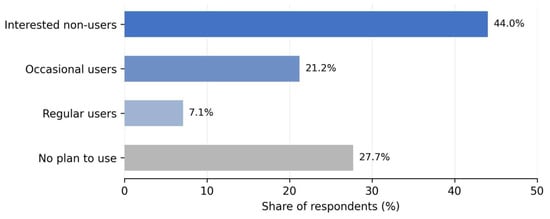
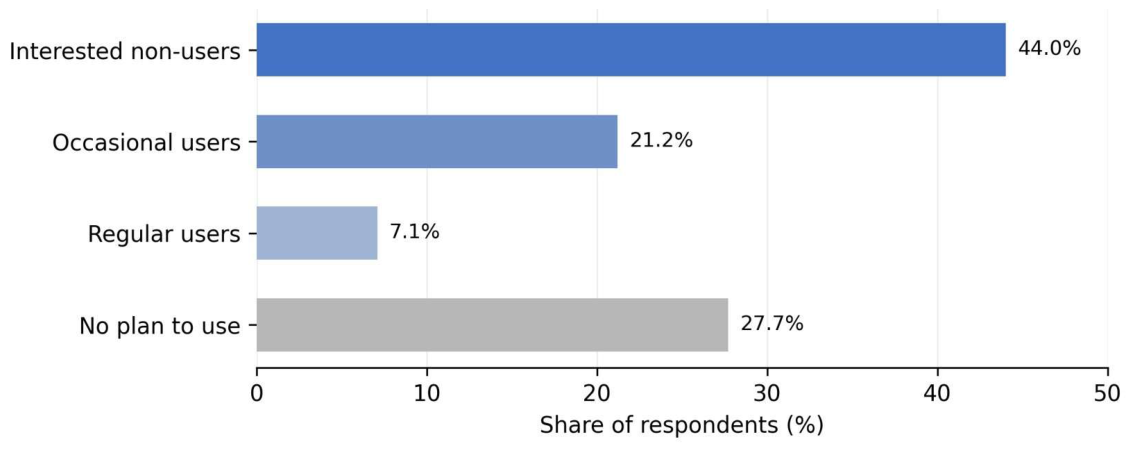
The AI pattern is more mixed. Approximately 5516 respondents report that they do not use AI at work but would like to; 2658 use it from time to time; 890 use it daily or regularly; and 3473 do not use it and do not plan to. Current practical exposure is therefore 28.3%, while 44.0% are interested non-users. The baseline AIRI is 0.450, but the alternative weighting rules produce values from 0.287 to 0.537. The exact index level is therefore not robust enough to support threshold-based claims. The more defensible finding is ordinal: expressed demand is substantially wider than regular use, which is consistent with a capability or access gap but does not identify its cause. Figure 1 displays the four response groups.
Figure 1.
AI use and latent demand among civil servants.
5.2. Focus Groups: The Practical Conditions of Trust
The focus-group material helps interpret why stated interest in AI should not be equated with organizational readiness. Across the reported discussions, recurring barriers included weak integration between HR modules and other information systems, limited HR analytics and forecasting, uneven digital and analytical competence, regulatory rigidity, information-security concerns, duplication across systems, and continuing manual or paper-based checks. These themes are consistent with the survey’s gap between interest and practical use, but the qualitative materials do not support frequency estimates or claims about how common each concern is across the full civil service.
Participants generally described acceptable AI use in task-specific terms. Routine applications included leave and sick-leave calculations, report generation, document-completeness checks, CV structuring, and analytical summaries. More consequential applications, such as candidate matching, risk diagnostics, and personalized development recommendations, were treated as decision support rather than substitutes for authorized human judgment. A recurring trust condition was explainability: HR staff and managers should be able to identify the data used, understand the basis of a recommendation, and provide a route for an affected employee to question or correct it. The pattern therefore supports a graded rather than binary view of AI adoption.
This interpretation explains the use of the term human-centered digital human resource management ecosystem. Human-centeredness does not imply rejection of automation. It means that automation should remove avoidable administrative burden and improve consistency or transparency while leaving accountability for consequential personnel decisions with legally authorized human decision-makers.
5.3. Pilot Evidence: From Project Output to Analytical Indicators
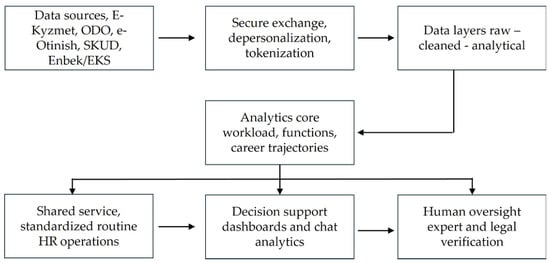
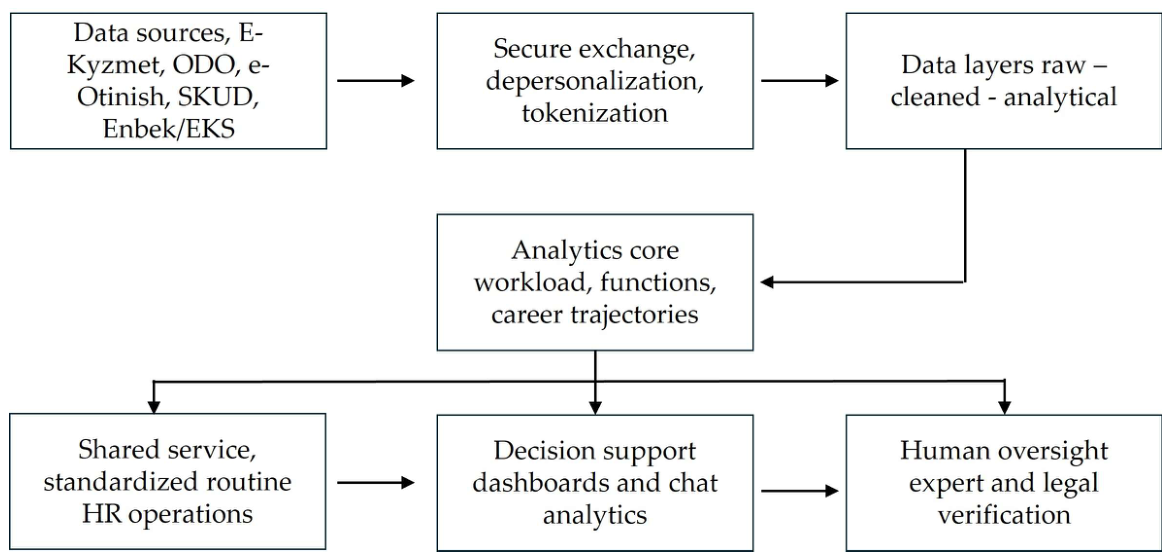
The approbation document provides operational evidence from a controlled pilot rather than a full-scale deployment. The pilot combined data preparation, process mapping, analytics, shared-service concepts, user training, and expert verification. Figure 2 summarizes the analytical logic of the pilot architecture.
Figure 2.
Analytical logic of the pilot HRM ecosystem.
The pilot included an autonomous test contour, data depersonalization and normalization, process mapping, AS-IS and TO-BE scenarios, user training, dashboards, chat analytics, and expert verification. Table 4 reports the principal pilot indicators and the derived calculations. These values should be read as evidence of technical and organizational feasibility under controlled conditions, not as estimates of nationwide reform effects.
Table 4.
Primary pilot indicators and derived calculations.
The test protocol distinguishes a full pass from a pass with methodological reservations. Five of eight scenarios passed without remarks and three passed with remarks. The strict pass rate is therefore 62.5%, while the protocol-weighted score is 81.2%. Reporting both values matters because the stronger figure depends on treating conditional operation as partial success. The results indicate that the tested functions operated in pilot mode, but data matching, dashboard filters, and confidence in chat analytics still required refinement. Table 5 shows how each test result contributes to the weighted score.
Table 5.
Functional testing results converted into integration-maturity signals.
5.4. Workload Concentration and Process Architecture
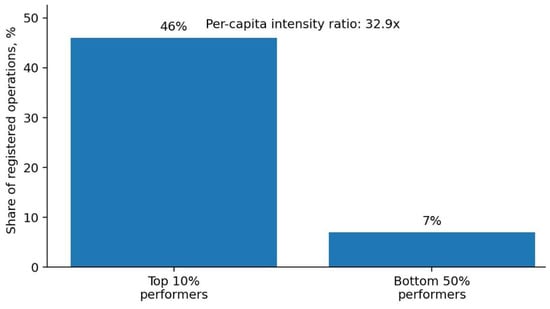
The pilot also reports a marked concentration of registered workload. Around 10% of performers, or 126 people, account for 46% of registered operations, while the bottom 50%, or 617 people, account for 7%. The corresponding WCR is 6.6. This is a strong contrast in the observed digital trace, but it should not be interpreted as a direct productivity ranking because task complexity, role assignment, hidden work, and differences in digital capture may all affect the recorded volume. Figure 3 visualizes the contrast.
Figure 3.
Concentration of operational workload in pilot bodies.
Normalizing the operation shares by group size gives a PCIR of 32.9, which confirms that the concentration is not an artifact of comparing groups of different size. Even so, the ratio does not imply that the lower-activity group is unnecessary. Plausible alternative explanations include hidden work, unequal task routing, role heterogeneity, supervisory responsibilities, and activity that is not recorded in the analyzed systems. Table 6 therefore treats the additional process-architecture findings as diagnostic signals for expert review rather than as automatic staffing rules.
Table 6.
Process-architecture findings from the 2026 pilot.
5.5. Foresight: What Kind of HR Specialist Does the Ecosystem Require?
The foresight session adds a future-oriented interpretation to the survey and pilot results. Participants used PESTLE and BANI lenses and identified four HR roles that remain relevant across scenarios: diplomat, coach, digital specialist, and mediator. These roles are consistent with the pilot evidence that HR work cannot remain limited to clerical administration. An ecosystem built around dashboards, tokenized data, shared services, and AI-supported analysis requires specialists who can translate data into human decisions, explain recommendations, manage conflict, support adaptation, and maintain trust between employees, managers, and technology.
The foresight findings also qualify the common assumption that digital transformation simply reduces the need for HR work. The evidence instead suggests a change in task composition: routine work may decline, while analytical, interpretive, relational, and governance work becomes more important. This interpretation is plausible in the present case, but it remains a foresight proposition that should be tested against observed role changes as the reform develops.
5.6. Robustness, Alternative Explanations, and Integrated Interpretation
The supplementary checks show that the principal findings do not depend on a single diagnostic specification. AIRI varies from 0.287 to 0.537 across alternative weights, so its precise level is unstable, but every version places practical readiness below a fully developed state. The pilot’s strict integration pass rate of 62.5% is lower than the weighted score of 81.2%, yet both indicate remaining technical conditions. The scenario-based order-routing calculation remains between 91.7% and 96.2% across the stated AS-IS and TO-BE bounds, and workload concentration is visible in both the WCR (6.6) and PCIR (32.9). The robust conclusion is therefore qualitative and directional rather than threshold-based.
A strength of the evidence is its triangulation. The large survey captures the breadth of reported attitudes and AI exposure; focus groups provide plausible explanations for capability and trust constraints; the pilot shows what selected technical and process arrangements can achieve in a controlled setting; and the foresight exercise identifies the human capabilities needed for later stages. Agreement across these sources increases the plausibility of the sequencing interpretation, although it does not eliminate selection bias, measurement error, or the absence of a counterfactual.
Several alternative explanations remain possible. Limited AI use may reflect restrictions on approved tools or access rather than low competence. Workload concentration may reflect role specialization or incomplete digital capture rather than unequal effort. Large cycle-time reductions may partly reflect the simplified conditions of a pilot rather than gains that will persist under full-scale deployment. Conditional integration tests may reflect temporary configuration problems rather than structural barriers. These alternatives do not invalidate the findings, but they narrow the claims that can reasonably be made from the present evidence.
The next empirical step should therefore move from diagnostic consistency to validation. Respondent-level data would permit subgroup analysis, reliability testing, and multivariate modeling; repeated agency-level observations would allow the sequence to be examined over time; and future pilot waves could compare pre- and post-implementation outcomes or use quasi-experimental designs where feasible. The AIRI should be validated against observed use and capability outcomes, while the SSPI should be calibrated against actual process-transfer decisions and performance after transfer.
6. Discussion
6.1. Theoretical Implications
The first theoretical implication is that public-sector digital HRM is better understood as a sequencing problem than as a single adoption decision. The Kazakhstan evidence separates willingness from operational readiness: interest in AI is relatively broad, yet regular use is limited and the qualitative evidence points to data, interoperability, skill, regulatory, and trust constraints. This extends recent work on human-centered AI readiness in public administration by showing that readiness is not only multidimensional but also ordered: certain capabilities become useful only when more basic data and process conditions are sufficiently stable (Tomaževič et al., 2026; Buonocore et al., 2026).
A second implication concerns the relationship between process redesign and AI. The pilot suggests that substantial operational value can arise from data consolidation, process mapping, shared-service design, and standardization before higher-discretion AI is introduced. This adds a process-architecture layer to studies that emphasize managerial capability and organizational readiness (Del Barone et al., 2026). The theoretical point is not that AI is unnecessary, but that AI may be a later-stage complement to organizational redesign rather than the starting point of digital HR transformation.
Third, the findings support a graded conception of human-centered governance. Huang et al. (2026) emphasize dignity, autonomy, fairness, and well-being in AI-driven HRM, while Hsieh et al. (2026) show why high-consequence public-employment recommendations require caution even when merit-related performance appears promising. The Kazakhstan case adds a sequencing interpretation: human oversight is not a final safeguard added after deployment, but a cross-cutting governance condition whose intensity should rise with the discretion and consequences of the task.
The comparison with international evidence also clarifies what is distinctive about the case. Ahn and Chen (2022) link public employees’ support for AI to familiarity and perceived benefits, while European studies show that AI use is more common in service delivery and internal management than in direct policy decisions and that implementation depends on interacting organizational and technological conditions (Van Noordt & Misuraca, 2022; Maragno et al., 2023). The present study is consistent with those findings but moves the analysis toward HR process architecture by showing how readiness constraints appear in survey responses, implementation narratives, and pilot data within the same reform programme.
The public-sector HR analytics literature provides another point of comparison. Espegren (2025) shows that Swedish public administrations adopt HR analytics for both performance-oriented and institutional reasons. In Kazakhstan, the stated demand for analytics is similarly connected to reporting and decision support, but the pilot exposes the underlying data and process work required to make those aspirations operational. This helps specify a mechanism often left implicit in adoption studies: analytics capacity depends on the prior standardization and integration of administrative records and workflows.
The contribution is therefore not a new universal maturity model. It is a testable sequencing proposition for settings where digital-government ambition may advance faster than HR data, process, and governance capability. The case is particularly relevant to emerging and decentralized administrative systems because it links employee readiness, organizational barriers, and operational infrastructure without assuming that a national platform has already produced an integrated HR ecosystem.
These theoretical claims remain deliberately bounded. The present evidence cannot establish that the proposed sequence is causally optimal, and the specific AIRI weights, integration thresholds, workload ratios, or shared-service criteria should not be generalized as universal benchmarks. The theoretical value lies in identifying relationships and ordering assumptions that can be tested in later agency-level and cross-national research.
6.2. Practical Implications
For practice, the findings support an assistive and staged approach to AI adoption. Standardized, high-frequency, low-discretion activities such as document checks, routine reporting, routing, leave calculations, and dashboard summaries are plausible early candidates because their rules and outputs can be inspected. Recommendation systems for recruitment, training, workload risk, or career development require stronger validation and human review, while predictive or ranking models should be considered only after data quality, audit trails, appeal mechanisms, role-based access, and accountable human decision-making are in place.
The immediate policy priority is therefore not to maximize the number of AI use cases, but to strengthen the foundations on which useful and legitimate AI depends. This includes common data definitions, stable interfaces between source systems, clear process ownership, reliable qualification and staffing records, and analytical capability among HR staff and managers. The 2026 pilot suggests that these investments can generate operational gains in their own right, which reduces the risk of treating foundational work as a delay to innovation.
Transferability should be understood at the level of design principles rather than numerical thresholds. The sequence of data quality, process definition, analytical capability, assistive automation, and stronger governance for higher-discretion uses is likely to be relevant beyond Kazakhstan, but the specific indicators and safeguards require recalibration to each country’s civil-service structure, labor law, data-protection regime, digital maturity, and distribution of administrative discretion.
On that basis, six practical priorities follow from the convergence of the survey, qualitative evidence, and pilot results:
These priorities are framed as actions for further piloting and evaluation rather than as proven reform effects.
- Treat HR data quality as core digital infrastructure. Before scaling AI, personnel, qualification, staffing, and document-flow data should be standardized, traceable, and governed across source systems.
- Link process ownership with shared-service design. Each process should have a responsible owner, defined inputs and outputs, a legal basis, and an explicit level of discretion; standardized, high-frequency processes can then be considered for shared services before discretionary ones.
- Establish an AI governance protocol for HRM. Permitted and restricted uses, human-review requirements, appeal routes, logging, data access, model-validation responsibilities, and audit responsibilities should be specified before higher-consequence applications are deployed.
- Use workload analytics for diagnosis, not automatic staffing decisions. Dashboards should identify overload, under-recorded work, and bottlenecks, with managerial and employee review before organizational action is taken.
- Build HR analytics capability alongside technology. HR specialists need competence in data interpretation, process mapping, ethics, communication, and change management, while managers need enough analytical literacy to question outputs rather than treating them as self-explanatory.
- Scale through transparent evaluation. Each implementation wave should report comparable indicators such as cycle time, error rates, data-quality problems, user experience, manual steps removed, and the share of consequential decisions that received documented human review.
6.3. Limitations and Future Research Agenda
The study has several limitations that define the scope of its claims. First, the survey is large but is not documented as a probability sample of the entire civil service; self-selection, nonresponse, uneven institutional coverage, and response-style bias therefore cannot be ruled out. Second, only aggregate survey tables are available, which prevents individual-level statistical testing, subgroup controls, reliability analysis, and causal inference; conversion from rounded percentages also produces approximate counts. Third, the questionnaire materials available for this article do not document formal psychometric validation of an AI-readiness construct, so AIRI should be treated as a heuristic indicator rather than a validated scale. Fourth, the qualitative source materials do not provide the recruitment and transcript-level coding detail needed to assess selection effects or inter-coder reliability. Fifth, the pilot involved seven public organizations in a controlled environment using depersonalized data and periodic uploads, so observed cycle times, integration scores, and workload patterns may differ under industrial, real-time deployment.
These limitations also define a concrete future research agenda. Respondent-level data should be used to validate the survey measures, test subgroup differences, and estimate multivariate relationships between readiness, skills, institutional location, and actual AI use. Repeated agency-level observations are needed to test whether improvements in data and process capability precede gains in analytics and AI use over time. Future pilots should replicate the results across additional ministries and regions, compare alternative index specifications, validate the SSPI against observed process-transfer outcomes, and examine whether cycle-time gains persist after full deployment. Qualitative work should return to transcript-level coding and include employees affected by AI-supported decisions, not only implementers. Cross-national comparison would then allow the sequencing framework to be tested against different legal, administrative, and digital-maturity conditions.
7. Conclusions
This study examined the early development of a human-centered digital HRM ecosystem in Kazakhstan’s civil service through initial calculations, preliminary multi-source evidence, and policy analysis. The survey shows substantial interest in AI but limited regular use; focus groups identify integration, capability, regulatory, security, and trust constraints; and the 2026 pilot shows that process mapping, data consolidation, shared-service redesign, and analytical tools can be tested before higher-discretion automation is introduced.
The combined evidence supports three cautious conclusions. First, willingness to use AI is not the same as organizational readiness to use it responsibly. Second, data and process redesign can create value in their own right and should not be treated only as preparation for AI. Third, human oversight becomes more important as analytical tools move closer to personnel decisions that affect careers, rights, and accountability. Robustness checks strengthen these directional conclusions, but the evidence remains descriptive and does not establish causal reform effects.
The article’s main contribution is therefore a testable sequencing framework: establish reliable data and process ownership; develop analytics and user capability; automate standardized, low-discretion tasks; and introduce more consequential decision support only with explainability, auditability, contestability, and accountable human authorization. The Kazakhstan case does not provide a universal maturity score, but it offers a policy-relevant sequence that can be validated, recalibrated, and compared across public administrations in future research.
Supplementary Materials
The following supporting information can be downloaded at: https://www.mdpi.com/article/10.3390/economies14100425/s1, S1: survey questionnaire for civil servants; S2: focus-group moderator guide; S3: non-identifying focus-group structure; S4: foresight-session concept and procedural protocol; S5: research protocol, participant criteria, ethics, data handling, and non-identifying data-architecture note; and S6: indicator-calculation workbook.
Funding
This research was prepared within research programme BR24993258, funded by the Ministry of Science and Higher Education of the Republic of Kazakhstan.
Institutional Review Board Statement
The study was conducted in accordance with the Declaration of Helsinki and approved by the Research Committee of the Academy of Public Administration under the President of the Republic of Kazakhstan (protocol code 7; date of approval: 24 January 2025).
Informed Consent Statement
The survey was conducted anonymously and the analysis in this article uses aggregate and depersonalized data only. The authors should verify and retain the consent script or participant information sheet used for focus groups and survey participation for submission if requested by the journal.
Data Availability Statement
The article uses aggregate indicators and internal project materials from research programme BR24993258. Individual-level survey responses and depersonalized administrative datasets are not publicly available because they concern civil-service personnel, administrative workloads and protected data-processing procedures. Aggregate calculation tables may be made available by the corresponding author subject to approval by the data owners and applicable personal-data protection rules.
Acknowledgments
The author acknowledges the public bodies, civil servants, HR specialists, experts and Academy staff who contributed to the focus groups, survey, foresight session and pilot approbation. The author is responsible for the interpretation of all results. During manuscript preparation, AI-assisted tools were used for language editing, formatting support and consistency checks.
Conflicts of Interest
The author declares no conflicts of interest. The funder had no role in the interpretation of results or in the decision to submit the article for publication.
References
- Ahn, M. J., & Chen, Y.-C. (2022). Digital transformation toward AI-augmented public administration: The perception of government employees and the willingness to use AI in government. Government Information Quarterly, 39(2), 101664. [Google Scholar] [CrossRef] [Scilit]
- Buonocore, F., de Gennaro, D., Del Barone, L., & Colombi Evangelista, V. (2026). Transforming public-sector HRM through AI: An integrated TAM-TOE framework. Journal of Managerial Psychology. Advance online publication. [Google Scholar] [CrossRef] [Scilit]
- Cho, W. (2023). Human resources analytics for public personnel management: Concepts, cases, and caveats. Administrative Sciences, 13(2), 41. [Google Scholar] [CrossRef] [Scilit]
- Criveanu, M. M. (2026). The impact of digital technology on E-commerce and sustainable performance in the EU. Economies, 14(1), 5. [Google Scholar] [CrossRef] [Scilit]
- Del Barone, L., de Gennaro, D., & Buonocore, F. (2026). AI-driven HRM and managerial competencies: Strengthening organizational resilience in public administration. Management Decision, 64(5), 1732–1751. [Google Scholar] [CrossRef] [Scilit]
- Denissova, O., Konurbayeva, Z., Kulisz, M., Yussubaliyeva, M., & Suieubayeva, S. (2025). Measuring the digital economy in Kazakhstan: From global indices to a contextual composite index (IDED). Economies, 13(8), 225. [Google Scholar] [CrossRef] [Scilit]
- Dima, J., Gilbert, M.-H., Dextras-Gauthier, J., & Giraud, L. (2024). The effects of artificial intelligence on human resource activities and the roles of the human resource triad: Opportunities and challenges. Frontiers in Psychology, 15, 1360401. [Google Scholar] [CrossRef] [Scilit] [PubMed]
- Eom, S.-J., & Lee, J. (2022). Digital government transformation in turbulent times: Responses, challenges, and future direction. Government Information Quarterly, 39(2), 101690. [Google Scholar] [CrossRef] [Scilit] [PubMed]
- Espegren, Y. (2025). Reasons for HR analytics adoption in public sector organisations: Evidence from Swedish public administrations. Personnel Review, 54(7), 1621–1642. [Google Scholar] [CrossRef] [Scilit]
- Government of Kazakhstan, Electronic Government Portal. (2024). Kazakhstan significantly improved its position in the UN E-Government Development Index. Available online: https://egov.kz/ (accessed on 6 May 2026).
- Haesevoets, T., Verschuere, B., & Roets, A. (2025). AI adoption in public administration: Perspectives of public sector managers and public sector non-managerial employees. Government Information Quarterly, 42(2), 102029. [Google Scholar] [CrossRef] [Scilit]
- Han, T. M. (2022). Analysis of the government’s introduction to artificial intelligence (AI): Focusing on the central government organizations. The Journal of the Korea Contents Association, 22(2), 281–293. [Google Scholar] [CrossRef]
- Hsieh, C.-W., Wang, D., He, Y., & Hsieh, D. W. (2026). Comparative analysis of generative artificial intelligence in evaluating candidate attributes for public employment: East versus west. Review of Public Personnel Administration. OnlineFirst. [Google Scholar] [CrossRef] [Scilit]
- Huang, B. E., Kang, H., Zur, E., & Liang, L. H. (2026). Humanistic human resource management for digital transformation: Addressing the challenges of AI advancement in the workplace. Human Resource Management Review, 36(3), 101151. [Google Scholar] [CrossRef] [Scilit]
- Maragno, G., Tangi, L., Gastaldi, L., & Benedetti, M. (2023). Exploring the factors, affordances and constraints outlining the implementation of artificial intelligence in public sector organizations. International Journal of Information Management, 73, 102686. [Google Scholar] [CrossRef] [Scilit]
- Mili, H. (2025). From digital transformation to circular growth: The role of economic complexity and eco-innovation in Africa’s sustainable future. Economies, 13(12), 339. [Google Scholar] [CrossRef] [Scilit]
- OECD. (2025a). Governing with artificial intelligence. OECD Publishing. [Google Scholar]
- OECD. (2025b). OECD public governance scan of Kazakhstan: Toward a more agile, responsive and effective public administration. OECD Publishing. [Google Scholar] [CrossRef] [Scilit]
- OECD. (2026). Digital government outlook 2026: Adopting and governing AI in government. OECD Publishing. [Google Scholar]
- Pan, Y., Froese, F. J., Liu, N., Hu, Y., & Ye, M. (2023). An interdisciplinary review of AI and HRM: Challenges and future directions. Human Resource Management Review, 33(1), 100924. [Google Scholar] [CrossRef] [Scilit]
- Sofrankova, B., Sira, E., Horvathova, J., & Mokrisova, M. (2025). Digital skills and digital transformation performance in the EU-27: A DESI-based nonparametric and panel data study. Economies, 13(11), 315. [Google Scholar] [CrossRef] [Scilit]
- Tomaževič, N., Babšek, M., Ravšelj, D., & Aristovnik, A. (2026). AI readiness as a human-centered organizational capability: Evidence on the role of HR development in public administration. Frontiers in Human Dynamics, 8, 1829457. [Google Scholar] [CrossRef] [Scilit]
- United Nations Department of Economic and Social Affairs. (2024). United Nations E-Government survey 2024: Accelerating digital transformation for sustainable development. United Nations Department of Economic and Social Affairs. [Google Scholar]
- Van Noordt, C., & Misuraca, G. (2022). Artificial intelligence for the public sector: Results of landscaping the use of AI in government across the European Union. Government Information Quarterly, 39(3), 101714. [Google Scholar] [CrossRef] [Scilit]
- World Bank. (2025). GovTech maturity index 2025: Tracking public sector digital transformation worldwide (Prosperity insight series). World Bank. [Google Scholar] [CrossRef] [Scilit]
- Zervas, I., & Triantari, S. (2025). Digital HRM practices and perceived digital competence: An analysis of organizational culture’s role. Digital, 5(3), 34. [Google Scholar] [CrossRef] [Scilit]

Disclaimer/Publisher’s Note: The statements, opinions and data contained in all publications are solely those of the individual author(s) and contributor(s) and not of MDPI and/or the editor(s). MDPI and/or the editor(s) disclaim responsibility for any injury to people or property resulting from any ideas, methods, instructions or products referred to in the content. |
© 2026 by the author. Licensee MDPI, Basel, Switzerland. This article is an open access article distributed under the terms and conditions of the Creative Commons Attribution (CC BY) license.