


1. Introduction
The first edition of the Special Issue entitled “Emerging Paradigms in AI, Autonomous Systems, and Intelligent Technologies”, published in Technologies within the Information and Communication Technologies section, was conceived around a practical observation that is now widely shared in engineering research: automation remains useful, but contemporary technological systems increasingly require autonomy, real-time decision making, transparent reasoning, robust communication, and reliable interaction with the physical world.
The central argument of this editorial is that the maturity of intelligent technologies should no longer be evaluated solely through isolated algorithmic performance. Instead, it should be assessed through the capacity of complete systems to integrate perception, representation, communication, control, validation, sustainability, and human interpretability. This system-centered perspective provides the conceptual thread through which the 14 contributions C1–C14 of the Special Issue are examined. The collection gathered 14 papers, hereafter discussed as contributions C1–C14 and listed separately at the end of this editorial. These papers form a coherent scientific picture of a field in transition, where algorithms, sensors, protocols, materials, controllers, energy constraints, and validation methods have to be considered together rather than in isolation.
Artificial intelligence has reached this systemic stage through several converging lines of research. Classical AI established the conceptual basis for agents, search, reasoning, uncertainty, and decision making [1].
Modern deep learning then provided the representational machinery required to extract structure from high-dimensional data [2,3], while attention-based architectures changed the way sequences, contexts, and relations can be modeled [4].
More recently, AI has been described not only as a computational tool but also as a new paradigm for scientific discovery, able to support modeling, hypothesis generation, experiment design, and knowledge extraction across domains [5,6].
This intellectual background helps explain why the Special Issue attracted contributions ranging from industrial robot state representation and LVC protocol-template construction to embedded traffic-sign recognition, autonomous underwater-vehicle decision making, railway monitoring, carbon-aware optimization, photovoltaic circularity, agricultural route planning, and fuzzy motion control.
The editorial call thus emphasized two complementary thematic axes.
The first was smart mechatronics, IoT, and industrial intelligence, including intelligent sensors, scalable mechatronic solutions, digital twins, predictive maintenance, MedTech, STEM education, sustainability, and cybersecurity.
The second was advanced autonomous systems and applied artificial intelligence, including autonomous decision making, real-time processing, computer vision, explainable AI, human–machine interaction, autonomous systems in healthcare, logistics and transportation, swarm intelligence, multi-agent systems, and edge AI.
The published contributions answered this call with notable breadth.
More importantly, they answered it in a technically grounded way: most papers do not treat intelligence as a fashionable label, but as a measurable capability connected to noisy data, embedded hardware, communication protocols, mechanical structures, energy cost, material strength, route smoothness, or safety monitoring.
According to the Special Issue webpage snapshot supplied to the Guest Editors, the 14 published papers accumulated 29,417 views and 33 citations at the time of manuscript preparation. These values are dynamic and should not be interpreted as final bibliometric judgements. Furthermore, it is important to distinguish between visibility, influence, and scientific durability. Visibility indicates that a topic attracts attention, and citation activity suggests that the work begins to enter scholarly conversations; durability, however, can only be assessed over a longer period, when the methods, datasets, frameworks, or conceptual arguments proposed by the papers are reused, challenged, extended, or integrated into subsequent research. From this perspective, the early indicators reported here should be interpreted as an encouraging beginning rather than as a final assessment.
Nevertheless, for a young interdisciplinary collection, they represent strong evidence of discoverability and early scholarly reuse.
The visibility of the Special Issue is not accidental. It reflects the fact that AI, autonomous systems, and intelligent technologies are no longer niche topics; they are becoming the enabling layers of modern industrial, transport, energy, agricultural, robotic, and cyber–physical infrastructures.
2. Editorial Scope and Scientific Context
The scientific scope of the Special Issue can be understood as an effort to connect algorithmic intelligence with technological deployment.
In this sense, the papers are aligned with the broader movement toward explainable, accountable, and human-understandable AI.
Arrieta and coauthors present explainable AI as a field concerned not only with model transparency, but also with responsible use, comprehensibility, trust, and the relationship between technical performance and human interpretation [7].
Similarly, Gunning and Aha describe explainability as a programmatic requirement for systems expected to justify their decisions to human users, especially when those systems act in contexts where errors are costly [8].
Doshi-Velez and Kim add a methodological warning that interpretability should be treated as a scientific object, not as a vague esthetic preference [9].
Several contributions in the Special Issue also resonate with the movement of intelligence from centralized servers toward devices, robots, vehicles, and infrastructures. Edge computing was initially framed as a way to bring computation, storage, and services closer to data sources [10], and edge intelligence later extended this view by arguing that AI must often operate near the sensor or actuator, under constraints of latency, bandwidth, privacy, and energy [11]. This is directly relevant to embedded autonomous-vehicle perception, mobile-robot fault detection, railway monitoring, IoT communication, agricultural route planning, and other applications represented in the collection.
Distributed intelligence is another important background theme. Federated learning illustrates how models can be trained across decentralized data sources while addressing privacy, heterogeneity, communication efficiency, and system robustness [12].
Cyber–physical systems and Industry 4.0 architectures show that intelligent technologies often exist as connected layers of sensing, computation, control, and physical process execution [13].
Digital twins push this integration further by linking physical assets with virtual representations that are able to support modeling, diagnosis, optimization, and life-cycle decision making [14,15].
The Special Issue does not reduce these ideas to theory; it illustrates them through concrete engineering situations in which representation, protocol compatibility, monitoring, and physical constraints become decisive.
Autonomous systems also demand validation. The literature on autonomous driving has shown that perception, planning, control, scenario coverage, and failure handling must be assessed together rather than independently [16].
Koopman and Wagner emphasize that autonomous-vehicle testing and validation face combinatorial complexity, while Varshney and Alemzadeh show that machine-learning safety becomes particularly challenging when learned models enter cyber–physical systems and data products [17,18].
These concerns provide an important lens for reading the contributions devoted to mobile robots, railway vehicles, underwater systems, traffic-sign recognition, and route planning.
Finally, the Special Issue is situated in a period when the environmental and resource costs of AI are becoming visible.
Amodei and coauthors discuss concrete problems in AI safety that include robustness, monitoring, reward specification, and safe exploration [19].
Strubell and coauthors draw attention to energy and policy considerations associated with large-scale deep learning [20], while Patterson and coauthors provide a broader analysis of carbon emissions and model-training choices [21].
These works reinforce the relevance of the Special Issue papers on sustainable swarm intelligence, photovoltaic end-of-life technologies, and energy-aware motion control.
The IoT literature also clarifies why distributed intelligent systems need scalable connectivity and urban-scale interoperability [22,23], while the robotics literature shows that intelligent machines remain grounded in mechanisms, sensing, actuation, control, and human interaction [24].
The collection therefore occupies a timely scientific position: it studies intelligent technologies not only as performance-driven systems, but also as deployable, inspectable, energy-aware, and socially useful technologies.
3. From Automation to Autonomous Systems
The transition from automation to autonomous systems represents one of the defining conceptual shifts in contemporary engineering. Traditional automation is generally associated with predefined sequences, deterministic control logic, and relatively stable operating conditions. Autonomous systems, by contrast, must operate in environments that are partially observable, dynamically changing, uncertain, and sometimes adversarial. This does not mean that autonomy eliminates classical engineering principles. On the contrary, meaningful autonomy emerges when classical control, sensing, actuation, modeling, communication, and safety are integrated with adaptive decision-making and data-driven intelligence.
In this respect, the contributions included in this Special Issue demonstrate that autonomy should not be understood as a single algorithmic property—autonomy is a system-level capability. As such, it requires perception mechanisms that can extract relevant information from noisy or incomplete data; representation structures that preserve semantic and operational context; reasoning methods that support decisions under uncertainty; and control architectures that translate decisions into safe and efficient physical action. This systemic interpretation is particularly important in robotics, autonomous vehicles, railway monitoring, agricultural machinery, underwater systems, and IoT-enabled infrastructures, all of which are represented in the collection.
A central lesson emerging from the Special Issue is therefore that autonomous intelligence is always present. It is situated in hardware because computational resources, sensors, actuators, embedded processors, and communication modules impose real constraints. It is situated in communication systems because distributed intelligence depends on protocols, latency, reliability, security, and interoperability. It is situated in physical environments because vibration, friction, terrain, weather, structural wear, and material properties affect system behavior.
This perspective helps avoid an overly abstract view of artificial intelligence. In engineering domains, intelligence is not valuable merely because a model performs well on a benchmark, but rather becomes valuable when it improves the reliability, safety, sustainability, efficiency, or usability of a technological process. The Special Issue therefore contributes to a more mature understanding of AI—one in which autonomous systems are not detached from the physical world. Still, it is tested precisely through its capacity to act meaningfully within it. A perception model may perform well in clean laboratory conditions but fail under illumination changes, sensor degradation, occlusion, or noise. A communication protocol may be efficient in a small network but insufficient for large-scale heterogeneous IoT deployment. A route-planning algorithm may produce mathematically valid paths that are mechanically unsuitable for agricultural terrain. A controller may achieve accurate motion but consume excessive energy. These examples show that autonomy becomes credible only when the conditions of use are incorporated into the scientific evaluation.
The Special Issue is valuable precisely because it does not present autonomous systems as an abstract promise. It shows intelligent technologies as an engineering achievement assembled from representation, perception, communication, diagnostics, planning, control, materials, energy awareness, and validation. In this sense, the collection confirms that the future of intelligent technologies belongs not to isolated algorithms, but to integrated systems.
4. The Common Message of the Special Issue
The common message emerging from the 14 contributions is that autonomy is no longer defined only by the sophistication of an algorithm. It is defined by the capacity of a complete technological system to sense, communicate, reason, act, adapt, and remain accountable under real operating constraints. In practical terms, an intelligent system becomes scientifically meaningful when its AI component is connected to a physical platform, a communication architecture, a validation environment, a sustainability criterion, or a user-relevant decision. This represents the reason why the Special Issue reads as more than a set of separate papers, but rather as a compact map of the engineering conditions under which autonomy becomes credible.
The first cluster of contributions gives the Special Issue its representational and infrastructural backbone. C1 proposes a hypergraph-based framework for multi-contextual state representation in industrial robots, treating a robot as part of a production ecosystem rather than as an isolated manipulator. C2 uses large language models for the intelligent construction of live–virtual–constructive resource interface protocol templates, showing how generative AI can support the standardization of complex technical documentation. C4 introduces structured reasoning over dynamic scenes by encoding sequences of textual scene graphs. Concurrently, C7 reviews transport and application-layer protocols for IoT, reminding the reader that connected intelligence depends on communication protocols that are lightweight, secure, interoperable, and appropriate for heterogeneous devices.
A second cluster moves from representation toward perception, decision making, and robust learning. C3 analyses supervised machine-learning models under impulsive α-stable noise, a technically important condition because real technological signals often contain outliers, heavy tails, and non-Gaussian disturbances. Furthermore, C6 reviews deep-learning-enabled intelligent decision-making systems for autonomous underwater vehicles, one of the most demanding environments for autonomy because communication is limited and sensing is uncertain. C8 benchmarks YOLOv8 to YOLOv11 architectures for traffic-sign recognition in embedded 1:10 scale autonomous vehicles, linking computer vision with real-time, resource-constrained implementation.
A further cluster anchors intelligence in mechanical systems, mobility, monitoring, and control. C5 proposes an intelligent fault-detection framework for the mechanical structure of a wheeled mobile robot, connecting vibration measurements and deep learning to reliability and remaining useful life. C12 improves the A* algorithm for agricultural route planning through a hybrid heuristic and path smoothing, a useful reminder that planning must respect terrain, motion smoothness, and operational constraints. C13 assesses the energy performance of a Tsukamoto fuzzy-logic controller for motion-control applications, showing that transparent rule-based control still has an important place in intelligent engineering. C14 reviews vibration measurement and monitoring in railway vehicles, a contribution with clear relevance for diagnostics, maintenance, comfort, and safety.
A final cluster expands the Special Issue toward sustainability, eco-technologies, and material foundations. C9 connects sustainable swarm intelligence with carbon-aware optimization in high-performance AI systems, giving the collection a strong environmental dimension. C10 systematically reviews intelligent eco-technologies for end-of-life photovoltaic modules, linking AI and automation with circular-energy infrastructure. C11 studies the mechanical tensile characteristics of 3D-printed Nylon 12 Carbon Fiber specimens, an apparently material-focused paper that is nevertheless highly relevant to robotics, mechatronics, fixtures, functional prototypes, and lightweight structural components.
Taken together, these clusters show that the Special Issue responded well to the original thematic invitation. It covered smart mechatronics, IoT, industrial intelligence, applied AI, autonomous decision making, computer vision, edge-relevant implementation, sustainable AI, renewable-energy technology, advanced materials, and safety-related monitoring.
The collection also reflects the humanistic tone of the original call: intelligent machines are valuable not because they replace people, but because they can support safer, cleaner, more efficient, and more capable forms of engineering work.
5. A Functional Taxonomy of the Published Contributions
Although the fourteen papers included in this Special Issue investigate diverse scientific and engineering topics, they are connected by a common objective: advancing the theoretical and technological foundations of intelligent systems. Their diversity should therefore not be interpreted as fragmentation but rather as evidence of the multidisciplinary nature of modern autonomy. When examined collectively, these contributions reveal a coherent progression that spans the entire technological pathway—from the formal description of complex systems to their implementation, operation, and long-term sustainability. This functional perspective provides a more meaningful understanding of the Special Issue than a conventional thematic classification because it emphasizes the relationships among the published works and the complementary role that each study plays within the broader architecture of intelligent technologies.
At the foundation of this architecture lies the ability to represent knowledge in a structured and computationally meaningful manner. Before an intelligent system can reason, communicate, or make autonomous decisions, it must first possess an appropriate internal representation of the environment in which it operates. This fundamental requirement is addressed by C1, C2, and C4, which propose different yet conceptually related approaches for modeling complex information. Whether the objective is the hypergraph representation of robotic systems, the formal specification of LVC communication templates, or the semantic encoding of scenes through graph structures, all three studies seek to establish models capable of preserving structural relationships, contextual dependencies, and operational semantics. Their common contribution lies in demonstrating that reliable intelligence is inseparable from reliable representation.
Once information has been formally organized, its effective exchange becomes the next essential requirement. Autonomous systems rarely operate in isolation; instead, they function within distributed environments in which continuous interaction among heterogeneous components is indispensable. In this respect, C7 highlights the critical role of communication and interoperability. Rather than viewing communication protocols as implementation details, the paper recognizes them as enabling mechanisms that support synchronization, coordination, secure data exchange, and scalable system integration. Interoperability therefore emerges not as a secondary characteristic but as a prerequisite for transforming isolated intelligent components into coherent cyber-physical ecosystems.
The acquisition and interpretation of information constitute the next stage in the technological chain. Intelligent behavior ultimately depends on the capability to perceive dynamic environments, extract relevant information, and distinguish meaningful patterns despite uncertainty or limited computational resources. These issues are explored in C3, C6, and C8, where learning algorithms and perception techniques are investigated under realistic operational constraints. Their contribution extends beyond improvements in classification or recognition performance. Instead, these studies emphasize that perception provides the indispensable connection between physical reality and computational reasoning, enabling intelligent systems to adapt their behavior in response to continuously changing environmental conditions.
Reliable operation also requires continuous awareness of the system’s own condition. For this reason, diagnostics and condition monitoring represent an essential component of intelligent technological infrastructures. The studies presented in C5 and C14 illustrate how artificial intelligence can support predictive maintenance, fault identification, and structural health assessment in complex engineering systems. By addressing fault diagnosis in mobile robotic platforms and vibration monitoring in railway vehicles, these contributions demonstrate that modern intelligent systems are expected not only to execute actions but also to evaluate their own operational state, anticipate failures, and provide information that enhances safety, reliability, and life-cycle performance.
The transition from perception to autonomous behavior is completed through planning and control. The ability to interpret information acquires practical significance only when it can be translated into effective physical actions. This perspective is reflected in C12 and C13, which investigate trajectory planning, motion control, and energy-aware optimization. Their results illustrate that successful autonomy depends on the integration of perception with decision-making algorithms capable of generating smooth, stable, efficient, and safe system behavior. Consequently, planning and control represent the operational layer through which intelligent computation interacts with the physical world.
Technological architecture is completed by considerations related to sustainability and material implementation. As intelligent systems become increasingly integrated into industrial and societal infrastructures, their evaluation can no longer be limited to algorithmic performance alone. Environmental impact, material selection, manufacturing technologies, and resource efficiency have become equally important criteria. This broader perspective is reflected in C9, C10, and C11, which address carbon-aware artificial intelligence, end-of-life photovoltaic technologies, and advanced additively manufactured materials. Together, these studies demonstrate that sustainable engineering principles are becoming an integral component of intelligent system design, extending the concept of intelligence beyond computation to encompass the entire technological life cycle.
Viewed from this functional perspective, the Special Issue represents considerably more than a collection of independent research articles. It outlines an integrated framework in which knowledge representation, communication, perception, diagnostics, planning, control, and sustainability are understood as interconnected stages of a unified technological process. Each contribution addresses a particular segment of this process, yet its scientific value becomes even more evident when considered in relation to the others. This integrated interpretation enhances both the scientific coherence and the educational significance of the volume, offering researchers, doctoral candidates, and practicing engineers a comprehensive view of how contemporary advances from multiple disciplines converge toward the development of intelligent, autonomous, and sustainable engineering systems.
6. Visibility, Citation Profile, and Readership Impact
The visibility profile of the Special Issue is one of its strongest editorial arguments. The supplied webpage snapshot reports 29,417 views and 33 citations for the 14 contributions. Such indicators should be read carefully. Views reflect discoverability, topical attractiveness, and immediate readership; citations reflect early scholarly reuse, which usually develops more slowly. A recent paper may have many views but few citations; a review may accumulate citations rapidly because it is useful across several communities; and a specialized technical article may influence practice or later research without immediately producing high citation numbers.
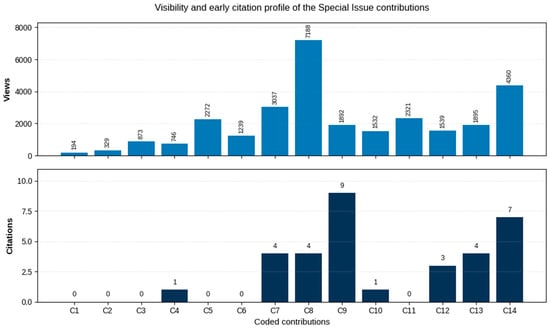
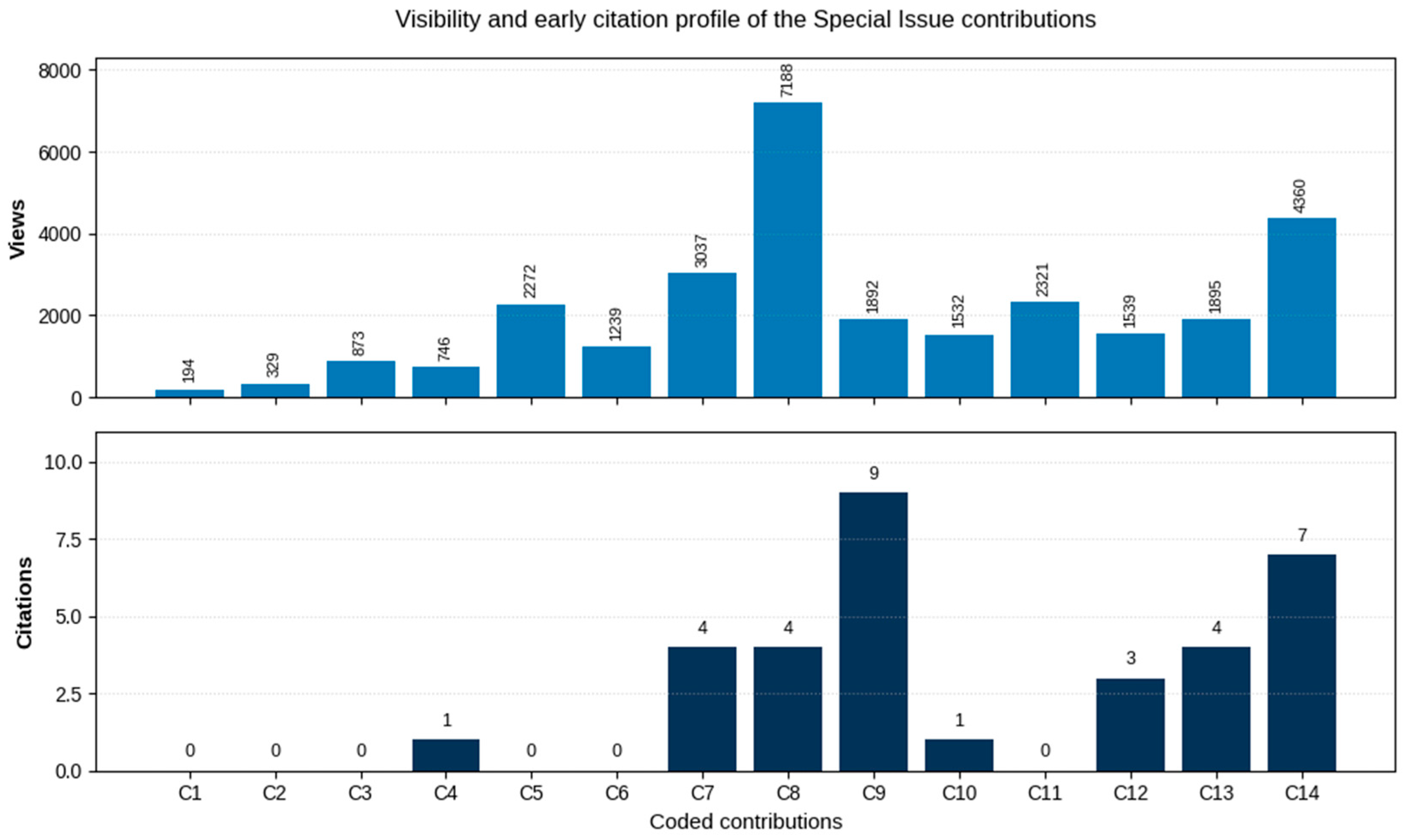
Figure 1 reports these indicators as a two-level histogram. The upper level shows views for contributions C1–C14, while the lower level shows citations for the same coded contributions. The figure is deliberately presented as a contextual editorial visualization rather than a ranking of scientific quality. It helps the reader see the diversity of engagement across the Special Issue while preserving the principle that each contribution should be assessed by its own scientific purpose, method, and application domain.
Figure 1.
Two-level histogram of the visibility and early citation indicators for the 14 Special Issue contributions. The upper level reports views, and the lower level reports citations for contributions C1–C14. The totals in the supplied webpage snapshot are 29,417 views and 33 citations. Values are dynamic and should be rechecked before final production; the figure is intended as contextual evidence of readership and early scholarly reuse, not as a ranking of scientific value.
The strongest readership signal was recorded by C8, the benchmark of YOLOv8 to YOLOv11 architectures for real-time traffic-sign recognition in embedded autonomous vehicles. This is understandable because autonomous mobility remains one of the most demanding and visible domains for efficient perception. The strongest citation signal was recorded by C9, which links swarm intelligence with carbon-aware high-performance AI systems. This result is scientifically meaningful because sustainability is becoming a genuine design requirement for AI systems, not an optional ethical appendix. C14, the review on railway vibration monitoring, also attracted a strong combination of views and citations, confirming that intelligent monitoring in transport infrastructure remains a topic of broad technical interest.
The broad distribution of views across the collection suggests that the Special Issue reached more than one community. Readers interested in AI and perception could find C3, C4, C6, and C8, while those interested in IoT, digital representation, and industrial interoperability could find C1, C2, and C7.
Readers working in robotics, monitoring, transportation, agriculture, and control could use C5, C12, C13, and C14, and those focused on sustainability, energy systems, materials, and eco-technologies could find C9, C10, and C11.
This breadth is one reason the Special Issue has editorial value—it brings adjacent communities into the same conversation.
7. Scientific Synthesis of Contributions
The strongest scientific lesson of the Special Issue is the transition from algorithm-centered AI to system-centered intelligence. In an algorithm-centered view, novelty is often measured by accuracy, loss, or benchmark performance. In a system-centered view, the same algorithm must be interpreted together with latency, explainability, sensor reliability, communication architecture, energy cost, mechanical degradation, material behavior, route geometry, and human use. The contributions in this collection repeatedly move toward the second view.
Representation is a particularly important thread. C1, C2, and C4 show that intelligent technologies need structured descriptions of states, protocols, scenes, relations, and contexts. Hypergraphs, protocol templates, and textual scene graphs are not merely data formats; they are ways of making complexity manageable. This is consistent with the broader idea that AI becomes more powerful when it is able to organize and exploit relationships that are difficult to describe manually. In industrial robotics, simulation infrastructures, and dynamic-scene reasoning, such representations are likely to become increasingly important.
Deployment is another visible thread. C5, C6, C8, C12, C13, and C14 all deal, in different ways, with systems that must operate under physical or operational constraints. A traffic-sign detector must be fast enough for embedded autonomous vehicles. A mobile-robot fault-detection method must be sensitive to vibration patterns that have maintenance meaning. An AUV decision-making system must cope with uncertain sensing and limited communication. Agricultural route planning must respect domain geometry, and fuzzy motion control must consider energy performance. Railway monitoring must transform vibration signals into actionable understanding. These papers share a practical temperament: they ask whether intelligence can survive the conditions of use.
Sustainability and life-cycle thinking form a third thread. C9, C10, C11, and C13 show that intelligent technologies are now evaluated beyond immediate functionality. High-performance AI has an energy and carbon footprint; photovoltaic modules require end-of-life strategies; advanced materials must be characterized before they can support reliable mechatronic structures; motion-control strategies can be assessed through energy performance. This is an important maturation of the field. It suggests that the next generation of intelligent technologies will be judged not only by what they can do, but also by what they cost, consume, emit, and enable across their life cycle.
A fourth thread is methodological humility. The Special Issue does not present autonomy as a solved problem, but instead shows that useful autonomy is assembled from partial solutions: better representations, better protocols, more robust learning under noise, improved perception, safer monitoring, smoother planning, cleaner computation, more reliable materials, and more interpretable control.
This makes the collection didactically valuable. It can help young researchers understand that AI in engineering is not a magic layer added at the end of a project, but a design discipline that interacts with sensors, actuators, hardware, networks, domain knowledge, safety analysis, and environmental constraints.
8. Methodological Maturity, Validation, and Engineering Credibility
A decisive criterion for the maturity of intelligent technologies is the quality of their validation. In early-stage AI research, performance is often reported through isolated metrics, controlled datasets, or simplified experimental conditions. While such evaluations are necessary, they are not sufficient for engineering deployment. Autonomous and intelligent systems must be validated under conditions that approximate operational reality: variable environments, imperfect sensors, resource limitations, human interaction, communication delays, component degradation, and rare but safety-relevant events.
The Special Issue implicitly illustrates this methodological transition. Several contributions move beyond abstract modeling and address concrete implementation environments. Embedded traffic-sign recognition is evaluated in relation to real-time autonomous-vehicle constraints. Railway monitoring is linked to vibration measurement and diagnostic relevance. Mobile-robot fault detection connects signal analysis with mechanical reliability. Agricultural route planning considers path smoothness and operational efficiency. Fuzzy motion control is examined through energy-performance criteria. These examples show that engineering credibility requires more than algorithmic novelty; it requires evidence that the proposed method remains meaningful under practical constraints.
Future research in this area should therefore adopt validation protocols that are more transparent, comparative, and scenario based. The authors of the 14 articles clearly report the assumptions under which their systems operate, the limitations of the available data, the sensitivity of the method to perturbation, and the boundary conditions under which performance degrades. Attention should be given to uncertainty quantification, failure-mode analysis, computational cost, energy consumption, reproducibility, and transferability across scenarios. These aspects are not secondary technical details, but rather define whether intelligent technology can move from laboratory demonstration to operational use.
Moreover, validation combines simulation, laboratory experimentation, and field-oriented testing. Digital twins, hardware-in-the-loop platforms, synthetic data generation, controlled real-world trials, and long-term monitoring can play complementary roles. Simulation enables coverage of many scenarios; laboratory experiments provide repeatability; field testing reveals unanticipated interactions with the environment; long-term monitoring reveals degradation, adaptation, and maintenance behavior. A mature validation culture should integrate all these approaches rather than privileging a single form of evidence.
Another important component of methodological maturity is negative evidence. Engineering science progresses not only through successful demonstrations but also through careful analysis of limitations, failures, and boundary conditions. A model that performs well under average conditions but fails unpredictably in rare cases may be inappropriate for safety-relevant systems. A controller that minimizes error but increases energy consumption may be unsuitable for autonomous platforms. A perception system that is accurate but not explainable may be difficult to certify. For this reason, future contributions should treat limitations not as weaknesses to be hidden, but as scientific information that improves the field.
The editorial significance of the Special Issue lies partly in the fact that it points toward this more demanding validation culture. The papers collectively suggest that the future of autonomous systems will depend not only on better models but also on better evidence. In this sense, methodological rigor becomes a central component of technological intelligence.
9. Continuity Toward the Second Edition
The first edition creates a natural foundation for the announced second edition, with the following title: “Emerging Paradigms in AI, Autonomous Systems, and Intelligent Technologies—2nd Edition”.
This continuation is justified by the scientific density of the topic and by the readership response to the first collection. The Special Issue has already shown that the research community is interested in precisely the themes proposed in the original call: smart mechatronics, IoT, industrial intelligence, autonomous decision making, computer vision, cyber–physical systems, edge intelligence, sustainability, and human-oriented technological development.
The second edition should therefore be understood not as a repetition of the first one, but as a continuation of an editorial line that has already proven productive.
Particularly valuable directions include edge-compatible AI for autonomous platforms, digital twins for industrial and educational environments, explainable perception and control, secure IoT and cyber–physical architectures, sustainable computation, renewable-energy monitoring, human-centered robotic assistance, multi-agent coordination, and validation methods for safety-relevant intelligent systems.
If the first edition documented the breadth of the field, the second edition can deepen the discussion around maturity, trustworthiness, certification, interoperability, and long-term deployment.
From an editorial perspective, this continuity also gives coherence to the work of the Guest Editors. The first edition attracted a diverse set of technically relevant papers and generated substantial visibility.
The second edition, announced as open until April 2027, can build on that result by encouraging authors to move beyond proof-of-concept demonstrations toward validated, resource-aware, explainable, and reusable intelligent technologies.
In this way, the Special Issue series can become a stable platform for researchers working at the intersection of AI, autonomous systems, mechatronics, IoT, cyber–physical infrastructure, and sustainable engineering.
10. Future Directions
Future work in this field should strengthen hybrid intelligence. This means combining data-driven learning with physical models, semantic representations, logical rules, control theory, and domain constraints.
Several contributions already point in this direction: hypergraph robot modeling, protocol-template generation, scene-graph reasoning, fuzzy control, and vibration-based monitoring all show that purely statistical learning is often insufficient when engineering systems have to be inspected, reused, and trusted.
Edge and embedded AI will remain central. Autonomous vehicles, mobile robots, IoT nodes, agricultural machines, railway monitoring systems, and underwater vehicles all need intelligence near the device, not only in the cloud. This requires efficient architecture, model compression, robust inference under limited resources, low-latency operation, and careful energy management. The most useful intelligent systems will often be those that are modest enough to run where decisions are actually needed.
Explainability should also be treated as an engineering deliverable. In many application domains, an explanation is not useful because it satisfies a general ethical requirement; it is useful because it helps an operator, certifier, maintainer, reviewer, or engineer understand why a system acted in a certain way.
The next generation of intelligent technologies should therefore provide explanations that are connected to physical variables, operational states, uncertainty, and domain constraints.
Validation must become more scenario-based and uncertainty-aware. The conditions under which autonomous and intelligent systems operate are rarely clean, stationary, or fully observable. Noise, sensor drift, environmental variability, communication failure, rare events, and user behavior all shape performance. Future research should therefore report not only average metrics, but also failure modes, boundary conditions, robustness tests, energy consumption, and deployment assumptions.
Sustainability should become a normal part of evaluation. Carbon-aware optimization, photovoltaic circularity, energy-efficient control, and advanced material characterization are already present in the Special Issue. New contributions should continue this direction by reporting computational cost, energy use, life-cycle implications, maintenance effects, and environmental benefits where relevant.
In a mature field, intelligent technologies should be not only accurate and autonomous, but also resource-aware and responsible.
11. Trustworthy, Human-Centered, and Responsible Intelligent Technologies
The development of intelligent technologies cannot be separated from the people who design, supervise, maintain, regulate, and use them. Human-centered intelligence does not mean that humans must remain involved in every low-level decision. Rather, it means that autonomous systems should be designed in ways that preserve human understanding, accountability, intervention capability, and meaningful control. This is especially relevant in safety-critical and infrastructure-oriented domains such as transport, robotics, energy systems, industrial production, healthcare technologies, and environmental monitoring.
Trustworthiness is therefore a multidimensional requirement. A trustworthy intelligent system should be technically robust, but also interpretable, auditable, secure, and compatible with the expectations of its users. Robustness ensures that the system does not fail unpredictably under moderate perturbations, while interpretability allows engineers and operators to understand the logic of decisions. Concurrently, auditability supports certification, maintenance, and post-event analysis, and security protects the system against malicious interference. Finally, human compatibility ensures that intelligent automation strengthens rather than weakens human work.
In the context of the Special Issue, these principles have direct relevance. Robot state representation, IoT protocols, autonomous underwater decision making, traffic-sign recognition, railway monitoring, and fault detection all involve decisions or observations that may influence physical operation. In such cases, the scientific value of AI depends not only on its computational performance but also on the clarity with which its behavior can be explained and controlled. An intelligent technology that cannot be inspected may become difficult to trust, even if its average performance is high.
Responsible intelligent technologies should also be designed with awareness of social and environmental consequences. Carbon-aware optimization, photovoltaic circularity, energy-aware motion control, and advanced materials characterization indicate that sustainability is becoming part of the technical core of AI-enabled engineering. This is an important evolution. It shows that responsibility is not external to design; it becomes one of the design criteria.
The second edition of the Special Issue could further strengthen this perspective by encouraging contributions that explicitly address human–machine interaction, explainable control, transparent diagnostics, safety certification, ethical deployment, environmental accounting, and long-term maintainability. These directions would position the Special Issue series not only as a platform for emerging technologies but also as a forum for mature, responsible, and socially relevant engineering intelligence.
A human-centered approach also requires linguistic and cognitive clarity. Engineering intelligence must be communicated in ways that operators, maintainers, decision makers, and reviewers can understand. This does not imply simplification of scientific content. It implies disciplined explanation: clear assumptions, transparent limitations, accessible diagrams, meaningful metrics, and terminology aligned with the actual technical function of the system. In this respect, editorial work has an important role. A Special Issue can help establish not only what research is published, but also how emerging technologies are explained to the scientific community.
12. Cross-Cutting Challenges for the Next Generation of Autonomous Systems
Several cross-cutting challenges emerge from the synthesis of the published contributions. The first is the challenge of interoperability. Intelligent systems increasingly operate as components of larger technological ecosystems. Robots, sensors, IoT devices, digital twins, cloud services, embedded controllers, monitoring platforms, and decision-support systems must exchange information in reliable and semantically meaningful way. Without interoperability, even advanced AI models remain isolated and difficult to integrate.
The second challenge is robustness under distribution shift. Many intelligent systems perform well when tested under conditions like their training or design environment, yet their performance may deteriorate when exposed to new noise patterns, sensor configurations, environmental conditions, or operational regimes. This is especially important in autonomous mobility, underwater systems, railway monitoring, agricultural environments, and industrial robotics, where real-world variability is unavoidable.
The third challenge is resource-aware intelligence. Edge devices and embedded platforms often cannot support computationally intensive models without compromises in latency, energy consumption, heat generation, reliability, or cost. The next generation of intelligent technologies will therefore require adequate architecture.
13. Conclusions
The first edition of “Emerging Paradigms in AI, Autonomous Systems, and Intelligent Technologies” brings together 14 papers that form a coherent and valuable editorial collection. Their strength lies not only in individual technical results, but also in the way they jointly cover the technological chain from representation and communication to perception, decision making, monitoring, control, materials, sustainability, planning, and transport infrastructure.
The collection responds directly to the original vision of the Special Issue, which emphasized the transition from useful automation to intelligent autonomy, real-time decision making, safer operation, and technological systems able to support human work and societal progress. The published papers confirm that this transition is already visible across several engineering domains: smart mechatronics, IoT, industrial robotics, autonomous mobility, underwater systems, embedded perception, sustainable AI, renewable-energy technologies, cyber–physical monitoring, and intelligent control.
The reported 29,417 views and 33 citations confirm that the Special Issue attracted substantial readership and early scholarly reuse. More importantly, these indicators are supported by the intrinsic topical relevance of the papers.
The editorial lesson is clear: the future of intelligent technologies will not be defined only by larger models or faster computation. It will be defined by systems that are understandable, resource-aware, safe, interoperable, sustainable, and useful in demanding environments.
In this respect, the first edition provides both a scientific synthesis and a credible platform for continuing the discussion through the second edition of the Special Issue.
The next stage should deepen the same intellectual direction while placing stronger emphasis on validation, explainability, edge deployment, sustainable computation, cyber–physical integration, and human-centered engineering.
The enduring value of this Special Issue remains the quality of the published contributions and their capacity to connect artificial intelligence, autonomous systems, and intelligent technologies with real engineering challenges.
14. List of Contributions
The following contributions are discussed in the editorial using the codes C1–C14. They are listed here as Special Issue contributions, not as regular references in the main reference list, in order to keep the bibliography focused on surrounding literature and to comply with citation-integrity guidance.
C1. Szilágyi, Z.; Hajdu, C.; Farkas, B.; Galambos, P.; Széll, K. Multi-Contextual State Representation for Industrial Robots: A Hypergraph-Based Modeling Framework. Technologies 2026, 14, 332. https://doi.org/10.3390/technologies14060332. Views: 194; citations: 0.
C2. Wang, D.; Zhang, Y.; Dong, G.; Xu, Y.; Huang, Y.; Xie, B.; Wei, C. Intelligent Construction of LVC Resource Interface Protocol Templates Using Large Language Models. Technologies 2026, 14, 325. https://doi.org/10.3390/technologies14060325. Views: 329; citations: 0.
C3. Ahmed, A.; Bosnić, Z. Complexity and Performance Analysis of Supervised Machine Learning Models for Applied Technologies: An Experimental Study with Impulsive α-Stable Noise. Technologies 2026, 14, 252. https://doi.org/10.3390/technologies14050252. Views: 873; citations: 0.
C4. Linok, S.; Semenov, V.; Trunova, A.; Bulichev, O.; Yudin, D. DyGEnc: Encoding a Sequence of Textual Scene Graphs to Reason and Answer Questions in Dynamic Scenes. Technologies 2026, 14, 150. https://doi.org/10.3390/technologies14030150. Views: 746; citations: 1.
C5. Gheorghe, V.I.; Cartal, L.A.; Comeagă, C.D.; Mocanu, B.-C.; Rotaru, A.; Nistor, M.-I.; Vartic, M.-V.; Tăbușcă, Ș.A. Intelligent Fault Detection in the Mechanical Structure of a Wheeled Mobile Robot. Technologies 2026, 14, 25. https://doi.org/10.3390/technologies14010025. Views: 2272; citations: 0.
C6. Ding, Q.; Ye, L.; Chen, H.; Liu, H.; Liang, A.; Cui, W. AUV Intelligent Decision-Making System Empowered by Deep Learning: Evolution, Challenges and Future Prospects. Technologies 2025, 13, 586. https://doi.org/10.3390/technologies13120586. Views: 1239; citations: 0.
C7. Petrescu, I.; Niculae, E.; Vulturescu, V.; Dimitrescu, A.; Ungureanu, L.M. Transport and Application Layer Protocols for IoT: Comprehensive Review. Technologies 2025, 13, 583. https://doi.org/10.3390/technologies13120583. Views: 3037; citations: 4.
C8. Reveles-Martínez, R.; Gamboa-Rosales, H.; Sánchez-Femat, E.; Saldívar-Pérez, J.; Ibarra-Pérez, T.; Reveles-Gómez, L.C.; Guirette-Barbosa, O.A.; Galván-Tejada, J.I.; Galván-Tejada, C.E.; Celaya-Padilla, J.M.; et al. Benchmarking YOLOv8 to YOLOv11 Architectures for Real-Time Traffic Sign Recognition in Embedded 1:10 Scale Autonomous Vehicles. Technologies 2025, 13, 531. https://doi.org/10.3390/technologies13110531. Views: 7188; citations: 4.
C9. Alevizos, V.; Gerolimos, N.; Leligkou, E.A.; Hompis, G.; Priniotakis, G.; Papakostas, G.A. Sustainable Swarm Intelligence: Assessing Carbon-Aware Optimization in High-Performance AI Systems. Technologies 2025, 13, 477. https://doi.org/10.3390/technologies13100477. Views: 1892; citations: 9.
C10. Băjenaru, V.-D.; Nechita, R.-M.; Istrițeanu, S.-E. Intelligent Eco-Technologies for End-of-Life Photovoltaic Modules: A Systematic Review. Technologies 2025, 13, 476. https://doi.org/10.3390/technologies13100476. Views: 1532; citations: 1.
C11. Babiș, C.; Dimitrescu, A.; Fica, S.A.; Antonescu, O.; Vlăsceanu, D.; Stochioiu, C. Determination of the Mechanical Tensile Characteristics of Some 3D-Printed Specimens from NYLON 12 CARBON Fiber Material. Technologies 2025, 13, 456. https://doi.org/10.3390/technologies13100456. Views: 2321; citations: 0.
C12. Chatzisavvas, A.; Dasygenis, M. Enhancing the A* Algorithm for Efficient Route Planning in Agricultural Environments with a Hybrid Heuristic Approach and Path Smoothing. Technologies 2025, 13, 389. https://doi.org/10.3390/technologies13090389. Views: 1539; citations: 3.
C13. Olmedo-García, L.F.; García-Martínez, J.R.; Rodríguez-Reséndiz, J.; Dublan-Barragán, B.S.; Cruz-Miguel, E.E.; Barra-Vázquez, O.A. Tsukamoto Fuzzy Logic Controller for Motion Control Applications: Assessment of Energy Performance. Technologies 2025, 13, 387. https://doi.org/10.3390/technologies13090387. Views: 1895; citations: 4.
C14. Popa, G.; Oprea, R.A.; Tudor, E.; Gheti, M.A.; Munteanu, I.S. Vibration Measurement and Monitoring in Railway Vehicles. Technologies 2025, 13, 370. https://doi.org/10.3390/technologies13080370. Views: 4360; citations: 7.
Author Contributions
Conceptualization, L.M.U. and I.S.M.; investigation, L.M.U. and I.S.M.; data curation, I.S.M.; writing—original draft preparation, I.S.M.; writing—review and editing, L.M.U. and I.S.M.; supervision, L.M.U. and I.S.M. All authors have read and agreed to the published version of the manuscript.
Data Availability Statement
No new data were created or analyzed in this study. Data sharing is not applicable to this article as it is an editorial synthesis of previously published contributions.
Acknowledgments
The authors express their sincere gratitude to all contributors to the Special Issue entitled “Emerging Paradigms in AI, Autonomous Systems, and Intelligent Technologies” for the scientific quality, diversity, and applied relevance of their work. We also gratefully acknowledge the reviewers, whose careful evaluations, constructive criticism, and expert guidance helped refine the submitted manuscripts and strengthen their final scientific form. Their contribution was essential not only for quality control, but also for improving clarity, methodological rigor, technical positioning, and editorial coherence. The authors also thank the editorial team of Technologies for its professional support throughout the editorial process, including manuscript handling, communication with authors and reviewers, and assistance in maintaining the standards of the journal. The continuous involvement of the Guest Editors, together with the work of the editorial office, reviewers, and authors, contributed to transforming initially submitted manuscripts into stronger, clearer, and more valuable published contributions. During the preparation of the Graphical Abstract, Google Gemini (Gemini 1.5 Pro) was utilized to assist in the conceptual design and the visual translation of the editorial’s thematic structure, helping to clearly convey the authors’ vision. Following the generation of the initial graphical elements, the authors carefully reviewed, structured, and edited the composite image to ensure technical accuracy and alignment with the manuscript’s taxonomy. The authors take full responsibility for the integrity and the final version of the Graphical Abstract.
Conflicts of Interest
The authors declare no conflicts of interest.
References
- Russell, S.; Norvig, P. Artificial Intelligence: A Modern Approach, 4th ed.; Pearson: Hoboken, NJ, USA, 2021. [Google Scholar]
- LeCun, Y.; Bengio, Y.; Hinton, G. Deep Learning. Nature 2015, 521, 436–444. [Google Scholar] [CrossRef] [Scilit] [PubMed]
- Goodfellow, I.; Bengio, Y.; Courville, A. Deep Learning; MIT Press: Cambridge, MA, USA, 2016; Available online: https://www.deeplearningbook.org/ (accessed on 1 July 2026).
- Vaswani, A.; Shazeer, N.; Parmar, N.; Uszkoreit, J.; Jones, L.; Gomez, A.N.; Kaiser, Ł.; Polosukhin, I. Attention Is All You Need. In Proceedings of the 31st International Conference on Neural Information Processing Systems (NeurIPS), Long Beach, CA, USA, 4–9 December 2017; pp. 5998–6008. [Google Scholar]
- Xu, Y.; Liu, X.; Cao, X.; Huang, C.; Liu, E.; Qian, S.; Liu, X.; Wu, Y.; Dong, F.; Qiu, C.-W.; et al. Artificial Intelligence: A Powerful Paradigm for Scientific Research. Innovation 2021, 2, 100179. [Google Scholar] [CrossRef] [Scilit] [PubMed]
- Wang, H.; Fu, T.; Du, Y.; Gao, W.; Huang, K.; Liu, Z.; Chandak, P.; Liu, S.; Van Katwyk, P.; Deac, A.; et al. Scientific Discovery in the Age of Artificial Intelligence. Nature 2023, 620, 47–60. [Google Scholar] [CrossRef] [Scilit] [PubMed]
- Arrieta, A.B.; Díaz-Rodríguez, N.; Del Ser, J.; Bennetot, A.; Tabik, S.; Barbado, A.; García, S.; Gil-López, S.; Molina, D.; Benjamins, R.; et al. Explainable Artificial Intelligence (XAI): Concepts, Taxonomies, Opportunities and Challenges toward Responsible AI. Inf. Fusion 2020, 58, 82–115. [Google Scholar] [CrossRef] [Scilit]
- Gunning, D.; Aha, D. DARPA’s Explainable Artificial Intelligence (XAI) Program. AI Mag. 2019, 40, 44–58. [Google Scholar] [CrossRef] [Scilit]
- Doshi-Velez, F.; Kim, B. Towards a Rigorous Science of Interpretable Machine Learning. arXiv 2017, arXiv:1702.08608. [Google Scholar] [CrossRef] [Scilit]
- Shi, W.; Cao, J.; Zhang, Q.; Li, Y.; Xu, L. Edge Computing: Vision and Challenges. IEEE Internet Things J. 2016, 3, 637–646. [Google Scholar] [CrossRef] [Scilit]
- Zhou, Z.; Chen, X.; Li, E.; Zeng, L.; Luo, K.; Zhang, J. Edge Intelligence: Paving the Last Mile of Artificial Intelligence with Edge Computing. Proc. IEEE 2019, 107, 1738–1762. [Google Scholar] [CrossRef] [Scilit]
- Kairouz, P.; McMahan, H.B.; Avent, B.; Bellet, A.; Bennis, M.; Bhagoji, A.N.; Bonawitz, K.; Charles, Z.; Cormode, G.; Cummings, R.; et al. Advances and Open Problems in Federated Learning. Found. Trends Mach. Learn. 2021, 14, 1–210. [Google Scholar] [CrossRef] [Scilit]
- Lee, J.; Bagheri, B.; Kao, H.-A. A Cyber-Physical Systems Architecture for Industry 4.0-Based Manufacturing Systems. Manuf. Lett. 2015, 3, 18–23. [Google Scholar] [CrossRef] [Scilit]
- Tao, F.; Cheng, J.; Qi, Q.; Zhang, M.; Zhang, H.; Sui, F. Digital Twin-Driven Product Design, Manufacturing and Service with Big Data. Int. J. Adv. Manuf. Technol. 2018, 94, 3563–3576. [Google Scholar] [CrossRef] [Scilit]
- Grieves, M.; Vickers, J. Digital Twin: Mitigating Unpredictable, Undesirable Emergent Behavior in Complex Systems. In Transdisciplinary Perspectives on Complex Systems; Kahlen, F.-J., Flumerfelt, S., Alves, A., Eds.; Springer: Cham, Switzerland, 2017; pp. 85–113. [Google Scholar] [CrossRef] [Scilit]
- Yurtsever, E.; Lambert, J.; Carballo, A.; Takeda, K. A Survey of Autonomous Driving: Common Practices and Emerging Technologies. IEEE Access 2020, 8, 58443–58469. [Google Scholar] [CrossRef] [Scilit]
- Koopman, P.; Wagner, M. Challenges in Autonomous Vehicle Testing and Validation. SAE Int. J. Transp. Saf. 2016, 4, 15–24. [Google Scholar] [CrossRef] [Scilit]
- Varshney, K.R.; Alemzadeh, H. On the Safety of Machine Learning: Cyber-Physical Systems, Decision Sciences, and Data Products. Big Data 2017, 5, 246–255. [Google Scholar] [CrossRef] [Scilit] [PubMed]
- Amodei, D.; Olah, C.; Steinhardt, J.; Christiano, P.; Schulman, J.; Mané, D. Concrete Problems in AI Safety. arXiv 2016, arXiv:1606.06565. [Google Scholar] [CrossRef] [Scilit]
- Strubell, E.; Ganesh, A.; McCallum, A. Energy and Policy Considerations for Deep Learning in NLP. In Proceedings of the 57th Annual Meeting of the Association for Computational Linguistics, Florence, Italy, 28 July–2 August 2019; pp. 3645–3650. [Google Scholar] [CrossRef] [Scilit]
- Patterson, D.; Gonzalez, J.; Le, Q.; Liang, C.; Munguia, L.-M.; Rothchild, D.; So, D.; Texier, M.; Dean, J. Carbon Emissions and Large Neural Network Training. arXiv 2021, arXiv:2104.10350. [Google Scholar] [CrossRef] [Scilit]
- Atzori, L.; Iera, A.; Morabito, G. The Internet of Things: A Survey. Comput. Netw. 2010, 54, 2787–2805. [Google Scholar] [CrossRef] [Scilit]
- Zanella, A.; Bui, N.; Castellani, A.; Vangelista, L.; Zorzi, M. Internet of Things for Smart Cities. IEEE Internet Things J. 2014, 1, 22–32. [Google Scholar] [CrossRef] [Scilit]
- Siciliano, B.; Khatib, O. (Eds.) Springer Handbook of Robotics, 2nd ed.; Springer: Cham, Switzerland, 2016. [Google Scholar] [CrossRef] [Scilit]
Disclaimer/Publisher’s Note: The statements, opinions and data contained in all publications are solely those of the individual author(s) and contributor(s) and not of MDPI and/or the editor(s). MDPI and/or the editor(s) disclaim responsibility for any injury to people or property resulting from any ideas, methods, instructions or products referred to in the content. |
© 2026 by the authors. Licensee MDPI, Basel, Switzerland. This article is an open access article distributed under the terms and conditions of the Creative Commons Attribution (CC BY) license.