


Abstract
This paper proposes a new fuzzified multi-objective wireless communication optimization model that maximizes the quantity and placement of Reconfigurable Intelligent Surfaces
(RISs). In order to meet realistic deployment constraints like non-overlapping and acceptable location, the model aims to decrease the number of deployed RISs while raising the achievable rate. The Modified Pied Kingfisher Optimization Algorithm (MPKOA) is suggested as a solution to this intricate optimization issue. MPKOA features many significant improvements over the traditional Pied Kingfisher Optimization Algorithm (PKOA), such as energy-based motion control, adaptive subgrouping, flock cooperation, and memory-driven re-perching. These techniques speed up convergence, improve solution precision, reduce computation time, and balance exploration and exploitation. MPKOA performs better than standard PKOA, Enhanced version of PKOA (EPKO), Differential Evolution (DE), Grey Wolf Optimizer (GWO), and other existing algorithms, according to extensive comparisons. MPKOA can achieve up to 20% higher optimization values and 30% faster convergence, according to simulation data. In addition, the proposed MPKOA reduces computational complexity and runtime by about 50% when compared to standard PKOA-based approaches since it only requires single fitness evaluation per iteration. This enables the deployment of fewer RISs while still achieving higher communication rates. In multiuser wireless systems, MPKOA offers a robust and effective approach to RIS placement optimization, which helps to boost capacity and provide more energy-efficient 6G communication networks.
1. Introduction
The rapid proliferation of smart devices and Internet of Things (IoT) applications has placed high demands on wireless communication systems in terms of throughput, latency, energy efficiency, and dependability. Although 5th-generation cellular network (5G) networks have made substantial gains, there are still tradeoffs among performance metrics [1,2]. Hence, sixth-generation cellular networks (6G) is envisioned to overcome these constraints by providing ultra-reliable, low-latency, and energy-efficient communications while supporting large-scale and intelligent services [3,4,5]. Among the upcoming technologies for 6G, Reconfigurable Intelligent Surface (RIS) has received significant interest due to its capacity to intelligently control the wireless propagation environment [6,7,8,9].
RIS is a potential physical-layer technique that uses reconfigurable metamaterials to dynamically modify the electromagnetic response to incident signals. An RIS is often made up of many passive reflecting devices that can change the phase of reflected signals [10]. By properly calibrating these phase shifts, RIS allows for reflection-based beamforming, which results in significant signal strength and coverage increases. RIS has advantages over traditional massive MIMO systems, including reduced hardware complexity, energy usage, and cost-effective deployment [11,12].
The optimization of RIS-assisted systems, in particular RIS placement and configuration, has emerged as an important research topic [13]. Existing methodologies can be divided into three categories: optimization-based methods, metaheuristic algorithms, and learning-based strategies. Optimization-based methods frequently suffer from high computational complexity due to non-convex formulations, whereas learning-based approaches necessitate extensive training datasets and significant processing resources. Metaheuristic algorithms offer a versatile alternative; yet, striking an optimal balance between solution quality and computational cost remains difficult. In this context, maximizing RIS deployment—such as selecting the best placements and configurations of reflecting elements—under practical constraints remains an open and challenging issue.
1.1. Related Work
Numerous studies have been conducted on the achievable rate of RIS; the authors of [14] investigated an adaptive clustering system for RIS in situations where there are obstructions or weak channels. A suitable self-organized RIS-assisted (SORA) strategy is suggested in order to enhance the transmission capacity. But in less-than-ideal channel conditions, one RIS might not be able to connect the BS and user equipment (UE). They propose a RIS-cluster-assisted (C-RCA) supplementary technique to address these less-than-ideal scenarios, which seeks to enhance system performance by reflecting signals between clusters.
The authors of [15] attempted to optimize the achievable-rate metric in uplink multi-antenna IoT networks with the help of RIS. When many mobile IoT devices are available, they simultaneously optimize RIS phase shifts, power distribution, and base station (BS) beamforming design to increase spectral efficiency. Since the problem is nonconcave and the controllable parameters are continuous variables, they approached the mathematical problem as a Markov decision process. To determine the best joint actions, they used the deep deterministic policy gradient (DDPG) technique. Additionally, they put in place a safe action-shaping process to reduce the limitations on the decision-making actor network. Meanwhile, a closed-form expression for this likelihood was obtained by the authors of [16], who examined the coverage performance of the downlink single-input–single-output system. To help with the discrete phase design of RIS, they also define a problem to maximize travel distance and optimize RIS placement with a restriction based on coverage probability.
Aiming to maximize energy efficiency (EE) in millimeter-wave (mmWave) networks with the help of RIS, the authors in [17] employed non-orthogonal multiple access (NOMA) with multiple mobile devices. In their initial proposal, the authors took into account limitations such constant modulus of beamforming (BF) vectors, minimum device rate, and maximum power for optimizing EE. When it comes to BF and power allocation (PA), they then collaborate to develop a common resource allocation plan. More precisely, they offer an effective iterative method for iteratively creating closed-form solutions for analogue BF (ABF) and suboptimal passive BF (PBF) under the given PA. Majorization primary-minimization and block coordinate descent (BCD) form the foundation of this algorithm.
In [18], the linear minimal mean square error estimator is created for active RIS-aided wireless frameworks. The moment-matching technique was also employed by the authors. This allowed them to calculate the outage probability and the closed-form channel capacity in the presence of RIS amplifier thermal noise and real-world channel estimation errors. For a general fading channel known as the Nakagami-m fading channel, the performance of RIS-assisted communication systems with device-to-device users is investigated in [19]. They create closed-form expressions for the outage probability, ergodic capacity, and symbol error rate.
In [16], the coverage performance of the downlink single-input–single-output system is analyzed and a closed-form formula for coverage probability is constructed. Furthermore, the optimization of RIS placement, which is limited by a coverage probability and the discrete phase design of RIS, is supported by a distance maximization problem. The coverage of a downlink RIS-assisted network with one BS and one UE is examined in [20]. Since these features significantly affect cell coverage, a RIS placement optimization problem is created to optimize coverage by maximizing the RIS orientation and the horizontal distance between the RIS and the BS. To address this problem, they apply the coverage maximization algorithm (CMA) to produce a closed-form optimum RIS orientation.
To enhance the system achievable-rate performance of an aided aerial base station (ABS) network, the authors of [21] want to integrate RIS. The RIS phase shifts and ABS altitudes are simultaneously optimized by the proposed method, which combines conjugate gradient and particle swarm optimization (CG-PSO). Additionally, after decomposing the problem into smaller problems, a different optimization approach is used. The optimal RIS phase shift is first determined using the conjugate gradient (CG) method with variable transmit power and fixed ABS altitude.
RIS-assisted communication with quantization phase errors and their effect on capacity were investigated by authors in [22]. Additionally, it determines how many reflectors are needed for a desired rate and uses simulations to verify the findings. The authors of [23] investigated how to satisfy energy and spectral efficiency restrictions while decreasing the number of RIS reflecting elements. It provides useful system design insights by deriving closed-form solutions and validating them via simulations. Minimizing the number of RIS reflecting components in D2D communications under power and outage limits was examined by the authors in [24]. Problem relaxation is used to create closed-form solutions, and simulations verify their efficacy in real-world scenarios.
PKOA is a novel optimization algorithm that draws inspiration from the unique hunting and cooperative behaviors of the pied kingfisher birds through modeling four distinct forms of perching, hovering, diving and commensalism. It was first proposed by Bouaouda et al. in 2024 as a bio-inspired metaheuristic for solving numerical optimization and industrial engineering problems [25]. The PKOA is based on the unique hunting and social behaviours of pied kingfisher birds. It models four different ways of perching, hovering, diving, and living together. The bird scans the water’s surface from a perch to save energy until it sees prey. Unlike most kingfishers, it can hover mid-air with a figure-of-eight wing stroke, enabling prey detection without relying on air currents. Once prey is detected, it dives vertically, bill-first, with great precision and hydrodynamic efficiency. Pied kingfishers and otters sometimes work together. Otters scare fish, which makes it easier for the birds to hunt. PKOA outperformed popular methods like Particle
Swarm Optimization (PSO) and Gaussian approximation (GA), more recent approaches like Harris Hawks Optimization (HHO) andWhale Optimization Algorithm (WOA), and sophisticated approaches like the Covariance Matrix Adaptation Evolution Strategy (CMA-ES) when tested on 39 benchmarks from the CEC 2014 suite and different engineering problems [25].
PKOA has been applied across various domains, showcasing its versatility in real-world optimization challenges such as array reconfiguration in photovoltaic systems conditions [26], optimal path planning of unmanned vehicles [27], datasets classification including uncertainty [28], parameters identification in fuel cells [29]. Despite the effective PKOA performance for common optimization tasks, several limitations in dealing with complex problems have been demonstrated like multi-modal and noise problems [25]. Also, The position of the preceding population and the optimal position globally have an impact on the PKOA updating system, which may stagnate if the local optimum of the previous population is reached [30]. Moreover, it has poor convergence speed and accuracy, falls into local optima, and lacks sufficient late exploration capability [30]. This paper presents a modified version of PKOA called MPKOA and developing it for solving the multi-objective optimization problem of RIS configuration.
1.2. Main Contributions
The presented MPKOA enhances the standard PKOA by incorporating Memory-Driven Re-perching (MDR), Flock Cooperation Strategy (FCS), an Adaptive Subgrouping Framework (ASF), and Energy-based Motion Regulation (EMR). These enhancements improve solution accuracy while reducing computational time, balance exploration and exploitation, and speed up convergence. The main contributions of this study can be summarized as follows:
- A multi-objective optimization model is developed to minimize the number of RISs with simultaneous maximization of the achievable rate.
- A novel MPKOA is introduced to enhance the standard PKOA performance for the deployment of RIS in multiuser wireless communication systems.
- Several enhancement are incorporated in the MPKOA, such as MDR, FCS, ASF, and EMR.
- The proposed scheme incorporates realistic deployment constraints to ensure practical and non-overlapping RIS placements within the given geographic boundaries of the communication environment.
- A thorough comparison is made between the proposed MPKOA and existing metaheuristic algorithms, such as DE [31], GWO, EPKO [30] and the standard PKOA [25].
- The MPKOA efficiently delivers higher achievable rates with fewer RISs at various rate thresholds, faster convergence and improved resilience compared to the benchmark methods.
The remaining sections of the paper are arranged as follows: Section 2 presents the system model. In Section 3, the development of MPKOA for the optimal placement of RIS elements is presented. Section 4 includes the simulation results to validate the performance of the proposed approach. Results from the study are presented at the end of Section 5.
Notation: Bold uppercase and lowercase letters denote matrices and column vectors, respectively. For a matrix , its inverse, conjugate transpose (Hermitian), transpose, and pseudo-inverse are represented by , , , and , respectively. The operator denotes the trace of matrix , and represents the Euclidean norm. A random vector denotes a circularly symmetric complex Gaussian vector with mean and covariance matrix . The symbol represents the set of all complex numbers, while and denote complex matrices and column vectors of dimensions and , respectively. The notation refers to the identity matrix.
2. System Model
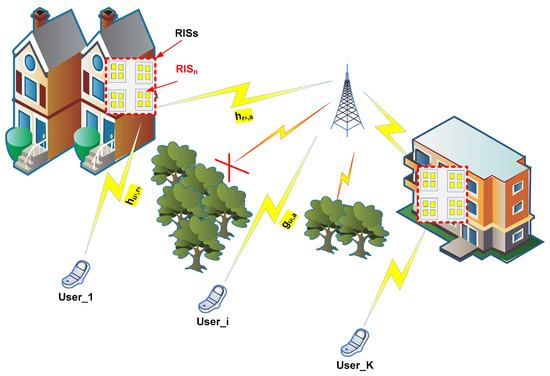
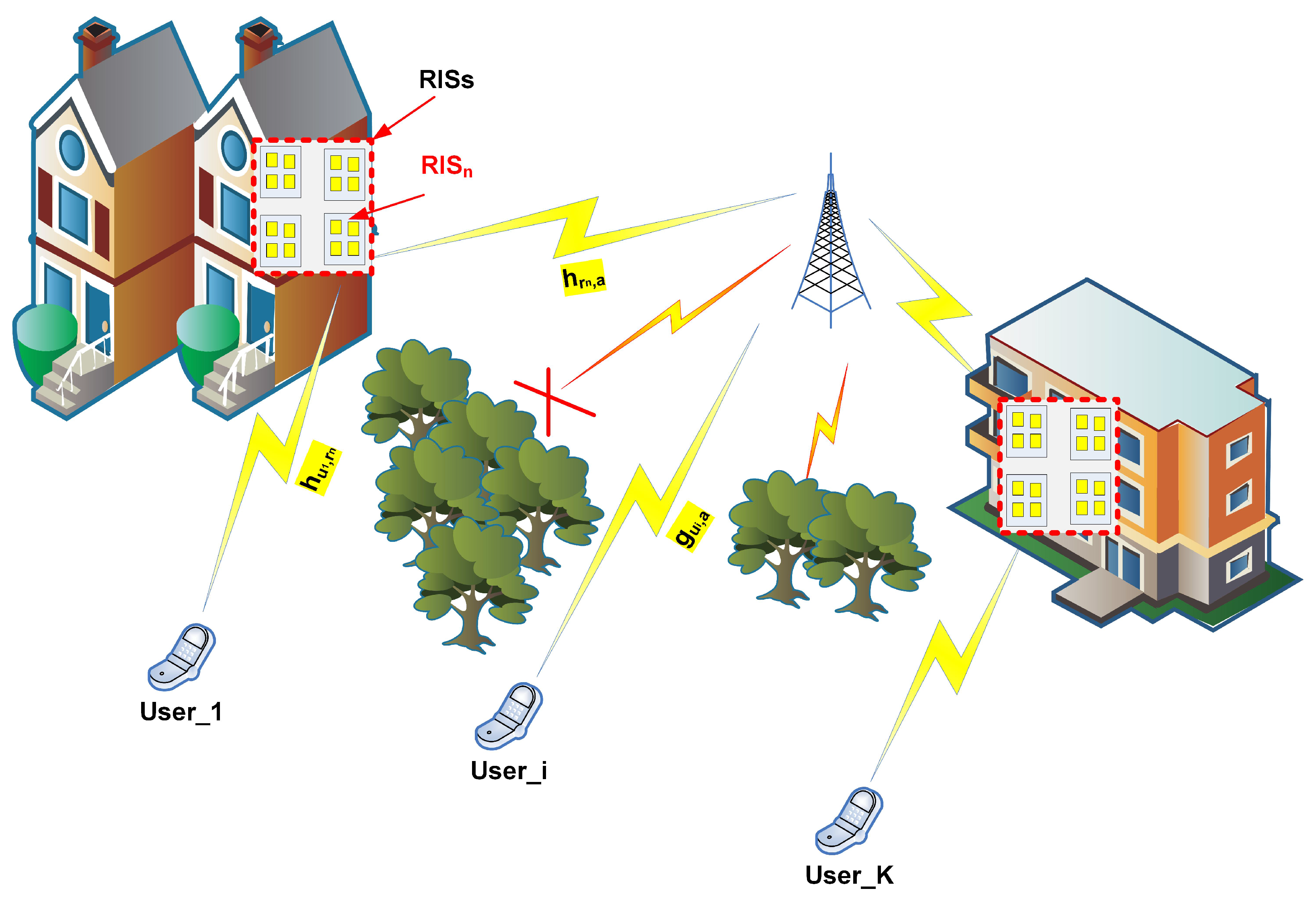
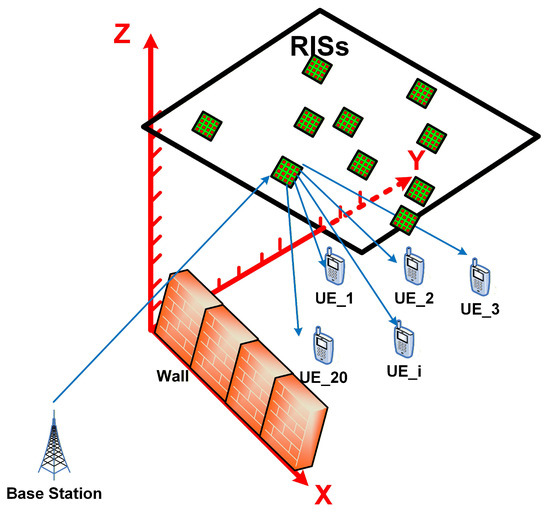
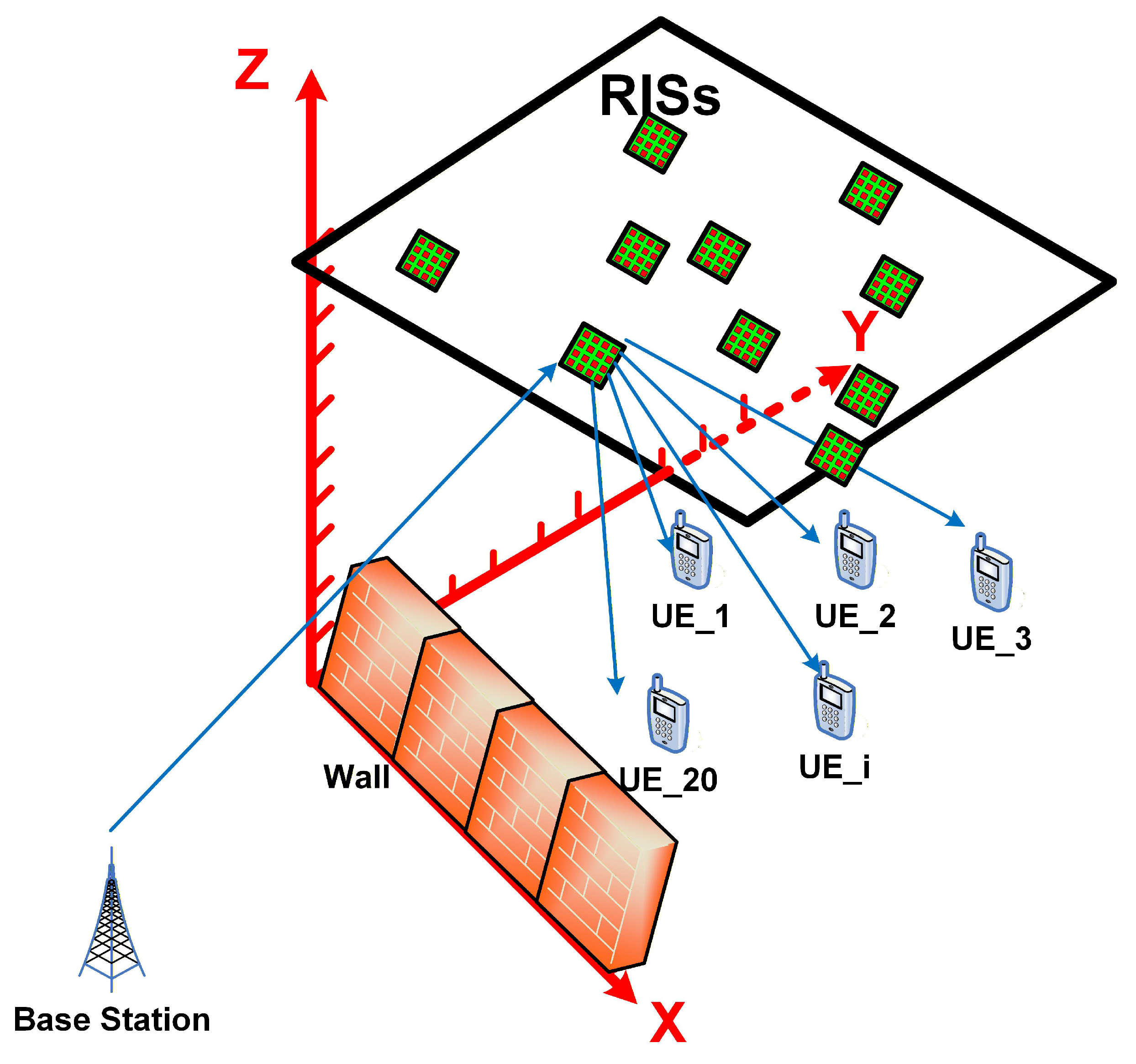
Figure 1 depicts the proposed multi-RIS-assisted wireless communication framework operating in an outdoor environment. In this system, a single-antenna Access Point (AP) communicates with K single-antenna user equipment (UE) through the assistance of N equal-sized RIS. Each RIS is modeled as a uniform planar array (UPA) consisting of M passive reflecting elements mounted on building surfaces.
Figure 1.
Proposed multi-RIS-assisted wireless communication system.
2.1. Communication Channel Model
Let denote the phase-shift vector of RIS n, and let represent its corresponding diagonal phase-shift matrix. The following channels are defined:
- : channel between RIS n and the AP,
- : channel between UE k and RIS n,
- : direct link between UE k and the AP.
Both RIS–AP and UE–RIS channels are modeled using Rician fading. Hence, the channel between RIS n and the AP can be expressed as
where is the Rician factor, is the large-scale path-loss coefficient, denotes the array response vector with azimuth and elevation , and represents the small-scale fading vector. Similarly, the channel between UE k and RIS n is given by
where and denote the azimuth and elevation angles associated with the UE–RIS link. The direct channel between UE k and the AP is modeled as
where is the path-loss and models Rayleigh fading. The received signal at the AP from user k is then expressed as
where is the transmitted symbol with power , is additive white Gaussian noise, and indicate the visibility of the corresponding wireless links (1 for active, 0 for blocked).
The instantaneous received SNR can be formulated as
Accordingly, the achievable rate for user k is given by
In this work, we consider that reliable channel state information (CSI) is available and that all channels are spatially independent. These assumptions simplify the research and allow us to focus on evaluating the optimization potential of the suggested MPKOA algorithm. However, in practice, CSI may contain estimating errors due to pilot overhead, feedback latency, or hardware malfunctions.
2.2. Traditional Model
The traditional optimization of RIS-assisted systems focuses on minimizing the number of deployed RISs while satisfying minimum rate and spatial constraints, which can be formulated as
subject to
where L is the physical size of each RIS, and represent their spatial coordinates. The constraint (8a) provides the assurance that the achievable rate for each user is higher than . Additionally, (8b) and (8c) illustrate the location restrictions imposed by the RISs. The number of RISs is guaranteed to be between by (8e), while RIS overlap is prevented by (8d).
2.3. Proposed Fuzzifed Model of RIS Minimization and Maximization of the Achievable Rate
In this subsection, a fuzzified model is introduced to represent each addressed objective function in a fuzzy environment.
2.3.1. Membership Definitions
In the proposed model, there is two objectives functions and , expressing RIS minimization and maximization of the achievable rate, respectively. For efficient fuzzy mapping, their bounds are firstly specified as follows:
Therefore, a raw linear membership functions and are associated to represent each objective in a trapezoidal model. The linear mapping of the first objective is modeled as follows:
for the second objective, the linear mapping is modeled as follows:
Clipping rules produce the intended extreme values:
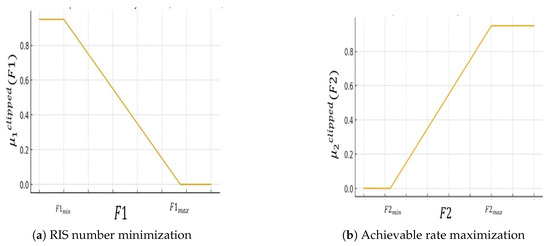
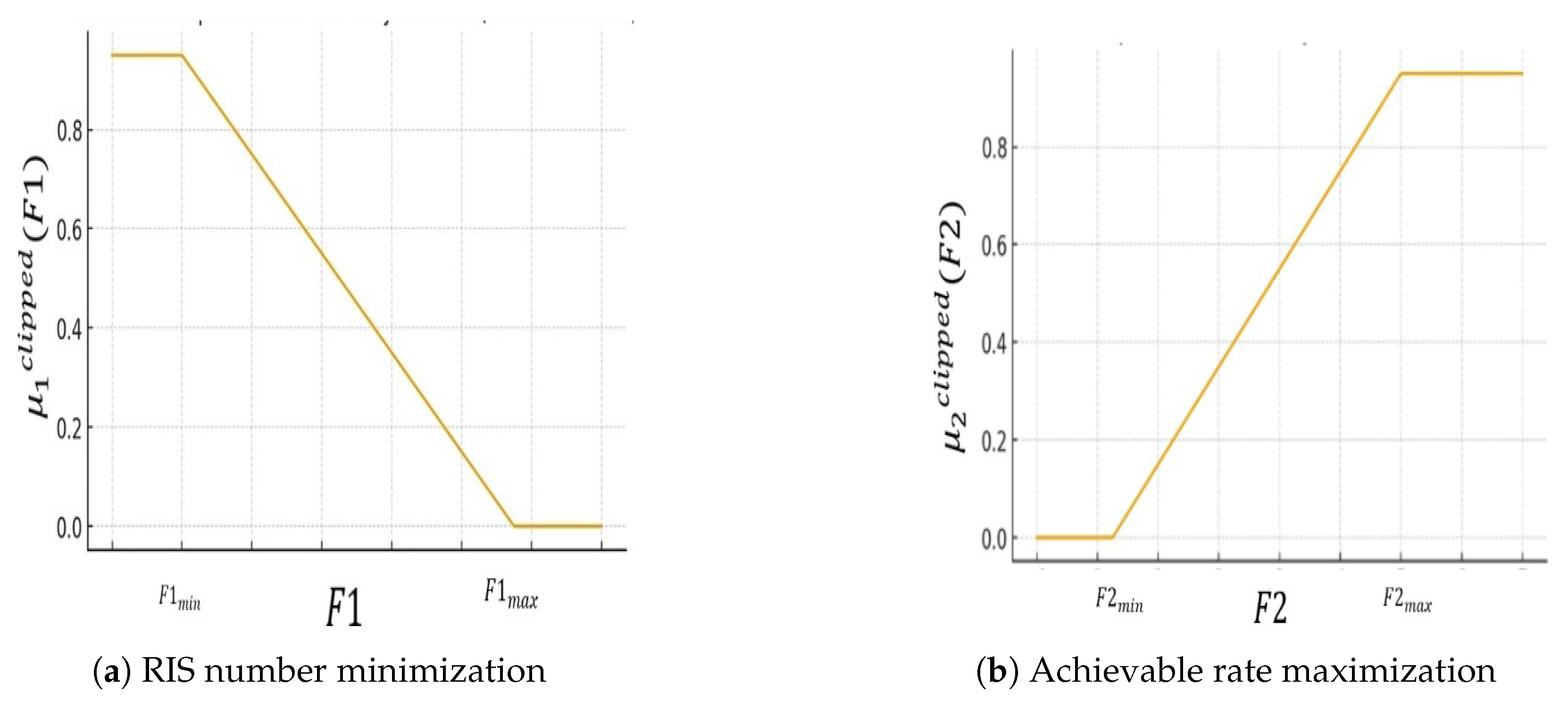
According to the clipping rules described in Equations (14) and (15), Figure 2 displays the clipped membership functions for both objectives. The first one is described in Figure 2a showing that the membership value is increased with the decrease in its objective score of RIS numbers. The second objective is described in Figure 2b showing that the membership value is increased with the increase in its objective score of achievable rates.
Figure 2.
Membership function of (a) RIS number minimization and (b) Achievable rate maximization.
Based on this proposed model, the maps are directed to 0 for the first objective and 1 for the second objective if the associated score is above its maximum.
Additionally, a penalty term is added to each objective function by subtracting a high scalar value p from each membership as follows:
2.3.2. Aggregation Rule
After representing the membership function of each objective target via clipping and penalty integration, the overall satisfaction is required. In this study, we employ the fuzzy operator as follows:
Using Equation (17), the model seeks to maximize overall satisfaction. In order to represent it by a minimization problem, we converted this to an objective value by negation:
Therefore, the optimizer searches for minimizing , defined in Equation (18) will attempt to maximize the minimum overall membership, defined in Equation (17).
Furthermore, whereas the traditional model focused on the average achievable rate, as shown in Equation (8a), the suggested constraints in Equation (10) maintain a high-quality communication for every user. Furthermore, the practical limitations of the restrictions shown in Equations (8b)–(8e) are still taken into consideration by the suggested model.
3. Proposed MPKOA Technique
3.1. Basic Mechanisms of Standard PKOA
The PKOA is a nature-inspired optimization algorithm that models the intelligent hunting behavior of pied kingfisher birds [25]. It mimics how these birds search for prey through a combination of individual exploration and cooperative interaction, enabling an effective balance between global search and local refinement. Each solution represents a bird, and its quality is evaluated using the objective function to identify the current best solution.
During the search process, PKOA relies on three main behavioral phases. The perching and hovering phase simulates how the bird scans for prey. Perching represents careful observation with small, controlled movements for local exploration, while hovering introduces more active adjustments guided by comparisons with other individuals, enhancing search diversity. Once a promising region is identified, PKOA enters the diving phase, which intensifies the search around the best solution found so far. In addition, PKOA incorporates a commensalism phase, inspired by the cooperative interaction between kingfishers and other animals such as otters. In this phase, individuals share information and adjust their positions based on others.
3.2. Proposed MPKOA
The PKOA makes use of the distinctive cooperation and predatory behaviors of pied kingfishers [25], such as commensalism, diving, perching, and hovering. The bird efficiently and precisely detects prey while conserving energy and scanning water surfaces. The proposed MPKOA enhances its performance with four different additions incorporating MDR, FCS, ASF, and EMR. The following sub-sections describe the main steps of the proposed MPKOA.
3.3. Initialization
Like most population-based algorithms [32], it starts by generating a population of NY candidate solutions, representing the pied kingfishers. Considering different randomized number are generated following uniform distributions and symbolized by , …. Each solution is placed randomly in the search space:
where k is the index of pied kingfisher agent; is the problem dimension; and are upper and lower bounds of search space.
Each candidate solution is evaluated using the objective function:
Therefore, the best solution found so far is stored as .
3.4. Perching and Hovering
This step mimics the bird’s scanning for prey from a perch or while hovering. The general update is:
where represents the new pied kingfisher agent; is the current solution while denotes a randomly chosen neighbor (); is a random coefficient depending on function () that draws a random scalar vector with -dimension from the standard normal distribution; is a movement factor following different strategies depending on perching or hovering.
In the perching phase, the energy-saving scanning is implemented using crest angles. When perched, the bird remains stationary but keeps scanning the water surface by turning its head and crest slightly to detect prey movements. This inspires a fine-tuned local exploration with directional oscillations controlled by the crest angle and energy factor:
where T is the current iteration while its maximum is set to ; illustrates the beating factor which controls the rate of motion modulation; is the crest-based angular orientation for scanning direction.
The movement factor in Equation (22) plays a central role in governing the position update of each agent in the PKOA. It acts as a dynamic scaling coefficient that modulates the step size and direction of movement when an individual solution is updated relative to another randomly selected agent. Through its integration within the position update rule, the movement factor determines how aggressively or conservatively an agent explores the search space.
During the perching phase, the movement factor simulates a bird’s scanning behavior, incorporating an oscillatory component linked to a random crest angle for directional perturbations. A time-dependent term modulates scanning intensity over time, allowing the PKOA to execute controlled small-scale movements around its current position.
In contrast, during the hovering phase, the movement factor is based on the relative fitness among individuals, simulating a bird’s adjustments while targeting prey. It incorporates a learning aspect into the PKOA, facilitating information sharing among agents and enhancing convergence towards effective search areas. Therefore, the formulation of the movement factor in PKOA is conceptually reasonable and biologically consistent, as it successfully translates natural foraging behaviors into mathematical search strategies. It provides a flexible mechanism for alternating between exploratory and exploitative movements while maintaining directional guidance through interactions among agents.
The PKOA initializes the crest angle () at random to be a fixed value that reflects a kingfisher’s field of vision orientation during perching or scanning. However, it lacks adaptability as optimisation progresses. An adaptable vision controller is added to the suggested MPKOA in order to gradually decrease the angular search range as the algorithm gets closer to convergence. Thus, the crest angle is represented as:
At first, the algorithm’s broad angular spectrum promotes general exploration, but as iterations go on, the angle gets smaller, allowing for more accurate exploitation. To dynamically control the shift among exploration, exploitation, and cooperative synchronization, an EMR is implemented. Every agent is given a dynamic energy value, which can be described in Equation (24) and gradually drops with the number of iterations, representing energy depletion over time:
On the other hand, in the hovering phase, a wing-beating control of search intensity is modeled. When prey is suspected, the kingfisher hovers above the water using rapid wing beats to stay in position and refine targeting. Thus, the movement factor (MF) can be described as follows:
3.5. Diving for Prey
When prey is detected, the kingfisher dives straight at it. This corresponds to intensification around the best solution.
3.6. FCS Enhancement
The social coordination of birds throughout hovering or scanning is addressed in this improvement. Thus, to develop insufficient synchronization, a global average component () is taken into consideration as follows:
FCS can be used to update the search agent in the following ways:
where represents the FCS weighting share (). This model pulls lone individuals towards the collective center and stabilizes the search.
3.7. MDR Enhancement
In the proposed MPKOA, a small storage of the most effective previous solutions is maintained (). Then, some selected present individuals can re-sample around one of those stored wealthy individuals alongside probability ():
where the probability of reperching certain solutions is indicated by (). The perching return behavior of actual kingfishers returning to productive hunting locations is replicated by this model. As a result, it keeps desirable regions from being lost too soon because of random variations, and it increases exploitation by permitting re-localization to formerly favorable search areas.
3.8. ASF Enhancement
The suggested MPKOA splits the population into diverse smaller groups (), which are frequently reshuffled every specified number of iteration (), as opposed to a singular flock as in the conventional PKOA. Therefore, after subgroup reshuffling, some targeted birds are updated as follows:
where is the best solution in a subgroup g, and is the newly generated solution in another targeted subgroup . A normally distributed random vector is denoted by , while is a stochastic exchange coefficient. This representation simulates the dispersed hunting of several kingfishers across various water areas. As a result, it aids in avoiding local entrapment and maintaining exploration diversity.
3.9. Boundary Control
Following the position updates, every control variable is limited to the acceptable ranges. This process ensures that each new control variable stays inside the search domain that is feasible. Then, for every bird solution k, the associated function of goal will be assessed. The bird’s position has been adjusted in accordance with the newly established fitness if it indicates an enhancement over the prior one, as shown below.
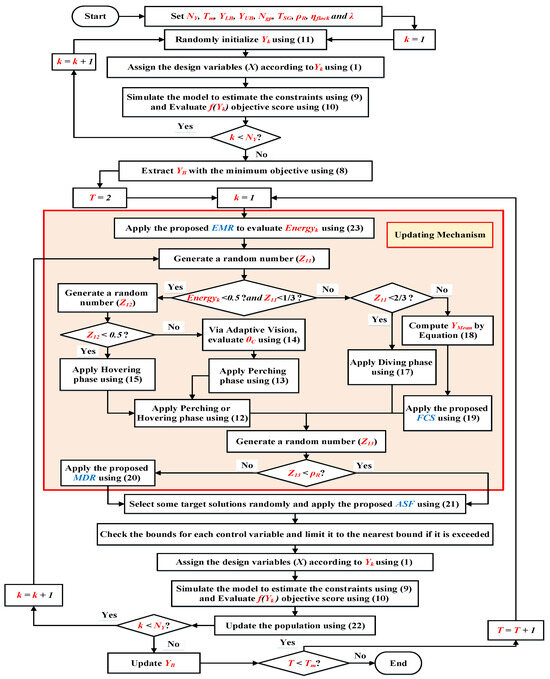
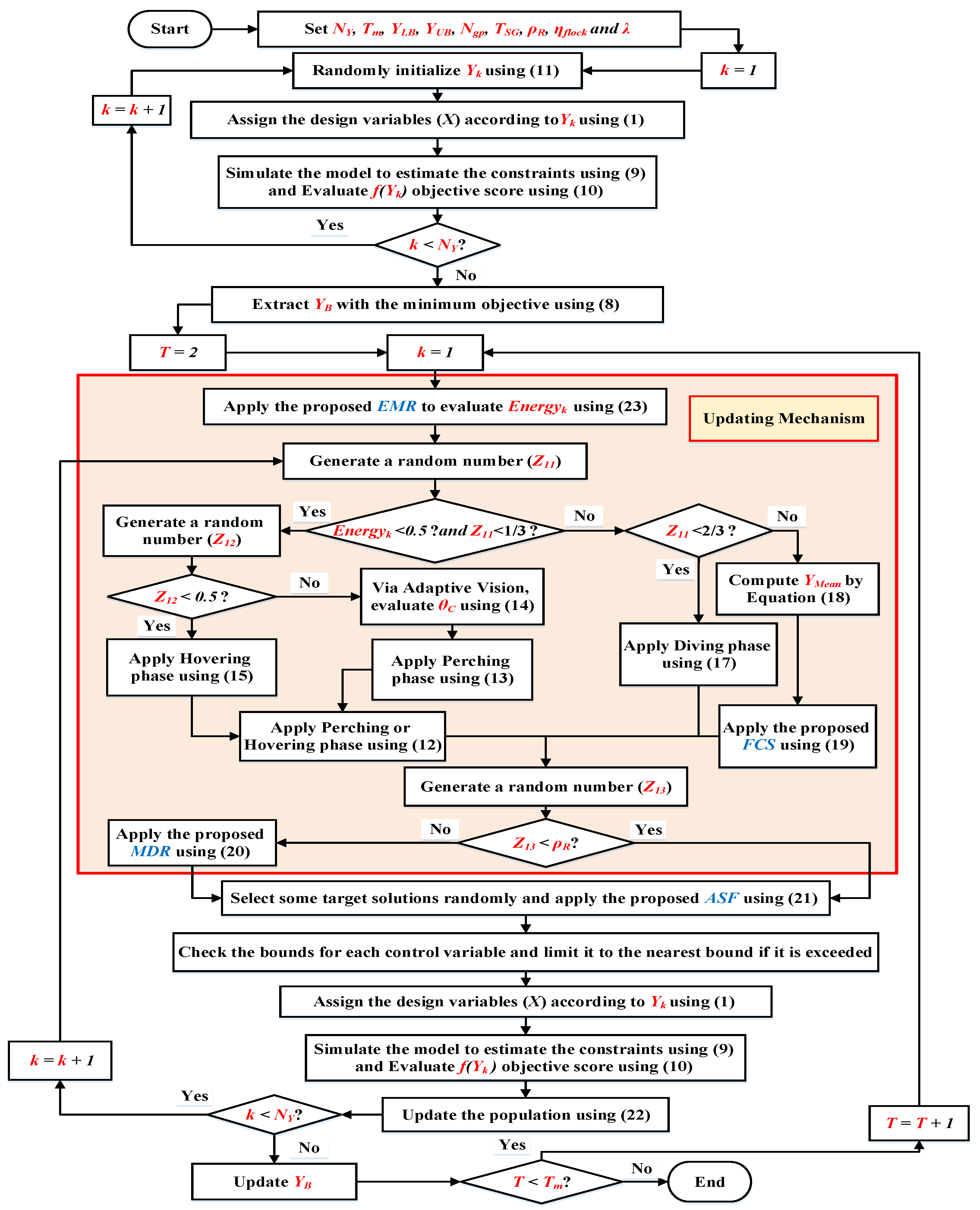
Furthermore, the best global solution is constantly updated as better fitness is extracted. Figure 3 displays a flowchart of the proposed MPKOA framework. Also, Table 1 displays a summary of the main differences between the standard PKOA and the proposed MPKOA.
Figure 3.
Main steps of the MPKOA.
Table 1.
Standard PKOA versus proposed MPKOA: main differences.
4. Numerical Results
Several simulation case studies were carried out in order to assess the efficacy of the suggested MPKOA in comparison to other benchmark algorithms. Optimizing the quantity and positioning of RIS units in a wireless communication environment is the primary goal of these experiments. As shown in Figure 1, physical obstacles are defined by vertices [0, 0, 0], [0, 0, 2.25], [10, 0, 2.25], and [10, 0, 0] m. The location of the AP is [5, −10, 1] m. With a reference path loss of = 20 dB at a distance = 1 m, path-loss modeling is carried out using exponents = 2.2 for the UE–RIS–AP links and = 4 for the direct UE–AP link. Each of the users in the simulated setup has a single antenna, and each RIS has reflecting elements with side lengths of m. Each user transmits with power mW, and the Rician factor is set to . The noise power is equivalent to an SNR of −23 dB, and the number of RISs ranges within . The normalized objective function limits are .
To thoroughly evaluate the suggested MPKOA, the simulation results are divided into four main parts. Initially, MPKOA’s statistical performance is examined and contrasted with various benchmark metaheuristic algorithms. Second, box plots, heatmaps, and histograms are used to show distribution patterns and performance variations through visual comparisons. Third, each optimization method’s stability and speed of convergence are assessed by looking into the algorithms’ convergence behavior. Lastly, the effectiveness and viability of the optimized placements are confirmed by analyzing the spatial distribution of the deployed RISs within the simulated environment.
The proposed MPKOA is evaluated against both classical and recent optimization algorithms, including the standard PKOA [25] (2024) and its enhanced version EPKO [30] (2025), which represents a recent advancement in this research direction. In addition, widely adopted benchmark algorithms such as DE and GWO are considered due to their proven efficiency and robustness.
4.1. Statistical Outcomes
Table 2 compares the statistical outcomes of the proposed MPKOA with DE, EPKO, GWO, and the standard PKOA at various rate thresholds ( = 1 to 1.5). The metrics include the minimum, mean, maximum, and standard deviation (STD) values derived from multiple separate runs. In general, MPKOA routinely outperforms all statistical metrics and rate criteria. For = 1, the suggested MPKOA achieves a mean objective value of 0.3349, compared to 0.3057 for DE and 0.2744 for EPKO. This is an average improvement of around 9.6% over DE and 22% over EPKO. At = 1.2, MPKOA achieves a mean value of 0.3262, surpassing EPKO and GWO by 17% and 2.5%, respectively. Even at higher thresholds ( = 1.5), where optimization becomes more problematic due to tighter achievable-rate restrictions, MPKOA maintains its resilience with a mean of 0.3251, outperforming DE, GWO, and PKOA by 2.2%, 11.5%, and 3.3%.
Table 2.
Statistical outcomes of the proposed MPKOA against other benchmark algorithms (DE, EPKO, GWO, and standard PKOA).
In terms of maximal performance, MPKOA routinely outperforms rival algorithms. For example, the highest objective at = 1 is 0.3929 for MPKOA compared to 0.3669 for DE and 0.3341 for EPKO, suggesting approximately 7% and 17.6%, respectively. MPKOA excels in identifying global optimal solutions in complicated, multi-modal search environments, with an average maximum improvement margin ranging from 10% to 20% across all values.
Furthermore, MPKOA exhibits low variance across runs, as shown by lower standard deviation values, typically 15–30% lower than those of DE and GWO. This decrease in variability indicates enhanced search stability, consistent convergence behavior, and a lower vulnerability to local optima. In contrast, algorithms like DE and GWO have broader performance variations, indicating less control over convergence dynamics and less adaptability to multi-objective constraints. EPKO improves moderately over PKOA due to improved exploitation capacity, but it still falls short of MPKOA’s balance of exploration and exploitation.
Table 2 illustrates the statistical performance of the algorithms based on best, mean, and worst objective values. The proposed MPKOA regularly outperforms all performance measures. In particular, MPKOA outperforms rival approaches in terms of mean and best objective values while preserving lower variability. This suggests not only better optimization capabilities, but also more stable convergence behavior. Compared to DE and GWO, which produce competitive but variable results, MPKOA exhibits more consistent performance with lower susceptibility to random initialization. These findings support the usefulness of the proposed modifications in boosting solution quality and robustness.
Since the proposed MPKOA is a heuristic method and no global optimum exists for the examined nonlinear stochastic issue, the optimality gap is evaluated in relation to the best-known solution found by the competing algorithms. Equations (32)–(34) define three metrics for quantifying the best, mean, and worst optimality gaps, indicated as , , and , respectively. Table 3 shows the findings for DE, EPKO, GWO, standard PKOA, and suggested MPKOA. MPKOA has a zero best-case optimality gap (), making it the best-known solution among all compared algorithms. Furthermore, MPKOA has the lowest mean optimality gap (), exceeding DE (), EPKO (), GWO (), and standard PKOA (), indicating higher average performance. In the worst-case situation, MPKOA has the smallest gap (), slightly better than regular PKOA (), and greatly outperforms other approaches.
Table 3.
Best, mean and worst optimality gaps of DE, EPKO, GWO, standard PKOA, and MPKOA for .
4.2. Achievable Rate
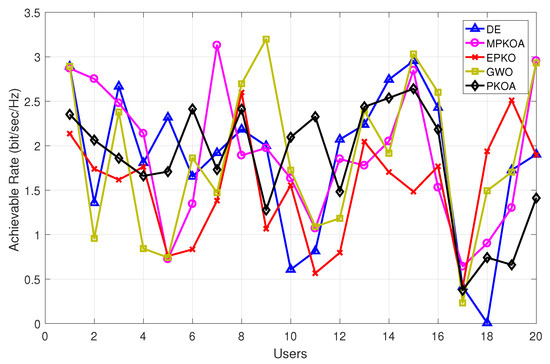
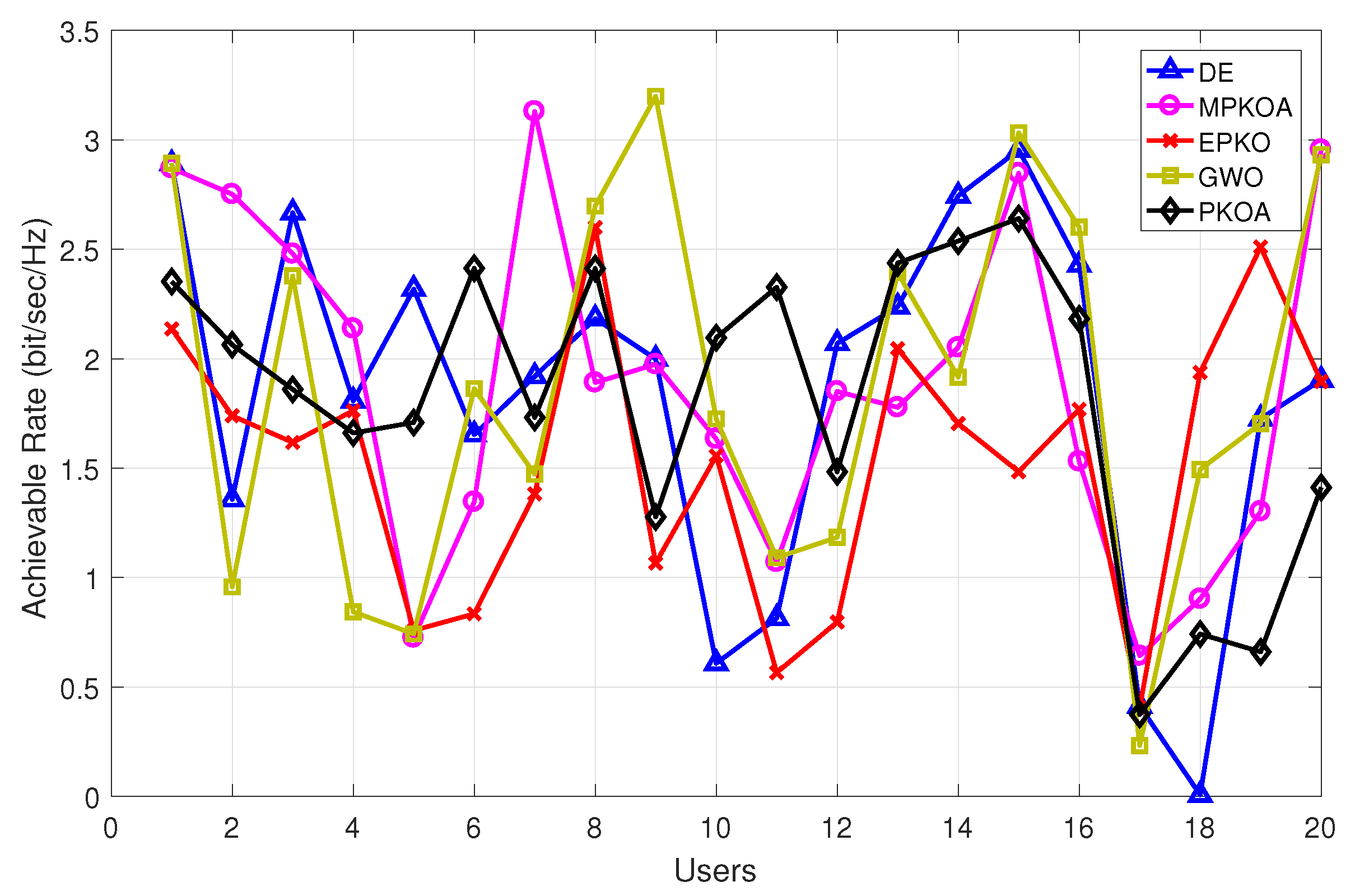
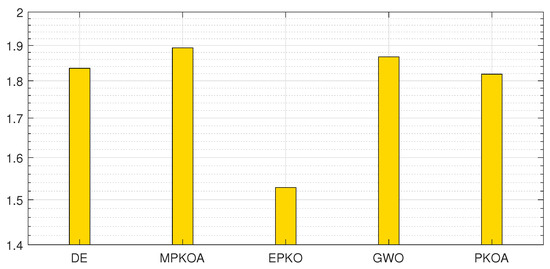
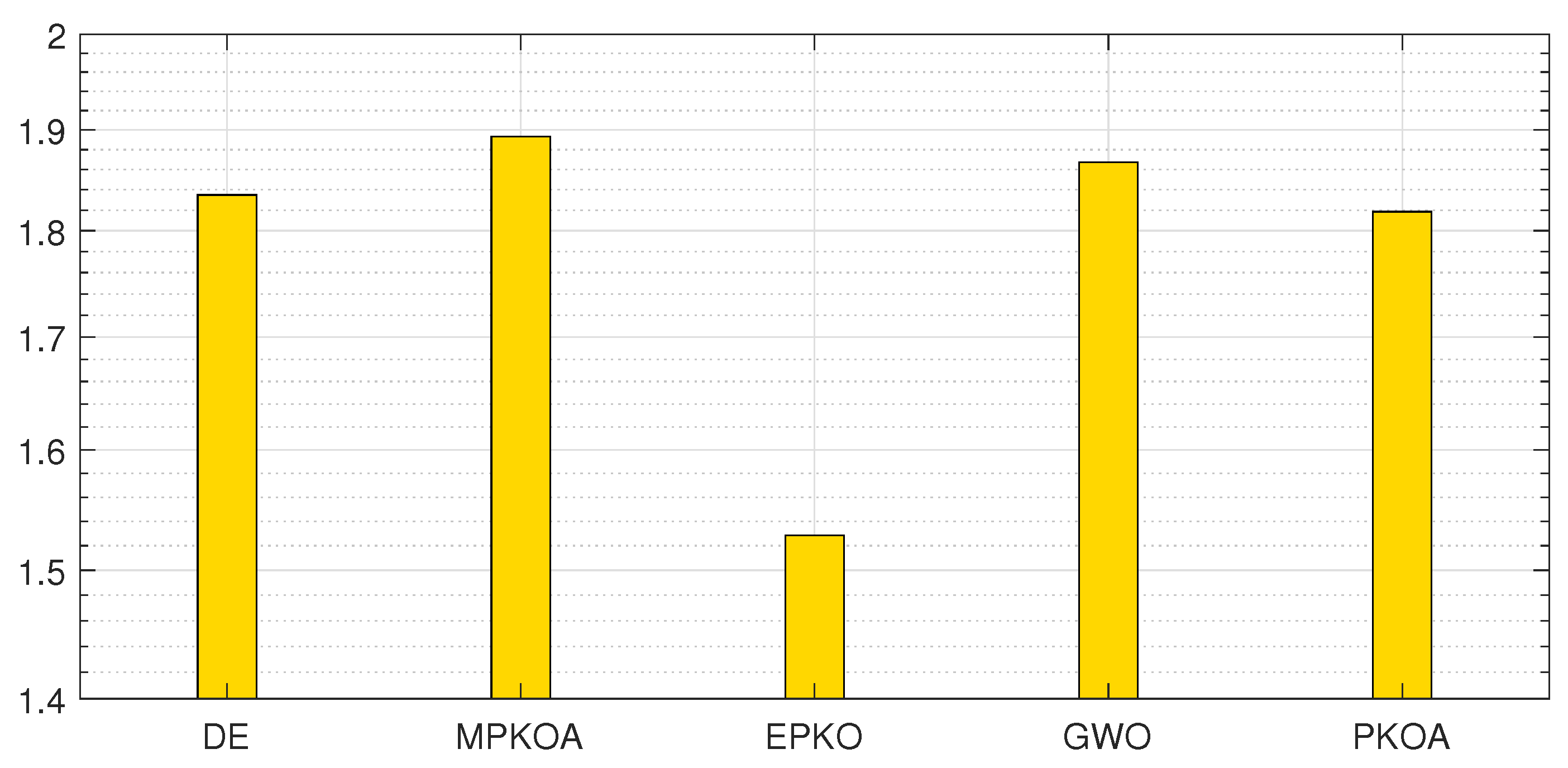
Figure 4 illustrates the achievable rate for each user under various optimization strategies. The proposed MPKOA consistently achieves greater or equivalent achievable rates for the majority of users when compared to DE, EPKO, GWO, and regular PKOA. MPKOA, in particular, has more steady performance with less severe degradations that indicate its potential to deliver consistent communication quality under a variety of user situations. Figure 5 illustrates the average achievable rate for all algorithms. As demonstrated, MPKOA has the highest average rate of , beating out GWO (), DE (), PKOA (), and EPKO (). MPKOA outperforms GWO, DE, normal PKOA, and EPKO by an average of , , , and , respectively. These results clearly indicate the superiority of the proposed MPKOA in improving communication performance, confirming that the optimization process directly translates into higher attainable rates and overall system efficiency.
Figure 4.
Achievable rate for each users with of different optimization algorithm (proposed MPKOA, DE, EPKO, GWO, and standard PKOA).
Figure 5.
Average achievable rate with of different optimization algorithm (proposed MPKOA, DE, EPKO, GWO, and standard PKOA).
4.3. Performance Evaluation
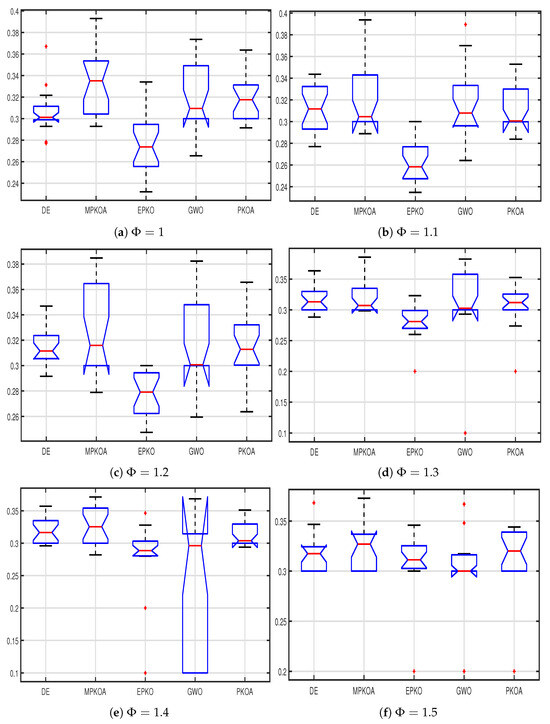
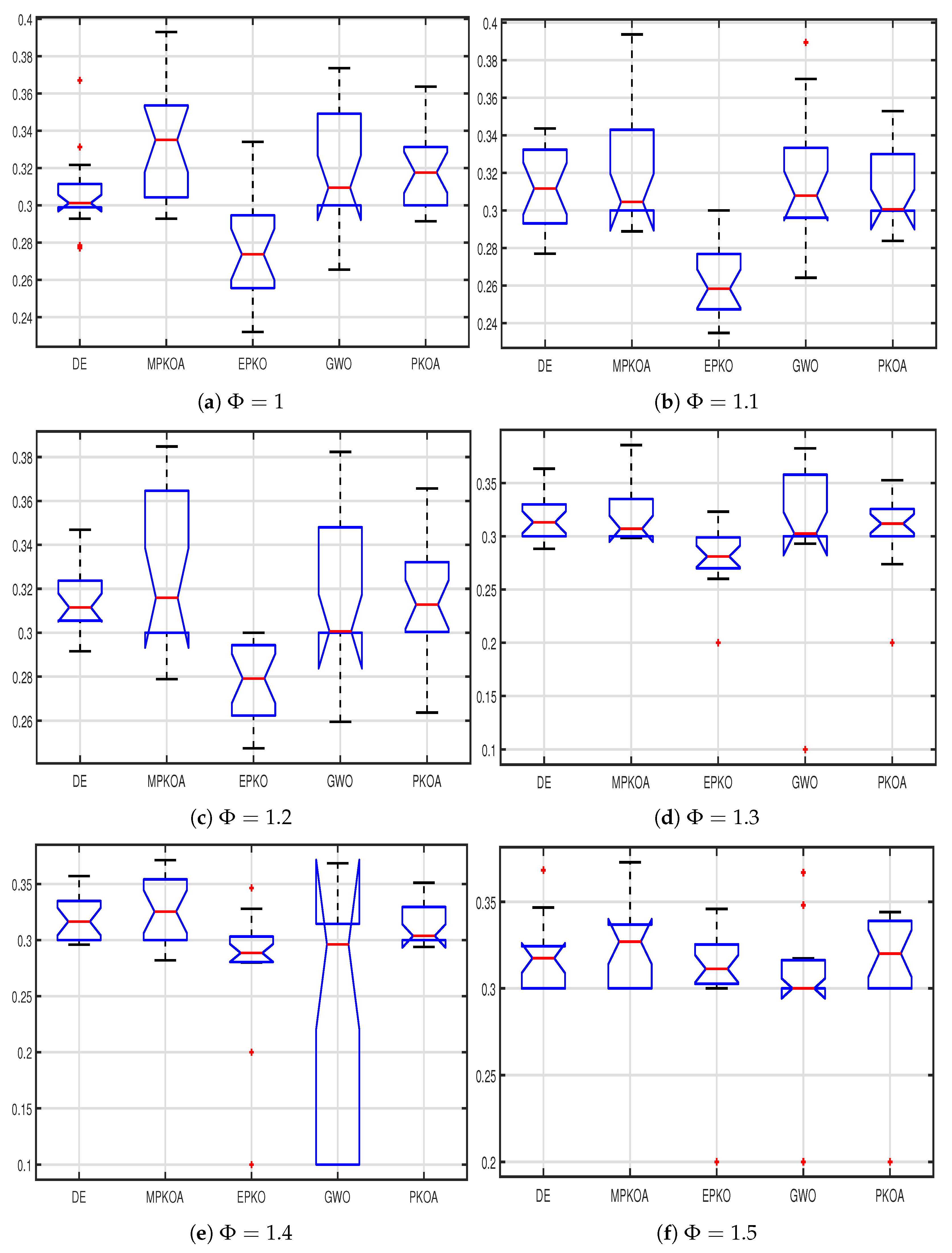
Figure 6 shows the box plots of objective function values acquired by the proposed MPKOA, DE, EPKO, GWO, and standard PKOA across 100 separate runs. MPKOA consistently yields higher median values than the other algorithms, indicating better optimization performance. The median improvement of MPKOA over GWO and DE is roughly 2–5%, and around 6–10% when compared to EPKO and standard PKOA, depending on the circumstance.
Figure 6.
Boxplot obtained by proposed MPKOA, DE, EPKO, GWO, and standard PKOA over 100 runs.
In addition to the better central tendency, MPKOA has a more compact interquartile range, indicating improved convergence stability and decreased variability. MPKOA has a narrower interquartile spread (20–35%) than DE and GWO, indicating more consistent performance across independent runs. This tighter distribution demonstrates MPKOA’s capacity to sustain consistent convergence behavior.
Furthermore, MPKOA has fewer extreme outliers than competing algorithms, indicating greater robustness and lower susceptibility to unstable search dynamics. In comparison, DE and GWO have wider spreads and more dispersed outliers, indicating less dependable convergence and a higher risk of stalling in local optima.
The comparison to EPKO and standard PKOA validates the usefulness of the proposed modifications. While EPKO improves upon the baseline PKOA, MPKOA obtains an additional 4–8% improvement in median performance coupled with a substantial reduction in variability, demonstrating that the proposed mechanisms boost both solution quality and convergence reliability.
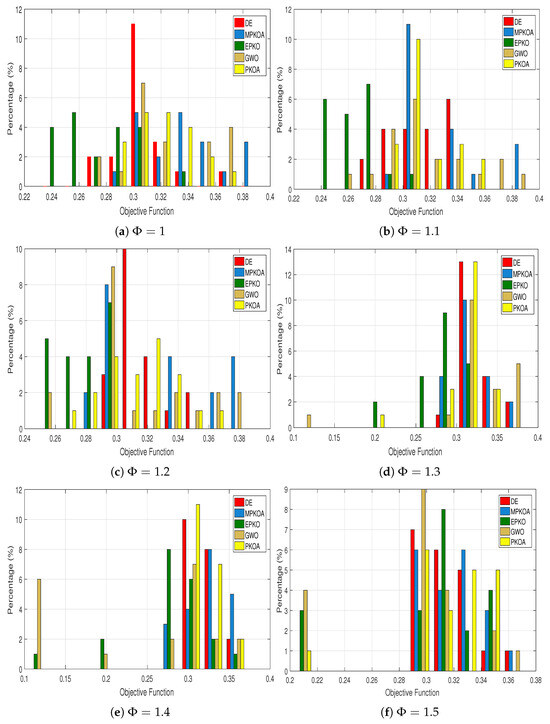
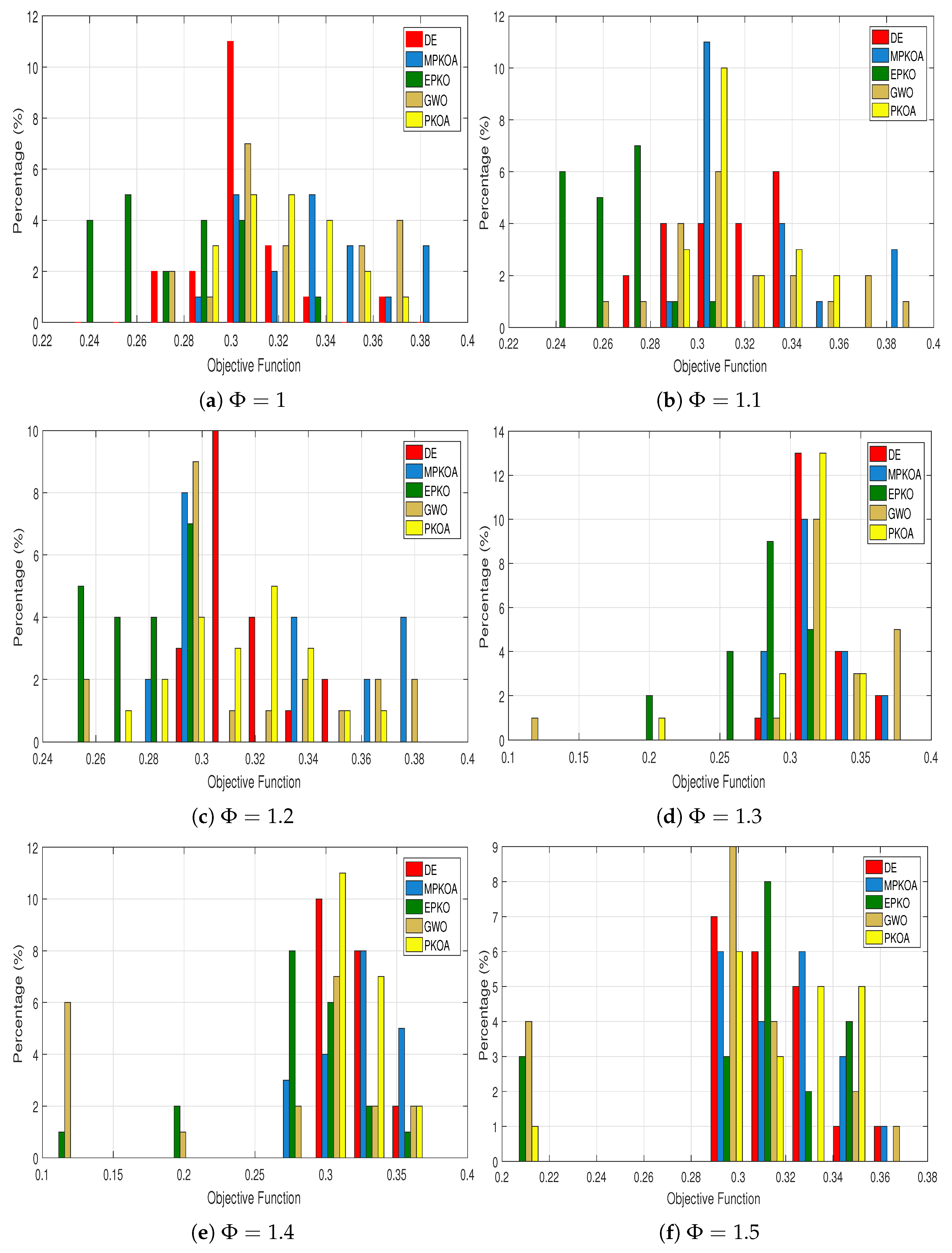
Figure 7 shows histograms of objective function values derived by MPKOA, DE, EPKO, GWO, and standard PKOA over 100 independent runs at various rate thresholds (:). MPKOA clearly shows a larger concentration of samples in the upper range of objective values in all scenarios. For most values, the bulk of MPKOA results cluster in the interval , with peak frequencies reaching roughly 10–12%, indicating substantial convergence toward high-quality solutions.
Figure 7.
Histogram obtained by proposed MPKOA, DE, EPKO, GWO, and standard PKOA over 100 runs.
In contrast, DE and GWO exhibit more dispersed distributions with noteworthy frequencies in lower objective ranges (e.g., less than ), indicating less consistent performance and greater unpredictability. EPKO outperforms standard PKOA by moving more samples to higher values; however, MPKOA maintains a larger concentration in the best-performing region. Specifically, MPKOA gives roughly 10–18% greater frequency in the top performance bins compared to DE and GWO, and about 6–12% improvement over EPKO across various thresholds.
Furthermore, MPKOA’s histogram peaks are sharper and narrower, indicating lower variance and increased robustness during the optimization process. This persistent clustering at higher goal values shows MPKOA’s capacity to consistently converge to near-optimal solutions across a variety of communication scenarios.
4.4. Convergence Rate
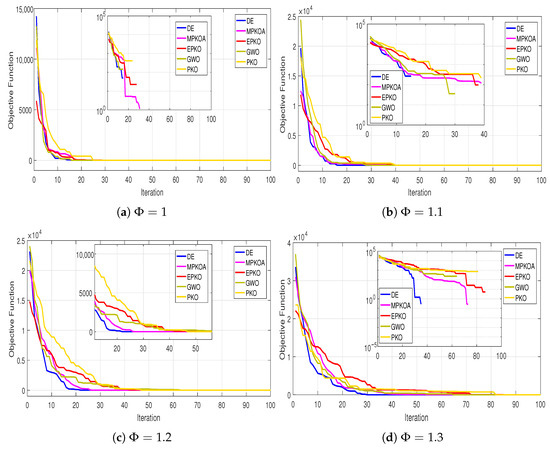
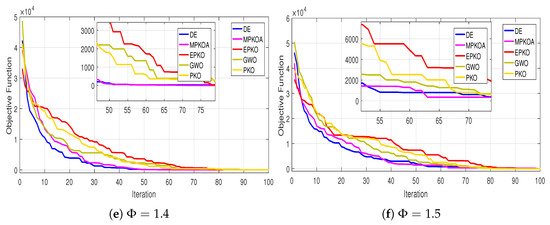
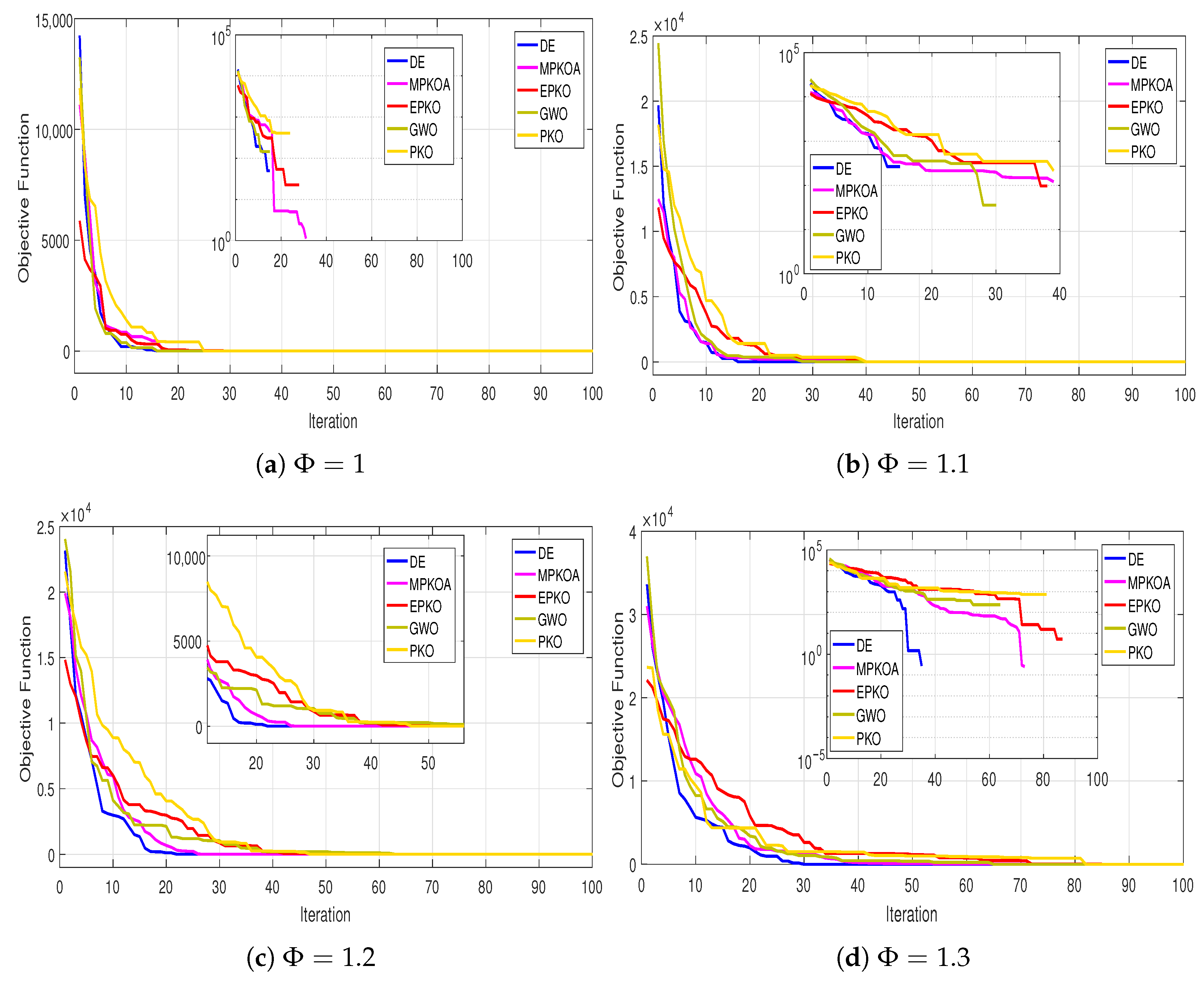
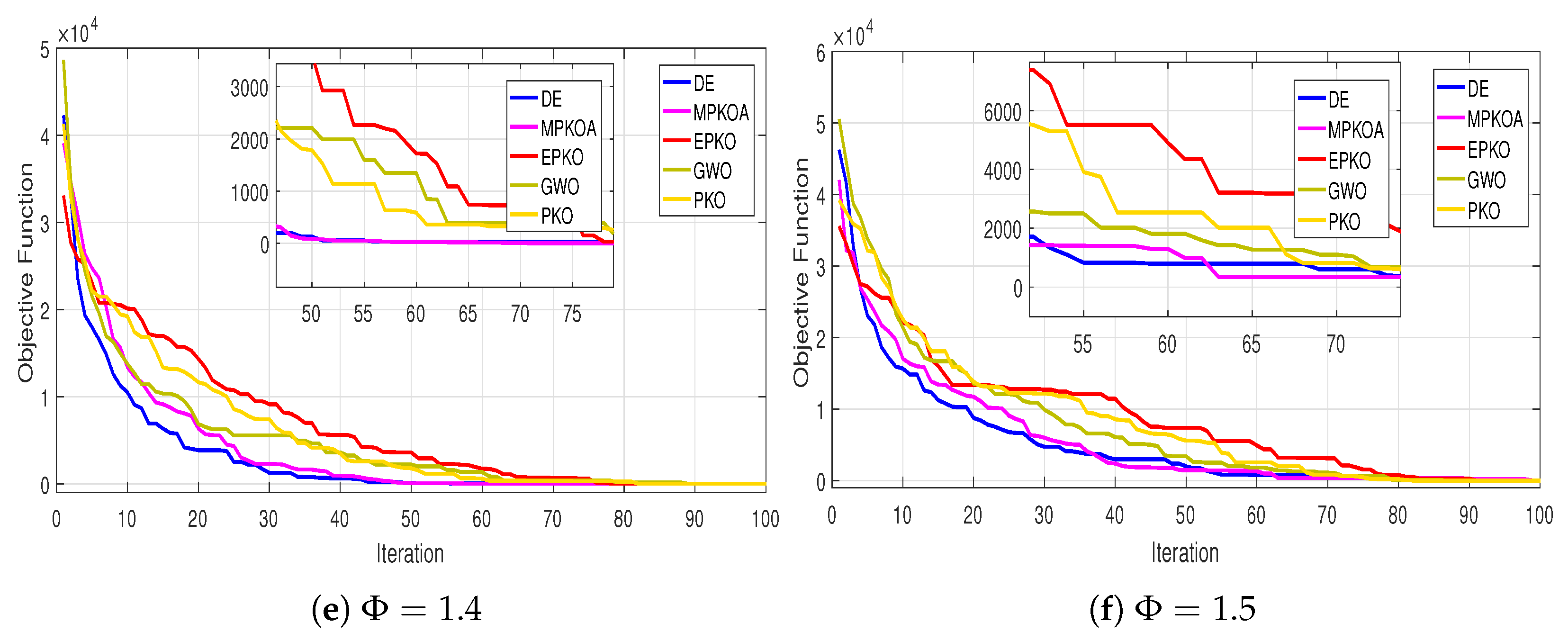
The average convergence rates of the proposed MPKOA over various achievable-rate thresholds ( = 1–1.5) are compared with DE, EPKO, GWO, and the standard PKOA in Figure 8. The convergence curves unequivocally demonstrate that MPKOA requires fewer iterations to obtain stability and achieves faster and smoother convergence toward the ideal solution. In particular, MPKOA’s improved search efficiency is demonstrated by the fact that it converges 25–35% quicker than DE and GWO and around 15–20% faster than EPKO and PKOA. MPKOA maintains a consistent improvement trend before stabilizing at a lower objective value, in contrast to the benchmark algorithms, which show oscillations or premature saturation. This is indicative of its successful balance between exploration in the early stages and exploitation in the later ones.
Figure 8.
Average convergence rates of different optimization algorithm (proposed MPKOA, DE, EPKO, GWO, and standard PKOA).
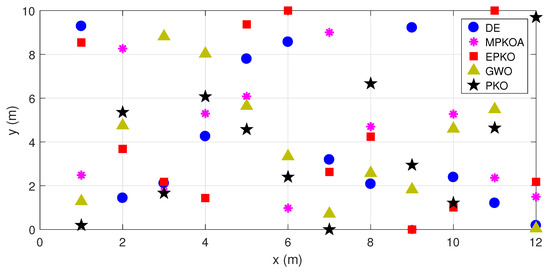
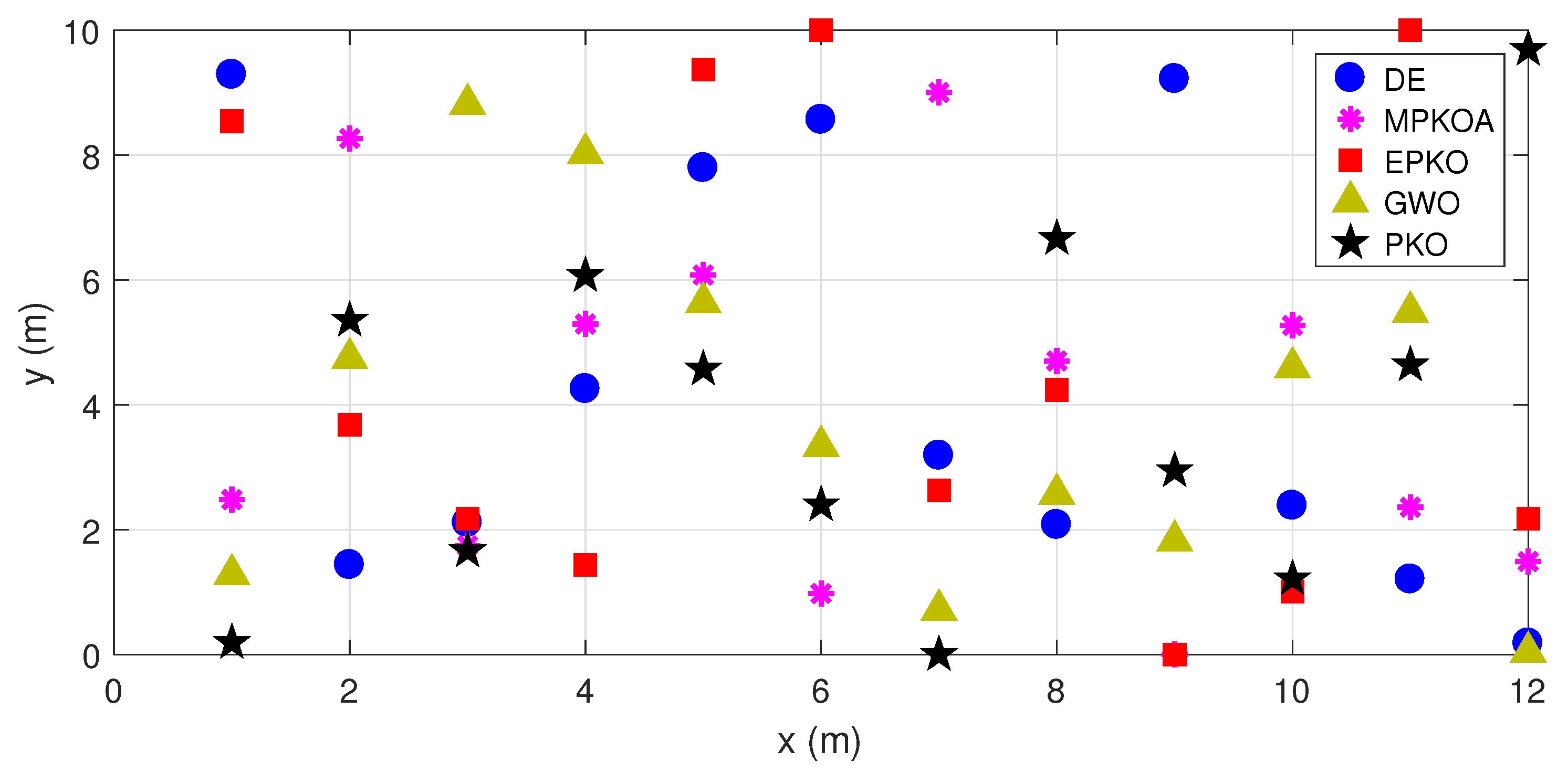
4.5. Spatial Distribution of Optimized RIS Placements
Figure 9 illustrates the spatial distribution of optimum RIS sites for . As demonstrated, the proposed MPKOA results in a well-organized and balanced RIS deployment within the prescribed area, successfully covering the user region while avoiding overlapping placements and complying to physical limits. The RISs are strategically positioned to optimize signal reflection routes between the AP and users, resulting in better coverage and higher attainable rates. Compared to other algorithms, MPKOA’s placement pattern exhibits greater spatial diversity and uniform distribution, reducing shadowing effects and path-loss fluctuations.
Figure 9.
RIS position with .
Figure 9 shows the spatial distribution of RISs, while Figure 10 visualizes the specific RIS positions determined by the proposed MPKOA algorithm. It also annotates the position of the wall and the users on the plot. As depicted, the RISs are placed on the surface, ensuring physically practical installation and unhindered reflected routes to users. The visual annotations confirm that no RIS is put within the obstacle region and that the optimal positions adhere to the geometric and separation criteria. This layout allows for successful signal redirection around the blockage while increasing coverage and achievable rate for users, indicating that the suggested optimization approach results in strategically positioned and physically realizable RIS deployments.
Figure 10.
RIS positions based on MPKOA algorithm for = 1 coordinated with the BS, wall and the users.
4.6. Computational Complexity Analysis
The computational complexity of the proposed MPKOA is consistent with the overall structure of population-based metaheuristic algorithms. Using the Big notation [33], the time complexity of the proposed MPKOA can be defined as [34], which is determined by the population size , evaluation of the fitness function , and maximum number of iterations , which is similar to DE and GWO algorithms. In contrast, for standard PKOA and EPKO, it can be defined as double the computational burden of the proposed MPKOA. This double consumption occurs because the proposed MPKOA evaluates the fitness of each generated solution once in each iteration, whereas the standard PKOA, and EPKO assess each counterpart twice every iteration.
Moreover, to provide a practical assessment of time and storage complexity, we compare the runtime and memory use of the proposed MPKOA and benchmark algorithms, such as DE, EPKO, GWO, and standard PKOA. To guarantee a fair comparison, all tests use the same simulation settings.
The time and memory complexity comparison is shown in Table 4. As can be seen, the proposed MPKOA outperforms DE, GWO, PKOA, and EPKO with the lowest runtime of s. In particular, MPKOA decreases runtime by roughly when compared to DE, when compared to PKO, when compared to GWO, and when compared to EPKO.
Table 4.
Computational complexity comparison with runtime and memory usage.
All algorithms have similar memory requirements; MPKOA maintains a memory footprint (2919 MB) that is smaller than GWO and EPKO and comparable to DE. These results show that the suggested MPKOA improves computational efficiency without adding extra memory overhead in addition to achieving better optimization performance.
4.7. Focus Comparison of DE vs. MPKOA: Discussion
A focused comparison between DE and the proposed MPKOA for maximizing the considered membership function clearly demonstrates the superior performance of MPKOA across most statistical indicators and operating conditions as shown in Table 2. In terms of mean objective value, which reflects the overall optimization capability, MPKOA consistently outperforms DE for all values of . The improvement ranges from approximately +0.7% (at = 1.3) up to about +9.6% (at = 1), with typical gains around 3–7% across the remaining cases. This indicates that MPKOA provides a more reliable convergence toward higher-quality solutions on average.
From the perspective of maximum achieved fitness, MPKOA shows even more pronounced advantages, highlighting its strong exploitation capability. The maximum values obtained by MPKOA exceed those of DE by approximately 6–15%, with the largest improvement observed at = 1.1 (≈+14.6%) and consistently above +4% in all scenarios. This confirms that MPKOA is more effective in locating superior global or near-global optima compared to DE.
Regarding the minimum values, which reflect worst-case performance, MPKOA generally maintains comparable or slightly better results in several cases (e.g., improvements of about +4–6% at = 1, 1.1, and 1.3), although slight degradation is observed at = 1.2 and 1.4 (around −4% to −5%).
In terms of standard deviation, DE tends to exhibit lower variability in some cases, whereas MPKOA shows slightly higher dispersion for certain values (increases of approximately 20–60% in some cases). However, this increased variance is accompanied by significantly higher maximum and mean values, indicating a deliberate trade-off between diversity and performance quality. In terms of runtime, MPKOA decreases runtime by roughly 14.16% when compared to DE as shown in Table 4.
5. Conclusions
This study describes a new MPKOA for optimizing the placement and number of RISs in multiuser wireless communication systems. A fuzzified multi-objective model was created to minimize the number of deployed RISs and optimize the achievable rate while adhering to realistic deployment limitations like spatial limits and non-overlapping requirements. The proposed MPKOA included several key enhancements—Memory-Driven Re-perching (MDR), Flock Cooperation Strategy (FCS), Adaptive Subgrouping Framework (ASF), and Energy-based Motion Regulation (EMR)—to achieve a more effective balance between exploration and exploitation, resulting in faster convergence and improved optimization accuracy.
Extensive simulations revealed that MPKOA routinely outperformed benchmark algorithms, including DE, GWO, EPKO, and the standard PKOA in terms of mean objective values, convergence speed, and solution stability. The statistical, visual, and convergence assessments all verified that MPKOA improves performance by up to 20% and speeds up convergence by 30% on average. Furthermore, MPKOA’s optimized RIS placements enabled uniform coverage, higher attainable rates, and more efficient use of geographical resources. These findings demonstrate MPKOA’s robustness and effectiveness in solving difficult multi-objective optimization problems in RIS-assisted wireless networks. Future study could expand this framework to include dynamic environments, multi-cell systems, and combined optimization with other upcoming technologies like fluid antennas or intelligent reflecting access points. An interesting development of this research would be to include robustness analysis for imperfect CSI and correlated channels.
Author Contributions
Conceptualization, A.S.A. and A.M.S.; methodology, A.S.A.; software, A.M.S.; validation, M.G., A.S.A. and S.S.; formal analysis, A.S.A.; investigation, A.M.S.; resources, M.G.; data curation, S.S.; writing—original draft preparation, A.S.A.; writing—review and editing, A.M.S.; visualization, M.G.; supervision, S.S.; project administration, S.S.; funding acquisition, M.G. All authors have read and agreed to the published version of the manuscript.
Funding
This research was funded by Prince Sattam bin Abdulaziz University, grant number PSAU/2025/01/34491.
Data Availability Statement
The original contributions presented in this study are included in the article. Further inquiries can be directed to the corresponding author.
Acknowledgments
The authors extend their appreciation to Prince Sattam bin Abdulaziz University for funding this research work through the project number (PSAU/2025/01/34491).
Conflicts of Interest
The authors declare no conflicts of interest.
References
- Pan, S.; Zhang, X.M. Cooperative Gigabit Content Distribution with Network Coding for mmWave Vehicular Networks. IEEE Trans. Mob. Comput. 2024, 23, 1863–1877. [Google Scholar] [CrossRef] [Scilit]
- Mehmeti, F.; Rosenberg, C. How Expensive is Consistency? Performance Analysis of Consistent Rate Provisioning to Mobile Users in Cellular Networks. IEEE Trans. Mob. Comput. 2019, 18, 1098–1115. [Google Scholar] [CrossRef] [Scilit]
- Xue, Q.; Ji, C.; Ma, S.; Guo, J.; Xu, Y.; Chen, Q.; Zhang, W. A Survey of Beam Management for mmWave and THz Communications Towards 6G. IEEE Commun. Surv. Tutor. 2024, 26, 1520–1559. [Google Scholar] [CrossRef] [Scilit]
- Minovski, D.; Ögren, N.; Mitra, K.; Åhlund, C. Throughput Prediction Using Machine Learning in LTE and 5G Networks. IEEE Trans. Mob. Comput. 2023, 22, 1825–1840. [Google Scholar] [CrossRef] [Scilit]
- Yi, X.; Li, J.; Liu, Y.; Kong, L.; Shao, Y.; Chen, G.; Liu, X.; Mumtaz, S.; Rodrigues, J.J.P.C. ArguteDUB: Deep Learning Based Distributed Uplink Beamforming in 6G-Based IoV. IEEE Trans. Mob. Comput. 2024, 23, 2551–2565. [Google Scholar] [CrossRef] [Scilit]
- Hashima, S.; Fadlullah, Z.M.; Fouda, M.M.; Mohamed, E.M.; Hatano, K.; ElHalawany, B.M.; Guizani, M. On Softwarization of Intelligence in 6G Networks for Ultra-Fast Optimal Policy Selection: Challenges and Opportunities. IEEE Netw. 2023, 37, 190–197. [Google Scholar] [CrossRef] [Scilit]
- Naeem, M.K.; Abozariba, R.; Asaduzzaman, M.; Patwary, M. Mobility Support for MIMO-NOMA User Clustering in Next-Generation Wireless Networks. IEEE Trans. Mob. Comput. 2023, 22, 6011–6026. [Google Scholar] [CrossRef] [Scilit]
- Zhang, P.; Zhang, J.; Xiao, H.; Du, H.; Niyato, D.; Ai, B. RIS-Aided 6G Communication System With Accurate Traceable User Mobility. IEEE Trans. Veh. Technol. 2023, 72, 2718–2722. [Google Scholar] [CrossRef] [Scilit]
- Xu, S.; Liu, J.; Rodrigues, T.K.; Kato, N. Robust Multiuser Beamforming for IRS-Enhanced Near-Space Downlink Communications Coexisting With Satellite System. IEEE Internet Things J. 2022, 9, 14900–14912. [Google Scholar] [CrossRef] [Scilit]
- Mao, B.; Kawamoto, Y.; Kato, N. AI-Based Joint Optimization of QoS and Security for 6G Energy Harvesting Internet of Things. IEEE Internet Things J. 2020, 7, 7032–7042. [Google Scholar] [CrossRef] [Scilit]
- Li, Z.; Yuan, W.; Li, B.; Wu, J.; You, C.; Meng, F. Reconfigurable-Intelligent-Surface-Aided OTFS: Transmission Scheme and Channel Estimation. IEEE Internet Things J. 2023, 10, 19518–19532. [Google Scholar] [CrossRef] [Scilit]
- Saad, W.; Bennis, M.; Chen, M. A Vision of 6G Wireless Systems: Applications, Trends, Technologies, and Open Research Problems. IEEE Netw. 2020, 34, 134–142. [Google Scholar] [CrossRef] [Scilit]
- Alwakeel, A.S.; Ismail, M.I.; Fouda, M.M.; Shaheen, A.M.; Khaled, A. Improved Artificial Rabbits Algorithm for Positioning Optimization and Energy Control in RIS Multiuser Wireless Communication Systems. IEEE Internet Things J. 2024, 11, 20605–20618. [Google Scholar] [CrossRef] [Scilit]
- Xiao, B.; Tian, Y.; Li, W.; Kho, Y.H.; Wang, X.; Zhu, C.; Liu, H. Performance Analysis of Adaptive RIS-Assisted Clustering Strategies in Downlink Communication Systems. IEEE Internet Things J. 2023, 10, 4520–4530. [Google Scholar] [CrossRef] [Scilit]
- Hua, D.T.; Do, Q.T.; Dao, N.N.; Nguyen, T.V.; Shumeye Lakew, D.; Cho, S. Learning-Based Reconfigurable-Intelligent-Surface-Aided Rate-Splitting Multiple Access Networks. IEEE Internet Things J. 2023, 10, 17603–17619. [Google Scholar] [CrossRef] [Scilit]
- Liu, C.; He, R.; Niu, Y.; Han, Z.; Ai, B.; Gao, M.; Ma, Z.; Wang, G.; Zhong, Z. Reconfigurable Intelligent Surface Assisted High-Speed Train Communications: Coverage Performance Analysis and Placement Optimization. IEEE Trans. Veh. Technol. 2024, 73, 3750–3766. [Google Scholar] [CrossRef] [Scilit]
- Yu, X.; Wang, G.; Huang, X.; Wang, K.; Xu, W.; Rui, Y. Energy Efficient Resource Allocation for Uplink RIS-Aided Millimeter-Wave Networks With NOMA. IEEE Trans. Mob. Comput. 2024, 23, 423–436. [Google Scholar] [CrossRef] [Scilit]
- Li, Q.; El-Hajjar, M.; Hemadeh, I.; Jagyasi, D.; Shojaeifard, A.; Hanzo, L. Performance Analysis of Active RIS-Aided Systems in the Face of Imperfect CSI and Phase Shift Noise. IEEE Trans. Veh. Technol. 2023, 72, 8140–8145. [Google Scholar] [CrossRef] [Scilit]
- Zhao, H.; Liu, Y.; Ni, Y.; Zhou, J.; Qiao, S.; He, K. Performance Analysis of RIS-Assisted D2D Communication Under Nakagami-m Fading. IEEE Trans. Veh. Technol. 2024, 73, 1447–1452. [Google Scholar] [CrossRef] [Scilit]
- Zeng, S.; Zhang, H.; Di, B.; Han, Z.; Song, L. Reconfigurable Intelligent Surface (RIS) Assisted Wireless Coverage Extension: RIS Orientation and Location Optimization. IEEE Commun. Lett. 2021, 25, 269–273. [Google Scholar] [CrossRef] [Scilit]
- Misbah, M.; Kaleem, Z.; Khalid, W.; Yuen, C.; Jamalipour, A. Phase and 3-D Placement Optimization for Rate Enhancement in RIS-Assisted UAV Networks. IEEE Wirel. Commun. Lett. 2023, 12, 1135–1138. [Google Scholar] [CrossRef] [Scilit]
- Li, D. Ergodic Capacity of Intelligent Reflecting Surface-Assisted Communication Systems With Phase Errors. IEEE Commun. Lett. 2020, 24, 1646–1650. [Google Scholar] [CrossRef] [Scilit]
- Li, D. How Many Reflecting Elements Are Needed for Energy- and Spectral-Efficient Intelligent Reflecting Surface-Assisted Communication. IEEE Trans. Commun. 2022, 70, 1320–1331. [Google Scholar] [CrossRef] [Scilit]
- Li, D. Bound Analysis of Number Configuration for Reflecting Elements in IRS-Assisted D2D Communications. IEEE Wirel. Commun. Lett. 2022, 11, 2220–2224. [Google Scholar] [CrossRef] [Scilit]
- Bouaouda, A.; Hashim, F.A.; Sayouti, Y.; Hussien, A.G. Pied kingfisher optimizer: A new bio-inspired algorithm for solving numerical optimization and industrial engineering problems. Neural Comput. Appl. 2024, 36, 15455–15513. [Google Scholar] [CrossRef] [Scilit]
- Qiu, W.; Liu, C.; Lin, B.; Chen, X.; Miao, D. Attribute reduction based on adaptive neighborhood rough sets and three-way pied kingfisher optimizer. Expert Syst. Appl. 2025, 271, 126618. [Google Scholar] [CrossRef] [Scilit]
- Yi, L.; Tan, J.; Wang, Y.; Cheng, S.; Luo, B.; Fan, L. Multi-objective pied kingfisher optimizer for optimal PV array reconfiguration under partial shading conditions. Opt. Laser Technol. 2025, 186, 112755. [Google Scholar] [CrossRef] [Scilit]
- Laib, A.; Necaibia, S.; Krama, A.; Guerrero, J.M. Pied kingfisher optimizer for accurate parameter extraction in proton exchange membrane fuel cell. Energy 2025, 325, 136079. [Google Scholar] [CrossRef] [Scilit]
- Cong, W.; Yi, H.; Yu, F.; Chen, J.; Chen, X.; Xu, F. An Improved Pied Kingfisher Optimizer for Maritime UAV Path Planning. Appl. Sci. 2024, 14, 11816. [Google Scholar] [CrossRef] [Scilit]
- Hu, B.; Zheng, X.; Lai, W. EPKO: Enhanced pied kingfisher optimizer for numerical optimization and engineering problems. Expert Syst. Appl. 2025, 278, 127416. [Google Scholar] [CrossRef] [Scilit]
- Bilal; Pant, M.; Zaheer, H.; Garcia-Hernandez, L.; Abraham, A. Differential Evolution: A review of more than two decades of research. Eng. Appl. Artif. Intell. 2020, 90, 103479. [Google Scholar] [CrossRef] [Scilit]
- Alqahtani, M.H.; Shaheen, A.M. Satin bowerbird algorithm with an adaptive constriction factor for enhanced photovoltaic integration in distribution feeders. Results Eng. 2024, 23, 102502. [Google Scholar] [CrossRef] [Scilit]
- Sarhan, S.; El-Sehiemy, R.A.; Shaheen, A.M.; Gafar, M. TLBO merged with studying effect for Economic Environmental Energy Management in High Voltage AC Networks Hybridized with Multi-Terminal DC Lines. Appl. Soft Comput. 2023, 143, 110426. [Google Scholar] [CrossRef] [Scilit]
- Gafar, M.; Sarhan, S.; Shaheen, A.M.; Alwakeel, A.S. A Novel Starfish Optimization Algorithm for Secure STAR-RIS Communications. Biomimetics 2026, 11, 243. [Google Scholar] [CrossRef] [Scilit]

Disclaimer/Publisher’s Note: The statements, opinions and data contained in all publications are solely those of the individual author(s) and contributor(s) and not of MDPI and/or the editor(s). MDPI and/or the editor(s) disclaim responsibility for any injury to people or property resulting from any ideas, methods, instructions or products referred to in the content. |
© 2026 by the authors. Licensee MDPI, Basel, Switzerland. This article is an open access article distributed under the terms and conditions of the Creative Commons Attribution (CC BY) license.