


Abstract
This study explores how Digital Service Innovation (DSI) shapes environmental and economic performance, addressing a fragmented but increasingly critical strand of sustainability research. Drawing on a corpus of 112 peer-reviewed publications, we apply a dual-method approach that combines scientometric mapping with AI-assisted content analysis. VOSviewer is used to reveal thematic clusters and dominant technologies through co-word analysis, while Elicit, an AI literature synthesis tool, systematically extracts and codes information on intervention types, outcomes, theoretical frameworks, research gaps, and policy recommendations. Our analysis is guided by three research questions: (1) Which digital service interventions are most frequently studied and what outcomes do they deliver? (2) What theoretical foundations and research gaps dominate the current literature on DSI and environmental performance? (3) What policy recommendations and managerial practices are proposed to strengthen DSI’s contribution to sustainability? Findings highlight recurrent interventions such as IoT-based platforms, AI-enabled resource optimization, and digital servitization models, which are consistently associated with outcomes like emissions reduction, efficiency gains, and circular economy practices. The theoretical landscape emerges as diverse but fragmented, with limited consolidation around frameworks such as the resource-based view, stakeholder theory, and circular economy. Policy recommendations converge on digital incentives for sustainability, sensor-enabled compliance monitoring, and ecosystem-level strategies to advance the Sustainable Development Goals (SDGs), while managerial implications stress Small and Medium-sized Enterprise (SME) digital readiness, supply chain integration, and servitization pathways. This study contributes to consolidating the DSI-environment nexus by offering an evidence-based taxonomy of interventions, a structured map of the field’s thematic foundations, and actionable insights for managers and policymakers. It further demonstrates a transparent and documented methodology that integrates scientometric analysis with AI-based content synthesis to support future interdisciplinary research on digital sustainability transitions.
1. Introduction
In the transition from manufacturing-based economies to service-oriented systems, Digital Service Innovation (DSI) has emerged as a transformative driver of environmental and economic sustainability. Following Opazo-Basáez et al. [1], we define DSI as a distinct form of technological innovation that combines digital technologies with service delivery to improve firm-level performance, particularly within manufacturing and industrial contexts, complementing traditional product- and process-based innovation. It is important to note that DSI represents one specific dimension within the broader service innovation literature, which typically distinguishes between process, product, organizational, and marketing innovation [2]. This study focuses specifically on the technological and digital dimension of service innovation, most closely aligned with process and product innovation, and does not directly address organizational or marketing innovation, nor the underlying knowledge-creation and organizational learning processes that support innovation more broadly. This scope reflects the study’s aim of mapping the DSI-environmental performance nexus rather than the service innovation literature as a whole. As firms increasingly embed digital technologies into their service offerings, ranging from IoT-enabled monitoring to AI-driven optimization, new opportunities arise to decouple growth from environmental harm. However, despite this promise, the relationship between DSI and environmental performance remains conceptually fragmented and empirically underexplored. Prior studies demonstrate that service-oriented digital innovations can enhance firm-level sustainability. For instance, Wang and Teng [3] show that digital product, platform, and service innovations positively influence environmental performance through improved supply chain management capabilities. Cheng et al. [4] showed that digital capability enhances green innovation performance through green supply chain collaboration, with top management’s environmental awareness moderating this relationship. DSI plays a crucial role in promoting environmental circularity through various mechanisms and technological applications. Research demonstrates that digital technologies enable circular economy business models by improving resource flows, value creation, and knowledge generation across industries [5]. DSI contributes to sustainability through mechanisms such as increased asset utilization, as exemplified by digitally enabled car-sharing services that reduce production-related greenhouse gas emissions [6]. The integration of digital technologies throughout product and service lifecycles extends product longevity, minimizes waste, and enhances resource efficiency [7]. Digital transformation strategies encompass innovations in products and services, energy efficiency through smart technologies, and development of digital platforms supporting circular economy principles [8]. Similarly, DSI has been linked to greater resource efficiency, emissions reductions, and enhanced resilience in supply chains. Yet, the current literature remains dispersed across disciplines and lacks a unified framework for understanding these connections.
Emerging research highlights the importance of digital technologies such as blockchain, AI, big data analytics, and the Internet of Things in enabling circular economy models [9]. These tools support traceability, real-time decision-making, and closed-loop logistics, all of which are central to sustainable operations. Artificial intelligence, in particular, has been conceptualized as a driver of circular business model innovation within digital servitization, strengthening firms’ dynamic capabilities and sustainability outcomes [10]. Nonetheless, large-scale empirical deployments of such systems remain limited, with most cases confined to pilot initiatives or conceptual models. At the same time, the theoretical grounding of DSI is uneven. As Rabetino et al. [11] notes in a multidisciplinary review, the notion of DSI is inconsistently defined and lacks consensus, which hinders theoretical development and practical application.
The fragmented nature of this field presents several challenges. First, the empirical evidence on DSI’s environmental and economic outcomes is scattered across sectors and varies widely in methodological rigor. Second, the theoretical base is underdeveloped and inconsistently applied. Third, although many studies discuss sustainability outcomes, few provide clear, actionable insights for managers or policymakers. There is therefore a pressing need to systematize what is known, identify where gaps remain, and extract practical guidance from the growing body of research.
To address this need, this study systematically analyzes 112 peer-reviewed publications that explore the intersection of DSI and environmental performance. We apply a dual-method approach that combines bibliometric and content-driven techniques. Scientometric analysis, conducted using the software VOSviewer (version 1.6.18), enables us to visualize thematic clusters and their evolution over time. This allows for the identification of dominant technologies, key theoretical contributions, and underexplored intersections within the literature. In parallel, we employ the Elicit platform to extract and code structured metadata from each article, including intervention types, measured outcomes, theoretical frameworks, research gaps, and policy recommendations. Elicit’s machine-assisted extraction capabilities enable a scalable and traceable review across a large corpus of academic studies. The integration of these tools strengthens the methodological rigor of the study and supports a more comprehensive synthesis than traditional manual reviews allow.
Our study is guided by three research questions:
RQ1.
What digital service interventions have been most commonly studied for their environmental and economic effects, and what outcomes do they report?
RQ2.
What theoretical frameworks and research gaps dominate the current literature on DSI and environmental performance, and what directions do they suggest for future research and policy?
RQ3.
What policy recommendations and managerial practices are proposed to enhance the impact of DSI on environmental performance?
These questions address the need for empirical clarity, theoretical consolidation, and practical relevance.
This study offers several important contributions. Empirically, we provide a taxonomy of common DSI interventions and link them to specific environmental and economic outcomes. Theoretically, we map the use of conceptual frameworks across the literature and highlight areas of fragmentation and opportunity. Practically, we synthesize evidence-based recommendations for firms and policymakers, focusing on the use of digital systems for environmental monitoring, compliance, and incentives. Methodologically, we present a transparent and documented research design that integrates automated content analysis with scientometric mapping, offering a new template for synthesizing large-scale interdisciplinary research.
By offering a structured and evidence-based understanding of DSI’s role in environmental performance, this paper responds directly to calls for more integrated and policy-relevant research in the domain of digital innovation and sustainability.
2. Methodology
This study applies a dual-method approach combining scientometric mapping and automated content analysis to examine the academic discourse on DSI and its environmental and economic outcomes. Scientometric analysis enables the identification of conceptual structures, trends, and knowledge clusters within the literature, while content extraction offers a granular understanding of interventions, theoretical frameworks, and practical implications. This methodology draws on best practices in literature synthesis by leveraging computational tools to enhance validity, transparency, and traceability [12,13].
2.1. Data Collection
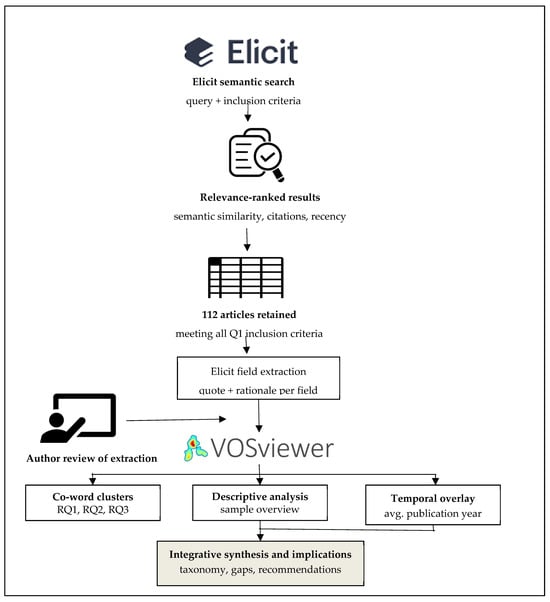
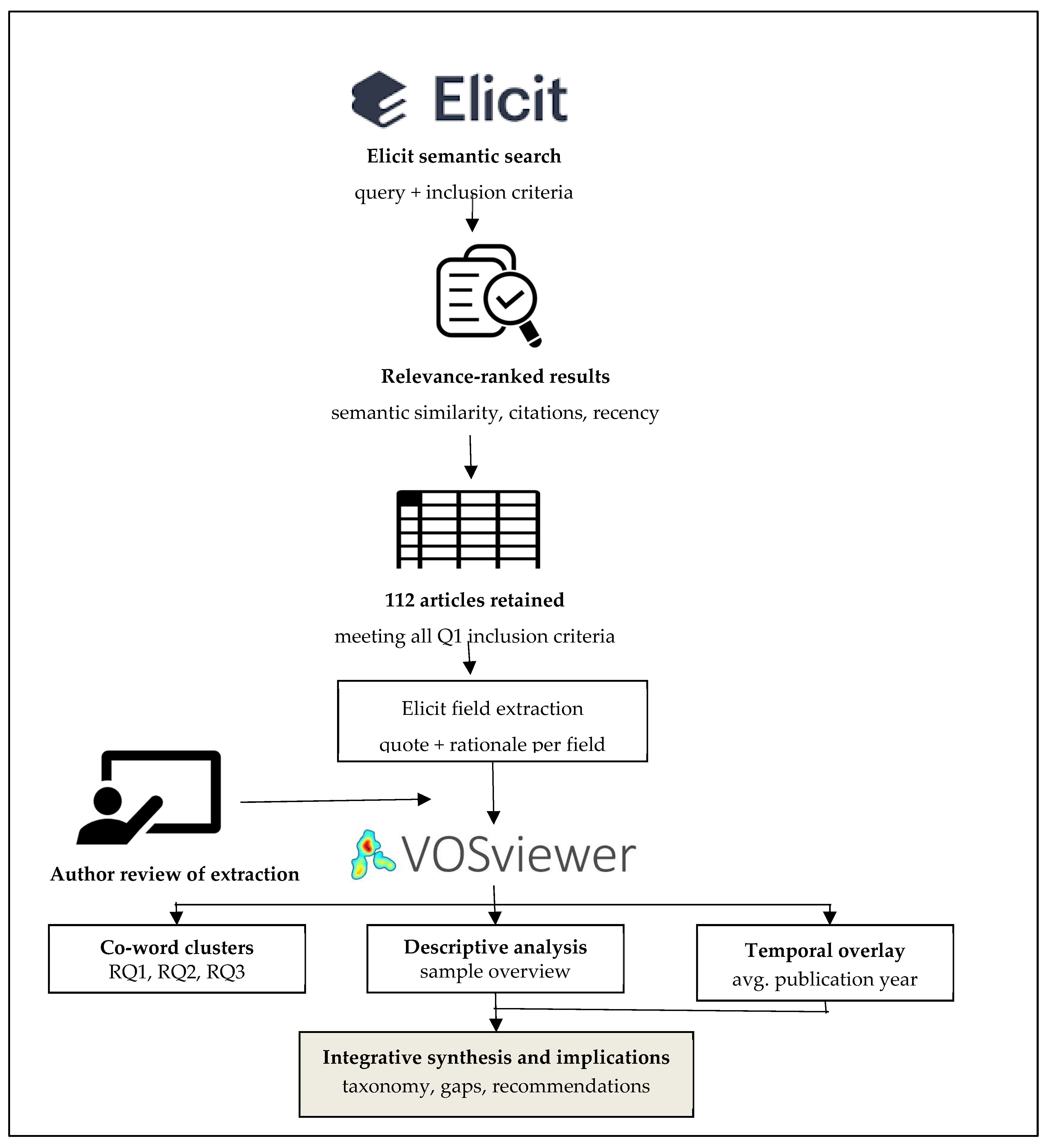
The dataset used in this study comprises 112 peer-reviewed publications (111 journal articles and one book) identified, in May 2026, through Elicit, a cloud-based AI research platform, using the search query “digital service innovation” AND (“environmental performance” OR “sustainability outcomes” OR “circular economy”). Articles were retained if they (1) addressed both DSI and environmental or economic performance, (2) were published in English, (3) provided sufficient metadata for automated extraction, and (4) were published in journals ranked Q1 in the Scimago Journal Rank at the time of retrieval, which is derived from Scopus citation data. Criterion 3, “sufficient metadata for automated extraction”, refers to articles providing, at minimum, an accessible abstract and complete bibliographic metadata enabling field extraction. The Q1 restriction was a deliberate methodological choice, aimed at ensuring a consistent baseline of methodological rigor and editorial quality control across a highly heterogeneous, multidisciplinary body of literature, rather than a limitation of the search itself. One of the 112 records is a book published by Springer in 2024 (A Circular Built Environment in the Digital Age), which Elicit returned among the results and which was retained because it met criteria 1 to 3 and addressed the research questions; the remaining 111 are journal articles. Elicit searches a corpus of scholarly records drawn from open sources such as Semantic Scholar and OpenAlex, not from the Scopus, Web of Science or ScienceDirect databases; Scopus-derived information enters only through the SJR quartile used in criterion 4. Elicit returns results ordered by a relevance score computed internally by the platform, which the authors could neither inspect nor adjust. The language and journal-quartile criteria (2 and 4) were applied as filters within Elicit, while criteria 1 and 3 were checked by the authors, who examined the returned records article by article and progressively loaded results from the top of the ranked list. Loading stopped when 112 articles meeting all criteria had been retained. This was a pragmatic cutoff set by the authors to keep the extraction and the manual verification of supporting quotes tractable, and not a saturation criterion; articles ranked below this point were not examined (see Section 5.2). The overall research workflow, from identification through extraction and analysis, is summarized in Figure 1. This approach, combining Elicit-based identification and extraction with VOSviewer (version 1.6.18) co-word mapping, builds on a methodology previously published by the authors in this same journal [14], which similarly established the value of this combined approach for systematizing large literature corpora in environmental and sustainability research.
Figure 1.
Research strategy containing the workflow outlining the steps from identifying articles with Elicit to bibliometric and thematic analysis for synthesizing results.
We also used Elicit to automate the retrieval and structuring of article metadata. Elicit allowed us to extract consistent information from both full-text articles and abstracts, depending on access rights. It performed key functions such as identifying interventions, theoretical frameworks, outcomes measured, future research directions, and policy recommendations. For each extracted field, Elicit provides a supporting verbatim quote from the source article together with an explicit rationale linking that quote to the assigned classification. Both authors reviewed these supporting quotes and rationales during the extraction process. This review allowed article-by-article inspection of Elicit’s outputs, rather than treating the extraction as an unverified black box, but it checks only that each entry is consistent with the quote selected by Elicit (see Section 5.2). Table 1 summarizes the Elicit fields used, their analytical purpose, and their contribution to each research question. Data extraction complied with copyright and text-and-data-mining provisions applicable to academic research: full-text access within Elicit was limited to articles for which the authors’ institutions held valid subscription or open-access licenses, and no copyrighted full texts were permanently stored, redistributed, or reproduced beyond the structured metadata fields used for analysis. For articles without full-text access rights, extraction was limited to publicly available abstracts. Of the 112 articles, 36 were extracted from full text and 76 from abstracts only, depending on access rights. Not every field was populated for every article: theoretical framework was reported for 63 articles and policy recommendations for 59, the remaining entries stating that the available text did not provide the information. The results for RQ2 and RQ3 therefore describe the subset of articles in which these fields were available.
Table 1.
Elicit fields and contributions to research questions.
This method enhanced efficiency, reduced subjectivity, and ensured the scalability of our analysis [15]. Moreover, the integration of AI tools in literature synthesis has been increasingly recognized as a valid methodological approach, with recent research demonstrating that such tools can effectively support the scalable, consistent, and traceable analysis of large academic corpora in the environmental domain [14].
2.2. Text Mining and Co-Word Analysis
To identify key research themes and conceptual linkages, we used VOSviewer (version 1.6.18) for co-word analysis. This technique detects patterns based on the frequency and co-occurrence of terms within the article metadata. Following established procedures [16], we preprocessed the text to remove stop words and merge synonyms, ensuring analytical clarity.
The resulting co-occurrence network enabled the visualization of clusters representing thematic groupings in the literature. VOSviewer’s clustering algorithm grouped terms based on association strength, highlighting areas such as digital technologies (e.g., IoT, AI), sustainability outcomes (e.g., carbon reduction, circularity), and organizational contexts (e.g., supply chain management, digital platforms). This approach has proven effective in revealing structural dynamics within academic fields [17,18].
2.3. Thematic Cluster Identification
Following the co-word analysis, we employed VOSviewer to identify and visualize thematic clusters within the corpus of 112 academic articles. VOSviewer uses a natural language processing algorithm based on the Apache OpenNLP library to detect co-occurrence links between frequently used terms. In this study, the text mapped consisted of the structured fields extracted through Elicit for each article (interventions, outcomes, theoretical frameworks, research gaps, and policy recommendations), rather than raw titles, abstracts, or author keywords. These co-occurrence relationships are mapped as a network, where nodes represent terms and edges reflect their strength of association. The co-occurrence network generated by VOSviewer allowed the identification of thematic clusters, representing conceptual linkages between interventions, outcomes, and theoretical frameworks. This technique has been applied in sustainability research to map intellectual structures and thematic developments [17]. and it has also been used for the systematic analysis of strategic policy documents, demonstrating its versatility in handling both academic literature and broader textual corpora [19]. Terms that tend to appear together in the literature are grouped into clusters, each reflecting a distinct thematic area within the broader research field [13].
Following established procedures, terms were preprocessed through stemming, synonym merging, and stop-word removal before applying co-word analysis. This approach has proven effective in revealing conceptual patterns in fields such as digital transformation [18]. This ensured that the analysis focused on meaningful, field-specific concepts [20].
VOSviewer’s clustering algorithm then grouped the remaining terms based on the strength of their co-occurrence links. A co-word analysis was performed in VOSviewer, using a minimum occurrence threshold of five terms and focusing on the 60% most relevant keywords. The resulting clusters represent conceptual communities, where terms are positioned in proximity according to how frequently they co-occur. Each cluster was color-coded and visualized in a two-dimensional map, providing an overview of how different topics and research strands are positioned in relation to one another. These clusters represent key domains of the literature, such as digital technologies, sustainability outcomes, organizational practices, and policy or regulatory aspects. Although their specific composition will be detailed in the Section 3, these clusters form the analytical foundation for the in-depth review that follows.
It is worth clarifying that the three co-occurrence networks presented in this study (Figure 2, Figure 3 and Figure 4, Table 2, Table 3 and Table 4) are not independent analyses of the same text but were built from three distinct groups of Elicit-extracted fields: intervention types and outcomes (RQ1), theoretical frameworks and research gaps (RQ2), and policy and managerial recommendations (RQ3), as detailed in Table 1. Because these fields were extracted from the same corpus of 112 articles, several core constructs, most notably circular economy practice, SMEs, and digital transformation, recur across more than one network. This recurrence is expected and analytically meaningful: it indicates that these constructs function simultaneously as objects of empirical study (RQ1), as theoretical or gap-related concerns (RQ2), and as targets of policy and managerial recommendations (RQ3), rather than being artifacts of overlapping or redundant analysis. Where a term appears in multiple networks, its cluster membership and co-occurrence partners differ across networks, reflecting the distinct analytical lens (intervention, theory, or recommendation) applied to that field of extraction.
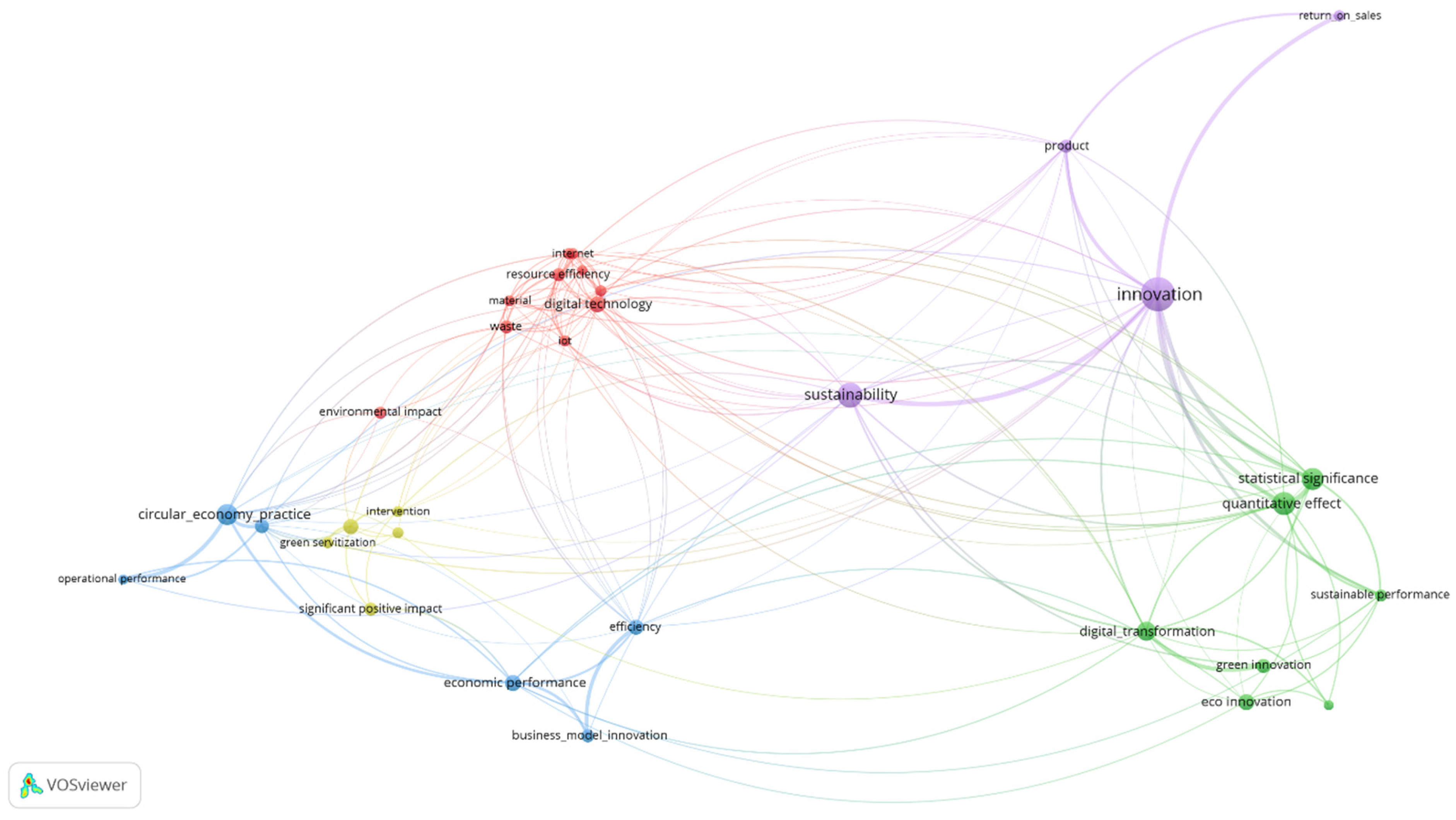
Figure 2.
VOSviewer thematic clusters for interventions and outcomes in DSI and environmental performance.
Figure 3.
VOSviewer thematic clusters for theoretical foundations and research gaps in DSI and environmental performance.
Figure 4.
VOSviewer thematic clusters for recommendations and managerial practices in DSI and environmental performance.
Table 2.
Clusters’ characterization for interventions and outcomes in DSI and environmental performance.
Table 3.
Clusters’ characterization for theoretical foundations and research gaps in DSI and environmental performance.
Table 4.
Clusters’ characterization for recommendations and managerial practices in DSI and environmental performance.
2.4. In-Depth Analysis and Research Implications
Finally, we conducted a structured synthesis of the metadata fields extracted by Elicit, aligning them with our three research questions. This phase involved analyzing intervention types and reported outcomes (RQ1), mapping theoretical frameworks and research gaps (RQ2), and synthesizing policy recommendations and managerial implications (RQ3). This triangulation of scientometric mapping and AI-assisted content analysis provides both breadth and depth, delivering a transparent and documented methodology for systematically consolidating fragmented literature [21].
3. Results and Critical Analysis
3.1. Overview of the Sample
The final dataset consists of 112 peer-reviewed publications (111 journal articles and one book) on DSI and environmental performance, 111 of them retrieved from Q1-ranked journals. Collectively, these publications have received 12,931 citations, indicating both the scholarly relevance and growing impact of this research stream.
The earliest article in the sample dates to 2015, and publication activity has steadily accelerated over the past decade. While only one article appeared in 2015, output grew rapidly from 11 publications in 2020 to a peak of 30 publications in 2023, confirming the increasing salience of DSI as a research domain. The number of retrieved publications from 2024 and 2025 is lower, and no 2026 articles were retrieved despite the search being conducted in May 2026. This pattern reflects the way the sample was built: results were loaded from the top of Elicit’s relevance-ranked list until 112 qualifying articles were reached (Section 2.1), so the most recent publications, which tend to rank lower, were not reached. It should be read as a feature of the sample and not as evidence that no relevant 2026 literature exists. The presence of articles from this recent period nonetheless illustrates that the field remains dynamic and continues to expand.
The citation distribution reflects both mature and emerging strands of the literature. Articles published in 2020 achieved the highest citation impact, amassing 2856 citations across 11 papers, indicating a cluster of highly influential studies. Publications from 2017 and 2018 are also well cited, with 692 and 698 citations respectively. More recent contributions (2023–2025) show lower absolute citation counts due to recency.
The dataset demonstrates the interdisciplinary character of the field, with contributions spanning environmental science, business strategy, and innovation studies. The most frequent publication outlet is Sustainability (26 articles, 23.2% of the sample), followed by Business Strategy and the Environment (10 articles, 8.9%), and the Journal of Cleaner Production (9 articles, 8.0%). Other notable outlets include Technological Forecasting and Social Change and Journal of Business Research (6 articles each). This diversity, covering a total of 44 distinct publication venues, reflects the broad interest in DSI as both a technological and managerial driver of environmental performance.
3.2. Digital Service Interventions and Outcomes (RQ1)
To address RQ1 (What digital service interventions have been most commonly studied and what outcomes do they report?), we analyzed the fields Intervention, Intervention effects, and Outcome measured extracted through Elicit. The analysis produced five thematic clusters, which we interpret below as distinct streams of research connecting digital service interventions to their reported environmental and economic outcomes. These clusters are displayed in Figure 2.
Across the five clusters, the literature on DSI interventions and outcomes can be grouped into five thematic streams: (Cluster 1) technology-driven interventions (IoT, AI, big data) targeting waste reduction and efficiency; (Cluster 2) eco-innovation and sustainable supply chain studies, whose frequent terms (e.g., quantitative effect, statistical significance) largely reproduce the vocabulary of Elicit’s entries on empirical results and therefore describe how studies report their findings, not the strength of their evidence; (Cluster 3) circular economy practices linking DSI to both environmental and economic performance; (Cluster 4) servitization models (digital and green servitization) consistently associated with positive sustainability outcomes; (Cluster 5) general innovation narratives, connecting DSI to sustainability and financial performance indicators. Table 2 lists the most frequent terms in each cluster and each term’s number of occurrences.
The first cluster (red) centers on digital technologies and resource efficiency, where interventions such as IoT, artificial intelligence, and big data are explicitly linked to outcomes such as waste reduction, material optimization, and improved resource efficiency. For example, IoT and AI are frequently reported to optimize production processes, extend product lifespans, and predict waste generation, thereby directly enhancing circular practices [22]. Similarly, systematic reviews of digital-circular innovation confirm significant efficiency gains and better integration of Industry 4.0 into circular business models [9].
The second cluster (green) highlights a quantitative evaluation tradition, where digital transformation is studied in connection with eco-innovation and green innovation. Studies adopting this lens use statistical validation to demonstrate that digital interventions yield measurable improvements in sustainable supply chain performance, such as efficiency and emissions reductions. For instance, empirical evidence from Chinese manufacturing shows that corporate digital transformation significantly improves environmental performance, though with differentiated effects depending on firm type [23].
The third cluster (dark blue) connects DSI to circular economy practices and business model innovation, emphasizing dual benefits in terms of both environmental outcomes (e.g., efficiency, circularity) and economic performance (e.g., profitability, operational improvements). Usage-focused servitized business models, for instance, have been found to extend product life cycles and improve material efficiency [24], while digital circular business models reduce operational costs and enhance Environmental Social Governance (ESG) performance [25].
The fourth cluster (yellow) captures the growing literature on digital servitization and green servitization. Studies consistently report significant positive impacts of service-based digital models on both environmental and economic outcomes. Evidence from the automotive industry shows that digital servitization contributes to both productivity gains and sustainability benefits [26], while more recent work highlights the role of green servitization in fostering technological innovation [27].
Finally, the fifth cluster (purple) reflects a broader innovation–sustainability discourse, where DSI is associated with improvements in general sustainability outcomes as well as financial indicators such as return on sales. AI-enabled circular business models have been conceptualized as drivers of innovation capabilities and market competitiveness [10]. This cluster highlights the integration of digital innovation into mainstream sustainability narratives, often at the level of product development and market positioning.
Taken together, these five clusters provide a structured map of how the literature conceptualizes DSI interventions and their outcomes. The findings suggest that while some interventions are narrowly focused on specific technologies and operational impacts, others adopt broader framings that combine environmental and economic dimensions, reflecting the multidisciplinarity of the field.
3.3. Theoretical Foundations and Research Gaps (RQ2)
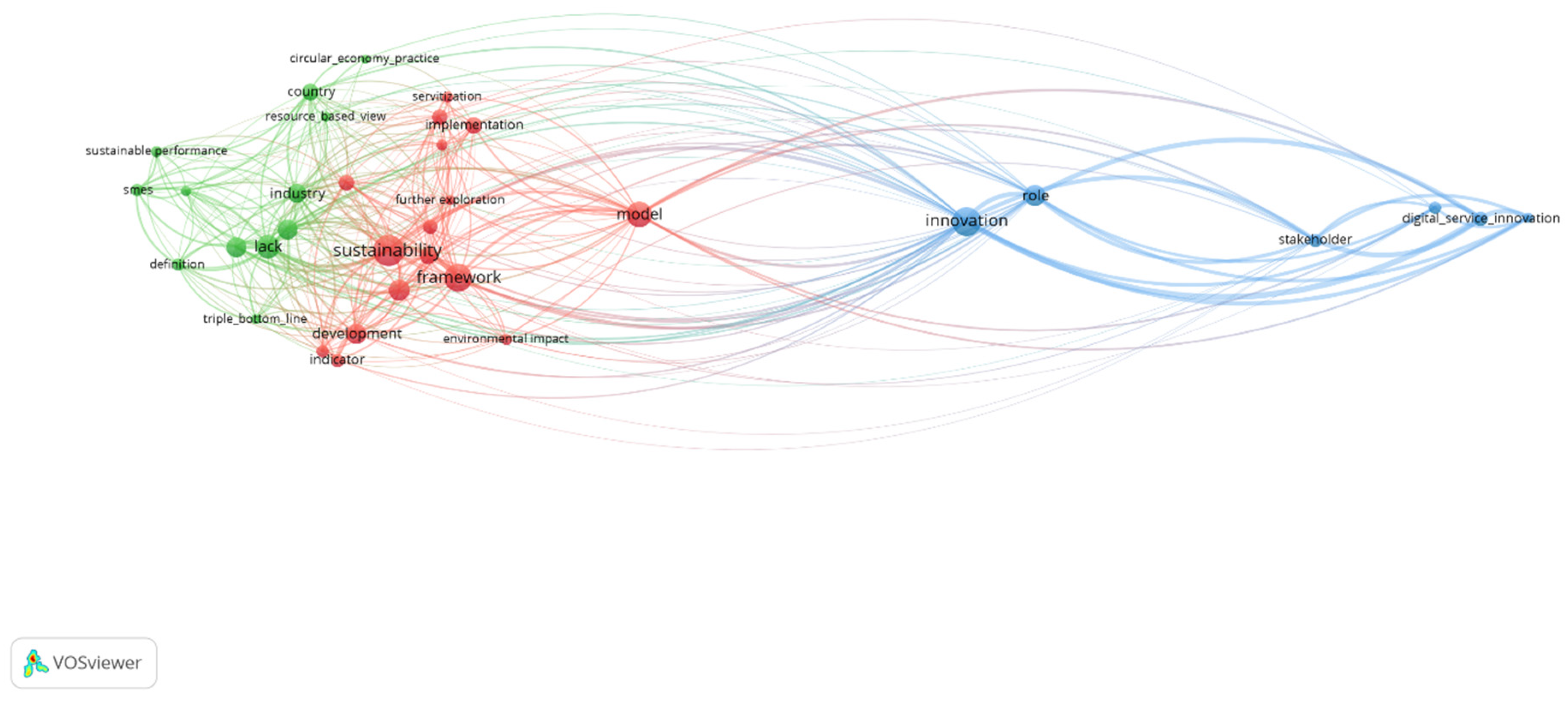
To address RQ2 (What theoretical frameworks and research gaps dominate the current literature on DSI and environmental performance?), we examined the theoretical frameworks, research gaps, and future research directions extracted with Elicit and analyzed them with VOSviewer. The co-word analysis identified three thematic clusters. These clusters capture both the conceptual foundations of the field and the areas where research remains fragmented. Figure 3 provides the visualization of the clusters.
The first cluster (red) is anchored in the terms sustainability, framework, model, digitalization, development, environmental performance, and servitization. This reflects the literature’s emphasis on conceptual models and frameworks that link DSI to sustainability outcomes. Many studies use digitalization and servitization perspectives to build models explaining how firms improve environmental performance [26]. Similarly, George et al. [28] propose new theoretical pathways for digital entrepreneurship, institutional logics, and ecosystems, while Baranauskas and Raišienė [29] highlight the role of conceptual frameworks such as the triple bottom line in integrating digital entrepreneurship and sustainability. However, the presence of terms such as indicator and further research/exploration suggests that while frameworks are abundant, their empirical validation remains limited. This cluster thus signals that much of the work is still conceptual, calling for more robust operationalization and indicator-based testing.
The second cluster (green) is characterized by terms such as absence [of clear definitions], performance, digital transformation, industry, country, Small and Medium-sized Enterprise (SMEs), definition, triple bottom line, resource-based view, and circular economy practice. This cluster captures the gaps and limitations identified in the literature. Key issues include: (1) a lack of clear definitions of DSI and sustainable performance, resulting in conceptual ambiguity; (2) overrepresentation of studies in specific industries and countries, limiting generalizability; (3) underexploration of SMEs, with most studies focused on large firms; and (4) limited integration of well-established frameworks such as the resource-based view, the triple bottom line, and circular economy practices. For example, Scarpellini et al. [30] apply a resource-based view and dynamic capabilities to circular eco-innovation but emphasize the need for broader measures of circular performance. Likewise, Alraja et al. [31] apply resource-based view and TOE to SMEs but note the absence of longitudinal data and the need for comparative studies across regions. More recent reviews stress the absence of comprehensive frameworks linking digital transformation to corporate environmental management, highlighting the need for stronger theorization and empirical breadth [32]. Overall, this cluster points to the need for greater theoretical consolidation and more diversified empirical contexts.
The third cluster (dark blue) centers on innovation, role, digital service innovation, stakeholder, digital servitization, and the product–service ecosystem. This reflects research that examines the stakeholder and ecosystem dimensions of DSI. The focus here is on the role of stakeholders in shaping digital servitization and innovation processes, particularly within product–service ecosystems [11]. Yet, while the stakeholder perspective is present, it is not deeply theorized. For instance, Rosa et al. [33] explore the effects of digitalization on innovation ecosystems in the food service industry but call for deeper theorization of ecosystem dynamics. Similarly, Chen et al. [34] show how digital servitization reshapes sustainable ecosystems but note the need for extending analysis beyond manufacturing sectors. This leaves room for stronger connections with institutional theory, stakeholder theory, and ecosystem-based frameworks. Table 3 lists the most frequent terms in each cluster and each term’s number of occurrences.
Taken together, these three clusters show that the literature on DSI and environmental performance is theoretically diverse but fragmented. While conceptual frameworks abound, empirical validation and cross-theoretical integration remain limited. Research gaps consistently highlight the need for clearer definitions, broader empirical coverage beyond large firms and specific geographies, and deeper theorization of the role of stakeholders and ecosystems. Future research should therefore include the operationalization of existing conceptual models by developing and testing robust indicators for measuring DSI’s environmental and economic impacts. Second, a broadened empirical scope, especially by including SMEs and cross-country comparisons. And finally, integration of multiple theoretical perspectives, linking resource-based, stakeholder, and ecosystem theories to sustainability outcomes.
3.4. Policy Recommendations and Managerial Practices (RQ3)
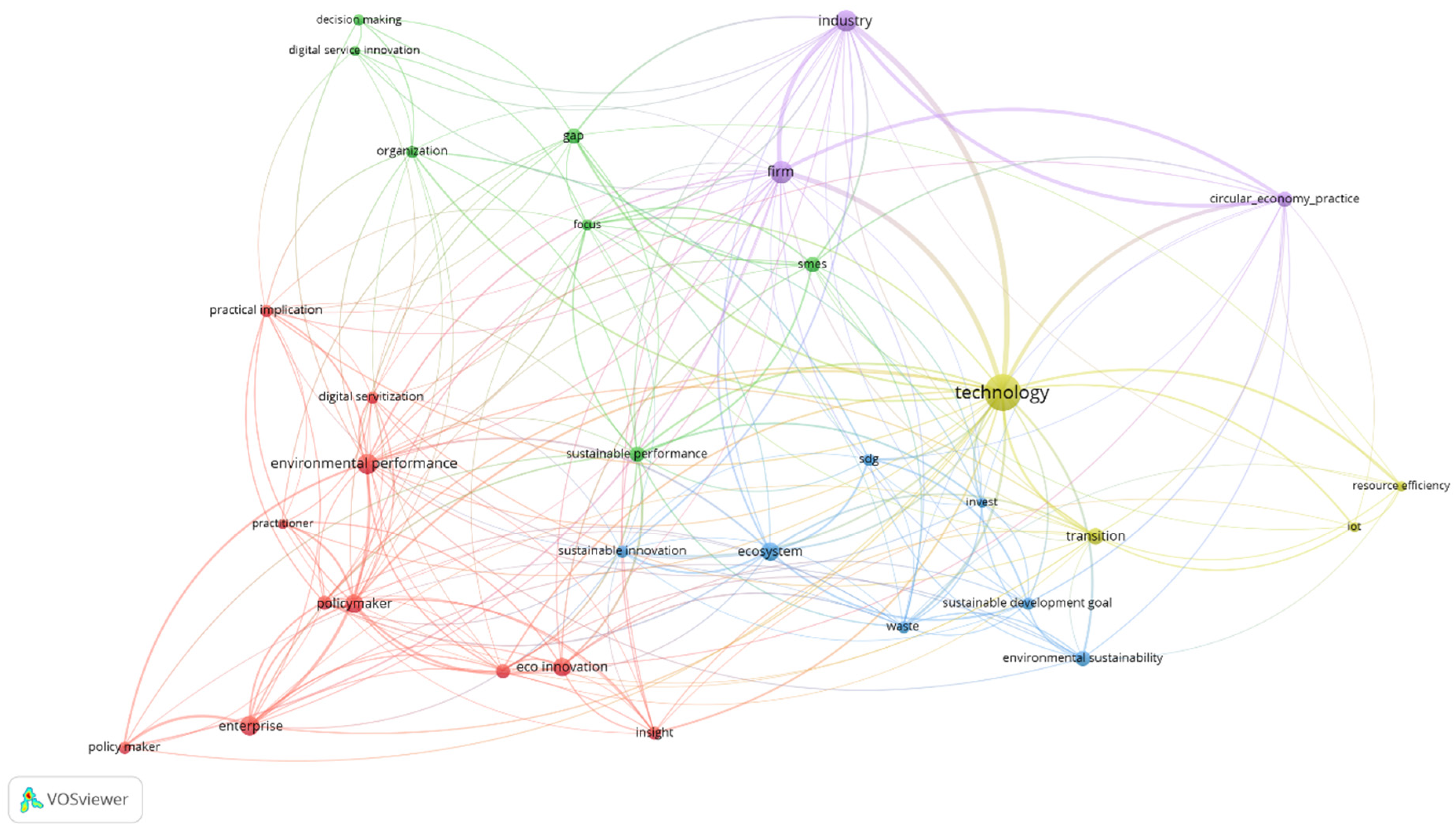
To address RQ3, we analyzed the policy recommendations and summary of discussion fields extracted with Elicit. A co-word analysis using VOSviewer produced five thematic clusters, each reflecting how scholars connect DSI with environmental performance through managerial practices and policy interventions. Figure 4 provides the network visualization of the clusters.
The first cluster (red) highlights the intersection of environmental performance, eco-innovation, and policymaking. Terms such as policymaker, policy maker, practitioner, practical implication, eco-innovation, and digital servitization indicate that the literature explicitly links DSI adoption to both managerial insights and policy support mechanisms. For instance, Khan [35] links, in an entry extracted from the abstract only, the alignment of circular economy practices with the United Nations Sustainable Development Goals (SDGs) to the promotion of digital technologies, although the text analyzed does not state explicit policy recommendations. Piscicelli [36] further emphasizes the role of governments in incentivizing digital circular economy practices and investing in R&D. The recurring presence of practical implication suggests that many studies already address how firms and policymakers can act on these findings. The implication is that stronger dialogue between enterprises, policymakers, and practitioners is critical to scaling eco-innovation through digital services.
The second cluster (green) centers on SMEs, organizational decision-making, and performance gaps. Here, the literature emphasizes that SMEs face distinct challenges in adopting DSI, including resource constraints and limited digital maturity. Rodríguez-Espíndola et al. [37] show that governmental support is crucial for SME adoption of circular economy practices. Likewise, Costa Melo et al. [38] highlight the need for standardized performance frameworks to assess SME sustainability during digital transformation. Managerial implications here stress the importance of building digital readiness and capacity, while policy recommendations emphasize targeted financial incentives, capability-building programs, and supportive regulatory frameworks.
The third cluster (dark blue) reflects a systemic and ecosystem perspective, with terms such as ecosystem, environmental sustainability, waste, and SDGs. This cluster highlights that DSI is increasingly framed as a tool for achieving system-level sustainability objectives, such as the SDGs and circular ecosystems. Liao et al. [39] propose a digital transformation roadmap explicitly tied to ecosystem innovation and SDG alignment, while Alojail and Khan [40] emphasize the importance of aligning digital transformation with sustainability objectives to ensure long-term success. Recommendations here focus on fostering cross-sector collaborations and embedding ecosystem-level thinking into both policy and managerial strategies.
The fourth cluster (yellow) emphasizes technology and resource efficiency. Dominated by the term technology (64 occurrences), this cluster also includes transition, IoT, and resource efficiency. Studies confirm that policy frameworks often focus on the diffusion of Industry 4.0 technologies to drive sustainability. For example, Khan et al. [41] recommend tax incentives, subsidies, and public–private partnerships to facilitate technology adoption and compliance monitoring. Similarly, Rusch et al. [42] argue that policies must encourage broader adoption of digital technologies for circular product management while also monitoring compliance across industries. The implication is that DSI interventions are seen as enablers of efficiency and sustainability transitions, but the cluster also reflects a tendency toward a technology-centric narrative that risks overlooking organizational and social dimensions.
Finally, the fifth cluster (purple) points to the role of firms and industries in circular economy practices. With terms like firm, industry, and circular economy practice, this cluster suggests that managerial practices often revolve around integrating DSI into industrial processes to enhance circularity. For instance, Chen and Wang [43] propose that servitization and digital innovation should be explicitly supported by public policy to strengthen SME ESG performance. Similarly, Bag et al. [44] emphasize policies promoting green supply chain management practices, which firms can operationalize through DSI. The emphasis here is on firm- and industry-level transformations that contribute to circular economy objectives, implying that managerial strategies must evolve alongside regulatory and policy frameworks to maximize impact. Table 4 lists the most frequent terms in each cluster and each term’s number of occurrences.
Taken together, these five clusters illustrate that the literature offers a dual orientation: managerial practices focus on firms, SMEs, and supply chains adopting DSI to improve efficiency and circularity, while policy recommendations emphasize ecosystem-level collaboration, SME support, and regulatory frameworks that incentivize eco-innovation. The findings reinforce the view that realizing the full sustainability potential of DSI requires both internal organizational adaptation and external institutional alignment.
3.5. Temporal Evolution of Terminology and Thematic Clusters
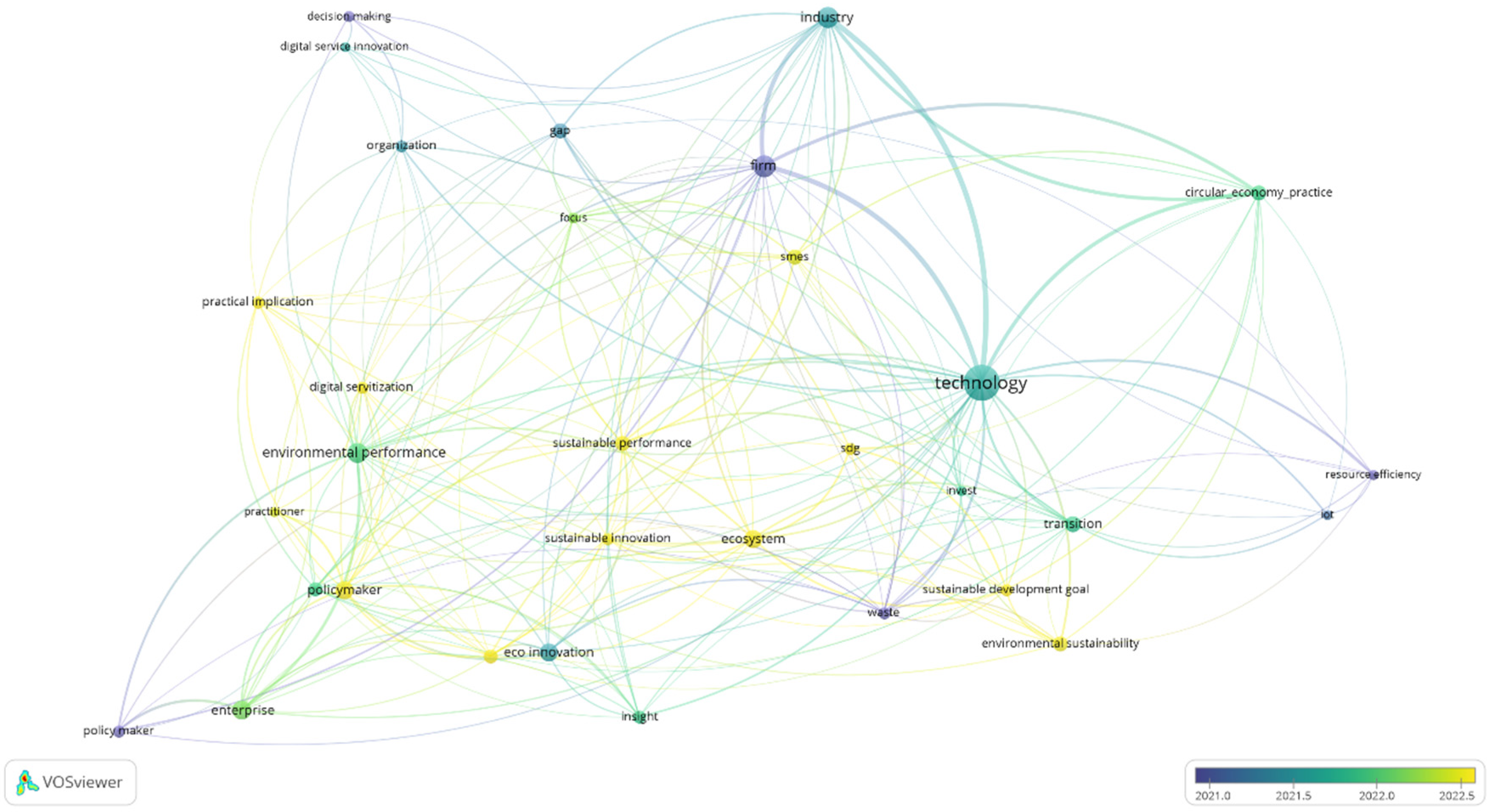
Building on the publication trajectory described in Section 3.1, where output grew from a single article in 2015 to a peak of 30 publications in 2023, this section examines how the thematic composition of the field has evolved alongside this growth, using average publication year as a proxy for the relative timing of each term’s emergence. To examine whether the clusters identified reflect genuinely new research issues or shifting terminology for related underlying phenomena, we generated a VOSviewer overlay visualization for each research question, coloring terms by their average publication year within the corpus (Figure A1, Figure A2 and Figure A3 from Appendix A).
For RQ1 (interventions and outcomes), the earliest terms in the network include “return on sales,” “intervention,” and “green servitization,” while “digital transformation,” “green innovation,” “business model innovation,” and “significant positive impact” occupy the most recent end of the scale. “Circular economy practice” occupies an intermediate position, neither among the earliest nor the most recent terms in this network.
For RQ2 (theoretical foundations), the temporal pattern is more pronounced. Foundational constructs, “sustainability,” “framework,” “model,” “resource-based view,” “triple bottom line,” and, notably, “circular economy practice” itself, cluster among the earliest terms in the network, consistent with their role as established theoretical anchors that predate the specific study of digital service innovation. By contrast, “stakeholder” and, strikingly, the term “digital service innovation” occupy the most recent end of the scale. This suggests that while the literature has long drawn on established sustainability frameworks, digital service innovation is only recently being theorized as a construct in its own right, rather than treated solely as an application of pre-existing sustainability theory.
For RQ3 (policy and managerial recommendations), the earliest terms include “decision making,” “firm,” and “organization,” while “SMEs,” “practical implication,” “sustainable performance,” and “SDG”-related terms are concentrated at the most recent end of the scale.
These patterns offer a more nuanced answer than a simple “new issue versus relabeling” dichotomy. Circular economy is not a recent addition to the literature; it functions as one of the field’s earliest and most established theoretical anchors, which more recent DSI-related work continues to draw upon rather than replace. What does appear genuinely emergent is the treatment of digital service innovation itself as a distinct construct, evidenced by “digital service innovation” clustering at the most recent end of the temporal scale in the theoretical network (RQ2), alongside recent recommendation-level terms such as “SMEs” and “practical implication” in the RQ3 network and recent intervention-level terms such as “digital transformation” and “business model innovation” in the RQ1 network. “Artificial intelligence” appears as a discrete term within Cluster 1 of the RQ1 network, but with a comparatively recent average publication year (2022–2023) and a low occurrence count (6), indicating that AI-based interventions have only recently begun to be identified empirically in this literature. It does not, however, appear as a discrete term in the RQ2 (theoretical foundations) or RQ3 (recommendations) networks, suggesting that while AI-based interventions are beginning to be identified empirically, they are not yet theorized or translated into recommendations as a distinct construct, remaining instead subsumed within broader references to “digital technology” and “digital transformation.”
4. Discussion
4.1. Integrative Synthesis of Findings
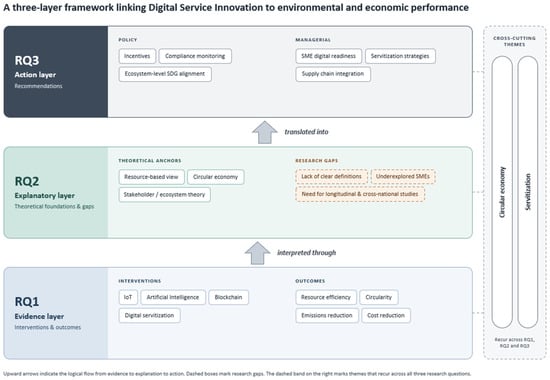
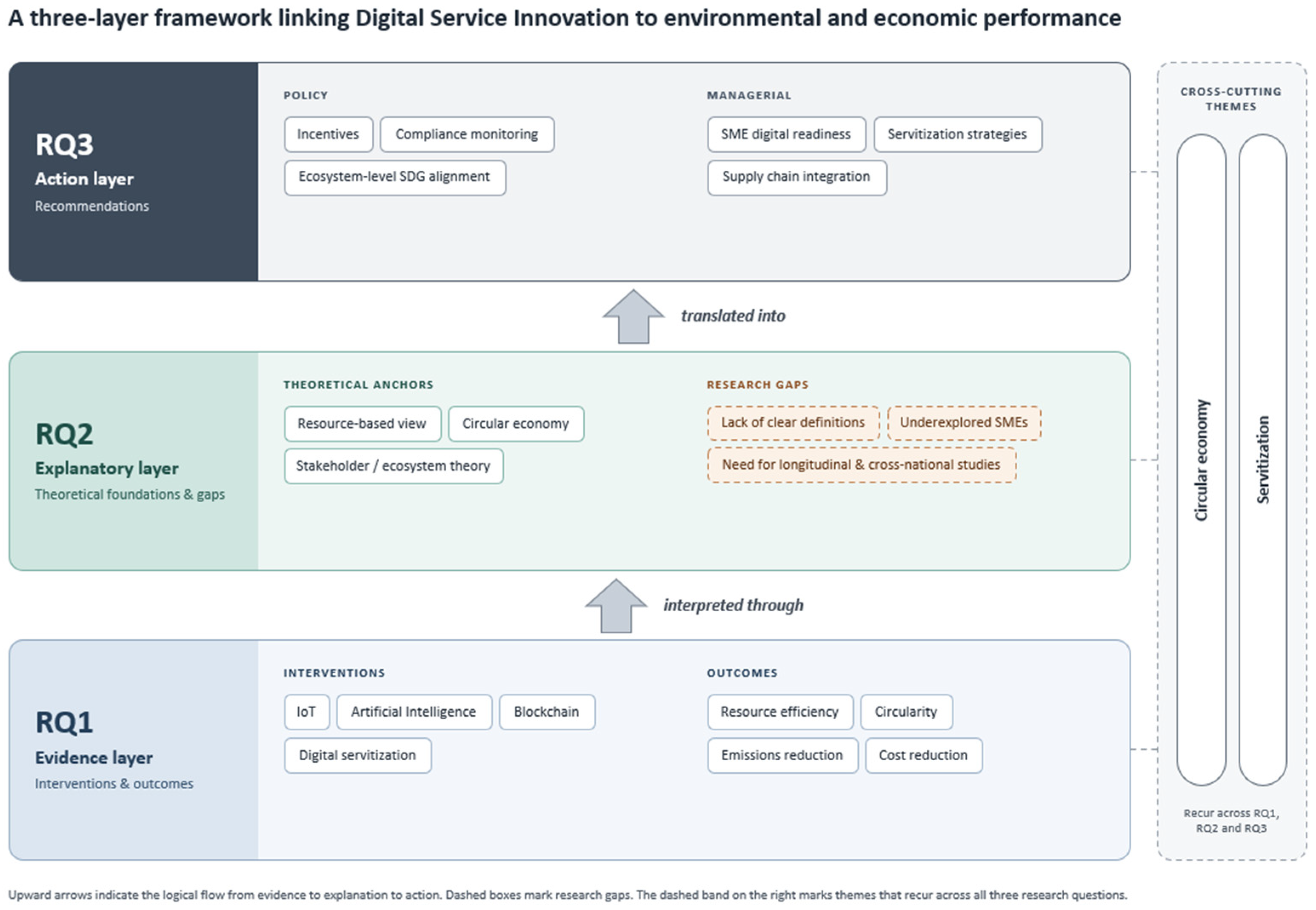
The results of this study, structured around the three research questions, provide complementary perspectives on how DSI relates to environmental and economic performance. Taken together, these findings highlight both areas of convergence and persistent gaps in the current literature. The conceptual synthesis presented in Figure 5 illustrates this alignment, organizing the three streams of literature into a coherent, layered framework that can guide both scholars and practitioners.
Figure 5.
A three-layer framework linking DSI to environmental and economic performance.
Rather than presenting the findings as a network in which every element connects to every other, Figure 5 organizes them into three sequential layers, each derived from one of the study’s research questions, making explicit which analysis each element originates from. The evidence layer (RQ1) captures the interventions empirically studied (e.g., IoT, artificial intelligence, digital servitization) and their documented outcomes (resource efficiency, circularity, emissions and cost reduction). This evidence is interpreted through the explanatory layer (RQ2), which contains the theoretical anchors that account for these outcomes (the resource-based view, circular economy, and stakeholder/ecosystem perspectives) alongside the research gaps that currently limit explanation (the lack of clear definitions, the underexploration of SMEs, and the need for longitudinal and cross-national studies). These, in turn, are translated into the action layer (RQ3), comprising policy recommendations (incentives, compliance monitoring, ecosystem-level SDG alignment) and managerial recommendations (SME digital readiness, servitization strategies, supply chain integration). The relationships between layers are interpretive rather than empirical associations: each layer is interpreted through the one below and translated into the one above, reflecting the logical flow from evidence to explanation to action rather than validated pairwise links between individual terms. Two themes, circular economy and servitization, recur across all three layers and are therefore shown as cross-cutting, whereas others are deliberately not bridged where the data do not support a connection. Notably, the SME theme appears in the explanatory and action layers but not in the evidence layer, indicating that SME-focused recommendations currently rest on an identified research gap rather than on a documented empirical basis, a discontinuity that is itself a finding of this synthesis.
From the analysis of interventions and outcomes (RQ1), the evidence shows that digital technologies such as IoT, artificial intelligence, blockchain, and servitization models are consistently associated with improvements in environmental outcomes, including resource efficiency, waste reduction, and emissions monitoring, while also generating economic benefits in terms of cost savings and competitiveness. However, the theoretical foundations of this body of work (RQ2) remain fragmented. While frameworks such as the resource-based view, circular economy, and servitization theory are recurrent, their application is inconsistent, and many studies remain largely descriptive. Research gaps are particularly evident in the lack of clear definitions of DSI, limited empirical coverage of SMEs, and the scarcity of longitudinal or cross-country studies.
At the managerial and policy level (RQ3), the literature emphasizes the dual role of organizations and policymakers in enabling DSI for sustainability. On the one hand, firms are encouraged to build digital capabilities, adopt servitization models, and integrate DSI into supply chain operations to improve circularity and resilience. On the other hand, policymakers are advised to create regulatory and incentive frameworks that stimulate eco-innovation, digital monitoring, and alignment with international standards such as ISO or EMAS.
A notable asymmetry emerges when RQ1, RQ2, and RQ3 findings are considered jointly. The empirical evidence on DSI outcomes (RQ1) is drawn predominantly from large firms and established industries, where the environmental benefits of digital transformation, resource efficiency gains, emissions monitoring, and circular economy integration are most readily documented, likely reflecting these firms’ greater data availability, sustainability reporting obligations, and capacity to implement large-scale digital infrastructure. Yet the policy and managerial recommendations synthesized under RQ3 disproportionately emphasize SMEs, calling for digital readiness support, targeted financial incentives, and capability-building programs. This asymmetry is not incidental: it reflects the research gap already identified under RQ2, namely the underexploration of SMEs relative to large firms. In other words, the literature’s emphasis on SME-oriented recommendations appears to be aspirational and policy-driven rather than evidence-based, motivated by the recognition that SMEs represent both the numerical majority of firms in most economies and a persistent blind spot in current empirical research, rather than by demonstrated evidence that SMEs generate the largest environmental gains from DSI. Given that larger organizations typically possess greater resources, economies of scale, and technological infrastructure, they may indeed be positioned to capture more substantial absolute environmental benefits from digital transformation, at least in the short term. The literature’s focus on SME support therefore reflects an equity- and diffusion-oriented policy agenda, aimed at closing an adoption gap, more than a reflection of where the largest measurable environmental impacts currently occur. This distinction is important for interpreting the practical implications of this study and points to a clear avenue for future empirical research: directly comparing the scale and nature of environmental benefits from DSI across firm sizes.
Beyond the general theoretical fragmentation discussed above, at least one clear thematic correspondence emerges between clusters across the three research questions. The SME-related research gap identified in RQ2 (Cluster 2: lack, digital transformation, industry, country, SMEs, definition) corresponds directly to a dedicated recommendations cluster in RQ3 (Cluster 2: SMEs, sustainable performance, gap, organization, decision making). This alignment suggests that, at least for this theme, the literature’s identification of an empirical and theoretical gap has translated coherently into a matching stream of targeted policy and managerial recommendations, rather than the two layers evolving independently. Whether similar theme-to-recommendation correspondences hold for other clusters, for instance, whether supply chain-oriented studies disproportionately generate relationship-oriented recommendations, cannot be confirmed with the current network-level data, as some candidate terms (e.g., “supply chain,” “relationship”) appear in only one of the three networks and lack a directly corresponding cluster in the others. A systematic examination of this question, as noted in Section 5.2, would require article-level recoding beyond the scope of the present study.
When considered together, these results suggest that the full potential of DSI for environmental performance can only be realized through the alignment of technological interventions, theoretical consolidation, and supportive policy frameworks. The clusters identified in this study provide a roadmap for future research and practice: interventions must be systematically linked to measurable outcomes, theoretical approaches must be integrated and empirically tested, and policy and managerial practices must be coordinated to maximize impact.
4.2. Research Gaps and Directions for Future Research
While Section 3.3 identified theoretical and definitional gaps, the corpus also reveals patterns worth making explicit regarding which empirical contexts remain under-researched. The reviewed literature is disproportionately anchored in manufacturing contexts, with the automotive industry featuring prominently among the empirical settings cited (e.g., ref. [26]), alongside broader evidence from Chinese manufacturing firms. By contrast, pure service sectors, such as financial services, healthcare, retail, hospitality, and education, are notably underrepresented as empirical settings for studying DSI’s environmental and economic outcomes, despite being service-intensive industries where digital service innovation would be conceptually central rather than a manufacturing complement. Geographically, the sample shows visible concentrations of evidence from China and, to a lesser extent, Mexico, while other major economic regions, including Sub-Saharan Africa, South Asia, and Latin America beyond Mexico, are largely absent from the reviewed evidence base. It should be noted that the present study’s extraction design (Table 1) did not include a dedicated field for country or sector, so this assessment is necessarily qualitative rather than based on systematic disaggregation; a structured coding of country and sector per article represents a valuable extension for future bibliometric work in this area. On this basis, we recommend that future empirical research prioritize: (1) service-intensive sectors where DSI is not a complement to product-based innovation but the primary value-creation mechanism; (2) underrepresented geographic contexts, particularly in the Global South, where resource constraints and regulatory environments differ substantially from the manufacturing-heavy, East Asian-concentrated evidence base identified here; and (3) emerging technologies such as generative AI applications in service delivery, which remain marginal in the current corpus (Section 3.5) relative to more established interventions such as IoT and blockchain.
5. Conclusions
5.1. Main Findings
This study provides a systematic examination of the relationship between DSI and environmental performance by integrating scientometric mapping with automated content analysis. By analyzing 112 peer-reviewed publications (111 articles from Q1 journals and one book), we developed an evidence-based taxonomy of DSI interventions, outcomes, theoretical foundations, and policy recommendations.
First, in response to RQ1, our findings show that digital interventions such as IoT, AI, blockchain, and servitization are consistently associated with environmental benefits, including waste reduction, improved resource efficiency, and emissions monitoring, while also delivering economic gains in cost savings and competitiveness. Five thematic clusters capture this dual focus on technology-driven interventions, quantitative validation, circular economy practices, servitization models, and broader innovation–sustainability narratives.
Second, regarding RQ2, the theoretical landscape of the field is diverse but fragmented. While frameworks such as the resource-based view, dynamic capabilities, circular economy, and stakeholder/ecosystem perspectives are applied, their use is inconsistent and often descriptive. Clear definitions of DSI remain scarce, SMEs are underexplored, and cross-national or longitudinal studies are limited. This highlights the need for both theoretical consolidation and broader empirical coverage.
Third, in relation to RQ3, the literature underscores the dual role of firms and policymakers in enabling DSI for sustainability. On the one hand, managerial practices emphasize building digital readiness, adopting servitization models, and integrating DSI into supply chains. On the other, policy recommendations call for targeted incentives, compliance monitoring, and ecosystem-level alignment with the SDGs. Together, these findings suggest that the full sustainability potential of DSI can only be realized when technological interventions, managerial practices, and policy frameworks are mutually reinforcing.
Overall, this study contributes to the consolidation of a fragmented field by offering a taxonomy of DSI interventions and outcomes, a map of the theoretical foundations and research gaps, and actionable recommendations for managers and policymakers. Methodologically, the integration of scientometric analysis with machine-assisted content extraction represents a transparent and scalable approach to synthesizing interdisciplinary sustainability research.
5.2. Limitations
While this study advances the literature on DSI and environmental performance, several limitations should be acknowledged. First, the dataset was restricted to peer-reviewed publications, 111 of them articles published in Q1 journals. This decision ensured a high level of academic quality but may have excluded relevant contributions from Q2–Q4 outlets or from the gray literature, particularly practitioner-oriented reports and policy documents that often provide timely evidence on DSI implementation.
Second, the use of automated content extraction via Elicit and co-word analysis in VOSviewer allowed for greater scalability and transparency compared to traditional manual reviews. While both authors reviewed Elicit’s supporting quotes and rationales for each extracted field, this check confirms only that an entry is consistent with the quote Elicit selected. It cannot reveal information that Elicit omitted or quotes that refer to a theory or recommendation the article cites without adopting. The number of entries corrected or discarded was not recorded, and no accuracy rate or inter-rater statistic against an independent manual reading was computed. In addition, 76 of the 112 articles were extracted from abstracts only, which often do not report theory or recommendations (63 and 59 articles, respectively, had these fields populated). Elicit is a cloud platform that does not issue version numbers, and its models and ranking may change over time, so repeating the same query may return different records or extractions; for this reason the list of analyzed articles is made available (see Data availability). Finally, results were loaded from the top of Elicit’s relevance-ranked list until 112 qualifying articles were reached, a pragmatic cutoff and not a saturation criterion, so lower-ranked articles were not examined. Quantifying extraction accuracy against a manual reading remains a valuable refinement for future applications of this approach.
Third, the co-word networks for RQ1 (interventions and outcomes) and RQ2 (theoretical foundations) were generated independently from separate metadata fields, which does not permit a systematic, article-level cross-tabulation of which theoretical frameworks are applied to which types of digital interventions. Such an analysis would represent a valuable direction for future research, as it could clarify whether specific theoretical lenses function as general-purpose frameworks applied across technological domains or remain confined to narrower application contexts. This is illustrated by the SME theme, which shows a clear correspondence between the research gap identified in RQ2 and the dedicated recommendations cluster in RQ3, though we could not confirm whether similar correspondences hold systematically across other themes without such recoding. Finally, while our approach provides a robust snapshot of the field, it remains cross-sectional and thus cannot fully account for the evolving and dynamic nature of DSI research, particularly the rapid developments in AI, IoT, and blockchain applications for environmental management.
Relatedly, the search strategy prioritized terms centered on sustainability and environmental performance rather than terms specific to the Information Systems (IS) discipline (e.g., “IT-enabled sustainability,” “green IS,” “IS affordances”). This may explain the limited representation of dedicated IS outlets (e.g., MIS Quarterly, Information Systems Research, Journal of the Association for Information Systems) in the final sample, despite the discipline’s long-standing engagement with digital technologies and environmental outcomes. Future research should extend the search strategy to IS-specific databases and terminology to capture this complementary body of work.
Additionally, while the reviewed literature calls for greater attention to SMEs, this reflects an identified research gap rather than robust comparative evidence on how the scale of environmental benefits from DSI differs between SMEs and large organizations. Future research should directly compare firm-size effects to clarify where digital transformation yields the greatest environmental returns.
Taken together, these limitations indicate that while the findings provide a robust and documented synthesis of the academic literature, future reviews should expand coverage, triangulate automated extraction with qualitative coding, and incorporate practitioner perspectives to enrich the understanding of DSI’s role in sustainability transitions.
Author Contributions
Conceptualization, M.R.C.d.S.; methodology, M.R.C.d.S.; data curation, M.R.C.d.S. and L.C.C.; writing—original draft, M.R.C.d.S. and L.C.C.; writing—review and editing, L.C.C. All authors have read and agreed to the published version of the manuscript.
Funding
The activities of Intrepid Lab are supported by Fundação para a Ciência e a Tecnologia (FCT), I.P., through the Strategic Project UIDB/04011/2025 (https://doi.org/10.54499/UIDB/04011/2025), the project UID/PRR/04011/2025 (https://doi.org/10.54499/UID/PRR/04011/2025), and the project UID/PRR2/04011/2025 (https://doi.org/10.54499/UID/PRR2/04011/2025). This research was also supported by the Portuguese Fundação para a Ciência e a Tecnologia (FCT) under grant number UID/04748/2025.
Institutional Review Board Statement
Not applicable.
Data Availability Statement
The list of the 112 analyzed articles is available at 10.5281/zenodo.24436905, as of 22 November 2026.
Conflicts of Interest
The authors declare no conflicts of interest.
Appendix A
Figure A1.
Overlay visualization (VOSviewer) of terms associated with RQ1 (digital service innovation interventions and outcomes), colored by average publication year.
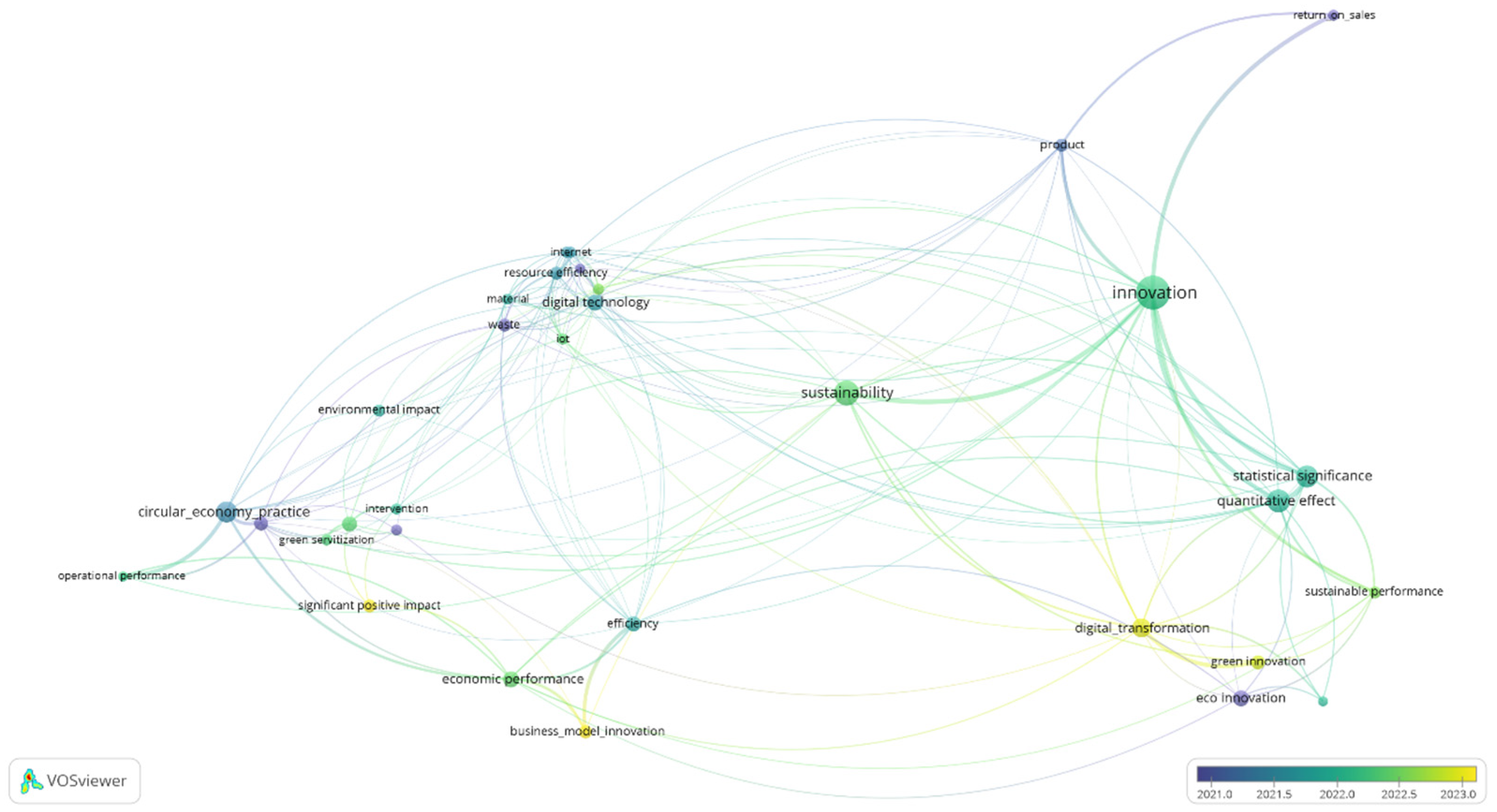
Figure A2.
Overlay visualization (VOSviewer) of terms associated with RQ2 (theoretical foundations and research gaps), colored by average publication year.
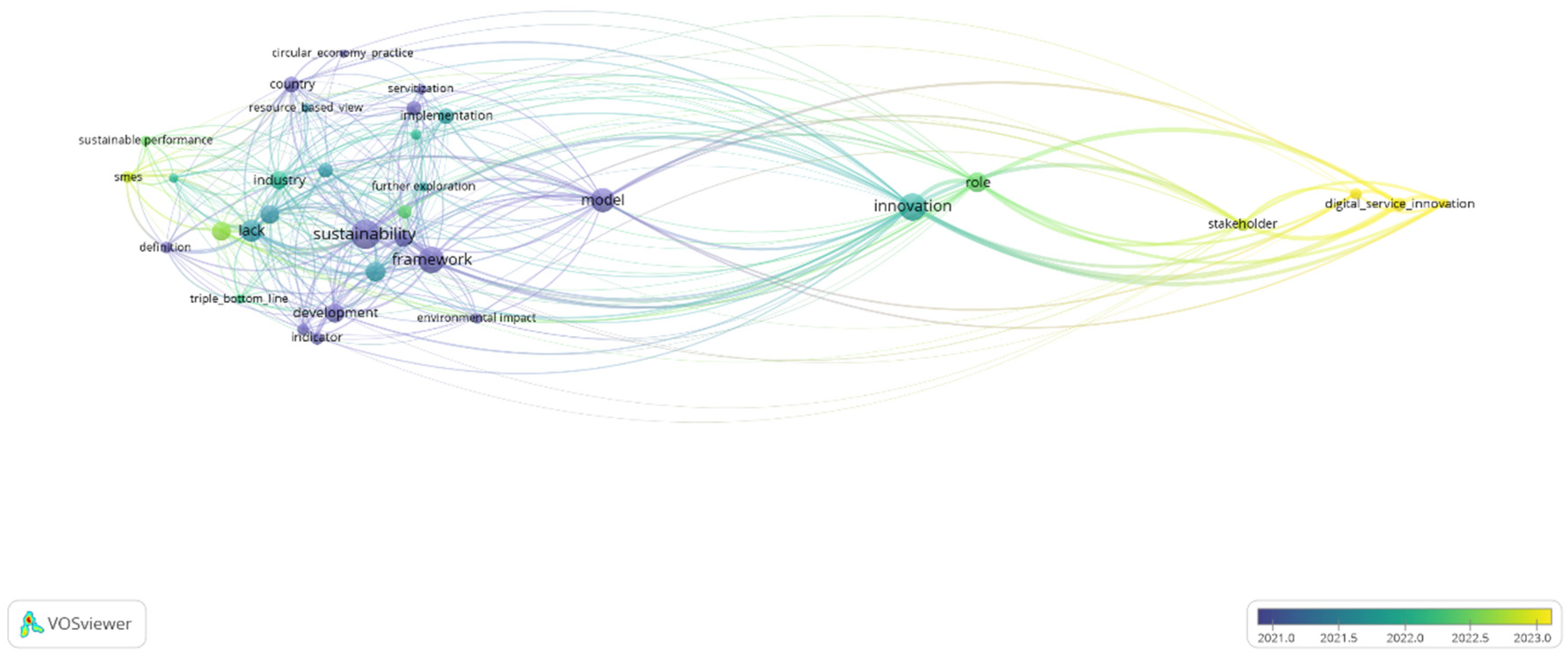
Figure A3.
Overlay visualization (VOSviewer) of terms associated with RQ3 (policy recommendations and managerial implications), colored by average publication year.
References
- Opazo-Basáez, M.; Vendrell-Herrero, F.; Bustinza, O.F. Digital service innovation: A paradigm shift in technological innovation. J. Serv. Manag. 2022, 33, 97–120. [Google Scholar] [CrossRef] [Scilit]
- Hizarci-Payne, A.K.; Ipek, I.; Kurt Gümüş, G. How environmental innovation influences firm performance: A meta-analytic review. Bus. Strategy Environ. 2021, 30, 1174–1190. [Google Scholar] [CrossRef] [Scilit]
- Wang, M.; Teng, W. Digital Innovation and Firm Environmental Performance: The Mediating Role of Supply Chain Management Capabilities. Front. Psychol. 2022, 13, 897080. [Google Scholar] [CrossRef] [Scilit]
- Cheng, W.; Li, Q.; Wu, Q.; Ye, F.; Jiang, Y. Digital capability and green innovation: The perspective of green supply chain collaboration and top management’s environmental awareness. Heliyon 2024, 10, e32290, Correction in Heliyon 2024, 12, e32916. https://doi.org/10.1016/j.heliyon.2024.e32916. [Google Scholar] [CrossRef] [Scilit]
- Ranta, V.; Aarikka-Stenroos, L.; Väisänen, J.-M. Digital technologies catalyzing business model innovation for circular economy—Multiple case study. Resour. Conserv. Recycl. 2021, 164, 105155. [Google Scholar] [CrossRef] [Scilit]
- Heinz, D.; Hu, M.; Benz, C.; Satzger, G. Digital Service Innovation for Sustainable Development: A Systematic Literature Review. In Transforming the Digitally Sustainable Enterprise; Springer: Berlin/Heidelberg, Germany, 2025; pp. 167–185. [Google Scholar] [CrossRef] [Scilit]
- Wilson, A.; Kask, R.; Ming, L.W. Exploring Circular Digital Economy Strategies for Sustainable Environmental, Economic, and Educational Technology. Int. Trans. Educ. Technol. (ITEE) 2024, 2, 129–139. [Google Scholar] [CrossRef] [Scilit]
- Arantes, L.; Ferreira, J.J. Innovative Sustainability Strategies and the Role of Digital Transformation in Organisations. Corp. Soc. Responsib. Environ. Manag. 2025, 32, 3088–3121. [Google Scholar] [CrossRef] [Scilit]
- Chauhan, C.; Parida, V.; Dhir, A. Linking circular economy and digitalisation technologies: A systematic literature review of past achievements and future promises. Technol. Forecast. Soc. Change 2022, 177, 121508. [Google Scholar] [CrossRef] [Scilit]
- Sjödin, D.; Parida, V.; Kohtamäki, M. Artificial intelligence enabling circular business model innovation in digital servitization: Conceptualizing dynamic capabilities, AI capacities, business models and effects. Technol. Forecast. Soc. Change 2023, 197, 122903. [Google Scholar] [CrossRef] [Scilit]
- Rabetino, R.; Kohtamäki, M.; Huikkola, T. Digital service innovation (DSI): A multidisciplinary (re)view of its origins and progress using bibliometric and text mining methods. J. Serv. Manag. 2024, 35, 176–201. [Google Scholar] [CrossRef] [Scilit]
- Calheiros, A.C.; Moro, S.; Rita, P. Sentiment Classification of Consumer-Generated Online Reviews Using Topic Modeling. J. Hosp. Mark. Manag. 2017, 26, 675–693. [Google Scholar] [CrossRef] [Scilit]
- van Eck, N.J.; Waltman, L. Software survey: VOSviewer, a computer program for bibliometric mapping. Scientometrics 2010, 84, 523–538. [Google Scholar] [CrossRef] [Scilit]
- Santos, M.R.C.; Carvalho, L.C. AI-driven participatory environmental management: Innovations, applications, and future prospects. J. Environ. Manag. 2025, 373, 123864. [Google Scholar] [CrossRef] [Scilit]
- Whitfield, S.; Hofmann, M.A. Elicit: AI literature review research assistant. Public Serv. Q. 2023, 19, 201–207. [Google Scholar] [CrossRef] [Scilit]
- van Eck, N.J.; Waltman, L. How to normalize cooccurrence data? An analysis of some well-known similarity measures. J. Am. Soc. Inf. Sci. 2009, 60, 1635–1651. [Google Scholar] [CrossRef] [Scilit]
- Ghosh, A.; Kumar, S.; Das, J. Impact of leachate and landfill gas on the ecosystem and health: Research trends and the way forward towards sustainability. J. Environ. Manag. 2023, 336, 117708. [Google Scholar] [CrossRef] [Scilit]
- Liu, X.; Yuan, J.; Feng, Y.; Zhang, Z.; Tang, L.; Chen, H. Knowledge graph and development hotspots of biochar as an emerging aquatic antibiotic remediator: A scientometric exploration based on VOSviewer and CiteSpace. J. Environ. Manag. 2024, 360, 121165. [Google Scholar] [CrossRef] [Scilit]
- Santos, M.R.C.; Moreira, S.B. Gaining Insight Into EU’s Social and Solidarity Economy Role via Strategic Policy Documents Analysis. Soc. Incl. 2025, 13, 1–15. [Google Scholar] [CrossRef] [Scilit]
- Santos, M.R.C.; Laureano, R.M.S. COVID-19-Related Studies of Nonprofit Management: A Critical Review and Research Agenda. Volunt. Int. J. Volunt. Nonprofit Organ. 2022, 33, 936–951. [Google Scholar] [CrossRef] [Scilit]
- Modak, N.M.; Lobos, V.; Merigó, J.M.; Gabrys, B.; Lee, J.H. Forty years of computers & chemical engineering: A bibliometric analysis. Comput. Chem. Eng. 2020, 141, 614–629. [Google Scholar] [CrossRef] [Scilit]
- Han, Y.; Shevchenko, T.; Yannou, B.; Ranjbari, M.; Shams Esfandabadi, Z.; Saidani, M.; Bouillass, G.; Bliumska-Danko, K.; Li, G. Exploring How Digital Technologies Enable a Circular Economy of Products. Sustainability 2023, 15, 2067. [Google Scholar] [CrossRef] [Scilit]
- Xu, P.; Chen, L.; Dai, H. Pathways to Sustainable Development: Corporate Digital Transformation and Environmental Performance in China. Sustainability 2022, 15, 256. [Google Scholar] [CrossRef] [Scilit]
- Bressanelli, G.; Adrodegari, F.; Perona, M.; Saccani, N. Exploring How Usage-Focused Business Models Enable Circular Economy through Digital Technologies. Sustainability 2018, 10, 639. [Google Scholar] [CrossRef] [Scilit]
- Fatimah, Y.A.; Kannan, D.; Govindan, K.; Hasibuan, Z.A. Circular economy e-business model portfolio development for e-business applications: Impacts on ESG and sustainability performance. J. Clean. Prod. 2023, 415, 137528. [Google Scholar] [CrossRef] [Scilit]
- Opazo-Basáez, M.; Vendrell-Herrero, F.; Bustinza, O.F. Uncovering Productivity Gains of Digital and Green Servitization: Implications from the Automotive Industry. Sustainability 2018, 10, 1524. [Google Scholar] [CrossRef] [Scilit]
- Upadhayay, N.B.; Rocchetta, S.; Gupta, S.; Kamble, S.; Stekelorum, R. Blazing the trail: The role of digital and green servitization on technological innovation. Technovation 2024, 130, 102922. [Google Scholar] [CrossRef] [Scilit]
- George, G.; Merrill, R.K.; Schillebeeckx, S.J.D. Digital Sustainability and Entrepreneurship: How Digital Innovations Are Helping Tackle Climate Change and Sustainable Development. Entrep. Theory Pract. 2021, 45, 999–1027. [Google Scholar] [CrossRef] [Scilit]
- Baranauskas, G.; Raišienė, A.G. Transition to Digital Entrepreneurship with a Quest of Sustainability: Development of a New Conceptual Framework. Sustainability 2022, 14, 1104. [Google Scholar] [CrossRef] [Scilit]
- Scarpellini, S.; Valero-Gil, J.; Moneva, J.M.; Andreaus, M. Environmental management capabilities for a “circular eco-innovation”. Bus. Strategy Environ. 2020, 29, 1850–1864. [Google Scholar] [CrossRef] [Scilit]
- Alraja, M.N.; Imran, R.; Khashab, B.M.; Shah, M. Technological Innovation, Sustainable Green Practices and SMEs Sustainable Performance in Times of Crisis (COVID-19 pandemic). Inf. Syst. Front. 2022, 24, 1081–1105. [Google Scholar] [CrossRef] [Scilit]
- Xia, J.; Wu, Z.; Chen, B. How digital transformation improves corporate environmental management: A review and research agenda. Front. Environ. Sci. 2022, 10, 943843. [Google Scholar] [CrossRef] [Scilit]
- Rosa, F.S.; Compagnucci, L.; Lunkes, R.J.; Monteiro, J.J. Green innovation ecosystem and water performance in the food service industry: The effects of environmental management controls and digitalization. Bus. Strategy Environ. 2023, 32, 5459–5476. [Google Scholar] [CrossRef] [Scilit]
- Chen, Y.; Wang, Z.; Ortiz, J. A Sustainable Digital Ecosystem: Digital Servitization Transformation and Digital Infrastructure Support. Sustainability 2023, 15, 1530. [Google Scholar] [CrossRef] [Scilit]
- Khan, S.A.R. Circular economy and digital technologies: An evolving trend in environmental research. Integr. Environ. Assess. Manag. 2022, 18, 853–854. [Google Scholar] [CrossRef] [Scilit]
- Piscicelli, L. The sustainability impact of a digital circular economy. Curr. Opin. Environ. Sustain. 2023, 61, 101251. [Google Scholar] [CrossRef] [Scilit]
- Rodríguez-Espíndola, O.; Cuevas-Romo, A.; Chowdhury, S.; Díaz-Acevedo, N.; Albores, P.; Despoudi, S.; Malesios, C.; Dey, P. The role of circular economy principles and sustainable-oriented innovation to enhance social, economic and environmental performance: Evidence from Mexican SMEs. Int. J. Prod. Econ. 2022, 248, 108495. [Google Scholar] [CrossRef] [Scilit]
- Costa Melo, I.; Queiroz, G.A.; Alves Junior, P.N.; de Sousa, T.B.; Yushimito, W.F.; Pereira, J. Sustainable digital transformation in small and medium enterprises (SMEs): A review on performance. Heliyon 2023, 9, e13908. [Google Scholar] [CrossRef] [Scilit]
- Liao, H.-T.; Pan, C.-L.; Wu, Z. Digital transformation and innovation and business ecosystems: A bibliometric analysis for conceptual insights and collaborative practices for ecosystem innovation. Int. J. Innov. Stud. 2024, 8, 406–431. [Google Scholar] [CrossRef] [Scilit]
- Alojail, M.; Khan, S.B. Impact of Digital Transformation toward Sustainable Development. Sustainability 2023, 15, 14697. [Google Scholar] [CrossRef] [Scilit]
- Khan, S.A.R.; Ponce, P.; Thomas, G.; Yu, Z.; Al-Ahmadi, M.S.; Tanveer, M. Digital Technologies, Circular Economy Practices and Environmental Policies in the Era of COVID-19. Sustainability 2021, 13, 12790. [Google Scholar] [CrossRef] [Scilit]
- Rusch, M.; Schöggl, J.P.; Baumgartner, R.J. Application of digital technologies for sustainable product management in a circular economy—A review. Bus. Strategy Environ. 2022, 32, 1159–1174. [Google Scholar] [CrossRef] [Scilit]
- Chen, D.; Wang, S. Digital transformation, innovation capabilities, and servitization as drivers of ESG performance in manufacturing SMEs. Sci. Rep. 2024, 14, 24516. [Google Scholar] [CrossRef] [Scilit]
- Bag, S.; Dhamija, P.; Bryde, D.J.; Singh, R.K. Effect of eco-innovation on green supply chain management, circular economy capability, and performance of small and medium enterprises. J. Bus. Res. 2022, 141, 60–72. [Google Scholar] [CrossRef] [Scilit]

Disclaimer/Publisher’s Note: The statements, opinions and data contained in all publications are solely those of the individual author(s) and contributor(s) and not of MDPI and/or the editor(s). MDPI and/or the editor(s) disclaim responsibility for any injury to people or property resulting from any ideas, methods, instructions or products referred to in the content. |
© 2026 by the authors. Licensee MDPI, Basel, Switzerland. This article is an open access article distributed under the terms and conditions of the Creative Commons Attribution (CC BY) license.