


Abstract
Generative-AI learning systems typically centralize conversational information in one agent or use multiple agents primarily as tutors or collaborators. This study presents a distributed multi-agent generative-AI architecture in which role-specific AI non-player characters (AI-NPCs) act as bounded information sources with private evidence states. The architecture was implemented in an information-verification serious game and evaluated with 90 first-year undergraduates randomly assigned to classroom instruction, a single-agent AI game, or a distributed multi-agent AI game. The two AI configurations used the same cases, total information, verification resources, GPT-5.1 model, generation settings, scoring rules, and final task; the principal difference was the information-access architecture and its associated interaction demands. All conditions produced substantial digital-literacy knowledge gains, with no significant differences in transfer accuracy. The multi-agent condition outperformed classroom instruction in source evaluation, evidence integration, and reasoning quality, and significantly exceeded the single-agent condition only in evidence integration. It also showed more frequent investigative actions. These findings suggest that controlled information distribution across generative-AI agents can influence information-seeking and evidence integration even when the underlying model and available information are held constant, supporting bounded agent states and controlled information asymmetry as interaction-design mechanisms for information verification.
1. Introduction
Information verification in digital environments is a multi-source reasoning problem. Users often encounter incomplete evidence, uncertain provenance, conflicting accounts, and rapidly circulating claims, and must determine not only whether a claim appears plausible but also who produced it, where it originated, what evidence supports it, and whether independent sources corroborate it. Research on sourcing, lateral reading, and source-credibility assessment shows that effective verification requires moving beyond surface features and actively seeking external information about sources and claims [1,2,3,4]. Training studies likewise indicate that sourcing and corroboration can be taught and can improve resilience to online misinformation [5]. These characteristics make information verification a useful domain for examining how AI system architecture can shape users’ search, comparison, and evidence-integration behavior.
Serious games provide a controlled interactive environment in which these verification processes can be repeatedly enacted rather than only explained. Reviews of misinformation and digital-literacy games report generally positive educational potential, while emphasizing that learning depends on the cognitive actions required by the game rather than on game features alone [6,7]. Active practice in evaluating sources and evidence appears particularly important [8,9]. Generative AI extends this design space by allowing non-player characters (NPCs) to function as dynamic conversational interfaces to case information. Prior work with the serious-game platform underlying the present study showed that bounded generative-AI NPCs can support role-based interaction while preserving predefined credibility labels and instructional control [10,11]. Other studies have similarly used GenAI characters or pedagogical agents for game-based learning, reflection, and proactive scaffolding [12,13,14].
From a system-design perspective, however, many AI-supported learning environments still centralize relevant information in one primary conversational agent, while multi-agent systems often distribute pedagogical functions among tutors, peers, or collaborators. Emerging research shows that role-differentiated AI agents can support collaborative problem solving, personalized learning, epistemic cognition, and instructional orchestration [15,16,17,18]. Less attention has been given to a different architectural question: what happens when the information itself, rather than only the instructional role, is deliberately partitioned across agents? In an information-verification task, this creates a controlled form of information asymmetry in which no single AI source can provide the complete case. The user must decide whom to consult, compare partial accounts, identify inconsistencies, verify selected claims and sources, and integrate evidence before reaching a judgment. This distributed-information architecture is the central technological mechanism examined in the present study.
To investigate this mechanism, we developed Investigate FAKE NEWS as a controlled generative-AI serious-game environment with two AI configurations. In the single-agent configuration, one AI information agent can access the complete set of conversational case information. In the distributed multi-agent configuration, equivalent information is partitioned across four or five role-specific AI-NPCs with bounded private evidence states. The underlying GPT-5.1 model, generation settings, game environment, cases, verification resources, scoring rules, and final judgment task are held constant across the two AI configurations. The study therefore makes three contributions: (1) a distributed multi-agent architecture based on role-specific private information states and controlled access boundaries; (2) an interaction design that combines information partitioning with controlled disclosure to induce source selection, cross-agent comparison, and corroboration; and (3) an experimental evaluation comparing classroom instruction, single-agent AI, and distributed multi-agent AI. The study addresses three research questions:
RQ1: How do classroom instruction, single-agent AI serious-game learning, and distributed multi-agent AI serious-game learning differ in digital-literacy knowledge and transfer performance?
RQ2: How do the three conditions differ in source evaluation, evidence integration, and reasoning quality?
RQ3: How does the interaction architecture affect learner engagement and logged investigative behavior, particularly when equivalent conversational information is centralized in one agent versus distributed across role-specific agents?
2. Background and Related Work
2.1. Digital Literacy and Information Verification
Contemporary information-literacy education increasingly treats credibility evaluation as an inquiry process rather than a one-step judgment. Sourcing research shows that learners must attend to who produced information, where it appeared, what expertise or interests the source has, and how source characteristics should influence interpretation of content [1,19]. Lateral reading adds an important digital strategy: instead of remaining within one unfamiliar webpage or post, learners leave it to investigate the source and corroborate claims through independent sources [2,4,20]. A recent meta-analysis of 64 controlled studies found that source-credibility interventions are effective overall and identified lateral reading as particularly promising for contemporary digital information settings [3].
Multiple-source work also indicates that verification depends on how learners allocate attention across sources and evidence. Eye-tracking research has shown that task demands can alter how students move between source information, evidence, and competing texts, with deeper source engagement associated with stronger integration in written products [21]. Experimental work on document-based inquiry likewise shows that structured comparison and shared evaluation criteria can improve source evaluation [22], while misinformation training focused on sourcing and corroboration can produce gains beyond topic knowledge alone [5]. These findings support an instructional design in which learners repeatedly select sources, compare claims, and verify evidence rather than receive a preassembled explanation of why a claim is true or false.
2.2. Cognitive Flexibility and Multiple-Source Learning
Cognitive Flexibility Theory (CFT) provides a useful educational foundation for misinformation verification because credibility problems are typically ill structured: relevant information is distributed, sources vary in reliability, and the meaning of a claim may depend on context. CFT proposes that advanced learning in such domains requires revisiting cases from multiple perspectives and flexibly assembling knowledge according to the demands of the current problem rather than relying on a single simplified representation [23]. This principle aligns with multiple-document literacy, in which successful understanding requires learners to construct connections among source features, content, and competing claims instead of treating each source independently [19,24]. Related research on distributed information offers two useful precedents. The jigsaw classroom structures cooperative learning around complementary information held by different students, although its outcomes vary across contexts [25]. The hidden-profile paradigm shows that groups may overlook uniquely held information when shared information dominates discussion [26]. Unlike these human-group settings, the present system distributes case evidence across bounded AI-NPCs and requires an individual learner to select sources, compare partial accounts, and integrate evidence into a credibility judgment.
For game-based learning, the implication is that multiple perspectives should be embedded in the task structure rather than added as optional background information. Investigate FAKE NEWS therefore distributes case-relevant information across sources that differ in role, evidence type, and certainty. The learner must decide which perspective is useful, identify where accounts converge or conflict, and determine what requires external verification. This design operationalizes cognitive flexibility through repeated case variation and multiple representations, while operationalizing multiple-source literacy through source selection, cross-source comparison, corroboration, and evidence integration. The intended educational target is not merely higher classification accuracy, but more flexible and evidence-sensitive reasoning that can transfer to unfamiliar cases.
2.3. Generative AI, Multi-Agent Systems, and Serious-Game Interaction
Generative-AI agents can provide flexible natural-language interaction within learning and simulation environments, but this flexibility also makes role definition and information control important design concerns. Research has shown that GenAI NPCs can support storyline-based game learning and metacognitive scaffolding [12,13], while proactive agents can outperform passive question-answering configurations when agent behavior is aligned with a defined instructional function [14]. Recent design work likewise argues that GenAI pedagogical agents should be integrated with explicit learning processes and safeguards rather than treated as unconstrained answer generators [27]. For serious-game systems, these findings imply that an AI character should not be defined only by a persona; its accessible knowledge, disclosure behavior, and relationship to the task state must also be bounded. Self-Determination Theory (SDT) provides a complementary perspective on learner motivation by emphasizing autonomy, competence, and relatedness as basic psychological needs [28]. In AI-supported learning environments, opportunities for learners to make choices, receive meaningful feedback, and develop competence can inform the design of interactive learning activities.
However, AI-supported learning may also frustrate these psychological needs if it is not carefully designed. From an autonomy perspective, excessive reliance on AI-generated suggestions may weaken learners’ independent choices and judgments. For competence, overly directive feedback or ready-made answers may reduce opportunities to practice verification skills and develop confidence in one’s own reasoning. Relatedness may also be affected if interactions with AI agents displace meaningful communication with peers or instructors. Basic Psychological Need Theory distinguishes need satisfaction from need frustration, highlighting that technology-supported activities can have both supportive and undermining features [29]. In the present game, AI-NPCs were designed as bounded information sources rather than answer providers, leaving source selection, corroboration, and final judgments to learners. Nevertheless, whether these design choices actually protected autonomy, competence, and relatedness was not directly tested.
Multi-agent learning systems extend this principle by assigning distinct roles or functions to multiple AI agents. Personalized multi-agent systems have been used to support epistemic cognition in STEM design [16], long-term student–AI interactions have revealed distinct co-construction and co-regulation patterns [17], and multi-agent approaches have supported collaborative problem solving across learning domains [18]. A systematic review similarly identifies cognitive scaffolding, social facilitation, and orchestration as major functions of AI agents in collaborative learning [15]. The architecture examined here differs from these role-distribution approaches by treating information partitioning as the primary interaction mechanism. Each AI-NPC is a bounded conversational source with a private evidence state, and the learner—rather than the agent ensemble—is responsible for integrating the distributed evidence. This distinction allows the study to examine the effect of information architecture while holding the underlying generative model and total available case information constant.
3. Design Framework for Distributed Multi-Agent Information Verification
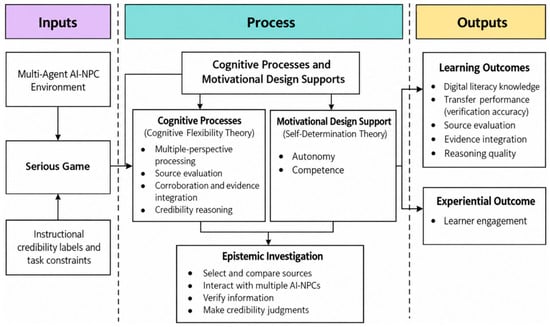
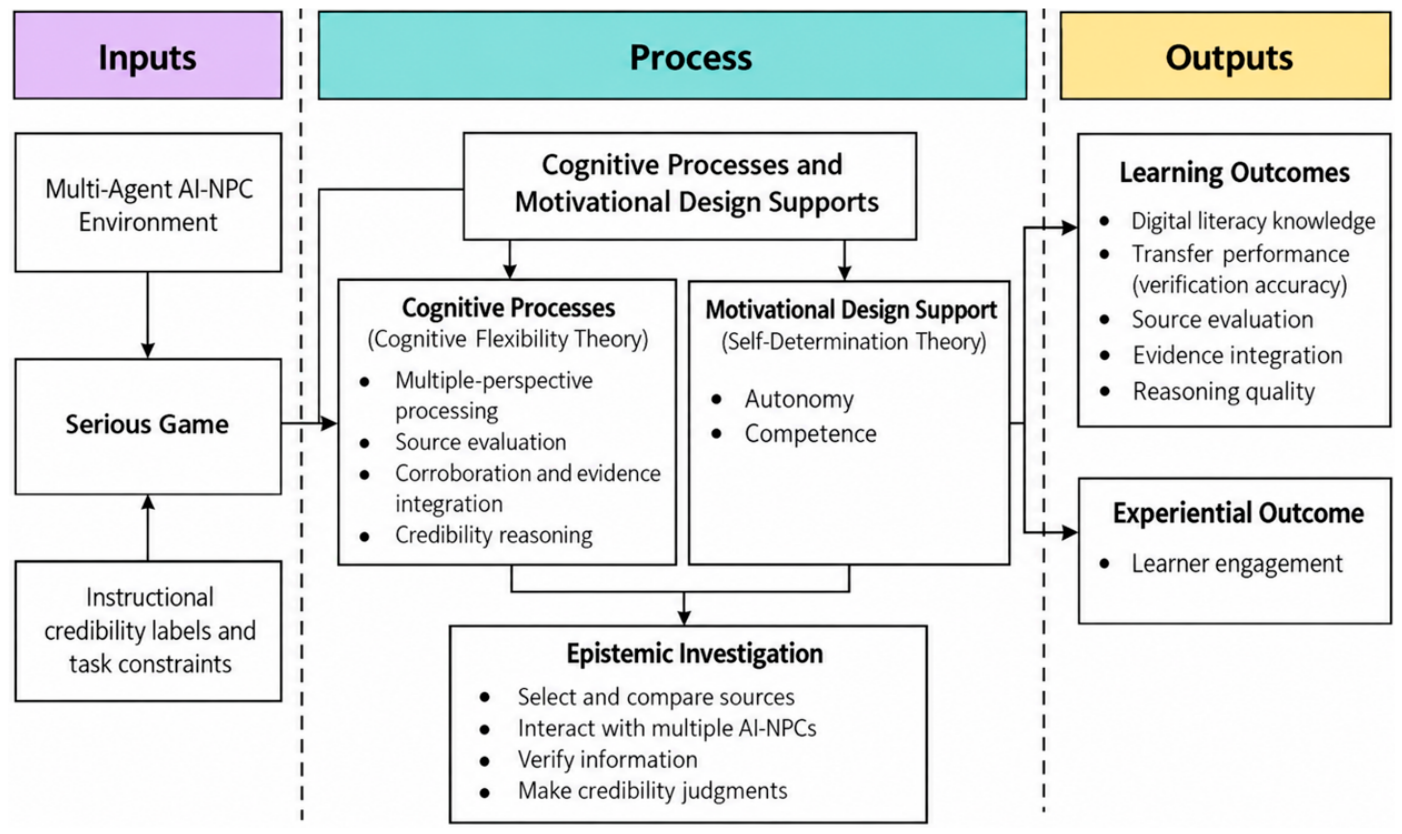
The design framework treats information distribution across AI agents as an architectural mechanism for structuring human information verification. The system combines three elements: a multi-agent generative-AI environment, a serious-game task context, and controlled credibility labels and task constraints. Together, these elements determine how learners encounter, question, compare, and verify information. Cognitive Flexibility Theory [23] provides the theoretical rationale for distributing incomplete and differing perspectives across agents: complex and ill-structured problems require users to revisit cases from multiple perspectives and reorganize knowledge according to the demands of the current problem. In the present architecture, that principle is implemented through role-specific information states, cross-source comparison, corroboration, evidence integration, and credibility reasoning. AI-NPCs therefore function as structured information sources rather than as multiple tutors supplying a shared answer.
Self-Determination Theory [28] provides a complementary interaction-design perspective. Learner autonomy is supported by allowing users to decide which AI-NPCs to consult, which information requires additional verification, and when sufficient evidence has been gathered, while competence is supported through repeated verification practice and feedback. The resulting human–AI interaction process is conceptualized as epistemic investigation: users select sources, elicit information, compare perspectives, consult external verification resources, and construct a final judgment. The framework therefore links the distributed AI architecture to both process-oriented outcomes—source evaluation, evidence integration, reasoning quality, and logged investigative behavior—and broader learning and experiential outcomes such as digital-literacy knowledge, transfer accuracy, and engagement. The overall design framework is illustrated in Figure 1.
Figure 1.
Design framework linking distributed multi-agent information architecture, epistemic investigation, and learning and experiential outcomes.
4. Distributed Multi-Agent Generative AI Architecture and Serious-Game Implementation
4.1. System Design Requirements and Serious-Game Context
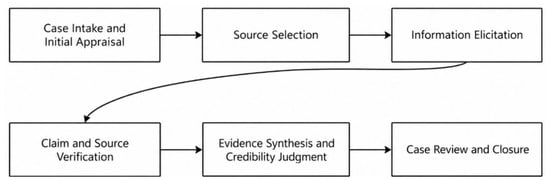
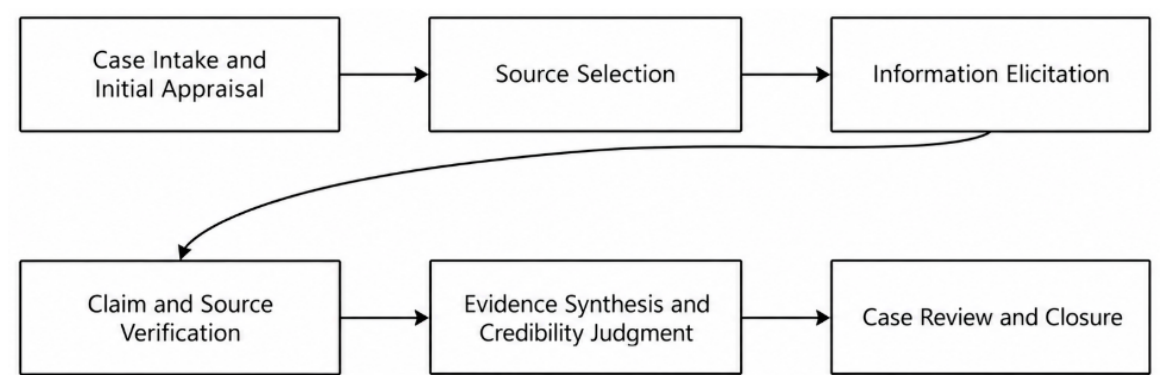
Investigate FAKE NEWS was developed from our previous AI-enhanced serious-game research on digital literacy, in which generative-AI NPCs supported interactive learning and adaptive dialogic feedback [10,11]. For the present study, the platform was redesigned around three system requirements: conversational flexibility, explicit control over what each agent can know and disclose, and experimental equivalence of the total case information available across AI configurations. The serious-game context provides the task environment for implementing these requirements. Learners act as information-verification librarians who examine suspicious or incomplete information cases submitted to a library-based verification service. Each case begins with a news-like artifact containing a headline, main claim, image, and limited contextual or provenance information. Key fields such as publication date, source, or author may initially be unavailable. As shown in Figure 2, the interaction cycle consists of case intake and initial appraisal, source selection, information elicitation, claim and source verification, evidence synthesis and credibility judgment, and case review and closure. Learners are not required to consult every source; they must determine which information is relevant and when sufficient evidence has been gathered to proceed.
Figure 2.
Core Investigate FAKE NEWS gameplay loop.
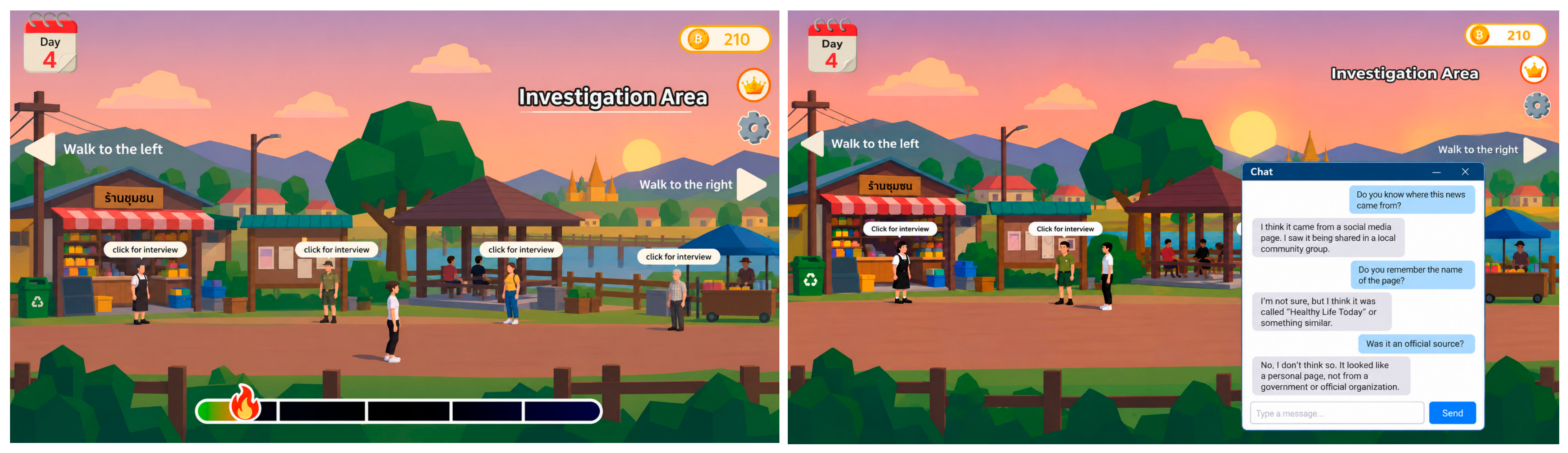
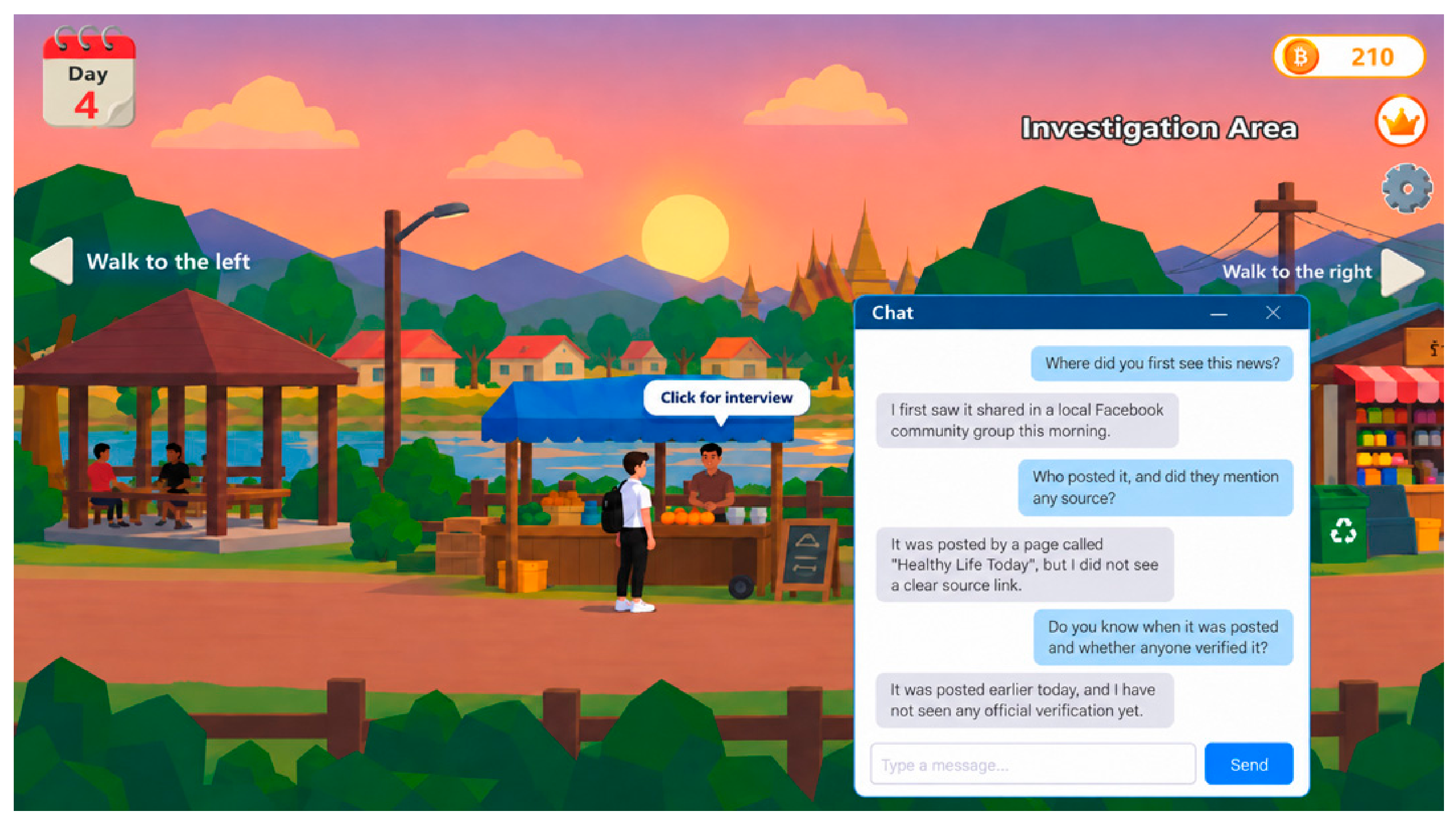
The front-end interface operationalizes the architecture through two connected interaction spaces. Figure 3 presents the title screen and verification desk, where learners inspect the case artifact and verify five structured elements: headline, main claim, published date, source, and author. Missing information is represented as unknown and is progressively resolved through investigation. Figure 4 presents the community investigation area and AI-NPC dialogue interface. Here, learners select conversational sources and elicit partial case-relevant information. The interface intentionally separates information acquisition from formal verification: clues obtained through dialogue must be connected to the verification fields and, where necessary, checked against curated evidence resources. This design makes source selection, conversational inquiry, cross-source comparison, and structured verification observable components of the human–AI interaction process.
Figure 3.
Investigate FAKE NEWS title screen and structured news-verification interface.
Figure 4.
Community investigation environment and AI-NPC interview interface for case information gathering.
4.2. Distributed Information Architecture and Role-Specific AI-NPC States
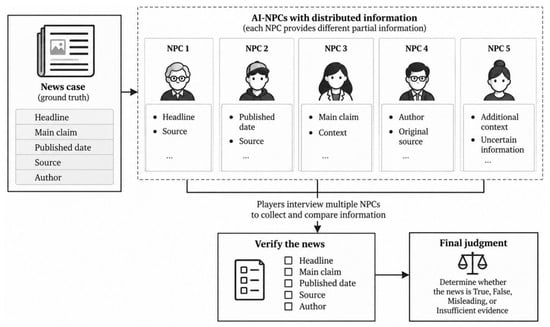
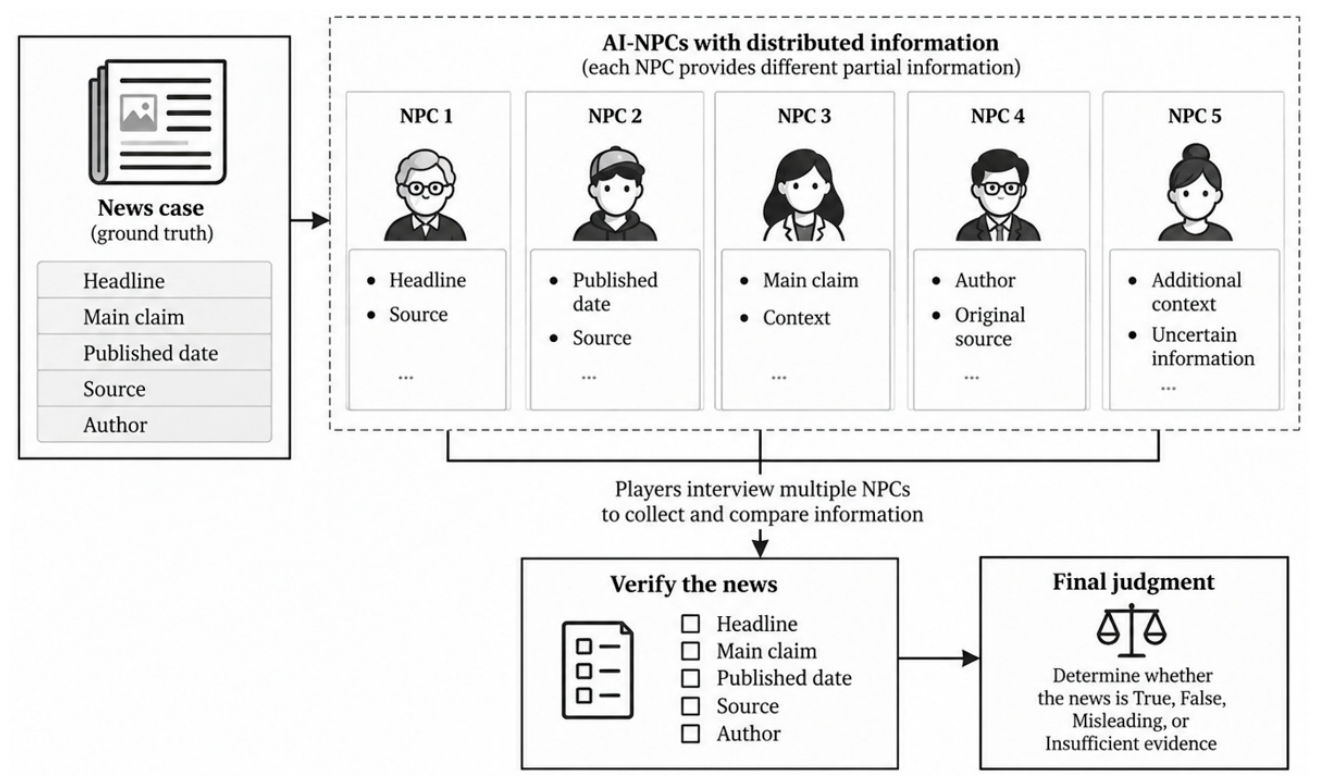
Each verification case contains four or five AI-NPCs that are narratively connected to the same news item but are assigned different subsets of case information. Rather than giving every NPC access to the complete case, the architecture partitions information according to each character’s role and position in the information chain. One agent may know how the claim circulated, another may know publication timing or a reposting source, while others may hold information about the main claim, authorship, original source, contextual evidence, or uncertainty. This partitioning creates controlled information asymmetry: no single AI-NPC functions as an authoritative answer source. As illustrated in Figure 5, users must select agents, compare their partial accounts, and integrate the resulting evidence before completing the verification fields and making a final credibility judgment. Differences among NPC responses are therefore intended consequences of bounded information access rather than uncontrolled contradictions among generative agents.
Figure 5.
Controlled partitioning of case information across role-specific AI-NPCs and its integration into the verification process.
At the system level, each AI-NPC is instantiated with a role profile and a private case-information state that specifies permitted facts, unresolved information, uncertainty, and disclosure boundaries. Natural-language responses are generated dynamically, but factual content is constrained by the state assigned to the selected agent. An AI-NPC is not permitted to reveal the case ground truth, access another agent’s private state, infer unsupported evidence, or fabricate sources outside the curated case structure. The same underlying language model and generation configuration are used for all agents, so differences in dialogue are intended to arise from role-specific information access and elicitation rules rather than from differences in model capability. This separation between shared language-generation capability and bounded private information states is central to the distributed architecture and enables controlled comparison with the single-agent configuration.
4.3. Controlled Information Elicitation and Interaction Difficulty
Information partitioning determines what an AI-NPC can disclose; a second control mechanism determines how readily that information can be elicited. This mechanism prevents the dialogue interface from functioning as a simple lookup system in which a generic question immediately returns the required fact. Each AI-NPC is assigned an information-elicitation profile specifying disclosure directness, contextuality, expressed uncertainty, and the need for follow-up questioning. Three levels are used: Direct, in which a relevant general question can elicit an explicit clue; Guided, in which an initial response provides only partial or contextual information and a more specific follow-up is required; and Investigative, in which the available information is incomplete, indirect, or explicitly uncertain and must be clarified or corroborated with another source. The mechanism is intended to shift interaction from information retrieval toward probing, clarification, and corroboration [14,30]. Importantly, difficulty is produced through predefined disclosure rules rather than random inconsistency: the factual state available to each agent remains fixed by the case design.
Table 1 summarizes how information roles and elicitation levels are combined. The architecture therefore controls two dimensions independently: the content assigned to an agent and the accessibility of that content through dialogue. For example, a Direct agent holding a source clue may identify the relevant page after a general source-related question, whereas a Guided agent may first provide only contextual information and reveal the specific page after a focused follow-up. At the Investigative level, an agent may provide an approximate or explicitly uncertain account that is insufficient by itself and requires cross-checking against another AI-NPC or the formal verification resources. The resulting interaction sequence is asking, probing, clarifying, comparing, and corroborating rather than merely accumulating NPC contacts. Elicitation profiles are predefined for each case so that participants encounter comparable interaction demands while retaining freedom in source selection and questioning strategy.
Table 1.
AI-NPC Information-Elicitation Levels and State-Control Strategies.
4.4. Single-Agent and Distributed Multi-Agent Configurations
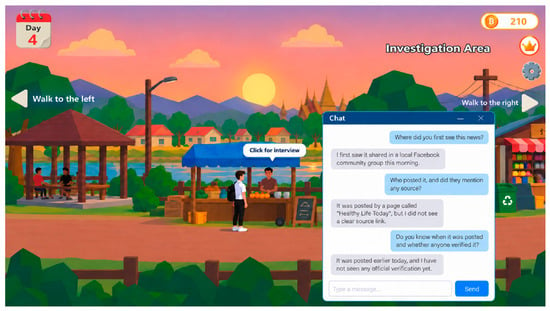
The experimental system implements two generative-AI configurations that differ primarily in information topology. In the single-agent configuration, one AI information agent has access to the complete set of conversational information for a case. The same elicitation constraints are retained, so individual clues are disclosed only in response to sufficiently relevant or specific questions. Users may ask about claim origins, provenance, contextual details, reported experiences, and Supporting Information, but the agent cannot disclose the ground-truth credibility label. Users must still determine what requires verification, consult the curated evidence resources, and submit a final credibility judgment with a written rationale. As illustrated in Figure 6, only one designated AI source is available for interview; other NPCs remain non-interactive. This configuration preserves open-ended generative dialogue and the verification task while removing cross-agent source selection and comparison.
Figure 6.
Single-agent generative-AI configuration. Case-relevant conversational information is accessed through one designated AI information agent, while other NPCs are non-interactive.
In the distributed multi-agent configuration, the same total case-relevant conversational information is partitioned across four or five role-specific AI-NPCs, each with access only to its private evidence state. Typical roles include a sharer, eyewitness, journalist, domain expert, and skeptical community member. Users must decide which sources to consult, compare information across agents, identify inconsistencies, and determine when the accumulated evidence is sufficient. No individual AI-NPC can provide the complete case information or final credibility judgment. As summarized in Table 2, the two AI configurations use the same cases, verification resources, GPT-5.1 model, generation settings, scoring rules, interface, and final task. The principal manipulation is therefore architectural: equivalent conversational information is either centralized in one agent or distributed across multiple bounded sources. This design enables a controlled comparison of centralized and distributed AI information architectures while maintaining equivalent case information, language models, verification resources, and learning tasks. However, information distribution is inherently accompanied by differences in source selection and interaction structure, and their individual contributions cannot be fully disentangled in the present design.
Table 2.
Controlled Comparison of the Single-Agent and Distributed Multi-Agent Generative-AI Configurations.
4.5. System Architecture, Orchestration, and Validation
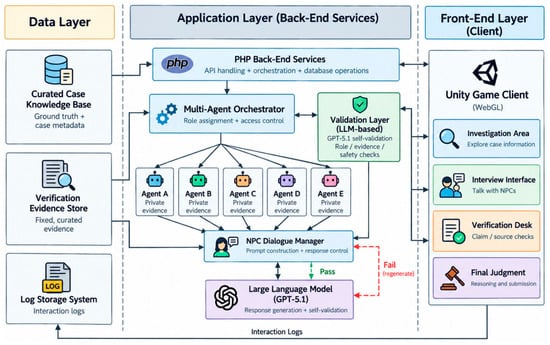
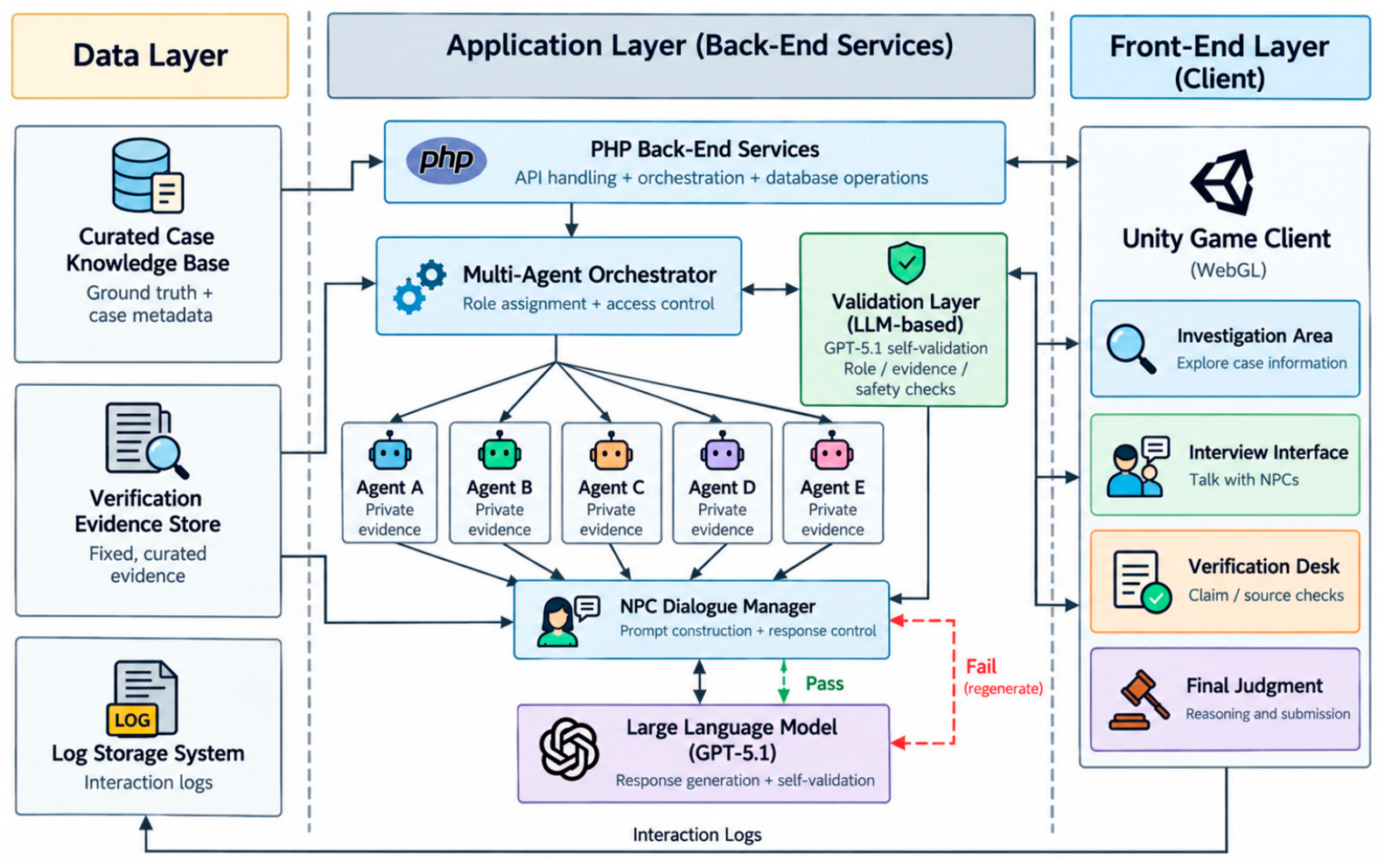
The system was implemented in Unity 2022.3.32f1 LTS, using C# to develop the interactive investigation environment, verification interface, and AI-NPC dialogue components. AI-NPC dialogue was generated using GPT-5.1 (model identifier: gpt-5.1-2025-11-13) through the OpenAI API (OpenAI, San Francisco, CA, USA). GPT-5.1 was adopted for its natural-language interaction capabilities and ability to follow role-specific instructions within controlled information-verification tasks. The model was configured with medium reasoning effort and low response verbosity. System prompts restricted responses to a maximum of 50 words per turn, prohibited disclosure of the ground-truth credibility label (true or false), and required each agent to respond within its assigned information boundaries. The same model, generation settings, and response constraints were applied across both AI conditions. The architecture comprises a curated case knowledge base, a multi-agent orchestrator, role-specific AI-NPC states, an LLM-based validation layer, a separate verification evidence store, and interaction-log storage. A PHP-based backend handled dialogue requests, agent orchestration, OpenAI API communication, and database operations. MySQL (version 8.0) stored structured case records, source metadata, permitted factual claims, agent-specific evidence states, verification resources, and interaction logs. The orchestrator initialized each case, retrieved the selected agent’s role profile and permitted evidence, constructed the role-specific prompt, and enforced information-access boundaries.
For experimental control, the single-agent configuration used the same case knowledge base, interface, verification resources, GPT-5.1 model, and generation settings as the distributed multi-agent configuration, but conversational case information was accessed through one AI source rather than partitioned across several private agent states. In the single-agent configuration, the designated AI source had access to the complete conversational case-information set while remaining subject to predefined disclosure constraints. In the multi-agent configuration, the same information was distributed among four or five role-specific AI-NPCs, each restricted to its assigned evidence state. The total case-relevant information was designed to be equivalent across the two AI configurations, while the interaction structure differed in how learners selected sources, elicited information, and compared evidence. Because information distribution also changes source-selection demands and conversational interactions, the experiment evaluates the distributed interaction architecture rather than isolating information partitioning as an independent causal factor. The classroom condition used matched cases and the same verification principles without AI-mediated gameplay. The system recorded agents consulted, consultation order, dialogue turns, evidence disclosed, verification actions, timestamps, final judgments, and written rationales. These logs provided process-level data for examining differences in investigative behavior between the two AI configurations. The overall system architecture is illustrated in Figure 7.
Figure 7.
System architecture of the controlled distributed multi-agent generative-AI implementation.
Operationally, each learner query followed a constrained generation and validation pipeline. The PHP backend identified the selected agent, retrieved its permitted private information state from MySQL, and constructed a case- and role-specific prompt before requesting a response from GPT-5.1. The generated response was then subjected to a separate LLM-based self-validation step using the same GPT-5.1 model. During validation, the model evaluated whether the candidate response was consistent with the selected agent’s knowledge state, introduced unsupported factual information, disclosed evidence assigned to other agents, or revealed the predefined ground-truth credibility label. Responses that failed validation were rejected and regenerated before being displayed to the learner, while responses that passed validation were recorded and presented through the Unity interface. The same generation and validation procedures were applied across both AI configurations. This architecture separated conversational generation from evidence-access control and response validation, making bounded information states and controlled disclosure the primary mechanisms governing what each AI source could contribute to the investigation.
5. Experimental Evaluation
5.1. Experimental Design and Participants
The evaluation used a three-group pretest-posttest experimental design involving 90 first-year undergraduate students. The study was conducted from 1 to 5 December 2025. Participants were recruited from Digital Literacy, a core undergraduate course taken by approximately 1000 students each academic year. Recruitment was conducted in two rounds. The first round did not yield a sufficient number of volunteers, whereas the second round resulted in 98 applicants in total. Eight applicants were excluded because they did not meet the prior generative AI experience criterion or because female applicants were overrepresented relative to the intended gender distribution. Eligible participants were students who had prior experience using generative AI tools and voluntarily expressed interest in participating in the study. Participants were randomly assigned to the three experimental conditions using gender-stratified randomization. The remaining 90 participants were first grouped by gender, and participants within each stratum were randomly allocated to maintain comparable gender distributions across the three groups: classroom case-based instruction (n = 30), single-agent AI serious-game learning (n = 30), and distributed multi-agent AI serious-game learning (n = 30). All participants were first-year students enrolled in the same course during the study period, providing a comparable educational background across conditions. The design allowed the two AI configurations to be compared under matched model and information conditions while retaining a non-AI instructional reference condition. Participant characteristics are summarized in Table 3.
Table 3.
Participant Demographic Characteristics by Experimental Condition.
A quantitative experimental approach was chosen because the research questions required systematic comparisons of measurable knowledge, reasoning, engagement, and investigative behavior across instructional conditions. Random assignment helps reduce pre-existing group differences and strengthens the internal validity of comparisons, while the common pretest–posttest assessment, standardized transfer tasks, blinded scoring, and recorded behavioral indicators provide consistent outcome measures [31,32]. The matched content, model, and verification resources in the two AI groups further support an evaluation of the overall information-access and interaction configuration. This design supports comparative inference about the implemented configurations, although it does not isolate information partitioning from the source-selection and dialogue demands that accompany it.
5.2. Measures
5.2.1. Digital Literacy Knowledge
Digital literacy knowledge was assessed using the same 40-item open-ended pre- and post-test instrument previously developed and used with the serious-game platform [10]. The instrument assesses theoretical and applied knowledge related to digital literacy, misinformation evaluation, and information credibility. The items were originally adapted from an undergraduate Information Literacy course and were reviewed by three domain experts, yielding an acceptable item–objective congruence (IOC) value of 0.75. The instrument demonstrated acceptable internal consistency (Cronbach’s α = 0.71). Responses were scored using the predefined scoring rubric established in the previous study. The complete test items and scoring criteria are provided in Supplementary Materials. The total score ranged from 0 to 40, with higher scores indicating stronger digital-literacy knowledge. The instrument was administered immediately before and after the intervention to assess learning gains across the three conditions.
5.2.2. Information Verification, Reasoning, and Transfer
Information-verification performance was assessed using 10 novel information cases not presented during the intervention. The cases comprised six true and four false claims. Participants completed the assessment using only the information and supporting evidence provided with each case, without access to external websites or AI assistance. For each case, participants judged whether the information was true or false and provided a brief justification. Transfer performance was scored as verification accuracy across the 10 cases (0–10). Written justifications were also rated for source evaluation, evidence integration, and reasoning quality, each on a 0–2 scale per case, yielding scores from 0 to 20 per dimension. Scores of 0, 1, and 2 represented no/limited, partial, and clear demonstration, respectively. Two independent raters, blinded to condition, scored all responses. For each reasoning dimension, the two raters’ scores were averaged at the case level and then summed across the 10 cases to obtain the participant’s total score. Disagreements were reviewed through discussion to ensure consistent application of the scoring criteria. Inter-rater reliability was assessed using the intraclass correlation coefficient (ICC) based on the independent ratings obtained before discussion.
5.2.3. Learner Engagement
Learner engagement was assessed immediately after the intervention using a 9-item adaptation of the User Engagement Scale–Short Form (UES-SF) [33]. Item wording referred to the assigned learning activity and materials to allow comparison across all three conditions. The measure retained three dimensions—Focused Attention, Perceived Usability, and Aesthetic Appeal—with three items per dimension, rated on a 5-point Likert scale from 1 (strongly disagree) to 5 (strongly agree). Negatively worded Perceived Usability items were reverse-scored, and mean scores were calculated for each dimension. The Reward dimension of the original 12-item UES-SF was omitted to focus the assessment on attention, usability, and presentation-related engagement across the different instructional formats, rather than perceived reward or gratification from the activity.
5.2.4. Investigative Behavior and AI Interaction Logs
Investigative behavior was captured automatically through gameplay logs. Four indicators were analyzed: NPC consultations per case, Source/Publisher checks, Author/Person checks, and verification revisits. For each participant, the total number of recorded actions for each indicator was divided by the number of cases investigated to obtain per-case averages. NPC consultations represented the number of times learners initiated an information-seeking interaction with an AI-NPC, while Source/Publisher and Author/Person checks recorded verification actions directed at source and authorship information. Verification revisits represented repeated checks of previously accessed verification information. These measures were used to compare investigative behavior between the single-agent and multi-agent AI conditions.
5.3. Experimental Procedure and Configuration Control
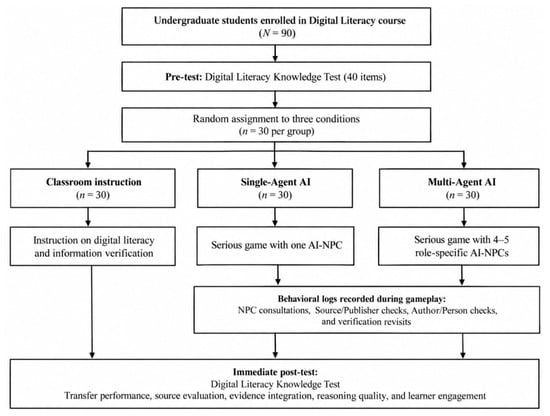
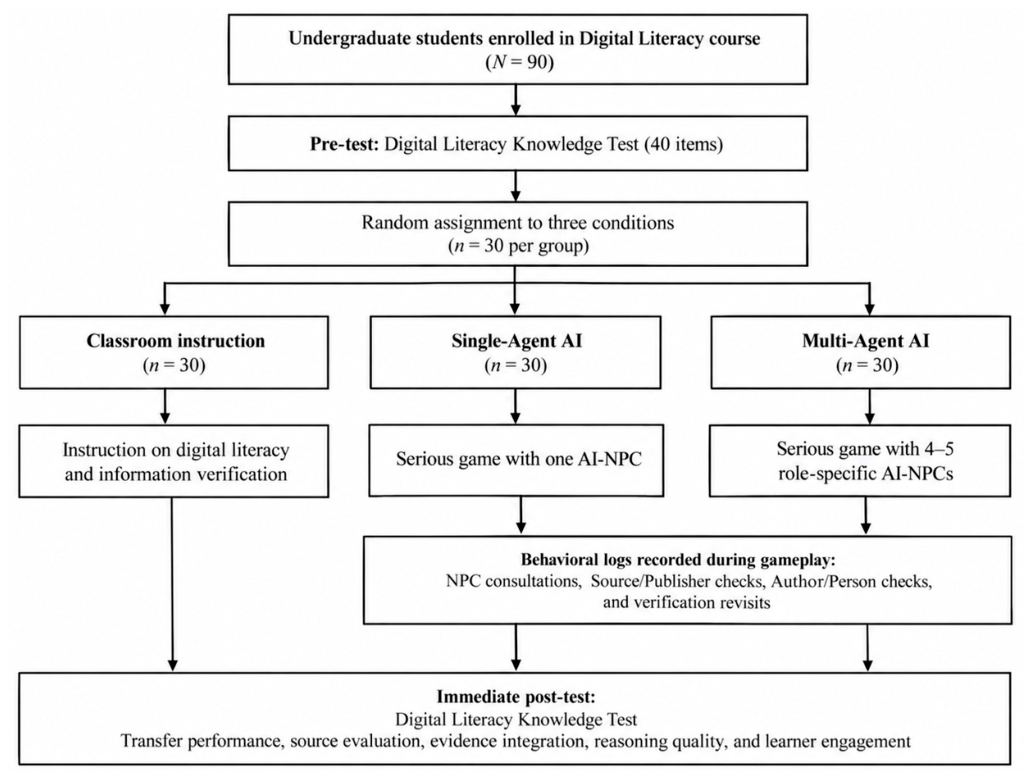
The experimental procedure is summarized in Figure 8. Participants first completed the Digital Literacy Knowledge pre-test and were then randomly assigned to classroom instruction, single-agent AI, or distributed multi-agent AI. All conditions used the same underlying news scenarios and information-verification principles. The classroom condition used the news cases as instructional examples to explain verification principles rather than requiring the same number of interactive investigations as the AI conditions. The instructor explained how to examine news claims, evaluate source credibility, identify supporting evidence, and make reasoned verification judgments using selected news examples. In the single-agent condition, participants accessed conversational case information through one AI source. In the distributed multi-agent condition, the same news cases and case information were accessed through four or five role-specific AI-NPCs, requiring participants to select sources and compare partial accounts. Both AI conditions provided access to the same pool of news cases. The classroom condition was conducted in a 90-min instructional session. Participants in both AI conditions were given up to 120 min, were required to complete at least one full investigation cycle, and could continue with additional cycles within the remaining time. Consequently, the number of completed cases could vary among participants. The additional time accommodated gameplay instructions and familiarization with the game interface, which were not required in the classroom condition. The two AI configurations therefore shared the same maximum duration and completion requirements. Research assistants were available to provide technical assistance and clarify procedural instructions during the sessions.
Figure 8.
Experimental procedure and configuration-control sequence across the three study conditions.
Configuration control was applied specifically to the comparison between the two AI conditions. Both used the same game environment, total case-relevant information, verification resources, GPT-5.1 model, generation settings, scoring rules, interface, and final judgment task. The manipulated factor was whether equivalent conversational information was centralized in one agent or partitioned across multiple role-specific private states. Both AI conditions used identical news cases and case completion requirements. Immediately after the intervention, participants completed the Digital Literacy Knowledge post-test, 10 novel transfer cases assessing verification accuracy, source evaluation, evidence integration, and reasoning quality, and the adapted 9-item UES-SF. Behavioral logs were recorded automatically during gameplay in the two AI conditions, and all activities were completed individually without consultation among participants.
5.4. Data Analysis
Descriptive statistics were calculated using means, standard deviations, frequencies, and percentages. A quantitative experimental approach was adopted to compare measurable learning outcomes and investigative behaviors across the three conditions under controlled procedures. Evidence integration was a central outcome of interest for comparing the two AI configurations, alongside digital-literacy knowledge, transfer performance, and other reasoning measures. Digital Literacy Knowledge scores were analyzed using a 3 (condition) × 2 (time) mixed-design ANOVA, with planned pre–post comparisons within each condition. Transfer performance, source evaluation, evidence integration, reasoning quality, and learner engagement were compared across the three conditions using one-way ANOVAs. Learner engagement analyses were treated as exploratory, with no adjustment for multiple outcome-level tests.
For outcomes with significant omnibus effects, pairwise independent-samples t tests were conducted with Bonferroni adjustment for the three pairwise comparisons. Bonferroni-adjusted 95% confidence intervals were also calculated for pairwise mean differences. Investigative behaviors were compared between the single-agent and multi-agent AI conditions using independent-samples t tests for NPC consultations, Source/Publisher checks, Author/Person checks, and verification revisits. Normality was assessed using the Shapiro–Wilk test, while homogeneity of variance was also examined before inferential analyses. Statistical significance was set at p < 0.05, with effect sizes reported as partial η2 for mixed-design ANOVA, η2 for one-way ANOVA, Cohen’s dz for within-group pre–post comparisons, and Cohen’s d for independent two-group comparisons. Given the multiple outcomes examined, findings were interpreted in relation to effect sizes and consistency across measures, rather than statistical significance alone.
6. Results
6.1. Digital-Literacy Knowledge
Descriptive statistics for the Digital Literacy Knowledge Test are presented in Table 4. Baseline scores were highly similar across the three conditions, ranging from 6.28 to 6.35. Substantial improvements were observed after the intervention in all groups, with mean gains of 14.10 points for classroom instruction, 14.25 points for single-agent AI, and 14.22 points for multi-agent AI. The mixed-design ANOVA (Table 5) revealed a significant main effect of time, F(1, 87) = 2087.34, p < 0.001, ηp2 = 0.960. However, neither the main effect of condition, F(2, 87) = 0.013, p = 0.987, ηp2 < 0.001, nor the Condition × Time interaction, F(2, 87) = 0.022, p = 0.978, ηp2 = 0.001, was significant. Planned within-group comparisons confirmed significant pre–post improvements in all three conditions (all p < 0.001). Thus, the results did not provide evidence that changing the AI information architecture produced additional gains in general digital-literacy knowledge relative to the alternative conditions.
Table 4.
Digital Literacy Knowledge Scores by Experimental Condition.
Table 5.
Mixed-Design ANOVA and Within-Group Comparisons for Digital Literacy Knowledge.
6.2. Information Verification, Evidence Integration, Reasoning, and Transfer
Descriptive statistics for transfer performance, source evaluation, evidence integration, and reasoning quality are presented in Table 6. Transfer performance was highly similar across the three conditions, with mean scores of 6.47 for classroom instruction, 6.53 for single-agent AI, and 6.60 for multi-agent AI. In contrast, the process-oriented measures were more sensitive to interaction architecture. Source evaluation scores were higher in both AI conditions than in the classroom condition, evidence integration showed a clearer progression from classroom to single-agent AI and then to multi-agent AI, and reasoning quality followed a similar pattern, although the difference between the two AI configurations was small. Inter-rater reliability was evaluated using intraclass correlation coefficients (ICC) for source evaluation, evidence integration, and reasoning quality, based on the independent ratings of two raters before discussion. The ICC values were 0.68 (95% CI: 0.54–0.78) for source evaluation, 0.72 (95% CI: 0.60–0.81) for evidence integration, and 0.65 (95% CI: 0.50–0.76) for reasoning quality, indicating moderate reliability.
Table 6.
Transfer and Reasoning Outcomes by Experimental Condition.
As shown in Table 7, the one-way ANOVA indicated no significant difference among conditions for transfer performance, F(2, 87) = 0.07, p = 0.930, η2 = 0.002. Significant overall condition effects were found for source evaluation, F(2, 87) = 4.76, p = 0.011, η2 = 0.099; evidence integration, F(2, 87) = 11.61, p < 0.001, η2 = 0.211; and reasoning quality, F(2, 87) = 4.50, p = 0.014, η2 = 0.094. Bonferroni-adjusted comparisons showed that the multi-agent AI condition scored significantly higher than the classroom condition in source evaluation (p = 0.015), evidence integration (p < 0.001), and reasoning quality (p = 0.019). For evidence integration, the multi-agent condition also outperformed the single-agent condition (p = 0.040). Although the single-agent condition generally produced higher mean scores than the classroom condition, these pairwise differences did not remain statistically significant after Bonferroni adjustment. The key comparison between the two AI configurations showed significantly higher evidence integration in the multi-agent condition (mean difference = 1.35, Bonferroni-adjusted 95% CI [0.04, 2.66], adjusted p = 0.040). In contrast, the confidence intervals for source evaluation and reasoning quality included zero, indicating no statistically significant differences between the two AI configurations.
Table 7.
One-Way ANOVA and Bonferroni-Adjusted Pairwise Comparisons.
6.3. Learner Engagement
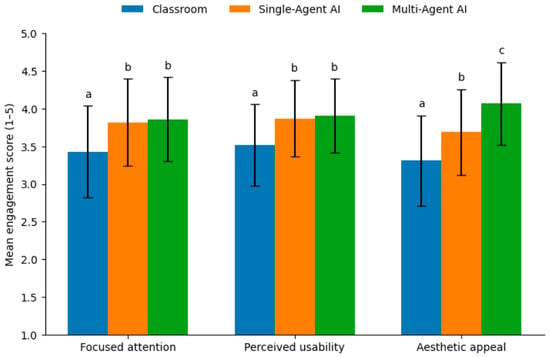
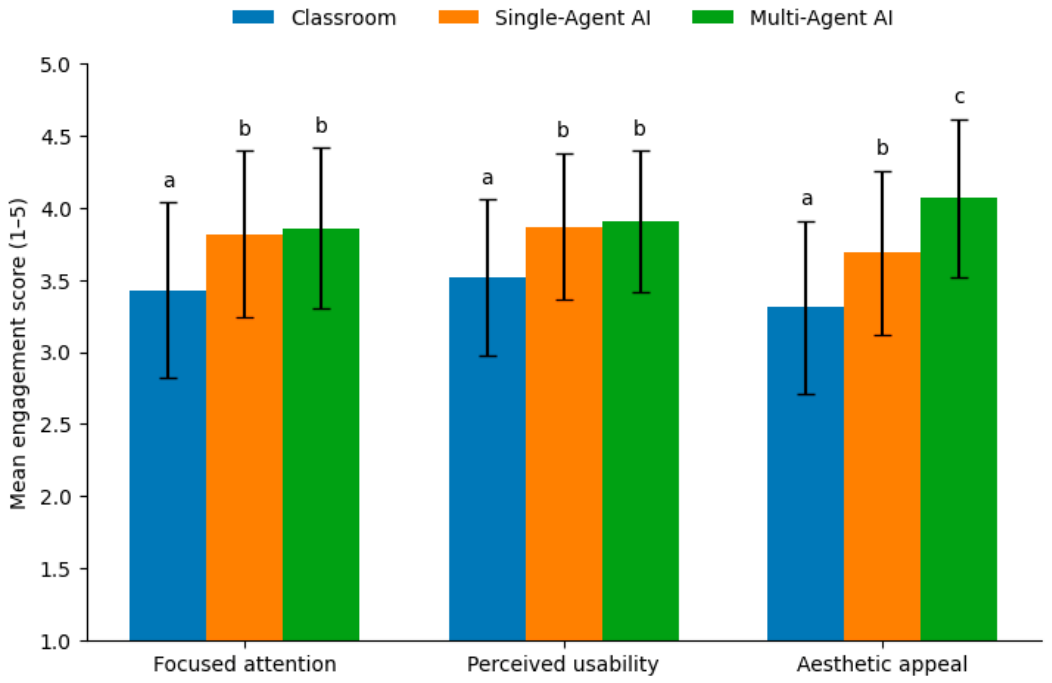
Learner engagement across the three experimental conditions is presented in Figure 9. For focused attention, both the single-agent AI (M = 3.82, SD = 0.58) and multi-agent AI conditions (M = 3.86, SD = 0.56) showed higher scores than the classroom condition (M = 3.43, SD = 0.61). A similar pattern was observed for perceived usability, with mean scores of 3.52 (SD = 0.54), 3.87 (SD = 0.51), and 3.91 (SD = 0.49) for the classroom, single-agent AI, and multi-agent AI conditions, respectively. For aesthetic appeal, a clearer progression was observed, with the multi-agent AI condition reporting the highest score (M = 4.07, SD = 0.55), followed by the single-agent AI condition (M = 3.69, SD = 0.57) and the classroom condition (M = 3.31, SD = 0.60). Internal consistency was examined separately for the three retained engagement dimensions using Cronbach’s alpha: focused attention (α = 0.72), perceived usability (α = 0.64), and aesthetic appeal (α = 0.82).
Figure 9.
Learner engagement across the classroom, single-agent AI, and multi-agent AI conditions. Error bars represent standard deviations. Different letters within each engagement dimension indicate statistically significant Bonferroni-adjusted pairwise differences (p < 0.05).
One-way ANOVAs indicated significant condition effects for focused attention, F(2, 87) = 4.97, p = 0.009, η2 = 0.103; perceived usability, F(2, 87) = 5.23, p = 0.007, η2 = 0.107; and aesthetic appeal, F(2, 87) = 13.16, p < 0.001, η2 = 0.232. Bonferroni-adjusted comparisons showed that both AI-supported conditions scored significantly higher than the classroom condition for focused attention and perceived usability, while the single-agent and multi-agent conditions did not differ significantly from each other on these dimensions. For aesthetic appeal, the multi-agent AI condition scored significantly higher than both the single-agent AI and classroom conditions, while the single-agent AI condition also scored significantly higher than the classroom condition.
6.4. Investigative Behavior and Human–AI Interaction Logs
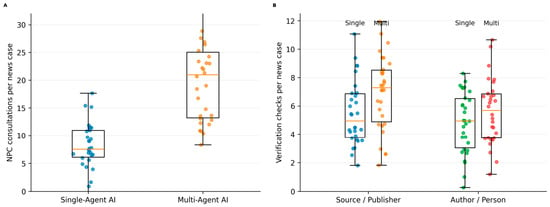
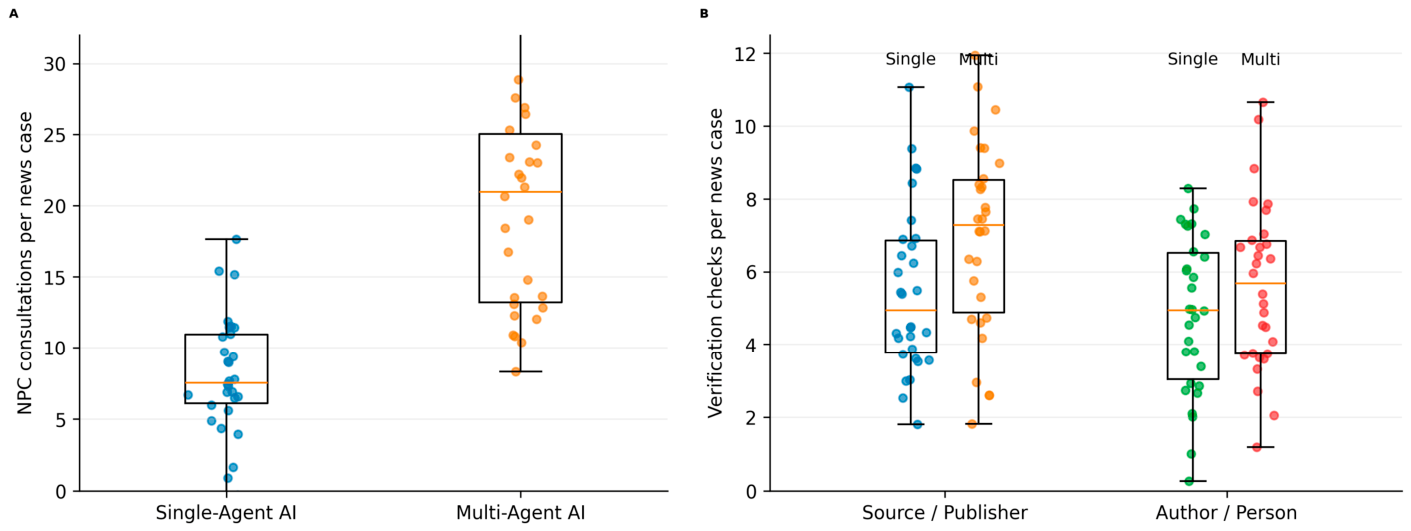
Behavioral log data are summarized in Figure 10 and Table 8. Participants in the distributed multi-agent AI condition showed substantially more NPC consultations than those in the single-agent AI condition, averaging 20.36 versus 8.13 consultations per case, t(58) = 7.41, p < 0.001, Cohen’s d = 1.91. The multi-agent group also performed significantly more Source/Publisher checks, with means of 6.94 and 5.47 checks per case, respectively, t(58) = 2.33, p = 0.023, d = 0.60. The architectural change from one conversational source to several bounded sources was therefore associated with both substantially greater source interaction and moderately more frequent source-level verification.
Figure 10.
Behavioral log comparisons between the single-agent and multi-agent AI conditions. (A) NPC consultations per news case; (B) Source/Publisher and Author/Person verification checks per news case. Blue and green represent the single-agent AI condition, while orange and red represent the multi-agent AI condition. Dots represent individual participants.
Table 8.
Investigative Behaviors in the Single-Agent and Multi-Agent AI Conditions.
A more differentiated pattern was observed for the remaining verification behaviors. Author/Person checks were somewhat more frequent in the distributed multi-agent condition than in the single-agent condition (5.61 vs. 4.82 per case), although this difference was not statistically significant, t(58) = 1.38, p = 0.172, d = 0.36. In contrast, verification revisits occurred significantly more often in the multi-agent condition (4.69 vs. 3.36 per case), t(58) = 2.74, p = 0.008, d = 0.71. Together, the log data indicate that distributed information access altered how participants navigated between conversational sources and verification resources, not simply how often they interacted with the game.
7. Discussion
7.1. Knowledge Gains and Transfer Accuracy Under Alternative Interaction Architectures
Regarding RQ1, all three conditions showed substantial gains in digital-literacy knowledge, but the magnitude of improvement did not differ significantly across classroom, single-agent AI, and distributed multi-agent AI conditions. Transfer accuracy on the 10 novel cases was likewise comparable across groups. From a systems perspective, this result is important because the distributed architecture changed how conversational information was structured without producing a general advantage in knowledge acquisition or final binary verification accuracy. Conventional case-based instruction and both AI configurations were therefore similarly effective for these broad outcomes. This pattern is consistent with misinformation-game research showing that active game-based practice can improve evaluation knowledge and accuracy discernment [8,34], while games and lectures can provide complementary rather than uniformly superior learning benefits [35].
The absence of a multi-agent advantage in transfer accuracy suggests that the main effect of distributed information architecture may lie in the verification process rather than in the final classification outcome. Barzilai and Stadtler [9] similarly showed that practicing evaluation strategies can strengthen sourcing and corroboration knowledge even when additional explanations do not translate directly into superior performance, and simulation-based formats do not always outperform simpler instruction on transfer measures [36]. In the present study, the strongest differences appeared in source evaluation, evidence integration, reasoning quality, and logged investigation behavior. The architecture therefore appears to have influenced how users reached a judgment more clearly than whether the final true/false judgment was correct.
7.2. Effects of Distributed Information Architecture on Evidence Integration and Reasoning
Regarding RQ2, the distributed multi-agent AI condition produced the highest mean scores for source evaluation, evidence integration, and reasoning quality, with the clearest advantage emerging for evidence integration. Multi-agent participants significantly outperformed the classroom condition across all three measures and also exceeded the single-agent condition in evidence integration, while the differences between the two AI configurations in source evaluation and reasoning quality were not statistically significant. Because the two AI configurations used equivalent case information and the same underlying GPT-5.1 model, the evidence-integration difference is consistent with the potential influence of the distributed interaction architecture. Partitioning information across bounded sources may encourage users to connect evidence across perspectives rather than obtain conversational information from a consolidated source. This interpretation is consistent with multiple-document literacy research, which treats integration as selecting, organizing, corroborating, and synthesizing information across sources [37], and with evidence that structured source-evaluation scaffolds can strengthen critical evaluation [22].
Cognitive Flexibility Theory provides a theoretical perspective for interpreting this effect. The distributed configuration externalizes multiple perspectives into separate conversational sources, requiring users to reorganize partial information as the case develops rather than rely on one unified representation [23]. Research on multiple-text reading likewise shows that learners adjust attention to source and evidence information according to task demands, and deeper engagement with multiple sources can support more integrated representations [21]. The present findings therefore suggest that the technological value of the multi-agent design may lie less in increasing the amount of available information and more in structuring how learners access, compare, and reconcile distributed evidence. However, the findings do not establish that information partitioning alone caused the observed difference, as the multi-agent configuration also introduced additional source-selection and interaction demands.
7.3. Human–AI Interaction Behavior and Engagement
Regarding RQ3, the behavioral logs show that participants in the distributed multi-agent condition demonstrated a more intensive and more iterative pattern of investigation than those in the single-agent configuration. Participants consulted AI-NPCs substantially more often, conducted more Source/Publisher checks, and revisited verification information more frequently, although the difference in Author/Person checks was not significant. These behaviors are consistent with the interaction demands created by information partitioning: users must move among conversational sources and formal verification resources instead of following one conversational pathway. Recent multi-agent research likewise reports distinct patterns of knowledge co-construction and regulation when learners interact with multiple AI agents [17]. Importantly, a larger number of consultations should not be interpreted as inherently better; in this study it indicates a difference in investigative behavior associated with the distributed interaction architecture.
Engagement results provide complementary evidence about the learner experience of these interaction architectures. Both AI-supported conditions produced higher focused attention and perceived usability than classroom instruction, while the multi-agent condition showed the highest aesthetic appeal. Previous work has similarly found that generative-AI NPCs can increase the interactivity and perceived engagement of serious-game experiences [10] and strengthen affective engagement and situational interest [13]. The present results suggest that the additional source switching and comparison required in the multi-agent condition did not correspond to lower reported engagement. However, higher engagement and more frequent investigative actions should not be interpreted as evidence of greater learning effectiveness, particularly given the absence of significant differences in knowledge gains and transfer accuracy. Instead, the findings suggest that the distributed configuration was associated with differences in how participants investigated information and experienced the activity.
7.4. Design Implications for Distributed Multi-Agent Generative AI
The findings suggest a design view in which the value of multi-agent generative AI depends less on the number of agents than on the architecture of information and control. Cognitive Flexibility Theory informed the decision to distribute incomplete, heterogeneous perspectives across role-specific sources, while the system implementation translated this principle into private evidence states, access boundaries, controlled disclosure, and a validation layer. The resulting architecture separates conversational generation from evidence authority: the shared language model provides flexible dialogue, but the curated state assigned to each agent determines what that source is permitted to contribute. Self-Determination Theory provides a complementary design rationale for how source choice and repeated verification may support autonomy and competence, although these psychological mechanisms were not directly tested in the present study. The main contribution is therefore a controlled distributed-information architecture that was associated with stronger evidence integration and more extensive investigative behavior, without demonstrating corresponding advantages in knowledge gains or transfer accuracy.
Four design implications follow. First, multi-agent systems may benefit from distributing distinct evidence across agents rather than simply duplicating conversational personas, particularly when the instructional goal is cross-source reasoning. Second, each agent should have an explicit private knowledge state and access boundary so that conversational differences reflect designed information structure rather than uncontrolled model variation. Third, disclosure difficulty can be controlled independently from information content, allowing designers to tune the amount of probing and corroboration required without changing the underlying ground truth. Fourth, response generation should be separated from validation: candidate language-model outputs should be checked against role and evidence constraints before being shown to users. These principles offer practical guidance for designing serious games and AI-supported verification activities in which learners must select sources, compare partial accounts, and justify their judgments. Their applicability to other simulation and decision-support settings remains to be evaluated. At the institutional level, these findings support considering multi-agent AI activities as a supplement to existing digital-literacy instruction rather than a replacement for classroom teaching. Educational institutions should establish guidelines for evidence quality, AI-generated content validation, and instructor oversight before adopting such systems. Broader implementation should be accompanied by evaluations of learning outcomes, accessibility, and operational costs to ensure that educational benefits justify the additional technological complexity.
7.5. Limitations and Future Research
Several limitations should be considered when interpreting the findings. First, the study involved 90 first-year undergraduates enrolled in a single Digital Literacy course, all of whom had prior experience using generative AI tools, which may limit generalizability to other age groups, disciplines, professional settings, and individuals with little or no prior AI experience. Second, outcomes were assessed immediately after the intervention; delayed post-tests are needed to examine retention and longer-term transfer. Additionally, using the same knowledge test before and after the intervention may have introduced testing effects, potentially contributing to the substantial learning gains observed across all three conditions. Third, although the two AI configurations held total case information, verification resources, model configuration, scoring, and task structure constant, their interaction structures necessarily differed and may have imposed different cognitive demands. Consequently, the effects of information partitioning cannot be fully separated from those of source selection and interaction demands. Fourth, the classroom condition lasted 90 min, whereas the AI conditions allowed up to 120 min and permitted additional investigation cycles after the minimum required cycle; comparisons between classroom and AI-supported conditions may therefore partly reflect differences in instructional format, system familiarization, time-on-task, and opportunities for repeated practice, although the two AI conditions were matched in duration and completion requirements. Fifth, the behavioral logs captured the frequency of consultations and verification actions rather than the semantic quality of learners’ questions or evidence-seeking strategies. Finally, the present evaluation used one language model and did not benchmark system-level factors such as validation rejection rates, regeneration frequency, latency, or computational cost. Future work should combine dialogue-level analysis with process logs, compare alternative model configurations, quantify validation and efficiency characteristics, and test whether specific multi-agent interaction patterns predict stronger reasoning and transfer outcomes.
A further limitation concerns the motivational interpretation of the design. Although Self-Determination Theory informed the provision of learner choices and verification feedback, the study did not directly measure autonomy, competence, relatedness, or psychological need frustration. The engagement scale therefore cannot establish whether either AI configuration supported or undermined these needs. Future studies should assess both need satisfaction and frustration, including possible overreliance on AI and changes in human interaction, alongside learning and behavioral outcomes.
8. Conclusions
This study presented and evaluated a distributed multi-agent generative-AI architecture for information verification in a serious-game environment. The central manipulation was not the amount of available information or the underlying language model, but how equivalent conversational information was structured: centralized in one AI source or partitioned across multiple role-specific sources with bounded private evidence states. All three instructional conditions produced substantial digital-literacy knowledge gains, and transfer accuracy remained comparable. However, the distributed multi-agent configuration produced significantly higher scores in source evaluation, evidence integration, and reasoning quality than classroom instruction, while its advantage over the single-agent configuration was statistically significant only for evidence integration. Participants in the multi-agent condition also demonstrated more frequent investigative actions. These results suggest that distributed AI information architecture can influence how users investigate and integrate evidence, even without measurable improvements in knowledge gains or final classification accuracy. The principal contribution is therefore not evidence that more agents are inherently better, but that controlled information partitioning, private agent states, controlled disclosure, and validation can be used together as an interaction-design mechanism. Although information partitioning and interaction demands cannot be fully disentangled in this design, this architecture offers a promising approach to designing generative-AI systems in which AI agents function as deliberately bounded information sources and users remain responsible for selecting, comparing, corroborating, and integrating evidence.
Supplementary Materials
The following supporting information can be downloaded at: https://www.mdpi.com/article/10.3390/technologies14110746/s1. Section S.1: Digital Literacy Knowledge Test; Section S.2: Digital Literacy Knowledge Test Scoring Rule; Section S.3: Information Verification, Transfer, and Reasoning Assessment; Section S.4: Adapted User Engagement Scale-Short Form; Section S.5: Technical Implementation and Example Case Configuration; Tables S1–S8: Scoring rubrics, assessment examples, engagement questionnaire items, and AI-NPC information distribution.
Author Contributions
Conceptualization, K.P.; methodology, S.C. and K.P.; software, K.I.; validation, K.I.; formal analysis, S.Y. and K.I.; investigation, K.I.; resources, K.I.; data curation, K.P.; writing—original draft preparation, S.C. and K.P.; writing—review and editing, K.P.; visualization, K.P.; supervision, K.I.; project administration, K.I.; funding acquisition, K.I. All authors have read and agreed to the published version of the manuscript.
Funding
This research was partially supported by Chiang Mai University and the Faculty of Humanities, Chiang Mai University.
Institutional Review Board Statement
The study was conducted in accordance with the Declaration of Helsinki and approved by the Institutional Review Board of the Chiang Mai University Research Ethics Committee (protocol code: CMU REC No. 67/268 and approval date: 18 October 2024).
Informed Consent Statement
Informed consent was obtained from all subjects involved in the study.
Data Availability Statement
The data presented in this study are available upon request from the corresponding author due to restrictions. The data are not publicly available.
Conflicts of Interest
The authors declare no conflicts of interest.
References
- Anmarkrud, Ø.; Bråten, I.; Florit, E.; Mason, L. The role of individual differences in sourcing: A systematic review. Educ. Psychol. Rev. 2022, 34, 749–792. [Google Scholar] [CrossRef] [Scilit]
- Breakstone, J.; Smith, M.; Connors, P.; Ortega, T.; Kerr, D.; Wineburg, S. Lateral reading: College students learn to critically evaluate internet sources in an online course. Harv. Kennedy Sch. Misinf. Rev. 2021, 2, 1–17. [Google Scholar] [CrossRef] [Scilit]
- Fendt, M.; Muth, X.; Edelsbrunner, P.A. Judging a text by its author—A meta-analysis of interventions to foster source credibility assessment. Learn. Individ. Differ. 2025, 124, 102782. [Google Scholar] [CrossRef] [Scilit]
- McGrew, S. Teaching lateral reading: Interventions to help people read like fact checkers. Curr. Opin. Psychol. 2024, 55, 101737. [Google Scholar] [CrossRef] [Scilit] [PubMed]
- Marten, P.L.; Aßmann, S.; Baumgarten-Kelm, C.; Stadtler, M. Did 5G radiation really kill birds? Training lower secondary students in epistemic strategies to counter online misinformation. Learn. Individ. Differ. 2025, 122, 102685. [Google Scholar] [CrossRef] [Scilit]
- De La Hera, T.; Cañete Sanz, L.; Navarro Sierra, N.; Jansz, J.; Kneer, J.; Glas, R.; van Vught, J. Digital literacy games: A systematic literature review. Front. Commun. 2024, 9, 1407532. [Google Scholar] [CrossRef] [Scilit]
- Kiili, K.; Siuko, J.; Ninaus, M. Tackling misinformation with games: A systematic literature review. Interact. Learn. Environ. 2024, 32, 7086–7101. [Google Scholar] [CrossRef] [Scilit]
- Barzilai, S.; Mor-Hagani, S.; Abed, F.; Tal-Savir, D.; Goldik, N.; Talmon, I.; Davidow, O. Misinformation is contagious: Middle school students learn how to evaluate and share information responsibly through a digital game. Comput. Educ. 2023, 202, 104832. [Google Scholar] [CrossRef] [Scilit]
- Barzilai, S.; Stadtler, M. Learning to evaluate (mis)information in an online game: Strategies matter! Comput. Educ. 2025, 227, 105210. [Google Scholar] [CrossRef] [Scilit]
- Chernbumroong, S.; Intawong, K.; Asawimalkit, U.; Puritat, K.; Julrode, P. Design and evaluation of a generative AI-enhanced serious game for digital literacy: An AI-driven NPC approach. Informatics 2026, 13, 16. [Google Scholar] [CrossRef] [Scilit]
- Intawong, K.; Thongthip, P.; Worragin, P.; Puritat, K. Adaptive dialogic feedback in AI-enhanced serious games: Examining effects on motivation and learning processes in digital literacy education. Educ. Technol. Res. Dev. 2026, 1–30. [Google Scholar] [CrossRef] [Scilit]
- Ngu, P.-C.; Chien, C.-C.; Ho, Y.-T.; Hou, H.-T. A generative AI educational game framework with multi-scaffolding supports workplace competency development. Comput. Educ. 2025, 239, 105421. [Google Scholar] [CrossRef] [Scilit]
- Xiao, Y.; Li, D.; Guo, K. Using ChatGPT to bring non-player characters to life: Effects on students’ storyline-driven game-based writing learning. Comput. Educ. 2025, 238, 105414. [Google Scholar] [CrossRef] [Scilit]
- Yan, L.; Martinez-Maldonado, R.; Jin, Y.; Echeverria, V.; Milesi, M.; Fan, J.; Zhao, L.; Alfredo, R.; Li, X.; Gašević, D. The effects of generative AI agents and scaffolding on enhancing students’ comprehension of visual learning analytics. Comput. Educ. 2025, 234, 105322. [Google Scholar] [CrossRef] [Scilit]
- Ba, S.; Shi, X.; Wu, S.; Lu, G. Artificial intelligence agents in computer-supported collaborative learning: A systematic literature review. Comput. Educ. Artif. Intell. 2026, 10, 100579. [Google Scholar] [CrossRef] [Scilit]
- Gao, L.; Jong, M.S.-Y.; Chai, C.S.; Li, K. STEM education: Understanding secondary students’ epistemic cognition in the design process with the support of a personalized multi-agent system. Comput. Educ. 2026, 242, 105504. [Google Scholar] [CrossRef] [Scilit]
- Hao, Z.; Cao, J.; Li, R.; Yu, J.; Liu, Z.; Zhang, Y. Mapping student-AI interaction dynamics in multi-agent learning environments: Supporting personalized learning and reducing performance gaps. Comput. Educ. 2026, 241, 105472. [Google Scholar] [CrossRef] [Scilit]
- Zheng, L.; Shi, Z.; Gao, L. A generative artificial intelligence-enhanced multiagent approach to empowering collaborative problem solving across different learning domains. Comput. Educ. 2026, 241, 105489. [Google Scholar] [CrossRef] [Scilit]
- Bråten, I.; Stadtler, M.; Salmerón, L. The role of sourcing in discourse comprehension. In The Routledge Handbook of Discourse Processes, 2nd ed.; Schober, M.F., Rapp, D.N., Britt, M.A., Eds.; Routledge: Oxfordshire, UK, 2018; pp. 141–166. [Google Scholar] [CrossRef] [Scilit]
- Wineburg, S.; McGrew, S. Lateral reading and the nature of expertise: Reading less and learning more when evaluating digital information. Teach. Coll. Rec. 2017, 119, 1–40. [Google Scholar]
- Guan, Z.-H.; Lin, S.S.J. When and how learners engage with source information in digital multiple-text reading: Effects of task instruction and text trustworthiness from eye-tracking technology. Comput. Educ. 2025, 236, 105362. [Google Scholar] [CrossRef] [Scilit]
- Barzilai, S.; Tal-Savir, D.; Abed, F.; Mor-Hagani, S.; Chinn, C.A. Scaffolding source evaluation during document-based scientific inquiry: The contributions of document mapping and shared criteria scaffolds. Comput. Hum. Behav. 2025, 165, 108547. [Google Scholar] [CrossRef] [Scilit]
- Spiro, R.J.; Feltovich, P.J.; Jacobson, M.J.; Coulson, R.L. Cognitive flexibility, constructivism, and hypertext: Random access instruction for advanced knowledge acquisition in ill-structured domains. Educ. Technol. 1991, 31, 24–33. [Google Scholar]
- Rouet, J.-F.; Britt, M.A.; Durik, A.M. RESOLV: Readers’ representation of reading contexts and tasks. Educ. Psychol. 2017, 52, 200–215. [Google Scholar] [CrossRef] [Scilit]
- Vives, E.; Poletti, C.; Robert, A.; Butera, F.; Huguet, P.; ProFAN Consortium; Régner, I. Learning with jigsaw: A systematic review gathering all the pieces of the puzzle more than 40 years later. Rev. Educ. Res. 2025, 95, 339–384. [Google Scholar] [CrossRef] [Scilit]
- Nicholson, D.H.; Hopthrow, T.; Randsley de Moura, G.; Travaglino, G.A. ‘I’ve just been pretending I can see this stuff!’: Group member voice in decision-making with a hidden profile. Br. J. Soc. Psychol. 2021, 60, 1096–1124. [Google Scholar] [CrossRef] [Scilit] [PubMed]
- Liu, C.-C.; Tsai, C.-C.; Yilmaz, R.; Wu, J.-Y.; Ranieri, M.; Zou, D.; Archambault, L.; van Braak, J.; Biswas, G. The design framework for pedagogical agents supporting constructivist learning with generative AI. Comput. Educ. 2026, 256, 105744. [Google Scholar] [CrossRef] [Scilit]
- Ryan, R.M.; Deci, E.L. Self-determination theory and the facilitation of intrinsic motivation, social development, and well-being. Am. Psychol. 2000, 55, 68–78. [Google Scholar] [CrossRef] [PubMed]
- Vansteenkiste, M.; Ryan, R.M.; Soenens, B. Basic psychological need theory: Advancements, critical themes, and future directions. Motiv. Emot. 2020, 44, 1–31. [Google Scholar] [CrossRef] [Scilit]
- Chi, M.T.H.; Wylie, R. The ICAP framework: Linking cognitive engagement to active learning outcomes. Educ. Psychol. 2014, 49, 219–243. [Google Scholar] [CrossRef] [Scilit]
- Shadish, W.R.; Cook, T.D.; Campbell, D.T. Experimental and Quasi-Experimental Designs for Generalized Causal Inference; Houghton Mifflin: Boston, MA, USA, 2002. [Google Scholar]
- Raudenbush, S.W.; Schwartz, D. Randomized experiments in education, with implications for multilevel causal inference. Annu. Rev. Stat. Its Appl. 2020, 7, 177–208. [Google Scholar] [CrossRef] [Scilit]
- O’Brien, H.L.; Cairns, P.; Hall, M. A practical approach to measuring user engagement with the refined User Engagement Scale (UES) and new UES Short Form. Int. J. Hum.-Comput. Stud. 2018, 112, 28–39. [Google Scholar] [CrossRef] [Scilit]
- Roozenbeek, J.; van der Linden, S. Fake news game confers psychological resistance against online misinformation. Palgrave Commun. 2019, 5, 65, Correction in Palgrave Commun. 2019, 5, 97. [Google Scholar] [CrossRef] [Scilit]
- Yang, S.; Choi, J.S.; Lee, J.W.; Kim, E.-M. Designing an effective fact-checking education program: The complementary relationship between games and lectures in teaching media literacy. Comput. Educ. 2024, 221, 105136. [Google Scholar] [CrossRef] [Scilit]
- Kienitz, A.; Krebs, M.-C.; Eitel, A. Level one: Teaching practice—Does playing a digital teaching simulation game foster novice student teachers’ perception and use of theoretical knowledge? Comput. Educ. 2025, 231, 105277. [Google Scholar] [CrossRef] [Scilit]
- Espinas, D.R.; Chandler, B.W. Correlates of K–12 students’ intertextual integration. Educ. Psychol. Rev. 2024, 36, 48. [Google Scholar] [CrossRef] [Scilit]




Disclaimer/Publisher’s Note: The statements, opinions and data contained in all publications are solely those of the individual author(s) and contributor(s) and not of MDPI and/or the editor(s). MDPI and/or the editor(s) disclaim responsibility for any injury to people or property resulting from any ideas, methods, instructions or products referred to in the content. |
© 2026 by the authors. Licensee MDPI, Basel, Switzerland. This article is an open access article distributed under the terms and conditions of the Creative Commons Attribution (CC BY) license.