


Abstract
A novel hybrid metaheuristic optimization algorithm for antenna design optimization is presented in this paper. The proposed algorithm, called the Hybrid Grey Wolf–Whale Particle Swarm Optimization Algorithm (HGWWOA-PSO), combines the exploration capability of Grey Wolf Optimizer (GWO), the exploitation mechanism of the Whale Optimization Algorithm (WOA), and the adaptive search strategy of Particle Swarm Optimization (PSO) to solve a multi-objective antenna design problem. The proposed hybrid algorithm is evaluated and validated based on its convergence characteristics and distribution of cost function value in comparison with GWO and WOA. The proposed HGWWOA-PSO is used to optimize the reflection coefficient, gain, and radiation efficiency of a terahertz antenna with a footprint of 0.24 0.24 at 361 GHz. The optimization targets three resonant frequencies (361 GHz, 391.6 GHz, and 611.2 GHz). The optimized antenna has a reflection coefficient of −51.35 dB, −16.7 dB, and −20 dB at 361.0 GHz, 391.6 GHz, and 611.2 GHz, respectively. The resonances at 361.0 GHz and 391.6 GHz combine to form a lower operating band, hence a dual-band antenna. The lower operating band achieves a −10 dB impedance bandwidth of 56.21 GHz (347.34–403.55 GHz), while the upper band impedance bandwidth is 183.21 GHz (524.60–707.81 GHz). The peak gain and radiation efficiency achieved are 4.5 dBi and 95%, respectively, while maintaining an omnidirectional radiation pattern in the E-plane and H-plane across both operating bands. The combination of miniaturization, multiband capability, high gain, and high radiation efficiency makes the proposed antenna an attractive candidate for terahertz communication systems.
1. Introduction
The rapid evolution of sixth-generation (6G) wireless communication, ultra-high-speed data transmission, biomedical imaging, spectroscopy, satellite communication, and high-resolution sensing has accelerated research into terahertz (THz) antenna technologies. The terahertz frequency spectrum (0.1–10 THz) offers wider bandwidth, higher data rates, and improved spectral efficiency than the conventional microwave and millimeter-wave spectrum, which makes it a promising spectrum for future wireless systems [1,2,3].
The antenna, being a composite part of wireless communication, in the terahertz antenna must be compact and produce a satisfying radiation performance such as good radiation efficiency and gain due to the terahertz spectrum use cases mentioned earlier. However, designing a compact terahertz antenna that simultaneously achieves low return loss, high gain, and radiation efficiency with multiband operation capability remains a challenging multi-objective optimization problem due to the complex electromagnetic interactions among antenna geometrical parameters [4,5,6,7,8,9,10,11]. For instance, the authors in [6] presented multiple rectangular-shape cascade terahertz antennas operating at the resonant frequency of 8.84 THz with a footprint of 1.03 × 1.06. The authors in [4] presented a DNA-shaped terahertz antenna with a footprint of 0.45 × 0.36 at 0.27 THz. An elliptical-shaped terahertz antenna is presented in [10] with a footprint of 2 × 1.9 at 1.262 THz. The authors in [5] presented a quartz substrate-based antenna operating at 0.5 THz with a footprint of 0.83 × 0.73. The work presented in [12] is developed using a Minkowski Island fractal patch on a duroid substrate with the footprint of 0.47 × 0.47. It is worth noting that all these authors used trial-and-error techniques (parametric analysis embedded in the simulators), as no reference is made to any optimization techniques in the presented manuscript.
Traditional deterministic optimization techniques often struggle with highly nonlinear, multimodal design spaces and are susceptible to convergence toward local optima [13,14]. Consequently, nature-inspired metaheuristic optimization algorithms have emerged as powerful alternatives for antenna optimization because of their ability to efficiently explore complex search spaces and obtain near-optimal solutions with minimal computational assumptions [15,16]. Among these algorithms, Grey Wolf Optimizer (GWO), Whale Optimization Algorithm (WOA), and Particle Swarm Optimization (PSO) have demonstrated considerable success in optimizing antenna characteristics such as return loss, gain, bandwidth, and radiation efficiency [17,18,19,20,21]. For instance, the authors in [20] presented an improved WOA and its application in an ultrawideband antenna. The array antenna radiation pattern is optimized by the authors in [21] using WOA. In addition, the authors in [19] used WOA to optimize an aperture-coupled E-shaped antenna to achieve dual-band operating frequencies.
Nevertheless, each algorithm possesses inherent limitations, including premature convergence, inadequate exploration–exploitation balance, and reduced population diversity during the optimization process. To address these shortcomings, this study proposes a novel Hybrid Grey Wolf–Whale Particle Swarm Optimization (HGWWOA-PSO) algorithm that integrates the complementary strengths of GWO, WOA, and PSO to optimize the patch antenna to achieve a minimized reflection coefficient and maximize gain and radiation efficiency at three different resonant frequencies.
In the optimization algorithm, weighting determines how competing criteria are combined into a single decision. This is done using different techniques, such as normalization-based weighting techniques, which determine the scale on which the weights are applied [22,23]. The authors in [22,23] show that the choice of normalization and distance measure can influence rankings, particularly when criteria have different scales or when outliers are present. Another technique is called preference-based methods, in which weights are derived from expert judgments, but it may be affected by subjectivity and bias [24].
The multi-criteria decision-making (MCDM) approach has also been proposed in the literature, which combines normalization, weighting, and aggregation to support decisions involving multiple criteria, while hybrid methods combine subjective and objective weighting information [25]. In multi-objective optimization, scalarization uses weight vectors to convert multiple objectives into a single objective [26]. Adaptive weighting methods have been proposed in the literature where weights change during optimization, with studies reporting improved results compared with fixed-weight approaches [27].
In this work, a scalarization technique is used to handle the three competing performance metrics (S11, peak gain, and radiation efficiency) at the target frequencies. The proposed hybrid grey wolf–whale optimization algorithm (HGWWOA) converts the multi-objective design problem into a single scalar cost using weighted-sum scalarization with penalty-based constraint handling. The cost minimizes the summed S11 and maximizes the weighted summed gain and radiation efficiency. Quadratic-free linear penalty terms are applied whenever S11, gain, or efficiency at any target band falls outside its acceptable threshold. This lets the GWO and WOA sub-populations, whose division ratio is adapted by a particle swarm optimizer, rank candidate designs with a single fitness value.
The contributions of this work are as follows: (i) Development of a novel Hybrid Grey Wolf–Whale Particle Swarm Optimization algorithm for multiband antenna performance optimization, and (ii) design of an ultracompact dual-band antenna without compromising the reflection coefficient, gain, and radiation efficiency. The rest of this work is arranged as follows: Section 2 presents the detailed methodology of the proposed HGWWOA-PSO-optimized antenna. The results and discussion are presented in Section 3. Section 4 presents the comparative analysis of the proposed HGWWOA-PSO-optimized antenna, followed by the conclusion in Section 5.
2. Methodology
This section is divided into two subsections. The initiator antenna design parameter is presented in Section 2.1, while the mathematical formulation of the proposed algorithm is presented in Section 2.2.
2.1. Proposed Candidate Antenna Initiator
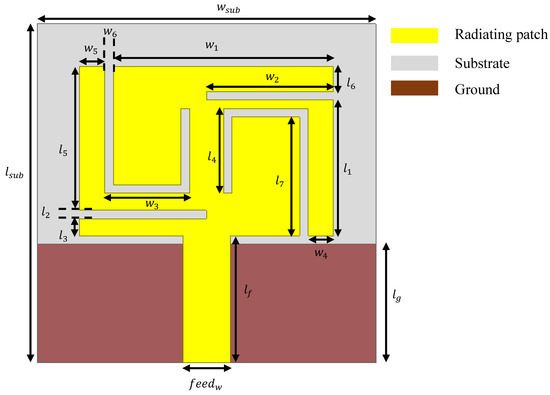
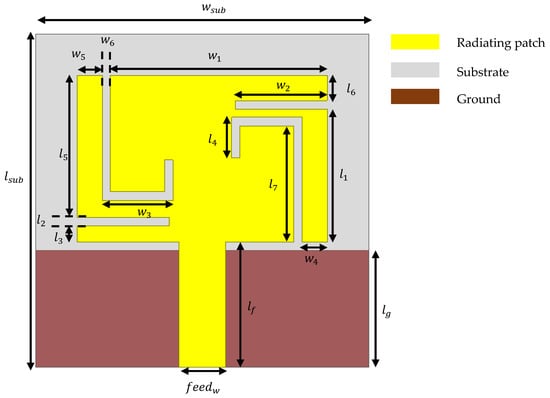
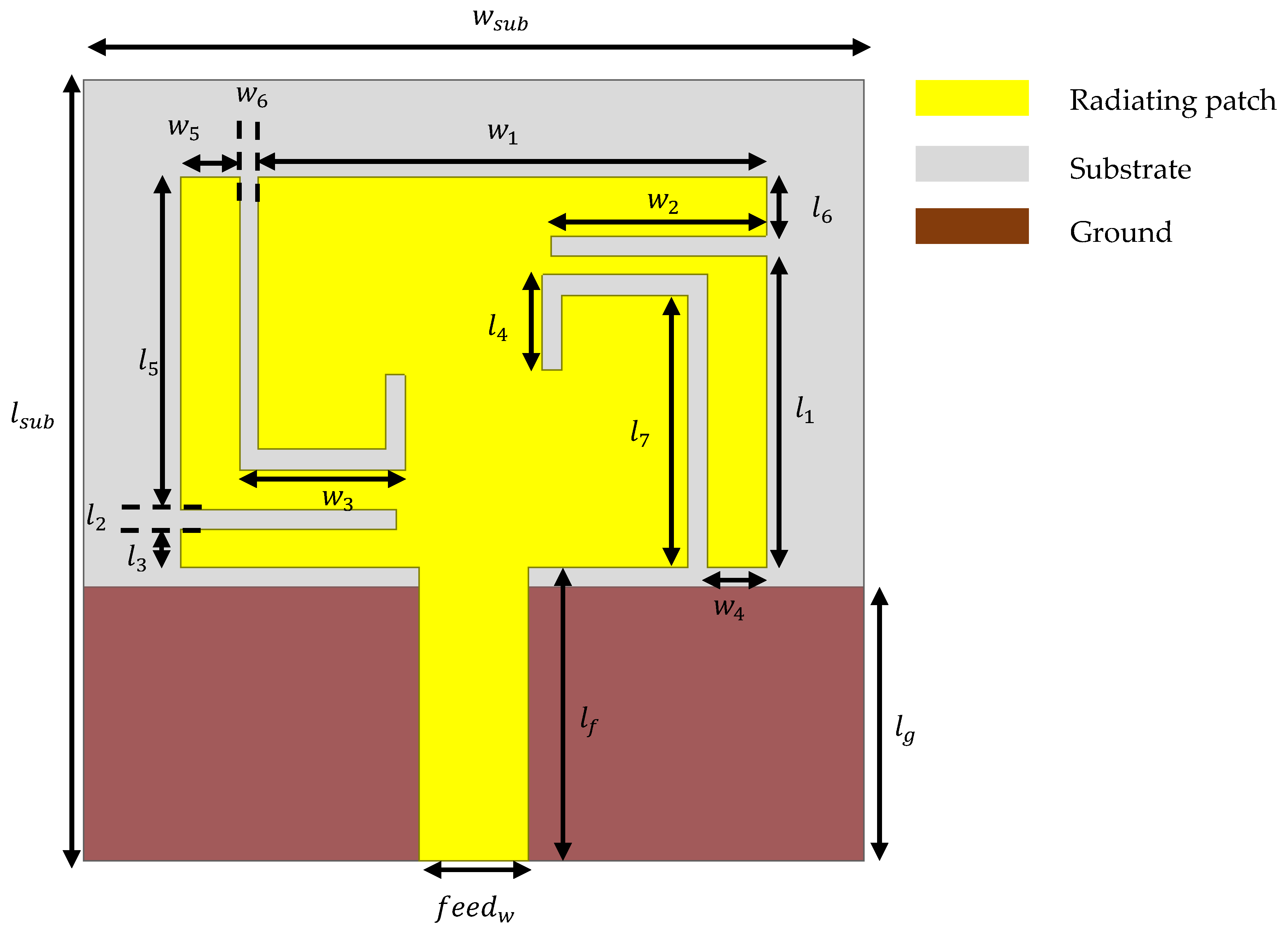
The initial candidate antenna is based on a square-shaped radiating microstrip patch with two orthogonal L and rectangular slits, as shown in Figure 1. It is etched on a Duroid substrate with a relative permittivity of 2.2 and a footprint of 0.24 at with a partial-ground plane, as shown in Figure 1. The initial candidate parameters are presented in Table 1. The antenna optimization problem is formulated as a multi-objective optimization problem. The design vector is .
Figure 1.
Proposed HGWWOA-PSO-optimized terahertz antenna initiator.
Table 1.
Initial agent parameters.
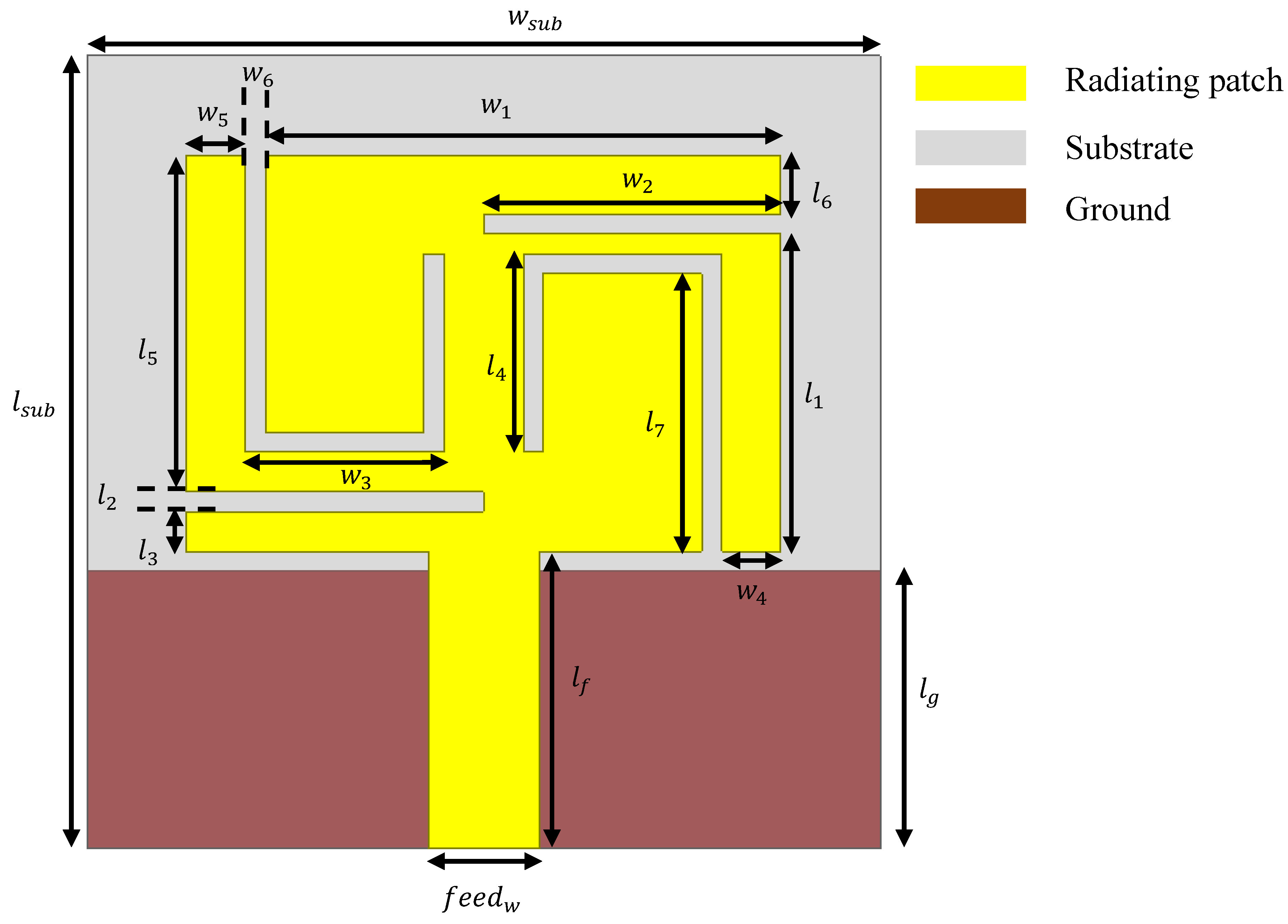
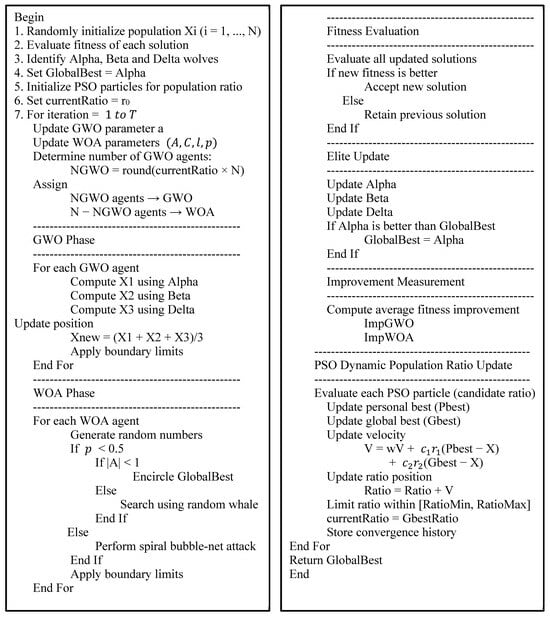
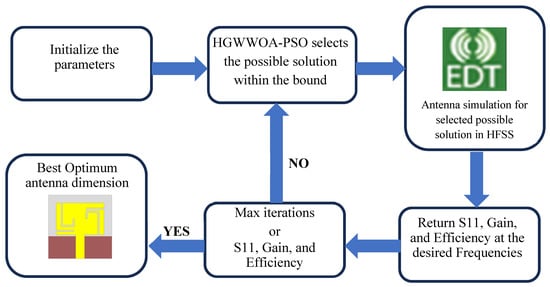
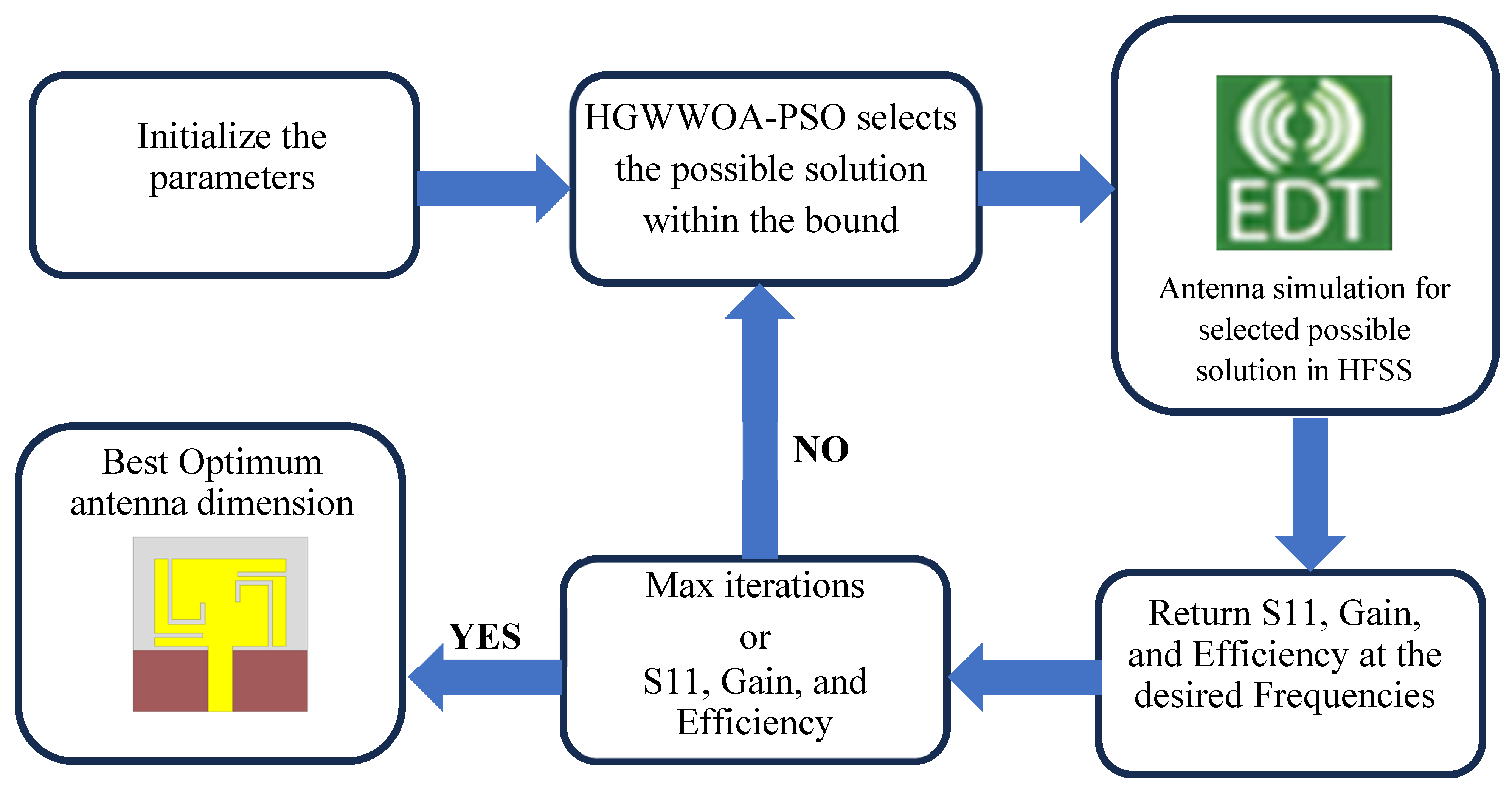
The objectives are to minimize the reflection coefficient and maximize gain and radiation efficiency. The optimization is subject to lower and upper bounds imposed on each design variable as constraints. An initial population of candidate antenna geometries is generated randomly within the design bounds. Each candidate solution represents a complete set of antenna parameters that is automatically transferred from MATLAB (R2024b) to HFSS for electromagnetic simulation. The pseudocode of the proposed HGWWOA-PSO is presented in Figure 2. The mathematical model of the proposed algorithm is discussed in Section 2.2 and was implemented using MATLAB interfaced with a High-Frequency System Simulator (HFSS). The MATLAB-ANSYS interface procedure is as shown in Figure 3. The global best candidate antenna parameters are presented in Figure 4, and the optimized parameter values are presented in Table 2.
Figure 2.
Pseudocode of the HGWWOA-PSO algorithm.
Figure 3.
MATLAB-HFSS interface of the proposed methodology.
Figure 4.
Proposed HGWWOA-PSO-optimized terahertz antenna.
Table 2.
Best candidate agent parameters.
2.2. Proposed HGWWOA-PSO Algorithm Mathematical Modeling
The problem mathematical formulation is depicted in Equations (1)–(4). In Equation (1), the decision variables of the antenna are defined, where each particle or search agent in the optimization algorithm represents one possible antenna geometry. The parameters are as shown in Figure 1. Equation (2) specifies the lower (l) and the upper (u) limits of each design parameter to prevent the optimization algorithm from generating a physically impossible antenna dimension. The quantities of optimization are defined in Equation (3). The HFSS sweep range and the target frequencies are specified. In Equation (4), the quantities for optimization are checked at the specified target frequencies rather than the whole frequency spectrum.
Let the design vector be
Bounded by
A full-wave electromagnetic simulator (HFSS) defines the response operator as:
evaluated at target frequencies
As can be observed above, the problem defined above is a multi-objective problem which involves minimization of the return loss and maximization of gain and radiation efficiency, as shown in Equation (5). These three (3) contradicting objectives are converted into one scalar cost using Equation (6), with a penalty given in Equation (7) whenever the design requirements are violated.
The multi-objective problem
subject to is scalarized by weighted-sum aggregation with exterior penalty functions:
where , and constants are , with floors .
Therefore, the actual cost minimized by the hybrid GWWOA-PSO is defined by Equation (8). Hence, every candidate antenna receives one numerical fitness value, and the lower the fitness value, the better the antenna.
The final fitness minimized by the algorithm is:
The entire population is dynamically divided between the Grey Wolf Optimizer and the Whale Optimization Algorithm, as shown in Equations (9) and (10), ensuring that every individual belongs to only one optimizer (no solution is simultaneously processed by both GWO and WOA).
A population is randomly partitioned each generation using ratio :
The Grey Wolf Optimizer formulation is given in Equations (11)–(13) [19]. The control parameters for exploration and exploitation are defined in Equation (11). is the exploration coefficient for each leader , and it determines how aggressively a wolf moves. decreases linearly from 2 0 during optimization, and and are random numbers uniformly distributed between 0 and 1. is the random weighting coefficient that introduces randomness into the estimated position of each leader to prevent premature convergence and improve the algorithm’s ability to escape local optima. The distance from the leader is defined in Equation (12). It computes the distance between the current wolf and one of the three leaders. is the candidate position relative to one leader (each leader independently suggests where the wolf should move). The average of the three (3) gives the new wolf position , as shown in Equation (13). Therefore, instead of following only the best solution, each wolf follows the combined guidance of the three best wolves.
The with decaying coefficient is , and are the three fittest individuals:
.
.
.
.
.
.
The whale optimizer formulation is given in Equations (14) and (15) [19]. The control parameter is denoted as , which decreases linearly from 2 0 during optimization, while is the spiral parameter and decreases from −1 −2. is the spiral variable, and is a random number uniformly between 0 and 1. controls the transition between global exploration during early iterations and local exploitation during later iterations. Hence, at the beginning, whales search widely across the design space, but toward the end, they focus on refining the best antenna design found so far. controls the logarithmic spiral used during the bubble net attacking phase. Therefore, as iterations proceed, the spiral becomes tighter around the best solution, enabling increasingly fine local optimization. ensures that each whale follows a slightly different spiral trajectory toward the best solution, hence enhancing diversity and helping avoid premature convergence. is the exploration coefficient, and is the random coefficient that introduces stochasticity into the movement to help the population to maintain diversity and avoid stagnation. Equation (15) has three cases (encircling, search, and bubble net attack), each dependent on and . controls the spiral radius, and produces the circular spiral motion. These update rules are applied only to the individuals assigned to the WOA subgroup.
With
where spiral constant . The probability is randomly generated between 0 and 1.
After the WOA and GWO subgroups independently update their candidate antenna designs, the PSO component evaluates their relative performance and dynamically adjusts the population ratio between the two algorithms for the next iteration. This adaptive collaboration enables the hybrid optimizer to balance exploration and exploitation more effectively than either GWO or WOA alone.
The adaptive learning mechanism of the proposed algorithm is presented in Equations (16)–(21). The boundary projection in Equation (16) occurs immediately after GWO or WOA updates a candidate antenna design in (13) or (15), respectively, to project every design variable back into its feasible range. This ensures that every antenna generated during optimization remains physically realizable and can be simulated in HFSS.
The greedy selection is introduced in Equation (17) to ensure that the optimizer does not replace a good solution with a poor one. If the new antenna has a lower objective value (better performance), it replaces the old one. Otherwise, the old solution is retained. Then, the leader is updated using Equation (18). After every individual has been updated, the algorithm ranks all solutions according to fitness. The three best solutions become alpha (), beta (), and delta (), where the alpha () wolf is stored as .
Equations (19) and (20) measure how much improvement was achieved by the grey wolf subgroup and whale optimization during the current iteration, respectively. means improvement contributes, deterioration contributes zero, and the average improvement over all GWO and WOA individuals is calculated. Equation (21) is the adaptive reward normalization to convert the two improvement measures to normalized performance scores, and in the denominator is to ensure a non-zero denominator. The score must satisfy . Therefore, if GWO performs better, then , but if then WOA performs better.
These scores become the inputs to the PSO module, which uses the normalized scores to compute the next population division ratio .
Equations (22)–(26) describe the PSO component and how it integrates GWO and WOA into the proposed HGWWOA–PSO algorithm. Unlike conventional PSO, the particles here do not optimize antenna dimensions directly. Instead, they optimize the population division ratio () between the GWO and WOA sub-populations. This adaptive mechanism enables the algorithm to allocate more search agents to the optimizer that is currently performing better. is the candidate proportion of the population assigned to GWO, and is the proportion assigned to WOA. is the normalized performance score of WOA, and is the normalized performance score of GWO. If GWO has been producing larger improvements than WOA, the fitness value increases as r increases. Conversely, if WOA performs better, lower values of r yield higher fitness. Thus, PSO searches for the population ratio that maximizes the expected effectiveness of the hybrid algorithm.
Equation (22) evaluates each candidate allocation using the normalized reward scores from Equation (21). Equations (23) and (24) update the swarm of candidate allocations using standard PSO dynamics. While Equation (23) performs velocity update, Equation (24) performs particle position update. Equation (25) selects the best-performing allocation for the next iteration. Finally, Equation (26) applies this allocation to repartition the population, allowing GWO and WOA to update their assigned solutions before merging them into the next generation. This adaptive feedback loop enables the hybrid algorithm to automatically emphasize the optimizer that is currently contributing the most to improving antenna performance, thereby enhancing both convergence speed and solution quality compared with a fixed-ratio hybrid approach.
For a swarm of particles, maximizes the surrogate fitness
where arg maxτ≤t fit (personal best), arg maxj fit (global best), , t = 1, 2, …, T, is the current velocity of particle j, is the cognitive learning coefficient, is the social learning coefficient, and are independent random numbers [0, 1].
The algorithm returns:
,
- , .
3. Results and Discussion
This section is divided into two sections, i.e., Section 3.1 and Section 3.2. The results of the performance evaluation of the proposed HGWWOA-PSO algorithm compared with the parent algorithm are presented in Section 3.1, while the results of the HGWWOA-PSO-optimized antenna are presented in Section 3.2.
3.1. HGWWOA-PSO Performance Analysis
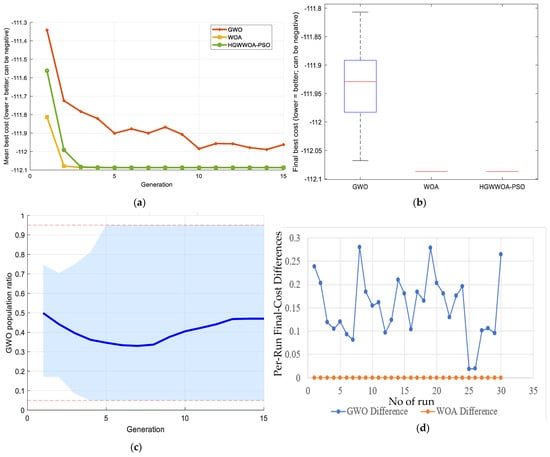
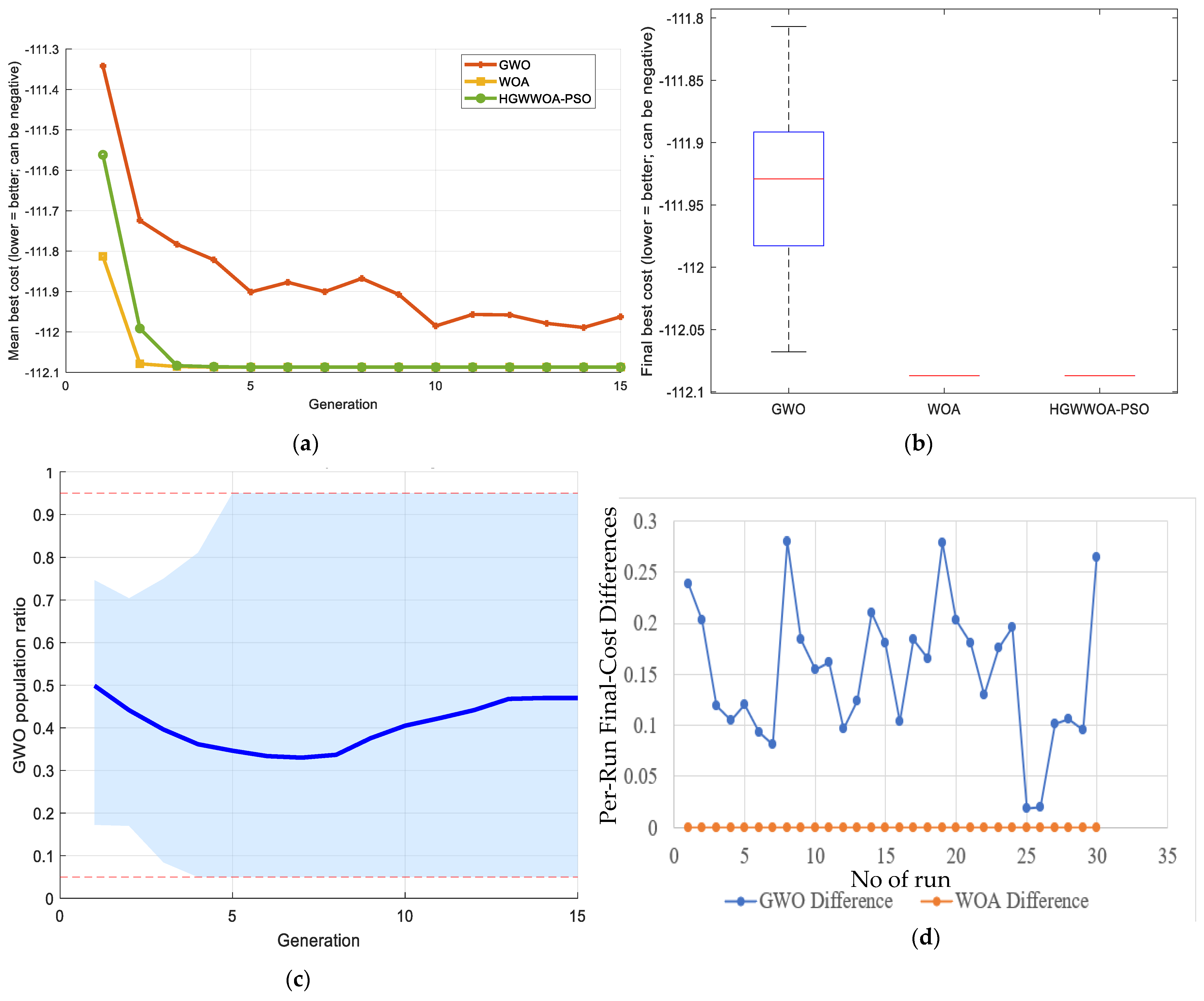
Figure 5a–c present the convergence characteristics, statistical performance, and adaptive population division ratio of the proposed HGWWOA-PSO as applied to the antenna optimization problem. As shown in Figure 5a, the proposed HGWWOA-PSO algorithm performs well compared to the standalone GWO and WOA. It reaches a stable minimum value (−112.1) within the first three generations, while WOA converges quickly but settles at a slightly higher cost value (−112.07), and GWO shows some instability within the iterations, as shown in Figure 5a.
Figure 5.
Proposed HWWOA-PSO: (a) convergence on THz antenna surrogate cost, (b) distribution of final best cost across independent runs, (c) HGWWOA-PSO adopted ratio over time (red dashes represent the bound), (d) paired per-run final cost differences between GWO/WOA and HGWWOA-PSO.
This efficiency in the proposed optimization algorithm is due to the combination of the broad search nature of GWO with the exploitation strength of WOA, guided by PSO to balance the approach continuously. The proposed HGWWOA-PSO algorithm has the lowest objective values with no spread, as seen in Figure 5b. The near-zero dispersion of the proposed algorithm shows that it is repeatable and is insensitive to random initialization, which is important for electromagnetic optimization where each full-wave simulation is costly and dependable convergence is expected. Figure 5c shows the evolution of the GWO population ratio determined by the embedded PSO algorithm during the optimization process. It can be observed that the adaptive ratio initially decreases from 0.5 (initial ratio) to 0.33, which means that the algorithm gradually allocates a larger proportion of the population to WOA during the early search stage because WOA provides greater fitness improvement. As optimization progresses, the ratio slowly increases toward approximately 0.47, reflecting a rebalancing of computational resources between GWO and WOA as the search approaches convergence, as shown in Figure 5c. This adaptive mechanism demonstrates that the proposed optimizer does not rely on a fixed population partition but instead continuously learns which search strategy contributes more effectively at each iteration. Consequently, the algorithm achieves an improved exploration–exploitation balance compared with conventional hybrid metaheuristics that employ static population allocations. Figure 5d shows the paired per-run final cost differences between GWO/WOA and HGWWOA-PSO. It can be observed that HGWWOA-PSO has a positive per-run difference relative to GWO in all 30 runs, while the WOA difference is exactly zero in all 30 runs. Thus, HGWWOA-PSO consistently produced a lower final cost than GWO and exactly the same final cost as WOA.
Table 3 presents the descriptive and inferential statistical comparison of the final costs obtained by GWO, WOA, and HGWWOA-PSO over 30 independent runs. HGWWOA-PSO obtained a mean and median final cost of −112.0870, with zero standard deviation and zero IQR because the same final value was obtained in all 30 runs. GWO obtained a mean final cost of −111.9345 and a median of −111.9290, with a standard deviation of 0.0670 and an IQR of 0.0888, as shown in Table 3.
Table 3.
Descriptive and Wilcoxon signed-rank statistical comparison of final costs for GWO, WOA, and HGWWOA-PSO over 30 independent runs.
The paired comparison between GWO and HGWWOA-PSO showed that all 30 paired differences were positive, with a mean difference of 0.1525 and a median difference of 0.1580. The Wilcoxon signed-rank test yielded and , with a rank-biserial effect size of . This indicates that HGWWOA-PSO consistently produced a lower final cost than GWO across all 30 runs. In contrast, WOA and HGWWOA-PSO produced the same final cost (−112.0870) in all 30 runs. Consequently, all paired differences were zero, and no Wilcoxon signed-rank statistic could be meaningfully estimated for this comparison. The corresponding percentage improvement of HGWWOA-PSO over WOA was, therefore, 0.0000%. Relative to the mean GWO cost, the improvement achieved by HGWWOA-PSO was approximately 0.1362%.
3.2. Results of the HGWWOA-PSO-Optimized Antenna
3.2.1. Reflection Coefficient
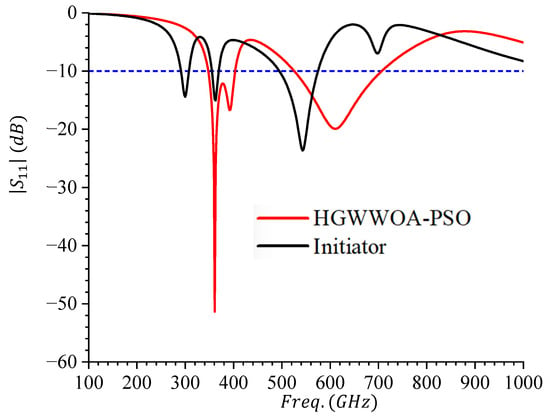
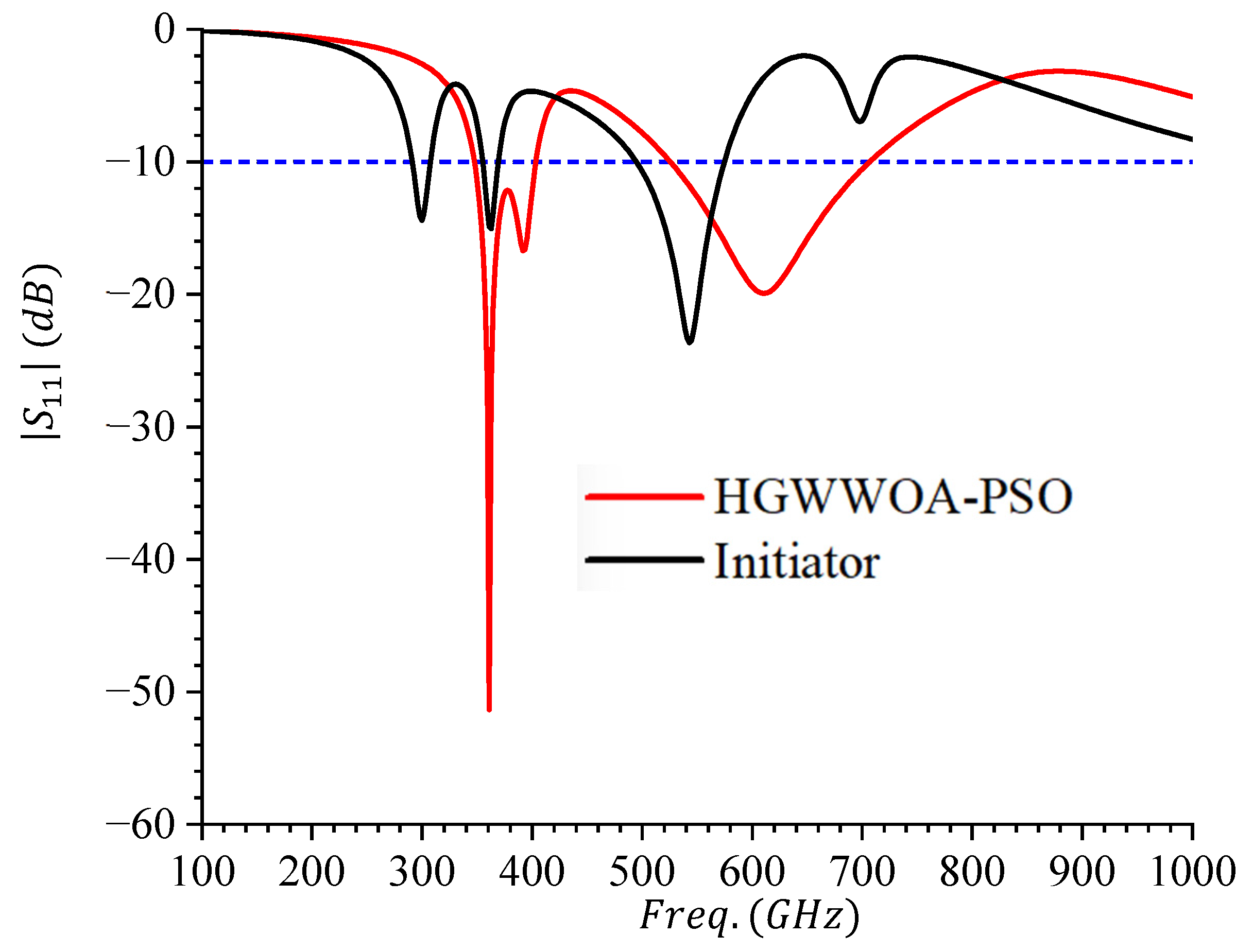
The reflection coefficient of the initiator and the HGWWOA-PSO-optimized antenna is shown in Figure 6. It can be seen that the initiator has resonance at three frequencies at 299.8 GHz, 362.8 GHz, and 544.6 GHz, with reflection coefficients of −14.4 dB, −15 dB, and −23.4 dB, respectively. It is worth noting that out of the three frequencies, only one is almost at one of the target frequencies, as shown in Figure 6. The proposed HGWWOA-PSO-optimized antenna has resonances at 361 GHz, 391.6 GHz, and 611.2 GHz (which are the targeted frequencies) with reflection coefficients of −51.3 dB, −16.7 dB, and −20 dB, respectively, as seen in Figure 6. It can be observed that the first and the second resonant frequencies form a single band with a −10 dB bandwidth of 56.21 GHz, and the third resonant frequency has a −10 dB bandwidth of 183.21 GHz, as seen in Figure 6. This result shows that the proposed HGWWOA-PSO algorithm can easily be used to optimize antenna design parameters to achieve any desired resonant frequency without doing a time-consuming trial and error.
Figure 6.
|S11| response of the initiator and the proposed HGWWOA-PSO-optimized antenna.
3.2.2. Gain, Radiation Patterns, Efficiency, and Current Density of the Proposed HGWWOA-PSO Antenna
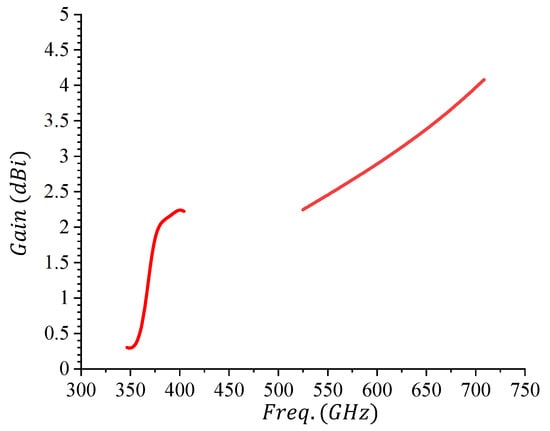
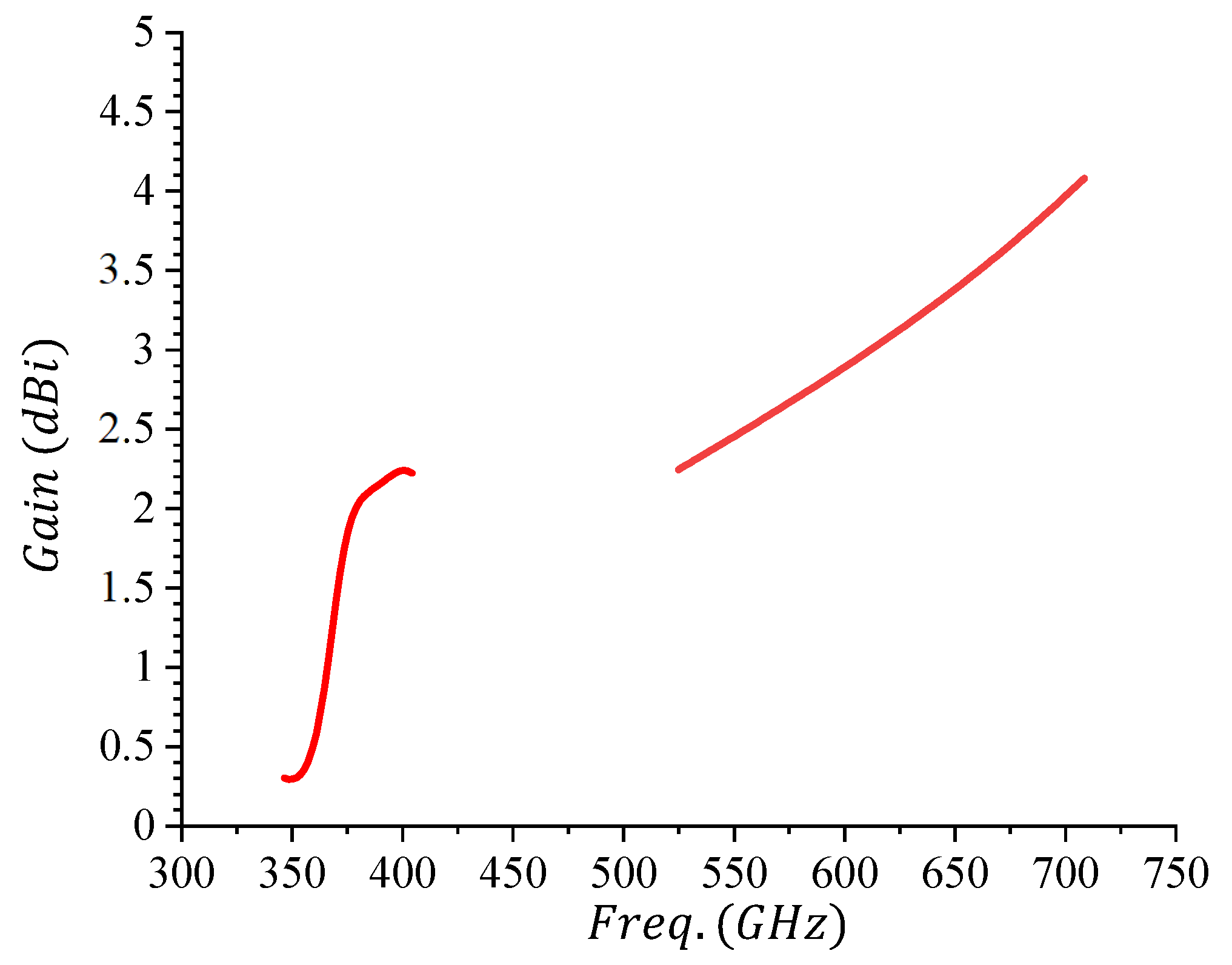
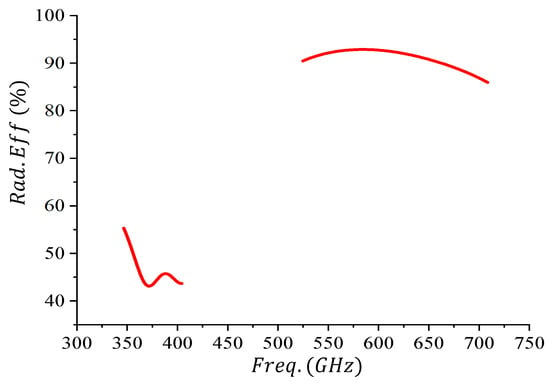
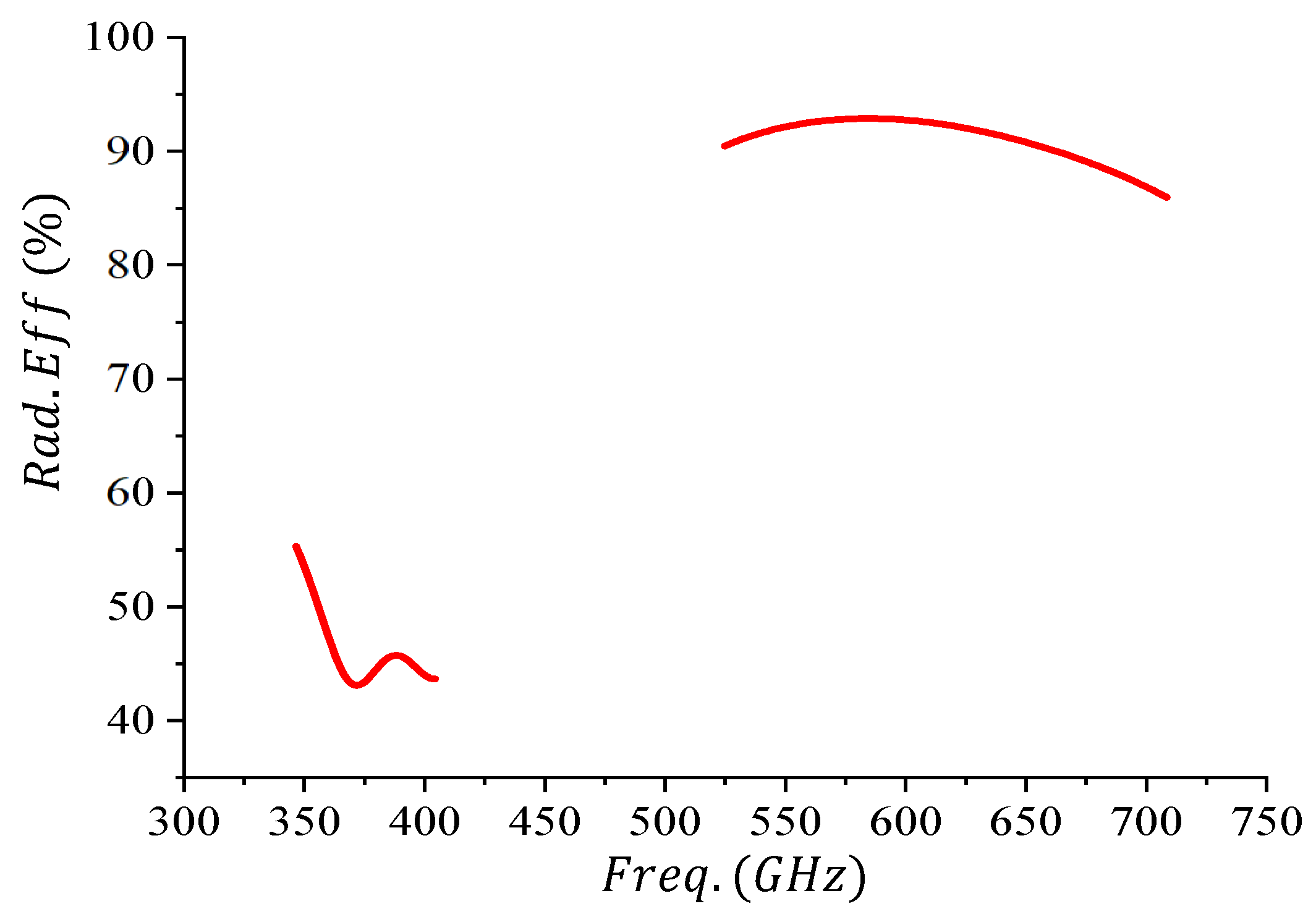
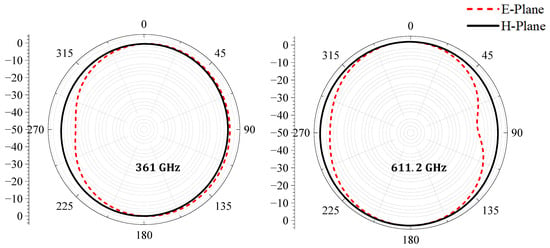
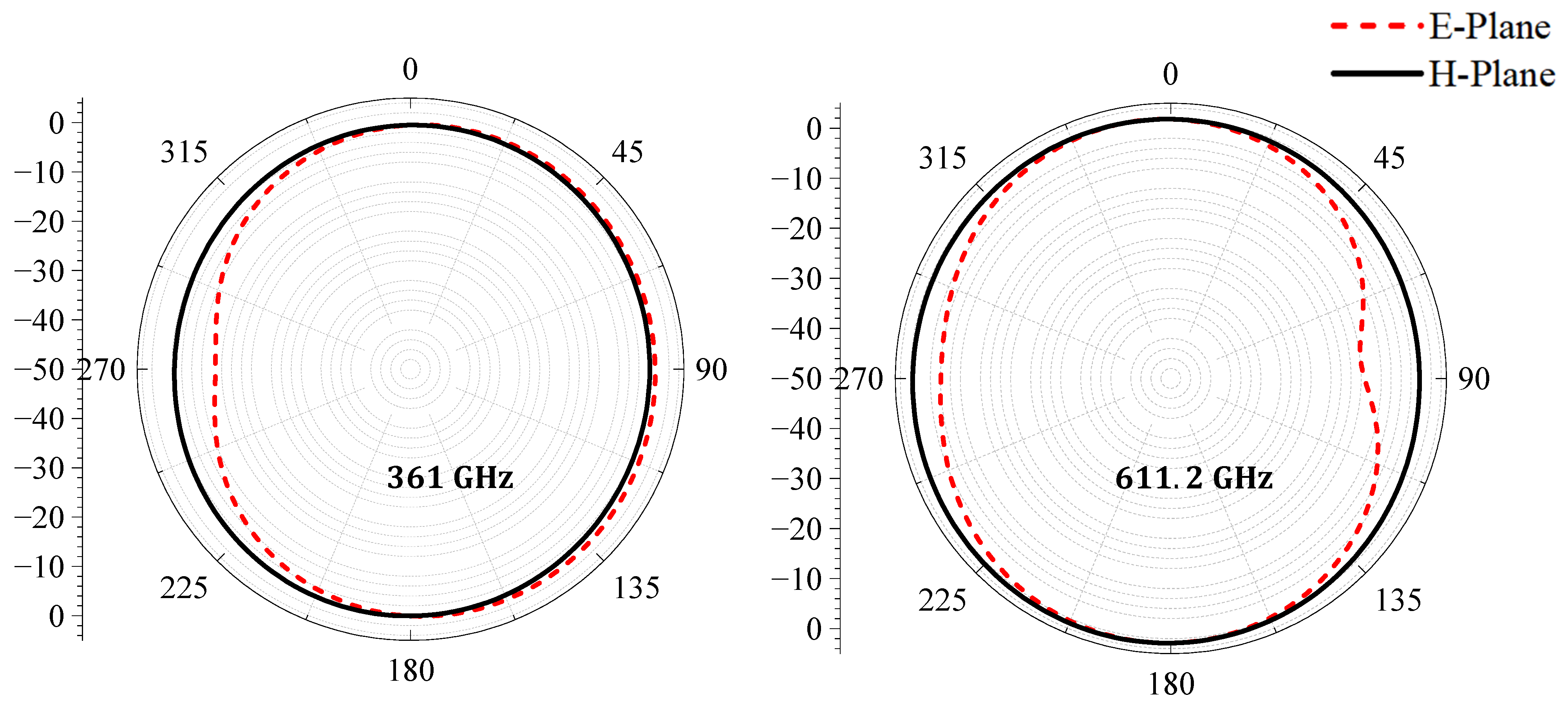
The gain, radiation efficiency, and radiation patterns of the proposed HGWWOA-PSO-optimized antenna are presented in Figure 7, Figure 8, and Figure 9, respectively. It can be observed in Figure 7 that the gain in the lower band is between 0.48 dBi and 2.4 dBi, while that of the upper band is between 2.5 dBi and 4.5 dBi. The radiation efficiency achieved at the lower band range is 45–55%, while the upper band is 85–95%, as shown in Figure 8. These results show that the HGWWOA-PSO-optimized antenna achieved a balanced trade-off between antenna miniaturization and radiation performance. These characteristics confirm the suitability of the proposed antenna for high-speed terahertz communication, imaging, sensing, and other emerging terahertz applications requiring compact size and high electromagnetic performance. The omnidirectional radiation patterns are observed at 361 GHz and 611.2 GHz in both the E-plane and H-plane of the proposed HGWWOA-PSO-optimized antenna, as shown in Figure 9. Therefore, the proposed antenna is a good candidate for many terahertz applications.
Figure 7.
Gain of the proposed HGWWOA-PSO-optimized antenna.
Figure 8.
Radiation efficiency of the proposed HGWWOA-PSO-optimized antenna.
Figure 9.
Radiation patterns of the proposed HGWWOA-PSO-optimized antenna.
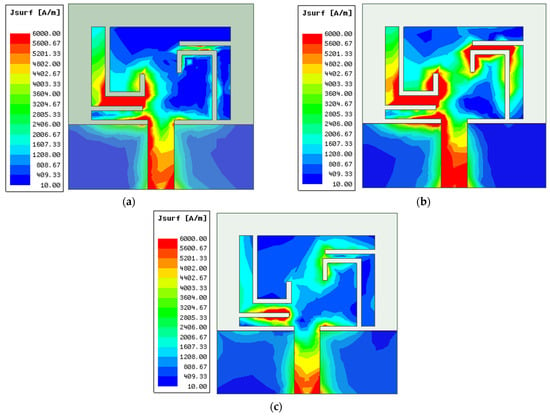
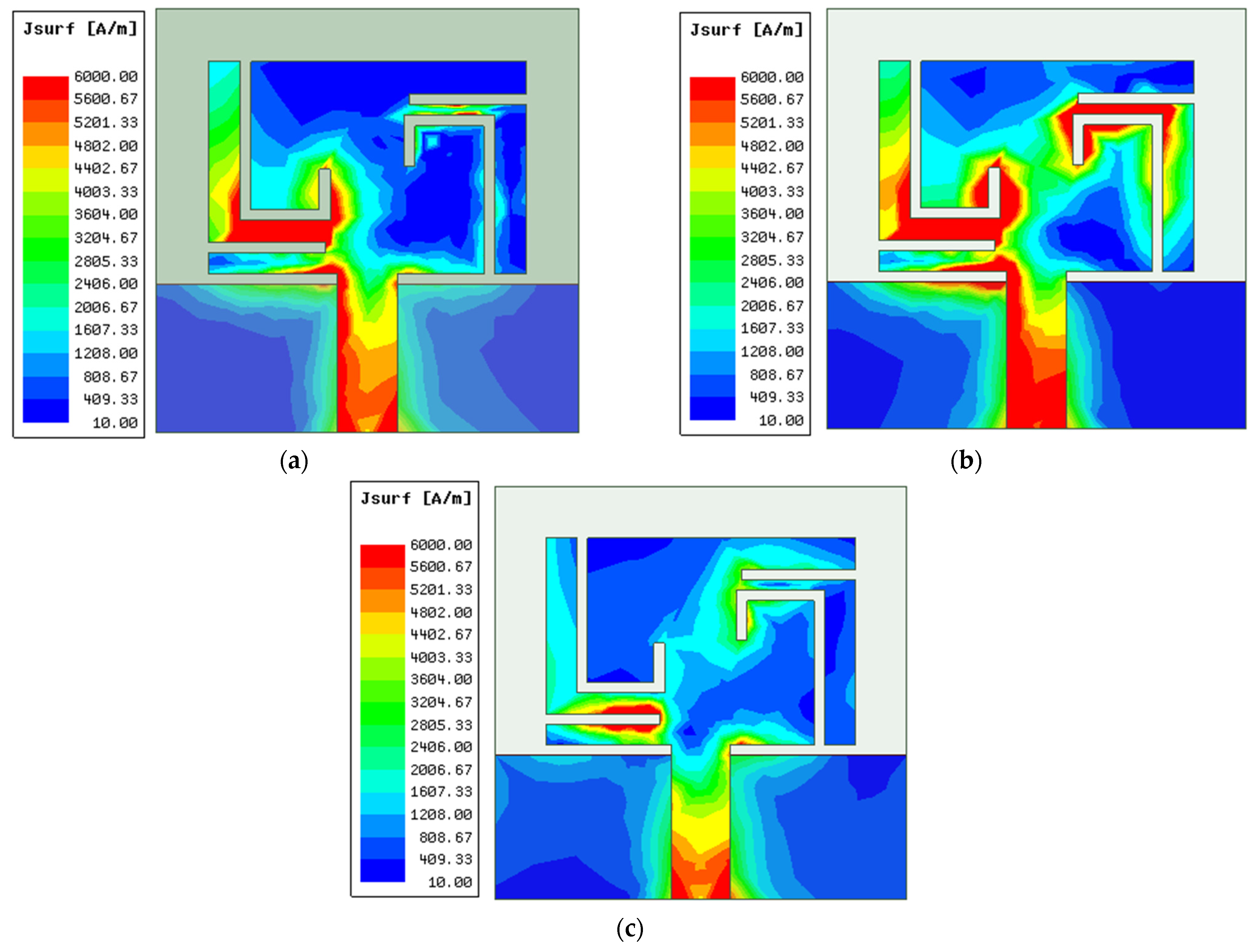
Figure 10 presents the simulated surface current density (Jsurf) distributions on the proposed HGWWOA-PSO-optimized antenna at its three resonant frequencies, 361 GHz, 391.6 GHz, and 611.2 GHz, to provide physical insight into the antenna’s multiband operation mechanism. It can be observed that the current distribution at both 361 GHz and 391.6 GHz is almost the same except that there is a stronger current concentration around the right-hand side L-slit, as seen in Figure 10a,b. This explains the reason for both resonant frequencies form a single band. At 6.112 GHz, the current is more pronounced at the lower left-hand side rectangular slit with reduced current magnitude spreading into the upper patch area, as shown in Figure 10c. The close correspondence between current path length and resonant frequency validates the antenna design and confirms that the HGWWOA-PSO optimization successfully tuned the slot dimensions to achieve the desired three resonant frequency responses while maintaining acceptable current confinement, that is, low surface current leakage to the ground plane, depicted as a uniformly blue outer regions, as shown in Figure 10.
Figure 10.
Current distribution of the proposed HGWWOA-PSO-optimized antenna at (a) 361 GHz, (b) 391.6 GHz, and (c) 611.2 GHz.
4. Comparative Analysis
Table 4 compares the proposed HGWWOA-PSO-optimized antenna with recently reported terahertz antennas in terms of electrical size using free-space wavelength ( at the lowest frequency, number of operating bands, peak radiation efficiency, and peak gain. It can be observed from Table 4 that the proposed antenna has the most compact electrical size of at 361 GHz, which shows a significant reduction in the antenna footprint compared with the recently published works. The antenna presented in [19] has a dual band but with a higher footprint compared with the proposed HGWWOA-PSO-optimized antenna, which achieves a dual band with a more compact footprint. This combination of miniaturization and multiband capability makes the proposed antenna an attractive candidate for terahertz communication systems, where compactness and dual-band are essential design requirements.
In terms of radiation performance, the proposed HGWWOA-PSO-optimized antenna attains a peak radiation efficiency of 95%, which is the highest among all the compared works. The peak gain of the proposed HGWWOA-PSO-optimized antenna exceeds the gains achieved in references [12,28,29,30] despite its compactness. Although the maximum gain of the proposed antenna is lower than the gains reported in references [19,31,32], it is noteworthy that the proposed antenna is more compact, and antennas in [31,32] operate for a single band only. Therefore, the proposed HGWWOA-PSO-optimized antenna offers a well-balanced trade-off between compactness, multiband operation, radiation efficiency, and gain, demonstrating superior overall performance and making it a good candidate for next-generation terahertz wireless communication and sensing applications. It is worth noting that at dimensions of 5–90 µm, fabrication tolerances become critical at THz frequencies, since deviations of even a few micrometers can shift the resonant frequencies and degrade matching and gain, so the reported results assume ideal manufacturing and should be validated through tolerance analysis and experimental fabrication in future work.
Table 4.
Comparative analysis of the HGTWOA-optimized antenna with previous works.
5. Conclusions
In this paper, a new hybrid metaheuristic algorithm called HGWWOA-PSO for antenna design optimization has been presented. The developed algorithm was deployed for a multi-objective antenna design problem (minimize reflection coefficient, maximize gain and radiation efficiency) at three different resonant frequencies. The proposed HGWWOA-PSO-optimized antenna resonates at the three target resonant frequencies (361 GHz, 391.6 GHz, and 611.2 GHz), two (361 GHz and 391.6 GHz) of which eventually form a band. Hence, the HGWWOA-PSO-optimized antenna is a dual-band antenna. The −10 dB bandwidth of the lower band is 56.21 GHz, while the upper band bandwidth is 183.21 GHz, with an antenna footprint of 0.24 0.24 at 361 GHz. At the lower band, the range of gain and radiation efficiency achieved is 0.48–2.4 dBi and 45–55%, respectively, but at the upper band, the range of gain and efficiency is 2.5–4.5 dBi and 85–95%, respectively, while maintaining an omnidirectional radiation pattern at the E-plane and H-plane. The features such as compact size, multiband operation, high gain, and high radiation efficiency make the proposed antenna suitable for terahertz communications. This study focused on evaluating the complete HGWWOA-PSO framework against GWO and WOA under identical computational conditions. Evaluation of partial hybrid variants is recommended as future work.
Author Contributions
Conceptualization, J.O.A., P.K. and D.B.O.K.; methodology, J.O.A., P.K. and D.B.O.K.; software, J.O.A.; validation, P.K.; formal analysis, J.O.A.; writing—original draft preparation, J.O.A.; writing—review and editing, P.K. and D.B.O.K. All authors have read and agreed to the published version of the manuscript.
Funding
This research received no external funding.
Institutional Review Board Statement
Not applicable.
Informed Consent Statement
Not applicable.
Data Availability Statement
The original contributions presented in this study are included in the article. Further inquiries can be directed to the corresponding authors.
Conflicts of Interest
The authors declare no conflicts of interest.
References
- Markelz, A.G.; Mittleman, D.M. Perspective on Terahertz Applications in Bioscience and Biotechnology. ACS Photonics 2022, 9, 1117–1126. [Google Scholar] [CrossRef] [Scilit]
- Li, J.; Deng, X.; Li, Y.; Hu, J.; Miao, W.; Lin, C.; Jiang, J.; Shi, S. Terahertz Science and Technology in Astronomy, Telecommunications, and Biophysics. Research 2025, 8, 0586. [Google Scholar] [CrossRef] [Scilit] [PubMed]
- Shen, Y.; Li, X.; Wang, J.; Liu, H.; Jing, J.; Deng, X.; Wei, D. Low-Concentration Biological Sample Detection Using an Asymmetric Split Resonator Terahertz Metamaterial. Photonics 2023, 10, 111. [Google Scholar] [CrossRef] [Scilit]
- Keshwala, U.; Rawat, S.; Ray, K. Design and analysis of DNA shaped antenna for terahertz and sub-terahertz applications. Optik 2021, 232, 166512. [Google Scholar] [CrossRef] [Scilit]
- Faridani, M.; Sadeghzadeh, R.A.; Khatir, M. Terahertz Dual-Band Dipole Antenna with Novel Small Flat Quartz- Copper Reflector. Optik 2017, 136, 336–340. [Google Scholar] [CrossRef] [Scilit]
- Rubani, Q.; Gupta, S.H.; Rajawat, A. A compact MIMO antenna for WBAN operating at Terahertz frequency. Optik 2020, 207, 164447. [Google Scholar] [CrossRef] [Scilit]
- Davoudabadifarahani, H.; Ghalamkari, B. High efficiency miniaturized microstrip patch antenna for wideband terahertz communications applications. Optik 2019, 194, 163118. [Google Scholar] [CrossRef] [Scilit]
- Singhal, S. CPW fed circular Sierpinski terahertz antenna for superwideband pattern diversity applications. Optik 2021, 243, 167430. [Google Scholar] [CrossRef] [Scilit]
- Shalini, M.; Madhan, M.G. A compact antenna structure for circular polarized terahertz radiation. Optik 2021, 231, 166393. [Google Scholar] [CrossRef] [Scilit]
- Naik, K.K.; Suman, M.; Rao, E.V.K. Design of complementary split ring resonators on elliptical patch antenna with enhanced gain for terahertz applications. Optik 2021, 243, 167434. [Google Scholar] [CrossRef] [Scilit]
- Abolade, J.O. Miniaturized multiband antenna for terahertz applications in wireless body area network. Results Opt. 2023, 10, 100340. [Google Scholar] [CrossRef] [Scilit]
- Abolade, J.O.; Konditi, D.B.O. Integrated Artificial Magnetic Conductor Minkowski Island fractal terahertz antenna (AMC-MIFA) for future Communications. Results Opt. 2025, 21, 100921. [Google Scholar] [CrossRef] [Scilit]
- Vigya; Raj, S.; Shiva, C.K.; Vedik, B.; Mahapatra, S.; Mukherjee, V. A novel chaotic chimp sine cosine algorithm Part-I: For solving optimization problem. Chaos Solitons Fractals 2023, 173, 113672. [Google Scholar] [CrossRef] [Scilit]
- Ibrahim, M.Q.; Qaraad, M.; Hussein, N.K.; Farag, M.A.; Guinovart, D. Secant Optimization Algorithm for efficient global optimization. Sci. Rep. 2026, 16, 6659. [Google Scholar] [CrossRef] [Scilit] [PubMed]
- Abouhssous, K.; Hasan, R.; Zugari, A.; Zakriti, A. Optimization Algorithms: Comprehensive Classification, Principles, and Scientometric Trends. Algorithms 2026, 19, 258. [Google Scholar] [CrossRef] [Scilit]
- Akter, A.; Zafir, E.I.; Dana, N.H.; Joysoyal, R.; Sarker, S.K.; Li, L.; Muyeen, S.M.; Das, S.K.; Kamwa, I. A review on microgrid optimization with meta-heuristic techniques: Scopes, trends and recommendation. Energy Strateg. Rev. 2024, 51, 101298. [Google Scholar] [CrossRef] [Scilit]
- Li, X.; Guo, Y.-X. The Grey Wolf Optimizer for Antenna Optimization Designs: Continuous, binary, single-objective, and multiobjective implementations. IEEE Antennas Propag. Mag. 2022, 64, 29–40. [Google Scholar] [CrossRef] [Scilit]
- Zhu, H.-Y.; Li, W.-D.; Zhao, H.-Y. Antenna Optimization Based on Quasi-Opposition Grey Wolf Optimization Algorithm. In Proceedings of the 2022 International Conference on Microwave and Millimeter Wave Technology (ICMMT), Harbin, China, 12–15 August 2022; IEEE: New York, NY, USA, 2022; pp. 1–3. [Google Scholar] [CrossRef] [Scilit]
- Boursianis, A.D.; Papadopoulou, M.S.; Salucci, M.; Polo, A.; Sarigiannidis, P.; Psannis, K.; Mirjalili, S.; Koulouridis, S.; Goudos, S.K. Emerging swarm intelligence algorithms and their applications in antenna design: The gwo, woa, and ssa optimizers. Appl. Sci. 2021, 11, 8330. [Google Scholar] [CrossRef] [Scilit]
- Fan, W.; Wang, Z.; Hong, W. Research on Optimized Design of Antenna Based on Improved Whale Optimization Algorithm. In Proceedings of the 2021 IEEE 4th International Conference on Electronic Information and Communication Technology (ICEICT), Xi’an, China, 18–20 August 2021; IEEE: New York, NY, USA, 2021; pp. 159–164. [Google Scholar] [CrossRef] [Scilit]
- Qin, L.; Yu, S.; Yu, F. The Application of Whale Optimization Algorithm in Array Antennas. Int. J. Adv. Netw. Monit. Controls 2023, 8, 29–37. [Google Scholar] [CrossRef] [Scilit]
- Shyur, H.J.; Shih, H.S. Resolving Rank Reversal in TOPSIS: A Comprehensive Analysis of Distance Metrics and Normalization Methods. Informatica 2024, 35, 837–858. [Google Scholar] [CrossRef] [Scilit]
- Anes, V.; Abreu, A. Adaptive Cluster-Based Normalization for Robust TOPSIS in Multicriteria Decision-Making. Appl. Sci. 2025, 15, 4044. [Google Scholar] [CrossRef] [Scilit]
- Kizielewicz, B.; Tomczyk, T.; Gandor, M.; Sałabun, W. Subjective weight determination methods in multi-criteria decision-making: A systematic review. Procedia Comput. Sci. 2024, 246, 5396–5407. [Google Scholar] [CrossRef] [Scilit]
- Sarkar, A.; Goswami, S.S. A Comprehensive Review: The Novel Weighting Methods For Multi-Criteria Decision-Making (MCDM). Spectr. Oper. Res. 2026, 1–26. [Google Scholar] [CrossRef] [Scilit]
- Ma, X.; Yu, Y.; Li, X.; Qi, Y.; Zhu, Z. A Survey of Weight Vector Adjustment Methods for Decomposition-Based Multiobjective Evolutionary Algorithms. IEEE Trans. Evol. Comput. 2020, 24, 634–649. [Google Scholar] [CrossRef] [Scilit]
- Han, X.; Chao, T.; Yang, M.; Li, M. A steady-state weight adaptation method for decomposition-based evolutionary multi-objective optimisation. Swarm Evol. Comput. 2024, 89, 101641. [Google Scholar] [CrossRef] [Scilit]
- Kong, S.; Hu, H.T.; Shum, K.M.; Chan, C.H. 450 GHz on-chip dual-patch antennas with expanded bandwidth and filtering response. IEEE Trans. Antennas Propag. 2024, 72, 3198–3209. [Google Scholar] [CrossRef] [Scilit]
- Bakshi, H.S.; Byreddy, P.R.; Kenneth, K.; Blanchard, A.J.; Lee, M.; Tuncer, E.; Choi, W. Low-Cost Packaging of 300 GHz Integrated Circuits with an On-Chip Patch Antenna. IEEE Antennas Wirel. Propag. Lett. 2019, 18, 2444–2448. [Google Scholar] [CrossRef] [Scilit]
- Sharma, A.; Singh, G. Rectangular microstirp patch antenna design at THz frequency for short distance wireless communication systems. J. Infrared Millim. Terahertz Waves 2009, 30, 1–7. [Google Scholar] [CrossRef] [Scilit]
- Temmar, M.N.E.; Hocini, A.; Khedrouche, D.; Denidni, T.A. Enhanced Flexible Terahertz Microstrip Antenna Based on Modified Silicon-Air Photonic Crystal. Optik 2020, 217, 164897. [Google Scholar] [CrossRef] [Scilit]
- Jin, J.; Cheng, Z.; Chen, J.; Zhou, T.; Wu, C.; Xu, C. Reconfigurable terahertz Vivaldi antenna based on a hybrid graphene-metal structure. Int. J. RF Microw. Comput. Eng. 2020, 30, e22175. [Google Scholar] [CrossRef] [Scilit]

Disclaimer/Publisher’s Note: The statements, opinions and data contained in all publications are solely those of the individual author(s) and contributor(s) and not of MDPI and/or the editor(s). MDPI and/or the editor(s) disclaim responsibility for any injury to people or property resulting from any ideas, methods, instructions or products referred to in the content. |
© 2026 by the authors. Licensee MDPI, Basel, Switzerland. This article is an open access article distributed under the terms and conditions of the Creative Commons Attribution (CC BY) license.