


Abstract
Studies on the implications of digital financial development and their impact on monetary policy effectiveness have shown mixed results, with some evidence of interdependence and potential transmission challenges. While some studies highlight positive growth impacts moderated by institutions with risks to policy sovereignty from innovations, research on South Africa remains minimal, despite having a mature financial system and rapid uptake of digital finance. The study used an ARDL model with the digital financial development index, inflation, interest rate, financial deepening, and an interaction of the digital financial development index and interest rate to analyse the implications of digital finance and its impact on monetary policy effectiveness in South Africa. Utilising annual data from 1990 to 2024, the results showed that the digital financial development index positively influences inflation in the long run. In addition, interest rates have a significant negative impact on inflation in the long run, while financial deepening, exchange rate and GDP per capita are insignificant in the long run. Furthermore, interest rate interactions with the digital financial development index exert downward inflationary pressure, but the interaction term is statistically significant in the long run. Therefore, digital financial development mitigates the inflationary effect of interest rates and appear to strengthen the monetary policy effectiveness in controlling inflation in the long run. We recommend that policymakers consider incorporating digital financial development indicators into the model for determining interest rates when developing a strategy to control inflation, thereby enhancing monetary policy effectiveness.
1. Introduction
Globally, digital financial development has proved to support economic growth and financial inclusion. Over the years, the world has experienced unprecedented increases in connectivity and global data flows, underpinning the fourth industrial revolution characterised by the digitisation of all assets and integration into a network of digital platforms, applications and devices (Dias & Perera, 2026; Jiang et al., 2022; Beck et al., 2018). New technologies and new business models have emerged, shifting the mindset of people on the way they transact, accelerating the substitution of cheques and cash transactions for electronic means of payment (Sangwan et al., 2020). In addition, there have been increased public discussions on the resultant changes in the governance, infrastructure and policy of digital finance in the African region to anticipate the implications for both the public and central bank operations (Fang et al., 2021).
Digital finance is defined as the integration of technology into financial services, or rather, the delivery of financial services such as banking, payments, investments and lending through digital products, applications and business models that replace traditional, cash-based, and branch-heavy banking, including mobile wallets, online banking, and peer-to-peer lending, among others (Dias & Perera, 2026; Tariq et al., 2023). The swift proliferation of digital financial technologies has fundamentally revolutionised global economic frameworks, expanding access to capital and increasing market efficiency, totally transforming the way households, firms and financial institutions interact with the formal financial system. In South Africa, the diffusion of mobile banking, card-based payments, fintech platforms, and other digital channels has deepened access to finance and altered the structure of financial intermediation (Beck et al., 2018). Leveraging big data, blockchain and artificial intelligence to optimise operational velocity, efficiency and financial inclusion, often termed fintech, digital banking, or electronic finance, is on the rise, helping to reduce costs and risks, as well as broadening services to unbanked populations. At the same time, these changes raise an important macroeconomic question: Does digital financial development strengthen or weaken monetary policy effectiveness? This question matters because central banks rely on predictable transmission channels to influence inflation, output, and financial stability, yet digitisation may change money demand, payment behaviour, and the speed with which policy actions pass through the economy.
A large body of empirical literature exists on the potential implications of digital financial development and how they shrink its non-interest-bearing liabilities, reducing its interest-earning capacity, and lowering its seigniorage profits (Jiang et al., 2022; Fang et al., 2021). Literature suggests that financial development can reshape monetary transmission in two opposing ways: a deeper and more effective financial infrastructure empowers businesses to scale, and fuels continuous innovation, and improves the pass-through of policy rates by expanding access to credit, payments, and savings instruments (Ricci et al., 2025; Meniago, 2025; Taonezvi & Esely, 2024). In addition, some studies have revealed the effect on the central bank’s capacity to execute monetary policy and ensure financial stability, with others raising safety and efficacy policy issues, with use protection, legislation, security and law protection being considered. On the other hand, digitalisation may reduce the relevance of traditional monetary aggregates, lower cash usage, and create new channels of disintermediation, thereby weakening the central bank’s control over liquidity conditions and demand for money.
Recent work on Sub-Saharan Africa shows that digital financial inclusion is closely linked to monetary policy transmission and economic development, with evidence of reciprocal relationships between the impact of digital financial services and transmission variables such as broad money growth (Kebede et al., 2024; Jiang et al., 2022). For South Africa, the issue is especially relevant because the country has one of the most developed financial systems in Africa, yet it also faces persistent inequality, uneven financial access, and the rapid adoption of digital payment technologies (Kebede et al., 2024). These features make South Africa an important case for examining whether digital financial development complements or complicates the Reserve Bank’s monetary policy operations. Prior evidence from Africa indicates that financial development and inclusion can alter the efficacy of policy and how it impacts output and inflation, but direction and magnitude of the effect depend on institutional quality, the composition of financial markets and institutions, alongside the degree of digital adoption (Kebede et al., 2024). More recent SSA evidence also suggests that the relationship is not linear, with some studies finding that digital finance supports growth and improves policy transmission, while others warn of threshold effects and the possible erosion of policy effectiveness at higher levels of digitalisation (Kebede et al., 2024; Jiang et al., 2022; Effiong et al., 2020). However, the implications of the development of digital finance and the effectiveness of monetary policy, especially in South Africa, remain scanty. With the reduction and, in others, the total elimination of cash transactions in most African countries, including South Africa, it is imperative that the effect of digital finance be sincerely evaluated and its potential roles with regard to the execution of monetary policy by the central bank in South Africa be analysed.
This paper adds to the growing body of literature in three ways: Firstly, it focuses on South Africa, where the financial system has significantly advanced when compared to other countries in the region and the rapid uptake of digital finance creates a distinct setting relative to many other African economies. Secondly, it links digital financial development directly to monetary policy effectiveness rather than treating digital finance only as a growth or inclusion variable. Thirdly, it speaks to the current policy debate on how central banks can preserve effective inflation control and output stabilisation in an increasingly digital economy. By doing so, the study adds evidence that can inform both monetary authorities and financial regulators seeking to balance innovation, inclusion, and macroeconomic stability.
2. Literature Review
The effectiveness of monetary policy has long been a central concern in macroeconomic theory, particularly in developing and emerging economies where financial markets are often shallow, and transmission mechanisms are weak. The rapid expansion of digital financial systems, including mobile money, digital payment platforms, fintech credit, and electronic banking, has fundamentally altered financial intermediation and monetary transmission processes. Within the context of South Africa, which has a relatively deep and sophisticated financial system compared to many developing economies, but continues to exhibit structural inequalities in financial access, understanding how digital financial development interacts with monetary policy effectiveness is of particular relevance.
2.1. Theoretical Literature Review
The theoretical relationship between digital financial development and the effectiveness of monetary policy is grounded in classical and modern monetary transmission theory, which emphasises the central role of financial intermediation in transmitting central bank policy actions to the real economy. Traditional monetary theory posits that monetary policy affects output and inflation through several transmission channels, including the interest-rate, credit, asset-price, and exchange-rate channels (Mishkin, 1995; Woodford, 2002). Within both the IS-LM and new Keynesian frameworks, changes in the policy rate influence aggregate demand by affecting real interest rates and broader financial conditions, thereby shaping consumption, investment, and ultimately price stability (Mishkin, 1995; Woodford, 2002; Mankiw, 2009). However, the strength and predictability of these channels depend critically on the depth, efficiency, and inclusiveness of the financial system.
Within new Keynesian frameworks, monetary policy transmission operates primarily through interest-rate adjustments, the management of expectations, and their effects on broader financial conditions and aggregate demand (Woodford, 2002). While these frameworks were developed before the widespread adoption of digital financial technologies, they remain relevant for understanding how monetary policy operates in modern economies. Recent fintech and digital finance literature suggests that technological innovation can reshape the financial environment in which monetary policy operates by reducing transaction costs, expanding access to financial services, improving information flows, and transforming the structure of financial intermediation (Ozili, 2018; Beck et al., 2018; Feyen et al., 2021). Consequently, digital financial development has emerged as an important factor influencing the effectiveness of monetary policy in both developed and emerging economies.
Monetary policy effectiveness generally refers to the ability of a central bank to achieve its intended macroeconomic objectives through the successful transmission of policy actions to the broader economy. In modern monetary frameworks, monetary policy effectiveness is commonly assessed by the extent to which changes in policy instruments, particularly interest rates, are transmitted to aggregate demand, inflation and real economic activity through established transmission mechanisms (Mishkin, 1995; Woodford, 2002). In inflation-targeting economies such as South Africa, monetary policy effectiveness is often assessed by the extent to which policy-induced changes in interest rates contribute to maintaining price stability and keeping inflation within the target range.
In economies with underdeveloped financial markets, institutional weaknesses, and structural financial frictions, monetary policy effectiveness may be constrained by limited interest-rate pass-through and other characteristics of the financial system (Mishra et al., 2016; Brandão-Marques et al., 2020). Financial development theory addresses these limitations by arguing that deeper and more efficient financial systems reduce information and transaction costs, ease external financing constraints, and thereby improve the allocation of resources in the economy (Levine, 2005). Within this framework, a well-functioning financial system enhances economic efficiency by improving resource allocation and easing access to external finance, while supporting monetary policy transmission through more effective credit allocation and interest-rate pass-through mechanisms (Levine, 2005; Mishkin, 1995; Brandão-Marques et al., 2020).
Digital financial development extends this theoretical perspective by introducing technological innovation as a catalyst for financial deepening and inclusion. Digital finance, which encompasses mobile money, digital payments, electronic banking, and fintech-based credit, broadens participation in the formal financial system and enhances the efficiency of financial service delivery (Ozili, 2018; Beck et al., 2018). These characteristics have important implications for monetary policy transmission. By expanding access to transaction accounts and digital payment platforms, digital finance broadens financial inclusion and enables financial services to reach previously underserved households and firms (Aron, 2018). Increased participation in the formal financial system may, in turn, enhance the effectiveness of the interest-rate and credit channels through which monetary policy affects economic activity (Mishkin, 1995; Kebede et al., 2024).
The credit channel is particularly relevant in this context, as theoretical models suggest that credit market imperfections and financing constraints can dampen the responsiveness of firms to monetary policy shocks and amplify their effects on economic activity (Bernanke & Gertler, 1989). Digital financial services can help alleviate financing constraints by broadening access to financial services and improving the efficiency of financial intermediation, while fintech and BigTech business models leverage alternative data to reduce information asymmetries in credit markets (Beck et al., 2018; Frost et al., 2019). As a result, policy-induced changes in monetary conditions are more likely to translate into changes in borrowing, investment, and consumption when financial intermediation channels function effectively (Bernanke & Gertler, 1995; Mishra et al., 2016). These mechanisms are particularly relevant for South Africa, where household credit, consumption dynamics, and bank-based intermediation play a central role in monetary transmission.
Digital financial development may strengthen the interest-rate channel of monetary policy by increasing the speed and efficiency with which policy rate changes are transmitted throughout the financial system. Digital banking platforms, electronic payment systems and fintech services can improve access to financial products and transform the delivery and intermediation of financial services (Beck et al., 2018; Feyen et al., 2021). In this way, digitalisation may improve the pass-through of policy rate adjustments to aggregate demand and inflation. Digital finance can affect credit-market functioning by using alternative data and fintech lending technologies to reduce information asymmetries and transaction costs (Frost et al., 2019). Consequently, changes in monetary policy may be transmitted more efficiently through lending activity and financial intermediation.
Within the New Keynesian framework, monetary policy effectiveness depends in part on the ability of central banks to influence inflation expectations and economic behaviour through credible policy communication and commitment (Woodford, 2002). The widespread use of digital technologies and online financial platforms may enhance the dissemination of policy information and increase public awareness of monetary policy actions. Improved communication and information access may therefore strengthen the capacity of central banks to anchor inflation expectations and improve policy effectiveness.
At the same time, theory also recognises potential challenges arising from digitalisation. The rapid expansion of digital finance may create challenges for monetary authorities by reshaping financial intermediation, encouraging the entry of non-bank providers, and shifting portions of financial activity away from traditional banking institutions (Brunnermeier & Niepelt, 2019; Feyen et al., 2021). These developments may weaken central banks’ ability to influence monetary aggregates and interest rates if regulatory frameworks and policy instruments do not adapt accordingly. Consequently, the impact of digital financial development on monetary policy effectiveness is unlikely to be uniform across countries and depends on institutional quality, regulatory capacity, and the manner in which digital innovation interacts with the existing financial system and policy environment (Ozili, 2018; Feyen et al., 2021). This conditionality is especially relevant for South Africa, given its evolving fintech regulatory framework and the South African Reserve Bank’s emphasis on maintaining monetary and financial stability.
Overall, the theoretical framework suggests that digital financial development can enhance the effectiveness of monetary policy by strengthening traditional transmission channels, improving financial inclusion, and increasing the responsiveness of economic agents to policy signals. However, these gains are contingent on supportive institutional and regulatory environments. This framework provides the conceptual basis for empirically examining how digital financial development influences monetary policy effectiveness in South Africa.
2.2. Empirical Literature Review
Evidence from developing countries by Dabla-Norris et al. (2015) suggests that financial inclusion and broader financial-sector development influence growth and distributional outcomes, underscoring the importance of financial system characteristics in shaping the effectiveness of economic policies.
Digital finance has also emerged as an important determinant of financial inclusion. Empirical evidence suggests that digital financial services reduce barriers to accessing financial products by lowering transaction costs and broadening access to formal financial services (Jack & Suri, 2014; Aron, 2018). Financial inclusion increases the proportion of households and firms participating in the formal financial system. This is particularly important in emerging and developing economies, where financial exclusion remains a significant challenge (Dabla-Norris et al., 2015; Ozili, 2018).
More recent empirical research has shifted attention toward the role of digital finance in shaping monetary transmission. Zhou (2023) finds that fintech lending eases mortgage-market frictions and improves interest-rate pass-through, while the study’s structural model shows that fintech lending amplifies household consumption responses to monetary-policy shocks. Additionally, financial innovation and digitalisation can improve financial-intermediation efficiency and market connectivity while transforming the structure of financial services (Feyen et al., 2021).
International evidence increasingly suggests that digital financial innovation influences the effectiveness of monetary policy through multiple channels. Studies of fintech lending, digital payments and platform-based financial services show that technological innovation can improve financial intermediation and expand access to credit (Frost et al., 2019; Feyen et al., 2021). However, some studies caution that rapid technological disruption may create new challenges for central banks by altering traditional patterns of financial intermediation, encouraging the growth of non-bank financial activities and changing monetary policy transmission mechanisms (Brunnermeier & Niepelt, 2019; Huang et al., 2024). These findings suggest that the relationship between digital finance and monetary policy effectiveness is complex and may vary according to institutional, regulatory and technological conditions.
Studies focusing on mobile money and digital financial services in Sub-Saharan Africa provide particularly relevant insights for Southern African economies. Using household-level panel data from Kenya, Jack and Suri (2014) show that mobile-money adoption improves financial access, transaction efficiency and consumption smoothing, with important implications for liquidity management. Aron’s (2018) comprehensive review indicates that mobile money can expand financial inclusion and influence economic behaviour by improving transaction efficiency, risk-sharing and liquidity management.
At the emerging-market level, recent studies emphasise the conditional, context-specific, and spatial nature of digital finance effects on monetary policy transmission. Providing emerging-market evidence, Jiang et al. (2022) examine the relationship between digital financial development and monetary policy effectiveness using panel data from China as a representative of an emerging market. Their results show that while the direct effects of digital finance on economic outcomes are heterogeneous, the interaction between digital finance and monetary policy is significantly positive, indicating that digital finance can enhance monetary policy effectiveness. The study further highlights regional heterogeneity and spatial spillover effects, suggesting that digital financial development influences the strength and propagation of monetary policy across regions.
The effectiveness of monetary policy in emerging markets is influenced by the structure and depth of domestic financial systems. Brandão-Marques et al. (2020) show that the strength of monetary policy transmission varies across emerging and developing economies according to differences in financial market development and other structural characteristics. Similarly, Mishra et al. (2016) argue that structural weaknesses in financial systems can hinder interest-rate pass-through and limit the effectiveness of monetary policy transmission. These findings suggest that differences in financial structures and levels of digitalisation may generate heterogeneity in monetary policy outcomes across emerging economies.
Within the SADC context, empirical research on the interaction between digital finance and monetary policy remains limited. Existing studies largely examine traditional financial development and conventional transmission mechanisms rather than digital channels. Evidence from emerging and developing economies suggests that monetary policy transmission is often heterogeneous and can be weaker in the presence of differences in financial structures and institutional frameworks (Brandão-Marques et al., 2020). At the same time, the rapid diffusion of mobile money and digital banking across several SADC economies suggests that digital finance may be altering transmission mechanisms in ways that remain underexplored in the empirical literature.
South African-specific empirical evidence provides additional but still incomplete insights into monetary policy transmission. South Africa operates under an inflation-targeting framework in which interest rates are the principal monetary policy instrument used to maintain price stability. Previous research has shown that interest rates and credit conditions play an important role in shaping household consumption and borrowing behaviour in South Africa (Aron & Muellbauer, 2013). Furthermore, South Africa’s relatively sophisticated banking sector and financial markets generally support stronger monetary transmission than many other African economies, although structural inequalities and uneven access to financial services continue to constrain transmission across certain segments of the economy.
Using South African time-series data, Ndzinisa (2025) finds that financial development enhances the effectiveness of monetary policy in influencing output and inflation. Employing ARDL/ECM and structural VAR models, the study shows that interactions between the repo rate and bank-based financial development indicators strengthen monetary-policy transmission and shorten the time required for policy effects to reach output and inflation. Collectively, these findings suggest that financial sector characteristics are important determinants of monetary policy effectiveness in South Africa and provide a basis for investigating whether digital financial development exerts similar effects.
Despite the rapid expansion of digital banking, electronic funds transfers, internet banking and fintech services in South Africa, empirical evidence examining the implications of digital payment systems for monetary policy remains limited. Existing studies have largely focused on traditional indicators of financial development and banking sector deepening, while the role of digital financial transformation in shaping inflation dynamics and monetary policy transmission has received comparatively little attention. This gap is particularly important given South Africa’s position as one of Africa’s most digitised and financially developed economies. Furthermore, South Africa provides a useful case study because it combines a sophisticated financial system, an established inflation-targeting regime, and rapid digital financial adoption, allowing for an examination of how digitalisation interacts with relatively mature monetary policy transmission mechanisms.
Additional evidence from other emerging economies reinforces the relevance of digitalisation. Using an ARDL model for Egypt, Ali and Mohammed (2024) examine how digital transformation affects cash demand and monetary-policy effectiveness. The findings indicate that digitalisation influences cash usage and liquidity conditions, while continued growth in cash circulation may create challenges for monetary-policy implementation.
Evidence indicates that digital finance can have varied implications for monetary-policy transmission. Zhou (2023) finds that fintech lending strengthens household refinancing and consumption responses to monetary-policy shocks. However, fintech expansion may also create bank-disintermediation risks and regulatory challenges (Feyen et al., 2021). The implications of digitalisation further depend on payment-system design, financial-system structure and the regulation of non-bank digital intermediaries (Bank for International Settlements, 2022).
A common pattern emerging from international literature is that digital finance tends to strengthen monetary transmission when it complements existing financial institutions and operates within effective regulatory frameworks. Existing research suggests that the relationship between digital finance and monetary-policy transmission may vary according to financial structures, institutional environments and levels of digital development. Brandão-Marques et al. (2020) identify heterogeneity in monetary transmission across emerging economies, Jiang et al. (2022) find regional differences within China, and Feyen et al. (2021) emphasise the importance of market structure and regulation. These differences suggest that country-specific analysis remains important for understanding how digital finance affects monetary policy effectiveness.
Although previous studies have examined digital finance, financial inclusion and monetary transmission separately, important gaps remain in the literature. Studies focusing on digital finance have primarily examined its effects on financial inclusion, economic growth and access to financial services (Aron, 2018; Ozili, 2018), whereas research on monetary policy effectiveness has generally concentrated on conventional measures of financial development and banking sector intermediation (Brandão-Marques et al., 2020; Ndzinisa, 2025). Existing evidence is drawn from different country contexts, including China in Jiang et al. (2022) and the United States in Zhou (2023). Consequently, their findings may not be directly applicable to African economies, highlighting the need for context-specific evidence from countries such as South Africa. This study addresses this gap by examining both the direct effect of digital financial development on inflation and its moderating role in the relationship between interest rates and inflation.
3. Materials and Methods
3.1. Model Specification
This study adopts the model specification by Ali and Mohammed (2024). This model is adopted because the study investigates the impact of digital transformation on the effectiveness of monetary policy. The empirical model is mathematically expressed as follows:
where is consumer price index at time, represents the number of automated teller machines at time, is gross domestic product per capita at time, is interest rate at time, and is the exchange rate at time. Moreover, is the intercept term and represents the error term at time. , , , are the coefficients.
This study revises the model specification presented in Equation (1) by removing the ATM due to limited availability of data covering the period under consideration. The ATM variable is substituted with the digital financial development index. The digital financial development index was constructed using the principal component analysis (PCA) technique. The variables used to construct this index are electronic funds transfer (EFT), credit cards, individuals using the internet, and mobile cellular subscriptions. These variables together capture the access and usage of digital financial services. Moreover, this study incorporates financial deepening to control for financial system development. In this study, monetary policy effectiveness refers to the extent to which policy-induced changes in interest rates influence inflation outcomes. The interaction term between digital financial development and interest rate is included in the empirical model to explore whether the inflationary effects of monetary policy differ with the level of digital financial development. In this study, interest rate is used as a proxy of monetary policy. Notably, inflation is used as the outcome/dependent variable because the primary objective of monetary policy in South Africa is to retain price stability through an inflation-targeting framework. The South African Reserve Bank (SARB) employs the interest rate to control inflation, and therefore the level at which inflation response to monetary policy actions provides a practical measure of monetary policy effectiveness. Therefore, the empirical model of this study is expressed as follows:
where is the digital financial development index at time, is financial deepening at time, and is the interaction term. All other variables are described in Equation (1). If the coefficient sign of the interaction term is negative, it would suggest that greater digital financial development is linked to a stronger disinflationary impact on interest rate changes. Nonetheless, if the coefficient sign of the interaction term is positive, it would suggest that greater digital development is linked to a stronger inflationary impact on interest rate changes.
3.2. Data and Data Sources
The analysis is based on annual time-series data spanning the period from 1990 to 2024 for the variables under consideration. This period is chosen to capture the full evolution of South Africa’s modern financial and economic system after 1990. Therefore, Table 1 presents data sources and measurements.
Table 1.
Data sources and measurements.
3.3. Econometric Techniques
The study timeline guided the selection of a suitable econometric approach for the analysis. Since the dataset consists of 35 observations per variable, the analysis is regarded as having a small sample size. Therefore, the autoregressive distributed lag (ARDL) technique is employed as it is robust when the sample size is small. The ARDL technique was pioneered by Pesaran and Shin (1999) and further improved by Pesaran et al. (2001). This technique has several benefits over other symmetric techniques; it is appropriate for estimating variables that are integrated to I(1), I(0) or a mix of the two, unlike the Johansen test, vector autoregression (VAR) model and vector error correction model (VECM), which require all variables to be stationary to the same order of integration. Moreover, ARDL techniques perform well with small sample sizes, unlike VAR and VECM, which require large sample sizes for reliable estimates. Notably, a potential econometric concern is endogeneity resulting from the simultaneous interaction between digital finance, monetary policy, and inflation. Access and usage of digital finance may influence inflation through its effect on financial intermediation and monetary transmission, while inflation and monetary policy settings may themselves affect the demand for and implementation of digital finance technologies. To mitigate this concern, the ARDL technique incorporates lagged values of dependent and independent variables; in this manner, it reduces contemporaneous endogeneity. Moreover, the study employs the dynamic ordinary least square (DOLS) technique as a robustness check. It was designed by Stock and Watson (1993) to address endogeneity and autocorrelation in cointegrated time series by including lags and leads of the first-differenced exogenous variables. Therefore, the long-run andshort-run coefficients are computed utilising the ARDL technique. Equation (2) is demonstrated using the ARDL model specification. Therefore, the ARDL framework adopted in this study is expressed as follows:
where
CPI = Consumer price index
DFD = Digital financial development index
ER = Exchange rate
FD = Financial deepening
GDPP = Gross domestic product per capita
INT = Interest rate
DFD INT = Interaction term between digital financial development index and interest rate
= Lag length for the unrestricted error-correction model
= First differencing operator
= intercept/constant
to = Short-run coefficients
to = Long-run coefficients
= Error term
Constructing a suitable ARDL model requires a number of steps. The first step is to determine the order of integration of each variable using the unit root tests. This study employs the Dicky–Fuller generalised least square (DF-GLS) unit root tests by Elliot et al. (1996) and the Ng-Perron unit root test by Ng and Perron (2001). The DF-GLS test is a modification of the augmented Dickey–Fuller (ADF) test, while the Ng-Perron test is a modification of the Phillips-Perron (PP) test. The tests were chosen because of their outstanding performance on small sample datasets. The second step is to select optimal lag length based on three information criteria, namely the Schwarz Bayesian criterion (SBC), the Akaike information criterion (AIC) and the Hannan-Quinn criterion (HQC). The third step is to cointegrate the variables. The bounds test is utilised to assess the long-run relationship between regressand and regressors. The calculated F-statistic is evaluated against the critical values, where the lower bound assumes that the regressors are integrated of order zero, while the upper bound assumes that they are integrated of order one. The fourth step is to estimate the long-run and short-run coefficients using the ARDL technique. The last step is to check the residual and stability diagnostics. To comply with the assumption of classical linear regression, the estimated model should have no heteroscedasticity or serial correlation, and the residuals should be normally distributed.
4. Results and Discussion
The purpose of this section is to present the key findings of the study. The descriptive statistics and the necessary pre-estimation tests for time series data are computed and discussed. Prior to conducting inferential statistical comparisons, it is important to commence with the descriptive statistics to study the characteristics of the data. Therefore, Table 2 presents the descriptive statistics results.
Table 2.
Descriptive statistics.
The descriptive statistics are computed to determine the statistical characteristics of the time-series data used in the model. The mean, median, maximum and minimum, standard deviation, kurtosis and skewness values are computed and presented in Table 2. The CPI, DFD, ER, FD, GDPPC and INT have recorded mean values of 6.31, 0.03, 9.11, 111.99, 68,455.93 and 13.04, respectively. The standard deviation results show varying levels of dispersion among the variables. For example, the GDPPC with a standard deviation of 9072.423 demonstrates the highest variability, implying substantial variations from its mean, while the DFD with a standard deviation of 0.99 exhibits the least dispersion, suggesting greater consistency around the mean. The skewness demonstrates that the variables under consideration are moderately skewed. CPI, DFD, ER, and INT are skewed to the right, while FD and GDPPC are skewed to the left. In this study, the Ng-Perron and DF-GLS unit root tests are utilised with an intercept specification for robust results. Consequently, Table 3 provides the results for the Ng-Perron and DF-GLS unit root tests.
Table 3.
Unit root test results.
Table 3 shows that all the variables became stationary after the 1st difference. This suggests that the integration order of one I(1) is achieved. This basically reflects the fulfilment of the main requirement of the ARDL methodology, which necessitates that the variables under consideration be integrated of order zero, I(0), integrated of order one, I(1), or a combination of both.
The ARDL modelling procedure requires the selection of optimal lag lengths for the variables. Therefore, each variable must be allocated optimal lag lengths. Therefore, Table 4 provides the results for the selection of optimal lag lengths for each variable under consideration. Notably, this study utilised the Akaike information criterion (AIC) to select optimal lag lengths for all the variables with a maximum of two lags due to the small dataset’s time span.
Table 4.
Optimal lag length.
Table 4 exhibits that CPI, DFD, ER, and FD are optimal at lag 2, while GDPPC, INT, and DFD INT are optimal at lag 1. Therefore, the estimated model is ARDL (2,2,2,2,1,1,1). Table 5 provides the results for the ARDL bounds test. The computed ARDL bounds test was conducted under a specification that includes a constant and no deterministic trend.
Table 5.
ARDL Bounds test results.
Table 5 exhibits that the computed F statistic is higher than the upper critical limit I(1) of a 1% level of significance, reflecting the existence of a cointegrating relationship between regressand and regressors. The verification of a cointegrated long-run relationship implies that the long-run and short-run relationship can be determined using the ARDL model. Therefore, Table 6 provides the long-run results.
Table 6.
Long-run results.
Table 6 exhibits that, in the long run, DFD has a positive and statistically significant influence on inflation in South Africa at the 5% level of significance. This implies that a one-unit increase in DFD would significantly lead to a 6.7611-unit increase in inflation in the long run, ceteris paribus. The implication associated with this finding is that an increased adoption of digital financial transactions contributes to rising price levels in South Africa. Economically, this implies that greater use of digital finance enhances transaction efficiency and raises total demand through easier access to financial services and quicker payments. This shows that digital financial development creates inflationary pressure in the long run. Moreover, digital finance may affect transaction velocity by increasing the speed and convenience of financial transactions. The access and usage of digital financial services reduce payment frictions, enabling businesses and households to complete transactions more efficiently, and therefore this contributes to inflationary pressure in the long run. This positive relationship between the digital mode of money transaction and inflation was also reported by Johnson and Anthony (2026). Moreover, Syafi’i (2025) revealed that digital transactions accelerate inflation in emerging markets.
Interest rate (INT) was found to have a negative and statistically significant impact on inflation in the long run. This suggests that a one-unit increase in the interest rate would significantly drop inflation by 0.3205 units in South Africa, ceteris paribus. This finding is as expected, since higher interest rates are normally used to reduce inflation. This finding suggests that the interest rate channel is strong enough to effectively limit demand through higher borrowing costs in South Africa, indicating effective monetary transmission. This finding is consistent with traditional monetary policy theory, which implies that contractionary monetary policy assists in stabilising prices by curbing spending and investment in the economy. Moreover, this finding aligns with empirical evidence provided by Ndzinisa (2025).
The estimation results further show that the interaction term between monetary policy and digital financial development (DFD INT) had a negative and statistically significant impact on inflation in the long run. This suggests that the influence of interest rates on inflation relies on the level of digital financial development. Specifically, a greater level of digital financial development enhances the inflation-reducing effect of interest rates, suggesting that digital financial development strengthens the effectiveness of monetary policy through interest rate channels in reducing inflation. Moreover, the coefficient of the interaction term suggests that, with a one-unit increase in digital financial development, the influence of interest rates on inflation becomes 0.3499 units more negative. In South Africa, where greater digital financial penetration is present and rapidly growing, variations in interest rates may be transmitted more quickly through the financial system. Therefore, digital financial development may independently produce inflationary pressure, and it simultaneously improves the ability of monetary policy to curb inflation through interest rate channels. A similar finding was reported by Ndzinisa (2025), whose study revealed a negative interaction term between monetary policy and financial development.
ER, GDPPC and LNFD were found to be statistically insignificant. This implies that the exchange rate, GDP per capita and financial deepening do not influence inflation in the long run. The lack of statistical significance for the exchange rate was also reported by Ali and Mohammed (2024).
The computed ARDL model’s goodness of fit is estimated with a 0.8270 coefficient of determination (adjusted R-squared), reflecting that 82.70% of the variation in inflation is jointly explained by the variation in digital financial development, interest rate, financial deepening, exchange rate, GDP per capita, and interest rate that interacted with digital financial development. The adjusted R-square is high with a significant F-statistic, indicating that the selected regressors offer significant statistical evidence in explaining inflation during the period of the study. Table 7 provides the short-run results.
Table 7.
Short-run results.
Table 7 exhibits that ER and GDPPC have a positive and statistically significant impact on inflation in the short run. This means that the exchange rate and GDP per capita exert upward inflationary pressure in South Africa in the short run. Moreover, this implies that the depreciation of the local currency increases inflation through exchange pass-through effects. However, DFD and FD were found to have a negative and statistically significant impact on inflation. This means that, during early stages of digital financial development and financial deepening, these variables exert downward pressure on inflation due to limited access to digital finance and financial services. DFD INT and INT were found to be statistically insignificant in the short run. This implies that these variables are not effective in affecting inflation in the short run as compared to the long run. The computed error correction model (ECM) is -0.2128 and statistically significant. This suggests that 21.28% of the disequilibrium in the model from the previous year is adjusted in the current year. The magnitude is low, suggesting a slow adjustment process toward an equilibrium state. To diagnose the computed ARDL model, Table 8 provides the results for residuals and model stability diagnostic tests.
Table 8.
Diagnostic tests.
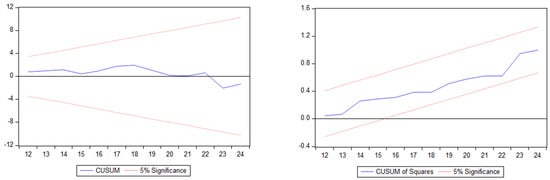
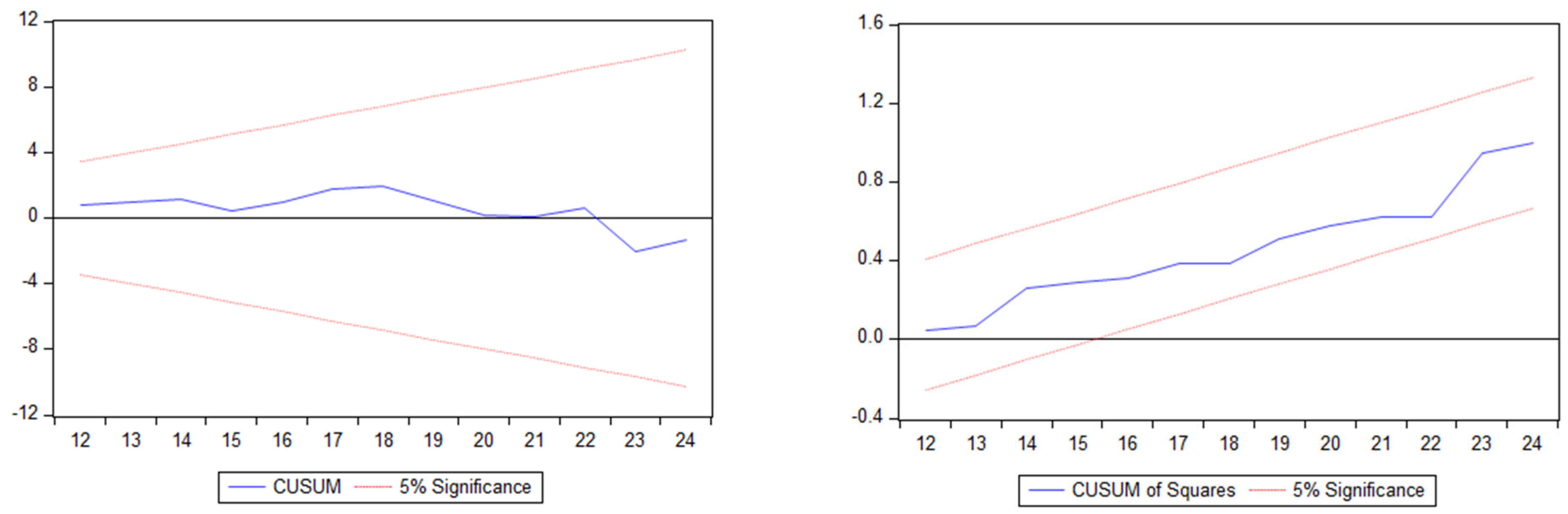
Table 8 reveals that the probability values for the normality test, the heteroscedasticity test, and the serial correlation test are greater than the 5% level of significance. This indicates that the computed residuals are normally distributed, homoscedasticity is confirmed, and they are free from serial correlation. Moreover, the probability value of the Ramsey specification error test is greater than all the levels of significance considered in this study, suggesting that the computed ARDL model is well-specified. Figure 1 exhibits the CUSUM and CUSUM of squares plot diagram to evaluate the reliability of the computed ARDL model stability.
Figure 1.
CUSUM and CUSUM of squares. Source: Authors’ own plot.
Figure 1 shows that the CUSUM statistic is within the 5% critical level, indicating the significance of the CUSUM test. This suggests that there is no evidence of instability in the model coefficients. In addition, the CUSUM of squares statistic is within the 5% critical level, indicating the significance of the CUSUM of squares. As a result, the computed ARDL model remains stable over the period under consideration. Overall, the diagnostic test for residuals and coefficients was satisfied, confirming that reliable and economic inference can be drawn from the model.
Table 9 reports the long-run results obtained using the DOLS technique. The results show that the DOLS technique results are consistent with the ARDL long-run results. The coefficient signs of all the variables are the same in both models, but only the statistical significance of the variables differs. For instance, all variables were found to be statistically significant with the DOLS technique, while only DFD, INT, and DFD INT were statistically significant in the ARDL technique. Nonetheless, the DOLS results confirm the robustness of the long-run relationship.
Table 9.
DOLS technique results (robustness check).
5. Conclusions and Policy Implications
The objective of this study was to investigate the impact of digital financial development on monetary policy effectiveness in South Africa utilising an ARDL approach. The study used annual time-series data from 1990 to 2024. The investigation was carried out using the following variables: digital financial development, inflation, GDP per capita, financial deepening, interest rate, and exchange rate. In the long run, it was found that digital financial development has a positive and significant impact on inflation in South Africa; however, this impact was negative in the short run. The exchange rate was found to have an insignificant impact on inflation in the long run, while in the short run, it had a positive and significant impact. Financial deepening was found to have an insignificant impact on inflation in both the long run and short run. GDP per capita had an insignificant impact in the long run; however, the impact was positive and significant in the short run. The interest rate was found to have a negative and significant impact in the long run but an insignificant impact in the short run. Similarly, the interaction term between digital financial development and interest rate was found to have a negative and significant impact on inflation in the long run, while it had an insignificant impact in the short run.
The findings of this study present policy implications; for instance, digital financial transactions contribute to rising price levels in South Africa. Therefore, this study advocates that the rapid growth of digital financial development should be cautiously managed to avoid inflationary pressure while protecting financial innovation and inclusion. Policymakers should consider incorporating digital financial development indicators such as the volume of EFT, credit card volume and the number of people using mobile finance trends into monetary policy frameworks. The South African Reserve Bank (SARB) may incorporate these indicators into its inflation forecasting and monetary policy model as supplementary variables. The interaction between digital financial development and interest rates reveals that financial development affects interest rate channels of monetary policy. Therefore, it is recommended that policymakers should consider digital financial development indicators when developing a strategy to control inflation. For instance, digital financial development indicators can be incorporated into a model used to determine interest rates. Moreover, policymakers should continue focusing on inflation targets while acknowledging that digital finance can affect money flow and financial systems.
This study was limited to the use of EFT, credit card, mobile cellular subscriptions, and the number of people using the internet to construct digital financial development. Further studies can benefit from using multiple digital financial development indicators separately and constructing a digital financial development index by combining multiple digital financial indicators to capture the overall digital financial system. Variables that can be considered are mobile money, mobile banking users, internet banking users, and number of bank branches, among others. Moreover, future studies can benefit by using a different estimation technique or methodology, such as panel analysis. In addition, the study did not employ formal structural break tests despite covering the period 1990 to 2024. Future studies should consider incorporating formal structural break tests.
Author Contributions
Conceptualisation, L.M., T.C.M. and B.C.B.; methodology, T.C.M.; software, T.C.M.; validation, L.M., T.C.M. and B.C.B.; formal analysis, T.C.M.; investigation, L.M., T.C.M. and B.C.B.; data curation, T.C.M.; writing, original draft preparation, B.C.B., L.M. and T.C.M.; writing—review and editing, L.M., T.C.M. and B.C.B. Specifically, B.C.B. prepared the Abstract and Introduction, L.M. prepared the Theoretical and Empirical Literature Review, and T.C.M. prepared the Methodology, Results and Conclusion. All authors have read and agreed to the published version of the manuscript.
Funding
This research received no external funding.
Institutional Review Board Statement
Not applicable.
Informed Consent Statement
Not applicable.
Data Availability Statement
Data was collected from publicly available sources and is available. upon request. South African Reserve Bank (SARB) available online: Online Statistical Query (https://www.resbank.co.za/en/home/what-we-do/statistics/releases/online-statistical-query, accessed on 28 March 2026). World Development indicators available online: https://databank.worldbank.org/source/world-development-indicators, accessed on 28 March 2026.
Acknowledgments
The authors would like to express their sincere gratitude to the North-West University for the institutional support and resources that made this research possible. We also wish to thank TRADE (Trade and Development Research Entity) within the university for generously covering the Article Processing Charges (APC), thereby facilitating the dissemination of our findings. Finally, we are deeply appreciative of the collaborative spirit and constructive contributions of all co-authors, whose insights and dedication greatly enhanced the quality and depth of this study. During the preparation of this manuscript, the authors used ChatGPT (OpenAI, GPT-5) and Microsoft Copilot to assist with information synthesis, language refinement, academic writing support, and the organisation of manuscript content. The authors reviewed, edited and verified all output generated by these tools and take full responsibility for the content of this publication.
Conflicts of Interest
The authors declare no conflicts of interest.
References
- Ali, S., & Mohammed, H. (2024). Monetary policy effectiveness in the digital era: Egypt case. Journal of Financial and Administrative Studies, 16(4), 1–53. [Google Scholar] [CrossRef] [Scilit]
- Aron, J. (2018). Mobile money and the economy: A review of the evidence. World Bank Research Observer, 33(2), 135–188. [Google Scholar] [CrossRef] [Scilit]
- Aron, J., & Muellbauer, J. (2013). Wealth, credit conditions, and consumption: Evidence from south Africa. Review of Income and Wealth, 59, 161–196. [Google Scholar]
- Bank for International Settlements. (2022). Annual economic report 2022: The future monetary system. Bank for International Settlements. Available online: https://www.bis.org/publ/arpdf/ar2022e3.pdf (accessed on 12 May 2026).
- Beck, T., Pamuk, H., Uras, B., & Ramrattan, R. (2018). Payment instruments, finance and development. Journal of Development Economics, 133, 162–186. [Google Scholar] [CrossRef] [Scilit]
- Bernanke, B., & Gertler, M. (1989). Agency costs, net worth and business fluctuations. American Economic Review, 79(1), 14–31. [Google Scholar]
- Bernanke, B., & Gertler, M. (1995). Inside the black box: The credit channel of monetary policy transmission. Journal of Economic Perspectives, 9(4), 27–48. [Google Scholar] [CrossRef] [Scilit]
- Brandão-Marques, L., Gelos, G., Harjes, T., Sahay, R., & Xue, Y. (2020). Monetary policy transmission in emerging markets and developing economies. IMF Working Paper No. 2020/035. International Monetary Fund. [Google Scholar]
- Brunnermeier, M., & Niepelt, D. (2019). On the equivalence of private and public money. Journal of Monetary Economics, 106, 27–41. [Google Scholar] [CrossRef] [Scilit]
- Dabla-Norris, E., Ji, Y., Townsend, R., & Unsal, D. (2015). Identifying constraints to financial inclusion and their impact on GDP and inequality: A structural framework for policy. IMF Working Paper WP/15/22. International Monetary Fund. [Google Scholar]
- Dias, S., & Perera, K. (2026). Exploring the role of digital finance in advancing financial inclusion with challenges and future directions. Discov Sustain, 7, 205. [Google Scholar] [CrossRef] [Scilit]
- Effiong, E. L., Esu, G. E., & Chuku, C. (2020). Financial development and monetary policy effectiveness in Africa. Journal of Social and Economic Development, 22, 160–181. [Google Scholar] [CrossRef] [Scilit]
- Elliot, G., Rothenburg, T., & Stock, J. (1996). Efficient tests for an autoregressive unit root. Econometrica, 64, 813–836. [Google Scholar] [CrossRef] [Scilit]
- Fang, Y., Jing, Z., Shi, Y., & Zhao, Y. (2021). Financial spillovers and spillbacks: New evidence from China and the G7 countries. Economic Modelling, 94, 184–200. [Google Scholar] [CrossRef] [Scilit]
- Feyen, E., Frost, J., Gambacorta, L., Natarajan, H., & Saal, M. (2021). Fintech and the digital transformation of financial services: Implications for market structure and public policy (pp. 8–27). BIS Papers, No. 117. Bank for International Settlements. [Google Scholar]
- Frost, J., Gambacorta, L., Huang, Y., Shin, H., & Zbinden, P. (2019). BigTech and the changing structure of financial intermediation. BIS working papers (No. 779). Bank for International Settlements. [Google Scholar]
- Huang, Z., Lahreche, A., Saito, M., & Wiriadinata, U. (2024). E-money and monetary policy transmission. IMF Working Paper WP/24/69. International Monetary Fund. [Google Scholar]
- Jack, W., & Suri, T. (2014). Risk sharing and transactions costs: Evidence from kenya’s mobile money revolution. American Economic Review, 104(1), 183–223. [Google Scholar] [CrossRef] [Scilit]
- Jiang, S., Qiu, S., & Zhou, H. (2022). Will digital financial development affect the effectiveness of monetary policy in emerging market countries? Economic Research Ekonomska Istraživanja, 35(1), 3437–3472. [Google Scholar]
- Johnson, K., & Anthony, O. (2026). Digital payments and inflation dynamics in nigeria. Journal of Economics, Management and Trade, 32(2), 56–68. [Google Scholar] [CrossRef] [Scilit]
- Kebede, J., Selvanathan, S., & Naranpanawa, A. (2024). Financial inclusion and monetary policy effectiveness in a monetary union: Heterogenous panel approach. Economics of Transition and Institutional Change, 32, 779–805. [Google Scholar] [CrossRef] [Scilit]
- Levine, R. (2005). Finance and growth: Theory and evidence. Available online: https://www.nber.org/system/files/working_papers/w10766/w10766.pdf (accessed on 12 May 2026).
- Mankiw, N. (2009). Macroeconomics (7th ed.). Worth Publishers. [Google Scholar]
- Meniago, C. (2025). Digital financial inclusion and economic growth: The moderating role of institutions in SADC countries. International Journal of Financial Studies, 13, 4. [Google Scholar] [CrossRef] [Scilit]
- Mishkin, F. (1995). Symposium on the monetary transmission mechanism. Journal of Economic Perspectives, 9(4), 3–10. [Google Scholar] [CrossRef] [Scilit]
- Mishra, P., Montiel, P., & Sengupta, R. (2016). Monetary transmission in developing countries: Evidence from India. International Monetary Fund Working paper 16/167. International Monetary Fund. [Google Scholar]
- Ndzinisa, P. (2025). The impact of financial development on the effectiveness of monetary policy in South Africa. AERC research paper no. 567. African Economic Research Consortium. [Google Scholar]
- Ng, S., & Perron, P. (2001). Lag length selection and the construction of unit root tests with good size and power. Econometrica, 69(6), 1519–1554. [Google Scholar] [CrossRef] [Scilit]
- Ozili, P. (2018). Impact of digital finance on financial inclusion and stability. Borsa Istanbul Review, 18(4), 329–340. [Google Scholar] [CrossRef] [Scilit]
- Pesaran, M., & Shin, Y. (1999). An autoregressive distributed-lag modelling approach to cointegration analysis. In S. Strom (Ed.), Econometrics and economic theory in the 20th century the ragnar frisch centennial symposium (pp. 371–413). Cambridge University Press. [Google Scholar]
- Pesaran, M., Shin, Y., & Smith, R. (2001). Bounds testing approaches to the analysis of level relationships. Journal of Applied Econometrics, 16(3), 289–326. [Google Scholar] [CrossRef] [Scilit]
- Ricci, L, A., Ahokpossi, A., Quayyum, A., Fuje, A., Lee, S., Li, G., Li, X., Mu, Y., Mwase, N., Ree, J., Shi, H., & Kramarenko, V. (2025). Digital payment innovations in Sub-Saharan Africa (Vol. 2025). IMF. [Google Scholar] [CrossRef] [Scilit]
- Sangwan, V., Prakash, P., & Singh, S. (2020). Financial technology: A review of extant literature. Studies in Economics and Finance, 37(1), 71–88. [Google Scholar] [CrossRef] [Scilit]
- Stock, J. H., & Watson, M. W. (1993). A simple estimator of cointegrating vectors in higher order integrated systems. Econometrica: Journal of the Econometric Society, 61, 783–820. [Google Scholar] [CrossRef] [Scilit]
- Syafi’i, A. (2025). Econometric analysis of inflation dynamics in digital payment ecosystems in emerging markets. Journal of Applied Econometric, 1(1), 9–15. [Google Scholar] [CrossRef] [Scilit]
- Taonezvi, L., & Esely, N. (2024). The nexus among digital financial inclusion, monetary policy transmission, and economic development in sub-saharan Africa. Journal of International Economics and Management, 24(2), 1–23. [Google Scholar] [CrossRef] [Scilit]
- Tariq, S., Iftikhar, S., Iftikhar, K., Raza, H., & Idrees, S. (2023). The role of digital finance in economic development: A cross -country analysis. Journal of Policy Research, 9(3), 160–171. [Google Scholar] [CrossRef] [Scilit] [PubMed]
- Woodford, M. (2002). Interest and prices. Princeton University Press. [Google Scholar]
- Zhou, X. (2023). Financial technology and the transmission of monetary policy: The role of social networks. Working Paper No. 2203. Federal Reserve Bank of Dallas. [Google Scholar]

Disclaimer/Publisher’s Note: The statements, opinions and data contained in all publications are solely those of the individual author(s) and contributor(s) and not of MDPI and/or the editor(s). MDPI and/or the editor(s) disclaim responsibility for any injury to people or property resulting from any ideas, methods, instructions or products referred to in the content. |
© 2026 by the authors. Licensee MDPI, Basel, Switzerland. This article is an open access article distributed under the terms and conditions of the Creative Commons Attribution (CC BY) license.