


Abstract
This study examines financial integration and contagion across South Asia’s emerging and frontier markets during the 2001–2013 period, encompassing both the global financial and Eurozone crises. Employing a multi-factor asset pricing model within an EGARCH framework, we disentangle systematic global exposures from idiosyncratic shocks originating in the U.S. and Eurozone. By formally testing for structural changes in both mean returns and conditional variance, we uncover a striking “integration-contagion paradox.” While frontier markets (Bangladesh, Nepal) appear segmented from global pricing signals in tranquil times, they remain acutely susceptible to second-moment volatility contagion during stress periods. In contrast, India exhibits strong systematic return integration yet remains relatively insulated from volatility cascades. These results challenge the conventional view that financial segmentation offers a robust shield against systemic risk, revealing that a lack of global integration does not immunize markets against the transmission of global uncertainty.
Keywords:
financial contagion; volatility spillover; financial integration; South Asia; global financial crisis; Eurozone crisis JEL Classification:
G01; G15; F36; C58
1. Introduction
Over the past several decades, equity markets have become increasingly integrated through the liberalization of capital accounts, the expansion of cross-border portfolio investment, the growth of cross-listings, and rapid advances in information and trading technology (Bekaert & Harvey, 2000; Berger et al., 2011; Goldstein et al., 2021; Moshirian et al., 2021). In theory, financial liberalization and the resulting market integration offer significant economic benefits, primarily by allowing for the sharing of risk across markets and reducing the cost of equity capital (Bekaert & Harvey, 1995; Chaieb et al., 2021; Moshirian et al., 2021; Stulz, 1999). For emerging economies, integration provides access to a deeper pool of global capital, fostering investment and economic growth (Henry, 2000). Importantly, capital mobility restrictions, market microstructure constraints, information asymmetries, and heterogeneous foreign participation imply that the degree of integration varies across markets and time (Akbari et al., 2020; Bekaert & Harvey, 1995). However, this interconnectedness comes with a cost: it exposes domestic markets to external shocks. As markets become more integrated, the buffer provided by segmentation erodes, making markets increasingly vulnerable to financial contagion, the rapid and often indiscriminate transmission of financial distress from one market to another (Dungey & Gajurel, 2015; Forbes & Rigobon, 2002). The broader contagion literature therefore emphasizes models that can separate common global shocks from source-market specific shocks and that allow the measurement of transmission strength during crisis periods (Calvo & Mendoza, 2000; Dungey & Martin, 2007). In this sense, contagion is not merely “high correlation” but a statistically meaningful change in propagation mechanisms relative to normal times (Bekaert et al., 2005).
The Global Financial Crisis (GFC) of 2007–2009 and the subsequent Eurozone Financial Crisis (EFC) provide two sharp, economically distinct episodes for evaluating crisis transmission. The GFC, which originated in U.S. housing and structured-credit markets, evolved into a global funding and liquidity shock with major disruptions to banking intermediation, capital markets, and real activity (Brunnermeier, 2009). The EFC, while intertwined with the aftermath of the GFC, reflected a sovereign–bank feedback loop and redenomination risk within the monetary union, with substantial cross-border spillovers through banks and asset markets (Brunnermeier et al., 2016; De Santis, 2019; Lane, 2012). Importantly for empirical work, these two episodes also differ in their global epicenters: U.S. shocks played a central role in the GFC, whereas the Eurozone was the focal point of stress during the EFC. This distinction motivates an empirical design that can attribute crisis transmission not only to an aggregate global factor but also to incremental source-specific spillovers from the U.S. and Europe.
A substantial body of literature documents the transmission of financial crises across equity markets, with a particular focus on the GFC and the EFC. During the GFC, Baur (2012) finds evidence of contagion from the U.S. financial sector to global equity markets. Bekaert et al. (2014) also show that although direct cross-border contagion from the U.S. was relatively limited, the GFC induced substantial domestic contagion across equity portfolios, confirming the “wake-up call” hypothesis whereby investors abruptly re-evaluated country-specific fundamentals. Dungey and Gajurel (2015) show that crisis transmission occurs through both systematic and idiosyncratic channels; the systematic factor captures fundamentals-based interdependence and the impact of common global shocks, whereas the idiosyncratic factor captures transmission driven by market imperfections, information asymmetries, and sudden shifts in investor behavior (Dungey & Gajurel, 2014). The subsequent EFC, characterized by sovereign and banking distress, presented a distinct crisis epicenter. Examining this period, Beirne and Fratzscher (2013) document a sharp rise in the sensitivity of sovereign yields to underlying economic fundamentals not only within the Eurozone but also across a broader set of advanced and emerging economies. Furthermore, Mink and de Haan (2013) highlight how localized news regarding Greek sovereign stress and bailout policies rapidly transmitted to broader European financial markets. Beyond Europe, Samarakoon (2017) finds strong and pervasive evidence of contagion from Eurozone crisis countries to developed and emerging equity markets worldwide, although Asian markets appear comparatively less affected.
Dungey et al. (2005) argue that tests for contagion depend on how contagion is defined and on the specific empirical model employed to identify it. For instance, early correlation-based tests, such as those of Forbes and Rigobon (2002), focus on adjusting cross-market correlation coefficients for conditional heteroskedasticity to distinguish contagion from interdependence. Relatedly, Bekaert et al. (2005) define contagion as excess comovement beyond what can be explained by fundamentals-based interdependence, providing a benchmark that is especially relevant for factor-based empirical designs. Other approaches employ copula-based models to capture non-linear and tail dependencies during extreme market downturns (Aloui et al., 2011; Garcia & Tsafack, 2011; Rodriguez, 2007). Furthermore, variance-decomposition frameworks, notably the spillover indices of Diebold and Yilmaz (2009) and Diebold and Yilmaz (2012), quantify directional connectedness and volatility spillovers across markets. While these methodologies provide valuable insights into market linkages, they face challenges in cleanly separating common global shocks from those originating specifically in a crisis epicenter. To address this limitation, we employ a multifactor model with an EGARCH specification. By explicitly decomposing equity returns, the model captures crisis transmission through a common global factor, orthogonalized idiosyncratic shocks from the crisis epicenters (the U.S. and the Eurozone), and simultaneous volatility spillovers. This specification provides a comprehensive framework for identifying structural changes in both the mean and variance equations.
South Asian equity markets are a natural laboratory for studying the integration–contagion trade-off. The region accounts for a large share of the world’s population and has experienced sustained economic growth, progressive financial reforms, and rising participation by both domestic and foreign investors. Yet, South Asian equity markets remain heterogeneous in size, liquidity, investor base, and openness (Gajurel & Chawla, 2022; Hearn, 2010; Sehgal et al., 2018). Historically, this region has been viewed as monolithic or relatively segmented from the global financial system, implying relative insulation from global contagion. However, this perception overlooks the profound heterogeneity within the region and the fact that vulnerability to external shocks can change over time (Kangogo et al., 2023). For example, while India exhibits consistent integration, frontier markets such as Nepal remain subject to rigid capital controls, whereas markets like Bangladesh continue to be characterized by more limited foreign participation and thinner liquidity. This unique divergence allows for a novel investigation into whether low levels of financial integration necessarily guarantee insulation from financial contagion during a crisis.
In addition, South Asian markets remain relatively underexplored in the financial contagion literature compared with other emerging and frontier markets in Latin America, emerging Europe, and East Asia. Much of the regional evidence focuses on long-run relationships and regional interdependence rather than on crisis-state changes in transmission. For example, Narayan et al. (2004) examine dynamic linkages among South Asian equity markets using cointegration and causality approaches. More recently, Gajurel and Chawla (2022) provide comprehensive evidence on information spillovers and asymmetric volatility for these markets. While informative, this literature leaves open two issues that are central for understanding crisis transmission. First, crisis episodes may alter the strength of propagation in ways that are not captured by average relationships estimated over the full sample. Second, disentangling global comovement from incremental source-market spillovers is crucial when shocks originate in major financial centres, especially in episodes like the GFC and EFC where the U.S. and Eurozone played distinct roles.
This study bridges the identified gap by investigating the “integration-contagion paradox” within South Asian equity markets, adapting the latent factor framework of Bekaert et al. (2014) and Dungey and Gajurel (2015). Our empirical setup distinguishes between standard interdependence—comovement driven by common global exposures during normal periods—and contagion, defined as a structural break in transmission channels during crisis periods. We augment this framework through two extensions specifically calibrated to capture distinct crisis episodes with different epicenters. First, we specify a multifactor model comprising a global equity factor alongside orthogonalized U.S. and Eurozone factors, allowing us to disentangle transmission through global systematic risk from idiosyncratic information spillovers originating from crisis epicenters. Second, we simultaneously model transmission across the first moment (returns) and the second moment (conditional variance) through an EGARCH specification. This dual mean-variance approach is important because crises may propagate not merely through breaks in expected returns, but through volatility cascades that tighten risk constraints and alter risk appetite. Consequently, this approach captures nonlinear contagion effects that may emerge even in markets where average return integration appears limited.
We aim to address four research questions in this paper. First, how integrated are South Asian equity markets with the global equity market in normal times? From a factor model perspective, this corresponds to the magnitude and significance of the exposure to the global equity factor, which can also be interpreted as the extent of global systematic risk borne by each market. Second, beyond global exposure, do U.S.-specific and Eurozone-specific shocks spill over into South Asian equity returns, and do these spillovers differ across markets in the region, which may have different degrees of openness and liquidity? Third, do the GFC and the EFC change the strength of transmission, and through which channels—systematic (global), idiosyncratic (source-country), and volatility—does contagion manifest? Fourth, does the region exhibit an “integration–contagion paradox” in which relatively segmented markets appear weakly integrated in mean returns but nonetheless experience substantial crisis transmission through volatility channels?
Our empirical results yield three main findings. First, we document a sharp dichotomy in baseline integration: while India exhibits statistically significant exposure to the global factor, consistent with an integrated emerging market, Bangladesh and Nepal lack global integration in returns during tranquil periods. Second, we find strong evidence of contagion during the GFC, although the transmission channels differ across markets. For India, contagion manifests most clearly through a structural change in systematic return linkages, whereas for the frontier markets, crisis transmission is more limited in the first moment. Third, and of particular significance, we uncover an “integration–contagion paradox” in the second moment. Despite limited global integration in mean returns, frontier markets exhibit pronounced volatility contagion, effectively importing global uncertainty. More broadly, the GFC emerges as a systemic contagion event for the region, whereas the EFC produces more selective and market-specific transmission effects, underscoring the importance of crisis epicenters in shaping transmission dynamics.
This study contributes to the literature in three distinct ways. First, we provide a cohesive decomposition of global integration and crisis transmission for a set of South Asian markets that includes both a large emerging market (India) and frontier markets with limited international visibility (including Nepal). Second, by explicitly modeling both the mean and conditional variance, we identify whether crises operate mainly via shifts in expected-return linkages or via changes in volatility spillovers and asymmetric risk dynamics, offering a richer characterization of contagion than mean-only models. Third, by distinguishing between the GFC and the EFC and allowing transmission from the U.S. and the Eurozone to change when each serves as the crisis epicenter, we provide an economically interpretable characterization of transmission pathways that aligns with the stylized facts of the respective episodes.
The remainder of the paper proceeds as follows. Section 2 presents the empirical framework and defines our measures of integration, spillovers, and contagion in both the mean and volatility equations. Section 3 describes the data, crisis windows, and summary statistics. Section 4 reports the empirical results and discusses their economic interpretation. Section 5 concludes.
2. The Empirical Framework
2.1. Modelling Financial Integration
We motivate the empirical specification from an international CAPM perspective in which, under full integration, a country’s equity returns are primarily priced by exposure to global systematic risk, while under segmentation domestic risks can command a local premium. A convenient reduced-form representation of partial integration is a multifactor model in which each market’s return loads on a common global equity factor, with additional country- or region-specific shocks capturing additional information beyond the common factor or global comovement. As we are interested in examining the global integration of the South Asian equity markets and financial contagion during the GFC and EFC, following Dungey and Gajurel (2015), we extend a single-factor model to a multifactor model that includes market-specific factors for the U.S. and Eurozone equity markets. These orthogonalized factors capture source-market innovations independent of the global common factor, providing a direct channel for crisis transmission from the epicenters to South Asian markets. Therefore, our baseline multifactor model for the tranquil period (non-crisis period) includes three factors. In addition, following Bekaert and Harvey (2000), we include an autoregressive AR(1) term, , to control for the autocorrelation induced by market inefficiencies and non-synchronous trading typical of the sample markets (Gajurel, 2019; Gajurel & Chawla, 2022).
Let denote the (log) return on country i’s aggregate stock market index at time t. The return equation is
where is the common or global factor, and and are U.S.- and Eurozone-specific idiosyncratic factors, respectively. To obtain an intuitive interpretation of the factor loadings, we orthogonalize the U.S. and Eurozone factors following Bekaert et al. (2014) and Dungey and Gajurel (2015). Specifically, the U.S. and Eurozone factors are constructed by regressing their respective equity returns on the common world equity returns over the full sample period. The residuals from these regressions are then utilized as the orthogonalized and factors. The coefficients , , and capture the normal-times exposure of equity market i to these factors, respectively. Specifically, captures the degree of global integration, while and capture the extent of incremental information spillovers from the U.S. and Eurozone markets during tranquil periods, respectively. Furthermore, captures the predictive power of lagged returns; if the financial market of country i is efficient and dominated by informed investors, we anticipate that . Finally, is the residual term.
International transmission may operate not only through expected returns but also through volatility. Volatility spillovers are economically relevant because they proxy uncertainty transmission, binding risk constraints, and liquidity-induced amplification, all of which intensify during crises (Brunnermeier, 2009). We therefore model the conditional variance of using an EGARCH specification (Nelson, 1991), augmented with volatility spillovers from the global and source markets (Baele, 2005; Gajurel & Chawla, 2022; Hamao et al., 1990). The variance equation of the EGARCH model accompanying the mean equation in Equation (1) is expressed as:
where denotes the standardized residual; is the constant; , , and capture the ARCH, leverage, and GARCH effects, respectively; and , , and measure the volatility spillover effects from the global, U.S., and Eurozone markets.
2.2. Testing for Contagion
Contagion is a crisis phenomenon. Following Dungey and Gajurel (2015), in Equation (1), we allow for structural breaks in both the intercept and the factor loadings during the crisis periods. As we are testing for contagion during the GFC and EFC, we introduce two dummy variables for the respective crisis episodes. The comprehensive equation to test contagion in the first-order moment is specified as:
where and denote the indicator functions for the GFC and EFC periods.
Similarly, to account for volatility transmission, we extend the EGARCH model specification in Equation (2) as follows:
Now, the crisis interaction coefficients in Equations (3) and (4) capture changes in transmission during the two crisis episodes. Consistent with the idea that crises can operate via both global shocks and source-country innovations, we allow the sensitivity to the common or global factor to change during both episodes through and . In contrast, we allow the U.S. idiosyncratic factor to change only during the GFC (through ) and the Eurozone idiosyncratic factor to change only during the EFC (through ), reflecting the distinct epicenters of the two crises. This framework allows for a more granular identification of the underlying contagion mechanisms: shifts in the global-factor loadings capture the systematic transmission of global risk, while variations in the orthogonalized U.S. and Eurozone exposures isolate pure, origin-specific shock transmissions emanating directly from the crisis epicenters.
We define contagion in the mean and variance equations using the crisis interaction coefficients, in the spirit of Dungey and Gajurel (2015). Systematic contagion is present during the GFC (EFC) if () is statistically different from zero. A significant estimate indicates that the market’s exposure to the common global factor changed in the crisis window beyond its normal-times level. Idiosyncratic contagion from the epicenter is present if during the GFC and/or during the EFC. Because and are orthogonal to , these effects represent crisis-state spillovers that are beyond global comovement.
More broadly, shift contagion in the literature refers to structural changes in established relationships during crises (Dungey & Gajurel, 2014, 2015; Gajurel & Dungey, 2023). In our context, shift contagion is assessed by examining whether the coefficient estimates and/or are statistically significant.
Similarly, volatility contagion is present during the GFC (EFC) when the corresponding interaction coefficient is statistically different from zero, for example (or ) for changes in common volatility transmission. Consistent with the distinct crisis epicenters, we emphasize changes in U.S. sourced volatility transmission during the GFC () and changes in Eurozone-factor volatility transmission during the EFC (). Our empirical model, therefore, identifies four forms of financial contagion transmitted through various channels. Table 1 provides a taxonomy of contagion tests in our model.
Table 1.
Taxonomy of Contagion Tests.
3. Sample, Data and Summary Statistics
There are eight countries in South Asia that are members of the South Asian Association for Regional Cooperation (SAARC): Afghanistan, Bangladesh, Bhutan, India, Maldives, Nepal, Pakistan, and Sri Lanka. Among these, Afghanistan, Bhutan, and Maldives lack established equity markets or possess highly nascent exchanges. Accordingly, our sample consists of the remaining five countries.
Aggregate equity index data for the sample markets, except Nepal, together with the aggregate world equity index, the U.S. equity index, and the European equity index, are extracted from the Refinitiv Datastream database. Table 2 provides the tickers of the equity indices in Datastream. For Nepal, we obtained the Nepal Stock Exchange (NEPSE) index directly from the official records and website of the Nepal Stock Exchange. We use the official NEPSE Index exactly as published by the exchange. The NEPSE Index is a value-weighted equity index and is adjusted for dividends and other corporate events.1
Table 2.
Tickers of equity market indices in Refinitiv.
The price series for the aggregate stock market indices are converted into daily log returns. In line with the existing literature, and to account for differing time zones and asynchronous trading, following Forbes and Rigobon (2002) and Dungey and Gajurel (2015), we align the data such that Day 1 in the U.S. corresponds to Day 2 in Asia and Europe.
In the empirical implementation, the common factor is proxied by the return on the aggregate world equity index (TOTMKWD). The construction of the orthogonalized U.S. and Eurozone factors follows the procedure described in Section 2; by construction, these source-country factors capture innovations that are incremental to global market movements.
3.1. Sample Period and Crisis Windows
Our sample window spans from 2 January 2001 to 7 June 2013, allowing us to distinguish the pre-crisis period, the global financial crisis period and the Eurozone crisis period. Following Dungey and Gajurel (2015), we define 11 July 2007 to 8 May 2009 as the global financial crisis period and 3 May 2010 to 8 June 2013 as the Eurozone financial crisis period. The start and end dates are closely aligned with widely used market-stress chronologies. Therefore, the crisis indicator functions used in Equations (3) and (4) are defined as follows:
3.2. Descriptive Statistics
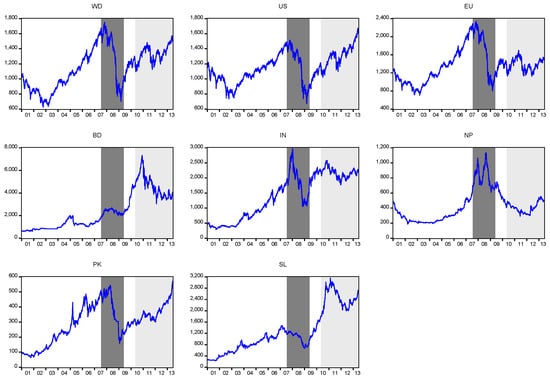
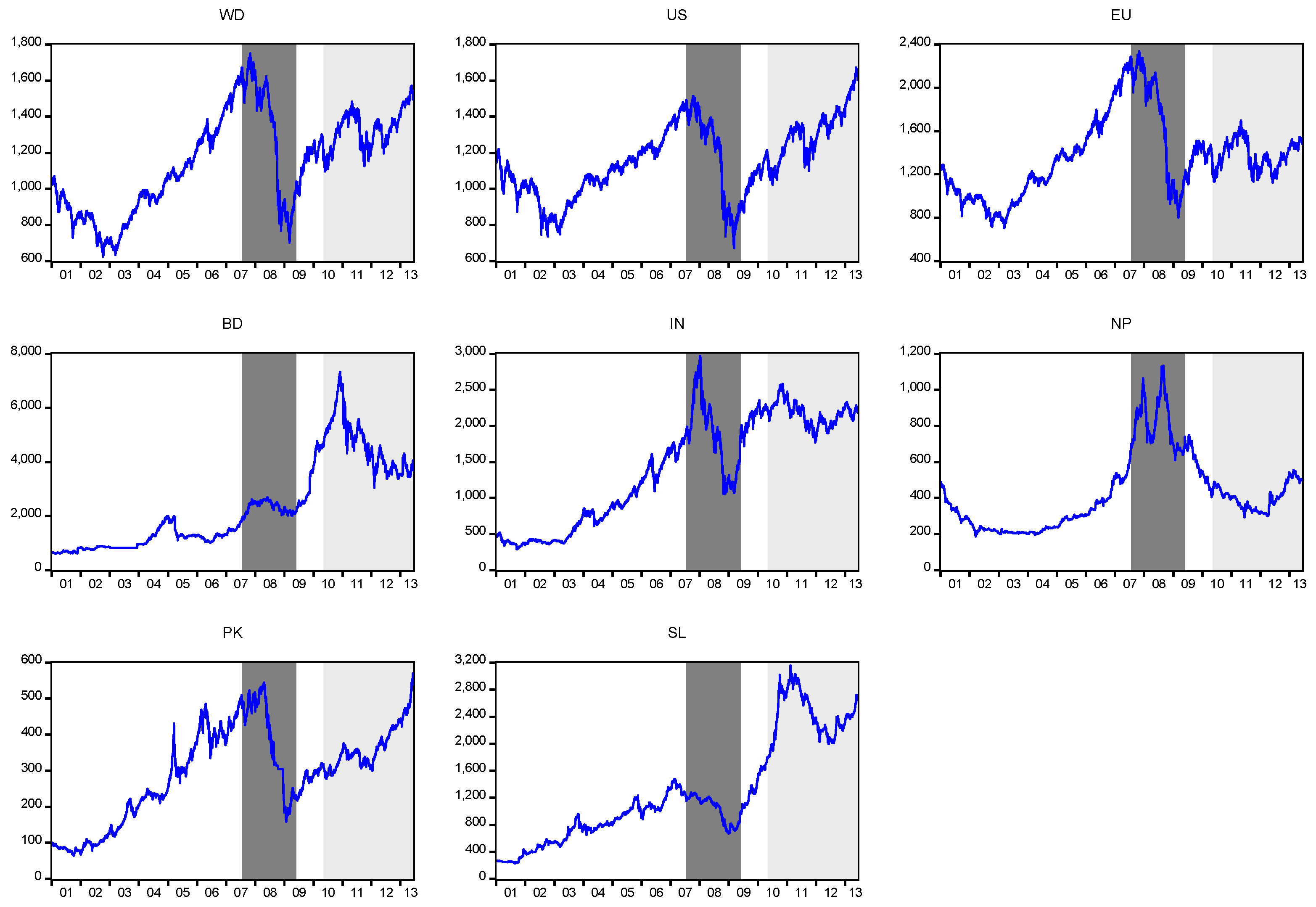
Figure 1 illustrates the daily closing price indices for the global benchmarks (World, U.S., and Eurozone) and South Asian markets. The price series reveal a distinct dichotomy between developed and frontier market dynamics. The global benchmarks exhibit a similar pre-crisis price evolution, followed by a precipitous drawdown during the GFC and a subsequent recovery that is noticeably more sluggish for the Eurozone. In South Asia, the crisis response is markedly heterogeneous. India displays a clear peak-to-trough decline suggesting a higher degree of global comovement. In contrast, Bangladesh and Nepal appear largely decoupled from global pricing cycles. Bangladesh trends upward with gradual adjustments, while Nepal exhibits a sharp, idiosyncratic mid-sample correction, suggesting market segmentation. Pakistan and Sri Lanka demonstrate significant structural shifts, with Sri Lanka’s strong post-GFC appreciation further indicating that domestic drivers, rather than global common factors, dominate its price discovery process.
Figure 1.
Daily Closing Price Indices. This figure plots the daily closing price indices for the World (WD), U.S. (US), and Eurozone (EU) markets alongside the five South Asian markets: Bangladesh (BD), India (IN), Nepal (NP), Pakistan (PK), and Sri Lanka (SL) over the sample period. The dark gray shaded regions denote the timeline of the GFC, while the light blue shaded regions indicate the EFC.
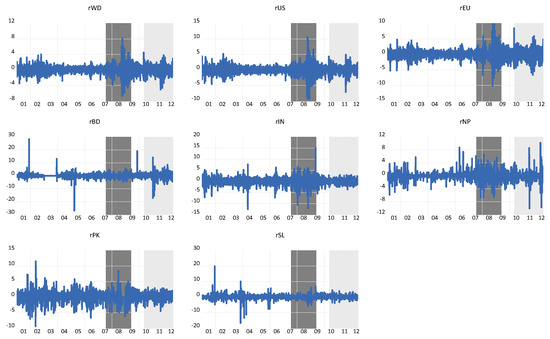
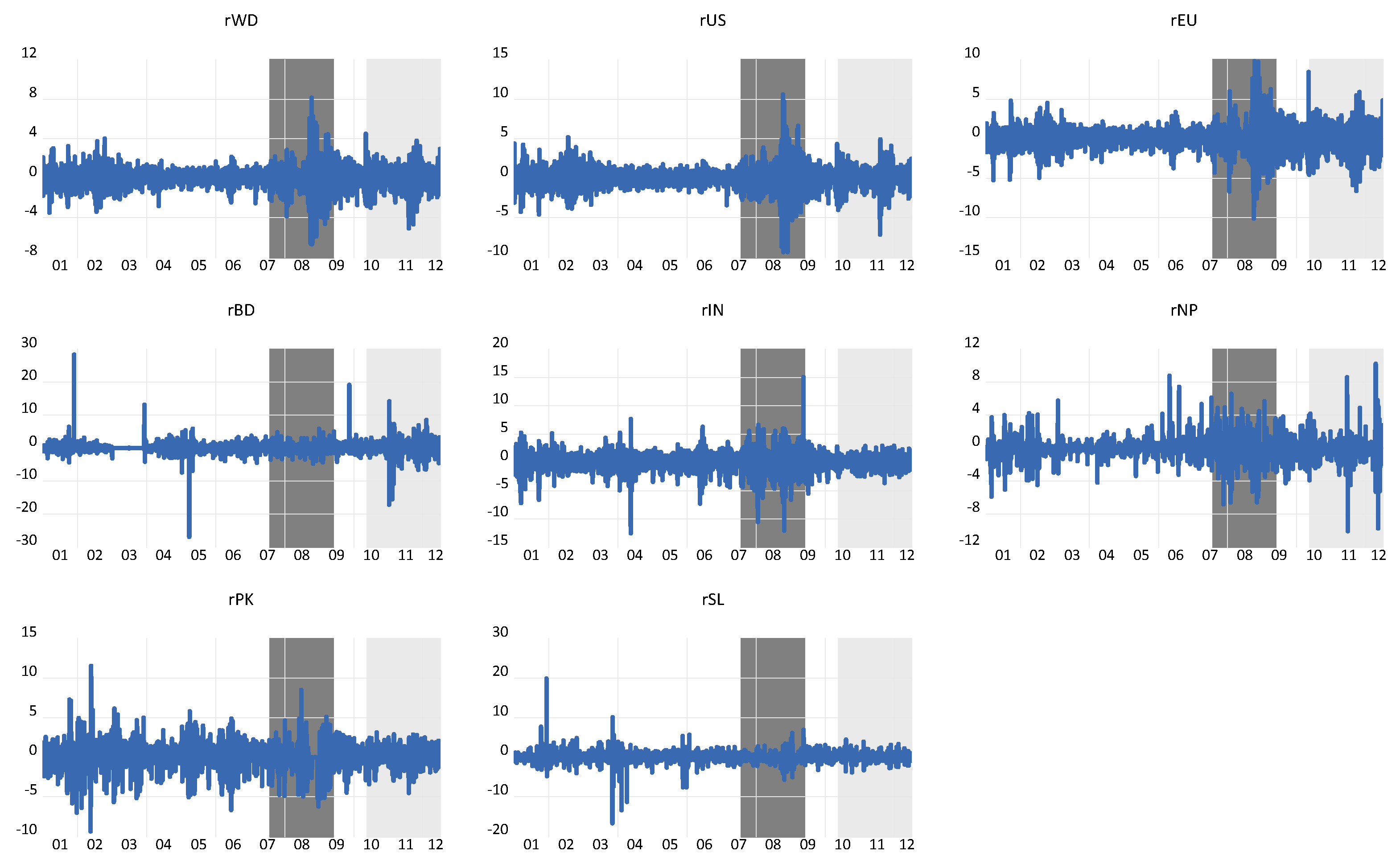
The return series in Figure 2 exhibit the standard stylized facts of financial time series, characterized by mean reversion and pronounced volatility clustering. During the shaded crisis windows, both global and South Asian markets display a surge in variance and a higher frequency of extreme outliers. Crucially, even markets with weak alignment in price levels (such as Bangladesh and Nepal) exhibit elevated volatility persistence during these periods. This visual evidence underscores the limitations of relying exclusively on first-moment analysis and provides strong empirical motivation for incorporating a second-moment perspective, thereby allowing contagion to be examined not only through mean transmission but also through volatility spillovers.
Figure 2.
Daily Logarithmic Returns. This figure displays the daily logarithmic return series (r) for the corresponding markets over the sample period. The dark gray shaded regions denote the timeline of the GFC, while the light blue shaded regions indicate the EFC.
Table 3 provides descriptive statistics for the daily log returns of the three global benchmarks and five South Asian equity markets. Panel A shows that mean daily returns are small and close to zero across series, which is typical for high-frequency financial returns. At the same time, dispersion varies markedly across markets, indicating substantial heterogeneity in risk profiles: unconditional volatility in several South Asian markets, most notably Bangladesh and India, exceeds that of the mature global benchmarks (World and U.S.), while Sri Lanka also displays considerable variability. These cross-sectional differences in second moments motivate treating the region as heterogeneous rather than assuming a uniform degree of integration and/or risk exposure.
Table 3.
Summary statistics.
Comparisons across subperiods highlight distinct crisis dynamics. During the GFC window (Panel C), the developed benchmarks record negative average returns and a sharp rise in volatility relative to the pre-GFC period (Panel B), with the U.S. standard deviation increasing substantially. South Asian markets, particularly Bangladesh and India, also display elevated variability in this period, although the mean responses are heterogeneous. During the Eurozone-crisis window (Panel D), global-factor returns turn positive on average but remain volatile, and regional outcomes diverge sharply: Bangladesh exhibits a negative mean and the highest volatility in the table, while Pakistan posts a relatively high positive mean with comparatively low dispersion. Overall, the subperiod evidence underscores that crisis episodes are associated with large shifts in second moments and tail risk, while mean responses differ across markets, aligning with our emphasis on distinguishing transmission through returns (first moment) from transmission through volatility (second moment).
4. Results and Discussion
The empirical results reported in Table 4 provide a granular view of how systematic and idiosyncratic shocks transmit to the five South Asian equity markets. As outlined in Equations (3) and (4), we assess contagion through changes in mean transmission (Panel A) and volatility spillovers and contagion (Panel B). Panel A reports the maximum-likelihood estimates for the mean equation. In our framework, market integration during tranquil periods is assessed by the statistical significance of the coefficient estimate on the global factor (). The coefficient estimates on the orthogonalized U.S. and Eurozone factors ( and ) capture idiosyncratic spillovers from shocks originating in those markets over and above the common global component.
Table 4.
Regression Results.
The results highlight a sharp dichotomy between the region’s emerging and frontier markets. India exhibits the strongest integration with global equity markets, evidenced by a statistically significant and positive coefficient estimate on the global factor (). Pakistan also displays statistically significant integration, although its coefficient estimate on the global factor () is approximately half that of India, indicating a more moderate degree of global linkage. Sri Lanka is weakly but significantly integrated with the global market, with a small yet statistically significant global factor exposure (). In contrast, Bangladesh and Nepal lack global integration, as the coefficient estimates on the global factor are statistically insignificant for both markets. At the same time, both markets exhibit evidence of selective idiosyncratic spillovers: Bangladesh shows a marginally significant coefficient estimate on the U.S. factor (), while Nepal displays statistically significant coefficient estimates on both the U.S. and Eurozone factors, with the coefficient estimate on the Eurozone factor being larger. These results suggest that source-specific idiosyncratic shocks can matter even in markets with statistically insignificant exposure to the global factor, which is economically intuitive given that the U.S. and Eurozone represent major markets of global equity trading and price discovery.
We test for contagion through the interaction terms involving the crisis indicators ( for the GFC and for the EFC). Systematic contagion is assessed by the statistical significance of the crisis interaction terms on the global factor, and . During the GFC, the results provide compelling evidence of systematic contagion for India and Pakistan. For India, the coefficient on the interaction term is positive and statistically significant (), indicating that the market’s sensitivity to the global factor increased. This supports the wake-up call hypothesis, where global investors reassess risk in integrated emerging markets during periods of systemic stress. Conversely, Pakistan also exhibits systematic contagion during the GFC (), but it manifests as decoupling; its market became less correlated with global trends, possibly due to capital controls or idiosyncratic domestic stability issues that overshadowed global signals. During the Eurozone crisis (EFC), the dynamics shift considerably. India exhibits significant systematic contagion () characterized by a structural reduction in its established global exposure, whereas Pakistan’s systematic contagion () reflects an increased sensitivity to the global market. Notably, Nepal presents a distinct dynamic: a market that lacks significant exposure to the global factor during normal times experienced systematic contagion during the EFC by becoming significantly exposed, albeit with a negative sensitivity (). In stark contrast, Bangladesh and Sri Lanka exhibit no evidence of systematic contagion during either crisis, as their respective coefficients lack statistical significance across both periods. Beyond these changes in global integration, evidence for idiosyncratic contagion from the crisis epicenters (via the idiosyncratic factors) is largely absent across the sample equity markets. The coefficients (for U.S. factor during the GFC) and (for Eurozone factor during the EFC) lack statistical significance for all markets, with the exception of India during the EFC (), which suggests a significant reduction in exposure to Eurozone shocks.
Turning to shift contagion, the intercept shift parameters ( and ) indicate whether a crisis period is associated with a structural break, specifically, an upward or downward shift in the benchmark conditional mean return () beyond the effects of global and source-specific factors. During the GFC, the model detects significant shift contagion in Bangladesh, India, and Sri Lanka. Bangladesh exhibits a profound negative shift (). Because Bangladesh lacks significant baseline systematic exposure, this pronounced negative intercept suggests that while domestic returns were largely insulated from the transmission of global price shocks, the market nonetheless suffered a severe domestic collapse in confidence or a flight to safety that manifested as a pure level effect. Sri Lanka experiences a similar, though smaller, downward shift in mean returns (). Conversely, India displays a positive level shift (), potentially reflecting the resilience of its domestic demand or the efficacy of counter-cyclical macroeconomic policies enacted during the global panic. During the EFC, shift contagion remains evident for Bangladesh and India, although the directional dynamics reverse. India experiences a negative structural shift () while Bangladesh records a positive shift (). In contrast, Sri Lanka exhibits no shift contagion during the EFC, and the shift parameters for Nepal and Pakistan lack statistical significance across both crisis windows.
In Panel B, the conditional variance estimates first establish the baseline volatility dynamics captured by the parameters. Across all sample markets, the volatility magnitude term () and the persistence term () are statistically significant, indicating pronounced volatility clustering and a high degree of persistence in domestic volatility. These results imply that volatility shocks are not merely transitory, but continue to influence conditional variance over time. The asymmetry parameter () is also statistically significant across the sample. Consistent with the asymmetry effect documented in the literature, the coefficient is negative for all markets except Nepal, indicating that volatility responds more strongly to negative domestic shocks than to positive shocks of equal magnitude. For Nepal, the positive estimate implies an inverted asymmetry, which may reflect retail-dominated trading and market microstructure features typical of highly segmented frontier markets.
Building on this domestic baseline, we next examine cross-border volatility transmission through the conditional variance equation. This second-moment perspective is particularly important in the South Asian context, where mean-return linkages may be weak or selective, yet volatility spillovers may still be economically meaningful. During non-crisis periods, the baseline international volatility coefficients (, , and ) indicate selective rather than pervasive external risk transmission across the sample equity markets. In particular, global volatility spillovers are statistically significant for Bangladesh, Nepal, and Sri Lanka, whereas U.S. and Eurozone volatility spillovers are significant for Bangladesh and Pakistan. Notably, India exhibits no significant baseline volatility spillovers from any of these international sources, a finding that contrasts sharply with its strong systematic integration in the mean equation. These results suggest that, even outside crisis periods, several markets in the region remain exposed to external shocks through volatility channels, including markets with limited integration in mean returns. Controlling for both the domestic effects and these baseline international spillovers allows us to quantify the magnitude of cross-border crisis-shock transmission through the conditional variance.
It is also important to consider the directional signs of the estimated crisis-interaction coefficients in both the mean and variance equations, as several statistically significant parameters imply not simply an amplification of exposure, but a broader structural change in cross-market transmission during crisis states. In our framework, contagion is identified as any statistically significant change in the transmission mechanism during a crisis episode, regardless of whether that change increases or decreases sensitivity to external shocks (Bekaert et al., 2014; Dungey & Gajurel, 2015; Gajurel & Dungey, 2023). Under this broader definition, a negative interaction coefficient indicates that the relevant exposure declines during the crisis relative to its tranquil-period level, consistent with episodes of “negative contagion” documented in the literature (Samarakoon, 2017). In the mean equation, the sign patterns reveal substantial heterogeneity in crisis-state repricing. India exhibits systematic contagion during both crises, characterized by an increased sensitivity to the global factor during the GFC but a structural change that reduces its global exposure during the EFC, alongside a significant reduction in idiosyncratic exposure to the Eurozone. Nepal experiences systematic contagion during the EFC by becoming significantly exposed to the global factor, albeit with a negative sensitivity. Meanwhile, Pakistan exhibits systematic contagion during both episodes, manifesting as reduced sensitivity (decoupling) during the GFC but increased sensitivity during the EFC. This suggests that the direction of transmission depends not only on market structure but also on the location and nature of the crisis epicenter. In the variance equation, several significant volatility-contagion interactions are also negative, implying crisis-state reductions in volatility transmission along particular channels. Economically, such inverse responses may reflect defensive decoupling under severe stress, as acute crisis episodes can induce domestic policy intervention, trading frictions, liquidity constraints, or heightened local risk aversion that dampen cross-border transmission. At the same time, these negative coefficients should not be interpreted mechanically as evidence of full insulation. As emphasized by Pukthuanthong and Roll (2009), declines in idiosyncratic volatility can themselves generate excess comovement, implying that observed linkage may strengthen even when direct exposure to external factors appears to weaken. Accordingly, crisis-state negative coefficients in our setting are best interpreted not as an absence of contagion, but as evidence that the form and intensity of international transmission undergo a structural change during periods of stress.
Table 5 summarizes the test results for the different forms of financial contagion across our sample markets, offering a consolidated view of the crisis-transmission channels operating during both the GFC and the EFC. By organizing the evidence into separate panels for the two crises, the table reveals pronounced cross-market heterogeneity in the way external shocks propagate through South Asian equity markets. The results strongly underscore the region’s integration–contagion paradox. India, the region’s most globally integrated market, is affected most clearly through systematic contagion in returns, whereas frontier markets such as Bangladesh and Nepal, despite lacking global integration, prove highly susceptible to second-moment volatility cascades. Crucially, the summary rows indicate that at least one form of contagion—whether functioning as risk amplification or defensive decoupling—is present in every sample market during the GFC, highlighting the broad, systemic character of that crisis. By contrast, contagion during the EFC remains evident in most markets but is less pervasive, with Sri Lanka showing no evidence of contagion under the reported tests for that specific episode. Overall, the table suggests that the GFC generated a more generalized transmission of shocks across South Asia, whereas the EFC operated through more selective, market-specific channels.
Table 5.
Summary of Empirical Results: Forms of Contagion Across South Asian Markets.
While the sharp dichotomy between highly integrated (India) and globally segmented (Bangladesh and Nepal) markets forms the anchor of the integration–contagion paradox, the results for Pakistan and Sri Lanka indicate that this pattern operates along a spectrum. Pakistan exhibits a pronounced dual vulnerability: it possesses sufficient global linkage to experience systematic contagion in the mean equation, yet also remains exposed to significant volatility contagion from multiple international sources. Sri Lanka, by contrast, displays a more crisis-contingent profile. Although it retains limited baseline linkages in the mean equation, it shows no evidence of systematic or idiosyncratic contagion during these episodes. Nevertheless, the magnitude of the GFC was sufficient to generate both shift contagion and global volatility contagion, whereas the EFC produced no comparable structural change under the reported tests. It is important to emphasize that, while our framework identifies these distinct transmission channels and their structural changes, formally testing the macroeconomic, institutional, or microstructural mechanisms underlying these heterogeneous outcomes lies beyond the scope of this study and remains a valuable avenue for future research.
5. Summary and Conclusions
In this paper, we investigate the dynamics of financial integration and contagion across South Asian equity markets using a multifactor latent-factor framework embedded in an EGARCH specification. By decomposing international transmission into exposure to a global (common) factor and idiosyncratic spillovers from the U.S. and Eurozone markets, we provide a detailed analysis of how crisis shocks propagate across the South Asian equity markets. Our empirical design, anchored in the crisis-contagion approach of Baur (2012); Bekaert et al. (2014); Dungey and Gajurel (2015), allows for a formal distinction between systematic interdependence (established linkages) and contagion (structural changes) across both the GFC and the EFC.
Our primary contribution is the identification of a distinct “integration–contagion paradox” within the region. We document a sharp contrast between India, the region’s largest emerging market, and the more segmented and smaller frontier markets. India exhibits strong systematic integration with global pricing signals during tranquil periods and experiences systematic contagion in mean returns during both crisis episodes, although the direction of this structural change differs across crises. During the GFC, its sensitivity to the systematic global factor increases, whereas during the EFC it declines. At the same time, India shows no evidence of volatility contagion, indicating that crisis transmission to the Indian market operates primarily through the first-moment (mean) equation rather than through second-moment (conditional-variance) spillovers.
In contrast, the frontier markets of Bangladesh and Nepal lack global integration, as indicated by statistically insignificant coefficient estimates on the global factor in the mean equation. Conventional wisdom may suggest that such segmentation should provide a degree of insulation from external shocks. However, our variance analysis shows that this insulation is incomplete: both markets remain vulnerable to volatility contagion during crisis periods. Although their returns do not move systematically with the common global factor in tranquil times, they nonetheless import substantial external uncertainty when global stress intensifies. The evidence therefore suggests that limited global integration in mean returns does not shield frontier markets from crisis transmission through volatility channels.
These findings challenge the “decoupling” hypothesis for frontier markets. We demonstrate that financial isolation provides an insufficient buffer against contagion, particularly through volatility channels. For international investors, this implies that the diversification benefits of South Asian frontier markets are regime-dependent: they may prevail during tranquil periods but can weaken precisely when global stress intensifies. For policymakers, the results are especially relevant in economies where capital account restrictions remain a core policy instrument. While such restrictions may contribute to segmentation in mean-return linkages and dampen the transmission of first-moment price shocks, our findings indicate that they do not necessarily insulate domestic markets from second-moment volatility cascades. More broadly, the evidence points to the importance of internal market resilience alongside external barriers. In this regard, the relative stability observed in deeper markets such as India suggests that structural market deepening including the development of a stronger domestic institutional investor base and greater market depth may help absorb liquidity pressures and reduce the domestic amplification of external shocks. In addition, targeted macroprudential tools, such as calibrated circuit breakers or dynamic margin requirements, may help contain the transmission of imported uncertainty into domestic volatility cascades. Future research could usefully examine how capital-market restrictions, domestic market development, and regional financial linkages jointly shape the integration–contagion trade-off over time.
Finally, we acknowledge the temporal boundaries of our empirical design. Because our objective is to isolate transmission channels originating from the U.S. and Eurozone during the GFC and the EFC, our sample naturally concludes in the post-EFC recovery phase. Analyzing more recent global stress episodes, such as the 2015 Chinese market turbulence or the 2020 COVID-19 pandemic, would require a re-specification of the multifactor EGARCH framework to accommodate new crisis epicenters and, in some cases, non-financial shock mechanisms. However, as South Asian economies continue to implement structural reforms and gradually integrate into regional and global capital markets, the segmented profiles observed in parts of our frontier sample will likely evolve. We conjecture that, as these markets mature, their crisis exposure may transition from volatility-dominant transmission toward more systematic mean-equation contagion. Investigating how the integration–contagion paradox evolves across more recent crisis episodes remains a compelling avenue for future research.
Author Contributions
Conceptualization, D.G.; Methodology, D.G.; Software, D.G.; Validation, D.G.; Formal analysis, D.G. and B.S.T.; Investigation, D.G.; Data curation, D.G.; Writing—original draft, D.G. and B.S.T.; Writing—review & editing, D.G. and B.S.T.; Visualization, D.G. and B.S.T. All authors have read and agreed to the published version of the manuscript.
Funding
This research received no external funding.
Institutional Review Board Statement
Not applicable.
Informed Consent Statement
Not applicable.
Data Availability Statement
The datasets analyzed in this study are not publicly available due to proprietary restrictions imposed by Refinitiv Datastream.
Acknowledgments
This work benefited from the comments of two anonymous reviewers, whose thoughtful suggestions enhanced the manuscript’s rigor and clarity. The authors also acknowledge the assistance of artificial intelligence platforms (ChatGPT-5.4 and Gemini 3) for linguistic enhancement.
Conflicts of Interest
The authors declare no conflict of interest.
Note
| 1 | More information is available on the NEPSE website: https://www.nepalstock.com/indices; https://www.nepalstock.com/news-and-alerts, accessed on 3 March 2026. |
References
- Akbari, A., Ng, L., & Solnik, B. (2020). Emerging markets are catching up: Economic or financial integration? Journal of Financial and Quantitative Analysis, 55(7), 2270–2303. [Google Scholar] [CrossRef] [Scilit]
- Aloui, R., Ben Aïssa, M. S., & Nguyen, D. K. (2011). Global financial crisis, extreme interdependences, and contagion effects: The role of economic structure? Journal of Banking & Finance, 35(1), 130–141. [Google Scholar] [CrossRef] [Scilit]
- Baele, L. (2005). Volatility spillover effects in European equity markets. Journal of Financial and Quantitative Analysis, 40(2), 373–401. [Google Scholar] [CrossRef] [Scilit]
- Baur, D. G. (2012). Financial contagion and the real economy. Journal of Banking & Finance, 36(10), 2680–2692. [Google Scholar] [CrossRef] [Scilit]
- Beirne, J., & Fratzscher, M. (2013). The pricing of sovereign risk and contagion during the European sovereign debt crisis. Journal of International Money and Finance, 34, 60–82. [Google Scholar] [CrossRef] [Scilit]
- Bekaert, G., Ehrmann, M., Fratzscher, M., & Mehl, A. (2014). The global crisis and equity market contagion. The Journal of Finance, 69(6), 2597–2649. [Google Scholar] [CrossRef] [Scilit]
- Bekaert, G., & Harvey, C. R. (1995). Time-varying world market integration. The Journal of Finance, 50(2), 403–444. [Google Scholar] [CrossRef] [Scilit]
- Bekaert, G., & Harvey, C. R. (2000). Foreign speculators and emerging equity markets. The Journal of Finance, 55(2), 565–613. [Google Scholar] [CrossRef] [Scilit]
- Bekaert, G., Harvey, C. R., & Ng, A. (2005). Market integration and contagion. The Journal of Business, 78(1), 39–70. [Google Scholar] [CrossRef] [Scilit]
- Berger, D., Pukthuanthong, K., & Yang, J. (2011). International diversification with frontier markets. Journal of Financial Economics, 101(1), 227–242. [Google Scholar] [CrossRef] [Scilit]
- Brunnermeier, M. K. (2009). Deciphering the liquidity and credit crunch 2007–2008. Journal of Economic Perspectives, 23(1), 77–100. [Google Scholar] [CrossRef] [Scilit]
- Brunnermeier, M. K., Garicano, L., Lane, P. R., Pagano, M., Reis, R., Santos, T., Thesmar, D., Van Nieuwerburgh, S., & Vayanos, D. (2016). The sovereign-bank diabolic loop and ESBies. American Economic Review: Papers & Proceedings, 106(5), 508–512. [Google Scholar] [CrossRef] [Scilit]
- Calvo, G. A., & Mendoza, E. G. (2000). Rational contagion and the globalization of securities markets. Journal of International Economics, 51(1), 79–113. [Google Scholar] [CrossRef] [Scilit]
- Chaieb, I., Errunza, V., & Langlois, H. (2021). Factors and risk premia in individual international stock returns. Journal of Financial Economics, 141(2), 669–692. [Google Scholar] [CrossRef] [Scilit]
- De Santis, R. A. (2019). Redenomination risk. Journal of Money, Credit and Banking, 51(8), 2173–2206. [Google Scholar] [CrossRef] [Scilit]
- Diebold, F. X., & Yilmaz, K. (2009). Measuring financial asset return and volatility spillovers, with application to global equity markets. The Economic Journal, 119(534), 158–171. [Google Scholar] [CrossRef] [Scilit]
- Diebold, F. X., & Yilmaz, K. (2012). Better to give than to receive: Predictive directional measurement of volatility spillovers. International Journal of Forecasting, 28(1), 57–66. [Google Scholar] [CrossRef] [Scilit]
- Dungey, M., Fry, R., Gonzalez-Hermosillo, B., & Martin, V. L. (2005). Empirical modelling of contagion: A review of methodologies. Quantitative Finance, 5(1), 9–24. [Google Scholar] [CrossRef] [Scilit]
- Dungey, M., & Gajurel, D. (2014). Equity market contagion during the global financial crisis: Evidence from the world’s eight largest economies. Economic Systems, 38(2), 161–176. [Google Scholar] [CrossRef] [Scilit]
- Dungey, M., & Gajurel, D. (2015). Contagion and banking crisis—International evidence for 2007–2009. Journal of Banking & Finance, 60, 271–283. [Google Scholar] [CrossRef] [Scilit]
- Dungey, M., & Martin, V. L. (2007). Unravelling financial market linkages during crises. Journal of Applied Econometrics, 22(1), 89–119. [Google Scholar] [CrossRef] [Scilit]
- Forbes, K. J., & Rigobon, R. (2002). No contagion, only interdependence: Measuring stock market comovements. The Journal of Finance, 57(5), 2223–2261. [Google Scholar] [CrossRef] [Scilit]
- Gajurel, D. (2019). Asymmetric volatility in the Nepalese stock market. Journal of Comparative International Management, 22(1), 41–59. [Google Scholar] [CrossRef] [Scilit]
- Gajurel, D., & Chawla, A. (2022). International information spillovers and asymmetric volatility in South Asian stock markets. Journal of Risk and Financial Management, 15(10), 471. [Google Scholar] [CrossRef] [Scilit]
- Gajurel, D., & Dungey, M. (2023). Systematic contagion effects of the global finance crisis: Evidence from the world’s largest advanced and emerging equity markets. Journal of Risk and Financial Management, 16(3), 182. [Google Scholar] [CrossRef] [Scilit]
- Garcia, R., & Tsafack, G. (2011). Dependence structure and extreme comovements in international equity and bond markets. Journal of Banking & Finance, 35(8), 1954–1970. [Google Scholar] [CrossRef] [Scilit]
- Goldstein, I., Spatt, C. S., & Ye, M. (2021). Big data in finance. The Review of Financial Studies, 34(7), 3213–3225. [Google Scholar] [CrossRef] [Scilit]
- Hamao, Y., Masulis, R. W., & Ng, V. (1990). Correlations in price changes and volatility across international stock markets. Review of Financial Studies, 3(2), 281–307. [Google Scholar] [CrossRef] [Scilit]
- Hearn, B. (2010). Time varying size and liquidity effects in South Asian equity markets: A study of blue-chip industry stocks. International Review of Financial Analysis, 19(4), 242–257. [Google Scholar] [CrossRef] [Scilit]
- Henry, P. B. (2000). Stock market liberalization, economic reform, and emerging market equity prices. The Journal of Finance, 55(2), 529–564. [Google Scholar] [CrossRef] [Scilit]
- Kangogo, M., Dungey, M., & Volkov, V. (2023). Changing vulnerability in Asia: Contagion and spillovers. Empirical Economics, 64(5), 2315–2355. [Google Scholar] [CrossRef] [Scilit]
- Lane, P. R. (2012). The European sovereign debt crisis. Journal of Economic Perspectives, 26(3), 49–68. [Google Scholar] [CrossRef] [Scilit]
- Mink, M., & de Haan, J. (2013). Contagion during the Greek sovereign debt crisis. Journal of International Money and Finance, 34, 102–113. [Google Scholar] [CrossRef] [Scilit]
- Moshirian, F., Tian, X., Zhang, B., & Zhang, W. (2021). Stock market liberalization and innovation. Journal of Financial Economics, 139(3), 985–1014. [Google Scholar] [CrossRef] [Scilit]
- Narayan, P. K., Smyth, R., & Nandha, M. (2004). Interdependence and dynamic linkages between the emerging stock markets of South Asia. Accounting & Finance, 44(3), 419–439. [Google Scholar] [CrossRef] [Scilit]
- Nelson, D. B. (1991). Conditional heteroskedasticity in asset returns: A new approach. Econometrica, 59(2), 347–370. [Google Scholar] [CrossRef] [Scilit]
- Pukthuanthong, K., & Roll, R. (2009). Global market integration: An alternative measure and its application. Journal of Financial Economics, 94(2), 214–232. [Google Scholar] [CrossRef] [Scilit]
- Rodriguez, J. C. (2007). Measuring financial contagion: A copula approach. Journal of Empirical Finance, 14(3), 401–423. [Google Scholar] [CrossRef] [Scilit]
- Samarakoon, L. P. (2017). Contagion of the eurozone debt crisis. Journal of International Financial Markets, Institutions & Money, 49, 115–128. [Google Scholar] [CrossRef] [Scilit]
- Sehgal, S., Pandey, P., & Deisting, F. (2018). Time varying integration amongst the South Asian equity markets: An empirical study. Cogent Economics & Finance, 6(1), 1452328. [Google Scholar] [CrossRef] [Scilit]
- Stulz, R. M. (1999). Globalization of equity markets and the cost of capital. Journal of Applied Corporate Finance, 12(3), 8–25. [Google Scholar] [CrossRef] [Scilit]

Disclaimer/Publisher’s Note: The statements, opinions and data contained in all publications are solely those of the individual author(s) and contributor(s) and not of MDPI and/or the editor(s). MDPI and/or the editor(s) disclaim responsibility for any injury to people or property resulting from any ideas, methods, instructions or products referred to in the content. |
© 2026 by the authors. Licensee MDPI, Basel, Switzerland. This article is an open access article distributed under the terms and conditions of the Creative Commons Attribution (CC BY) license.