


Abstract
Using a method inspired by quantum principles, this study estimates the composition of various types of tax contributions expected from foreign trade operations. The estimation approach is proposed considering the superposition of expectations and disturbances—fundamental elements of quantum methods—that add complexity to the forecasts of tax collections. For instance, the contributions of international trade-related taxes may be determined not only by the country’s degree of regional integration but also by the composition of tax revenue that depends on the kind and use of merchandise. Using the case of Mexico’s imports, the methodology illustrates how the expectations of collecting certain taxes—like the General Import Tariff (GIT) and the Value Added Tax (VAT)—would be impacted by fluctuations in others—such as the Special Tax on Production and Services (STPS). The hypothesis of this study is that, through the proposed quantum-inspired methodology, it is possible to establish future scenarios of tax revenue compositions while maintaining fiscal consistency by anticipating potential outcomes in the adjustments of contributions if the recently proposed fiscal reform is approved by the Mexican Government. This work contributes to the academic literature on public finance management by advancing a methodology that can support the strategic formulation of fiscal expectations and policy.
1. Introduction
The analysis and forecast of tax collections remain among the most challenging tasks in public finance management due to the interaction of different types of taxes, especially under the current complex, dynamic economic environments. The recent worldwide turbulence derived from the trade war heightened by the United States under President Donald Trump’s second term, followed by responses in foreign trade policies by numerous other countries, has intensified the need to accurately estimate the expected revenues for national governments (Bouët et al., 2025; Cai & Li, 2025; Clarke, 2025). A major financial management problem for the public and governmental sectors has been addressing revenue volatility and forecasting errors that can lead to flawed fiscal policy formulation, ineffective financial planning, and ensuing budget imbalances given the nature of business cycles, price shocks, as well as structural uncertainty (Auerbach, 1999; Leal et al., 2008; Wang, 2006). In this regard, anticipating future collection of tax and tariffs from foreign trade activities represents a particular challenge since these depend heavily on erratic import volumes, exchange rates, changes in the policies of trade partners and global demand, or unexpected external events (e.g., armed and political conflicts, health and sanitary crises, supply chain disruptions) that create large forecast errors (Baunsgaard & Keen, 2010; Gnangnon & Brun, 2019; Jochimsen & Lehmann, 2015). Thus, the augmented uncertainty in the present economic and financial context calls for the exploration of alternative means to anticipate future tax collections.
Approaches typically fall into one of two categories: reduced-form or structural. Reduced-form models widely used by industry (such as econometric regression, panel data, or ARIMA/VAR/ARIMAX time-series models) are more appropriate for making forecasts under existing policy rather than analyzing the impact of new policies, while the structural models more commonly used in academia (such as Dynamic Stochastic General Equilibrium, Computable General Equilibrium, or structural econometric models) account for how consumers and businesses change their decisions under a new policy, making abstractions from the real world (Anthony & Biggs, 2024; Leal et al., 2008; Musgrave & Muscrave, 1989). Some tariff simulator tools like the Penn Wharton Budget Model combine both types of models, thereby allowing for real-world detail while incorporating the ability to analyze new policy changes (University of Pennsylvania, 2025). However, the number of datasets and quality of calibrated census-level data required to perform such stochastic simulations are not available in all countries, which makes it difficult to be implemented by governments in other countries in the way it is done in the United States.
Conventional methodologies may estimate fiscal revenues as isolated components, such as in national and domestic economic activities in which various taxes are largely collected independently. For instance, consumers may pay a Value Added Tax (VAT) at the moment of purchasing a product from a retailer, while other taxes for that same product were levied to the manufacturer and intermediaries at previous, separate transactions throughout the production and distribution chain before the final sale. However, in the case of foreign trade activities, various taxes may be closely linked to each other in such a way that charging one type of tax can affect the collection of other tax categories. Therefore, the application of estimation models inspired by quantum physics offers a novel, useful perspective to study expected tax revenues as an interrelated, dynamic, yet coherent operational ensemble as part of a country’s fiscal system.
In this context, using the case of Mexico’s foreign trade activities, the objective of this work is to propose and empirically demonstrate how a model based on the quantum principles of superposition states can be useful to forecast fiscal revenue scenarios for which the collection of certain taxes would be impacted by fluctuations in others. The model is built starting on a normalized base state, allowing the representation of multiple possible configurations in a simultaneous manner, and is developed by incorporating the relative percentages of tax collections for the three major types of tax revenues for Mexico’s import activities: Value Added Tax (VAT), General Import Tariff (GIT), and the Special Tax on Production and Services (STPS). Based on observations of tax collections during 2025, with validation through a comparison of two periods of time, unitary transformations are applied to the data in order to simulate possible outcomes derived from tax rate adjustments due to changes in fiscal policy for 2026. Those transformations are expressed through angular rotations along two planes: the first in relation to VAT–STPS () and the second in relation to STPS–GIT ().
Each angle combination generates a different tax contribution scenario, under which the probability of collecting each tax is adjusted without altering the general, overall coherence of the fiscal revenue structure. Ten scenarios are generated and analyzed, demonstrating how even slight variations of a few hundredths of a radian can produce noticeable redistributions within the expected tax collection composition. For instance, when shifts to positive values and shifts to negative values, a displacement of amplitude is observed towards STPS. This is interpreted as a relative increase in the expected STPS collections to the detriment of the other two taxes in the model: VAT and GIT. On the other hand, rotations in the opposite direction would strengthen the VAT collections and, under certain combinations, perhaps affect all types of taxes under study.
The hypothesis of this research is that, by means of adopting quantum-based principles, a model for estimating future tax compositions can be implemented while maintaining integration coherence—absence of abrupt, drastic changes in the forecasts—and without relying on multi-year, long time-series, or historical data, as is necessary in conventional estimation methods. Further, the investigation adds to the extant body of literature by providing an application of the methodology in the context of public finance management, a sector that has received scant attention in quantum-based models, which have been mostly illustrated using cases in the private financial sector.
2. Theoretical Background
Traditional methodologies to estimate fiscal revenues have focused on techniques that may be relatively easy to implement but are inherently backward-looking (e.g., reduced-form approaches) or capable of considering future and counterfactual analysis but are highly data- and assumption-intensive, where misspecification or parameter uncertainty can produce misleading forecasts (e.g., structural approaches). Against this backdrop, the development of quantum-based methods in finance represents one of the most promising advancements in the intersection of physics, economics, financial, and data engineering (Jayakumar & Selvaraj, 2023). Over the past decade, new progress in the area of quantum application has provided insights reconfiguring the way to understand financial models that shift from the classic, deterministic logic towards calculation systems based on probabilities and superposition states. In recent years, investigations in the literature have moved from a conceptual perspective to a more empirical, practical level by advancing proposals in the fields of risk management, derivative valuations, and investment portfolio optimization, among others (Wilkens & Moorhouse, 2023).
Some tenets of quantum mechanics are suitable to be applied as useful elements in novel methodologies that address the complexities typical of financial and economic problems. The principle of superposition permits working with combinations of linear states at specific moments in time (e.g., prices, losses, investments, fiscal revenues, etc.) before observing and “measuring” their results (Holtfort, 2023). A perturbation (e.g., changes or interferences) will capture the extent to which a number of alternatives are reinforced or cancelled, while the entanglement—interpreted as angular values for sines and cosines—allows the codification of the deeper interdependencies between variables that cannot always be adequately modeled through linear correlations (López-Chamorro, 2024). It is upon these foundations that algorithmic methods are nowadays being used to explore new avenues in risk management, optimization, and machine learning solutions. Although these new approaches offer ample possibilities, it is stressed that they do not attempt to entirely substitute the established, traditional methodologies but rather supplement the repertoire of analytical options with quantum-based techniques (Orús et al., 2019).
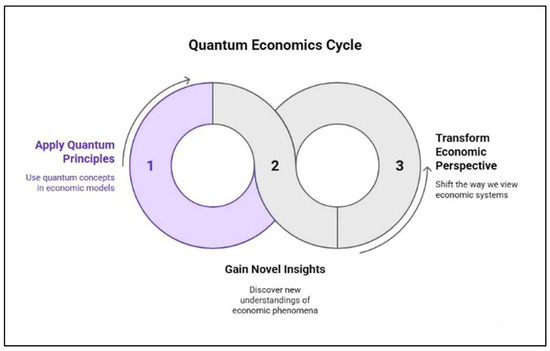
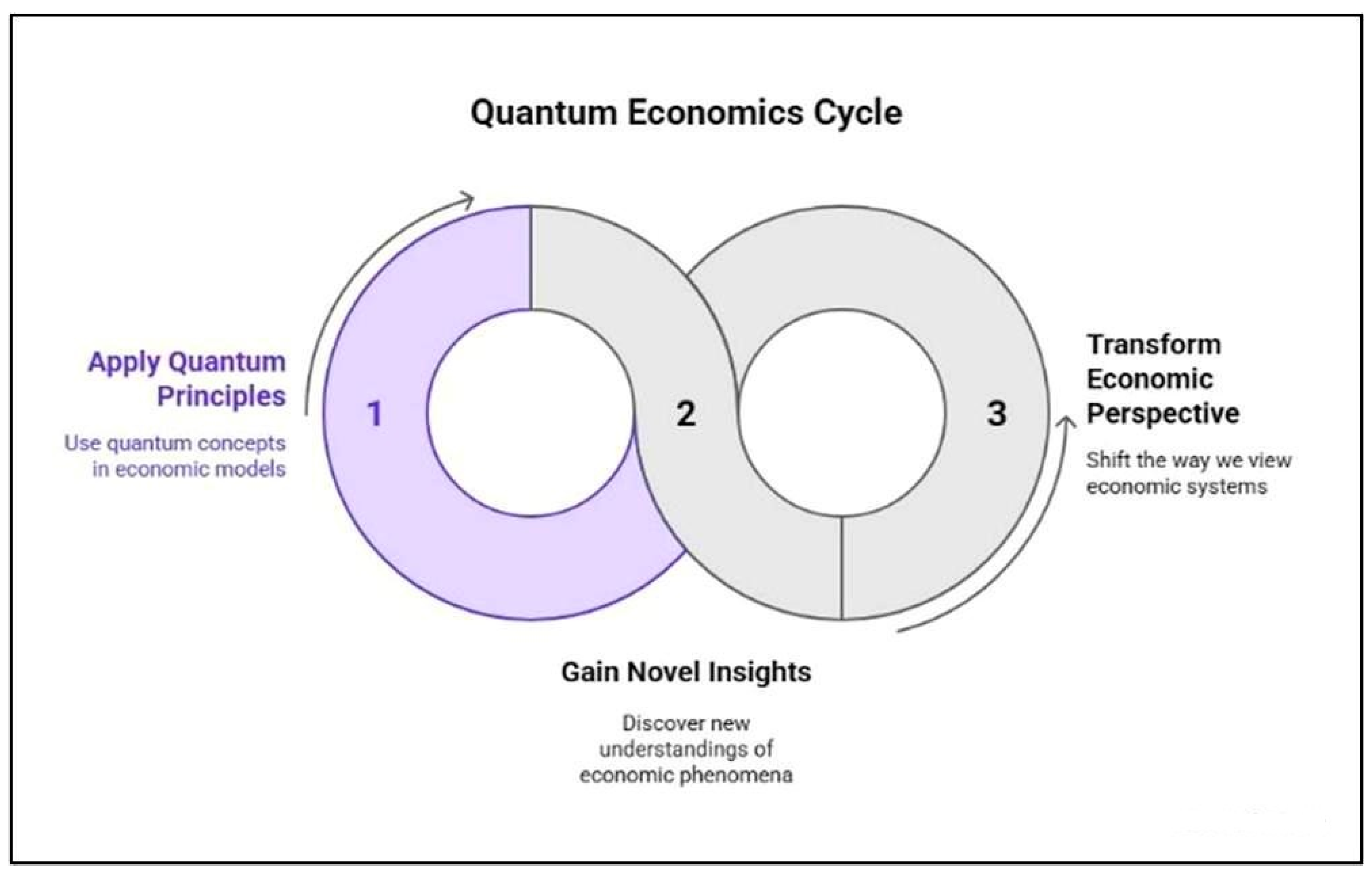
According to mathematician and author David Orrell, quantum models that can be useful in describing very small physical processes are also useful in studying the flow and cycle of information to derive insights in economics as depicted in the three stages of Figure 1, constituting a new paradigm and tool for understanding the behavior of some system in non-conventional ways (see Swayne, 2024). For instance, a variety of financial problems ranging from working with prices for down-and-out barrier options to managing Value at Risk (VaR) investment portfolios are usually formulated to be addressed through Monte Carlo methods, which require running a number of simulations that consider different probabilities. On the other hand, a Quantum Amplitude Estimation (QAE) offers an alternative that codifies the quantities to estimate amplitudes of a quantum state, employing amplification operators in order to accelerate convergence (Stamatopoulos et al., 2020).
Figure 1.
Quantum economics paradigm. Note: 1 = First stage; 2 = Second stage; 3 = Third stage (Elaborated in Napkin AI).
The recent literature underscores the way that quantum computing is revolutionizing financial modeling methods to reduce the overreliance and burden on complex calculations such as Monte Carlo. The work of Zhou (2025) demonstrates that quantum-based algorithms are able to reduce up to four times the sample size required by classical methods, reflected as a substantial improvement in efficiency and accuracy when performing VaR and Conditional Value at Risk (CVaR) calculations. According to Zhou (2025), such gains in efficiency are attributed to the use of QAE and the Grover algorithm1, leading to the maximization of amplitude states with greater success probability in financial scenarios. This integration constitutes a major, solid methodological contribution in developing predictive models in quantum-based finances.
Wilkens and Moorhouse (2023) further build on the implementation of quantum-inspired approaches to financial risk measurement frameworks. Their investigation purports that, despite some technical limitations in hardware to process quantum-related algorithms, the conceptual advances are solid and may serve as the basis for developing practical applications and solutions. In their analysis, Wilkens and Moorhouse (2023) apply QAE schemes and scenario simulations to calculate VaR and potential future exposure risk measures, yielding feasible results derived from small-scale tests. However, the scalability and precision of quantum-based systems represent clear, fundamental advantages in terms of converting theoretical concepts into operational, actionable solutions in financial institutions. In this respect, the adoption of combined, hybrid architectures (quantum-based and classic models) will likely be a key approach in the progressive transition towards a more efficient, coherent measurement of risk (Wilkens & Moorhouse, 2023).
Another growing stream of empirical research has focused on models that blend machine learning and quantum computing. Manjunath et al. (2023) proposed a hybrid model to examine Nifty 50 index stock market trends in India, integrating automatic machine learning models with quantum finances. Their study provides evidence that combining classic machine learning frameworks with quantum processing yields improved performance to detect non-linear patterns and accurately predict stock market trends. Manjunath et al. (2023) show that employing quantum algorithms not only reduces the time required for model training but also makes it possible to extend and generalize the implementation of financial modeling by exploring more ample spaces of probabilistic solutions. In this way, the investigation is innovative by advancing a practical simulation methodology that can be replicated with different indexes in other financial sectors.
In her research elaborated for the Bank of Spain, López-Chamorro (2024) elaborates on an institutional vision of the challenges and opportunities for which quantum-based methods have implications on financial systems. The study highlights that, although quantum computing power (e.g., hardware) is largely in developing stages, the potential to transform the sector could alter the current encryption mechanisms and financial data management—which is also relevant in terms of other post-quantum cryptographic approaches. According to López-Chamorro (2024), transitioning towards an increasingly quantum-based financial system will be enabled not only by technological innovations but also through a solid coordination of entities at the international level that lead to a safe, organized migration under rigorous, strict standards of digital security.
In summary, the field of quantum-based financial applications appears to be advancing in a two-fold direction: one stream is moving towards improving computing capabilities and perfecting quantum algorithms to be employed for optimization and financial risk models, while another path aims to integrate such models into real-world economic and financial systems. Extant research suggests that methodologies mirroring quantum principles not only offer important advantages for data processing and analysis but also could reshape our understanding of how economic variables are interrelated by introducing new frameworks in which superposition, probabilities, and coherence may replace traditional notions of deterministic equilibrium. As such, a case pertaining to the application of these concepts for solving problems related to tax collections from foreign trade is illustrated next.
Application on Tax Collections from Foreign Trade in Mexico
For most of the second half of the twentieth century, Mexico’s economic and financial system remained under a protectionist, nationalistic-oriented policy of imports substitution (López-Pérez & Vence, 2021; Soederberg, 2005; Uhthoff-López, 2005). However, the country’s foreign trade activities have steadily increased in recent decades—particularly since the implementation of the North American Free Trade Agreement (NAFTA) in 1994, and its replacement, the United States–Mexico–Canada Agreement (USCMA) in 2020—representing an important source of tax revenue for the country’s public finances (Valencia-Romero et al., 2023). Fiscal records from the federal government’s National Customs Agency (NCA) provide an opportunity to analyze tax collections derived from import operations using a quantum-based method in relation to forecasting tax compositions. This is particularly relevant and timely for the purpose of this research in light of the current discussion of a proposed fiscal reform aiming to adjust the Special Tax on Production and Services (STPS), which would not directly modify the number of taxpayer entities domestically but could impact the collection of other taxes for products imported into the country, such as the Value Added Tax (VAT) and the General Import Tariff (GIT) (Díaz, 2025). In this respect, the expectation of tax contributions under different scenarios of STPS rates can be effectively estimated by employing principles inspired by quantum mechanics.
The classification of tax and tariffs for specific merchandise is determined through a standardized nomenclature process. These customs codes are based on an internationally agreed Harmonized System (HS) developed and administered by the World Customs Organization (WCO) and serve as the reference framework for identifying and establishing taxes and tariffs that are imposed on import–export transactions between most countries. The HS systematically groups products according to the 21 sections depending on their general categories (e.g., minerals, manufactured articles, vegetable products, live animals, chemicals, etc.), which, in turn, are organized in a six-digit code structure depending on the specificity of product characteristics as shown in Table 1 (World Customs Organization, 2023).
Table 1.
Customs codes and standardization structure.
While the HS standardized code rules provide a common baseline for the categorization of import operations, each country can incorporate additional digits to the codes in order to address specific circumstances or context needs or to do a more precise classification of merchandise. For example, Mexico has added two more digits to comply with a federal government directive for tax collection purposes (Congreso de la Unión, 2025). In this case, the eight-digit code, known as fracción arancelaria, represents the tariff classification fraction that enables customs brokers and government agents to determine the taxes to be paid by importers. The accurate classification of products is not only important as a mechanism to reduce obstacles in foreign trade operations but also to facilitate crucial functions such as compliance with commercial agreements, prevention of sanctions (e.g., fines, product confiscation), and other non-tariff regulations (e.g., licenses, permissions, certifications, technical norms).
Specifically in the case of foreign trade operations in Mexico, importing products into the country does not only require payment of one single, flat tax imposed on all product categories, making it difficult to anticipate projections of tax revenues, which depend on the types of goods to be imported. According to the applicable Mexican regulatory framework, each product is subject to a particular combination of taxes levied depending on the specific characteristics, purpose, and final destination (Macías, 2025). For instance, introducing alcoholic beverages or soft drinks into the country requires that importers pay a General Import Tariff (GIT) but also a Special Tax on Production and Services (STPS) based on their ingredients and/or content (e.g., percentage of alcohol concentration) because they are considered by Mexican law as non-essential products with harmful health consequences on consumers. On top of those taxes, importers must be charged the Value Added Tax (VAT) that generally applies to commercial transactions in which a sale takes place.
Similarly, importing new automobiles into Mexico requires payment of the GIT and VAT, plus a special Tax on New Automobiles (TNA) that is imposed on vehicles that are permanently introduced to the country for sale to final customers (Ortíz, 2025). This set of rules illustrates the integral logic of the national fiscal system that aims not only to collect taxes and tariffs but also to incentivize the purchase of products in certain sectors while discouraging the consumption of others. As a consequence, the complex regulatory structure and challenge for estimating simultaneous tax payments from import operations throughout the country’s customs network call for the exploration of methodological approaches that take into account the dynamic, non-static interrelations between various taxes. In the context of the current political and economic discussions in Mexico around a proposed fiscal reform to substantially increase the existing rates of some particular types of taxes, it is uncertain the impact that such modifications would have on revenues from other taxes and tariffs that depend on the collection of the former.
The existing literature on forecasting and estimations of future tax revenues focused on the case of foreign trade in Mexico is scarce. Published research, such as that by Juárez-Montiel and Hernández-Veleros (2023), Fonseca and Ventosa-Santaulària (2011), and Cárdenas et al. (2008), examines general taxes that are not specific to international or foreign trade, and the work by Reyes-Loya and Blanco (2008) relates to revenues derived from export, not import, operations. Some authors have investigated tax and tariff collections from a historical perspective (see López-Pérez & Vence, 2021; Rodríguez-Benavides & Venegas-Martínez, 2011; and Uhthoff-López, 2005), while others have examined the ex post effects of tax reforms previously implemented (see Aguilar-Gutiérrez & Lagunas-Puls, 2017; Lagunas-Puls & Almeida-Baeza, 2021; and Lagunas-Puls & Ramírez-Pacheco, 2016). Only Moreno-Espinosa et al. (2023) estimated the elasticities of VAT collections on imports, finding relationships that can aid in the forecasting of import-related revenues. However, despite the key contribution and insights of the study, its scope focused mostly on the analysis of elasticities, required multi-year data with records across dozens of product classifications, and cannot be directly applied to anticipate tax collections that would depend on potential new policy changes. Thus, the development and application of a methodology inspired in quantum principles for these types of cases are presented next.
3. Methodology
The analysis presented here is based on real values (Mexican pesos converted to US dollars) retrieved from Mexico’s federal government official database (National Customs Agency, 2025), which generates data of recorded tax collections. A summary of the data employed for the analysis is shown in Table 2, corresponding to the period from January to August of 2025 (the most recent available month), broken down by type of tax, and including the contribution (%) to the overall tax collections obtained from foreign trade activities.
Table 2.
Foreign trade tax collections: January–August 2025.
As noted before, the implementation of Mexico’s fiscal policy and tax collection operationalization is highly complex (Centro de Estudios de las Finanzas Públicas, 2018). The taxable base for each operation is related to the composition, origin, use, and destination of the imported goods as well as any preferential treatment derived from trade agreements with other countries (Estrada, 2025). An analysis of each specific, individual transaction in a given custom would fully identify and determine the applicable tax and non-tariff import requirements on a small scale. However, for the analysis of hundreds, thousands, or millions of operations for transactions recorded over a period of time across the country’s customs network, a quantum-based analytical approach is a feasible alternative to estimate superposition states.
Superposition states are among the fundamental concepts of quantum mechanics (Holtfort, 2023). Applied to economics and finances, superposition states can be represented by the events or transactions performed by economic agents (Orrell, 2021; Orrell & Houshmand, 2022), such as the interactions between importers, exporters, and customs, in which taxes and tariffs are assessed and paid simultaneously. For instance, the import of alcoholic beverages into Mexico involves the collection of VAT, STPS, and CPF taxes, while importing a different product like a new automobile requires payment of VAT, STPS, and TNA taxes, which are shown in Table 2.
A second major theoretical concept in quantum mechanics is amplitude, which is the combination of distinct states for a single event under study (Kanishk & Kathiravan, 2025). In economic and financial phenomena, amplitudes can be represented by the likelihood, intensity, or preference of an occurrence, such as the collection of a tax or tariff (Herzog, 2015).
In this way, the proposed quantum-based method is applied to the case of estimating the expected composition of tax collections contingent on potential variations in STPS rates (to be determined by Mexico’s government) that would impact the contribution of VAT and GIT as described previously. Based on data summarized in Table 2, the collection of tax and tariffs in excess of USD 5,000,000 (thousands) corresponding to VAT, STPS, and GIT was selected for the analysis, since they represent substantial contributions of no less than 10%. Thus, the contributions of the different types of tax collected represent the probability vectors, where
Consistent with a quantum-based approach, amplitudes are determined as
Thus, the vector or normalized quantum state is
Next, a perturbation operator with rotations is introduced as a way to simulate the following effects: the increased, stricter custom inspection of import operations implemented due to closer information exchange between the National Customs Agency of Mexico and the Tax Administration Service, the elasticities in demand for some product categories levied with special taxes, and the greater collection of GIT as a result of tariff rate adjustments on products coming from certain countries in the context of political pressures from the Trump administration (e.g., higher tariffs on imports from China).
Taking as a reference recent fiscal changes in Mexico, which raised the STPS rate on soft drinks and tobacco products (Sanciprián, 2025), the following rotations for imposed taxes are performed:
(VAT, STPS) with greater amplitude or contribution transferred from VAT to STPS;
(STPS, GIT) with greater amplitude or contribution transferred from GIT to STPS.
In order to estimate the effects for the next year, 2026, conservative (lower) simulation angles could be selected assuming a plane with two dimensions, which would yield the following rotation matrix:
However, because this case involves three types of taxes (VAT, STPS, GIT), a third fixed dimension is incorporated, obtaining the following rotation matrices:
Following Zingoni et al. (2018) and Evans (2001), the reason to employ sines and cosines is that, together, they constitute functions able to wave while maintaining a vector’s magnitude and coherence but do not deform its components and orthogonality. For the purpose of this study, both are capable of harmoniously redistributing the tax contributions by acquiring greater or smaller amplitudes (Theta values θ). These functions are set up based on a classical geometric principle through which a figure is rotated in such a way that, as applied to this research, the figure’s elements represent the taxes, while the functions (cos or sin) indicate the magnitude of transfers from one tax to another. For instance, a rotation of VAT to STPS would lead us to examine how much of the VAT remains and how much is transferred towards STPS. In this case, cosθ corresponds to the portion of the vector that is kept unmodified. Thus, a small value of 0.01 conveys a “small” spinning movement, indicating a slight shift from VAT to STPS, while a greater value would represent a higher proportion transferred from VAT towards STPS. On the other hand, the role of function sinθ is equivalent to the portion that STPS receives from VAT. Thus, negative signs are used to denote the redistribution in tax collections explained by what is being transferred (and received) under each assumption. Based on Zingoni et al. (2018), this is due to the mathematical principle of rotation of planes:
Obtained through
For the objective of this procedure, the total tax collection remains the same but is redistributed in different proportions of individual taxes. Therefore, it is necessary to estimate , which is obtained by multiplying matrices (6) and (7):
Expectations for the Composition of Tax Collections
Assuming that a decision by Mexico’s government to modify future tax rates through a fiscal reform produces adjustments of a different magnitude in the collection of STPS taxes without increasing the taxpayer base, it is useful to lay out a number of distinct, potential scenarios of tax revenues derived from foreign trade activities. Therefore, different values of quantum rotation are taken into account: .
For the amplitude in relation to the VAT–STPS plane:
For the amplitude in relation to the STPS–GIT plane,
For all the following scenarios, consider
4. Results
Based on the proposed methodology, Table 3 shows the increases and decreases (rotations) for and , representing the extent to which potential levels of adjustments in a fiscal reform may impact the expected composition (of contributions) for each of the scenarios estimated for 2026. In this exercise, scenario 1 represents the baseline of tax collections as of August 2025, and scenarios 2 through 10 are interpreted as gradual increases in STPS collected in relation to the other taxes—consistent with the proposed fiscal reform that focuses on STPS as a way to enhance tax revenues. Because the fiscal reform does not consider any measure to expand the number of taxpayers, the scenarios redistribute the contribution of tax and tariff collections.
Table 3.
Scenarios for expected compositions of Mexico’s tax collections from import operations.
In inspecting the percentage changes under each tax type across the ten scenarios in Table 3, a general pattern is observed as potential outcomes taking, as a reference, the baseline scenario: while the contribution of STPS tends to increase, the contributions of VAT and the GIT tend to decrease. This model permits us to estimate the potential outcomes derived from changes in the STPS tax collection that would eventually impact the composition of other types of taxes and tariffs that depend on the rate of the former.
4.1. Model Validation
An analysis was performed using the tax collection composition as of April 2025, shown in Table 4, instead of August 2025 in order to identify an adjustment of the quantum-based model by employing a different time period (only the first four months of the year).
Table 4.
Foreign trade tax collections: January–April 2025.
Hence, based on the contribution of each type of tax in relation to the total tax collection depicted in Table 4,
According to the quantum-based approach, amplitudes are determined as
Therefore, the vector or normalized quantum state for April 2025 is
The structure or model (11) is employed, substituting the vector values:
Trials are conducted then by modifying radian values as follows:
Taking into consideration that the proposed fiscal reform in Mexico is aimed at increasing tax revenues by means of STPS collection, this model (16) is then utilized to find the θ value that is required to meet the real, observed tax collection of August 2025. In other words, the value identified based on the prior four-month period suggests the future composition for the next four-month period, which establishes the precision of the quantum-based method. As seen in Table 5, in this case, the result displaying the composition closest to the benchmark is scenario 4 (in bold font), with a θ value of 0.03.
Table 5.
Scenarios based on the April 2025 vector for verification of August 2025 compositions.
Furthermore, in comparing the observed (real) composition vs. the expected (quantum-based approach) composition, when , the estimation accuracy for the specific STPS contribution indicates total coincidence (100%), while the average for the contributions of the three types of taxes in general is high (94.13% in average), as shown in Table 6.
Table 6.
Comparison between the observed and expected tax collection compositions.
4.2. Estimation of Future Tax Collection Revenues
As discussed previously, by changing vector values that multiply the operator (8), it is possible to project future expectations. In the estimation of absolute (not relative) amounts of tax collections for 2026, these are not to be normalized to 100%. Therefore, the most recent known tax revenue values should be considered in the vector that multiplies the operator U. For example, using the official records of tax and tariff collections from January to August 2025 in Mexico (National Customs Agency, 2025), the corresponding cummulative absolute amounts for January to August 2026 can be anticipated as follows:
As illustrated in Table 7, according to the scenarios developed in this study based on the fiscal reform proposed in Mexico, the collection of STPS from foreign trade operations from January to August 2026 would increase by approximately USD 1,151,938 (thousands US dollars) in comparison to the same period of 2025, considering the overall demand will tend to be inelastic. However, the total revenues (from the three types of taxes in general) would only be increased by approximately USD 644,438 (thousands US dollars) due to the Mexican government’s emphasis on collecting STPS, which is expected to have negative impacts on the collection of GIT and VAT from other products and merchandise—as a result of reduced imports as demonstrated here through the quantum-based methodology in which tax compositions are redistributed.
Table 7.
Anticipated, cumulative tax collection revenues: January–August 2026.
5. Discussion
The body of knowledge in the field shows that typical forecasting methods (either reduced-form or structural models) can be applicable to anticipate future tax and tariffs derived from international trade, but they do not facilitate the estimation of scenarios incorporating new policy changes as is often required in public finance management. In this respect, the analysis performed in this research demonstrated that quantum-inspired approaches are able to lay out innovative, useful models to study potential dynamic scenarios that could result from the implementation of an eventual fiscal reform focused on taxation of imports into Mexico—a developing country with intensive foreign trade activities for which scant empirical works in forecasting are found in the literature. Therefore, a major theoretical contribution of this investigation’s proposal is the adoption of principles originating in physics—superposition, interference, coherence—that are transferable to economics and finances to represent interactions between different tax and tariff types in a more natural, realistic way. Unlike traditional models approaching VAT, GIT, and STPS as independent, disconnected variables, the methodology presented here conceives them as intertwined states under a fiscal framework evolving as a function of public policy, regulatory changes, and the overall conditions of international trade.
The evidence observed from the simulation of scenarios suggests that the relation between the elements of the compositions is not linear nor isolated. In particular, the scenarios generated through angular rotations yield variations that, though apparently minimal in degree, may significantly alter the contributions from tax collections in foreign trade activities. The finding points out the need to implement methodological perspectives that acknowledge the interdependent environment in which fiscal systems operate, which is the case in Mexico. As demonstrated in the research results, a proposal for higher STPS rates is unlikely to produce proportional increases in the STPS contributions, which would instead indirectly impact the relative contributions of VAT and GIT by shifting the general equilibrium of tax compositions derived from imports.
From a methodological standpoint, the proposed quantum-based model offers four outstanding advantages. First, its implementation does not necessitate long time-series or historical data, which may need to be seasonally adjusted and often excludes or includes observations that distort estimations. Second, it allows the representation of multiple possible configurations of tax collections in a simultaneous way without losing the system’s global coherence. Third, it provides a formal framework to analyze perturbations or changes in fiscal policy through unitary operators that facilitate the simulation of expected scenarios without reliance on rigid assumptions. Fourth, it contributes to diminishing the deterministic biases in traditional models, incorporating the notion of quantum probabilities that recognize the coexistence of different potential outcomes before actually observing and measuring them. As referred before, classical econometric models tend to focus on determining statistical significance after a policy change has taken place (e.g., fiscal reform), so the proposed methodology can serve as an ex ante complement to lineal models.
From a practical standpoint, the methodology’s application to the case of Mexico’s expected tax and tariff collections based on 2025 data corroborates the STPS tendency to gain relative contributions as rotation angles become greater, consistent with the purported goals of the federal government’s economic policy. However, this effect does not occur in isolation to other taxes: the greater the SPTS contribution, the smaller the participation of VAT and GIT contributions—although the effect on the latter is moderate. In other words, this quantum-based method offers a useful, actionable approach to anticipate changes in the structure of tax collections that can serve as a strategic diagnostic tool for fiscal planning solutions. For instance, public administrators and government officials in charge of financial decisions would benefit from realizing the expected contribution of each of the taxes and tariff types, which could be projected from relative values (percentages) to actual, absolute revenues for budgeting purposes.
Conceptually, the advancement of quantum-inspired methods provides a platform for rethinking the role of estimations and forecasting for fiscal and public financial management. This view is especially relevant for the context of countries like Mexico, which is highly dependent on foreign trade activities and subject to external influences (e.g., commercial partners, market conditions) as well as internal factors (e.g., political agendas and priorities, regulatory decisions), making the analysis of scenarios a challenging task. Thus, implementing a quantum-based approach serves as a bridge that can link the gap between economic theory and public administration when the objective is to evaluate the feasibility of expectations regarding consequences of a potential fiscal reform before it takes place or goes into effect, as shown in this study.
6. Concluding Remarks
Worldwide uncertainty in trade policy changes resulting from trade wars affects economic activity, investment, and expectations, which, in turn, complicates the forecasting of government revenues (Caldara et al., 2020; Kyriazis, 2021). This represents an issue in the realm of finance, since the discipline pertains to the study of how governments—not only private organizations, businesses, or individuals—acquire money and funds to manage through budgeting and financial planning processes (Bandy, 2023; Melicher & Norton, 2019), which can be addressed and supported by means of the quantum-based approach to anticipate tax revenue compositions from foreign trade. In line with that, the insights provided through this investigation affirm that applying quantum-based principles to the estimation of future revenue compositions in public finances is not only viable but also worth pursuing given the advantages shown in this research. This is particularly relevant given that the existing, traditional methods do not easily permit anticipating the impacts of proposed or new fiscal reforms on tax collections in the way that the presented quantum-based method does. Although greater technical capabilities are still necessary to fully realize the operational implementation in terms of sophistication of computing processing, the modeling approach developed here demonstrated its capacity to capture the inherent complexity of fiscal rules in relation to taxation on import transactions in countries with systems similar to Mexico. Therefore, the integration of tenets in quantum physics and economic phenomena should not be seen as a metaphor but as an innovative, yet rigorous mathematical framework that is making possible the advancement towards analytical models with greater sensitivity, coherence, and adaptiveness.
A limitation of this work is that the proposed technique depends on employing government-generated records that are often modified and/or corrected over time and, thus, would need monitoring and adjustments in order to conduct new matrix rotations. Additionally, its implementation may require solid, strong assumptions about rational expectations regarding policy changes. Future investigations should be oriented to developing proposals that expand the scope of conceptual applications and problem solving within the realm of quantum-based analysis or to supplementing this methodology in terms of managerial and practical implications. For instance, further research could explore empirical frameworks or techniques to connect the adjustments in expected tax contributions illustrated in this work with projected revenues from the different types of taxes and tariffs for planning purposes. In this regard, the advent of large language models and machine learning tools can represent a promising avenue of research in developing further quantum-based method refinements (Boobier, 2022; Simonov & Gligorov, 2021).
Author Contributions
Conceptualization, S.L.-P.; methodology, S.L.-P.; software, S.L.-P.; validation, S.L.-P.; formal analysis, S.L.-P.; investigation, S.L.-P. and O.C.-M.; resources, S.L.-P. and O.C.-M.; data curation, S.L.-P.; writing—original draft preparation, S.L.-P. and O.C.-M.; writing—review and editing, S.L.-P. and O.C.-M.; visualization, S.L.-P. and O.C.-M.; supervision, S.L.-P. and O.C.-M.; project administration, S.L.-P. and O.C.-M. All authors have read and agreed to the published version of the manuscript.
Funding
The APC was funded by the Texas A&M University-Corpus Christi’s Open Access Publication Fund.
Institutional Review Board Statement
Not applicable.
Informed Consent Statement
Not applicable.
Data Availability Statement
Publicly available reports by the Mexican government used for the analysis can be found at https://www.anam.gob.mx (accessed on 25 October 2025).
Conflicts of Interest
The authors declare no conflicts of interest.
Abbreviations
The following abbreviations are used in this manuscript:
| STPS | Special Tax on Production and Services |
| GIT | General Import Tariff |
| VAT | Value Added Tax |
| VaR | Value at Risk |
| CVaR | Conditional Value at Risk |
| QAE | Quantum Amplitude Estimation |
| NAFTA | North American Free Trade Agreement |
| USCMA | United States–Mexico–Canada Agreement |
| NCA | National Customs Agency |
| HS | Harmonized System |
| WCO | World Customs Organization |
| TNA | Tax on New Automobiles |
| CPF | Custom Processing Fee |
Note
| 1 | The Grover algorithm is a crucial solution to solve problems related to unstructured searches and is established as an essential quantum subroutine in various complex algorithms (Sun & Wu, 2024). |
References
- Aguilar-Gutiérrez, G., & Lagunas-Puls, S. (2017). ¿Resultados positivos con la reforma fiscal de México en 2014? Revista Punto de Vista, 7(11), 101–116. [Google Scholar] [CrossRef] [Scilit]
- Anthony, M., & Biggs, N. (2024). Mathematics for economics and finance (2nd ed.). Cambridge University Press. [Google Scholar]
- Auerbach, A. J. (1999). On the performance and use of government revenue forecasts. National Tax Journal, 52(4), 767–782. [Google Scholar] [CrossRef] [Scilit]
- Bandy, G. (2023). Financial management and accounting in the public sector (3rd ed.). Routledge. [Google Scholar]
- Baunsgaard, T., & Keen, M. (2010). Tax revenue and (or?) trade liberalization. Journal of Public Economics, 94(9–10), 563–577. [Google Scholar] [CrossRef] [Scilit]
- Boobier, T. (2022). AI and the future of the public sector: The creation of public sector 4.0 (1st ed.). Wiley Finance. [Google Scholar]
- Bouët, A., Sall, L. M., & Zheng, Y. (2025). Towards a trade war in 2025: Real threats for the world economy, false promises for the US (CEPII Working Paper No. 2025-03-February). Centre d’Études Prospectives et d’Informations Internationales.
- Cai, Z., & Li, J. (2025). Econometric evaluation of the China–US trade war effects. China Economic Review, 94, 102567. [Google Scholar] [CrossRef] [Scilit]
- Caldara, D., Iacoviello, M., Molligo, P., Prestipino, A., & Raffo, A. (2020). The economic effects of trade policy uncertainty. Journal of Monetary Economics, 109, 38–59. [Google Scholar] [CrossRef] [Scilit]
- Cárdenas, Ó., Ventosa-Santaulària, D., & Gómez, M. (2008). Elasticidad ingreso de los impuestos federales en México. Efectos en la recaudación federal participable. El Trimestre Económico, 75(298), 519–531. Available online: https://www.redalyc.org/pdf/313/31340955009.pdf (accessed on 12 December 2025). [CrossRef] [Scilit]
- Centro de Estudios de las Finanzas Públicas. (2018). Régimen aduanero y excepciones en materia de. Congreso de la Unión. Available online: https://www.cefp.gob.mx/publicaciones/nota/2018/notacefp0262018.pdf (accessed on 25 October 2025).
- Clarke, J. (2025, November 5). What tariffs has Trump announced and why? BBC News. Available online: https://www.bbc.com/news/articles/cn93e12rypgo (accessed on 14 December 2025).
- Congreso de la Unión. (2025). Ley de los impuestos generales de importación y exportación. Congreso de la Unión. Available online: https://mexico.justia.com/federales/leyes/ley-de-los-impuestos-generales-de-importacion-y-de-exportacion/ (accessed on 23 November 2025).
- Díaz, S. (2025, July 24). En los hechos, ya hay una reforma fiscal en México: Instituto Mexicano Contadores Públicos. El Economista. Available online: https://www.eleconomista.com.mx/economia/hechos-hay-reforma-fiscal-mexico-instituto-mexicano-contadores-publicos-20250724-769700.html (accessed on 5 November 2025).
- Estrada, G. (2025, September 12). Alcances de la reforma a la Ley de Aduanas. Radio Educación. Available online: https://youtu.be/9rHMvy5AhL8 (accessed on 10 November 2025).
- Evans, P. R. (2001). Rotations and rotation matrices. Biological Crystallography, 57(10), 1355–1359. [Google Scholar] [CrossRef] [Scilit]
- Fonseca, F. J., & Ventosa-Santaulària, D. (2011). Revenue elasticity of the main federal taxes in Mexico. Latin American Journal of Economics, 48(1), 89–111. [Google Scholar]
- Gnangnon, S. K., & Brun, J. F. (2019). Trade openness, tax reform and tax revenue in developing countries. The World Economy, 42(12), 3515–3536. [Google Scholar] [CrossRef] [Scilit]
- Herzog, B. (2015). Quantum model of decision-making in economics. Journal of Quantum Information Science, 5, 1–5. [Google Scholar] [CrossRef]
- Holtfort, T. H. (2023). Social science goes quantum: Explaining human decision-making, cognitive biases and Darwinian selection from a quantum perspective. Journal of Bioeconomics, 25(2), 99–116. [Google Scholar] [CrossRef] [Scilit]
- Jayakumar, D., & Selvaraj, S. (2023). Revolutionizing financial services with quantum machine learning techniques. Semarak International Journal of Machine Learning, 3(1), 1–10. [Google Scholar] [CrossRef] [Scilit]
- Jochimsen, B., & Lehmann, R. (2015). On the political economy of national tax revenue forecasts (Ifo Working Paper No. 198). Leibniz Institute for Economic Research at the University of Munich. [Google Scholar]
- Juárez-Montiel, S. Y., & Hernández-Veleros, Z. S. (2023). Dynamics of tax collection in Mexico during January 2018–February 2022. Journal of Administrative Science, 4(8), 22–28. [Google Scholar] [CrossRef] [Scilit]
- Kanishk, B., & Kathiravan, S. (2025). Quantum inspired qubit qutrit neural networks for real time financial forecasting. Scientific Reports, 15(1), 28711. [Google Scholar] [CrossRef] [Scilit]
- Kyriazis, N. A. (2021). Trade policy uncertainty effects on macro economy and financial markets: An integrated survey and empirical investigation. Journal of Risk and Financial Management, 14(1), 41. [Google Scholar] [CrossRef] [Scilit]
- Lagunas-Puls, S., & Almeida-Baeza, A. (2021). Significance analysis to the Value-Added Tax increments for the border region of: Quintana Roo, 2003–2015. EconoQuantum, 16(2), 43–64. [Google Scholar] [CrossRef] [Scilit]
- Lagunas-Puls, S., & Ramírez-Pacheco, J. C. (2016). ¿Pueden considerarse significativas las reformas fiscales de México? Revista de Métodos Cuantitativos Para La Economía y La Empresa, 22, 78–103. [Google Scholar] [CrossRef] [Scilit]
- Leal, T., Pérez, J. J., Tujula, M., & Vidal, J. P. (2008). Fiscal forecasting: Lessons from the literature and challenges. Fiscal Studies, 29(3), 347–386. [Google Scholar] [CrossRef] [Scilit]
- López-Chamorro, N. (2024). El camino hacia la supremacía cuántica: Oportunidades y desafíos en el ámbito financiero, la nueva generación de criptografía resiliente. Banco de España. [Google Scholar] [CrossRef] [Scilit]
- López-Pérez, S. J., & Vence, X. (2021). Estructura y evolución de ingresos tributarios y beneficios fiscales en México. Análisis del periodo 1990–2019 y evaluación de la reforma fiscal de 2014. El Trimestre Económico, 88, 350. [Google Scholar] [CrossRef] [Scilit]
- Macías, M. (2025). IVA e IEPS: Visitas de verificación para empresas IMMEX. Veritas. Available online: https://www.veritas.org.mx/Impuestos/Comercio-exterior/IVA-e-IEPS-visitas-de-verificacion-para-empresas-IMMEX (accessed on 16 November 2025).
- Manjunath, C., Marimuthu, B., & Ghosh, B. (2023). Analysis of nifty 50 index stock market trends using hybrid machine learning model in quantum finance. International Journal of Electrical and Computer Engineering, 13(3), 3549–3560. [Google Scholar] [CrossRef] [Scilit]
- Melicher, R. W., & Norton, E. A. (2019). Introduction to finance: Markets, investments, and financial management (17th ed.). Wiley. [Google Scholar]
- Moreno-Espinosa, J., Mata-Mata, L., & Beltrán-Godoy, J. H. (2023). VAT elasticities on imports as a lever to forecast collection: Mexico 2010–2021. In E. Murillo, P. R. Morganti, & J. Moreno-Espinosa (Eds.), Creating economic stability amid global uncertainty: Post-Pandemic recovery in Mexico’s emerging economy (pp. 115–139). Springer Nature Switzerland. [Google Scholar]
- Musgrave, R. A., & Muscrave, P. B. (1989). Public finance in theory and practice (5th ed.). McGraw-Hill College. [Google Scholar]
- National Customs Agency. (2025). Informe mensual de la agencia nacional de aduanas de México. Secretaría de Hacienda y Crédito Público. [Google Scholar]
- Orrell, D. (2021). A quantum walk model of financial options. Wilmott, 2021(112), 62–69. [Google Scholar] [CrossRef] [Scilit]
- Orrell, D., & Houshmand, M. (2022). Quantum propensity in economics. Frontiers in Artificial Intelligence, 4, 772294. [Google Scholar] [CrossRef] [Scilit]
- Ortíz, J. (2025). PAMA: Facultades de la autoridad aduanera y cómo enfrentarlas. Veritas. Available online: https://www.veritas.org.mx/Impuestos/Comercio-exterior/pama-facultades-de-la-autoridad-aduanera-y-como-enfrentarlas (accessed on 30 October 2025).
- Orús, R., Mugel, S., & Lizaso, E. (2019). Quantum computing for finance: Overview and prospects. Reviews in Physics, 4, 100028. [Google Scholar] [CrossRef] [Scilit]
- Reyes-Loya, M. L., & Blanco, L. (2008). Measuring the importance of oil-related revenues in total fiscal income for Mexico. Energy Economics, 30(5), 2552–2568. [Google Scholar] [CrossRef] [Scilit]
- Rodríguez-Benavides, D., & Venegas-Martínez, F. (2011). Efectos de las exportaciones en el crecimiento económico de México: Un análisis de cointegración, 1929–2009. EconoQuantum, 7(2), 55–71. [Google Scholar] [CrossRef] [Scilit]
- Sanciprián, E. (2025, October 14). Reforma fiscal 2026 avanza sin cambios en el Congreso. IDC. Available online: https://idconline.mx/fiscal-contable/2025/10/14/reforma-fiscal-2026-avanza-sin-cambios-en-el-congreso (accessed on 15 November 2025).
- Simonov, J., & Gligorov, Z. (2021). Customs revenues prediction using ensemble methods (statistical modelling vs machine learning). World Customs Journal, 15(2), 111–128. Available online: https://www.worldcustomsjournal.org/article/116452-customs-revenues-prediction-using-ensemble-methods-statistical-modelling-vs-machine-learning (accessed on 11 December 2025). [CrossRef] [Scilit]
- Soederberg, S. (2005). The rise of neoliberalism in Mexico: From a developmental to a competition state. In S. Soederberg, G. Menz, & P. G. Cerny (Eds.), Internalizing globalization: The rise of neoliberalism and the decline of national varieties of capitalism (pp. 167–182). Palgrave Macmillan UK. [Google Scholar] [CrossRef] [Scilit]
- Stamatopoulos, N., Egger, D. J., Zoufal, C., Iten, R. S., & Woerner, S. (2020). Option pricing using quantum computers. Quantum, 4, 291. [Google Scholar] [CrossRef] [Scilit]
- Sun, Y., & Wu, L. (2024). Quantum search algorithm on weighted databases. Nature portfolio. [Google Scholar] [CrossRef] [Scilit]
- Swayne, M. (2024, April 12). Quantum economics: Could a new economic paradigm be guided by quantum models? Quantum Insider. Available online: https://thequantuminsider.com/2024/02/20/quantum-economics-could-a-new-economic-paradigm-be-guided-by-quantum-models/ (accessed on 2 November 2025).
- Uhthoff-López, L. M. (2005). Los impuestos al comercio exterior en México en la era de las exportaciones, 1872–1930. América Latina En La Historia Económica, 12(2), 5–36. Available online: https://alhe.mora.edu.mx/index.php/ALHE/article/view/362 (accessed on 11 December 2025). [CrossRef] [Scilit]
- University of Pennsylvania. (2025). Tariff simulator: Revenue and prices. University of Pennsylvania. Available online: https://budgetmodel.wharton.upenn.edu/our-model-0 (accessed on 14 December 2025).
- Valencia-Romero, R., Trejo-García, J. C., & Ríos-Bolívar, H. (2023). Wheat import demand in Mexico: Evidence of quantile cointegration. Agriculture, 13(5), 980. [Google Scholar] [CrossRef] [Scilit]
- Wang, X. (2006). Financial management in the public sector (3rd ed.). Routledge. [Google Scholar]
- Wilkens, S., & Moorhouse, J. (2023). Quantum computing for financial risk measurement. Quantum Information Processing, 22(1), 51. [Google Scholar] [CrossRef] [Scilit]
- World Customs Organization. (2023, October 18). Nomenclature and classification of goods. Available online: https://www.wcoomd.org/en/topics/nomenclature.aspx (accessed on 8 November 2025).
- Zhou, J. (2025). Quantum finance: Exploring the implications of quantum computing on financial models. Computational Economics, 1–30. [Google Scholar] [CrossRef] [Scilit]
- Zingoni, A., Diani, M., & Corsini, G. (2018). Dealing with rotation matrices and translation vectors in image-based applications: A tutorial. IEEE Aerospace and Electronic Systems Magazine, 34(2), 38–53. [Google Scholar] [CrossRef] [Scilit]

Disclaimer/Publisher’s Note: The statements, opinions and data contained in all publications are solely those of the individual author(s) and contributor(s) and not of MDPI and/or the editor(s). MDPI and/or the editor(s) disclaim responsibility for any injury to people or property resulting from any ideas, methods, instructions or products referred to in the content. |
© 2026 by the authors. Licensee MDPI, Basel, Switzerland. This article is an open access article distributed under the terms and conditions of the Creative Commons Attribution (CC BY) license.