


Abstract
Over-the-counter (OTC) medication overdose among young people is an increasing public-health concern, but the economic value of pharmacy-based prevention is unknown. We evaluated the potential cost-effectiveness of a brief community pharmacy intervention for high-risk young adult OTC purchasers in Japan. We developed an exploratory decision-tree model using quality-adjusted life-years (QALYs) to compare usual care with a 5–10 min pharmacist intervention for a hypothetical cohort of 1000 high-risk OTC purchasers aged 18–25 years. The model used a 1-year acute-care horizon and included discounted lifetime QALY loss from premature mortality. A recurrence multiplier was applied only to non-fatal outcomes; fatal outcomes were counted once. The base case assumed 50% intervention coverage, a relative risk (RR) of 0.70, and an annual overdose incidence of 0.5%. Deterministic, threshold, scenario, and probabilistic sensitivity analyses were performed. The intervention increased costs by JPY 609,204 and gained 0.234 QALYs, yielding an incremental cost-effectiveness ratio of JPY 2.60 million/QALY. Prevention of fatal outcomes accounted for 83.4% of the incremental QALYs. At JPY 5.0 million/QALY, cost-effectiveness required an RR of 0.833 or lower (≥16.7% risk reduction) or an annual overdose incidence of at least 0.278%. When mortality was unaffected, the ICER was JPY 15.79 million/QALY. The probabilities of cost-effectiveness at JPY 5.0 million/QALY were 75.1% under the primary intervention-effect distribution and 33.4% under a conservative distribution. The intervention may be cost-effective if it meaningfully reduces fatal as well as non-fatal overdoses. These exploratory findings are conditional on uncertain assumptions and require empirical validation.
1. Introduction
Overdose with over-the-counter (OTC) medications has recently been reported to be increasing among young people in many countries, including Japan [1,2,3]. In particular, overdose using easily accessible OTC products such as analgesics and cold remedies is often carried out as a form of suicide attempt or expression of suicidal ideation, and not infrequently requires emergency transportation, hospital admission, or even intensive care. In adolescence and young adulthood, overdose is of concern not only because of acute mortality and physical sequelae, but also because it may lead to long-term health loss and social consequences through disruption of schooling and employment and through recurrent episodes of self-poisoning [4,5].
Expectations toward community pharmacies and pharmacists as key professionals supporting the safe use of OTC medicines are increasing internationally. Among older adults, pharmacy-based interventions such as the “Senior Section,” which combines shelf reorganization of OTC products, improved warning labels, and staff training, have been shown to significantly reduce inappropriate use of high-risk OTC medications [6]. A large observational study from Finland reported that approximately 0.6% of OTC customers had drug-related problems, 87% of which were managed by pharmacist counseling, highlighting the importance of pharmacist intervention, particularly for “high-risk OTC” products such as analgesics [7]. Furthermore, demonstration projects that combine changes in pharmacy layout, clinical decision support tools, and pharmacist training to improve the safety of OTC use among older adults have been planned, reflecting growing interest in redesigning pharmacy systems to address OTC misuse and overuse [8]. A scoping review synthesizing such studies concluded that community pharmacists can intervene in analgesic (including opioid and OTC pain reliever) misuse through brief motivational interviewing, medication therapy management, naloxone education, and environmental changes, with education, training, environmental restructuring, and empowerment emerging as key intervention functions [9].
By contrast, economic evaluations of pharmacist interventions have largely focused on prescription medicines. An economic evaluation of pharmacist-led discharge counseling suggested that pharmacist intervention could improve clinical outcomes at a similar overall cost [10]. However, existing economic evaluations have generally focused on prescription medicines, and, to the best of our knowledge, virtually no studies have examined both the effectiveness and cost-effectiveness of pharmacy-based interventions that primarily target OTC misuse or overdose.
With respect to psychosocial interventions for suicide attempts and self-harm, systematic reviews and meta-analyses have reported that brief interventions and active follow-up in emergency departments and psychiatric inpatient settings can reduce the risk of repeat self-harm [11,12]. Some school-based suicide prevention programs have also demonstrated promising cost-effectiveness in economic evaluations [13]. However, to our knowledge, no studies have evaluated the effectiveness or cost-effectiveness of pharmacy-based interventions to prevent OTC overdose among young people. These hospital-based and non-pharmacy studies were used to inform plausibility only and do not provide direct evidence for the modeled intervention in young community-pharmacy customers.
Drug overdose is often a recurrent behavior rather than a one-off event [14]. Fatal overdose in adolescence or young adulthood may result in substantial lifetime health and economic losses [15,16], and even non-fatal overdose is expected to incur cumulative costs through repeated emergency visits, hospitalizations, and psychiatric follow-up. Therefore, it is important from a health resource perspective to evaluate low-cost, brief interventions delivered in community pharmacies to young people at high risk of OTC overdose.
The aim of this study was to construct a decision-analytic model based on the Japanese healthcare system and to evaluate the cost-effectiveness of a brief pharmacy-based intervention for young adults aged 18–25 years at high risk of OTC overdose, compared with usual care.
2. Materials and Methods
2.1. Study Design and Analytic Perspective
This study was an exploratory model-based cost-effectiveness analysis using QALYs as the health outcome measure and a decision-analytic framework based on the Japanese healthcare system. We simulated a hypothetical cohort of 1000 young adults aged 18–25 years at high risk of over-the-counter (OTC) medication overdose and compared “usual care” with “a brief pharmacy-based intervention.” The analysis adopted a Japanese healthcare sector perspective and included direct medical and intervention-delivery costs only; productivity losses and costs outside the healthcare sector were excluded. The design and reporting of this study were informed by the Consolidated Health Economic Evaluation Reporting Standards (CHEERS) [17]. No separate health economic analysis plan was developed or preregistered.
2.2. Target Population and Comparator Strategies
The target population was young adults aged 18–25 years whom community pharmacists could judge to be at high risk of OTC overdose at the time of purchase. We simulated a hypothetical cohort of 1000 such individuals, assuming that all of them purchased OTC medications at least once during the 1-year acute-care horizon. The economic evaluation was therefore conditional on membership in this modeled high-risk cohort; the accuracy, resource use, and cost-effectiveness of identifying high-risk purchasers from the broader OTC customer population were outside the scope of the model.
In the usual care strategy, no systematic intervention specifically targeting overdose risk was provided at the time of OTC purchase. In the intervention strategy, when a purchase pattern was judged to be high risk for overdose (e.g., large quantities, frequent purchases, or combinations of multiple OTC products), the pharmacist was assumed to deliver a brief intervention consisting of a 5–10 min interview, information on medication use and overdose risk, and referral to counseling services or medical care as needed. The modeled interview comprised confirmation of purchase purpose, intended dose and frequency, recent or concurrent use of products with overlapping ingredients, brief assessment of emotional distress and possible self-harm intent, risk communication, documentation, and referral. If imminent intentional self-harm was suspected, the modeled response was immediate connection to emergency medical or specialist mental-health services rather than routine counseling alone. The intervention was assumed to be delivered once per person per year in principle, while recognizing that some young adults might receive ongoing follow-up from a regular community pharmacist.
In this model, “high-risk” OTC purchasers were conceptualized as young adults who exhibited purchasing patterns or behaviors suggestive of overdose risk, such as repeated purchases of large quantities of analgesics or multi-ingredient cold medicines within a short period, simultaneous purchase of multiple OTC products with overlapping ingredients, or explicit statements of emotional distress (e.g., insomnia, severe stress, relationship problems). We assumed that such high-risk purchasers represent a small subset of all OTC customers, consistent with recent Japanese reports indicating that only a minority of young OTC users exhibit clear misuse or suicidal intent [1,2,18,19]. The annual overdose incidence of 0.005 was used as a scenario-based base-case value intended to represent an enriched-risk population compared with the general young adult population. Because empirical data on overdose incidence specifically among pharmacist-identified high-risk OTC customers are lacking, uncertainty in this parameter was examined extensively in one-way and threshold analyses. Additional operational indicators included attempts to circumvent purchase limits, known prior overdose when available, and statements suggestive of intentional self-harm. These criteria were conceptual and did not constitute a validated screening rule.
2.3. Model Structure
Because most direct medical costs associated with OTC overdose in young adults are incurred within 1 year through emergency department (ED) visits and hospital admissions, and because the long-term impact of fatal overdose was modeled separately as lifetime QALY loss due to premature mortality, we adopted a 1-year decision tree model of the acute phase. For each strategy, the cohort of 1000 high-risk young adults aged 18–25 years was first divided into those who did and did not experience overdose during the year. Among those who experienced overdose, we assumed that each individual followed one of five clinical pathways:
- No hospital visit (no hospital);
- ED visit only (ED);
- General ward admission (ward);
- Severe admission including intensive care unit stay (ICU);
- Acute death (death).
We assumed that a proportion of young people with an overdose history did not present to hospital, a proportion visited the ED only and were discharged, and the remainder required hospital admission. Among those admitted, a fixed proportion were assumed to require ICU care, and the rest were admitted to a general ward.
Given evidence that OTC overdose is a recurrent behavior rather than a single event, the model assumed that young adults who experienced overdose had on average 1.3 overdose episodes within the year. To represent recurrence without explicitly modeling sequential events, the recurrence multiplier was applied to costs and QALY losses from non-fatal overdose pathways only. Acute death was treated as a terminal event; the associated acute-care cost and lifetime QALY loss were counted once and were not multiplied by the recurrence factor. We selected a 1-year decision tree rather than a state-transition (Markov) model because most direct medical costs of OTC overdose are incurred within the acute phase and because our primary aim was to estimate the short-term cost-effectiveness of introducing a pharmacy-based intervention. This simplified approach represented recurrent non-fatal overdose within the 1-year horizon without substantially increasing model complexity.
The time horizon of the model was 1 year. However, because the impact of fatal overdose in young adulthood extends over the life course, we separately calculated lifetime QALY loss associated with fatal overdose and entered the discounted value into the model.
2.4. Model Inputs
2.4.1. Clinical Parameters
Clinical parameters included the annual overdose incidence, the distribution of clinical pathways following overdose (no hospital visit, ED only, general ward admission, ICU admission, and acute death), the proportion of admitted patients requiring ICU care, and acute mortality. Because epidemiological data on OTC overdose among young people in Japan are limited, published studies of OTC/drug poisoning and self-harm cohorts [18,19] were used to inform plausible inputs and ranges, supplemented by other domestic and international literature and expert opinion from emergency physicians, psychiatrists, and pharmacists. Where a numeric input could not be directly estimated from a source population matching the modeled cohort, it was explicitly treated as a scenario assumption rather than an empirical estimate.
We assumed that 50% of high-risk OTC purchasers received the pharmacy intervention, reflecting a situation in which pharmacists are able to identify and engage approximately half of potentially eligible young adults during routine practice. This coverage rate was informed by expert opinion from emergency physicians, psychiatrists, and community pharmacists, who judged that time constraints, privacy concerns, and stigma would limit universal delivery of the intervention.
For young adults who received the intervention, we assumed a 30% relative reduction in overdose risk (relative risk [RR] of 0.70) compared with usual care. Because no empirical study has directly estimated the effect of a community pharmacy-based brief intervention on OTC overdose among young adults, this value was treated as a scenario-based assumption rather than an empirically established effect estimate. The assumption was informed by studies of brief psychosocial interventions in emergency and psychiatric settings, which have reported approximately 20–40% reductions in repeat self-harm or suicidal behavior [20,21]. Given the differences in setting, target population, and intervention intensity, substantial uncertainty surrounding this parameter was anticipated and explicitly examined in sensitivity and threshold analyses. The RR of 0.70 lies within the 20–40% range reported in the source settings but was not treated as a directly transferable estimate. Additional scenarios examined RR values of 0.90, 1.00, and 1.10, and a conservative probabilistic sensitivity analysis assigned substantial probability to negligible or unfavorable effects.
2.4.2. Costs
Costs were expressed in Japanese yen (JPY). Contemporary Japanese unit-cost estimates specific to young adults with OTC overdose were unavailable for all modeled pathways; therefore, base-case costs were treated as rounded scenario-based estimates intended to approximate acute-care resource use in Japanese practice. Estimates were informed primarily by Japanese Diagnosis Procedure Combination (DPC) data on drug-poisoning hospitalizations [22], supplemented by international data on intentional drug poisoning and self-harm-related admissions [23]. Because the source studies spanned different years and countries, all values were entered as nominal JPY scenario inputs without formal inflation adjustment, and no single reference price year was assigned.
The per-episode cost of the pharmacy intervention included pharmacist time for a 5–10 min intervention and simple documentation and record management. In addition, the costs required to introduce the overdose prevention program—such as training workshops, preparation of educational materials, and system setup—were modeled as a fixed cost per 1000 young adults. Following previous economic evaluation of a pharmacist intervention [24], we assumed that this intervention primarily targeted communication and behavior change, with limited immediate impact on drug utilization patterns; therefore, additional medication costs were not explicitly considered in the base-case analysis. Unit costs for ED-only care, general ward admission, severe admission including ICU stay, and acute death were rounded to scenario values of 40,000, 120,000, 450,000, and 800,000 JPY, respectively, informed by [22,23] and chosen to avoid overstating potential cost savings. Downstream healthcare utilization and health gains arising from referral were not modeled because corresponding empirical data were unavailable. To assess the possible impact of downstream referral-related healthcare use, we conducted a threshold analysis for the maximum additional referral cost that could be accommodated while maintaining a positive incremental net monetary benefit (INMB).
2.4.3. Utilities and QALY Loss
Baseline health-related quality of life was informed by Japanese EQ-5D-5L and Health Utilities Index Mark 3 population norms [25] and was set to 0.94 as a representative baseline utility for healthy young adults. Because direct utility estimates for OTC overdose in this population were unavailable, short-term QALY losses following overdose were specified as scenario values informed by studies of self-harm and acute hospitalization [20] and a Japanese disutility catalog [25], and were set to increase in magnitude across the following categories: no hospital visit, ED only, general ward admission, and ICU admission.
Lifetime QALY loss associated with fatal overdose was calculated using remaining life expectancy from age 18–25 years and general population utility values, and the resulting lifetime QALYs were discounted at an annual rate of 3% to obtain present values that were entered into the model. The calculation was informed by Japanese population utility estimates and a microsimulation study of lifetime QALYs [25,26]. Costs and QALYs incurred within the 1-year acute phase were not discounted.
2.5. Stakeholder Engagement, Heterogeneity, and Model Validation
Informal expert input from emergency physicians, psychiatrists, and community pharmacists was used to assess the plausibility of scenario assumptions, including intervention coverage; this was not a formal elicitation study. No formal patient or public involvement was undertaken. Subgroup heterogeneity and distributional or equity effects were not modeled because empirical subgroup-specific inputs were unavailable. Internal consistency checks confirmed the base-case cost and QALY calculations and the threshold conditions based on zero incremental net monetary benefit. External validation was not possible because no empirical dataset evaluating the modeled community pharmacy intervention was available.
3. Analyses
3.1. Base-Case Analysis
In the base-case analysis, we used the parameter values listed in Table 1 to calculate expected costs and QALYs per 1000 young adults for each strategy. The recurrence factor was applied only to costs and QALY losses from non-fatal overdose pathways, whereas fatal acute-care costs and lifetime QALY loss were counted once. Because the model combines 1-year non-fatal morbidity losses with lifetime QALY loss from premature mortality, absolute QALYs are reported in Table 2 for transparency but should not be interpreted as outcomes over a single uniform analytic horizon. Primary interpretation focused on the between-strategy incremental QALY difference (ΔQ), incremental cost (ΔC), and incremental cost-effectiveness ratio (ICER).
Table 1.
Model parameters used in the base-case and probabilistic sensitivity analyses.
Table 2.
Base-case cost–effectiveness results per 1000 high-risk young adults for the pharmacy intervention versus usual care.
3.2. One-Way Sensitivity Analysis
To examine the impact of parameter uncertainty on the ICER, we conducted one-way sensitivity analyses. Parameters examined included overdose incidence, acute mortality, intervention effect (relative risk), intervention coverage, intervention cost, training and implementation cost, hospitalization rate, lifetime QALY loss from fatal overdose, and the overdose recurrence factor. Upper and lower bounds were set based on published values and clinically plausible ranges. The RR was varied from 0.50 to 0.90 to reflect the substantial uncertainty associated with extrapolating intervention effects from emergency and psychiatric settings to community pharmacies. Results are presented as tornado diagrams.
3.3. Threshold Analyses
Given the uncertainty surrounding both the baseline incidence of overdose among pharmacist-identified high-risk OTC purchasers and the effectiveness of the pharmacy-based intervention, we conducted deterministic threshold analyses for these two parameters. For intervention effectiveness, we identified the maximum RR at which the intervention remained cost-effective. For baseline overdose incidence, we identified the minimum annual incidence at which the intervention remained cost-effective. Thresholds were defined as the values at which incremental net monetary benefit (INMB = benchmark value × ΔQALY − ΔCost) equaled zero. We used 5.0 million JPY per QALY as the primary benchmark and 7.5 million JPY per QALY as a higher secondary benchmark because these are reference points used in Japan’s formal cost-effectiveness evaluation framework [29]. The 7.5 million value was used only as a higher scenario benchmark and was not intended to imply that the modeled intervention met formal criteria for special consideration or to represent a single societal willingness-to-pay estimate. We additionally estimated the maximum additional referral-related healthcare cost compatible with a positive INMB, assuming no additional referral-related health gain.
3.4. Scenario and Structural Analyses
To examine uncertainty in intervention effectiveness and mortality effects, we evaluated scenarios with RR values of 0.90, 1.00, and 1.10 for all overdose outcomes. We also evaluated a no-mortality-benefit scenario in which the RR was 0.70 for non-fatal outcomes and 1.00 for acute death. Incremental QALYs were decomposed into contributions from fatal and non-fatal outcomes. The base-case model treated acute death as terminal and applied the recurrence multiplier only to non-fatal costs and QALY losses.
3.5. Probabilistic Sensitivity Analysis
To account for joint uncertainty in model parameters, we performed a primary probabilistic sensitivity analysis using 10,000 Monte Carlo simulations. All probability, cost, utility, QALY-loss, recurrence, coverage, and intervention-effect distributions in the primary analysis were centered on the base-case values in Table 1. Annual overdose incidence and acute mortality were assigned beta distributions with standard deviations (SDs) of 0.001 and 0.005, respectively. Conditional on survival, the three non-fatal clinical pathways (no hospital visit, ED only, and hospital admission) were sampled jointly from a Dirichlet distribution with concentration parameter 100 and means corresponding to the base-case proportions; the proportion of admitted patients requiring ICU care was assigned a beta distribution with an SD of 0.03. Intervention coverage was assigned a beta distribution with an SD of 0.10, and the intervention RR was assigned a lognormal distribution with an arithmetic mean of 0.70 and log-SD of 0.15. The recurrence factor was assigned a gamma distribution with an SD of 0.30 and restricted to 1.0–2.0. Medical costs were assigned gamma distributions with coefficients of variation (CVs) of 0.50, except ED cost, which used a normal distribution truncated at zero with the same CV. Pharmacist intervention cost and training/implementation cost used gamma distributions with CVs of 0.40 and 0.50, respectively. Baseline utility used a beta distribution with an SD of 0.02; short-term QALY losses used beta distributions with CVs of 0.25; and lifetime QALY loss from fatal overdose used a normal distribution truncated at zero with an SD of 5.0. A fixed random seed (12345) was used for reproducibility. For each iteration, incremental costs and QALYs were calculated, and results were summarized using the cost-effectiveness plane and cost-effectiveness acceptability curve (CEAC).
To examine the dependence of results on the intervention-effect distribution, a conservative probabilistic sensitivity analysis used a lognormal RR distribution with a median of 0.90 and log-SD of 0.25, while all other parameter distributions were unchanged. This distribution assigned substantial probability to negligible or unfavorable intervention effects (RR ≥ 1).
All decision-analytic modeling and cost-effectiveness analyses, including deterministic, threshold, scenario, and probabilistic sensitivity analyses, were implemented using Python (version 3.12.12; Python Software Foundation, Wilmington, DE, USA) with custom scripts. The complete analytical code is provided as Supplementary File S1. Generative AI was used to assist with drafting and checking analytical code; all parameter choices, analytical logic, and model outputs were reviewed and verified by the authors.
4. Results
4.1. Base-Case Analysis
In the base-case analysis, implementation of the brief pharmacist intervention for OTC overdose increased the expected cost per 1000 young adults from 605,305 to 1,214,509 JPY compared with usual care. Expected QALYs were 938.440 with usual care and 938.674 with the intervention. The resulting incremental cost was 609,204 JPY and the incremental gain was 0.234 QALYs, yielding an ICER of 2,603,979 JPY per QALY. Of the incremental QALY gain, 0.195 QALYs (83.4%) arose from prevention of fatal outcomes and 0.039 QALYs (16.6%) from prevention of non-fatal outcomes. The ICER was below both the primary benchmark of 5.0 million JPY per QALY and the higher secondary benchmark of 7.5 million JPY per QALY (Table 2).
4.2. One-Way Sensitivity Analysis
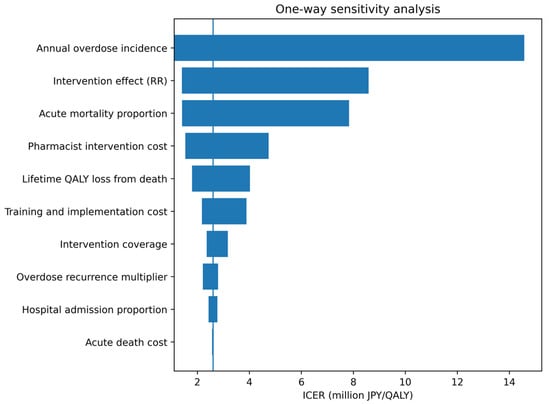
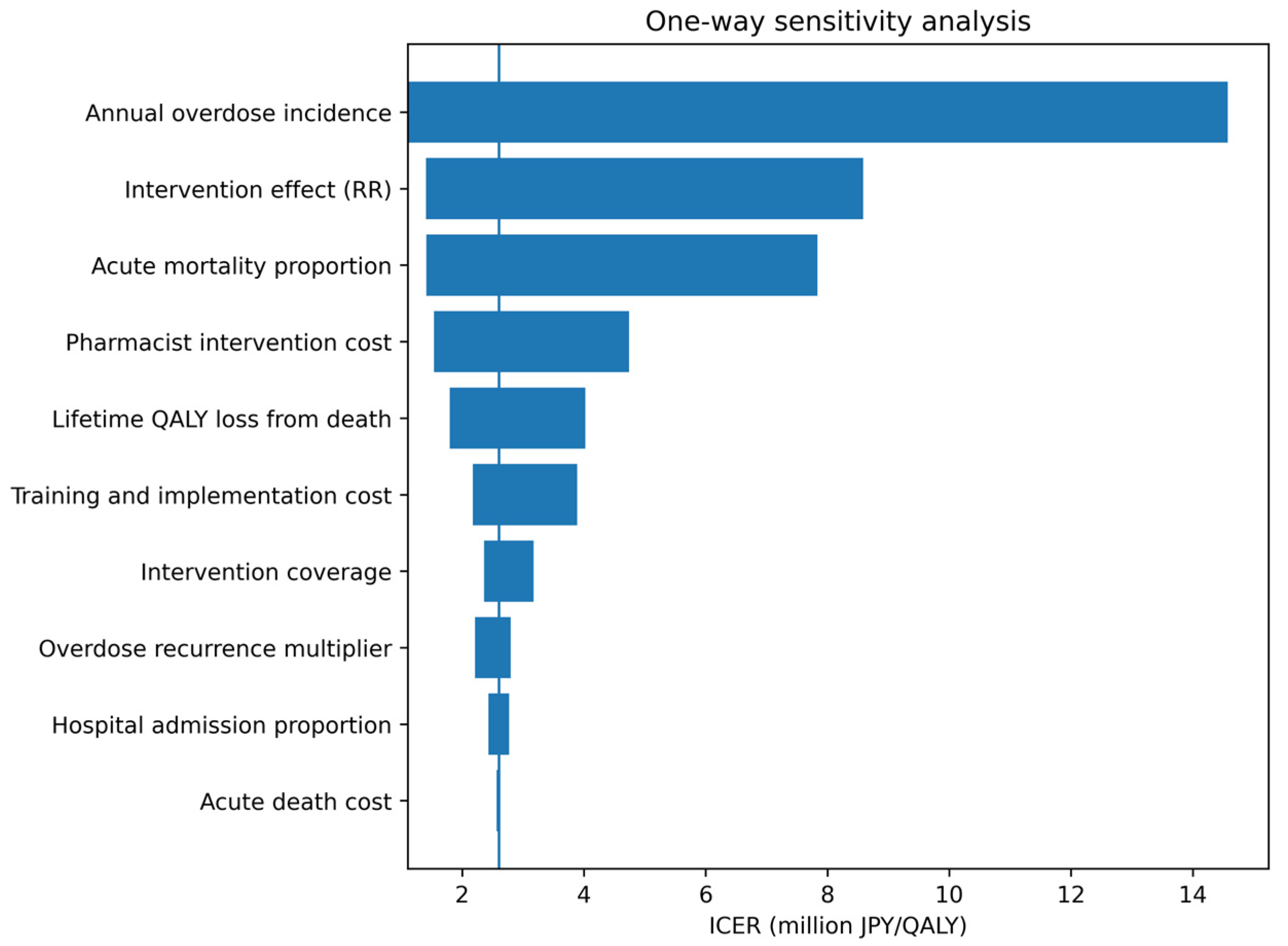
One-way sensitivity analyses indicated that the parameters with the greatest impact on the ICER were the baseline overdose incidence (p_OD_base), intervention effect on overdose risk (RR_OD), acute mortality (p_death), pharmacist intervention cost (C_pharm), and lifetime QALY loss associated with fatal overdose (Qloss_death) (Figure 1). The annual probability of at least one overdose in the high-risk cohort (base-case: 0.005) was varied from 0.001 to 0.010. The proportion of overdose episodes resulting in acute death (0.010) was varied from 0.002 to 0.020, and the probability of hospital admission among overdose cases (0.49) was varied from 0.30 to 0.70. The RR of overdose among intervention recipients (0.70) was varied from 0.50 to 0.90, and intervention coverage among high-risk OTC purchasers (0.50) was varied from 0.30 to 0.70. The overdose recurrence factor (1.3 episodes per person-year) was varied between 1.0 and 2.0. For costs, we varied the unit cost of a single pharmacist intervention (1000 JPY) from 500 to 2000 JPY; training and implementation costs per 1000 high-risk young adults (200,000 JPY) were varied from 100,000 to 500,000 JPY; and acute medical costs associated with fatal overdose (800,000 JPY) were varied from 400,000 to 2,000,000 JPY. Lifetime QALY loss associated with fatal overdose (26 QALYs) was varied from 15 to 40 QALYs. All other parameters were kept at their base-case values.
Figure 1.
Tornado diagram for one-way sensitivity analyses.
4.3. Threshold Analyses
At the primary benchmark of 5.0 million JPY per QALY, the intervention remained cost-effective when the RR of overdose was approximately 0.833 or lower, corresponding to a relative risk reduction of at least 16.7%. The corresponding minimum annual overdose incidence in the high-risk population was 0.278%. Up to 560,552 JPY in additional referral-related healthcare costs per 1000 high-risk purchasers (approximately 1121 JPY per intervention recipient) could be accommodated while retaining a positive INMB. At the higher secondary benchmark of 7.5 million JPY per QALY, the corresponding thresholds were an RR of approximately 0.886 (relative risk reduction of at least 11.4%), an annual overdose incidence of 0.190%, and additional referral-related healthcare costs of 1,145,430 JPY per 1000 high-risk purchasers.
4.4. Scenario and Structural Analyses
With an RR of 0.90 for all overdose outcomes, the ICER increased to 8.59 million JPY per QALY and the intervention was not cost-effective at either prespecified benchmark. At RR = 1.00, the intervention generated no health gain while increasing costs by 700,000 JPY; at RR = 1.10, the intervention was dominated by usual care. In the no-mortality-benefit scenario, the intervention reduced non-fatal overdose outcomes but not acute death; the incremental cost was 615,204 JPY, the incremental QALY gain was 0.039, and the ICER was 15.79 million JPY per QALY. These findings show that the base-case result depends substantially on reducing fatal outcomes.
4.5. Probabilistic Sensitivity Analysis
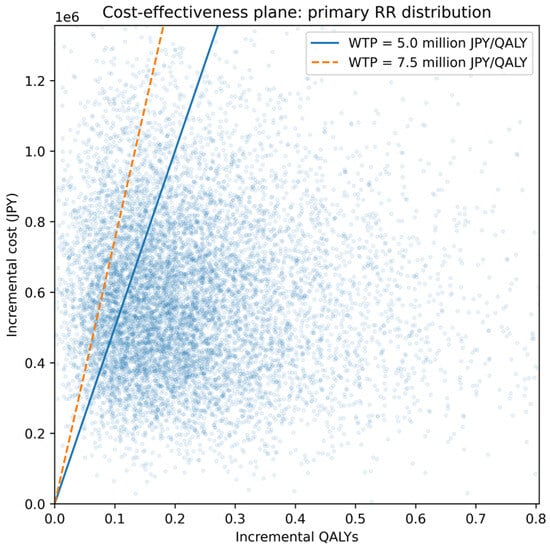
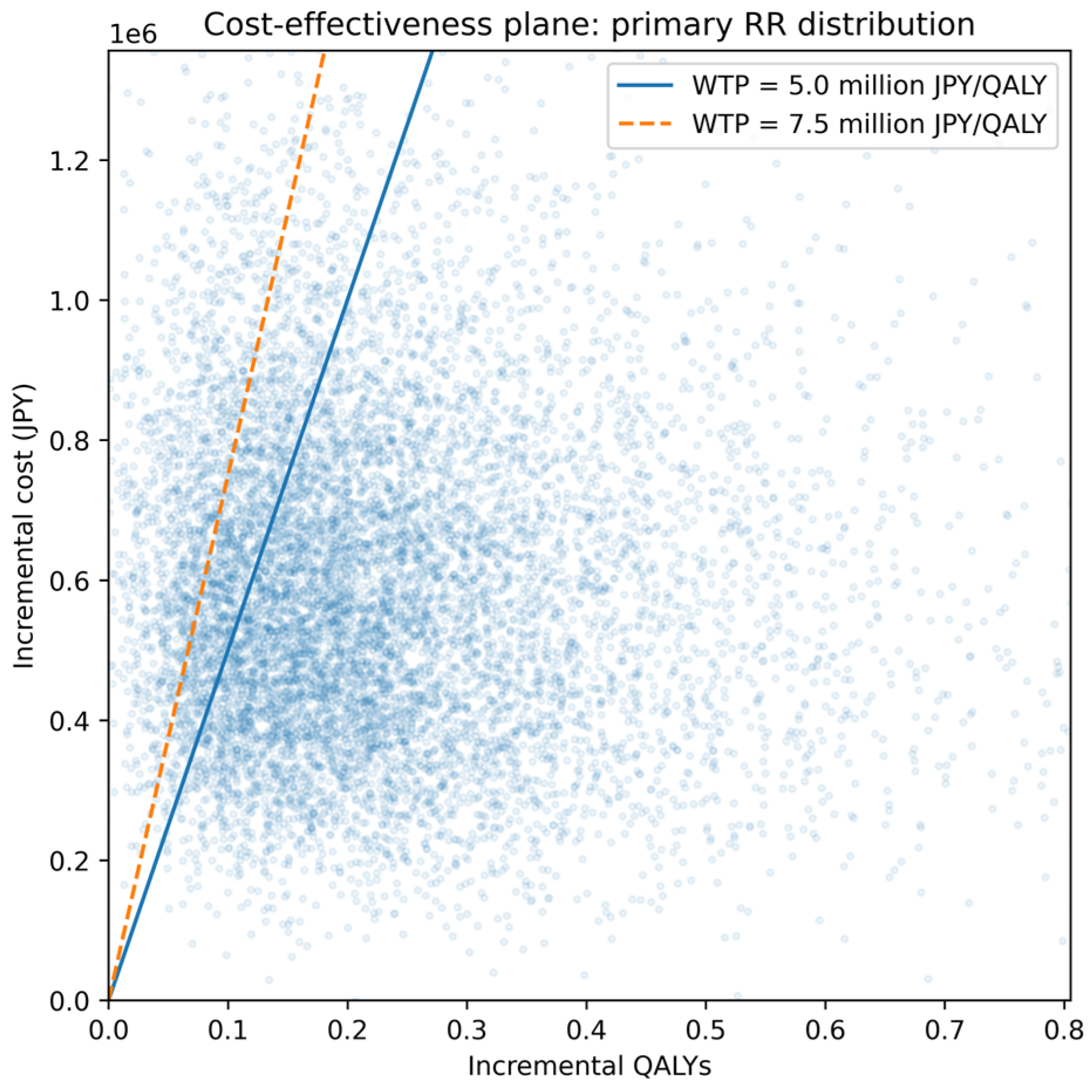
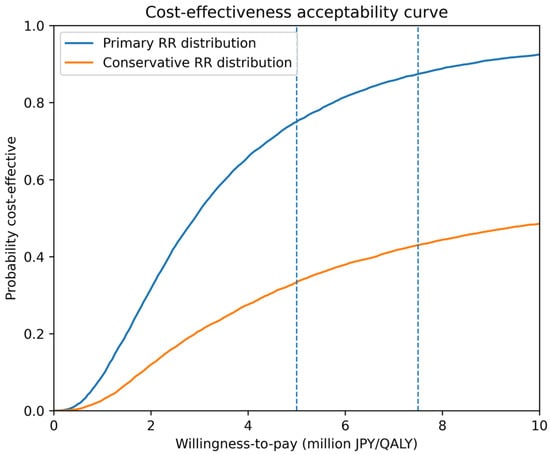
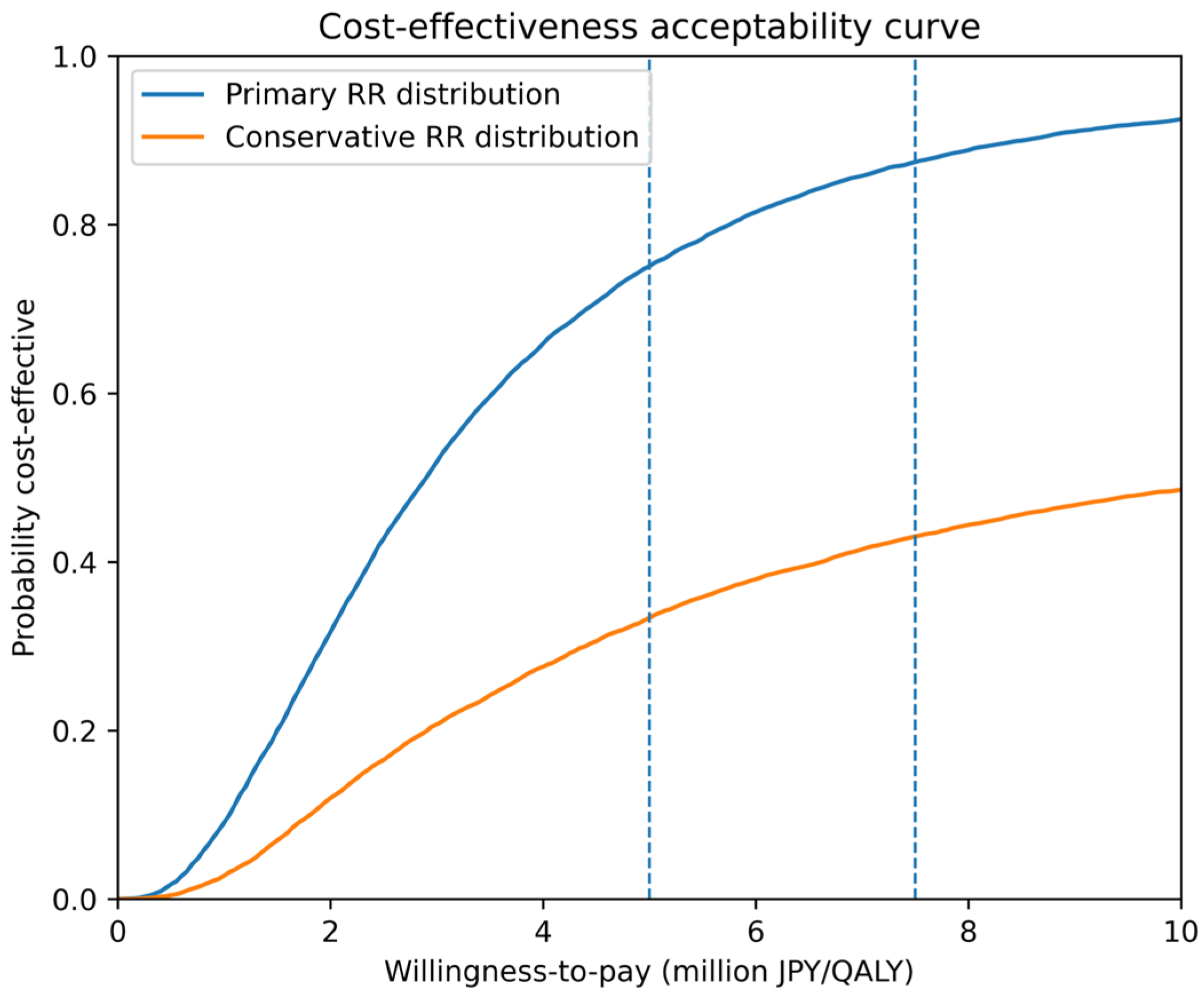
In the primary probabilistic sensitivity analysis (10,000 iterations), the mean incremental cost was 603,683 JPY (95% uncertainty interval [UI]: 213,650 to 1,176,043) and the mean incremental QALY gain was 0.234 (95% UI: 0.031 to 0.649). The probabilities of cost-effectiveness were 51.9%, 75.1%, 87.4%, and 92.5% at benchmark values of 3.0, 5.0, 7.5, and 10.0 million JPY per QALY, respectively. In the conservative probabilistic sensitivity analysis, the mean incremental cost was 675,066 JPY (95% UI: 261,528 to 1,277,945) and the mean incremental QALY gain was 0.055 (95% UI: −0.397 to 0.480); the corresponding probabilities were 20.7%, 33.4%, 43.0%, and 48.6%. The sampled RR was ≥1 in 0.7% of primary-analysis iterations and 33.7% of conservative-analysis iterations. Figure 2 shows the primary cost-effectiveness plane, and Figure 3 compares the CEACs under the two intervention-effect distributions. These probabilities should be interpreted as conditional on the assumed intervention-effect distributions.
Figure 2.
Cost-effectiveness plane from the primary probabilistic sensitivity analysis. Blue points represent individual Monte Carlo simulations; the solid blue and dashed orange lines indicate willingness-to-pay thresholds of 5.0 and 7.5 million JPY per QALY, respectively.
Figure 3.
Cost-effectiveness acceptability curves under the primary and conservative intervention-effect distributions. Dashed vertical reference lines indicate the primary benchmark of 5.0 million JPY per QALY and the higher secondary benchmark of 7.5 million JPY per QALY.
5. Discussion
In this study, we used a decision tree model based on the Japanese healthcare system to evaluate the potential cost-effectiveness of a brief community pharmacy intervention for OTC overdose among young adults. In the revised base-case analysis, the intervention increased costs by approximately 609,000 JPY per 1000 high-risk young adults and gained 0.234 QALYs, yielding an ICER of approximately 2.60 million JPY per QALY. Prevention of fatal outcomes accounted for 83.4% of the incremental QALY gain. The ICER was below the primary benchmark of 5.0 million JPY per QALY and the higher 7.5 million JPY benchmark drawn from Japan’s formal cost-effectiveness evaluation framework [29]. These comparisons support potential economic attractiveness under the modeled base-case assumptions but should not be interpreted as a definitive reimbursement decision or as evidence of a single societal willingness-to-pay threshold.
Sensitivity analyses highlighted baseline overdose incidence, intervention effectiveness, and acute mortality as principal drivers of cost-effectiveness. At the primary benchmark of 5.0 million JPY per QALY, the revised thresholds were a relative risk reduction of at least 16.7% and an annual overdose incidence of at least 0.278%. However, an RR of 0.90 produced an ICER of 8.59 million JPY per QALY, and the intervention was not cost-effective when mortality was unaffected. The primary PSA yielded a 75.1% probability of cost-effectiveness at the primary benchmark, whereas the probability fell to 33.4% under the conservative intervention-effect distribution. Thus, the economic conclusion is sensitive to both the magnitude and distribution of the assumed clinical effect, particularly its effect on fatal overdose.
Previous brief intervention studies targeting suicide attempts and self-harm have reported that short psychosocial interventions and active follow-up in emergency departments and psychiatric inpatient units can reduce the risk of repetition by approximately 20–40% [11,12,21]. In the absence of direct evidence for pharmacy-based OTC overdose prevention, we used an RR of 0.70 as a plausible base-case scenario informed by these studies. This effect estimate should not be interpreted as an established effect of community pharmacy intervention because the setting, intervention intensity, and target population differ substantially from those of the source studies. The additional RR = 0.90, RR = 1.00, RR = 1.10, and conservative-PSA analyses make this dependence explicit: the favorable base-case finding is conditional on the intervention achieving a meaningful reduction in overdose risk.
Economic evaluations of pharmacist interventions in other disease areas, such as hypertension and depression, have reported favorable cost-effectiveness for pharmacist collaboration and adherence support [24,30]. Although the target condition and intervention content differ substantially, the present findings suggest that a brief pharmacy-based intervention could provide economic value if it achieves a clinically meaningful reduction in overdose risk, including fatal outcomes. The principal contribution of this analysis is not to establish the clinical effectiveness of such an intervention, but to quantify the intervention effects, baseline risks, and additional referral costs under which further development and empirical evaluation could represent an efficient use of healthcare resources.
At the same time, several limitations should be noted. First, the model relies on literature-informed parameters, expert opinion, and explicit scenario assumptions, and there is a paucity of empirical data from Japan on the incidence and clinical course of OTC overdose among pharmacist-identified high-risk young people and on the real-world effectiveness of pharmacy interventions. The base-case annual overdose incidence of 0.5% and intervention RR of 0.70 are scenario-based rather than directly observed. QALY decomposition showed that 83.4% of the modeled health gain arose from fatal outcomes, and the intervention was not cost-effective when mortality was assumed to be unaffected. Threshold, scenario, and probabilistic analyses characterize this uncertainty but do not substitute for empirical estimation. Second, we used a 1-year decision tree with a recurrence multiplier rather than a state-transition model. Although the multiplier was applied only to non-fatal outcomes and death was treated as terminal, the model does not capture the timing or sequence of repeated events or changes in severity across episodes. Third, the model combines a 1-year horizon for non-fatal morbidity with lifetime QALY loss from premature mortality. This captures the long-term consequence of death but means that absolute total QALYs do not represent a uniform analytic horizon. Fourth, the analysis adopted a healthcare sector perspective and excluded productivity losses, education and welfare costs, and family burden.
Fifth, the analysis was conditional on a modeled cohort already classified as high risk. The operational indicators described in this study are conceptual and have not been validated as a screening rule. The model did not evaluate sensitivity, specificity, opportunity cost, or the consequences of false-positive and false-negative identification in the broader OTC-purchasing population. Sixth, referral-related healthcare use and health gains were not explicitly modeled. The threshold analysis indicated that, at 5.0 million JPY per QALY and assuming no additional health gain, up to approximately 561,000 JPY per 1000 high-risk purchasers could be added before the INMB became negative; actual referral patterns remain unknown. Seventh, several acute-care costs and short-term QALY decrements were rounded scenario inputs rather than contemporaneous patient-level estimates, formal micro-costing values, or values converted to a common price year. Eighth, the modeled intervention remains to be developed and tested in practice.
Practical implementation would require pharmacist time, a private environment for sensitive discussion, staff training in suicide-risk recognition, standardized documentation, and established referral and emergency pathways. Purchasers may decline discussion or withhold information, and false-positive or false-negative identification could create opportunity costs or safety concerns. Remuneration, information sharing across pharmacies, and collaboration with emergency and mental-health services would also require consideration.
Future Directions
Future research should include multicenter collaborative studies involving emergency departments, psychiatric services, and community pharmacies to prospectively examine the prevalence and patterns of OTC overdose among young people, their healthcare utilization pathways after overdose, and the feasibility and effectiveness of pharmacy-based interventions. Under the other base-case assumptions, the revised threshold analyses indicate that an annual overdose incidence of approximately 0.278% among pharmacist-identified high-risk purchasers or a relative risk reduction of approximately 16.7% would be required to meet the primary benchmark of 5.0 million JPY per QALY. Empirical studies should estimate effects on fatal and non-fatal overdose separately, as well as screening performance, resource requirements, referral-related utilization, and acceptability.
In addition, the recurrent nature of overdose and the long-term consequences of fatal and non-fatal overdose could be examined using registry data and linked healthcare and social welfare databases to improve the precision of QALY loss estimates. The modeling framework used in this study can also be applied to evaluate the cost-effectiveness of pharmacy-based interventions for other forms of self-harm or substance misuse beyond OTC overdose. Accumulating intervention and economic evaluation studies in this area may help to clarify the potential role of community pharmacies and pharmacists in supporting young people’s mental health and contributing to suicide prevention.
6. Conclusions
Under the assumptions of this exploratory decision-analytic model, a low-intensity community pharmacy intervention for high-risk young adults may be cost-effective if it meaningfully reduces both fatal and non-fatal OTC overdose. The revised base-case ICER was approximately JPY 2.60 million per QALY, but the probability of cost-effectiveness at JPY 5.0 million per QALY ranged from 75.1% under the primary intervention-effect distribution to 33.4% under a conservative distribution, and the intervention was not cost-effective when mortality was unaffected. These findings are exploratory, conditional on uncertain assumptions, and intended to support empirical study design rather than establish clinical effectiveness. Prospective pharmacy-based studies are needed to estimate overdose incidence, intervention effectiveness, mortality effects, identification performance, referral consequences, and contemporary costs directly.
Supplementary Materials
The following supporting information can be downloaded at: https://www.mdpi.com/article/10.3390/pharmacy14090180/s1, Supplementary File S1: Complete Python code used for the base-case, deterministic, threshold, scenario, and probabilistic analyses and for figure generation.
Author Contributions
Conceptualization, M.S.; methodology, M.S.; software, M.S.; formal analysis, M.S.; visualization, M.S.; writing—original draft preparation, M.S.; writing—review and editing, M.S. and M.O.; supervision, M.O. All authors have read and agreed to the published version of the manuscript.
Funding
This research received no external funding.
Institutional Review Board Statement
Not applicable.
Informed Consent Statement
Not applicable.
Data Availability Statement
No individual-level data were used in this study. All model inputs, distributions, and analytical assumptions are reported in the article. The complete analytical code is provided as Supplementary File S1.
Acknowledgments
During the preparation of this manuscript/study, the authors used ChatGPT (OpenAI; GPT-5.1 Thinking and GPT-5.6 Sol) for assistance with language editing and the development and checking of analytical code. The authors reviewed and verified the output and take full responsibility for the content of this publication.
Conflicts of Interest
The authors declare no conflicts of interest.
References
- Shimane, T.; Inoura, S.; Kitamura, M.; Kitagaki, K.; Tominaga, K.; Matsumoto, T. Prevalence of Over-the-Counter Drug Abuse and Associated Psychosocial Factors Among High School Students: A Nationwide Cross-Sectional Survey in Japan. Neuropsychopharmacol. Rep. 2025, 45, e70030. [Google Scholar] [CrossRef] [Scilit] [PubMed]
- Abraham, O.; Chmielinski, J. Adolescents’ Misuse of Over-The-Counter Medications: The Need for Pharmacist-led Intervention. Innov. Pharm. 2018, 9, 4. [Google Scholar] [CrossRef] [Scilit] [PubMed]
- Ford, J.A. Misuse of over-the-counter cough or cold medications among adolescents: Prevalence and correlates in a national sample. J. Adolesc. Health 2009, 44, 505–507. [Google Scholar] [CrossRef] [Scilit] [PubMed]
- Finkelstein, Y.; Macdonald, E.M.; Hollands, S.; Hutson, J.R.; Sivilotti, M.L.; Mamdani, M.M.; Koren, G.; Juurlink, D.N.; Canadian Drug Safety and Effectiveness Research Network (CDSERN). Long-term outcomes following self-poisoning in adolescents: A population-based cohort study. Lancet Psychiatry 2015, 2, 532–539. [Google Scholar] [CrossRef] [Scilit] [PubMed]
- Mars, B.; Heron, J.; Crane, C.; Hawton, K.; Lewis, G.; Macleod, J.; Tilling, K.; Gunnell, D. Clinical and social outcomes of adolescent self harm: Population based birth cohort study. BMJ 2014, 349, g5954. [Google Scholar] [CrossRef] [Scilit] [PubMed]
- Gilson, A.M.; Chladek, J.S.; Stone, J.A.; Watterson, T.L.; Lehnbom, E.C.; Hoffins, E.L.; Berbakov, M.E.; Moon, J.; Jacobson, N.A.; Holden, R.J.; et al. Older Adult Misuse of Over-the-Counter Medications: Effectiveness of a Novel Pharmacy-Based Intervention to Improve Patient Safety. J. Patient Saf. 2025, 21, 38–47. [Google Scholar] [CrossRef] [Scilit] [PubMed]
- Ylä-Rautio, H.; Siissalo, S.; Leikola, S. Drug-related problems and pharmacy interventions in non-prescription medication, with a focus on high-risk over-the-counter medications. Int. J. Clin. Pharm. 2020, 42, 786–795. [Google Scholar] [CrossRef] [Scilit] [PubMed]
- Chui, M.A.; Stone, J.A.; Holden, R.J. Improving over-the-counter medication safety for older adults: A study protocol for a demonstration and dissemination study. Res. Soc. Adm. Pharm. 2017, 13, 930–937. [Google Scholar] [CrossRef] [Scilit] [PubMed]
- Mills, V.G.; Meaadi, J.; Nazar, H.; Obara, I. A review and narrative synthesis of community pharmacist-led interventions to tackle medicines for pain that are misused. Int. J. Pharm. Pract. 2022, 30, 305–314. [Google Scholar] [CrossRef] [Scilit] [PubMed]
- Chinthammit, C.; Armstrong, E.P.; Warholak, T.L. A cost-effectiveness evaluation of hospital discharge counseling by pharmacists. J. Pharm. Pract. 2012, 25, 201–208. [Google Scholar] [CrossRef] [Scilit] [PubMed]
- Hawton, K.; Witt, K.G.; Salisbury, T.L.T.; Arensman, E.; Gunnell, D.; Hazell, P.; Townsend, E.; van Heeringen, K. Psychosocial interventions following self-harm in adults: A systematic review and meta-analysis. Lancet Psychiatry 2016, 3, 740–750. [Google Scholar] [CrossRef] [Scilit] [PubMed]
- Hetrick, S.E.; Robinson, J.; Spittal, M.J.; Carter, G. Effective psychological and psychosocial approaches to reduce repetition of self-harm: A systematic review, meta-analysis and meta-regression. BMJ Open 2016, 6, e011024. [Google Scholar] [CrossRef] [Scilit] [PubMed]
- Ahern, S.; Burke, L.A.; McElroy, B.; Corcoran, P.; McMahon, E.M.; Keeley, H.; Carli, V.; Wasserman, C.; Hoven, C.W.; Sarchiapone, M.; et al. A cost-effectiveness analysis of school-based suicide prevention programmes. Eur. Child Adolesc. Psychiatry 2018, 27, 1295–1304. [Google Scholar] [CrossRef] [Scilit] [PubMed]
- Daly, C.; Griffin, E.; McMahon, E.; Corcoran, P.; Webb, R.T.; Witt, K.; Ashcroft, D.M.; Arensman, E. Repeat Self-Harm Following Hospital-Presenting Intentional Drug Overdose among Young People-A National Registry Study. Int. J. Environ. Res. Public Health 2020, 17, 6159. [Google Scholar] [CrossRef] [Scilit] [PubMed]
- Yan, N.; Luo, Y.; Mackay, L.E.; Wang, Y.; Wang, Y.; Wang, Y.; Shiferaw, B.D.; Wang, J.; Tang, J.; Yan, W.; et al. Global patterns and trends of suicide mortality and years of life lost among adolescents and young adults from 1990 to 2021: A systematic analysis for the Global Burden of Disease Study 2021. Epidemiol. Psychiatr. Sci. 2024, 33, e52. [Google Scholar] [CrossRef] [Scilit] [PubMed] [PubMed Central]
- Doran, C.M.; Kinchin, I. Economic and epidemiological impact of youth suicide in countries with the highest human development index. PLoS ONE 2020, 15, e0232940. [Google Scholar] [CrossRef] [Scilit] [PubMed]
- Husereau, D.; Drummond, M.; Augustovski, F.; de Bekker-Grob, E.; Briggs, A.H.; Carswell, C.; Caulley, L.; Chaiyakunapruk, N.; Greenberg, D.; Loder, E.; et al. Consolidated Health Economic Evaluation Reporting Standards 2022 (CHEERS 2022) Statement: Updated Reporting Guidance for Health Economic Evaluations. Value Health 2022, 25, 3–9. [Google Scholar] [CrossRef] [Scilit] [PubMed]
- Kyan, R.; Kamijo, Y.; Kohara, S.; Takai, M.; Shimane, T.; Matsumoto, T.; Fukushima, H.; Narumi, S.; Chiba, T.; Sera, T.; et al. Prospective multicenter study of the epidemiological features of emergency patients with overdose of over-the-counter drugs in Japan. PCN Rep. 2024, 3, e225. [Google Scholar] [CrossRef] [Scilit] [PubMed]
- Mizuno, S.; Inoura, S.; Matsumoto, T.; Shimane, T. Characteristics of the drinking habits of people who overdose over-the-counter drugs: Insights from a nationwide Japanese survey. PCN Rep. 2024, 3, e70027. [Google Scholar] [CrossRef] [Scilit] [PubMed]
- McDaid, D.; Park, A.L.; Tsiachristas, A.; Brand, F.; Casey, D.; Clements, C.; Geulayov, G.; Kapur, N.; Ness, J.; Waters, K.; et al. Cost-effectiveness of psychosocial assessment for individuals who present to hospital following self-harm in England: A model-based retrospective analysis. Eur. Psychiatry 2022, 65, e16. [Google Scholar] [CrossRef] [Scilit] [PubMed]
- Inagaki, M.; Kawashima, Y.; Kawanishi, C.; Yonemoto, N.; Sugimoto, T.; Furuno, T.; Ikeshita, K.; Eto, N.; Tachikawa, H.; Shiraishi, Y.; et al. Interventions to prevent repeat suicidal behavior in patients admitted to an emergency department for a suicide attempt: A meta-analysis. J. Affect Disord. 2015, 175, 66–78. [Google Scholar] [CrossRef] [Scilit] [PubMed]
- Okumura, Y.; Shimizu, S.; Ishikawa, K.B.; Matsuda, S.; Fushimi, K.; Ito, H. Characteristics, procedural differences, and costs of inpatients with drug poisoning in acute care hospitals in Japan. Gen. Hosp. Psychiatry 2012, 34, 681–685. [Google Scholar] [CrossRef] [Scilit] [PubMed]
- Descamps, A.K.; Vandijck, D.M.; Buylaert, W.A.; Mostin, M.A.; Paepe, P. Characteristics and costs in adults with acute poisoning admitted to the emergency department of a university hospital in Belgium. PLoS ONE 2019, 14, e0223479. [Google Scholar] [CrossRef] [Scilit] [PubMed]
- Rubio-Valera, M.; Bosmans, J.; Fernández, A.; Peñarrubia-María, M.; March, M.; Travé, P.; Bellón, J.A.; Serrano-Blanco, A. Cost-effectiveness of a community pharmacist intervention in patients with depression: A randomized controlled trial (PRODEFAR Study). PLoS ONE 2013, 8, e70588. [Google Scholar] [CrossRef] [Scilit] [PubMed]
- Shiroiwa, T.; Noto, S.; Fukuda, T. Japanese Population Norms of EQ-5D-5L and Health Utilities Index Mark 3: Disutility Catalog by Disease and Symptom in Community Settings. Value Health 2021, 24, 1193–1202. [Google Scholar] [CrossRef] [Scilit] [PubMed]
- Noto, S.; Saito, S.; Shiroiwa, T.; Fukuda, T. Estimation of Lifetime QALYs Based on Lifestyle Behaviors. Int. J. Environ. Res. Public Health 2021, 18, 9970. [Google Scholar] [CrossRef] [Scilit] [PubMed]
- Reisinger, A.C.; Schneider, N.; Schreiber, N.; Janisch, M.; Rauch, I.; Kaufmann, P.; Wünsch, G.; Eller, P.; Hackl, G. Critical care management of acute intoxications, dynamics and changes over time: A cohort study. Intern Emerg. Med. 2024, 19, 2015–2024. [Google Scholar] [CrossRef] [Scilit] [PubMed]
- Hirose, M.; Kasugai, D.; Tajima, K.; Takahashi, H.; Yamada, S.; Hirakawa, A. Recurrence of Overdose Suicide Attempt index: A novel scoring system for predicting the recurrence of intentional overdose. Nagoya J. Med. Sci. 2022, 84, 301–310. [Google Scholar] [CrossRef] [Scilit] [PubMed]
- Fukuda, T.; Shiroiwa, T. Cost effectiveness evaluation of health care technologies in Japan: New HTA system and the role of C2H. J. Natl. Inst. Public Health 2021, 70, 22–27. [Google Scholar] [CrossRef] [PubMed]
- Polgreen, L.A.; Han, J.; Carter, B.L.; Ardery, G.P.; Coffey, C.S.; Chrischilles, E.A.; James, P.A. Cost-effectiveness of a physician–pharmacist collaboration intervention to improve blood pressure control. Hypertension 2015, 66, 1145–1151. [Google Scholar] [CrossRef] [Scilit] [PubMed]

Disclaimer/Publisher’s Note: The statements, opinions and data contained in all publications are solely those of the individual author(s) and contributor(s) and not of MDPI and/or the editor(s). MDPI and/or the editor(s) disclaim responsibility for any injury to people or property resulting from any ideas, methods, instructions or products referred to in the content. |
© 2026 by the authors. Licensee MDPI, Basel, Switzerland. This article is an open access article distributed under the terms and conditions of the Creative Commons Attribution (CC BY) license.