


Abstract
Pharmaceutical calculations is an essential competency for student pharmacists, yet pharmacy educators continue to identify challenges in teaching and assessing calculation skills. At Western University of Health Sciences (WesternU), performance in a longitudinal asynchronous pharmacy calculations course declined across consecutive cohorts, prompting a multifaceted curriculum redesign. The primary objective was to evaluate longitudinal trends in student performance in a first-year pharmacy calculations course and describe performance following implementation of a multifaceted curriculum redesign. A secondary objective was to examine associations between pre-admission academic characteristics and final examination performance. Final examination performance and selected pre-admission academic characteristics were analyzed using nonparametric comparisons including Kruskal–Wallis, Mann–Whitney U tests, Spearman correlations, and linear regression. Mean raw final examination performance declined from 88.7% in 2020 to 75.8% in 2023 and increased to 81.3% in 2024 following implementation of the curriculum redesign. The overall comparison was statistically significant (p < 0.001). Apart from undergraduate study type, pre-admission academic characteristics demonstrated weak to modest associations with final examination performance; math Grade Point Average (GPA) had the strongest association (Spearman ρ = 0.297, p < 0.001). Student performance increased in the first cohort following implementation of a multifaceted redesign of an asynchronous pharmacy calculations course. Findings support continued evaluation of structured practice, active learning, and assessment opportunities in pharmacy calculations education.
1. Introduction
Pharmaceutical calculations are a foundational competency in pharmacy education and practice. Student pharmacists are expected to accurately perform calculations involving medication doses, concentrations, infusion rates, days’ supply, and compounding, among other applications. Errors in pharmaceutical calculations can contribute to medication-related harm, making development of reliable calculation skills an important component of preparation for pharmacy practice [1,2].
Despite the importance of these skills, pharmacy educators continue to have challenges in pharmaceutical calculations education. Proficiency in pharmaceutical calculations requires students to demonstrate foundational mathematical knowledge, reading comprehension skills, and the ability to apply mathematical concepts to medication-related clinical scenarios, often under the time constraints of examinations [3]. Variability in student preparedness, math anxiety, and differences in learning styles further complicates instruction and the assessment of competency for educators [3].
Several educational strategies have been explored to address these challenges. A retrospective study by McMillan et al. found the use of optional practice calculation questions associated with higher examination scores, though not consistently across all cohorts [4]. Other studies investigated approaches such as algebra-based pretests to identify students at risk for poor performance, mock examinations, integrative curriculum design and motivational design models, flipped-classrooms, self-assessments and self-directed learning, and other structured practice opportunities [1,2,5,6,7,8,9]. These studies suggest that assessment and practice strategies may provide useful opportunities to identify or support students who struggle with pharmaceutical calculations [3,5,10]. Other studies have reported positive associations between collaborative and peer-led learning approaches and student academic performance [11,12,13]. The results of these studies reflect the benefit of collaborative learning and structured peer interaction in enhancing learning outcomes.
Additionally, asynchronous instruction offers an alternative to traditional teaching by allowing students greater flexibility in when and how they engage with instructional materials. This web-based format may be particularly useful for calculation-based coursework, in which students benefit from revisiting concepts and completing practice problems at an individualized pace [14,15]. Research comparing asynchronous and synchronous remote learning in a pharmacy skills course found that students valued the flexibility and preparation associated with asynchronous sessions, while emphasizing the benefits of real-time faculty feedback during synchronous instruction [14]. These findings suggest that instructional format alone may not determine educational effectiveness and that opportunities for practice, interaction, and feedback remain important considerations when designing asynchronous courses.
One key strategy to improving student performance includes identifying students at risk of underperformance and providing them with additional tailored support. Several preadmission variables are associated with predicting student performance in pharmaceutical calculations courses [16]. According to a retrospective analysis by Dell et al., the Pharmacy College Admission Test (PCAT) composite score, PCAT quantitative score, pre-admission grade point average GPA, math GPA, science GPA, and the presence of a 4-year degree have a positive correlation to academic success in pharmaceutical calculations [16]. Further examination of these predictors of success and their utilization in identifying at-risk students is warranted for institutions looking to provide tailored academic support to improve student performance in calculations.
While several studies seek to address these challenges by evaluating individual educational interventions, longitudinal evidence examining trends in student performance within pharmaceutical calculations courses over time remains limited. Additionally, few studies have evaluated the outcomes of broader, multifaceted curricular redesigns on student learning and academic performance.
The primary objective of this study was to evaluate longitudinal trends in student performance in an asynchronous first-year pharmacy calculations course and describe performance following implementation of the multifaceted curriculum redesign. A secondary objective was to examine associations between pre-admission academic characteristics and final examination performance.
2. Methods
2.1. Study Setting and Course
The study evaluated data from Western University of Health Sciences (WesternU) College of Pharmacy which offers a three and a half year fully accredited Doctor of Pharmacy (PharmD) program. This program offers one credit hour in pharmaceutical calculations course in the first year of the program. At WesternU, pharmacy calculations have been taught asynchronously and longitudinally for approximately ten years. The course was designed to provide students with flexibility while maintaining structured progression through calculation content. The course consists of seven online modules containing one to three chapters each. Each module includes recorded lectures and practice questions. Modules are due every two weeks to maintain a structured pace through the curriculum.
Although the course structure and content remained relatively consistent, final examination performance declined across several consecutive cohorts. This local trend prompted faculty to review the course and identify changes that could provide additional opportunities for practice, feedback, active learning, and assessment preparation.
Prior to 2024, the graded components of the course consisted of a midterm examination, a post-midterm quiz, and a final examination. In 2024, the course underwent a multifaceted redesign involving several concurrent changes. These included updated and re-recorded lectures, three in-person calculation workshops, an additional quiz before the midterm, an increase in final examination time, and a mock examination before the final. The changes were selected in response to annual course evaluations, discussions with the curricular office and students, faculty feedback, and available literature regarding calculation education and assessment [17]. The curricular changes are summarized in Table 1.
Table 1.
Curriculum modifications implemented in the asynchronous pharmacy calculations course.
The content taught in the course remained highly consistent across the study period. Final examinations included clinical application problems involving topics such as weight-based dosing, days’ supply, rate of flow, and compounding. Examinations across years used the same question with different numerical values to maintain comparable difficulty though equivalence can only be assumed given no formal analyses was used.
2.2. Curriculum Redesign
The selection and implementation of these changes were informed by annual student evaluations, discussions with the curricular office and students, faculty feedback, and published literature regarding pharmacy calculations education and assessment. Because the changes were implemented concurrently, the study was designed to evaluate the overall curriculum redesign rather than determine the independent effect of individual components.
2.3. Study Design and Participants
This observational study included students enrolled in the first-year pharmacy calculations course from 2019 through 2024. The 2019–2023 cohorts completed the pre-redesign curriculum, and the 2024 cohort completed the redesigned curriculum. Students were eligible if they were enrolled in the first-year calculations course during the study period. Repeat students were only included in their original year.
Final examination scores and selected pre-admission academic characteristics were retrospectively collected for 2019–2023 and collected for 2024 as part of the prospective course evaluation. Variables included original GPA, science GPA, math GPA, recalculated GPA measures, Health Science Reasoning Test (HSRT) score, number of repeated undergraduate courses, and undergraduate educational background. Students with missing values were excluded only from analyses involving the missing variable.
2.4. Examination Outcome
The primary outcome was final examination performance, expressed as the percentage of points earned. The final examination was selected because it was cumulative and represented the most consistent assessment across the study period. Overall course grades were not used because the weighting of graded components varied slightly across years.
The primary longitudinal analysis used the original examination scores that included questions that were subsequently dropped from scoring. Examination questions were occasionally removed from the final score when student performance on that question was substantially lower than anticipated. Following faculty review, these questions were not found to contain ambiguity, factual errors, or other item defects. Rather, the dropped questions assessed intended course competencies and were considered valid but more difficult than anticipated. Because the content of these questions remained part of the course curriculum and were used on subsequent examinations, the original scores were retained for the primary longitudinal analysis to provide greater consistency in the assessment content evaluated across cohorts.
The final examination contained twenty questions and was allotted two hours before 2024 and three hours beginning in 2024. Examinations assessed comparable calculation questions across cohorts, with numerical values varying across administrations.
2.5. Student Feedback
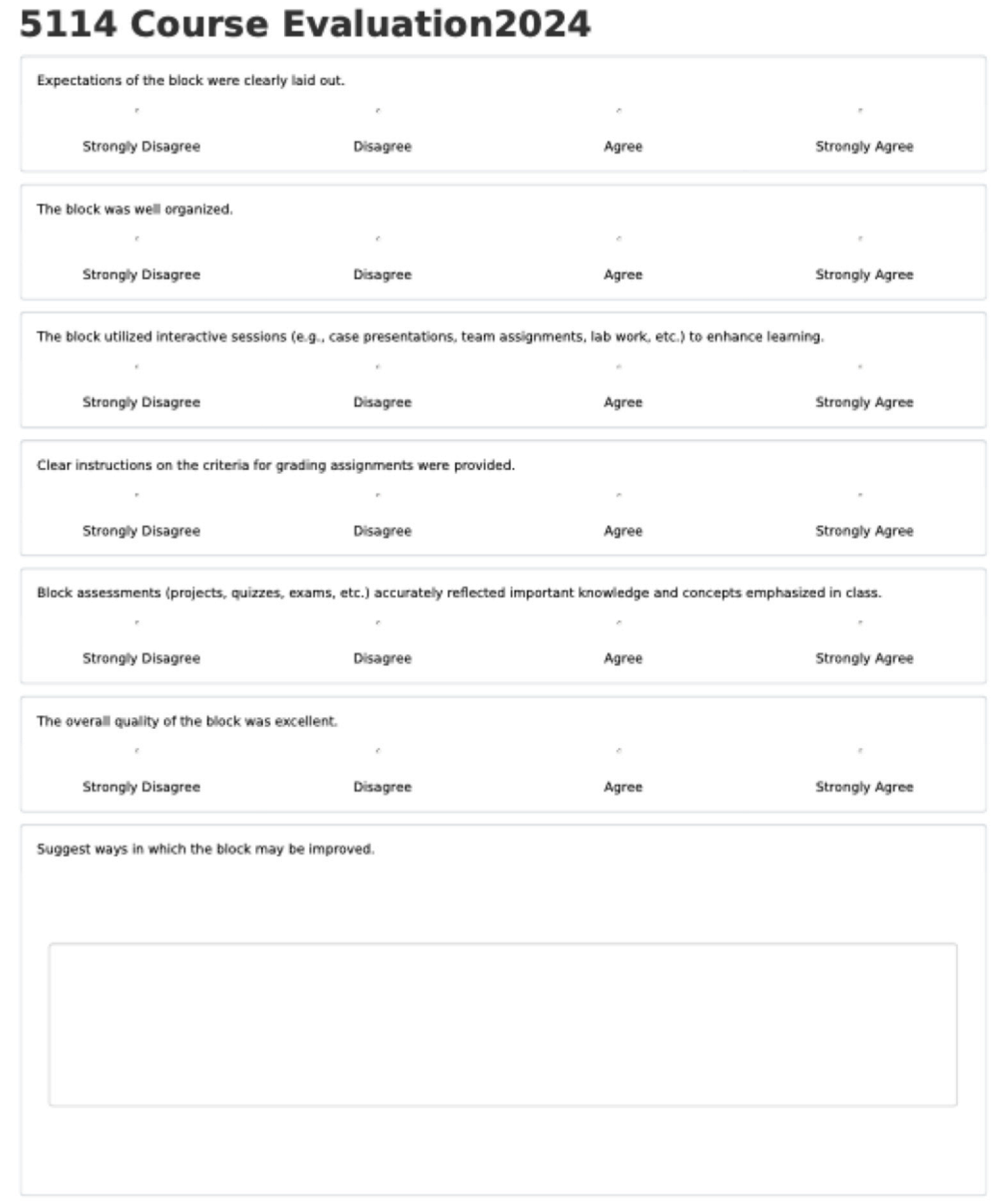
Student perceptions of the 2024 curricular changes were assessed using an anonymous course evaluation survey immediately following their final exam. The survey used a four-point Likert scale ranging from 1 (strongly disagree) to 4 (strongly agree). Final exam scores are not released until completion of course evaluations ensuring 100% completion rate from students. Student feedback was considered a descriptive secondary outcome and was not used to establish the effectiveness or causal effect of individual curricular changes.
2.6. Statistical Analysis
Analyses were performed using IBM SPSS Statistics version 29.0.1.0. Distributional characteristics of final examination scores were assessed before selection of inferential tests. Because examination scores were not normally distributed, nonparametric methods were used for comparisons of examination performance. Final examination performance was compared across the six course cohorts using the Kruskal–Wallis test. When the overall comparison was significant, pairwise post-hoc comparisons were performed using the Mann–Whitney U test.
Associations between continuous pre-admission academic characteristics and final examination performance were evaluated using Spearman rank-order correlations. The sample size for each correlation was reported because the number of students with complete data varied among variables. Continuous academic characteristics were parametric and compared between students who passed the final examination (≥70%) and those who did not pass (<70%) using independent-samples t-tests. Linear regression was then used to assess factors associated with students’ ability to pass the final examination.
Statistical significance was defined as a two-sided p-value < 0.05.
3. Results
3.1. Participants and Cohort Characteristics
A total of 528 students were included across the six course cohorts from 2019 through 2024. Across the full sample, 64% had completed a four-year undergraduate degree and 54% had repeated at least one undergraduate course. The mean number of repeated undergraduate courses was 1.6. Mean original GPA was 3.25, mean science GPA was 3.13, mean recalculated GPA was 3.31, mean recalculated science GPA was 3.20, mean math GPA was 3.12, and mean HSRT score was 21. Details of these results can be found in Table 2.
Table 2.
Baseline Characteristics Across Years.
3.2. Longitudinal Final Examination Performance
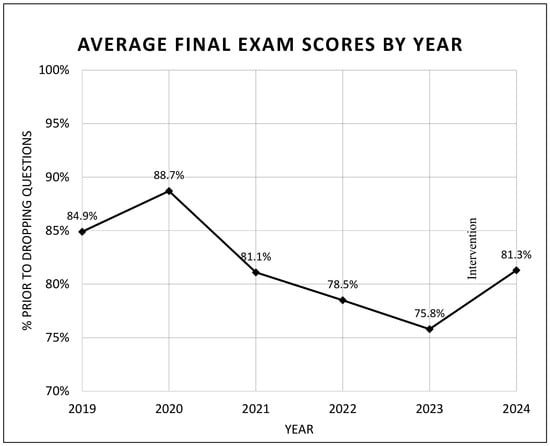
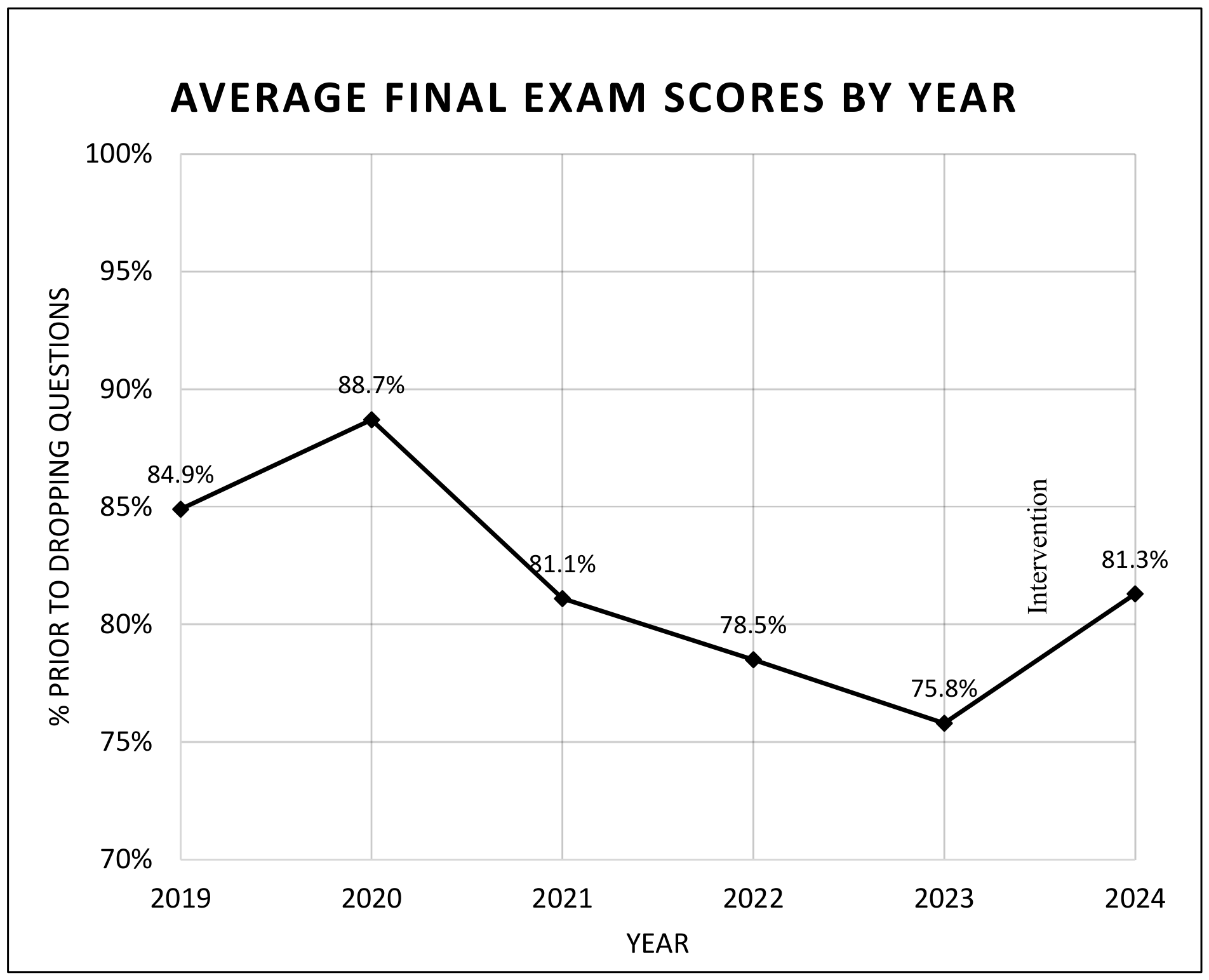
Mean final examination performance was 82.6% across all cohorts using the pre-drop scoring approach. Mean performance was 84.9% in 2019, increased to 88.7% in 2020, then declined to 81.1% in 2021, 78.5% in 2022, and 75.8% in 2023. Following implementation of the curriculum redesign, mean performance increased to 81.3% in 2024, a 7% increase from 2023 (p < 0.001). The overall comparison across cohorts was statistically significant (p < 0.001). Comparisons between years can be seen in Figure 1.
Figure 1.
Average Final Exam Scores by Year.
Figure 1 illustrates the trends in final examination scores in a first-year pharmacy calculations course. Raw data (prior to any dropping of questions) were used for more consistent grading across years. After 2020, there has been a dramatic decline in students’ scores though an increase was seen in the class of 2024 after interventions were made to the course.
3.3. Academic Characteristics Associated with Performance
Pre-admission academic characteristics demonstrated weak to modest associations with final examination performance. All proposed indicators of success except undergraduate study type were positively correlated with final examination scores (p < 0.001). Math GPA had the strongest Spearman correlation with examination score (ρ = 0.297), while the number of repeated undergraduate courses was inversely associated with performance. These findings suggest that pre-admission characteristics may provide some insight into final examination performance; however, their weak associations indicate they may only explain a limited portion of the variability in student outcomes. Details of these results can be found in Table 3.
Table 3.
Associations between pre-admission academic characteristics and final examination performance.
Students with a history of repeated undergraduate coursework had lower mean examination scores than students without repeated coursework (79.97% vs. 85.77%, p < 0.001). Undergraduate educational background was not significantly associated with overall examination performance (p = 0.126). Students with a four-year degree had a mean score of approximately 83%, compared with 77.35% among students with community-college-only backgrounds; this individual comparison was statistically significant (p = 0.048). These subgroup comparisons should be interpreted cautiously because of unequal and small subgroup sample sizes.
3.4. Student Feedback
Among respondents to the 2024 course evaluation, the mock examination received the highest mean helpfulness rating (3.35/4), followed by the in-person workshops (3.28/4) and the additional pre-midterm quiz (3.15/4). The full questionnaire is provided in Appendix A.
4. Discussion
This study evaluated longitudinal trends in student performance and the implementation of a multifaceted redesign of an asynchronous first-year pharmacy calculations course. Examination performance declined from 88.7% in 2020 to 75.8% in 2023 and increased to 81.3% in the first cohort following implementation of the redesigned curriculum. The redesign incorporated multiple opportunities for structured practice and feedback, active and collaborative learning, assessment preparation, and additional time for the final examination. Although examination performance improved following implementation, these findings should be interpreted as an evaluation of a comprehensive curricular change rather than evidence of the effectiveness of any individual educational intervention.
The decline in examination performance at WesternU between 2020 and 2023 occurred alongside a broader decline in pharmacy licensure examination performance. The North American Pharmacist License Exam (NAPLEX), which graduates must pass to practice pharmacy in the US, consists of 14% direct pharmacy calculations questions [18]. National first-time NAPLEX pass rates also declined during this period, from 86% in 2020 to 76% in 2023 [15]. Although NAPLEX performance is not directly comparable to performance in a first-year pharmaceutical calculations course, the concurrent decline in national licensure examination pass rates provides context for the trends observed at WesternU. However, limited longitudinal data on pharmaceutical calculations performance across pharmacy institutions make it difficult to determine whether similar declines occurred at other institutions or whether the trend observed at WesternU was institution specific.
The increase in student performance following the curricular redesign is consistent with the broader pharmacy education literature demonstrating growing interest in structured practice and assessment strategies for pharmaceutical calculations. Recent literature has examined mock examinations, pretests for identifying students at risk for poor performance, and repeated testing as potential approaches to support calculation learning [1,2,5,6,7]. The additional quizzes incorporated into the redesign may have provided students with opportunities to identify learning gaps, engage in more calculations study periods and practice sessions, and strengthen their recall and application of calculation concepts. This interpretation is consistent with the systematic review by Trumble et al., a systematic review that evaluated the effect of study practices on academic grades in health professions education [19]. This study found that spacing out study periods over time and increasing retrieval practice or recall exercises through formative assessments positively improves academic performance [19]. Additionally, the findings from McMillen et al. provide more directly relevant evidence that engagement with pharmaceutical calculations practice questions may be associated with subsequent examination performance [4]. Nevertheless, the present study did not isolate the effect of additional quizzes or measure the extent to which students engaged with these activities. Therefore, the observed improvement following the course redesign cannot be attributed specifically to additional quizzes or calculations practice.
Student feedback was generally favorable toward the new learning activities, particularly the mock examination and workshops. These perceptions may help explain why students viewed the redesigned course as useful; however, the survey was descriptive and should not be interpreted as evidence of effectiveness. Several characteristics of these activities may have contributed to their favorable evaluations. The mock examination provided an opportunity to apply calculation concepts in an assessment setting before the final examination, potentially helping students become familiar with the examination format, assess their readiness, and identify learning gaps. Similarly, workshops may have provided a more interactive and collaborative environment for working through calculation problems and addressing areas of difficulty. Such opportunities may be particularly valuable in an asynchronous course, where students have fewer structured opportunities for direct interaction and immediate clarification of challenging concepts [9]. Although these explanations may help contextualize student perceptions, the study did not assess the specific reasons underlying students’ evaluations or establish whether these activities resulted in greater improvements in examination performance than other components of the redesign.
The current findings should nevertheless be interpreted as an evaluation of a multifaceted curriculum change rather than a controlled test of individual educational interventions. Five major changes were introduced concurrently. Consequently, the study cannot determine whether the improvement was attributable to any of the individual educational changes such as the workshops, additional quiz, mock examination, revised lectures, extended examination time, or a combination of these changes. Future curricular redesign efforts may benefit from explicitly incorporating an established educational framework to guide the identification of learning needs, selection of instructional strategies, and evaluation of outcomes. Such an approach may also facilitate a more systematic assessment of how individual curricular components contribute to student learning.
The longitudinal decline observed before the redesign provides important context for interpreting the 2024 result. Performance decreased across several consecutive cohorts before the curriculum was changed, followed by an increase in the first post-redesign cohort. This pattern supports continued evaluation of the redesigned course but does not establish causality because cohorts were not randomized and student characteristics may differ across academic years. An important limitation is that the evaluation included only one cohort following implementation of the redesign, making it difficult to determine whether the observed improvement represents a sustained change or reflects cohort-specific factors or random variation. Additionally, students were aware that they were evaluating newly implemented curricular activities, which may have influenced their feedback and introduced response bias. Changes in students’ use of external learning resources also represent a potential unmeasured influence on academic outcomes. Students may supplement institutional course materials with online educational resources, artificial intelligence tools, and peer support. These resources could provide additional opportunities for practice and clarification on difficult calculations concepts. Future investigations may benefit from evaluating how students utilize these resources and its impact on student performance outcomes.
The predictor analysis provides additional insight into the relationship between admission characteristics and final examination performance. Students who passed the final examination had higher mean oGPA, sGPA, mGPA, recalculated GPA, recalculated science GPA, and HSRT score, whereas students who did not pass had a high mean number of repeated courses. Although mGPA demonstrated the strongest association of the variables examined, regression analysis found only weak to modest association between mGPA, number of repeated courses, HSRT score, and final examination performance. These results are consistent with another recent study that by Lee et al. that also evaluated student pharmacist admission data on pharmacy course grades. This study found weak or very weak correlations between prerequisite grades and pre-pharmacy GPAs on PharmD course grades, highlighting the limited reliability in utilizing pre-pharmacy data to identify at risk students [20].
Finally, examination items that were subsequently removed from scoring were retained in the primary longitudinal analysis. Although these items had lower-than-anticipated performance, faculty review did not identify ambiguity, factual errors, or other item defects. Retaining these items was intended to support consistency across cohorts because the items assessed intended course competencies and could be reused in subsequent examinations.
Future research should evaluate the redesigned course across additional cohorts to determine whether the observed improvement is sustained and to examine individual curricular components separately. Future studies could also evaluate performance on subsequent high-stakes calculations assessments to determine whether gains observed in the first-year course persist beyond the initial course.
5. Conclusions
Student performance in an asynchronous first-year pharmacy calculations course declined across several cohorts and increased in the first cohort following implementation of a multifaceted curriculum redesign. The findings support continued evaluation of structured practice, active learning, and assessment-preparation strategies in pharmacy calculations education. However, because multiple changes were implemented simultaneously and only one post-redesign cohort was available, the observed improvement cannot be attributed to any individual curricular change or established as causal. Pre-admission academic characteristics demonstrated weak to modest associations with calculation performance, with math GPA showing the strongest correlation. These characteristics may help educators identify students who warrant early assessment and additional support, although their predictive strength appears limited.
Author Contributions
Conceptualization: J.A., P.C. and D.H.; Data Curation: J.A., L.L. and P.C.; Formal Analysis: J.A. and Y.Y.T.; Investigation: J.A. and L.L.; Methodology: J.A. and P.C.; Project Administration: J.A.; Validation: J.A.; Visualization: J.A. and L.L.; Writing—Original Draft: J.A. and L.L.; Writing—Review & Editing: J.A., D.H. and M.N. All authors have read and agreed to the published version of the manuscript.
Funding
This research received no external funding.
Institutional Review Board Statement
IRB (IRB number: 2069299-1) approval from Western University of Health Sciences was granted as an exempt study.
Informed Consent Statement
Not applicable. This approval is based on an appropriate risk/benefit ratio and a project design wherein the risks have been minimized. This submission has received Exempt Review based on the applicable federal regulation.
Data Availability Statement
The raw data supporting the conclusions of this article will be made available by the authors on request.
Acknowledgments
The authors would like to thank Western University of Health Sciences for providing the de-identified data. ChatGPT 5.6 was utilized solely to assist in language editing to refine and improve the clarity of the manuscript only after authors originally wrote the manuscript.
Conflicts of Interest
The authors declare no conflicts of interest.
Glossary/Nomenclature/Abbreviations
| GPA | grade point average |
| GPAr | recalculated grade point average |
| HSRT | Health Science Reasoning Test |
| mGPA | mathematics grade point average |
| oGPA | original grade point average |
| oGPAr | recalculated grade point average |
| sGPA | science grade point average |
| sGPAr | recalculated science grade point average |
Appendix A. Student Course Evaluation
References
- Fredrickson, M.E.; Nogid, A.; Wu, S.; Peddi, A.N.; Whitney, R.; Gratz, M.; Wisniewski, J.N. A Scoping Review of Teaching and Assessment Strategies for Pharmaceutical Calculations in Health Professions Education. Am. J. Pharm. Educ. 2025, 89, 101430. [Google Scholar] [CrossRef] [Scilit] [PubMed]
- Ha, C.; Ahmed, U.; Khasminsky, M.; Salib, M.; Andey, T. Correlative and Comparative Study Assessing Use of a Mock Examination in a Pharmaceutical Calculations Course. Am. J. Pharm. Educ. 2023, 87, aje8654. [Google Scholar] [CrossRef] [Scilit] [PubMed]
- Crawford, A.N.; Anksorus, H.N.; Clark Dula, C.A.; Fredrickson, M.E.; Peddi, A.N.; Riley, B.L.; Wisniewski, J.N.; Wu, S. Counting on Change: Conquering Challenges in Teaching Pharmaceutical Calculations. Am. J. Pharm. Educ. 2024, 88, 101259. [Google Scholar] [CrossRef] [Scilit] [PubMed]
- McMillen, A.; Brosch, H.; Zakhary, K.; Juzkiw, S.; Fredrickson, L.; Tromp, K.M.; Fujiwara, R. Retrospective study assessing student utilization of optional practice questions on pharmacy calculations final examination performance. Curr. Pharm. Teach. Learn 2024, 16, 102203. [Google Scholar] [CrossRef] [Scilit] [PubMed]
- Aronson, B.D.; Eddy, E.; Long, B.; Welch, O.K.; Grundey, J.; Hinson, J.L. Identifying Low Pharmaceutical Calculation Performers Using an Algebra-Based Pretest. Am. J. Pharm. Educ. 2022, 86, 8473. [Google Scholar] [CrossRef] [Scilit] [PubMed]
- Bowman, B.J.; Aphaisuwan, H. An evaluation of student performance and perceptions within an integrated pharmaceutics course sequence. Curr. Pharm. Teach. Learn 2018, 10, 473–485. [Google Scholar] [CrossRef] [Scilit] [PubMed]
- Le, U.M.; Kassem, T.; Tran, T.T. Enhancing pharmaceutical calculation proficiency: Exploring self-directed learning and self-reinforcement assessment strategies for student success. Curr. Pharm. Teach. Learn 2025, 17, 102323. [Google Scholar] [CrossRef] [Scilit] [PubMed]
- Beauduy, C.E.; Milone, A.S.; Vollbrecht, A.T.; Lounsbery, J.L. Calculations skills and patient safety: Motivational design for an undergraduate health sciences calculations course. Curr. Pharm. Teach. Learn 2026, 18, 102544. [Google Scholar] [CrossRef] [Scilit] [PubMed]
- Hansen, D.J.; Tummala, H.; Jensen-Bender, W.; Meyer, B.A.; Ngorsuraches, S. Evaluating Student Performance and Perception of a Workshop Integrating Pharmacy Practice and a Pharmaceutics Lab. Innov. Pharm. 2018, 9, 7. [Google Scholar] [CrossRef] [Scilit] [PubMed]
- Davies, M.; Pon, D.; Garavalia, L.S. Improving Pharmacy Calculations Using an Instructional Design Model. Am. J. Pharm. Educ. 2018, 82, 6200. [Google Scholar] [CrossRef] [Scilit] [PubMed]
- Melo, M.M.C.; Inouye, F.C.; Cunha, J.P.A.; Pereira, L.R.L. Impact of individual and collaborative assessment strategies on pharmacy students’ performance. Curr. Pharm. Teach. Learn 2026, 18, 102679. [Google Scholar] [CrossRef] [Scilit] [PubMed]
- Spivey, C.A.; Davis, M.S.; Rodriguez, J.D.; Havrda, D.; Chisholm-Burns, M.A. Effects of peer-led study sessions on first-year student pharmacist performance in pharmacy math. Curr. Pharm. Teach. Learn 2021, 13, 1168–1173. [Google Scholar] [CrossRef] [Scilit] [PubMed]
- Persky, A.M.; Noel, Z.R.; McLaughlin, J.E. Student Performance and Instructional Complexity Across Team-Based and Mastery Learning Course Formats. Am. J. Pharm. Educ. 2026, 90, 102091. [Google Scholar] [CrossRef] [Scilit] [PubMed]
- Hsia, S.L.; Mackey, G.; Mondal, R.; Zhou, C. Student perceptions and outcomes from asynchronous versus synchronous remote learning in a pharmacy skills course. Curr. Pharm. Teach. Learn 2025, 17, 102299. [Google Scholar] [CrossRef] [Scilit] [PubMed]
- National Association of Boards of Pharmacy. North American Pharmacist Licensure Examination (NAPLEX®) and Multistate Pharmacy Jurisprudence Examination® (MPJE®) Passing Rates for 2015–2025 ACPEAccredited US Colleges and Schools of Pharmacy Graduates; National Association of Boards of Pharmacy: Mount Prospect, IL, USA, 2026; Volume 2. [Google Scholar]
- Dell, K.A.; Wantuch, G.A. Predicting success in pharmaceutical calculations. Curr. Pharm. Teach. Learn 2019, 11, 972–978. [Google Scholar] [CrossRef] [Scilit] [PubMed]
- Coker, A.O.; Lusk, K.A.; Maize, D.F.; Ramsinghani, S.; Tabor, R.A.; Yablonski, E.A.; Zertuche, A. The effect of repeated testing of pharmacy calculations and drug knowledge to improve knowledge retention in pharmacy students. Curr. Pharm. Teach. Learn 2018, 10, 1609–1615. [Google Scholar] [CrossRef] [Scilit] [PubMed]
- Brandon, H.H.; Romanelli, F. The North American Pharmacist Licensure Examination (NAPLEX) Pass Rate Conundrum. Am. J. Pharm. Educ. 2024, 88, 100701. [Google Scholar] [CrossRef] [Scilit] [PubMed]
- Trumble, E.; Lodge, J.; Mandrusiak, A.; Forbes, R. Systematic review of distributed practice and retrieval practice in health professions education. Adv. Health Sci. Educ. Theory Pract. 2024, 29, 689–714. [Google Scholar] [CrossRef] [Scilit] [PubMed]
- Lee, J.; Alvarez, N.K.; Fraser, M.; Cornelison, C.P.; Gallo, B.; Axon, T. Correlations Between Student Pharmacist Admissions Data and Pharmacy Course Grades at One College of Pharmacy. Am. J. Pharm. Educ. 2025, 89, 101506. [Google Scholar] [CrossRef] [Scilit]

Disclaimer/Publisher’s Note: The statements, opinions and data contained in all publications are solely those of the individual author(s) and contributor(s) and not of MDPI and/or the editor(s). MDPI and/or the editor(s) disclaim responsibility for any injury to people or property resulting from any ideas, methods, instructions or products referred to in the content. |
© 2026 by the authors. Licensee MDPI, Basel, Switzerland. This article is an open access article distributed under the terms and conditions of the Creative Commons Attribution (CC BY) license.