


Abstract
Speech pauses between turns of conversations are crucial for assessing conversation partners’ cognitive states, such as their knowledge, confidence and willingness to grant requests; in general, speakers making longer pauses are regarded as less apt and willing. However, it is unclear if the interpretation of pause length is mediated by the accent of interactants, in particular native versus non-native accents. We hypothesized that native listeners are more tolerant towards long pauses made by non-native speakers than those made by native speakers. This is because, in non-native speakers, long pauses might be the result of prolonged cognitive processing when planning an answer in a non-native language rather than of a lack of knowledge, confidence or willingness. Our experiment, in which 100 native Polish-speaking raters rated native and non-native speakers of Polish on their knowledge, confidence and willingness, showed that this hypothesis was confirmed for perceived willingness only; non-native speakers were regarded as equally willing to grant requests, irrespective of their inter-turn pause durations, whereas native speakers making long pauses were regarded as less willing than those making short pauses. For knowledge and confidence, we did not find a mediating effect of accent; both native and non-native speakers were rated as less knowledgeable and confident when making long pauses. One possible reason for the difference between our findings on perceived willingness to grant requests versus perceived knowledge and confidence is that requests might be more socially engaging and more directly relevant for interpersonal cooperative interactions than knowledge that reflects on partners’ competence but not cooperativeness. Overall, our study shows that (non-)native accents can influence which cognitive states are signaled by different pause durations, which may have important implications for intercultural communication settings where topics are negotiated between native and non-native speakers.
1. Introduction
Speech pauses in conversations have important communicative functions and can allow interlocutors to make inferences about the nature of the conversation. For example, interlocutors can infer communication style, the emotional state of the speaker or speaker identity by evaluating the pause characteristics of a conversation (e.g., Fletcher 2010; Igras-Cybulska et al. 2016; Duez 1982; Çokal et al. 2019; O’Connell and Kowal 1983; Lundholm-Fors 2015). Pauses also allow interlocutors to make inferences about their communication partners’ cognitive state, knowledge and intentions. Here, one important distinction concerns inferences based on intra-turn pauses and pauses between turns. Regarding intra-turn pauses, research has shown that interlocutors make inferences about the speaker’s fluency (Bosker et al. 2014; Kahng 2018) and his or her knowledge state (Brennan and Williams 1995) based on pauses in the speaker’s turn. Regarding inter-turn pauses, interlocutors attribute cognitive states such as production difficulty, honesty and being comfortable with the conversation topic to pauses (Fox Tree 2002).
Inter-turn speech pauses have also been investigated in the tradition of Conversation Analysis (Sacks 1992), particularly in the context of studying adjacency pairs. Adjacency pairs are fundamental units of conversation, consisting of pairs of functionally related conversational turns that have a “first pair part” and a “second pair part”, such as question–answer, request–request granting or offer–offer acceptance (Sacks and Schegloff 1973). An essential characteristic of adjacency pairs is preference organization, whereby the structure of second pair parts in adjacencies correlates with their function (Wootton 1981; Pomerantz 1984). Preferred second pair parts, such as offer acceptance, are structurally simple, often have an elliptic form and are, hence, relatively short, as in Turn 2 of the following exchange:
Turn 1 A: Why don’t you come up and see me some // times.
Turn 2 B: I would like to1.(Atkinson and Drew 1979: 58)
Dispreferred second pair parts, such as request refusal, are structurally complex; they tend to have a complete grammatical format and make use of a variety of hedging elements, which serve to minimize the threat of disaffiliation (Heritage 1984). These include the following:
- Delays, e.g., insertion sequences;
- Prefaces, e.g., markers or announcers of dispreferreds, such as “Uh” and “Well”;
- Politeness markers, e.g., appreciation markers and apologies;
- Hesitations, e.g., self-editing;
- Accounts: carefully formulated explanations for why the (dispreferred) act is being performed (Levinson 1983, pp. 334–35).
A key element of the dispreferred turn format is delaying the initiation of dispreferred second pair parts, as argued by Schegloff: “The transition space between the first part turn and a dispreferred second part turn is commonly overlong” (Schegloff 2007, p. 67; cf. Heritage 1984; Pomerantz and Heritage 2013; for a discussion, see Kendrick and Torreira 2015). In the example below, the refusal of the invitation (Turn 2) shows a number of characteristics of the dispreferred turn format, including a pause before turn-initiation:
Turn 1 A: Uh if you’d care to come and visit me a little while this morning I’ll give you a cup of coffee.
Turn 2 B: [pause] Hehh ((DELAY)) well ((ANNOUNCER)) that’s awfully sweet of you ((APPRECIATION)), I don’t think I can make it this morning. ((DECLINATION)) I’m running an ad in the paper and I have to stay near the phone ((REASON)).(Atkinson and Drew 1979, p. 58)
Conversation analysis inspires more psycholinguistically minded research on planning and processing conversational turns, with a focus on the problem of inter-turn pauses (Levinson and Torreira 2015). This line of research has seen quantitative studies on the relation between (dis)preference and pause length. Stivers and colleagues’ cross-linguistic research on turn-taking showed that, in polar questions, confirmations, i.e., preferred second pair parts, are delivered on average between 100 and 500 ms faster than disconfirmations, i.e., dispreferred second pair parts. The difference in timing between preferred and dispreferred second pair parts reached statistical significance in seven of the ten studied languages (Stivers et al. 2009). The same pattern was observed by Stivers (2010) in a corpus study of polar questions in American English. Kendrick and Torreira (2015) studied preference and dispreference not only in questions–answers but also in other adjacencies: requests, offers, invitations, proposals and suggestions. Although their inspection of the corpus of telephone conversations did not reveal differences in the timing of preferred vs. dispreferred second pair parts, they noticed that the proportion of dispreferreds was significantly higher after a long pause (more than 700 ms). Although most preferreds and dispreferreds occurred with little or no delay, dispreferred second pair parts were much more common after long pauses. This finding gives support to the previously made observation that a long pause signals to the producer of the first pair part (questioner, requester, offerer, etc.) that a forthcoming response is going to be dispreferred (Pomerantz 1984).
The universalistic assumptions that are implicit in conversation-analytic research on pauses have been questioned by experimental studies focused on cross-linguistic differences. Overall, “across cultures, people treat gaps as meaningful beyond a threshold of a few hundred milliseconds, but the exact threshold varies with culture.” (Dingemanse and Liesenfeld 2022, p. 5617). In the context of the present study, Roberts and colleagues’ work on the interpretation of inter-turn silence is particularly interesting (Roberts et al. 2011). The authors used a cross-linguistic design to investigate universal patterns in interpreting silence. They tested English, Italian and Japanese participants’ rating of speakers’ willingness to comply with requests or agree with assessments. To do so, they manipulated telephone conversations in English, Italian and Japanese to obtain three inter-turn silence lengths (0 ms, 600 ms and 1200 ms) and then asked native speaker participants to provide ratings of the speakers’ attitudes. Roberts and colleagues found that, across languages, as the inter-turn silence became longer, the perceived willingness to comply with requests or agree with assessments became lower. This general trend, however, showed some culture-specific variations, with the Japanese participants being the most and the Italians the least tolerant towards longer pauses.
Differences in pause evaluations in different languages and differences in fluency—and therefore potentially also in pausing behavior—in native and non-native speakers have caught the attention of researchers interested in language acquisition and language learning. Here, most research has focused on possible differences in intra-turn pauses between L1 and L2 speakers (e.g., Bosker et al. 2014; De Jong 2016; Trouvain et al. 2016; Matzinger et al. 2020; Raupach 1980; Tavakoli 2011). Much less research has dealt with L2 turn-taking behavior in general (Feng 2022) and with inter-turn pauses in particular (Peltonen 2017; Van Os et al. 2020). Low-proficiency L2 speakers make more and longer inter-turn pauses, as they are more hesitant to start a turn and, in contrast to high-proficiency L2 speakers, lack the automaticity to respond to a turn (Peltonen 2017; cf. Feng 2022). Across languages, turn reactions, irrespective of the context, come within 500 ms from the end of the preceding turn. Levinson and Torreira (2015) stress that this time is impressively short, if we consider that it takes 600 ms to plan for the articulation of a single lexeme (Levelt 1999) and as much as 1500 ms for the articulation of a simple utterance (Griffin and Bock 2000; Gleitman et al. 2007). This means that listeners’ comprehension and production run in parallel and that they start formulating their response while their interlocutor’s turn is still ongoing (Levinson 2016). Interactants therefore continuously predict the likely content at the end of a turn while already planning their own turn (De Ruiter et al. 2006; cf. Dingemanse and Liesenfeld 2022). This need for parallel comprehension and prediction while starting to plan one’s own turn puts additional demands on L2 speakers and strongly affects their fluency in responding.
Pauses in L2 speakers might therefore be evaluated differently than those in non-native speakers. Whereas Van Os et al. (2020) have shown that both native and non-native speakers of Dutch are judged to be less fluent when their turn is preceded by a long pause, it is an open question what other attributions and evaluations native speakers make regarding inter-turn pauses by non-native speakers.
As research in sociolinguistics (e.g., Lippi-Green 2012; Peterson 2019; Trzeciakowska 2020), especially on raciolinguistics (e.g., Alim et al. 2016; Rosa and Flores 2017), accentism and linguistic prejudice (e.g., Roessel et al. 2020), as well as other fields have shown, non-native speech is evaluated differently by native speakers along a number of dimensions (Fuertes et al. 2012). Generally, non-native speech is judged to be less prestigious and socially attractive (Coupland and Bishop 2007), and non-native speakers are judged to be less employable (Timming 2017; Ramjattan 2022), less competent (Gluszek and Dovidio 2010) and less intelligent and knowledgeable (Tsalikis et al. 1991). In a study in which listeners were asked to rate the veracity of trivia items such as “Ants don’t sleep”, Lev-Ari and Keysar (2010) found that native speakers judged the statements to be less true if they were spoken by a non-native speaker (see also Boduch-Grabka and Lev-Ari 2021). Non-native speech therefore also negatively affected native speakers’ evaluations of credibility, trustworthiness and competence. Although much work on linguistic prejudice from the perspective of raciolinguistics and accentism research has demonstrated that such evaluations are influenced by racialized stereotypes and ideologies (e.g., Lippi-Green 2012; Alim et al. 2016; Rosa and Flores 2017; Roessel et al. 2020), it is still unclear which features of non-native accents exactly lead to these evaluations and how different factors interact with each other.
For example, Lev-Ari and Keysar (2010) argued that lower credibility ratings for non-native speaker statements are the result of the “processing difficulty” that native speakers have with non-native speech. Processing fluency is often associated with positive aspects, whereas processing difficulty is associated with negative attributes such as a lack of truthfulness (cf. Reber and Schwarz 1999; McGlone and Tofighbakhsh 2000; Boduch-Grabka and Lev-Ari 2021). Speakers therefore associate the ease of processing fluency with truthfulness and, as a consequence, regard those speakers that they find harder to process as less trustworthy. In a follow up study, Boduch-Grabka and Lev-Ari (2021) repeated the experiment by Lev-Ari and Keysar (2010), but before the experiment, they shortly exposed native speakers of English to Polish-accented speech, which also was the accent of the trivia statements they had to assess. Boduch-Grabka and Lev-Ari (2021) found that this short familiarization with Polish-accented English reduced the bias to find statements by Polish-accented speakers less credible than those made by native speakers. As they argued, by familiarizing participants with the foreign accent, native raters are less likely to find statements less credible, as processing difficulty is reduced.
However, although processing fluency might be one factor influencing credibility ratings, it is not clear how it might interact with other factors and which factors influence the other negative attributions attested in the literature. Specifically, it is mostly not known to which degree inter-turn pauses influence evaluations and cognitive-state attribution in non-native speakers as compared with native speakers. However, understanding which cognitive states are attributed to native and non-native speakers when they make pauses of different lengths may have important implications for intercultural spoken negotiations that involve native and non-native speakers and may help act against the linguistic underpinnings of prejudice towards immigrants (e.g., Dobrow and Gidney 1998). The problem of such prejudice is of special importance in countries new to large-scale immigration, such as Poland, which is ethnically and linguistically monolithic and which has only recently experienced an influx of foreigners (Davis 2003). Hence, in this paper, we are focusing on the influence of inter-turn pauses made by native and non-native speakers of Polish and do so with regard to three cognitive states: knowledge, confidence and willingness to grant requests, i.e., we were interested in whether participants made assumptions about these three different mental states of speakers based on the speakers’ linguistic behaviors.
Specifically, we performed a perception experiment in which we investigated how native listeners evaluate the pause length of native and non-native speakers of Polish with regard to these three cognitive states. In particular, we hypothesized that (a) listeners evaluate speakers making short and long pauses before they answer a question or grant a request differently with regard to these dimensions and, more importantly, that (b) this difference is mediated by the accent of the speakers.
We predicted that pause length influences how participants rated the answers on (a) how knowledgeable, (b) how confident (for questions) and (c) how willing to grant request (for requests) they perceived the respondents to be. In addition, we predicted that short and long pauses would be perceived differently in native and non-native speakers; we predicted that longer pauses made by native speakers before answers are associated with a perception of lower knowledge and confidence and that shorter pauses are associated with higher knowledge and confidence. This is because longer pauses may reflect the cognitive processing time for thinking about the answer and hesitation regarding the content of the answer (Nakane 2007; Chafe 1980). Specifically, response latency, i.e., the fluency with which an answer comes to mind and the time it takes to answer a question, is positively related to confidence in the accuracy of the answer (Ackerman and Zalmanov 2012). In the case of requests, we similarly predicted that longer pauses made by native speakers are associated with lower willingness to grant requests than shorter pauses. This is because longer pauses before addressing a request tend to introduce its declination rather than granting (Wootton 1981, see discussion above). For non-native speakers, in contrast, we predicted that longer pause lengths would not be attributed to lower knowledge, confidence or willingness, as participants would instead attribute longer pause lengths to the cognitive processing time needed to process the question or the request and think about their reply in a non-native language as they are typically less fluent (Cenoz 2000; Van Os et al. 2020). In summary, we predicted that, for native speakers answering knowledge questions, raters attribute longer pauses to a lack of knowledge and confidence, whereas for non-native speakers, they instead attribute them to a lack of fluency. Similarly, for native speakers answering requests, we predicted that, in accordance with previous research, longer pauses are attributed with lower willingness, whereas for non-native speakers, this is not the case, as instead it is again associated with the non-native speakers’ lack of fluency and is rather represented as the respondents’ difficulties in formulating an answer (Guyer et al. 2019; Van Os et al. 2020; Goupil et al. 2021).
To test these hypotheses, we asked native Polish participants to rate short staged conversations, during which a speaker asked questions or made requests that were answered or granted by either native or non-native speakers of Polish. The pauses that the respondents made to answer the questions or grant the requests were experimentally manipulated to be either short (200 ms) or long (1200 ms; cf. Roberts and Francis 2013; Dingemanse and Liesenfeld 2022). The “short” pauses were based on (a) cross-cultural research on the temporal relation between question–answer pairs, which showed that, in Polish, the median duration between the end of one turn and the beginning of the next is 111 ms (Dingemanse and Liesenfeld 2022; see also Stivers et al. 2009); (b) research showing that there are no negative social attributions connected to pauses of 200 ms (Roberts and Francis 2013; see also Roberts et al. 2011 and the discussion above); and (c) pauses of around 200 ms representing the threshold for a slight or just noticeable gap that is characteristic of conversations and that is seen as a smooth transition (Walker and Trimboli 1982; Heldner and Edlund 2010). A length of 1200 ms was chosen because it (a) was the longest pause length for which Roberts et al. (2011) showed that raters associated it with lower willingness to grant requests, and (b) it was also well above the longest gap (900 ms) investigated by Van Os et al. (2020), who showed that, for slow speech, such a gap leads to the lowest fluency ratings by native raters.
2. Methods
2.1. Experimental Conditions and Procedure
To test the hypothesis that pause durations before answering knowledge questions and granting requests are perceived differently when made by native and non-native speakers, we conducted a rating experiment. In this experiment, participants listened to mini-conversations between friends (Roberts et al. 2011), in which one speaker asked a knowledge question or posed a request, and a second speaker, who was either a native or non-native speaker, answered the question or the request. We experimentally manipulated the pauses that the respondents made before giving their answers to be either short (200 ms) or long (1200 ms). Thus, our experiment had four conditions: conversations in which the respondents were 1. native speakers making short pauses, 2. native speakers making long pauses, 3. non-native speakers making short pauses and 4. non-native speakers making long pauses. After listening to each conversation, participants evaluated the respondents in terms of their (a) knowledge, (b) confidence (for the knowledge questions) and (c) willingness to grant the requests (for the requests).
The mini-conversations were presented in two blocks. The first block was the block with the knowledge questions, and the second block was the block with the requests. In each block, participants listened to 32 mini-conversations. We used a within-subjects design; each participant was tested on all four experimental conditions. This means that, in each block of the 32 mini-conversations, there were 8 mini-conversations with native speakers making short pauses, native speakers making long pauses, non-native speakers making short pauses and non-native speakers making long pauses. Within the two blocks, the individual mini-conversations were presented in a randomized order.
After listening to each knowledge question and answer, participants used a slider to indicate (a) how knowledgeable and (b) how confident they perceived the respondents to be (ranging from 0 = not knowledgeable/confident at all to 100 = very knowledgeable/confident). After listening to each request and answer, participants used the slider to indicate how willing they perceived the respondents to grant the requests (ranging from 0 = not willing at all to 100 = very willing). Thus, in total, each participant listened to 64 mini-conversations and provided 96 ratings (two ratings for each knowledge question and one rating for each request).
Before each block of mini-conversations, there was a short practice phase where participants listened to two mini-conversations with intermediate pause durations (700 ms) so that they became familiarized with the experimental setup. The responses of the practice phase were not included in the analyses.
To explore the motivations behind the participants’ choices, after the two blocks of rating tasks, participants answered a short questionnaire. In this questionnaire, they were asked (a) if they had noticed differences in pause durations, (b) if they thought that differences in pause duration had influenced their ratings, (c) if they thought that differences in accent had influenced their ratings and (d) if they thought that they based their decisions on factors other than pause durations and accents. Participants could leave additional comments for all of those questions.
2.2. Participants and Setting
We tested 100 participants (50 female, 46 male, 4 other; mean age: 27.0 ± SD 8.9 years), who were all native speakers of Polish. A total of 88 participants were recruited via the crowdsourcing platform Prolific and received £ 2 for their participation. A total of 12 participants were students at the Nicolaus Copernicus University in Toruń, who received course credits for their participation. Participants had the opportunity to drop out from the experiment at any time while still being fully remunerated (dropping out happened for 14 additional crowdsourced participants, who were not included in the above-described sample).
For all participants, the experiment was administered via the experiment platform Labvanced (Finger et al. 2017). Participants received a link to the experiment and completed the experiment on their own devices, using the built-in loudspeakers or their headphones.
After the experiment, participants provided demographic data (gender and age), information about their language background and information on their pause and accent perception via a questionnaire. Immediately after testing, there was a short debriefing, and participants were informed where they could obtain additional information about the study. In total, the experiment lasted about 20 minutes per participant. The study protocol was approved by the Scientific Research Ethics Committee at the University of Warmia and Mazury in Olsztyn, Poland (reference number: Decision no. 8/2018), and all participants gave their informed consent in accordance with the Declaration of Helsinki.
2.3. Stimulus Material
The stimuli, i.e., the mini-conversations with knowledge questions, requests and answers, were scripted and standardized in terms of their format, difficulty and scope. The knowledge questions were yes/no trivia questions, for which it was very unlikely that participants would know the answers to (e.g., “Jakie były pierwsze warzywa wyhodowane w kosmosie: ziemniaki czy sałata?”/“What were the first vegetables to be grown in space: potatoes or lettuce?”). Most of the questions were inspired by the little-known trivia statements used in the work by Lev-Ari and Keysar (2010) and Boduch-Grabka and Lev-Ari (2021). As these studies have previously shown that non-native speech influences how participants rate these little-known trivia statements, we designed our trivia statements in a similar manner, i.e., we made it unlikely that raters would know the answers to these trivia questions given many different areas of knowledge they covered. To further decrease the influence of the participants’ potential own prior knowledge about the answers, we only used correct answers in the mini-conversations. The answers to the knowledge questions all started with the phrase “I think” (“myślę”), so that the respondents’ stances towards the answer were standardized. Moreover, most answers repeated parts of the questions or provided some additional context so that participants had more opportunities to recognize if the answer was given by a native or non-native speaker (e.g., “Myślę, że ziemniaki były pierwszymi warzywami wyhodowanymi w kosmosie”/“I think that potatoes were the first vegetables to be grown in space”).
The requests first introduced the context of the conversations and were followed by friendly questions that asked the respondents to perform small tasks for the speakers (e.g., “Zaczynam czuć zmęczenie. Czy możesz mi zrobić czarną kawę?”/”I am starting to get really tired. Could you make me a black coffee?”; Roberts et al. 2011). To standardize the answers, in all answers, the respondents granted the requests without reservation and started their responses with the phrase “Okay, I can…” (“Dobrze, mogę…”). Like the answers to the knowledge questions, the answers to the requests also repeated parts of the questions or added some extra information to give the participants the chance to recognize the accents better (e.g., “Dobrze, mogę zrobić ci czarną kawę.”/“Okay, I can make you black coffee”). We ensured that all answers had approximately the same number of words to minimize variation in the duration of the spoken answers. The full list of trivia questions, requests and the respective answers can be found in Appendix A.
All questions and answers were read by people who were university staff or students (age range: 20–35). The knowledge questions and requests were read by a male Polish native speaker. The answers to the questions and requests were read by four Polish native speakers (=native speakers; 2 female, 2 male) and by four native Chinese learners of Polish who were students of Polish philology at the Nicolaus Copernicus University Toruń, who had studied Polish for at least 5 years (CEFR levels: upper A2/lower B1) and who had lived in Poland at the time of the study (=non-native speakers; 2 female, 2 male). All Chinese L2 learners of Polish had a clearly recognizable Chinese accent when speaking Polish. We selected the Chinese accent because it is easily recognized by native speakers of Polish but is not associated with either strong positive or negative sentiments (Wardęga 2017; CBOS 2020). In addition, previous research has shown that native speakers of Polish are influenced by different non-native accents (e.g., Czech, French, Arabic and Russian) in their ratings of the truthfulness of English-language trivia statements (Hanzlíková and Skarnitzl 2017). This made it a likely hypothesis that Polish speakers would show a similar effect when assessing statements in a non-native accent in Polish.
Speakers were instructed to read the answers in a flat but still natural tone, in order to minimize and standardize the influence of intonation on how knowledgeable, confident or willing the respondents were perceived. We recorded the stimuli with a ZOOM Handy Recorder (H4n, ZOOM Corporation, Japan; sampling rate: 44.1 kHz, bit depth: 16 bits, format: wav) in a quiet office.
All recordings were edited using the software package Praat (version 6.2.19, Boersma and Weenink 2022); first, all individual questions, requests and answers were cut so that there were no silent intervals preceding or following them. Moreover, the amplitude of the individual questions, requests and answers was scaled so that the recordings of all speakers had the same loudness. Then, questions, requests and answers were concatenated, and silent pauses of exactly 200 ms (short pauses) or 1200 ms (long pauses) were inserted between the questions/requests and answers (see the extended discussion about pause durations in our introduction).
In total, we created 4 different sets of all 64 of our mini-conversations, in which we semi-randomly varied which speaker answered which question and which pause duration was used after which question. Therefore, in our overall stimulus collection, each question was answered by two different native speakers (one with a short pause and one with a long pause) and two different non-native speakers (one with a short pause and one with a long pause). This ensured that the individual questions were not linked to specific speakers, accents or pause durations. Participants were semi-randomly assigned to one of the four sets of mini-conversations, so that half of the participants heard a specific question being answered by a native speaker and the other half of the participants heard the same question being answered by a non-native speaker. Similarly, one half of the participants heard a specific question being answered after a short pause, and the other half of the participants heard the same question being answered after a long pause.
2.4. Analyses
To test whether the ratings of perceived knowledge, perceived confidence and perceived willingness were influenced by pause duration and nativeness, i.e., whether different pause durations led to different ratings when the pauses were made by native and non-native speakers, we applied three Linear Mixed Models (Baayen 2008; Field et al. 2012), in which perceived knowledge, perceived confidence and perceived willingness, respectively, were the response variables.
Initially, in all three models, pause duration, nativeness and their interaction were included as fixed effects. In cases where there was no significant interaction effect of pause duration and nativeness (i.e., in the models testing perceived knowledge and perceived confidence; see the results section), we excluded the interaction from the models and reported the results of reduced models that only included pause duration and nativeness as fixed effects. We also entered random intercepts of the participants and speakers into the model. To avoid inflated type I error rates, each model included a random slope (Barr et al. 2013; Schielzeth and Forstmeier 2009) of nativeness within the participants.
The sample size for each model was 3200 data points (100 participants tested on 32 utterances each). We used a short pause duration and the native language condition as reference levels in the models.
The models were fitted in R (version 4.2.1; R Development Core Team 2018), using the function lmer of the R-package “lme4” (version 1.1-30; Bates et al. 2015). Additionally, we used the R-package “lmerTest” (version 3.1-3; Kuznetsova et al. 2017) to obtain p-values for the effects of the individual predictors.
We used a likelihood ratio test to test the overall significance of the full model as compared with a null model comprising only the random effects (R function anova; Dobson 2002).
For each linear mixed effects model, we visually inspected a qqplot as well as the residuals plotted against fitted values. Those inspections checked whether the assumptions of normally distributed and homogeneous residuals were fulfilled and indicated no obvious deviations from normality or homoscedasticity.
For calculating effect sizes that serve as indicators of the goodness-of-fit of our models, we used the function r.squaredGLMM of the R package “MuMIn” (version 1.47.1; Bartón 2018) to obtain the marginal and conditional R2 for each model (Nakagawa and Schielzeth 2013). The marginal R2 (R2m) indicates the variance explained by the fixed effects, whereas the conditional R2 (R2c) indicates the variance explained by the fixed and random effects.
All hypotheses, study protocols and analyses, including the R files with our models, were preregistered (https://osf.io/z83yx/, Preregistration date: 29 September 2022 accessed on 2 January 2023).
3. Results
3.1. Rating Data: Pre-Registered Analyses
3.1.1. Perceived Knowledge
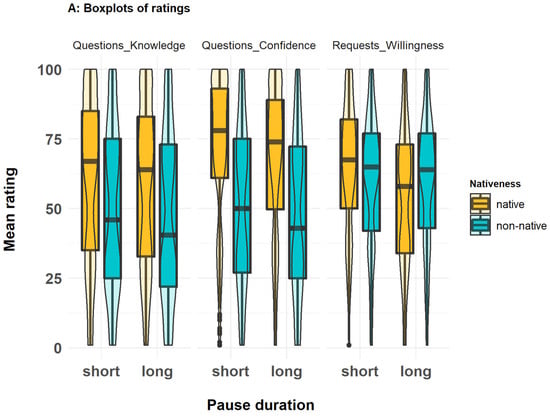
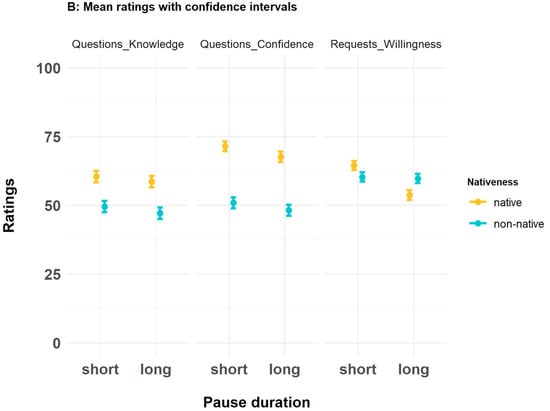
Regarding the perceived knowledge of speakers, the comparison of the full model and the null model showed an effect of either pause duration, nativeness or their interaction on how knowledgeable speakers were perceived (likelihood ratio test: χ2 = 13.20, df = 3, p = 0.004; effect size for the full model: R2m = 0.04, R2c = 0.21). Specifically, we found a significant main effect of pause duration on perceived knowledge, indicating that speakers who made shorter pauses were perceived as more knowledgeable than speakers who made longer pauses (Table 1, Reduced model; Figure 1A; also see overlapping confidence intervals in Figure 1B). Furthermore, there was a significant effect of nativeness on perceived knowledge, with native speakers being perceived as more knowledgeable than non-native speakers (Table 1, Reduced model; Figure 1A; Figure 1B, non-overlapping confidence intervals). However, there was no significant interaction effect of pause duration and nativeness, i.e., the duration of pauses was not interpreted differently depending on whether the pauses were made by native or non-native speakers (Table 1, Full model). The effect of nativeness on perceived knowledge was approximately five times bigger than the effect of pause duration (Table 1).
Table 1.
Results of the linear mixed model exploring the effects of pause duration and nativeness on perceived knowledge. The table reports estimated model coefficients (Estimate), standard errors (SE) and p-values (p). Because of the non-significant interaction effect in the full model, to determine the effects of pause duration and nativeness alone, we also report the results of a reduced model excluding this interaction effect.
Figure 1.
Ratings of the perceived knowledge and confidence of speakers answering knowledge questions, and of the perceived willingness of speakers to comply with requests. Answers were given either by native or non-native speakers and were preceded by either a short (200 ms) or long (1200 ms) pause. Ratings range from 0 (not knowledgeable/confident/willing at all) to 100 (very knowledgeable/confident/willing). (A): Boxes depict medians and quartiles, whiskers depict minimum and maximum values, and black dots depict outliers. Violin shapes around the boxes depict the distribution of the ratings. The width of the violin shapes at a given y coordinate corresponds to the number of ratings in this region. Note that, when evaluating the speakers’ knowledge, confidence and willingness, participants used the full range of the rating scale. (B): Mean and 95% confidence intervals of participants’ responses. Non-overlapping confidence intervals indicate significant differences between the groups.
3.1.2. Perceived Confidence
The comparison of the full model and the null model that investigated perceived confidence showed an effect of either pause duration, nativeness or their interaction on how confident speakers were perceived (likelihood ratio test: χ2 = 26.58, df = 3, p < 0.001; effect size for the full model: R2m = 0.12, R2c = 0.29). More specifically, pause duration had a significant effect on perceived confidence, with speakers who made shorter pauses being perceived as more confident than speakers who made longer pauses (Table 2, Reduced model; Figure 1A; non-overlapping confidence intervals in Figure 1B). In addition, nativeness had a significant effect on perceived knowledge, i.e., native speakers were perceived as more confident than non-native speakers (Table 2, Reduced model; Figure 1A; Figure 1B, non-overlapping confidence intervals). However, similar to perceived knowledge, there was no significant interaction effect of pause duration and nativeness on perceived confidence, i.e., the duration of pauses was not interpreted differently depending on whether the pauses were made by native or non-native speakers (Table 2, Full model). The effect of nativeness on perceived confidence was approximately five times bigger than the effect of pause duration (Table 2).
Table 2.
Results of the linear mixed model exploring the effects of pause duration and nativeness on perceived confidence. The table reports estimated model coefficients (Estimate), standard errors (SE) and p-values (p). Because of the non-significant interaction effect in the full model, to determine the effects of pause duration and nativeness alone, we also report the results of a reduced model excluding this interaction effect.
Because the knowledge and confidence ratings were based on the same mini-conversations, we computed Spearman’s rank correlation coefficient to assess the relationship between perceived knowledge and perceived confidence. There was a medium positive correlation between the two variables (r = 0.56, p < 0.001; Cohen 1992).
3.1.3. Perceived Willingness to Grant Requests
A comparison of the full model and the null model testing the perceived willingness of speakers to grant requests revealed that there was an effect of either pause duration, nativeness or their interaction on how willing speakers were perceived (likelihood ratio test: χ2 = 108.01, df = 3, p < 0.001; effect size for the full model: R2m = 0.02, R2c = 0.30). More specifically, there was a significant interaction effect of pause duration and nativeness on the perceived willingness to grant requests (Table 3; Figure 1A,B). This indicates that short and long pauses made by non-native speakers were interpreted differently than short and long pauses made by native speakers. For native speakers, we observed the same pattern as that for knowledge and confidence; speakers making short pauses were perceived as more willing to grant requests than speakers making long pauses (Figure 1B, non-overlapping confidence intervals). For non-native speakers, however, there was no difference in how willing they were perceived, irrespective of the duration of the pauses they made (Figure 1B, overlapping confidence intervals). In contrast to perceived knowledge and confidence, there was no additional main effect of nativeness, which indicates that, overall, regarding perceived willingness, there was no difference in native and non-native speakers (Table 3).
Table 3.
Results of the linear mixed model exploring the effects of pause duration and nativeness on perceived willingness to grant requests. The table reports estimated model coefficients (Estimate), standard errors (SE) and p-values (p).
3.2. Questionnaire Data: Exploratory Analyses
Here, we exploratorily report the answers of the post-study questionnaire, which help to understand why participants rated the mini-conversations in the way they did. Note that, in the questionnaire, the participants were explicitly asked to comment about our experimental manipulations, which is why it is impossible to disentangle if the participants were really influenced by the manipulations during the experiment or if they just believed they had been influenced by them in retrospect when their attention was drawn to the manipulations in the questionnaire.
Our post-study questionnaire showed that about two thirds of the participants (65.0%; Table 4) had noticed the differences in pause durations in the mini-conversations. Regarding their ratings, approximately half of the participants reported that the duration of the pauses influenced their ratings of knowledge and confidence (53.0%; Table 4), whereas a little less than half of the participants reported that the duration of the pauses influenced their ratings of willingness (44.0%; Table 4). This is compatible with the results of our linear mixed models, which showed a significant effect of pause duration on perceived knowledge and confidence but no significant effect of pause duration on perceived willingness (pause duration factored into the significant interaction effect; see Section 3.1.3). Approximately half of the participants (53.0%; Table 4) reported that the accent of the speakers influenced their ratings. It is interesting that, overall, the influence of accent on the ratings was bigger than the influence of pause duration (Figure 1B), although the number of participants who reported that pause duration and accent influenced their ratings were comparable. This might indicate that, when being influenced by accent, participants gave more extreme ratings than when being influenced by pause durations.
Table 4.
Results of the descriptive analyses of the questionnaire.
Half of the participants (50.0%; Table 4) reported that factors other than pause durations and accent influenced their ratings. Out of the 50 participants who reported that other factors influenced their ratings, 46 provided further comments. Approximately half (25) of those comments mentioned talking speed as an additional influencing factor, with faster speech indicating higher knowledge, confidence and willingness. In our samples, on average, native speakers had a faster talking speed than that of non-native speakers, with native speakers needing, on average, 2.28 ± SD 0.87 s and the non-native speakers needing, on average, 3.68 ± SD 1.84 s per answer. This was unavoidable because, naturally, most L2 learners speak more slowly than native speakers. Because of this difference in speech tempo between native and non-native speakers, it is possible that the observed effects of accent can, to a large extent, be explained by speech tempo, and that speech tempo, which is closely related to perceptions of fluency, might have been more relevant for the ratings than other characteristics of non-native speech, such as deviations in the pronunciation of phonemes or intonation (cf. Bosker et al. 2014).
4. Discussion
This study demonstrated that native raters attribute cognitive states to others when listening to their answers to knowledge questions and requests. In addition, we showed that, in some cases, these cognitive state attributions are influenced by both pause length and nativeness. In the case of knowledge questions, our predictions were confirmed (a) that shorter pauses were associated with higher confidence and knowledge, whereas longer pauses were associated with lower confidence and knowledge, and (b) that non-native speakers were generally judged as less knowledgeable and less confident. However, we did not find the predicted mediating effect of accent on the interpretation of pause duration. In terms of requests, the results confirmed our predictions (a) that, for native speakers, longer pauses are associated with less willingness, and shorter pauses are associated with more willingness, and that, (b) for non-native speakers, this effect does not hold. Thus, for willingness, nativeness has a mediating effect on the perception of pause duration.
Our results are in accordance with prior research but also extend it. In line with Lev-Ari and Keysar (2010), we found that native speakers find non-native speakers to be less knowledgeable than native speakers and also less confident. We therefore replicated an effect found for English for a variety of different accents (such as Polish, French, Italian, Arabic, Russian, Czech, Austrian–German, Turkish and Korean, both with native English-speaking and non-native raters, Lev-Ari and Keysar 2010; Hanzlíková and Skarnitzl 2017) for Chinese-accented Polish (for Polish-speaking raters).
However, we found that this effect was also mediated by pause length in both native and non-native speakers, so that responses after a short pause generally were associated with higher knowledge and confidence ratings than responses after a long pause. For knowledge questions, pause length therefore seems to be one factor that raters take into account when attributing cognitive states to others. However, we also found that the effect of nativeness on perceived knowledge and confidence was much bigger than that of pause length. This means that, whereas pause length does indeed contribute to evaluations, other aspects of non-nativeness are more influential. Such a configuration of results is interesting for conversation-analytic and psycholinguistic research on (dis)preference phenomena in adjacent questions and answers (see Section 1).
It is possible that the results are due to the ‘processing difficulty’ that native raters have when listening to non-native speech, which is associatively misattributed to negative attributes such as a lack of knowledge and confidence, as proposed by Lev-Ari and Keysar (2010) (cf. McGlone and Tofighbakhsh 2000; Reber and Schwarz 1999). Another possible contributing factor is the assessment of fluency, which is mostly related to speech rate and pausing behavior (Van Os et al. 2020; Suzuki et al. 2021). A low speech rate is generally associated with low fluency and is likely to influence native speakers’ ratings, given that, in our samples, non-native speakers needed, on average, 1.6 times as long as native speakers to produce their turn. Therefore, raters might have associated a perceived lack of fluency in non-native speakers with lower knowledge and confidence. However, it is unlikely that a low speech rate alone explains the results, as we also found an effect of pause length in both native speakers and non-native speakers. Here, it is possible that the effect was due to two general associations: first, an association between shorter pauses, on the one hand, and higher knowledge and confidence on the other, and second, an association between longer pauses on the one hand and lower knowledge and confidence on the other hand, due to longer pauses expressing hesitation and prolonged processing time needed to think about the answer (Chafe 1980; Brennan and Williams 1995; Nakane 2007).
However, for non-native speakers it is also possible that lower ratings in the long pause condition are related to fluency, as native raters associate non-native speakers taking longer to respond with lower fluency (Van Os et al. 2020). Here, it is important to note that, in our study, the difference in perceived confidence is larger than the difference in perceived knowledge. This is likely due to the fact that fluency and especially speech rate are both positively linked with associations of confidence (Ackerman and Zalmanov 2012; Jiang and Pell 2017; Guyer et al. 2019; Goupil et al. 2021). Therefore, native raters might have perceived non-native speakers to be less fluent in general due to factors such as their lower speech rate, therefore judging them to be less confident. This, in turn, would also have had consequences for judging them as less knowledgeable, because less confident speakers are likely to also be less knowledgeable about the answer. In the long pause condition, native raters then might have judged non-native speakers as even less fluent, which would have then led to even lower confidence and knowledge ratings. It is likely that raters were influenced by their assessment of the non-native speakers’ confidence in speaking Polish and their knowledge of Polish when judging their general knowledge, confidence and willingness regarding the topic of conversation.
There are, however, likely other factors at play apart from processing difficulty and fluency. For one, confidence might be easier to assess than knowledge, as humans are adapted to quickly detect unreliability in communicative encounters (Goupil et al. 2021). In addition, non-native speakers were likely less confident because they were being recorded in a non-native language in an unfamiliar setting by strangers. The native speakers, on the other hand, were likely more confident, as they knew the setting and were acquainted with the experimenters. This might be another contributing factor to why non-native speakers sounded and were perceived as less confident.
Regarding willingness, we successfully replicated previous results on American English, Italian and Japanese, such that responses after longer pauses are associated with lower willingness to grant requests (Roberts et al. 2011) for Polish. In this regard, our results confirm the findings about the relation between pause length and conversational dispreference made within the tradition of Conversation Analysis (Section 1), but in addition, we also showed that the same effect does not hold for non-native speakers, who are not judged to be less willing to grant requests after a long pause. Native raters therefore seem to be more tolerant toward long pauses in non-native speakers, as we predicted. This suggests that native raters likely attributed a longer response latency to lower fluency and processing difficulty, indicating more time needed to process the question and formulate a response (Cenoz 2000) rather than a lack of willingness. This is in line with research showing that L2 speakers have lower processing speeds in their L2 (Hui and Godfroid 2021) and that working memory for L2 seems to be shorter in the L2 (Linck et al. 2014).
Another important finding in need of explanation is the difference in how people react to questions and requests. Whereas native raters were tolerant towards longer pauses in the request condition, they were not in the knowledge/confidence condition, attributing lower scores to non-native speakers who responded after longer pauses than after shorter pauses. This result is especially interesting from a conversation analysis point of view. One possible explanation is that requests are more socially engaging than questions. As the requests regarded doing things for someone else, request responses can reflect if one is a good cooperator from a social point of view.
Knowledge questions, on the other hand, are less socially engaging, i.e., responses reflect on the partner’s quality in terms of their competence, not their cooperativeness. Answers to requests might therefore be more important for assessing trust than answers to knowledge questions. In other words, when assessing social relationships, raters were more likely to attribute pausing behavior to non-nativeness, whereas for knowledge questions, they evaluated the respondents’ competence, where they took all cues, including pauses, into account.
Our study has a few limitations that could be addressed in follow-up studies. For example, it would be good to have a larger set of native and non-native speakers in the recordings of conversations to balance out variations in individual voice characteristics, intonation or talking speed. Moreover, a bigger set of speakers would allow for measuring and investigating a larger number of features of L2 speech that could affect how pauses are interpreted (e.g., intonation, fluency and non-native pronunciation of particular phonemes).
Alternatively, one could systematically vary features such as talking speed and L2 proficiency levels and see how pause durations are interpreted under those conditions. For example, one could first let native speakers rate the proficiency levels of L2 speakers and then correlate those results with the ratings of cognitive states such as knowledge, confidence and willingness. It would be especially interesting to test the perception of knowledge, confidence and willingness in L2 speakers with native-like fluency levels but who still clearly have recognizable non-native accents. Ratings of such speakers could disentangle if and how the interplay of pause length and accents relates to perceptions of fluency (cf. Van Os et al. 2020).
In addition, in this study, we did not assess directly how fluent raters perceived the speakers. Given that fluency is a likely factor in raters’ evaluations of knowledge, confidence and willingness, it would be interesting to see in future studies whether direct correlations between these dimensions and fluency ratings can be found. As discussed above, there are also other potential factors that could influence ratings, such as speech rate, but also disfluencies and prosody, when producing answers to trivia questions and requests. This means that pauses are potentially one of several factors impacting native speaker ratings. Future studies could more systematically measure and thereby disentangle the individual contributions of different aspects, such as variations in fluency, speech rate, hesitation markers, intonation or the overall naturalness of the answers.
This research focuses on unfilled inter-turn pauses. However, speakers also use filled inter-turn pauses (e.g., um…. ehm…..), which could be added in future studies. In addition, the stimuli in our experiment did not include unfilled or filled intra-turn pauses, which, however, are a frequent characteristic of spoken language. As a wealth of the literature has shown that such intra-turn pauses are evaluated by listeners to assess the cognitive states of speakers (e.g., Bosker et al. 2014), future research might address the question of how intra-turn pauses contribute to attributing knowledge, confidence and willingness to native and non-native speakers.
Finally, it would also be interesting to test if perceptions of knowledge, confidence and willingness of speakers differ, depending on whether the raters are active participants in the dialogue (i.e., asking the question or posing the request) or external third-party listeners, as was the case in our study. Overall, we hypothesize that the effects that were found in our study are not qualitatively different in dialogue participants and external listeners. However, we expect quantitative differences; we predict the effects to be stronger in dialogue participants than in external listeners because, for the former, the response and associated indicators of knowledge and willingness are more socially relevant than for unrelated bystanders.
5. Conclusions
Our study engages with discussions about conversational turn-taking, and more specifically inter-turn phenomena (Levinson 1983; Kendrick and Torreira 2015). An important quality that the present research brings into these discussions is an approach to the problem of pauses as a complex phenomenon, by integrating the purely conversational element of pause length with sociolinguistic variables (speaker nativity), together with functional (questions and requests) and psychological considerations (perceptions of knowledgeability, confidence and willingness). This opens up vistas for better-informed and more pragmatically realistic studies.
Author Contributions
Conceptualization: T.M., M.P. and P.Z.; Methodology: T.M., M.P. and P.Z.; Data Collection, Data Analysis, Data Visualization and Data Curation: T.M.; Writing—original draft preparation: T.M., M.P. and P.Z.; Writing—review and editing: T.M., M.P. and P.Z.; Project Administration: T.M. All authors have read and agreed to the published version of the manuscript.
Funding
Theresa Matzinger was supported by a mobility fellowship of Nicolaus Copernicus University Toruń and a Post-doc Track stipend from the Austrian Academy of Sciences. Michael Pleyer was supported by grant UMO-2021/43/P/HS2/02729 co-funded by the Polish National Science Centre (NCN) and the European Union’s Horizon 2020 research and innovation programme under the Marie Skłodowska-Curie grant agreement no. 945339. Przemysław Żywiczyński was supported by the Polish National Science Centre (NCN) under grant agreement UMO-2017/27/B/HS2/00642. Open Access Funding by the University of Vienna.
Institutional Review Board Statement
The study was conducted in accordance with the Declaration of Helsinki, and approved by the Scientific Research Ethics Committee at the University of Warmia and Mazury in Olsztyn, Poland (reference number: Decision no. 8/2018).
Informed Consent Statement
Informed consent was obtained from all subjects involved in the study.
Data Availability Statement
All data as well as the preregistered R files used for analysis can be found on the Open Science Framework under the following link: https://osf.io/z83yx/ accessed on 2 January 2023.
Acknowledgments
We thank Elizabeth Qing Zhang for helping with the editing of the stimuli, Mariusz Lewandowski and Adam Gutowski for programming the experimental interface in Labvanced, Sławomir Wacewicz for acquiring funds for participant remuneration, and Monika Pleyer for helpful discussions.
Conflicts of Interest
The authors declare no conflict of interest.
Appendix A. Mini-Conversations
In the following two tables (Table A1 and Table A2), we present the mini-conversations of knowledge questions and requests that were used in the study.
Table A1.
Knowledge questions and answers that were used as stimuli for testing perceived knowledge and confidence of the respondents. The mini-conversations are presented in English translations and the original Polish versions that were used in the study.
Table A2.
Requests and answers that were used as stimuli for testing perceived willingness of the respondents to grant the requests. The mini-conversations are presented in English translations and the original Polish versions that were used in the study.
Note
| 1 | // indicates that “times” and “I would like to” are delivered in an overlap. |
References
- Ackerman, Rakefet, and Hagar Zalmanov. 2012. The persistence of the fluency–confidence association in problem solving. Psychonomic Bulletin and Review 19: 1187–92. [Google Scholar] [CrossRef] [Scilit] [PubMed]
- Alim, H. Samy, John R. Rickford, and Arnetha F. Ball, eds. 2016. Raciolinguistics: How Language Shapes Our Ideas about Race. Oxford: Oxford University Press. [Google Scholar]
- Atkinson, J. Maxwell, and Paul Drew. 1979. Order in Court: The Organization of Verbal Interaction in Juridical Settings. London: Macmillan. [Google Scholar]
- Baayen, R. Harald. 2008. Analyzing Linguistic Data. Cambridge: Cambridge University Press. [Google Scholar]
- Barr, Dale J., Roger Levy, Christoph Scheepers, and Harry J. Tily. 2013. Random Effects Structure for Confirmatory Hypothesis Testing: Keep It Maximal. Journal of Memory and Language 68: 255–78. [Google Scholar] [CrossRef] [Scilit] [PubMed]
- Bartón, Kamil. 2018. MuMIn: Multi-Model Inference. R Package Version 1.42.1. Available online: https://cran.r-project.org/package=MuMIn (accessed on 2 January 2023).
- Bates, Douglas, Martin Mächler, Benjamin M. Bolker, and Steven C. Walker. 2015. Fitting Linear Mixed-Effects Models Using Lme4. Journal of Statistical Software 67: 1–48. [Google Scholar] [CrossRef] [Scilit]
- Boduch-Grabka, Katarzyna, and Shiri Lev-Ari. 2021. Exposing Individuals to Foreign Accent Increases their Trust in What Nonnative Speakers Say. Cognitive Science 45: e13064. [Google Scholar] [CrossRef] [Scilit]
- Boersma, Paul, and David Weenink. 2022. Praat: Doing Phonetics by Computer (Version 6.2.19). Available online: http://www.praat.org/ (accessed on 2 January 2023).
- Bosker, Hans Rutger, Hugo Quené, Ted Sanders, and Nivja H. De Jong. 2014. The perception of fluency in native and nonnative speech. Language Learning 64: 579–614. [Google Scholar] [CrossRef] [Scilit]
- Brennan, Susan E., and Maurice Williams. 1995. The Feeling of Another′s Knowing: Prosody and Filled Pauses as Cues to Listeners about the Metacognitive States of Speakers. Journal of Memory and Language 34: 383–98. [Google Scholar] [CrossRef] [Scilit]
- CBOS (Centrum Badania Opinii Publicznej). 2020. Tożsamość narodowa i postrzeganie praw mniejszości narodowych i etnicznych. Warszawa: Fundacja Centrum Badania Opinii Społecznej. [Google Scholar]
- Cenoz, Jasone. 2000. Pauses and hesitation phenomena in second language production. ITL: Review of Applied Linguistics 127: 53–69. [Google Scholar] [CrossRef] [Scilit]
- Chafe, Wallace L. 1980. Some reasons for hesitating. In Temporal Variables in Speech 86. Edited by Hans W. Dechert and Manfred Raupach. New York: De Gruyter Mouton. [Google Scholar]
- Cohen, Jacob. 1992. A Power Primer. Psychological Bulletin 112: 155–59. [Google Scholar] [CrossRef]
- Çokal, Derya, Vitor Zimmerer, Douglas Turkington, Nicol Ferrier, Rosemary Varley, Stuart Watson, and Wolfram Hinzen. 2019. Disturbing the rhythm of thought: Speech pausing patterns in schizophrenia, with and without formal thought disorder. PLoS ONE 14: e0217404. [Google Scholar] [CrossRef] [Scilit]
- Coupland, Nikolas, and Hywel Bishop. 2007. Ideologised values for British accents 1. Journal of Sociolinguistics 11: 74–93. [Google Scholar] [CrossRef] [Scilit]
- Davis, Norman. 2003. God’s Playground A History of Poland: Volume II: 1795 to the Present. Oxford: Oxford University Press. [Google Scholar]
- De Jong, Nivja H. 2016. Predicting pauses in L1 and L2 speech: The effects of utterance boundaries and word frequency. International Review of Applied Linguistics in Language Teaching 54: 113–32. [Google Scholar] [CrossRef] [Scilit]
- De Ruiter, Jan-Peter, Holger Mitterer, and Nick J. Enfield. 2006. Projecting the end of a Speaker’s Turn: A Cognitive Cornerstone of Conversation. Language 82: 515–35. [Google Scholar] [CrossRef] [Scilit]
- Dingemanse, Mark, and Andreas Liesenfeld. 2022. From text to talk: Harnessing conversational corpora for humane and diversity-aware language technology. In Proceedings of the 60th Annual Meeting of the Association for Computational Linguistics 1 (Long Papers). Dublin: Association for Computational Linguistics, pp. 5614–33. [Google Scholar]
- Dobrow, Julia R., and Calvin L. Gidney. 1998. The good, the bad, and the foreign: The use of dialect in children’s animated television. The Annals of the American Academy of Political and Social Science 557: 105–19. [Google Scholar] [CrossRef] [Scilit]
- Dobson, Annette J. 2002. An Introduction to Generalized Linear Models. Boca Raton: Chapman and Hall. [Google Scholar]
- Duez, Danielle. 1982. Silent and non-silent pauses in three speech styles. Language and Speech 25: 11–28. [Google Scholar] [CrossRef] [Scilit]
- Feng, Ruiling. 2022. Cognitive Factors Influencing Utterance Fluency in L2 Dialogues: Monadic and Non-monadic Perspectives. Frontiers in Psychology 13: 926367. [Google Scholar] [CrossRef] [Scilit]
- Field, Andy, Jeremy Miles, and Zoë Field. 2012. Discovering Statistics Using R. Los Angeles: SAGE. [Google Scholar] [CrossRef] [Scilit]
- Finger, Holger, Caspar Goeke, Dorena Diekamp, Kai Standvoß, and Peter König. 2017. LabVanced: A unified JavaScript framework for online studies. In International Conference on Computational Social Science (Cologne). Cologne: University of Osnabrück, pp. 1–3. [Google Scholar]
- Fletcher, Janet. 2010. The Prosody of Speech: Timing and Rhythm. In The Handbook of Phonetic Sciences. Edited by William J. Hardcastle, John Laver and Fiona E. Gibbon. New Jersey: Wiley-Blackwell, pp. 521–602. [Google Scholar]
- Fox Tree, Jean E. 2002. Interpreting pauses and ums at turn exchanges. Discourse Processes 34: 37–55. [Google Scholar] [CrossRef] [Scilit]
- Fuertes, Jairo N., William H. Gottdiener, Helena Martin, Tracey C. Gilbert, and Howard Giles. 2012. A meta-analysis of the effects of speakers’ accents on interpersonal evaluations. European Journal of Social Psychology 42: 120–33. [Google Scholar] [CrossRef] [Scilit]
- Gleitman, Lila R., David January, Rebecca Nappa, and John C. Trueswell. 2007. On the give and take between event apprehension and utterance formulation. Journal of Memory and Language 57: 544–69. [Google Scholar] [CrossRef] [Scilit]
- Gluszek, Agata, and John F. Dovidio. 2010. Speaking with a nonnative accent: Perceptions of bias, communication difficulties, and belonging in the United States. Journal of Language and Social Psychology 29: 224–34. [Google Scholar] [CrossRef] [Scilit]
- Goupil, Louise, Emmanuel Ponsot, Daniel Richardson, Gabriel Reyes, and Jean-Julien Aucouturier. 2021. Listeners’ perceptions of the certainty and honesty of a speaker are associated with a common prosodic signature. Nature Communications 12: 1–17. [Google Scholar] [CrossRef] [Scilit] [PubMed]
- Griffin, Zenzi M., and Kathryn Bock. 2000. What the eyes say about speaking. Psychological Science 11: 274–79. [Google Scholar] [CrossRef] [Scilit] [PubMed]
- Guyer, Joshua J., Leandre R. Fabrigar, and Thomas I. Vaughan-Johnston. 2019. Speech rate, intonation, and pitch: Investigating the bias and cue effects of vocal confidence on persuasion. Personality and Social Psychology Bulletin 45: 389–405. [Google Scholar] [CrossRef] [Scilit]
- Hanzlíková, Dagmar, and Radek Skarnitzl. 2017. Credibility of native and non-native speakers of English revisited: Do non-native listeners feel the same? Research in Language 15: 285–98. [Google Scholar] [CrossRef] [Scilit]
- Heldner, Mattias, and Jens Edlund. 2010. Pauses, gaps and overlaps in conversations. Journal of Phonetics 38: 555–68. [Google Scholar] [CrossRef] [Scilit]
- Heritage, John. 1984. Garfinkel and Ethnomethodology. Cambridge: Polity Press. [Google Scholar]
- Hui, Bronson, and Aline Godfroid. 2021. Testing the role of processing speed and automaticity in second language listening. Applied Psycholinguistics 42: 1089–115. [Google Scholar] [CrossRef] [Scilit]
- Igras-Cybulska, Magdalena, Bartosz Ziółko, Piotr Żelasko, and Marcin Witkowski. 2016. Structure of pauses in speech in the context of speaker verification and classification of speech type. EURASIP Journal on Audio, Speech, and Music Processing 18: 1–16. [Google Scholar] [CrossRef] [Scilit]
- Jiang, Xiaoming, and Marc D. Pell. 2017. The sound of confidence and doubt. Speech Communication 88: 106–26. [Google Scholar] [CrossRef] [Scilit]
- Kahng, Jimin. 2018. The effect of pause location on perceived fluency. Applied Psycholinguistics 39: 569–91. [Google Scholar] [CrossRef] [Scilit]
- Kendrick, Kobin H., and Francisco Torreira. 2015. The timing and construction of preference: A quantitative study. Discourse Processes 52: 255–89. [Google Scholar] [CrossRef] [Scilit]
- Kuznetsova, Alexandra, Per B. Brockhoff, and Rune H. B. Christensen. 2017. lmerTest Package: Tests in Linear Mixed Effects Models. Journal of Statistical Software 82: 1–26. [Google Scholar] [CrossRef] [Scilit]
- Lev-Ari, Shiri, and Boaz Keysar. 2010. Why don’t we believe non-native speakers? The influence of accent on credibility. Journal of Experimental Social Psychology 46: 1093–96. [Google Scholar] [CrossRef] [Scilit]
- Levelt, Willem. M. 1999. Producing spoken language: A blueprint of the speaker. In The Neurocognition of Language. Edited by Colin M. Brown and Peter Hagoort. Oxford: Oxford Press, pp. 83–122. [Google Scholar]
- Levinson, Stephen C. 1983. Pragmatics. Cambridge: Cambridge University Press. [Google Scholar]
- Levinson, Stephen C. 2016. Turn-taking in Human Communication–Origins and Implications for Language Processing. Trends in Cognitive Sciences 20: 6–14. [Google Scholar] [CrossRef] [Scilit] [PubMed]
- Levinson, Stephen C., and Francisco Torreira. 2015. Timing in turn-taking and its implications for processing models of language. Frontiers in Psychology 6: 731. [Google Scholar] [CrossRef] [Scilit]
- Linck, Jared A., Peter Osthus, Joel T. Koeth, and Michael F. Bunting. 2014. Working memory and second language comprehension and production: A meta-analysis. Psychonomic Bulletin & Review 21: 861–83. [Google Scholar]
- Lippi-Green, Rosina. 2012. English with an Accent: Language, Ideology, and Discrimination in the United States. London: Routledge. [Google Scholar]
- Lundholm-Fors, Kristina. 2015. Production and Perception of Pauses in Speech. Ph.D. dissertation, University of Gothenburg, Gothenburg, Sweden. [Google Scholar]
- Matzinger, Theresa, Nikolaus Ritt, and W. Tecumseh Fitch. 2020. Non-native speaker pause patterns closely correspond to those of native speakers at different speech rates. PLoS ONE 15: e0230710. [Google Scholar] [CrossRef] [Scilit] [PubMed]
- McGlone, Matthew S., and Jessica Tofighbakhsh. 2000. Birds of a feather flock conjointly (?): Rhyme as reason in aphorisms. Psychological Science 11: 424–28. [Google Scholar] [CrossRef] [Scilit]
- Nakagawa, Shinichi, and Holger Schielzeth. 2013. A general and simple method for obtaining R2 from generalized linear mixed-effects models. Methods in Ecology and Evolution 4: 133–42. [Google Scholar] [CrossRef] [Scilit]
- Nakane, Ikuko. 2007. Silence in Intercultural Communication. Amsterdam: John Benjamins. [Google Scholar]
- O’Connell, Daniel C., and Sabine Kowal. 1983. Pausology. In Computers in Language Research 2. Edited by Walter A. Sedelow and Sally Yeates Sedelow. New York: De Gruyter Mouton. [Google Scholar]
- Peltonen, Pauliina. 2017. Temporal fluency and problem-solving in interaction: An exploratory study of fluency resources in L2 dialogue. System 70: 1–13. [Google Scholar] [CrossRef] [Scilit]
- Peterson, Elizabeth. 2019. Making Sense of Bad English. London: Taylor and Francis. [Google Scholar]
- Pomerantz, Anita. 1984. Agreeing and Disagreeing with Assessments: Some Features of Preferred and Dispreferred Turn Shapes. In Structures of Social Action. Studies in Conversation Analysis. Edited by J. Maxwell Atkinson and John Heritage. Cambridge: Cambridge University Press, pp. 57–101. [Google Scholar]
- Pomerantz, A., and J. Heritage. 2013. Preference. In The Handbook of Conversation Analysis. Edited by Tanya Stivers and Jack Sidnell. Malden: Wiley-Blackwell, pp. 210–29. [Google Scholar]
- R Development Core Team. 2018. R: A Language and Environment for Statistical Computing. Vienna: R Foundation for Statistical Computing. [Google Scholar]
- Ramjattan, Vijay A. 2022. Accenting racism in labour migration. Annual Review of Applied Linguistics 42: 87–92. [Google Scholar] [CrossRef] [Scilit]
- Raupach, Manfred. 1980. Temporal variables in first and second language speech and perception of fluency. In Temporal Variables in Speech: Studies in Honour of Frieda Goldman-Eisler. Edited by Hans W. Dechert and Manfred Raupach. New York: De Gruyter Mouton, pp. 263–70. [Google Scholar]
- Reber, Rolf, and Norbert Schwarz. 1999. Effects of perceptual fluency on judgments of truth. Consciousness and Cognition 8: 338–42. [Google Scholar] [CrossRef] [Scilit]
- Roberts, Felicia, and Alexander L. Francis. 2013. Identifying a temporal threshold of tolerance for silent gaps after requests. The Journal of the Acoustical Society of America 133: EL471–EL477. [Google Scholar] [CrossRef] [Scilit] [PubMed]
- Roberts, Felicia, Piera Margutti, and Shoji Takano. 2011. Judgments concerning the valence of inter-turn silence across speakers of American English, Italian, and Japanese. Discourse Processes 48: 331–54. [Google Scholar] [CrossRef] [Scilit]
- Roessel, Janin, Christiane Schoel, and Dagmar Stahlberg. 2020. Modern notions of accent-ism: Findings, conceptualizations, and implications for interventions and research on nonnative accents. Journal of Language and Social Psychology 39: 87–111. [Google Scholar] [CrossRef] [Scilit]
- Rosa, Jonathan, and Nelson Flores. 2017. Unsettling race and language: Toward a raciolinguistic perspective. Language in Society 46: 621–47. [Google Scholar] [CrossRef] [Scilit]
- Sacks, Harvey. 1992. Lectures on Conversations. Oxford: Blackwell, vols. I and II. [Google Scholar]
- Sacks, Harvey, and Emmanuel Schegloff. 1973. Opening up Closings. Semiotica 7: 289–327. [Google Scholar]
- Schegloff, Emmanuel A. 2007. Sequence Organization in Interaction: A Primer in Conversation Analysis I. Cambridge: Cambridge University Press, vol. 1. [Google Scholar]
- Schielzeth, Holger, and Wolfgang Forstmeier. 2009. Conclusions beyond support: Overconfident estimates in Mixed Models. Behavioral Ecology 20: 416–20. [Google Scholar] [CrossRef] [Scilit]
- Stivers, Tanya. 2010. An overview of the question–response system in American English conversation. Journal of Pragmatics 42: 2772–81. [Google Scholar] [CrossRef] [Scilit]
- Stivers, Tanya, Nicholas J. Enfield, Penelope Brown, Christina Englert, Makoto Hayashi, Trine Heinemann, Gertie Hoymann, Federico Rossano, Jan Peter de Ruiter, Kyung-Eun Yoon, and et al. 2009. Universals and cultural variation in turn-taking in conversation. Proceedings of the National Academy of Sciences 106: 10587–92. [Google Scholar] [CrossRef] [Scilit]
- Suzuki, Shungo, Judit Kormos, and Takumi Uchihara. 2021. The relationship between utterance and perceived fluency: A meta-analysis of correlational studies. The Modern Language Journal 105: 435–63. [Google Scholar] [CrossRef] [Scilit]
- Tavakoli, Parvaneh. 2011. Pausing patterns: Differences between L2 learners and native speakers. ELT Journal 65: 71–79. [Google Scholar] [CrossRef] [Scilit]
- Timming, Andrew R. 2017. The effect of foreign accent on employability: A study of the aural dimensions of aesthetic labour in customer-facing and non-customer-facing jobs. Work, Employment and Society 31: 409–28. [Google Scholar] [CrossRef] [Scilit]
- Trouvain, Jürgen, Camille Fauth, and Bernd Möbius. 2016. Breath and Non-breath Pauses in Fluent and Disfluent Phases of German and French L1 and L2 Read Speech. Speech Prosody (SP8) 31: 31–35. [Google Scholar]
- Trzeciakowska, Julia. 2020. Non-Native English Speakers’ Attitudes Towards Polish-Accented English. Theoria et Historia Scientiarum 17: 77–94. [Google Scholar] [CrossRef] [Scilit]
- Tsalikis, John, Oscar W. DeShields, Jr., and Michael S. LaTour. 1991. The role of accent on the credibility and effectiveness of the salesperson. Journal of Personal Selling and Sales Management 11: 31–41. [Google Scholar]
- Van Os, Marjolein, Nivja H. De Jong, and Hans Rutger Bosker. 2020. Fluency in dialogue: Turn-taking behavior shapes perceived fluency in native and nonnative speech. Language Learning 70: 1183–217. [Google Scholar] [CrossRef] [Scilit]
- Walker, Michael B., and Carmelina Trimboli. 1982. Smooth transitions in conversational interactions. The Journal of Social Psychology 117: 305–6. [Google Scholar] [CrossRef] [Scilit]
- Wardęga, Joanna. 2017. Chińczycy w Polsce–niewidoczna mniejszość. Studia Migracyjne-Przegląd Polonijny 2: 121–41. [Google Scholar]
- Wootton, Anthony J. 1981. The Management of Grantings and Rejections by Parents in Request Sequences. Semiotica 37: 59–90. [Google Scholar] [CrossRef] [Scilit]

Disclaimer/Publisher’s Note: The statements, opinions and data contained in all publications are solely those of the individual author(s) and contributor(s) and not of MDPI and/or the editor(s). MDPI and/or the editor(s) disclaim responsibility for any injury to people or property resulting from any ideas, methods, instructions or products referred to in the content. |
© 2023 by the authors. Licensee MDPI, Basel, Switzerland. This article is an open access article distributed under the terms and conditions of the Creative Commons Attribution (CC BY) license (https://creativecommons.org/licenses/by/4.0/).