


Abstract
This quantitative study explores divergent beliefs about word order in American Sign Language (ASL) within the U.S. Deaf community. Although the academic literature commonly characterizes ASL as following a Subject–Verb–Object (SVO) structure, certain Deaf individuals maintain that ASL predominantly uses a Subject–Object–Verb (SOV) order. This perception reflects an ideological positioning of ASL as fundamentally distinct from English and may align with community norms that have historically emphasized SOV structures. Data were collected through an acceptability judgment task with 53 varied sentence structures presented via video. Among 86 Deaf participants, distinct preferences emerged based on ASL acquisition background. Participants with early ASL exposure from Deaf parents preferred the SOV structure, while those with early ASL exposure from hearing parents preferred the SVO structure. This finding suggests that variability in beliefs about acceptable ASL word order, along with factors such as early language exposure and parental input, influences judgments of acceptability.
1. Introduction
Basic word order refers to the canonical or default arrangement of subject, verb, and object in neutral declarative sentences (Dryer, 2005). In the academic literature, the term “basic word order” is often used with a specific definition in mind. It has been variously defined as the underlying word order of a language, the most unmarked, pragmatically neutral and/or frequently occurring word order, or the word order which, if taken to be the underlying order of all sentences in the language, generates the simplest overall grammar (Pichler, 2001).
There is considerable debate within the Deaf community over what constitutes proper ASL composition, with sociolinguistic implications. This debate can be categorized into three competing descriptions: (1) ASL (like English) follows a Subject–Verb–Object (SVO) structure; (2) ASL has a flexible word order, in which SVO and SOV (Subject–Object–Verb) are equally allowable; and (3) ASL uses an SOV word order, a characteristic that distinguishes it from English grammar. This study explores beliefs regarding word order in American Sign Language (ASL) within the U.S. Deaf community, examining how community members evaluate the grammatical acceptability of different word orders and how these evaluations are shaped by language ideologies. Although SVO is often cited as the basic word order in ASL, the language exhibits flexibility in word order (S. Fischer & Li, 1975; S. D. Fischer & Van der Hulst, 2003; Liddell, 1980; Neidle et al., 2000; Padden, 1988; Sandler & Lillo-Martin, 2006). Some Deaf people assert that ASL is characterized by a Subject–Object–Verb (SOV) structure. As someone who grew up in the Deaf community, I have frequently encountered statements such as the following in informal discussions about differences between English and ASL:
Upon being asked how English and ASL differ:
YOU KNOW WORD SWITCH WORD PLACE DIFFERENT
‘You know, the placement in the sentence is different.’
SHOULD ACT LAST
‘The verb should be at the end of the sentence.’
Among some Deaf community members, there is a belief that ASL should avoid English-like structures (Kusters et al., 2020; Tanner & Doré, 2019) and maintain a “pure” form (Kusters et al., 2020) often associated with SOV word order. As a result, criticism within the community is sometimes directed at individuals whose signing reflects what is perceived as “English” word order. This critique may stem from broader concerns about language dilution or assimilation and is often exemplified in opposition to manually coded systems like Signed Exact English (SEE), which strictly follow English grammatical structure and are widely rejected by native ASL signers.
1.1. ASL’s Word Order History
While we will not discuss the typological implications of ASL word order, it should be mentioned that ASL allows more freedom of constituent ordering in the main clause (i.e., the preference of rightward or leftward movement), and this freedom gives the impression that ASL shuffles word order (which is why there is a long debate over whether it even has a basic word order) (Kimmelman, 2022; Neidle et al., 2000; Pichler, 2001; Sandler & Lillo-Martin, 2006; Schlenker et al., 2024; Wilbur, 1997, p. 98). Aarons (1994) noted problems with limited sources for ASL discourse and word order and that because of the modality of the language (visual) there was not enough evidence from the early days of ASL research due to a lack of documentation. Unlike many spoken languages, ASL does not have a widely adopted orthographic system. While several notation systems have been developed by researchers (e.g., Stokoe notation (W. C. Stokoe, 1960), SignWriting (Sutton, 1981)), these have not been embraced for everyday use by the Deaf community. This lack of adoption is often attributed to the historical marginalization of sign languages in education (Baynton, 1996; Henner & Robinson, 2021; Humphries et al., 2012; Monaghan, 2003) and to the perception among Deaf signers that a separate writing system is unnecessary, given their fluency in the written form of their country’s spoken language (Hill, 2012; Hoffmann-Dilloway, 2011).
As the field progressed and more data became available, some scholars debated whether ASL’s underlying word order was SOV or SVO. Fischer’s research in 1975, which concluded that ASL adheres to a SVO structure, appears to have largely gone unrecognized outside academic circles. Given the possible belief that ASL should follow an SOV structure, it is essential to review S. Fischer and Li’s (1975)work on SOV and SVO. Fischer believed that the shift from SOV to SVO in ASL was influenced by English word order, particularly the prestige of and contact with English (S. Fischer & Li, 1975). S. Fischer and Li (1975) discussed whether the “standard”1 ASL word order is SOV, SVO, or even OSV. By the time Fischer published, the word order of ASL was SVO in general, not including topicalization (indicated by pauses, head tilts, or raising of eyebrows) (S. Fischer & Li, 1975). However, a review found one-hundred-year-old evidence from French Sign Language and historical ASL data to suggest that ASL was likely originally SOV in nature (see S. Fischer & Li, 1975).
While ASL was acquired and preserved by many Deaf individuals, particularly those from Deaf families or who resisted oralist constraints, we caution against assuming that early ASL films from the 1900s fully represent the broader community’s language use (Supalla, 2004). Educational and medical institutions during this period often marginalized natural sign language in favor of speech and English grammar, shaping the linguistic environment in which ASL developed and was recorded (Imm, 2025; Supalla, 2004). It is important to note that perceptions of what constitutes “proper” signing have shifted over time. As Supalla (2004) noted, at least until the recent past, the “proper” form of signing was often perceived as a form of English, reflecting societal attitudes that favored spoken language usage over natural sign language. Another possible piece of evidence supporting SOV word order comes from an 1871 article written by Keep, who observed the surface part of sign language and documented sentence structure, possibly a basic word order:
“Thirdly, inversion, or the placing of the object before the action, is, it will be seen, a striking feature of the sign-language. That in this respect it follows the method in which all minds conceive of objects and actions, we have no doubt”.(p. 224)
This may indicate that older ASL was indeed a SOV language. Keep (1871) also suggested a correlation between word order and perception of the world: how perception works in the mind, seeing the object first before action. He used the example of striking a board: seeing the board first with the intention to strike it, rather than striking into the air, because there is no board mentioned until after.
In conclusion, although ASL has been documented as an SVO language in the academic literature, there are also observations dating back to the 19th century that ASL is an SOV language as well.
1.2. Language Ideology
Previous studies by S. Fischer and Li (1975), Supalla (2004), Spooner (2020), Hoffmann-Dilloway (2011), T. Reagan (2011), Kusters et al. (2020), and Noschese (2025) on a variety of sentence structures in ASL suggest differing perspectives on sentence structure and beliefs about what constitutes ASL. Some Deaf people assert that the word order of ASL is different from English; for these signers, productions that resemble English word order suggest that the person is either not proficient in ASL or not a native signer (Hill, 2012; Lucas et al., 2001; Tanner & Doré, 2019). The belief that ASL follows an SOV structure dates back over a hundred years ago, possibly to recognize that ASL remains distinct from English. English has a rigid SVO word order (Biber et al., 2021), and categorizing ASL in the same way might imply conformity to English, a language historically favored in Deaf education at the expense of sign languages, most notably following the 1880 Milan Conference, which banned the use of sign language in schools and promoted oralism (Baynton, 1996; Henner & Robinson, 2021; T. G. Reagan, 2010). As a result, ASL was actively suppressed in formal settings and Deaf individuals often had to resist these policies to maintain their language (De Meulder, 2016; Henner & Robinson, 2021; Klein, 2021; Limani, 2024; T. Reagan, 2011). These oppressive practices have contributed to a strong desire within the Deaf community to affirm the autonomy and legitimacy of ASL, which includes emphasizing structural distinctions from English.
Belief and ideology are often closely related, as both represent systems of thought that influence how individuals and groups interpret the world and their place within it. While belief typically refers to individual convictions in specific truths, ideology is a broader set of beliefs that form a framework guiding social, political, or economic actions (Kusters et al., 2020). The relationship between belief and ideology is significant because personal beliefs can contribute to the formation of ideologies, while established ideologies can shape and reinforce beliefs (Kusters et al., 2020).
Language ideology, in simple terms, refers to socially shared and often taken-for-granted beliefs about language and its speakers, which may potentially amplify or diminish inequalities and differences by hierarchically categorizing people into different linguistic groups (Schieffelin & Woolard, 1994). Language ideologies, in principle, concern issues of intergroup relations by providing social categories (Schieffelin & Woolard, 1994). These ideologies, through interactions, can hold significant implications for interpersonal relationships, as belonging to certain social categories becomes part of one’s identity, thus becoming important in these interactions (E. Stokoe, 2012).
Members of linguistic communities conceal conscious and subconscious ideologies regarding languages, shaped by factors like educational placements and social perceptions (Rumsey, 1990). Hill (2012) discussed how social factors and educational policies influence Deaf individuals’ beliefs about their languages, with early ASL exposure viewed as crucial for proficiency. Despite notions of “standard ASL”, variations exist within the Deaf community, influenced by upbringing and educational experiences. Hill underscores the significance of English in shaping perceptions of ASL within the Deaf community, emphasizing its impact on linguistic structure and societal status (Hill, 2012).
Hill (2012) explains how social factors and educational policies can influence Deaf individuals’ beliefs about their languages. For instance, within American academic settings, policies that prioritize English as the language of instruction tend to perpetuate negative attitudes toward signed languages, both within and outside the classroom. Consequently, Deaf individuals may come to view English as superior. Also, beliefs appear to be influenced by ideologies regarding the superiority of the spoken modality (Senghas & Monaghan, 2002; Hill, 2012).
A common ideology within the Deaf community is that early ASL exposure and acquisition are the crucial factors in developing proficiency in standard ASL (Hill, 2012). For example, Deaf people who are proficient in ASL are either part of Deaf generational lineage, or have attended special schools for the Deaf where ASL is the norm, whereas “less proficient” users (that is, those who use another variety than “standard ASL”) are assumed to have been raised by hearing families, or to have been schooled in a mainstream education setting where ASL has a marginal role in an English-dominant curriculum (Hill, 2012). Despite ideologies about standard ASL, it is easy to observe in almost any ASL community that ASL is in fact not monolithic; rather, multiple varieties coexist, reflecting geographic and social factors, including educational backgrounds, generational differences, and language contact.
Noschese (2025) conducted a qualitative study exploring Deaf signers’ perceptions of ASL word order, particularly beliefs about the use of SOV structure. This study included ten Deaf participants with diverse language backgrounds and educational experiences and revealed variation in how participants viewed ASL grammar. While some participants, especially those from hearing families, explicitly discussed differences between ASL and English word orders, others, those from Deaf families or with early ASL exposure, expressed less awareness of such distinctions. These findings suggest that a belief associating ASL with SOV word order may be present among segments of the community, although it is not uniformly held. Understanding how these ideologies are shaped by language background and educational experience provides important context for examining how Deaf individuals respond to different ASL word order structures, which this quantitative study investigates further.
The central research question of this paper is: Do participants give different acceptability ratings to SVO and SOV sentences? It is hypothesized that some Deaf participants will show a preference for SOV structures in their acceptability ratings relative to SVO. While this study does not directly measure participants’ explicit beliefs about ASL grammar, patterns in their acceptability ratings can provide insight into underlying linguistic intuitions and perceptions shaped by language background and educational experience. These evaluative judgments may also be influenced by socially circulating norms about what constitutes acceptable or “correct” ASL; however, the present study cannot determine the extent to which explicit beliefs drive these ratings.
2. Methods
2.1. Participants
This study has received approval from the university’s Institutional Review Board (IRB) to conduct the research ethically and in compliance with established guidelines. The final sample consisted of 84 Deaf participants. Participants were categorized based on two demographic factors: age of acquisition (early: n = 66; late: n = 18) and Parental Hearing Status (Deaf parents: n = 42; hearing parents: n = 42). Participants categorized as having Deaf parents had two Deaf parents, and those categorized as having hearing parents had two hearing parents; there were no mixed-parent households in the sample. Signers who started learning ASL at birth to early childhood (0–72 months) were grouped as early signers (Newport, 1990), and the rest were late signers. The distribution across the four resulting groups was as follows: early signers with hearing parents (n = 26), early signers with Deaf parents (n = 40), late signers with hearing parents (n = 16), and late signers with Deaf parents (n = 2). Due to the extremely small sample size in the late Deaf-parented group, analyses focused on the three larger groups to ensure statistical reliability.
Recruitment was done using a snowballing method on social media. The recruitment post was shared on a publicly accessible platform (i.e., not restricted to a private account), ensuring accessibility for a diverse array of participants and allowing for specific targeting of the Deaf community for participants. In the recruitment flyer, the criteria were outlined as follows: (1) individuals who are Deaf, (2) proficient in ASL, and (3) aged between 18 and 40. However, during recruitment, several individuals slightly outside the age range expressed interest and met all other criteria. Given their relevance to the study and in consideration of sample size, they were included. As a result, the actual participant age range was 21–55 years.
Participants self-reported their age of ASL acquisition as part of the demographic questionnaire. The survey included a prompt asking them to indicate the age at which they first began acquiring ASL, whether at home, in school, or through community exposure. While self-reported measures involve a degree of subjectivity, they are a common and informative method for capturing language background in sociolinguistic research.
2.2. Materials
The materials included both SOV and SVO structures to assess participants’ acceptability judgments of these sentence types. A variety of strategies and sentence structures were intentionally incorporated to prevent participants from discerning the specific focus of the study, ensuring more authentic responses. The sentence stimuli were developed in collaboration with the researcher’s dissertation advisors. One advisor has over 50 years of experience in sign language research, including work with William Stokoe, and is highly familiar with ASL structure and use. The stimulus videos were produced by the researcher, a fourth-generation Deaf individual who grew up in the Deaf community and has extensive daily ASL experience. Stimuli were also informed by preliminary data collected from late Deaf signers (age 60+), as documented in a prior study (Noschese, 2021); details on elicitation can be found in that study. Sentences were drawn from naturalistic ASL productions to capture authentic structures and to provide insight into patterns used by older signers compared with younger generations. The stimuli were then expanded to create a diverse set of items, including both SVO and SOV structures, as well as distractor items with varied syntactic forms to obscure the study’s focus and elicit more authentic participant responses.
For consistency and to isolate grammatical word-order judgments, the video stimuli were produced with careful attention to non-manual markers. The researcher avoided marked non-manual markers that could alter meaning or indicate emphasis to maintain basic word order for the SOV and SVO target sentences. However, natural non-manual markers were permitted in the distractor items to maintain variability across stimuli.
Two of the stimulus sentences were modified: MAN WITH GOAT DRAG (“The man is dragging a goat”) and BOY WITH BICYCLE CL:3 (“The boy is riding a bicycle”). Here, CL refers to a classifier construction, in which a handshape is used to represent a class of entities while depicting aspects of their movement, location, orientation, or shape. In the sentence MAN WITH GOAT DRAG, instead of the classifier, the verb DRAG was used. The aim was to assess whether this sentence would be acceptable. As for sentence BOY WITH BICYCLE CL:3, the handshape of a classifier (CL:1), which represents a person, was switched to a vehicle classifier (CL:3) to ensure alignment with the sentence BOY BICYCLE CL:3 and to enable comparison between the acceptance of the two sentences (BOY BICYCLE CL:3 and BOY WITH BICYCLE CL:3) by the Deaf participants. To discuss the difference between instrument and object regarding the sentence BOY BICYCLE PEDAL (“The boy is pedaling a bicycle”): in this context, BICYCLE is a lexical noun that identifies the object being pedaled, and PEDAL is a verb indicating the action. Now compare this to a sentence using a classifier construction, such as BOY CL:3 PEDAL (“The boy is pedaling a bicycle”). Here, CL:3 functions as a predicative depicting verb, representing the movement of an unspecified vehicle-like object, and does not specify what the object is. This construction is more instrument-like in function, as it raises the question: “What kind of vehicle is it?” A bicycle, a tricycle, or a unicycle? In this way, the classifier verb construction does not explicitly identify an object, unlike the sentence with the lexical noun BICYCLE, which does. Classifier constructions themselves were not analyzed quantitatively in this study.
The stimuli were designed to examine three primary linguistic features: (1) word order, (2) verb choice, and (3) prepositions. Individual stimuli could represent more than one feature. In terms of word order, the direct object and the verb appeared in different positions. Representative examples of the stimulus categories are presented in Table 1. The five SOV and SVO sentence pairs included in the mixed-effects analysis are presented in Table 2. As for verb choice, the study compares plain verbs, which do not inflect for grammatical agreement, with classifier verbs, which use handshape and movement to depict entities and their actions. As for prepositions, they were included in the stimuli but were not analyzed in this study.
Table 1.
Representative examples of the remaining stimulus categories.
Table 2.
Critical SOV and SVO sentence pairs included in the mixed-effects analysis.
Distractor sentences were also included to reduce response bias and prevent participants from focusing solely on the target sentence structures. These sentences are easily recognized as part of ASL and include one WH-question that is sentence-final, which could be found in the ASL structure. Additionally, participants were to be prevented from learning about the distribution of stimuli in the experiment and from consciously answering sentences not based on their natural knowledge of each sentence.
Ungrammatical sentences were included to validate the sentence choices and to ensure they would be obvious for participants to recognize as ungrammatical. One strategy for creating ungrammatical sentences involved using SVO with a classifier, as there is a rule for the classifier stimulating that it must occur after the object (noun). Therefore, any sentence featuring S-SCLV-O with a classifier is considered ungrammatical.
2.3. Procedure
The procedure was administered online through a Google Form. Before participating, participants were presented with an ASL video detailing the consent process and an introduction. Initiating the survey indicated their consent to participate in the study. Participants were informed that they could withdraw from the study at any point by closing the Google Form.
After giving consent, they were shown a second video that provided detailed instructions for the task. This instructional video explained how to complete the sentence rating task and the use of ASL videos ensured that all instructions were accessible and consistent across participants. Participants were then presented with videos featuring various sentences. As described above, these sentences were carefully crafted to encompass different word orders, including SOV and SVO, alongside classifiers and prepositions. Furthermore, a selection of sentences was deliberately rendered ungrammatical for control purposes. The task comprised 53 ASL video stimuli in a randomized order across five sections (pages) of a Google Form survey. Each participant saw the videos in the same randomized sequence, and the distractor and ungrammatical sentences were evenly distributed throughout the survey. Each section typically included 10 videos, except one section that included 13 videos to accommodate all items, including the distractors. The stimuli were mixed rather than grouped by category, and all videos were rated using a 5-point Likert scale. The points between the endpoints had no other labels: the emoji of thumbs up constituted 5 points (ASL) and the emoji of thumbs down or 0 points (not ASL). It took participants approximately 30 min to complete the survey. The inclusion of consent and introduction videos in ASL, along with emojis rather than English word descriptions of the Likert scale, serves the purpose of minimizing any potential influence from the English language. Participants were instructed to rate each sentence based on how much it would be considered ASL, rather than whether they would personally produce the sentence themselves.
2.4. Data Analysis
Analytical Approach
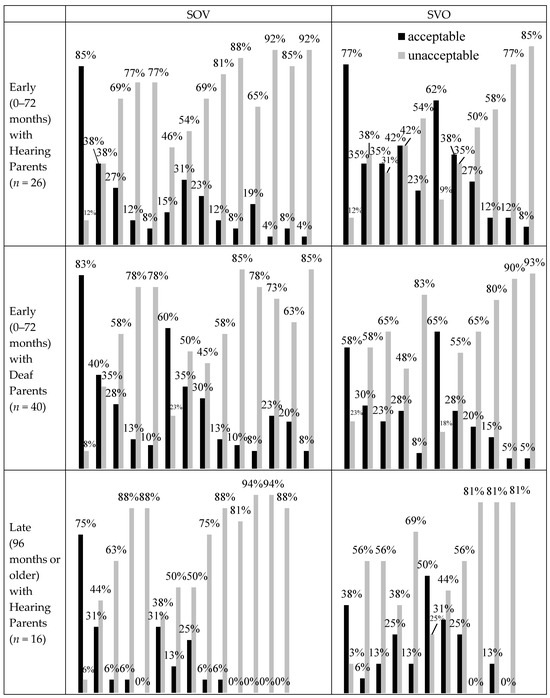
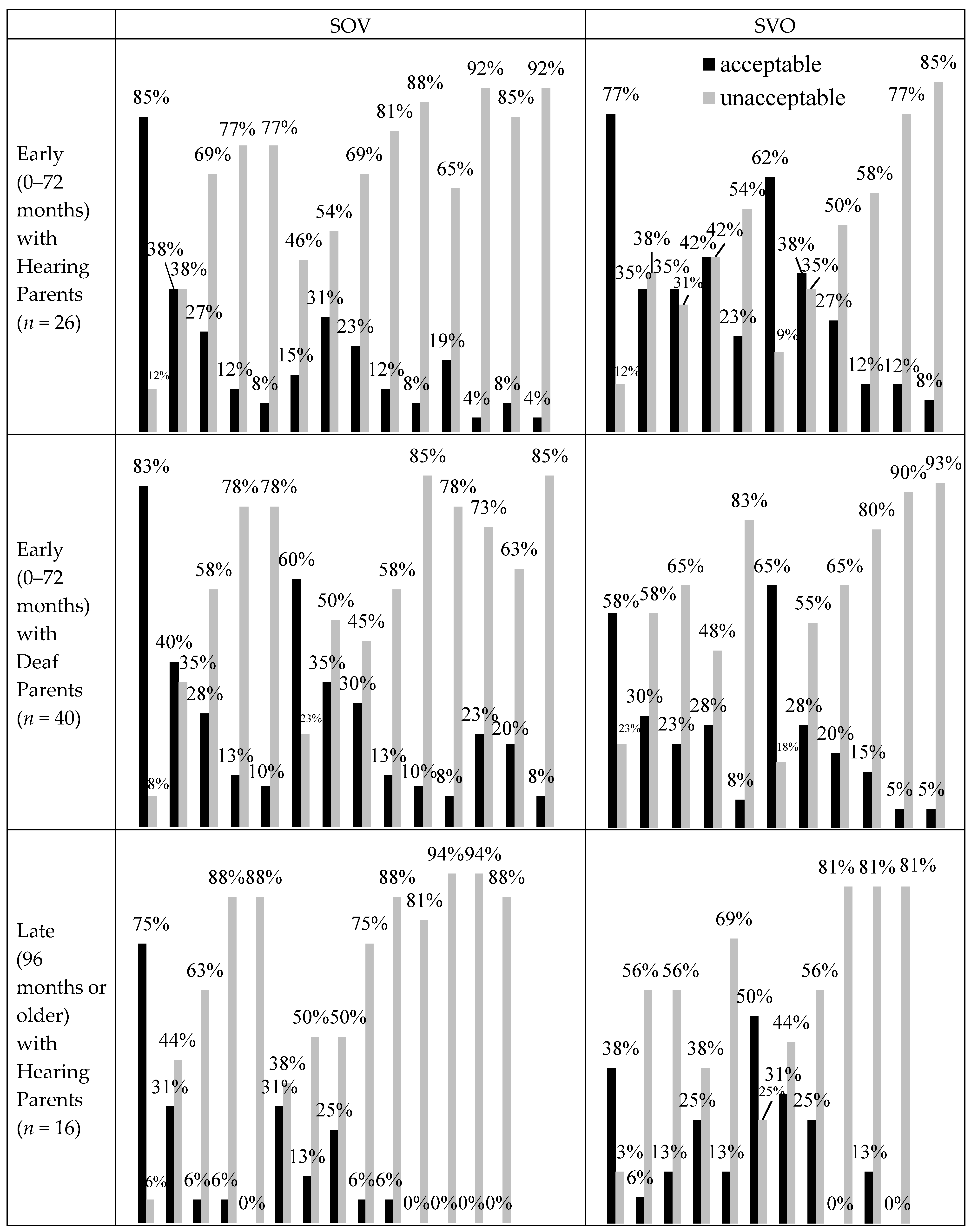
In this study, we first examined the descriptive statistics and constructed a series of bar graphs to visualize acceptance patterns. Likert-scale ratings (1–5) were dichotomized into binary acceptance categories: ratings of 4 (mostly acceptable) and 5 (completely acceptable) were classified as acceptable, while ratings of 1 (completely unacceptable) and 2 (mostly unacceptable) were classified as unacceptable. Ratings of 3 (neutral) were excluded from this classification to enhance clarity of preference patterns. For each of the three demographic groups, two bar graphs were generated: one displaying acceptance percentages for all SOV items and another for all SVO items. The first five items represented the sentence pairs that appeared in both SOV and SVO versions, allowing for direct within-item comparison of word-order preferences. Subsequent items were ordered by descending acceptance percentages averaged across all responses.
Then, we used a linear mixed-effects regression model implemented in the lme4 package (version 1.1-37; Bates et al., 2015) in R (version 4.5.1; R Core Team, 2025) to examine acceptability ratings (i.e., preferences for American Sign Language word order). We focused on within-item comparisons using the five sentence pairs that appeared in both SOV and SVO forms. This design allows for direct comparison of word order while holding lexical and semantic content constant.
The model was specified as follows:
Rating ~ Sentence_Type * Acquisition_months * Deaf_Parents + (1|Participant) + (1|Pair)
Fixed effects tested the three-way interaction between acquisition age (months), family background (having or not having Deaf parents), and word order. Sentence_Type and Deaf_Parents were treated as categorical predictors, with SOV and hearing parents as reference levels, respectively. Acquisition_months was treated as a continuous predictor and entered without standardization. Random intercepts were included for participants and sentence pairs to account for repeated measures and pair-level variability.
3. Results
3.1. Descriptive Statistics
Visual analysis of the acceptance percentage bar graphs revealed interesting patterns across demographic groups (see Figure 1). Between-group comparisons showed that early signers with hearing parents had higher acceptance of SVO structures than other groups, while early signers with Deaf parents had stronger acceptance of SOV structures. Late signers with hearing parents showed lower acceptance of both structures compared to the two younger groups. Within-group analyses revealed that early signers with hearing parents preferred SVO over SOV structures, and late signers with hearing parents showed a similar but milder preference pattern.
Figure 1.
Participants’ preference for SOV and SVO structures by demographic group.
For the five paired sentences, early signers exhibited consistent patterns based on family background, while late signers with hearing parents showed no consistent preference. These patterns indicate that family language background could play an important role in syntactic preference. Signers from hearing families demonstrated a preference for English-like SVO structures, whereas signers from Deaf families showed a preference for ASL SOV structures.
Table 3 below presents the mean acceptability ratings for all sentences across the three primary demographic groups. Early signers with hearing parents showed the highest SVO ratings (M = 3.15) and the largest positive preference difference (+0.54), whereas early signer participants with Deaf parents exhibited a slight preference for SOV. Late signers showed only a weak SVO preference.
Table 3.
Word-order preferences across all 26 items by demographic group.
3.2. Mixed-Effects Model
The results of the mixed-effects model are presented in Table 4 below. There was a robust interaction between sentence type and family background. Participants with hearing parents showed a clear preference for SVO over SOV sentences (b = 0.64, SE = 0.18, t = 3.48, p < 0.001). In contrast, this preference was substantially reduced among participants with Deaf parents (interaction: b = −0.83, SE = 0.22, t = −3.70, p < 0.001), resulting in an SOV preference in this group. This pattern indicates that word-order preferences differ systematically as a function of family language environment.
Table 4.
Fixed effects from linear mixed-effects model (matched 5-pair analysis).
Age of acquisition did not show a reliable main effect (b = −0.0008, SE = 0.0017, t = −0.47, p = 0.636), indicating that acquisition timing alone did not predict overall preference of sentence order. However, there was a marginal interaction between age of acquisition and sentence type (b = −0.0035, SE = 0.0019, t = −1.82, p = 0.069), suggesting that later learners might exhibit a weaker preference for SVO structures. No reliable three-way interaction among age of acquisition, family background, and sentence type was observed (b = 0.0048, SE = 0.0033, t = 1.44, p = 0.150).
The random effects structure indicated substantial variability across sentence pairs (σ2 = 0.75) relative to participants (σ2 = 0.22), with approximately 29% of the variance attributable to item-level differences and 9% to participant-level differences. This pattern highlights the strong influence of sentence-specific factors on word-order preferences. Some sentences can be easier to judge as acceptable, no matter what word order they are in.
Taken together, the results indicate that family background plays a strong and reliable influence on word-order preferences, while the role of age of acquisition remains less clear.
4. Discussion
This study’s findings provide new insights into the complexities of sentence structure in ASL. To reiterate, the central research question of this paper is the following: do participants give different acceptability ratings to SVO and SOV sentences? It is hypothesized that some Deaf participants will show a preference for SOV structures in their acceptability ratings and may implicitly associate this word order with ASL more strongly than SVO.
These findings partially align with earlier qualitative reports (Noschese, 2025) in which some Deaf individuals described ASL as favoring an SOV structure. However, the current study reveals more variation in participants’ perceptions. Among early hearing-parented signers, there was a stronger inclination toward SVO preferences. This suggests that while certain community beliefs persist, they may not fully capture the diversity of linguistic intuitions among Deaf signers.
4.1. Role of Early Acquisition
In Figure 1, a significant difference emerges between early and late learners of ASL: late learners tend to assign higher acceptability scores than early learners. In other words, the older an individual was at initial exposure to ASL, the more likely they were to rate multiple sentence types as acceptable. This pattern is consistent with prior research demonstrating that the age of first language acquisition influences syntactic evaluation in signed languages. For example, Boudreault and Mayberry (2006) showed through timed grammaticality judgment tasks that delayed first language acquisition affects syntactic processing across multiple ASL structures. Similarly, Cormier et al. (2012) found that age of acquisition significantly impacts sensitivity to syntactic violations in British Sign Language, with native signers demonstrating greater consistency in grammatical judgments than later learners. More recently, Krebs et al. (2021) reported subtle but measurable effects of age of acquisition on acceptability ratings for word order variations in ASL.
Evidence from production studies provides additional, complementary insight. S. Berk and Lillo-Martin (2012) showed that late first language learners, even with mature cognitive abilities, progress through the two-word stage and initially produce simpler utterances. Their findings suggest that linguistic constraints shape syntactic development regardless of cognitive maturity, highlighting the role of timing of exposure. Similarly, Cheng and Mayberry (2019) found that adolescents acquiring ASL as a first language (after age 13) produced multiple sentence structures rather than consistently producing only one structure. While their study examined production rather than acceptability judgments, such variability may be relevant when considering how different word orders are evaluated. Notably, production-based findings cannot be assumed to directly correspond to acceptability judgments, though both may reflect underlying patterns of linguistic experience.
In contrast, early learners from Deaf families often stabilize more quickly on a preferred word order, reflecting the influence of consistent input during critical periods of language development (S. B. Berk, 2003; Boudreault & Mayberry, 2006; Pichler, 2001).
4.2. Role of Parental Input
The greater acceptance of varied sentence structures among early Deafofhearing parents (DoH) individuals, as shown in Figure 1, as well as Table 4, could be due to parental input. Hearing parents, whose native language is English, may be more likely to use SVO-structured sentences when signing with their children as a result of the influence of English word order (Palmer, 2015). This pattern of parents using the word order from their native language would parallel research on immigrant parents, whose English word order may be influenced by their heritage language (Odlin, 1989). Deaf children of hearing parents may thus be accepting of these “more English” sentence constructions. In contrast, early DeafofDeaf-parents (DoD) individuals, who are more likely to have experienced early and consistent ASL exposure, may show a greater preference for SOV structures.
The differences observed between DoD and DoH participants appear to reflect the influence of early and consistent language exposure. DoD participants, who typically acquire ASL from birth through natural and consistent interaction at home, tend to favor SOV order. Their early access to fluent ASL models may foster a more intuitive understanding of ASL grammar, allowing them to code-switch effectively and recognize which structures align more closely with ASL. In contrast, DoH participants, whose exposure to accessible language is often delayed or inconsistent, may be more flexible or accepting of different sentence structures (S. Berk & Lillo-Martin, 2012; Cheng & Mayberry, 2019). Additionally, within school environments, Deaf students often receive their primary ASL input from peers rather than teachers, who may model English-influenced signing (Chibuye et al., 2023; Dang et al., 2024; Higgins & Lieberman, 2016). This dynamic emphasizes how early, natural ASL exposure and peer language models may influence patterns of structural preference and evaluative judgment.
On the extreme end, children of hearing parents frequently experience early language deprivation (W. C. Hall, 2017). Because spoken language is acoustically inaccessible and many hearing parents do not know any sign (W. C. Hall, 2017; Humphries et al., 2012; Mayberry, 2010), many DOH children undergo months or years during which they are not exposed to any fluent language models (M. L. Hall et al., 2019; W. C. Hall, 2017); this deprivation has long-term consequences for children’s development (M. L. Hall et al., 2019; W. C. Hall, 2017). In particular, researchers have documented differences in how late-exposed signers process language (Mayberry, 1993; Emmorey, 2002; Mayberry & Lock, 2003; Newport, 1990). Our results may reflect differences in how sentence structures are evaluated, which may or may not align with patterns observed in production. DoH and DoD individuals may show flexibility and acceptance of variations in sentence structures, including the SVO structure commonly taught in educational settings. This flexibility can be seen as a result of their diverse linguistic environment where crosslinguistic influence can occur, and as such ASL may be influenced by English (Morford et al., 2017, 2019).
4.3. Role of Language Ideology
Schieffelin and Woolard (1994) support the idea of linguistic ideologies shaping language use, exploring how communities hold beliefs about preferred ways of speaking. For example, their research explores the ideological belief in the Ultra-Orthodox Jewish community that Hebrew should be reserved for religiously sacred discourse. Similarly, there exists a belief within some ASL-using communities that the SVO structure, particularly influenced by contact with English, reflects the most prestigious, educated, and intelligent Deaf individuals (Kusters et al., 2020; Spooner, 2020).
Schieffelin and Woolard (1994) also mention that Standard Arabic is regarded as a pure form of the language, valued for both written and spoken communication. In the diglossia situation of Arabic, which ranges from high Arabic to low Arabic, Standard Arabic is considered the high variety due to its religious status among Muslims, while colloquial dialects are seen as the low varieties, commonly used in everyday conversations. This parallels the belief in ASL where in the SOV structure may be seen as more representative of everyday, casual ASL usage, while SVO, influenced by English, might be considered a “high” variety.
Although members of the Deaf community may hold explicit beliefs or ideologies about ASL word order, such as a preference for SOV, these beliefs do not always translate into consistent behavior during experimental tasks. When tested, participants often do not show a consistent preference for SOV, suggesting that the role of language ideology in shaping actual language use may be limited or context-dependent. The difference between community ideals and actual usage suggests that while language ideologies reflect shared norms and values, they may have only a limited influence on everyday ASL, which is shaped by social interactions, bilingual experience, and context.
These results reveal considerable variability in acceptability judgments among Deaf participants: some accept primarily SVO, others SOV, and still others a mixture of both structures. Because acceptability judgments may reflect a combination of exposure, perceived grammaticality, and socially circulating norms, it remains unclear how these preferences relate to explicitly held beliefs about ASL word order. Indeed, one of the participants from the current study, selected for a follow-up interview, acknowledged that the community’s strongly held belief in SOV as the “correct” ASL word order does not reflect everyday language use (Noschese, 2025). This admission underscores the difference between prescriptive beliefs and actual use, showing that even strongly held community norms may not determine how ASL is used in everyday communication.
This data collection is important due to its focus on the intersection of language experience and acquisition timing in the Deaf community. By analyzing the effects of age of acquisition on acceptability judgments, this research provides valuable insights into the cognitive and linguistic development of ASL users. Additionally, it explores the ideological significance of ASL being an SOV language, which the Deaf community strongly upholds.
4.4. Limitations and Future Research
Several limitations should be considered when interpreting these results. There were uneven sample sizes across groups in terms of age of acquisition, particularly the very small late Deaf-parented group. As a result, estimates of interactions involving age of acquisition and family background rely on limited data, which might reduce the stability and reliability of these interactions. The study also relied on acceptability judgments rather than naturalistic production data. While acceptability judgments provide valuable insights into linguistic intuitions, they may tap into explicit rather than implicit knowledge. Future studies could employ production tasks or psycholinguistic methods to examine whether similar patterns emerge in more implicit measures of syntactic knowledge.
Participants tend to be younger (age range: 21–55 years; M: 34 years) and highly educated (the majority held bachelor’s or master’s degrees). Although highly educated, participants are not trained linguists and may lack explicit knowledge of ASL grammar rules. Nonetheless, their perspectives offer valuable insight into language ideologies and a point of comparison for the broader Deaf community. In addition, the present study did not examine other sociolinguistic variables that may contribute to variation, such as race and educational experiences (e.g., school placement). Although school placement information was collected, it was not included in the present analyses. Future research should investigate how these factors may influence acceptability judgments and word-order preferences.
Finally, a limitation of the current study is the lack of directly comparable corpus resources for ASL. Existing resources such as the ASL Signbank (Hochgesang et al., 2026) are primarily lexical and dictionary-based, focusing on individual signs rather than sentence-level grammatical structure, while the American Sign Language Linguistic Research Project (ASLLRP) (Neidle et al., 2022) includes controlled sentence materials rather than fully naturalistic discourse. As a result, currently available ASL resources do not provide a direct corpus-based comparison for the syntactic contrasts examined here.
Future research should investigate the interplay of cognitive, phonological, semantic, discourse, and sociolinguistic factors in ASL sentence-structure preferences. Semantic and discourse features such as object concreteness, verb transitivity, and the use of classifiers may influence word-order choices by affecting visual salience and discourse prominence. Moreover, sociolinguistic factors, particularly purism theory (Kusters et al., 2020), may shape preferences. This theory helps explain how certain linguistic features can become socially enregistered as emblematic of a language within community discourse. In some segments of the Deaf community, SOV has been described as more representative of ASL. Such discourse may influence how different word orders are evaluated, particularly among individuals with early and sustained exposure to Deaf community norms.
Studying word-order judgments across a wider range of ages and educational backgrounds may help clarify whether these patterns reflect differences in language exposure or language ideology. At the same time, the Deaf community is not monolithic, and these findings should not be taken to suggest that SOV is a more authentic or legitimate form of ASL. Rather, they reflect variation in evaluative judgments, including ideological associations that may position SOV in contrast to English influence and as a way of maintaining linguistic boundaries.
5. Conclusions
This study sheds light on the nuanced perceptions of word order within the U.S. Deaf community, revealing a significant divide between academic descriptions of ASL and the lived experiences of its native users. The preference for SOV structure among participants with Deaf parents suggests that SOV patterns, often described in the literature or community discourse as “standard” ASL, may remain more prevalent in certain segments of the Deaf community. Participants with hearing parents, and those who learned ASL later in life, show a tendency to more flexibly accept SVO and SOV word orders. These findings underscore the importance of considering the cultural and experiential contexts in which ASL is learned and used. As ASL continues to evolve, further research is essential to bridge the gap between linguistic ideology and the realities of ASL as a living language, ensuring that the rich diversity of this language is fully understood and appreciated.
Author Contributions
Conceptualization, E.J.N.; methodology, E.J.N.; software, C.W.; validation, E.J.N. and C.W.; formal analysis, C.W.; investigation, E.J.N.; resources, E.J.N.; data curation, E.J.N.; writing—original draft preparation, E.J.N.; writing—review and editing, E.J.N. and C.W.; visualization, E.J.N. and C.W.; supervision, E.J.N.; project administration, E.J.N. All authors have read and agreed to the published version of the manuscript.
Funding
This research received no external funding.
Institutional Review Board Statement
The study was conducted in accordance with the Declaration of Helsinki and approved by the Institutional Review Board of the University of Hawai’i Manoa (2019-01056, approved on 3 February 2020).
Informed Consent Statement
Informed consent was obtained from all subjects involved in the study.
Data Availability Statement
The raw data supporting the conclusions of this article will be made available by the authors on request.
Conflicts of Interest
The authors declare no conflicts of interest.
Note
| 1 | Some literature (e.g., S. Fischer & Li, 1975; Hill, 2012) refers to a “standard” ASL word order. This characterization is descriptive and does not imply a prescriptive or hierarchical claim about ASL. |
References
- Aarons, D. (1994). Aspects of the syntax of American Sign Language [Ph.D. dissertation, Boston University]. [Google Scholar]
- Bates, D., Mächler, M., Bolker, B., & Walker, S. (2015). Fitting linear mixed-effects models using lme4. Journal of Statistical Software, 67(1), 1–48. [Google Scholar]
- Baynton, D. C. (1996). Forbidden signs: American culture and the campaign against sign language. University of Chicago Press. [Google Scholar]
- Berk, S., & Lillo-Martin, D. (2012). The two-word stage: Motivated by linguistic or cognitive constraints? Cognitive Psychology, 65(1), 118–140. [Google Scholar] [CrossRef] [Scilit] [PubMed]
- Berk, S. B. (2003). Sensitive period effects on the acquisition of language: A study of language development [Ph.D. thesis, University of Connecticut]. [Google Scholar]
- Biber, D., Johansson, S., Finegan, E., Conrad, S., & Leech, G. N. (2021). Grammar of spoken and written English. Torrossa. [Google Scholar]
- Boudreault, P., & Mayberry, R. I. (2006). Grammatical processing in American Sign Language: Age of first-language acquisition effects in relation to syntactic structure. Language and Cognitive Processes, 21(5), 608–635. [Google Scholar] [CrossRef] [Scilit]
- Cheng, Q., & Mayberry, R. I. (2019). Acquiring a first language in adolescence: The case of basic word order in American Sign Language. Journal of Child Language, 46(2), 214–240. [Google Scholar] [CrossRef] [Scilit] [PubMed]
- Chibuye, L., Matafwali, B., & Joseph, M. M. (2023). Teacher proficiency in sign language and reading skills development of learners with hearing impairment. International Journal of Research and Innovation in Social Science, 7(5), 727–742. [Google Scholar] [CrossRef] [Scilit]
- Cormier, K., Schembri, A., Vinson, D., & Orfanidou, E. (2012). First language acquisition differs from second language acquisition in prelingually deaf signers: Evidence from sensitivity to grammaticality judgment in British Sign Language. Cognition, 124(1), 50–65. [Google Scholar] [CrossRef] [Scilit] [PubMed]
- Dang, D., Lutz, L., & Marchut, A. (2024, September). Public input 2018 survey findings: The influence of factors associated with literacies on the development of deaf and hard of hearing students. Gallaudet University, Laurent Clerc National Deaf Education Center. [Google Scholar]
- De Meulder, M. (2016). The power of language policy: The legal recognition of sign languages and the aspirations of deaf communities (No. 301). University of Jyväskylä. [Google Scholar]
- Dryer, M. S. (2005). Order of subject, object and verb. In M. Haspelmath, M. S. Dryer, D. Gil, & B. Comrie (Eds.), The world atlas of language structures (pp. 330–333). Oxford University Press. [Google Scholar]
- Emmorey, K. (2002). Language, cognition, and the brain: Insights from sign language research. Lawrence Erlbaum Associates. [Google Scholar]
- Fischer, S., & Li, C. (1975). Word order and word order change. The University of Texas Press. [Google Scholar]
- Fischer, S. D., & Van der Hulst, H. (2003). Sign language structures. In Oxford handbook of deaf studies, language, and education (pp. 319–331). Oxford University Press. [Google Scholar]
- Hall, M. L., Hall, W. C., & Caselli, N. K. (2019). Deaf children need language, not (just) speech. First Language, 39(4), 367–395. [Google Scholar] [CrossRef] [Scilit]
- Hall, W. C. (2017). What you don’t know can hurt you: The risk of language deprivation by impairing sign language development in deaf children. Maternal and Child Health Journal, 21(5), 961–965. [Google Scholar] [CrossRef] [Scilit] [PubMed]
- Henner, J., & Robinson, O. (2021). Signs of oppression in the academy: The case of signed languages. In Linguistic discrimination in US higher education (pp. 92–109). Routledge. [Google Scholar]
- Higgins, M., & Lieberman, A. M. (2016). Deaf students as a linguistic and cultural minority: Shifting perspectives and implications for teaching and learning. Journal of Education, 196(1), 9–18. [Google Scholar] [CrossRef] [Scilit] [PubMed]
- Hill, J. C. (2012). Language attitudes in the American deaf community. Gallaudet University Press. [Google Scholar]
- Hochgesang, J. A., Crasborn, O., & Lillo-Martin, D. (2026). ASL signbank. Available online: https://aslsignbank.com (accessed on 9 August 2026).
- Hoffmann-Dilloway, E. (2011). Writing the smile: Language ideologies in, and through, sign language scripts. Language & Communication, 31(4), 345–355. [Google Scholar] [CrossRef] [Scilit]
- Humphries, T., Kushalnagar, P., Mathur, G., Napoli, D. J., Padden, C., Rathmann, C., & Smith, S. R. (2012). Language acquisition for deaf children: Reducing the harms of zero tolerance to the use of alternative approaches. Harm Reduction Journal, 9(1), 16. [Google Scholar] [CrossRef] [Scilit] [PubMed]
- Imm, K. E. (2025). Disability: A dirty word? How language historically perpetuates exclusion and systemic oppression [Master’s thesis, University of Massachusetts]. Available online: https://scholarworks.umb.edu/masters_theses/894 (accessed on 9 August 2026).
- Keep, J. R. (1871). The sign-language. American Annals of the Deaf and Dumb, 16(4), 221–234. [Google Scholar]
- Kimmelman, V. (2022). Argument structure in sign languages. Annual Review of Linguistics, 8, 19–38. [Google Scholar] [CrossRef] [Scilit]
- Klein, B. A. (2021). Aging deaf lesbians: A study of stigmatization, marginalization, resistance and resilience from 1945 to 2020. American University. [Google Scholar]
- Krebs, J., Roehm, D., Wilbur, R. B., & Malaia, E. A. (2021). Age of sign language acquisition has lifelong effect on syntactic preferences in sign language users. International Journal of Behavioral Development, 45(5), 397–408. [Google Scholar] [CrossRef] [Scilit] [PubMed]
- Kusters, A., Green, M., Moriarty, E., & Snoddon, K. (2020). Sign language ideologies: Practices and politics. In Sign language ideologies in practice (pp. 3–22). Walter de Gruyter GmbH & Co., KG. [Google Scholar]
- Liddell, S. K. (1980). American sign language syntax. Mouton. [Google Scholar]
- Limani, J. (2024). A qualitative descriptive study of foreign language credit decisions for curriculum decision makers of high schools offering American Sign Language [Doctoral dissertation, National University]. [Google Scholar]
- Lucas, C., Bayley, R., Valli, C., Rose, M., & Wulf, A. (2001). Sociolinguistic variation. In C. Lucas (Ed.), The sociolinguistics of sign languages (pp. 61–111). Cambridge University Press. [Google Scholar]
- Mayberry, R. I. (1993). First-language acquisition after childhood differs from second-language acquisition: The case of American Sign Language. Journal of Speech and Hearing Research, 36(6), 1258–1270. [Google Scholar] [PubMed]
- Mayberry, R. I. (2010). Early language acquisition and adult language ability: What sign language reveals about the critical period for language. In M. Marschark, & P. E. Spencer (Eds.), The Oxford handbook of deaf studies, language, and education (Vol. 2, pp. 281–291). Oxford University Press. [Google Scholar]
- Mayberry, R. I., & Lock, E. (2003). Age constraints on first versus second language acquisition: Evidence for linguistic plasticity and epigenesis. Brain and language, 87(3), 369–384. [Google Scholar] [CrossRef] [Scilit] [PubMed]
- Monaghan, L. (2003). A world’s eye view: Deaf cultures in global perspective. In L. Monaghan, C. Schmaling, K. Nakamura, & G. H. Turner (Eds.), Many ways to be deaf: International variation in deaf communities (pp. 1–24). Gallaudet University Press. [Google Scholar]
- Morford, J. P., Occhino, C., Zirnstein, M., Kroll, J. F., Wilkinson, E., & Piñar, P. (2019). What is the source of bilingual cross-language activation in deaf bilinguals? The Journal of Deaf Studies and Deaf Education, 24(4), 356–365. [Google Scholar] [CrossRef] [Scilit] [PubMed]
- Morford, J. P., Occhino-Kehoe, C., Piñar, P., Wilkinson, E., & Kroll, J. F. (2017). The time course of cross-language activation in deaf ASL–English bilinguals. Bilingualism: Language and Cognition, 20(2), 337–350. [Google Scholar] [CrossRef] [Scilit] [PubMed]
- Neidle, C., Kegl, J., MacLaughlin, D., Bahan, B., & Lee, R. G. (2000). The syntax of American Sign Language: Functional categories and hierarchical structure. MIT Press. [Google Scholar]
- Neidle, C., Opoku, A., & Metaxas, D. (2022). Asl video corpora & sign bank: Resources available through the American Sign Language linguistic research project (ASLLRP). arXiv, arXiv:2201.07899. [Google Scholar]
- Newport, E. (1990). Maturational constraints on language learning. Cognitive Science, 14(1), 11–28. [Google Scholar] [CrossRef] [Scilit]
- Noschese, E. J. (2021). Younger deaf people's attitudes toward American Sign Language structure [Ph.D. thesis, University of Hawai’i at Manoa]. [Google Scholar]
- Noschese, E. J. (2025). Attitudes and ideologies of deaf signers toward American Sign Language structure. Linguistics and Education, 87, 101410. [Google Scholar] [CrossRef] [Scilit]
- Odlin, T. (1989). Language transfer: Cross-linguistic influence in language learning. Cambridge University Press. [Google Scholar]
- Padden, C. (1988). Interaction of morphology and syntax in American Sign Language. In Outstanding dissertations in linguistics. Garland Press. [Google Scholar]
- Palmer, J. L. (2015). ASL word order development in bimodal bilingual children: Early syntax of hearing and cochlear-implanted Deaf children from signing families. Gallaudet University. [Google Scholar]
- Pichler, D. C. (2001). Word order variation and acquisition in American Sign Language [Ph.D. thesis, University of Connecticut]. [Google Scholar]
- R Core Team. (2025). R: A language and environment for statistical computing. R Foundation for Statistical Computing. [Google Scholar]
- Reagan, T. (2011). Ideological barriers to American Sign Language: Unpacking linguistic resistance. Sign Language Studies, 11(4), 606–636. [Google Scholar] [CrossRef] [Scilit]
- Reagan, T. G. (2010). Language policy and planning for sign languages. Gallaudet University Press. [Google Scholar]
- Rumsey, A. (1990). Wording, meaning, and linguistic ideology. American Anthropologist, 92(2), 346–361. [Google Scholar] [CrossRef] [Scilit]
- Sandler, W., & Lillo-Martin, D. C. (2006). Sign language and linguistic universals (Vol. 1). Cambridge University Press. [Google Scholar]
- Schieffelin, B., & Woolard, K. (1994). Language ideology. Annual Review of Anthropology, 23(1), 55–82. [Google Scholar] [CrossRef] [Scilit]
- Schlenker, P., Bonnet, M., Lamberton, J., Lamberton, J., Chemla, E., Santoro, M., & Geraci, C. (2024). Iconic syntax: Sign language classifier predicates and gesture sequences. Linguistics and Philosophy, 47(1), 77–147. [Google Scholar] [CrossRef] [Scilit]
- Senghas, R. J., & Monaghan, L. (2002). Signs of their times: Deaf communities and the culture of language. Annual Review of Anthropology, 31(1), 69–97. [Google Scholar] [CrossRef] [Scilit]
- Spooner, R. A. (2020). Permissive vs. prohibitive: Deaf and hard-of-hearing students’ perceptions of ASL and English. In A. Kusters, M. Green, E. Moriarty, & K. Snoddon (Eds.), Sign language ideologies in practice (pp. 167–182). De Gruyter Mouton. [Google Scholar]
- Stokoe, E. (2012). Moving forward with membership categorization analysis: Methods for systematic analysis. Discourse Studies, 14(3), 277–303. [Google Scholar] [CrossRef] [Scilit]
- Stokoe, W. C. (1960). Sign language structure. An outline of the visual communication system of the American deaf. In Studies in linguistics occasional papers 8. Department of Anthropology and Linguistics, University of Buffalo. Reprinted in Linstok Press, 1978. [Google Scholar]
- Supalla, T. (2004). The validity of the Gallaudet lecture films. Sign Language Studies, 4(3), 261–292. [Google Scholar] [CrossRef] [Scilit]
- Sutton, V. (1981). Sign writing for everyday use. Sutton Movement Writing Press. [Google Scholar]
- Tanner, J. A., & Doré, N. (2019). Translanguaging and the no voice policy in L2 sign language contexts. OLBI Journal, 10, 273–289. [Google Scholar] [CrossRef] [Scilit]
- Wilbur, R. B. (1997). A prosodic/pragmatic explanation for word order variation in ASL with typological implications. In Lexical and syntactical constructions and the construction of meaning (Vol. 89). John Benjamins Press. [Google Scholar]

Disclaimer/Publisher’s Note: The statements, opinions and data contained in all publications are solely those of the individual author(s) and contributor(s) and not of MDPI and/or the editor(s). MDPI and/or the editor(s) disclaim responsibility for any injury to people or property resulting from any ideas, methods, instructions or products referred to in the content. |
© 2026 by the authors. Licensee MDPI, Basel, Switzerland. This article is an open access article distributed under the terms and conditions of the Creative Commons Attribution (CC BY) license.