Review

How Studying Varied Input Contexts Can Further Our Understanding of L1 Grammatical Attrition: Insights from Studies of Bidialectal Speakers


1
Institute of English and American Studies, Technische Universität Braunschweig, 38093 Braunschweig, Germany
2
Department of Languages, Cultures and Linguistics, University of Southampton, Southampton SO17 1BJ, UK
3
Department of Applied Linguistics, Swansea University, Swansea SA2 8PP, UK
4
Department of Language and Linguistic Science, University of York, York YO10 5DD, UK
*
Author to whom correspondence should be addressed.
Languages 2026, 11(7), 147; https://doi.org/10.3390/languages11070147
Submission received: 18 December 2025 / Revised: 17 June 2026 / Accepted: 1 July 2026 / Published: 15 July 2026

Abstract

To advance our understanding of the vulnerability of native adult grammars to grammatical attrition, research should further explore the various input contexts in which such attrition may obtain. This article considers contexts where speakers are first exposed in adulthood to a grammatically distinct dialectal variety of their first language (L1), which may result in modifications to the grammar of their native dialect. Within psycholinguistic approaches to L1 attrition, these changes under the influence of a new L1 dialect are often considered part of the same phenomenon as attrition under the influence of a second language (L2). Changes to late-sequential bidialectals’ native dialects have also been investigated within variationist sociolinguistics under the term ‘long-term accommodation’. Despite the fact that both the psycholinguistic and sociolinguistic approaches are essentially studying the same patterns of native grammatical change in the same populations of speakers, communication between the two fields has been scarce. The purpose of this review article is therefore twofold: Firstly, we aim to provide an overview of some key studies evidencing changes in the native grammars of late-sequential bidialectals, bringing together research from the fields of L1 attrition and variationist sociolinguistics. Secondly, building on this review, we explore how drawing upon insights from these two fields can further our understanding of some key issues in the field of L1 grammatical attrition more broadly, and we explore some of the implications for current attempts to model grammatical attrition across a range of input contexts.

1. Introduction

First language (L1) grammatical attrition refers to non-native-like morphosyntactic, semantic, and phonological behaviour in the L1s of late-sequential bilinguals. Whilst this may obtain due to non-native-like real-time grammatical processing and production, i.e., attrition at the level of performance, in this review article, we are interested in modifications to adult L1 grammatical (specifically morphosyntactic and semantic) representations, i.e., the restructuring of native grammars at the level of competence, which constitutes a qualitative change in the L1 grammar.1 It is widely acknowledged that the mature L1 grammars of late-sequential bilinguals are especially resilient to change (e.g., Gürel, 2008, p. 447; Tsimpli, 2017, p. 759) and that grammatical attrition is highly selective in the grammatical properties it affects (Gürel, 2004a; Schmid & Köpke, 2017; Hicks & Domínguez, 2020a; Baker, 2024). To be able to comprehensively model the malleability of adult native grammars, it is therefore important to identify the input conditions that are conducive to grammatical attrition and investigate how such attrition obtains across these different input contexts.
The possibility of adult L1 attrition is determined by the influence of two types of linguistic input. The first is the input that formed a speaker’s Primary Linguistic Data (PLD) during L1 acquisition and remained so until they relocated to a new linguistic environment in adulthood. The second type of input is the dominant input in the linguistic environment in which the speaker now lives, and which has replaced the L1 as the speaker’s new PLD. To date, L1 attrition, as studied from the psycholinguistic perspective, has almost exclusively considered late-sequential bilinguals, where modifications to the native grammar are argued to be the result of some degree of cross-linguistic influence from a societally dominant second language (L2) to an L1 (see Domínguez, 2013, Chapter 5; contributions in Schmid & Köpke, 2019; and Baker, 2024 for overviews of grammatical attrition). However, the new PLD input may also be from a qualitatively distinct dialectal variety of the L1. Following Domínguez and Hicks (2016), we term the native dialect the ‘L1a’ and the new, distinct dialect the ‘L1b’. A small, yet increasing, number of studies within the field of L1 attrition attest that exposure to an L1b in adulthood can also engender changes to a speaker’s native variety (e.g., Domínguez, 2013; Castro et al., 2017, 2020).
In variationist sociolinguistics, changes in mature L1a grammars resulting from contact with a distinct L1b variety have also been explored. Here, a distinction is made between instances of transient modification/adoption of a dialect feature within a particular interactional context (‘accommodation’—Giles et al., 1973) and cases where this feature is maintained outside of an accommodating speech situation (e.g., Kerswill, 1994), termed ‘long-term accommodation’ (Trudgill, 1986; Auer & Hinskens, 2005). Studies of long-term accommodation among late-sequential bidialectals, first exposed to the L1b in adulthood, investigate essentially the same type of speakers and the same patterns of grammatical change as studies of L1a attrition under the influence of an L1b within psycholinguistic approaches (Jamieson et al., 2024; see also Section 3). We therefore refer to native grammatical change in late-sequential bidialectals studied from either the psycholinguistic or sociolinguistic perspective as ‘bidialectal attrition’.2
Jamieson et al. (2024) further highlight that, despite shared interest, there has been little communication between sociolinguistic and psycholinguistic approaches.3 In the present article, we seek to contribute towards bridging the divide. However, we do not present any novel empirical data. Rather, after first outlining some relevant aspects of psycholinguistic and sociolinguistic approaches to (modelling) grammatical attrition in Section 2, we provide in Section 3 an overview of key empirical studies of bidialectal attrition that have been conducted within these frameworks. This is—to the best of our knowledge—the first time that such studies from both fields have been brought together in one review. Following the literature review, we draw from these studies and insights from the broader psycholinguistic and sociolinguistic literature to tackle the following questions:
(1)
What can bidialectal attrition tell us about the role of cross-linguistic similarity in grammatical attrition? Specifically, to what extent does similarity on multiple linguistic levels (i.e., phonetic, phonological, lexical, semantic, and morphosyntactic) facilitate grammatical attrition? How does this similarity modulate the perceptual encoding of input to intake?
(2)
What can bidialectal attrition tell us about the underlying structure of multilingual and multilectal speakers’ attrited grammars? Can an L1b variety or closely related L2 modify an existing L1(a) grammar directly, or is it first acquired as part of a separate grammar?
(3)
What are the implications of the answers to the questions posed in (1) and (2) for attempts to comprehensively model grammatical attrition across a range of input contexts? How can insights from both psycholinguistic and sociolinguistic research inform current models of grammatical attrition?
We conclude by proposing some methodological considerations and directions for future research into bidialectal attrition.

2. Background

2.1. Bilingual and Bidialectal Grammatical Attrition—A Psycholinguistic Perspective

Within the field of psycholinguistic approaches to L1 attrition, L1 grammatical changes due to the influence of L1b are generally considered part of the same phenomenon as changes due to the influence of an L2 (Domínguez & Hicks, 2016; Schmid & Köpke, 2017; Hicks & Domínguez, 2020a; Jamieson et al., 2024). This is based partly on the difficulty in making clear-cut distinctions between dialects of the same language and typologically closely related L2s (Schmid & Köpke, 2017, p. 652), as well as the assumption that the same linguistic processes and mechanisms underpin both bidialectal and bilingual attrition, leading to broadly the same patterns of change in the L1a (Hicks & Domínguez, 2020a, 2020b).
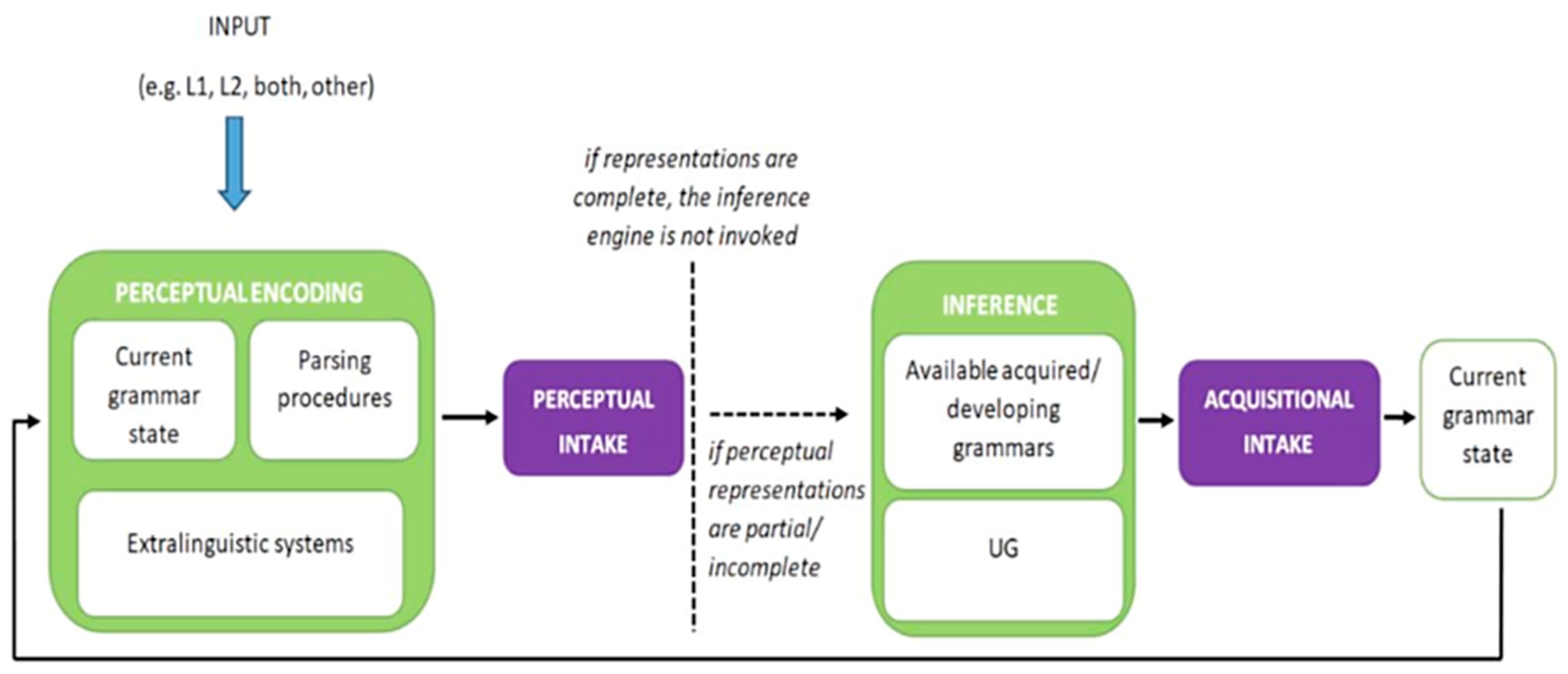
Despite this, there is to date only one psycholinguistic model of attrition that also accounts for bidialectal attrition: the Attrition via Acquisition (AvA) Model (Hicks & Domínguez, 2020a, 2020b; see Figure 1).4 The model—adapted from Lidz and Gagliardi’s (2015) model of L1 acquisition—adopts a broadly Minimalist view of the grammar in which inter- and intra-speaker grammatical variation (including dialectal variation) is accounted for in terms of differences in the combinations of morphosyntactic and semantic features specified on functional lexical items within different languages, varieties, and individual speakers’ grammars (e.g., Borer, 1984; Chomsky, 1995, 2001; Adger & Smith, 2010; Gallego, 2011).5 In the model, both L2 acquisition and L1 attrition obtain via Feature Reassembly (FR), as originally proposed for L2 acquisition (e.g., Lardiere, 2009).
Following Corder (1967), Carroll (1999, 2001), and many others (see Hicks & Domínguez, 2020a, pp. 147–148), the model assumes a fundamental distinction between ‘input’ and ‘intake’, where ‘input’ describes the linguistic data that a learner is exposed to and ‘intake’ describes input that has been perceptually encoded and assigned a representation on one or more linguistic levels (i.e., phonetic, phonological, lexical, semantic, and morphosyntactic). This is referred to as ‘Perceptual Intake’. During L2 acquisition, when a discrepancy in terms of morphosyntactic and semantic features between a learner’s current L2 grammar and the L2 Perceptual Intake is detected, the inferential mechanisms generate ‘Acquisitional Intake’ based on this mismatch. Acquisitional Intake is, effectively, a set of instructions as to how to update the feature specifications of the L2 grammar to match those detected in the Perceptual Intake. Coactivation of a speaker’s grammars leads to potential for cross-linguistic influence within the inferential component, giving rise to the possibility that L2 Perceptual Intake is also compared to the L1 grammar, particularly in typical attrition contexts where there is prolonged processing and activation of the L2 coupled with diminished L1 input to reinforce L1 representations. Acquisitional Intake generated from this comparison may then target the L1 grammar, updating the L1 feature assemblies to match those of the L2 intake. The L1 structures therefore become more L2-like, resulting in grammatical attrition. Hicks and Domínguez (2020a) assume that these same mechanisms can give rise to bidialectal attrition, with a mismatch between the L1b intake and L1a grammar being detected and the L1a grammar modified according to the Acquisitional Intake.

2.2. Bidialectal Accommodation and Attrition—A Variationist Sociolinguistic Perspective

Within variationist sociolinguistics, there has generally been a perception that changes to an adult’s L1a as a result of contact with an L1b are distinct from changes that may happen as a result of contact with an L2 (e.g., Trudgill, 1986; Kerswill & Williams, 2002). As a result, there are no models that are directly comparable to the AvA model. Indeed, there are (to our knowledge) no formal models in sociolinguistics of how extended immersion in an L1b context might lead to changes in the grammar, though some sociosyntactic research has considered the structure of variation within (stable) bidialectal grammars (e.g., Adger & Smith, 2010; Lundquist et al., 2020). Besides the modelling of the grammar, however, there are many relevant aspects of the study of bidialectalism and long-term accommodation in the sociolinguistic framework that are informative for the broader study of attrition.
One such aspect is dialect ‘mode’. Depending on their interlocutor(s), proficient bidialectal speakers may alternate between two inventories of phonetic, phonological, lexical, and grammatical features, such that their accents, vocabulary, and grammar may change, much in the same way that bilinguals switch between their L1 and L2 (see e.g., Grosjean, 1998 for language switching in bilingualism). A number of recent psycholinguistic papers investigating language switching in bidialectal speakers have suggested that, at least for lexical access, there are similar switch costs for bidialectal speakers as for bilingual speakers (Kirk et al., 2018.; Vorwerg et al., 2019; Kirk et al., 2022; though see Melinger, 2018). However, outside of lexical access, the style-shifting continuum in bidialectalism is generally assumed to be more gradient and fluid than switching languages in bilingualism. Hazen (2001, pp. 7–8) argues that ‘no speaker has the ability to switch between two dialects as coherent sets of language variation patterns with quantitative and qualitative accuracy to both dialects’, and research has found significant individual variation in how ‘distinct’ bidialectals’ ‘modes’ may be (e.g., Sharma, 2011; Smith & Durham, 2012). Nevertheless, there are shifts between a more-L1a mode and a more-L1b mode, which have also recently been observed in psycholinguistic work (Sandstedt et al., 2025), again depending on individuals’ experiences of bidialectalism (Lundquist & Vangsnes, 2018).
For a late-sequential bidialectal, the distinction between the two modes is determined by the extent to which the speaker has acquired the L1b and the extent to which they alternate between the distinct features of the L1a and L1b. Importantly, for bidialectal attrition, we are interested in whether speakers exhibit convergence on specific L1b grammatical structures whilst in a more-L1a mode (i.e., with L1a lexis, accent, etc.). Dialect modes are an important consideration for the design of empirical studies to distinguish between short- and long-term accommodation/attrition and for answering questions related to the structure of attrited bidialectal grammars, which we explore in Section 4.2.
A further consideration is the distinction between receptive and productive bidialectalism: whilst productive bidialectals can both process and produce the L1b, receptive bilinguals do not actively produce the L1b. Children become productive bidialectals as a result of exposure to variation from their caregivers (see Smith, 2021, for an overview). It is long held in the sociolinguistic literature that adult speakers can become receptive bidialectals as a result of exposure to an L1b (e.g., Weener, 1969); however, though there has been increased interest in adult ‘second dialect acquisition’ in recent years (e.g., Siegel, 2010; Fernández-Mallat & Nycz, 2025), the mechanisms that lead to an adult speaker becoming a productive bidialectal remain unclear. In this article, this distinction is relevant when considering how psycholinguistic accounts of attrition in which activation is a key mechanism may be extended to bidialectal contexts.
Finally, further relevant factors for bidialectal attrition which appear in the sociolinguistic literature include the role of volition to change (Hinskens et al., 2005), attitudes to dialect and community (Beaman, 2021), social salience of the features (Kerswill & Williams, 2002), and the standard/non-standard nature of the dialects (Beebe & Giles, 1984); see Jamieson et al. (2024) for a recent discussion of some of these factors in the context of bidialectal attrition. These factors are generally not considered in attrition studies in the psycholinguistic framework, given that this framework focuses primarily on bilingual attrition, where these factors are generally less relevant.

2.3. Summary: Uniting the Perspectives

Psycholinguistic approaches to attrition assume that it is possible to treat changes to the native grammar as a result of influence from an L1b in the same way as changes resulting from influence from an L2 (Domínguez & Hicks, 2016; Schmid & Köpke, 2017; Hicks & Domínguez, 2020a, 2020b; Jamieson et al., 2024). To this end, the AvA model proposes to capture both types of attrition with the same linguistic mechanisms. While there are no formal models of long-term accommodation within the sociolinguistic literature, there are formal models of (stable) variation in the grammar, as well as consideration of a range of extralinguistic factors that are relevant to bidialectalism and essential to understanding how best to model potential changes (or lack thereof) in the native grammars of late-sequential bidialectal speakers (Jamieson et al., 2024). Given the shared interest in the same population of late-sequential bidialectals and in the outcomes of cross-dialectal influence in these speakers, we believe that incorporating insights from both psycholinguistic and sociolinguistic approaches can help us gain a more comprehensive understanding of native grammatical change both in bidialectal contexts and more broadly. We therefore draw from both psycholinguistic and sociolinguistic approaches in Section 4 when addressing the three key questions posed in this article.

3. Bidialectal Grammatical Attrition—Key Studies

In this section, we give an overview of key empirical studies investigating grammatical changes in the mature L1a grammars of late-sequential bidialectals from both psycholinguistic and variationist sociolinguistic perspectives. All of these studies involve speakers who migrated as adults to live in a country or area where an L1b is spoken and who had lived there for a considerable number of years. Each study investigates a morphosyntactic property or set of properties that differs between the L1a and L1b and reports potential changes in the grammars of the L1a. We do not include studies of childhood bidialectals or childhood or teenage migrants (e.g., Chambers, 1992) as it is well established that children’s grammars are more susceptible to change (e.g., Byland, 2009). We also do not include studies that investigate change across generations (e.g., Kerswill & Williams, 2000), nor those that use a second population as a proxy for individual grammatical change (e.g., Hirano, 2025), nor those that consider mobility as a broad factor in L1a use across the lifespan (e.g., Beaman, 2021). We begin with the psycholinguistic perspective in Section 3.1, discussing Domínguez (2013) and Domínguez and Hicks (2016), Castro et al. (2017, 2020), and Jamieson et al. (2024). We then turn, in Section 3.2, to consider the variationist sociolinguistic literature: Bortoni-Ricardo (1985), Ivars (1994), Kerswill (1994), Omdal (1994), and the Otheguy-Zentella Corpus of Spanish in NYC. To the best of our knowledge, this is essentially an exhaustive list of such studies to date.6

3.1. L1 Attrition Studies

3.1.1. Domínguez (2013) and Domínguez and Hicks (2016)

Domínguez (2013) and Domínguez and Hicks (2016) directly compare attrition in bidialectal and bilingual contexts, finding attrition of an L1a property due to the influence of an L1b, but not an L2. The bidialectal group consisted of 20 speakers of L1a Cuban Spanish (CS) living in Miami for over 15 years, receiving L1b exposure to Mainland Spanish (MS), and L2 exposure to English. This group is compared to 11 L1 European Spanish (ES) speakers from Spain who had lived in the UK, in contact with L2 English only, for over 10 years.
Both MS and ES are archetypal null subject languages: null subjects are the default, whilst overt and pre-verbal subjects are preferred in topic-shift and focus contexts. On the other hand, in CS, overt and pre-verbal subjects are not restricted to specific pragmatic contexts, nor do they necessarily carry pragmatic effects. Consequently, the frequency of overt and pre-verbal subjects is considerably higher in CS than in MS. For overt subjects, then, the rates of use in CS, the L1a, fall in between those of the L1b and the L2, English, in which they are the only pronominal subject option in finite clauses.
Production data from interviews revealed that the rate of overt and pre-verbal subject production was significantly lower for L1a CS speakers in Miami compared to a group of CS controls living in Cuba. Furthermore, not only had the overall rate of overt subjects decreased for the bidialectal group, but also their occurrence in topic-shift contexts increased significantly (Domínguez, 2013, p. 199). This suggests not just a quantitative but also a qualitative change towards the distribution of null and overt subjects in the L1b, MS, rather than towards the overt subjects of the L2, English.7 Furthermore, for the ES bilinguals in the UK, no significant changes in the rate of null or overt subjects were found (Domínguez & Hicks, 2016).

3.1.2. Castro et al. (2017, 2020)

Castro et al. (2017) investigate attrition and acquisition of null/overt objects among native Brazilian Portuguese (BP) speakers exposed to European Portuguese (EP) in Portugal. Both BP and EP permit third person accusative null objects; however, they are subject to different syntactic and semantic constraints. A total of 32 L1a BP speakers, who had moved to Portugal more than 10 years ago, completed an Acceptability Judgment Task (AJT). Participants were tested in both L1a and L1b dialect modes through BP and EP versions of the AJT, each using BP- or EP-specific lexis. Results showed bidialectal participants no longer distinguished between null and overt objects in the same manner as the BP controls, whilst still diverging from EP controls on the EP version. For null objects, bidialectal participants showed no difference in their judgments in the BP and EP modes, which is interpreted as bidirectional cross-dialectal influence, whilst a difference was found for overt objects in the two modes.
Castro et al. (2020) investigate production of both null and overt objects and subjects with BP–EP bidialectals in Portugal. EP is a typical null subject language, while BP is undergoing change towards a non-null subject language. As such, overt subjects do not carry pragmatic effects and are in free variation with null subjects. A total of 20 L1a BP–L1b EP speakers who had lived in Portugal for an average of 10 years completed a narrative retelling task in both L1a and L1b modes. In BP mode, participants produced significantly fewer overt subjects than the BP controls, yet still significantly more overt subjects in EP mode than the EP controls. Furthermore, the bidialectals’ BP and EP results do not differ significantly from each other, again suggesting bidirectional cross-dialectal influence. For objects, however, their BP results do not diverge significantly from the BP controls, nor do their EP results diverge significantly from the EP controls.

3.1.3. Jamieson et al. (2024)

Jamieson et al. investigate 30 L1a Standard Southern British English (SSBE) speakers who have lived in Belfast, Northern Ireland, for an average of 25 years. Two morphosyntactic features of Northern Irish English were investigated: the Northern Subject Rule (NSR) and embedded inverted questions (EIQs). The NSR describes variation in third person plural verbal agreement marking. Only when the subject is a full DP, the finite verb may exhibit either standard third person plural agreement or third person singular agreement, e.g., ‘These cars go/goes very fast’ but not *‘They goes very fast’ (Henry, 1995, p. 16). EIQ describes subject–verb inversion in embedded yes/no and wh-questions with certain predicates, e.g., ‘I asked Jack was she in his class’ (McCloskey, 2006, p. 88). Here, SSBE would require an overt complementiser with no inversion, i.e., ‘I asked Jack if/whether she was in his class’—an option that is also available in Northern Irish English.
Attrition was probed with an aural AJT in L1a mode and a sociolinguistic interview with an L1a SSBE speaker. No attrition of the NSR was found either at the group or individual level on the AJT, and there were no instances of NSR production in the interviews. No group-level attrition of EIQ was found on the AJT; however, nine individual participants exhibited very high acceptance of EIQs, four of whom gave all test items a 5/5 acceptability rating. Two instances of EIQs were also produced in the interviews. It therefore appears that some speakers have incorporated into their L1a a new syntactic structure from their L1b.

3.2. Variationist Studies

3.2.1. Bortoni-Ricardo (1985)

Bortoni-Ricardo (1985) studied subject–verb agreement patterns in 33 adult speakers of the rural Caipira dialect of Brazilian Portuguese, who had lived in the city of Brazlândia, where a standard urban variety of Brazilian Portuguese is spoken, for between 1 and 35 years. In the L1a, there is no distinction between first and third person plural morphology, unlike in standard Brazilian Portuguese, the L1b (Bortoni-Ricardo, 1985, p. 199).
Bortoni-Ricardo measures the percentage of use of the standard agreement forms in each context from sociolinguistic interviews conducted with herself and another non-L1a-speaking fieldworker, finding that the participants use 48% standard agreement in the first-person plural (Bortoni-Ricardo, 1985, p. 212) and 27% standard agreement in the third person plural (Bortoni-Ricardo, 1985, p. 205), though this varied in rates across different morphological contexts. It thus appears that the speakers had shifted somewhat towards more of an L1b agreement paradigm.

3.2.2. Ivars (1994)

Ivars (1994) investigates phonological and morphological changes in 32 people originally from Närpes, a Swedish-speaking area of Finland, living in the Swedish city of Eskilstuna for between 3 and 33 years. The L1a variety spoken in Närpes differs significantly from standard Swedish, whilst the L1b Eskilstuna variety is reasonably close to standard Swedish but with some dialect-specific features (Ivars, 1994, p. 206). Ivars reports that Närpes speakers were existing bidialectals who also had some command of a more standard variety of Swedish.
Ivars investigated 17 morphological features and nine phonological ones. Morphological differences included lack of agreement marking on plural predicative adjectives, definiteness inflection, and various verb forms. Note that some features were shared between Närpes and Eskiltuna, and some between Närpes and the standard, making the picture of input and contact quite complicated. Unfortunately, Ivars does not present results for individual features, but rather three general ‘dialect indices’ for participants’ use of Närpes-specific variants, Eskilstuna-specific variants, and standard Swedish variants in an interview. There was wide individual variation, with the Eskiltuna-specific index (i.e., new L1b features participants would have had to acquire) ranging from 0 to 63%, while the Närpes index ranged from 0 to 94% and standard Swedish from 4 to 80%.

3.2.3. Kerswill (1994)

Kerswill (1994) analysed the speech of 39 people from the rural Strilelandet region of Norway, living in Bergen, the nearby urban centre, for between 2 and 59 years. Although the Strilelandet area surrounds Bergen, there are sharp isoglosses differentiating the two varieties (Kerswill, 1994, p. 36). Specific morphosyntactic feature differences include a three-way verb class distinction, absent in Bergen, and the use of three/four grammatical genders in Strilelandet vs. two in Bergen. Unfortunately, like Ivars (1994), Kerswill does not investigate features individually and instead produces a ‘morpholexical index’ of variation across 23 morphological and lexical features for each participant in an interview. He finds ‘a considerable amount of morpho-lexical mixing’ (Kerswill, 1994, p. 146) between the two varieties: Five participants used over 90% L1a-specific features (on par with an L1a control group recorded in the Strilelandet area). Twenty-four had an index between 57 and 90%, and six used between 20 and 48% L1a features.8

3.2.4. Omdal (1994)

Omdal (1994) studied 24 speakers from the rural Setesdal dialect (L1a) region of Norway, living in Kristiansand, the closest urban centre, for between 5 and 51 years. She investigates three L1b Kristiansand-specific features in participants’ speech, recorded in an interview with two Kristiansand speakers: use of the first-person pronoun [vi:], use of final -r on indefinite plural nouns, and lack of umlaut, or vowel change in strong present singular verbs (Omdal, 1994, pp. 127–128). Omdal finds 47.8% overall use of Kristiansand features, ranging from 40.7 to 55.8% depending on the feature (Omdal, 1994, p. 129), and with wide-ranging individual variation.

3.2.5. The Otheguy-Zentella Corpus of Spanish in NYC

The Otheguy-Zentella Corpus of Spanish in NYC (e.g., Otheguy et al., 2007; Livert & Otheguy, 2010; Otheguy & Zentella, 2012; Shin & Otheguy, 2013; Erker & Otheguy, 2016; Erker, 2025) contains sociolinguistic interviews with 140 L1 Spanish speakers with either Caribbean or mainland Latin American heritage, the majority of whom had migrated to NYC as adults.9 Caribbean Spanish employs more overt subjects than mainland Latin American Spanish. As length of residence increases, so do the rates of overt subjects—regardless of background—which is generally considered to be due to the influence of L2 English (e.g., Livert & Otheguy, 2010). However, there is also evidence of influence from L1b contact, with Caribbean Spanish speakers’ linguistic constraints on use of overt/null subject pronouns shifting towards the Mainland Spanish constraints (Otheguy & Zentella, 2012; Erker, 2025).

3.3. Summary: Bidialectal Attrition Studies

In this section, we have presented an overview of studies in both attrition and variationist frameworks that investigate morphosyntactic change among adult L1a speakers who have migrated to an L1b environment. Across both frameworks, we see evidence of L1a grammatical changes in the form of shifts towards the L1b. We have seen that although both psycholinguistics and sociolinguistics consider the same types of data in bidialectal attrition contexts, they approach the topic from different directions. While studies within psycholinguistic approaches to attrition have tended to focus on one or two morphosyntactic properties, studies in the variationist framework have tended to incorporate morphosyntactic features into broader indices of ‘long-term accommodation’. Furthermore, whilst the psycholinguistic studies have primarily been interested identifying the types of grammatical properties most vulnerable to change, the potential role of cross-linguistic (dis)similarity, and the grammatical mechanisms underpinning this change, the sociolinguistic studies have prioritised discussion of individual variation, as well as greater understanding of the social differences between the L1a and L1b communities, and the relationships between them as potential windows into variation and change. This makes it harder to compare like for like. Nevertheless, we believe that there are benefits to both approaches, and that taking into account both perspectives when investigating this kind of data is essential to get the full picture of where attrition is possible, and how or why it does (or does not) take place.

4. Discussion: Major Questions in the Study of Bidialectal Attrition

In the introduction, we laid out three major questions for the study of bidialectal attrition, which we repeat here:
(1)
What can bidialectal attrition tell us about the role of cross-linguistic similarity in grammatical attrition? Specifically, to what extent does similarity on multiple linguistic levels (i.e., phonetic, phonological, lexical, semantic, and morphosyntactic) facilitate grammatical attrition? How does this similarity modulate the perceptual encoding of input to intake?
(2)
What can bidialectal attrition tell us about the underlying structure of multilingual and multilectal speakers’ attrited grammars? Can an L1b variety or closely related L2 modify an existing L1(a) grammar directly, or is it first acquired as part of a separate grammar?
(3)
What are the implications of the answers to the questions posed in (1) and (2) for attempts to comprehensively model grammatical attrition across a range of input contexts? How can insights from both psycholinguistic and sociolinguistic research inform current models of grammatical attrition?
We address these questions in turn in Section 4.1, Section 4.2 and Section 4.3. In doing so, we draw on the studies presented in Section 3 and insights from both the broader psycholinguistic and sociolinguistic literature, as well as consider what further research would be needed to address these questions more effectively. We also provide, in Section 4.4, a brief discussion of methodological points to assist in shaping future studies in the field(s).

4.1. The Role of Cross-Linguistic Similarity in Grammatical Attrition

4.1.1. Cross-Linguistic Similarity as a Facilitator

Within psycholinguistic approaches to L1 attrition, cross-linguistic similarity has long been regarded as a key factor in predicting the likelihood and extent of grammatical attrition: both similarity in individual grammatical structures and in the overall/holistic linguistic similarity of the L1 and L2 (Sharwood-Smith, 1983, 1989; Altenberg, 1991; Paradis, 2000; Köpke, 2007; Gürel, 2008; Domínguez, 2013; Schmid & Köpke, 2017). In terms of individual grammatical structures, there appears to be a need for some formal equivalence between a structure in the L1 and L2, yet also some divergence in the behaviours of the analogous forms, for the L1 structure to be vulnerable to attrition (Altenberg, 1991; Paradis, 2007; Gürel, 2008; Gürel & Yılmaz, 2011; Schmid & Köpke, 2017; Hicks & Domínguez, 2020a; Schmid et al., 2023; Baker, 2024; Smeets, 2024). Structures that are too dissimilar are assumed to be unlikely to attrite. In terms of overall linguistic similarity, the prevailing assumption is that attrition is facilitated in L1–L2 pairs that are typologically more similar (Sharwood-Smith, 1989; Domínguez, 2013; Schmid & Köpke, 2017; Hicks & Domínguez, 2020a; Baker, 2024), though attrition in dissimilar language pairs, e.g., Turkish and English (Gürel, 2004b), has also been attested.
These assumptions regarding cross-linguistic similarity are formalised in Hicks and Domínguez’s (2020a) AvA model, outlined in Section 2.1. Recall that, in the model, the possibility of attrition requires two types of intake—Perceptual Intake and Acquisitional Intake—generated from the input. Regarding individual structures, the model predicts that attrition is possible only for L1(a) structures where there is an equivalent yet divergent L1b/L2 structure, as it is only for these structures that Acquisitional Intake targeting L1(a) feature assemblies can be generated. In other words, there needs to be something ‘new’ to acquire in the L1b/L2 in terms of formal features, yet, at the same time, there needs to be compatible lexical items in the L1(a) onto which the L1b/L2 features can be reassembled (see Baker, 2024, pp. 83–84).
Regarding typological/holistic cross-linguistic similarity, the model assumes that greater cross-linguistic similarity on all levels (i.e., phonetic, phonological, semantic, and morphosyntactic) aids perceptual encoding: the speaker can more readily assign representations to the input and generate Perceptual Intake. This allows for more accurate inferences about the L2 grammar and how it differs from a speaker’s current grammar(s), facilitating the generation of Acquisitional Intake. The greater degree of overlap on multiple levels likely also results in higher cross-linguistic coactivation within the inferential component, increasing the chances of L2/L1b to L1(a) transfer. These considerations increase the likelihood of attrition occurring, and potentially of occurring sooner after acquisition in very closely related language (or dialect) pairs (Iverson, 2020). The model also predicts that, in closely related languages/dialects, there will be the possibility of more widespread attrition: in these contexts, the vast majority of L1a grammatical structures will have equivalent L1b/L2 forms and a large number of these will differ in their behaviour, resulting in more potential ‘candidates’ for attrition than in more distantly related languages (Hicks & Domínguez, 2020a, p. 159). Indeed, studies investigating closely related language pairs, e.g., Spanish and Portuguese (Iverson, 2012), have found attrition of a wide range of grammatical properties.

4.1.2. Cross-Linguistic Similarity as an Inhibitor

Although psycholinguistic approaches assume similarity facilitates attrition, sociolinguistic approaches recognise that there are some aspects of dialectal input that may have the opposite effect and make bidialectal grammatical attrition less likely. Languages and dialects exist on a continuum of linguistic similarity; there are no objective linguistic criteria to distinguish them (Grohmann et al., 2016; Chevrot & Ghimenton, 2018; Melinger, 2018). A consequence of the cumulative increase in linguistic similarity, moving from more distant languages to more closely related languages or dialects, is increased mutual intelligibility. Speakers who move to an environment where the L1b dialect is mutually intelligible experience significant exposure to the new dialect and regularly process the dialect input for comprehension. However, it may not be necessary for the speaker to use the new dialect to communicate successfully in that environment (the same may also be true of very closely related, mutually intelligible languages). These speakers may therefore rarely, or indeed never, use the dialect features in their own production, becoming receptive bidialectals (Weener, 1969). Furthermore, in many cases (though not all, as we touch on in Section 4.3.2), it may even be considered inappropriate by the wider community for a new speaker to produce the L1b: this may be interpreted as stereotyping, particularly where the L1b is denigrated as non-standard, or as inauthentic, faking, or appropriating in-group membership. These factors do not impact L2 acquisition in the same way (see Siegel, 2010, Chapter 6).
As we see it, there are two possibilities as to how cross-linguistic similarity may hinder L1a attrition. Firstly, given the higher degree of similarity on all levels, a speaker will likely be able to process for comprehension without the need for fine-grained perceptual encoding and, crucially, without necessarily noticing subtle grammatical differences in the input. Noticing has long been considered an essential initial step in second language acquisition and in converting input to intake (e.g., Schmidt, 1990 in L2 acquisition; Siegel, 2010, p. 139 in second dialect acquisition). If mutual intelligibility makes it less likely that speakers notice these differences, they are ultimately less likely to acquire them. This is particularly true for features that are not salient in the variety, whether language-internally (e.g., in terms of phonological prominence or creating a reliable form-meaning mapping) or language-externally (e.g., in terms of social stigma) (Kerswill & Williams, 2002; Jamieson et al., 2024). In the AvA model, then, no mismatch between the input and current grammar would be detected, and Perceptual Intake would not be passed onto the inferential component, resulting in no L1b acquisition or subsequent L1a attrition.
Alternatively, it may be that speakers do notice these differences and Perceptual Intake is passed on to the inferential component. However, this intake is either never converted to Acquisitional Intake (as is effectively proposed by Jamieson et al., 2024), or it is, but there is not enough regular activation of the variant in the inferential component to trigger cross-dialectal influence (as is effectively proposed by Baker, 2024 for bilingual attrition). We consider these possibilities in further detail within the context of the AvA model in Section 4.3.

4.1.3. Cross-Linguistic Similarity: Evidence from Bidialectal Attrition Studies

We now evaluate the extent to which the empirical data presented in Section 3 support the prediction of attrition facilitation due to cross-linguistic similarity. Regarding the similarity of individual properties, data from both the psycholinguistic and sociolinguistic studies (at least from Bortoni-Ricardo, 1985, and Omdal, 1994, who present results for the individual grammatical structures they investigate) corroborate the evidence from bilingual data that grammatical attrition occurs principally—perhaps exclusively—for an L1a structure with an equivalent yet divergent form in the L1b/L2. However, while it has been suggested that cross-linguistic similarity leads to a higher number of potential ‘candidate’ structures for attrition, and thus more widespread attrition, it is difficult to conclude from the available data whether this is indeed the case, as there is considerable variation in the number of structures that any study investigates. Moreover, there is by no means any certainty that any ‘candidate’ structures will attrite due to the myriad linguistic and extralinguistic factors that may condition the possibility of attrition (see Schmid & De Leeuw, 2019 and Schmid & Cherciov, 2019 for overviews). Thus, whilst the assumption of more widespread attrition is plausible in principle, these additional factors make it unlikely that we would ever actually see this emerge in the data.
Turning to typological/holistic similarity, within dialect pairings, attrition is found both when the L1b exhibits a very high degree of overlap in terms of lexis, phonology, semantics, and morphosyntax (L1a SSBE–L1b Belfast English—Jamieson et al., 2024) and when there is a relatively greater degree of divergence across these levels (L1a BP–L1b EP—Castro et al., 2017, 2020). Note, however, that in many of the studies (Jamieson et al., 2024; Ivars, 1994; Kerswill, 1994), there is individual variation in attrition outcomes suggestive of the fact that issues of salience, identity, community, or volition can play a role in grammatical change. Nevertheless, there is one study that provides very clear evidence for the role of holistic/typological similarity in grammatical attrition: Domínguez (2013). The linguistic context of this study arguably constitutes an ideal testing ground for the role of overall similarity as the same L1a (Cuban Spanish) speakers have significant exposure to both an L1b (Mainland Spanish) and L2 (English) in the new linguistic environment of Miami. In this context, there is essentially an equal chance of overt subject distribution converging on either the L1b or the L2 patterns; however, the study finds convergence on the L1b pattern only. This is further supported by data investigating overt subject distribution among European Spanish speakers in the UK, where speakers are exposed to L2 English but no L1b, and undergo no grammatical changes for this property. This is therefore particularly clear and compelling evidence that exposure to L1b input can facilitate grammatical attrition over exposure to more dissimilar L2 input.
Beyond the key predictions of the AvA model, it has also been proposed that greater cross-linguistic similarity may result in more nuanced differences between the patterns of grammatical attrition found among bilinguals vs. bidialectals (Iverson, 2020; Hicks & Domínguez, 2020a, p. 156). For example, bilingual grammatical attrition manifests as existing L1 morpholexical items exhibiting L2-like behaviours (i.e., the L1 lexis do not change, but the grammatical patterns associated with the items do). In bidialectal attrition, L1a morpholexical items may likewise exhibit L1b-like behaviours. However, due to a high degree of overlap in morpholexical forms, distinct L1b morpholexical forms may be directly adopted into the attrited L1a grammar and used in an L1b manner (i.e., L1b lexical items are now used as part of the L1a with the associated grammatical behaviour also transferred over from the L1b). Indeed, Kerswill (1994, p. 146) reports finding significant ‘morpho-lexical mixing’ in his long-term accommodation data, lending tentative support to this suggestion. Further research is required to determine the relationship between acquisition and attrition across different linguistic domains in bidialectal attrition contexts (see Zingaretti et al., 2025 for a recent study of attrition across different domains in a bilingual context).
Taken together, data from the studies reviewed in Section 3 appear to indicate that there may be a small role for holistic or typological similarity between language/dialect pairs in determining the likelihood of attrition. However, the key factor appears to be the presence of individual grammatical structures that are potential ‘candidates’ for attrition i.e., analogous forms with diverging behaviour in the two varieties.

4.2. The Structure of Attrited Grammars

4.2.1. Competing Perspectives on Multilingual and Multilectal Grammars and the Need for Evidence

How multilingual grammars are organised, in particular the way in which they are distinct yet interconnected, has been a long-contested topic across many linguistic subfields. Early research into creole grammars (Bickerton, 1975) and diachronic syntax (Kroch, 1989) supported the idea of multiple, distinct grammars underlying morphosyntactic variation and change. In language acquisition (Yang, 2002) and bilingualism (Roeper, 1999; Amaral & Roeper, 2014), similarly, the idea that speakers master multiple (sub)grammars has been pervasive. In sociolinguistics, variable rules (Labov, 1969; Cedergren & Sankoff, 1974) were initially proposed to account for the ‘orderly heterogeneity’ in the grammar, probabilistically determining which variant of a single underlying grammar would be produced based on linguistic and social factors. Although, at first, variationist theories appeared incompatible with generative grammar, the use of microparameters in Minimalism (e.g., Henry, 1995) opened the door for formalising variation. Further developments in sociosyntax modelled dialect variation on the range of functional lexical items available for an individual speaker, rejecting the idea of multiple grammars in favour of optionality within a single system (e.g., Adger & Smith, 2010), or a single system that interfaces with post-syntactic rules (e.g., Nevins & Parrott, 2010). However, multiple grammars have also remained an appealing analysis (e.g., Tortora & den Dikken, 2010; Lundquist et al., 2020), with some evidence of crossover between approaches in sociosyntax and bilingualism (e.g., Eide & Åfarli, 2020).
Across both fields, discussions are ongoing as to the kind of evidence required to tease apart multiple grammars vs. variation within a single grammar (e.g., Labov, 1998; Lundquist et al., 2020; Polinsky, 2025). Proposed evidence for multiple grammars include (i) ‘segregation of variants’ (Labov, 1998)—whether syntactic variation co-occurs with morphophonological and lexical variation (Lundquist et al., 2020, p. 250), giving ‘consistent individual behaviour’ and ‘replicable patterns’ (Polinsky, 2025, pp. 3–4), i.e., is the variation systematic?; (ii) co-occurrence of syntactic phenomena, such that a feature systematically occurs in tandem with other features (Labov, 1998; Polinsky, 2025); (iii) distribution not conditioned by non-syntactic features, such as phonology (Labov, 1998), and (iv) acquisitional evidence including developmental trajectories and error patterns (Polinsky, 2025, p. 4). To date, there has been little explicit consideration of the structure of attrited grammars, particularly in bidialectal contexts. Here we focus on two types of evidence and apply these to bidialectal attrition: ‘segregation of variants’ (in particular, the evidence from dialect modes—see Section 2.2) and developmental trajectories (i.e., acquisition and subsequent attrition of an L1b).10

4.2.2. Dialect Modes and ‘Segregation of Variants’: Evidence from Bidialectal Attrition Studies

Lundquist et al. (2020, p. 1) argue that syntactic variation ‘completely independent of variation in lexical, morphological, and phonological forms’ is better modelled as variation within a single grammar, rather than variation across multiple (sub)grammars. Grammatical attrition is characterised by using L1 forms (i.e., L1 lexis) in accordance with the syntactic rules of the L2 either exclusively, resulting in L2 convergence, or alternating between the L1 and L2 syntax, resulting in optionality (see also Section 4.1.3). Such syntactic variation is therefore independent of lexical, morphological, and phonological variation (i.e., L2 syntax is exhibited with both L1 and L2 morpholexical/phonological forms).11 Applying Lundquist et al.’s (2020) logic to attrited grammars, then, would suggest that grammatical attrition is better modelled as variation within a single attrited grammar.
This is in fact what is already implicitly assumed in the AvA model: Hicks and Domínguez (2020a) analyse L1–L2 optionality as the attrited grammar now containing two copies of the same L1 morpholexical item, the first specified with the features from the L1 grammar, and the second specified with the corresponding features from the L2 grammar. This is therefore variation within a single attrited grammar, with optionality arising depending on which of these forms is selected. Domínguez and Hicks (2016) also apply this analysis to their bidialectal attrition data, discussed in Section 3.1.1.
Furthermore, a clear segregation of variants would be the case where speakers possess distinct dialect modes. Within the studies presented in Section 3, there is very little discussion of dialect mode overall; one exception to this is Kerswill (1994). While the majority of data came from an interview with the author, a small number of participants were also recorded in conversation with each other, i.e., with people with whom they would be expected to be able to use their L1a Strilelandet dialect exclusively. Kerswill (1994, p. 146) finds that the migrants still used their ‘mixed’ dialect in this casual in-group conversation. There was no clear segregation of variants, which may indicate an update to the existing grammar rather than acquisition of a new one. However, Kerswill also recorded one participant during a visit to their family in the Strilelandet area. In this ‘mode’, the participant used no Bergen morpholexical features whatsoever, indicative of two separate grammars. Among the psycholinguistic studies, only Castro et al. (2017, 2020) test bidialectals in both dialect modes. In some experimental conditions, the bidialectals exhibit similar patterns in both modes, and their results do not differ in either mode. This suggests that the syntactic variation (at least for these specific structures) is independent of lexical, morphological, and phonological variation, and should be interpreted as variation within a single, integrated grammar.
It seems that systematic investigation into potential attriters’ use of grammatical features across modes would be a productive route for the ongoing development of research into bidialectal grammatical attrition. This is done in a recent study by Pereira et al. (2026), who categorise their participants based on the degree of cross-dialectal influence exhibited in both L1a and L1b modes. Models like Kerswill’s (1994) and Ivars’s (1994) use of general dialect indices may also be useful to understand the extent to which L1b grammatical features co-occur with L1a lexical/phonological features, and thus provide evidence of a single attrited grammar; however, each feature would also need to be explored individually.

4.2.3. Developmental Trajectories: Evidence from Bidialectal Attrition Studies

Iverson (2020) questions whether a fundamental distinction between acquisition and attrition in bilingual vs. bidialectal contexts may be that, whilst bilingual acquisition entails the acquisition of a separate L2 grammar that then influences the L1 grammar, in bidialectal contexts the L1a grammar is modified directly (i.e., an L1b variant is acquired as a part of the L1a grammar, rather than first as part of an L1b grammar that subsequently engenders attrition in the L1a grammar). He also questions how dissimilar varieties must be to be acquired as a separate grammar. We, like Iverson, speculate that mutual intelligibility, as discussed in Section 4.1, likely plays an important role, and that mutually intelligible input is more likely to be processed as part of the existing L1a grammar. Indeed, the case study participant reported by Iverson (2012) lends support to this: on a series of judgment and interpretation tasks in his L1, Spanish, and L2, Brazilian Portuguese, Pablo’s results pattern on the L2. Iverson and Miller (2017) suggest that, due to the two languages being largely mutually intelligible, Pablo is in fact not bilingual but rather uses a single grammatical system to parse Spanish and BP. One interpretation, then, is that Pablo has not acquired a BP as a separate L2 grammar; rather, his L1 Spanish grammar has been modified directly in that the BP options have replaced the Spanish options in all the cases where the languages diverge. The single grammatical system that he uses to parse both Spanish and BP would be an attrited L1 Spanish grammar that has been directly updated with features from the L2, BP.
It seems plausible, then, that in bidialectal contexts and possibly also in contexts with closely related, mutually intelligible L2s, there may be multiple ‘routes’ to attrition: via acquisition of a separate grammar that subsequently bears on an existing grammar (as currently modelled by the AvA model for both bilingual and bidialectal contexts) or via direct updating of, i.e., acquisition into, the existing L1a grammar. We further explore the implications of the possibility of directly updating the L1a for the AvA model in Section 4.3.2.
Unfortunately, none of the studies presented in Section 3 can definitively tease apart these two possible routes. The results of Castro et al. (2017, 2020) show that the bidialectals do not distinguish between their L1a and L1b modes, yet their behaviour differs from both the L1a and L1b baselines. This may suggest that they have not acquired a separate L1b grammar that has subsequently influenced their L1a, but that the L1a has been directly modified with the addition of competing L1b options and that the speakers are, therefore, using one integrated, attrited grammar. One possible way to tease apart these two potential routes may be to investigate how soon after immersion in the L1b environment grammatical attrition obtains. Presumably, directly updating the L1a grammar, where acquisition of a novel L1b feature constitutes attrition of this structure in the L1a, in the same step, is a relatively quicker process than having first to acquire, in an intermediate step, the feature as part of a separate L1b grammar that subsequently influences an existing L1a representation. This is, however, entirely speculative, and a well-controlled longitudinal study of multiple groups of bidialectals would be needed to explore this. It is important to highlight we are considering here the initial acquisition process itself rather than the resultant structure of the attrited grammar: whether acquired as a separate L1b or L2 grammar or directly updating the L1a grammar, there is in principle nothing to preclude the same patterns of grammatical attrition obtaining under either route: an L1b variant acquired directly into the L1a may supplant the existing L1a option, leading to L1b convergence, or be added alongside the existing option, leading to optionality.
Finally, we note that in L2 acquisition, certainly with less closely related languages, most of the structures the learner is exposed to will involve ‘new’ grammatical forms (at the very least, even if the underlying syntax is the same, they will still need to map this syntax to new L2 lexical forms in the L2 grammar). In bidialectal contexts, the situation is often far less clear, as is highlighted in the sociolinguistic literature (Siegel, 2010, p. 136). Many speakers of non-standard dialects may in effect be ‘simultaneous bidialectals’, acquiring standard variants alongside their non-standard dialect as children, and learning to shift their use of each according to social context (Smith, 2021). Many of the sociolinguistic studies considered in Section 3 fall into this category, with non-standard speakers moving to an environment where a more standard variety is spoken. Some studies explicitly state that they cannot know to what extent the speakers had already acquired the features under investigation before moving to the new dialect area (e.g., Bortoni-Ricardo, 1985; Omdal, 1994; Ivars, 1994). Whether conceptualised as probabilistic optionality within one grammar or as multiple grammars, bidialectal attrition in this context thus purely requires shifting towards greater use of an existing variant, i.e., a variant already present in the speaker’s grammar(s). These contexts of ‘upward convergence’ from a less to a more standard variety (Beebe & Giles, 1984, p. 18), where speakers presumably already have some exposure to the more standard L1b variants, are therefore more likely cases of updating existing grammar(s) rather than initially acquiring a new, separate grammar.
‘Downward convergence’, in which speakers of a more standard dialect acquire features of a non-standard one, is considered extremely rare ‘due to a lack of educational or economic pressures to do so’ (Escure, 1997, p. 7). However, attrition in these contexts would require acquiring new features, given that more standard dialect speakers will not have been exposed to or acquired the minority/non-standard dialect from childhood. From the research discussed in Section 3, only Jamieson et al.’s (2024) study clearly fits this profile. However, a third possibility is to investigate speakers who may experience ‘sideways convergence’, where the L1a and L1b are equally (non-)standard. Whether or not there is pressure to accommodate here may depend on the mutual intelligibility of ‘sideways’ dialects or individual volition; however, the overarching social pressures driving upward/downward convergence (or the lack thereof) should be lessened. Indeed, one of the studies summarised above arguably fits this profile: Castro et al.’s (2017, 2020) L1a Brazilian Portuguese speakers in contact with L1b European Portuguese. Focusing on downward or sideways instances of dialect contact, we feel, allows for the greatest potential for useful evidence of L1b grammatical acquisition, subsequent or concurrent L1a attrition, and therefore evidence of the underlying structure of multilingual grammars.
Based on the criteria for determining optionality vs. multiple grammars, from the very limited evidence provided by the studies discussed above, initial suggestions would be that attrited bidialectal grammars should be conceptualised as variation within a single (attrited) grammatical system. Whether speakers initially acquire a separate L1b grammar or the L1a is updated directly is far less clear, though it seems plausible that both are possible ‘routes’ to attrition, with the route likely depending on the combination of varieties, in particular their mutual intelligibility and also the social directionality of the changes. In the following section, we explore the consequences of these possibilities for modelling attrition.

4.3. Modelling Bidialectal and Bilingual Grammatical Attrition

4.3.1. Cross-Linguistic Similarity: Implications for Perceptual Intake and Activation

The AvA model (Hicks & Domínguez, 2020a, 2020b) formalises the prediction that holistic cross-linguistic similarity facilitates the likelihood and extent of grammatical attrition. However, our review of the bidialectal attrition literature finds minimal evidence supporting this prediction to date, with a larger role for the direct similarity of individual grammatical properties (mirroring findings from the bilingual attrition literature discussed in Section 4.1.1). Furthermore, we noted in Section 4.1.2 that a high degree of mutual intelligibility in dialect contexts may actually make attrition less likely, as speakers do not need to acquire and use novel L1b features to communicate with L1b speakers. Moreover, social factors, such as volition, identity, and orientation may also intervene, likewise reducing the likelihood of novel L1b features being acquired and used in the first place.
As noted in Section 4.1.2, there are a number of ways in which these considerations could be accounted for in the AvA model. Most straightforwardly, speakers may not notice novel features in the input in the first place. The novel features are thus not encoded in the speaker’s Perceptual Intake: no mismatch between the intake and current grammar is detected, and so the intake is not passed to the inferential mechanisms to allow any updating of the grammar(s). On the other hand, speakers may in fact notice the features that become perceptually encoded in the intake. However, due to the aforementioned sociolinguistic pressures, which are argued to be at stake in bidialectal acquisition but not in bilingual acquisition, speakers may consciously suppress the inferential mechanisms such that no Acquisitional Intake is generated and thus no acquisition or subsequent attrition of this grammatical property is possible (as argued for by Jamieson et al., 2024).
Alternatively, Baker (2024) proposes that, in order to decouple acquisition from attrition within the AvA model, such that the model does not predict significant grammatical attrition from the onset of L2 exposure, two adjustments are needed: (i) the incorporation of a mechanism that monitors the ‘strength’, i.e., activation levels, of L2 linguistic representations and (ii) a subsequent change in where and how L2 Perceptual Intake is compared to the L1a grammar. The details of the latter are not essential here and are not discussed further. Regarding the former, this mechanism ensures that it is only when the activation level of acquired L2 representations reaches a certain threshold that they may bear on the existing L1 grammar and representations (this approach therefore draws from the Activation Threshold Hypothesis as applied to attrition in Paradis, 2007). The activation level is modulated by frequency of use in processing and production (see Schmid, 2019, for an overview of work on the relationship between language use and attrition). Baker (2024) considers these modifications in the context of bilingual attrition; however, applying these to bidialectal contexts, the tentative assumption would be that a speaker may have in fact acquired the new structure in their L1b grammar, yet, as they either consciously avoid using the structure due to sociolinguistic pressures, or, due to mutual intelligibility, do not need to use it to be understood, the structure is thus (largely or wholly) absent in their own production and so does not reach the requisite activation level for it to bear on the existing L1a grammar. Such bidialectals would be receptive bidialectals who have acquired the L1b but do not produce it. This proposal therefore implicitly assumes that productive bidialectals are more likely to experience bidialectal attrition than receptive bidialectals. The potential roles of mutual intelligibility and volition in ’reining in’ attrition can thereby be accounted for in a theoretically parsimonious manner within the AvA model.

4.3.2. Modelling Bidialectal Attrition: Direct Update of an L1a, or Initial Acquisition of an L1b?

In Section 4.2.2, we suggested that, based on the limited available evidence, attrited multilingual grammars are best conceptualised as variation within a single grammatical system. However, it is far less clear whether bidialectal grammatical attrition is the result of L1b features initially acquired as part of a separate L1b grammar or directly updating L1a grammars. We speculated that the degree of mutual intelligibility may determine whether the new input is processed and categorised as belonging to a new grammar or the existing L1a grammar. Despite the lack of clear evidence either way, we consider here the implications of these different possibilities for modelling grammatical attrition.
In its current form, the AvA model assumes that the same mechanisms are responsible for acquisition and attrition in both bilingual and bidialectal contexts, and, therefore, the L1b dialect is acquired as a distinct grammar. Baker’s (2024) proposal, outlined in Section 4.3.1, also assumes separate L1b acquisition. However, if the L1a grammar were to be updated directly, then it seems that the AvA model could also straightforwardly account for this possibility. In this scenario, bidialectal attrition can be conceptualised as a continuation of L1a acquisition: new L1b grammatical properties can be acquired directly into the L1a grammar via the mechanisms of Feature Selection and Feature Assembly (see Domínguez et al., 2011 for discussion of these mechanisms). As speculated in Section 4.2.3, directly updating the L1a grammar may allow attrition to obtain sooner after moving to the L1b environment, relative to first acquiring L1b representations as part of a new grammar. Under this ‘route’ to attrition, the mechanism that monitors activation levels in Baker’s proposal is not implicated, and there is no latency period before the new representations, once acquired, reach the activation level required to bear on existing representations, as acquiring a novel L1b representation for a grammatical property entails L1a attrition of that property.
Finally, we speculate briefly on a third possible ‘route’ to attrition in bidialectal contexts, tying activation thresholds to grammaticalisation. From the variationist perspective, long-term accommodation is argued to be the result of continued interaction with L1b-speaking interlocutors, leading to repeated instances of short-term accommodation (i.e., accommodation only when communicating with L1b speakers). Over time, the L1b converged features gradually begin to appear outside of L1b interaction contexts (Trudgill, 1986, p. 40). Though there is very little discussion of this process in the literature, the assumption appears to be that these repeated instances of short-term accommodation could lead to the converged L1b feature becoming in some way grammaticalised in the L1a. It is in principle possible that, rather than being acquired via Feature (Re)assembly either as part of a separate L1b grammar or directly into the L1a, the speaker first consciously adopts the use of a certain novel L1b structure in their speech when conversing with L1b speakers and over time the use of this structure reaches a certain activation threshold such that the structure is used outside of L1b interaction contexts without the need to be consciously selected for production. The structure has now become a viable option, i.e., grammaticalised, within the L1a grammar. To confirm this hypothesis, however, a longitudinal study tracking individual speakers from their initial exposure to the L1b and in interaction contexts with both L1a and L1b speakers would be needed. Again, here, we speculate that cross-linguistic similarity and mutual intelligibility play some role, as it is under these conditions that short-term accommodation seems possible in the first place.

4.3.3. Summary: Key Questions

In Section 4.3.1, we considered the role of cross-linguistic similarity, both at the level of individual grammatical properties and at the broader holistic/typological level, noting that the prevailing assumption in the psycholinguistic research is that greater similarity facilitates grammatical attrition. We noted that both the bilingual and bidialectal attrition data strongly support this assumption at the level of individual properties; however, the role of typological similarity is less clear, with more studies needed to test this. We also proposed that mutual intelligibility and certain social pressures discussed in the sociolinguistic literature could, in fact, decrease the likelihood of attrition in bidialectal contexts and with closely related, mutually intelligible L2s, contrary to the current assumptions in the psycholinguistic literature. In Section 4.3.2, we considered the structure of attrited grammars and whether bidialectal attrition is a direct update to the L1a grammar or involves an intermediate step of L1b acquisition. We argued in Section 4.3.3 that the AvA model, with some further specifications, is well placed to deal with the potential roles of mutual intelligibility, sociolinguistic pressures, and the possibility of direct updating of an L1b grammar in bidialectal contexts.
Throughout this discussion, we have focused on the areas where we feel the data from bidialectal attrition studies is at present most informative for current attempts to model grammatical attrition, though we acknowledge that we cannot present a clear picture of how these various aspects tie together. It is the task of future research informed by further empirical studies to better connect these aspects to give a more comprehensive account of bidialectal attrition. In the following section, we outline some suggestions for this research.

4.4. Methodological Considerations and Future Directions

To date, our understanding of the role of holistic/typological cross-linguistic similarity in attrition is limited by a dearth of studies investigating multiple language/dialect pairs, as highlighted by Schmid and De Leeuw (2019, p. 187). An optimal design would be one in which the L1(a) is held constant under the influence of multiple L2/L1bs of differing similarity and with properties predicted to be vulnerable to attrition tested in each language/dialect pair. In the largest study to date to investigate typological similarity in attrition, Baker (2024) employed such a design with three different L2s but found no effect of linguistic similarity. Domínguez (2013) is arguably a ‘gold standard’ for investigating the role of holistic similarity in attrition as the same participants are exposed to both L1b and L2 input where the same linguistic property is present (overt pronominal subjects). Though such ‘ideal’ linguistic situations may not be very common, an experimental design in which two groups of L1a speakers, one group exposed to an L1b and the other to an L2 (or multiple L2s of differing typological similarity), would likewise allow robust investigation of the role of cross-linguistic similarity in attrition.
It is equally important that the nature of the grammatical properties being investigated in both language pairs is borne in mind. Again, Domínguez (2013) is somewhat of a ‘gold standard’: the behaviour of the grammatical property in the L1a falls between the behaviour of the same property in the L1b and L2, allowing us to see clearly whether attrition manifests as a convergence towards the L1b or L2 grammar. Problems may arise if, for example, the property is only assumed to be vulnerable to attrition in the more closely related pair, as this confounds typological similarity and the similarity of specific grammatical features. To most clearly disentangle these factors—to the extent that it is possible—an experimental design that holds the L1a constant under multiple L1b/L2 inputs and tests at least two properties predicted to be vulnerable within each dialect/language pair would be needed (e.g., attrition of both properties only in the more similar language suggests a greater role for holistic similarity, whilst attrition of only one property in each suggests the similarity of individual structures is most important).
Future research into bidialectal attrition would also benefit from more studies that test participants in both their L1a and L1b modes to allow better investigation of the mechanisms of dialectal acquisition and attrition and the underlying structure of the attrited grammar(s) (e.g., Castro et al., 2017, 2020). An explicit consideration of dialect modes is also key to ensuring that any deviations from the L1a grammatical patterns can be more reliably attributed to attrition rather than short-term accommodation to an interviewer.
From the review in Section 3, production tasks are clearly the most frequently used tasks to investigate bidialectal attrition; however, it has long been acknowledged that production can be a poor reflection of grammatical competence (e.g., Haznedar & Schwartz, 1997; Prévost & White, 2000; Cornips & Poletto, 2005). This disconnect between grammatical production and underlying knowledge is arguably even more problematic when probing attrited grammars, as grammatical attrition most often manifests as optionality between L1a and L1b/L2 structures (Baker, 2024, p. 28–29). Two alternative structures could now be part of the attrited grammar, but for any number of psycholinguistic and/or sociolinguistic reasons, one form may be favoured over the other in production, giving the impression that this is the only option available in the grammar. Future studies should employ tasks that ensure participants are exposed to and engage with all relevant structural variants (e.g., AJTs, SPRTs), ideally coupled with free production.
Finally, we conclude this section by urging future investigations into bidialectal attrition to go beyond group-level analysis and also explore in more detail potential individual grammatical variation (and for specific structures, as in Jamieson et al., 2024, rather than with general ‘dialect indices’ e.g., Ivars, 1994). In doing so, we echo recent calls for increased individual-level analysis in the bilingual grammatical attrition literature (Baker, 2024; Smeets, 2026) and in investigations into grammatical processing among bidialectals (Kubota et al., 2024). Though this point applies to all areas of bilingualism and bidialectalism, it is especially the case for L1(a) attrition, where numerous linguistic and extralinguistic factors operate at the group and individual level to determine attrition outcomes. This is arguably even more crucial for bidialectal attrition, where several additional sociolinguistic factors—some of which we have considered in this paper—are also potentially in play. The current general focus and reliance on (only) group-level averages within the attrition literature inevitably means that some insightful patterns of individual-level variation are never detected.

5. Conclusions

In this article, we noted that L1a grammatical attrition among late-sequential bidialectals as documented in the psycholinguistic literature and grammatical changes described as ‘long-term accommodation’ in the variationist sociolinguistic literature involve the same types of changes in the same types of late-sequential bidialectals. Nevertheless, the two subfields have approached the outcomes of this type of change very differently. Psycholinguistic models assume direct parallels with bilingual attrition, take a more formally oriented approach and investigate changes in one or two features at a time. On the other hand, sociolinguistic approaches consider bidialectal changes to be separate from bilingual attrition, and generally take a more holistic approach, considering change in a broad range of features, as well as the social factors relevant to the dialects and speakers in question. We sought to consider how these frameworks could inform each other to build a more comprehensive picture and understanding of bidialectal attrition.
Having reviewed key empirical studies conducted in both frameworks, we looked to bring the data to bear on key questions regarding the role of cross-linguistic similarity in attrition and the structure of attrited grammars, before considering the implications for current approaches to modelling both bidialectal and bilingual attrition. While existing research shines a light on some aspects of these questions—namely, that similarity of grammatical properties appears to be more relevant for possible attrition than holistic/typological similarity—we are currently only able to speculate on the relationship between L1b acquisition, L1a attrition, and the underlying structure of the grammar(s). Regardless, we proposed a number of further specifications to the AvA model that could allow bidialectal attrition to be more roundly incorporated into the same framework as bilingual attrition.
This discussion highlighted that considerably more research is required on the role of cross-linguistic similarity and/or mutual intelligibility in determining attrition outcomes; the developmental pathway of acquiring an L1b and attriting an L1a; and the role of social factors in both supporting and preventing attrition. These have the potential to be highly informative lines of enquiry for grammatical attrition research and research into the structure and acquisition of multilingual grammars more broadly. We hope we have demonstrated how studying grammatical attrition in bidialectal contexts can further our understanding of grammatical attrition as a wider phenomenon, and that models of grammatical attrition should seek to account for bidialectal attrition if they are to comprehensively model attrition across the range of input contexts in which it obtains.

Author Contributions

Conceptualisation, L.B. and E.J.; investigation, L.B. and E.J.; writing—original draft preparation, L.B. and E.J.; writing—review and editing, L.B. and E.J. All authors have read and agreed to the published version of the manuscript.

Funding

This research received no external funding.

Institutional Review Board Statement

Not applicable.

Informed Consent Statement

Not applicable.

Data Availability Statement

No new data were created or analysed for this article.

Conflicts of Interest

The authors declare no conflicts of interest.

Notes

1
The assumption that mature L1 grammatical representations are vulnerable to change is by no means uncontroversial. Space restrictions prevent elaboration of this debate here, but see Baker (2024) and Smeets (2026) for recent discussions and arguments in support of representational change in mature L1 grammars.
2
Note that the term ‘attrition’ is sometimes used in the sociolinguistic literature. However, in this context, the term refers to (community) dialect death and inter-generational erosion of traditional dialect features (e.g., Britain, 2009, p. 128). We do not discuss this change in this paper.
3
This is not the case for other populations: see Chambers (1992) for discussion of second dialect acquisition in childhood and Nagy (2017) on the benefits of incorporating insights from attrition research with variationist perspectives on heritage languages.
4
For a recent overview of psycholinguistic approaches to L1 attrition in adulthood, see Schmid et al. (2023).
5
In the context of the AvA model, we are referring to features in the Minimalist sense (i.e., syntactic ‘building blocks’) as opposed to how we use ‘feature’ elsewhere in this paper to describe a linguistic property, structure or characteristic.
6
Pereira (2025) and Pereira et al. (2026) are recent studies that investigate the same grammatical properties and bidialectals (Brazilian Portuguese–European Portuguese bidialectals) as Castro et al. (2017, 2020), which we discuss in Section 3.1.2, though in a wider range of discourse and syntactic contexts. Due to space constraints, we do not discuss these studies here. For an extensive overview of long-term accommodation studies across age groups, social groups, and linguistic domains, in a variety of dialect combinations, see Siegel (2010).
7
Domínguez (2013) also finds significant attrition of post-verbal subjects on a context-dependent preference task administered to the bidialectal group.
8
There are four speakers who use almost entirely L1b features (only 0.9–2.2% Strilelandet features). However, all four of these speakers moved to Bergen before the age of 16, and so we set them aside here.
9
The remainder had migrated as children or were born and raised second-generation migrants. We do not discuss the results of this group here.
10
In response to an anonymous reviewer’s comment, we note here that regardless of whether variation is understood as multiple (sub)grammars or as variation within a single grammar, coactivation of variants is expected. In the case of multiple grammars, this is coactivation across different, yet interconnected grammars; in the case of a single grammar, this is coactivation of competing variants within a single grammar.
11
This can be contrasted with code-switching, where, though there is language mixing, the L1 and L2 forms are used in accordance with the syntactic rules of the language to which they belong (e.g., MacSwan, 2013).

References

  1. Adger, D., & Smith, J. (2010). Variation in agreement: A lexical feature-based approach. Lingua, 120(5), 1109–1134. [Google Scholar] [CrossRef] [Scilit]
  2. Altenberg, E. (1991). Assessing first language vulnerability to attrition. In H. Seeliger, & R. Vago (Eds.), First language attrition (pp. 189–206). Cambridge University Press. [Google Scholar]
  3. Amaral, L., & Roeper, T. (2014). Multiple grammars and second language representation. Second Language Research, 30(1), 3–36. [Google Scholar] [CrossRef] [Scilit]
  4. Auer, P., & Hinskens, F. (2005). The role of interpersonal accommodation in a theory of language change. In P. Auer, F. Hinskens, & P. Kerswill (Eds.), Dialect change: Convergence and divergence in European languages (pp. 335–357). Cambridge University Press. [Google Scholar]
  5. Baker, L. (2024). The role of linguistic input in adult grammars: Modelling L1 morphosyntactic attrition [Ph.D. thesis, University of Southampton]. [Google Scholar]
  6. Beaman, K. (2021). Identity and mobility in linguistic change across the lifespan: The case of Swabian German. In A. Ziegler, S. Edler, & G. Oberdorfer (Eds.), Urban matters: Current approaches in variationist sociolinguistics (pp. 27–60). John Benjamins. [Google Scholar]
  7. Beebe, L., & Giles, H. (1984). Speech-accommodation theories: A discussion in terms of second-language acquisition. International Journal of the Sociology of Language, 46, 5–32. [Google Scholar]
  8. Bickerton, D. (1975). Dynamics of a creole system. Cambridge University Press. [Google Scholar]
  9. Borer, H. (1984). Parametric syntax: Case studies in Semitic and Romance languages. Foris. [Google Scholar]
  10. Bortoni-Ricardo, S. (1985). The urbanization of rural dialect speakers: A sociolinguistic study in Brazil. Cambridge University Press. [Google Scholar]
  11. Britain, D. (2009). One foot in the grave? Dialect death, dialect contact and dialect birth in England. International Journal of the Sociology of Language, 196/197, 121–155. [Google Scholar] [CrossRef] [Scilit]
  12. Byland, E. (2009). Maturational constraints and first language attrition. Language Learning, 59(3), 687–716. [Google Scholar] [CrossRef] [Scilit]
  13. Carroll, S. (1999). Putting ‘input’ in its proper place. Second Language Research, 15(4), 337–388. [Google Scholar] [CrossRef] [Scilit]
  14. Carroll, S. (2001). Input and evidence: The raw material of second language acquisition. John Benjamins. [Google Scholar]
  15. Castro, T., Rothman, J., & Westergaard, M. (2017). Comparing anaphora resolution in early and late Brazilian Portuguese-European Portuguese bidialectal bilinguals. Revista Española de Lingüística Aplicada/Spanish Journal of Applied Linguistics, 29(2), 429–461. [Google Scholar]
  16. Castro, T., Rothman, J., & Westergaard, M. (2020). Syntactic contrasts in early and late Brazilian Portuguese-European Portuguese bidialectal bilinguals: Data from production. In K. Molsing, C. Becker Lopes Perna, & A. Tramunt Ibaños (Eds.), Issues in Hispanic and Lusophone linguistics (pp. 35–59). John Benjamins. [Google Scholar]
  17. Cedergren, H., & Sankoff, D. (1974). Variable rules: Performance as a statistical reflection of competence. Language, 50(2), 333–355. [Google Scholar] [CrossRef] [Scilit]
  18. Chambers, J. K. (1992). Dialect acquisition. Language, 68(4), 673–705. [Google Scholar] [CrossRef] [Scilit]
  19. Chevrot, J. P., & Ghimenton, A. (2018). Bilingualism and bidialectalism. In A. De Houwer, & L. Ortega (Eds.), The Cambridge handbook of bilingualism (pp. 510–523). Cambridge University Press. [Google Scholar]
  20. Chomsky, N. (1995). The minimalist program. MIT Press. [Google Scholar]
  21. Chomsky, N. (2001). Derivation by phase. In M. Kenstowicz (Ed.), Ken Hale: A life in language (pp. 1–51). MIT Press. [Google Scholar]
  22. Corder, S. (1967). The significance of learner’s errors. IRAL: International Review of Applied Linguistics in Language Teaching, 5(4), 161–170. [Google Scholar] [CrossRef] [Scilit]
  23. Cornips, L., & Poletto, C. (2005). On standardizing syntactic elicitation techniques. Lingua, 115(7), 939–957. [Google Scholar] [CrossRef] [Scilit]
  24. Domínguez, L. (2013). Understanding interfaces: Second language acquisition and first language attrition of Spanish subject realisation and word order variation. John Benjamins. [Google Scholar]
  25. Domínguez, L., Arche, M., & Myles, F. (2011). Testing the predictions of the feature assembly hypothesis: Evidence from the L2 acquisition of Spanish aspect morphology. In N. Danis, K. Mesh, & H. Sung (Eds.), BUCLD 35: Proceedings of the 35th annual Boston University conference on language development (pp. 183–196). Cascadilla Press. [Google Scholar]
  26. Domínguez, L., & Hicks, G. (2016). Synchronic change in a multidialectal community: Evidence from Spanish null and postverbal subjects. In A. Cuza, L. Czerwionka, & D. Olson (Eds.), Inquiries in Hispanic linguistics: From theory to empirical evidence (pp. 53–72). John Benjamins. [Google Scholar]
  27. Eide, K., & Åfarli, T. (2020). Dialects, registers and intraindividual variation: Outside the scope of generative frameworks? Nordic Journal of Linguistics, 43(3), 233–248. [Google Scholar] [CrossRef] [Scilit]
  28. Erker, D. (2025). On the (non-)uniformity of contact outcomes: A comparison of Spanish in New York City and Boston. In V. Fernández-Mallat, & J. Nycz (Eds.), Dialect contact: From speaker to community-based perspectives (pp. 137–160). John Benjamins. [Google Scholar]
  29. Erker, D., & Otheguy, R. (2016). Contact and coherence: Dialectal leveling and structural convergence in NYC Spanish. Lingua, 172/173, 131–146. [Google Scholar] [CrossRef] [Scilit]
  30. Escure, G. (1997). Creole and dialect continua: Standard acquisition processes in Belize and China. John Benjamins. [Google Scholar]
  31. Fernández-Mallat, V., & Nycz, J. (2025). Dialect contact: From speaker to community-based perspectives. Georgetown University Press. [Google Scholar]
  32. Gallego, A. (2011). Parameters. In C. Boeckx (Ed.), Oxford handbook of linguistic Minimalism (pp. 523–550). Oxford University Press. [Google Scholar]
  33. Giles, H., Taylor, D., & Bourhis, R. (1973). Towards a theory of interpersonal accommodation through language: Some Canadian data. Language in Society, 2(2), 177–192. [Google Scholar] [CrossRef] [Scilit]
  34. Grohmann, K. K., Kambanaros, M., Leivada, E., & Rowe, C. (2016). A developmental approach to diglossia: Bilectalism on a gradient scale of linguality. Poznan Studies in Contemporary Linguistics, 52, 629–662. [Google Scholar] [CrossRef] [Scilit]
  35. Grosjean, F. (1998). Studying bilinguals: Methodological and conceptual issues. Bilingualism: Language and Cognition, 1(2), 131–149. [Google Scholar] [CrossRef] [Scilit]
  36. Gürel, A. (2004a). Selectivity in L2 induced attrition: A psycholinguistic account. Journal of Neurolinguistics, 17(1), 53–78. [Google Scholar] [CrossRef] [Scilit]
  37. Gürel, A. (2004b). Attrition in L1 competence: The case of Turkish. In M. S. Schmid, M. Keijzer, & L. Weilemar (Eds.), First language attrition: Interdisciplinary perspectives on methodological issues (pp. 225–242). John Benjamins. [Google Scholar]
  38. Gürel, A. (2008). Research on first language attrition of morphosyntax in adult bilinguals. Second Language Research, 24(3), 431–449. [Google Scholar] [CrossRef] [Scilit]
  39. Gürel, A., & Yılmaz, G. (2011). Restructuring in the L1 Turkish grammar: Effects of L2 English and L2 Dutch. Language, Interaction and Acquisition, 22(2), 221–250. [Google Scholar] [CrossRef] [Scilit]
  40. Hazen, K. (2001). An introductory investigation into bidialectalism. University of Pennsylvania Working Papers in Linguistics, 7(3), 85–99. [Google Scholar]
  41. Haznedar, B., & Schwartz, B. (1997). Are there optional infinitives in child L2 acquisition? In E. Hughes, M. Hughes, & A. Greenhill (Eds.), Proceedings of the 21st annual Boston University conference on language development (pp. 257–268). Cascadilla Press. [Google Scholar]
  42. Henry, A. (1995). Belfast English and standard English: Dialect variation and parameter setting. Oxford University Press. [Google Scholar]
  43. Hicks, G., & Domínguez, L. (2020a). A model for L1 grammatical attrition. Second Language Research, 36(2), 143–165. [Google Scholar] [CrossRef] [Scilit]
  44. Hicks, G., & Domínguez, L. (2020b). Modelling L1 grammatical attrition through language acquisition: A reply to comments. Second Language Research, 36(2), 231–239. [Google Scholar] [CrossRef] [Scilit]
  45. Hinskens, F., Auer, P., & Kerswill, P. (2005). Dialect change: Convergence and divergence in European languages. Cambridge University Press. [Google Scholar]
  46. Hirano, K. (2025). A directional shift in linguistic change: A longitudinal study on English-speaking expatriates in Japan. In S. Wagner, & U. Stange-Hundsdörfer (Eds.), (Dia)Lects in the 21st century (pp. 107–121). Language Science Press. [Google Scholar]
  47. Ivars, A. M. (1994). Bidialectalism and identity. In B. Nordberg (Ed.), The sociolinguistics of urbanization: The case of the Nordic countries (pp. 203–222). Walter de Grutyer. [Google Scholar]
  48. Iverson, M. (2012). Advanced language attrition of Spanish in contact with Brazilian Portuguese [PhD thesis, University of Iowa]. [Google Scholar]
  49. Iverson, M. (2020). Unbridled attrition? Second Language Research, 36(2), 183–186. [Google Scholar]
  50. Iverson, M., & Miller, M. (2017). Language attrition and maintenance Two sides of the same coin? Linguistic Approaches to Bilingualism, 7(6), 704–708. [Google Scholar] [CrossRef] [Scilit]
  51. Jamieson, E., Hicks, G., Domínguez, L., & Schmid, M. (2024). Accommodation, acquisition, attrition? The (un)changing grammars of standard Southern British English speakers in Belfast [Under review]. Available online: https://lingbuzz.net/lingbuzz/010072 (accessed on 1 June 2025).
  52. Kerswill, P. (1994). Dialects converging: Rural speech in urban Norway. Clarendon. [Google Scholar]
  53. Kerswill, P., & Williams, A. (2000). Creating a new town koiné: Children and language change in Milton Keynes. Language in Society, 29(1), 65–115. [Google Scholar] [CrossRef] [Scilit]
  54. Kerswill, P., & Williams, A. (2002). ‘Salience’ as an explanatory factor in language change: Evidence from dialect levelling in urban England. In M. Jones, E. Esch, & V. Herman (Eds.), Language change: The interplay of internal, external and extra-linguistic factors (pp. 81–110). Mouton de Grutyer. [Google Scholar]
  55. Kirk, N., Declerck, M., Kemp, R., & Kempe, V. (2022). Language control in regional dialect speakers—Monolingual by name, bilingual by nature? Bilingualism: Language and Cognition, 25, 511–520. [Google Scholar]
  56. Kirk, N., Kempe, V., Scott-Brown, K. C., Philipp, A., & Declerck, M. (2018). Can monolinguals be like bilinguals? Evidence from dialect switching. Cognition, 170, 164–178. [Google Scholar] [CrossRef] [Scilit] [PubMed]
  57. Köpke, B. (2007). Language attrition at the crossroads of brain, mind, and society. In B. Köpke, M. S. Schmid, M. Keijzer, & S. Dostert (Eds.), Language attrition: Theoretical perspectives (pp. 9–37). John Benjamins. [Google Scholar]
  58. Kroch, A. (1989). Reflexes of grammar in patterns of language change. Language Variation and Change, 1, 199–244. [Google Scholar] [CrossRef] [Scilit]
  59. Kubota, M., González Alonso, J., Anderssen, M., Jensen, I., Luque, A., Pereira Soares, S., Prystauka, Y., Vangsnes, O., Sandstedt, J., & Rothman, J. (2024). Bilectal exposure modulates neural signatures to conflicting grammatical properties: Norway as a natural laboratory. Language Learning, 74(2), 436–467. [Google Scholar]
  60. Labov, W. (1969). Contraction, deletion and inherent variabilty of the English copula. Language, 45(4), 715–762. [Google Scholar] [CrossRef] [Scilit]
  61. Labov, W. (1998). Co-existent systems in African-American vernacular English. In S. Mufwene, J. Rickford, G. Bailey, & J. Baugh (Eds.), African-American English: Structure, history and use (pp. 85–109). Routledge. [Google Scholar]
  62. Lardiere, D. (2009). Some thoughts on the contrastive analysis of features in second language acquisition. Second Language Research, 25(2), 173–227. [Google Scholar] [CrossRef] [Scilit]
  63. Lidz, J., & Gagliardi, A. (2015). How nature meets nurture: Universal Grammar and statistical learning. Annual Review of Linguistics, 1, 333–353. [Google Scholar] [CrossRef] [Scilit]
  64. Livert, D., & Otheguy, R. (2010). A multilevel statistical analysis of changes in language use among first-generation immigrants in a bilingual setting. International Journal of the Sociology of Language, 203, 83–99. [Google Scholar] [CrossRef] [Scilit]
  65. Lundquist, B., & Vangsnes, O. (2018). Language separation in bidialectal speakers: Evidence from eye tracking. Frontiers in Psychology, 9, 1394. [Google Scholar] [CrossRef] [Scilit] [PubMed]
  66. Lundquist, B., Westendorp, M., & Strand, B. M. (2020). Code-switching alone cannot explain intraspeaker syntactic variability: Evidence from a spoken elicitation experiment. Nordic Journal of Linguistics, 43(3), 249–287. [Google Scholar] [CrossRef] [Scilit]
  67. MacSwan, J. (2013). Code switching and linguistic theory. In T. Bhatia, & W. Ritchie (Eds.), Handbook of bilingualism and multilingualism (2nd ed., pp. 223–350). Blackwell. [Google Scholar]
  68. McCloskey, J. (2006). Questions and questioning in a local English. In R. Zanuttini, H. Campos, E. Herburger, & P. Portner (Eds.), Crosslinguistic research in syntax and semantics: Negation, tense and clausal architecture (pp. 87–126). Georgetown University Press. [Google Scholar]
  69. Melinger, A. (2018). Distinguishing languages from dialects. Cognition, 172, 73–88. [Google Scholar] [CrossRef] [Scilit] [PubMed]
  70. Nagy, N. (2017). The relevance of first language attrition to sociolinguistics, and vice versa. Linguistic Approaches to Bilingualism, 7(6), 744–749. [Google Scholar] [CrossRef] [Scilit]
  71. Nevins, A., & Parrott, J. (2010). Variable rules meet Impoverishment theory: Patterns of agreement levelling in English varieties. Lingua, 120, 1135–1159. [Google Scholar] [CrossRef] [Scilit]
  72. Omdal, H. (1994). From the valley to the city: Language modification and language attitudes. In B. Nordberg (Ed.), The sociolinguistics of urbanization: The case of the Nordic countries (pp. 116–148). Walter de Grutyer. [Google Scholar]
  73. Otheguy, R., & Zentella, A. (2012). Spanish in New York: Language contact, dialectal leveling, and structural continuity. Oxford University Press. [Google Scholar]
  74. Otheguy, R., Zentella, A., & Livert, D. (2007). Language and dialect contact in Spanish in New York: Toward the formation of a speech community. Language, 83(4), 770–802. [Google Scholar] [CrossRef] [Scilit]
  75. Paradis, M. (2000). An integrated neurolinguistic theory of bilingualism. LACUS, 27, 5–15. [Google Scholar]
  76. Paradis, M. (2007). L1 attrition features predicted by a neurolinguistic theory of bilingualism. In B. Köpke, M. S. Schmid, M. Keijzer, & S. Dostert (Eds.), Language attrition: Theoretical perspectives (pp. 121–133). John Benjamins. [Google Scholar]
  77. Pereira, R. (2025). Aquisição de segundo dialeto e erosão linguística: Os pronomes objeto nas gramáticas dos imigrantes adultos nativos do português brasileiro em Portugal [Second dialect acquisition and linguistic attrition: The object pronouns in the grammar of native Brazilian Portuguese adult immigrants in Portugal] [Unpublished Ph.D. dissertation]. Department of Linguistics, NOVA University of Lisbon.
  78. Pereira, R., Rosa, C., & Silva, M. (2026). Tracking pragmatic contexts of pronominal subjects: Acquisition and attrition in Brazilian–European Portuguese late-sequential bidialectals. Languages, 11(4), 72. [Google Scholar] [CrossRef] [Scilit]
  79. Polinsky, M. (2025). Multiple grammars within linguistic populations: Distributions and theoretical implications. Linguistic Approaches to Bilingualism, 16, 101–128. [Google Scholar] [CrossRef] [Scilit]
  80. Prévost, P., & White, L. (2000). Missing surface inflection or impairment in second language? Evidence from tense and agreement. Second Language Research, 16(2), 103–133. [Google Scholar] [CrossRef] [Scilit]
  81. Roeper, T. (1999). Universal bilingualism. Bilingualism, Language and Cognition, 2, 169–186. [Google Scholar] [CrossRef] [Scilit]
  82. Sandstedt, J., Kubota, M., Anderssen, M., Derby, J., Helset, S., Tavakoli, E., Vangsnes, O., & Rothman, J. (2025). Bidialectal language representation and processing: Evidence from Norwegian ERPs. Journal of Memory and Language, 140, 104557. [Google Scholar] [CrossRef] [Scilit]
  83. Schmid, M. S. (2019). The impact of frequency of use and length of residence on L1 attrition. In M. S. Schmid, & B. Köpke (Eds.), The Oxford handbook of language attrition (pp. 288–303). Oxford University Press. [Google Scholar]
  84. Schmid, M. S., & Cherciov, M. (2019). Introduction to extralinguistic factors in language attrition. In M. S. Schmid, & B. Köpke (Eds.), The Oxford handbook of language attrition (pp. 505–522). Oxford University Press. [Google Scholar]
  85. Schmid, M. S., & De Leeuw, E. (2019). Introduction to linguistic factors in language acquisition. In M. S. Schmid, & B. Köpke (Eds.), The Oxford handbook of language attrition (pp. 181–190). Oxford University Press. [Google Scholar]
  86. Schmid, M. S., & Köpke, B. (2017). The relevance of first language attrition to theories of bilingual development. Linguistic Approaches to Bilingualism, 7(6), 637–667. [Google Scholar] [CrossRef] [Scilit]
  87. Schmid, M. S., & Köpke, B. (2019). The Oxford handbook of language attrition. Oxford University Press. [Google Scholar]
  88. Schmid, M. S., Soto, C., & Heimann, J. (2023). The psycholinguistics of first language attrition. In A. Godfroid, & H. Hopp (Eds.), The Routledge handbook of second language acquisition and psycholinguistics (pp. 61–72). Routledge. [Google Scholar]
  89. Schmidt, R. (1990). The role of consciousness in second language learning. Applied Linguistics, 11(2), 129–158. [Google Scholar] [CrossRef] [Scilit]
  90. Sharma, D. (2011). Style repertoire and social change in British Asian English. Journal of Sociolinguistics, 15(4), 464–492. [Google Scholar] [CrossRef] [Scilit]
  91. Sharwood-Smith, M. (1983). On first language loss in the second language acquirer: Problems of transfer. In S. Gass, & L. Selinker (Eds.), Language transfer in language learning (pp. 222–231). Newbury House. [Google Scholar]
  92. Sharwood-Smith, M. (1989). Crosslinguistic influence in language loss. In K. Hyltenstam, & L. Obler (Eds.), Bilingualism across the lifespan (pp. 185–201). Cambridge University Press. [Google Scholar]
  93. Shin, N., & Otheguy, R. (2013). Social class and gender impacting change in bilingual settings: Spanish subject pronoun use in New York. Language in Society, 42(4), 429–452. [Google Scholar] [CrossRef] [Scilit]
  94. Siegel, J. (2010). Second dialect acquisition. Cambridge University Press. [Google Scholar]
  95. Smeets, L. (2024). L1 grammatical attrition through the acquisition of competing L2 discourse features. Frontiers in Psychology, 15, 1399870. [Google Scholar] [CrossRef] [Scilit]
  96. Smeets, L. (2026). Using L2 properties in native grammars: What constitutes as evidence for representational change? Languages, 11(5), 96. [Google Scholar] [CrossRef] [Scilit]
  97. Smith, J. (2021). Child language acquisition and sociolinguistic variation. In A. Ghimenton, A. Nardy, & J. P. Chevrot (Eds.), Sociolinguistic variation and language acquisition across the lifespan (pp. 12–19). John Benjamins. [Google Scholar]
  98. Smith, J., & Durham, M. (2012). Bidialectalism or dialect death: Explaining generation change in the Shetland Islands, Scotland. American Speech, 87(1), 57–88. [Google Scholar] [CrossRef] [Scilit]
  99. Tortora, C., & den Dikken, M. (2010). Subject agreement variation: Support for the configurational approach. Lingua, 120, 1089–1108. [Google Scholar] [CrossRef] [Scilit]
  100. Trudgill, P. (1986). Dialects in contact. Blackwell. [Google Scholar]
  101. Tsimpli, I. (2017). Crosslinguistic influence is not necessarily attrition. Linguistic Approaches to Bilingualism, 7(6), 759–762. [Google Scholar] [CrossRef] [Scilit]
  102. Vorwerg, C., Suntharam, S., & Morand, M. (2019). Language control and lexical access in diglossic speech production: Evidence from variety switching in speakers of Swiss German. Journal of Memory and Language, 107, 40–53. [Google Scholar] [CrossRef] [Scilit]
  103. Weener, P. (1969). Social dialect differences and the recall of verbal messages. Journal of Educational Psychology, 60(3), 194–199. [Google Scholar] [CrossRef] [Scilit]
  104. Yang, C. (2002). Knowledge and learning in natural language. Oxford University Press. [Google Scholar]
  105. Zingaretti, M., Chondrogianni, V., Ladd, D. R., & Sorace, A. (2025). L1 Attrition vis-à-vis L2 Acquisition: Lexicon, Syntax–Pragmatics Interface, and Prosody in L1-English L2-Italian Late Bilinguals. Languages, 10(9), 224. [Google Scholar] [CrossRef] [Scilit]
Figure 1. Unified Model of Grammatical Acquisition and Attrition (‘Attrition via Acquisition Model’) (Hicks & Domínguez, 2020a, p. 152).
Languages 11 00147 g001
Disclaimer/Publisher’s Note: The statements, opinions and data contained in all publications are solely those of the individual author(s) and contributor(s) and not of MDPI and/or the editor(s). MDPI and/or the editor(s) disclaim responsibility for any injury to people or property resulting from any ideas, methods, instructions or products referred to in the content.