Article

Semantic Acquisition of Telic and Atelic Interpretations in L2 English: Evidence from Pakistani ESL Learners


by
Fariha Yasmeen
1,*,
Yap Ngee Thai
2,
Zalina Mohammad Kasim
2 and
Vahid Nimehchisalem
3
1
Department of English, University of Education, Lahore 54770, Pakistan
2
Department of English, Faculty of Modern Languages and Communication, Universiti Putra Malaysia, Serdang 43400, Selangor, Malaysia
3
Faculty of Humanities and Arts, University of Economics and Human Sciences in Warsaw, Okopowa 59, 01-043 Warszawa, Poland
*
Author to whom correspondence should be addressed.
Languages 2026, 11(2), 31; https://doi.org/10.3390/languages11020031

Submission received: 10 October 2025 / Revised: 29 January 2026 / Accepted: 2 February 2026 / Published: 12 February 2026

Abstract

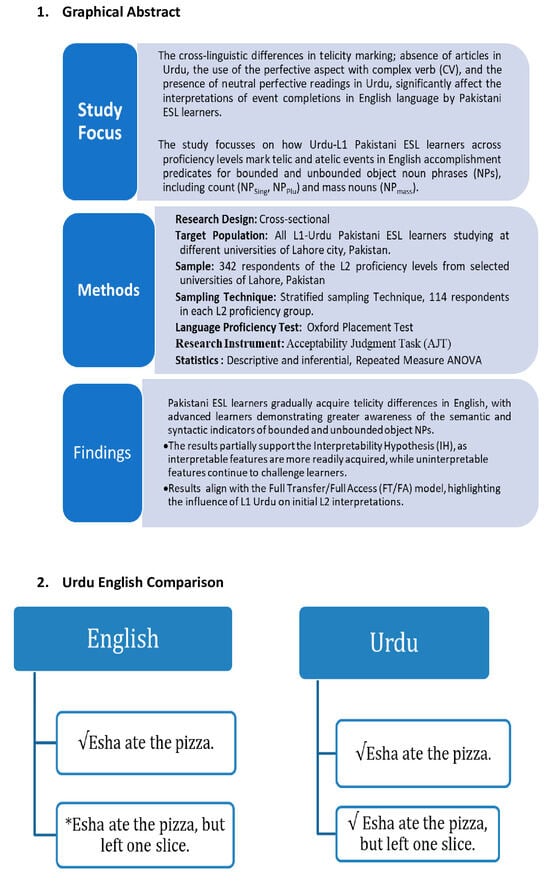
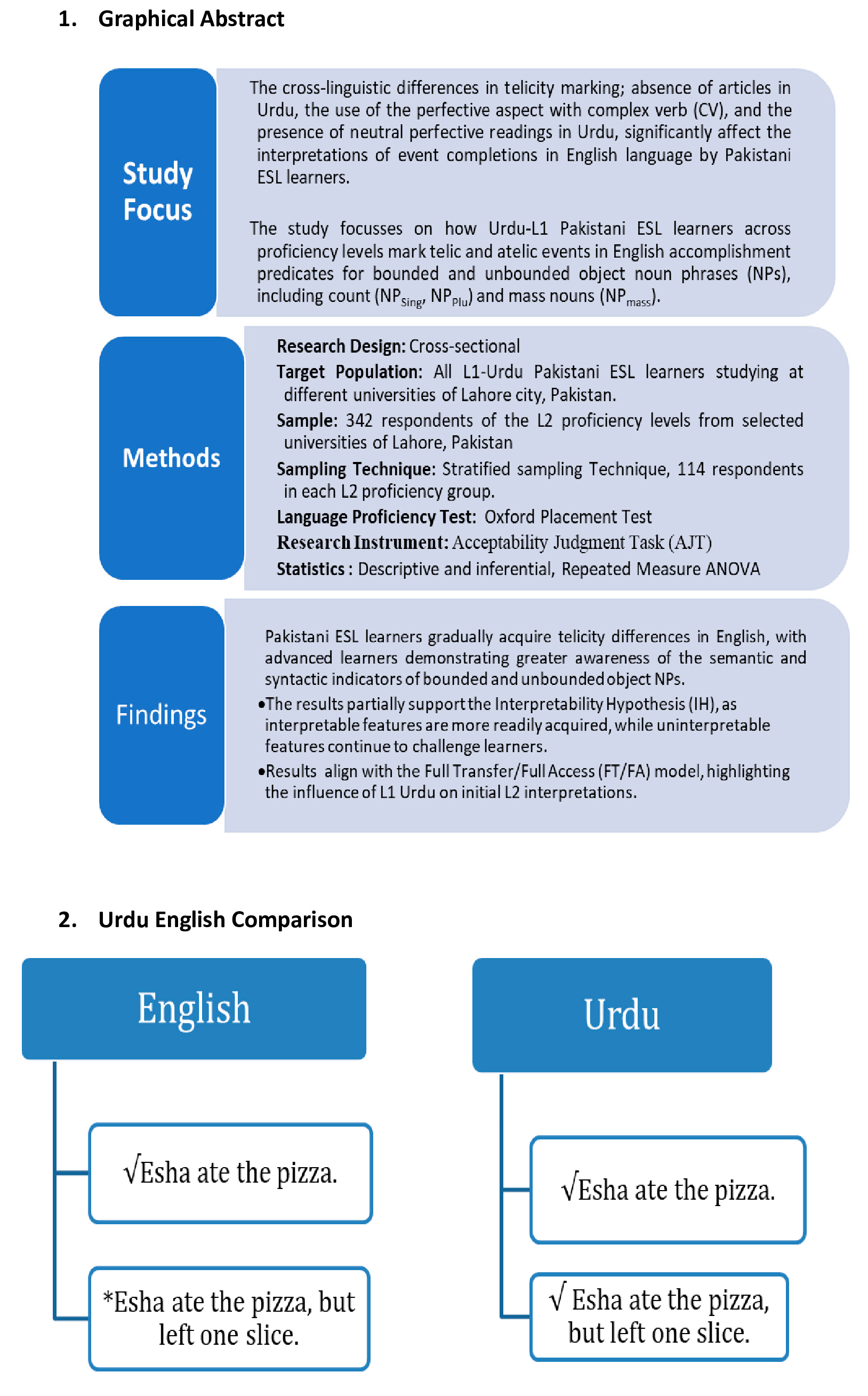
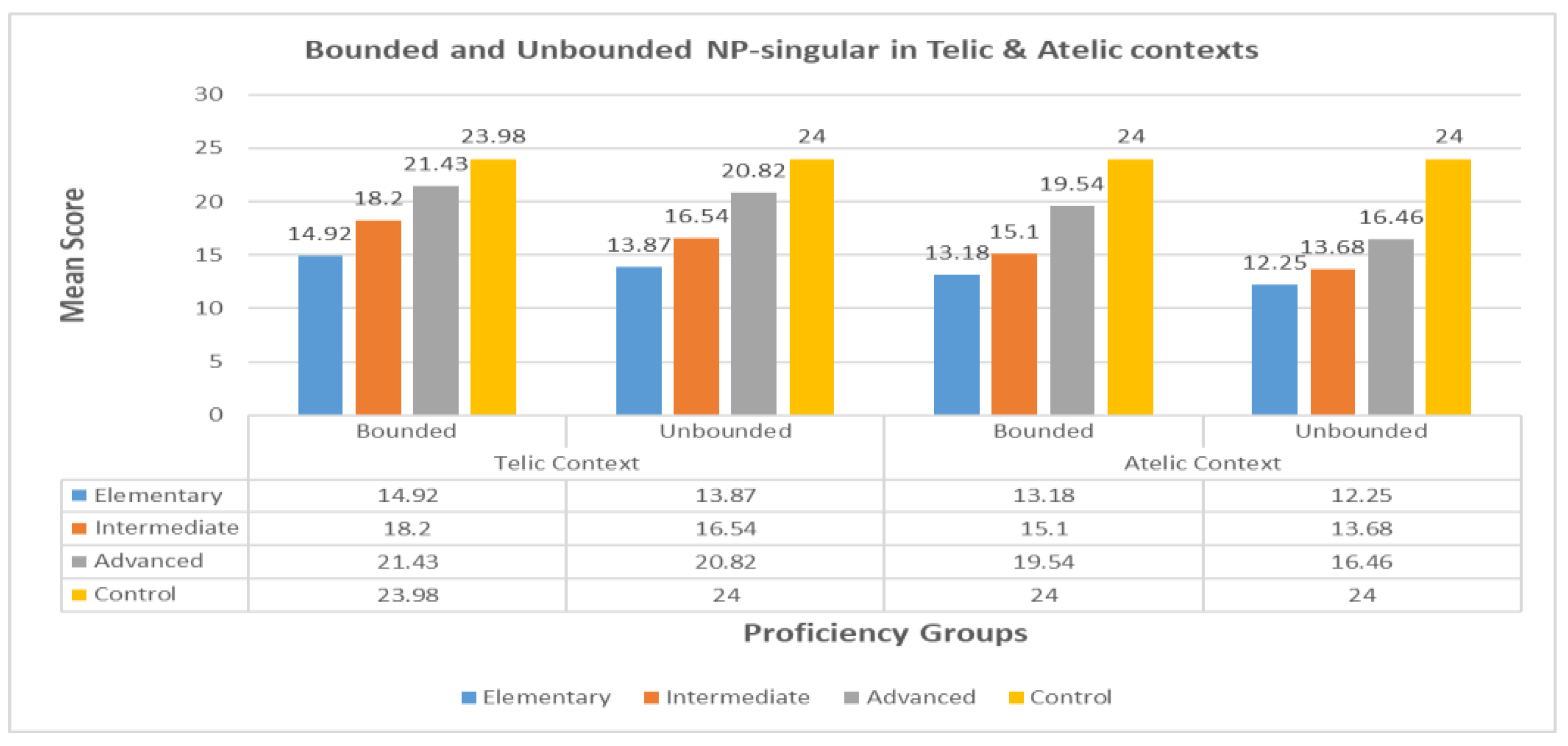
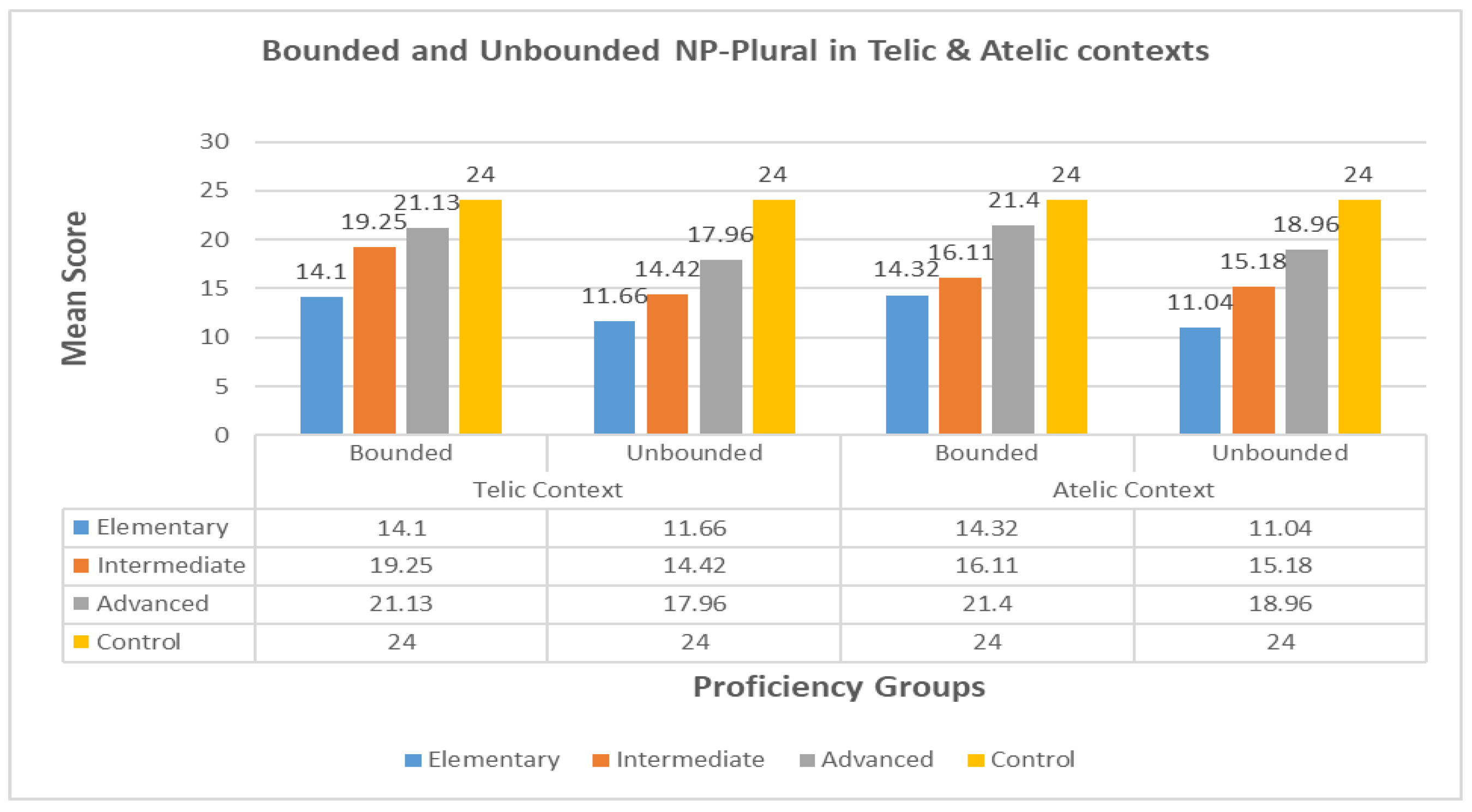
Interpreting event completion is a core difficulty in second language acquisition, as it underpins temporal reference and communication. This study investigates how L1 Urdu Pakistani learners of English acquire telicity, a semantic property that distinguishes completed and ongoing events. The analysis centers on bounded and unbounded object noun phrases (NPs) in marking telic/atelic events within accomplishment predicates. In English, telicity is compositionally encoded through verb types, object NPs, and temporal adverbials, whereas Urdu relies on aspectual morphology, creating challenges for learners in mapping event completion. The study is framed within the Full Transfer Full Access (FTFA) model and the Interpretability Hypothesis (IH). Data were collected through an Acceptability Judgment Task (AJT) administered to Pakistani ESL learners at elementary, intermediate, and advanced levels, alongside a native English control group. Results support the FTFA model, revealing a significant developmental trajectory where accuracy in distinguishing telic/atelic contrasts increases with proficiency. At the elementary level, an L1-based accuracy gradient emerged across NP types, reflecting the transfer of Urdu nominal underspecification. While advanced learners demonstrated successful restructuring in bounded contexts, partial support for the IH was found in atelic contexts. Continued divergence from native judgements in unbounded NP conditions highlights a persistent mapping deficit at the syntax–semantics interface. The study advances second language event semantics, emphasizing the role of object structure and cross-linguistic influence in the acquisition of L2 event boundaries.
Keywords: telicity; atelicity; bounded and unbounded noun phrases; Full Transfer Full Access; Interpretability Hypothesis; Pakistani ESL learners; event semantics telicity; atelicity; bounded and unbounded noun phrases; Full Transfer Full Access; Interpretability Hypothesis; Pakistani ESL learners; event semantics
Graphical Abstract