1. Introduction
Interrogatives are pervasive in conversation, with the question-answer sequence widely recognized as a foundational organizational structure of human interaction (
Schegloff, 1976). While conventionally associated with information seeking, interrogatives have been shown to implement a diverse range of social actions, including requesting confirmation, offering, inviting, and challenging (
Schegloff, 1968;
Stivers, 2010). What unites these otherwise diverse actions is that interrogatives are ordinarily designed as answer-seeking, thereby making a response by the recipient conditionally relevant as the next action. Against this backdrop, the present study investigates a less explored but theoretically revealing subtype of interrogatives in Mandarin Chinese, which is formulated with the first person singular pronoun wo ‘I’ as the grammatical subject, here termed as first person formulated interrogatives. At first glance, such interrogatives appear to pose an epistemic puzzle. While prevailing accounts of interrogatives as grounded in epistemic asymmetry, involving a speaker at a
less knowledgeable (K–) position and a recipient at a
more knowledgeable (K+) position (
Heritage, 2012;
Stivers et al., 2011), first person formulated interrogatives seem to involve speakers asking questions about themselves, a domain over which they ordinarily possess primary epistemic rights. This raises the question of how such interrogatives are intelligible and interactionally functional in everyday conversation.
Drawing on empirical evidence from naturally occurring interaction, this study found that first person formulated interrogatives are far from anomalous. Rather, they display a systematic dual interactional potential. They may be treated as answer-seeking and performing actions such as requesting information or confirmation, or as non-answer-seeking and performing actions such as displaying stance or informing. Importantly, participants routinely orient to these different uses without observable difficulty, responding swiftly and appropriately in the ongoing flow of talk (
Levinson, 2000). This dual potential raises a central question for the study of action formation and ascription: how do interlocutors determine whether a first person formulated interrogative is designed to solicit an answer from the recipient or to serve a self-directed interactional function? Rather than treating this as a problem of ambiguity per se, the present study approaches it as a question of how action is interactionally achieved when grammatical form alone does not uniquely specify addressivity. This issue is particularly salient in Mandarin Chinese. Unlike languages such as English, which rely on subject–auxiliary inversion to formally distinguish interrogatives from declaratives, Mandarin interrogatives frequently share the same word order as declarative clauses, with interrogativity indicated through optional particles, prosody, and pragmatic context (
Chao, 1968;
Chu, 1998;
Li & Thompson, 1981;
Lu, 2005). As a result, first person formulated interrogatives in Mandarin Chinese cannot rely solely on syntactic structure to signal addressivity and response relevance, rendering their interpretation especially dependent on other aspects of turn design. This typological feature makes Mandarin a particularly informative testing ground for examining how speakers and recipients manage action ascription under conditions of grammatical underspecification.
Building on recent theorization of action ascription (
Stivers et al., 2022), this study analyzes 116 instances of first person formulated interrogatives drawn from TalkBank, a large open-access corpus of Mandarin telephone conversations. The analysis demonstrates that two sets of morphosyntactic resources, namely, interrogative markers and recipient-addressed terms, are recurrently deployed in the design and interpretation of these interrogatives. These resources function by indexing relative epistemic relationship and the relevance of recipients to the issue at hand. Interrogatives designed to foreground low epistemic stance of speaker and high relevance of recipients are treated as other-addressed and answer-seeking, whereas those that foreground high epistemic stance of speakers are treated as self-addressed and non-answer-seeking. Theoretically, this study contributes to research on interrogatives, epistemics, and action ascription by showing how optional morphosyntactic resources play a crucial role in action formation in Mandarin Chinese. More broadly, it advances an interactional account of action in which social actions are not structurally pre-given by grammatical form but are achieved through the cumulative deployment of turn-design resources in real-time interaction.
2. Literature Review
A central concern in Conversation Analysis (CA) is how participants recognize the social action implemented by a turn at talk. Early work established that action formation is inseparable from turn design by showing the crucial role of lexical, grammatical, and prosodic composition of a turn in shaping how it is understood by recipients (
Drew & Holt, 1998). Subsequent research has elaborated the range of resources implicated in action ascription, including morphosyntactic format, prosodic contour, epistemic stance, embodiment, and sequential positioning (
Fox, 2007;
Thompson et al., 2015;
Couper-Kuhlen & Selting, 2017;
Heritage, 2012). Importantly, these studies converge on the insight that participants rely on clusters of converging cues, rather than single formal features, to recognize action. This insight is captured in
Stivers et al. (
2022) work, which conceptualizes action ascription as grounded in three interrelated components: sequential context, dedicated action design, and multiple indicators of action.
Sequential context encompasses the expectations generated by prior talk, including adjacency pair organization and broader activity structures.
Dedicated action design refers to the specific linguistic and interactional resources used in the formulation of a turn, such as word choice, grammar, prosody, and embodiment.
Multiple indicators of action emphasizes that action recognition typically relies on the convergence of several mutually reinforcing cues rather than a single feature. This three-pillar framework has important implications for the analysis of interrogatives. While interrogative format conventionally projects an answer as next relevant action, prior work has repeatedly shown that interrogatives may implement a wide range of actions depending on how they are designed and positioned. From this perspective, cases in which interrogative form alone does not uniquely specify action are not exceptional but theoretically revealing. Such cases foreground the interpretive work participants undertake and the resources they mobilize to achieve action ascription with remarkable speed and reliability (
Levinson, 2000). First person formulated interrogatives constitute one such revealing case. Their grammatical design provides only partial guidance regarding addressivity and response relevance, making them particularly suitable for examining how speakers strategically deploy additional interactional resources to secure recognizable action.
Cross-linguistic research has demonstrated that interrogatives cannot be equated with information-seeking across languages or interactional settings. In many languages, interrogative formats are routinely used to perform actions such as requests, assessments, challenges, and stance displays, often without any expectation of a substantive answer (
Heinemann, 2008;
Stivers, 2010;
Enfield et al., 2019). These findings have led to a broad reconceptualization of interrogatives as interactional resources rather than form-function pairings. Comparative work has further shown that languages differ considerably in how interrogativity is grammatically encoded. While some languages rely heavily on syntactic mechanisms such as inversion or interrogative morphology, others, such as Mandarin Chinese, Japanese, and many Austronesian languages, employ optional particles, prosody, and pragmatic inference (
Enfield, 2010;
Hayashi, 2010). Importantly, this typological variation does not lead to systematic breakdowns in interaction. Instead, it reveals how participants exploit language-specific resources to accomplish action formation. From an interactional perspective, such variation highlights the need to distinguish grammatical interrogativity from interrogative action. A turn may be grammatically interrogative without being treated as answer-seeking, just as a non-interrogative form may mobilize questioning action. Accepted terminology in CA therefore distinguishes between interrogative format and questioning action (
Stivers & Enfield, 2010), a distinction that is central to the present study.
Research on epistemics has shown that interrogatives are deeply intertwined with the management of knowledge, authority, and entitlement in interaction. Canonically, interrogatives are understood to enact an epistemic asymmetry in which a
less knowledgeable (K–) speaker seeks information from a
more knowledgeable (K+) recipient (
Heritage, 2012). However, a growing body of research has demonstrated that interrogatives frequently occur in epistemically incongruent environments, where speakers ask about matters to which they ostensibly have primary access. Such practices have been documented across a range of institutional and everyday settings, including medical consultations (
Heritage & Robinson, 2006), classroom interaction (
Koshik, 2005), and advice-giving sequences (
Vehviläinen, 2001). In these contexts, interrogatives may function to challenge prior claims, display stance, prompt reflection, or manage participation rather than to request information. These findings underscore that interrogative format does not straightforwardly map onto epistemic status and that epistemic relations are dynamically negotiated through turn design. First person formulated interrogatives extend this line of inquiry by pushing epistemic incongruence to an extreme. By asking questions about themselves, speakers appear to violate the expectation that interrogatives target knowledge held by others. Investigating how such interrogatives are designed and responded to therefore offers a particularly sharp lens on how epistemic stance is calibrated and how participants manage potential tensions between grammatical person reference and epistemic relationship.
Mandarin Chinese provides a particularly fertile site for examining these issues due to the typological properties of its interrogative system. Unlike languages such as English, Mandarin does not rely on subject-auxiliary inversion to mark interrogativity. Declarative and interrogative clauses often share identical word order, with interrogativity signaled through optional lexico-syntactic markers, prosody, and pragmatic context (
Li & Thompson, 1981). This places greater interactional weight on non-obligatory resources in the formation and recognition of interrogative action. A substantial body of research has documented the role of turn-final particles in Mandarin interrogatives, showing that they encode fine-grained epistemic and pragmatic distinctions (
Chao, 1968;
Chu, 1998;
Lu, 2005). For example, particles such as
ba,
ha, and
ne have been shown to index different epistemic stances, degrees of speaker commitment, and orientations to recipient agreement or prior talk (
Fang & Hengeveld, 2022;
Wang, 2021). These studies demonstrate that Mandarin speakers systematically exploit optional morphosyntactic resources to shape the interactional import of interrogatives. Despite this rich literature, interrogatives formulated with first person subjects have received relatively little attention. Yet these forms are common in everyday Mandarin conversation and analytically significant, as they combine the epistemic tension of “I”-questions with the absence of syntactic inversion. By examining how optional morphosyntactic cues, such as interrogative markers and recipient-addressed terms, are deployed in first person formulated interrogatives, the present study extends prior research on Mandarin interrogatives and situates it within broader cross-linguistic discussions of action formation and ascription.
3. Materials and Method
This study investigates the linguistic design and interactional import of first person formulated interrogatives in Mandarin conversation. The aim is to examine how such interrogatives are designed to be recognizable as implementing particular social actions and how they elicit different types of responses from recipients. To this end, the study draws on naturally occurring telephone conversations among native speakers of Mandarin Chinese. The data used for analysis were drawn from a Mandarin telephone conversation corpus collected by the Linguistic Data Consortium (
Canavan & Zipperlen, 1996), available through TalkBank—CallHome/CallFriend (
https://ca.talkbank.org/, accessed on 3 February 2024). Participants of the CallHome (140 participants) and CallFriend (35 from mainland China and 60 from Taiwan) corpora are demographically diverse and reside in various locations in mainland China, Taiwan, and United States. This corpus documents ordinary, everyday interactions without the constraints of experimental manipulation or elicitation tasks, thereby providing ecologically valid evidence of how speakers deploy interrogatives and how recipients respond to them in real-time interaction.
For the purposes of this study, an instance was identified as a first person formulated interrogative if it met the following criterion in Mandarin Chinese: the turn is interrogative in form and contains the first person singular pronoun
wo ‘I’ as the grammatical subject.
Table 1 below presents examples of turns that were included because they meet this criterion, as well as examples that were excluded because they do not. It is important to note that the initial identification of first person formulated interrogatives in the corpus was purely form-driven. That is, all interrogatives matching the structural criterion were included regardless of whether they functioned interactionally as information-seeking questions. As a result, interrogatives that do not perform the action of questioning, such as rhetorical or reflective uses, were retained for analysis. Using this procedure, a total of 116 instances of first person formulated interrogatives were identified in the dataset.
Following the identification of all relevant instances, each first person formulated interrogative was subjected to detailed qualitative analysis to examine its linguistic design and its relationship to the type of response elicited. The methodological orientation of the study is Conversation Analysis (CA) (
Clayman & Heritage, 2025;
Stivers, 2015), supplemented by insights from interactional linguistics. Abbreviations used in the gloss and transcription conventions can be found in
Appendix A and
Appendix B, respectively. This combined approach enables a fine-grained examination of how interrogatives are designed, how they are positioned within sequential environments, and how they are oriented to by co-participants. Rather than treating interrogatives as abstract grammatical forms, the analysis attends to their situated deployment in talk-in-interaction, foregrounding the interplay between morphosyntactic design, sequential context, and recipient uptake. Linguistic design features examined include, but are not limited to, question words, modal verbs, turn-final particles, and rhetorical markers. Responses to the first person formulated interrogative were broadly categorized into two types: (i)
Turn-taking response, which is defined as the response in which the recipient enters the turn space as next speaker and advances the sequence; and (ii)
Non-turn-taking response, which is defined as the response in which the recipient does not take the floor, or only produces weak recipiency displays that do not interrupt speaker progressivity.
Table 2 below presents the coding scheme for response types, illustrated with representative examples. Overall, qualitative analyses of instances of first person formulated interrogatives identified from corpus focused on how specific morphosyntactic design features of first person formulated interrogatives systematically relate to the type of response elicited. Each instance was examined in its full sequential context to determine how participants oriented to the interrogative and how its action was ascribed in interaction. By combining CA-based sequential analysis with close attention to morphosyntactic design, the study investigates how first person formulated interrogatives are mobilized as social actions and how their linguistic design contributes to their recognizability as either answer-seeking or non-answer-seeking.
4. Morphosyntactic Resources in First Person Formulated Interrogatives
This section presents main findings of this study by examining how specific morphosyntactic resources are systematically implicated in the action formation and ascription of first person formulated interrogatives in Mandarin Chinese. Conducting CA-driven analysis of all 116 identified instances, the result shows that two sets of morphosyntactic resources, namely, interrogative markers and recipient-addressed terms, play a recurrent and consequential role in shaping how these interrogatives are understood and responded to. In this study,
interrogative markers is defined as morphosyntactic resources that contribute to the grammatical formatting of a turn as interrogative, such as turn-final particles (e.g.,
ma,
ba), whereas
recipient-addressed terms refer to resources that explicitly index the intended respondent and thereby establish addressivity, such as second-person pronouns (e.g.,
ni ‘you’,
nimen ‘you guys’), titles (e.g.,
laoshi ‘teacher’), kinship terms (e.g.,
ma ‘mom’) and personal names. The selection of interrogative markers and recipient-addresed terms in this study is motivated by their recurrent deployment in participants’ own practices of action formation, as evidenced by systematic differences in recipient uptake. The identification of these resources emerged through iterative qualitative analysis. After all first person formulated interrogatives were located using form-based criteria (see
Section 3), each instance was examined sequentially to determine how recipients oriented to it in next turns. Patterns were then identified by comparing cases that elicited different types of responses. Morphosyntactic features that recurrently co-occurred with particular response trajectories were subsequently coded and refined through repeated comparison across cases. Importantly, coding decisions were grounded not in analyst intuitions about form, but in participants’ own displayed orientations, as evidenced by recipient uptake or lack thereof. The analysis reveals that interrogative markers and recipient-addressed terms function as interactionally salient cues that guide recipients in ascribing whether a first person formulated interrogative is answer-seeking or non-answer-seeking.
Table 3 below illustrated how these two sets of morphosyntax resources were used in designing first person formulated interrogatives. Overall, the present study focuses on interrogative markers and recipient-addressed terms because these morphosyntactic resources are optional yet interactionally consequential in Mandarin interrogatives. In what follows, closer qualitative analyses are presented to explicate how these morphosyntactic resources operate in interaction, showing how such resources become primary sites for the display of epistemic stance and response relevance in a language where interrogativity and addressivity are not obligatorily encoded by syntactic structure,
Before turning to the analysis, however, a brief overview of relevant morphosyntactic features of Mandarin interrogatives is provided to facilitate understanding for readers unfamiliar with the language. Mandarin Chinese does not employ subject–auxiliary inversion to mark interrogativity. Declarative and interrogative clauses often share identical word order, with interrogative force signaled through a combination of interrogative markers, modal elements, turn-final particles, and prosody (
Li & Thompson, 1981;
Chao, 1968). These resources are optional rather than obligatory, rendering interrogativity and addressivity interactionally negotiable. In this study, the term ‘interrogative markers’ is used as a cover term for morphosyntactic elements that contribute to the formation of interrogative formats. These include open-ended interrogative formats (e.g.,
shenme ‘what’,
zenme ‘how’,
weishenme ‘why’) and closed-ended interrogative formats (e.g.,
shi-bu-shi ‘be-not-be’). Broadly speaker, closed-ended interrogatives can be achieved through two main structural pathways. One involves predicate-based interrogative constructions, most notably A-not-A formats (e.g.,
hao-bu-hao ‘okay-not-okay,
shi-bu-shi ‘be-not-be’), which explicitly present alternative propositions and typically project a closed response set. The other relies on turn-final particles, often in combination with declarative syntax, to mark an utterance as interrogative (
Li & Thompson, 1981). Turn-final particles such as
ma,
ba, and
ne do not encode interrogativity in a purely truth-conditional sense, but function as interactional operators that shape epistemic stance and response expectations. Importantly, these particles can combine with modal verbs such as
keyi ‘can/could’ or
yinggai ‘should’, yielding interrogative formats that simultaneously invoke modality, epistemic positioning, and interactional delicacy. For example,
ma is conventionally associated with neutral polar questions and projects a relatively open confirmation space, as in
wo bang ni, hao ma? ‘I’ll help you, okay?’. These interrogative markers differ not only in the type of information they solicit (open vs. closed), but also in the epistemic stance they index and the response space they project, which will be discussed in detail in the later part of this paper. The second set of resources examined in this section, recipient-addressed terms, refers to overt linguistic forms used to explicitly index the recipient, including second-person pronouns (e.g.,
ni ‘you’,
nimen ‘you guys’), titles (e.g.,
laoshi ‘teacher’), kinship terms (e.g.,
ma ‘mom’) and personal names. Such terms function as powerful cues for recipient relevance and participation.
4.1. Epistemic Positioning Displayed Through Interrogative Markers
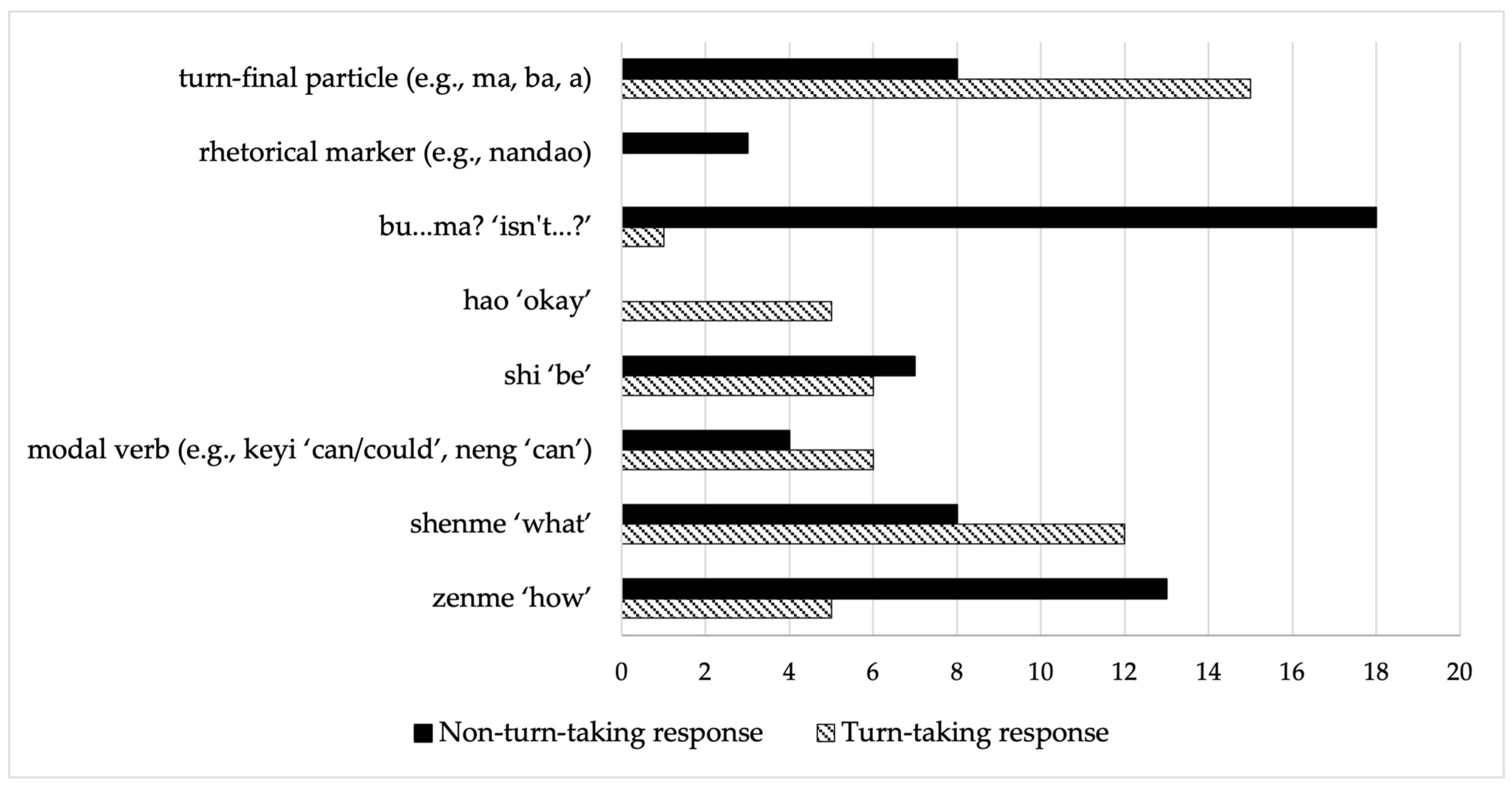
A close examination of the dataset reveals systematic differences in the types of recipient responses associated with different interrogative markers.
Table 4 and
Figure 1 below presents the overall distribution of response types elicited by first person formulated interrogatives across different interrogative markers.
As shown in
Table 4 and
Figure 1, interrogatives designed with distinct interrogative markers display markedly different response trajectories. For instance, first person formulated interrogatives marked with open-ended interrogative words such as
shenme ‘what’ predominantly elicit turn-taking responses, often in the form of elaborated advice or suggestions. By contrast, interrogatives marked with negative polar formats such as
bu… ma? ‘isn’t…?’ overwhelmingly receive non-turn-taking response from recipients. These distributional patterns indicate that interrogative markers constitute a salient morphosyntactic resource in the action formation of first person formulated interrogatives. Further analysis suggests that these markers can be analytically differentiated along two dimensions: (i) whether they frame the interrogative as open-ended or closed-ended, and (ii) whether they are dedicated to rhetorical uses. In what follows, these dimensions are examined in turn, with particular attention to how interrogative markers index epistemic relationships between speakers and recipients and thereby shape action ascription.
4.1.1. Markers Framing Interrogatives as Open-Ended or Closed-Ended
Whether an interrogative marker frames a turn as open-ended or closed-ended is found to be consequential for both action ascription and recipient response. First person formulated interrogatives constructed with open-ended markers (e.g.,
shenme ‘what’,
zenme ‘how’) systematically elicit fuller and more elaborated responses from recipients. In contrast, those constructed with closed-ended formats, particularly negative polar interrogatives such as
bu… ma? ‘isn’t…?’ are considerably less likely to mobilize substantive uptake. Qualitative analysis suggests that this contrast can be accounted for in terms of the epistemic stance indexed by different interrogative formats. Open-ended interrogatives typically contain relatively little propositional content and therefore foreground the speaker’s limited epistemic access to the matter at hand.
Heritage (
2013, p. 556) frames the issue as a ‘B-event’, that is, an event more properly knowable by the recipient than by the speaker. This design implies low epistemic stance of the speaker and expands the response space, inviting elaboration rather than mere confirmation. By contrast, closed-ended interrogatives, especially negative polar formats, encode a higher degree of speaker commitment to a particular proposition. In doing so, they display stronger epistemic access on the part of the speaker and correspondingly narrow the space for recipient contribution. As a result, such interrogatives are more readily treated as self-addressed or stance-displaying, rather than as genuine solicitations for information. Excerpt (1) below illustrates how an open-ended interrogative marker contributes to the formation of an answer-seeking first person formulated interrogative.
| 01 | | AMY: | 我 | 觉得 | 你: | 把 | 你 | 那边儿 | 的 | 那 | 个- |
| wǒ | juédé | nǐ: | bǎ | nǐ | nàbiāner | de | nà | ge- |
| 1SG | think | 2SG | BA | 2SG | there | DE | that | CLF |
‘I think you can make that one-
|
| 02 | | | 比如 | 要 | 上学 | 的… |
| Bǐrú | yào | shàngxué | de… |
| such.as | need.to | go.to.school | DE |
such as going to school-
|
| 03 | | | 你 | 就 | 别 | 说 | 太 | 那什么… |
| nǐ | jiù | bié | shuō | tài | nàshénme… |
| 2SG | just | NEG | say | too | that |
you just don’t say too much about that-
|
| 04 | | | 别 | 说 | [太-] |
| bié | shuō | [tài-] |
| NEG | say | [too] |
don’t say [too-]’
|
| 05 | → | CAT: | [那 | 我-] |
| [nà | wǒ-] |
| then | 1SG |
’Then I-
|
| 06 | → | | 那 | 我 | 有 | 什么 | 理由 | 啊? |
| nà | wǒ | yǒu | shénme | lǐyóu | a? |
| then | 1SG | have | what | excuse | PRT |
Then what kind of excuse can I make?’
|
| 07 | | AMY: | 那 | 你 | 就 | 说 | 你- |
| nà | nǐ | jiù | shuō | nǐ- |
| then | 2SG | just | say | 2SG |
‘Then you just say you-
|
| 08 | | | 你 | 就 | 说: | 你 | 这 | 培训班… |
| nǐ | jiù | shuō | nǐ | zhè | péixùnbān… |
| 2SG | just | say | 2SG | this | tutorial |
You just say your tutorial-
|
| 09 | | | 就是说 | 还 | 要 | 延长. |
| jiùshìshuō | hái | yào | yáncháng. |
| that.is | still | need.to.be | extend |
that still needs to be extended.
|
| 10 | | | 或者 | 还 | 要 | 怎么样. |
| huòzhě | hái | yào | zěnmeyàng. |
| or | still | need.to.be | somehow |
| Or still need something to be done.’ |
Excerpt (1) is drawn from a telephone conversation between Amy and Cathy, in which Amy proposes that Cathy could fabricate an excuse for not attending a mandatory event that she wishes to avoid (lines 1–4). In response, Cathy produces a first person formulated interrogative (lines 5–6), asking what kind of excuse she might make. The interrogative is then responded by its recipient Amy by providing a list of concrete possibilities (lines 7–10). Here, the first person formulated interrogative is marked by the open-ended question format shenme ‘what’, which indexes the speaker Cathy’s lack of knowledge regarding the excuse to be made, framing the issue being discussed as one in which the recipient is positioned as epistemically more knowledgeable. By doing so, the speaker cedes relative authority to the recipient, despite the fact that the issue at stake primarily concerns herself. Importantly, the use of the open-ended question format shenme ‘what’ not only underscores the speaker’s epistemic stance but also creates an expanded response space for the recipient, allowing the recipient to elaborate multiple candidate solutions rather than being constrained to a confirmation or disconfirmation.
In contrast to those with open-ended question formats which often elicit elaborated answers from recipients, first person formulated interrogatives marked with negative polar formats, such as bu… ma? ‘isn’t…?’, tend to elicit only continuers or acknowledgment tokens rather than substantive answers. This can be illustrated by Excerpt (2) given below. In this excerpt, Emma is recounting to her friend Nicole her recent experience of purchasing a new car. Early in the telling, Emma reminds Nicole that she had already mentioned this event in a prior conversation two days earlier (lines 1–3). The reminder is formulated as a first person formulated interrogative with the negative polar format bu… ma? ‘isn’t…?’. Notably, Nicole does not respond with an explicit answer such as shi ‘yes’or bushi ‘no’, but instead produces a continuer token en ‘uh-huh’ (line 4). In response, Emma then went on to talk about the details of how she returned the prior car and got a new one (lines 5–6). This suggests that the first person formulated interrogative interrogative here is not ascribed by the recipient as the action of information-seeking but rather as a preface to an upcoming storytelling sequence. In particular, the negative polar question format bu… ma? ‘isn’t…?’ functions as a semi-fixed framing device that foregrounds high epistemic stance of the speaker over the matter being discussed while simultaneously restricting the range of legitimate responses from the recipient. In this sense, the interrogative is actionally ascribed as informing rather than questioning or information-seeking, implying that the recipient is not expected to contribute with an elaborated answer more than a simple continuer serving primarily to ratify the speaker’s upcoming narrative agenda.
| 01 | | EMM: | 那 | 个- |
| nà | ge- |
| that | CLF |
‘That-
| |
| 02 | | | 我们 | 又- |
| wǒmen | yòu- |
| 1PL | also |
We also-
| |
| 03 | → | | 我 | 不 | 是 | 前两天 | 跟 | 你 | 说 | 我 | 买 | 辆 | 车 | 吗? |
| wǒ | bú | shì | qiánliǎngtiān | gēn | nǐ | shuō | wǒ | mǎi | liàng | chē | ma? |
| 1SG | NEG | COP | two.day.ago | to | you | say | 1SG | buy | CLF | car | PRT |
Isn’t that I told you two days ago that I bought a car?’
|
| 04 | | NIC: | 嗯. |
| en. |
| INJ |
‘Uh-huh.’
|
| 05 | | EMM: | 把 | 那 | 辆 | 车 | 退: | 了. |
| bǎ | nà | liàng | chē | tuì: | le. |
| BA | that | CLF | car | return | PST |
‘(I) returned that car.
|
| 06 | | | 又 | 买 | 了 | 一 | 辆. |
| yòu | mǎi | le | yí | liàng. |
| again | buy | PST | one | CLF |
Bought another one.’
|
| 07 | | | @@
|
| 08 | | NIC: | @@
|
| 09 | | | 你 | 是 | 从 | dealer | 那 | 买 | 的 | 是 | 吗? |
| nǐ | shì | cóng | <dealer> | nà | mǎi | de | shì | ma? |
| 2SG | COP | from | dealer | there | buy | DE | COP | PRT |
| ‘You bought it from dealer, is it?’ |
Taken together, the cases discussed above demonstrate that the selection of interrogative markers systematically contributes to whether first person formulated interrogatives are framed as open- or closed-ended, thereby shaping both participants’ epistemic positioning and the range of responses made relevant. Open-ended formats such as
shenme ‘what’ display the speaker’s limited epistemic access and position the recipient as epistemically authoritative, thereby inviting elaborated and substantive responses. By contrast, closed-ended formats, particularly negative polar formats such as
bu… ma? ‘isn’t…?’, presuppose substantial speaker knowledge and accordingly constrain recipients to continuers or even non-response. These patterns align with
Heritage’s (
2013, p. 556) distinction between
A-events and
B-events, illustrating how epistemic relationship between speakers and recipients is not pre-given but interactionally negotiated through interrogative design.
4.1.2. Markers Modifying the Rhetorical Style of Interrogatives
The preceding subsection demonstrated how the distinction between open- and closed-ended interrogative formats indexes relative epistemic positioning by framing the matter at hand as an A-event or B-event (
Heritage, 2013, p. 556), thereby shaping the response types made relevant. Beyond this epistemic distinction, the present subsection shows that interrogative markers also play a crucial role in shaping the rhetorical style of first person formulated interrogatives. Specifically, morphosyntactic resources may inflect an interrogative toward negotiation, mitigation, or rhetorical display, thereby modulating the extent to which recipients are invited or obligated to provide uptake. Evidence from the corpus indicates that first person formulated interrogatives marked with hao ma? ‘okay?’ elicit turn-taking responses more frequently than those marked with
shi ba? ‘is it?’, despite both being formally close-ended polar interrogatives. This divergence suggests that response trajectories are sensitive not only to interrogative polarity but also to the rhetorical stance indexed by specific morphosyntactic choices. In particular, the particle hao ‘okay’ conveys a negotiating orientation that foregrounds recipient involvement and highlights the relevance of recipient ratification. This pattern can be illustrated by Excerpt (3) given below.
| 01 | | EMI: | [公公]. |
| [gōnggong]. |
| grandpa |
‘[Grandpa].’
|
| 02 | | DAV: | [啊]. |
| [a]. |
| PRT |
‘[Ah].
|
| 03 | | | 嗯. |
| en. |
| PRT |
Un-huh.’
|
| 04 | | EMI: | 你 | 写 | 信 | 讲 | 个 | 孙悟空 | 的 | 故事 | 给 | 我 | 听 | 吧? |
| nǐ | xiě | xìn | jiǎng | ge | sūnwùkōng | de | gùshì | gěi | wǒ | tīng | ba? |
| 2SG write letter tell CLF Monkey.King DE story to 1SG listen PRT |
‘How about you writing a letter to tell me a Monkey King’s story?’
|
| 05 | | DAV: | 好 | 吧 | 好 | 吧. |
| hǎo | ba | hǎo | ba. |
| Okay | PRT | okay | PRT |
‘Okay okay.
|
| 06 | → | | 那 | 明- | 今天 | 我 | 就 | 来 | 写 | 好 | 吧? |
| nà | míng- | jīntiān | wǒ | jiù | lái | xiě | hǎo | ba? |
| then | tomorrow- | today | 1SG | will | start | write | okay | PRT |
| Then tomorrow- today I will start writing, okay?’ |
| 07 | | EMI: | 好. |
| hǎo. |
| okay |
‘Okay.’
|
| 08 | | DAV: | ..过 | 几 | 天 | 就 | 寄 | 到 | 你 | 那里. |
| ..guò | jǐ | tiān | jiù | jì | dào | nǐ | nàli, |
| after | several | day | will | send | to | 2SG | there |
‘(I) will send to you several days later.
|
| 09 | | | ..好 | 不 | 好? |
| ..hǎo | bú | hǎo? |
| okay | NEG | okay |
Okay?’
|
| 10 | | EMI: | 嗯. |
| en. |
| INJ |
‘Uh-huh.
|
| 11 | | | 你 | 讲 | 个- |
| nǐ | jiǎng | ge- |
| 2SG | tell | CLF |
You tell a-’
|
| 12 | | DAV: | =哦. |
| =o. |
| INJ |
‘Oh.’
|
| 13 | | EMI: | 你 | 讲 | 个 | 什么 | 孙悟空 | 的 | 故事 | 啊? |
| nǐ | jiǎng | gè | shénme | sūnwùkōng | de | gùshì | a? |
| 2SG | tell | CLF | what | Monkey.King | DE | story | PRT |
‘What kind of Monkey King’s story will you tell me?’
|
| 14 | | DAV: | 讲 | 一 | 个::- |
| jiǎng | yí | ge::- |
| tell | one | CLF |
‘Tell a-
|
| 15 | | | 孙悟空 | 跟: | 那 | 个 | 牛魔王 | 的 | 故事. |
| sūnwùkōng | gēn: | nà | ge | niúmówáng | de | gùshì. |
| Monkey.King | and | that | CLF | Niumowang | DE | story |
story about Monkey King and the Niumowang.
|
| 16 | | | 好 | 不 | 好? |
| hǎo | bù | hǎo? |
| okay | NEG | okay |
| Okay?’ |
In this excerpt, Emily asks her grandfather David to write her a letter and tell her a story about the Monkey King (line 4). In response, David initially produces two acceptance tokens, hao ba? ‘okay?’, followed by a first person formulated interrogative proposing to write the story that day (lines 5–6). This is then responded by Emily with a confirmation token hao ‘okay’ (line 7). In this context, David’s interrogative does not function primarily as a request for information but rather as an offer framed through negotiation. The use of the marker hao ba? ‘okay?’ imbues the interrogative with a conciliatory and evaluative tone, inviting the recipient to endorse the proposed arrangement. Compared with interrogative particles derived from the copula shi ‘be’, which tend to solicit factual confirmation, the evaluative predicate hao ‘okay’ invokes a more subjective judgment. That is, whether something is hao ‘okay’ depends on the recipient’s assessment rather than on objective knowledge. By selecting hao ba? ‘okay?’, the speaker displays epistemic tentativeness and explicitly orients to the recipient’s authority to ratify the proposal. In this way, the rhetorical style encoded by hao ‘okay’ signals that recipient uptake is consequential, thereby encouraging an affirmative response. This analysis demonstrates that meaningful variation exists not only between open- and closed-ended first person formulated interrogatives, but also within the category of closed-ended interrogatives itself. Fine-grained differences in rhetorical style, achieved through the selective deployment of morphosyntactic particles, have systematic consequences for action ascription and recipient response. Together, these findings underscore the importance of treating interrogative design as a multidimensional practice through which speakers calibrate epistemic stance, interpersonal alignment, and expectations of uptake.
Another morphosyntactic resource that substantially shapes the rhetorical style of first person formulated interrogatives is
nandao, a particle widely recognized as a dedicated device for constructing rhetorical questions in Mandarin. Prior research has shown that
nandao is commonly used to express the speaker’s doubt, incredulity, or self-questioning stance toward a state of affairs, rather than to solicit information from a recipient (
Jing-Schmidt, 2008;
Xu, 2012). Consistent with this characterization, first person formulated interrogatives prefaced with
nandao in our dataset overwhelmingly fail to elicit recipient uptake (see
Table 4 and
Figure 1 above). This pattern can be illustrated by Excerpt (4) given below.
| 01 | | BEL: | 我靠. |
| wǒkào. |
| damn |
‘Damn.
|
| 02 | | | 为什么 | 咱们 | 到 | 那边 | 要 | 两:: | 个 | 小时? |
| wéishénme | zánmen | dào | nàbiān | yào | liǎng:: | ge | xiǎoshí? |
| why | 1PL | get | there | need | two | CLF | hour |
Why do we need two hours to get there?
|
| 03 | | | 到 | 那 | 个 | 莎士比亚 | 小镇 | 啊. |
| dào | nà | ge | shāshìbǐyà | xiǎozhèn | a. |
| get | that | CLF | Shakespeare | Town | PRT |
Get to that Shakespeare Town.
|
| 04 | → | | 难道 | 我 | 查 | 错 | 了? |
| nándào | wǒ | chá | cuò | le? |
| NANDAO | 1SG | search | wrong | PRT |
Did I searched (it) in a wrong way?’
|
| 05 | | EVE: | 交通 | 不 | 便利. |
| jiāotōng | bú | biànlì. |
| transportation | NEG | convenient |
‘The transportation is not convenient.’
|
| 06 | | BEL: | 我 | 知道 | 为什么 | 了. |
| wǒ | zhīdào | wéishénme | le. |
| 1SG | know | why | PST |
‘I have known why.
|
| 07 | | | 我 | 知道 | 要- |
| wǒ | zhīdào | yào- |
| 1SG | know | have.to |
I know (we) have to-
|
| 08 | | | 要 | 在 | 伯明翰 | 这边 | 倒车. |
| yào | zài | bómínghàn | zhèbiān | dǎochē. |
| have.to | at | Birmingham | here | transfer |
have to transfer at Birmingham.
|
| 09 | | | …这 | 什么 | 鬼? |
| …zhè | shénme | guǐ? |
| this | what | heck |
What the heck is this?’
|
| 10 | | | ((Silence between speakers, during which Bella keeps searching on google map.))
|
| 11 | | BEL: | 对 | 对 | 对. |
| duì | duì | duì. |
| right | right | right |
| ‘Right. |
| 12 | | |
牛津 | 这边 | 过去- |
| niújīn | zhèbiān | guòqù- |
| Oxford | here | go.to |
| Going from Oxford here- |
| 13 | | |
啊 | 不 | 是 | 不 | 是. |
| a | bù | shì | bù | shì. |
| INJ | NEG | COP | NEG | COP |
Ah no no.
|
| 14 | | | 牛津 | 过去 | 的话 | 就要 | 倒车. |
| niújīn | guòqù | dehuà | jiùyào | dǎochē. |
| Oxford | go.to | if | need.to | transfer |
If going from Oxford, we need to transfer.
|
| 15 | | | 而且 | 要 | 到- |
| érqiě | yào | dào- |
| and | need.to | go.to |
And (we) need to go to-
|
| 16 | | | …哎 | 我 | 看 | 一下. |
| …ai | wǒ | kàn | yíxià. |
| INJ | 1SG | look | a.bit |
Ah I take a look.
|
| 17 | | | 先: | 到: | Banbury. |
| Xiān: | dào: | <Banbury>. |
| first | go.to | Banbury |
(We) first go to Banbury.
|
| 18 | | | ((lines omitted, at which Bella describes the route in detail))
|
| 19 | | EVE: | 嗯. |
| en. |
| INJ |
| ‘Uh-huh.’ |
In this excerpt, Bella and her friend Eve are planning a trip to Shakespeare Town. Bella begins by complaining about the excessive travel time involved (lines 1–3). She then produces a first person formulated interrogative prefaced with nandao, questioning whether she might have searched for the destination incorrectly (line 4). Notably, Eve does not respond with a polar confirmation or disconfirmation. Instead, she comments on the inconvenience of the transportation system itself (line 5). This response neither constitutes a continuer nor addresses the interrogative content directly. Rather, it aligns with Bella’s prior complaint (lines 1–3) while effectively bypassing the interrogative format. This pattern indicates that the nandao-prefaced interrogative is not treated by participants as an information-seeking action. Instead, it is interactionally understood as a self-directed rhetorical formulation, one that externalizes the speaker’s uncertainty or frustration without projecting an obligation for recipient response. In this sense, the interrogative is oriented less toward the recipient than toward the speaker’s own stance display and reflective reasoning. The rhetorical particle nandao thus crucially modifies the action ascription of first person formulated interrogatives. Although such turns are morphosyntactically interrogative, they are interactionally hearable as rhetorical, with a markedly reduced expectation of recipient uptake. This finding further demonstrates that interrogativity alone does not determine action type. Rather, fine-grained morphosyntactic resources play a decisive role in shaping whether an interrogative is treated as recipient-addressed questioning or as a vehicle for stance-taking and self-reflection.
4.2. Addressivity Displayed Through Recipient-Addressed Terms
The previous section examined interrogative particles as one of the two primary morphosyntactic resources shaping the ascription of social action and the response types elicited by first person formulated interrogatives. This section turns to the second resource, namely, recipient-addressed terms. Analysis of all 116 identified instances reveals that the presence or absence of explicit recipient-addressed practices has systematic consequences for how first person formulated interrogatives are interpreted and responded to.
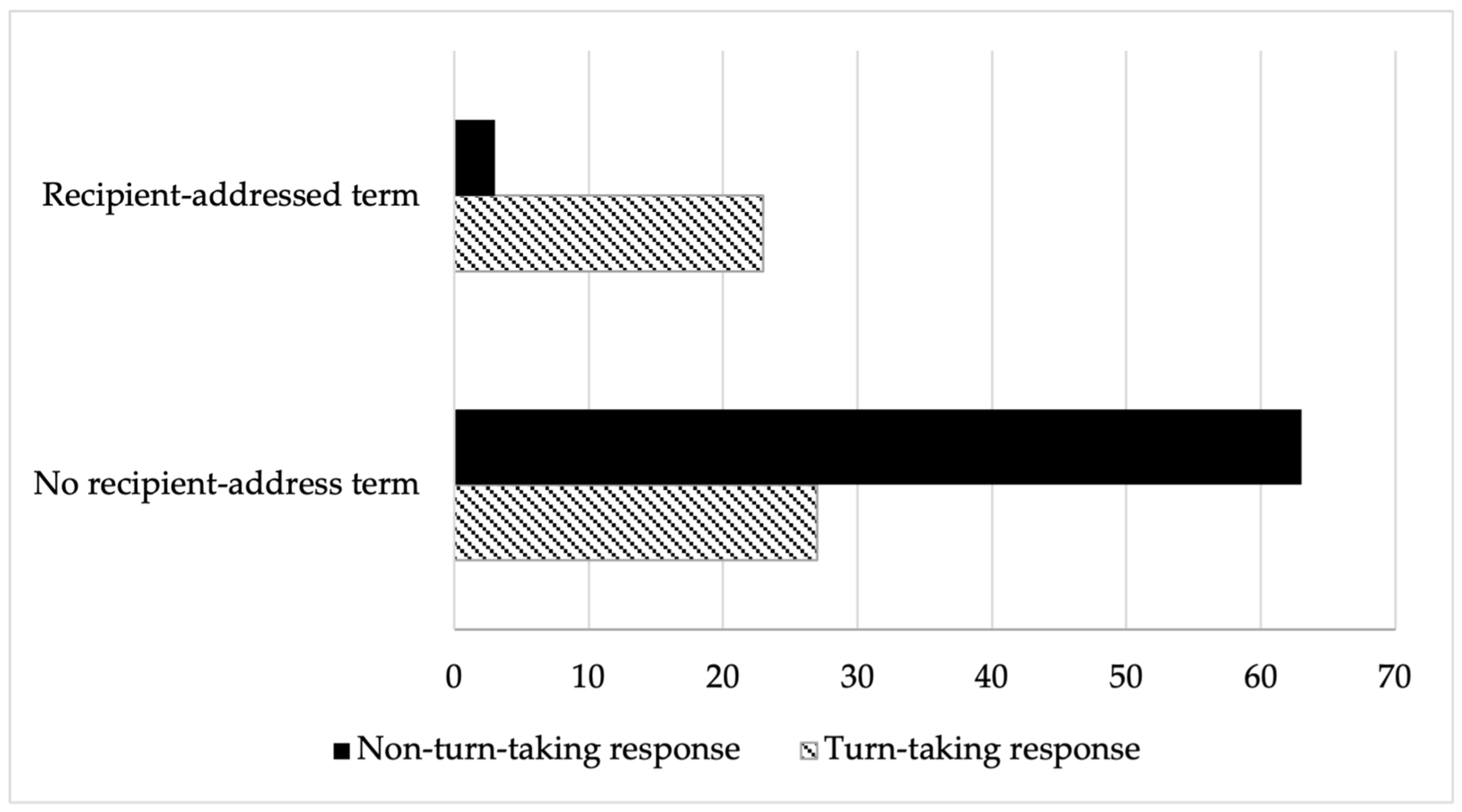
Table 5 and
Figure 2 present the overall distribution of response types according to whether an interrogative is designed with or without recipient-addressed terms.
As shown in
Table 5, first person formulated interrogatives that include an explicit recipient-addressed term overwhelmingly elicit turn-taking responses, even in cases where the interrogative design does not index a low epistemic stance on the part of the speaker. This pattern suggests that addressivity operates independently from epistemic positioning and constitutes a distinct dimension of action formation. Excerpt (5) illustrates this point. In this excerpt, the interrogative in line 2 is prefaced with
jie ‘older sister’, explicitly addressing the recipient Ava by her younger sister Kim. By overtly naming the recipient, Kim unambiguously establishes Ava as the expected responder to the upcoming interrogative. Despite being formulated with the first person pronoun
wo ‘I’, the interrogative is thereby oriented outward rather than inward. This design aligns with the notions of a
response-eligible recipient (
Lerner, 2003) and a
rightful next speaker (
Schegloff, 2007), whereby the recipient is interactionally positioned as both epistemically entitled and sequentially obligated to provide a response.
| 01 | → | KIM: | 姐. |
| jiě. |
| older.sister |
| ‘Older sister, |
| 02 | → | | 我 | 还 | 没 | 告诉 | 你 | 我 | 把 | 头发 | 绞: | 了 | 吧? |
| wǒ | hái | méi | gàosu | nǐ | wǒ | bǎ | tóufa | jiao: | le | ba? |
| 1SG | yet | NEG | tell | 2SG | 1SG | BA | hair | cut | PST | PRT |
| Haven’t I told you that I have my hair cut?’ |
| 03 | | AVA: | 真的 | 啊? |
| zhēnde | a? |
| really | PRT |
| ‘Really? | |
| 04 | | | 没 | 有. |
| méi | yǒu. |
| NEG | have |
| (you) haven’t.’ | |
| 05 | | KIM: | 我 | 现在 | 绞 | 了 | 短发 | 了. |
| Wǒ | xiànzài | jiǎo | le | duǎnfà | le. |
| 1SG | now | cut | PST | shorthair | PST |
| ‘Now I have cut (it into) shorthair.’ |
5. Discussion
This study has examined a theoretically revealing yet underexplored subtype of interrogatives in Mandarin Chinese that are formulated with the first person singular pronoun
wo ‘I’ as subject. Unlike prototypical interrogatives that are conventionally recipient-directed and information-seeking (
Heritage, 2012;
Raymond & Heritage, 2021), first person formulated interrogatives exhibit an intrinsic interactional indeterminacy and may be oriented to as either recipient-addressed or self-addressed. This indeterminacy raises a fundamental problem for the study of action ascription, namely, how participants in real-time interaction determine the action import of grammatically underspecified interrogatives and how they calibrate recipient responses accordingly. Based on a conversation-analytic examination of 116 instances drawn from a corpus of Mandarin telephone conversations, this study has identified two sets of morphosyntactic resources that participants recurrently mobilize to resolve this ambiguity, including interrogative particles and recipient-addressed terms. Further analyses reveal that these resources operate through distinct but complementary interactional mechanisms. Interrogative particles contribute primarily to the epistemic framing of the interrogative, while recipient-addressed terms serve to anchor addressivity by marking recipient relevance and response entitlement. With respect to interrogative particles, the findings show that they mostly function to frame first person formulated interrogatives as open- or close-ended, thereby construing the issue at hand as an
A-event or
B-event (
Labov & Fanshel, 1977;
Heritage, 2013). Through this framing, speakers display relative epistemic positioning vis-à-vis recipients (
Heritage, 2012), which in turn shapes the trajectory and character of recipient responses. Open-ended formats (e.g.,
shenme ‘what’) tend to index speaker epistemic limitation and position the recipient as epistemically authoritative, inviting elaborated answers. By contrast, close-ended, and especially negative polar, formats (e.g.,
bushi… ma? ‘isn’t…?’) display stronger speaker epistemic commitment, constraining recipients to non-turn-taking response. Importantly, these particles also modulate the rhetorical stance of the interrogative, allowing speakers to hedge, mitigate, or project an informing rather than information-seeking action. In this way, interrogative particles do not merely mark interrogativity, but participate actively in the formation and ascription of social action. By contrast, recipient-addressed terms function to resolve addressivity by explicitly or implicitly establishing the recipient as relevant and response-eligible. Whether through overt nominations (e.g., second-person pronouns, names, kinship terms) or through the recycling of elements from the recipient’s prior talk, these practices mark the recipient as a
response-eligible recipient (
Lerner, 2003) and a
rightful next speaker (
Schegloff, 2007). These resources are particularly consequential in the present dataset, which consists of telephone interactions where embodied resources such as gaze and body orientation are unavailable. The presence of recipient-addressed terms consistently strengthens the outward orientation of first person formulated interrogatives, even in cases where interrogative particles index relatively high epistemic stance of the speaker.
Taken together, the findings demonstrate that first person formulated interrogatives are interactionally flexible yet delicately calibrated practices. When designed with morphosyntactic cues that index low epistemic stance of the speaker and relevance of the recipient, they are treated as recipient-addressed and answer-seeking, often eliciting elaborated responses. In such cases, speakers position themselves as epistemically subordinate to recipients, despite the interrogative being grammatically self-referential. Conversely, when designed with cues displaying speaker epistemic primacy and limited recipient relevance, these interrogatives are treated as self-addressed and non-answer-seeking, performing actions such as registering, stance display, or prefacing an extended telling (
Clayman & Heritage, 2014). Notably, overt recipient-addressed terms are largely absent from these latter cases, as their use would conflict with the speaker’s orientation to maintaining the conversational floor. More broadly, this study contributes to cross-linguistic theorization of action formation by showing how optional morphosyntactic resources assume heightened interactional significance in languages that lack syntactic inversion for interrogatives. In Mandarin, where interrogativity is not structurally encoded through word order, participants rely on the cumulative deployment of particles, address terms, and sequential placement to resolve action and addressivity in real time (
Enfield et al., 2006). This finding reinforces a central insight of conversation analysis, that is, grammatical form alone underdetermines social action (
Schegloff, 1996), and action recognition is achieved through the situated coordination of multiple semiotic resources. Notably, the typological contribution of this study does not lie in claiming the uniqueness of first person formulated interrogatives in Mandarin, but in demonstrating how language-specific morphosyntactic affordances shape the interactional resolution of their action ambiguity. Cross-linguistic research has shown that languages differ in the extent to which interrogativity and addressivity are grammatically encoded (
Siemund, 2001). In languages such as English, interrogative clause types and syntactic inversion routinely project recipient-directedness and response relevance, thereby constraining action ascription even in first person formats (
Schegloff, 2007). Mandarin, by contrast, lacks obligatory interrogative morphology and does not encode interrogativity through word order, nor does grammatical person directly determine epistemic or interactional orientation (
Li & Thompson, 1981). As a result, optional morphosyntactic resources, such as interrogative particles and recipient-addressed terms, assume heightened interactional significance in the local accomplishment of action and addressivity. From a typological perspective, the findings suggest that first person formulated interrogatives constitute a cross-linguistically available interactional format whose action import is not fixed by grammatical person, but is achieved through language-specific configurations of morphosyntax, sequential positioning, and participation framework (
Enfield et al., 2006). Mandarin thus provides a particularly transparent site for observing how interrogative action is assembled through the cumulative deployment of semiotic resources rather than clause type alone.
The study also bears on broader issues in the study of epistemics. While interrogatives have often been characterized as actions performed by
less knowledgeable (K–) speakers seeking information from
more knowledgeable (K+) recipients (
Heritage, 2012;
Stivers et al., 2011), first person formulated interrogatives complicate this model by embedding epistemic asymmetries within a grammatically self-referential format. Their interactional ambiguity reveals that epistemic stance is not encoded directly by grammatical person, but is interactionally achieved through turn design and sequential positioning (
Heritage, 2012;
Raymond & Heritage, 2021). In this sense, first person formulated interrogatives provide a particularly sharp lens on the distinction between grammatical form and epistemic action. At the same time, the findings highlight the strategic affordances of first person interrogatives as action formats. By blurring the boundary between self- and other-addressivity, speakers can accomplish delicate actions that are less readily achievable through canonical interrogatives, such as mitigating face threats, embedding informings within interrogative formats, or projecting extended tellings while only minimally engaging the recipient. These practices underscore the rhetorical flexibility of interrogatives and their capacity to implement complex, layered actions (
Fox & Thompson, 2010).
Finally, the study also points to several issues that warrant further investigation. First, even when recipient-addressed terms are employed, addressivity may remain partially ambiguous, with some first person formulated interrogatives implementing a composite of self- and other-addressed actions. Second, in some cases, morphosyntactic cues do not converge on a single action trajectory, for example, when a close-ended interrogative particle indexing high epistemic stance of the speaker co-occurs with a recipient-addressed term inviting uptake. Whether certain cues systematically override others in participants’ interpretations remains an open empirical question. Moreover, because the present analysis is based on audio-only data, it cannot address how embodied resources such as gaze, gesture, or facial expression might collaborate with morphosyntax in resolving addressivity (
Goodwin, 1981;
Mondada, 2018). These limitations point to promising directions for future multimodal and cross-linguistic research. In sum, this study shows how Mandarin speakers exploit optional morphosyntactic resources to design and strategically deploy first person formulated interrogatives. By foregrounding the role of cumulative turn design in action formation and ascription, the findings contribute to a more nuanced understanding of interrogatives as interactional practices and of social action as an emergent, collaboratively achieved phenomenon.