


Abstract
Perceptual development of English intonation remains challenging for Iranian EFL learners due to systematic L1–L2 prosodic differences. Adopting a quasi-experimental pretest-posttest control-group design with a sequential mixed-methods component (quantitative measures followed by qualitative interviews to interpret the findings), this study investigates the effects of pitch-range expansion training on Iranian EFL learners’ perception of English question intonation, along with their metalinguistic awareness and experiential reflections. Sixty intermediate learners, homogenized via the Oxford Quick Placement Test, were randomly assigned to experimental and control groups. In addition to the regular communicative curriculum, the experimental group underwent a seven-week training intervention (delivered in biweekly 20 min sessions) using Praat (Version 6.3.090) to develop pitch-range perception. Data collection utilized an intonation perception test (pre/post), an Intonation Awareness Questionnaire (IAQ), and semi-structured interviews. Quantitative analyses (ANCOVA and three-factor mixed ANOVA) revealed that the experimental group significantly outperformed the control group in overall perception accuracy, with a notably larger improvement for yes/no questions than for wh-questions. Furthermore, the experimental group demonstrated a significant increase in self-reported metalinguistic awareness from pre-test to post-test. Qualitative thematic analysis corroborated these findings, with participants reporting that visual feedback made intonation tangible and helped ease their listening anxiety. These findings highlight the efficacy of visually supported prosodic training in recalibrating L2 perceptual patterns and enhancing metacognitive awareness in EFL contexts.
1. Introduction
Verbal communication relies heavily on intonation, a key suprasegmental feature that conveys grammatical, pragmatic, and attitudinal meaning. In English, question intonation, particularly the distinction between yes/no and wh-questions, is crucial for accurate speech comprehension (Gussenhoven, 2004). However, EFL learners often struggle to perceive these subtle melodic contours, especially when their native prosodic system differs significantly from the target language. The interference of L1 prosodic patterns can further complicate the acquisition of L2 intonation.
Acquiring the ability to perceive English question intonation poses a significant challenge for EFL learners, particularly when their native prosodic system differs markedly from the target language. For Iranian learners, this challenge is especially acute due to systematic differences in the prosodic systems of English and Persian. Contrastive phonological research (e.g., Hayati, 1998; Taheri-Ardali et al., 2025) provides converging evidence that Persian employs a narrower global pitch span and exhibits less steep declination slopes compared to American English. However, it is important to distinguish pitch range (the overall F0 interval available to the speaker) from other prosodic dimensions, such as boundary tones and focus-marking strategies. While English uses expanded pitch range and specific boundary tones (e.g., high-rising H-H% for polar questions) as primary cues for question type, Persian relies more heavily on syntactic markers and word-order variations. This prosodic divergence often leads to the flattening of pragmatic contrasts in Iranian learners’ L2 speech and perception, as they tend to transfer their L1 prosodic filtering system to English.
Two theoretical frameworks are particularly relevant to understanding how Iranian learners might overcome these perceptual challenges. First, the Perceptual Assimilation Model for Suprasegmentals (PAM-S; So & Best, 2010) predicts that L2 contours that are phonetically novel, such as the English high-rising terminal contour for yes/no questions, which does not exist in Persian, will be easier to learn than contours that are assimilated to existing L1 categories. In contrast, the wh-question contour, which may be partially assimilated to Persian intonational patterns, is expected to pose greater difficulty. Second, the Speech Learning Model (SLM-r; Flege & Bohn, 2021) posits that L2 perception can be enhanced with sufficient input and practice. From a pedagogical perspective, explicit focus-on-form instruction on suprasegmentals is expected to yield significant progress in learners’ prosodic skills (Levis, 2023). Levis emphasizes a progression from awareness to controlled practice and finally to communicative integration. Our training, which employs visual cues and aims to change perceptual patterns, aligns with this pedagogical principle.
Despite the theoretical plausibility of such training, several gaps remain in the literature. First, most pitch-training studies have focused on learners of East Asian or European descent, leaving Iranian learners whose L1 prosodic system differs substantially from English largely unexamined. Second, while many studies have investigated the efficacy of pitch training, their focus has largely been on production, with perceptual accuracy remaining underexplored. Third, technology-based prosody instruction has rarely been attempted in Iran, and to our knowledge, no systematic investigation has yet been published examining whether pitch training can improve Iranian students’ perception of English question intonation. Given these gaps, the present study aims to investigate the effects of a multicomponent prosody intervention, incorporating pitch-range visualization, on Iranian EFL learners’ perception of English question intonation, their metalinguistic awareness, and their subjective experiences.
1.1. Theoretical Background
Intonation plays an important role in spoken language, carrying grammatical information, speakers’ attitudes, and organizational aspects, as articulated in seminal works such as Ladd’s (2008) Intonational Phonology, which provides a foundational framework for understanding how pitch contours encode meaning at the sentence level. Pierrehumbert’s (1980) landmark dissertation further established the Autosegmental-Metrical model of English intonation, which remains the dominant theoretical paradigm for analyzing pitch accents and boundary tones in both L1 and L2 speech. However, when learning English as a foreign language (EFL), many students find it challenging to acquire its intonation patterns due to the influence of their native language (Reed & Levis, 2015). In fact, research into the nature of foreign accent formation suggests that prosodic transfer from one’s native-language prosody plays a significant role in difficulties in perceiving foreign-language contrasts (Flege & Bohn, 2021). The problem is especially relevant for Iranian EFL learners due to the unique prosodic system of their native language. For instance, according to findings from several contrastive phonology studies (Hayati, 1998; Taheri-Ardali et al., 2025), Iranian learners often fail to perceive the high-rising terminal contour characteristic of English yes/no questions, as this pattern does not exist in their L1 inventory. More recently, Taheri-Ardali et al. (2025) provided empirical evidence from production studies confirming that Persian employs a narrower pitch range and different focus-marking strategies compared to English.
Two interrelated theories serve as a basis for the research design and goals of the present paper. First, the Perceptual Assimilation Model for Suprasegmentals (PAM-S) was proposed by So and Best (2010). It extends the Perceptual Assimilation Model developed by Best (1995). The PAM-S theory describes the process of perceptual assimilation of L2 suprasegmental contrasts into the native speaker’s prosodic categories. To make the link to PAM-S more explicit for the present study, the English yes/no question contour (characterized by a high-rising terminal boundary tone, H-H%) has no phonetic equivalent in Persian, and is therefore predicted to be perceived as a “new” or “uncategorized” contour. Under PAM-S, such uncategorized contrasts are expected to be relatively learnable, as they are not assimilated into any existing L1 category. In contrast, the wh-question contour in English (frequently produced with a falling or fall-rise pattern, e.g., H-L% or L-H%) may be perceptually assimilated to existing Persian declarative or echo-question contours, making it more difficult to distinguish. The present study directly tests these predictions by examining whether training yields a significantly greater perceptual gain for yes/no contours (predicted to be uncategorized) than for wh-contours (predicted to be assimilated).
Moreover, the idea of learning L2 suprasegmentals can be supported by the Speech Learning Model (SLM-r) developed by Flege and Bohn (2021). A second guiding pedagogical principle is the one holding that explicit focus-on-form instruction on suprasegmentals is expected to yield significant progress in learners’ prosodic skills (Levis, 2023). Levis (2023) emphasizes the need for pedagogically sound approaches to prosody studies in an editorial article in the Journal of Second Language Pronunciation. Levis highlights the need to make learners aware of a pronunciation aspect before providing controlled practice opportunities and, finally, integrating the knowledge into communicative use. Although no Prosody Training Cycle was provided by Levis, his findings, along with general pedagogical research, confirm the need for a progression from awareness to practice and communicative integration. Our training, which involves visual cues and our intention to change perceptual patterns (according to PAM-S), aligns with this pedagogical idea.
1.2. Empirical Studies
Recent research on pronunciation instruction has shown that explicit instruction of suprasegmentals is effective. It was found that instruction aimed at developing prosodic skills led to positive effects on L2 pronunciation for both speakers and listeners. Thomson and Derwing (2015) provided a complementary narrative review, concluding that prosodic instruction is particularly effective when it incorporates both perceptual and production training. Lee et al. (2015) conducted a meta-analysis confirming that explicit pronunciation instruction yields moderate to large effects, with suprasegmental training outperforming segmental training in most instructional contexts. More recently, Saito and Plonsky (2019) conducted a meta-analysis of 33 experimental and quasi-experimental studies, concluding that explicit instruction had positive effects on L2 pronunciation for both producers and listeners.
In this context, much focus has been placed on approaches that use technology to provide visual feedback on pitch perception, with successful results. Hardison (2004) demonstrated that visual feedback in computer-assisted prosody training not only improved learners’ immediate perception but also generalized to novel stimuli, suggesting durable learning effects. Chen (2022) further showed that Praat-based visual feedback significantly enhanced tone perception and production among L2 learners, providing empirical evidence for the efficacy of this specific visualization tool. In a comprehensive meta-analysis of computer-assisted pronunciation training (CAPT) based on 19 articles, Mahdi and Al Khateeb (2019) found a positive overall effect of the technique (d = 0.68) and indicated that the largest effects were observed among beginning and intermediate students, who can benefit greatly from such techniques. Moreover, the authors found that CAPT programs that included not only auditory but also visual feedback and automatic speech recognition achieved the largest effect size compared with other techniques.
Research on pitch manipulation further highlights this possibility. Specifically, Zhi et al. (2024) studied whether multimodal information, specifically the coupling of adult speech with visual frames of the speaker’s face, enhances the performance of a computational model of phonetic learning. The Bayesian model trained and tested on audiovisual inputs demonstrated up to 8.1% relative improvement in performance on a phoneme discrimination test compared to the model with the same training but only audio inputs. The former model achieved up to 3.9% better results on audio-only data than the latter model. In addition, Zhi et al. showed that visual inputs were particularly advantageous under noisy audio conditions, allowing the audiovisual model to recover 67% of the audio model’s phoneme-discrimination loss in noise compared to silence. Although Zhi et al.’s (2024) study was conducted within a computational framework and examined phoneme-level audiovisual integration rather than human prosody perception per se, their finding that visual input can enhance auditory discrimination under challenging listening conditions provides a plausible theoretical rationale for why visual displays of pitch (e.g., Praat spectrograms) might similarly support intonation learning in human L2 learners. It is worth noting that, although Zhi et al.’s study did not explicitly explore intonation, its findings imply that similar advantages may be observed when teaching other prosodic elements, including pitch and its variations.
In summary, externalizing visual pitch helps construct a more reliable mental representation of L2 intonation patterns. Both theoretical and empirical arguments support this conclusion.
While all of the above research points to the promise of successful prosodic training programs, two key issues in the international literature need to be addressed in the current study. The first gap is that most pitch-training studies involve only learners of East Asian or European descent. As mentioned above, the prosody of Persian differs substantially from that of English. It does not, however, mean that research involving Iranian learners should be assumed to yield similar results.
It is impossible to overstate the impact of Persian’s prosodic structure on the acquisition of English intonation among Iranian EFL learners. While American English makes heavy use of pitch patterns to convey syntactic and pragmatic information, Persian uses much less varied pitch and flatter declination contours. The structural difference between the languages, as established through the study of contrastive phonology, suggests that the difficulty Iranians have in acquiring new sounds goes further than that: it is their inability to perceive pitch contour as meaningful.
Studies of the prosodic behavior of Iranian learners of English as a foreign language have repeatedly shown that there are indeed perceptual and production problems at various levels of proficiency. Thus, when Iranians try to make an English yes/no question, they usually create a terminal pitch movement that is not sufficiently high, and as a result, native speakers of English perceive it as a declarative sentence just by the sound itself. In perception tasks, Iranian listeners tend to confuse different terminal contours, especially the delicate fall-rising contour typical of wh-questions and the abrupt rise in polar questions. The perceptual discrimination problem persists even among advanced learners, indicating that mere natural exposure to the L2 environment without focused instruction is simply inadequate to retrain the established prosodic filtering system established during L1 acquisition.
Notwithstanding the obvious pedagogical importance of the above consistent findings, the current body of literature in the Iranian EFL setting still suffers from a relative scarcity of studies that provide any kind of remedy for these errors. As far as one can see, the bulk of studies carried out to date have been based on a purely descriptive or diagnostic approach and have focused on listing the types and frequencies of these errors without delving into the pragmatic field of pronunciation teaching strategies. The result of all this is that although classroom teachers are fully aware of the problems at hand, they still lack a systematic framework to remedy these intonational problems.
Finally, technology-based prosody instruction has rarely been attempted in Iran. Despite the successful use of Praat as an effective tool for visualizing intonation in previous research (e.g., Boersma & Weenink, 2023), to our knowledge, no systematic investigation has yet been published examining whether pitch training can improve Iranian students’ perception of question intonation in English. Given the significant differences in the prosody between the L1 and L2 systems in question, and the known perceptual challenges associated with them, it would be interesting to investigate if targeted practice could help Iranian learners recalibrate their prosodic perception.
As the literature review above makes clear, several important gaps warrant further investigation through empirical studies. First, while the theoretical frameworks of both PAM-S (So & Best, 2010) and SLM-r (Flege & Bohn, 2021) posit that L2 perception can be enhanced with proper input and practice, neither of them has so far been empirically validated on Iranian learners due to the differences between their L1 prosody and that of English. Second, while several studies have investigated the efficacy of pitch training in English-language contexts, their focus has largely been on production, with perceptual accuracy remaining underexplored. Finally, despite the documented prosodic difficulties among Iranian EFL learners, the current literature offers limited empirical research on how to tackle these problems. Most studies to date have been descriptive.
The current study aims to address all these gaps simultaneously. The decision to focus on the Iranian EFL population was motivated not by an attempt to establish statistical generalizability to all teaching contexts (which a convenience sample from a single institute cannot support), but rather by the need to examine an understudied learner population whose L1 prosody presents specific theoretical interest. The findings are intended to provide empirical evidence that can inform future research and motivate broader replication across diverse instructional settings. Moreover, it has been decided to concentrate exclusively on perceptual accuracy as the dependent variable. Finally, while the quantitative approach will be used to measure outcomes, the qualitative interviews will provide depth to the interpretation.
The following research questions guided this investigation:
- Does pitch range expansion training significantly improve English question intonation perception among Iranian EFL learners?
- To what extent does the training affect the perception of yes/no questions versus wh-questions differently?
- Is there a significant change in learners’ self-reported awareness of English intonation patterns after training?
2. Materials and Methods
This section outlines the research design, participants, materials, instruments, data-collection steps, and analytical methods used to examine how a multicomponent prosody intervention incorporating pitch-range visualization affects perception of question intonation.
2.1. Design and Context of the Study
To assess the effectiveness of the training intervention, a true experimental pretest-posttest control-group design was employed. Participants were randomly assigned to conditions (see Section 2.2). A sequential explanatory mixed-methods strategy was adopted, meaning that quantitative data (perceptual tests and questionnaires) were collected first (Phase 1), followed by qualitative interview data (Phase 2) to facilitate interpretation of the quantitative findings. Integration of the two strands occurred at the interpretation stage, where the emergent qualitative themes were mapped onto the quantitative effect sizes to provide a more comprehensive understanding of the training outcomes. The study took place over eight weeks of the Fall/Winter 2025 academic semester at a private language institute in Isfahan, Iran, where all procedures were conducted in the institute’s regular classrooms and language lab.
2.2. Participants
Initially, a sample of 72 intermediate-level EFL learners at a language institute in Isfahan, Iran, was selected from the larger population of 180 students using convenience sampling due to organizational restrictions. All participants were native Persian speakers aged 18 to 25 years, with no reported hearing or speech problems. Intermediate-level proficiency was determined by administering the Oxford Quick Placement Test (OQPT, Version 2.0); learners scoring in the 40–47 range were retained. From this homogenized pool, 12 participants were excluded: 8 due to irregular attendance (missing more than one training session) and 4 due to incomplete test data. The remaining 60 learners were then randomly assigned to two groups (n = 30 per group): the experimental and control groups. Random allocation was performed using a computer-based randomization procedure (www.randomizer.org). Demographic information of all participants disaggregated by group is presented in Table 1. Strict adherence to ethical principles was maintained. Written consent was obtained from all participants, and they were assured of anonymity, confidentiality, and exclusive use for research purposes.
Table 1.
Demographic Background of the Participants.
2.3. Material
For both conditions, the course book NorthStar Listening and Speaking 4 (Fifth Edition) was used, which is widely used to teach a general aural-oral course at the intermediate proficiency level. In the experimental group, a specially created multicomponent training module was integrated into the classes. This module included audio and visual stimuli generated with Praat (Version 6.3.09; Boersma & Weenink, 2023). The audio stimuli consisted of recordings of 80 sentences (40 statements and 40 questions) spoken by four native American English speakers (two male and two female) in a sound-dampened booth. Sentences were matched for duration (6–10 syllables) and used high-frequency lexical items and simple grammatical structures. It is important to note that the 20 min training component in the experimental group was not an addition to the total contact time; rather, it replaced 20 min of the general communicative listening activities from the coursebook that the control group completed during the same period. Thus, total instructional time was held constant across groups.
2.4. Instruments
Several instruments were used for participant selection, treatment implementation, and data gathering. Reliability and validity were confirmed before the main experiment.
2.4.1. Language Proficiency Test
The Oxford Quick Placement Test (OQPT, Version 2.0) served to homogenize the participants and to test their intermediate language proficiency. This examination was developed by Oxford University Press together with the University of Cambridge Local Examinations Syndicate; therefore, its validity and reliability are internationally recognized. In this study, Cronbach’s alpha for internal consistency was calculated to be 0.92.
2.4.2. Pretest and Posttest of Intonation Perception
The auditory test for the study was custom-made by the researcher to assess learners’ intonation perception skills. The test consisted of 60 audio stimuli: 40 questions (20 yes/no questions and 20 wh-questions) and 20 declarative statements. To minimize reliance on syntactic cues, all items (both questions and statements) were constructed with declarative word order (e.g., “The train is arriving”) and contained no overt question syntax (e.g., inversion or auxiliary fronting) except for the wh-words, which were retained as an inherent lexical cue. Thus, for yes/no items, the only distinguishing feature was the terminal pitch contour, whereas for wh-items, the presence of wh-words may have provided an additional cue at a point considered in the interpretation. All selected sentences conformed to strict standards in that they had from six to ten syllables, used high-frequency vocabulary, and possessed a simple syntactic structure so as to reduce any unnecessary cognitive burden other than those related to prosodic analysis. The sentences were then recorded in an acoustically controlled studio by four native speakers of American English (two male and two female) speaking with a standard General American accent.
To achieve maximum clarity and naturalness in the stimuli, the recorded materials underwent an auditory screening conducted by two experienced instructors in phonetics. For content validity, the entire set of items was evaluated by a group of three applied linguists specializing in phonology, who verified that the selected sentences accurately reflect the intended distinction between questions and statements in terms of their terminal pitch. Finally, the face validity of the stimuli was tested in a pilot study with 15 intermediate-level EFL learners recruited from the target population. The final set of stimuli for the pretest included 60 randomized audio items. Accuracy was calculated as the percentage of correct classifications, defined as the sum of correctly identified questions (hits) and correctly rejected statements (correct rejections), divided by the total number of items, then multiplied by 100.
In the experiment, subjects listened to each sentence and then dichotomously classified it as either a question or a statement. In order not to produce any effects of practice or memorizing in the post-test stage, the post-test was created in a strict parallel version; more specifically, the same pool of sentences was recorded by an entirely different group of four native speakers (gender-balanced again). However, it is acknowledged that using the same lexical pool (even with different speakers) does not fully eliminate item-specific practice effects; this is addressed as a limitation. Reliability of the pre-test was calculated using an internal consistency procedure, showing the value of Cronbach’s Alpha equal to 0.89, which indicates very good reliability. Furthermore, the parallel post-test had equally high internal consistency (Cronbach’s\alpha = 0.91).
2.4.3. Training Module
The training module, developed specifically for the experimental intervention, used Praat software (Boersma & Weenink, 2023). Rather than isolating a single component, this module should be understood as a multicomponent prosody intervention, as it included visual feedback, explicit instructor guidance, controlled production practice, imitation, and perceptual identification tasks. The module was developed in such a way that participants were provided with immediate visual feedback on their production and perception of the pitch in six practice sessions, each running for about 20 min. The underlying theory behind the design of this module was the awareness-practice-perception cycle of Levis (2023).
In implementing the module, 80 sound files (40 questions and 40 statements) were progressively arranged in terms of their level of difficulty, starting from week one to week five. A critical methodological point must be noted: the training stimuli were drawn from the same general sentence pool as the perceptual tests, although they were shuffled and re-recorded by different speakers. This was done to ensure acoustic comparability; however, it creates a potential confound of item memorization. Consequently, the results should be interpreted as evidence of short-term perceptual learning on familiarized contours, and replication with entirely novel stimuli is necessary to establish generalized learning. Also, all sound files were generated by the same native speakers who recorded them in the pre-test phase, ensuring acoustic consistency throughout the whole experiment. The instructor, a phonetics instructor with more than five years’ experience using Praat in teaching, conducted the sessions using a standard script.
Operationally, pitch-range expansion was defined as the degree of F0 excursion (in Hertz and semitones) from the lowest to the highest point of the terminal pitch contour in the final syllable of each utterance. Successful expansion during training was operationalized as achieving a terminal rise of at least 3 semitones for yes/no questions (compared to the learners’ pre-training baseline of <1 semitone, typical of Persian declarative contours) and a consistent fall-rise pattern for wh-questions, as visually displayed and measured in Praat by the instructor.
Specifically, the training procedure was subdivided into three successive stages of different duration and focus. First, learners listened to two-sentence pairs (one question, one statement) while observing the F0 contours on the spectrogram of Praat shown on a big screen. This phase lasted for about five minutes, during which time the instructor drew attention to the visual differences between the terminal pitch movements in yes/no questions (sharp high rise) and statements (fall), as well as wh-questions (fall-rise). Thus, students had the opportunity to build an association between the intangible acoustic property (pitch) and the tangible graphical pattern. The second stage took most of the session, about ten minutes, and was concerned with controlled production practice. At this stage, each participant used his or her own laptop where Praat was installed and repeated model sentences by listening to them via headphones. At the same time, learners could see their own F0 contour along with that of the native speaker on the computer screen. It is necessary to mention that participants had to make an upward shift in their pitch range to get similar contours to those of the native model. The last stage, which lasted only five minutes, took the perception aspect of the exercise one step further, where the learners had to listen to a different batch of sentences (not similar to what they heard in the other stages) that they did not rehearse beforehand, and then classify them into questions or statements just by listening to the pitch of the voice alone. The stages of the task were designed to move from an external visual aid to an internal auditory decision process.
2.4.4. Intonation Awareness Questionnaire (IAQ)
The Fifteen-item Intonation Awareness Questionnaire (IAQ) was created to measure the metacognition of learners in terms of intonation awareness. The items covered perceptual attention, self-efficacy, and strategy use. To justify treating the IAQ as a single composite score, a principal component analysis conducted on pilot data (n = 15) yielded a single factor with an eigenvalue of 6.2, explaining 68% of the total variance, thereby supporting a unidimensional construct of metalinguistic awareness for this scale. The participants rated the items on a 5-point Likert scale, where 1 means strongly disagree, and 5 means strongly agree. It was found that the IAQ in this study had high reliability with a Cronbach’s Alpha of 0.84. Also, the content validity of the questionnaire was ensured through evaluation by two experts in applied linguistics, who found that all items corresponded to the measurement of intonation awareness. The full IAQ is available from the authors upon reasonable request.
2.4.5. Semi-Structured Interview Protocol
The semi-structured interview protocol enabled the collection of qualitative data on participants’ experiences working through the training program, their perceptions of changes in awareness of English intonation, and the coping strategies they used. The protocol consisted of five open-ended questions designed to explore various aspects of the learning process without suggesting any predetermined answers. The first question: What did you find particularly useful about the training with Praat in understanding English intonation? aimed at identifying the specific features of visual feedback that participants valued most. The second question: How do you think your perception of the English language changed as a result of the training? was intended to capture self-reported perceptual changes following the intervention. The third question: Were there any difficulties in the training? If yes, how did you overcome them? explored potential challenges and the coping strategies employed by the participants. The fourth question: Do you feel more confident in recognizing questions in spoken English compared to before the training? Targeted affective and metacognitive shifts. Finally, the fifth question: Have you found yourself using any of the skills you gained through training in real-life listening contexts, like watching movies and talking to native speakers? addressed the transferability of the acquired skills to authentic contexts beyond the classroom. The 12 interview participants were purposively selected from the experimental group to represent a range of perceptual improvement scores: four high-gainers, four medium-gainers, and four low-gainers (based on posttest-pretest difference scores). The interviews were conducted separately in Persian, the participants’ language, to allow them to express their thoughts and feelings freely. Each session lasted 15–25 min, depending on the depth of participants’ responses, and was audio-recorded with the explicit permission of the interviewees. Regarding translation: all interviews were transcribed verbatim in Persian. Translations into English were performed by the first researcher, who is a bilingual (Persian-English) applied linguist. A second bilingual researcher independently back-translated 30% of the translated transcripts into Persian to verify equivalence; discrepancies were resolved through discussion. After transcription of the audio tapes done by a trained research assistant, the transcripts were reviewed by the first researcher for accuracy. To ensure the accuracy of the qualitative data, member checking was conducted with three randomly selected participants, who affirmed that the transcriptions accurately conveyed their messages. Furthermore, a pilot study was conducted in which two EFL learners were interviewed using the interview protocol, but were not involved in the main study. Based on the feedback, some wording changes were made to improve comprehensibility. In this way, the qualitative part of the study was as rigorously conducted as the quantitative part.
2.5. Data Collection Procedure
Data collection for this study lasted 8 weeks, during which participants attended biweekly 90 min classes. In Week 1, all learners underwent the OQPT for homogenization. Immediately afterward, they were administered the Intonation Perception Pretest and the IAQ. The intervention was conducted during 7 weeks, that is, from Week 2 to Week 8. Every week, the experimental group spent the first 20 min doing the Pitch Range Expansion Training. It consisted of a cycle of three consecutive phases, taking 5, 10, and 5 min, respectively. The first phase, Awareness Raising, involved listening to audio stimuli and analyzing the F0 contours presented in Praat spectrograms. The second one, Controlled Practice, lasted for 10 min and required learners to repeat model sentences with visual feedback to reach the target pitch range. At last, the Perceptual Identification stage lasted another 5 min and comprised identifying new sentences based on their audio presentation. At the same time, the control group performed communicative listening tasks in accordance with the coursebook without mentioning intonation. In Week 8, all learners completed the corresponding Intonation Perception Posttest and the IAQ. After this, 12 students in the experimental group participated in individual, recorded interviews.
2.6. Data Analysis Procedure
Regarding the data analysis, both quantitative and qualitative data were analyzed using respective statistical software, namely SPSS Version 28 and MAXQDA 2022. First, the quantitative data underwent descriptive analyses, including computing means and standard deviations. A priori power analysis using G*Power (Version 3.1.9.7; Faul et al., 2007) indicated that a sample size of 60 was sufficient to detect a medium effect size (f = 0.25) with α = 0.05 and power = 0.80 for an ANCOVA with one covariate.
As for the inferential statistics, the following three tests were performed. The one-way ANCOVA was used to examine RQ1; the dependent variable was posttest accuracy, the independent variable was Group, and pretest scores served as the covariate controlling for initial differences. Furthermore, the test of RQ2 involved a two-way mixed ANOVA, with Time and Question Type as within-subject variables and Group as a between-subject variable. For RQ3, unlike a paired t-test limited to the experimental group, a 2 (Group) × 2 (Time) mixed ANOVA on IAQ scores was conducted to test for differential change between the experimental and control groups. This was supplemented by paired-samples t-tests within each group for descriptive purposes. For qualitative data analysis, transcripts were created and analyzed using Braun and Clarke’s (2006) thematic analysis approach. The analysis followed a rigorous six-phase procedure: (1) familiarization with the data, (2) generating initial codes (open coding in MAXQDA), (3) searching for themes by collating codes, (4) reviewing themes against the data, (5) defining and naming themes, and (6) producing the report. Inter-coder reliability was established by having a second researcher independently code 20% of the interviews; Cohen’s kappa was calculated at 0.93, indicating excellent agreement. Disagreements were resolved through consensus discussion. The themes were used to elaborate on and provide an additional perspective on the quantitative results, rather than to confirm them, respecting the independent nature of the qualitative strand.
Additional methodological details: All training and testing sessions were delivered by the same instructor to control for instructor effects. Treatment fidelity was monitored by audio-recording 20% of the training sessions and checking them against the standard script; adherence was found to be 96%. Attendance was consistently high, with all 60 participants attending at least 90% of the sessions. Furthermore, the scoring of all perception tests was conducted blind to group assignment by a research assistant who was not informed of the participants’ condition.
Ethical considerations were strictly adhered to at all stages of the current study. Before data collection, written informed consent was obtained from all 60 participants, and they were fully informed about the nature of the study and their right to withdraw at any time without repercussions. The participants were assured that their involvement in the research was completely voluntary and that their answers would not affect their academic status in any way. In order to ensure confidentiality and privacy, all personal identifiers (names, contact information, etc.) were stripped from the dataset and replaced by unique participant codes (P1, P2, … P60). The gathered data (interview audio recordings and scores from the perceptual tests) were stored on a password-protected computer accessible only to the principal researcher. Furthermore, it was made clear to participants that the data would be used solely for research purposes and would not be disseminated to any third party.
The study was conducted with the full approval of Nasl-e Farda IELTS Center, which operates under the supervision of the Ministry of Science, Research and Technology of Iran. Although the institute does not have a formal Institutional Review Board (IRB) with a specific approval code, all ethical principles, including informed consent, confidentiality, voluntary participation, and data protection, were strictly observed throughout the study. A formal letter of confirmation from the institute is provided in the backmatters. These efforts helped ensure that ethical standards in educational research were rigorously followed in this study.
3. Results
This chapter presents the findings. It first reports the preliminary analyses necessary to ensure the validity of the parametric analyses. It then presents the quantitative results for three research questions. Finally, it provides qualitative findings from the semi-structured interviews. All inferential statistics were calculated in SPSS (Version 28) with an alpha level of 0.05. Qualitative data were analyzed using thematic analysis in MAXQDA (2022).
3.1. Preliminary Analyses
Data were checked for missing values, univariate outliers, and normality. No missing values were found, as all participants completed the pre- and post-test measures. Univariate outliers were identified using boxplots and z-scores; no extreme values were observed (z > 3.29 or z < −3.29). Skewness (range: −0.41 to 0.54) and kurtosis (range: −0.62 to 0.31) were within acceptable limits for all variables; thus, the assumption of univariate normality was met.
For the one-way ANCOVA, two key assumptions were tested separately. First, the assumption of homogeneity of regression slopes was assessed by examining the interaction between the covariate (Pretest) and Group. This interaction was not significant, F(1, 56) = 1.29, p = 0.261, indicating that the relationship between the covariate and the outcome was similar across the two groups. Second, the assumption of homogeneity of error variances was tested using Levene’s test, which was also non-significant, F(1, 58) = 0.84, p = 0.363, confirming that the error variances were equal across groups. The degrees of freedom for the Pretest × Group interaction have been corrected from F(1, 58) to F(1, 56), as the full ANCOVA model with one covariate, one grouping variable, and their interaction yielded an error df of N − 4 = 56. The assumption of homogeneity of error variances was further corroborated by the regression slope indices and model fit statistics, which are summarized in Table 2. For the mixed ANOVA, the assumption of homogeneity of covariance matrices was confirmed with the help of Box’s M test (p = 0.217). Mauchly’s test of sphericity could not be performed as the repeated-measures factor had only two levels (Time: pretest vs. posttest). The parallel post-test demonstrated excellent internal consistency (Cronbach’s\alpha = 0.91).
Table 2.
Regression Fit Indices for Pretest-Posttest Relationship by Group.
Table 3 provides the means and standard deviations for the Intonation Perception Test (maximum = 40) for both groups across the two testing occasions.
Table 3.
Total Perception Scores by Group and Time.
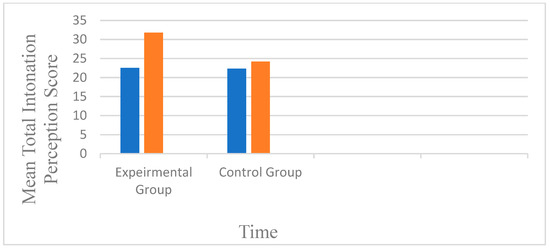
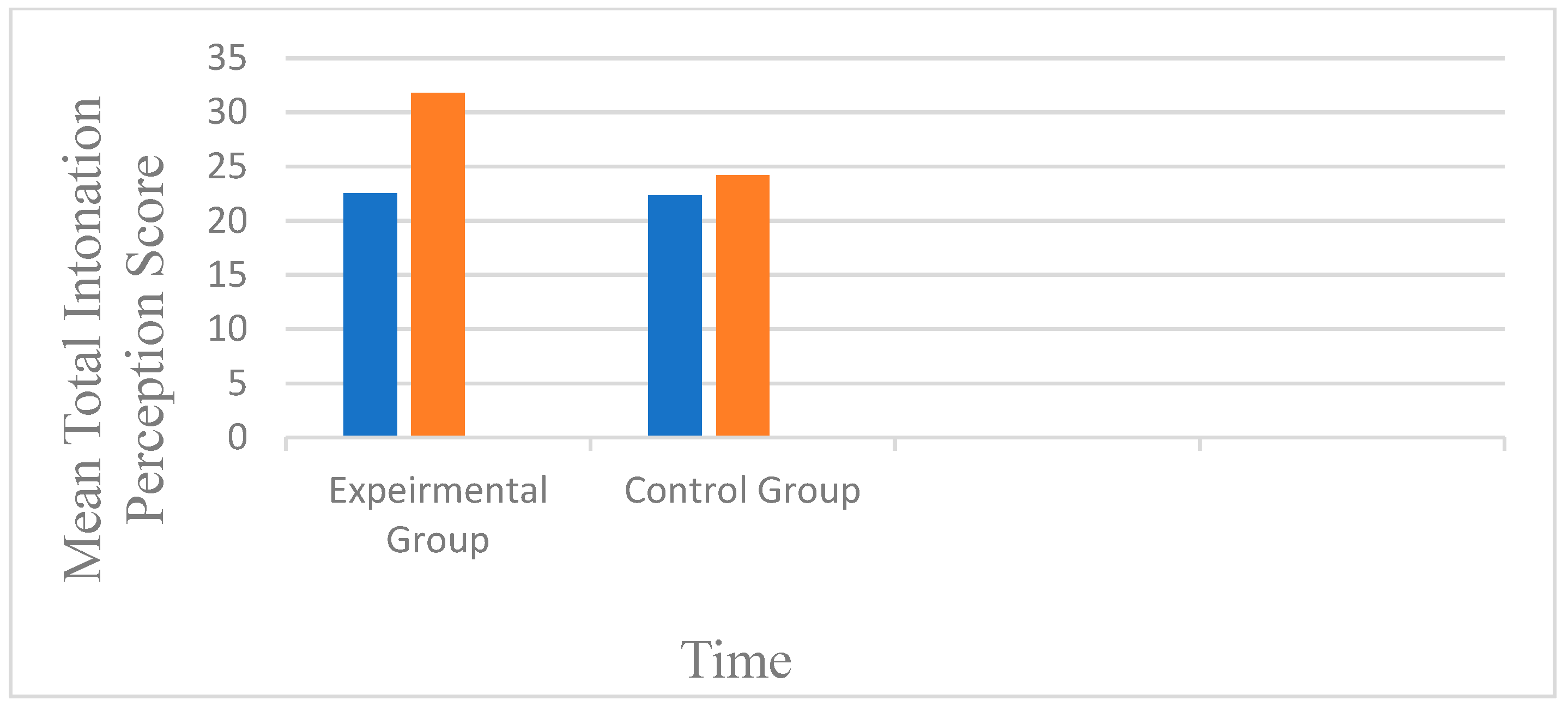
As indicated in Table 3, the means obtained for the pretest for the experimental and control groups were almost equal (22.53 and 22.37). Nevertheless, during the analysis of the posttest, a considerable difference between the groups was noticed, since the experimental group obtained a higher mean (31.76) as compared to the mean for the control group (24.20). The difference in means is 9.2 points for the experimental group and only 1.8 points for the control group.
A visual summary of these descriptive statistics is presented in Figure 1.
Figure 1.
Mean Total Intonation Perception Scores by Time and Group. Blue: Pretest; Orange: Posttest.
3.2. Quantitative Results
This section reports the quantitative results for three research questions, covering overall perception accuracy, differential effects by question type, and metalinguistic awareness.
3.2.1. Overall Perception Accuracy (RQ1)
A one-way ANCOVA compared posttest scores while controlling for pretest differences. The adjusted means significantly favored the experimental group (Madj) = 31.62, SE = 0.52 over the control group (Madj) = 24.34, SE = 0.52. The full ANCOVA summary is given in Table 4.
Table 4.
ANCOVA Results for Posttest Perception Scores.
According to Table 4, the ANCOVA analysis revealed a highly significant group effect despite controlling for pretest differences, with the experimental group performing much better than the control group. The effect size is extremely large (ηp2 = 0.64). However, this large effect should be interpreted with caution: because the training and test stimuli shared the same lexical pool and the experimental group received explicit prosodic instruction replacing general listening practice, this effect reflects the combined outcome of a multicomponent intervention rather than the effect of pitch-range expansion in isolation.
3.2.2. Differential Effects by Question Type (RQ2)
In order to analyze the effect of training on question type, a 2 (Group) × 2 (Time) × 2 (Question Type) mixed factorial ANOVA was conducted. The descriptive statistics are shown in Table 5, and the results of the omnibus ANOVA are shown in Table 6.
Table 5.
Means and Standard Deviations by Question Type and Time (Maximum per Subscale = 20).
Table 6.
Summary of Mixed ANOVA Effects for Perception Scores.
From a descriptive point of view, as seen in Table 5, the amount of gains achieved by the experimental group was always more significant in yes/no questions (5.12 points) than in wh-questions (4.11 points). To formally test whether the control group showed no significant gains, paired-samples t-tests were conducted within the control group. These confirmed that the pre-to-post changes were not statistically significant for either yes/no questions (t(29) = 0.88, p = 0.389) or wh-questions (t(29) = 0.71, p = 0.483).
The three-way interaction effect was found to be statistically significant (p = 0.011, ηp2 = 0.11). Simple effects analysis found that among the experimental subjects, the Time × Question Type interaction was significant, F(1, 29) = 8.54, p = 0.007, ηp2 = 0.23; however, the interaction effect among the control group was not significant (p = 0.781). Follow-up pairwise comparisons within the experimental group were conducted using paired-samples t-tests with a Bonferroni correction for multiple comparisons (adjusted alpha = 0.025). These comparisons confirmed that the experimental group showed significant gains for both question types (yes/no: t(29) = 2.92, p = 0.007; wh-questions: t(29) = 2.55, p = 0.016). The gain scores are presented in Table 7.
Table 7.
Mean Gain Scores (Posttest–Pretest) by Question Type & Group.
3.2.3. Metalinguistic Awareness (RQ3)
To assess whether the training led to differential changes in metalinguistic awareness between the groups, a 2 (Group) × 2 (Time) mixed ANOVA was conducted on the IAQ scores. The analysis revealed a significant main effect of Time, F(1, 58) = 58.42, p < 0.001, ηp2 = 0.50, a significant main effect of Group, F(1, 58) = 15.31, p < 0.001, ηp2 = 0.21, and most importantly, a significant Time × Group interaction, F(1, 58) = 31.79, p < 0.001, ηp2 = 0.35, indicating that the increase in intonation awareness was significantly greater in the experimental group than in the control group.
For descriptive completeness, paired-samples t-tests within each group showed that the experimental group exhibited a substantial pre-to-post increase (Pretest M = 2.82, SD = 0.61; Posttest M = 3.92, SD = 0.49; t(29) = 10.45, p < 0.001, Cohen’s d = 1.91), whereas the control group showed only a minimal, non-significant change (Pretest M = 2.79, SD = 0.58; Posttest M = 2.91, SD = 0.62; t(29) = 1.12, p = 0.271, Cohen’s d = 0.20). The significant interaction effect unequivocally demonstrates that the training had a differential impact on learners’ self-reported intonation awareness compared to the control condition. The results are summarized in Table 8.
Table 8.
Paired-Samples t-Test for Intonation Awareness (Experimental Group).
3.3. Qualitative Findings
Thematic analysis of the 12 semi-structured interviews identified 3 overarching themes that provide deeper insight into the quantitative findings. It is important to frame these findings as participants’ reported experiences and perceptions, which complement the quantitative outcomes rather than independently establishing causal effects. The next table presents three themes along with representative quotations.
Theme 1 demonstrates that participants perceived the visual feedback provided by Praat software as making intonation tangible and learnable. Theme 2 shows that participants reported having internalized the contour pattern, thus creating a trustworthy reference point that they felt increased their confidence. Eight participants explicitly mentioned feeling less anxious when listening to English, suggesting that the training may have positively influenced the affective dimension of listening, although this finding is based on self-report rather than a validated anxiety measure. Theme 3 highlights that the training produced effects that participants perceived as extending beyond the laboratory setting; specifically, five participants reported increased metalinguistic awareness in their first language. These qualitative themes are best understood as participants’ subjective experiences that elaborate on and provide an additional perspective on the quantitative findings, rather than as independent evidence of causal treatment effects on affective outcomes.
Overall, both quantitative and qualitative results demonstrate that the training led to a highly significant improvement in intonation perception in English questions, with a slightly more noticeable effect for yes/no questions, and the development of metalinguistic awareness.
To substantiate the qualitative aspects discussed above, an excerpt from a semi-structured interview is presented below. Participant 2 (P2), who is a 22-year-old female participant in the experimental group, answered the following question related to the effectiveness of the training in the framework of the study:
“I had never really paid attention to pitch before the training. All I did was listen to the words. However, seeing the blue line rising and falling on the computer screen really made me realize something. In yes/no questions, it rose very high at the end, and it was very noticeable. The case with wh-questions was less obvious, but I could still follow the pattern. When I listen to English now, I try to visualize the line, which helps me tell whether it is a question. Also, I understood that in Persian we do not have such a high rise.”
The above-mentioned passage effectively demonstrates all three major themes listed in Table 9: the visualization of pitch (Theme 1), the formation of a mental standard and confidence (Theme 2), and the surprising realization in the participants’ native language (Theme 3).
Table 9.
Thematic Summary of Qualitative Data.
4. Discussion
The primary goal of this research was to determine whether the application of a multicomponent prosody intervention incorporating pitch-range visualization, explicit instruction, and perception/production practice using Praat would improve Iranian EFL learners’ ability to understand the intonation patterns of English questions. In addition, this research sought to establish whether the treatment would yield different outcomes for yes/no and wh-questions, and whether it would affect participants’ metalinguistic awareness.
Most remarkable among the outcomes of the experiment is the extent of perceptual enhancement observed in the experimental group participants compared with the control group. Despite the close alignment of the pretest means across the two groups, the group receiving the multicomponent intervention demonstrated a clear advantage in identifying question intonation. In its general tenor, this finding echoes the conclusions of the meta-analytic review by Saito and Plonsky (2019), which found that the effect size of suprasegmental training in pronunciation instruction is among the largest. In particular, Lee et al. (2015), whose meta-analysis included 33 experimental and quasi-experimental studies, concluded that L2 pronunciation instruction yields moderate to large effects, with suprasegmental training outperforming segmental training. This assumption is broadly consistent with the results of our study. Moreover, the results of this investigation broadly align with the previous findings of Mahdi and Al Khateeb (2019), which indicate that CAPT is particularly effective in training intermediate-level learners, exactly the group considered in our study. However, it is important to note that the present design does not allow the effect of visualization to be isolated from the other components of the intervention. The training package included explicit instruction, awareness-raising activities, controlled production practice, and perceptual identification, all within a structured sequence. Therefore, the observed gains should be attributed to the intervention package as a whole rather than to pitch-range visualization alone.
The differential effects observed in response to the two types of questions are among the most theoretically intriguing results of the current study. It was found that training led to greater gains for yes/no questions than for wh-questions, an observation that may be explained theoretically from two perspectives. One is the Perceptual Assimilation Model for Suprasegmentals (PAM-S; So & Best, 2010). According to this framework, contours that are acoustically different from L1 categories tend to be learned more easily than those that get assimilated into L1 categories. Yes/no questions in English, characterized by the high-rising terminal contour, constitute a novel prosodic category for Iranian L2 learners. The present findings are consistent with this theoretical prediction, as the experimental group showed significantly larger improvement for the uncategorized yes/no contour than for the wh-contour, which may be partially assimilated to Persian intonational patterns. However, because perceptual assimilation patterns were not measured directly in this study, the evidence should be framed as suggestive of, and compatible with, the PAM-S framework rather than as a direct confirmation of the model.
Beyond the scope of perceptual accuracy, the training has caused a significant and rather substantial change in learners’ metalinguistic awareness. The considerable growth in self-perceived awareness of intonation, as reflected in the results of the Intonation Awareness Questionnaire (and confirmed by the significant Group × Time interaction), suggests that the activity not only improved auditory discrimination but also altered conscious monitoring of prosodic characteristics. From a theoretical perspective, this result corresponds with the approach developed by Levis (2023), which highlights the importance of progression from awareness to controlled practice and communication practice. The visualization of pitch contour has been an effective tool for raising awareness of a phenomenon that is both abstract and difficult to observe. As a result, the learners describe the experience in their own way, and the Praat visualization made intonation “a line I could follow,” according to one participant, while another notes that it gives them “a mental reference point for questions.” The learners’ introspective reflections align with the findings of Zhi et al. (2024) on the advantages of multimodal learning, in which visual input significantly improves phonetic learning, especially under suboptimal conditions. This study, therefore, offers empirical evidence in favor of the pedagogical approach whereby explicit instruction with visual aids can lead to the development of both perceptual skills and metacognitive awareness. This achievement cannot be easily gained through listening exercises alone. It is also worth noting that participants’ qualitative reports suggested heightened engagement with the learning process. It is possible that this increased metacognitive awareness contributed to maintaining learner interest, although motivation was not directly measured, and this interpretation remains speculative rather than a demonstrated finding.
The results of this study, when viewed in light of L2 prosody research literature, reveal several areas of correspondence and distinction. In one way, they are consistent with the abundant evidence of the efficiency of suprasegmental training and align with the theoretical predictions of PAM-S and SLM-r about the learnability of perceptually salient prosodic contours. However, the present research contributes to the literature in at least three ways. First, it expands the body of empirical studies on an under-studied learner population, Iranian learners, whose native prosodic system differs considerably from the target one. Most previous studies focused on learners from East Asia and Europe, leaving a gap in knowledge about Persian-speaking learners’ responses to prosodic instruction. Second, while most previous studies investigated mainly production-based outcomes of prosodic training, this study specifically aimed at perceptual accuracy and thus attempted to address the methodological limitation noted by some researchers. Third, the mixed-methods methodology used in the study enabled a more detailed analysis of the training mechanisms than would be possible in a purely quantitative design. Such a decision was influenced by the idea that learning is not only cognitive but also affective and experiential, as reflected in the qualitative interview data.
One particularly noteworthy qualitative finding was the spontaneous observation by several participants that the training made them more aware of intonation patterns in their native Persian, an instance of L1 metalinguistic transfer that has rarely been documented systematically in the literature on Iranian EFL learners. While this observation is suggestive and merits further investigation, it should be interpreted cautiously, as it emerged from participants’ self-reports rather than a controlled experimental measure.
Several methodological limitations must be acknowledged when interpreting the results of this study. First, as noted earlier, the training and test stimuli were drawn from the same general sentence pool (although re-recorded by different speakers). This overlap raises the possibility of item-specific memorization or practice effects, which means that the observed gains may partly reflect familiarity with particular lexical items rather than generalization to novel intonational patterns. Future research should employ entirely novel stimuli in the posttest to obtain a cleaner estimate of generalized perceptual learning.
Second, the perception task may have included lexical or syntactic cues that assisted participants in identifying questions. For the wh-questions, the presence of wh-words (e.g., “what,” “where”) provided an inherent cue that could have reduced reliance on pitch information. In the yes/no items, declarative word order was used to minimize syntactic cues, but the task nevertheless required participants to classify items as questions or statements based on the auditory input. Future studies should consider using resynthesized stimuli to isolate pitch contour as the sole cue.
Third, while we attempted to balance instructional time across groups by having the experimental group’s 20 min training replace general listening activities from the coursebook, it remains possible that the experimental group received qualitatively different or more intensive exposure to spoken English during that time. The control group completed general listening activities, whereas the experimental group engaged in focused prosodic practice. This difference in instructional content—rather than the visual feedback alone—could have contributed to the observed gains. Thus, the findings should be interpreted as evidence for the effectiveness of the multicomponent intervention package, not as an effect of any single component.
Fourth, the multicomponent nature of the intervention itself precludes attribution of the effects to any specific element (e.g., visual feedback, production practice, explicit instruction). A component-by-component dismantling study would be needed to determine the relative contribution of each element.
Fifth, the sample was drawn from a single private language institute in Isfahan, Iran, using convenience sampling, which limits the generalizability of the findings to other contexts or proficiency levels. Replications with larger, more diverse samples across multiple institutions are needed before broader claims can be made.
Finally, the affective outcomes (e.g., reduced anxiety, increased confidence) were based on participants’ self-reports during interviews rather than on validated psychometric instruments. While these reports are valuable for understanding participants’ subjective experiences, they should not be interpreted as objectively measured treatment effects.
Future research could address these limitations by using novel stimuli in both training and testing phases, incorporating resynthesized speech to eliminate lexical cues, employing fully balanced instructional designs with equivalent content across groups, and including validated measures of motivation and anxiety to capture affective changes more precisely. Additionally, longitudinal designs would help determine whether the observed perceptual gains are maintained over time.
Despite these limitations, the present findings offer encouraging evidence that visually supported prosodic training can recalibrate perceptual patterns in an under-studied learner population and provide a basis for larger-scale replication studies. The results also underscore the value of mixed-methods approaches in capturing both the cognitive and experiential dimensions of L2 prosody learning.
To conclude, the specific visualized training can alter the well-entrenched prosodic L1 habitus and equip the learner with perceptual skills necessary for communicative competence. The results of the current study not only provide insights into theoretical models of L2 prosodic perception but also offer guidance on the use of technology-assisted prosody training in EFL syllabuses.
5. Conclusions
This study set out to examine whether a multicomponent prosody intervention, incorporating pitch-range visualization, explicit instruction, and perception/production practice using Praat, could improve Iranian EFL learners’ perception of English question intonation. Under the specific conditions of this study, the experimental group demonstrated significantly larger immediate posttest gains in intonation perception accuracy compared to the control group, particularly for yes/no questions. Additionally, the intervention was associated with a substantial increase in self-reported metalinguistic awareness, as evidenced by both the significant Group × Time interaction on the IAQ and the qualitative interview data.
The differential improvement observed for yes/no questions over wh-questions is consistent with the predictions of the Perceptual Assimilation Model for Suprasegmentals (PAM-S), suggesting that novel L2 contours (i.e., the high-rising terminal pattern) may be more learnable than those that are partially assimilated to existing L1 categories. However, as perceptual assimilation was not measured directly, this interpretation remains suggestive rather than confirmatory. The qualitative findings further indicated that participants perceived visual feedback as making intonation tangible, which appeared to enhance their confidence and reduce listening anxiety, although these affective outcomes were based on self-report and were not measured with validated instruments.
The findings also carry tentative pedagogical implications. The fact that yes/no questions showed greater improvement may suggest that teachers could introduce this contour earlier or provide more focused practice on it, given that it represents a novel prosodic category for Persian learners. However, this sequencing recommendation was not directly tested in the present study and should therefore be treated as a hypothesis for future research rather than as an empirically established guideline.
One of the key contributions of this study is its mixed-methods approach, which allowed for a richer understanding of participants’ subjective experiences. The qualitative data illuminated how learners perceived the training process and what aspects they found most beneficial. Nevertheless, it is important to recognize that these qualitative insights help interpret the quantitative outcomes but do not, by themselves, establish the causal mechanism through which the intervention produced the observed perceptual gains. Causal attribution is primarily supported by the experimental design, while the qualitative data provide complementary depth.
Several limitations must be acknowledged when interpreting these conclusions. First, the training and test stimuli were drawn from the same general sentence pool, which raises the possibility of item-specific memorization and limits the extent to which the gains can be interpreted as generalized perceptual learning. Second, the perception task may have included lexical cues (particularly for wh-questions) that could have assisted participants in identifying questions without fully relying on pitch. Third, although we attempted to balance instructional time, the experimental group received qualitatively different content during the 20 min training period, which introduces a potential confound. Fourth, the IAQ analysis was conducted with a Group × Time interaction to address the earlier concern; however, the reliance on self-report measures for awareness and the absence of a validated anxiety instrument remain limitations. Future research employing entirely novel stimuli, resynthesized speech to eliminate lexical cues, fully balanced instructional designs, and validated affective measures would strengthen the evidence base for visually supported prosody training.
In light of these limitations, the present findings are best interpreted as providing encouraging, though preliminary, evidence that visually supported prosodic training can recalibrate perceptual patterns in an under-studied learner population. Rather than claiming that the intervention definitively alters a “well-entrenched prosodic L1 habitus” or establishes full communicative competence, we suggest that the training facilitated measurable improvements in the specific perceptual outcomes assessed in this study (i.e., identification of question intonation). Whether these gains translate to broader communicative skills or long-term maintenance requires further investigation through longitudinal and generalization-focused designs.
In sum, this study contributes empirical data on an under-studied population and demonstrates the potential of technology-assisted, multicomponent prosody instruction to enhance perceptual accuracy and metalinguistic awareness in an EFL context. The findings provide a foundation for future replication studies with more rigorous controls and novel stimuli, which are necessary to confirm the robustness and generalizability of the observed effects.
Author Contributions
Conceptualization, A.C.; Methodology, A.H.M.; Software, A.H.M.; Formal analysis, A.H.M.; Investigation, A.H.M.; Resources, A.H.M.; Data curation, A.H.M.; Writing—original draft, A.H.M.; Writing—review & editing, A.C.; Visualization, A.H.M.; Supervision, A.C.; Project administration, A.H.M. and A.C.; Funding acquisition, A.C. All authors have read and agreed to the published version of the manuscript.
Funding
This research received no external funding.
Institutional Review Board Statement
The study was conducted in accordance with the Declaration of Helsinki. The study was conducted with the full approval of Nasl-e Farda IELTS Center, which operates under the supervision of the Ministry of Science, Research and Technology of Iran. Although the institute does not have a formal Institutional Review Board (IRB) with a specific approval code, all ethical principles were strictly observed.
Informed Consent Statement
Informed consent was obtained from all subjects involved in the study.
Data Availability Statement
The data presented in this study are available on request from the corresponding author.
Conflicts of Interest
The authors declare no conflict of interest.
References
- Best, C. T. (1995). A direct realist view of cross-language speech perception. In W. Strange (Ed.), Speech perception and linguistic experience: Issues in cross-language research (pp. 171–204). York Press. [Google Scholar]
- Boersma, P., & Weenink, D. (2023). Praat: Doing phonetics by computer (Version 6.3.09) [Computer software]. University of Amsterdam. Available online: https://www.fon.hum.uva.nl/praat/ (accessed on 20 September 2026).
- Braun, V., & Clarke, V. (2006). Using thematic analysis in psychology. Qualitative Research in Psychology, 3(2), 77–101. [Google Scholar] [CrossRef] [Scilit]
- Chen, M. (2022). Computer-aided feedback on the pronunciation of Mandarin Chinese tones: Using Praat to promote multimedia foreign language learning. Computer Assisted Language Learning, 37(3), 363–388. [Google Scholar] [CrossRef] [Scilit]
- Faul, F., Erdfelder, E., Lang, A.-G., & Buchner, A. (2007). G*Power 3: A flexible statistical power analysis program for the social, behavioral, and biomedical sciences. Behavior Research Methods, 39(2), 175–191. [Google Scholar] [CrossRef] [Scilit] [PubMed]
- Flege, J. E., & Bohn, O.-S. (2021). The revised speech learning model (SLM-r). In R. Wayland (Ed.), Second language speech learning: Theoretical and empirical progress (pp. 3–83). Cambridge University Press. [Google Scholar] [CrossRef] [Scilit]
- Gussenhoven, C. (2004). The phonology of tone and intonation. Cambridge University Press. [Google Scholar]
- Hardison, D. M. (2004). Generalization of computer-assisted prosody training: Quantitative and qualitative findings. Language Learning & Technology, 8(1), 34–52. [Google Scholar] [CrossRef] [Scilit]
- Hayati, A. M. (1998). A contrastive analysis of English and Persian intonation. Papers and Studies in Contrastive Linguistics, 34, 53–72. [Google Scholar]
- Ladd, D. R. (2008). Intonational phonology (2nd ed.). Cambridge University Press. [Google Scholar]
- Lee, J., Jang, J., & Plonsky, L. (2015). The effectiveness of second language pronunciation instruction: A meta-analysis. Applied Linguistics, 36(3), 345–366. [Google Scholar] [CrossRef] [Scilit]
- Levis, J. M. (2023). Teaching prosody in research studies: How researchers make decisions about pedagogy in research studies. Journal of Second Language Pronunciation, 9(3), 285–288. [Google Scholar] [CrossRef] [Scilit]
- Mahdi, H. S., & Al Khateeb, A. A. (2019). The effectiveness of computer-assisted pronunciation training: A meta-analysis. Review of Education, 7(3), 733–753. [Google Scholar] [CrossRef] [Scilit]
- Pierrehumbert, J. B. (1980). The phonology and phonetics of English intonation [Doctoral dissertation, Massachusetts Institute of Technology]. MIT Libraries. [Google Scholar]
- Reed, M., & Levis, J. M. (Eds.). (2015). The handbook of English pronunciation. Wiley Blackwell. [Google Scholar]
- Saito, K., & Plonsky, L. (2019). Effects of second language pronunciation teaching revisited: A proposed measurement framework and meta-analysis. Language Learning, 69(3), 652–708. [Google Scholar] [CrossRef] [Scilit]
- So, C. K., & Best, C. T. (2010). Cross-language perception of non-native tonal contrasts: Effects of native phonological and phonetic influences. Language and Speech, 53(2), 273–293. [Google Scholar] [CrossRef] [Scilit] [PubMed]
- Taheri-Ardali, M., Roessig, S., Pagel, L., & Mücke, D. (2025). Prosodic cues for broad, narrow, and corrective focus in Persian. Language and Speech, 68(3), 566–591. [Google Scholar] [CrossRef] [Scilit] [PubMed]
- Thomson, R. I., & Derwing, T. M. (2015). The effectiveness of L2 pronunciation instruction: A narrative review. Applied Linguistics, 36(3), 326–344. [Google Scholar] [CrossRef] [Scilit]
- Zhi, S., Levy, R. P., & Meylan, S. C. (2024). Multimodal input aids a Bayesian model of phonetic learning. arXiv, arXiv:2407.15992. [Google Scholar]

Disclaimer/Publisher’s Note: The statements, opinions and data contained in all publications are solely those of the individual author(s) and contributor(s) and not of MDPI and/or the editor(s). MDPI and/or the editor(s) disclaim responsibility for any injury to people or property resulting from any ideas, methods, instructions or products referred to in the content. |
© 2026 by the authors. Licensee MDPI, Basel, Switzerland. This article is an open access article distributed under the terms and conditions of the Creative Commons Attribution (CC BY) license.