Skip to Content

Languages

Languages is an international, multidisciplinary, peer-reviewed, open access journal on interdisciplinary studies of languages published monthly online by MDPI. 
The European Society for Transcultural and Interdisciplinary Dialogue (ESTIDIA) is affiliated with Languages and its members receive discounts on the article processing charges.
Quartile Ranking JCR - Q2 (Linguistics)

Get Alerted

Add your email address to receive forthcoming issues of this journal.

All Articles (1,822)

The Back-and-Forth of assim que in the History of Portuguese

  • Aroldo Leal de Andrade and
  • Glayson Martins Oliveira

This paper investigates the diachronic development of the sequence assim que (lit. ‘such that’) in the history of Portuguese, with a comparative perspective on the parallel construction así que in Spanish. A corpus-based approach was employed, analyzing approximately 1800 tokens from the Corpus do Português: Historical Genres, spanning eight centuries of written European Portuguese. The results show that assim que remained highly analyzable until the end of the Old Portuguese period, with the adverb assim often followed by a complement or result clause. The grammaticalization of assim que appears to have evolved partly independently from standalone assim. While Portuguese and Spanish share many uses of the construction, modern European Portuguese has diverged, with assim que losing its status as a discourse marker. This change is best explained by the frequent use of cleft constructions (e.g., foi assim que), which reanalyzed que as a subordinating connector, undoing the earlier single-unit interpretation. These findings suggest that even deeply entrenched grammaticalization processes may undergo retraction when the semantic analyzability of component elements allows it.

16 March 2026
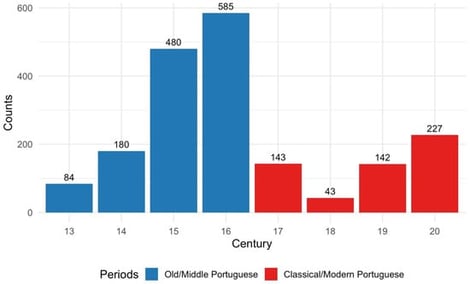
Distribution of sentences forming the database per century.

This study reconstructs the geography of meaning of the German perception verb schmecken on the basis of 30 major dialect dictionaries, treating them as a distributed semantic corpus and coding attestations as binary variables reflecting the presence or absence of semantic options. Combining a construal-based framework with spatial modeling, the analysis shows that the polysemy of schmecken is structured by three mutually reinforcing forces: embodied sensory organization, construal-based perspectivization, and regionally patterned areal dynamics. The gustatory–olfactory axis forms the semantic core of the verb, from which tactile, visual, affective, and epistemic extensions emerge. These extensions align with systematic pathways constrained by agentive, experiential, emissive, and evaluative construals, demonstrating that semantic extension is channeled through specific construal modes—notably emissive and agentive—rather than determined by sensory modality alone. A detailed areal analysis reveals a pronounced north–south divide. While Low German dialects conform to the cross-linguistically more common tendency to avoid colexifying taste and smekk—itself the outcome of historical change rather than uninterrupted differentiation—Upper German varieties preserve a typologically rare gustatory–olfactory cluster and exhibit the richest range of cross-modal and abstract extensions. The resulting semantic graph formalizes how regional varieties activate different subsets of a lexeme’s semantic potential and demonstrates that semantic networks themselves display spatial organization. The study thus provides an empirically grounded reconstruction of a German geography of meaning and illustrates how dialect data illuminate the interplay between embodied cognition, construal-based lexical architecture, and areal dynamics.

16 March 2026

This study aims, first, to contribute to our understanding of the regularities of light verb constructions (LVCs) by identifying syntactic–semantic patterns and, secondly, to provide data and reflections on how syntactic analyzability and semantic compositionality interact to shape the diachronic evolution of LVCs. To this end, the paper analyzes and describes, through corpus research, a subset of LVCs from Old Catalan—psych LVC or those denoting emotional states—and compares them with those from Contemporary Catalan. The main contrast between Old Catalan and Contemporary Catalan in this domain is that Contemporary Catalan tends to place the Experiencer in non-localist positions. Localist metaphors no longer structure the form–meaning pairing of Catalan psych LVCs. Once these metaphorical extensions no longer link P(sych)LVCs to their dominating construction, what remains can be described as a situation of vacuous analyzability: linguistic chains that are syntactically analyzable but lack semantic pairing.

16 March 2026

This study investigated family language policies (FLP) in the current context of the Macao Special Administrative Region (Macao SAR). It explored family language ideologies, management strategies, and intergenerational practices through questionnaires, semi-structured interviews, and participant observations. The findings indicate that Macao permanent residents’ families take Cantonese Chinese as the primary medium of communication and cultural identity. Simultaneously, Mandarin and English are often valued for their roles in academic and professional advancement. Portuguese exhibits a trend of marginalization, despite remaining one of the official languages of the Macao SAR. As for other dialects, they may be used in family conversations but are not considered important languages. Beyond this hierarchy of language values, the researchers also revealed that the FLP of Macao’s permanent residents’ families tends to be driven by both experience and foresight, enabling family members to engage in effective consultation on language choice and language learning. Regarding language practice, children’s multilingual fluency is significantly better than that of their parents. The dominant family language tendency does not influence the consensus of multilingualism and allows code-mixing to appear in conversations. In this article, FLP in Macao families is found to be shaped by both experiential knowledge and future-oriented practical considerations, while also reflecting parents’ affective concerns and responses to broader structural pressures. All these factors together form a decision-making system. In this system, both emotion and reason play their roles simultaneously. If a hierarchical distinction must be made, the rational recognition of the diverse characteristics of the linguistic environment and the dominant status of the main language will be primary.

16 March 2026

News & Conferences

Volumes

Latest Issues

Open for Submission

Editor's Choice

Reprints of Collections

Current Issues in Vietnamese Linguistics
Reprint

Current Issues in Vietnamese Linguistics

Editors: Trang Phan, Nigel Duffield, Tim Chou
Phonetics and Phonology of Ibero-Romance Languages
Reprint

Phonetics and Phonology of Ibero-Romance Languages

Editors: Rebeka Campos-Astorkiza
XFacebookLinkedIn
Languages - ISSN 2226-471X