You are currently viewing a new version of our website. To view the old version click .

Aerospace, Volume 7, Issue 4

April 2020 - 14 articles

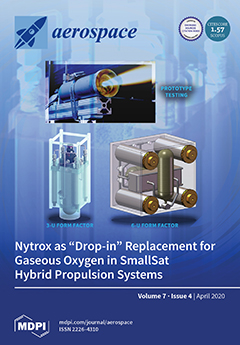
Cover Story: A novel high-performance “green” hybrid propulsion (HPGHP ) system has been developed as an environmentally sustainable replacement for hydrazine. HPGHP has been enabled by recent advances in 3D printing and leverages the unique electrical breakdown characteristics of certain printable plastic filaments. When the 3D-printed fuel materials are presented with an electrical potential, arcing occurs along the layered surface, pyrolyzing the material and allowing combustion. In its most mature form, HPGHP uses gaseous oxygen (GOX) as the oxidizer. To increase the HPGHP volumetric efficiency, a two-phase blend of nitrous oxide and oxygen, similar to laughing gas or Nytrox, has been engineered as a higher-density “drop-in” replacement. View this paper
  • Issues are regarded as officially published after their release is announced to the table of contents alert mailing list .
  • You may sign up for email alerts to receive table of contents of newly released issues.
  • PDF is the official format for papers published in both, html and pdf forms. To view the papers in pdf format, click on the "PDF Full-text" link, and use the free Adobe Reader to open them.

Articles (14)

  • Article
  • Open Access
15 Citations
5,874 Views
25 Pages

Airport surface movement operations are complex processes with many types of adverse events which require resilient, safe, and efficient responses. One regularly occurring adverse event is that of runway reconfiguration. Agent-based distributed plann...

  • Article
  • Open Access
9 Citations
5,465 Views
22 Pages

Dynamic soaring is a non-powered flight mode that enables extremely high speeds by extracting energy from thin shear wind layers. Trajectory optimization is applied to construct solutions of the maximum speed achievable with dynamic soaring and to de...

  • Article
  • Open Access
60 Citations
7,972 Views
18 Pages

Experimental and Numerical Icing Penalties of an S826 Airfoil at Low Reynolds Numbers

  • Richard Hann,
  • R. Jason Hearst,
  • Lars Roar Sætran and
  • Tania Bracchi

Most icing research focuses on the high Reynolds number regime and manned aviation. Information on icing at low Reynolds numbers, as it is encountered by wind turbines and unmanned aerial vehicles, is less available, and few experimental datasets exi...

  • Article
  • Open Access
10 Citations
8,827 Views
19 Pages

In this work, a study to design a highly flexible flutter demonstrator for the development and testing of active flutter suppression is presented. Based on the UAV mission, a bi-objective design optimization problem can be formulated. The aeroelastic...

  • Review
  • Open Access
260 Citations
55,014 Views
69 Pages

Electrification of the propulsion system has opened the door to a new paradigm of propulsion system configurations and novel aircraft designs, which was never envisioned before. Despite lofty promises, the concept must overcome the design and sizing...

  • Article
  • Open Access
14 Citations
11,334 Views
38 Pages

A medical grade nitrous oxide (N2O) and gaseous oxygen (GOX) “Nytrox” blend is investigated as a volumetrically-efficient replacement for GOX in SmallSat-scale hybrid propulsion systems. Combined with 3-D printed acrylonitrile butadiene s...

  • Article
  • Open Access
20 Citations
6,783 Views
22 Pages

Effect of Levels of Fidelity on Steady Aerodynamic and Static Aeroelastic Computations

  • Adrien Crovato,
  • Hugo S. Almeida,
  • Gareth Vio,
  • Gustavo H. Silva,
  • Alex P. Prado,
  • Carlos Breviglieri,
  • Huseyin Guner,
  • Pedro H. Cabral,
  • Romain Boman and
  • Vincent E. Terrapon
  • + 1 author

Static aeroelastic deformations are nowadays considered as early as in the preliminary aircraft design stage, where low-fidelity linear aerodynamic modeling is favored because of its low computational cost. However, transonic flows are essentially no...

  • Article
  • Open Access
5 Citations
7,601 Views
10 Pages

The Study of Aircraft Accidents Causes by Computer Simulations

  • Paweł Szczepaniak,
  • Grzegorz Jastrzębski,
  • Krzysztof Sibilski and
  • Andrzej Bartosiewicz

Defects in an aircraft can be caused by design flaw, manufacturer flaw or wear and tear from use. Although inspections are performed on the airplane before and after flights, accidents still result from faulty equipment and malfunctioning components....

  • Article
  • Open Access
8 Citations
4,864 Views
14 Pages

Computer-Assisted Aircraft Anti-Icing Fluids Endurance Time Determination

  • David Gagnon,
  • Jean-Denis Brassard,
  • Hassan Ezzaidi and
  • Christophe Volat

Deicing and anti-icing the aircraft using proper chemical fluids, prior takeoff, are mandatory. A thin layer of ice or snow can compromise the safety, causing lift loss and drag increase. Commercialized deicing and anti-icing fluids all pass a qualif...

of 2

Get Alerted

Add your email address to receive forthcoming issues of this journal.

XFacebookLinkedIn
Aerospace - ISSN 2226-4310