


Abstract
Accurate satellite component segmentation plays a fundamental role in numerous on-orbit perception tasks, including spacecraft pose estimation, autonomous robotic servicing, and space situational awareness. However, existing segmentation methods still face three major challenges: the scarcity of fine-grained annotations, the difficulty of preserving structural continuity under large pose variations, and the severe structural imbalance caused by extremely small and slender components such as antennas. To address these issues, this paper proposes LRSRNet, a low-resource spatial reconstruction network for satellite component segmentation. First, a LoRA-adapted DINOv3 foundation model is employed to efficiently transfer large-scale visual priors to the satellite domain, enabling robust structural representation under limited supervision. To exploit the complementary information encoded at different semantic levels, multi-level transformer features are uniformly aggregated for structural representation learning. Subsequently, a Converse2D-based spatial reconstruction decoder progressively restores the spatial continuity of satellite components, facilitating the recovery of fine structural details lost during hierarchical feature encoding. Furthermore, a structure-aware optimization strategy is introduced by jointly considering the geometric characteristics and category imbalance of satellite components during training, thereby improving the learning of geometrically fragile structures without sacrificing overall segmentation performance. Experimental results on a public satellite component segmentation benchmark demonstrate the effectiveness of the proposed method. LRSRNet achieves an mIoU of 77.10% on foreground categories and 82.45% over all categories. Ablation studies and visualization results further validate the contributions of the proposed representation adaptation, spatial reconstruction, and structure-aware optimization strategies.
1. Introduction
The increasing use of autonomous technologies in space has created a growing need for visual perception in on-orbit applications, such as spacecraft inspection, autonomous rendezvous and docking, on-orbit servicing, satellite maintenance, and space debris mitigation [1,2,3,4]. Unlike conventional space surveillance tasks, which mainly focus on detecting and tracking spacecraft, these applications often require more detailed information about spacecraft structures to support subsequent operations. For example, an on-orbit servicing robot may need to distinguish the satellite body, solar panels, and antennas to identify potential grasping regions and avoid fragile components [5]. Structural information is also useful for spacecraft condition assessment, digital twin construction, and space situational awareness, where identifying individual components can provide more detailed information than locating the spacecraft as a whole [3]. In this context, satellite component segmentation aims to assign pixel-level semantic labels to different functional parts of a spacecraft, providing detailed structural information for downstream visual perception and analysis.
Despite its importance, satellite component segmentation remains significantly more challenging than semantic segmentation in natural scenes. Spacecraft are characterized by weak texture, repetitive metallic surfaces, severe illumination variations, and largely textureless backgrounds, making component discrimination heavily dependent on structural geometry rather than appearance [5,6]. Moreover, spacecraft components usually exhibit extreme scale variation and highly imbalanced spatial distributions. Thin structures such as antennas and narrow solar panel boundaries occupy only a limited number of pixels and are therefore particularly vulnerable to information loss during hierarchical feature extraction [7]. Satellite component segmentation should be regarded not merely as a conventional dense prediction task, but as a low-resource structural perception problem requiring robust representation learning and reliable structural recovery under degraded observations.
Recent advances in semantic segmentation have led to remarkable performance improvements through encoder–decoder architectures and multi-scale feature learning [8]. Representative methods, including U-Net [9], U-Net++ [10], LinkNet [11], FPN [12], PAN [13], PSPNet [14], DeepLabV3+ [15], MA-Net [16], and SegFormer-B5 [17], progressively aggregate hierarchical features and recover dense predictions using skip connections, feature pyramid structures, or attention mechanisms. The fine geometric structures of spacecraft components, such as antennas and narrow solar panels, are highly susceptible to structural degradation during hierarchical encoding [7,18]. Conventional decoders mainly enlarge feature resolution through interpolation or transposed convolution, but lack an explicit mechanism to reconstruct the underlying spatial structures lost during feature abstraction. Consequently, existing segmentation frameworks often struggle to simultaneously preserve global structural consistency and recover fine component boundaries in challenging satellite imagery [19,20].
Recent vision foundation models have demonstrated remarkable capability in learning transferable visual representations through large-scale self-supervised pretraining [21,22,23,24,25]. Among them, DINOv3 provides geometry-aware and semantically consistent representations without relying on dense annotations, making it well suited for satellite imagery where viewpoint variations, illumination changes, and weak-texture components are common [25,26]. Such pretrained representations offer a strong foundation for satellite component segmentation.
However, adapting foundation models to satellite component segmentation remains challenging. High-quality annotations are limited, particularly for components that are small or structurally slender [27,28]. Direct fine-tuning of large foundation models may also lead to overfitting when only limited task-specific annotations are available, while potentially altering the general representations acquired during pretraining. Parameter-efficient adaptation therefore provides a practical way to adapt foundation models to the target domain while retaining most of the pretrained parameters [29,30,31,32]. Accurate component segmentation also depends on how spatial information is recovered in the decoder. Existing encoder-decoder frameworks commonly restore spatial resolution through progressive upsampling and feature fusion. However, for thin and geometrically slender components such as antennas and solar panels, spatial details may be weakened during feature encoding, and conventional upsampling alone may not fully recover their original structures. This can result in inaccurate or fragmented boundaries and incomplete component regions [18]. Therefore, effective decoding should consider not only the recovery of spatial resolution but also the reconstruction of structural information, motivating the use of a structure-aware spatial reconstruction strategy.
To address the above challenges, we propose LRSRNet, a Low-Resource Spatial Reconstruction Network for satellite component segmentation. We formulate satellite component segmentation as a low-resource structural perception problem under limited supervision and severe class imbalance. The main contributions of this work are summarized as follows:
- We propose a Low-Resource Adaptation strategy based on LoRA-equipped DINOv3, which efficiently transfers geometry-aware pretrained representations to the component segmentation task under limited annotations, while keeping the majority of the foundation-model parameters fixed.
- We propose a structural reconstruction decoder, in which Converse2D modules replace conventional transposed-convolution upsampling to progressively reconstruct dense spatial representations and preserve fine-grained structural information for satellite component segmentation.
- Experimental results indicate that LRSRNet provides improved segmentation performance on the satellite component segmentation benchmark, particularly for thin and small-scale components.
2. Methods
2.1. Overall Architecture
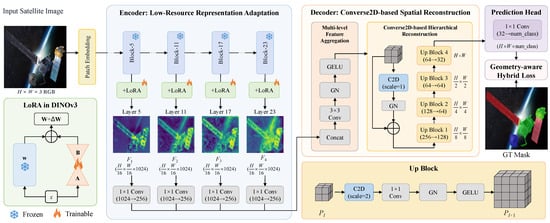
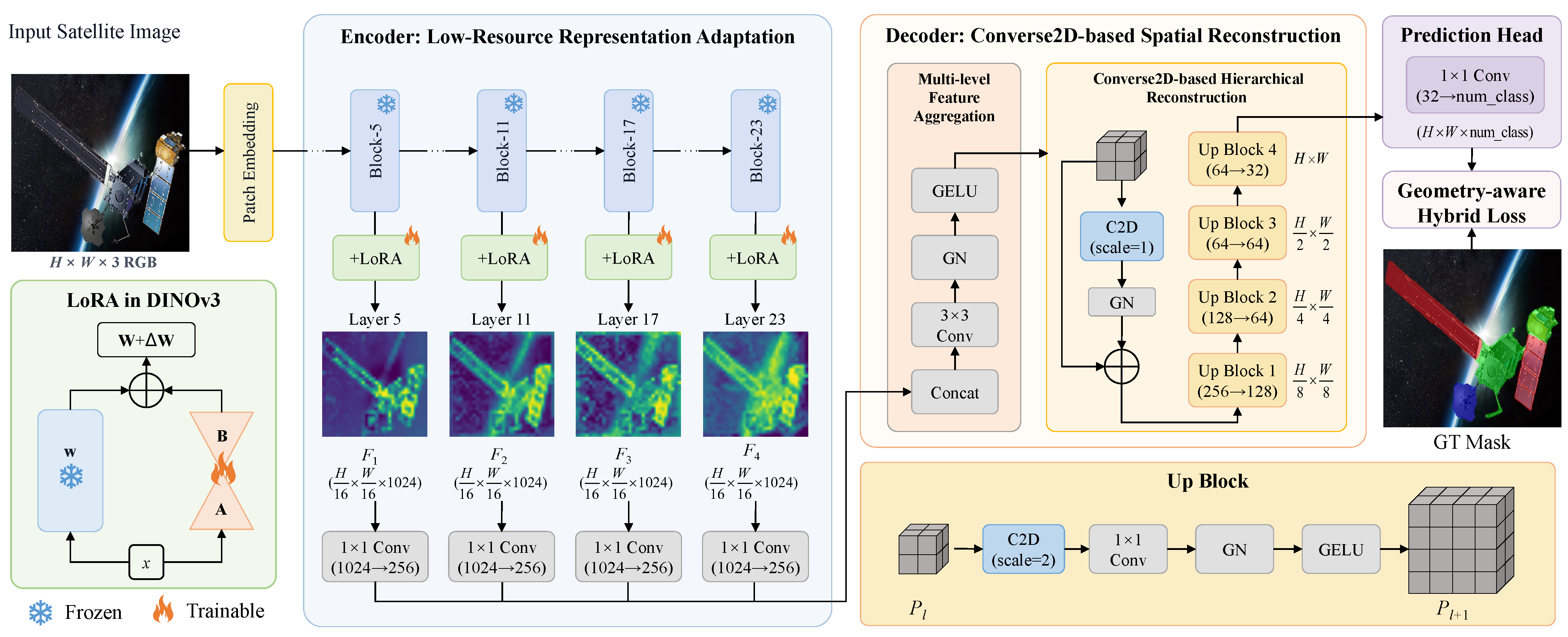
An overview of the proposed LRSRNet is illustrated in Figure 1. Motivated by the observation that satellite component segmentation is fundamentally a low-resource structural perception problem, the proposed framework is developed from two complementary perspectives: low-resource representation adaptation and spatial reconstruction. The former aims to learn robust geometry-aware representations under limited and heterogeneous supervision, while the latter focuses on progressively recovering the spatial structures degraded during hierarchical feature encoding.
Figure 1.
Overall architecture of the proposed LRSRNet. The framework consists of two complementary stages: (1) Low-Resource Representation Adaptation, where LoRA-adapted DINOv3 extracts geometry-aware multi-level structural representations; (2) Spatial Reconstruction, where Converse2D modules replace conventional transposed-convolution upsampling to progressively reconstruct dense spatial representations for component segmentation.
Given an input satellite image , a LoRA-adapted [31] DINOv3-L [26] is employed as the visual encoder. The ViT-L backbone consists of 24 transformer blocks, where the input image is first partitioned into non-overlapping patches and projected into token embeddings through a patch embedding layer [26,33]. To capture structural representations at different semantic levels, the intermediate features from transformer blocks are extracted as multi-level representations.
These multi-layer feature maps are sampled from the early, middle, and late stages. To facilitate feature aggregation, each feature is first projected and further fused through a convolutional embedding layer, yielding the fused structural representation .
The fused representation is subsequently fed into the spatial reconstruction decoder, which progressively restores the degraded spatial structures through four hierarchical reconstruction stages and recovers a dense feature map with the original image resolution. By the spatial reconstruction decoder, we can get the reconstructed feature map . Finally, a convolution is adopted as the prediction head to generate the pixel-wise component probability map,
where and C denotes the number of semantic categories.
2.2. Low-Resource Representation Adaptation
Satellite component segmentation poses a unique challenge for visual representation learning. Unlike natural image segmentation, spacecraft exhibit extremely diverse poses, viewing angles, and illumination conditions, while their components are characterized by weak textures and highly regular geometric structures. Consequently, the encoder is required to learn transferable geometry-aware representations that remain stable under large appearance variations [34,35]. Meanwhile, the available training data contain only a limited number of finely annotated samples together with heterogeneous annotation quality, making the direct optimization of large vision models prone to overfitting [36]. Therefore, the representation learning stage should simultaneously satisfy two requirements: (i) strong structural generalization across diverse satellite observations, and (ii) efficient adaptation under low-resource supervision.
To meet these requirements, we adopt DINOv3 ViT-L as the visual encoder. Benefiting from large-scale self-supervised pretraining, DINOv3 learns transferable visual representations with strong geometric consistency, providing robust structural priors for satellite component perception. Given an input image I, the encoder extracts hierarchical structural representations:
where denotes the DINOv3 encoder parameterized by the pretrained weights . Unlike conventional supervised backbones that rely heavily on appearance statistics, the learned representations are more robust to viewpoint changes and weak-texture regions, which are common characteristics of satellite imagery.
However, directly fine-tuning all parameters of a large foundation model on the target dataset is neither necessary nor desirable. Owing to the limited number of fine annotations, full-parameter optimization tends to overfit the target distribution and gradually weaken the transferable structural knowledge acquired during large-scale pretraining [37]. To alleviate this issue, we employ Low-Rank Adaptation (LoRA) [31] as a lightweight adaptation strategy. Instead of updating the entire parameter space, LoRA introduces a learnable low-rank residual to the pretrained weights,
where
with , , and . During training, only the low-rank matrices and are optimized, while the pretrained parameters remain frozen.
It is worth noting that the role of LoRA in our framework is not merely to reduce the number of trainable parameters. More importantly, the low-rank constraint restricts the adaptation to a compact parameter subspace, enabling the pretrained structural knowledge of DINOv3 to be transferred to the satellite domain without substantially altering its geometry-aware representation space. Such constrained representation adaptation effectively balances representation capability and adaptation flexibility under limited supervision, thereby providing reliable structural features for the subsequent spatial reconstruction stage.
2.3. Spatial Reconstruction
Although the proposed representation adaptation strategy provides robust geometry-aware features, accurately segmenting satellite components still requires recovering the structural information progressively degraded during hierarchical feature encoding. In particular, repeated tokenization and spatial abstraction inevitably weaken fine geometric details, making thin and elongated components, such as antennas and solar panels, difficult to distinguish from the background. Simply increasing the feature resolution is therefore insufficient to faithfully reconstruct the underlying component structures.
To address this issue, we propose a Converse2D-based spatial reconstruction strategy that reconstructs structural information from both the representation and spatial perspectives. Specifically, we first aggregate multi-level transformer features to integrate complementary structural cues across different semantic levels. Rather than relying solely on the final-layer representation, the proposed aggregation exploits intermediate structural features that preserve richer local geometry while maintaining high-level semantic consistency [38]. Subsequently, the fused representation is progressively reconstructed by a Converse2D-based hierarchical decoder, which formulates feature upsampling as a reconstruction process instead of conventional interpolation [39]. By jointly leveraging multi-level structural aggregation and hierarchical spatial reconstruction, the proposed decoder effectively restores degraded component structures and produces spatially consistent segmentation results.
2.3.1. Multi-Level Structural Aggregation
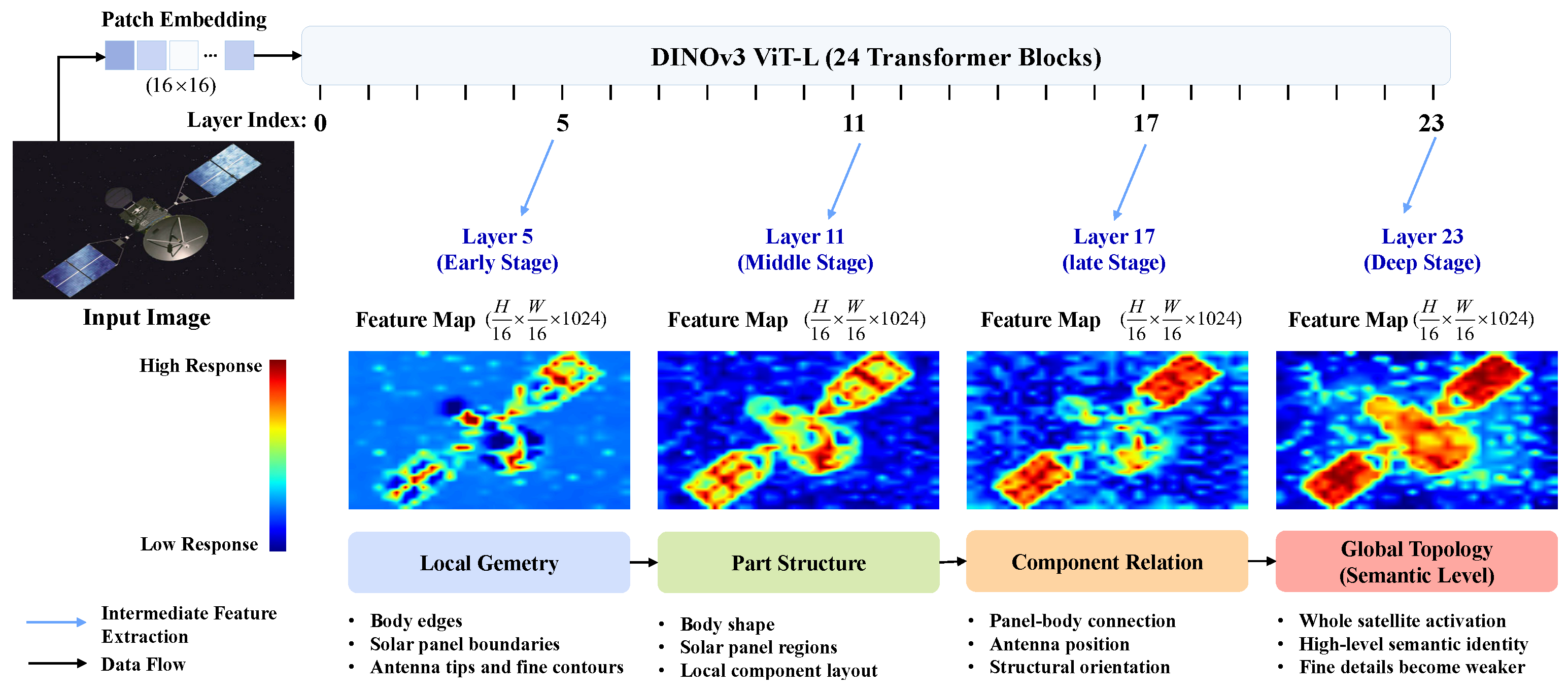
Although the deepest transformer features possess the strongest semantic discrimination, they are not necessarily the most informative representations for satellite component segmentation. During hierarchical self-attention learning, the visual representation gradually evolves from local geometric primitives to high-level semantic concepts. As the transformer depth increases, fine structural details are progressively abstracted into global semantic representations. While such abstraction benefits semantic recognition, it inevitably weakens the geometric information required for accurately distinguishing thin satellite components and preserving structural boundaries.
Instead of relying solely on the final transformer representation, we explicitly aggregate intermediate features from different depths to preserve the progressive structural evolution of satellite components [40]. Specifically, the intermediate representations extracted from the 5th, 11th, 17th, and 23rd transformer blocks are uniformly sampled across the 24-layer DINOv3-L encoder. This selection provides a simple and deterministic way to cover the representation hierarchy, while avoiding excessive redundancy among adjacent deep-layer features. The selected features span different levels of representation, enabling the network to capture local geometric details, part-level structural configurations, intermediate semantic relationships, and global structural context. Empirical analysis further shows that uniformly distributed layer selection provides more complementary representations than using only the final layer or adjacent deep layers, supporting the use of the fixed layer set in our implementation, with Equation (6) defined as
forming a set of multi-level structural representations:
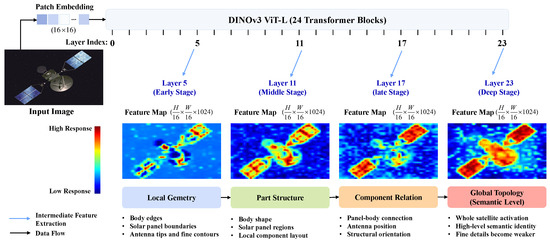
Figure 2 illustrates the structural evolution of visual representations across different depths of DINOv3, revealing how feature representations progressively transition from local geometric details to global semantic structures.
Figure 2.
Structural evolution of visual representations in DINOv3. As the transformer depth increases, the representation gradually evolves from local geometric primitives to global semantic structures.
Since the intermediate features extracted from different transformer blocks have identical spatial resolution and channel dimension (1024), direct concatenation would result in a prohibitively high-dimensional representation with substantial computational overhead. Therefore, each feature is first projected to a compact 256-dimensional representation through a learnable convolution, which performs channel compression while simultaneously learning a layer-specific feature projection to facilitate subsequent multi-level feature aggregation:
where denotes channel projection. The projected features are subsequently concatenated and fused by a convolutional embedding module consisting of a convolution, Group Normalization, and GELU activation:
The resulting feature integrates complementary structural information from different transformer stages, providing a geometry-preserving representation for the subsequent hierarchical spatial reconstruction process.
2.3.2. Structural Reconstruction
The spatial continuity of satellite components has already been progressively weakened during hierarchical feature encoding. In particular, thin structures such as antennas and narrow solar panels are easily fragmented after repeated abstraction, making accurate boundary recovery particularly challenging. Existing decoder architectures typically enlarge feature resolution through interpolation or transposed convolution [41,42]. However, increasing spatial resolution alone cannot faithfully reconstruct the degraded structural information, since the lost geometric cues are not explicitly modeled during the decoding process.
To address this issue, we formulate feature decoding as a spatial reconstruction process rather than simple resolution enlargement. Inspired by Converse2D [43], the proposed decoder progressively reconstructs high-resolution spatial representations through learnable feature transformations. Instead of merely increasing the spatial resolution of coarse semantic features, Converse2D performs spatially structured feature reconstruction during each decoding stage, enabling the progressively recovered representations to retain spatial continuity and fine-grained component structures. This design is particularly beneficial for slender and small components whose geometric details are easily weakened during feature encoding.
Let denote the latent high-resolution structural representation before hierarchical encoding, and let denote the corresponding low-resolution feature extracted by the encoder. The encoding process can be regarded as a structural degradation operator
where represents the hierarchical feature abstraction performed by the backbone network. Since is generally non-invertible, directly enlarging the feature resolution cannot recover the lost structural information. Therefore, the decoder aims to learn an reconstruction operator defined as
where progressively reconstructs the degraded structural representations instead of simply performing spatial upsampling.
Different from conventional convolution, which performs forward local feature aggregation, Converse2D explicitly models spatial feature transformation during the reconstruction process. By learning the spatial correspondence between neighboring feature representations while progressively increasing the spatial resolution, Converse2D enables more structured recovery of spatial continuity and fine-grained geometric information. This property is particularly relevant to satellite component segmentation, where slender components such as antennas and narrow solar-panel structures are sensitive to spatial discontinuities and boundary distortions.
Specifically, the fused structural representation is first refined by a residual reconstruction block,
where consists of a Converse2D operator with scale factor 1, followed by Group Normalization and GELU activation. The residual connection further preserves the global semantic representation while compensating for local structural inconsistencies introduced during feature aggregation.
The refined feature is subsequently reconstructed through N hierarchical reconstruction stages,
where each reconstruction block contains a Converse2D operator with scale factor 2, a convolution for channel projection, Group Normalization, and GELU activation. The Converse2D operator is responsible for reconstructing spatial structures, whereas the subsequent convolution performs channel interaction and semantic refinement. This decoupled design enables spatial geometry and semantic representations to be optimized collaboratively during hierarchical reconstruction. Consequently, the feature resolution is progressively recovered from to the original image resolution while the channel dimension is gradually reduced from 256 to 32. The output of the final reconstruction stage is taken as the reconstructed feature representation:
In our implementation, , corresponding to four successive reconstruction stages that progressively recover the spatial resolution. The resulting feature representation preserves both high-level semantic information inherited from the DINOv3 encoder and fine-grained spatial structures recovered during hierarchical reconstruction. is subsequently fed into a prediction head to produce the final pixel-wise component segmentation.
2.4. Structure-Aware Optimization
Besides representation learning and spatial reconstruction, effective optimization is equally important for satellite component segmentation. Unlike conventional semantic segmentation benchmarks, satellite components exhibit severe structural imbalance. As illustrated in Figure 3, the satellite body occupies the majority of image pixels, whereas antennas usually appear as extremely thin and elongated structures with only a few pixels. During optimization, the gradients are therefore dominated by large-area categories, causing the network to converge toward the easier classes while neglecting geometrically fragile components. Consequently, simply employing standard pixel-wise supervision often leads to fragmented antenna predictions and discontinuous structural boundaries.
Figure 3.
Illustration of the structural imbalance in satellite component segmentation and the motivation of the proposed geometry-aware optimization strategy. (a) A satellite image example. (b) Corresponding ground-truth component annotations. (c) Pixel distribution of different semantic categories, showing that antenna pixels account for only a negligible proportion.
To alleviate this issue, we introduce a structure-aware optimization strategy that jointly considers category imbalance and structural sparsity from both the loss and data distribution perspectives.
2.4.1. Structure-Aware Hybrid Loss
Let denote the predicted probability map and Y be the corresponding ground-truth labels, where represents the four semantic categories, i.e., background, body, solar panel, and antenna. We first employ a weighted cross-entropy loss
where N denotes the number of pixels, is the one-hot ground-truth label, is the predicted probability, and is the class weight assigned to category c.
Unlike conventional semantic segmentation datasets, antenna pixels occupy only a very small proportion of the image while exhibiting highly elongated geometries. Consequently, they contribute only weak gradients during optimization and are easily overwhelmed by dominant categories. To compensate for this imbalance, we assign a larger weight to the antenna category,
corresponding to the background, body, solar panel, and antenna classes, respectively. This weighting strategy encourages the network to allocate greater learning capacity to geometrically fragile components without excessively suppressing the optimization of large structural regions.
Although weighted cross-entropy improves category balance, it still optimizes pixels independently and is insensitive to the overall structural integrity of each component. Therefore, Dice loss is further introduced to directly maximize the regional overlap between prediction and ground truth,
where denotes the binary ground-truth mask and is a small constant preventing numerical instability.
Finally, the overall optimization objective is formulated as
where in all experiments. The weighted cross-entropy emphasizes difficult structural categories during pixel-level classification, while Dice loss encourages global structural consistency by directly optimizing region overlap. Their combination provides complementary supervision for both semantic discrimination and structural completeness.
2.4.2. Antenna-Aware Sampling
Besides category imbalance, another challenge originates from the highly uneven sample distribution. Images containing clearly visible antennas account for only a small portion of the training set, resulting in insufficient exposure of the network to these structurally challenging samples.
To alleviate this problem, we further adopt an antenna-aware sampling strategy during training. Let denote the training set and represent the subset containing antenna annotations. Instead of uniformly sampling training images, the sampling probability of is increased by a factor ,
where denotes the original sampling probability.
By increasing the occurrence frequency of antenna-containing samples, the proposed sampling strategy enables the network to repeatedly observe diverse antenna geometries throughout training, thereby improving the robustness of structural representation learning for extremely small and elongated components.
3. Experiments
3.1. Experimental Setup
Experiments are conducted on the public satellite component segmentation dataset introduced in [5]. The dataset contains 3117 RGB satellite images with a spatial resolution of , covering diverse viewpoints, illumination conditions, and imaging backgrounds. Each image is annotated with pixel-level semantic masks for four categories: background, satellite body, solar panel, and antenna. Following the adopted benchmark protocol, 2517 images are used for training and 600 images are reserved for validation. All images are resized to during training while preserving the original aspect ratio. Since the released dataset does not provide an independent test split, the 600-image validation set is used for both checkpoint selection and quantitative evaluation. It is not involved in gradient-based optimization. All quantitative results reported in this work are evaluated using this checkpoint on the same 600-image validation set.
The proposed LRSRNet is implemented in PyTorch and trained on a single NVIDIA RTX 5060 Ti GPU with 16 GB memory. DINOv3 ViT-L/16 is adopted as the visual encoder, where LoRA is inserted into the all attention qkv and output projection layers of the self-attention modules. The LoRA rank, scaling factor, and dropout rate are set to 16, 32, and 0.05, respectively. During training, random crops, horizontal/vertical flipping, 90-degree rotations, and brightness/contrast jittering are adopted for data augmentation. During inference, the checkpoint with the best foreground mIoU is selected. A sliding-window strategy with a window size of and a stride of 384 is adopted to generate full-resolution segmentation results without introducing additional interpolation errors. During training, only the LoRA adapters and the proposed decoder are updated, while the remaining pretrained parameters are frozen. Specifically, 2,359,296 LoRA parameters and 4,068,548 decoder parameters are trainable, resulting in 6,427,844 trainable parameters among 309,507,268 total parameters (2.08%).
The network is optimized using AdamW with a batch size of 4. The maximum number of training epochs is set to 300. To account for the different optimization characteristics of pretrained and newly initialized parameters, separate learning rates are adopted: for the LoRA parameters and for the decoder and segmentation head. The weight decay is set to . A 5% warm-up schedule followed by cosine learning-rate decay is adopted. Mixed-precision training with BF16 is used. Full validation is performed at the end of every epoch. Early stopping with a patience of 10 epochs is applied based on the validation foreground mIoU, and training is terminated if no improvement is observed for 10 consecutive epochs. The checkpoint achieving the highest validation foreground mIoU is retained for final evaluation.
3.2. Comparison with State-of-the-Art Methods
To comprehensively evaluate the proposed method, we compare LRSRNet with representative semantic segmentation methods, including U-Net [9], U-Net++ [10], LinkNet [11], FPN [12], PAN [13], PSPNet [14], DeepLabV3+ [15], MA-Net [16], and SegFormer-B5 [17]. SegFormer-B5 is included as a representative Transformer-based segmentation model to provide a non-foundation-model reference beyond methods using conventional convolutional backbones. DINOv3-TConv equips the DINOv3 foundation model with conventional transposed convolution layers. Following the same experimental protocol, all competing methods are trained and evaluated on the same dataset with identical input preprocessing and evaluation criteria.
The quantitative results are reported in Table 1. We report the IoU of each semantic category, namely Boundary IoU (BIoU), denoted as , the foreground mean IoU (mIoUfg), and the all-class mean IoU (mIoUall). The mIoUfg is calculated as the mean IoU of the satellite body, solar panel, and antenna classes, whereas mIoUall additionally includes the background class. BIoU evaluates the overlap between predicted and ground-truth boundary regions within a predefined boundary width, which is set to of the image diagonal in our experiments. Compared with conventional IoU, BIoU provides a more direct measure of boundary alignment and is particularly informative for geometrically slender components, whose segmentation quality can be sensitive to small spatial localization errors. Therefore, BIoU complements region-based IoU metrics by providing an additional assessment of structural and boundary preservation.
Table 1.
Comparison with state-of-the-art semantic segmentation methods on the satellite component segmentation dataset.
As shown in Table 1, LRSRNet achieves an mIoUfg of 77.10% and an mIoUall of 82.45%, outperforming both SegFormer-B5 and the DINOv3-TConv. Compared with SegFormer-B5, LRSRNet improves mIoUfg by 2.99% and mIoUall by 2.23%. More importantly, the improvement is particularly pronounced for the antenna category. LRSRNet achieves an antenna IoU of 65.49%, compared with 53.47% for SegFormer-B5 and 49.08% for DINOv3-TConv. LRSRNet achieves a of 41.15%, compared with 39.24% for SegFormer-B5 and 32.88% for DINOv3-TConv. The advantage of LRSRNet is not limited to region-level overlap, but also extends to more accurate localization of component boundaries.
It is also important to distinguish the two Transformer-based approaches in terms of their model paradigms. SegFormer-B5 employs the MiT-B5 encoder as a task-specific Transformer-based semantic segmentation architecture, whereas LRSRNet adopts the pretrained ViT-L/16 encoder of DINOv3 as a visual foundation model. The latter is not trained from scratch for the target segmentation task; instead, LoRA is used to efficiently adapt the pretrained representation to the target domain while keeping the majority of the foundation-model parameters fixed. Therefore, the comparison with SegFormer-B5 does not aim to establish a general superiority of one Transformer architecture over another. Rather, it provides a Transformer-based non-foundation reference and allows us to evaluate whether a pretrained foundation-model representation, combined with parameter-efficient adaptation and spatial reconstruction, provides additional benefits for the satellite component segmentation problem.
3.3. Ablation Study
3.3.1. Component-Wise Ablation Analysis
To investigate the individual contributions of the proposed method, we conduct ablation experiments by independently enabling LoRA and Converse2D while keeping all other settings unchanged. The quantitative results are summarized in Table 2.
Table 2.
Comparison of different adaptation strategies on satellite component segmentation.
To investigate the contribution of each key component, we conduct ablation studies on representation adaptation and spatial reconstruction. The baseline denotes the model without LoRA adaptation and Converse2D reconstruction, where the pretrained DINOv3 encoder is directly used with the original decoder. The +LoRA-Adapt-only variant introduces LoRA into the DINOv3 encoder while keeping the baseline decoder unchanged. The +C2D-Recon-only variant replaces the original decoder with the proposed Converse2D-based reconstruction module without LoRA adaptation. Finally, LRSRNet combines both components.
The results in Table 2 provide a clearer comparison of the contributions of representation adaptation and spatial reconstruction. To ensure that the ablation results are robust to training stochasticity, each ablation setting is evaluated over three independently trained runs and reported as mean ± sample standard deviation. The +LoRA-Adapt-only configuration substantially improves the region-level segmentation performance over the baseline, with the foreground mIoU increasing from to . This improvement indicates that parameter-efficient adaptation is important for transferring the strong visual representations of DINOv3 to the target segmentation task under limited fine-grained supervision. When Converse2D is introduced on top of DINOv3+LoRA, the foreground mIoU further increases from to , while the improves from to . The improvement in is consistent with the intended role of the reconstruction decoder, which is to recover spatial continuity and fine-grained boundaries from the encoded representations.
3.3.2. Effectiveness of Structure-Aware Optimization
To evaluate the effectiveness of the proposed structure-aware optimization (SO) strategy, we compare the complete LRSRNet with its counterpart without the proposed optimization module. The quantitative results are summarized in Table 3.
Table 3.
Ablation study of the proposed structure-aware optimization (SO) strategy.
As observed, incorporating the proposed SO further improves the foreground mIoU from 76.89% to 77.10% and the overall mIoU from 82.33% to 82.45%. Although the overall performance gain appears moderate, a substantial improvement is achieved on the antenna category, whose IoU increases from 63.41% to 65.49%, representing the largest improvement among all semantic classes. Considering that antenna pixels account for only 0.0373% of the entire dataset, this improvement demonstrates that the proposed optimization strategy effectively enhances the learning of extremely sparse and geometrically slender structures without sacrificing the overall segmentation accuracy.
It is worth noting that the optimization strategy does not aim to uniformly improve all semantic categories. Instead, it intentionally redistributes the optimization focus toward structurally challenging components. Compared with the satellite body and solar panels, antennas occupy only a negligible proportion of image pixels and exhibit highly elongated geometries, making them more susceptible to weak supervision during conventional pixel-wise optimization. Consequently, optimization is naturally dominated by large-area components, while the gradients contributed by antenna regions are easily overwhelmed. The segmentation performance of the most difficult category is significantly enhanced, while maintaining competitive accuracy for the dominant classes.
To further examine the effect of the proposed imbalance handling strategy, we separately evaluate class weighting and oversampling, as well as their combination, under the same experimental setting. The results are reported in Table 4. Oversampling alone provides a slight improvement over the baseline, increasing mIoUfg to , whereas class weighting alone leads to a decrease to . When the two mechanisms are jointly applied, the performance increases to mIoUfg and mIoUall, accompanied by the highest BIoU of . The effect is particularly evident for the antenna category. Although oversampling or class weighting alone does not consistently improve antenna IoU, their combination increases the antenna IoU. This result suggests that the two mechanisms provide complementary effects for the highly imbalanced component distribution. Class weighting adjusts the contribution of under-represented categories during optimization, while oversampling increases their effective occurrence during training. Their combination therefore provides a more balanced optimization signal, which is beneficial for the recognition of the extremely sparse antenna component.
Table 4.
Ablation study of imbalance handling strategies.
3.3.3. Performance Under Limited Annotation Budgets
To further evaluate the low-resource capability of the proposed method, we vary the fine-annotation budget while keeping the remaining training data fixed. As shown in Table 5, the proposed method achieves a foreground mIoU of 73.07% with only 10% of the annotation budget. Increasing the budget to 25%, 50%, and 100% improves the foreground mIoU to 74.13%, 75.94%, and 77.10%, respectively. exhibits a consistent improvement from 38.15% to 41.15%. The results indicate that the model can maintain effective component segmentation with substantially limited fine-grained supervision, while additional annotations progressively improve the segmentation quality.
Table 5.
Performance under different annotation budgets.
3.3.4. Effectiveness of Multi-Level Feature Selection
To further investigate the effect of Transformer-layer selection on multi-level feature aggregation, we compare different layer selection strategies, as reported in Table 6. Using only the final layer (layer 23) achieves an mIoUfg of 76.07%. When four adjacent deep layers (20, 21, 22, and 23) are aggregated, the performance decreases to 75.76%, indicating that simply increasing the number of deep-layer features does not necessarily provide complementary information. In contrast, uniformly selecting layers from different depths, i.e., , achieves the best performance, with an mIoUfg of 77.10% and a of 41.15%. The antenna IoU also reach 65.49%, respectively. These results suggest that features from different depths provide more complementary structural information, which is particularly beneficial for the segmentation of geometrically slender components.
Table 6.
Ablation study of different Transformer-layer selection strategies for multi-level feature aggregation.
3.4. Visualization
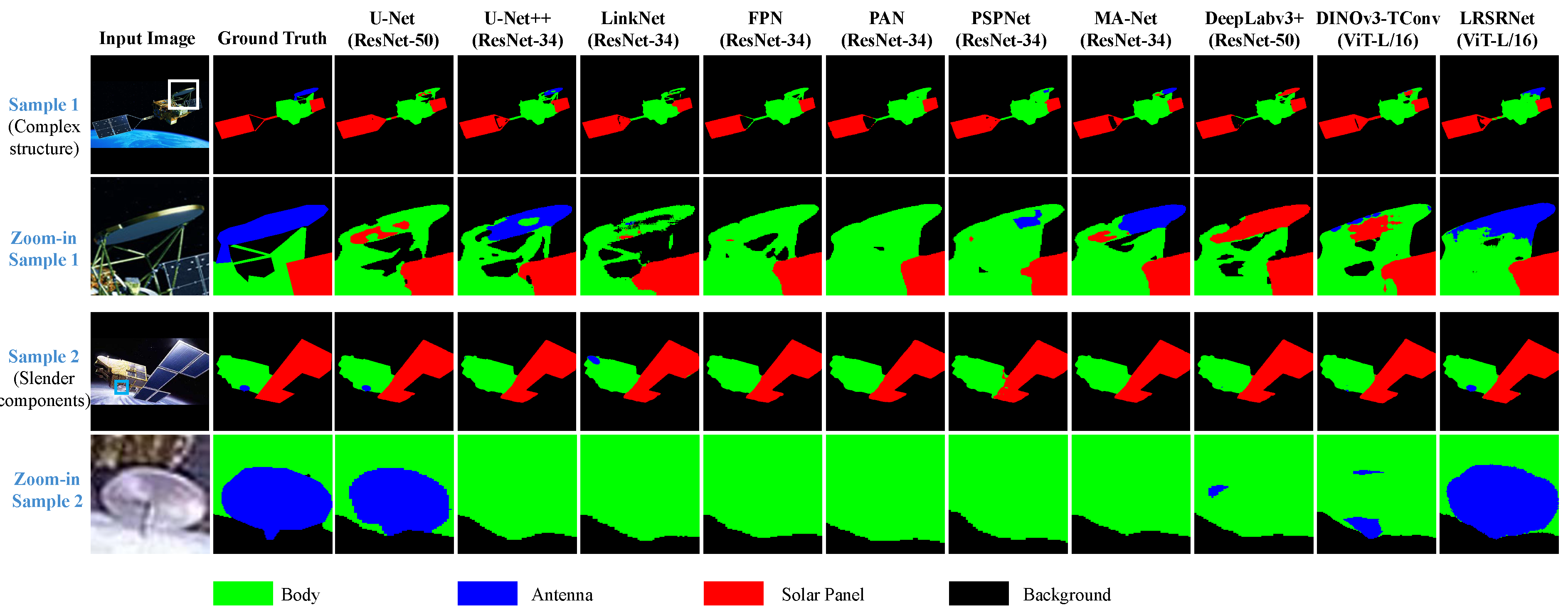
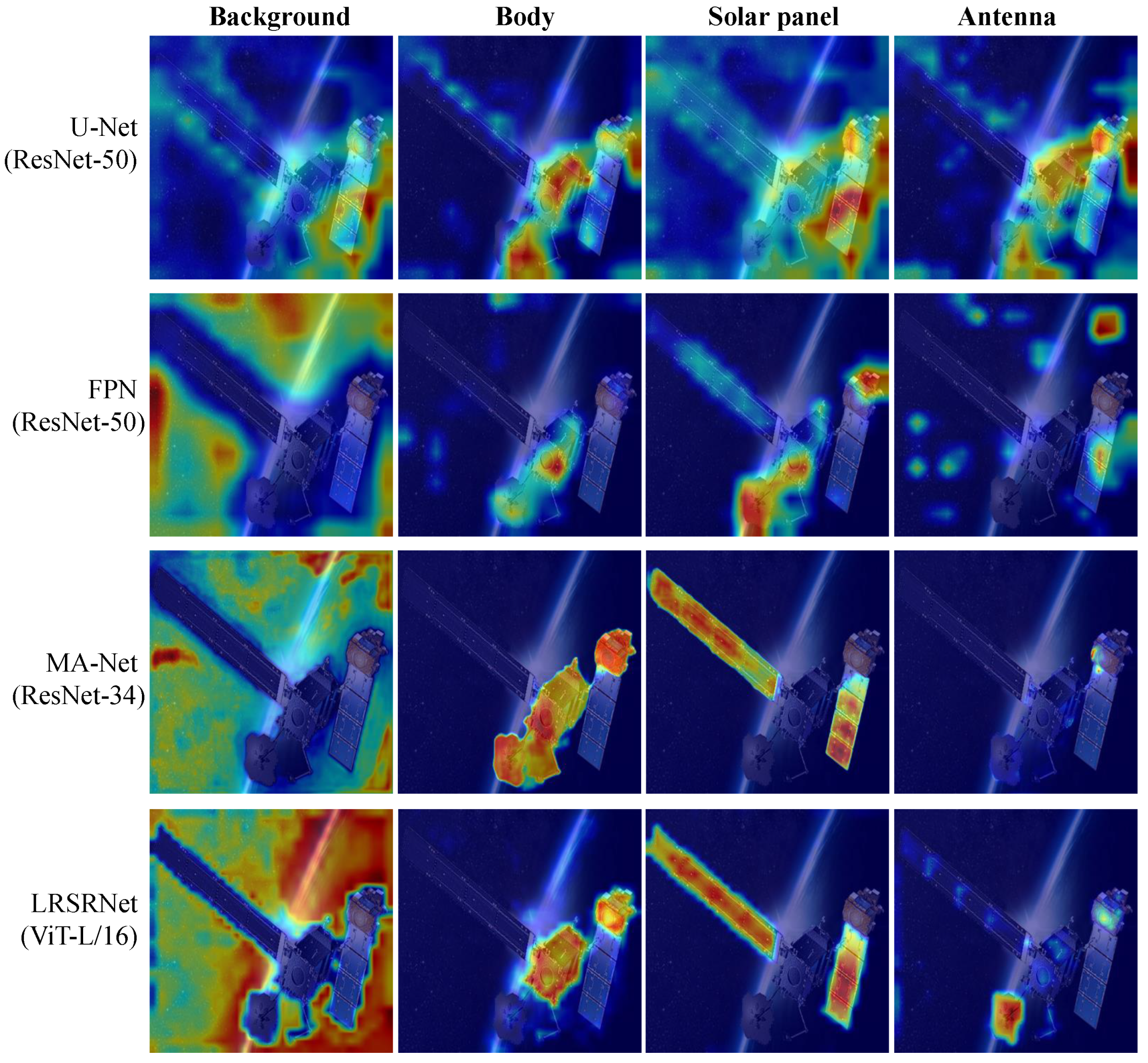
To qualitatively evaluate the effectiveness of the proposed LRSRNet, we present both the final segmentation results and the intermediate feature representations in Figure 4 and Figure 5, respectively. The former demonstrates the segmentation performance of the proposed framework, while the latter provides an intuitive understanding of how the learned structural representations evolve during feature extraction and reconstruction.
Figure 4.
Qualitative comparison of satellite component segmentation results. The proposed method produces more complete satellite components. Zoomed-in regions further demonstrate its superiority in maintaining the structural continuity of slender satellite components.
Figure 5.
Visualization of class activation maps (CAMs) of different semantic categories. Compared with representative segmentation networks, the proposed LRSRNet exhibits better semantic discrimination, more geometry-consistent structural responses, and enhanced activation on extremely slender satellite components.
Figure 4 presents qualitative comparisons on two representative challenging scenarios. The first example involves a satellite with a complex structural layout, where the body and solar panels exhibit irregular boundaries and large intra-component appearance variations. Existing CNN-based methods often produce incomplete region predictions or fragmented component structures due to their reliance on local appearance cues, while the proposed LRSRNet successfully preserves the structural integrity of all components. Benefiting from the strong structural representations learned by the LoRA-adapted DINOv3 encoder together with the spatial reconstruction decoder, our method maintains consistent semantic assignment over the entire component despite substantial appearance variations. The second example focuses on an extremely slender antenna, which occupies only a few pixels and therefore contributes very limited supervisory signals during training. Most comparison methods either miss the antenna completely or predict only partial structures, owing to the severe geometric imbalance between large and small satellite components. In contrast, the proposed method accurately preserves the complete antenna geometry.
To provide qualitative insights into the learned representations of different models, Figure 5 visualizes the class activation maps (CAMs) of the four semantic categories, including background, body, solar panel, and antenna. To ensure a consistent comparison, we generate class-specific activation maps for all competing methods using the same Grad-CAM procedure [44]. For each model, the activation map is extracted from the final feature layer. Given a selected semantic class c, the scalar target is defined as the spatial mean of its class logit. The channel weights are obtained by global-average pooling the gradients of this target with respect to the corresponding feature maps. The weighted feature maps are then passed through ReLU and resized to the input resolution. Finally, each activation map is independently min–max-normalized to for visualization. The same procedure and normalization are applied to all compared models. We compare LRSRNet with three representative segmentation frameworks, i.e., U-Net (ResNet-50), FPN (ResNet-50), and MA-Net (ResNet-34).
Compared with U-Net, the proposed method exhibits substantially stronger semantic discrimination among different satellite components. The activation responses corresponding to body, solar panel, and antenna are well separated with significantly reduced cross-category interference, whereas U-Net produces highly overlapped responses among multiple classes. This observation indicates that the LoRA-adapted DINOv3 encoder learns more discriminative structural representations under limited supervision, enabling a clearer semantic decomposition of different satellite components before dense prediction. Compared with FPN, both methods successfully localize the major satellite components; however, the activation maps generated by FPN are spatially diffused and exhibit smooth, blob-like responses without clear structural boundaries. Such responses suggest that conventional top-down feature propagation gradually loses high-frequency spatial details during progressive upsampling. In contrast, the spatial reconstruction preserves sharper structural transitions and generates activation maps that closely follow the geometric contours of each component, leading to more accurate boundary localization. Compared with MA-Net, although the major components are correctly localized with relatively compact activation regions, almost no meaningful response is observed for the antenna category. This phenomenon reflects the difficulty of learning extremely small and slender structures under severe structural imbalance. Benefiting from the proposed geometry-aware optimization, including antenna-aware sampling and category reweighting, LRSRNet produces strong and continuous responses on the antenna while maintaining the accurate localization of larger components, demonstrating a more balanced structural representation across components of different scales.
4. Conclusions and Discussion
In this work, we investigate satellite component segmentation under limited annotation conditions and propose a parameter-efficient adaptation framework based on pretrained visual representations. By adapting DINOv3 through LoRA, the proposed method effectively transfers rich visual priors to the satellite domain without requiring full backbone optimization. Meanwhile, the hierarchical decoder improves spatial reconstruction by progressively recovering structural information during feature decoding.
Extensive experiments demonstrate that the proposed framework achieves competitive performance compared with representative segmentation methods, including Transformer-based segmentation networks. The ablation studies further verify the complementary roles of representation adaptation and spatial reconstruction. In addition, the proposed supervision regulation strategy alleviates the influence of severe class imbalance and improves the recognition of minority structural components, while maintaining the overall segmentation quality.
Despite these improvements, several challenges remain. The current framework relies on pretrained visual representations and focuses on parameter-efficient adaptation under limited annotations. More comprehensive studies on cross-domain generalization, broader satellite scenarios, and automatic adaptation to different annotation qualities will be valuable directions for future research. Overall, this work highlights the potential of combining pretrained visual knowledge, efficient adaptation, and structure-aware reconstruction for resource-efficient satellite image understanding.
Author Contributions
Conceptualization, R.H. and Q.W.; methodology, Q.W. and L.C.; software, C.Z. and H.H.; validation, H.P., R.H. and C.Z.; formal analysis, Q.W.; investigation, H.P.; resources, R.H. and H.P.; data curation, R.H.; writing—original draft preparation, R.H. and L.C.; review and editing, Q.W.; visualization, C.Z. and H.H.; supervision, Q.W.; project administration, H.P.; funding acquisition, H.P. All authors have read and agreed to the published version of the manuscript.
Funding
This work is supported by the Aviation Key Laboratory of Science and Technology on Aerospace Vehicle (No. J2025-STAV-03-001) and the Key Laboratory of Polar Science, Ministry of Natural Resources (No. KP202603).
Institutional Review Board Statement
Not applicable.
Data Availability Statement
The data used in this study are publicly available. The satellite segmentation component dataset can be accessed at https://github.com/Yurushia1998/SatelliteDataset, accessed on 10 January 2026. No new datasets were generated in this work.
Conflicts of Interest
The authors declare no conflicts of interest.
References
- Park, T.H.; Märtens, M.; Lecuyer, G.; Izzo, D.; D’Amico, S. SPEED+: Next-generation dataset for spacecraft pose estimation across domain gap. In Proceedings of the 2022 IEEE Aerospace Conference (AERO), Big Sky, MT, USA, 5–12 March 2022; pp. 1–15. [Google Scholar]
- Park, T.H.; D’Amico, S. Robust multi-task learning and online refinement for spacecraft pose estimation across domain gap. Adv. Space Res. 2024, 73, 5726–5740. [Google Scholar] [CrossRef] [Scilit]
- Pauly, L.; Rharbaoui, W.; Shneider, C.; Rathinam, A.; Gaudillière, V.; Aouada, D. A survey on deep learning-based monocular spacecraft pose estimation: Current state, limitations and prospects. Acta Astronaut. 2023, 212, 339–360. [Google Scholar] [CrossRef] [Scilit]
- Song, J.; Rondao, D.; Aouf, N. Deep learning-based spacecraft relative navigation methods: A survey. Acta Astronaut. 2022, 191, 22–40. [Google Scholar] [CrossRef] [Scilit]
- Dung, H.A.; Chen, B.; Chin, T.J. A spacecraft dataset for detection, segmentation and parts recognition. In Proceedings of the IEEE/CVF Conference on Computer Vision and Pattern Recognition Workshops (CVPRW), Virtual, 19–25 June 2021; pp. 2012–2019. [Google Scholar]
- Hu, Y.; Speierer, S.; Jakob, W.; Fua, P.; Salzmann, M. Wide-depth-range 6D object pose estimation in space. In Proceedings of the IEEE/CVF Conference on Computer Vision and Pattern Recognition (CVPR), Virtual, 19–25 June 2021; pp. 15870–15879. [Google Scholar]
- Cheng, B.; Misra, I.; Schwing, A.G.; Kirillov, A.; Girdhar, R. Masked-attention mask transformer for universal image segmentation. In Proceedings of the IEEE/CVF Conference on Computer Vision and Pattern Recognition (CVPR), New Orleans, LA, USA, 19–24 June 2022; pp. 1290–1299. [Google Scholar]
- Strudel, R.; Garcia, R.; Laptev, I.; Schmid, C. Segmenter: Transformer for semantic segmentation. In Proceedings of the IEEE/CVF International Conference on Computer Vision (ICCV), Virtual, 11–17 October 2021; pp. 7262–7272. [Google Scholar]
- Ronneberger, O.; Fischer, P.; Brox, T. U-Net: Convolutional networks for biomedical image segmentation. In Proceedings of the International Conference on Medical Image Computing and Computer-Assisted Intervention (MICCAI), Munich, Germany, 5–9 October 2015; pp. 234–241. [Google Scholar]
- Zhou, Z.; Rahman Siddiquee, M.M.; Tajbakhsh, N.; Liang, J. UNet++: A nested U-Net architecture for medical image segmentation. In Proceedings of the Deep Learning in Medical Image Analysis and Multimodal Learning for Clinical Decision Support, Granada, Spain, 20 September 2018; pp. 3–11. [Google Scholar]
- Chaurasia, A.; Culurciello, E. LinkNet: Exploiting encoder representations for efficient semantic segmentation. In Proceedings of the 2017 IEEE Visual Communications and Image Processing (VCIP), St. Petersburg, FL, USA, 10–13 December 2017; pp. 1–4. [Google Scholar]
- Lin, T.Y.; Dollár, P.; Girshick, R.; He, K.; Hariharan, B.; Belongie, S. Feature pyramid networks for object detection. In Proceedings of the IEEE Conference on Computer Vision and Pattern Recognition (CVPR), Honolulu, HI, USA, 21–26 July 2017; pp. 2117–2125. [Google Scholar]
- Li, H.; Xiong, P.; An, J.; Wang, L. Pyramid attention network for semantic segmentation. In Proceedings of the 29th British Machine Vision Conference (BMVC), Newcastle, UK, 3–6 September 2018; p. 285. [Google Scholar]
- Zhao, H.; Shi, J.; Qi, X.; Wang, X.; Jia, J. Pyramid scene parsing network. In Proceedings of the IEEE Conference on Computer Vision and Pattern Recognition (CVPR), Honolulu, HI, USA, 21–26 July 2017; pp. 2881–2890. [Google Scholar]
- Chen, L.C.; Zhu, Y.; Papandreou, G.; Schroff, F.; Adam, H. Encoder-decoder with atrous separable convolution for semantic image segmentation. In Proceedings of the European Conference on Computer Vision (ECCV), Munich, Germany, 8–14 September 2018; pp. 801–818. [Google Scholar]
- Fan, T.; Wang, G.; Li, Y.; Wang, H. MA-Net: A multi-scale attention network for liver and tumor segmentation. IEEE Access 2020, 8, 179656–179665. [Google Scholar] [CrossRef] [Scilit]
- Xie, E.; Wang, W.; Yu, Z.; Anandkumar, A.; Alvarez, J.M.; Luo, P. SegFormer: Simple and efficient design for semantic segmentation with transformers. Adv. Neural Inf. Process. Syst. 2021, 34, 12077–12090. [Google Scholar]
- Xu, J.; Xiong, Z.; Bhattacharyya, S.P. PIDNet: A real-time semantic segmentation network inspired by PID controllers. In Proceedings of the IEEE/CVF Conference on Computer Vision and Pattern Recognition (CVPR), Vancouver, BC, Canada, 18–22 June 2023; pp. 19529–19539. [Google Scholar]
- Jain, J.; Li, J.; Chiu, M.T.; Hassani, A.; Orlov, N.; Shi, H. OneFormer: One transformer to rule universal image segmentation. In Proceedings of the IEEE/CVF Conference on Computer Vision and Pattern Recognition (CVPR), Vancouver, BC, Canada, 18–22 June 2023; pp. 2989–2998. [Google Scholar]
- Li, F.; Zhang, H.; Xu, H.; Liu, S.; Zhang, L.; Ni, L.M.; Shum, H.Y. Mask DINO: Towards a unified transformer-based framework for object detection and segmentation. In Proceedings of the IEEE/CVF Conference on Computer Vision and Pattern Recognition (CVPR), Vancouver, BC, Canada, 18–22 June 2023; pp. 3041–3050. [Google Scholar]
- Caron, M.; Touvron, H.; Misra, I.; Jégou, H.; Mairal, J.; Bojanowski, P.; Joulin, A. Emerging properties in self-supervised vision transformers. In Proceedings of the IEEE/CVF International Conference on Computer Vision (ICCV), Virtual, 11–17 October 2021; pp. 9650–9660. [Google Scholar]
- He, K.; Chen, X.; Xie, S.; Li, Y.; Dollár, P.; Girshick, R. Masked autoencoders are scalable vision learners. In Proceedings of the IEEE/CVF Conference on Computer Vision and Pattern Recognition (CVPR), New Orleans, LA, USA, 19–24 June 2022; pp. 16000–16009. [Google Scholar]
- Bao, H.; Dong, L.; Piao, S.; Wei, F. BEiT: BERT pre-training of image transformers. In Proceedings of the International Conference on Learning Representations (ICLR), Virtual, 25–29 April 2022. [Google Scholar]
- Zhou, J.; Wei, C.; Wang, H.; Shen, W.; Xie, C.; Yuille, A.; Kong, T. iBOT: Image BERT pre-training with online tokenizer. In Proceedings of the International Conference on Learning Representations (ICLR), Virtual, 25–29 April 2022. [Google Scholar]
- Oquab, M.; Darcet, T.; Moutakanni, T.; Vo, H.V.; Szafraniec, M.; Khalidov, V.; Fernandez, P.; Haziza, D.; Massa, F.; El-Nouby, A.; et al. DINOv2: Learning robust visual features without supervision. Trans. Mach. Learn. Res. arXiv 2024, arXiv:2304.07193. [Google Scholar]
- Siméoni, O.; Vo, H.V.; Seitzer, M.; Baldassarre, F.; Oquab, M.; Jose, C.; Khalidov, V.; Szafraniec, M.; Yi, S.; Ramamonjisoa, M.; et al. DINOv3. arXiv 2025, arXiv:2508.10104. [Google Scholar]
- Hoyer, L.; Dai, D.; Van Gool, L. DAFormer: Improving network architectures and training strategies for domain-adaptive semantic segmentation. In Proceedings of the IEEE/CVF Conference on Computer Vision and Pattern Recognition (CVPR), New Orleans, LA, USA, 19–24 June 2022; pp. 9924–9935. [Google Scholar]
- Hoyer, L.; Dai, D.; Van Gool, L. HRDA: Context-aware high-resolution domain-adaptive semantic segmentation. In Proceedings of the European Conference on Computer Vision (ECCV), Tel Aviv, Israel, 23–27 October 2022; pp. 372–391. [Google Scholar]
- Jia, M.; Tang, L.; Chen, B.C.; Cardie, C.; Belongie, S.; Hariharan, B.; Lim, S.N. Visual prompt tuning. In Proceedings of the European Conference on Computer Vision (ECCV), Tel Aviv, Israel, 23–27 October 2022; pp. 709–727. [Google Scholar]
- Chen, S.; Ge, C.; Tong, Z.; Wang, J.; Song, Y.; Wang, J.; Luo, P. AdaptFormer: Adapting vision transformers for scalable visual recognition. Adv. Neural Inf. Process. Syst. 2022, 35, 16664–16678. [Google Scholar] [CrossRef] [Scilit]
- Hu, E.J.; Shen, Y.; Wallis, P.; Allen-Zhu, Z.; Li, Y.; Wang, S.; Wang, L.; Chen, W. LoRA: Low-Rank Adaptation of Large Language Models. arXiv 2021, arXiv:2106.09685. [Google Scholar]
- He, H.; Cai, J.; Zhang, J.; Tao, D.; Zhuang, B. Sensitivity-aware visual parameter-efficient fine-tuning. In Proceedings of the IEEE/CVF International Conference on Computer Vision (ICCV), Paris, France, 2–6 October 2023; pp. 11825–11835. [Google Scholar]
- Dosovitskiy, A.; Beyer, L.; Kolesnikov, A.; Weissenborn, D.; Zhai, X.; Unterthiner, T.; Dehghani, M.; Minderer, M.; Heigold, G.; Gelly, S.; et al. An image is worth 16 × 16 words: Transformers for image recognition at scale. In Proceedings of the International Conference on Learning Representations (ICLR), Virtual, 3–7 May 2021. [Google Scholar]
- Radford, A.; Kim, J.W.; Hallacy, C.; Ramesh, A.; Goh, G.; Agarwal, S.; Sastry, G.; Askell, A.; Mishkin, P.; Clark, J.; et al. Learning transferable visual models from natural language supervision. In Proceedings of the 38th International Conference on Machine Learning (ICML), Virtual, 18–24 July 2021; Volume 139, pp. 8748–8763. [Google Scholar]
- Assran, M.; Duval, Q.; Misra, I.; Bojanowski, P.; Vincent, P.; Rabbat, M.; LeCun, Y.; Ballas, N. Self-supervised learning from images with a joint-embedding predictive architecture. In Proceedings of the IEEE/CVF Conference on Computer Vision and Pattern Recognition (CVPR), Vancouver, BC, Canada, 18–22 June 2023; pp. 15619–15629. [Google Scholar]
- Khattak, M.U.; Rasheed, H.; Maaz, M.; Khan, S.; Khan, F.S. MaPLe: Multi-modal prompt learning. In Proceedings of the IEEE/CVF Conference on Computer Vision and Pattern Recognition (CVPR), Vancouver, BC, Canada, 18–22 June 2023; pp. 19113–19122. [Google Scholar]
- Wei, Z.; Chen, L.; Jin, Y.; Ma, X.; Liu, T.; Ling, P.; Wang, B.; Chen, H.; Zheng, J. Stronger, fewer, & superior: Harnessing vision foundation models for domain generalized semantic segmentation. In Proceedings of the IEEE/CVF Conference on Computer Vision and Pattern Recognition (CVPR), Seattle, WA, USA, 17–21 June 2024; pp. 28619–28630. [Google Scholar]
- Ranftl, R.; Bochkovskiy, A.; Koltun, V. Vision transformers for dense prediction. In Proceedings of the IEEE/CVF International Conference on Computer Vision (ICCV), Virtual, 11–17 October 2021; pp. 12179–12188. [Google Scholar]
- Li, Y.; Mao, H.; Girshick, R.; He, K. Exploring plain vision transformer backbones for object detection. In Proceedings of the European Conference on Computer Vision (ECCV), Tel Aviv, Israel, 23–27 October 2022; pp. 280–296. [Google Scholar]
- Xia, C.; Wang, X.; Lv, F.; Hao, X.; Shi, Y. ViT-CoMer: Vision transformer with convolutional multi-scale feature interaction for dense predictions. In Proceedings of the IEEE/CVF Conference on Computer Vision and Pattern Recognition (CVPR), Seattle, WA, USA, 17–21 June 2024; pp. 5493–5502. [Google Scholar]
- Lu, H.; Liu, W.; Fu, H.; Cao, Z. FADE: Fusing the assets of decoder and encoder for task-agnostic upsampling. In Proceedings of the European Conference on Computer Vision (ECCV), Tel Aviv, Israel, 23–27 October 2022; pp. 231–247. [Google Scholar]
- Liu, W.; Lu, H.; Fu, H.; Cao, Z. Learning to upsample by learning to sample. In Proceedings of the IEEE/CVF International Conference on Computer Vision (ICCV), Paris, France, 2–6 October 2023; pp. 6027–6037. [Google Scholar]
- Huang, X.; Liu, S.; Zhang, K.; Tai, Y.; Yang, J.; Zeng, H.; Zhang, L. Reverse convolution and its applications to image restoration. In Proceedings of the IEEE/CVF International Conference on Computer Vision (ICCV), Honolulu, HI, USA, 19–23 October 2025; pp. 10507–10516. [Google Scholar]
- Selvaraju, R.R.; Cogswell, M.; Das, A.; Vedantam, R.; Parikh, D.; Batra, D. Grad-CAM: Visual explanations from deep networks via gradient-based localization. In Proceedings of the IEEE International Conference on Computer Vision (ICCV), Venice, Italy, 22–29 October 2017; pp. 618–626. [Google Scholar]



Disclaimer/Publisher’s Note: The statements, opinions and data contained in all publications are solely those of the individual author(s) and contributor(s) and not of MDPI and/or the editor(s). MDPI and/or the editor(s) disclaim responsibility for any injury to people or property resulting from any ideas, methods, instructions or products referred to in the content. |
© 2026 by the authors. Licensee MDPI, Basel, Switzerland. This article is an open access article distributed under the terms and conditions of the Creative Commons Attribution (CC BY) license.