


The authors have made the following corrections to the author list and the content of the original publication [1].
1. Text Correction
The word “University” was removed from the phrase “University CubeSat” in the article’s title; the first, second, and last phrases of the Abstract; and the first phrase of the second paragraph in the Conclusion Section.
The company name previously written as “UZURO Tech.” was corrected to “UZURO Tech Inc.” in the second phrase of the first paragraph in Section 2.1, the Funding Section, the Acknowledgements Section, and the last row in the Abbreviations Section.
In the second phrase of the Abstract, the first phrase of the sixth paragraph of the Introduction, and the first phrase of the first paragraph and the last paragraph in Section 2.1, the description of COSMIC was corrected to state that the satellite was jointly developed by Yonsei University, Unmanned Exploration Laboratory (UEL), and UZURO Tech Inc.
The word “innovative” was removed from the first phrase in the sixth paragraph of the Introduction Section and from the fifth row that describes COSMIC in the Abbreviations Section.
The detailed specifications of the UZU PMD were removed from the second paragraph of Section 2.1, along with the corresponding Figure 1. Additionally, Figure 2, which showed the UEL OBC and UEL ESC, was removed, and the remaining figure numbers were corrected. The last paragraph of the same section was corrected to state every institution that developed the described system.
In Section 3.4.4, the third phrase from the first paragraph was removed. The first paragraph was corrected as follows:
Thermal vacuum (TVAC) cycle testing was performed twice to more comprehensively verify the functional integrity of the satellite under simulated space environmental conditions. The first test was conducted at the Korea Reliability Technology Center (KRTC) facility, and the second test was conducted at the Korea Aerospace Industries (KAI) facility immediately following the thermal vacuum bakeout conducted in the same session. The test conditions for both tests are summarized in Table 7, and the corresponding temperature and pressure profiles are shown in Figure 7 and Figure 8, respectively.
In the third paragraph of Section 3.4.4, the description of the intermittent PCDU communication failures observed when power was supplied to the UEL payload during the second thermal vacuum cycle test was removed. The corrected paragraph is shown below:
One of the significant findings of the second test was the measurement of deployment times for each deployable component under vacuum and cold state conditions. In particular, the two solar arrays required approximately 15 s and 40 s to deploy, respectively, with the latter representing the worst-case deployment time. This worst-case value of 40 s was subsequently adopted as the burn time for on-orbit solar array deployment operations. During the second test, the UHF antenna deployment in the +X and −X directions failed because the bottom panel pressed against the antenna cover prior to deployment. This was resolved by modifying the bottom panel design to provide clearance for the antenna cover, and successful deployment was confirmed under ambient conditions following the modification.
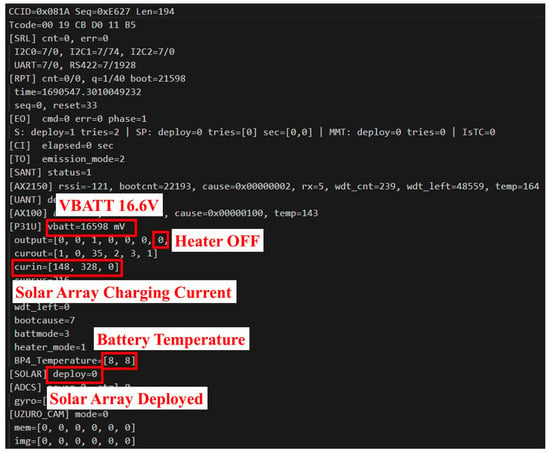
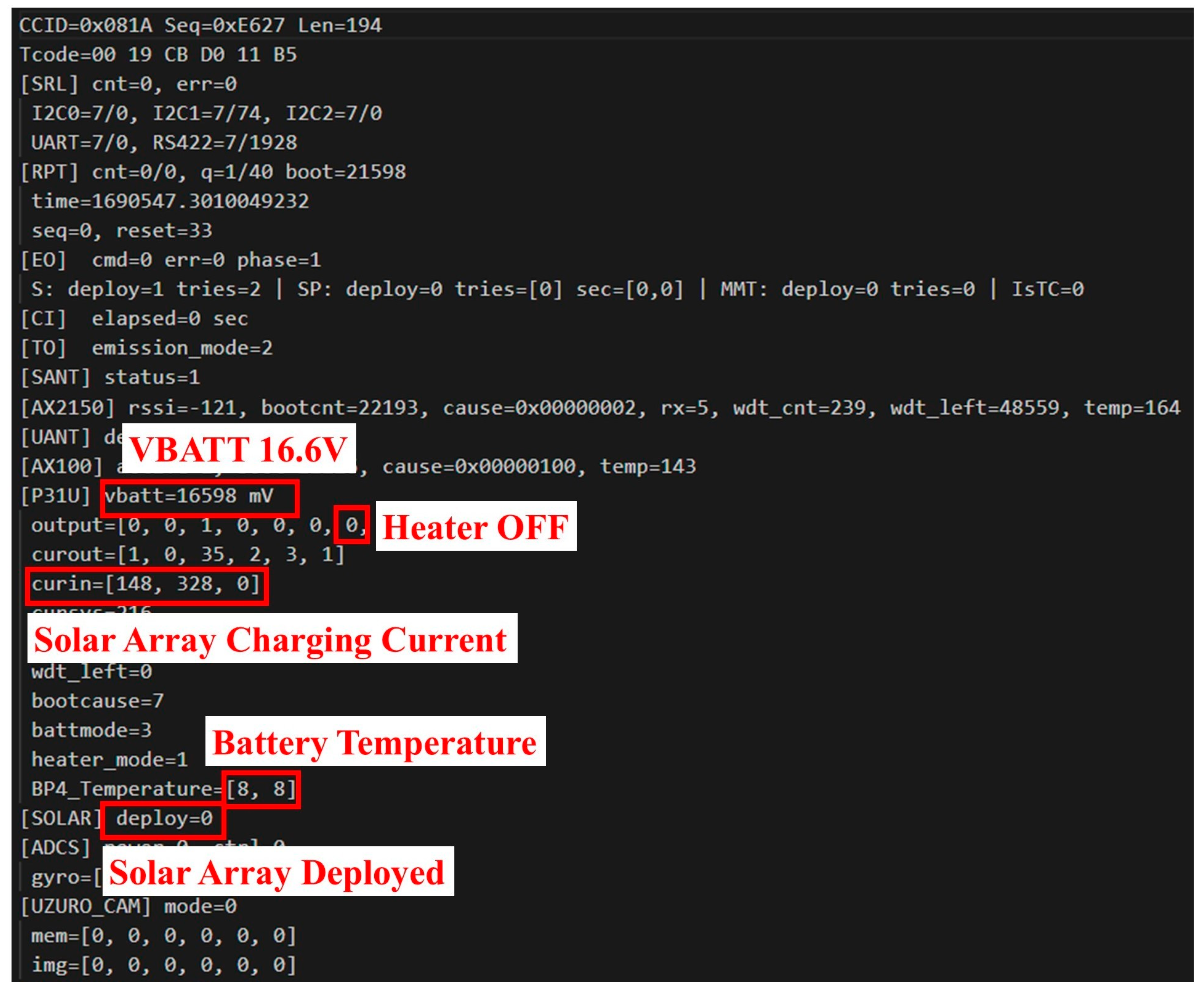
In Figure 13, the dummy [DEORBIT] data included in the beacon data was removed. The corrected Figure 13 is below:
Figure 13.
Beacon data received after recovery, confirming restoration of the satellite state following solar-array deployment.
In the last paragraph of Section 4.3, the description of the PCDU communication failure that involved references implying that the GPS RX and UZU PMD could not be operated was corrected. The text now describes only the inability to collect PCDU telemetry, execute PCDU commands, and perform switch-channel operations and is shown below:
The OBC command execution failure recurred during subsequent operations, after which further operations were temporarily not possible. The OBC subsequently recovered and returned to normal command execution state following an autonomous satellite reboot; however, a new anomaly was identified in which the OBC was unable to communicate with the PCDU. While the power input and output of the PCDU were confirmed to be functioning normally, PCDU telemetry could not be collected and commands could not be executed through the PCDU, preventing switch-channel operations. The satellite is currently in operation, and the key timeline of on-orbit operations is summarized in Table 11.
In Table 11, in the line describing Day L+151, the Status and Outcome line was corrected. The line describing the Ongoing status was also corrected.
In Section 5.1, the fourth phrase in the fifth paragraph that contained the description of the second anomaly observed was removed. Consequently, the second phrase was corrected to express that two anomalies were observed, instead of three. The corrected paragraph is below:
Beyond the mandatory launch vehicle requirements, thermal vacuum cycle testing was performed as an additional activity and proved to be one of the most effective verification activities in the COSMIC program. Over the course of two thermal vacuum cycle tests, two anomalies were identified and resolved prior to launch. During the first test, excessive OBC CPU load during beacon collection was identified, revealing a software edge case that was subsequently addressed. During the second test, the UHF antenna deployment failure caused by bottom-panel interference was identified and resolved through hardware redesign. In addition, the worst-case solar array deployment time, approximately 40 s as measured under cold and vacuum conditions, was directly adopted as the burn time for the on-orbit solar array deployment command. As described in Section 4.2, this value proved critical in the successful recovery of the satellite following the initial orbit anomaly, demonstrating the practical value of thermal vacuum cycle testing even in a resource-constrained development environment.
In Section 5.2, the second and third phrases of the second paragraph were corrected, and the analysis of the anomaly involving intermittent PCDU communication failures observed when power was supplied to the UEL payload during the second thermal vacuum cycle test was removed. Accordingly, the content related to A-05 in the previous version of the manuscript was removed, and the subsequent anomaly IDs were renumbered. The corrected second and third phrases of this paragraph are below:
These included interface, software, and mechanical deployment issues. In particular, the ADCS–OBC CAN communication issue (A-02), the CSP-library-related software edge case (A-03), and the UHF antenna deployment failure (A-04) were identified through system-level or environmental testing.
Table 14 was corrected as well, and the content related to A-05 was deleted; the subsequent anomaly IDs were renumbered.
The Author Contributions Section was corrected to state the contributions of the four newly added authors.
The Acknowledgments Section was corrected to acknowledge the institutions that supported the CubeSat work.
The Conflicts of Interest statement was revised to clarify the role of the funding organizations. The revised statement is as follows:
The authors declare that this study received funding from UZURO Tech Inc. and Unmanned Exploration Laboratory (UEL). The funders were not involved in the study design, collection, analysis, interpretation of data, the writing of this article or the decision to submit it for publication.
2. Explanation
Corrections were made to the author list and the content of the original publication [1], such as expressions that could imply that COSMIC was developed solely by Yonsei University or was owned by the university, which were removed or corrected. In addition, payload-related information that could be considered sensitive by the participating companies was removed.
Upon the authors’ and Yonsei University’s request, four additional authors were added to the author list. Dae-Eun Kang, Dooyoung Jeong, Hyeokjin Kweon, and Jaeheon Cheong were added as the third, fourth, fifth, and sixth authors. A third affiliation was added as well. The authors state that the scientific conclusions are unaffected. This correction was approved by the Academic Editor. The original publication has also been updated.
The Conflicts of Interest statement was revised to explicitly disclose the funding sources and clarify that the funders had no involvement in the research process or publication decision.
Reference
- Park, D.; Eun, Y.; Kang, D.-E.; Jeong, D.; Kweon, H.; Cheong, J.; Park, S.-Y. Verification and Testing of a Resource-Constrained CubeSat: On-Orbit Results and Lessons Learned from COSMIC. Aerospace 2026, 13, 654. [Google Scholar] [CrossRef] [Scilit]
Disclaimer/Publisher’s Note: The statements, opinions and data contained in all publications are solely those of the individual author(s) and contributor(s) and not of MDPI and/or the editor(s). MDPI and/or the editor(s) disclaim responsibility for any injury to people or property resulting from any ideas, methods, instructions or products referred to in the content. |
© 2026 by the authors. Licensee MDPI, Basel, Switzerland. This article is an open access article distributed under the terms and conditions of the Creative Commons Attribution (CC BY) license.