


Abstract
As an innovative application of wireless sensor networks (WSNs), the Solar Insecticidal Lamp Internet of Things (SIL-IoTs) is widely deployed for green pest control. However, existing deployment strategies commonly assume homogeneous energy-harvesting capabilities among nodes and mandate full coverage, thereby overlooking the realities of uneven solar irradiation and budget constraints in complex 3D terrains. To address these issues, this paper investigates the SIL deployment problem using real DEM data. We first introduce a 3D coverage model alongside a terrain-based solar energy weight model, and formulate the task as a partial coverage optimization problem constrained by both energy harvesting and budget limitations. To solve this problem and avoid premature convergence, we propose an Improved Jumping Particle Swarm Optimization (IJPSO) algorithm. Experimental results on benchmark datasets and DEM-based 3D terrain simulations demonstrate that IJPSO outperforms six competing algorithms, achieving average relative percentage deviations (RPD) of 0.045% and 0.140% and average 3D deployment objective values of 62.27 and 84.37 under the 80% and 90% coverage constraints, respectively. These results demonstrate the effectiveness of IJPSO in reducing deployment costs while maintaining solution consistency.
1. Introduction
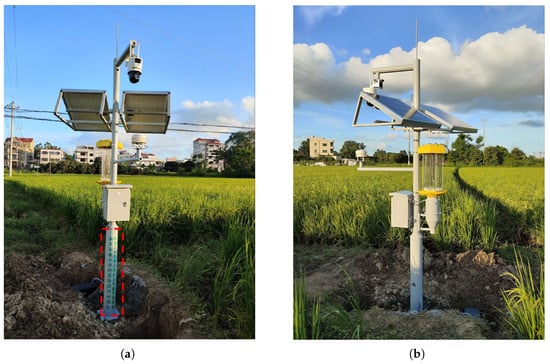
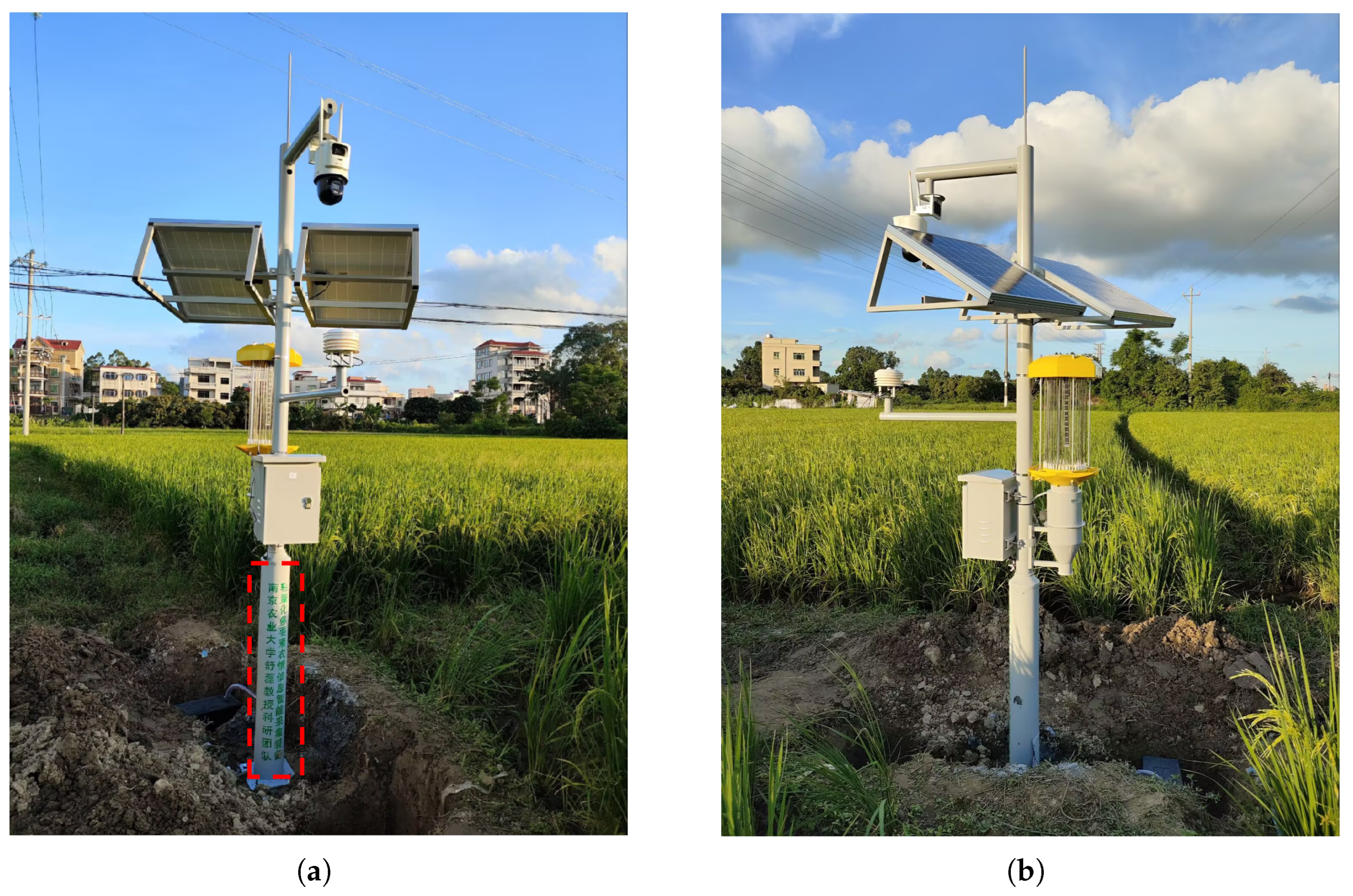
In recent years, the excessive use of chemical pesticides in traditional agriculture has caused severe environmental pollution and food safety issues. To improve agricultural management and sustainability, wireless sensor networks (WSNs) and the Internet of Things (IoT) have been widely adopted in smart agriculture [1,2,3]. Meanwhile, as a green and physical pest control alternative, solar insecticidal lamps (SILs) have gained significant attention [4,5]. By integrating traditional SIL with agricultural WSNs, the concept of solar insecticidal lamps Internet of Things (SIL-IoTs) has been proposed to achieve real-time monitoring and automated pest control. In SIL-IoTs, each SIL shown in Figure 1 acts as an intelligent agricultural IoT node equipped with communication and pest-control capabilities. SILs use phototaxis to attract and control pests, especially moths, beetles and flies [6]. Specifically, the IoT technology is utilized through the integration of communication hardware, which transforms the SIL into a connected node capable of real-time data collection and remote management. However, deploying SIL nodes in complex agricultural environments involves large-scale combinatorial optimization problems due to terrain constraints, energy variations, and coverage requirements. Artificial intelligence (AI)-based computational intelligence methods, particularly meta-heuristic optimization algorithms, provide effective solutions for such deployment problems by searching high-quality configurations under complex constraints.
Figure 1.
Diagram of nodes in SIL-IoTs: (a) rear view of SIL node; (b) side view of SIL node. The content in red dashed box indicates “Nanjing Agricultural University, Team of Professor Lei Shu” and “Compact Multi-Parameter Intelligent Agricultural Data Acquisition System”.
In the context of SIL-IoTs, node deployment is a critical issue that directly affects pest control efficiency and network construction costs. Generally, the coverage problem in IoT can be classified into area coverage, target coverage, and barrier coverage [7,8]. For SIL-IoTs, the deployment is fundamentally an area coverage problem, which aims to optimize the positions of SIL nodes so that their coverage ranges effectively cover the agricultural region of interest. Unlike general WSNs where sensors can often be placed arbitrarily, SILs cannot be randomly deployed across farmland, as doing so would interfere with routine agricultural machinery operations. Therefore, in practice, SIL placement is restricted to a set of feasible locations, referred to as candidate locations, which are typically located on ridges or field boundaries. In SIL systems, photovoltaic panels harvest solar energy during the daytime and store it in capacity-limited batteries (e.g., lead–acid batteries) to power nighttime insecticidal operations. However, due to the limited energy storage capacity of the batteries, SIL nodes deployed in shaded locations with insufficient sunlight are prone to battery deep discharge and premature shutdown during peak nocturnal pest activity hours [9]. To further account for such non-uniform solar energy distribution in complex terrains, we assign a weight to each candidate location quantifying its solar harvesting potential. Consequently, the SILs deployment problem becomes: select a subset of candidate locations that collectively cover the target area while minimizing total weight. Mathematically, this is formulated as a weighted set coverage problem (WSCP) [10,11,12].
Although extensive studies have addressed SIL deployment, most existing strategies focus on 2D planar environments and overlook the severe Line-of-Sight (LOS) degradation caused by undulating 3D terrain. In practical mountainous settings, the constantly changing elevation and slope orientation compromise sensing coverage and cause highly uneven solar energy distribution across candidate locations. Furthermore, given the stringent budget constraints typical of real-world applications, a partial coverage solution is often more practical and cost-effective than a full coverage strategy [13,14].
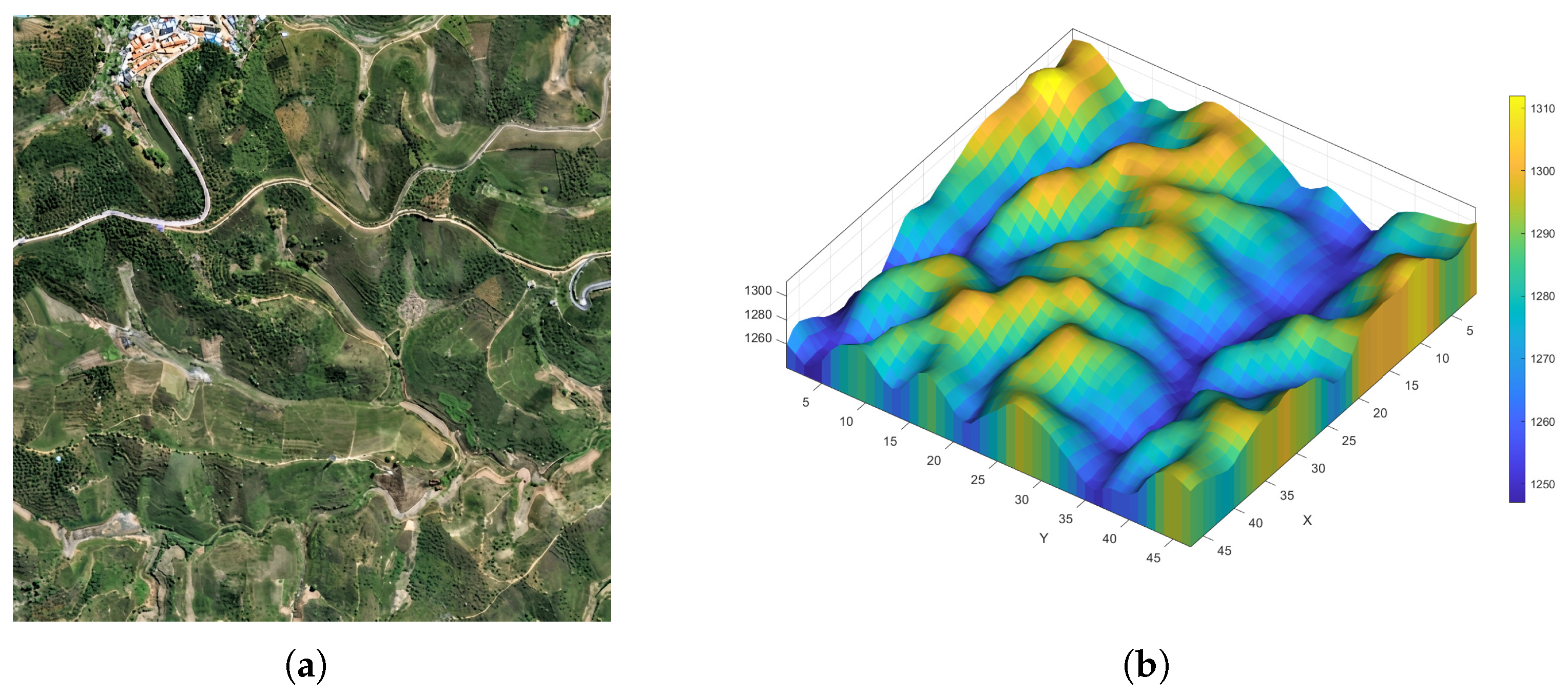
Motivated by these limitations, this paper investigates the SIL deployment problem (SILDP) in 3D mountainous environments. We introduce a 3D coverage model with strict LOS constraints and a terrain-based solar weight model. In practice, SIL nodes can be equipped with various communication interfaces—including short-range (e.g., WiFi, ZigBee), low-power wide-area (e.g., LoRa, NB-IoT), and cellular (e.g., 4G/5G) modules—allowing flexible adaptation to different application scenarios [15,16,17,18]. Since the specific communication technology can be tailored to the deployment environment, and given that the primary challenge addressed in this work is prevention and control coverage rather than network connectivity, we do not incorporate inter-node connectivity constraints into our optimization model. An actual mountainous terrain shown in Figure 2 is studied in this paper and the main contributions of this paper are summarized as follows:
Figure 2.
A mountainous terrain in Xishuangbanna, Yunnan, China ( N, E): (a) real satellite image. (b) Simulated 3D mountain.
- We develop a terrain-based solar weight model that quantifies the uneven distribution of solar energy caused by complex 3D terrain, providing a realistic energy evaluation for candidate locations.
- We propose an improved jumping particle swarm optimization (IJPSO) algorithm to solve the SILDP with partial coverage constraints.
- We conduct extensive simulation experiments on benchmark datasets and real 3D map data to validate the superiority and stability of the proposed approach.
The remainder of this article is organized as follows. In Section 2, we review related work. In Section 3, we introduce basic models and formulate the SILDP. In Section 4, we describe the problem studied. Next, the proposed IJPSO algorithm is described in detail in Section 5. We provide simulation results and discussions in Section 6. Finally, we conclude this article in Section 7.
2. Related Work
To address the area coverage problem in SIL-IoTs, various deployment strategies and optimization algorithms have been proposed. Early studies mainly focused on achieving complete area coverage while optimizing fundamental network metrics. For example, a meta-heuristic strategy was proposed in [19] to simultaneously minimize SIL nodes and maximize the coverage overlap rate. Specifically, irregular farmlands with penetrable obstacles were divided into multiple natural partitions, and deployment was formulated as a quadratic assignment problem to iteratively optimize node distribution. Considering location-dependent installation costs, ref. [10] formulated a weighted set cover problem to minimize deployment expenses while maximizing the total weight of pre-specified candidate locations on field ridges. To ensure reliable network communication, ref. [20] introduced a hole-aware greedy approximation algorithm for the connected set cover problem, achieving both full coverage and seamless network connectivity. This approach was further extended in [21,22] to address practical constraints under strict connectivity requirements. Specifically, ref. [21] incorporated agricultural workers’ walking trajectories to quantify and minimize routine maintenance costs, while [22] adopted a probabilistic coverage model instead of the traditional disk model to more accurately evaluate complete area -probability coverage under realistic sensing decay.
However, considering complete coverage is often infeasible in real-world scenarios due to strict budgets, recent research has shifted toward partial coverage strategies. In this context, approximation algorithms were designed in [23] to maximize effective coverage under a limited maintenance budget by mapping the deployment task to a budgeted maximum coverage problem. Similarly, ref. [24] addressed partial coverage constrained by uneven energy-harvesting capabilities, formulating the deployment as a quota node-weighted Steiner tree problem to optimize candidate locations based on their actual sunshine duration. To overcome the limitations of discrete coverage evaluation, a recent study in [25] proposed a surrogate-aided multi-objective particle swarm optimization algorithm. By replacing traditional binary hard-thresholds with a Gaussian-smoothed coverage model, this method simultaneously optimizes deployment cost, smooth coverage rate, overlap rate, and coverage uniformity.
Furthermore, the scope of SIL-IoTs has continuously expanded to accommodate multifunctional agricultural demands. To combine pest control with intruder monitoring, the authors in [26,27] studied camera-integrated solar insecticidal lamps, establishing an internet of video things architecture. These studies utilized bi-level optimization to simultaneously handle the omni-directional sensing range of insecticidal lamps and the directional sensing angle of surveillance cameras.
Recent research has also extended SIL deployment to 3D agricultural surfaces. The authors in [28] developed a 3D surface coverage model for terraced tea plantations, representing the terrain using rotated quadratic surfaces while accounting for tea tree height, lamp installation height, and ridge-constrained placement. They introduced a coverage additional benefit metric to evaluate the trade-off between coverage benefits and deployment costs. A collaborative optimization mechanism was then developed by coupling gradient-direction and planar-direction deployment through two mixed-integer programming models.
To compare the aforementioned work, a summary of typical studies on SIL deployment is presented in Table 1. We can observe that the majority of existing studies focus on 2D planar environments. They generally ignore the Line-of-Sight (LOS) effects and terrain occlusions in realistic 3D mountainous terrains, which inevitably results in sensing blind spots and pest control failures in 3D environments. Moreover, while a few studies have employed meta-heuristic algorithms such as [19,25], most of these studies [10,20,21,22,23,24,26,27] rely on approximation algorithms to obtain solutions, lacking the global exploration mechanisms necessary to escape local optima in complex topographies. Although some studies have taken into account ridge constraints, maintenance trajectories, or camera monitoring, they also fail to consider the crucial impact of solar weights among different candidate locations in a 3D spatial context. Regarding energy and cost evaluation, while certain works such as [10,21,22] incorporate location weights to reflect installation expenses, they fail to consider the crucial impact of uneven solar energy distribution caused by terrain elevations and dynamic shading. Furthermore, although recent research like [24] accounts for the potential of solar energy harvesting, its formulation is strictly confined to a 2D context, fundamentally ignoring obstacle occlusions and elevation variations present in realistic 3D mountainous environments. Although [28] extends SIL deployment optimization to 3D terrain, it does not consider the spatial heterogeneity of solar energy-harvesting potential across different candidate locations.
Table 1.
Comparison of recent studies on SIL node deployment.
To address the aforementioned limitations, this paper investigates SILDP in realistic 3D mountainous environments. Specifically, we formulate a 3D coverage model with LOS constraints and propose the IJPSO algorithm to optimize partial coverage while minimizing the terrain-induced solar weight.
3. Preliminaries
To mathematically formulate the SILDP, the target environment is established on a realistic 3D mountainous terrain generated from actual DEM data. The real terrain surface is discretized into a set of target points M and a set of candidate locations N. Thus, the deployment task is transformed into finding a subset that minimizes the total solar weight, while fulfilling the specified partial coverage constraints under the LOS model.
3.1. 3D Coverage Model with LOS Constraints
In 3D mountainous environments, the traditional 2D binary coverage model is insufficient due to complex terrain obstacles and elevation variations [29,30,31,32]. Unlike flat farmlands, mountainous topographies can easily obstruct the propagation of the attractant light emitted by the lamps. Consequently, evaluating coverage only based on horizontal or even simple 3D Euclidean distance overestimates the actual effective pest-killing area. Therefore, a target point is considered as covered by a node only if two physical conditions are met: the 3D spatial distance must be within the valid coverage radius , and a clear LOS must exist between them.
Let and denote the 3D spatial coordinates of the candidate SIL location i and target point j extracted from the DEM, respectively. These spatial coordinates are meticulously extracted from the DEM data of the target deployment region, ensuring that the topographical variations are accurately captured. The Euclidean distance is calculated as:
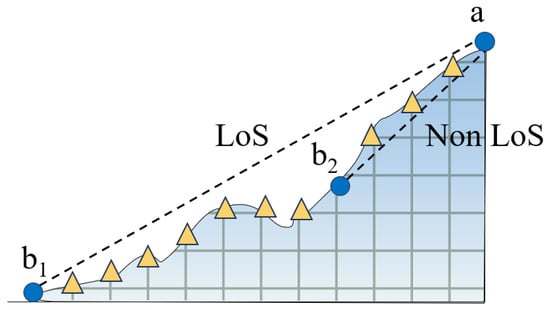
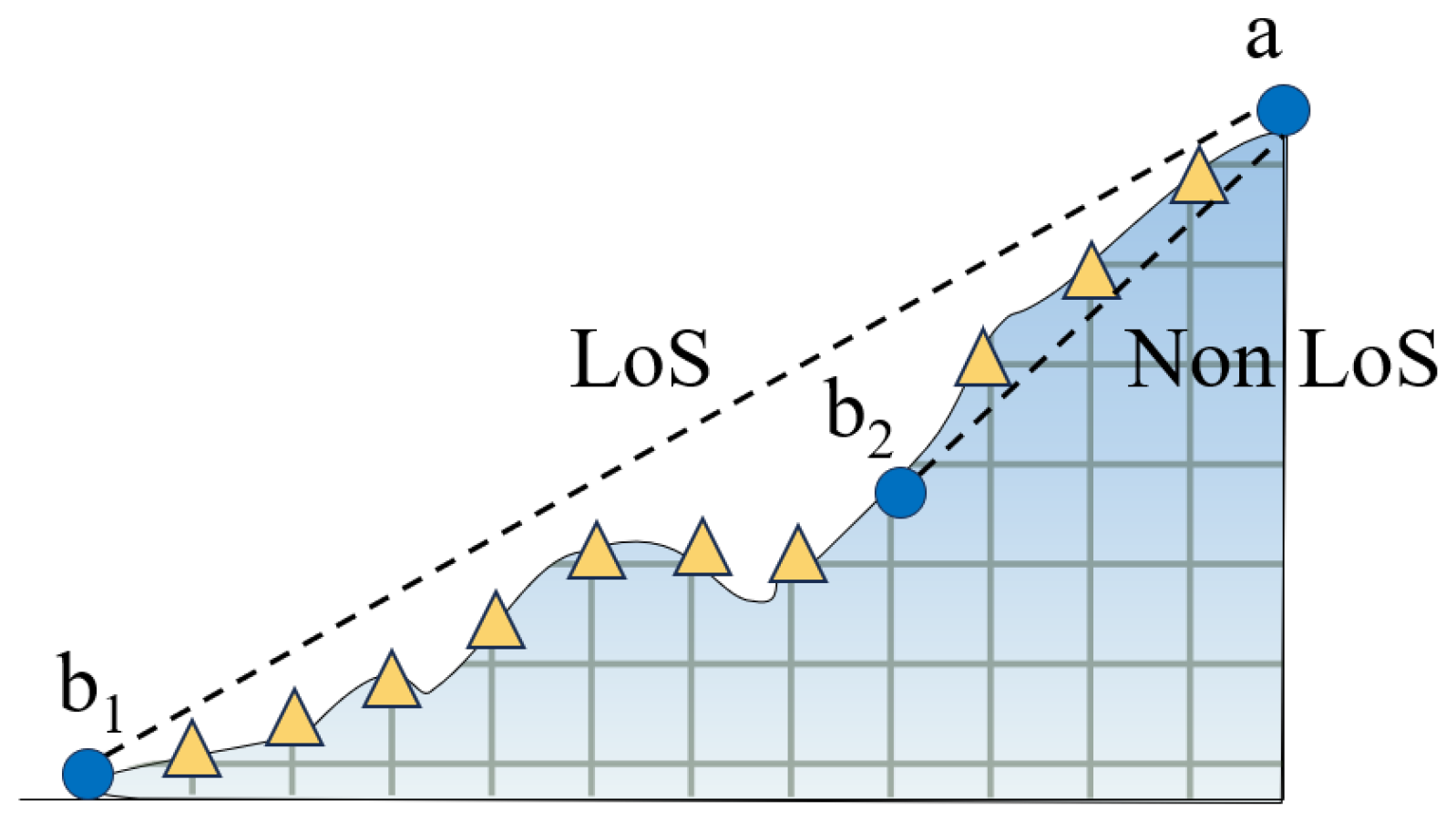
To evaluate the LOS condition, the 3D straight-line path between the two points is assessed against the DEM grid [33]. Specifically, the continuous line segment connecting the SIL and the target point is projected onto the grid. By sampling the intermediate points along this projected path, we compare the interpolated elevation of the line-of-sight ray against the corresponding actual terrain elevation provided by the DEM data. A clear LOS is successfully established only if the theoretical visual height remains strictly greater than the actual terrain elevation along the entire path; otherwise, it is considered obstructed by the terrain (as shown in Figure 3).
Figure 3.
LOS evaluation in 3D terrain (Clear LOS between a and , but no LOS between a and ).
By integrating the Euclidean distance constraint and the rigorous LOS evaluation to guarantee both spatial distance and clear visibility, the binary coverage parameter utilized in the SILDP formulation is defined as:
3.2. Terrain-Based Sunlight Calculation Model
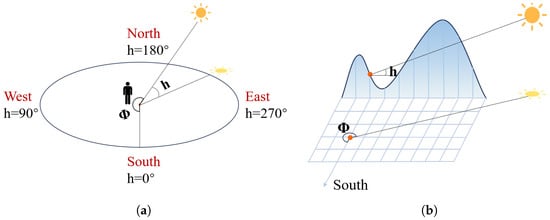
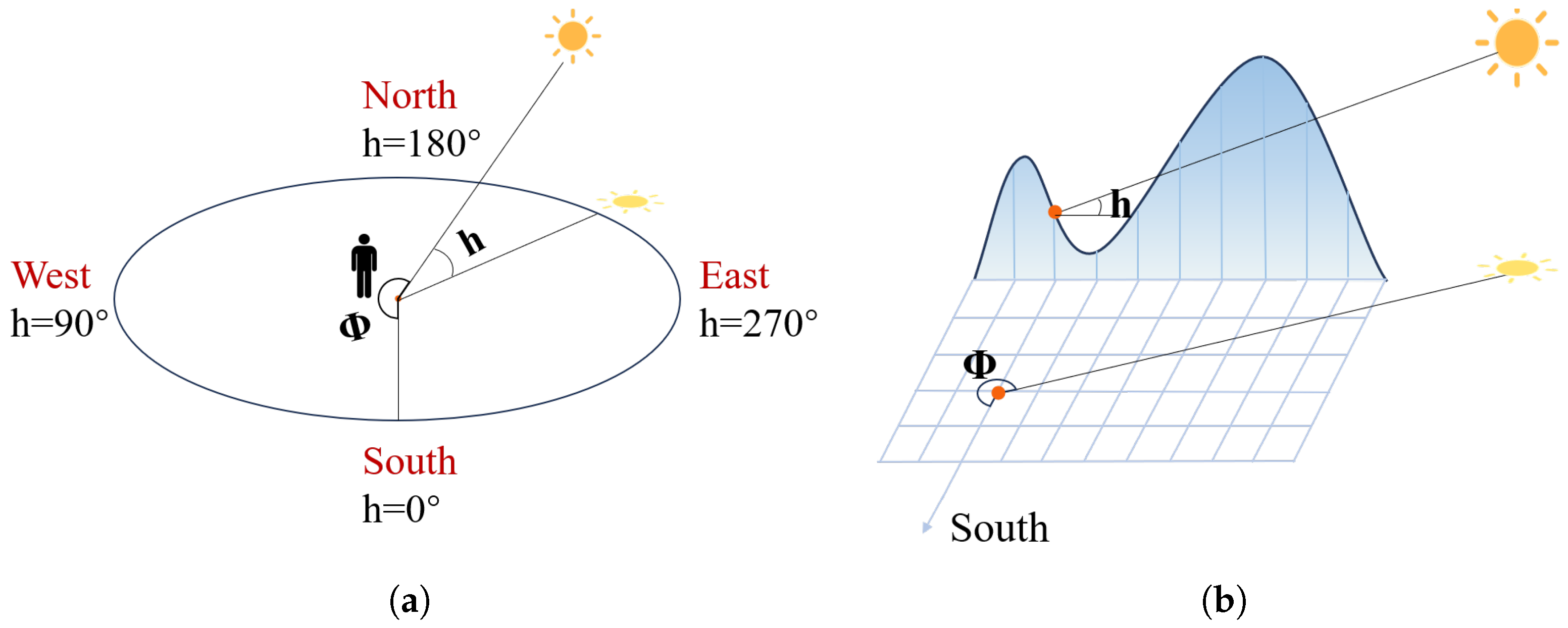
To accurately evaluate the solar energy harvest capacity of SILs, it is essential to consider terrain shading and calculate the actual sunshine duration for each candidate location. The dynamic incidence direction of sunlight is determined by the solar altitude angle h and azimuth angle (as illustrated in Figure 4a), which rely on the observation latitude, solar declination, and hour angle [34].
Figure 4.
Terrain-based sunlight calculation models: (a) solar altitude and azimuth angles determining the dynamic incidence direction of sunlight; (b) evaluation of sunlight obstruction based on theoretical ray height and actual terrain elevation.
To assess whether the sunlight is obstructed by the terrain at a specific time, the sun’s rays are projected onto the DEM grid using the aforementioned LOS mechanism. In order to capture the dynamic daily movement of the sun, its continuous trajectory from sunrise to sunset is discretized and sampled at regular 10-min temporal intervals. At any given time step, the incidence path of the sunlight is mapped onto the discrete spatial grid. For each sampling point along the light path, let be the horizontal distance from the observation location (with elevation ). The theoretical visual height of the sun’s ray at this point is calculated as:
This theoretical height is then dynamically compared with the actual maximum elevation of terrain in the adjacent DEM cells. The sunlight is considered reachable only if remains strictly higher than the terrain elevation along the entire projection path (as illustrated in Figure 4b). By accumulating the unobstructed time periods for all daylight hours and averaging them over 365 days to robustly account for seasonal variations in solar declination throughout the entire agricultural lifecycle, the annual average daily sunlight time for each candidate position is obtained [35].
Since the SIL deployment is mathematically formulated as a minimization problem, a longer sunshine duration corresponds to a lower deployment cost. Therefore, in order to align with the goal of minimizing the solar energy penalty, is normalized to a penalty weight :
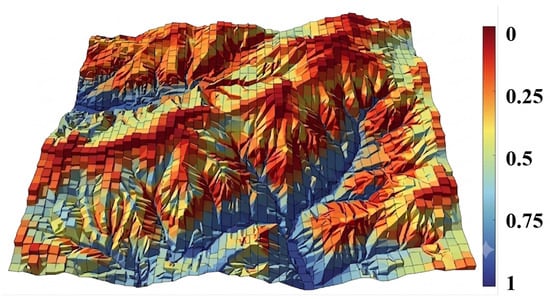
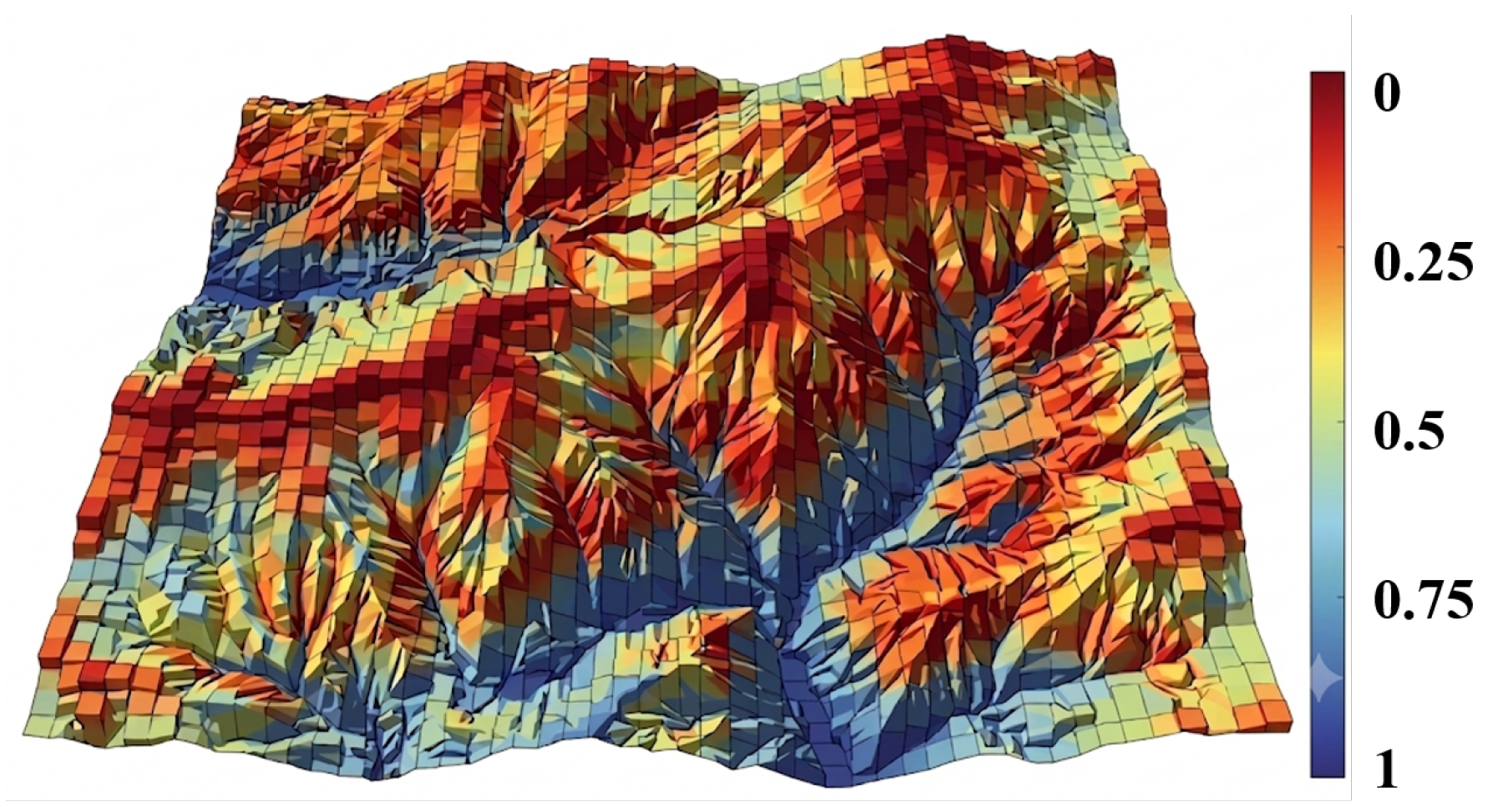
where and represent the maximum and minimum sunlight times among candidate locations, and is a small constant preventing division by zero. Sun-exposed locations, such as mountain peaks, have weights close to 0, whereas shaded valleys approach 1. Figure 5 illustrates the solar weight distribution over the 3D DEM. This terrain-aware weight matrix serves as the cost parameter for partial coverage optimization, penalizing severely shaded locations.
Figure 5.
The solar weight over the DEM grid (a lower weight indicates more abundant sunlight).
4. Problem Statement
4.1. Problem Formulation and Objective
The objective of SILDP is to minimize the total solar weight of the selected candidate locations, while satisfying a predefined partial coverage threshold . To mathematically formulate this problem, let be the decision variable indicating whether a SIL is deployed at the candidate location i, and let indicate whether target point j is counted as covered, where indicates that target point j is effectively covered by at least one deployed SIL satisfying the distance and LOS constraints. The mathematical formulation of SILDP is given as follows:
where constraint (6) guarantees the partial coverage requirement, ensuring that the total number of covered targets is not below the required threshold proportion . Constraint (7) ensures that a target is considered as covered only if at least one selected SIL covers it, thereby linking the coverage indicators to the lamp-selection variables through the coverage matrix. Constraint (8) defines the domain of the SIL deployment decision variables and coverage indicators as binary integers.
4.2. NP-Hardness Analysis
The formulated SILDP can be analyzed by mapping it to the standard weighted set cover problem, a classical combinatorial optimization problem known to be NP-hard. Given a universal set , a collection of subsets of , and a weight function , the WSC seeks a sub-collection that covers all elements in while minimizing the total cost.
For the proposed SILDP, the set of target points M corresponds to the universal set , and the set of candidate locations N corresponds to the collection of subsets . Specifically, each candidate location covers a subset of M defined by the coverage matrix , and the normalized solar weight corresponds to the weight function C.
When the partial coverage threshold is set to , constraint (6) strictly requires all target points to be fully covered. Under this condition, the standard WSC problem can be reduced to the SILDP. Since the NP-hard WSC problem is a special case of the SILDP (when ), it logically follows that the general SILDP formulated in this study is also NP-hard.
Notations used in this article are listed in Table 2.
Table 2.
Notations.
5. Proposed Algorithm
5.1. Particle Swarm Optimization
Particle swarm optimization (PSO) [36] is a heuristic algorithm based on swarm intelligence, inspired by the foraging behavior of bird flocks. Particles update their velocities and positions by tracking the best historical position of each individual and the best global position of the entire swarm. The standard formulas for updating the velocity v and position x are expressed as follows:
where and represent the velocity and position vectors of the i-th particle, respectively. The parameter acts as the inertia coefficient, while and denote the cognitive and social acceleration coefficients. and are independent random numbers uniformly distributed in the range . The variable indicates the best historical position vector found by the i-th particle, and represents the best global position vector in the entire swarm.
However, standard PSO operates in a continuous solution space, whereas SILDP is inherently a discrete combinatorial optimization problem, making direct application infeasible. To bridge this gap, Kennedy and Eberhart proposed binary particle swarm optimization (BPSO) [37]. While retaining the standard continuous velocity update mechanism, BPSO introduces a transfer function (typically the Sigmoid function) to map the real-valued velocity into a probability threshold within , as defined in (11):
Based on this probability mapping, the discrete state of the i-th particle is determined by comparing with a uniformly distributed random number , which is formulated in (12):
where and represent the velocity and the discrete state of the i-th particle, respectively.
As an extension of BPSO, JPSO replaces the traditional concept of continuous velocity with a discrete jump mechanism. In this framework, particles update their positions through four probabilistic behaviors: attraction to the current position, best personal, neighborhood, and global solutions [38,39].
5.2. Improved Jumping Particle Swarm Optimization Algorithm for SILDP
To efficiently solve the SILDP while satisfying strict spatial and energy constraints, we develop IJPSO by retaining the discrete attractor-based jumping framework of JPSO and integrating three complementary search strategies. Specifically, the proposed IJPSO introduces the following three improvements to the original JPSO:
- A hybrid population initialization strategy is used to improve the diversity and quality of the initial candidate locations.
- A time-varying attractor selection strategy is designed to dynamically adjust the influence of different attractors according to the search stage, progressively increasing the influence of the global best.
- A stagnation-triggered restart reinitializes the worst 50% of particles using a stronger weight perturbation while retaining high-quality solutions.
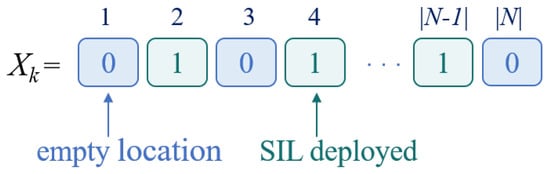
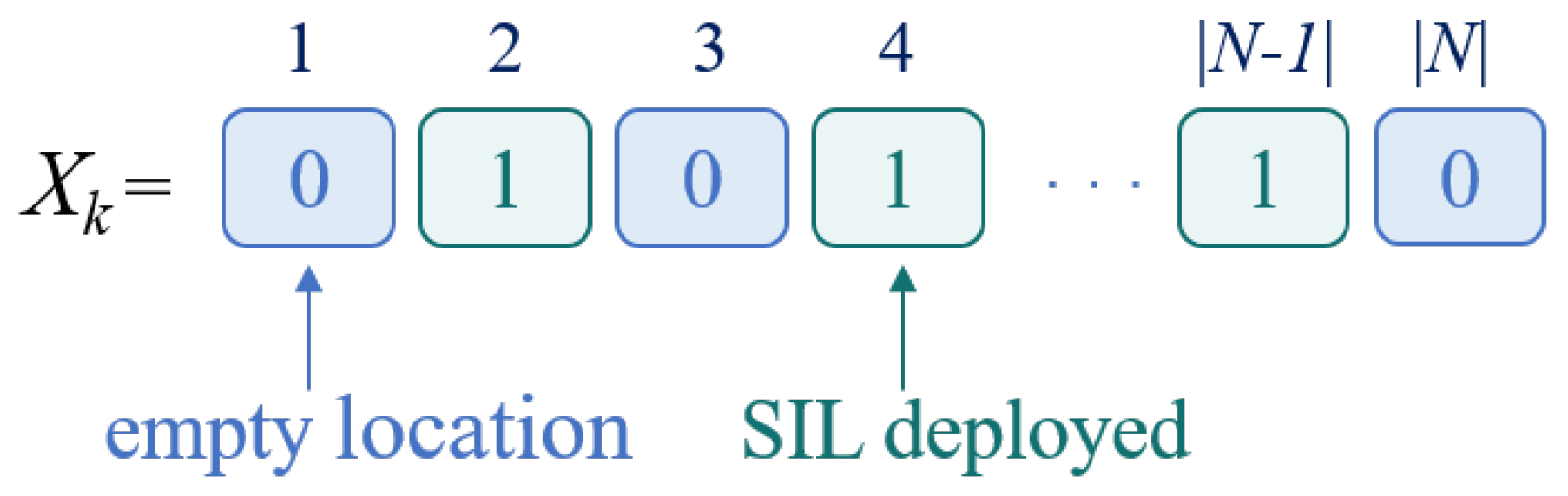
The IJPSO uses a discrete binary string to represent a solution for the SIL deployment. Specifically, the position of the k-th particle in the swarm is encoded as an -dimensional binary vector, as shown in Figure 6.
Figure 6.
Particle representation. Each dimension corresponds to a candidate location, where ’1’ denotes a deployed SIL and ’0’ denotes an empty location.
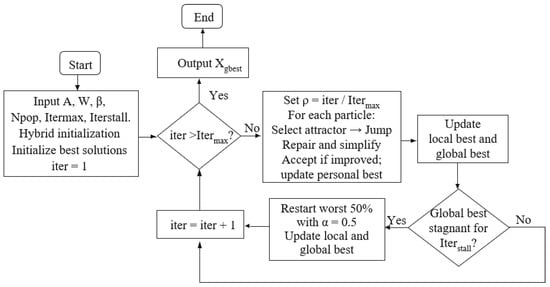
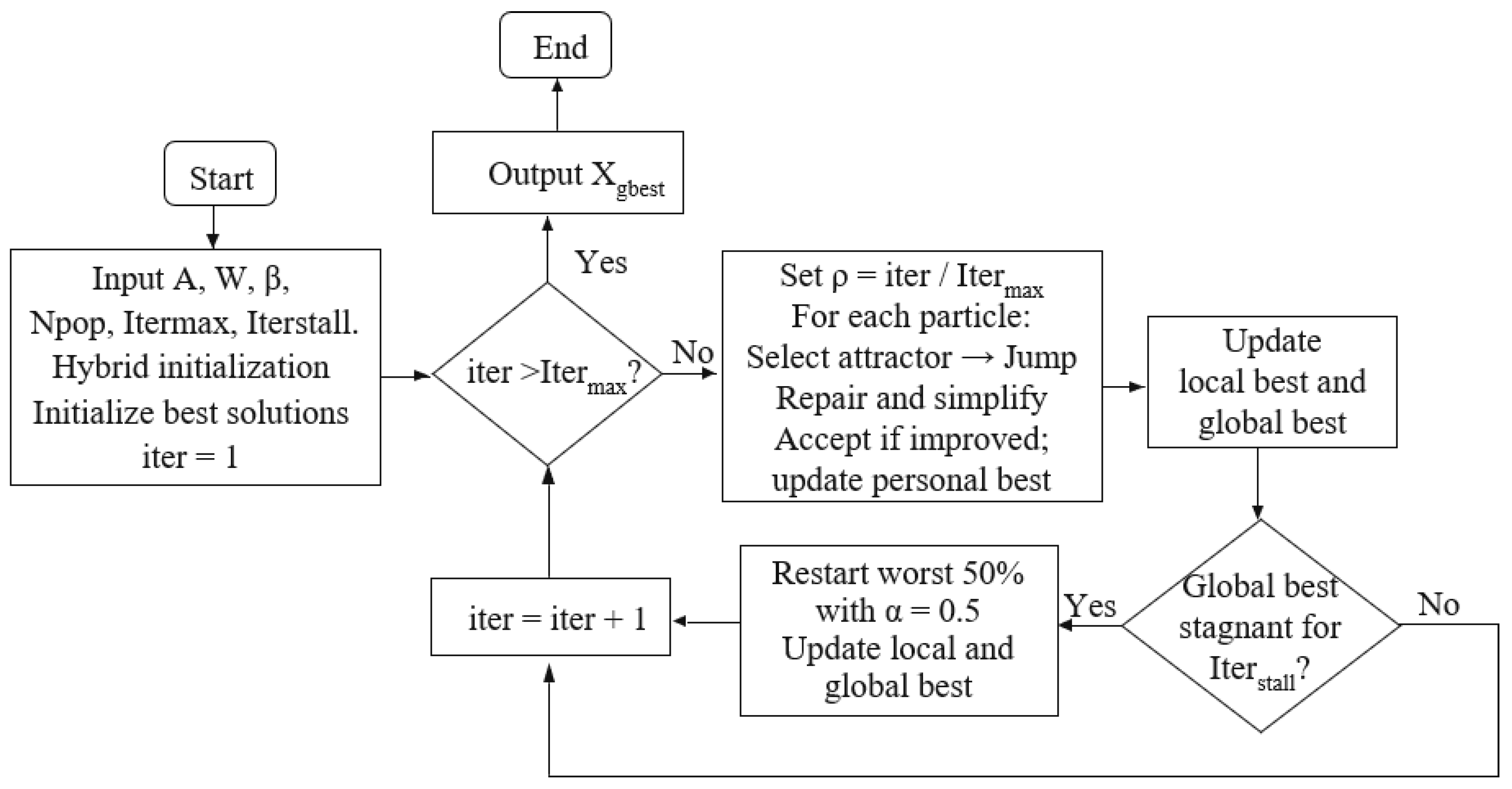
The procedure of the proposed IJPSO for SILDP is as follows: initially, a swarm containing particles is generated using a hybrid initialization strategy that combines random generation with a perturbed greedy algorithm to ensure a high-quality and diverse starting population. The position of particle k develops in the binary solution space by dynamically jumping from one discrete state to another. At each iteration, the discrete jump of particle k is guided by the following attractors: its current state (), its own best position found to date (), the best position within its local social neighborhood (), and the best global position obtained by the entire swarm ().
Following the dynamic attractor selection, each particle performs a discrete jump by probabilistically updating the selection status of candidate locations according to the corresponding selection weights. The resulting solution then undergoes repair and simplification to satisfy the partial coverage requirement and reduce the total solar weight, followed by a substitution operation for further refinement. Furthermore, a stagnation escape strategy is incorporated to perturb the swarm when the global best solution remains unchanged for a specified number of iterations.
The overall workflow of the proposed IJPSO is illustrated in Figure 7, and its detailed procedure is presented in Algorithm 1.
| Algorithm 1: IJPSO |
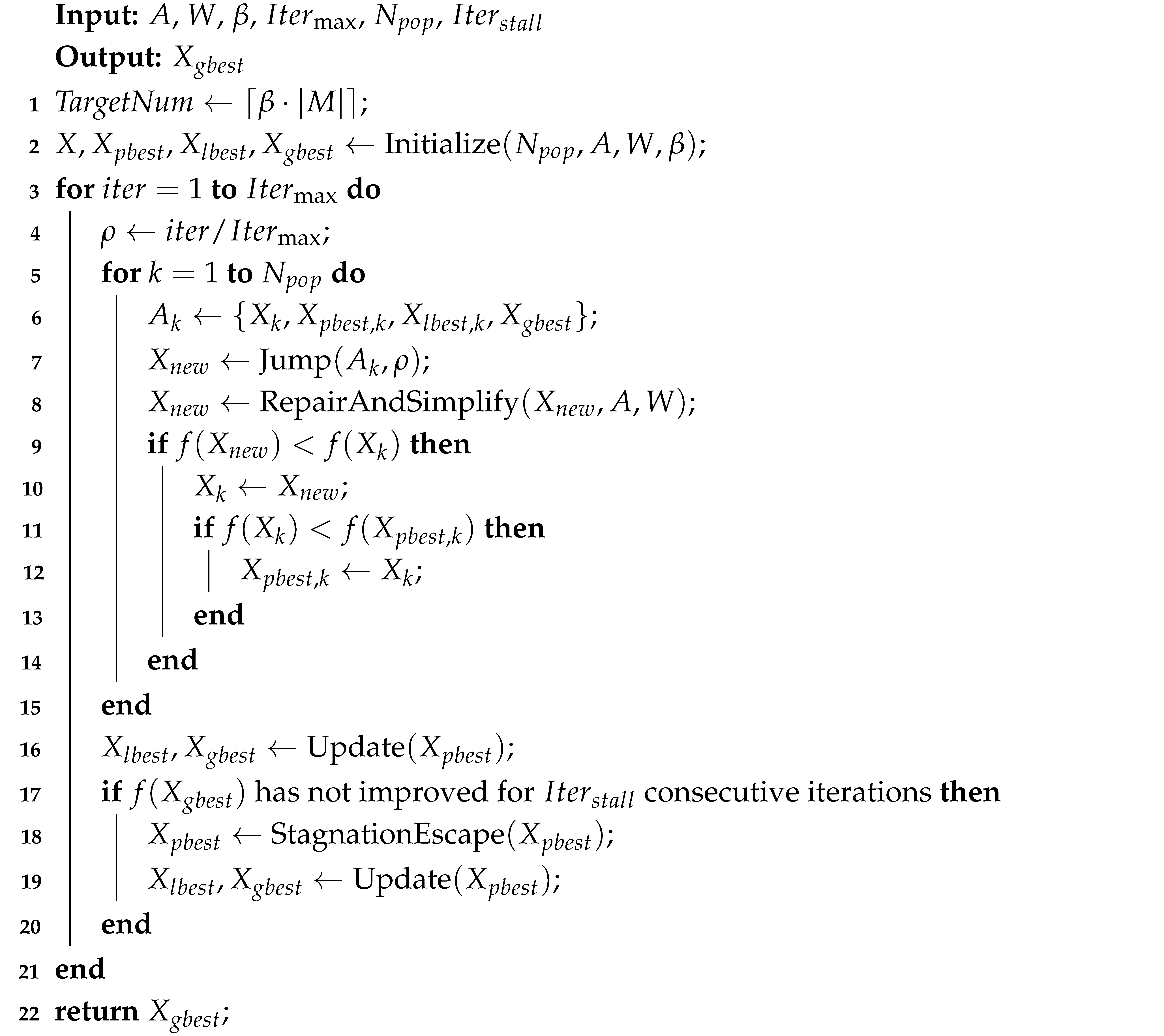 |
Figure 7.
Overall workflow of the proposed IJPSO algorithm.
5.3. Hybrid Population Initialization Strategy
To balance population diversity and initial solution quality, IJPSO employs a hybrid population initialization strategy. The swarm of particles is evenly divided into two subsets: one half is generated using a random strategy to enhance population diversity, and the other half is constructed by a perturbed greedy method to inject high-quality solutions.
To construct the greedily initialized particles without generating identical individuals, a random perturbation is introduced into the deterministic greedy method [40,41]. Before selecting the candidate locations, a perturbed virtual weight is pre-calculated for each candidate location i:
where is the original weight and is a random noise variable drawn from a uniform distribution defined by the perturbation factor (set to 0.1).
By combining random exploration and greedy exploitation, the proposed initialization strategy provides a better trade-off between population diversity and initial solution quality.
5.4. Time-Varying Attractor Selection Strategy
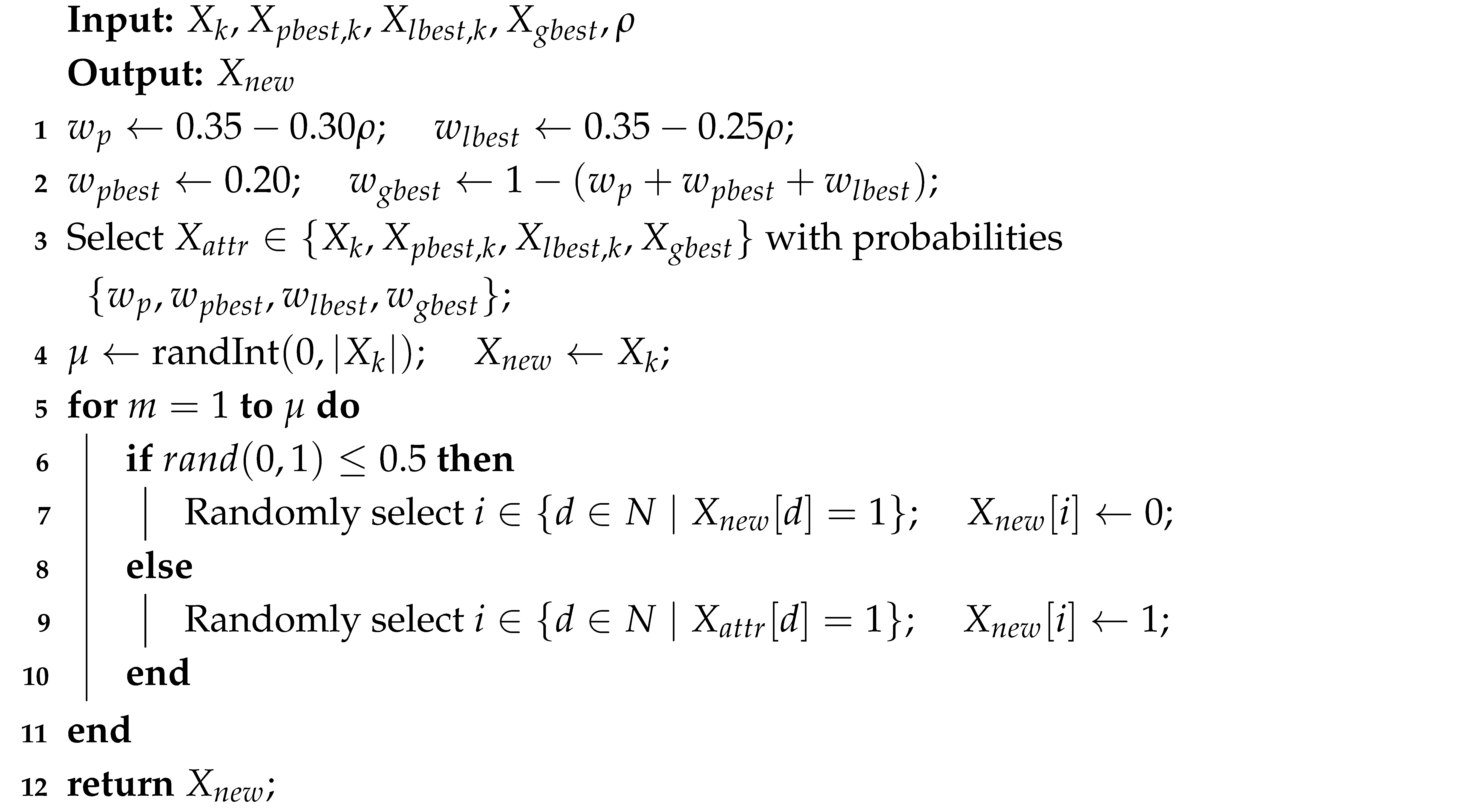
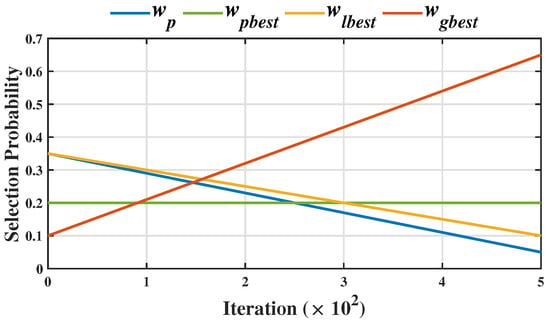
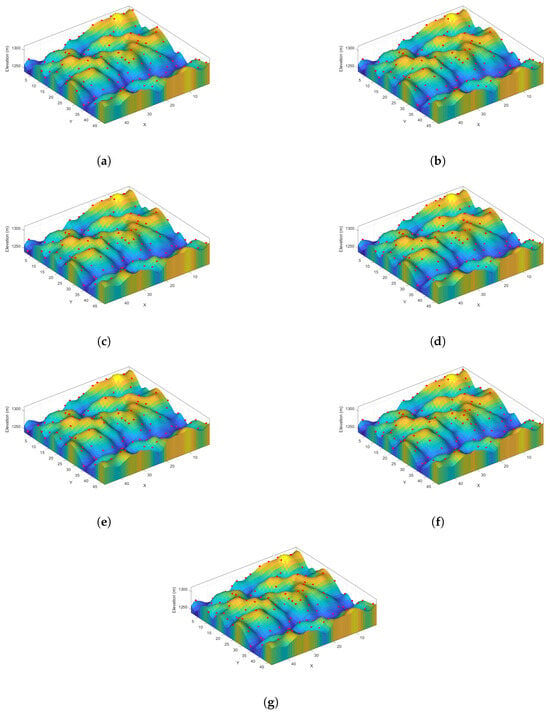
Unlike the fixed probabilities used in conventional JPSO, our time-varying strategy dynamically adjusts the selection probabilities of different attractors across various search stages [42]. As detailed in Algorithm 2 and illustrated in Figure 8, this strategy smoothly transitions the swarm’s behavior from diverse exploration in the early iterations to focused convergence in the later stages.
Figure 8.
Evolution of attractor selection probabilities, shifting the search focus from early exploration () to late convergence ().
Initially (), higher weights are assigned to the current state () and local best () to promote population diversity. As iterations progress (with the evolution ratio ), these exploration-focused weights gradually decrease. Simultaneously, the global best weight () smoothly increases to become the dominant attractor. This mechanism effectively tightens the search radius, guiding the swarm toward high-quality regions. Meanwhile, the personal best weight () remains constant to preserve stable individual search memory throughout the entire optimization process. Once an attractor is determined via roulette-wheel selection based on these adaptive probabilities, the particle executes a discrete feature jump to update its state.
| Algorithm 2: Jump |
 |
5.5. Repair and Simplification
After the discrete jump operation, the newly generated position may become infeasible if it fails to meet the coverage requirement. To restore feasibility and further reduce the deployment cost, a three-phase repair and simplification procedure is sequentially applied, as detailed in Algorithm 3. The first phase greedily adds candidate nodes to satisfy the spatial coverage target. The second phase systematically eliminates strictly redundant nodes to reduce the total weight. Finally, a deep substitution phase is executed to replace single expensive nodes with a combination of cheaper alternatives, optimizing the total deployment cost without violating the predefined coverage constraints.
| Algorithm 3: Repair and Simplification |
 |
5.6. Stagnation Escape Strategy
Although the time-varying attractor selection operator improves search performance, the swarm may still suffer from premature convergence due to the loss of population diversity. This issue is particularly common in large-scale combinatorial optimization problems such as SILDP, where particles may gradually converge toward similar attractors.
To alleviate this problem, a stagnation escape strategy is introduced [43]. When the global best solution does not improve for consecutive iterations, the worst 50% particles are reinitialized using the perturbed greedy initialization strategy described in Section 5.3. Different from the initialization stage, a larger perturbation factor () is adopted during the escape phase to generate more diverse candidate solutions. This selective replacement strategy preserves high-quality solutions while introducing new search directions, helping the swarm escape from local optima.
6. Simulation Experiment and Result Analysis
This section evaluates the proposed IJPSO through extensive simulations. We first introduce the experimental settings, followed by an ablation study and a performance comparison on standard benchmarks. Finally, the algorithm is applied to a realistic 3D mountainous deployment scenario.
6.1. Benchmark Datasets and Parameter Settings
Since the SILDP in a 3D mountainous environment is essentially a weighted set covering problem with complex spatial constraints, we conducted extensive experiments using the widely recognized OR-Library benchmark datasets to evaluate the performance of the proposed algorithm. The detailed characteristics of these test instances are summarized in Table 3. Specifically, Set denotes the benchmark group, and Inst. represents the number of test instances within each group. In the context of SIL deployment, the number of rows corresponds to the discrete target points that require coverage, while the number of columns represents the total available candidate SIL deployment locations. Finally, density indicates the percentage of non-zero entries in the coverage matrix, reflecting the combinatorial complexity of the instances.
Table 3.
OR-Library benchmark description.
The experiment selected six mainstream meta-heuristic algorithms for comparison, including the JPSO [39], novel binary artificial bee colony algorithm (nBABC) [44], NuSC [45], improved genetic algorithm (IGA) [46], binary cat swarm optimization algorithm (BCSO) [47], binary fruit fly swarm algorithm (BFFSA) [48]. Since this paper focuses on partial coverage problems, necessary modifications were made to the coverage verification logic and termination conditions of the aforementioned comparative algorithms, while strictly retaining their respective core search mechanisms. For the proposed IJPSO, the population size and maximum iterations are set to 30 and 500, respectively. The stagnation threshold is set to 50. Other algorithms follow their original parameter settings. To ensure the reliability of the experimental results, each algorithm was independently executed 15 times per test instance.
The following four core metrics are used to evaluate the algorithm performance:
- Average relative percentage deviation (Avg. RPD): The relative gap between the average solution obtained by the algorithm over multiple independent runs and the known optimal solution for that particular instance. It is calculated as follows:where represents the average objective value obtained by the algorithm in all independent runs, and denotes the optimal or best-known solution for the specific test instance.
- Best instances: The number of test instances where an algorithm achieves the best average objective value among all competitors.
- Average rank (Avg. Rank): The relative ranking position of the average solutions obtained by each algorithm across all test instances.
- Shifted geometric mean (SGM): A robust statistical metric employed to evaluate computational efficiency. This metric can prevent extremely large execution times from dominating the overall average, while also preventing extremely small times from being over-amplified. SGM successfully balances these two extremes, and its calculation method is as follows:where represents the average computational time over multiple independent runs for the i-th test instance, and n is the total number of instances. In this study, we set the shift value to . This approach provides a fair assessment by dampening the impact of both extreme outliers and negligible variations.
To further assess the statistical reliability of the experimental results, 95% confidence intervals (CIs) and statistical significance tests are introduced. For the OR-Library benchmark experiments, the 95% CIs are calculated for the average RPD across test instances, while the Wilcoxon signed-rank test is employed to evaluate the performance differences between IJPSO and the baseline algorithms based on paired instance-level RPD values. For the 3D mountainous deployment experiments, the 95% CIs are calculated for the mean objective values, and Welch’s two-sample t-test is used to assess the differences between IJPSO and the baseline algorithms. The significance level is set to 0.05, and the Holm correction is applied to account for multiple comparisons.
6.2. Effectiveness Analysis of Improvement Strategies
To evaluate individual and combined contributions of the proposed improvement strategies, a systematic ablation study was conducted. The three strategies include (1) hybrid initialization, (2) time-varying attractor selection probability, and (3) stagnation escape. Specifically, JPSO-1, JPSO-2, and JPSO-3 were constructed by independently incorporating the above strategies into the original JPSO, respectively. Similarly, JPSO-23, JPSO-13, and JPSO-12 were constructed by incorporating strategies (2) and (3), (1) and (3), and (1) and (2), respectively. The original JPSO without any improvement strategies and the complete IJPSO incorporating all three strategies were also included for comparison. All eight algorithms were evaluated under two partial coverage constraints of 80% and 90%. The experimental results, measured by average RPD, number of best instances and average rank, are presented in Table 4.
Table 4.
Ablation study results under different coverage constraints.
As illustrated by the experimental results, all three improvement strategies effectively enhance the optimization capability of the standard JPSO. Across both the 80% and 90% coverage constraints, the variants generally achieve lower Avg. RPD, a higher number of best instances, and better Avg. Ranks compared to the baseline. Among the single-strategy variants, JPSO-3 achieves the most remarkable performance improvement, highlighting the effectiveness of the stagnation escape strategy. Furthermore, the two-strategy variants JPSO-23 and JPSO-13 demonstrate competitive performance, while the complete IJPSO consistently achieves the best overall results under both coverage constraints. This superior effectiveness can be attributed to the complementary contributions of the three improvement strategies. In particular, the stagnation escape strategy introduces perturbations when the population stagnates, helping particles escape from local optima and discover higher-quality solutions in the later stages of evolution.
6.3. Comparison of IJPSO with Other Algorithms
To evaluate the overall performance of the proposed IJPSO, it was compared with six existing algorithms under 80% and 90% target coverage constraints. Each algorithm was independently executed 15 times on 63 benchmark instances. The experimental results, including average RPD with 95% confidence intervals obtained through bootstrap resampling across the 63 benchmark instances, number of best instances, average rank, and SGM, are summarized in Table 5. Statistical significance was assessed using the Wilcoxon signed-rank test on paired instance-level RPD values, with Holm-adjusted p-values for multiple comparisons, where “+” indicates that IJPSO significantly outperforms the corresponding algorithm at the 0.05 significance level. These results provide a comprehensive evaluation of IJPSO in terms of solution quality, computational efficiency, and statistical reliability.
Table 5.
Comparison results of algorithms under different coverage constraints.
Regarding solution accuracy, IJPSO performs the best at both coverage thresholds, achieving the lowest Avg. RPD of 0.045% at 80% coverage and 0.140% at 90% coverage. When the coverage requirement increases from 80% to 90%, the feasible solution space becomes more constrained, posing additional challenges for optimization algorithms. Traditional algorithms such as IGA exhibit relatively poor optimization performance, recording the highest Avg. RPD of 4.427% and 3.501% under the two coverage constraints, respectively. In contrast, IJPSO finds the highest number of Best Instances (62 and 60) and maintains an excellent Avg. Rank close to 1.0 (1.03 and 1.05). Compared with the standard JPSO, IJPSO reduces the Avg. RPD from 0.191% to 0.045% and from 0.318% to 0.140% under the two coverage constraints, respectively, demonstrating that the proposed improvement strategies effectively enhance optimization performance.
For computational efficiency, the SGM metric shows a clear trade-off between speed and search capability. NuSC is the fastest method (averaging under 2 s) due to its local approximation design. However, its relatively limited global search capability is associated with higher RPD values and less competitive deployment solutions. On the other hand, BCSO and nBABC require substantially more computational time (approximately 153 to 541 s) without achieving better solution quality. IJPSO achieves a favorable balance between accuracy and efficiency, delivering the best solution quality within a reasonable computational time (approximately 48 to 51 s). Although it takes slightly longer than the standard JPSO, it achieves lower deployment costs and better overall optimization performance.
6.4. Application of IJPSO in SILDP on the Surface of 3D Mountains
To evaluate the proposed algorithm under realistic terrain conditions, a 3D SIL deployment simulation is conducted using real DEM data. The geographical data are acquired from the EarthExplorer platform (USGS EarthExplorer: https://earthexplorer.usgs.gov/, accessed on 1 October 2025) and processed and cropped using QGIS software (QGIS: A Free and Open Source Geographic Information System; https://qgis.org/) to construct a 3D terrain elevation matrix. The 3D coordinates of target points and candidate locations are then extracted from this matrix. Based on these coordinates, the binary coverage matrix A is constructed jointly considering the 3D distance and LOS constraints. The solar weight vector W for the candidate locations is calculated using the terrain-based sunlight model. Together with the prescribed partial coverage threshold , the coverage matrix and the solar weight vector constitute inputs for the deployment problem.
The map characteristics and deployment settings are summarized in Table 6. Each candidate location corresponds to a binary decision variable, resulting in a 576-dimensional search space. The population size and maximum number of iterations are kept consistent with the preceding benchmark experiments. This case study is conducted entirely in simulation, without field deployment of SILs.
Table 6.
Simulation settings for SIL deployment on 3D terrain.
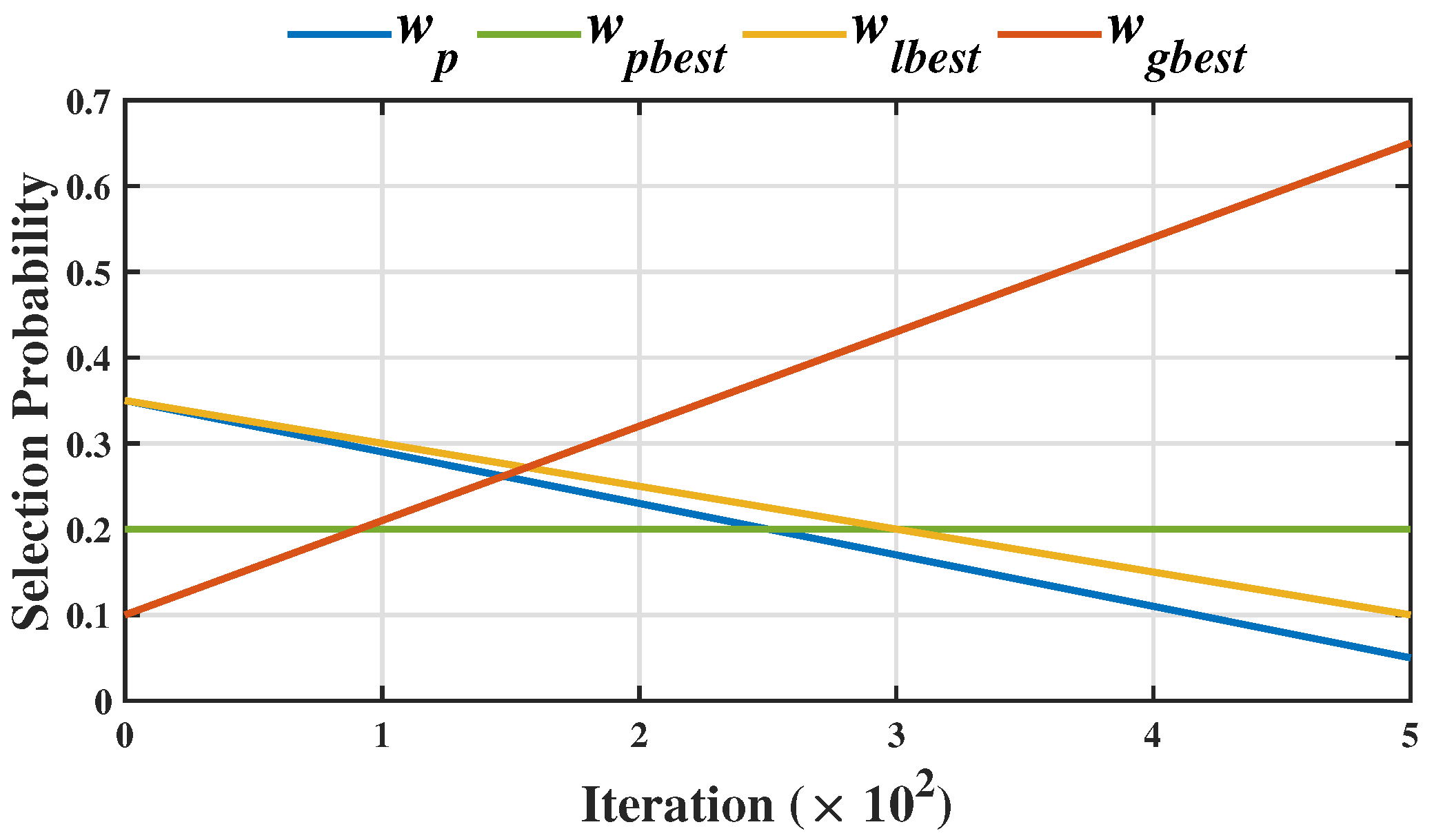
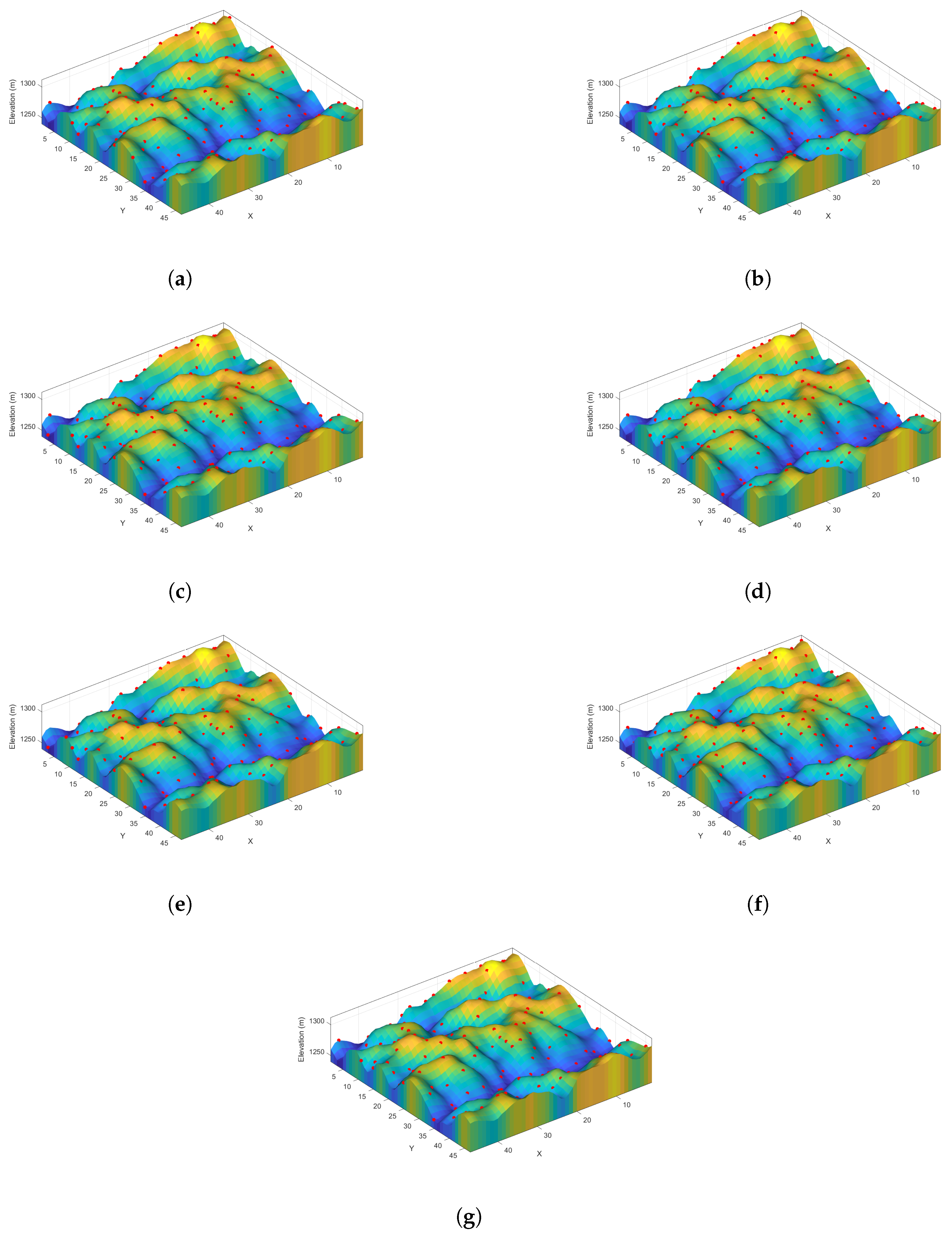
IJPSO is compared with the aforementioned algorithms under partial coverage requirements of 80% and 90%. Table 7 summarizes the results of 15 independent runs for each algorithm under each coverage requirement, including the best-found objective value, average objective value with 95% confidence intervals, variance, and average number of selected nodes. The confidence intervals are calculated using the Student’s t-distribution, while statistical significance is assessed using Welch’s t-test with Holm’s correction for multiple comparisons. The symbol “+” indicates that IJPSO significantly outperforms the corresponding algorithm at the 0.05 significance level. Figure 9 illustrates the simulated spatial distributions of the SILs selected by the different algorithms from a representative run.
Table 7.
Results of 3D mountain deployment under different coverage constraints. (Best and second-best results are bolded and underlined, respectively.)
Figure 9.
3D spatial distribution of SIL nodes deployed by different algorithms in a representative run under the 80% coverage constraint: (a) BCSO; (b) BFFSA; (c) JPSO; (d) nBABC; (e) NuSC; (f) IGA; and (g) IJPSO.
As shown in Table 7, IJPSO achieves the lowest average objective values (62.27 and 84.37) under the 80% and 90% coverage constraints, respectively. Regarding the best-found objective values, IJPSO obtains the lowest value of 84.33 under the 90% coverage constraint, while BFFSA achieves a slightly lower value (62.18 versus 62.22) under the 80% constraint. Compared with JPSO, IJPSO reduces the average objective values by approximately 0.21% and 0.24% under the two coverage constraints, respectively. Although these improvements are relatively modest, IJPSO exhibits lower variances (0.0010 and 0.0033) than JPSO (0.0027 and 0.0086), indicating reduced run-to-run variability in the obtained solutions. Although NuSC achieves nearly zero variance under the 80% coverage constraint, its average objective value remains higher than that of IJPSO, indicating that lower variability does not necessarily correspond to better solution quality. Furthermore, the 95% confidence intervals and statistical significance tests provide additional evidence of the performance advantages of IJPSO.
Regarding the average number of deployed nodes, BFFSA uses slightly fewer nodes (155.9 and 185.0) compared to IJPSO (156.3 and 185.3). However, IJPSO consistently achieves lower average objective values under both coverage constraints. This suggests that IJPSO does not simply minimize the number of selected nodes but effectively identifies high-quality deployment locations with lower solar weights, demonstrating its effectiveness in the simulated mountainous deployment scenario.
7. Conclusions and Future Work
This paper investigated the optimal deployment of SILs in complex 3D mountainous environments. To accurately reflect real-world physical constraints, we explicitly constructed a 3D coverage model with LOS constraints and a terrain-based solar weight model. The SILDP was formulated as a discrete optimization task aimed at minimizing the total solar weight while satisfying a predefined partial coverage threshold. To effectively solve this NP-hard problem, we proposed an IJPSO algorithm. By integrating a hybrid initialization strategy, a time-varying attractor selection mechanism, and a stagnation escape strategy, IJPSO effectively mitigates premature convergence in complex optimization landscapes. Experimental results on 63 OR-Library benchmark instances show that IJPSO achieves average RPDs of 0.045% and 0.140% under the 80% and 90% coverage constraints, respectively. Furthermore, in DEM-based 3D deployment simulations, IJPSO obtains average objective values of 62.27 and 84.37, demonstrating its effectiveness in minimizing terrain-induced solar weights while satisfying partial coverage requirements.
However, several promising directions remain for future exploration:
- Multi-objective optimization: Extending the model to jointly consider coverage quality, network connectivity, and routing energy consumption.
- Non-uniform coverage: Investigating strategies to ensure robust multiple coverage for high-risk pest areas while maintaining basic coverage.
- Maintenance cost: Incorporating maintenance costs such as battery degradation and node fault probabilities into the deployment optimization to maximize the life cycle.
- Heterogeneous sensor deployment: Investigating hybrid deployment strategies with diverse agricultural devices, such as combining SILs and UAVs to build collaborative networks.
Author Contributions
Conceptualization, T.C., F.Y. and L.S.; Writing—original draft preparation, T.C.; Writing—review and editing, T.C., F.Y. and L.S.; Supervision, R.H. and X.Y.; Funding acquisition, F.Y. and H.P. All authors have read and agreed to the published version of the manuscript.
Funding
This research was funded in part by the National Natural Science Foundation of China under Grant 12301351 and Grant 62102170.
Data Availability Statement
The DEM data used in this study are publicly available from the USGS EarthExplorer platform (https://earthexplorer.usgs.gov/). The benchmark instances are available from the OR-Library (https://people.brunel.ac.uk/~mastjjb/jeb/orlib/ accessed on 3 October 2026).
Conflicts of Interest
The authors declare no conflicts of interest.
References
- Ojha, T.; Misra, S.; Raghuwanshi, N.S. Wireless sensor networks for agriculture: The state-of-the-art in practice and future challenges. Comput. Electron. Agric. 2015, 118, 66–84. [Google Scholar] [CrossRef] [Scilit]
- Friha, O.; Ferrag, M.A.; Shu, L.; Maglaras, L.; Wang, X. Internet of things for the future of smart agriculture: A comprehensive survey of emerging technologies. IEEE/CAA J. Autom. Sin. 2021, 8, 718–752. [Google Scholar] [CrossRef] [Scilit]
- Duguma, A.L.; Bai, X. How the internet of things technology improves agricultural efficiency. Artif. Intell. Rev. 2024, 58, 63. [Google Scholar] [CrossRef] [Scilit]
- Tang, X.; Zhang, C.; Xia, Y.; Zhao, W.; Luo, J.; Yin, J.; Chen, Q. Smart Agriculture Enhancement: Greedy-Based Layered Deployment of Solar Insecticidal Lamps. IEEE Internet Things J. 2025, 12, 51651–51663. [Google Scholar] [CrossRef] [Scilit]
- Shao, S.; Zhang, Q.; Guo, S.; Sun, L.; Qiu, X.; Meng, L. Intelligent farm meets edge computing: Energy-efficient solar insecticidal lamp management. IEEE Syst. J. 2022, 16, 3668–3678. [Google Scholar] [CrossRef] [Scilit]
- Khan, A.; Hasan, W.; Bisht, K.; Khan, R.M.; Chattopadhyay, D.; Majumder, J.; Khan, I.; Rabeek, S.M.; Ahmad, S. Insect phototaxis mechanisms innovations in pest control strategies and applications. Uttar Pradesh J. Zool. 2024, 45, 169–180. [Google Scholar] [CrossRef] [Scilit]
- Wang, B. Coverage problems in sensor networks: A survey. ACM Comput. Surv. (CSUR) 2011, 43, 32. [Google Scholar] [CrossRef] [Scilit]
- Li, L.; Chen, H. UAV enhanced target-barrier coverage algorithm for wireless sensor networks based on reinforcement learning. Sensors 2022, 22, 6381. [Google Scholar] [CrossRef] [Scilit] [PubMed]
- Yao, H.; Shu, L.; Yang, X.; Li, K.; Martínez-García, M. SILDSO: Dynamic switching optimization scheme for solar insecticidal lamp based on multi-pest phototactic rhythm. Sensors 2025, 25, 7332. [Google Scholar] [CrossRef] [Scilit] [PubMed]
- Yang, F.; Shu, L.; Yang, Y.; Liu, Y.; Gordon, T. Improved coverage and connectivity via weighted node deployment in solar insecticidal lamp Internet of Things. IEEE Internet Things J. 2021, 8, 10170–10186. [Google Scholar] [CrossRef] [Scilit]
- Beasley, J.E. A lagrangian heuristic for set-covering problems. Nav. Res. Logist. (NRL) 1990, 37, 151–164. [Google Scholar] [CrossRef] [Scilit]
- Vasko, F.J.; Lu, Y.; Zyma, K. What is the best greedy-like heuristic for the weighted set covering problem? Oper. Res. Lett. 2016, 44, 366–369. [Google Scholar] [CrossRef] [Scilit]
- Li, Y.; Vu, C.; Ai, C.; Chen, G.; Zhao, Y. Transforming complete coverage algorithms to partial coverage algorithms for wireless sensor networks. IEEE Trans. Parallel Distrib. Syst. 2010, 22, 695–703. [Google Scholar] [CrossRef] [Scilit]
- Ghaffari, F.; Bahrak, B.; Shariatpanahi, S.P. A novel approach to partial coverage in wireless sensor networks via the roman dominating set. IET Netw. 2022, 11, 58–69. [Google Scholar] [CrossRef] [Scilit]
- Dadhich, S.M.; Pandey, Y.; Mehraj, N.; Mir, G. A review on wireless communication technologies for agriculture. J. Community Mobilization Sustain. Dev. 2023, 18, 1012–1022. [Google Scholar] [CrossRef] [Scilit]
- Gatkal, N.R.; Nalawade, S.M.; Sahni, R.K.; Bhanage, G.B.; Walunj, A.A.; Kadam, P.B.; Ali, M. Review of IoT and electronics enabled smart agriculture. Int. J. Agric. Biol. Eng. 2024, 17, 1–14. [Google Scholar] [CrossRef] [Scilit]
- Ray, P.P. Internet of things for smart agriculture: Technologies, practices and future direction. J. Ambient. Intell. Smart Environ. 2017, 9, 395–420. [Google Scholar] [CrossRef] [Scilit]
- Farooq, M.S.; Riaz, S.; Abid, A.; Abid, K.; Naeem, M.A. A Survey on the Role of IoT in Agriculture for the Implementation of Smart Farming. IEEE Access 2019, 7, 156237–156271. [Google Scholar] [CrossRef] [Scilit]
- Yang, F.; Shu, L.; Huang, K.; Li, K.; Han, G.; Liu, Y. A partition-based node deployment strategy in solar insecticidal lamps Internet of Things. IEEE Internet Things J. 2020, 7, 11223–11237. [Google Scholar] [CrossRef] [Scilit]
- Yang, F.; Shu, L.; Yang, Y.; Han, G.; Pearson, S.; Li, K. Optimal deployment of solar insecticidal lamps over constrained locations in mixed-crop farmlands. IEEE Internet Things J. 2021, 8, 13095–13114. [Google Scholar] [CrossRef] [Scilit]
- Yang, F.; Shu, L.; Su, Q.; Han, G. Optimal deployment of IoT-based solar insecticide lamps under coverage and maintenance cost considerations. In Proceedings of the 2022 IEEE 20th International Conference on Industrial Informatics (INDIN), Perth, Australia, 25–28 July 2022; pp. 251–256. [Google Scholar]
- Yang, F.; Shu, L.; Duan, N.; Yang, X.; Hancke, G.P. Complete area ϵ-probability coverage in solar insecticidal lamps Internet of Things. IEEE Internet Things J. 2023, 10, 22764–22774. [Google Scholar] [CrossRef] [Scilit]
- Yang, F.; Shu, L. A trajectory-inspired node deployment strategy in solar insecticidal lamps Internet of Things under coverage and maintenance cost considerations. IEEE Trans. Agrifood Electron. 2024, 2, 28–42. [Google Scholar] [CrossRef] [Scilit]
- Yang, F.; Tian, X.; Zhang, Z.; Shu, L.; Jing, X. A node deployment strategy in solar insecticidal lamps internet of things with respect to partial coverage and energy harvesting requirements. IEEE Trans. Sustain. Comput. 2025, 10, 1147–1157. [Google Scholar] [CrossRef] [Scilit]
- Liu, W.; Zhu, D.; Zhou, C.; Cheng, S.; Ma, L.; Li, T. A matrix-assisted surrogate particle swarm optimization algorithm for multi-objective deployment of solar insecticidal lamps. Expert Syst. Appl. 2026, 299, 129926. [Google Scholar] [CrossRef] [Scilit]
- Zhang, Y.; Si, P.; Shu, L. SIL-IoVTs: A Bi-Level Optimization Approach for Pest Control and Intruder Monitoring in Smart Agriculture. In Proceedings of the 2025 IEEE International Conference on Industrial Technology (ICIT), Wuhan, China, 26–28 March 2025; pp. 1–5. [Google Scholar]
- Si, P.; Zhang, Y.; Zhang, H.; Su, Q.; Jing, X.; Shu, L. Optimal deployment of solar insecticidal lamps With cameras in smart agriculture. IEEE Trans. Green Commun. Netw. 2026, 10, 560–572. [Google Scholar] [CrossRef] [Scilit]
- Si, P.; Zhang, Y.; Zhao, S.; Wang, H.; Ji, B.; Shu, L. Optimizing Solar Insecticidal Lamp Deployment on 3-D Terrain: A Novel Surface Coverage Model for Enhanced Pest Control in Tea Plantations. IEEE Trans. Ind. Inform. 2026, 22, 8966–8977. [Google Scholar] [CrossRef] [Scilit]
- Akbarzadeh, V.; Gagne, C.; Parizeau, M.; Argany, M.; Mostafavi, M.A. Probabilistic sensing model for sensor placement optimization based on line-of-sight coverage. IEEE Trans. Instrum. Meas. 2012, 62, 293–303. [Google Scholar] [CrossRef] [Scilit]
- Wang, Z.; Xiao, H.; Yang, S.; Wang, J.; Mahmoodi, S. Multistrategy integrated marine predator algorithm applied to 3D surface WSN coverage optimization. Wirel. Commun. Mob. Comput. 2022, 2022, 9593103. [Google Scholar] [CrossRef] [Scilit]
- Liu, N.; Chai, Q.W.; Liu, S.; Zheng, W.M. A novel compact particle swarm optimization for optimizing coverage of 3d in wireless sensor network. Wirel. Commun. Mob. Comput. 2022, 2022, 4600787. [Google Scholar] [CrossRef] [Scilit]
- Wang, Z.; Xie, H. Wireless sensor network deployment of 3D surface based on enhanced grey wolf optimizer. IEEE Access 2020, 8, 57229–57251. [Google Scholar] [CrossRef] [Scilit]
- Cao, B.; Zhao, J.; Yang, P.; Yang, P.; Liu, X.; Zhang, Y. 3-D deployment optimization for heterogeneous wireless directional sensor networks on smart city. IEEE Trans. Ind. Inform. 2018, 15, 1798–1808. [Google Scholar] [CrossRef] [Scilit]
- Shi, G.; Qiu, X.; Zeng, Y. New method for estimating daily global solar radiation over sloped topography in China. Adv. Atmos. Sci. 2018, 35, 285–295. [Google Scholar] [CrossRef] [Scilit]
- Wang, H.; Yin, J.; Zhan, M.; Huang, M. Refine project model of sunshine resources in China considering terrain masking. Chin. J. Agrometeorol. 2011, 32, 273–278. [Google Scholar]
- Kennedy, J.; Eberhart, R. Particle swarm optimization. In Proceedings of the ICNN’95-International Conference on Neural Networks, Perth, WA, Australia, 27 November–1 December 1995; Volume 4, pp. 1942–1948. [Google Scholar]
- Kennedy, J.; Eberhart, R.C. A discrete binary version of the particle swarm algorithm. In Proceedings of the 1997 IEEE International Conference on Systems, Man, and Cybernetics, Computational Cybernetics and Simulation, Hyatt Orlando, OL, USA, 12–15 October 1997; Volume 5, pp. 4104–4108. [Google Scholar]
- Garcia, F.J.M.; Perez, J.A.M. Jumping frogs optimization: A new swarm method for discrete optimization. Doc. De Trab. Del DEIOC 2008, 3, 159–172. [Google Scholar]
- Balaji, S.; Revathi, N. A new approach for solving set covering problem using jumping particle swarm optimization method. Nat. Comput. 2016, 15, 503–517. [Google Scholar] [CrossRef] [Scilit]
- Ribeiro, C.C.; Uchoa, E.; Werneck, R.F. A hybrid GRASP with perturbations for the Steiner problem in graphs. INFORMS J. Comput. 2002, 14, 228–246. [Google Scholar] [CrossRef] [Scilit]
- Resende, M.G.; Ribeiro, C.C. Greedy randomized adaptive search procedures: Advances, hybridizations, and applications. In Handbook of Metaheuristics; Springer: Berlin/Heidelberg, Germany, 2010; pp. 283–319. [Google Scholar]
- Ratnaweera, A.; Halgamuge, S.K.; Watson, H.C. Self-organizing hierarchical particle swarm optimizer with time-varying acceleration coefficients. IEEE Trans. Evol. Comput. 2004, 8, 240–255. [Google Scholar] [CrossRef] [Scilit]
- Martínez-Guerrero, E. A Social Learning Based Particle Swarm Optimization Algorithm for Real-Parameter Single Objective Optimization Problems. Comput. Sist. 2025, 29, 719–729. [Google Scholar] [CrossRef] [Scilit]
- Sun, F.; He, Y.; Zhang, H.; Li, M.; Wang, L.; Gao, Z. Novel binary artificial bee colony algorithm for solving weighted set covering problem. Appl. Res. Comput. 2024, 41, 2722–2731. (In Chinese) [Google Scholar]
- Luo, C.; Xing, W.; Cai, S.; Hu, C. NuSC: An effective local search algorithm for solving the set covering problem. IEEE Trans. Cybern. 2022, 54, 1403–1416. [Google Scholar] [CrossRef] [Scilit] [PubMed]
- Tayebi, D.; Ray, S.; Ajwani, D. An improved genetic algorithm for set cover using rosenthal potential. In Proceedings of the 2024 19th Conference on Computer Science and Intelligence Systems (FedCSIS), Belgrade, Serbia, 8–11 September 2024; pp. 689–694. [Google Scholar]
- Lanza-Gutierrez, J.M.; Crawford, B.; Soto, R.; Berrios, N.; Gomez-Pulido, J.A.; Paredes, F. Analyzing the effects of binarization techniques when solving the set covering problem through swarm optimization. Expert Syst. Appl. 2017, 70, 67–82. [Google Scholar] [CrossRef] [Scilit]
- Crawford, B.; Soto, R.; de la Fuente Mella, H.; Elortegui, C.; Palma, W.; Torres-Rojas, C.; Vasconcellos-Gaete, C.; Becerra, M.; Peña, J.; Misra, S. Binary fruit fly swarm algorithms for the set covering problem. Comput. Mater. Contin. 2022, 71, 4295–4318. [Google Scholar] [CrossRef] [Scilit]

Disclaimer/Publisher’s Note: The statements, opinions and data contained in all publications are solely those of the individual author(s) and contributor(s) and not of MDPI and/or the editor(s). MDPI and/or the editor(s) disclaim responsibility for any injury to people or property resulting from any ideas, methods, instructions or products referred to in the content. |
© 2026 by the authors. Licensee MDPI, Basel, Switzerland. This article is an open access article distributed under the terms and conditions of the Creative Commons Attribution (CC BY) license.