


Abstract
Wheat is a globally important food crop, and its yield is crucial for ensuring food security. Lunxuan 13 is an elite wheat variety developed by the Institute of Crop Sciences, Chinese Academy of Agricultural Sciences. It has high yield potential and outstanding agronomic traits, such as excellent seed setting rate, plump kernels, and good lodging resistance. However, this variety is highly susceptible to pre-harvest sprouting (PHS) when exposed to rain during the maturation period, leading to premature grain germination on the spike, which causes yield losses and quality deterioration, severely restricting its popularization. This study focused on addressing the PHS susceptibility of Lunxuan 13 by employing CRISPR/Cas9 technology for the targeted knockout of the three homoeologous copies (A, B, and D subgenomes) of TaQsd1, a key gene regulating seed dormancy. A total of 41 transgenic plants were obtained, achieving a transformation efficiency of 52.6%, among which 27 plants exhibited edits at the target sites, resulting in an editing efficiency of 65.9%. Phenotypic analysis of homozygous T2 edited lines revealed significant functional redundancy among the three TaQsd1 homoeologs: a significant extension of the seed dormancy period and a substantial increase in PHS resistance were achieved only when all three A, B, and D copies underwent loss-of-function mutation (aabbdd genotype). After-ripened seeds from these mutants showed normal germination ability, indicating enhanced dormancy rather than loss of germination capacity. Importantly, all of the edited lines exhibited no significant differences compared to the wild type in key agronomic traits such as plant height, spike length, and grains per spike, thus retaining the excellent characteristics of Lunxuan 13. This study successfully optimized Lunxuan 13 for significantly enhanced PHS resistance while retaining its superior agronomic traits. This work provides an effective approach for improving PHS resistance in white-grained wheat and removes a key barrier to the potential commercialization of this variety.
Keywords:
Lunxuan 13; wheat; pre-harvest sprouting; CRISPR/Cas9; TaQsd1; seed dormancy; gene editing 1. Introduction
As one of the world’s most vital cereal crops, common wheat (Triticum aestivum L.), with its remarkable adaptability and high yield potential, serves as a primary dietary energy source for over 35% of the global population, playing an indispensable role in ensuring worldwide food security [1]. However, under the dual pressures of continuous global population growth and intensifying climate change, breaking the yield ceiling of wheat to meet escalating food demands has become a critical challenge in agricultural research [2]. Wheat yield is determined by multiple factors, including productive tillers per unit area, grains per spike, thousand-kernel weight, spike uniformity, and stress resistance. Among these, three components are particularly crucial: productive tillers per unit area, grains per spike, and thousand-kernel weight. With the ongoing advancement of global agricultural modernization, the potential for further increasing tiller density has become increasingly constrained, while thousand-kernel weight remains largely limited by the genetic characteristics of cultivars. Under these circumstances, in-depth investigation of the regulatory mechanisms governing grain number per spike and optimization of its key determinants has emerged as a pivotal research focus for overcoming current yield limitations in wheat production [3].
Lunxuan 13 is an elite white-grained wheat cultivar developed by the Institute of Crop Sciences, Chinese Academy of Agricultural Sciences. It was released in 2018 and is suitable for planting in the northern winter wheat regions of China, including Beijing, Tianjin, and Hebei Province. As a facultative variety with a growth period of approximately 240 days, it exhibits superior agronomic traits including excellent seed setting rate, plump kernels, and remarkable yield potential. Field evaluations have demonstrated its outstanding performance, with average yields consistently exceeding control varieties by more than 5% in national regional trials during 2013–2015, reaching up to 8.2 t/ha [4]. However, this variety exhibits a significant drawback: it is prone to PHS when exposed to prolonged rain or high humidity during the ripening stage. The premature germination of grains on the spikes before harvest not only reduces yield but also severely impairs processing quality, potentially leading to substantial economic losses in agricultural production [5,6].
PHS refers to the premature germination of cereal grains on the spike before or during harvest due to prolonged wet or high-humidity conditions [7,8,9]. In the major wheat-producing regions of China, such as the Huang–Huai–Hai Plain, seasonal rainfall during the ripening period occurs frequently, leading to significant PHS outbreaks and severe yield losses annually [10]. During sprouting, increased activity of amylases and proteases degrades stored starch and proteins, lowering test weight and thousand-kernel weight, thereby reducing yield. Additionally, the breakdown of gluten proteins impairs flour processing quality, leading to reduced dough viscosity, poor baking performance, and downgrading to feed-grade use in severe cases. Moreover, sprouted grains are prone to mold contamination, increasing the risk of mycotoxins such as deoxynivalenol (DON) and aflatoxins, posing food safety hazards [10,11,12,13].
Research has demonstrated a strong correlation between seed dormancy characteristics and PHS resistance [14]. Seeds with low dormancy are more prone to PHS, while excessive dormancy may negatively impact germination uniformity and subsequent seedling establishment. Notably, modern wheat cultivars commonly exhibit weak dormancy and poor PHS resistance [15]. Therefore, appropriately enhancing seed dormancy through genetic improvement can effectively mitigate the adverse effects of PHS on yield and grain quality [15,16,17]. Previous studies demonstrated an association between the barley seed dormancy gene Qsd1 (quantitative trait locus on seed dormancy 1) and PHS tolerance, where loss of Qsd1 function leads to prolonged seed dormancy [18]. Given the high genomic homology between barley and wheat, a novel wheat germplasm with stable PHS resistance was developed by employing gene-editing technology to target and knock out the Qsd1 ortholog in wheat [19].
Gene editing is a revolutionary approach that enables precise modification of endogenous genes in organisms using nucleases. Operations such as targeted knock-in or knock-out have demonstrated tremendous potential in both gene function research and gene therapy [20]. Among the genome editing technologies developed recently, the CRISPR/Cas9 system has emerged as a core tool for crop genetic improvement and trait enhancement due to its advantages of simple design, high editing efficiency, and low cost [21]. In plant genome editing, the CRISPR/Cas9 components are typically delivered via biolistic bombardment or Agrobacterium-mediated transformation, integrating exogenous DNA (containing the Cas9 expression cassette and sgRNA expression elements) into the plant genome. Subsequently, the Cas9 nuclease, guided by the sgRNA, induces site-specific cleavage at the target locus, leading to gene mutations through either non-homologous end joining (NHEJ) or homology-directed repair (HDR) pathways [22,23,24]. In recent years, with breakthroughs in efficient genetic transformation systems for wheat, the application of Agrobacterium-mediated CRISPR/Cas9 systems in wheat genome editing has become increasingly widespread [25,26,27]. By using the editing system, many improvements in important agronomic traits have been achieved in wheat [28,29,30,31].
The primary objective of this research was to improve the PHS susceptibility of the high-yielding wheat variety Lunxuan 13 through targeted genetic modification. We therefore employed an optimized Agrobacterium-mediated CRISPR/Cas9 system to perform genome editing on the Qsd1 homologous loci in the wheat cultivar Lunxuan 13. Three mutant lines with edited homologs were successfully obtained, and they exhibited significantly stronger PHS resistance compared to the wild-type Lunxuan 13. The new lines might be potentially used in wheat production in the future after further trial tests and biosafety evaluation by replacing Lunxuan 13.
2. Results
2.1. Knockout of Three TaQsd1 Allele Genes in Wheat via CRISPR/Cas9 Technology
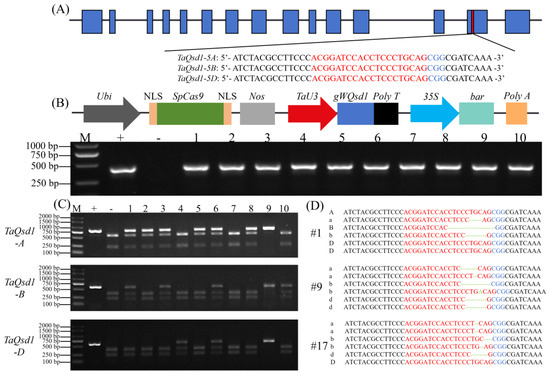
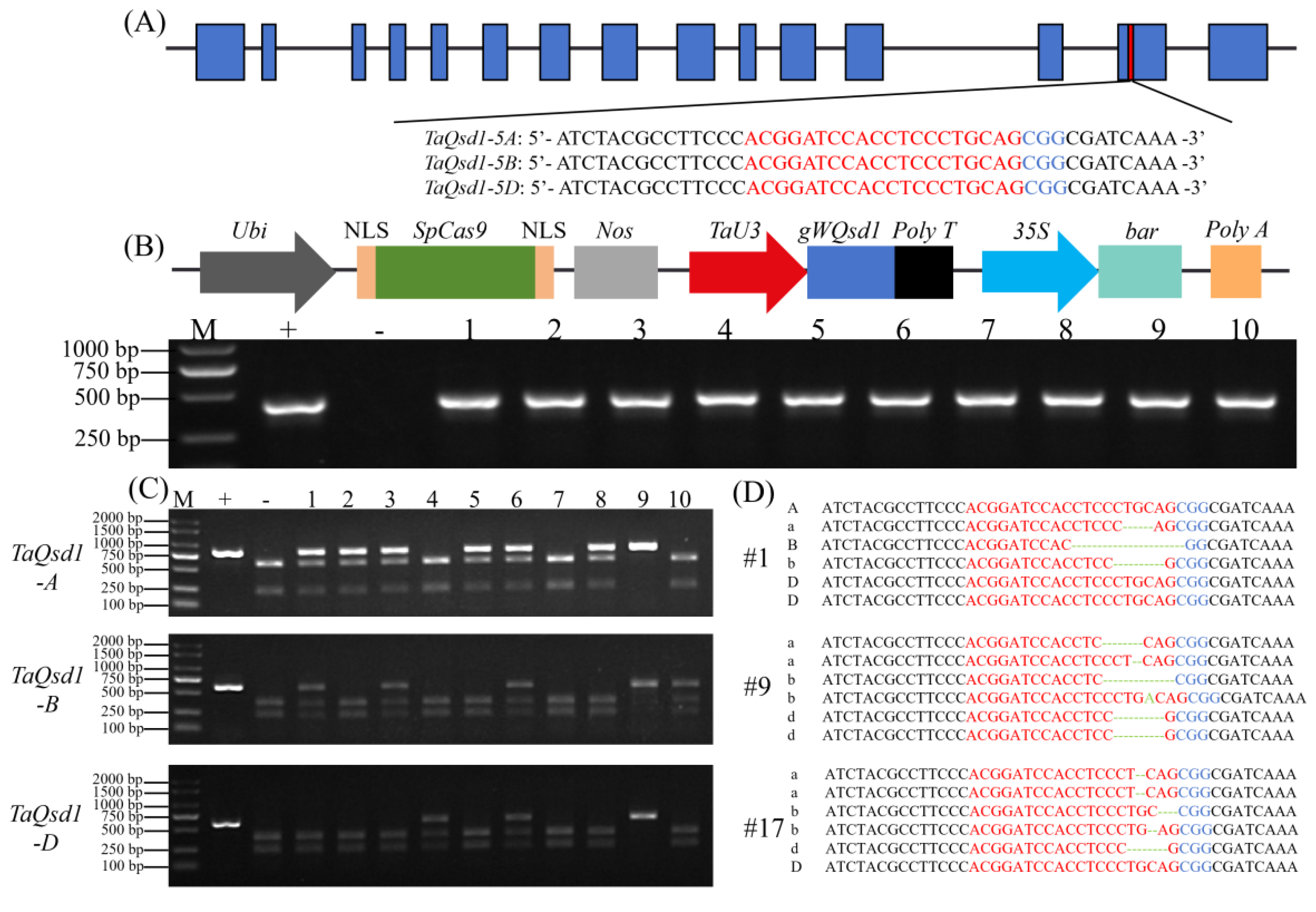
To perform genome editing on the homologous alleles of the TaQsd1 gene in wheat cultivar Lunxuan 13, we designed a 20 bp guide RNA (gRNA) targeting a conserved region within the exons of the three TaQsd1 alleles, which can simultaneously target the A, B, and D subgenomes and contains a restriction enzyme recognition site located 3 bp upstream of the protospacer adjacent motif (PAM) (Figure 1A). For editing the TaQsd1 homologous genes, a total of 78 immature embryos from Lunxuan 13 were transformed by the Agrobacterium cells harboring a vector pWMB110-Cas9-TaQsd1 co-expressing Cas9 and the gRNA. After preliminary screening by means of PCR detection using bar gene-specific primers, 41 T0 transgenic plants were obtained, with a transformation efficiency of 52.6% (Figure 1B and Table 1).
Figure 1.
Targeted knockout of TaQsd1 via Agrobacterium-mediated transformation using CRISPR/Cas9. (A) Linearized expression vector structure of pWMB110-Cas9-TaQsd1; blue letters indicate the PAM sequences; red letters indicate the sgRNA sequences. 35S, CaMV35S promoter; bar, phosphinothricin resistance gene; NLS, nuclear localisation signal; Nos, Nos terminator; TaU3, the wheat U3 promoter; Ubi, ubiquitin promoter. (B) PCR amplification of bar in T0 plants; M, marker; +, vector pWMB110-Cas9-TaQsd1; -, wild-type Lunxuan 13; 1–10, T0 plants. (C) PCR/RE detection of TaQsd1 edits in T0 transgenic plants; M: DNA marker; +: Undigested PCR product; -: Digested wild-type control; 1–10: RE-digested T0 samples. (D) Nucleotide sequences showing genome editing at the TaQsd1 locus. The target sequence and PAM are indicated as in (A). Deleted and inserted nucleotides are shown in green.
Table 1.
Transformation efficiency and editing efficiency of TaQsd1 homologous genes in the T0 generation.
Further validation by means of amplification with TaQsd1-specific primers and PstI restriction enzyme digestion (PCR/RE) identified 27 T0 plants with editing events at the target site, yielding an editing efficiency of 65.9% (Table 1). Among these plants, 23 were heterozygous and 3 were homozygous mutants. Specifically, among the identified T0 edited plants, mutations in the TaQsd1-5A, TaQsd1-5B, and TaQsd1-5D homologous genes were detected in 21, 23, and 17 plants, corresponding to editing efficiencies of 51.2%, 56.1%, and 41.5% in order (Table 1). Regarding mutation types, 7 plants had mutations in only one of the three homologous genes, accounting for 25.9% in the edited plants (Table 1); 6 plants had simultaneous mutations at two loci, accounting for 22.2% (Table 1); and another 14 plants exhibited mutations in all three alleles, accounting for 51.9% (Figure 1C and Table 1). Sanger sequencing revealed that the primary knockout types for TaQsd1 in the edited plants included deletions of 1–11 bp at the 3 bp upstream of the PAM site within the sgRNA, and a 1 bp insertion was also identified (Figure 1D). The mutation genotypes at the loci in this generation involved aabbDD, Aabbdd, AAbbDD, AabbDD, aabbdd, AABbDD, aabbDd, AABbDd, and AABbdd. These results indicate that the CRISPR/Cas9 system performed effectively for editing TaQsd1 genes in Lunxuan 13.
2.2. Off-Target Validation
To ensure the specificity of the CRISPR/Cas9 system in editing wheat TaQsd1 genes, we screened the wheat reference genome for the TaQsd1 sgRNA sequence and identified three potential off-target genomic sites for validation analysis. These sites contained three or five nucleotide mismatches compared to the target sequence of TaQsd1. Detection by means of PCR-RE combining Sanger sequencing on T1 edited plants showed that no editing mutations occurred at any of the three potential off-target sites (Supplementary Table S2). This result indicates that, under our experimental conditions, CRISPR/Cas9 editing of TaQsd1 was highly specific, and off-target effects could be effectively excluded.
2.3. Genetic Inheritance Detection in the T2 Generation
To verify the genetic stability of the TaQsd1-edited plants and the sustained activity of Cas9 in the T2 generation, we randomly selected five T1 edited plants carrying the Cas9 expression cassette (Ya33-1-3, Ya33-1-6, Ya33-6-2, Ya33-17-4, and Ya33-25-7) and produced T2 edited plants for analysis (Figure 2).
Figure 2.
PCR amplification of Cas9 in T1 plants; M, marker; +, vector pWMB110-Cas9-TaQsd1; -, wild-type Lunxuan 13; 1–5, T1 plants.
Editing detection results showed that at the TaQsd1-5A sgRNA target site, Ya33-1-6 and Ya33-17-4 harbored a 1 bp deletion at the position 3 bp upstream of the PAM. At the TaQsd1-5B sgRNA target site, Ya33-1-6, Ya33-6-2, Ya33-17-4, and Ya33-25-7 exhibited either a 3 bp or an 11 bp deletion at the position 3 bp upstream of the PAM. At the TaQsd1-5D sgRNA target site, a 1 bp insertion was detected at the position 3 bp upstream of the PAM in Ya33-1-3, Ya33-17-4, and Ya33-25-7. Genotype analysis indicated that Ya33-6-2 and Ya33-17-4 were homozygous knockout lines, while Ya33-1-3, Ya33-1-6, and Ya33-25-7 were heterozygous knockout lines in the T1 generation (Table 2). Further Sanger sequencing of 20 T2 plants derived from the aforementioned five T1 lines revealed that the editing types of TaQsd1 in the T2 generation were completely consistent with those in the T1 generation, without new mutation types generated. The segregation ratios of biallelic mutations, heterozygous mutations, and wild type among the progeny in each line followed Mendelian inheritance patterns (approximately 1:2:1) (Table 2). These results indicate that genome editing in wheat occurred only during the transformation and regeneration period, and no new mutations or phenotypic changes were induced in the T2 generation despite the persistent presence of Cas9 and sgRNA.
Table 2.
Inheritance of different knockout types for TaQsd1 genes in T1 and T2 generations.
2.4. Dormancy Period Determination and Germination Assay
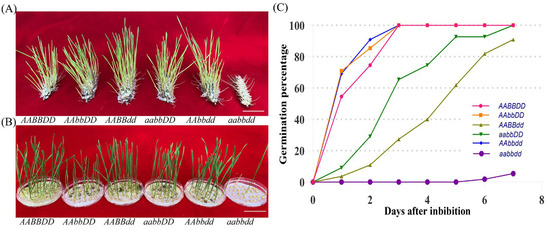
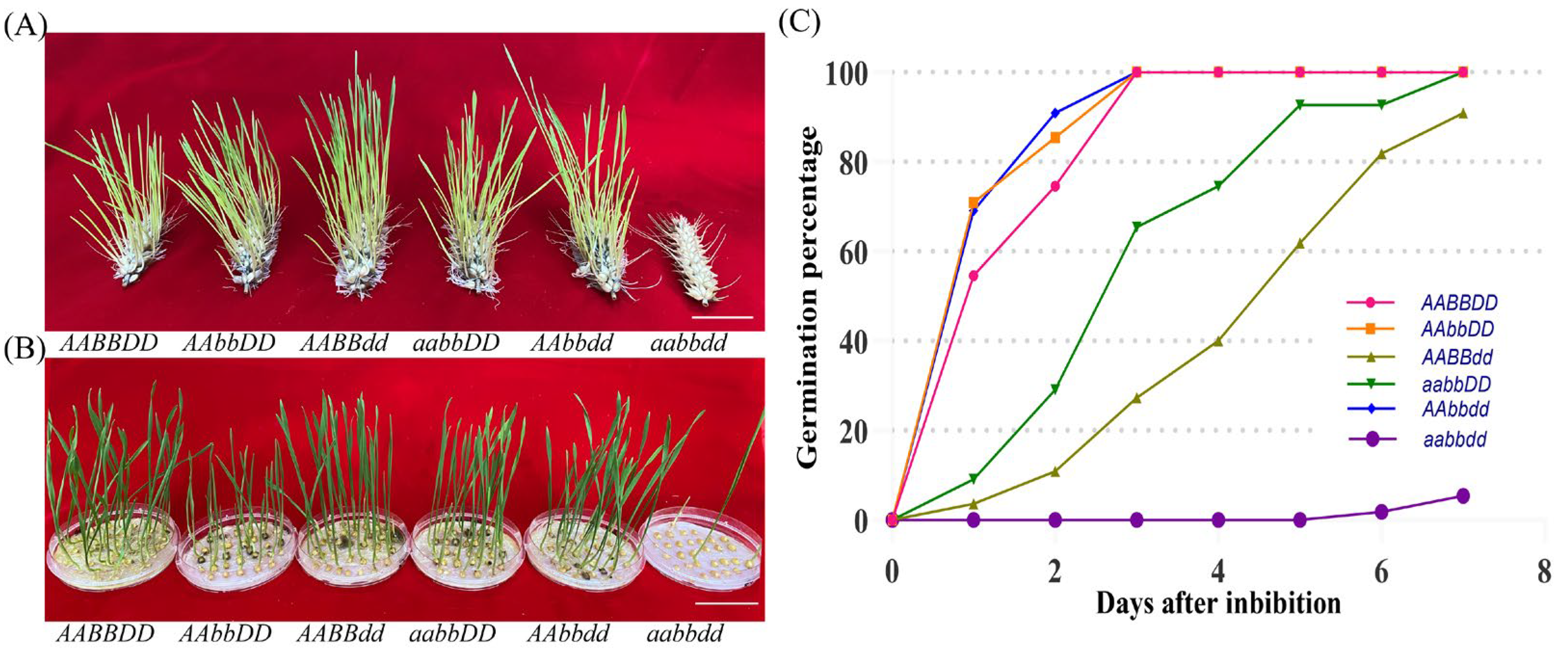
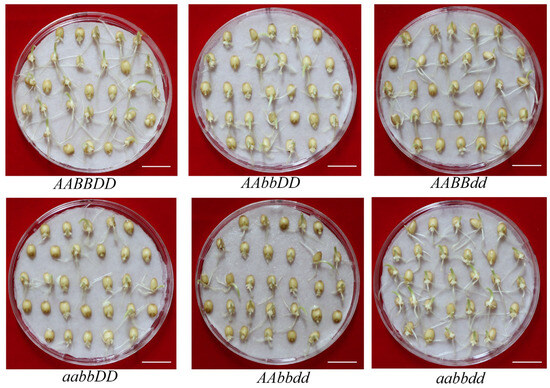
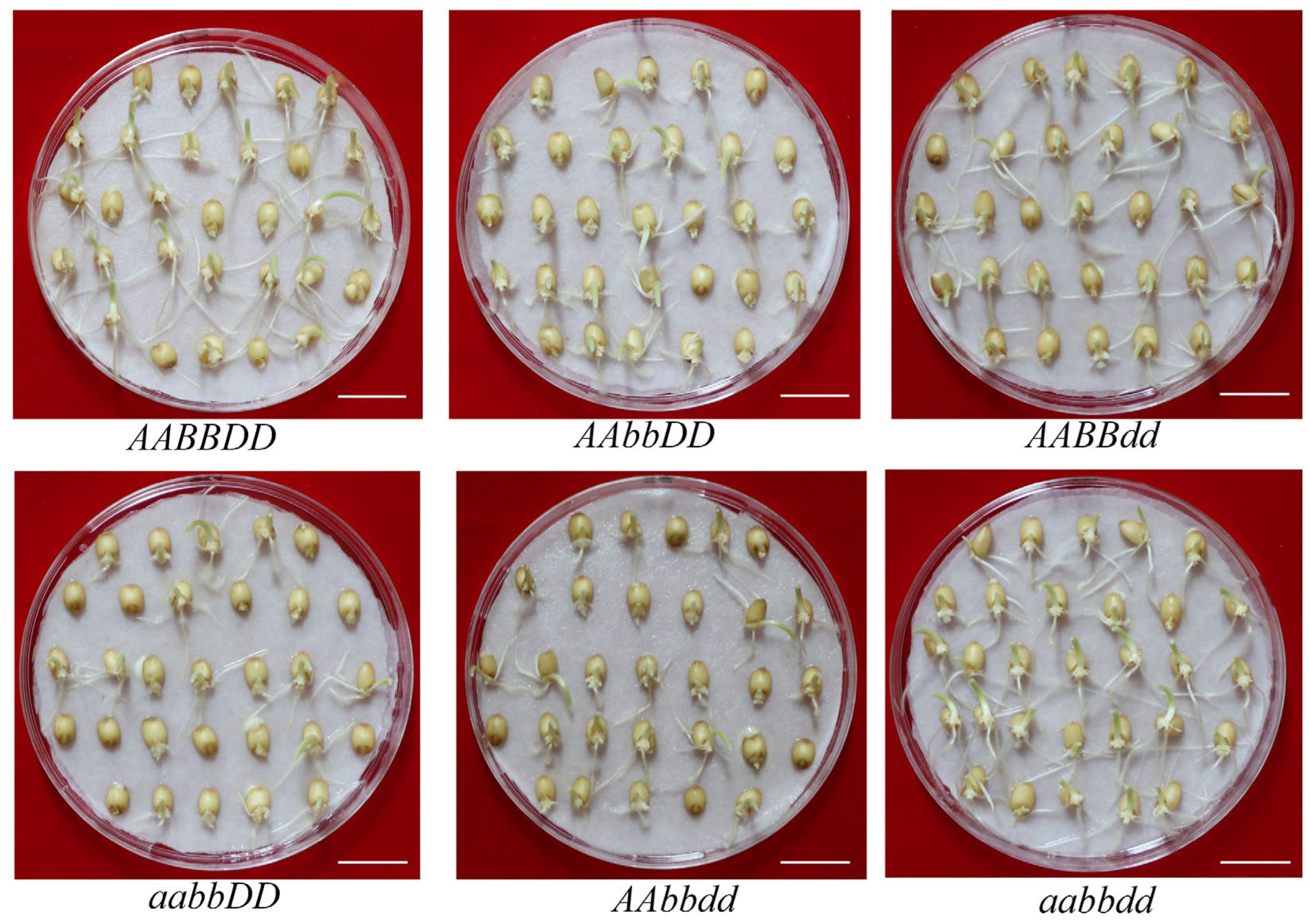
In the T2 generation derived from the T0 edited lines for TaQsd1, we selected five stable edited genotypes of AAbbDD, AABBdd, aabbDD, AAbbdd, and aabbdd for a systematic effect comparison test of various mutation combinations of different TaQsd1 alleles on the PHS phenotype using their seeds at the physiologically mature stage. To more realistically simulate field PHS conditions, we simultaneously conducted whole-spike germination assays. Main stem and secondary tiller spikes of each edited line and the wild type were collected at physiological maturity and placed in a 23 °C constant-temperature incubator with spray misting to maintain humidity. The results showed that the spike germination rate of the aabbdd line was significantly lower than that of the wild type and other partial mutant types (p < 0.01). After 7 days of incubation, the germination rate of the wild type had exceeded 85% (87.3 ± 2.5%), while that of the aabbdd line was less than 10% (8.7 ± 1.8%); after 12 days of incubation, the germination rate of the aabbdd line remained below 30% (27.3 ± 3.2%), whereas all wild-type grains had already germinated (100 ± 0%). The remaining four partial knockout types (AAbbDD, AABBdd, aabbDD, and AAbbdd) showed no statistically significant difference in spike germination rate compared to the wild type, exhibiting a susceptible phenotype (Figure 3A–C).
Figure 3.
The triple homozygous mutant exhibited a significantly longer seed dormancy period. (A) Spike samples of different genotypes germinated in a dew chamber for 12 days. Scale bar, 3 cm. (B) Germination assays of different genotypes. Seeds were imbibed on petri dishes and germinated in a growth chamber at 23°C for 12 days. Scale bar, 5 cm. (C) Germination behaviors of 6 homozygous lines.
The whole-spike germination results were highly consistent with the seed germination assay results. The results showed that only the mutation genotype aabbdd, in which all of the three homologous alleles of TaQsd1 were completely knocked out, exhibited extremely strong PHS resistance: the time required for the seed germination rate reaching 50% was delayed by more than 7 days compared to the wild type (AABBDD), and its complete grain germination took over 30 days. It is noteworthy that, despite the significantly delayed germination process of the fresh harvest seeds of the aabbdd mutant, its seeds, maintained for one month after harvest, germinated normally, indicating an enhanced dormancy characteristic rather than a loss of germination ability of this mutation phenotype (Figure 4).
Figure 4.
Seed germination assay at 30 days post-maturity. Scale bar, 1.5 cm.
This test clearly demonstrates significant functional redundancy of the TaQsd1 gene in regulating PHS, as only simultaneous inactivation of all three TaQsd1 homologous genes could effectively increase seed dormancy and enhance sprouting resistance. To evaluate whether knockout of TaQsd1 affects normal growth and development, we compared key agronomic traits of the edited lines with wild-type Lunxuan 13 at maturity. As shown in Table 3, no significant differences were observed between any of the edited lines and the wild type for plant height, spike length, spikelets per spike, grains per spike, or effective tillers per plant (p > 0.05). Notably, the triple homozygous mutant aabbdd, which exhibited significantly enhanced PHS resistance, showed normal agronomic performance comparable to the wild type, with plant height of 78.00 ± 0.00 cm, spike length of 7.00 ± 0.06 cm, spikelets per spike of 17.67 ± 0.33, grains per spike of 41.67 ± 0.88, and tillers per plant of 3.33 ± 0.33. These results indicate that loss of TaQsd1 function does not compromise major agronomic traits at maturity.
Table 3.
Agronomic traits of wild-type Lunxuan 13 and TaQsd1-knockout lines.
3. Discussion
PHS is one of the most destructive abiotic stress disasters in global wheat production. When wheat encounters continuous rain or high humidity during the grain maturation stage, the kernels often germinate prematurely on the spike, leading to a decrease in thousand-kernel weight and test weight, resulting in yield losses and flour quality deterioration [32,33]. In the context of global climate change, extreme precipitation events are becoming more frequent and unpredictable, and the frequency and intensity of PHS continue to rise, making it a key bottleneck constraining the stable yield and quality of wheat [11]. Wheat resistance to PHS is a typical quantitative trait, co-regulated by multiple factors including seed dormancy depth, seed coat permeability, and hormone metabolism, particularly the balance between abscisic acid (ABA) and gibberellins (GA) [34,35,36,37,38]. Mining key genes conferring PHS resistance and breeding high-resistance varieties through genetic improvement have become a core strategy for ensuring global food security [11].
To date, several major genes associated with PHS resistance have been identified. Among them, the R2R3-MYB-type transcription factor family gene TaMYB10 has been most extensively studied. This family comprises three homoeologous genes (TaMYB10-A1, TaMYB10-B1, TaMYB10-D1) located on chromosome 3, within the same genetic interval as the R locus controlling grain color [39]. The TaMYB10 can activate genes in the flavonoid biosynthesis pathway, promoting anthocyanin accumulation and resulting in red grains; simultaneously, it can activate the NCED promoter, promoting ABA biosynthesis, thereby enhancing seed dormancy and improving PHS resistance [40,41,42,43]. However, the PHS resistance mediated by TaMYB10-D1 is tightly linked to the red grain phenotype. Loss-of-function mutations (e.g., partial base deletions) lead to a change in grain color from red to white and reduce dormancy, making its direct application in white-grained wheat cultivars challenging [44,45].
Another class of core regulatory genes includes TaPHS1 (located on chromosome 3A) and MKK3 (located on chromosome 4A). TaPHS1 encodes a protein homologous to phosphatidylethanolamine-binding protein (PEBP), while MKK3 encodes mitogen-activated protein kinase kinase 3. Both enhance PHS resistance by maintaining seed dormancy [46,47]. However, their expression is susceptible to temperature fluctuations, limiting their efficiency in breeding applications [46,48]. Furthermore, hormone signaling pathway-related genes such as DOG1 (Delay of Germination 1) and ABI5 (ABA Insensitive 5) also play crucial roles in PHS regulation. DOG1 influences dormancy depth by modulating the ABA/GA balance [49,50], while ABI5, as a core transcription factor downstream of ABA signaling, can activate multiple dormancy maintenance genes [51,52]. Nevertheless, the regulatory networks of these genes are complex. DOG1 expression is developmentally regulated, and overexpression of ABI5 may lead to reduced seedling emergence after sowing, affecting field establishment [52,53,54].
In contrast, the Qsd gene family has emerged as an ideal target for PHS improvement in white-grained wheat due to its unique advantages. The Qsd1 was initially cloned in barley, mapped to chromosome 5H, and encodes alanine aminotransferase (AlaAT). Loss-of-function mutations of Qsd1 can significantly prolong seed dormancy without affecting grain color or other agronomic traits [18]. Due to the high conservation between wheat and barley genomes, functionally conserved homoeologous genes of TaQsd1 exist in the A, B, and D subgenomes of wheat. Abe et al. first used the CRISPR/Cas9 system to simultaneously knock out all three TaQsd1 copies in the white-grained cultivar Fielder. The obtained mutants exhibited a 2–3 times longer seed dormancy period and significantly enhanced PHS resistance while maintaining the white grain phenotype and normal germination capacity [19].
In this study, through precise editing of the TaQsd1 gene using CRISPR/Cas9 in the high-yielding, high-quality but PHS-susceptible white-grained wheat cultivar Lunxuan 13, we successfully generated edited lines with significantly improved PHS resistance. Under high-humidity conditions, the sprouting rate of spikes in these lines was reduced by over 60%, while their sowing germination rate remained above 90%. Furthermore, the original superior agronomic traits, such as high yield potential and lodging resistance, were preserved, achieving a synergistic optimization of resistance and practical utility for wheat production. It should be noted that in the present research, we neglected to specifically select the Cas9-free mutants in the T2 generation and just focused on the selection of genetically stable mutants at the TaQsd1 loci, which is adverse to the possible field application of the edited lines. Despite the progress described above, future research needs to deepen in several directions: obtaining Cas9-free individuals in the segregation population of the hybrid cross between the edited mutants and their wild-type Lunxuan 13; elucidating the interaction network between TaQsd1 and other dormancy regulatory genes; validating the field stability of resistance through multi-location and multi-year trials; clarifying its molecular mechanisms in regulating ABA/GA metabolism and amino acid homeostasis by integrating multi-omics technologies; and extending this editing strategy to other leading cultivars and exploring the synergistic effects of multi-gene editing. Overall, the Qsd1 gene, with its advantages of functional conservation, stable resistance, and absence of undesirable linked phenotypes, has become a preferred target for the genetic improvement of PHS resistance in white-grained wheat. This work not only validates the application potential of the Qsd1 gene but also improves the PHS resistance of the good wheat variety Lunxuan 13 for its revitalization.
4. Materials and Methods
4.1. Plant Materials and Bacterial Strains
The wheat variety Lunxuan 13 was kindly provided by Prof. Zhou Yang from the Institute of Crop Sciences, Chinese Academy of Agricultural Sciences, and it was cultivated in the experimental fields of the Chinese Academy of Agricultural Sciences (39° N, 116° E) under conventional field management practices, with a row spacing of 20 cm and a row length of 1.5 m, and irrigated monthly during the growth period. Immature seeds collected 15 days after flowering were used as material for genetic transformation experiments. The Agrobacterium tumefaciens strain GV3101 used in the experiments was purchased from Jiangsu CoWin Biotech Co., Ltd., Taizhou, China.
4.2. Gene Editing Vector Construction
Our laboratory had previously constructed the expression vector pWMB110-Cas9, on which the bar gene was used as a selectable marker, and the maize ubiquitin (ubi) promoter was employed to drive Cas9 gene expression. Based on this, a single guide RNA (sgRNA) targeting the TaQsd1 gene (5′-ACGGATCCACCTCCCTGCAG-3′) was designed, and the TaU3 promoter was amplified using the genomic DNA from Lunxuan 13 as the template to regulate the expression of this sgRNA. Subsequently, the TaU3-sgRNA expression cassette was cloned into the pWMB110-Cas9 vector, successfully constructing the recombinant plasmid pWMB110-Cas9-TaQsd1. Finally, the recombinant vector was introduced into the Agrobacterium GV3101 strain for subsequent genetic transformation experiments. The primers used for vector construction are listed in Supplementary Table S1.
4.3. Agrobacterium-Mediated Wheat Transformation
Immature seeds of Lunxuan 13 were collected from the field. Under sterile conditions, seed surface sterilization was performed through treatment with 75% ethanol for 1 min, followed by 10% sodium hypochlorite for 10 min, and finally rinsing three times with sterile distilled water. Immature embryos were isolated under a microscope, and transformation was carried out using an Agrobacterium-mediated genetic transformation method, specifically following the technical system established by Wang et al. [55]. Briefly, immature embryos were immersed in a suspension of Agrobacterium tumefaciens strain GV3101 harboring the binary vector pWMB110-Cas9-TaQsd1, prepared in WLS-inf liquid medium, for 10 min at room temperature. Following infection, the embryos were placed scutellum-side up onto WLS-AS co-cultivation medium and kept in darkness at 25 °C for 48 h. After co-cultivation, the embryonic axes were carefully excised with a sterile scalpel. The scutella explants were then transferred onto WLS-Res selection medium. After five days, the tissues were moved onto callus induction medium (WLS-P5). Following two weeks of culture, proliferating calli were subdivided and transferred to WLS-P10 medium for an additional three weeks to induce embryogenic callus formation. The embryogenic calli were subsequently transferred onto differentiation medium (LSZ-P5) and cultured at 25 °C under continuous light (100 μmol m−2 s−1) for 16 h every day. Regenerated shoots were excised and transferred onto MSF-P5 medium for further elongation and root development. Finally, well-rooted plantlets were transplanted into pots (20 × 30 cm) and acclimatized in a greenhouse under controlled conditions: 24 °C, a 16 h light/8 h dark photoperiod, 45% relative humidity, and a light intensity of 300 μmol m−2 s−1.
The obtained transgenic wheat plants were transplanted into 20 cm × 30 cm pots filled with conventional cultivation soil and grown in an artificial climate greenhouse. The growth conditions were set as follows: day/night temperature 24 ± 1 °C, photoperiod 16 h light/8 h dark, relative humidity 45 ± 5%, light intensity 300 μmol m−2 s−1 (supplemented by a lighting system), and aphid control using sticky colored boards (Zhengzhou Oukeqi Instruments Ltd., Zhengzhou, China). During growth, plants were watered weekly to maintain appropriate soil moisture. More detailed information on wheat cultivation and transformation procedures can be found in the study by Wang et al. [55].
4.4. Detection of Transgenic Wheat Plants
Genomic DNA was extracted from the young leaves of candidate transgenic wheat plants using the FastClean Plant Genomic DNA Kit (Jiangsu CoWin Biotech Co., Ltd., Taizhou, China). To identify positive transgenic plants, specific primers for the bar and Cas9 genes (sequence information is provided in the Supplementary Materials) were designed. PCR amplification was performed using the 2× Rapid Taq Master Mix-P222 kit (Nanjing Vazyme Biotech Co., Ltd., Nanjing, China) on a Veriti 96-well gradient PCR instrument (Thermo Fisher Scientific, Waltham, MA, USA). The reaction program was set as follows: 95 °C pre-denaturation for 5 min, followed by 38 cycles (95 °C for 30 s, 60 °C for 20 s, and 72 °C for 1 min) and a final extension at 72 °C for 10 min. To detect the editing status of the three homologous TaQsd1 genes, the target region was amplified using the PCR method described above. Edited plants were identified using a PCR-restriction enzyme (PCR-RE) assay: 5 μL of PCR product was taken, 0.3 U of PstI (CTGCAG) restriction enzyme was added, and digestion was performed at 37 °C for 2 h in a 20 μL reaction volume. The digested products and undigested controls were separated by means of electrophoresis on a 1.5% agarose gel, and results were visualized using a GelDoc XR gel imaging system (Bio-Rad, Laboratories., Hercules, CA, USA). To precisely identify the mutation types of TaQsd1 genes, PCR products from randomly selected mutant plants were sent for sequencing. The sequencing results were aligned with the TaQsd1 gene sequences (TraesCS5A02G216200, TraesCS5B02G214700, and TraesCS5D02G224200) in the wheat reference genome database to determine specific gene editing types and mutation sites. The primers used for plant genotyping are listed in Supplementary Table S1.
4.5. Seed Dormancy Assay
Five healthy and plump seeds from each edited line with a mutation in either one of the three TaQsd1-abd alleles were carefully selected and sown individually in standard pots measuring 20 cm × 20 cm. The cultivation substrate consisted of sterilized conventional horticultural potting soil. Five biological replicates were set up for each line (one plant per pot). All plants were cultivated under identical environmental conditions (specific conditions as described in Section 2.3), with uniform water and fertilizer management and pest control measures. All naturally occurring tillers were retained during growth, but only seeds from the main spike and secondary spikes were ultimately collected for dormancy characterization. Seeds were harvested at 45 days after flowering (physiological maturity), with a total of 10 spikes harvested per line as experimental materials. For the assay, 30 uniformly sized grains were randomly selected from each main spike for the dormancy scoring experiment, in which wild-type Lunxuan 13 was set as the control. The specific procedure was as follows: each group of 30 seeds was evenly arranged in a Petri dish lined with two layers of filter paper, moistened with 3 mL of distilled water, and then placed in a 23 °C constant temperature incubator for dark incubation. Starting from the first day of incubation, germinated seeds were counted daily at a fixed time until germination ceased. Finally, the average germination rate (number of germinated seeds/total number of tested seeds × 100%) and its standard error for each line were calculated based on the cumulative germination data to assess differences in seed dormancy characteristics.
To further evaluate wheat PHS resistance under conditions simulating field humidity, a whole-spike germination assay was also performed. At physiological maturity (45 days after flowering), main stems and secondary tiller spikes were harvested from each edited line and wild-type Lunxuan 13 (10 spikes per line). The spikes were placed upright in a humidity chamber maintained at 23 °C with continuous spray misting to keep relative humidity above 90%. Germinated grains on each spike were counted daily at a fixed time for up to 12 days. For the spike germination assay, each line had five biological replicates (one spike per replicate). For each biological replicate, the germination rate was calculated based on three technical replicates, and the wild type was used as the control.
4.6. Seed Germination Assay at 30 Days Post-Maturity
Seed germination assays were conducted 30 days after the maturity of seeds from the main and secondary spikes. Wild-type Lunxuan 13 and the materials with mutations in the three TaQsd1-abd alleles were used, with 10 spikes harvested from each line as experimental materials. For the assay, 30 uniformly sized grains were randomly selected from each main spike for the germination experiment. The specific procedure was the same as in Section 4.5.
4.7. Statistical Analysis of Seed Dormancy
The SPSS 26.0 software package (SPSS, Chicago, IL, USA) was used for statistical analysis. One-way analysis of variance (ANOVA) followed by Tukey’s HSD post hoc test was used to compare germination rates among different lines. Data are presented as mean ± standard error (SE).
Supplementary Materials
The following supporting information can be downloaded at https://www.mdpi.com/article/10.3390/plants15091322/s1. Table S1: PCR primers for vector construction and identification of transgenic wheat plants; Table S2: Predicted and evaluated off-target sites of designed sgRNAs for the TaQsd1 gene.
Author Contributions
X.Y., H.T. and K.W. conceived the project and guided all of the work. Z.H., L.Y. and Y.Z. conducted most of the experiments, analyzed the data, and wrote the manuscript. X.L., S.W., K.D., B.Z., W.H. and H.P. participated in the transformation and detection of transgenic and edited plants. H.T. and X.Y. revised the manuscript. All authors have read and agreed to the published version of the manuscript.
Funding
This research was funded by the National Natural Science Foundation of China (grant numbers 32272180 and 32401875).
Data Availability Statement
The original contributions presented in this study are included in the article. Further inquiries can be directed to the corresponding authors.
Conflicts of Interest
No conflicts of interest to declare.
References
- Crist, E.; Mora, C.; Engelman, R. The interaction of human population, food production, and biodiversity protection. Science 2017, 356, 260–264. [Google Scholar] [CrossRef] [Scilit]
- Kettlewell, P.; Byrne, R.; Jeffery, S. Wheat area expansion into northern higher latitudes and global food security. Agric. Ecosyst. Environ. 2023, 351, 108499. [Google Scholar] [CrossRef] [Scilit]
- Brinton, J.; Uauy, C. A reductionist approach to dissecting grain weight and yield in wheat. J. Integr. Plant Biol. 2019, 61, 337–358. [Google Scholar] [CrossRef] [Scilit] [PubMed]
- Ministry of Agriculture and Rural Affairs of P.R.C. Announcement No. 18 (National Approved Wheat Variety Guoshenmai 20180026). 2018. Available online: https://www.moa.gov.cn/nybgb/2018/201806/201809/t20180904_6156760.htm (accessed on 22 March 2026).
- Moot, D.J.; Every, D. A comparison of bread baking, falling number, α-amylase assay and visual method for the assessment of pre-harvest sprouting in wheat. J. Cereal Sci. 1990, 11, 225–234. [Google Scholar]
- Ross, A.S.; Bettge, A.D. Passing the Test on Wheat End-Use Quality; US Department of Agriculture: Washington, DC, USA, 2009; pp. 455–494.
- Matilla, A.J. Exploring breakthroughs in three traits belonging to seed life. Plants 2022, 11, 490. [Google Scholar] [PubMed]
- Ji, T.; Penning, B.; Baik, B.K. Pre-harvest sprouting resistance of soft winter wheat varieties and associated grain characteristics. J. Cereal Sci. 2018, 83, 110–115. [Google Scholar] [CrossRef] [Scilit]
- Vetch, J.M.; Stougaard, R.N.; Martin, J.M.; Giroux, M.J. Revealing the genetic mechanisms of pre-harvest sprouting in hexaploid wheat (Triticum aestivum L.). Plant Sci. 2019, 281, 180–185. [Google Scholar] [CrossRef] [Scilit]
- Yang, Y.; Zhang, C.L.; Liu, S.X.; Sun, Y.Q.; Meng, J.Y.; Xia, L.Q. Characterization of the rich haplotypes of Viviparous-1A in Chinese wheats and development of a novel sequence-tagged site marker for pre-harvest sprouting resistance. Mol. Breed. 2014, 33, 75–88. [Google Scholar] [CrossRef] [Scilit]
- Hull, S.I.; Swanepoel, P.A.; Botes, W.C. A critical review of the factors influencing pre-harvest sprouting of wheat. Agron. J. 2024, 116, 3354–3367. [Google Scholar] [CrossRef] [Scilit]
- Tai, L.; Wang, H.J.; Xu, X.J.; Sun, W.H.; Ju, L.; Liu, W.T.; Li, W.Q.; Sun, G.Q.; Chen, K.M. Pre-harvest sprouting in cereals: Genetic and biochemical mechanisms. J. Exp. Bot. 2021, 72, 2857–2876. [Google Scholar] [PubMed]
- Huang, Y.; Dai, X.; Liu, H.; Yu, S.; Mai, C.Y.; Yu, L.Q.; Yu, G.G.; Yang, L.; Zhou, Y.; Li, H.J.; et al. Identification of effective alleles and haplotypes conferring pre-harvest sprouting resistance in winter wheat cultivars. BMC Plant Biol. 2022, 22, 326. [Google Scholar] [CrossRef] [Scilit] [PubMed]
- Lei, S.; Yin, J.; Li, C.; Xu, Q.; Tian, B.; Cheng, X.; Zhang, H. Impacts of natural variations in the TaLEA-1A gene on seed dormancy and germination in wheat and transgenic Arabidopsis and rice. Environ. Exp. Bot. 2024, 220, 105715. [Google Scholar] [CrossRef] [Scilit]
- Rehal, P.K.; Tuan, P.A.; Nguyen, T.N.; Cattani, D.J.; Humphreys, D.G.; Ayele, B.T. Genetic variation of seed dormancy in wheat (Triticum aestivum L.) is mediated by transcriptional regulation of abscisic acid metabolism and signaling. Plant Sci. 2022, 324, 111432. [Google Scholar] [CrossRef] [Scilit]
- Gao, F.; Ayele, B.T. Functional genomics of seed dormancy in wheat: Advances and prospects. Front. Plant Sci. 2014, 5, 458. [Google Scholar] [CrossRef] [Scilit] [PubMed]
- Tuan, P.A.; Kumar, R.; Rehal, P.K.; Toora, P.K.; Ayele, B.T. Molecular mechanisms underlying abscisic acid/gibberellin balance in the control of seed dormancy and germination in cereals. Front. Plant Sci. 2018, 9, 668. [Google Scholar] [CrossRef] [Scilit]
- Sato, K.; Yamane, M.; Yamaji, N.; Kanamori, H.; Tagiri, A.; Schwerdt, J.G.; Fincher, G.B.; Matsumoto, T.; Takeda, K.; Komatsuda, T. Alanine aminotransferase controls seed dormancy in barley. Nat. Commun. 2016, 7, 11625. [Google Scholar] [CrossRef] [Scilit]
- Abe, F.; Haque, E.; Hisano, H.; Tanaka, T.; Kamiya, Y.; Mikami, M.; Kawaura, K.; Endo, M.; Onishi, K.; Hayashi, T.; et al. Genome-edited triple-recessive mutation alters seed dormancy in wheat. Cell Rep. 2019, 28, 1362–1369. [Google Scholar] [CrossRef] [Scilit]
- Gaj, T.; Sirk, S.J.; Shui, S. Genome-editing technologies: Principles and applications. Cold Spring Harb. Perspect. Biol. 2016, 8, a023754. [Google Scholar] [CrossRef] [Scilit]
- Wang, H.; La Russa, M.; Qi, L.S. CRISPR/Cas9 in genome editing and beyond. Annu. Rev. Biochem. 2016, 85, 227–264. [Google Scholar] [CrossRef] [Scilit]
- Jiang, F.; Doudna, J.A. CRISPR-Cas9 structures and mechanisms. Annu. Rev. Biophys. 2017, 46, 505–529. [Google Scholar] [CrossRef] [Scilit]
- Jinek, M.; Chylinski, K.; Fonfara, I.; Hauer, M.; Doudna, J.A.; Charpentier, E. A programmable dual-RNA–guided DNA endonuclease in adaptive bacterial immunity. Science 2012, 337, 816–821. [Google Scholar] [CrossRef] [Scilit] [PubMed]
- Que, Q.; Chen, Z.; Kelliher, T.; Skibbe, D.; Dong, S.; Chilton, M.D. Plant DNA repair pathways and their applications in genome engineering. Methods Mol. Biol. 2019, 1917, 3–24. [Google Scholar]
- Ishida, Y.; Tsunashima, M.; Hiei, Y.; Komari, T. Wheat (Triticum aestivum L.) transformation using immature embryos. In Agrobacterium Protocols; Springer: Berlin/Heidelberg, Germany, 2014; pp. 189–198. [Google Scholar]
- Zhang, K.; Liu, J.; Zhang, Y.; Yang, Z.; Gao, C. Biolistic genetic transformation of a wide range of Chinese elite wheat (Triticum aestivum L.) varieties. J. Genet. Genom. 2015, 42, 39–42. [Google Scholar] [CrossRef] [Scilit] [PubMed]
- Zhang, Y.; Liang, Z.; Zong, Y.; Wang, Y.; Liu, J.; Chen, K.; Qiu, J.L.; Gao, C.X. Efficient and transgene-free genome editing in wheat through transient expression of CRISPR/Cas9 DNA or RNA. Nat. Commun. 2016, 7, 12617. [Google Scholar] [CrossRef] [Scilit]
- Liu, H.; Wang, K.; Jia, Z.; Gong, Q.; Lin, Z.; Du, L.; Pei, X.W.; Ye, X.G. Efficient induction of haploid plants in wheat by editing of TaMTL using an optimized Agrobacterium-mediated CRISPR system. J. Exp. Bot. 2020, 71, 1337–1349. [Google Scholar]
- Liu, H.; Wang, K.; Tang, H.; Gong, Q.; Du, L.; Pei, X.; Ye, X. CRISPR/Cas9 editing of wheat TaQ genes alters spike morphogenesis and grain threshability. J. Genet. Genom. 2020, 47, 563–575. [Google Scholar]
- Okada, A.; Arndell, T.; Borisjuk, N.; Sharma, N.; Watson-Haigh, N.S.; Tucker, E.J.; Baumann, U.; Langridge, P.; Whitford, R. CRISPR/Cas9-mediated knockout of Ms1 enables the rapid generation of male-sterile hexaploid wheat lines for use in hybrid seed production. Plant Biotechnol. J. 2019, 17, 1905–1913. [Google Scholar]
- Tang, H.L.; Liu, H.Y.; Zhou, Y.; Liu, H.; Du, L.P.; Wang, K.; Ye, X.G. Fertility recovery of wheat male sterility controlled by Ms2 using CRISPR/Cas9. Plant Biotechnol. J. 2020, 19, 224. [Google Scholar] [CrossRef] [Scilit] [PubMed]
- Groos, C.; Gay, G.; Perretant, M.R. Study of the relationship between pre-harvest sprouting and grain color by quantitative trait loci analysis in a white × red grain bread-wheat cross. Theor. Appl. Genet. 2002, 104, 39–47. [Google Scholar] [PubMed]
- Gubler, F.; Millar, A.A.; Jacobsen, J.V. Dormancy release, ABA and pre-harvest sprouting. Curr. Opin. Plant Biol. 2005, 8, 183–187. [Google Scholar] [CrossRef] [Scilit]
- Miao, C.; Wang, Z.; Zhang, L.; Yao, J.J.; Hua, K.; Liu, X.; Huazhong Shi, H.Z.; Zhu, J.K. The grain yield modulator miR156 regulates seed dormancy through the gibberellin pathway in rice. Nat. Commun. 2019, 10, 3822. [Google Scholar] [CrossRef] [Scilit] [PubMed]
- Sohn, S.I.; Pandian, S.; Kumar, T.S.; Zoclanclounon, Y.A.B.; Muthuramalingam, P.; Shilpha, J.; Satish, L.; Ramesh, M. Seed dormancy and pre-harvest sprouting in rice—An updated overview. Int. J. Mol. Sci. 2021, 22, 11804. [Google Scholar] [CrossRef] [Scilit]
- Liu, X.; Wang, J.; Yu, Y.; Kong, L.; Liu, Y.; Liu, Z.; Li, H.Y.; Wei, P.W.; Liu, M.L.; Zhou, H.; et al. Identification and characterization of the rice pre-harvest sprouting mutants involved in molybdenum cofactor biosynthesis. New Phytol. 2019, 222, 275–285. [Google Scholar] [CrossRef] [Scilit]
- Cheng, X.; Wang, S.; Xu, D.; Liu, X.; Li, X.; Xiao, W.; Cao, J.; Jiang, H.; Min, X.; Wang, J.; et al. Identification and analysis of the GASR gene family in common wheat (Triticum aestivum L.) and characterization of TaGASR34, a gene associated with seed dormancy and germination. Front. Genet. 2019, 10, 980. [Google Scholar] [CrossRef] [Scilit]
- Howard, T.P.; Fahy, B.; Craggs, A.; Mumford, R.; Leigh, F.; Howell, P.; Greenland, A.; Smith, A.M. Barley mutants with low rates of endosperm starch synthesis have low grain dormancy and high susceptibility to preharvest sprouting. New Phytol. 2012, 194, 158–167. [Google Scholar] [CrossRef] [Scilit]
- Himi, E.; Noda, K. Red grain colour gene (R) of wheat is a Myb-type transcription factor. Euphytica 2005, 143, 239–242. [Google Scholar] [CrossRef] [Scilit]
- Himi, E.; Maekawa, M.; Miura, H.; Noda, K. Development of PCR markers for Tamyb10 related to R-1, red grain color gene in wheat. Theor. Appl. Genet. 2011, 122, 1561–1576. [Google Scholar] [CrossRef] [Scilit]
- Lang, J.; Fu, Y.; Zhou, Y.; Lang, J.; Fu, Y.; Zhou, Y.; Cheng, M.; Deng, M.; Li, M.; Zhu, T.T.; et al. Myb10-D confers PHS-3D resistance to pre-harvest sprouting by regulating NCED in ABA biosynthesis pathway of wheat. New Phytol. 2021, 230, 1940–1952. [Google Scholar] [CrossRef] [Scilit]
- Wang, Y.; Wang, X.L.; Meng, J.Y.; Zhang, Y.J.; He, Z.H.; Yang, Y. Characterization of Tamyb10 allelic variants and development of STS marker for pre-harvest sprouting resistance in Chinese bread wheat. Mol. Breed. 2016, 36, 148. [Google Scholar] [CrossRef] [Scilit]
- Zhu, Y.; Lin, Y.; Fan, Y.; Wang, Y.; Li, P.; Xiong, J.; He, Y.H.; Cheng, S.F.; Ye, X.G.; Wang, F. CRISPR/Cas9-mediated restoration of Tamyb10 to create pre-harvest sprouting-resistant red wheat. Plant Biotechnol. J. 2023, 21, 665. [Google Scholar] [CrossRef] [Scilit]
- Lang, J.; Jiang, H.; Cheng, M.; Wang, M.; Gu, J.; Dong, H.; Li, M.L.; Guo, X.J.; Chen, Q.; Wang, J. Variation of TaMyb10 and their function on grain color and pre-harvest sprouting resistance of wheat. Plant J. 2024, 118, 1388–1399. [Google Scholar] [CrossRef] [Scilit] [PubMed]
- Chen, L.; Tao, Y.; Song, C.; Liu, Y.; Tong, H.; Ning, Q.; Zou, J.; Fu, P.H.; Zhang, Y.Q.; Gao, C.B.; et al. Genome-wide association study of pre-harvest sprouting resistance and grain color in common wheat (Triticum aestivum L.). BMC Plant Biol. 2025, 25, 973. [Google Scholar] [CrossRef] [Scilit]
- Liu, S.; Sehgal, S.K.; Li, J.; Lin, M.; Trick, H.N.; Yu, J.; Gill, B.S.; Bai, G. Cloning and characterization of a critical regulator for preharvest sprouting in wheat. Genetics 2013, 195, 263–273. [Google Scholar] [CrossRef] [Scilit]
- Torada, A.; Koike, M.; Ogawa, T.; Takenouchi, Y.; Tadamura, K.; Wu, J.; Matsumoto, T.; Kawaura, K.; Ogihara, Y. A causal gene for seed dormancy on wheat chromosome 4A encodes a MAP kinase kinase. Curr. Biol. 2016, 26, 782–787. [Google Scholar] [CrossRef] [Scilit] [PubMed]
- Otani, M.; Tojo, R.; Regnard, S. The MKK3 MAPK cascade integrates temperature and after-ripening signals to modulate seed germination. Proc. Natl. Acad. Sci. USA 2024, 121, e2404887121. [Google Scholar]
- Zhang, Q.; Yu, X.; Wang, R.; Wu, Y.N.; Shi, F.; Zhang, Y.; Zhao, H.Y.; Xu, H.Z.; Pan, J.; Wang, Y.S.; et al. TaPP2C-a6 interacts with TaDOG1Ls and regulates seed dormancy and germination in wheat. Plant Biotechnol. J. 2025, 23, 3313–3329. [Google Scholar] [PubMed]
- Cyrek, M.; Fedak, H.; Ciesielski, A.; Guo, Y.; Sliwa, A.; Brzezniak, L.; Krzyczmonik, K.; Pietras, Z.; Kaczanowski, S.; Liu, F.L.; et al. Seed dormancy in Arabidopsis is controlled by alternative polyadenylation of DOG1. Plant Physiol. 2016, 170, 947–955. [Google Scholar]
- Ju, L.; Jing, Y.; Shi, P.; Liu, J.; Chen, J.; Yan, J.; Chu, J.F.; Chen, K.M.; Sun, J. JAZ proteins modulate seed germination through interaction with ABI 5 in bread wheat and Arabidopsis. New Phytol. 2019, 223, 246–260. [Google Scholar]
- Vittozzi, Y.; Krüger, T.; Majee, A.; Née, G.; Wenkel, S. ABI5 binding proteins: Key players in coordinating plant growth and development. Trends Plant Sci. 2024, 29, 1006–1017. [Google Scholar] [CrossRef] [Scilit]
- Ni, Y.; Guo, C.; Zhang, X.; Ma, M.; Liu, X.; Li, Y.; Lian, S.Y.; Li, J.C.; Jiang, Y.M.; Niu, J.S.; et al. Evolutionary and functional diversification of the DOG gene family in wheat (Triticum aestivum L.) and their roles in seed dormancy. BMC Genom. 2025, 26, 861. [Google Scholar] [CrossRef] [Scilit]
- Singh, C.; Kamble, U.R.; Gupta, V.; Singh, G.; Sheoran, S.; Gupta, A.; Tyagi, B.S.; Kumar, P.; Mishra, C.N.; Krishannapa, G.; et al. Pre-harvest sprouting in wheat: Current status and future prospects. J. Cereal Res. 2021, 13, 1–22. [Google Scholar] [CrossRef] [Scilit]
- Wang, K.; Liu, H.Y.; Du, L.P.; Ye, X.G. Generation of marker-free transgenic hexaploid wheat via an Agrobacterium-mediated co-transformation strategy in commercial Chinese wheat varieties. Plant Biotechnol. J. 2017, 15, 614–623. [Google Scholar] [CrossRef] [Scilit]



Disclaimer/Publisher’s Note: The statements, opinions and data contained in all publications are solely those of the individual author(s) and contributor(s) and not of MDPI and/or the editor(s). MDPI and/or the editor(s) disclaim responsibility for any injury to people or property resulting from any ideas, methods, instructions or products referred to in the content. |
© 2026 by the authors. Licensee MDPI, Basel, Switzerland. This article is an open access article distributed under the terms and conditions of the Creative Commons Attribution (CC BY) license.