


Abstract
Sunflower downy mildew, caused by Plasmopara halstedii, remains one of the most destructive diseases worldwide. The genetic diversity of P. halstedii populations continues to challenge resistance breeding efforts. This study evaluates the effectiveness of key resistance genes against P. halstedii isolates collected in Hungary. Eight isolates were tested using the sunflower differential lines HA-335, RHA-419, and RHA-340, with the resistance genes Pl6, PlArg, and Pl8, respectively. Disease development was assessed by observing sporulation and symptoms including stunting, chlorosis, damping-off, and abnormal development at three time points after inoculation. Plant height was also measured to evaluate growth responses. The Pl6 resistance gene (HA-335) did not provide effective protection against any of the tested isolates, indicating that Pl6 does not confer reliable resistance against the Hungarian isolates examined in this study. The resistance conferred by Pl8 was not uniformly effective against the Hungarian isolates tested. This study provides the first report of Pl8-virulent P. halstedii isolates identified in both Hungary and Central Europe. The resistance gene PlArg (RHA-419) conferred resistance to all tested P. halstedii isolates. These findings highlight the changing virulence profiles of P. halstedii populations in Hungary, emphasizing the need for ongoing pathogen monitoring and strategic use of resistance genes.
Keywords:
sunflower downy mildew; Plasmopara halstedii; virulence diversity; resistance genes; Pl6; Pl8; PlArg 1. Introduction
Plasmopara halstedii (Farl.) Berl. et de Toni, the causal agent of sunflower downy mildew, remains one of the most destructive biotic constraints to sunflower (Helianthus annuus L.) cultivation worldwide [1]. This obligate oomycete infects seedlings through the roots and rapidly colonizes host tissues systemically, resulting in stunting, chlorosis, abnormal leaf development, and severe yield losses under favorable conditions [2,3,4]. Downy mildew causes significant economic losses in major sunflower-producing regions, including Central and Eastern Europe [5,6]. In this context, an understanding of pathogen population structure and virulence evolution is essential for sustainable disease management.
A major challenge in sunflower downy mildew control is the high genetic diversity and rapid evolutionary potential of P. halstedii populations. Numerous studies have demonstrated that pathogen variability, driven by sexual recombination and long-distance dispersal, as well as by strong selection pressure from resistant cultivars, leads to the continuous emergence of new virulent pathotypes [7,8,9]. These dynamics undermine resistance strategies based on single major genes and complicate the development of durable resistance. Consequently, breeding for durable resistance demands detailed knowledge of host–pathogen interactions, isolate-specific virulence, and regional pathogen diversity.
Despite Hungary being one of Europe’s leading sunflower-producing countries, recent information on the virulence composition of P. halstedii populations is lacking. Earlier studies primarily focused on detecting highly virulent pathotypes and their spread, but comprehensive phenotypic evaluations of isolate aggressiveness and host responses have been scarce [6,10]. Over the past decades, extensive surveys across Europe have documented the emergence and spread of highly virulent P. halstedii pathotypes that can overcome key resistance genes, especially Pl6 and Pl8, which historically formed the core of commercial sunflower resistance. Vear et al. [11] suggested that Pl6 resistance may not correspond to a single gene conferring broad-spectrum resistance, but rather to a cluster of genes, each effective against one or a limited number of P. halstedii races. Pl6 genes provided resistance to all pathotypes until the 2000s, but then virulent pathogen variants began to appear, first in France [12].
Subsequently, evidence of Pl6 resistance erosion was reported from the USA in 2009 [13]. A later Europe-wide survey showed that more than half of the tested isolates were virulent on Pl6, including isolates from Spain, Portugal, Romania, Italy, France, and Hungary [6,14]. Resistance breakdown involving Pl6 has now been widely reported across Europe, with increasing numbers of Pl6-virulent isolates detected in Central and Eastern European sunflower-growing regions [15,16].
The situation escalated further with the detection of P. halstedii isolates capable of overcoming Pl8, a resistance gene derived from Helianthus argophyllus and long regarded as one of the most effective resistance sources worldwide. During 2017–2018, severe downy mildew outbreaks were observed in commercial sunflower hybrids carrying Pl8 in France and Italy, with disease incidences reaching 40–70% [17]. Inoculation assays on the traditional sunflower differential set confirmed that these isolates belonged to pathotype 714. Furthermore, it was virulent on RHA-340, a sunflower genotype carrying the Pl8 resistance gene, which has not been included in the traditional differential set containing 9 or even 15 differential lines [3]. This was the first report of a breakdown in Pl8 resistance in Europe. This finding confirmed that the currently used differential lines are not suitable for accurately estimating the virulence. Subsequent studies in the USA also demonstrated the occurrence of Pl8-virulent isolates [18].
In contrast to Pl6 and Pl8, the resistance gene PlArg, also derived from H. argophyllus, has been reported to confer broad-spectrum resistance to a wide range of P. halstedii pathotypes and has attracted renewed attention as a potentially more durable resistance source. Fine-mapping and molecular characterization studies localized PlArg to linkage group 1 and identified resistance gene candidates associated with its function [19,20]. Marker-assisted selection and gene pyramiding strategies incorporating PlArg have been proposed as promising approaches to enhance resistance durability and mitigate the rapid erosion observed with single major genes [21,22,23]. Taken together, the rapid emergence of highly virulent P. halstedii pathotypes capable of overcoming Pl6 and Pl8 reflects an ongoing shift in the virulence profile of sunflower downy mildew. These changes threaten the prolonged effectiveness of major-gene resistance and accentuate the importance of continuous pathogen surveillance, expanded differential sets, and the strategic integration of novel resistance sources, including quantitative resistance and pyramided gene combinations. In this context, the present study addresses critical knowledge gaps by characterizing the virulence profiles of P. halstedii isolates collected from Hungary and evaluating the responses of sunflower genotypes HA-335, RHA-419, and RHA-340, which carry the resistance genes Pl6, PlArg, and Pl8, respectively. By combining disease severity assessments with plant growth responses and further symptom expressions, this work provides new data on local pathogen diversity and contributes to the development of durable resistance strategies for sustainable sunflower production.
2. Results
2.1. Disease Rates of Plasmopara halstedii Isolates: Assessment of Symptoms and Signs on Different Plant Genotypes
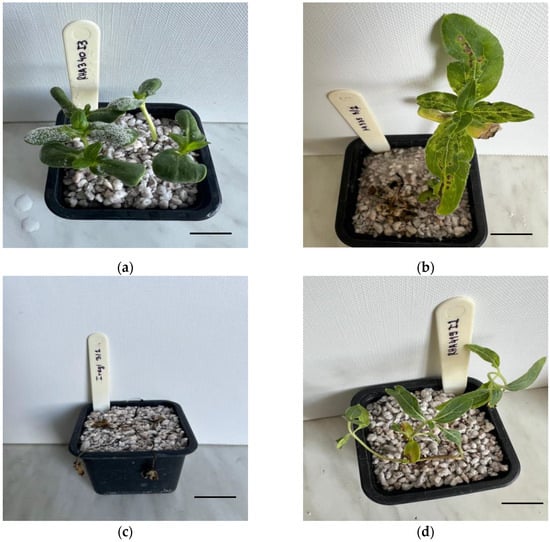
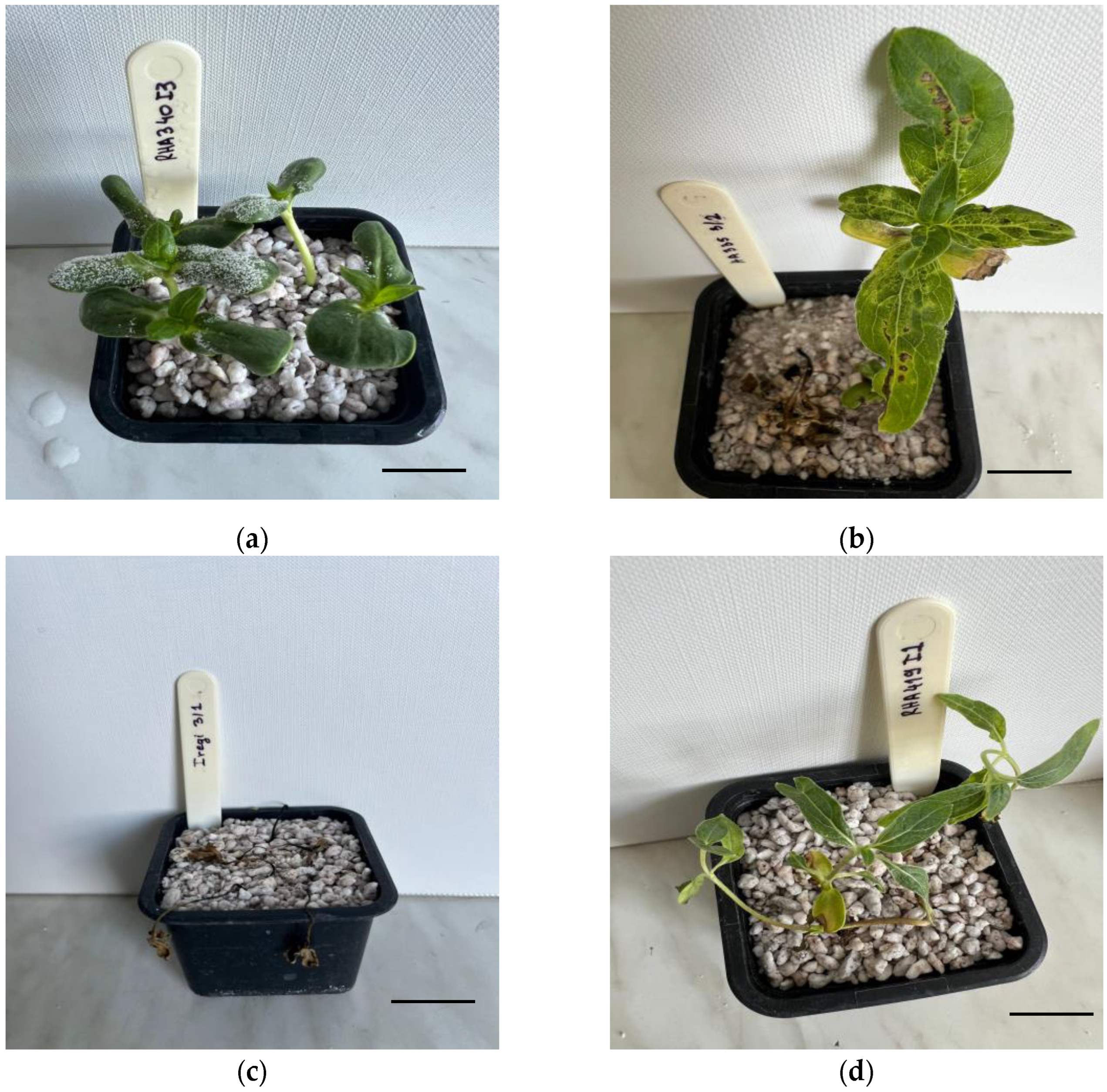
Figure 1 shows the characteristic symptoms and signs of P. halstedii observed during the experiments. After inoculating young susceptible or partially resistant seedlings, the pathogen’s asexual reproductive organs (sporangiophores and sporangia) appeared as a white coating on the cotyledons (Figure 1a). Then, the pathogen systemically spread in susceptible plants, causing chlorotic symptoms (chlorosis) on the true leaves (Figure 1b). In many cases, susceptible plants died after germination or emergence, indicating typical damping-off symptoms (Figure 1c). Leaf curling and abnormal growth were also common symptoms in both susceptible and some resistant host–parasite interactions (Figure 1d).
Figure 1.
Symptoms and signs of sunflower downy mildew. (a) Sporulation of P. halstedii on cotyledons of RHA-340 (Pl8) following inoculation with isolate I3, visible as a white coating made of sporangiophores and sporangia. (b) Chlorosis and necrotic lesions on true leaves of HA-335 (Pl6) after inoculation with isolate 3/2. (c) Damping-off in the susceptible control genotype Iregi after inoculation with isolate 3/1. (d) Abnormal leaf development and growth distortion in RHA-419 (PlArg) following inoculation with isolate I1. Pictures are representative examples chosen to illustrate different symptom types and are not meant to show all isolate-genotype combinations. Scale bars represent 2 cm (a), 3 cm (b), 4 cm (c) and 4.5 cm (d).
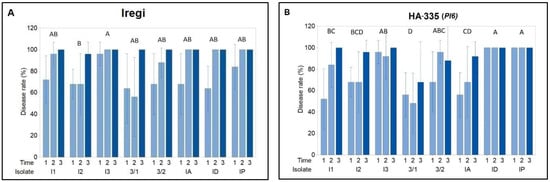
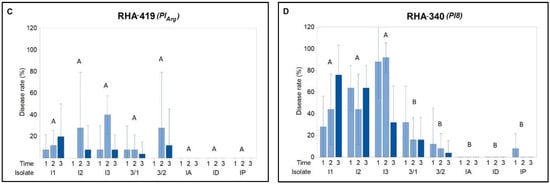
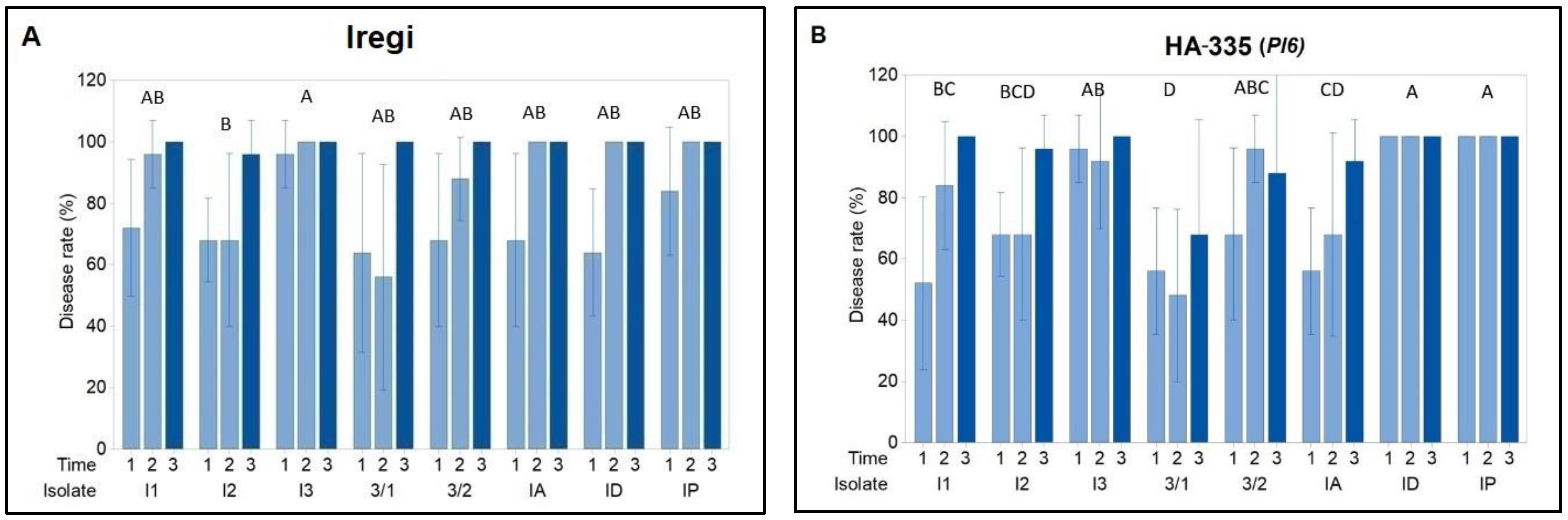
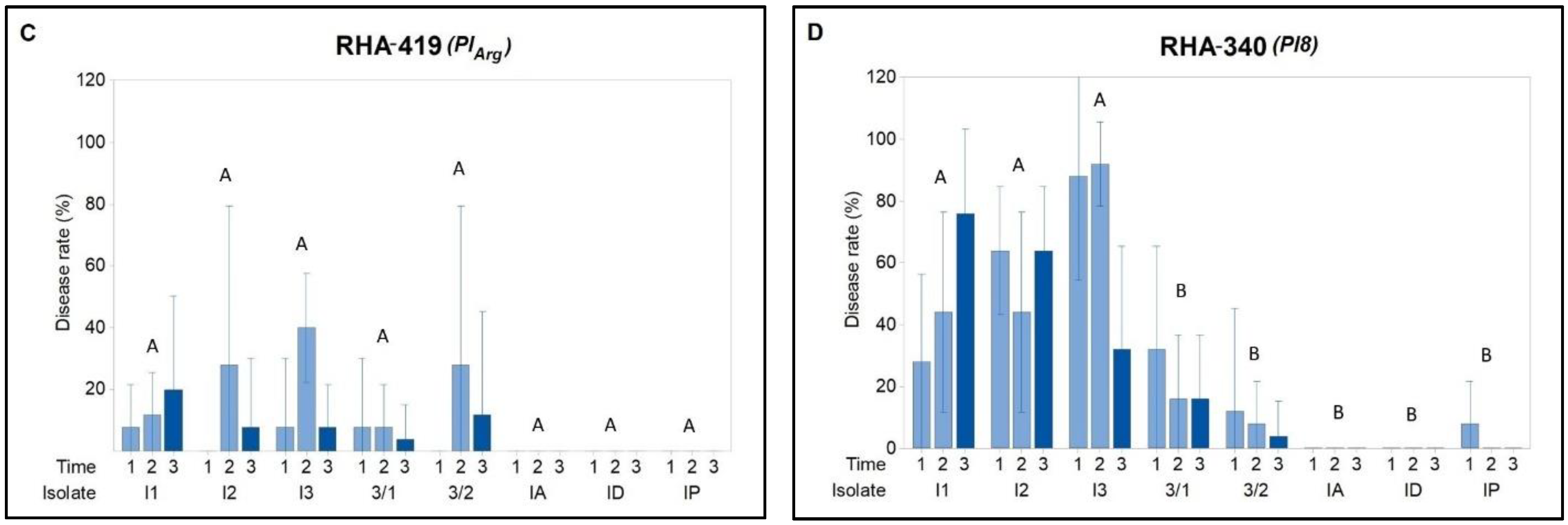
Disease rates varied significantly among sunflower genotypes and P. halstedii isolates (Figure 2). The susceptible control cultivar Iregi showed consistently high disease rates across all isolates and assessment times, often exceeding 80%, which confirms its high inoculum viability and uniform infection pressure (Figure 2A). The infection rate of Iregi plants inoculated with the I2 P. halstedii isolate was slightly lower than the others, but it was only significantly different from that of plants infected with I3. In the HA-335 genotype carrying the Pl6 gene, high disease rates were observed for most isolates, including I1, I2, I3, IA, ID, and IP, frequently approaching levels similar to the susceptible control (Figure 2B). Although isolates 3/1 and 3/2 caused moderately lower disease rates, infection increased at later assessment times. The RHA-419 sunflower genotype, which carries PlArg, exhibited a markedly different response pattern (Figure 2C). Disease progression was mostly limited for most isolates, with disease rates remaining close to zero for IA, ID, and IP throughout the assessment period. While some infection was observed with isolates I1, I2, I3, and 3/2, disease levels were much lower than in HA-335 and RHA-340. In genotype RHA-340 carrying Pl8, disease response varied by isolate (Figure 2D). Isolates I1, I2, and I3 caused moderate to high disease rates, whereas isolates 3/1 and 3/2 caused less infection. No disease was seen after inoculation with IA and ID, and only minimal infection occurred with IP.
Figure 2.
Disease rates (%) of sunflower genotypes (A) Iregi, (B) HA-335 (Pl6), (C) RHA-419 (PlArg), and (D) RHA-340 (Pl8) following inoculation with eight Plasmopara halstedii isolates (I1, I2, I3, 3/1, 3/2, IA, ID, and IP). Disease assessments were performed at three evaluation points: 1 = 9 days, 2 = 21 days, and 3 = 29 days post-inoculation. Bars represent mean values (n = 5), with standard deviations shown as error bars. Different letters above the central bars indicate significant differences in the average disease rates across the three evaluation times for the isolates.
2.2. Refining Symptom Assessment by Evaluating Plant Height, Damping-Off, Chlorosis, and Abnormal Plant Development
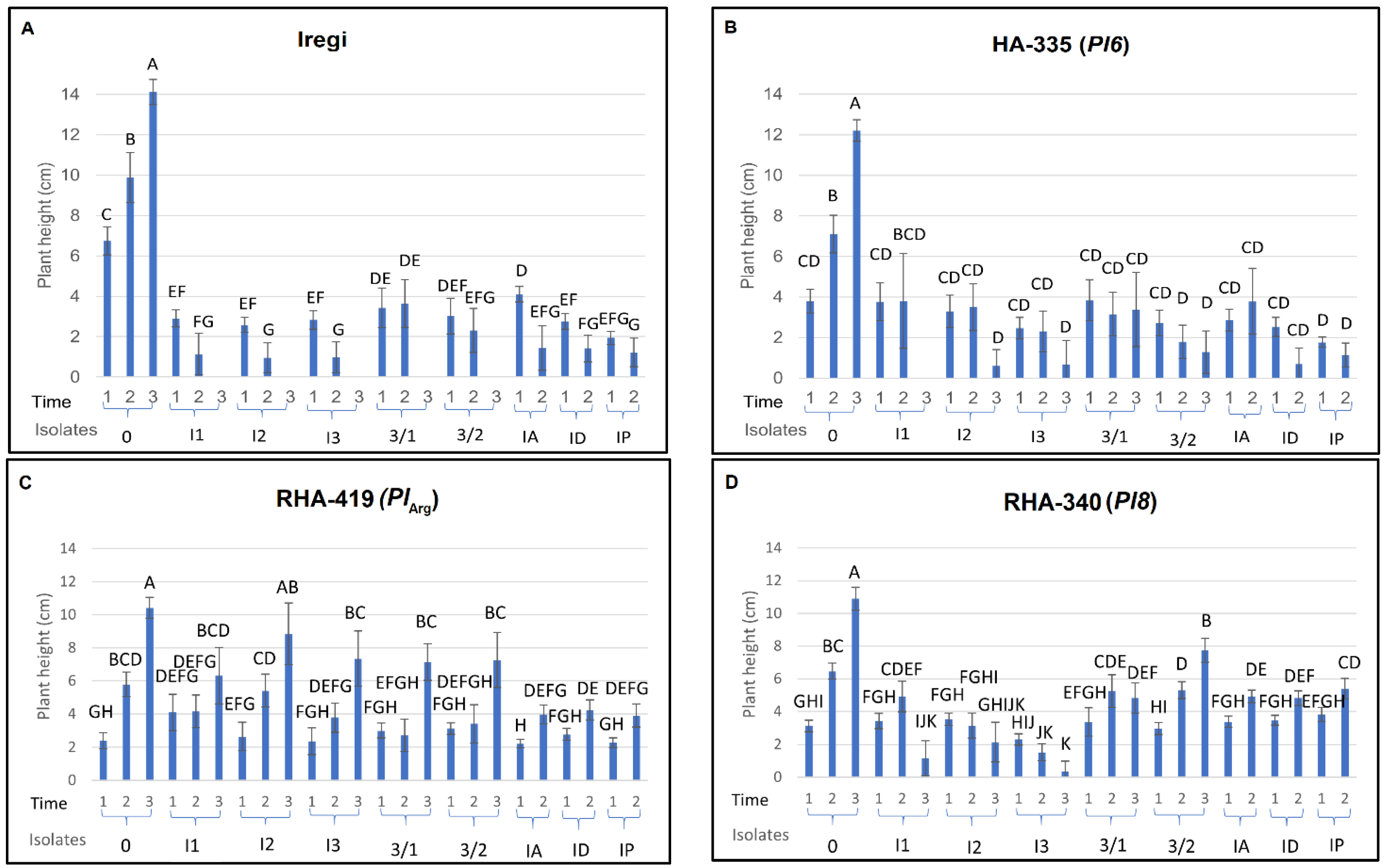
Plant height was significantly affected by genotype, isolate, and their interaction (Figure 3). In the susceptible control genotype Iregi, non-inoculated plants reached the greatest height, while inoculation with any P. halstedii isolate caused severe statistically significant growth suppression (Figure 3A). Height reduction was consistent across isolates and evaluation times, confirming the high aggressiveness of the isolates. Several isolate–genotype combinations (I1, I2, I3, 3/1, and 3/2) resulted in plant death due to damping-off by the third evaluation, resulting in a recorded height of zero. In the HA-335 genotype carrying Pl6, all isolates caused significant reductions in plant height compared to the non-inoculated control (Figure 3B). Growth suppression was especially notable after inoculation with isolates I3, 3/2, and IP. Plant height remained reduced at later assessment times. Conversely, inoculation of the genotype RHA-419 carrying PlArg with different P. halstedii isolates caused limited reductions in height (Figure 3C). Additionally, there was no significant difference between plants inoculated with the I2 isolate and non-inoculated plants. However, the genotype RHA-340 carrying Pl8 displayed pronounced isolate-dependent growth responses (Figure 3D). Isolates I1, I2, I3, and 3/1 caused strong suppression of plant height, while growth reduction was less evident following inoculation with isolate 3/2. For isolates IA, ID, and IP, plant height was only measured at the first two evaluation times, and these P. halstedii isolates induced moderate growth suppression in the RHA-340 genotype.
Figure 3.
Plant height of sunflower genotypes: (A) Iregi (susceptible control), (B) HA-335 (Pl6), (C) RHA-419 (PlArg), and (D) RHA-340 (Pl8) after inoculation with eight Plasmopara halstedii isolates (I1, I2, I3, 3/1, 3/2, IA, ID, and IP). 0 indicates a non-inoculated control. Plant height was measured at three evaluation times (1 = 9, 2 = 21, and 3 = 29 days post-inoculation) for isolates I1, I2, I3, 3/1, and 3/2. For isolates IA, ID, and IP, height was assessed at two times (9 and 21 days post-inoculation). Plants inoculated with I1, I2, I3, 3/1, and 3/2 that showed a height of zero (e.g., Iregi and HA-335) had died from damping-off before the final evaluation. Values represent means (n = 25), with standard deviations as the error bars. Different letters indicate statistically significant differences among treatments within the same genotype (p < 0.05).
Distinct genotype- and isolate-dependent differences were observed in damping-off incidence, chlorosis, and abnormal leaf development following inoculation with P. halstedii isolates (Table 1). In the susceptible control cultivar Iregi, damping-off reached 100% for isolates I1, I2, I3, 3/1, and 3/2 when assessed at the third evaluation, confirming extreme susceptibility and severe early infection. For isolates IA, ID, and IP, the damping-off percentages were lower, ranging from 52% to 68%. This was observed during the second evaluation, indicating that the disease’s progression varied among the isolates. Chlorosis was detected at low to moderate levels depending on the isolate, while abnormal leaf development was not observed in the Iregi cultivar.
Table 1.
Incidence of damping-off, chlorosis, and abnormal leaf development (mean ± SD, %) in sunflower genotypes Iregi, HA-335 (Pl6), RHA-419 (PlArg), and RHA-340 (Pl8) after inoculation with eight Plasmopara halstedii isolates.
In the HA-335 genotype carrying the Pl6 gene, high damping-off rates were observed across all isolates (Table 1). Complete seedling collapse occurred after inoculation with isolates I1 and I3 at the third evaluation, while isolates IA, ID, and IP showed reduced but still significant damping-off (28–72%) during the second evaluation. Abnormal leaf development was not observed in HA-335, likely due to early seedling mortality, which limited the appearance of further symptoms.
In contrast, the RHA-419 genotype carrying the PlArg gene showed significantly less damping-off across most isolates (Table 1). However, the level of damping-off observed in RHA-419 plants inoculated with isolates I1 and 3/2 is notable, at 16% and 12%, respectively. Chlorosis was not seen in any of the PlArg interactions. Additionally, abnormal leaf development was consistently observed with isolates I3, 3/1, and 3/2.
The RHA-340 genotype, which carries the Pl8 gene, showed distinct responses across isolates (Table 1). High damping-off and chlorosis were observed after inoculation with isolates I1, I2, and I3 during the third evaluation. In contrast, isolates 3/1 and 3/2 caused very little damping-off but were linked to significant abnormal leaf development. For isolates IA, ID, and IP, no damping-off, chlorosis, or abnormal leaf symptoms were seen at the second evaluation.
2.3. Virulence of Plasmopara halstedii Isolates on Plant Genotypes with Different Resistance Genes
Summarizing the results from disease rates, plant heights, damping-off, chlorosis, and abnormal leaves, the virulence of eight P. halstedii isolates were evaluated on four sunflower genotypes with different resistance backgrounds (Table 2). The control cultivar, Iregi, was shown to be susceptible to all isolates. Likewise, the HA-335 genotype carrying Pl6 was susceptible to all tested isolates, indicating that Pl6 did not confer effective resistance to the P. halstedii isolates studied. In contrast, the RHA-419 genotype, which carries PlArg, demonstrated resistance to all eight isolates, with no compatible interactions observed. However, further quantitative assessments revealed isolate-dependent variation in disease severity and plant growth effects. The RHA-340 genotype, carrying Pl8, showed reactions specific to certain isolates. After inoculation with isolates I1, I2, and I3, susceptibility was observed, while resistant responses were observed with isolates 3/1, 3/2, IA, ID, and IP. Overall, the pathogenicity tests highlight clear differences in resistance effectiveness among Pl6, Pl8, and PlArg.
Table 2.
Virulence of eight Plasmopara halstedii isolates (I1, I2, I3, 3/1, 3/2, IA, ID, and IP) on sunflower genotypes Iregi, HA-335 (Pl6), RHA-419 (PlArg), and RHA-340 (Pl8). Reactions were classified as resistant (R) or susceptible (S) based on the presence or absence of pathogen sporulation on cotyledons and leaves, damping-off, chlorosis on true leaves, and abnormal development.
3. Discussion
The current study shows significant variation in the virulence of P. halstedii isolates collected from Hungary over the past five years. All isolates infected the susceptible control cultivar Iregi and consistently exhibited high disease incidences, severe damping-off, and strong growth suppression. This consistent susceptibility confirms the effectiveness of the inoculation method, verifies isolate viability and aggressiveness, and provides a reliable baseline for assessing resistance responses in plant genotypes with different resistance genes.
Building on our findings, the Pl6 resistance gene carried by HA-335 did not provide effective protection against any of the tested isolates, indicating that Pl6 does not confer reliable resistance against the Hungarian isolates examined in this study. This conclusion is supported by multiple indicators: high disease rates, extensive damping-off, frequent chlorosis, and ongoing growth suppression. In practice, these results suggest that Pl6 did not reduce the damaging effects of infection on plant growth. These observations align with previous reports of Pl6 resistance breaking down across Europe and beyond [6,13,24]. The historical reliance on Pl6-based hybrids likely created strong selection pressure on P. halstedii populations, promoting the emergence and spread of virulent pathotypes [9].
It should be noted that pooling disease assessments across time points does not account for the temporal autocorrelation inherent to systemic infection processes. Therefore, the statistical results primarily reflect overall differences in isolate aggressiveness rather than detailed temporal dynamics of disease progression. Future studies should employ repeated-measures or mixed-effects models to better capture disease development over time.
In contrast to Pl6, Pl8-mediated resistance showed a variable response that largely depended on the isolate’s identity. The RHA-340 line, which carries the Pl8 gene, was clearly susceptible to isolates I1, I2, and I3 but showed resistance to isolates 3/1, 3/2, IA, ID, and IP. This isolate-specific behavior was consistent across disease-rate data, damping-off incidence, chlorosis development, and plant-height responses, indicating that Pl8 resistance is not reliably effective against the Hungarian isolates tested. Notably, the susceptibility of RHA-340 to isolates I1, I2, and I3 provides evidence of the presence of Pl8-virulent P. halstedii isolates in Hungary. To our knowledge, this is the first report of Pl8-virulent P. halstedii isolates in both Hungary and Central Europe. At the population level, our findings suggest a partial breakdown of the Pl8 resistance gene, making this an important discovery for guiding national resistance deployment and breeding strategies. Resistance conferred by major Pl genes, including Pl8, is generally consistent with a gene-for-gene interaction model. However, the molecular basis of Pl8-mediated resistance and the identity of P. halstedii effectors capable of overcoming this resistance remain largely uncharacterized [3]. This lack of molecular information may contribute to the observed variability in resistance responses and highlights the need for further research.
In the European context, Pl8 breakdown was first confirmed in France and Italy [17] and has since been recognized as a major threat to breeding programs, with further confirmation of Pl8-virulent populations in other regions, including North America [18]. The present results extend this pattern by showing that Pl8-virulent isolates are also found in Hungary. This is significant because commercial sunflower hybrids containing Pl8 are common in Europe and the USA [17,18].
It is well known that the traditional, internationally accepted differential set used to identify sunflower downy mildew pathotypes contains nine sunflower lines with different resistance genes [25]. One of the most advanced resistance genes in the set is Pl6. Tourvieille de Labrouhe et al. [12] proposed expanding the set by including sunflower lines with additional resistance genes, such as PlArg. However, this expanded system still does not contain important genes used in sunflower breeding, such as Pl8; hence, the same nominal pathotype designation may mask biologically meaningful virulence differences [17]. Therefore, the lack of a differential line with the Pl8 gene in the classical set, as well as the set’s known limitations, and the rapid spread of highly virulent pathotypes highlight the need to revise and expand pathotype identification frameworks [15,26,27].
Among the resistance genes evaluated, PlArg (RHA-419) showed the highest effectiveness, which demonstrated resistance to all tested P. halstedii isolates. This supports reports identifying PlArg as a broadly effective resistance source in H. agrophyllus [19,20,21]. PlArg has provided reliable resistance to various pathotypes of P. halstedii for several decades in sunflower-growing regions around the world [18,27,28,29,30,31]. However, it is noteworthy that isolates I1 and 3/2 caused damping-off in more than 10% of cases, while isolates I3, 3/1, and 3/2 resulted in abnormal leaf development in more than 30% of cases.
Nevertheless, these observations on genotypes carrying PlArg should be interpreted with caution. Although most plants remained phenotypically healthy at the final evaluation and showed no systemic disease symptoms, the presence of abnormal leaf development may indicate a more complex host–pathogen interaction. This response could reflect either a localized defense reaction or a limited level of pathogen colonization that cannot be resolved based on macroscopic symptoms alone. Therefore, these findings may represent an early signal of partial pathogenicity or incomplete resistance rather than a purely physiological growth-related effect. Further microscopic and histological analyses would be required to distinguish between a hypersensitive response and restricted infection.
Additionally, the quantitative data may demonstrate that PlArg resistance is not necessarily “cost-free”. Although the development of systemic disease was restricted (e.g., no chlorosis was recorded), certain isolate–genotype combinations produced mild disease symptoms, with moderate reductions in plant height. PlArg restricted pathogen colonization and/or systemic development rather than fully preventing early infection. Such partial resistance could contribute to improved durability by reducing selection pressure on pathogen populations, but it can also entail physiological costs or developmental penalties. In this context, defense-related trade-offs between growth and resistance have been described in other host–pathogen systems [32,33], and the PlArg responses observed here are consistent with that general framework.
It should be noted that plant height values include zero measurements corresponding to dead plants (damping-off), thereby integrating both survival and growth responses. In several cases, complete mortality was observed, while in others, only a small number of plants survived, making height measurements from surviving individuals alone unrepresentative. Therefore, plant height should be interpreted as an integrated measure of disease impact rather than growth of surviving plants only.
Collectively, these results show that P. halstedii populations in Hungary possess virulence profiles that can overcome widely deployed resistance genes. The complete loss of Pl6 effectiveness and the isolate-dependent erosion of Pl8 highlight the vulnerability of relying on single major genes under sustained selection pressure. Importantly, the detection of Pl8-virulent isolates in Hungary complements earlier Hungarian observations and monitoring efforts reporting high-virulence pathotypes and the evolving nature of national pathogen populations [1,6,34]. By integrating virulence characterization with quantitative measures of symptoms and growth, the present study strengthens the evidence base for updating resistance deployment strategies in sunflower.
From a breeding perspective, the results support diversifying resistance sources as priorities for durable downy mildew management. PlArg remains a highly valuable resistance component, but its partial nature and the presence of isolate-dependent developmental effects suggest it should not be deployed in isolation. Marker-assisted selection and gene pyramiding strategies offer practical routes to combine PlArg with additional major or quantitative loci to enhance durability [22,23]. In parallel, continued monitoring of P. halstedii populations and systematic characterization of isolates across regions remain essential to anticipate shifts in virulence and proactively adapt breeding strategies. Overall, this study provides new, isolate-resolved evidence of resistance erosion in Hungary—especially with respect to Pl8—and supports integrated resistance breeding as a cornerstone of sustainable sunflower production under an evolving pathogen threat.
4. Materials and Methods
4.1. Sunflower Genotypes and Plasmopara halstedii Isolates
Four sunflower genotypes were used in this study: Iregi szürke csíkos (Iregi), HA-335, RHA-419, and RHA-340. The Hungarian cultivar Iregi, which is susceptible to all known pathotypes of P. halstedii, was used as a susceptible control and as a host for increasing inoculum quantity. The sunflower inbred lines HA-335, RHA-419, and RHA-340 were selected as differential genotypes for resistance evaluation, which carry resistance genes Pl6, PlArg, and Pl8, respectively. A total of eight P. halstedii isolates were included in the experiments, which were collected in Hungary in 2021, 2024, and 2025 (Table 3). The origin of the isolates and their associated host resistance backgrounds were determined based on the commercial sunflower hybrids from which they were collected. All isolates were maintained on infected sunflower tissue in an ultra-low temperature freezer at −70 °C to preserve viability until use.
Table 3.
Origin of Plasmopara halstedii isolates used in this survey.
4.2. Preparation of Plasmopara halstedii Inoculum and Inoculation
For inoculum preparation and inoculation, we used the method described by Trojanová et al. [26]. Briefly, seeds of Iregi, HA-335, RHA-419, and RHA-340 were surface-sterilized in 1% NaOCl for 3–5 min to eliminate surface contaminants, and then thoroughly rinsed with running tap water. Seeds were germinated on moist filter paper under controlled conditions. Based on the germination vigor of the sunflower genotypes, germination was carried out at 19 °C for Iregi and at 24 °C for HA-335, RHA-419, and RHA-340 for 2–3 days, until radicles reached 3–5 mm.
Sporangial suspensions were prepared from infected leaf tissues of preserved isolates by gently rinsing the tissue in bidistilled water. Inoculation was performed using the whole seedling immersion (WSI) [35] as follows: germinated seeds were first rinsed in bidistilled water for 5–6 min. Infected leaf material of each isolate was removed from cold storage, and sporangia were released by gently brushing the leaf surface in 100 mL of bidistilled water. Then the sporangial concentration was adjusted to 50,000 sporangia mL−1 using a Bürker counting chamber. For each isolate–genotype combination, approximately 25 mL of sporangial suspension was used to ensure complete immersion of all seedlings during inoculation. Seeds were transferred to Petri dishes for each isolate-genotype combination. Control dishes contained an equal number of seeds immersed in bidistilled water. Seeds were fully submerged in the sporangial suspension and incubated overnight in darkness at 16 °C to promote infection.
4.3. Plant Cultivation
After inoculation, seedlings were transplanted into pots (10 pots per isolate-genotype combination, 5 seedlings per pot) containing horticultural perlite (d = 4 mm). Pots were placed in trays and cultivated in a growth chamber under a 12-h photoperiod at 22 °C and under a light intensity of 100 μE·m−2·s−1. Plants were watered every two days. A nutrient solution (Volldünger Linz, 0.2 g L−1, 0.5 L per tray) was applied three days after sowing to support seedling development.
4.4. Sporulation Induction and Disease Assessments
Sporulation was induced 9 days post-inoculation (dpi). Trays were placed in dark plastic bags, and plants were sprayed with bidistilled water before the bags were sealed, creating high-humidity conditions favorable for pathogen development. The sealed trays were incubated in darkness at 19 °C for 24 h. We performed disease assessments three times: 1. at 10 dpi, right after sporulation; 2. at 21 dpi, when most plants had developed true leaves, allowing for the evaluation of systemic infection; and 3. at 29 dpi. Plants were classified as healthy or diseased based on the absence or appearance of visible symptoms, including sporulation on cotyledons, chlorosis on true leaves, abnormal plant development (stunting, curling, asymmetric true leaves), and damping-off. If only slight sporulation was observed on the plants without the appearance of further symptoms, the reaction was assessed as resistant. The disease rate (%) was calculated as the percentage of diseased plants. Because downy mildew infection causes pronounced growth suppression, plant height was measured at 10, 21, and 29 dpi.
4.5. Statistical Analysis
The experimental unit for disease-related parameters was the pot, with each pot containing five seedlings. Disease rate was calculated as the mean value per pot (n = 5 pots per isolate–genotype combination). For plant height measurements, individual plants were used as statistical units. However, plants within the same pot may not be fully independent due to shared microenvironmental conditions.
Two independent experiments were conducted. Statistical analyses were performed using IBM SPSS Statistics (version 25). Assuming normal distributions because of the relatively large sample size (n = 15–25 for disease assessments and 50–75 for plant height measurements per genotype-isolate combinations), homogeneity of variances was assessed using Bartlett’s test. Since equal variance was not satisfied in either case, we used Welch-Anova with the Games-Howell Pairwise Comparisons as a post hoc test (p ≤ 0.05) [36].
Because the number of replicates (n = 5) per individual evaluation time was insufficient to assess distributional assumptions and perform robust parametric comparisons, statistical analyses were not conducted separately for time points 1, 2, and 3 during disease assessment. To increase statistical power and meet the assumptions required for parametric testing, disease rate data were pooled across all three assessment periods (total n = 15 per isolate–genotype combination). The larger combined sample size allowed for the assumption of approximate normality and enabled statistical comparisons among isolates [36].
Disease progression over time (9, 21, and 29 dpi) was evaluated descriptively, and no formal statistical comparison across time points or time × isolate interactions was performed due to the limited number of replicates per time point. Disease rate data from multiple assessment time points represent repeated measurements on the same experimental units and are therefore not independent; consequently, the pooled analysis should be interpreted as an exploratory approach and does not fully account for temporal dependence. Disease reactions were additionally interpreted using threshold-based criteria, where values above 60% were considered susceptible and values below 20% resistant.
5. Conclusions
This study shows significant differences in virulence among P. halstedii isolates collected in Hungary over the last 5 years. It highlights contrasting resistance profiles of the major sunflower downy mildew resistance genes. The Pl6 gene no longer provides effective protection against most tested isolates, while Pl8 resistance was selectively overcome across isolates, confirming the ongoing weakening of widely used resistance sources. In contrast, the PlArg gene conferred the highest level of resistance, substantially reducing disease development and early seedling damping-off. However, minor growth and morphological effects suggest a partial resistance response. These findings highlight the limitations of relying on a single dominant resistance gene and emphasize the need to incorporate durable resistance strategies, including gene pyramiding, quantitative resistance, and ongoing pathogen monitoring. A better understanding of local P. halstedii virulence patterns will be crucial for guiding sunflower breeding programs toward more sustainable and long-term disease management.
Author Contributions
Conceptualization, A.B. (Arbnora Berisha), R.B., K.K. and A.K.; Data curation, A.B. (Arbnora Berisha) and R.B.; Formal analysis, A.B. (Arbnora Berisha), R.B., A.K., K.K., Á.L., A.S. and A.B. (Altin Berisha); Investigation, A.B. (Arbnora Berisha), A.K., K.K., Á.L., A.S. and R.B.; Methodology, A.B. (Arbnora Berisha), A.K. and R.B.; Resources, A.B. (Arbnora Berisha) and R.B.; Software, A.B. (Arbnora Berisha), R.B. and A.B. (Altin Berisha); Supervision, R.B., A.K. and K.K.; Validation, R.B., K.K. and A.K.; Visualization, A.B. (Arbnora Berisha) and R.B.; Writing—original draft, A.B. (Arbnora Berisha) and R.B.; Writing—review and editing, A.B. (Arbnora Berisha), A.K., K.K., Á.L., A.S., A.B. (Altin Berisha) and R.B. All authors have read and agreed to the published version of the manuscript.
Funding
This research was funded by the STIPENDIUM HUNGARICUM SCHOLARSHIP PROGRAM (Registration Number: 497809).
Data Availability Statement
The original contributions presented in this study are included in the article. Further inquiries can be directed to the corresponding author.
Acknowledgments
We are grateful to Marie-Claude Boniface and Marianne Gani (INRAE-LIPME) for providing the sunflower genotypes RHA-340 and RHA-419. We also thank Rita Baraksó for her help with the lab experiments and Andrea Nagy for managing the administrative tasks. We appreciate Jozsef Kiss for his dedicated support during our studies on sunflower downy mildew.
Conflicts of Interest
Author Attila Kovács was employed by the company Syngenta. The remaining authors declare that the research was conducted in the absence of any commercial or financial relationships that could be construed as a potential conflict of interest.
References
- Bán, R.; Kiss, J.; Pálinkás, Z.; Körösi, K. Placing Management of Sunflower Downy Mildew (Plasmopara halstedii (Farl.) Berl. et de Toni) under an Integrated Pest Management (IPM) System Approach: Challenges and New Perspectives. Agronomy 2023, 13, 1029. [Google Scholar] [CrossRef] [Scilit]
- Spring, O. Transition of secondary to systemic infection of sunflower with Plasmopara halstedii—An underestimated factor in the epidemiology of the pathogen. Fungal Ecol. 2009, 2, 75–80. [Google Scholar] [CrossRef] [Scilit]
- Gascuel, Q.; Martinez, Y.; Boniface, M.-C.; Vear, F.; Pichon, M.; Godiard, L. The sunflower downy mildew pathogen Plasmopara halstedii: Plasmopara halstedii, sunflower downy mildew. Mol. Plant Pathol. 2015, 16, 109–122. [Google Scholar] [CrossRef] [Scilit] [PubMed]
- Gulya, T.; Harveson, R.; Mathew, F.; Block, C.; Thompson, S.; Kandel, H.; Berglund, D.; Sandbakken, J.; Kleingartner, L.; Markell, S. Comprehensive Disease Survey of U.S. Sunflower: Disease Trends, Research Priorities and Unanticipated Impacts. Plant Dis. 2019, 103, 601–618. [Google Scholar] [CrossRef] [Scilit] [PubMed]
- Debaeke, P.; Mestries, E.; Desanlis, M.; Seassau, C. Effects of crop management on the incidence and severity of fungal diseases in sunflower. In Sunflowers: Growth and Development, Environmental Influences and Pests/Diseases; Arribas, J.I., Ed.; Botanical research and practices; Nova Science Publishers: New York, NY, USA, 2014; pp. 201–226. [Google Scholar]
- Bán, R.; Kovács, A.; Nisha, N.; Pálinkás, Z.; Zalai, M.; Yousif, A.I.A.; Körösi, K. New and High Virulent Pathotypes of Sunflower Downy Mildew (Plasmopara halstedii) in Seven Countries in Europe. JoF 2021, 7, 549. [Google Scholar] [CrossRef] [Scilit]
- Crute, I.R.; Pink, D. Genetics and Utilization of Pathogen Resistance in Plants. Plant Cell 1996, 8, 1747–1755. [Google Scholar] [CrossRef] [Scilit] [PubMed]
- Sakr, N. Pathogenic, morphological and genetic diversity in Plasmopara halstedii, the causal agent of sunflower downy mildew. Acta Sci. Agron. 2013, 35, 9–19. [Google Scholar] [CrossRef] [Scilit]
- Spring, O. Spreading and global pathogenic diversity of sunflower downy mildew—Review. Plant Prot. Sci. 2019, 55, 149–158. [Google Scholar] [CrossRef] [Scilit]
- Nisha, N.; Körösi, K.; Perczel, M.; Yousif, A.I.A.; Bán, R. First Report on the Occurrence of an Aggressive Pathotype, 734, of Plasmopara halstedii Causing Sunflower Downy Mildew in Hungary. Plant Dis. 2021, 105, 711. [Google Scholar] [CrossRef] [Scilit]
- Vear, F.; Gentzbittel, L.; Philippon, J.; Mouzeyar, S.; Mestries, E.; Roeckel-Drevet, P.; Tourvieille de Labrouhe, D.; Nicolas, P. The genetics of resistance to five races of downy mildew (Plasmopara halstedii) in sunflower (Helianthus annuus L.). Theor. Appl. Genet. 1997, 95, 584–589. [Google Scholar] [CrossRef] [Scilit]
- de Labrouhe, D.T.; Bordat, A.; Tourvieille, J.; Mestries, E.; Walser, P.; Sakr, N.; Ducher, M.; Delmotte, F.; Vear, F. Impact of major gene resistance management for sunflower on fitness of Plasmopara halstedii (downy mildew) populations. OCL 2010, 17, 56–64. [Google Scholar] [CrossRef] [Scilit]
- Gulya, T.J., Jr.; Markell, S.; McMullen, M.; Harveson, R.M.; Osborne, L.E. Emergence of new virulent races of Plasmopara halstedii inciting downy mildew on sunflower in the United States. In North Central Division Meeting Abstracts; Sunflower and Plant Biology Research: Fargo, ND, USA, 2011; Volume S2.3–4. [Google Scholar]
- Miranda-Fuentes, P.; García-Carneros, A.B.; Molinero-Ruiz, L. Updated Characterization of Races of Plasmopara halstedii and Entomopathogenic Fungi as Endophytes of Sunflower Plants in Axenic Culture. Agronomy 2021, 11, 268. [Google Scholar] [CrossRef] [Scilit]
- Sedlářová, M.; Pospíchalová, R.; Drábková Trojanová, Z.; Bartůšek, T.; Slobodianová, L.; Lebeda, A. First Report of Plasmopara halstedii New Races 705 and 715 on Sunflower from the Czech Republic—Short Communication. Plant Prot. Sci. 2016, 52, 182–187. [Google Scholar] [CrossRef] [Scilit]
- Spring, O.; Zipper, R. New highly aggressive pathotype 354 of Plasmopara halstedii in German sunflower fields. Plant Prot. Sci. 2018, 54, 83–86. [Google Scholar] [CrossRef] [Scilit]
- Martín-Sanz, A.; Rueda, S.; García-Carneros, A.B.; Molinero-Ruiz, L. First Report of a New Highly Virulent Pathotype of Sunflower Downy Mildew (Plasmopara halstedii) Overcoming the Pl8 Resistance Gene in Europe. Plant Dis. 2020, 104, 597. [Google Scholar] [CrossRef] [Scilit]
- Gilley, M.A.; Gulya, T.J.; Seiler, G.J.; Underwood, W.; Hulke, B.S.; Misar, C.G.; Markell, S.G. Determination of Virulence Phenotypes of Plasmopara halstedii in the United States. Plant Dis. 2020, 104, 2823–2831. [Google Scholar] [CrossRef] [Scilit]
- Wieckhorst, S.; Bachlava, E.; Dußle, C.M.; Tang, S.; Gao, W.; Saski, C.; Knapp, S.J.; Schön, C.-C.; Hahn, V.; Bauer, E. Fine mapping of the sunflower resistance locus Pl ARG introduced from the wild species Helianthus argophyllus. Theor. Appl. Genet. 2010, 121, 1633–1644. [Google Scholar] [CrossRef] [Scilit] [PubMed]
- Wang, Z.; Shen, W.; Mészáros, G.; Smith, K.; Pang, D.; Calhoun, S. Marker Development and Fine-Mapping of Downy Mildew (Plasmopara halstedii) (DM) Resistance PlArg in Sunflower (Helianthus annuus) using nested-association-mapping (NAM) Populations. Int. J. Plant Breed. Genet. 2023, 10, 1–9. [Google Scholar]
- Qi, L.L.; Talukder, Z.I.; Hulke, B.S.; Foley, M.E. Development and dissection of diagnostic SNP markers for the downy mildew resistance genes Pl Arg and Pl 8 and maker-assisted gene pyramiding in sunflower (Helianthus annuus L.). Mol. Genet. Genom. 2017, 292, 551–563. [Google Scholar] [CrossRef] [Scilit]
- Şahin, E.Ç; Kalenderoğlu, A.; Aydın, Y.; Evci, G.; Uncuoğlu, A.A. SSR Markers Suitable for Marker Assisted Selection in Sunflower for Downy Mildew Resistance. Open Life Sci. 2018, 13, 319–326. [Google Scholar] [CrossRef] [Scilit]
- Qi, L.; Ma, G. Marker-Assisted Gene Pyramiding and the Reliability of Using SNP Markers Located in the Recombination Suppressed Regions of Sunflower (Helianthus annuus L.). Genes 2019, 11, 10. [Google Scholar] [CrossRef] [Scilit]
- Virányi, F.; Gulya, T.J.; Tourvieille, D.L. Recent Changes in the Pathogenic Variability of Plasmopara halstedii (Sunflower Downy Mildew) Populations from Different Continents. Helia 2015, 38, 149–162. [Google Scholar] [CrossRef] [Scilit]
- Gulya, T.J.; de Labrouhe, D.T.; Masirevic, S.; Penaud, A.; Rashid, K.; Virányi, F. Proposal for standardized nomenclature and identification of races of Plasmopara halstedii (sunflower downy mildew). In Proceedings of the International Sunflower Association Symposium; Gulya, T.J., Vear, F., Eds.; III, Sunflower Downy Mildew; International Sunflower Association: Fargo, ND, USA, 1998; pp. 130–136. [Google Scholar]
- Trojanová, Z.; Sedlářová, M.; Gulya, T.J.; Lebeda, A. Methodology of virulence screening and race characterization of Plasmopara halstedii, and resistance evaluation in sunflower—A review. Plant Pathol. 2017, 66, 171–185. [Google Scholar] [CrossRef] [Scilit]
- Molinero-Ruiz, L. Sustainable and efficient control of sunflower downy mildew by means of genetic resistance: A review. Theor. Appl. Genet. 2022, 135, 3757–3771. [Google Scholar] [CrossRef] [Scilit] [PubMed]
- Vear, F.; de Labrouhe, D.T.; Miller, J. Inheritance of the wide-range downy mildew resistance in the sunflower line RHA 419. Helia 2003, 26, 19–24. [Google Scholar] [CrossRef] [Scilit]
- Berisha, A.; Körösi, K.; Bán, R. Efficacy of BTH and NeemAzal against an aggressive isolate of sunflower downy mildew caused by Plasmopara halstedii. Rev. Agric. Rural Dev. 2024, 13, 48–55. [Google Scholar] [CrossRef] [Scilit]
- Iwebor, M.; Antonova, T.; Araslanova, N.; Saukova, S.; Pitinova, Y.; Eliseeva, K.; Belorutskiy, A. The first report of Plasmopara halstedii race 337 in the Russian Federation. Plant Prot. Sci. 2022, 58, 76–80. [Google Scholar] [CrossRef] [Scilit]
- Iwebor, M.V.; Antonova, T.S.; Araslanova, N.M.; Saukova, S.L. First report of the detection of the sunflower downy mildew pathogen pathotype 737 in the Russian Federation. Oil Crops 2025, 4, 99–105. [Google Scholar] [CrossRef] [Scilit]
- Heil, M.; Baldwin, I.T. Fitness costs of induced resistance: Emerging experimental support for a slippery concept. Trends Plant Sci. 2002, 7, 61–67. [Google Scholar] [CrossRef] [Scilit]
- Brown, J.K.M. Yield penalties of disease resistance in crops. Curr. Opin. Plant Biol. 2002, 5, 339–344. [Google Scholar] [CrossRef] [Scilit] [PubMed]
- Bán, R.; Kovács, A.; Körösi, K.; Perczel, M.; Turóczi, G. First Report on the Occurrence of a New Pathotype, 714, of Plasmopara halstedii (Sunflower Downy Mildew) in Hungary. Plant Dis. 2014, 98, 1580. [Google Scholar] [CrossRef] [Scilit] [PubMed]
- Cohen, Y.; Sackston, W.E. Factors affecting infection of sunflowers by Plasmopara halstedii. Can. J. Bot. 1973, 51, 15–22. [Google Scholar] [CrossRef] [Scilit]
- Delacre, M.; Leys, C.; Mora, Y.L.; Lakens, D. Taking Parametric Assumptions Seriously: Arguments for the Use of Welch’s F-test instead of the Classical F-test in One-Way ANOVA. Int. Rev. Soc. Psychol. 2019, 32, 13. [Google Scholar] [CrossRef] [Scilit]

Disclaimer/Publisher’s Note: The statements, opinions and data contained in all publications are solely those of the individual author(s) and contributor(s) and not of MDPI and/or the editor(s). MDPI and/or the editor(s) disclaim responsibility for any injury to people or property resulting from any ideas, methods, instructions or products referred to in the content. |
© 2026 by the authors. Licensee MDPI, Basel, Switzerland. This article is an open access article distributed under the terms and conditions of the Creative Commons Attribution (CC BY) license.