


Abstract
Willow-based phytomanagement is considered for metal-contaminated sites. However, the effects of concurrent water deficit on willow performance and metal uptake remain poorly understood. We investigated the responses of the energy willow Salix viminalis L. cultivar ‘Tordis’ to copper (Cu)-, nickel (Ni)-, and polyethylene glycol (PEG)-induced osmotic stress and their combinations. Plants were cultivated hydroponically for 21 days with 1 mM Cu or Ni and 5% PEG-6000. Biomass, leaf relative water content (RWC), metal accumulation and translocation, and elemental composition were assessed. Cu was more phytotoxic than Ni, reducing total fresh biomass by 65.8% and RWC by 7.2%, whereas PEG alone did not significantly affect total fresh biomass or leaf RWC, despite significantly reducing root fresh biomass by approximately 29.1%. PEG co-treatment did not significantly alter metal-induced biomass reductions but produced the lowest RWC when combined with Cu. PEG decreased Cu content by 62.8% in shoots and 69.5% in roots while maintaining its predominantly root-bound distribution. Conversely, PEG increased shoot Ni content 4.2-fold and enhanced its translocation to shoots, despite a slight reduction in root Ni content. Combined treatments were associated with altered C:N ratios, higher Ca and Mg concentrations in shoots and roots, and markedly lower shoot Fe concentrations. Overall, PEG supplementation modified tissue metal and nutrient concentrations in a metal-dependent manner under short-term hydroponic conditions. The relevance of these responses to willow phytomanagement under soil water deficits requires validation in soil-based and field experiments.
1. Introduction
Willow (Salix spp.) is one of the most widely cultivated woody bioenergy crops in short-rotation coppice (SRC) systems, owing to its rapid growth, high biomass productivity, strong coppicing capacity, and relatively low agronomic requirements. Among the numerous willow genotypes developed for SRC production, the hybrid cultivar ‘Tordis’ (‘Tora’ × ‘Ulv’), with the pedigree (S. schwerinii × S. viminalis) × S. viminalis, is of particular interest. ‘Tordis’ was bred by Svalöf-Weibull AB in Sweden, released in 2000 under the breeding designation SW960299, and subsequently marketed through Lantmännen Agroenergi’s commercial willow programme. It was registered by the CPVO under the botanical taxon S. viminalis L., and Community plant variety right No. 9288 was granted on 6 May 2002 [1]. ‘Tordis’ is characterized by vigorous growth, high biomass and cutting production, resistance to leaf rust, and relatively stable performance across a range of soil and climatic conditions [2,3,4]. In a large-scale comparison of 22 willow cultivars, ‘Tordis’ demonstrated high productivity under short-rotation cultivation, reaching a dry matter yield of 33.1 t ha−1 in the third year after transplanting [5].
Beyond its role as a biomass crop, ‘Tordis’ has been investigated for environmental applications, including soil carbon sequestration and integration into willow–grassland agroforestry systems. Willow-based systems have been considered for phytoremediation and phytomanagement of contaminated soils due to their high tolerance and capacity for the stabilization and/or accumulation of potentially toxic elements, such as cadmium (Cd), zinc (Zn), and lead (Pb) [6,7,8]. The choice of willow genotype can influence the carbon balance and climate-mitigation potential of biomass plantations, with ‘Tordis’ included among the genotypes evaluated for carbon sequestration within Salix plantations [9]. Willow-based SRC systems established within agroforestry arrangements may also affect soil properties and plant community composition; however, the magnitude of these ecosystem services depends strongly on the location, as well as genotype and plantation management [10,11]. In this context, willow-based phytoremediation represents a potentially sustainable approach to the management and reclamation of soils contaminated with potentially toxic elements originating from mining and metallurgical activities, fossil-fuel combustion, and the long-term application of metal-containing fertilizers, pesticides, and sewage sludge [12,13,14,15]. Among the metals commonly occurring in contaminated soils, copper (Cu) and nickel (Ni) are essential micronutrients required for normal plant functioning, including the activity of metalloenzymes involved in electron transport, nitrogen metabolism, and redox regulation. However, when present in excess, both elements can disrupt cellular homeostasis and become phytotoxic [16,17,18].
Cu toxicity is primarily associated with disruption of cellular redox homeostasis and enhanced production of reactive oxygen species (ROS), which may result in oxidative damage and impairment of physiological processes. Excessive Cu accumulation can consequently inhibit plant growth and photosynthesis and disturb nutrient homeostasis, whereas plants activate antioxidant defense systems and metal-sequestration mechanisms to maintain Cu homeostasis [19]. Similarly, Ni toxicity involves disturbances in mineral nutrition, photosynthesis, water relations, and enzymatic activity and may result in chlorosis and inhibition of root and shoot growth. Excess Ni can also promote oxidative stress and cellular damage, while plants may mitigate its adverse effects through antioxidant responses, intracellular sequestration, and regulation of Ni uptake and transport [20,21].
Previous exposure studies on energy willow indicate that Cu may exert stronger phytotoxic effects than Ni at comparable concentrations, causing more pronounced chlorosis, necrosis, biomass reduction, and dehydration [22].
In addition to metal pollution, increasing frequency, duration, and severity of drought events associated with climate change represent an important constraint on the productivity of woody biomass crops [23,24]. This is particularly relevant for SRC plantations, which are frequently established on rain-fed or marginal sites where irrigation is unavailable or economically impractical. Water deficit can reduce stomatal conductance, leaf area, photosynthetic capacity, and ultimately biomass accumulation, although the magnitude of these responses varies considerably among willow genotypes [25,26]. Consequently, drought may not only directly constrain biomass production but also influence the uptake, translocation, and physiological effects of potentially toxic elements.
Although the individual effects of Cu, Ni, and water deficit on willow physiology and productivity have received considerable attention, the responses of energy willow to their combined occurrence remain insufficiently understood. Limited information is available on how simultaneous exposure to metal stress and water deficit affects biomass production and allocation, plant water status, metal accumulation and translocation, and elemental stoichiometry. Recent evidence indicates that interactions between heavy-metal stress and drought may be highly variable in direction and magnitude, depending on plant species or genotype, metal identity, and stress intensity [27]. Therefore, the present study aimed to assess the effects of metal (Cu, Ni), PEG-simulated drought, and their pairwise combinations on S. viminalis cv. ‘Tordis’ cultivated hydroponically. Specifically, we evaluated (i) total biomass production and its partitioning between shoots and roots, (ii) leaf relative water content as an indicator of plant water status, (iii) Cu and Ni accumulation and their translocation between roots and shoots, and (iv) macronutrient concentrations (C, N, and H) and mineral stoichiometry in both plant organs. The results provide novel insights into the response of ‘Tordis’ to combined metal and water stress and may contribute to the development of more efficient strategies for the cultivation of willow on marginal or polluted sites, particularly under increasingly variable water availability.
2. Results
2.1. Biomass and Water Status
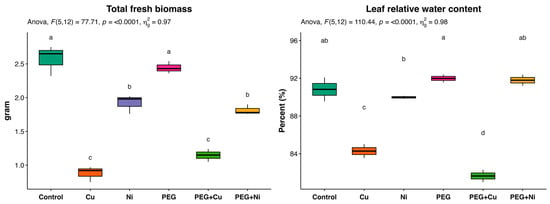
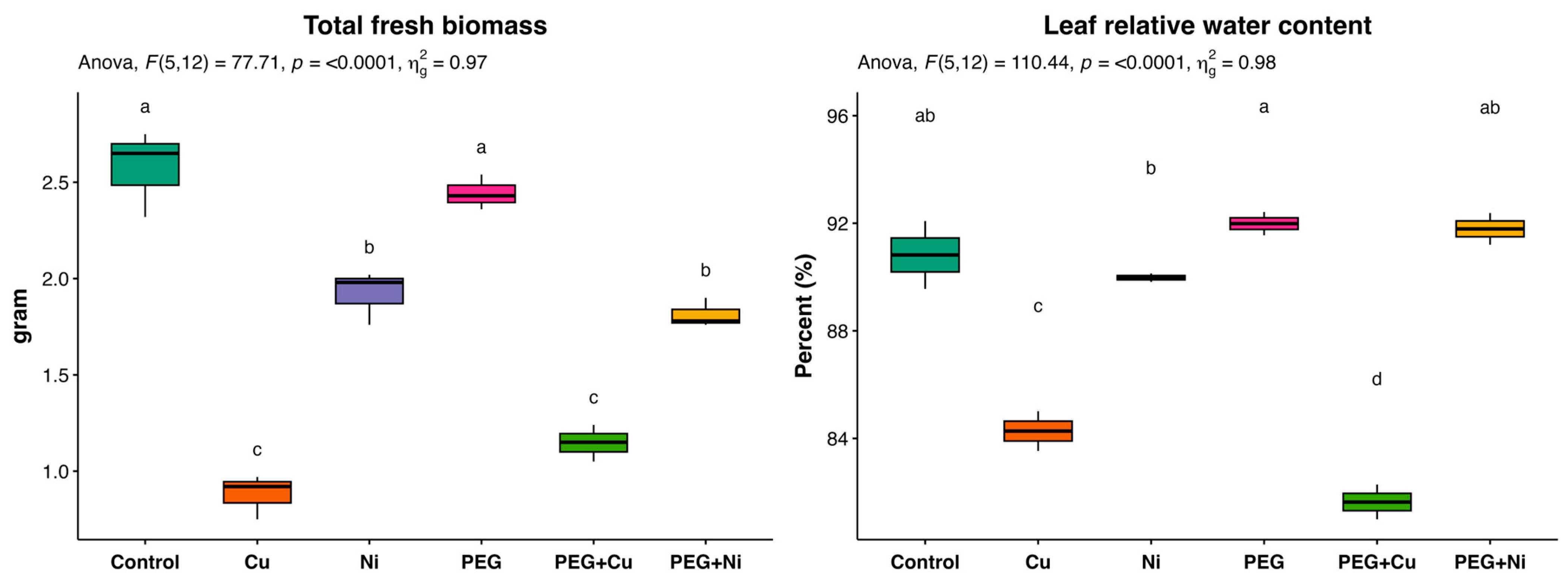
Biomass production and its partitioning between shoots and roots in S. viminalis L. ‘Tordis’ were significantly affected by the applied treatments (Figure 1). Total fresh biomass was highest in the control (2.57 ± 0.23 g FW) and declined under all stress treatments. Among the single-factor treatments, Cu caused the strongest reduction, decreasing biomass by 65.8% vs. control to 0.88 ± 0.12 g FW, whereas Ni reduced it by 25.4% vs. control to 1.92 ± 0.14 g FW. PEG alone had no significant effect, with biomass decreasing by only 5.1% relative to the control (2.44 ± 0.09 g FW). Under combined stress, PEG + Cu increased biomass by 30.3% relative to Cu alone (1.15 ± 0.10 vs. 0.88 ± 0.12 g FW), whereas PEG + Ni decreased it by 5.6% relative to Ni alone (1.81 ± 0.08 vs. 1.92 ± 0.14 g FW). However, neither the difference between Cu and PEG + Cu nor that between Ni and PEG + Ni was significant.
Figure 1.
Fresh biomass (combined roots and shoots without woody cuttings) and leaf relative water content (RWC) of S. viminalis L. ‘Tordis’ under the experimental treatments. Lines indicate medians, boxes indicate the interquartile range (25th–75th percentiles, IQR), and whiskers extend to the most extreme observations within 1.5 × IQR below the first or above the third quartile. Groups sharing a letter do not differ significantly (Tukey’s HSD following one-way ANOVA, α = 0.05).
Analysis of individual organs revealed treatment-specific effects on biomass partitioning (Figures S1 and S2). Control plants produced 2.07 ± 0.16 g FW of shoots and 0.50 ± 0.08 g FW of roots. Compared to control plants, Cu reduced shoot and root biomass by 66.0% and 64.9%, respectively, to 0.70 ± 0.12 and 0.18 ± 0.03 g FW. Ni had a weaker effect on shoots, decreasing their biomass by 18.8% to 1.68 ± 0.14 g FW, but reduced root biomass by 52.3% to 0.24 ± 0.02 g FW, indicating greater sensitivity of roots to Ni. PEG alone did not affect shoot biomass (2.09 ± 0.08 g FW) but decreased root biomass by 29.1% (0.36 ± 0.05 g FW). Shoot and root biomass under PEG + Cu and PEG + Ni did not differ significantly from the respective metal-only treatments, indicating that PEG did not significantly enhance metal-induced growth inhibition.
Root biomass showed a significant metal × PEG interaction (F2,12 = 10.96, p < 0.05; Table S1). PEG reduced root biomass in the absence of added metal, whereas its addition under Cu or Ni exposure did not produce a corresponding reduction. Interaction contrasts confirmed that the response to PEG differed between the no-metal treatment and the Cu and Ni treatments (both Holm-adjusted p < 0.05), but not between Cu and Ni (p = 0.20; Table S2).
Relative water content (RWC) of leaves also varied markedly among treatments, although its response did not fully correspond to changes in biomass (Figure 1). Control plants maintained an RWC of 90.82 ± 1.26%. Cu reduced RWC by 7.2% relative to the control, to 84.27 ± 0.74%, whereas Ni caused only a minor decrease of 0.9% (89.98 ± 0.16%). PEG alone did not reduce leaf hydration; RWC reached 91.99 ± 0.43%, suggesting that plants maintained their water status under PEG-induced osmotic treatment. The lowest RWC was recorded under PEG + Cu (81.64 ± 0.65%), corresponding to a 10.1% decrease relative to the control and a further 3.1% reduction compared with Cu alone. In contrast, PEG + Ni plants maintained a high RWC (91.79 ± 0.59%), approximately 2.0% higher than under Ni alone and comparable to the control and PEG treatments.
The contrasting effects of PEG on leaf hydration under Cu and Ni exposure were reflected in a significant metal × PEG interaction (F2,12 = 16.71, p < 0.001; Table S1). PEG decreased RWC by 2.6 percentage points under Cu exposure but increased it by 1.8 percentage points under Ni exposure, yielding a difference of 4.5 percentage points between the two PEG responses (Holm-adjusted interaction contrast, p < 0.001; Table S2).
A uniform 4 h rehydration period was used to standardize RWC measurements across treatments. Although this approach facilitated comparison, treatment-specific rehydration kinetics were not evaluated, and differences in the capacity of leaves to reach full turgor or in water uptake by potentially damaged tissues may have influenced the estimates.
2.2. Cu and Ni Uptake
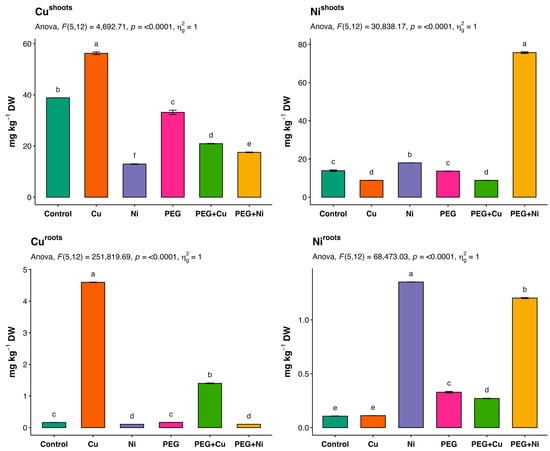
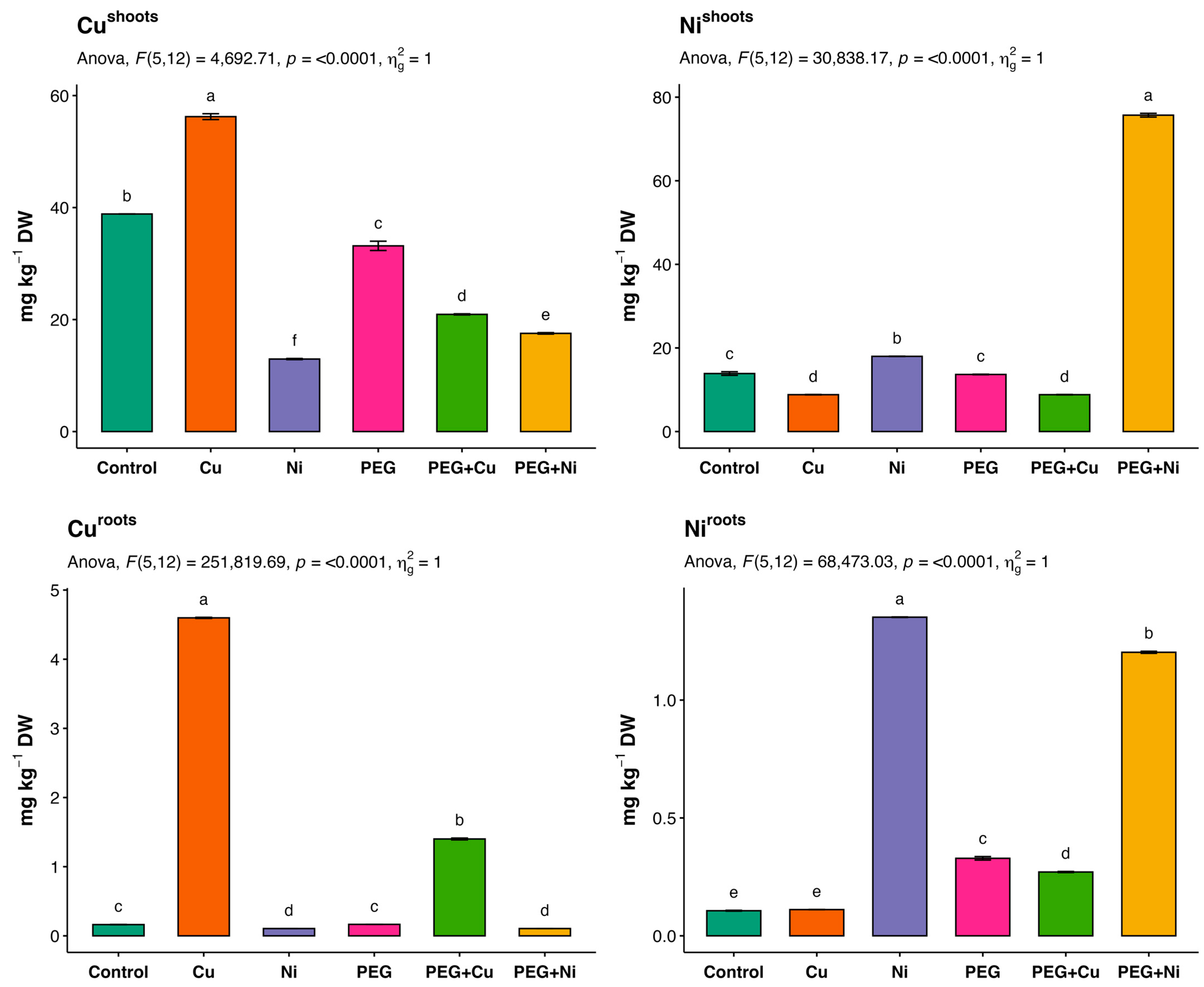
In shoots, Cu content was comparable in the control and PEG treatments (38.85 ± 0.02 and 33.16 ± 0.83 mg kg−1 DW, respectively) (Figure 2). Cu exposure increased shoot Cu by 44.7%, reaching 56.24 ± 0.52 mg kg−1 DW, whereas PEG + Cu reduced it by 62.8% relative to Cu alone (20.93 ± 0.10 mg kg−1 DW). The lowest shoot Cu content was noted under Ni treatment (12.95 ± 0.10 mg kg−1 DW). Cu accumulated predominantly in roots. Under Cu and PEG + Cu additions, root content was approximately 82- and 67-fold higher than in shoots, respectively. Nevertheless, PEG reduced its root level in roots by 69.5%, from 4598.24 ± 7.52 to 1400.55 ± 12.94 mg kg−1 DW.
Figure 2.
Copper (Cu) and nickel (Ni) concentrations in shoots and roots of S. viminalis L. ‘Tordis’ under the experimental treatments. Bars show means ± SD, and groups sharing a letter do not differ significantly (Tukey’s HSD following one-way ANOVA, α = 0.05).
Ni content in shoots increased moderately under Ni alone, by 29.6% relative to the control (17.99 ± 0.04 vs. 13.88 ± 0.43 mg kg−1 DW) (Figure 2). In contrast, PEG + Ni increased shoot Ni approximately 4.2-fold compared with Ni alone, reaching 75.69 ± 0.45 mg kg−1 DW, indicating enhanced Ni allocation to aboveground tissues under osmotic stress. Root Ni content reached 1351.74 ± 1.09 mg kg−1 DW under Ni treatment and remained high under PEG + Ni (1202.77 ± 4.35 mg kg−1 DW), despite an 11.0% decrease. Root Ni levels were lower than the corresponding Cu contents under metal-containing treatments, confirming stronger root retention of Cu than Ni.
Metal × PEG interactions were significant for Cu and Ni concentrations in both shoots and roots (all p < 0.001; Table S1). Under Cu exposure, PEG reduced Cu concentrations in both organs, whereas under Ni exposure it increased shoot Ni while decreasing root Ni. For each metal, these responses differed from the corresponding effects of PEG in the absence of added metal, as demonstrated by interaction contrasts for both organs (all Holm-adjusted p < 0.001; Table S2).
Total Cu and Ni contents in shoots and roots (per organ dry weight) differed significantly among treatments (Figure S3). Shoot Cu content was highest in control plants, followed by PEG-treated plants, and was significantly lower in all metal-containing treatments. PEG co-treatment significantly decreased shoot Cu content compared with Cu alone. Root Cu content was highest under Cu treatment and significantly lower under PEG + Cu, although both treatments resulted in substantially higher values than the remaining treatments. Shoot Ni content was highest under PEG + Ni and significantly exceeded that in all other treatments. Ni alone resulted in slightly lower shoot Ni content than the control, while the lowest values occurred under Cu and PEG + Cu. Root Ni content was highest under Ni and PEG + Ni, with no significant difference between these treatments. PEG alone and PEG + Cu resulted in intermediate root Ni contents, whereas the lowest value was recorded under Cu treatment.
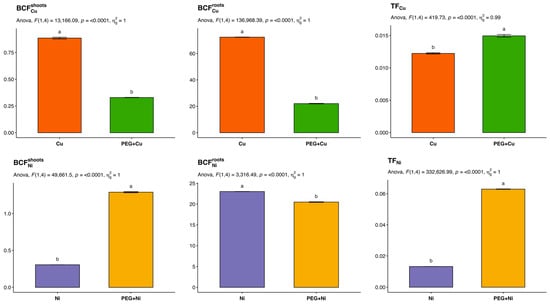
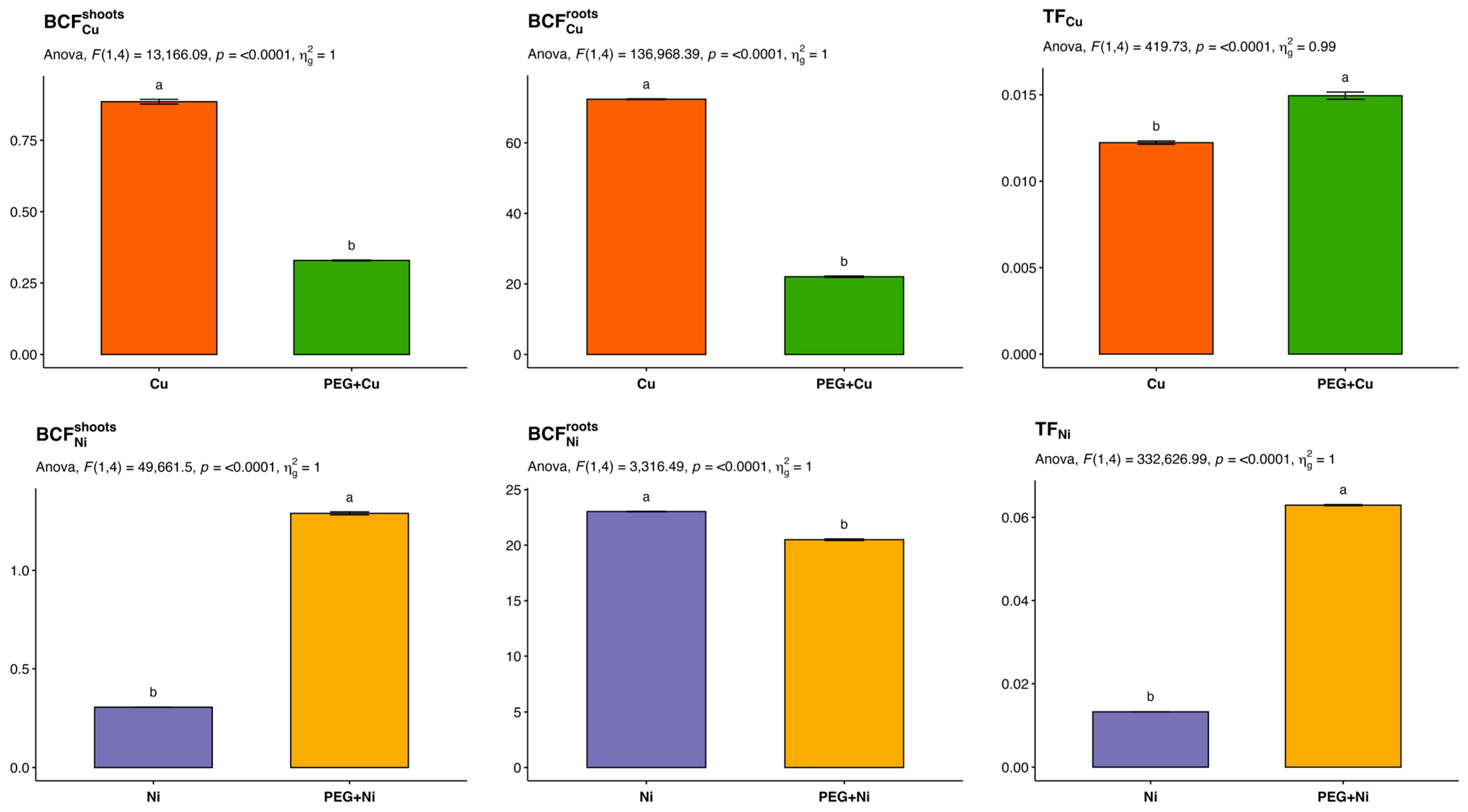
Under combined metal exposure and PEG-induced osmotic stress, bioconcentration factors (BCFs) showed distinct metal- and tissue-specific responses (Figure 3). For Cu, PEG co-treatment reduced the shoot BCF by 62.8% (from 0.885 to 0.329) and the root BCF by 69.5% (from 72.37 to 22.04) compared with Cu exposure alone. Cu accumulation remained strongly root-dominant. Accordingly, the Cu translocation factor increased by 22.2%, from 0.0122 under Cu treatment to 0.0149 under PEG + Cu treatment, indicating a moderate increase in the relative transfer of Cu to shoots despite the substantial reduction in its bioconcentration in both tissues. For Ni, PEG co-treatment increased the shoot BCF by 320.7% (from 0.307 to 1.290), whereas the root BCF decreased by 11.0% (from 23.03 to 20.49). This redistribution was accompanied by a 4.7-fold increase in the Ni translocation factor, from 0.0133 to 0.0629, demonstrating that PEG-induced osmotic stress markedly enhanced the relative translocation of Ni from roots to shoots.
Figure 3.
Bioconcentration factors (BCFs) and translocation factors (TFs) (dimensionless values) for copper (Cu) and nickel (Ni) in S. viminalis L. ‘Tordis’. Bars show means ± SD, and groups sharing a letter do not differ significantly (Tukey’s HSD following one-way ANOVA, α = 0.05).
2.3. Macronutrient Composition and C:N Stoichiometry
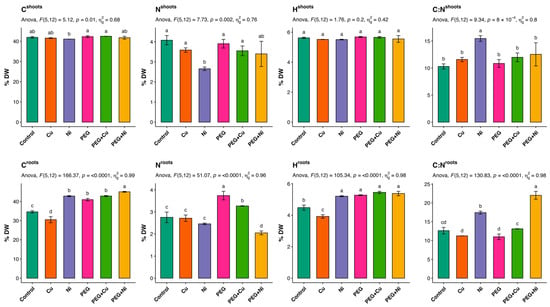
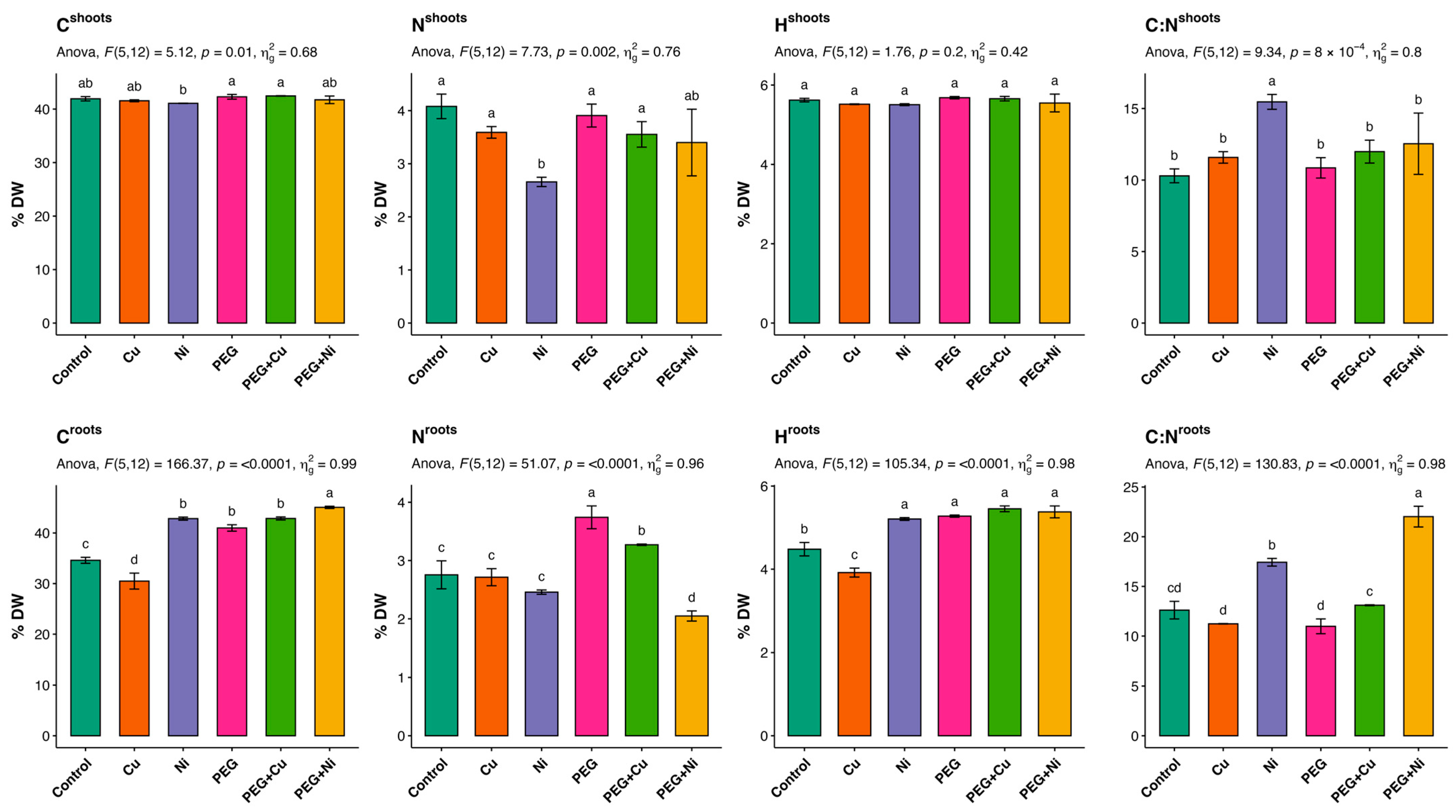
Macronutrient contents in shoots and roots of S. viminalis L. ‘Tordis’ were differentially affected by the applied treatments, with generally stronger effects observed in roots than in shoots (Figure 4).
Figure 4.
Carbon (C), nitrogen (N) and hydrogen (H) concentrations and the C:N mass ratio in shoots and roots of S. viminalis L. ‘Tordis’ under the experimental treatments. Bars show means ± SD, and groups sharing a letter do not differ significantly (Tukey’s HSD following one-way ANOVA, α = 0.05).
Shoot C content remained high and stable across all variants (41.08–42.46%), indicating that overall carbon status of the shoot tissues was largely maintained despite exposure to Cu, Ni, and PEG. Shoot N was more responsive, with significantly lower levels under Ni treatment (by 34.8%, i.e., from 4.08 ± 0.23% for control to 2.66 ± 0.09%), and consequently the shoot C:N ratio increased from 10.29 ± 0.49 for control to 15.47 ± 0.52 for Ni addition. Shoot H concentration did not differ significantly among treatments.
In roots, C content varied markedly among treatments. It was lowest under Cu (30.49 ± 1.58%), representing an 11.9% decrease relative to the control (34.60 ± 0.59%). In contrast, C content increased by 23.8% under Ni, 18.5% under PEG, 23.9% under PEG + Cu, and 30.2% under PEG + Ni, reaching the highest level under PEG + Ni (45.06 ± 0.22%). Root N content increased by 35.8% under PEG and by 18.7% under PEG + Cu, whereas PEG + Ni reduced it by 25.6% relative to the control. Consequently, the root C:N ratio increased by 38.2% under Ni and by 74.7% under PEG + Ni treatments. Root H content was lowest under Cu (3.92 ± 0.11%), corresponding to a 12.6% decrease relative to the control.
2.4. Nutrient Status: Ca, Mg, Fe and Ca:Mg Ratio
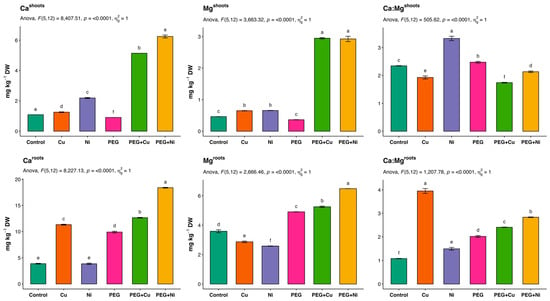
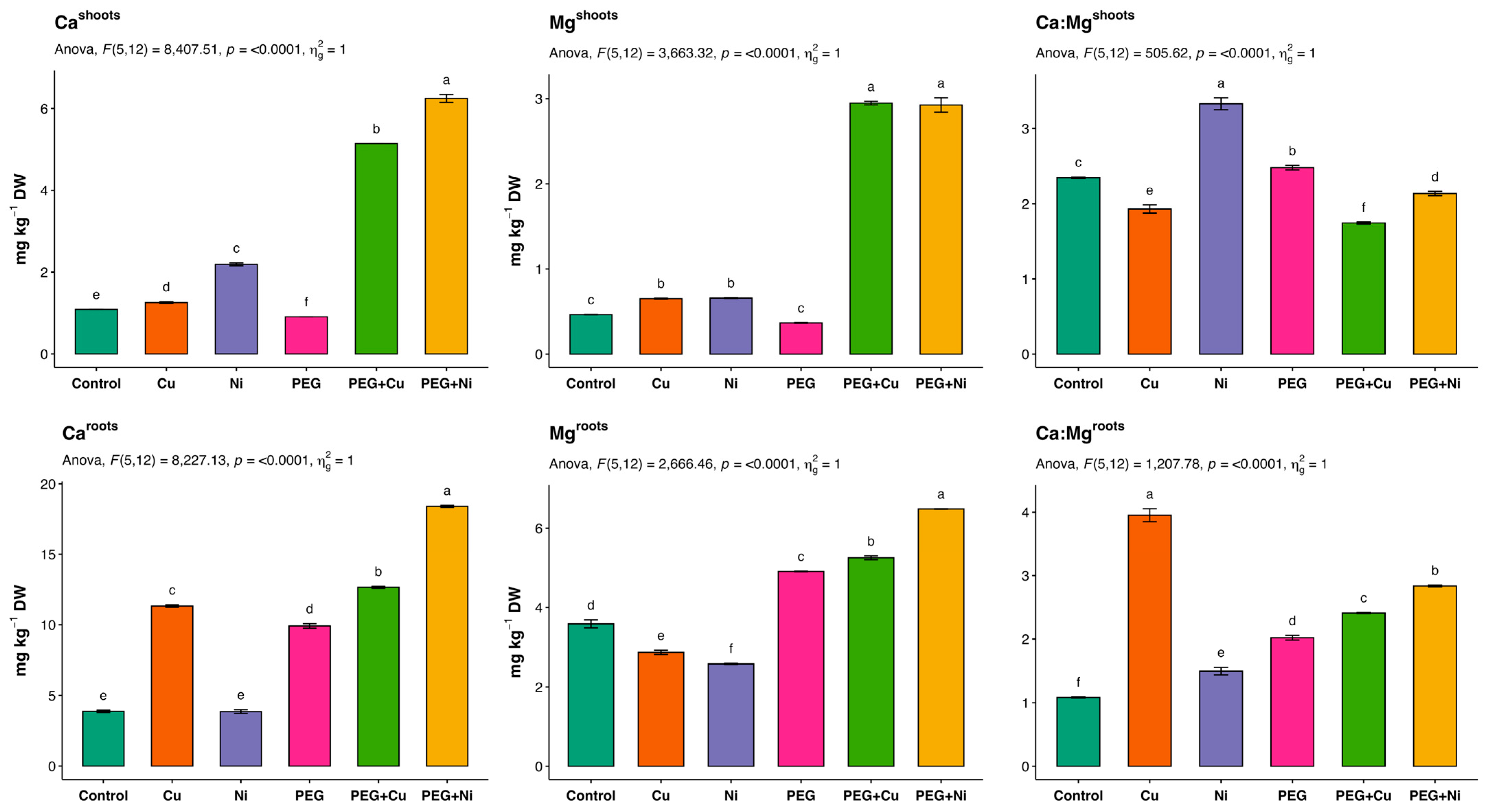
Calcium (Ca) and magnesium (Mg) contents, together with the Ca:Mg ratio, showed pronounced tissue- and treatment-specific changes (Figure 5). In shoots, Ca content increased most strongly under PEG + Cu and PEG + Ni, reaching 5142.36 ± 0.42 and 6246.32 ± 97.96 mg kg−1, respectively. These values were 4.73- and 5.74-fold higher than the control level (1088.07 ± 1.92 mg kg−1). Shoot Mg content ranged from 366.01 ± 3.94 to 658.08 ± 4.96 mg kg−1 under the control and single-stressor treatments but increased approximately 6.3-fold under PEG + Cu and PEG + Ni, reaching 2948.06 ± 21.18 and 2925.57 ± 84.19 mg kg−1, respectively. The shoot Ca:Mg ratio was highest under Ni alone (3.33 ± 0.08) and lowest under PEG + Cu (1.74 ± 0.01), compared with 2.35 ± 0.01 in the control.
Figure 5.
Calcium (Ca) and magnesium (Mg) concentrations and the Ca:Mg mass ratio in shoots and roots of S. viminalis L. ‘Tordis’ under the experimental treatments. Bars show means ± SD, and groups sharing a letter do not differ significantly (Tukey’s HSD following one-way ANOVA, α = 0.05).
In roots, Ca content increased from 3881.17 ± 77.87 mg kg−1 in the control to 11,326.97 ± 86.53, 9914.46 ± 160.90, 12,658.06 ± 69.61, and 18,402.07 ± 74.30 mg kg−1 under Cu, PEG, PEG + Cu, and PEG + Ni, respectively. The highest level under PEG + Ni represented a 4.74-fold increase relative to the control, whereas Ni alone did not significantly alter root Ca levels relative to the control. Root Mg content decreased by 20.0% under Cu and by 28.1% under Ni relative to the control (3585.50 ± 101.60 mg kg−1), but increased under all PEG-containing treatments, reaching the highest level under PEG + Ni (6488.56 ± 5.02 mg kg−1). The root Ca:Mg ratio increased from 1.08 ± 0.01 in the control to 3.95 ± 0.10 under Cu addition, while intermediate values of 1.50–2.84 were recorded under Ni, PEG, PEG + Cu, and PEG + Ni treatments.
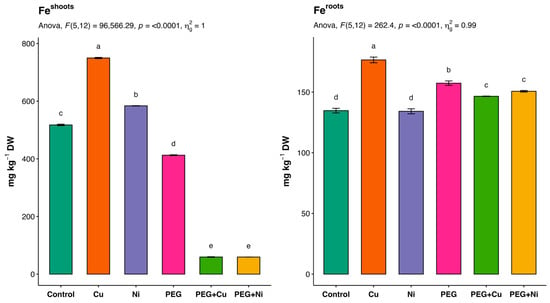
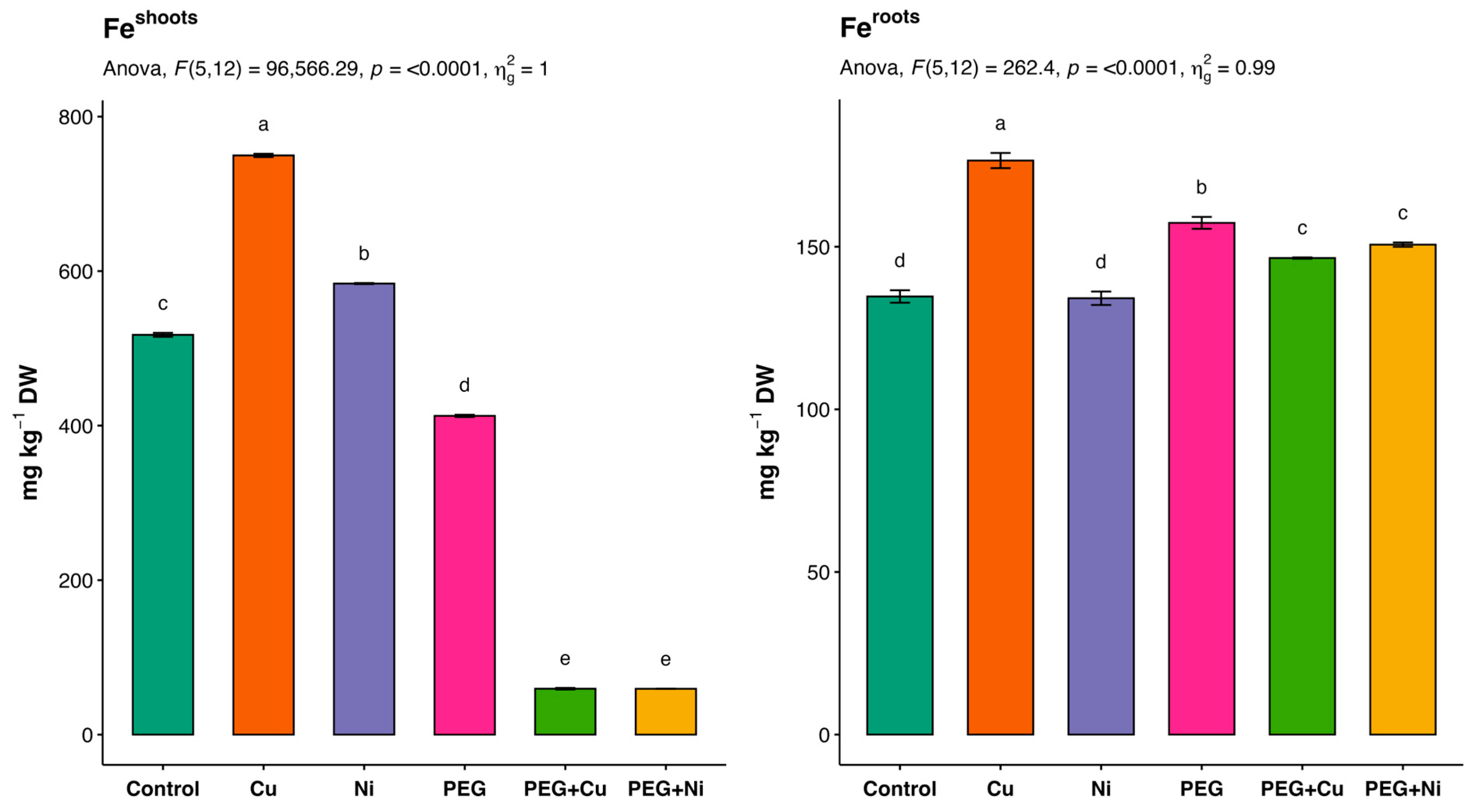
Iron (Fe) content exhibited distinct tissue-specific responses to metal and osmotic stress. In shoots, Fe content increased by 44.9% under Cu and by 12.8% under Ni, reaching 749.75 ± 3.06 and 583.93 ± 0.97 mg kg−1, respectively, compared with 517.54 ± 3.63 mg kg−1 in the control (Figure 6). PEG alone decreased shoot Fe content by 20.3% to 412.62 ± 2.09 mg kg−1. The strongest decline occurred under combined stress, i.e., by 88.5% under both PEG + Cu and PEG + Ni, reaching 59.45 ± 1.43 and 59.37 ± 0.23 mg kg−1, respectively.
Figure 6.
Iron (Fe) concentrations in shoots and roots of S. viminalis L. ‘Tordis’ under the experimental treatments. Bars show means ± SD, and groups sharing a letter do not differ significantly (Tukey’s HSD following one-way ANOVA, α = 0.05).
In roots, Fe content varied less markedly, ranging from 134.17 to 176.51 mg kg−1. Cu increased root Fe content by 31.0%, from 134.71 ± 2.70 mg kg−1 in the control to 176.51 ± 3.31 mg kg−1 (Figure 6). Ni alone had no significant effect (134.17 ± 2.91 mg kg−1), whereas PEG, PEG + Cu, and PEG + Ni increased root Fe content by 16.8%, 8.8%, and 11.8%, respectively, reaching 157.35 ± 2.59, 146.53 ± 0.27, and 150.65 ± 0.95 mg kg−1.
2.5. Principal Component Analysis (PCA)
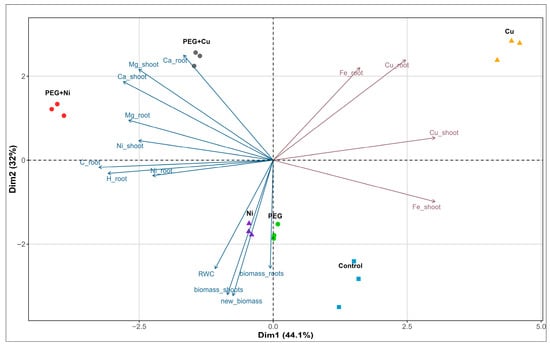
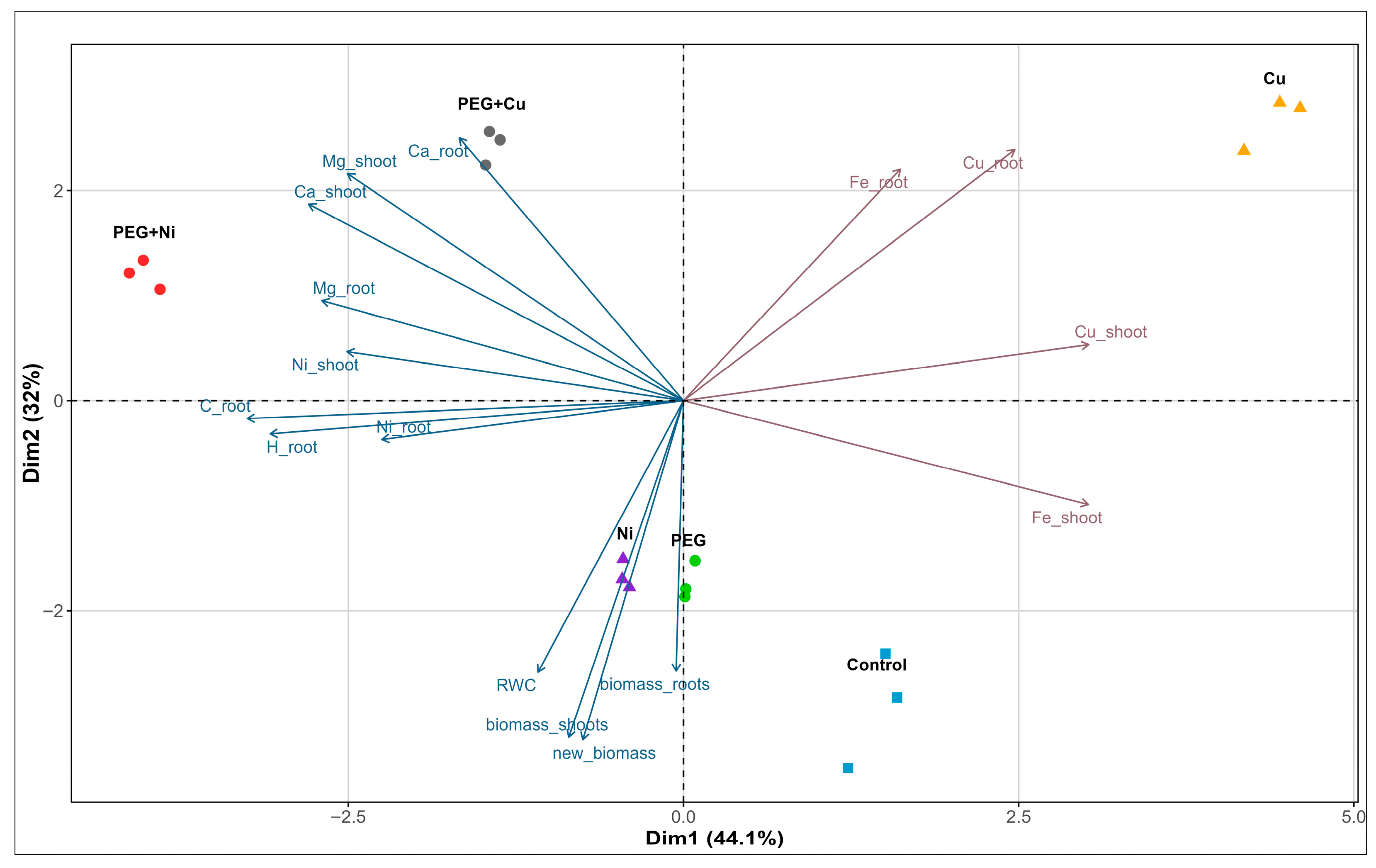
The first two principal components accounted for 76.1% of the variance in the selected dataset, with PC1 and PC2 explaining 44.1% and 32.0%, respectively (Figure 7). In this exploratory ordination, PC1 primarily reflected contrasting patterns of elemental composition. Cu-treated observations were positioned towards the vectors representing Cu and Fe concentrations in shoots and roots. In contrast, Ni, Ca, and Mg vectors were oriented towards negative PC1 scores, where the PEG + Cu and PEG + Ni observations were located.
Figure 7.
Exploratory PCA biplot for S. viminalis L. ‘Tordis’, based on 18 biological replicates and 16 selected, standardized variables, with points coloured by treatment (n = 3 per treatment), labels positioned near treatment centroids, and variable vectors coloured according to an exploratory k-means partition (k = 2); C—control; Cu—copper treatment; Ni—nickel treatment; PEG—PEG-induced osmotic stress; PEG + Cu and PEG + Ni—combined treatments; RWC—relative water content.
PC2 additionally reflected variation in biomass and plant water status. Biomass and RWC vectors showed similar orientations towards negative PC2 scores, alongside the control, Ni, and PEG observations. Cu and PEG + Cu observations occupied the opposite part of the ordination, whereas PEG + Ni observations combined negative PC1 with positive PC2 scores. The biplot thus provided a descriptive overview of the associations between metal accumulation, nutrient composition, biomass and water status across the experimental treatments.
3. Discussion
3.1. Biomass Production and Water Status
The reduction in S. viminalis L. ‘Tordis’ biomass observed under Cu treatment is consistent with earlier findings for other energy willow genotypes, i.e., S. viminalis L. ‘Gigantea’ [22]. In ‘Gigantea’, 1 mM Cu significantly decreased combined root and shoot fresh weight relative to Ni and control treatments, whereas the equimolar Ni addition, in contrast, stimulated shoot growth. A pronounced Cu-induced growth inhibition, mostly affecting roots, was also reported for S. purpurea × viminalis in a hydroponic experiment, where 3 mM Cu led to up to ~90% reduction in root biomass, indicating that the root system is the primary site of Cu-induced damage across energy willow genotypes [28]. In basket willow (S. viminalis L. ‘Cannabina’), Ni at concentrations up to 3 mM produced a comparatively milder growth response, with the strongest inhibition localized in the root system, and photosynthetic tissue remained largely unaffected [29]. In the present experiment, Cu and Ni were applied at equal molar concentrations rather than at equivalent-effect levels; therefore, comparisons between the two metals should be interpreted in the context of their different toxicities at 1 mM.
PEG addition alone did not significantly reduce total biomass in ‘Tordis’, but significantly reduced root fresh biomass by approximately 29.1%. This observation agrees with previous results obtained in ‘Gigantea’, where 5% PEG-6000 did not affect the total biomass yield or protective-metabolite content, suggesting a genotype-independent tolerance of energy willow to PEG-induced osmotic treatment under hydroponic conditions [22]. There is a lack of studies addressing PEG applications in drought-tolerance research on willow. Thus, the obtained results can be discussed in the context of studies conducted on energy poplar, a related short-rotation woody crop. In a recent study on six Populus genotypes, logistic modeling of relative electrolyte leakage (REC) across a PEG concentration gradient was used to evaluate clone-specific semi-lethal PEG concentrations (LC50), which ranged from 7.99% in the drought-sensitive cultivar to 13.44% in the drought-tolerant cultivar [30]. Under a standardized 10% PEG stress, the tolerant cultivar maintained leaf water content at 73% compared with only 63% in the sensitive cultivar. On the other hand, in Populus canadensis, drought was induced by applying PEG 6000 to the solid growth substrate (50 g L−1) and produced a marked decrease in predawn leaf water potential, with significant reductions after approximately 10 days of treatment [31]. In the present study, the absence of significant biomass reduction and the maintenance of high leaf RWC in ‘Tordis’ under PEG addition are consistent with mild osmotic stress. The relatively low PEG concentration was deliberately selected to establish a mild background of osmotic constraint against the effects of co-occurring heavy metals (Cu, Ni) on growth, water status, and nutrient content. However, the PEG treatment should be interpreted with caution because neither solution water potential nor dissolved oxygen concentration was measured, and the hydroponic system was not artificially aerated. Although a relatively low PEG concentration was selected, secondary oxygen limitation cannot be excluded. Consequently, the observed responses to PEG may reflect osmotic effects, oxygen-related effects, or their interaction, rather than osmotic stress alone.
The combined PEG + Cu treatment did not significantly affect Cu-induced biomass reduction, although PEG + Cu resulted in the lowest leaf RWC, whereas the effect of PEG + Ni was comparable to Ni alone. This pattern was similar to previous findings for ‘Gigantea’, where PEG + Cu intensified Cu toxicity symptoms while PEG + Ni did not amplify Ni-induced damage [22]. The Cu-drought synergism likely reflects Cu-induced root structural and hydraulic damage and drought-limited compensatory water uptake, both acting at the root system where Cu is preferentially retained [17]; however, root hydraulic conductivity and transpiration were not measured. In contrast, the increased shoot Ni concentration and translocation factor under PEG + Ni indicate altered Ni partitioning, consistent with our previous findings for ‘Gigantea’ [22]. Changes in transpiration, root membrane permeability, or transporter-mediated processes could contribute to this response, but these mechanisms were not investigated. The higher shoot-to-root Ni concentration ratio under PEG + Ni needs further investigation to determine its physiological basis.
Additionally, within a particular taxon (S. × fragilis), metals (Cu, Zn) and sorbitol-stimulated drought showed both sex- and organ-specific interactions [32]. For shoots, Cu + drought strongly reduced biomass in both sexes, while Zn + drought reversed Zn-induced growth stimulation into a biomass loss only in females. In roots, the pattern was opposite, i.e., Zn, drought, and their combination strongly stimulated root biomass in females, whereas male roots were similarly suppressed under Cu, drought, and co-treatment, indicating that metal–drought interactions redistribute growth between shoots and roots in a sex- and metal-dependent manner [32].
Leaf relative water content (RWC) is a pivotal physiological indicator of whole-plant water status and drought tolerance in plants. In the present study, leaf RWC changes followed the reduction pattern observed for the total biomass. The lower leaf RWC under Cu and PEG + Cu treatments indicates altered plant water status and may result from impaired root hydraulic conductivity. The resulting Cu-induced growth inhibition may involve both impaired root function and reduced photosynthetic carbon assimilation [17]. However, neither root hydraulic conductivity nor photosynthetic performance was measured in this study; therefore, their relative contributions to the observed growth inhibition cannot be determined. In contrast, Ni and PEG + Ni additions did not affect the leaf RWC. This aligns with the previous study, in which PEG + Cu co-treatment increased overall Cu toxicity symptoms, including dehydration in ‘Gigantea’, whereas PEG + Ni produced comparatively minor additional water-status impairment [22]. A comparable cumulative effect of drought and metal stress on leaf water status was also reported for S. × fragilis [32].
3.2. Copper and Nickel Accumulation and Translocation
Root-dominant Cu accumulation with restricted translocation to shoots was observed in ‘Tordis’ and is a common feature across Salix genotypes. In S. viminalis L. ‘Cannabina’ cultivated under different Ca/Mg regimes, Cu uptake to roots was consistently around three times higher than in leaves, with translocation index strongly influenced by the Ca/Mg ratio of the cultivation medium [33]. Hydroponic experiments on ‘Cannabina’ showed the following organ order in Cu phytoextraction efficiency, i.e., roots > rods > shoots ≥ bark > leaves, with bioaccumulation factors generally classified as weak to medium [34]. Xylem-imaging studies in Salix integra have confirmed that only a limited fraction of root-absorbed Cu reaches actively growing shoot tissue, providing a physiological basis for the strongly reduced shoot Cu content observed in the present study [35]. Further, the lower shoot Cu concentration under Ni treatment also suggests a possible antagonistic Ni–Cu interaction, consistent with Ni-induced reductions in Cu influx and root-to-shoot transport reported in other plant species [36]. However, the mechanism underlying this response in ‘Tordis’ was not determined. In contrast to Cu, PEG increased the shoot-to-root Ni concentration ratio, consistent with our previous findings for ‘Gigantea’ [22]. However, despite the approximately 4.7-fold increase in Ni TF, its absolute value remained low (0.0629), with root Ni concentrations approximately 16 times higher than shoot concentrations. Thus, PEG increased the relative shoot enrichment of Ni without changing its predominantly root-associated distribution. Cu likewise remained strongly root-associated, with TF increasing only from 0.0122 to 0.0149. A comparable metal-specific pattern was reported in S. × fragilis, where drought simulation limited Zn accumulation in roots while increasing its translocation to leaves, and simultaneously increased root Cu accumulation predominantly in the more tolerant female specimens [32]. In the energy poplar (Populus nigra × P. maximowiczii), lower soil moisture increased Ni translocation to aboveground organs, while Cu translocation remained limited (TF < 0.94) regardless of soil moisture level [37], confirming that the pattern for these metals is reproducible across other Salicaceae genera. Studies on other plants showed a partly similar effect of restricted water availability on metal translocation. In barley, drought increased the Cu root-accumulation index up to 6.82-fold and raised the Cu translocation index [38], indicating that drought promoted root retention rather than shoot translocation. Conversely, in Colocasia esculenta grown on Cd/Zn-contaminated soil, moderate drought (60–40% field capacity) increased both Cd and Zn translocation to shoots (TF > 1) [39]. In Chromolaena odorata, PEG-simulated drought did not affect Cd/Zn translocation (TF remained below 1 regardless of PEG) [40].
The consistently high root BCF calculated for ‘Tordis’ likely reflects not only intracellular accumulation but also a substantial contribution from metal ions adsorbed onto the root cell wall and apoplast, since roots were rinsed with distilled water rather than desorbed with a chelating agent such as EDTA. Comparative studies have shown that a brief EDTA (or CaCl2) rinse specifically removes cations bound to extracellular exchange sites on the root surface, enabling us to distinguish the intracellular uptake from surface adsorption [41,42]. The apoplastic contribution can be substantial. In a root-uptake fractionation study, apoplastic binding accounted for 15–96% of total root Cd content depending on plant species and metal concentration, confirming that cell-wall/apoplast adsorption, rather than symplastic uptake alone, can dominate the measured root metal pool when no desorption wash is applied [43]. This effect is expected to be particularly pronounced for divalent cations such as Cu2+ and Ni2+, which readily bind to carboxyl groups of root cell-wall pectins and can extensively accumulate in the apoplast and at the root surface before active uptake into the symplast [17]. Consequently, the BCF values reported here for roots should be interpreted as reflecting the combined pool of surface-bound and intracell-accumulated metal. Extracellular retention may also contribute to the low shoot-to-root concentration ratios. Additionally, BCF values were calculated using nominal initial solution metal concentrations, following the approach used in our previous studies to maintain methodological comparability. Metal concentrations in solution were not measured at the end of exposure; thus, these values do not account for changes in metal concentrations in the cultivation medium.
3.3. Macronutrient Composition and Carbon–Nitrogen Stoichiometry
In ‘Tordis’, the organ-specific macronutrient responses were observed. Excluding Cu, the remaining additions led to increased C content in roots. This suggests that both Ni stress and water deficit affect carbon allocation in the below-ground organs. As previously shown, Ni may alter carbon metabolism and carbohydrate partitioning [29,44], particularly in Salix, where roots represent an important storage site for carbohydrates, and particularly for starch [45]. Under water deficit, changes in the relative proportions of soluble sugars and starch may further modify the carbon status of roots. The lack of an increase in root C content under Cu stress may indicate metal-specific effects on carbon allocation and metabolism. Although changes in carbohydrate metabolism could contribute to this response, total elemental carbon analysis cannot distinguish osmolyte accumulation from changes in structural constituents or the relative abundance of other dry-matter components. As carbohydrate fractions and whole-root carbon pools were not quantified, the underlying mechanism requires further investigation.
Tordis roots showed an increase in N content under PEG and PEG + Cu treatments, whereas PEG + Ni resulted in a decrease in N content. In the shoots, a decrease in N content was observed only under Ni treatment, indicating a tissue- and metal-specific response of N accumulation. The increase in N content in roots under PEG and PEG + Cu treatments may reflect enhanced N retention or accumulation in below-ground tissues during osmotic stress [46]. A similar change of root N metabolism in response to water deficit has been reported in Populus species [47], where PEG-induced drought altered N uptake and assimilation in P. simonii, affecting both inorganic N concentrations and the activity of enzymes involved in N metabolism. In contrast, the decrease in root N content under PEG + Ni and in shoots under Ni treatment suggests that Ni may interfere with N acquisition, assimilation or translocation more strongly than Cu. The contrasting response to Ni and Cu may therefore result from differences in their effects on root function and N metabolism. Consequently, the C:N ratio increased following Ni and PEG + Ni treatments both in roots and shoots. This indicates a shift in resource allocation, with a relatively greater effect on carbon-containing structural or storage compounds and/or reduced N assimilation.
Interpretation of tissue N content and C:N ratios is limited by the additional nitrate supplied with the metal salts. Both Cu(NO3)2 and Ni(NO3)2 introduced 2 mM nitrate above the basal nutrient solution, and no nitrate-matched control was included. Consequently, differences between metal-containing and metal-free treatments cannot be attributed exclusively to metal exposure.
The contrasting tissue N contents under Cu- and Ni-containing treatments indicate treatment-dependent differences in N status, but do not establish specific effects on N acquisition, assimilation, or translocation due to the nitrate load introduced along with metal treatments.
3.4. Effects on Calcium, Magnesium, and Iron Contents
PEG-simulated drought markedly enhanced Ca and Mg accumulation in the roots of ‘Tordis’, even though shoot contents of both cations declined or remained similar to control under PEG treatment. This observation can be explained by the suppression of transpiration-driven xylem transport. The reduced water potential imposed by PEG restricts their loading into the xylem and long-distance translocation [48,49]. The increased root concentrations of Ca and Mg may contribute to ionic homeostasis under osmotic stress, whereas Ca also participates in stress signalling and cell-wall stabilization through Ca-pectate cross-linking [49,50,51,52]. The strongest root enrichment under PEG + Cu and PEG + Ni indicates an additive interaction, in which drought-limited uptake to shoots coincides with an elevated demand for these membrane-protective and metal-immobilizing cations under combined stress. Additionally, the increases in shoot Ca and Mg concentrations in combined treatments may reflect contributions from reduced biomass production. These findings provide a basis for further studies combining biomass and total element contents with measurements of transpiration, membrane integrity, and ion fluxes. Analyses of cell-wall-bound Ca and pectin composition could additionally help establish whether Ca enrichment is associated with structural adjustments in the cell wall.
Cu exposure markedly increased Fe contents in both shoots and roots of ‘Tordis’. This response may reflect Cu-induced disruption of Fe redox homeostasis and the regulation of Fe uptake and distribution [53]. However, because Cu markedly reduced plant biomass, a concentration effect cannot be excluded. In contrast, PEG combined with either metal caused a pronounced decrease in shoot Fe, while root Fe remained close to or above the control level, suggesting that combined stress primarily restricted root-to-shoot Fe translocation. PEG-induced limitation of water flow may have reduced the xylem transport of Fe complexes, while metal-induced changes in transporter activity may have promoted Fe retention in roots [54]. Under PEG + Ni, competition between Ni2+ and Fe2+ for IRT1 may have additionally contributed to the disturbed Fe distribution [55].
4. Materials and Methods
4.1. Plant Material and Experimental Set-Up
Commercially obtained, two-year-old dormant stem cuttings of the willow S. viminalis L. cv. ‘Tordis’ with 3 or 4 buds (25 cm in length, 10–15 mm in diameter) were initially rooted for 14 days in a Knop’s medium. The full-strength Knop’s nutrient solution contained KNO3 (250 mg L−1; 2.5 mM), Ca(NO3)2·4H2O (1000 mg L−1; 4.23 mM), MgSO4·7H2O (250 mg L−1; 1.0 mM), KH2PO4 (250 mg L−1; 1.84 mM), and FeSO4·7H2O (12.5 mg L−1; 45 µM). All salts used to prepare the nutrient solution were of analytical grade (Avantor Performance Materials Poland, Gliwice, Poland). During the initial 14-day rooting period, the concentrations of all components were reduced by half. The stem cuttings were obtained directly from the grower’s mother plantation maintained for biomass production and vegetative propagation of the energy willow cultivar ‘Tordis’. Subsequently, the rooted cuttings were transferred to polyethylene (PE) hydroponic vessels (18/19 cm, diameter/height) equipped with net inserts and water level indicators (LENI Gebr. Lenz GmbH, Bergneustadt, Germany), with three plants per pot and three pots assigned to each treatment to ensure statistical reliability of the results. Although cutting age, dimensions, bud number, and rooting conditions were standardized within the stated ranges, initial physiological variation among cuttings could not be excluded. The use of three pot-level biological replicates per treatment should therefore be considered when interpreting the results.
Plant cultivation was carried out in a full-strength Knop’s solution, while the shoots were stabilized using steam-sterilized quartz sand of 3–4 mm grain size. Experimental variants included the addition of Cu(NO3)2 × 3H2O or Ni(NO3)2 × 6H2O (Sigma-Aldrich, Merck KGaA, Darmstadt, Germany) at an equimolar concentration of 1 mM. No nitrate-matched control was included. The choice of metal concentration was based on previous studies involving willow species, which demonstrated that both Cu and Ni elicit distinct physiological responses at 1 mM concentration [22]. Higher Cu doses (up to 3 mM) were shown to cause pronounced growth inhibition and lethality in S. purpurea × viminalis under prolonged exposure [28]. Equal molar concentrations were used to compare responses to Cu and Ni at the same molar exposure, rather than at equivalent toxicity levels. Cultivar-specific dose–response curves were not established for ‘Tordis’.
To induce moderate drought stress, polyethylene glycol (PEG 6000; Merck KGaA, Darmstadt, Germany) was incorporated into the medium. PEG, particularly at higher molecular weights such as PEG-6000 or PEG-8000, is a biologically inert, non-penetrating osmoticum applied for simulating drought stress in controlled hydroponic and agar-based experimental systems. PEG maintains a stable and reproducible reduction in the water potential (Ψw) of the growth medium without direct cellular uptake of the polymer. PEG concentrations in the range of 5–20% (w/v) are commonly applied to induce mild-to-moderate drought stress, while 40% has been used to simulate more severe water deficit. As a disadvantage, PEG-supplemented nutrient solutions are characterized by increased viscosity, which can impair oxygen diffusion to submerged root systems and cause secondary hypoxic stress unless additional aeration is provided [56]. In the present study, PEG-6000 was used at 5% (w/v) to avoid heavily increased viscosity in the hydroponic system without aeration of the cultivation solution.
Plants cultivated in unmodified Knop’s medium served as controls. The experimental design comprised six treatment variants: control, copper addition (Cu—1 mM), nickel addition (Ni—1 mM), drought simulation (PEG—5% (w/v)), and combined metal and drought stress variants (PEG + Cu—5% (w/v) + 1 mM, PEG + Ni—5% (w/v) + 1 mM).
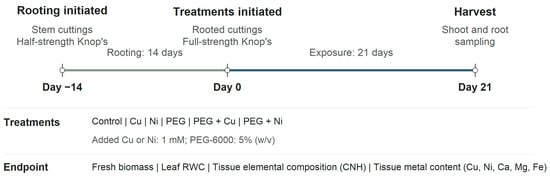
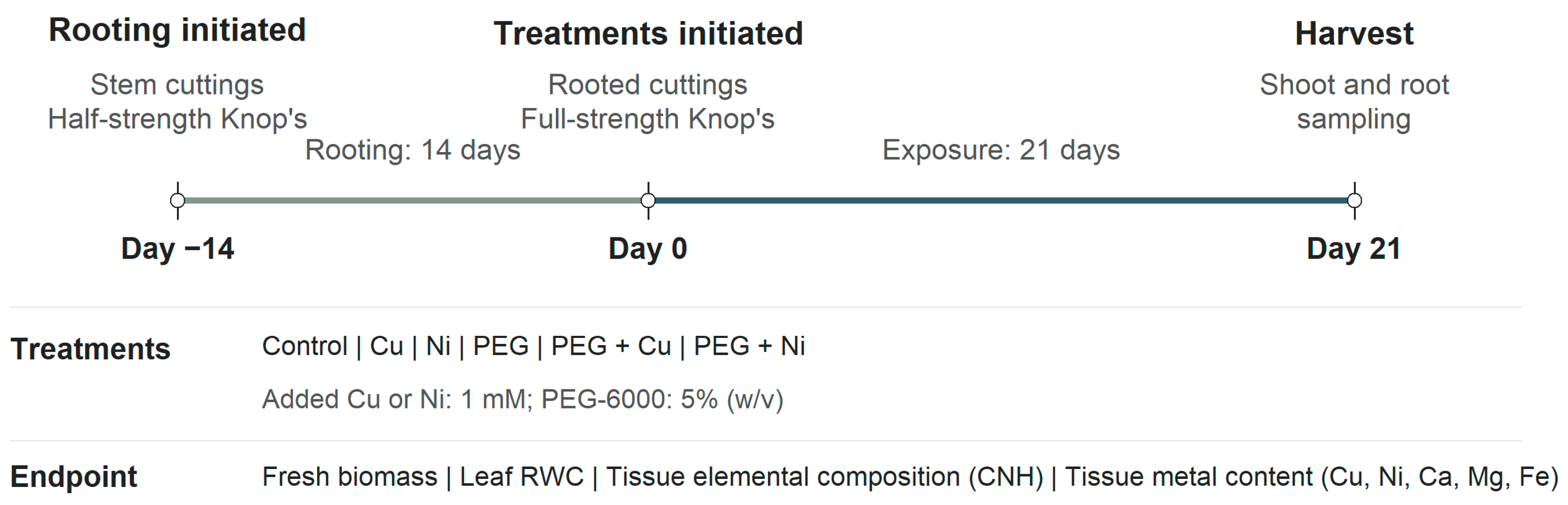
Throughout the cultivation period, plants were supplied daily with tap water as required to maintain a consistent water level indicated by the markers. Polish drinking-water quality standards specify maximum concentrations of 2.0 mg L−1 for Cu and 0.020 mg L−1 for Ni [57], approximately 32 and 2935 times lower, respectively, than the concentrations applied in the metal treatments (1 mM). These limits provide context for the possible background contribution from tap water used for replenishment; however, its actual metal concentrations and cumulative inputs were not quantified. After 21 days of growth under a hydroponic system installed in a greenhouse, plant material was harvested, and shoots and roots were separated from wooden cuttings and weighed for subsequent analyses. Roots were washed twice with distilled water to remove residual particles and metal ions adhered to the root surface. No chemical desorption procedure was applied, and surface-adsorbed metals were not quantified separately. For biomass and relative water content determinations, measurements from the three plants were averaged to obtain one value per pot. Plant biomass from each pot was combined for the chemical analyses. The timeline of the experiment is presented in Figure 8.
Figure 8.
Experimental timeline.
4.2. Leaf Relative Water Content (RWC)
Immediately after harvesting, the middle leaf from each plant was weighed on an analytical balance to obtain its fresh weight (FW). Collected leaves were placed in sealed plastic bags with their petioles submerged in distilled water and maintained in darkness for 4 h before turgid weight (TW) was recorded. The same rehydration period was applied to all treatments to standardize the procedure and facilitate comparisons; treatment-specific rehydration times were not investigated. Finally, leaves were oven-dried at 80 °C for 48 h to constant weight to determine dry weight (DW). The RWC values were subsequently calculated according to the formula reported by [58].
4.3. Metal Content and Uptake Ratios
Total concentrations of Ni, Cu, the divalent nutrients Ca and Mg, and Fe in willow roots and shoots were determined by atomic absorption spectrophotometry (AAS) using an AA280 FS/Z atomic absorption spectrometer (Agilent Technologies, Santa Clara, CA, USA) operating in flame atomization mode. Plant tissue subsamples (0.1–0.5 g, weighed to ±0.1 mg) were taken from dried and homogenized material and digested in concentrated HNO3 (Sigma-Aldrich, Steinheim, Germany) using a Mars Xpress microwave digestion system (CEM International Corporation, Matthews, NC, USA) operated for 30 min at 2450 MHz. Digests were quantitatively transferred into volumetric flasks, brought to a final volume of 25 or 50 cm3 with demineralized water, and clarified by paper filtration. Element-specific calibration curves were prepared, and sample mass and dilution volume were accounted for in the corresponding calculations. For each element, a five-point calibration curve was constructed from freshly prepared standard solutions derived from certified 1000 mg L−1 stock standards (Sigma-Aldrich, Steinheim, Germany), and all reported values represent means of three independent measurements. The accuracy of the AAS analysis was assessed using the certified reference material NCS DC 73350 (NACIS, Shanghai, China). The measured concentrations of the analyzed elements were compared with the corresponding certified values. Element concentrations in plant tissue are expressed as mg kg−1 dry weight (DW).
Metal translocation from roots to shoots was assessed via the translocation factor (TF) according to Equation (1), and defined as the ratio of shoot to root metal concentration, while metal uptake efficiency was assessed via the bioconcentration factor (BCF), defined as the ratio of metal content in roots or shoots (mg kg−1 DW) to the initial metal concentration supplied in the cultivation medium (mg L−1) [59,60] calculated using Equation (2). For BCF calculations, nutrient solution concentrations were converted to a mass basis assuming a solution density of 1 ± 0.01 kg L−1, and BCF was therefore expressed as a dimensionless ratio. BCF values were calculated using nominal initial solution metal concentrations, following the approach used in our previous studies to ensure methodological comparability. Solution metal concentrations were not measured during or at the end of exposure; therefore, these values should be interpreted as concentration ratios relative to the nominal initial exposure.
4.4. Elemental Analysis
Nitrogen (N), carbon (C), and hydrogen (H) contents in willow roots and shoots were quantified with a FLASH 2000 Series elemental analyzer (Thermo Fisher Scientific, Waltham, MA, USA). Plant material (2–3 mg per sample) was weighed on a Mettler XP6 electronic microbalance (Mettler-Toledo, LLC, Columbus, OH, USA), sealed into tin capsules (Thermo Fisher Scientific), and loaded onto a MAS 200R autosampler (Thermo Fisher Scientific, Bremen, Germany) for automated transfer into the combustion reactor. Combustion products were quantified using a thermal conductivity detector (TCD). Instrument calibration was based on a five-point curve for each analyzed element, established using the BBOT standard (2,5-bis(5-tert-butyl-benzoxazol-2-yl)thiophene; Thermo Fisher Scientific) and certified Alfalfa reference material (Elemental Microanalysis Ltd., Okehampton, UK). Calibration accuracy was subsequently confirmed by analyzing a certified Birch leaf reference material (Elemental Microanalysis Ltd., Okehampton, UK).
4.5. Statistical Analyses
Biomass, leaf relative water content, tissue elemental concentrations, and elemental ratios were analyzed using two-way ANOVA, with metal treatment (no added metal, Cu, or Ni), PEG (absent or present), and their interaction as fixed effects. Tukey-adjusted pairwise comparisons were conducted among all six treatment combinations. For graphical presentation, comparisons among the six treatment combinations were based on the equivalent one-way ANOVA model followed by Tukey’s HSD test. Interaction contrasts compared the PEG response under Cu and Ni with the response without added metal and with each other. Holm adjustment was applied to these three contrasts separately for each response variable. BCF and TF were analyzed separately by comparing the relevant metal-only and metal + PEG treatments.
Residual distributions and variance homogeneity were evaluated using Q–Q plots, Shapiro–Wilk tests, and Levene’s tests. Because some diagnostics indicated departures from model assumptions, sensitivity analyses were conducted using HC3 heteroscedasticity-consistent covariance estimates and approximate Wald tests. Results are reported in Tables S1 and S2. Principal component analysis (PCA) was used to explore variation in physiological and elemental traits among 18 biological replicates, comprising three replicates for each of the six treatments. Variables were screened using a >5% contribution threshold in a preliminary PCA of the first two principal components. The selected 16 quantitative variables were centred and scaled to unit variance before the final PCA. Horn’s parallel analysis (10,000 simulations; paran package) supported interpreting two principal components. K-means clustering was applied to variable coordinates across all principal components for descriptive coding of the variable vectors. Individual biological replicates were displayed as points, with treatment labels positioned near the centroids of their PCA scores. Since variable selection was based on a preliminary analysis of the same dataset, the ordination and variable grouping were interpreted as exploratory patterns within the selected variable set, without inferential claims concerning treatment separation or interactions.
All statistical analyses were performed using the R software (ver. 4.2; R Development Core Team). The experimental timeline was prepared in R using the RStudio (ver. 2026.11.0) integrated development environment and base R graphics.
5. Conclusions
The energy willow clone ‘Tordis’ showed contrasting responses to Cu and Ni during a 21-day hydroponic experiment with 5% PEG-6000. Cu caused greater biomass reduction than Ni and decreased leaf relative water content. PEG alone did not significantly affect total fresh biomass or leaf RWC, but significantly reduced root fresh biomass by approximately 29.1%, with no significant change in shoot fresh biomass. PEG did not significantly intensify the metal-induced reduction in biomass, although the PEG + Cu treatment resulted in the lowest leaf RWC.
PEG addition also modified tissue metal concentrations and their shoot-to-root ratios in a metal-dependent manner. It decreased Cu concentrations in both roots and shoots, whereas it increased shoot Ni concentration and the Ni translocation factor. Nevertheless, the absolute TF values remained low for both metals, and concentrations in the analyzed root material substantially exceeded those in shoots. This response provides a basis for further investigation on improved Ni phytoextraction under field conditions considering soil sorption–desorption processes, rhizosphere interactions, and moisture dynamics that may modify Ni availability and plant accumulation.
Combined treatments were also associated with altered C:N ratios, higher Ca and Mg concentrations in shoots and roots, and markedly lower shoot Fe concentrations. These observations describe tissue concentrations rather than total elemental amounts accumulated per plant. These findings demonstrate that PEG can modify willow responses to Cu and Ni under the tested short-term hydroponic conditions. They provide a basis for investigating whether water availability similarly modifies metal accumulation and distribution in energy willow, but do not directly establish effects on field phytomanagement performance. Because the experiment was conducted under short-term hydroponic conditions and root metal measurements may include surface-bound fractions, the observed responses should be validated in longer-term soil experiments under variable water regimes.
Supplementary Materials
The following supporting information can be downloaded at https://www.mdpi.com/article/10.3390/plants15233735/s1, Figure S1: Biomass of shoots and roots of S. viminalis L. ‘Tordis’ in experimental variants (data presented as mean ± SD). Bars show means ± SD, and groups sharing a letter do not differ significantly (Tukey’s HSD following one-way ANOVA, α = 0.05); Figure S2: Selected example plants of S. viminalis L. ‘Tordis’ cultivated in hydroponic system under greenhouse conditions. Treatments shown from left to right are: (A) Control, Cu, and PEG + Cu; (B) Control, Ni, and PEG + Ni. Cu and Ni were supplied separately as Cu(NO3)2 and Ni(NO3)2, respectively, at a concentration of 1 mM. PEG-6000 was applied at 5% (w/v). Control plants were grown in nutrient solution without added metals or PEG. The photographs show selected examples and provide a qualitative illustration of plant appearance under different treatments; Figure S3: Total copper (Cu) and nickel (Ni) contents in shoots and roots of S. viminalis L. ‘Tordis’ under control conditions and following treatment with Cu, Ni, PEG, PEG + Cu, or PEG + Ni. Values represent the total amount of metal (µg) in the dry biomass (DW) of the respective organ. Lines indicate medians, boxes the interquartile range (25th–75th percentiles, IQR), and whiskers extend to the most extreme observations within 1.5 × IQR below the first or above the third quartile. Groups sharing a letter do not differ significantly (Tukey’s HSD following one-way ANOVA, α = 0.05); Table S1: Factorial ANOVA and HC3 sensitivity tests; Table S2. Metal × PEG interaction contrasts.
Author Contributions
Conceptualization, K.D.; methodology, K.D., M.W. and M.R.; formal analysis, K.D. and M.R.; investigation, K.D., M.W., Z.S. and P.G.; data curation, K.D. and M.R.; writing—original draft preparation, K.D., M.R., M.W. and Z.S.; writing—review and editing, K.D.; visualization, M.R. and K.D.; supervision, K.D. All authors have read and agreed to the published version of the manuscript.
Funding
This research received no external funding.
Data Availability Statement
The data supporting the findings of this study are available from the corresponding author upon reasonable request.
Acknowledgments
During the preparation of this manuscript, the authors used Perplexity AI (Perplexity Pro subscription, https://www.perplexity.ai/pro, accessed on 18 November 2026) to assist with literature exploration and to improve the language and readability of the text. All AI-generated suggestions were critically reviewed, verified against the original sources where applicable, and revised by the authors. The authors take full responsibility for the accuracy, integrity, and final content of this manuscript.
Conflicts of Interest
The authors declare no conflicts of interest.
References
- Community Plant Variety Office. Official Gazette of the Community Plant Variety Office; No. 4/2002; CPVO: Angers, France, 2002; p. 50. Available online: https://cpvo.europa.eu/sites/default/files/documents/gazettes/2002/cpvo_2002_4.pdf (accessed on 15 November 2026).
- Bakšienė, E.; Titova, J. Effects of cultivation technologies on woody biomass yield of various willow (Salix spp.) cultivars. Zemdirb.-Agric. 2018, 105, 339–348. [Google Scholar] [CrossRef] [Scilit]
- Trava, I.D.; Borlea, G.F.; Hollerbach, W. Identification of the most productive species from the Salix genus and its use in energetic cultures. J. Hortic. For. Biotechnol. 2014, 18, 209–213. [Google Scholar]
- Vâtcă, S.D.; Gâdea, Ș.; Vidican, R.; Șandor, M.; Stoian, V.; Vâtcă, A.; Horvath, A.; Stoian, V.A. Primary growth effect of Salix viminalis L. cv. Inger and Tordis in controlled conditions by exploring optimum cutting lengths and rhizogenesis treatments. Sustainability 2022, 14, 9272. [Google Scholar] [CrossRef] [Scilit]
- Kulig, B.; Gacek, E.; Wojciechowski, R.; Oleksy, A.; Kołodziejczyk, M.; Szewczyk, W.; Klimek-Kopyra, A. Biomass yield and energy efficiency of willow depending on cultivar, harvesting frequency and planting density. Plant Soil Environ. 2019, 65, 377–386. [Google Scholar] [CrossRef] [Scilit]
- Weih, M.; Nordh, N.E. Characterising willows for biomass and phytoremediation: Growth, nitrogen and water use of 14 willow clones under different irrigation and fertilisation regimes. Biomass Bioenergy 2002, 23, 397–413. [Google Scholar] [CrossRef] [Scilit]
- Kubátová, P.; Hejcman, M.; Száková, J.; Vondráčková, S.; Tlustoš, P. Effects of sewage sludge application on biomass production and concentrations of Cd, Pb and Zn in shoots of Salix and Populus clones: Improvement of phytoremediation efficiency in contaminated soils. Bioenergy Res. 2016, 9, 809–819. [Google Scholar] [CrossRef] [Scilit]
- Kubátová, P.; Száková, J.; Břendová, K.; Kroulíková-Vondráčková, S.; Mercl, F.; Tlustoš, P. Effects of summer and winter harvesting on element phytoextraction efficiency of Salix and Populus clones planted on contaminated soil. Int. J. Phytoremediat. 2018, 20, 499–506. [Google Scholar] [CrossRef] [Scilit] [PubMed]
- Kalita, S.; Potter, H.K.; Weih, M.; Baum, C.; Nordberg, Å.; Hansson, P.-A. Soil carbon modelling in Salix biomass plantations: Variety determines carbon sequestration and climate impacts. Forests 2021, 12, 1529. [Google Scholar] [CrossRef] [Scilit]
- Larsen, S.U.; Jørgensen, U.; Lærke, P.E. Biomass yield, nutrient concentration and nutrient uptake by SRC willow cultivars grown on different sites in Denmark. Biomass Bioenergy 2018, 116, 161–170. [Google Scholar] [CrossRef] [Scilit]
- Graß, R.; Malec, S.; Wachendorf, M. Biomass performance and competition effects in an established temperate agroforestry system of willow and grassland—Results of the 2nd rotation. Agronomy 2020, 10, 1819. [Google Scholar] [CrossRef] [Scilit]
- Alloway, B.J. Sources of heavy metals and metalloids in soils. In Heavy Metals in Soils: Trace Metals and Metalloids in Soils and Their Bioavailability, 3rd ed.; Alloway, B.J., Ed.; Springer: Dordrecht, The Netherlands, 2013; pp. 11–50. [Google Scholar] [CrossRef] [Scilit]
- Cao, Y.; Tan, Q.; Zhang, F.; Ma, C.; Xiao, J.; Chen, G. Phytoremediation potential evaluation of multiple Salix clones for heavy metals (Cd, Zn and Pb) in flooded soils. Sci. Total Environ. 2022, 813, 152482. [Google Scholar] [CrossRef] [Scilit] [PubMed]
- Scriba, C.; Lunguleasa, A.; Spirchez, C.; Ciobanu, V. Influence of INGER and TORDIS energetic willow clones planted on contaminated soil on the survival rates, yields and calorific value. Forests 2021, 12, 826. [Google Scholar] [CrossRef] [Scilit]
- Wani, K.A.; Sofi, Z.M.; Malik, J.A.; Wani, J.A. Phytoremediation of heavy metals using Salix (willows). In Bioremediation and Biotechnology, Volume 2: Degradation of Pesticides and Heavy Metals; Bhat, R., Hakeem, K.R., Dervash, M.A., Eds.; Springer: Cham, Switzerland, 2020; pp. 161–174. [Google Scholar] [CrossRef] [Scilit]
- Hall, J.L. Cellular mechanisms for heavy metal detoxification and tolerance. J. Exp. Bot. 2002, 53, 1–11. [Google Scholar] [CrossRef]
- Küpper, H.; Andresen, E. Mechanisms of metal toxicity in plants. Metallomics 2016, 8, 269–285. [Google Scholar] [CrossRef] [Scilit] [PubMed]
- Tang, Z.; Wang, H.Q.; Chen, J.; Chang, J.D.; Zhao, F.J. Molecular mechanisms underlying the toxicity and detoxification of trace metals and metalloids in plants. J. Integr. Plant Biol. 2023, 65, 570–593. [Google Scholar] [CrossRef] [Scilit] [PubMed]
- Shabbir, Z.; Sardar, A.; Shabbir, A.; Abbas, G.; Shamshad, S.; Khalid, S.; Natasha; Murtaza, G.; Dumat, C.; Shahid, M. Copper uptake, essentiality, toxicity, detoxification and risk assessment in soil–plant environment. Chemosphere 2020, 259, 127436. [Google Scholar] [CrossRef] [Scilit] [PubMed]
- Yusuf, M.; Fariduddin, Q.; Hayat, S.; Ahmad, A. Nickel: An overview of uptake, essentiality and toxicity in plants. Bull. Environ. Contam. Toxicol. 2011, 86, 1–17. [Google Scholar] [CrossRef] [Scilit] [PubMed]
- Seregin, I.V.; Kozhevnikova, A.D. Physiological role of nickel and its toxic effects on higher plants. Russ. J. Plant Physiol. 2006, 53, 257–277. [Google Scholar] [CrossRef] [Scilit]
- Drzewiecka, K.; Gawrysiak, P.; Woźniak, M.; Rybak, M. Metal accumulation and tolerance of energy willow to copper and nickel under simulated drought conditions. Sustainability 2023, 15, 13084. [Google Scholar] [CrossRef] [Scilit]
- Han, J.; Singh, V.P. A review of widely used drought indices and the challenges of drought assessment under climate change. Environ. Monit. Assess. 2023, 195, 1438. [Google Scholar] [CrossRef] [Scilit] [PubMed]
- Mukherjee, S.; Mishra, A.; Trenberth, K.E. Climate change and drought: A perspective on drought indices. Curr. Clim. Change Rep. 2018, 4, 145–163. [Google Scholar] [CrossRef] [Scilit]
- Wikberg, J.; Ögren, E. Variation in drought resistance, drought acclimation and water conservation in four willow cultivars used for biomass production. Tree Physiol. 2007, 27, 1339–1346. [Google Scholar] [CrossRef] [Scilit] [PubMed]
- Pucholt, P.; Sjödin, P.; Weih, M.; Rönnberg-Wästljung, A.-C.; Berlin, S. Genome-wide transcriptional and physiological responses to drought stress in leaves and roots of two willow genotypes. BMC Plant Biol. 2015, 15, 244. [Google Scholar] [CrossRef] [Scilit] [PubMed]
- Sharma, P.; Jha, A.B.; Dubey, R.S. Enhancing phytoremediation efficacy in plants cultivated in heavy metal-contaminated soil under drought stress: Understanding plant responses and genetic engineering strategies. Water Air Soil Pollut. 2024, 235, 451. [Google Scholar] [CrossRef] [Scilit]
- Drzewiecka, K.; Mleczek, M.; Gąsecka, M.; Magdziak, Z.; Budka, A.; Chadzinikolau, T.; Kaczmarek, Z.; Goliński, P. Copper and nickel co-treatment alters metal uptake and stress parameters of Salix purpurea × viminalis. J. Plant Physiol. 2017, 216, 125–134. [Google Scholar] [CrossRef] [Scilit] [PubMed]
- Drzewiecka, K.; Mleczek, M.; Gąsecka, M.; Magdziak, Z.; Goliński, P. Changes in Salix viminalis L. cv. ‘Cannabina’ morphology and physiology in response to nickel ions—Hydroponic investigations. J. Hazard. Mater. 2012, 217–218, 429–438. [Google Scholar] [CrossRef] [Scilit] [PubMed]
- Fan, L.; Tang, L.; Zuo, Z.; Fan, W.; Yang, H.; Zhou, Q. Screening and identification of drought-sensitive and drought-tolerant poplar germplasm based on short-term physiological and biochemical differences. Forests 2025, 16, 1750. [Google Scholar] [CrossRef] [Scilit]
- Caruso, A.; Chefdor, F.; Carpin, S.; Depierreux, C.; Delmotte, F.M.; Kahlem, G.; Morabito, D. Physiological characterization and identification of genes differentially expressed in response to drought induced by PEG 6000 in Populus canadensis leaves. J. Plant Physiol. 2008, 165, 932–941. [Google Scholar] [CrossRef] [Scilit] [PubMed]
- Drzewiecka, K.; Gąsecka, M.; Magdziak, Z.; Rybak, M.; Budzyńska, S.; Rutkowski, P.; Niedzielski, P.; Mleczek, M. Drought differently modifies tolerance and metal uptake in Zn- or Cu-treated male and female Salix × fragilis L. Forests 2024, 15, 562. [Google Scholar] [CrossRef] [Scilit]
- Borowiak, K.; Drzewiecka, K.; Magdziak, Z.; Gąsecka, M.; Mleczek, M. Effect of Ca/Mg ions ratio on copper accumulation, photosynthetic activity and growth of Cu2+-treated Salix viminalis L. ‘Cannabina’. Photosynthetica 2012, 50, 353–361. [Google Scholar] [CrossRef] [Scilit]
- Mleczek, M.; Gąsecka, M.; Drzewiecka, K.; Goliński, P.; Magdziak, Z.; Chadzinikolau, T. Copper phytoextraction with willow (Salix viminalis L.) under various Ca/Mg ratios. Part 1. Copper accumulation and plant morphology changes. Acta Physiol. Plant. 2013, 35, 3251–3259. [Google Scholar] [CrossRef] [Scilit]
- Cao, Y.; Ma, C.; Chen, H.; Zhang, J.; White, J.C.; Chen, G.; Xing, B. Xylem-based long-distance transport and phloem remobilization of copper in Salix integra Thunb. J. Hazard. Mater. 2020, 392, 122428. [Google Scholar] [CrossRef] [Scilit] [PubMed]
- Yang, X.; Baligar, V.C.; Martens, D.C.; Clark, R.B. Plant tolerance to nickel toxicity. II. Nickel effects on influx and transport of mineral nutrients in four plant species. J. Plant Nutr. 1996, 19, 265–279. [Google Scholar] [CrossRef] [Scilit]
- Magdziak, Z.; Gąsecka, M.; Drzewiecka, K.; Ilek, A.; Rybak, M.; Proch, J.; Niedzielski, P. The influence of water conditions on heavy metal tolerance mechanisms in hybrid poplar (Populus nigra × Populus maximowiczii) in the light of Sustainable Development Goals. Sustainability 2025, 17, 4989. [Google Scholar] [CrossRef] [Scilit]
- Madahinasab, M.; Mousavi Nik, M.; Ghanbari, A.; Sirousmehr, A.R.; Kouhestani, S. Investigation of the effect of drought stress on bioavailability and bioaccumulation of cadmium, copper, and iron in barley. Iran. J. Soil Water Res. 2022, 53, 1111–1125. [Google Scholar] [CrossRef]
- Saeng-ngam, S.; Larpkern, P.; Moungsrimuangdee, B.; Jampasri, K. Phytoextraction potential of Colocasia esculenta for cadmium- and zinc-contaminated soils under moderate drought stress: A short-term pot study. J. Curr. Sci. Technol. 2026, 16, 193. [Google Scholar] [CrossRef] [Scilit]
- Saeng-ngam, S.; Jampasri, K. Effects of drought stress on the growth and heavy metal accumulation by Chromolaena odorata grown in hydroponic media. Bull. Environ. Contam. Toxicol. 2022, 108, 762–767. [Google Scholar] [CrossRef] [Scilit] [PubMed]
- Macfie, S.M.; Welbourn, P.M. The cell wall as a barrier to uptake of metal ions in the unicellular green alga Chlamydomonas reinhardtii (Chlorophyceae). Arch. Environ. Contam. Toxicol. 2000, 39, 413–419. [Google Scholar] [CrossRef] [Scilit] [PubMed]
- Kalis, E.J.J.; Temminghoff, E.J.M.; Weng, L.; van Riemsdijk, W.H. Effects of humic acid and competing cations on metal uptake by Lolium perenne. Environ. Toxicol. Chem. 2006, 25, 702–711. [Google Scholar] [CrossRef] [Scilit] [PubMed]
- Redjala, T.; Sterckeman, T.; Morel, J.L. Determination of the different components of cadmium short-term uptake by roots. J. Plant Nutr. Soil Sci. 2010, 173, 935–945. [Google Scholar] [CrossRef] [Scilit]
- Gajewska, E.; Niewiadomska, E.; Tokarz, K.; Słaba, M.; Skłodowska, M. Nickel-induced changes in carbon metabolism in wheat shoots. J. Plant Physiol. 2013, 170, 369–377. [Google Scholar] [CrossRef] [Scilit] [PubMed]
- Bollmark, L.; Sennerby-Forsse, L.; Ericsson, T. Seasonal dynamics and effects of nitrogen supply rate on nitrogen and carbohydrate reserves in cutting-derived Salix viminalis plants. Can. J. For. Res. 1999, 29, 85–94. [Google Scholar] [CrossRef]
- Weih, M.; Bonosi, L.; Ghelardini, L.; Rönnberg-Wästljung, A.-C. Optimizing nitrogen economy under drought: Increased leaf nitrogen is an acclimation to water stress in willow (Salix spp.). Ann. Bot. 2011, 108, 1347–1353. [Google Scholar] [CrossRef] [Scilit] [PubMed]
- Meng, S.; Zhang, C.; Su, L.; Li, Y.; Zhao, Z. Nitrogen uptake and metabolism of Populus simonii in response to PEG-induced drought stress. Environ. Exp. Bot. 2016, 123, 78–87. [Google Scholar] [CrossRef] [Scilit]
- Yu, F.Y.; Wang, Y.; Luo, X.; Li, K.W.; Hou, J.W.; Dai, G.G.; Yuan, H.M.; Zhang, L.H. Effects of PEG-simulated drought stress and selenite treatment on mineral nutrient homeostasis in wheat roots and shoots. Plant Soil Environ. 2025, 71, 614–620. [Google Scholar] [CrossRef] [Scilit]
- Waraich, E.A.; Ahmad, R.; Ashraf, M.Y. Role of mineral nutrition in alleviation of drought stress in plants. Aust. J. Crop Sci. 2011, 5, 764–777. [Google Scholar]
- Peaucelle, A.; Braybrook, S.; Höfte, H. Cell wall mechanics and growth control in plants: The role of pectins revisited. Front. Plant Sci. 2012, 3, 121. [Google Scholar] [CrossRef] [Scilit] [PubMed]
- Zhang, T.; Dong, G.; Tian, Y.; Zhou, Y.; Li, Y.; Zhang, S.; Li, H. Effects of drought stress and Ca supply on the biomass allocation strategies of poplar and mulberry. Forests 2023, 14, 505. [Google Scholar] [CrossRef] [Scilit]
- Sardans, J.; Peñuelas, J.; Ogaya, R. Drought’s impact on Ca, Fe, Mg, Mo and S concentration and accumulation patterns in the plants and soil of a Mediterranean evergreen Quercus ilex forest. Biogeochemistry 2008, 87, 49–69. [Google Scholar] [CrossRef] [Scilit]
- Perea-García, A.; Andrés-Bordería, A.; Vera-Sirera, F.; Pérez-Amador, M.A.; Puig, S.; Peñarrubia, L. Deregulated high-affinity copper transport alters iron homeostasis in Arabidopsis. Front. Plant Sci. 2020, 11, 1106. [Google Scholar] [CrossRef] [Scilit] [PubMed]
- Kobayashi, T.; Nishizawa, N.K. Iron uptake, translocation, and regulation in higher plants. Annu. Rev. Plant Biol. 2012, 63, 131–152. [Google Scholar] [CrossRef] [Scilit] [PubMed]
- Nishida, S.; Tsuzuki, C.; Kato, A.; Aisu, A.; Yoshida, J.; Mizuno, T. AtIRT1, the primary iron uptake transporter in the root, mediates excess nickel accumulation in Arabidopsis thaliana. Plant Cell Physiol. 2011, 52, 1433–1442. [Google Scholar] [CrossRef] [Scilit] [PubMed]
- Osmolovskaya, N.; Shumilina, J.; Kim, A.; Didio, A.; Grishina, T.; Bilova, T.; Keltsieva, O.A.; Zhukov, V.; Tikhonovich, I.; Tarakhovskaya, E.; et al. Methodology of drought stress research: Experimental setup and physiological characterization. Int. J. Mol. Sci. 2018, 19, 4089. [Google Scholar] [CrossRef] [Scilit] [PubMed]
- Minister of Health of the Republic of Poland. Regulation of the Minister of Health of 22 May 2026 on the Quality of Water Intended for Human Consumption. J. Laws Repub. Pol. 2026, 748, 1–34. Available online: https://dziennikustaw.gov.pl/D2026000074801.pdf (accessed on 18 November 2026). (In Polish)
- Weatherley, P.E.; Slatyer, R.O. Relationship between relative turgidity and diffusion pressure deficit in leaves. Nature 1957, 179, 1085–1086. [Google Scholar] [CrossRef] [Scilit]
- Baker, A.J.M. Accumulators and excluders—Strategies in the response of plants to heavy metals. J. Plant Nutr. 1981, 3, 643–654. [Google Scholar] [CrossRef] [Scilit]
- Ma, L.Q.; Komar, K.M.; Tu, C.; Zhang, W.; Cai, Y.; Kennelley, E.D. A fern that hyperaccumulates arsenic. Nature 2001, 409, 579. [Google Scholar] [CrossRef] [Scilit] [PubMed]
Disclaimer/Publisher’s Note: The statements, opinions and data contained in all publications are solely those of the individual author(s) and contributor(s) and not of MDPI and/or the editor(s). MDPI and/or the editor(s) disclaim responsibility for any injury to people or property resulting from any ideas, methods, instructions or products referred to in the content. |
© 2026 by the authors. Licensee MDPI, Basel, Switzerland. This article is an open access article distributed under the terms and conditions of the Creative Commons Attribution (CC BY) license.