


Abstract
Birds are key pollinators for many plants, yet some perform nectar robbing without pollinating flowers. As non-native plants have not evolved with the local avifauna, they could have less protection against flower robbing, thus facing higher risks of avian nectar robbing. In this study, we built a bird–flower interaction network for the Kunming Botanical Garden by recording the floral-visiting behaviour of birds over 17 months to assess if local birds are more likely to rob non-native plant species. We recorded 39 plant species (15 families, 22 genera) and 12 bird species (nine families, 11 genera), documenting a total of 13,196 interactions. We analysed the differences in nectar robbing between non-native (five species) and native (34 species) plants, the effects of floral traits on nectar robbing, network structures, and phylogenetic correlations between plants and birds. The results show that plant origin (native versus non-native) had no significant effect on nectar-robbing probability, indicating that non-native flowers are not more robbed by native birds. The key floral trait determining nectar-robbing behaviour was corolla tube length: flowers with longer tubes were more likely to be robbed. In contrast, corolla tube aperture diameter and nectar sugar concentration negatively influenced robbing. The overall network had moderate connectance, significant modularity and weak nestedness. We found no significant association between measured floral traits and network module membership. Flower length and corolla tube aperture diameter have significant phylogenetic signals, whereas nectar traits and nectar-robbing behaviour showed no significant phylogenetic signal. Moreover, there was no significant phylogenetic congruence between native plants and birds. This study clarifies the core roles of floral traits but not plant origin in avian nectar-robbing behaviour, revealing the modular characteristics of interaction networks and the lack of evolutionary history driving mechanisms of bird–flower interactions. Our findings provide new insights into the factors restricting the integration of non-native plants into recently created ecosystems.
1. Introduction
In pollination networks, birds serve as an indispensable functional group, providing stable pollination services for angiosperms across perhaps as many as 74 families [1,2]. It is estimated that more than 1000 bird species from 50 families have been confirmed to participate in the pollination of thousands of plant species [3,4,5], but the actual number of pollinating bird species may exceed 2000 species. Among them, hummingbirds (Trochilidae), sunbirds (Nectariniidae), and the honeyeaters (Meliphagidae) are usually recognised as the most specialised pollinators [6,7]. In addition to these specialised groups, generalist birds also make remarkable contributions to pollination and have been recorded to participate in the pollination of plants in at least 36 families and 70 genera [8]. Many frugivorous birds, such as members of Thraupidae and Picidae in the Americas, Pycnonotidae and oriental white-eyes (Zosterops palpebrosus Temminck, 1824) in tropical and temperate Asia, often take nectar as a supplementary food source [2]. Their flower-visiting behaviours not only directly affect the reproductive success of plants but also maintain the complexity and stability of pollination networks [9].
Bird pollination occurs when birds visit flowers to obtain floral rewards and make contact with both the anthers and stigmas. During legitimate visits, birds insert their bills or tongues through the corolla opening, allowing pollen to adhere to their bodies from the anthers and subsequently be transferred to the stigmatic surfaces of the same or other flowers. However, bird flower-visiting behaviours do not always result in pollination. In general, when there is a mismatch between bird bill and floral structural traits, flower visitors may act as nectar robbers [10]. Nectar robbing occurs when animals obtain nectar directly by biting or piercing floral tissues instead of accessing nectar through the corolla openings of flowers, without contacting the reproductive organs of plants [11,12]. For birds, this behaviour is particularly prevalent among generalist passerines [13]. Compared with insect nectar robbing, avian nectar robbing usually results in more severe damage to floral structures. Birds’ hard beaks can tear corollas, damage nectaries, and even destroy reproductive organs, thus exerting more prominent negative impacts on plants.
With the intensification of global biotic exchanges, an increasing number of non-native plants have been introduced into regions outside their native distribution ranges either by intentional human activities or accidental factors [14,15,16]. When plants spread to new habitats, they are exposed to new pollinating animals. Non-native plants usually attract native floral visitors through large floral displays, showy flower colour and/or high nectar production [17,18], potentially altering flower-visiting behaviour and resource use by native birds [19]. Such changes may promote a shift from legitimate flower visitation to nectar robbing, while the behavioural patterns and ecological consequences of these novel interactions remain unclear.
Previous studies of nectar robbing have revealed the animal taxa involved, their behavioural patterns and the complex impacts of nectar robbing on plant reproduction [20,21,22,23]. Nevertheless, most studies have focused on the nectar-robbing relationships between native plants and native flower visitors, with few studies of the interactions between non-native plants and native floral visitors, including birds [24]. Moreover, systematic comparison of susceptibility to avian nectar robbing between non-native and native plants is lacking, as is understanding of the floral traits that might regulate any differences.
To address these gaps, this study used a botanical garden, with a high species richness of cultivated non-native and native plants, as the research area. We systematically observed 34 native and five non-native plant species to classify and quantify the legitimate flower-visiting and nectar-robbing behaviours and to analyse how floral traits influence bird behaviour during visits to flowers. We constructed bird–flower interaction networks, comparing the structural differences between the overall network and the legitimate visitation network, which excludes nectar-robbing interactions. We examined the phylogenetic components of bird–flower interactions and assessed whether nectar robbing shows any phylogenetic signal. Specifically, we aimed to address the following questions: (1) Are non-native plants more likely to be robbed by local birds than native ones? (2) Which floral traits affect the likelihood of avian nectar robbing? How do these traits regulate the level of nectar robbing? (3) Do these bird species acting as nectar robbers play key roles in bird–flower interaction networks? Floral traits are often better matched to flower visitors from their native range because flowers and their visitors have a shared evolutionary and ecological history [1,2]. Such adaptations would either prevent legitimate visits by floral visitors present outside their native range or favour robbing by local flower-visiting birds. Therefore, we hypothesised that non-native plants would be more frequently robbed by native flower visitors. We further expected that the presence and quantity of nectar, as well as the length of the corolla tube, would positively affect the likelihood of avian nectar robbing, whereas the size of the corolla tube opening would negatively affect the probability. We also expect that key nectar robbers play important roles in the bird–flower interaction networks.
2. Material and Methods
2.1. Study Site and Data Collection
We conducted the study from June 2024 to October 2025 (17 months in total) at the Kunming Botanical Garden, Kunming Institute of Botany, Chinese Academy of Sciences, Yunnan Province, China (1990 m a.s.l.; 25°8′27″ N, 102°44′25″ E), located in a subtropical evergreen broadleaved forest area. The annual average precipitation in Kunming was 772 mm in 2024, with an annual average temperature of 17.1 °C; as of September 2025, the average precipitation had reached 865.2 mm, and the average temperature was 17 °C.
We focused on bird-visited flowering plants and flower-visiting birds; we tried to observe as many flowering plant species interacting with birds as possible. During the field observations, we carefully recorded and classified the identity and behaviours of floral visitors. We conducted observations from 7:00 am to 7:00 pm at selected intervals (15 min per interval, randomly distributed across different time points), at a distance of 5 to 10 m. Each plant was observed once per day, with a total observation duration of 1.5 h per plant over the whole study period.
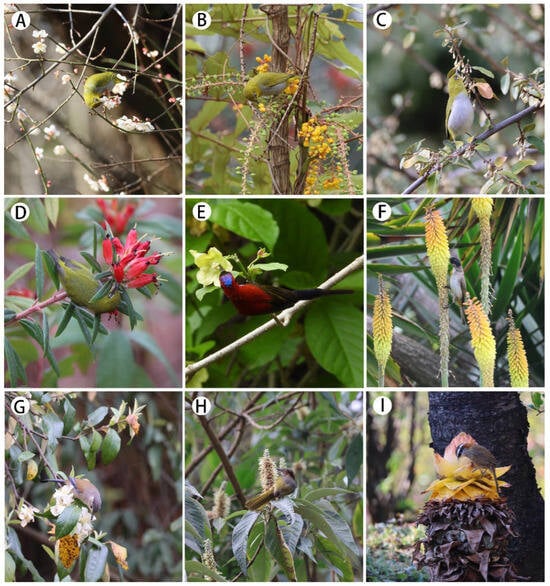
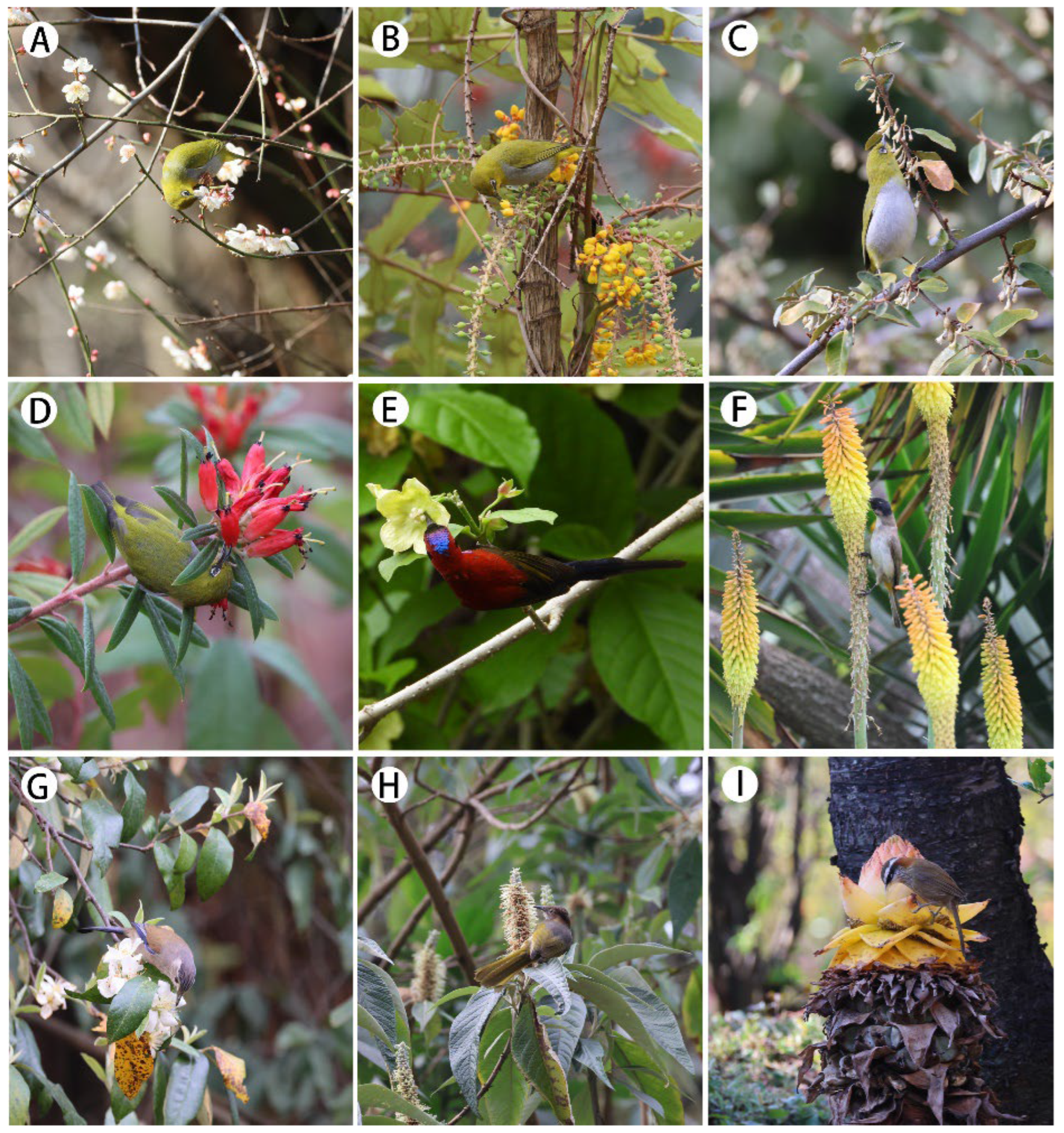
All avian visitors were observed with the help of binoculars (10×42, 13-31042, Bresser UK Ltd., Kent, UK) (Figure 1). We then categorised the bird visits to flowers based on their behaviour as (1) legitimate if they entered or inserted parts of their bodies through the corolla opening, and (2) illegitimate if they accessed floral resources without entering or inserting their mouthparts in the corolla opening, which includes robbing if they exerted force to create a hole in the corolla and bypassed the normal floral opening to obtain nectar directly from the nectary, a classification modified from Inouye [12]. In our system, when a bird visits a flower illegitimately, it is more likely to act as nectar robbing; therefore, we treat illegitimate visits as equal to nectar robbing. The total number of visits made by each bird visitor during the observation period was subsequently calculated. Additionally, we recorded the total number of observed plants in each plot, the number of open flowers per plant, and the total number of flowers in each patch. The probability of legitimate visits and nectar robbing for each plant was calculated as the number of visits in each category divided by the total number of visits to that plant.
Figure 1.
Avian flower visitation behaviours in Kunming Botanical Garden, Kunming, China (A–D). Oriental white-eyes (Zosterops palpebrosus) visiting flowers of Prunus mume ‘Jiang Mei’ (A), Mahonia duclouxiana Gagnep (B), Elaeagnus pungens Thunb (C), and Rhododendron spinuliferum Franch (D), respectively; (E) Mrs. Gould’s sunbird (Aethopyga gouldiae Vigors, 1831) visiting a flower of Vallaris indecora (Baill.) Tsiang & P. T. Li; (F) brown-breasted bulbul (Pycnonotus xanthorrhous Anderson, 1869) visiting flowers of a non-native plant, Kniphofia uvaria (L.) Oken; (G) blue-winged minla (Actinodura cyanouroptera Hodgson, 1837) visiting a flower of Docynia delavayi (Franch.) C. K. Schneid; (H) mountain bulbul (Ixos mcclellandii Horsfield, 1840) visiting flowers of Leucosceptrum canum Sm; and (I) streak-breasted scimitar-babbler (Pomatorhinus ruficollis Hodgson, 1836) visiting a flower of Musella lasiocarpa (Franch.) C. Y. Wu ex H. W. Li.
2.2. Measurements of Floral Traits
For each plant species, we randomly bagged 25 flower buds with nylon mesh bags. After 24 h, when the flowers were fully open, we measured 20 ± 0.23 flowers per species. First, we measured flower length, corolla tube length, corolla tube aperture (tube diameter at the opening) and petal thickness using a digital vernier calliper (0.01 mm precision). We also categorised flower symmetry (bilateral or radial) and recorded protective structures such as enlarged calyces and bracts, as well as latex or resin secretion after robbing, which acts as a defence against further nectar theft [25]. We further measured the nectar volume of the same flowers using capillary micropipettes with volumes of 1, 5, or 10 µL (accuracy: 0.5%; coefficient of variation: 1.0%; Hirschmann Laboratory, Germany). We then used portable refractometers (range: 0–45% Brix and 45–80% Brix, Bellingham & Stanley Ltd., Letchworth Garden City, UK) to measure the sugar concentration of the nectar in each flower. Finally, the nectar sugar content (Z, mg) was calculated using the following formula based on the nectar sugar concentration (X, %), the nectar sugar content per microliter (Y, mg/μL), and the nectar volume (V, μL) [26].
Y = 0.00226 + 0.00937 X + 0.0000585 X2
Z = V × Y
2.3. Analysis of Nectar-Robbing Levels Between Native and Non-Native Plants
Based on all observational data, we constructed a binomial mixed-effects model with plant origin as the fixed effect, and plant species and animal species as random effects using the glmmTMB package version 1.1.15.2 [27,28] to test nectar-robbing pattern differences among non-native and native plants. The model was as follows: robbing ~ plant origin + (1|plant species) + (1|bird species). The effect of plant origin (non-native and native) on nectar robbing probability was assessed using model summaries and Type II Wald chi-squared tests via the Anova function in the car package [29]. We defined native plants as the species distributed in Yunnan and adjacent regions; these species have interacted with native flower-visiting birds for a long time. Non-native species were defined as those introduced from other continents outside of East Asia, as these species have had no historical interaction with local pollinators in Kunming.
To investigate the influence of floral traits on nectar robbing, we built a more complex full model, which takes nectar-robbing occurrence as the dependent variable, floral traits as fixed effects, and bird and plant species as random effects. By iteratively removing or retaining variables and comparing the fitting performance of different models using indicators such as AIC, we finally determined the optimal prediction model, thereby accurately identifying the key floral trait variables that significantly affect nectar-robbing behaviour. We applied Type II analysis of variance to assess the overall significance of each fixed effect in the optimal model, thereby clarifying the influence of each variable on nectar-robbing behaviour.
2.4. Phylogenetic Tree Reconstruction
All statistical analyses were calculated with the R Statistical Software (version 4.4.2; R Core Team 2025) with the R Studio interface (version 2024.09.1; R Studio Team 2025).
We reconstructed the phylogenetic tree for the studied plant species using the function phylo.maker from the V.Phylomaker package [30]. The GBOTB.extended mega phylogeny in Newick format served as the backbone, with the default option “scenario 3”. To address polytomies in the resulting phylogenetic tree, we applied the multi2di function from the ape package [31] for random resolution. For birds, we obtained the complete mitochondrial genomes from the National Center for Biotechnology Information (NCBI). The sequences were aligned using ClustalW in MEGA 12 [32], and a phylogenetic tree was then constructed using the maximum likelihood method.
2.5. Construction and Analysis of Interaction Networks
To examine how nectar-robbing interactions behave in bird–flower interactions, we plotted the overall bird–flower interaction network, including legitimate visitations and nectar-robbing visitations, as well as the legitimate visitation network between birds and plants. We used the plotweb function from the bipartite package [33] and calculated the visitation network parameters with the networklevel function. For the calculation of modularity and the number of modules, due to the inherent randomness of the method, a random seed was first set to ensure the reproducibility of results. Each network was computed 50 times, and the highest modularity value was selected [34] to systematically quantify the structural characteristics of the networks.
To assess the significance of key network parameters, we constructed two sets of random null model networks using the r2dtable algorithm: 1000 null networks for verifying the network specialisation index (H2′), nestedness index (NODF) [35] and modularity [36]. For each index, we calculated its value in the observed network and the corresponding mean and standard deviation across null models. Then, we used z-scores, calculated as z = (observed − mean (null))/sd (null), to determine statistical significance.
To assess whether differences in floral traits among plants affect the formation of distinct modules in the network, we conducted a Bayesian analysis using the brms package [37] to assess the significance of differences in floral traits across modules. After Markov Chain Monte Carlo (MCMC) simulation (4 chains, 5000 iterations) and convergence diagnostics [38], we obtained posterior predictive values of traits at the module level. Additionally, to test whether floral trait combinations were significantly associated with plant network module membership, we performed a multi-response permutation procedure (MRPP) using the vegan package [39], with plant module identity as the grouping variable and floral traits as multivariate response variables; within-group dissimilarity (delta) was calculated based on Euclidean distance to evaluate differences in floral trait composition across modules.
2.6. Analysis of Species Roles in Visitation Networks
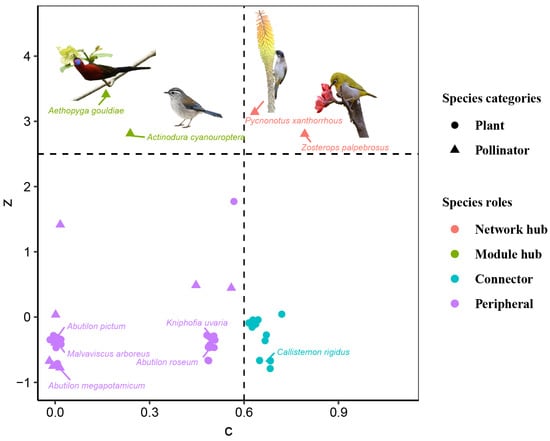
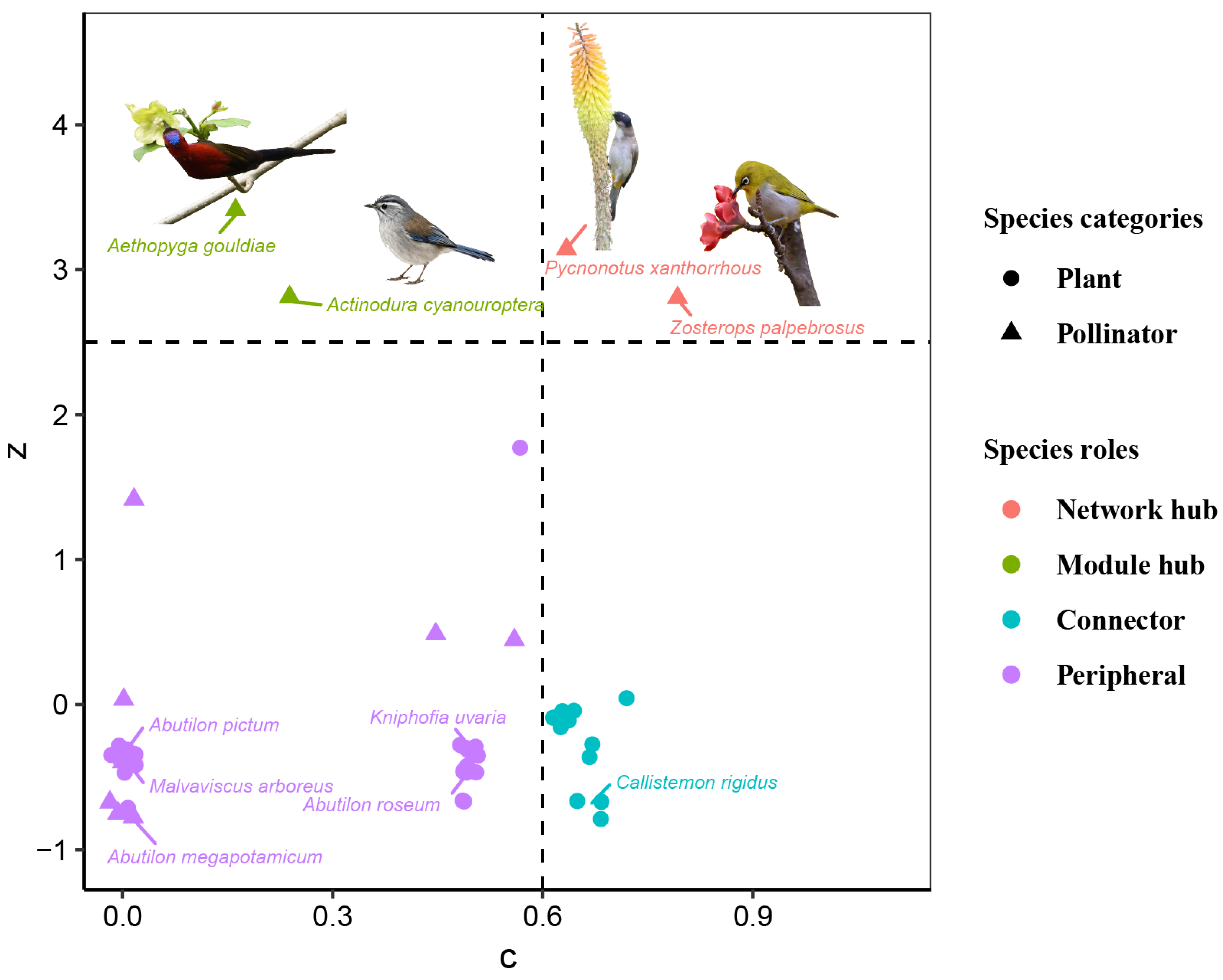
The standardised within-module connectivity (z) and among-module connectivity (c) of each species in the legitimate visitation network were calculated using netcarto software [40] to explore the roles of species in this network. Network hubs (z > 2.5; c > 0.62) are the core maintaining the overall network structure, with high connectivity both within and among modules. Connectors (z < 2.5; c > 0.62) link different modules in the network. Module hubs (z > 2.5; c < 0.62) focus on the interior of their respective modules and are crucial for maintaining module stability. Peripheral species (z < 2.5; c < 0.62) have weaker connectivity both within and among modules, thus playing a limited role in module maintenance and network function realisation [41,42].
2.7. Phylogenetic Correlation Analysis of Native Bird–Flower Interactions
To test if the current bird–flower interactions are shaped by shared evolutionary history, we conducted two analyses to assess phylogenetic associations within native bird–flower interactions (legitimate visitation network). First, we calculated phylogenetic distances among bird species using the bird phylogenetic tree, and applied the Bray–Curtis method [43] to quantify dissimilarity in plant assemblages visited by different birds. A Mantel test was then used to examine the correlation between these two distance matrices. Second, we adopted the Procrustes Approach to Co-Phylogeny (PACo) method in the paco package [44] to test phylogenetic congruence between plant and bird lineages based on their phylogenetic distance matrices. The Procrustes sum of squares (m2) was used to measure the overall match of phylogenetic structures and evaluate evolutionary impacts on contemporary interaction patterns.
2.8. Phylogenetic Signal Analysis of Nectar Robbing and Floral Traits
We estimated the phylogenetic signal of nectar robbing and flower traits to determine if the variation in trait expression among species correlates with their phylogenetic relationships. We calculated Pagel’s λ and Blomberg’s K to estimate phylogenetic signals in the geiger package [45]. Pagel’s λ quantifies phylogenetic signal, with values near 1 indicating evolution consistent with Brownian motion, whereas Blomberg’s K tests phylogenetic conservatism: K > 1 indicates strong conservatism, while K < 1 indicates a more random or labile evolutionary pattern. Their significance was tested against a null distribution generated by 1000 random permutations of the tips of the phylogeny using the picante package [46].
3. Results
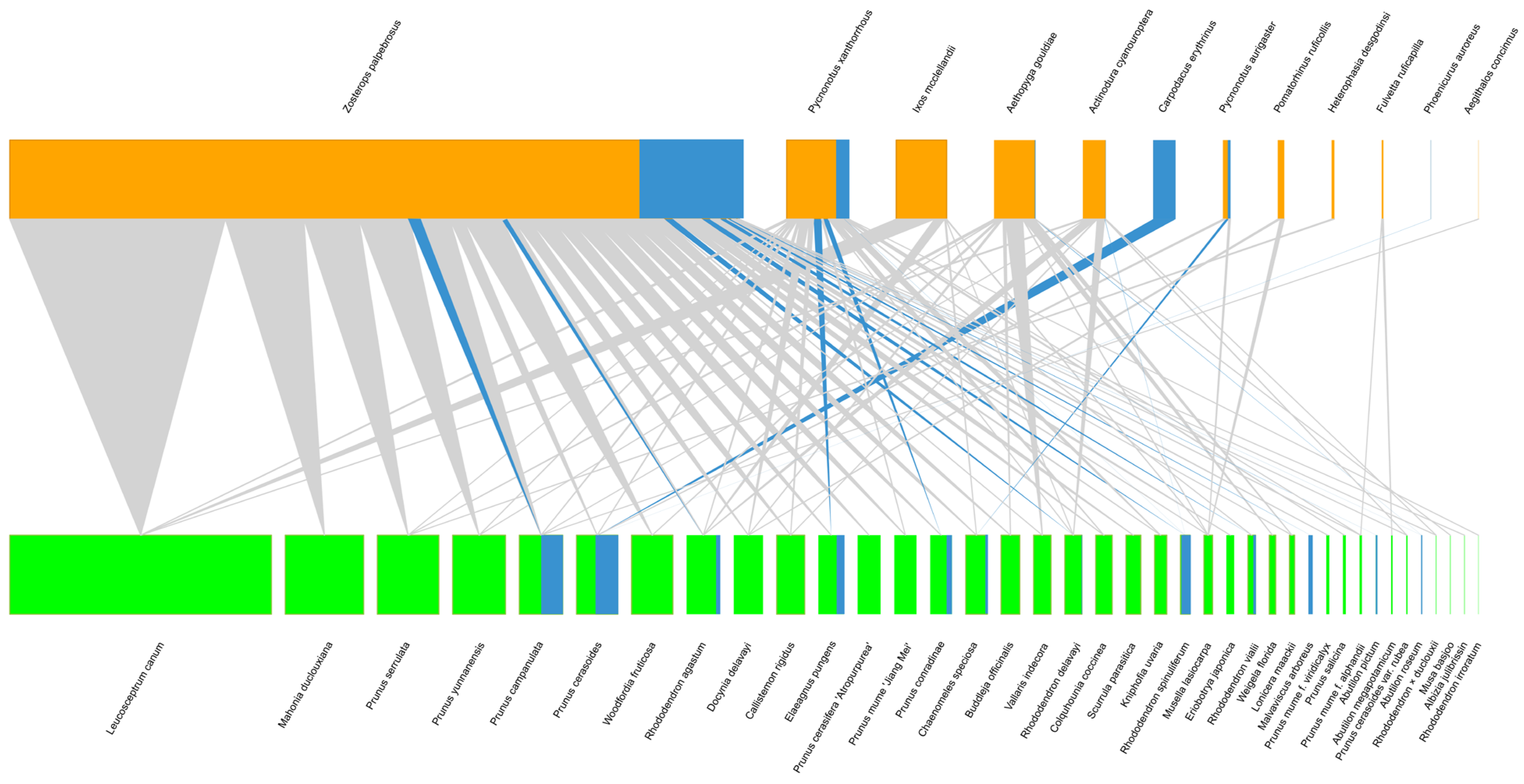
In total, we recorded 39 plant species (15 families and 22 genera), including herbs, woody plants, and lianas, and observed 12 bird species (nine families and 11 genera), making a total of 13,196 visits to these plants. Among them, five plants are non-native, and all the bird species are native. Oriental white-eyes (Z. palpebrosus) accounted for approximately 10,161 of 13,196 observed visits, counting 77% of the total. The most frequent interaction species pair was between oriental white-eyes and Leucosceptrum canum Sm, which accounted for 22.8% of all recorded interactions (Figure 2; Table S1).
Figure 2.
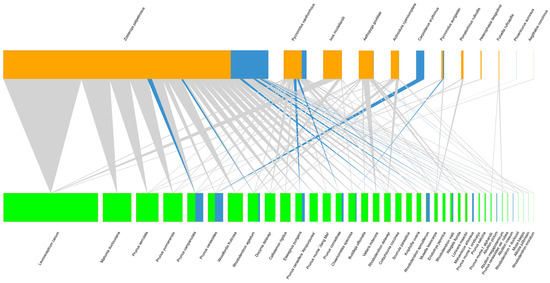
Interaction network of 12 bird species (upper part) and 39 plant species (lower part). The link width indicates interaction intensity, and species node width represents species abundance. The blue-coloured links indicate nectar robbing.
Patterns of interaction were uneven across the network, with some specialised interactions. For example, M. duclouxiana was visited exclusively by Z. palpebrosus, whereas daurian redstart (Phoenicurus auroreus Pallas, 1776) and common rosefinch (Carpodacus erythrinus Pallas, 1770) were recorded only foraging on Prunus cerasoides Buch.-Ham. ex D. Don. Legitimate visits accounted for the majority of bird–plant interactions recorded in this study. Nectar-robbing rates also varied markedly among both bird and plant species. Carpodacus erythrinus and P. auroreus obtained nectar exclusively by robbing, and a native plant, Abutilon roseum Hand.-Mazz, and a non-native plant species, Malvaviscus arboreus Cav, were visited only through nectar-robbing interactions (Table S2).
We also documented several novel or rarely reported interactions. To our knowledge, this is the first record of flower visitation by spectacled fulvetta (Fulvetta ruficapilla Verreaux, J, 1871). In addition, we recorded birds visiting Buddleja officinalis Maxim, E. pungens, M. duclouxiana, Scurrula parasitica L., V. indecora and Lonicera maackii (Rupr.) Maxim, adding further detail to the known diversity of bird–flower interactions.
3.1. Nectar-Robbing Levels Between Native and Non-Native Plants
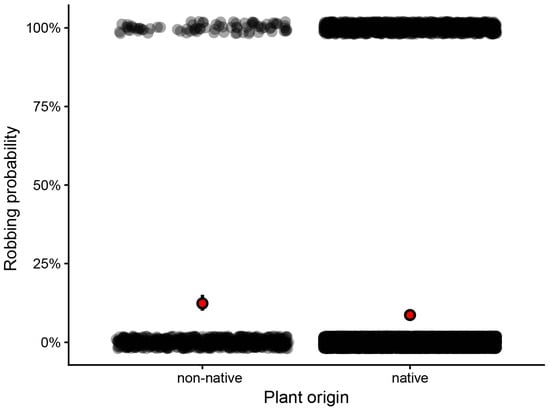
For the observed proportions of nectar robbing, we recorded 1088 robbing events out of 12,532 visits, with an 8.7% robbing rate for native plants and a rate of 12.4% (82 robbing events among 664 visits) for non-native plants. Model predictions indicated that, within the 95% confidence interval, the range of robbing probability was 10.1% to 15.1% with a mean of 12.3% for non-native plants, and 8.2–9.2% with a mean of 8.7% for native plants (Figure 3). However, with plant species and animal species specified as random effects, the mixed-effects analysis showed that plant origin had no significant effect on nectar-robbing behaviour (χ2 = 0.077; p = 0.782; Figure 3).
Figure 3.
The robbing occurrence and probability in native and non-native plants. Black dots represent single occurrences in the observed data, with each dot indicating one bird–flower interaction: dots above denote nectar-robbing events, while those below represent legitimate visiting. The two red dots and line segments indicate the predicted, model-adjusted probabilities and 95% CI.
At both the species level and the flower level, non-native plants had significantly higher nectar volumes, longer flowers, wider corolla tube aperture diameters, and higher nectar sugar amounts than native plants, whereas nectar sugar concentration did not differ significantly between non-native and native plants (Tables S3–S5; Figure S1).
A binomial mixed-effects model based on all observations was used to examine the specific effects of floral traits on nectar robbing (Table 1 and Tables S2–S4). Corolla tube length (χ2 = 89.298; p < 0.001) exerted a significant positive effect; corolla tube aperture diameter (χ2 = 88.874; p < 0.001) had a significant negative effect; and nectar concentration (χ2 = 10.781; p = 0.001) had a significant negative effect on nectar-robbing behaviour, while nectar volume showed a small, non-significant positive coefficient (χ2 = 0.416; p = 0.519).
Table 1.
Results of deviance analysis (Type II Wald test) to test the specific effects of floral traits on nectar robbing.
3.2. Structure of the Interaction Networks
The overall and legitimate bird–flower interaction networks differed (Table 2). Excluding robbing interactions, a total of 10 bird species and 37 plant species were recorded in the legitimate network, with 12,026 of these interaction events recorded (Table 2 and Table S1). The connectance of the legitimate interaction network was 0.214, slightly higher than that of the overall interaction network (0.188). The H2′ specialisation index was higher than that of null models and statistically significant in both networks. The nestedness index (NODF) was similar between the two networks, and both deviated significantly from random expectations. Modularity analysis revealed significant modularity in both networks, with values of 0.20 for the legitimate visitation network and 0.23 for the total interaction network.
Table 2.
Parameters of the bird–plant interaction networks.
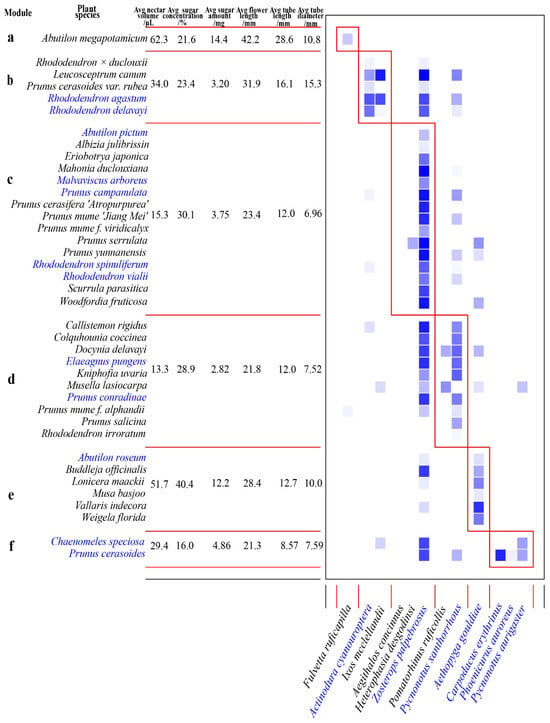
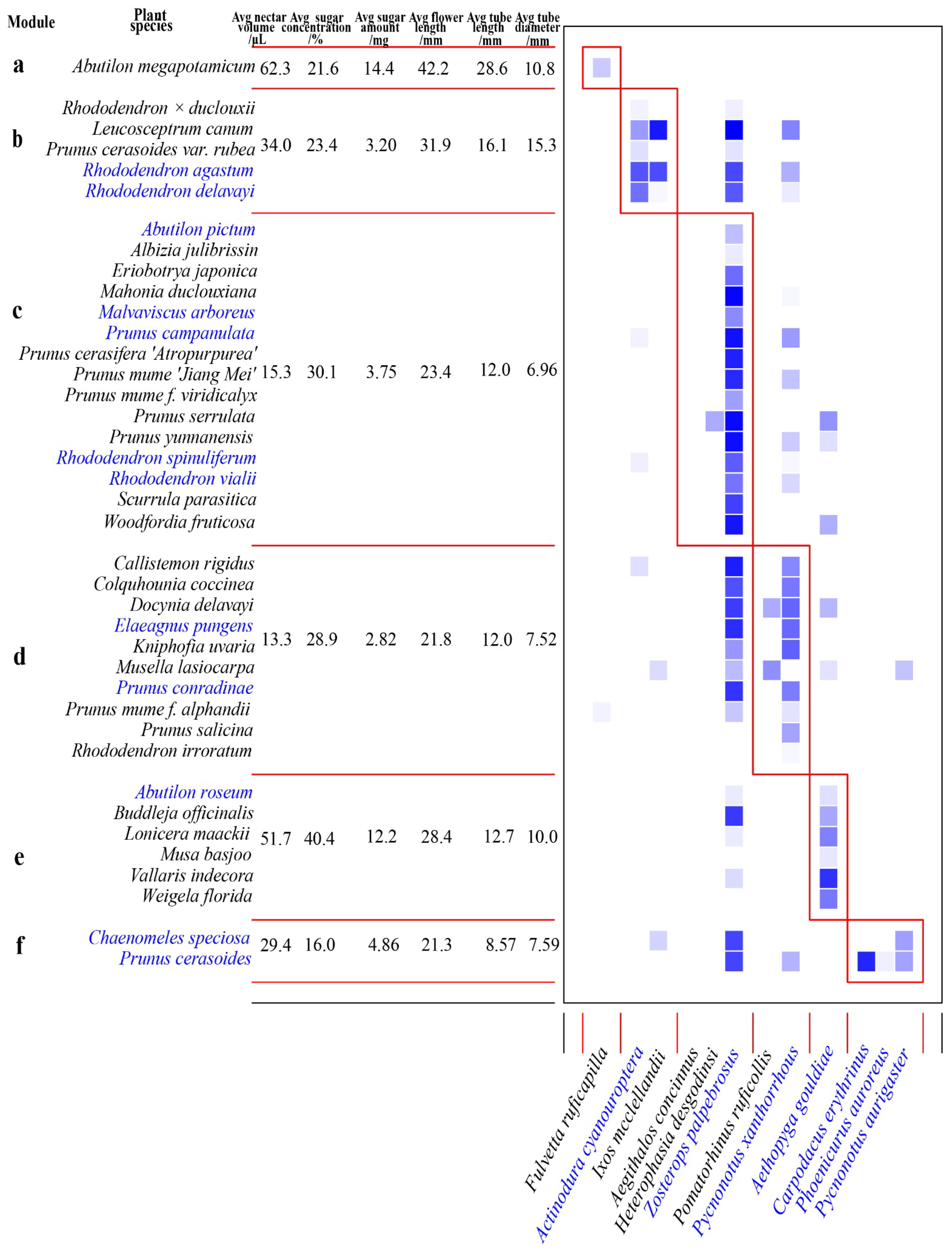
Species form functionally independent interaction subgroups through modular division, and within these subgroups, species achieve precise interactions through significantly specialised preferences, leading to a reduction in the overall nestedness of the network. Specifically, the overall interaction network can be divided into six modules: a, b, c, d, e and f (Figure 4). Two exclusive robbing birds, C. erythrinus and P. auroreus, with another robbing bird, the sooty-headed bulbul (Pycnonotus aurigaster Vieillot, 1818), formed a unique robbing module f, interacting with winter and early spring flowering plants P. cerasoides and Chaenomeles speciosa (Sweet) Nakai. Other bird species involved in nectar robbing were distributed in other modules (Figure 4). In terms of floral traits, there are differences in floral traits among different modules. The prediction test using the Bayesian linear regression model shows that not all traits differ significantly among modules (Figure S2). The MRPP test showed no statistically significant differences in the multivariate floral trait composition of plants among different network modules in the full network (A = 0.030, observed delta = 2.913, expected delta = 3.002, and p = 0.176; Figure S3).
Figure 4.
Modular structure of the overall visitation interaction network. In the vertical direction on the left are plants, and at the bottom are birds. In the interaction matrix, the purple squares in the module represent interactions between plant species and bird species, with darker-coloured squares indicating higher interaction frequencies. Plant and bird species names marked into blue colours are these species involving nectar-robbing interactions.
3.3. Species Roles in Visitation Networks
In the overall network, Z. palpebrosus and P. xanthorrhous are network hubs (Figure 5). Mrs. Gould’s sunbird (Aethopyga gouldiae) and A. cyanouroptera belong to module hubs, being highly connected to core species within their respective modules. All network hubs and module hubs were also the primary nectar robbers. Some plant species function as connectors, linking different modules and facilitating species interactions among these modules. Nonetheless, most birds and plants are peripheral species with narrow interaction ranges. Two exclusive robbers, C. erythrinus and P. auroreus, are peripheral species.
Figure 5.
Results of species role analysis in the overall visitation interaction network. The figure uses standardised within-module connectivity (z) and between-module connectivity (c) as the coordinate axes. The dots represent plants, and triangles represent pollinators. The dashed lines (Z = 2.5; C = 0.62) indicate the thresholds for classifying structural roles. Distinct colours indicate distinct roles of species (Network hub, Module hub, Connector, and Peripheral).
3.4. Phylogenetic Correlation of Native Bird–Flower Interactions
Based on the Mantel test, there was no significant association between bird phylogenetic distances and distances in their flower-visiting plant compositions (r = −0.177; p = 0.924). Co-phylogenetic analysis showed an extremely low degree of phylogenetic structure matching between native plants and birds (Procrustes sum of squares; m2 = 0.961), which was not statistically significant (p = 0.162) (Figure S4). Linear regression showed that plant specialisation (number of interacting partners) did not significantly predict the co-phylogenetic signal between native plants and birds (β = 0.003 ± 0.002; t = 1.257; p = 0.213).
3.5. Phylogenetic Signals of Floral Traits and Nectar-Robbing Behaviour
The phylogenetic signal analysis of flower traits and nectar robbing revealed clear differences among traits (Table 3; Figure S5). Flower length and corolla tube aperture diameter exhibited significant phylogenetic signals (p < 0.05). In contrast, nectar volume, nectar sugar amount, nectar sugar concentration, corolla tube length, and nectar robbing did not show significant phylogenetic signals (p > 0.05).
Table 3.
Results of phylogenetic signal analysis for floral traits and nectar-robbing behaviour.
4. Discussion
After a 17-month-long survey in an environment rich in both native and non-native flowering plant species, but occupied solely by native flower visitors, we characterised a large bird–flower interaction network and found that the probability of nectar robbing shows no difference between non-native and native plants. Together with our results on how well floral traits explain bird–flower interactions within this network, our finding does not support our hypothesis that non-native plants would be more frequently robbed by flower visiting birds. More specifically, our results suggest that the length of the corolla tube, as well as the presence and quantity of nectar, would positively affect the likelihood of avian nectar robbing, whereas corolla tube aperture diameter would negatively affect the probability. Furthermore, bird–flower interactions are more likely driven by trait matching, rather than evolutionary constraint in this region.
4.1. Native Birds Show Equal Chance to Rob Nectar from Non-Native and Native Plants
To our knowledge, this is the first community study to investigate native flower-visiting birds robbing nectar from non-native and native plants in a botanical garden. Our 17-month survey with robust bird–flower interaction data does not support our hypothesis that native flower-visiting birds are more likely to rob nectar from non-native plants. The probability of nectar robbing by native birds on both non-native and native plants shows no significant difference. This community-based result differs from the results from previous species-based studies. For example, the European foxglove Digitalis purpurea experiences intense nectar robbing in introduced Central and South American populations, where 42.5% of recently opened flowers are robbed by bumblebees, flower piercers, and hummingbirds compared with minimal robbing in its native range, resulting in significantly lower seed production in the non-native range [24]. The invasive yellow bells, Tecoma stans, face nectar robbing in up to 94% of flowers by native stingless bees and carpenter bees in urban areas in Brazil [47].
We do have reasons to suspect that non-native plants should be more likely to be robbed by native birds, because non-native plants evolved floral traits through selection by the main flower visitors in their native distribution range [1,2]. For instance, in the Tropical Americas, native hummingbirds with longer bills preferentially interact with native flowers with longer corolla tubes and a higher amount of nectar [48]. Once in their introduced range, these same traits of flowers native to the Tropical Americas can mismatch the traits of local flower-visiting birds, which bear much shorter bills [2]. In addition to having much longer bills, hummingbirds have the ability to hover while visiting flowers, while in Asia, local bird species have no or very limited ability to hover when they forage for floral nectar [2]. Long bills and hovering in hummingbirds would thus allow them to access nectar legitimately and pollinate many plant species with long corolla tubes and pendant flowers in their native ranges. In our case, the non-native flowers vary substantially in floral morphology, i.e., long floral tubes and a pendant floral presentation (Figure 1). When local birds visit these non-native flowers, they need to find a landing position to collect nectar, and the most efficient (and maybe only) way to accomplish this is by nectar robbing. This can explain why Malvaviscus arboreus, a species from North America with reddish and pendant flowers, is exclusively robbed by local birds. Importantly, in our observation, almost all these non-native birds visiting plants in the botanical garden failed to produce fruits; further research is needed to confirm this observation. However, within our large database, the recorded nectar robbing to non-native plants is only counting 664 for five non-native species, while there are 34 native species visited by local birds. This imbalance may affect the precision of the estimated plant origin effect.
Nectar robbing appears to be associated with floral morphology [25,49,50]. In this study, non-native plants exhibited morphological differences compared with native plants, such as greater nectar volume, longer flower tubes and larger corolla tube aperture diameters. However, such differences do not result in a higher probability of nectar robbing for non-native plants. Previous studies have confirmed that nectar-robbing behaviour is more prevalent in plant species with long-tubed flowers and abundant nectar, suggesting that these traits may constitute important predictors of nectar robbing [51,52,53,54]. Further analyses confirmed the core role of floral traits: corolla tube length, corolla tube aperture diameter and nectar sugar concentration significantly predicted nectar-robbing likelihood, although the effect of nectar sugar concentration is significantly weaker than that of the former two traits. This indicated that corolla tube length and aperture diameter were the primary determinants of nectar robbing. Corolla tube length was positively correlated with the frequency of nectar robbing, whereas corolla tube aperture diameter was negatively correlated. According to previous research, nectar-robbing behaviour is more likely to occur when corolla tube length exceeds bird beak length or when the corolla tube aperture diameter is too small for legitimate foraging [10]. Furthermore, why do local birds adapt to new plant species quickly? Local nectar-feeding birds may readily incorporate novel plant species into their foraging repertoire through ecological fitting and behavioural flexibility, exploiting floral rewards either through legitimate visitation or through nectar robbing, depending on floral morphology and nectar accessibility [19,55,56]. However, it is worth testing how native birds are attracted to these new plant species by means of floral colour, presentation and reward.
Collectively, these floral traits would regulate the occurrence and frequency of nectar robbing. Notwithstanding, our initial hypotheses gained mixed support. The prediction that non-native plants would suffer more nectar robbing was not supported. However, for the floral trait effects, correlations of corolla tube length and corolla tube aperture diameter with robbing probability matched our expectation, while nectar volume was not significantly associated with robbing probability.
4.2. Network Structure and Species Roles
To our knowledge, this is the second bird–flower interaction network analysed in China, following Nonsri et al. [57], and the first such network in an urban garden. Importantly, our network revealed many bird–flower interactions involving these plants previously believed to be pollinated by generalist insect species. For example, we first recorded sunbirds visiting flowers of V. indecora, in the Apocynaceae, a plant family in which bird pollination/visitation is rarely found [58]. Additionally, many of the native plant species we surveyed were believed to be pollinated by generalist insects, i.e., Prunus spp., and it is true that a large number of insects visited these flowers. Thus, our findings increased the floral visitor assemblage of those plant species, although most of these plant species have not been studied for their pollinators.
Noteworthily, our results of birds visiting flowers of these generalist insect-pollinated species depict a pollination syndrome nested within another syndrome in this region: specialised bird pollination by long-billed, long-tongued nectar-specialist sunbirds within the broader bird pollination system. The network displayed asymmetric interactions. Most species maintained few interaction links, while a smaller number of generalist species occupied a substantial proportion of interactions, consistent with previous studies [57,59]. The dominance of oriental white-eyes was one of the key characteristics of this network; how such over-dominance influences network structure warrants further research. The network exhibited significant modularity; the species within each module interacted frequently, improving resource utilisation efficiency and interaction accuracy [60]. Our flower morphology analysis among modules suggested that there is no clear differentiation in floral traits, indicating that floral traits do not determine the modular structure of the network. Interestingly, we detected a module with winter and early spring flowering plants and robbing birds, suggesting flowering phenology could influence modular structure. Winter flowering may be a mechanism to avoid competing with other flowers or an adaptation to bird pollination in the cold and unstable weather in the early season.
All species were classified into four functional groups: network hubs, module hubs, connectors and peripheral species [41,61]. We found that Z. palpebrosus and P. xanthorrhous functioned as cross-module network hubs. Both species are the most abundant and common flower visitors in wild and urban environments in Kunming [62]. They can not only access nectar from plants with short corollas but also cope with flowers with long corollas or specialised floral morphologies through nectar-robbing behaviour, thereby stabilizing interactions across multiple modules. Aethopyga gouldiae and Actinodura cyanouroptera served as module hubs and maintained frequent visitation with most co-occurring plants within their modules. Some plant species, such as Callistemon rigidus R. Br, acted as connectors, while most birds and plants were peripheral species. Though they interacted with only a few partners, these taxa increased overall interaction diversity and network complexity. The most distinctive character of the network is that these key species, including network hubs and module hubs, are birds, all of which can act as legitimate visitors and nectar robbers. This suggests that bird–flower interaction is more likely shaped by ecological opportunity for nectar foraging by birds.
4.3. Effects of Phylogeny on Bird–Flower Interactions
Plant–pollinator interactions often exhibit phylogenetic dependence, or structure, in which closely related species tend to interact due to shared evolutionary history [63,64]. However, our results provide little evidence that phylogenetic relationships constrain the observed bird–flower interactions, suggesting that contemporary ecological factors, including floral morphology and opportunities for nectar feeding, may play important roles in structuring this network.
Among floral traits, flower length and corolla tube aperture diameter carried strong phylogenetic signals [65,66,67]. In contrast, no significant phylogenetic signals were detected in corolla tube length, nectar volume and nectar sugar concentration. Nectar traits possess high phenotypic plasticity and are susceptible to various environmental factors, including water, temperature and soil, which greatly diminishes the influence of genetics [68,69,70]. Likewise, we found no phylogenetic signal in nectar-robbing behaviour. This indicates that nectar robbing is not influenced by plant evolutionary background; floral morphology and ecological opportunity, rather than phylogeny, explain nectar-robbing frequency by birds.
4.4. Limitations, Caveats and Perspectives
Botanical gardens contain abundant native and non-native plants with homogeneous habitats, making them suitable for this study. However, plant distribution, phenology and bird behaviour here differ from those in natural communities. In addition, our dataset contained only five bird-visited non-native plant species compared with 34 native species. Thus, despite abundant interaction records, the findings cannot be widely generalised. Future studies should sample more non-native species and carry out field surveys in natural habitats. Comparative analyses across different sites will improve the extrapolation and reliability of relevant conclusions. In this study, we did not collect data on bill length and width and head size for the birds; future studies should measure these data and then compare them with corolla measurements to better understand trait matching and the reason for avian nectar robbing.
5. Conclusions
This study revealed that non-native and native plants showed similar probability of nectar robbing by native flower-visiting birds. Corolla tube length was positively correlated with nectar robbing, while corolla tube aperture diameter and nectar sugar concentration were negatively correlated with it. For some birds, floral morphology rarely limits their access to nectar. These birds exhibit strong behavioural plasticity, adopting a dual foraging strategy: they conduct legitimate flower visitation on morphologically compatible flowers, and resort to nectar robbing when normal access is impeded. Within this bird–flower interaction network, flower length and corolla tube aperture diameter possessed significant phylogenetic signals, whereas nectar-robbing behaviour and nectar-related traits showed no obvious phylogenetic conservatism. Moreover, no significant phylogenetic congruence was detected between interacting native plants and birds, indicating that bird–flower interactions are driven by ecological opportunity and trait matching, rather than evolutionary constraints.
Supplementary Materials
The following supporting information can be downloaded at https://www.mdpi.com/article/10.3390/plants15233729/s1. Table S1: Matrix of bird–flower interactions recorded. Table S2: Nectar-robbing percentage of plant and bird species recorded in this study. Table S3: Effects of floral traits on nectar-robbing levels. Table S4: Model selection results based on AIC; Table S5: Plant functional trait data for the plant species. Figure S1: Comparison of floral traits between native and non-native plants. Values in the figure represent the mean value of each group. Figure S2: Bayesian posterior predictions of traits across modules of the overall network. Jitters represent raw data, and red lines represent posterior mean. Figure S3: Principal Coordinates Analysis (PCoA) of floral traits among plant species from different network modules. Figure S4: Phylogenetic relationships of 12 bird species (right) and 34 native plant species (left). Figure S5: Phylogenetic clustering of plant species and associated floral traits, including nectar characteristics, flower morphology, and nectar robbing percentage.
Author Contributions
Conceptualisation, C.E.P.N. and Z.-X.R.; Methodology, C.E.P.N. and Z.-X.R.; Software, A.Q., C.E.P.N. and X.X.; Formal Analysis, A.Q., C.E.P.N., J.O., H.-D.L. and X.X.; Investigation, A.Q., C.E.P.N., J.O., Y.-X.D., Y.-L.C. and Z.-X.R.; Resources, Z.-X.R.; Data Curation, Z.-X.R.; Writing—Original Draft, A.Q., C.E.P.N., J.O. and Z.-X.R.; Writing—Review and Editing, A.Q., C.E.P.N., J.O., Y.-X.D., H.-D.L., Y.-L.C., X.X. and Z.-X.R.; Visualisation, A.Q. and X.X.; Supervision, C.E.P.N., J.O. and Z.-X.R.; Project Administration, Z.-X.R.; Funding Acquisition, J.O. and Z.-X.R. All authors have read and agreed to the published version of the manuscript.
Funding
This research was funded by the National Natural Science Foundation of China (32401288; 32271594) and the Caiyun Postdoctoral Program of Yunnan Province. JO was funded by a High-End Foreign Expert Project of the Yunnan Revitalization Talent Support Program.
Data Availability Statement
The data that support the findings of this study are available in this article and in the Supplementary Materials.
Acknowledgments
We thank Shi-Jia Wen and Yuan-Sheng Fu for their help in the field and laboratory. We are also grateful to the Kunming Botanical Garden for granting permission to conduct the experiments. We also thank David Inouye of the University of Maryland and two anonymous reviewers for providing helpful comments for improving this manuscript.
Conflicts of Interest
The authors declare no conflicts of interest.
References
- Cronk, Q.; Ojeda, I. Bird-pollinated flowers in an evolutionary and molecular context. J. Exp. Bot. 2008, 59, 715–727. [Google Scholar] [CrossRef] [Scilit] [PubMed]
- Ollerton, J. Birds and Flowers: An Intimate 50 Million Year Relationship; Pelagic Publishing: Exeter, UK, 2024. [Google Scholar]
- Krauss, S.L.; Phillips, R.D.; Karron, J.D.; Johnson, S.D.; Roberts, D.G.; Hopper, S.D. Novel consequences of bird pollination for plant mating. Trends Plant Sci. 2017, 22, 395–410. [Google Scholar] [CrossRef] [Scilit] [PubMed]
- Pauw, A. A bird’s-eye view of pollination: Biotic interactions as drivers of adaptation and community change. Annu. Rev. Ecol. Syst. 2019, 50, 477–502. [Google Scholar] [CrossRef] [Scilit]
- Kiepiel, I.; Brown, M.; Johnson, S.D. A generalized bird pollination system in Schotia brachypetala (Fabaceae). Plant Biol. 2022, 24, 806–814. [Google Scholar] [CrossRef] [Scilit] [PubMed]
- Chmel, K.; Ewome, F.L.; Gomez, G.U.; Klomberg, Y.; Mertens, J.E.J.; Tropek, R.; Janecek, S. Bird pollination syndrome is the plant’s adaptation to ornithophily, but nectarivorous birds are not so selective. Oikos 2021, 130, 1411–1424. [Google Scholar] [CrossRef] [Scilit]
- Fleming, T.H.; Muchhala, N. Nectar-feeding bird and bat niches in two worlds: Pantropical comparisons of vertebrate pollination systems. J. Biogeogr. 2008, 35, 764–780. [Google Scholar] [CrossRef] [Scilit]
- Abrahamczyk, S. Comparison of the ecology and evolution of plants with a generalist bird pollination system between continents and islands worldwide. Biol. Rev. 2019, 94, 1658–1671. [Google Scholar] [CrossRef] [Scilit] [PubMed]
- Rocca, M.A.; Sazima, M. Beyond hummingbird-flowers: The other side of ornithophily in the Neotropics. Oecologia Australis 2010, 14, 67–99. [Google Scholar] [CrossRef] [Scilit]
- Aubert, S.; Duchenne, F.; Tinoco, B.A.; Santander, T.; Guevara, E.A.; Graham, C.H. Trait matching affects the probability of nectar robbing in plant-pollinator networks. Oikos 2026, 2026, e11552. [Google Scholar] [CrossRef] [Scilit]
- Irwin, R.E.; Brody, A.K. Consequences of nectar robbing for realized male function in a hummingbird-pollinated plant. Ecology 2000, 81, 2637–2643. [Google Scholar] [CrossRef]
- Inouye, D.W. The terminology of floral larceny. Ecology 1980, 61, 1251–1253. [Google Scholar] [CrossRef] [Scilit]
- Irwin, R.E.; Bronstein, J.L.; Manson, J.S.; Richardson, L. Nectar robbing: Ecological and evolutionary perspectives. Annu. Rev. Ecol. Syst. 2010, 41, 271–292. [Google Scholar] [CrossRef] [Scilit]
- Stohigren, T.J.; Barnett, D.T.; Jarnevich, C.S.; Flather, C.; Kartesz, J. The myth of plant species saturation. Ecol. Lett. 2008, 11, 313–322. [Google Scholar] [CrossRef] [Scilit] [PubMed]
- Brandt, A.J.; Bellingham, P.J.; Duncan, R.P.; Etherington, T.R.; Fridley, J.D.; Howell, C.J.; Hulme, P.E.; Jo, I.; McGlone, M.S.; Richardson, S.J.; et al. Naturalised plants transform the composition and function of the New Zealand flora. Biol. Invasions 2021, 23, 351–366. [Google Scholar] [CrossRef] [Scilit]
- Lin, Q.; Xiao, C.; Ma, J. A dataset on catalogue of alien plants in China. Biodivers. Sci. 2022, 30, 22127. [Google Scholar] [CrossRef] [Scilit]
- Buchholz, S.; Kowarik, I. Urbanisation modulates plant-pollinator interactions in invasive vs. native plant species. Sci. Rep. 2019, 9, 6375. [Google Scholar] [CrossRef] [Scilit] [PubMed]
- Howard, S.R.; Symonds, M.R.E. Complex preference relationships between native and non-native angiosperms and foraging insect visitors in a suburban greenspace under field and laboratory conditions. Sci. Nat. 2023, 110, 16. [Google Scholar] [CrossRef] [Scilit] [PubMed]
- Ollerton, J.; Watts, S.; Connerty, S.; Lock, J.; Parker, L.; Wilson, I.; Schueller, S.; Nattero, J.; Cocucci, A.A.; Izhaki, I.; et al. Pollination ecology of the invasive tree tobacco Nicotiana glauca: Comparisons across native and non-native ranges. J. Pollinat. Ecol. 2012, 9, 85–95. [Google Scholar] [CrossRef] [Scilit]
- Higashi, S.; Ohara, M.; Arai, H.; Matsuo, K. Robber-like pollinators: Overwintered queen bumblebees foraging on Corydalis ambigua. Ecol. Entomol. 1988, 13, 411–418. [Google Scholar] [CrossRef] [Scilit]
- Morris, W.F. Mutualism denied? Nectar-robbing bumble bees do not reduce female or male success of bluebells. Ecology 1996, 77, 1451–1462. [Google Scholar] [CrossRef] [Scilit]
- Irwin, R.E.; Maloof, J.E. Variation in nectar robbing over time, space, and species. Oecologia 2002, 133, 525–533. [Google Scholar] [CrossRef] [Scilit] [PubMed]
- Layek, U.; Bhandari, T.; Das, A.; Karmakar, P. Floral visitors of sesame (Sesamum indicum L.): Elucidating their nectar-robbing behaviour and impacts on the plant reproduction. PLoS ONE 2024, 19, e0300398. [Google Scholar] [CrossRef] [Scilit] [PubMed]
- Mackin, C.R.; Goulson, D.; Castellanos, M.C. Novel nectar robbing negatively affects reproduction in Digitalis purpurea. Ecol. Evol. 2021, 11, 13455–13463. [Google Scholar] [CrossRef] [Scilit] [PubMed]
- Rojas-Nossa, S.V.; Maria Sanchez, J.; Navarro, L. Nectar robbing: A common phenomenon mainly determined by accessibility constraints, nectar volume and density of energy rewards. Oikos 2016, 125, 1044–1055. [Google Scholar] [CrossRef] [Scilit]
- Pyke, G.H.; Kalman, J.R.M.; Bordin, D.M.; Blanes, L.; Doble, P.A. Patterns of floral nectar standing crops allow plants to manipulate their pollinators. Sci. Rep. 2020, 10, 1660. [Google Scholar] [CrossRef] [Scilit] [PubMed]
- Brooks, M.E.; Kristensen, K.; van Benthem, K.J.; Magnusson, A.; Berg, C.W.; Nielsen, A.; Skaug, H.J.; Machler, M.; Bolker, B.M. glmmTMB balances speed and flexibility among packages for zero-inflated generalized linear mixed modeling. R J. 2017, 9, 378–400. [Google Scholar] [CrossRef] [Scilit]
- Bates, D.; Maechler, M.; Bolker, B.M.; Walker, S.C. Fitting linear mixed-effects models using lme4. J. Stat. Softw. 2015, 67, 1–48. [Google Scholar] [CrossRef] [Scilit]
- Fox, J.; Weisberg, S. An R Companion to Applied Regression, 3rd ed.; Sage: Thousand Oaks, CA, USA, 2019. [Google Scholar]
- Jin, Y.; Qian, H.V. PhyloMaker: An R package that can generate very large phylogenies for vascular plants. Ecography 2019, 42, 1353–1359. [Google Scholar] [CrossRef] [Scilit]
- Paradis, E.; Schliep, K. Ape 5.0: An environment for modern phylogenetics and evolutionary analyses in R. Bioinformatics 2019, 35, 526–528. [Google Scholar] [CrossRef] [Scilit] [PubMed]
- Kumar, S.; Stecher, G.; Suleski, M.; Sanderford, M.; Sharma, S.; Tamura, K. MEGA12: Molecular Evolutionary Genetic Analysis version 12 for adaptive and green computing. Mol. Biol. Evol. 2024, 41, msae263. [Google Scholar] [CrossRef] [Scilit] [PubMed]
- Dormann, C.F.; Gruber, B.; Fründ, J. Introducing the bipartite package: Analysing ecological networks. R News 2008, 8, 8–11. [Google Scholar]
- Dormann, C.F.; Strauss, R. A method for detecting modules in quantitative bipartite networks. Methods Ecol. Evol. 2014, 5, 90–98. [Google Scholar] [CrossRef] [Scilit]
- Schleuning, M.; Fruend, J.; Klein, A.-M.; Abrahamczyk, S.; Alarcon, R.; Albrecht, M.; Andersson, G.K.S.; Bazarian, S.; Boehning-Gaese, K.; Bommarco, R.; et al. Specialization of mutualistic interaction networks decreases toward tropical latitudes. Curr. Biol. 2012, 22, 1925–1931. [Google Scholar] [CrossRef] [Scilit] [PubMed]
- Schleuning, M.; Ingmann, L.; Strauss, R.; Fritz, S.A.; Dalsgaard, B.; Dehling, D.M.; Plein, M.; Saavedra, F.; Sandel, B.; Svenning, J.-C.; et al. Ecological, historical and evolutionary determinants of modularity in weighted seed-dispersal networks. Ecol. Lett. 2014, 17, 454–463. [Google Scholar] [CrossRef] [Scilit] [PubMed]
- Buerkner, P.-C. brms: An R package for Bayesian Multilevel Models using stan. J. Stat. Softw. 2017, 80, 1–28. [Google Scholar] [CrossRef] [Scilit]
- Lun, H.N.; Inouye, D.W.; Yang, C.F. Nectar sugar concentration contributes to structuring bumblebee and plant interactions. J. Ecol. 2025, 113, 2744–2757. [Google Scholar] [CrossRef] [Scilit]
- Oksanen, J.; Simpson, G.; Blanchet, F.; Kindt, R.; Legendre, P.; Minchin, P.; O’Hara, R.; Solymos, P.; Stevens, M.; Szoecs, E.; et al. vegan: Community Ecology Package. R Package Version 2.7-8. 2026. Available online: https://CRAN.R-project.org/package=vegan (accessed on 21 November 2026).
- Guimera, R.; Sales-Pardo, M.; Amaral, L.A.N. Module identification in bipartite and directed networks. Phys. Rev. E 2007, 76, 036102. [Google Scholar] [CrossRef] [Scilit] [PubMed]
- Olesen, J.M.; Bascompte, J.; Dupont, Y.L.; Jordano, P. The modularity of pollination networks. Proc. Natl. Acad. Sci. USA 2007, 104, 19891–19896. [Google Scholar] [CrossRef] [Scilit] [PubMed]
- Guimerà, R.; Amaral, L.A.N. Functional cartography of complex metabolic networks. Nature 2005, 433, 895–900. [Google Scholar] [CrossRef] [Scilit] [PubMed]
- Ricotta, C.; Pavoine, S. A new parametric measure of functional dissimilarity: Bridging the gap between the Bray-Curtis dissimilarity and the Euclidean distance. Ecol. Model. 2022, 466, 109880. [Google Scholar] [CrossRef] [Scilit]
- Hutchinson, M.C.; Cagua, E.F.; Balbuena, J.A.; Stouffer, D.B.; Poisot, T.; Fitzjohn, R. Paco: Implementing procrustean approach to cophylogeny in R. Methods Ecol. Evol. 2017, 8, 932–940. [Google Scholar] [CrossRef] [Scilit]
- Revell, L.J.; Harmon, L.J.; Collar, D.C. Phylogenetic signal, evolutionary process, and rate. Syst. Biol. 2008, 57, 591–601. [Google Scholar] [CrossRef] [Scilit] [PubMed]
- Kembel, S.W.; Cowan, P.D.; Helmus, M.R.; Cornwell, W.K.; Morlon, H.; Ackerly, D.D.; Blomberg, S.P.; Webb, C.O. Picante: R tools for integrating phylogenies and ecology. Bioinformatics 2010, 26, 1463–1464. [Google Scholar] [CrossRef] [Scilit] [PubMed]
- Dos Santos, J.M.A.; Carneiro, L.T.; Martins, C.F. Are native nectar robbers against the alien? Effects of floral larceny on the reproductive success of the invasive yellow bells (Tecoma stans, Bignoniaceae). Acta Oecol. 2020, 105, 103547. [Google Scholar] [CrossRef] [Scilit]
- Vizentin-Bugoni, J.; Maruyama, P.K.; Sazima, M. Processes entangling interactions in communities: Forbidden links are more important than abundance in a hummingbird-plant network. Proc. R. Soc. B-Biol. Sci. 2014, 281, 20132397. [Google Scholar] [CrossRef] [Scilit] [PubMed]
- Davies, R.M.; Coetzee, A.; Seymour, C.L. Robbers vs. invaders: The effects of alien tree invasions on nectar robbing in bird-pollinated Erica species. J. Plant Res. 2025, 139, 35–48. [Google Scholar] [CrossRef] [Scilit] [PubMed]
- Huang, X.; Chen, M.; Wang, L.; Yang, M.; Yang, N.; Li, Z.; Duan, Y. Phenotypic selection in Halenia elliptica D. Don (Gentianaceae), an alpine biennial with mixed mating system. Plants 2022, 11, 1488. [Google Scholar] [CrossRef] [Scilit] [PubMed]
- Maruyama, P.K.; Vizentin-Bugoni, J.; Dalsgaard, B.; Sazima, I.; Sazima, M. Nectar robbery by a hermit hummingbird: Association to floral phenotype and its influence on flowers and network structure. Oecologia 2015, 178, 783–793. [Google Scholar] [CrossRef] [Scilit] [PubMed]
- Lara, C.; Ornelas, J.F. Preferential nectar robbing of flowers with long corollas: Experimental studies of two hummingbird species visiting three plant species. Oecologia 2001, 128, 263–273. [Google Scholar] [CrossRef] [Scilit] [PubMed]
- Singh, V.K.; Barman, C.; Tandon, R. Nectar robbing positively influences the reproductive success of Tecomella undulata (Bignoniaceae). PLoS ONE 2014, 9, e102607. [Google Scholar] [CrossRef] [Scilit] [PubMed]
- Bergamo, P.J.; Sazima, M. Differential outcomes of nectar robbing on the reproductive success of a melittophilous and an ornithophilous species. Int. J. Plant Sci. 2018, 179, 192–197. [Google Scholar] [CrossRef] [Scilit] [PubMed]
- Janeček, Š.; Chmel, K.; Uceda Gómez, G.; Janečková, P.; Chmelová, E.; Sejfová, Z.; Luma Ewome, F. Ecological fitting is a sufficient driver of tight interactions between sunbirds and ornithophilous plants. Ecol. Evol. 2020, 10, 1784–1793. [Google Scholar] [CrossRef] [Scilit] [PubMed]
- Geerts, S.; Pauw, A. African sunbirds hover to pollinate an invasive hummingbird-pollinated plant. Oikos 2009, 118, 573–579. [Google Scholar] [CrossRef] [Scilit]
- Nonsri, P.; He, X.; Lin, L. Evaluating drivers shaping the structure of bird-plant pollination and seed dispersal mutualistic networks in a subtropical evergreen broadleaf forest. Glob. Ecol. Conserv. 2025, 59, e03523. [Google Scholar] [CrossRef] [Scilit]
- Ollerton, J.; Liede-Schumann, S.; Endress, M.E.; Meve, U.; Rech, A.R.; Shuttleworth, A.; Keller, H.A.; Fishbein, M.; Alvarado-Cárdenas, L.O.; Amorim, F.W.; et al. The diversity and evolution of pollination systems in large plant clades: Apocynaceae as a case study. Ann. Bot. 2019, 123, 311–325. [Google Scholar] [CrossRef] [Scilit] [PubMed]
- Bascompte, J.; Jordano, P.; Melián, C.J.; Olesen, J.M. The nested assembly of plant-animal mutualistic networks. Proc. Natl. Acad. Sci. USA 2003, 100, 9383–9387. [Google Scholar] [CrossRef] [Scilit] [PubMed]
- Beckett, S.J. Improved community detection in weighted bipartite networks. R. Soc. Open Sci. 2016, 3, 140536. [Google Scholar] [CrossRef] [Scilit] [PubMed]
- Thompson, A.; Stefan, V.; Knight, T.M. Oilseed rape shares abundant and generalized pollinators with its co-flowering plant species. Insects 2021, 12, 1096. [Google Scholar] [CrossRef] [Scilit] [PubMed]
- Albuquerque-Lima, S.; Ferreira, B.H.D.S.; Rech, A.R.; Ollerton, J.; Lunau, K.; Smagghe, G.; Li, K.-Q.; Oliveira, P.E.; Ren, Z.-X. Beyond bees: Evidence of bird visitation and putative pollination in the Golden Lotus (Musella lasiocarpa)-one of the six buddhist flowers-through field surveys and citizen science. Plants 2025, 14, 3157. [Google Scholar] [CrossRef] [Scilit] [PubMed]
- Aizen, M.A.; Gleiser, G.; Sabatino, M.; Gilarranz, L.J.; Bascompte, J.; Verdu, M. The phylogenetic structure of plant-pollinator networks increases with habitat size and isolation. Ecol. Lett. 2016, 19, 29–36. [Google Scholar] [CrossRef] [Scilit] [PubMed]
- Kantsa, A.; Raguso, R.A.; Dyer, A.G.; Olesen, J.M.; Tscheulin, T.; Petanidou, T. Disentangling the role of floral sensory stimuli in pollination networks. Nat. Commun. 2018, 9, 1041. [Google Scholar] [CrossRef] [Scilit] [PubMed]
- Xiang, G.; Jiang, Y.; Lan, J.; Huang, L.; Hao, L.; Liu, Z.; Xia, J. Different influences of phylogenetically conserved and independent floral traits on plant functional specialization and pollination network structure. Front. Plant Sci. 2023, 14, 1084995. [Google Scholar] [CrossRef] [Scilit] [PubMed]
- Johnson, M.A. Phylogenetic and functional trait-based community assembly within Pacific Cyrtandra (Gesneriaceae): Evidence for clustering at multiple spatial scales. Ecol. Evol. 2023, 13, e10048. [Google Scholar] [CrossRef] [Scilit] [PubMed]
- Teixido, A.L.; Guzman, B.; Staggemeier, V.G.; Valladares, F. Phylogeny determines flower size-dependent sex allocation at flowering in a hermaphroditic family. Plant Biol. 2017, 19, 963–972. [Google Scholar] [CrossRef] [Scilit] [PubMed]
- Waser, N.M.; Price, M.V. Drought, pollen and nectar availability, and pollination success. Ecology 2016, 97, 1400–1409. [Google Scholar] [CrossRef] [Scilit] [PubMed]
- Takkis, K.; Tscheulin, T.; Petanidou, T. Differential effects of climate warming on the nectar secretion of early- and late-flowering mediterranean plants. Front. Plant Sci. 2018, 9, 874. [Google Scholar] [CrossRef] [Scilit] [PubMed]
- Bodo, A.; Farkas, A.; Nagy, D.U.; Rudolf, K.; Hoffmann, R.; Kocsis, M.; Morschhauser, T. Soil humus, iron, sulphate and magnesium content affect nectar traits of Wild Garlic (Allium ursinum L.). Plants 2021, 10, 597. [Google Scholar] [CrossRef] [Scilit] [PubMed]

Disclaimer/Publisher’s Note: The statements, opinions and data contained in all publications are solely those of the individual author(s) and contributor(s) and not of MDPI and/or the editor(s). MDPI and/or the editor(s) disclaim responsibility for any injury to people or property resulting from any ideas, methods, instructions or products referred to in the content. |
© 2026 by the authors. Licensee MDPI, Basel, Switzerland. This article is an open access article distributed under the terms and conditions of the Creative Commons Attribution (CC BY) license.