


Abstract
Direct-seeded rice (DSR) can reduce transplanting labor and, under suitable irrigation regimes, water use; however, these benefits vary among dry-, wet-, and water-seeded systems. Weed competition during crop establishment is a major constraint because rice and weeds emerge together and early flooding may be absent. This review critically examines herbicide modes of action, target-site resistance (TSR), non-target-site resistance (NTSR), and genetic strategies for herbicide-resistant rice, distinguishing field observations from functional validation. It further links resistance mechanisms to DSR-specific management constraints, including weed seedbanks, herbicide selection pressure, gene flow to weedy rice, and integration of chemical and nonchemical control. We identify research gaps in cross-resistance prediction, trait deployment, and field-scale durability, and propose an evidence-based framework for sustainable DSR weed management.
1. Introduction
Global population growth continues to increase pressure on rice productivity [1,2,3]. Rice (Oryza sativa L.) is established by transplanting or direct seeding [4]. Direct seeding encompasses dry seeding into nonpuddled soil, wet seeding into puddled soil, and water seeding into flooded fields; the associated irrigation regimes, weed flora, and greenhouse-gas outcomes differ [4,5]. In dry- and wet-seeded systems, rice and weeds may germinate simultaneously, and limited early flooding can favor competitive grasses, sedges, and broadleaf weeds. Therefore, water savings, labor savings, and methane reductions should be described relative to the establishment and irrigation system used, rather than as universal advantages of DSR. Weed competition is especially damaging during crop establishment, when small differences in emergence and early growth influence later canopy closure and yield. This review focuses on how herbicide resistance and rice breeding interact with these DSR-specific ecological constraints.
Weed management in DSR combines preventive measures (clean seed, machinery sanitation, and seedbank reduction), cultural practices (stale seedbeds, competitive cultivars, crop rotation where feasible, seeding density and timing), water management, mechanical removal, and herbicides. Herbicide-resistant rice traits and breeding strategies also broaden management options [6,7,8]. The feasibility of each practice depends on soil and irrigation conditions [9,10,11]. Straw burning is not a generally recommended weed-management option because of air-quality impacts and local restrictions. Rapid canopy closure can suppress weed emergence by reducing light availability [12,13,14], but claims about accelerated nitrogen cycling require direct evidence and should not be treated as an established weed-suppression mechanism.
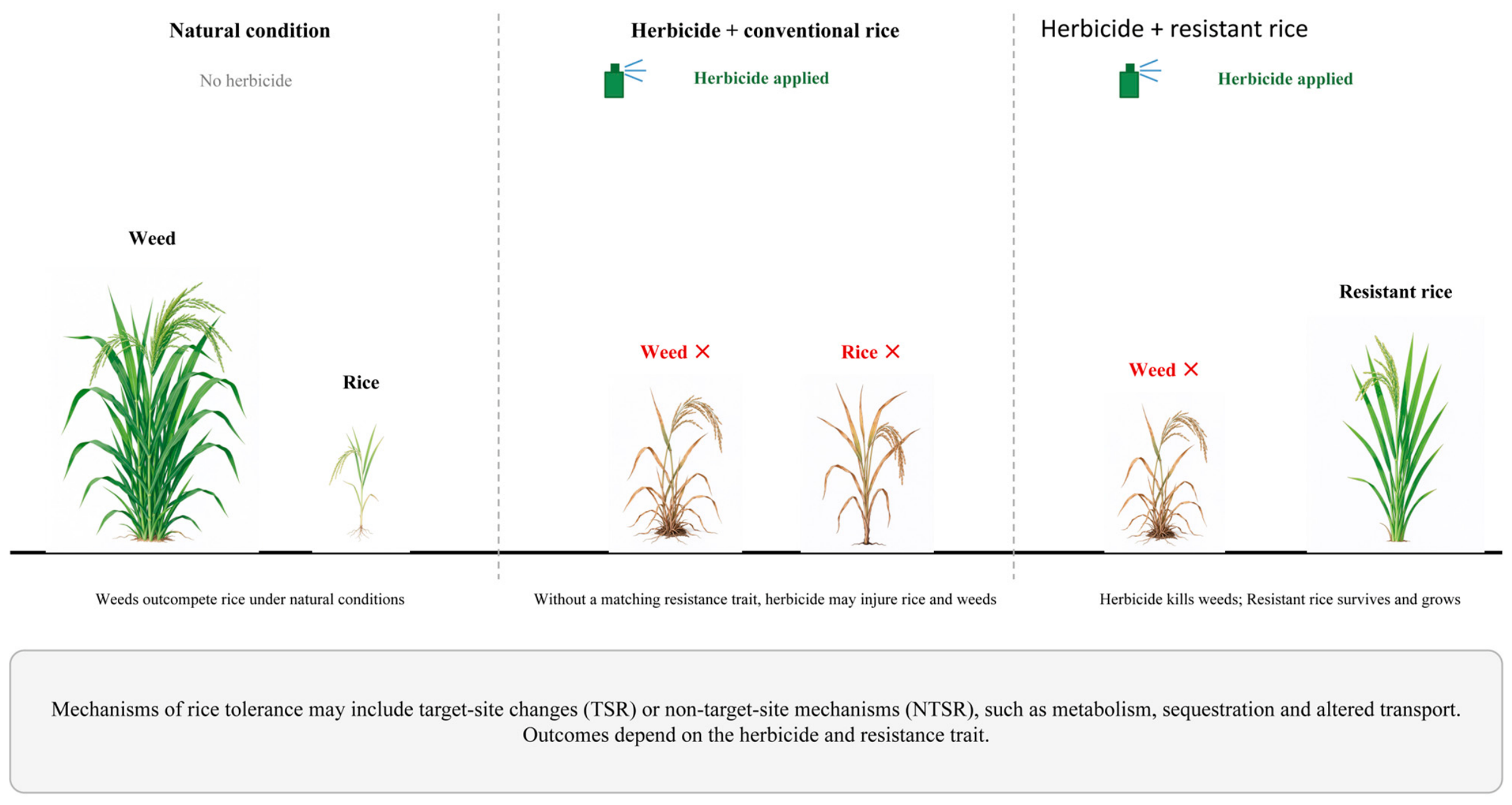
Herbicides remain important for timely weed control in mechanized DSR, but repeated use of one effective mode of action selects for resistant weeds (Figure 1) [15,16]. We searched Web of Science, Scopus, PubMed, Google Scholar, the HRAC mode-of-action classification and the International Herbicide-Resistant Weed Database through 18 November 2026, using combinations of direct-seeded rice, dry/wet/water seeding, rice weeds, herbicide resistance, target-site resistance, non-target-site resistance, metabolism, gene editing and resistance breeding. We prioritized primary studies and authoritative databases, distinguishing DSR field populations from studies in other weeds, rice genotypes and model plants. Herbicide-resistant rice can expand management options [16,17,18], but crop tolerance alone does not prevent resistant weeds, resistant volunteer rice or gene flow into weedy rice. Unlike reviews focused primarily on resistance genes or editing tools, this article evaluates evidence strength and connects resistance mechanisms to DSR establishment conditions, breeding readiness and integrated weed management. Specifically, we (i) compare herbicide target pathways and resistance mechanisms, (ii) distinguish associative from causal evidence, (iii) evaluate herbicide-resistant rice breeding approaches and (iv) prioritize DSR-specific resistance stewardship.
Figure 1.
Conceptual comparison of weed competition and herbicide response in direct-seeded rice. Without herbicide, weeds may outcompete rice during establishment. A herbicide lacking crop selectivity can injure both rice and susceptible weeds, whereas a matching resistance trait may protect rice while susceptible weeds are controlled. Herbicide resistance can involve target-site resistance (TSR) or non-target-site resistance (NTSR), including metabolism, transport, and sequestration; the mechanism depends on the herbicide and rice genotype.
2. Classification and Application of Rice Herbicides
2.1. ACCase-Inhibitor Herbicides
Acetyl-CoA carboxylase (ACCase) catalyzes the carboxylation of acetyl-CoA to malonyl-CoA, a key step in fatty-acid biosynthesis [19,20,21,22,23,24]. Plants may possess plastidic heteromeric ACCase and homomeric ACCase isoforms; the distribution of these forms varies across taxa. The heteromeric enzyme contains biotin carboxylase, biotin carboxyl carrier protein, and carboxyltransferase components that associate as a functional complex rather than being universally linked by covalent bonds. ACCase-inhibiting herbicides primarily act on susceptible homomeric plastidic ACCase in grasses, whereas heteromeric plastidic ACCase is generally insensitive to these herbicides [22,23]. Binding at the carboxyltransferase region inhibits fatty-acid synthesis; membrane disruption and growth arrest are downstream consequences, not the primary binding mechanism.
ACCase-inhibiting herbicides include aryloxyphenoxypropionates (FOPs), cyclohexanediones (DIMs), and phenylpyrazolines (DENs). These families differ in chemical structure and binding interactions but share ACCase as the biochemical target [19,23]. Structure–activity claims concerning individual substitutions require verification against the original chemistry studies; unsupported generalizations about benzene-ring substitutions have been removed. The choice of active ingredient in rice must consider crop selectivity, application timing, registered uses, and resistance status of local grass-weed populations.
2.2. Hormone-Type Herbicides
Hormonal herbicides act through auxin perception and signaling. Representative rice-use examples include the quinolinecarboxylate quinclorac and the aryl picolinate florpyrauxifen-benzyl. Chemical family, active ingredient, crop selectivity, application timing and local resistance status should be specified separately because auxin-like plant growth regulators are not interchangeable with registered herbicides.
Quinclorac is used in rice to control Echinochloa spp. and other grass weeds, and resistant populations have been reported [25]. Florpyrauxifen-benzyl is an aryl picolinate auxin herbicide registered for rice. In a study of Echinochloa crus-galli, treatment induced ethylene biosynthesis, increased abscisic acid, antioxidant responses and malondialdehyde, with the magnitude and timing depending on the tested species and treatment conditions [26,27,28]. These observations describe a tested phytotoxicity response and should not be generalized to every weed or field situation.
2.3. Acetolactate Synthase (ALS)-Inhibiting Herbicides
Acetolactate synthase (ALS; also called acetohydroxyacid synthase) catalyzes early reactions in branched-chain amino acid biosynthesis [29]. ALS inhibitors block production of valine, leucine, and isoleucine, causing growth arrest, particularly in meristematic tissues. The absence of this pathway in animals contributes to biochemical selectivity, but does not by itself demonstrate human safety or environmental benignity. Toxicological profile, persistence, crop injury, and effects on nontarget organisms vary by active ingredient, dose, soil conditions, and use pattern. Sulfonylureas and imidazolinones are among the ALS-inhibiting chemical families relevant to rice systems [30].
2.4. Protoporphyrinogen Oxidase (PPO)-Inhibiting Herbicides
Protoporphyrinogen oxidase (PPO) catalyzes the oxidation of protoporphyrinogen IX to protoporphyrin IX (Proto IX), a shared intermediate in chlorophyll and heme biosynthesis (Table 1). HPPD inhibitors are a separate Group 27 class, represented by mesotrione and bicyclopyrone, and should not be conflated with PPO inhibitors [31]. Proto IX is a substrate for Mg-chelatase and Fe-chelatase, which direct tetrapyrrole metabolism toward chlorophyll and heme, respectively. Plants contain PPO isoforms whose subcellular distribution can vary among species; generalizations concerning PPO1 and PPO2 localization should therefore be made cautiously [32,33]. PPO-inhibiting herbicides block this oxidation step, allowing protoporphyrinogen IX to accumulate and move to other cellular compartments, where it can undergo nonenzymatic oxidation to Proto IX. In illuminated tissues, excess Proto IX acts as a photosensitizer and generates reactive oxygen species, including singlet oxygen, leading to lipid peroxidation, membrane damage and tissue necrosis. Thus, phytotoxicity is associated with light-dependent oxidative damage, not with an inability of Proto IX to serve as a chelatase substrate. The activity, persistence and crop selectivity of individual PPO inhibitors vary with their chemical properties and application conditions [33,34].
2.5. Photosystem II Inhibitors
PSII mediates the transfer of electrons from water to plastoquinone, which further binds to the D1 protein (Table 1). The D1 protein is an essential subunit of the PSII reaction center. It provides binding sites for various co-factors and participates in primary charge separation and electron transport. Inhibition of electron transfer from PSII to PSI suppresses the production of nicotinamide adenine dinucleotide phosphate (NADPH) and ATP. Damage to the D1 protein blocks photosynthetic electron transport, impairs the PSII reaction center, and ultimately causes plant death due to disrupted photosynthesis. Photosystem II-inhibiting herbicides compete with plastoquinone for binding sites on the D1 protein. By binding to the D1 protein, they block electron transfer from the Qa site to the Qβ site, suppress photosynthesis, and eventually kill weeds. Triazine herbicides represent the major group within this class and have been widely applied. As selective, systemic and broad-spectrum herbicides, triazines are absorbed by plant leaves and roots and translocated upward via the xylem. They possess advantages including a broad weed-control spectrum, chemical stability and low cost.
2.6. 5-Enolpyruvylshikimate-3-Phosphate (EPSPS)-Inhibiting Herbicides
5-Enolpyruvylshikimate-3-phosphate synthase (EPSPS) catalyzes the reaction between shikimate-3-phosphate (S3P) and phosphoenolpyruvate (PEP) to form 5-enolpyruvylshikimate-3-phosphate in the shikimate pathway. Glyphosate is competitive with PEP and binds preferentially to the EPSPS-S3P complex, forming a stable inhibitory EPSPS-S3P-glyphosate ternary complex [35]. This interaction blocks aromatic amino acid biosynthesis. Glyphosate is generally absorbed through foliage and translocated to growing tissues, although efficacy depends on species, developmental stage and environment.
2.7. Glutamine Synthetase (GS)-Inhibiting Herbicides
Glutamine synthetase (GS) catalyzes the ATP-dependent incorporation of ammonium into glutamate to form glutamine and is essential for nitrogen assimilation and reassimilation of photorespiratory ammonium. Glufosinate (phosphinothricin) inhibits GS, causing ammonium accumulation, altered amino acid homeostasis, oxidative stress and secondary impairment of photosynthesis [36]. During photorespiration, glyoxylate is converted to glycine by transamination. Glufosinate is predominantly contact-acting, but limited translocation can occur depending on species, application and physiological conditions. Assertions about neurotoxicity, livestock sensitivity, leaching or environmental safety require compound-specific toxicological and exposure evidence.
Table 1.
Representative HRAC/WSSA herbicide groups, biochemical targets, selected active ingredients and DSR considerations.
3. Research Progress on Herbicide Resistance in Weeds
Herbicide-resistant weed populations have evolved through target-site resistance (TSR) and non-target-site resistance (NTSR), often in combination [37,38,39]. Counts of resistant species, active ingredients, and sites of action depend on the database, date accessed, and counting criteria; readers should consult the International Herbicide-Resistant Weed Database (weedscience.org) for dated records rather than treating undated counts as fixed. Evidence from DSR weed populations should be distinguished from the findings in other cropping systems and model plants, especially when drawing management conclusions.
3.1. Target-Site Resistance Mechanism
TSR results from alterations involving the herbicide target itself. Amino acid substitutions may reduce herbicide binding; target-gene amplification can increase gene dosage; and regulatory changes can elevate target expression without changing copy number. These are mechanistically distinct processes and should be reported separately. An observed expression increase does not establish causality without genetic, biochemical, or other functional validation.
3.1.1. Target Enzyme Gene Mutation
Target-site mutations alter the amino acid sequence of the herbicide target and can reduce binding. Examples include ALS, ACCase, PPO and EPSPS substitutions. In EPSPS, single substitutions such as Pro106 or Thr102 generally confer low-level glyphosate resistance, whereas combinations such as T102I + P106S can confer much higher resistance in particular weed populations [44,45,46]. The TAP-IVS combination in Amaranthus palmeri has also been reported [47,48]. The reported fold changes are resistance ratios or LD50-based comparisons from the cited studies, not universal values. In the PDS gene, Leu498Val and Leu498Val + Glu425Asp were associated with diflufenican resistance and cross-resistance to picolinafen in Sisymbrium orientale [55].
3.1.2. Increased Target Enzyme Gene Expression
Increased gene expression is generally caused by mutations in the gene promoter region or elevated gene copy number. Glyphosate resistance in Conyza canadensis collected from the Bohai-Rim Bay and Loess Plateau regions of China, as well as in Eleusine indica from the Dongting Lake and Poyang Lake surrounding areas, is associated with EPSPS gene overexpression [40,49]. Transgenic Arabidopsis thaliana was used as a model plant to investigate the effects of EPSPS gene overexpression on plant growth and reproduction. The results revealed that EPSPS overexpression in Arabidopsis thaliana incurred no fitness cost and might confer benefits under the tested growth conditions [50]. In recent years, a growing number of studies have focused on the expression of target genes at different growth stages or in distinct organs. Overexpression-mediated weed resistance of varying magnitudes has also been observed in target-enzyme genes other than EPSPS. ACCase gene overexpression was documented to confer resistance to cyhalofop-butyl in Echinochloa crus-galli. Resistant plants exhibited 2.0-fold and 2.8-fold overexpression of ACCase1 and ACCase3, respectively [56]. Similarly, enhanced overexpression of the ALS gene was found to confer resistance to pyroxsulam in Bromus sterilis [41]. Subsequently, target-site ALS gene overexpression conferring resistance to the ALS-inhibiting herbicide nicosulfuron was also identified in Digitaria sanguinalis collected from Heilongjiang Province, China. The ALS gene expression level in resistant populations was 2.07-fold higher than that in susceptible populations [42].
EPSPS copy-number increases should be reported as copy-number or relative quantitative differences, not as expression fold changes unless the study measured expression [57,58,59,60,61,62]. In Amaranthus palmeri, copy-number amplification may involve extrachromosomal circular DNA, whereas other weeds show tandem duplication or chromosomal rearrangement [63,64,65,66]. ACCase copy-number changes and increased expression are distinct from metabolic detoxification and require direct evidence before being assigned a metabolic mechanism [67]. In a glufosinate-resistant Amaranthus palmeri accession, GS2 copy-number and expression increases were reported, but their contribution should be interpreted with the study’s resistance phenotype and other mechanisms [51].
3.2. Non-Target-Site Resistance Mechanisms
NTSR encompasses mechanisms that reduce the biologically effective herbicide dose at the target without altering the target enzyme itself, including metabolic conversion, reduced uptake or movement, and sequestration. These mechanisms can confer cross-resistance across chemically distinct herbicides, although the spectrum depends on the substrate specificity and regulation of the underlying genes. Transcript accumulation or association with a resistant population is hypothesis-generating; causal assignment requires functional tests and, where feasible, direct measurements of herbicide disposition.
3.2.1. Detoxification Metabolism of Herbicides
Herbicide metabolism may involve oxidation, reduction, hydrolysis, conjugation, and compartmentation, but these reactions do not always follow a universal three-phase sequence. Some initial transformations may generate metabolites that retain or increase biological activity. Cytochrome P450 monooxygenases, glutathione S-transferases, and aldo-keto reductases are candidate mediators of metabolic resistance, yet their roles must be evaluated for the specific herbicide and weed population using metabolism assays, genetic manipulation, or complementary functional evidence.
A set of specific P450 enzymes belonging to the CYP81 family have been proven to mediate resistance to multiple herbicides in grass weeds. For instance, CYP81A10v7 confers broad-spectrum resistance to herbicides of diverse modes of action, including ALS inhibitors (chlorsulfuron), ACCase inhibitors (diclofop-methyl), HPPD inhibitors (mesotrione), PSII inhibitors (atrazine), and tubulin inhibitors (trifluralin) in Lolium rigidum [43]. CYP81A68 in Echinochloa crus-galli is associated with resistance to ALS- and ACCase-inhibiting herbicides (Table 2) [68]. Transgenic rice overexpressing CYP81Q32 exhibits enhanced tolerance to mesosulfuron-methyl, pyriminobac-methyl and bispyribac-sodium [69]. Six CYP81A family genes (CYP81A12, CYP81A14, CYP81A15, CYP81A18, CYP81A21 and CYP81A24) have been identified in Echinochloa phyllopogon (water barnyardgrass) to possess metabolic functions toward herbicides with diverse modes of action. Among them, CYP81A12 and CYP81A21 are associated with the metabolism and resistance to multiple ALS- and ACCase-inhibiting herbicides, whereas CYP81A15 and CYP81A24 reduce the sensitivity of transgenic Arabidopsis thaliana to clomazone [70,71,72,73]. Apart from P450 enzymes of the CYP81 family, studies have reported that CYP709C69 mediates resistance to diclofop-methyl in Echinochloa phyllopogon. In terms of broadleaf weeds, a set of P450 genes potentially associated with herbicide resistance (CYP77B34, CYP709B8, CYP81F5, CYP96A146 and CYP96A1-47) have been identified in Descurainia sophia populations [74,75]. Among them, both CYP96A146 and CYP77B34 mediate resistance to tribenuron-methyl. Transgenic Arabidopsis thaliana overexpressing CYP96A146 exhibits strong metabolic activity toward carfentrazone-ethyl and oxyfluorfen. Transgenic Arabidopsis thaliana overexpressing CYP77B34 also displays certain metabolic capacity against herbicides belonging to PPO inhibitors (carfentrazone-ethyl and oxyfluorfen), very-long-chain fatty acids (VLCFAs) inhibitors (pretilachlor), and PSII inhibitors (bromoxynil) [76].
Table 2.
Representative weed problems and management options in direct-seeded rice.
GSTs represent a supergene-family-encoded group of metabolic enzymes. They catalyze the conjugation reaction between glutathione (GSH) and herbicide molecules containing alkyl sulfoxide, phenolic or halogen functional groups, degrading primarily metabolized herbicides into more polar and less toxic metabolites, and thereby play a vital role in herbicide metabolism and resistance [79]. GSTs exert direct herbicide-detoxifying effects by catalyzing the conjugation reaction between herbicide molecules and glutathione. Alternatively, they mitigate or protect plants from injury by scavenging various reactive oxygen species generated during herbicide action. In addition, GSTs can respond to abiotic stress by modulating redox-signaling pathways that transcriptionally activate defense-related genes [80]. Recent studies have revealed that overexpression of GSTF1 and GSTU6 is associated with resistance to cyhalofop-butyl in Leptochloa chinensis [77]. Resistance to quizalofop-p-ethyl in Polypogon fugax is linked to the overexpression of GST2c and GSTL3, and overexpression of GSTU3 is related to glyphosate resistance in Eleusine indica [81,82]. Some studies have found that overexpression of GSTF1 is associated with resistance to the 4-hydroxyphenylpyruvate dioxygenase (HPPD)-inhibiting herbicide tripyrasulfone in Leptochloa chinensis [53]. At present, most evidence for GST-mediated herbicide metabolism or resistance is derived from RNA-seq or RT-qPCR assays. Both RNA-seq and RT-qPCR detect gene expression differences in one or multiple genes between susceptible and resistant plants at a given time point. Such differences may result from variations in plant genetic background, growth status, culture conditions, resistance traits, and herbicide treatment effects. Expression differences in GST genes between susceptible and resistant plants can partly indicate the involvement of GSTs in weed herbicide resistance. Nevertheless, further, more direct evidence from genetic transformation and herbicide metabolic assays is required to ultimately confirm the participation of specific GST isoenzymes in herbicide metabolism or resistance.
AKR evidence includes both heterologous functional assays and weed-population studies. Vemanna et al. reported enhanced glyphosate tolerance in plants expressing bacterial or rice AKR genes [83]. Pan et al. identified EcAKR4-1 and EcAKR4-2 in glyphosate-resistant Echinochloa colona and showed higher expression, AKR activity and glyphosate metabolism than in susceptible plants [84]. These results support a functional contribution in that population, while the species, allele and assay context should not be generalized to all Echinochloa or all glyphosate-resistant weeds [85].
3.2.2. Herbicide Sequestration
Herbicide sequestration can reduce the biologically active dose by restricting movement or exporting herbicide and metabolites to the apoplast or vacuole. Vacuolar or cellular sequestration is documented for particular glyphosate-resistant populations, but its prevalence varies among species and mechanisms. In Echinochloa colona, EcABCC8 overexpression in rice, maize and soybean increased glyphosate tolerance, whereas knockout of the endogenous rice ortholog OsABCC8 increased rice sensitivity, supporting a transporter-mediated efflux mechanism [86].
3.2.3. Reduced Herbicide Absorption and Translocation
Reduced uptake or translocation can contribute to resistance for particular herbicide-population combinations. In Amaranthus hybridus, lower uptake and translocation of glyphosate and imazethapyr were measured in the resistant population [87]. Reduced 2,4-D translocation was reported in Sisymbrium orientale [88], and rapid leaf necrosis or restricted movement was reported for 2,4-D in Conyza sumatrensis [89]. These studies do not establish impaired translocation as a mechanism for all auxin analogs.
4. Application of Herbicide-Resistant Genes in Rice Breeding
With the continuous advancement of molecular biology technologies, herbicide-tolerant crop breeding has gradually evolved from natural screening and random mutagenesis to precision design. Three major technical systems have been established: conventional mutation breeding, transgenic breeding and gene-editing breeding. The integrated model of mutation breeding combined with molecular marker-assisted selection and other technologies has become mainstream, driving the upgrading of herbicide-tolerant crop germplasms from single resistance toward multiple-resistance and stacked traits.
4.1. Developing Herbicide-Resistant Rice by Transgenic Technology
Transgenic herbicide-tolerant crops include traits based on CP4-EPSPS, glyphosate acetyltransferases or oxidoreductases, PAT or Bar, and other trait systems. The commercial status and regulatory treatment of a trait depend on crop, country and year, so a global claim that only three commercial traits exist is not supportable. Nontransgenic imidazolinone-tolerant crops produced by mutagenesis should be distinguished from transgenic traits. Transgenic methods can provide strong tolerance but require transformation, event selection, regulatory review and stewardship. Comparisons of time, cost or success rate should be made only with defined evidence.
4.2. Development of Herbicide-Resistant Rice Using Gene Editing Technology
The gene-editing system precisely modifies genes to express specific herbicide-resistance genes or regulate the expression of relevant genes, thereby enhancing plant tolerance to herbicides. To date, remarkable progress has been achieved in developing herbicide-resistant crops using gene-editing technology.
4.2.1. Non-Homologous End Joining and Homology-Directed Repair
Genome editing can create herbicide-tolerance alleles through different DNA-repair or nucleotide-conversion routes. Classical NHEJ commonly generates insertions or deletions, but the intron-targeting CRISPR-Cas9 method reported by Li et al. used paired sgRNAs and a donor template to replace an OsEPSPS exon through NHEJ-mediated targeted replacement. The study obtained the T102I + P106S (TIPS) substitutions at about 2.0% frequency, confirmed the intended sequence and glyphosate-resistant phenotype, and observed transmission to the next generation [90]. This example should be distinguished from HDR, base editing and prime editing. Editing of OsCNGC12 and the OsHPPD 3′ untranslated region concerns different loci and herbicide-response phenotypes [54,91].
In maize (Zea mays), CRISPR/Cas9 and homology-directed repair replaced a ZmEPSPS fragment with a GATIPS sequence containing three amino acid substitutions, rather than disrupting the conserved domain. The edited plants showed enhanced glyphosate tolerance [92]. In rice, targeted OsALS substitutions including W548L and S627I were obtained by gene targeting, and Cas9-VirD2 was used to facilitate HDR in another study [93,94]. These examples illustrate distinct replacement and donor-directed strategies, while HDR efficiency remains context-dependent.
4.2.2. Development of Herbicide-Resistant Rice by Base Editing
Using the rice adenine base editor rBE14, the endogenous rice tubulin gene (OsTubA2, tubulin alpha 2) was targeted. Among the 63 obtained ‘Kitaake’ rice lines, eight lines harbored an A-to-G base substitution in OsTubA2, resulting in an amino acid substitution from Met to Thr at residue 268 (M268T). Further resistance assays demonstrated that rice plants carrying the M268T mutation in OsTubA2 acquired resistance to the herbicides trifluralin and pendimethalin, and this trait was stably inherited in subsequent generations [95]. Multiple crop varieties tolerant to ALS-inhibiting herbicides have been successfully developed using the CBE technology [96,97,98,99,100,101], including wheat (Triticum aestivum), rice, maize, watermelon (Citrullus lanatus), rapeseed (Brassica napus), tomato (Solanum lycopersicum), and potato (Solanum tuberosum) [102,103,104,105]. Targeting GmALS1 and GmALS3 genes in soybean (Glycine max), the cytosine base editor (BE4max-dCas12-SF01) was used to induce C-to-T base substitutions at the P178 site of GmALS1 and the P172 site of GmALS3. The base editor was delivered into the elite soybean cultivar ‘Xudou18’ via Agrobacterium-mediated transformation, generating single mutants ALS1(P178S), ALS3(P172S), and the double mutant ALS1(P178S)/ALS3(P172S), designated as als1, als3, and als1/als3, respectively. Wild-type and als1/als3 plants were treated with different concentrations of the herbicide flucarbazone-sodium. Wild-type plants suffered severe damage under the treatment of twice the recommended field dose. In contrast, the als1/als3 plants showed no significant differences in agronomic traits compared with untreated wild-type plants [106]. Studies have shown that targeted mutation of the DNA sequences encoding Pro-171 (P171) and Gly-628 (G628) of rice ALS using CBE generated a set of mutant lines resistant to ALS-inhibiting herbicides. Among them, four distinct P171 mutants, namely P171S, P171A, P171Y and P171F, exhibited varying levels of resistance after spraying with five ALS-inhibiting herbicides: nicosulfuron, imazapyr, pyrazosulfuron-ethyl, fenpyrazone and bispyribac-sodium (Table 2). When the application rate of bispyribac-sodium increased from 1-fold to 32-fold of the recommended field dose, growth arrest was aggravated in P171S and P171A mutants, whereas P171Y and P171F mutants remained unaffected. In addition, the triple-amino-acid mutant P171F/G628E/G629S displayed high-level resistance to all five tested ALS-inhibiting herbicides. Field trials demonstrated that mutants P171F and P171F/G628E/G629S possessed favorable herbicide resistance under field-rate herbicide application, without any yield penalty (Table 2) [107]. Recent studies have uncovered the potential of TadDE, a high-performance cytosine and dual-base editor derived from TadA-8e. TadDE was employed for base editing of OsALS, and two herbicide-resistance sites, OsALS-R190H and OsALS-G628E/G629S, were validated via herbicide screening [108].
4.2.3. Development of Herbicide-Resistant Rice Using Prime-Editing Technology
Prime editing uses a Cas nickase fused to reverse transcriptase and a pegRNA to encode intended substitutions or short insertions/deletions. For the HIS1 example, the reported system was GRAND editing, which uses paired nickase complexes and complementary reverse-transcription templates to restore the 28 bp sequence deleted in some Indica rice. In the S1035 transformation, nine of 78 RTT-10 T0 plants were herbicide-resistant (11.5%); in MingHui86, 13 of 84 RTT-10 T0 plants were resistant (15.5%). Target-site sequencing identified precise insertions and byproducts, mesotrione treatment provided phenotypic selection, and T-DNA-free homozygous progeny were identified in the T1 generation [109,110]. These percentages refer to resistant T0 plants divided by transformed T0 plants and do not by themselves establish field-level durability (Table 3).
4.2.4. Generation of Herbicide-Resistant Crops by Gene-Editing-Mediated Upregulation
A donor-DNA-free CRISPR/Cas9 study generated a 911 kb inversion that swapped the CP12 promoter onto OsPPO1 and a 338 kb duplication that placed the Ubiquitin2 promoter before OsHPPD. Homozygous structural-variant plants showed tens-fold increases in expression and resistance to flumioxazin and bicyclopyrone in field trials [111]. PrimeRoot is a separate system for precise insertion of large DNA sequences, including an Act1 promoter upstream of OsHPPD [112]. The inversion and duplication should therefore be reported as distinct structural outcomes.
Table 3.
Reported rice gene-editing examples associated with herbicide response. Direct target alterations, metabolic protection and indirect sensitivity changes are separated.
5. Discussion
The evidence reviewed here supports a DSR-specific conclusion. Target-site substitutions are often supported by sequence and functional tests, whereas many proposed non-target-site mechanisms remain based on expression differences. For DSR, a candidate gene matters only when its effect is demonstrated in the relevant weed or rice background and the resulting trait improves control under field conditions.
TSR and NTSR also differ in management implications. A different mode of action may reduce selection for one target-site mutation, but cross-resistance and multiple resistance can limit alternatives. Resistance to 2,4-D and dicamba has been documented in weeds [28,85]. In DSR, mixtures or rotations should be used only when each component is independently effective against the local population, with cultural practices that reduce weed recruitment and seed return.
Breeding value depends on more than editing precision. Functionally validated alleles still require stable inheritance, dose–response data, agronomic evaluation, and assessment of gene flow and regulatory requirements. Plant origin alone does not establish environmental safety or public acceptance.
Herbicide-resistant rice should therefore be deployed within integrated weed management. Clean seed and equipment, competitive establishment, suitable water management, early scouting, removal of escapes, seedbank reduction, and monitoring of weedy rice and volunteers should accompany any resistant cultivar. The priority is to connect molecular evidence with local weed phenotypes and field durability.
Author Contributions
G.L. and T.Z. conceptualized and designed the review. G.L. and B.F. wrote the original draft. T.Z. and L.G. edited and finalized the manuscript. T.Z. and G.L. acquired funding. All authors have read and agreed to the published version of the manuscript.
Funding
This work was supported by Young Scientist Studio Program of SAAS (QNKXJ-PY-004), Natural Science Foundation of Sichuan Pronvice (25NSFSC0332), Key Science and Technology Project of Sichuan Province (2022ZDZX0012-02), Sichuan Rice Innovation Team (SCCXTD-2024-SD-6), the 1+9 Open Competition Project of Sichuan Academy of Agricultural Sciences (1+9KJGG002, 1+9KJGG001), Original Innovation Program of SAAS (YSCX2035-010), and Key Projects of Rice and Sorghum Research Institute 2026SZDLY03).
Data Availability Statement
No new data were generated in association with this article.
Conflicts of Interest
The authors declare no conflicts of interest.
References
- Yu, S.; Ali, J.; Zhang, C.; Li, Z.; Zhang, Q. Genomic Breeding of Green Super Rice Varieties and Their Deployment in Asia and Africa. Theor. Appl. Genet. 2020, 133, 1427–1442. [Google Scholar] [CrossRef] [Scilit] [PubMed]
- Zhang, C.; Zhong, X.; Li, S.; Yan, L.; Li, J.; He, Y.; Lin, Y.; Zhang, Y.; Xia, L. Artificial evolution of OsEPSPS through an improved dual cytosine and adenine base editor generated a novel allele conferring rice glyphosate tolerance. J. Integr. Plant Biol. 2023, 65, 2194–2203. [Google Scholar] [CrossRef] [Scilit] [PubMed]
- Bilal, M.; Geng, J.; Chen, L.; García-Caparros, P.; Hu, T. Genome editing for grass improvement and future agriculture. Hortic. Res. 2024, 12, uhae293. [Google Scholar] [CrossRef] [Scilit] [PubMed]
- Hernández-Soto, A.; Echeverría-Beirute, F.; Abdelnour-Esquivel, A.; Valdez-Melara, M.; Boch, J.; Gatica-Arias, A. Rice breeding in the new era: Comparison of useful agronomic traits. Curr. Plant Biol. 2021, 27, 100211. [Google Scholar] [CrossRef] [Scilit]
- Luo, X.; Wang, Z.; Zeng, S.; Zang, Y.; Yang, W.; Zhang, M. Recent advances in mechanized direct seeding technology for rice. J. South China Agric. Univ. 2019, 40, 1–13. [Google Scholar]
- Lv, Q.; Zhang, X.; Yuan, D.; Huang, Z.; Peng, R.; Peng, J.; Li, Z.; Tang, L.; Liu, D.; Zhou, X.; et al. Exploring Natural Allelic Variations of the β-Triketone Herbicide Resistance Gene HIS1 for Application in indica Rice and Particularly in Two-Line Hybrid Rice. Rice 2021, 14, 7. [Google Scholar] [CrossRef] [Scilit] [PubMed]
- Li, Y.; Liang, J.; Deng, B.; Jiang, Y.; Zhu, J.; Chen, L.; Li, M.; Li, J. Applications and Prospects of CRISPR/Cas9-Mediated Base Editing in Plant Breeding. Curr. Issues Mol. Biol. 2023, 45, 918–935. [Google Scholar] [CrossRef] [Scilit] [PubMed]
- Sony, S.K.; Kaul, T.; Motelb, K.F.A.; Thangaraj, A.; Bharti, J.; Kaul, R.; Verma, R.; Nehra, M. CRISPR/Cas9-mediated homology donor repair base editing confers glyphosate resistance to rice (Oryza sativa L.). Front. Plant Sci. 2023, 14, 1122926. [Google Scholar] [CrossRef] [Scilit] [PubMed]
- Iwasa, M.; Chigira, K.; Nomura, T.; Adachi, S.; Asami, H.; Nakamura, T.; Motobayashi, T.; Ookawa, T. Identification of Genomic Regions for Deep-Water Resistance in Rice for Efficient Weed Control with Reduced Herbicide Use. Rice 2023, 16, 53. [Google Scholar] [CrossRef] [Scilit] [PubMed]
- Ren, B.; Kuang, Y.; Xu, Z.; Wu, X.; Zhang, D.; Yan, F.; Li, X.; Zhou, X.; Wang, G.; Zhou, H. Three novel alleles of OsGS1 developed by base-editing-mediated artificial evolution confer glufosinate tolerance in rice. Crop J. 2023, 11, 661–665. [Google Scholar] [CrossRef] [Scilit]
- Nath, C.P.; Singh, R.G.; Choudhary, V.K.; Datta, D.; Nandan, R.; Singh, S.S. Challenges and Alternatives of Herbicide-Based Weed Management. Agronomy 2024, 14, 126. [Google Scholar] [CrossRef] [Scilit]
- Heredia, M.C.; Kant, J.; Prodhan, M.A.; Dixit, S.; Wissuwa, M. Breeding rice for a changing climate by improving adaptations to water saving technologies. Theor. Appl. Genet. 2021, 135, 17–33. [Google Scholar] [CrossRef] [Scilit] [PubMed]
- Luo, Q.; Liu, Y.-G. Breeding herbicide-resistant rice using CRISPR-Cas gene editing and other technologies. Plant Commun. 2024, 6, 101172. [Google Scholar] [CrossRef] [Scilit] [PubMed]
- Shrestha, S.; Sharma, G.; Burgos, N.R.; Tseng, T.-M. Competitive ability of weedy rice: Toward breeding weed-suppressive rice cultivars. J. Crop Improv. 2020, 34, 455–469. [Google Scholar] [CrossRef] [Scilit]
- Hulme, P.E. Weed resistance to different herbicide modes of action is driven by agricultural intensification. Field Crop. Res. 2023, 292, 108819. [Google Scholar] [CrossRef] [Scilit]
- Jin, M.; Chen, L.; Deng, X.W.; Tang, X. Development of herbicide resistance genes and their application in rice. Crop J. 2022, 10, 26–35. [Google Scholar] [CrossRef] [Scilit]
- Huang, Y.; Dong, H.; Shang, M.; Wang, K. CRISPR/Cas systems: The link between functional genes and genetic improvement. Crop J. 2021, 9, 678–687. [Google Scholar] [CrossRef] [Scilit]
- Ren, Y.; Liu, B.; Jiang, H.; Cheng, W.; Tao, L.; Wu, K.; Wang, H.; Shen, G.; Fang, Y.; Zhang, C.; et al. Precision editing of GLR1 confers glufosinate resistance without yield penalty in rice. Plant Biotechnol. J. 2023, 21, 2417–2419. [Google Scholar] [CrossRef] [Scilit] [PubMed]
- Sasaki, Y.; Nagano, Y. Plant acetyl-CoA carboxylase: Structure, biosynthesis, regulation, and gene manipulation for plant breeding. Biosci. Biotechnol. Biochem. 2004, 68, 1175–1184. [Google Scholar] [CrossRef] [Scilit] [PubMed]
- Herbert, D.; Price, L.J.; Alban, C.; Dehaye, L.; Job, D.; Cole, D.J.; Pallett, K.E.; Harwood, J.L. Kinetic studies on two isoforms of acetyl-CoA carboxylase from maize leaves. Biochem. J. 1996, 318, 997–1006. [Google Scholar] [CrossRef] [Scilit] [PubMed]
- Kozaki, A.; Mayumi, K.; Sasaki, Y. Thiol-disulfide exchange between nuclear-encoded and chloroplast-encoded subunits of pea acetyl-CoA carboxylase. J. Biol. Chem. 2001, 276, 39919–39925. [Google Scholar] [CrossRef] [Scilit] [PubMed]
- Tang, W.; Zhou, F.; Chen, J.; Zhou, X. Resistance to ACCase-inhibiting herbicides in an Asia minor bluegrass (Polypogon fugax) population in China. Pestic. Biochem. Physiol. 2014, 108, 16–20. [Google Scholar] [CrossRef] [Scilit] [PubMed]
- Zhang, H.; Tweel, B.; Tong, L. Molecular basis for the inhibition of the carboxyltransferase domain of acetyl-coenzyme-A carboxylase by haloxyfop and diclofop. Proc. Natl. Acad. Sci. USA 2004, 101, 5910–5915. [Google Scholar] [CrossRef] [Scilit] [PubMed]
- Nikolau, B.J.; Ohlrogge, J.B.; Wurtele, E.S. Plant biotin-containing carboxylases. Arch. Biochem. Biophys. 2003, 414, 211–222. [Google Scholar] [CrossRef] [Scilit] [PubMed]
- Rangani, G.; Rouse, C.E.; Saski, C.; Noorai, R.E.; Shankar, V.; Lawton-Rauh, A.L.; Werle, I.S.; Roma-Burgos, N. High Resistance to Quinclorac in Multiple-Resistant Echinochloa colona Associated with Elevated Stress Tolerance Gene Expression and Enriched Xenobiotic Detoxification Pathway. Genes 2022, 13, 515. [Google Scholar] [CrossRef] [Scilit] [PubMed]
- Grossmann, K. Auxin herbicides: Current status of mechanism and mode of action. Pest Manag. Sci. 2009, 66, 113–120. [Google Scholar] [CrossRef] [Scilit] [PubMed]
- Wang, H.; Sun, X.; Yu, J.; Li, J.; Dong, L. The phytotoxicity mechanism of florpyrauxifen-benzyl to Echinochloa crus-galli (L.) P. Beauv and weed control effect. Pestic. Biochem. Physiol. 2021, 179, 104978. [Google Scholar] [CrossRef] [Scilit] [PubMed]
- Cranston, H.J.; Kern, A.J.; Hackett, J.L.; Miller, E.K.; Maxwell, B.D.; Dyer, W.E. Dicamba resistance in kochia. Weed Sci. 2001, 49, 164–170. [Google Scholar] [CrossRef] [Scilit]
- Liu, Y.; Li, Y.; Wang, X. Acetohydroxyacid synthases: Evolution, structure, and function. Appl. Microbiol. Biotechnol. 2016, 100, 8633–8649. [Google Scholar] [CrossRef] [Scilit] [PubMed]
- Akbar, N.; Jabran, K.; Ali, M.A. Weed management improves yield and quality of direct seeded rice. Aust. J. Crop Sci. 2011, 5, 688–694. [Google Scholar]
- Mitchell, G.; Bartlett, D.W.; Fraser, T.E.M.; Hawkes, T.R.; Holt, D.C.; Townson, J.K.; Wichert, R.A. Mesotrione: A new selective herbicide for use in maize. Pest Manag. Sci. 2001, 57, 120–128. [Google Scholar] [CrossRef] [Scilit] [PubMed]
- Shende, V.V.; Bauman, K.D.; Moore, B.S. The shikimate pathway: Gateway to metabolic diversity. Nat. Prod. Rep. 2024, 41, 604–648. [Google Scholar] [CrossRef] [Scilit] [PubMed]
- Salas, R.A.; Burgos, N.R.; Tranel, P.J.; Singh, S.; Glasgow, L.; Scott, R.C.; Nichols, R.L. Resistance to PPO-inhibiting herbicide in Palmer amaranth from Arkansas. Pest Manag. Sci. 2016, 72, 864–869. [Google Scholar] [CrossRef] [Scilit] [PubMed]
- Hao, G.-F.; Zuo, Y.; Yang, S.-G.; Yang, G.-F. Protoporphyrinogen oxidase inhibitor: An ideal target for herbicide discovery. Chimia 2011, 65, 961–969. [Google Scholar] [CrossRef] [Scilit] [PubMed]
- Schönbrunn, E.; Eschenburg, S.; Shuttleworth, W.A.; Schloss, J.V.; Amrhein, N.; Evans, J.N.S.; Kabsch, W. Interaction of the herbicide glyphosate with its target enzyme 5-enolpyruvylshikimate 3-phosphate synthase in atomic detail. Proc. Natl. Acad. Sci. USA 2001, 98, 1376–1380. [Google Scholar] [CrossRef] [Scilit] [PubMed]
- Takano, H.K.; Beffa, R.; Preston, C.; Westra, P.; Dayan, F.E. Reactive oxygen species trigger the fast action of glufosinate. Planta 2019, 249, 1837–1849. [Google Scholar] [CrossRef] [Scilit] [PubMed]
- Délye, C. Unravelling the genetic bases of non-target-site-based resistance (NTSR) to herbicides: A major challenge for weed science in the forthcoming decade. Pest Manag. Sci. 2012, 69, 176–187. [Google Scholar] [CrossRef] [Scilit] [PubMed]
- Deng, W.; Yang, Q.; Chen, Y.; Yang, M.; Xia, Z.; Zhu, J.; Chen, Y.; Cai, J.; Yuan, S. Cyhalofop-butyl and Glyphosate Multiple-Herbicide Resistance Evolved in an Eleusine indica Population Collected in Chinese Direct-Seeding Rice. J. Agric. Food Chem. 2020, 68, 2623–2630. [Google Scholar] [CrossRef] [Scilit] [PubMed]
- Murphy, B.P.; Tranel, P.J. Target-Site Mutations Conferring Herbicide Resistance. Plants 2019, 8, 382. [Google Scholar] [CrossRef] [Scilit] [PubMed]
- Xu, Y.; Xu, L.; Li, X.; Zheng, M. Investigation of resistant level to tribenuron-methyl, diversity and regional difference of the resistant mutations on acetolactate synthase (ALS) isozymes in Descurainia sophia L. from China. Pestic. Biochem. Physiol. 2020, 169, 104653. [Google Scholar] [CrossRef] [Scilit] [PubMed]
- Sen, M.K.; Hamouzová, K.; Mikulka, J.; Bharati, R.; Košnarová, P.; Hamouz, P.; Roy, A.; Soukup, J. Enhanced metabolism and target gene overexpression confer resistance against acetolactate synthase-inhibiting herbicides in Bromus sterilis. Pest Manag. Sci. 2020, 77, 2122–2128. [Google Scholar] [CrossRef] [Scilit]
- Wang, R.; Sun, Y.; Lan, Y.; Wei, S.; Huang, H.; Li, X.; Huang, Z. ALS gene overexpression and enhanced metabolism conferring Digitaria sanguinalis resistance to nicosulfuron in China. Front. Plant Sci. 2023, 14, 1290600. [Google Scholar] [CrossRef] [Scilit] [PubMed]
- Han, H.; Yu, Q.; Beffa, R.; González, S.; Maiwald, F.; Wang, J.; Powles, S.B. Cytochrome P450 CYP81A10v7 in Lolium rigidum confers metabolic resistance to herbicides across at least five modes of action. Plant J. 2020, 105, 79–92. [Google Scholar] [CrossRef] [Scilit] [PubMed]
- Deng, W.; Duan, Z.; Li, Y.; Peng, C.; Yuan, S. Multiple Resistance Mechanisms Involved in Glyphosate Resistance in Eleusine indica. Plants 2022, 11, 3199. [Google Scholar] [CrossRef] [Scilit] [PubMed]
- Ngo, T.D.; Krishnan, M.; Boutsalis, P.; Gill, G.; Preston, C. Target-site mutations conferring resistance to glyphosate in feathertop Rhodes grass (Chloris virgata) populations in Australia. Pest Manag. Sci. 2017, 74, 1094–1100. [Google Scholar] [CrossRef] [Scilit] [PubMed]
- Yu, Q.; Jalaludin, A.; Han, H.; Chen, M.; Sammons, R.D.; Powles, S.B. Evolution of a double amino acid substitution in EPSPS in Eleusine indica conferring high-level glyphosate resistance. Plant Physiol. 2015, 167, 1440–1447. [Google Scholar] [CrossRef] [Scilit]
- Perotti, V.E.; Larran, A.S.; Palmieri, V.E.; Martinatto, A.K.; Alvarez, C.E.; Tuesca, D.; Permingeat, H.R. A novel triple amino acid substitution in the EPSPS found in a high-level glyphosate-resistant Amaranthus hybridus population from Argentina. Pest Manag. Sci. 2018, 75, 1242–1251. [Google Scholar] [CrossRef] [Scilit] [PubMed]
- Takano, H.K.; Fernandes, V.N.; Adegas, F.S.; Oliveira, R.S., Jr.; Westra, P.; Gaines, T.A.; Dayan, F.E. A novel TIPT double mutation in EPSPS conferring glyphosate resistance in tetraploid Bidens subalternans. Pest Manag. Sci. 2020, 76, 95–102. [Google Scholar] [CrossRef] [Scilit]
- Mei, Y.; Xu, Y.; Wang, S.; Qiu, L.; Zheng, M. Investigation of glyphosate resistance levels and target-site based resistance (TSR) mechanisms in Conyza canadensis (L.) from apple orchards around areas of Bohai seas and Loess Plateau in China. Pestic. Biochem. Physiol. 2018, 146, 7–12. [Google Scholar] [CrossRef] [Scilit] [PubMed]
- Beres, Z.T.; Yang, X.; Jin, L.; Zhao, W.; Mackey, D.M.; Snow, A.A. Overexpression of a Native Gene Encoding 5-Enolpyruvylshikimate-3-Phosphate Synthase (EPSPS) May Enhance Fecundity in Arabidopsis thaliana in the Absence of Glyphosate. Int. J. Plant Sci. 2018, 179, 390–401. [Google Scholar] [CrossRef] [Scilit]
- Carvalho-Moore, P.; Norsworthy, J.K.; González-Torralva, F.; Hwang, J.-I.; Patel, J.D.; Barber, L.T.; Butts, T.R.; McElroy, J.S. Unraveling the mechanism of resistance in a glufosinate-resistant Palmer amaranth (Amaranthus palmeri) accession. Weed Sci. 2022, 70, 370–379. [Google Scholar] [CrossRef] [Scilit]
- Cui, Y.; Liu, Z.; Li, Y.; Zhou, F.; Chen, H.; Lin, Y. Application of a novel phosphinothricin N-acetyltransferase (RePAT) gene in developing glufosinate-resistant rice. Sci. Rep. 2016, 6, 21259. [Google Scholar] [CrossRef] [Scilit] [PubMed]
- Ju, B.; Liu, M.; Fang, Y.; Liu, L.; Pan, L. First Report on Resistance to HPPD Herbicides Mediated by Nontarget-Site Mechanisms in the Grass Leptochloa chinensis. J. Agric. Food Chem. 2023, 71, 17669–17677. [Google Scholar] [CrossRef] [Scilit]
- Wu, Y.; Xiao, N.; Cai, Y.; Yang, Q.; Yu, L.; Chen, Z.; Shi, W.; Liu, J.; Pan, C.; Li, Y.; et al. CRISPR-Cas9-mediated editing of the OsHPPD 3′ UTR confers enhanced resistance to HPPD-inhibiting herbicides in rice. Plant Commun. 2023, 4, 100605. [Google Scholar] [CrossRef] [Scilit]
- Dang, H.T.; Malone, J.M.; Gill, G.; Preston, C. Cross-resistance to diflufenican and picolinafen and its inheritance in oriental mustard (Sisymbrium orientale L.). Pest Manag. Sci. 2018, 75, 195–203. [Google Scholar] [CrossRef] [Scilit] [PubMed]
- González-Torralva, F.; Norsworthy, J.K. Overexpression of Acetyl CoA Carboxylase 1 and 3 (ACCase1 and ACCase3), and CYP81A21 were related to cyhalofop resistance in a barnyardgrass accession from Arkansas. Plant Signal. Behav. 2023, 18, 2172517. [Google Scholar] [CrossRef] [Scilit] [PubMed]
- Gaines, T.A.; Zhang, W.; Wang, D.; Bukun, B.; Chisholm, S.T.; Shaner, D.; Nissen, S.J.; Patzoldt, W.L.; Tranel, P.; Culpepper, A.S.; et al. Gene amplification confers glyphosate resistance in Amaranthus palmeri. Proc. Natl. Acad. Sci. USA 2010, 107, 1029–1034. [Google Scholar] [CrossRef] [Scilit]
- Cockerton, H.M.; Kaundun, S.S.; Nguyen, L.; Hutchings, S.J.; Dale, R.P.; Howell, A.; Neve, P. Fitness Cost Associated with Enhanced EPSPS Gene Copy Number and Glyphosate Resistance in an Amaranthus tuberculatus Population. Front. Plant Sci. 2021, 12, 651381. [Google Scholar] [CrossRef] [Scilit]
- Ngo, T.D.; Malone, J.M.; Boutsalis, P.; Gill, G.; Preston, C. EPSPS gene amplification conferring resistance to glyphosate in windmill grass (Chloris truncata) in Australia. Pest Manag. Sci. 2017, 74, 1101–1108. [Google Scholar] [CrossRef] [Scilit]
- Salas, R.A.; Dayan, F.E.; Pan, Z.; Watson, S.B.; Dickson, J.W.; Scott, R.C.; Burgos, N.R. EPSPS gene amplification in glyphosate-resistant Italian ryegrass (Lolium perenne ssp. multiflorum) from Arkansas. Pest Manag. Sci. 2012, 68, 1223–1230. [Google Scholar] [CrossRef] [Scilit] [PubMed]
- Yanniccari, M.; Palma-Bautista, C.; Vázquez-García, J.G.; Gigón, R.; Mallory-Smith, C.A.; De Prado, R. Constitutive overexpression of EPSPS by gene duplication is involved in glyphosate resistance in Salsola tragus. Pest Manag. Sci. 2022, 79, 1062–1068. [Google Scholar] [CrossRef] [Scilit] [PubMed]
- Dillon, A.; Varanasi, V.K.; Danilova, T.V.; Koo, D.-H.; Nakka, S.; Peterson, D.E.; Tranel, P.J.; Friebe, B.; Gill, B.S.; Jugulam, M. Physical Mapping of Amplified Copies of the 5-Enolpyruvylshikimate-3-Phosphate Synthase Gene in Glyphosate-Resistant Amaranthus tuberculatus. Plant Physiol. 2016, 173, 1226–1234. [Google Scholar] [CrossRef] [Scilit]
- Koo, D.-H.; Molin, W.T.; Saski, C.A.; Jiang, J.; Putta, K.; Jugulam, M.; Friebe, B.; Gill, B.S. Extrachromosomal circular DNA-based amplification and transmission of herbicide resistance in crop weed Amaranthus palmeri. Proc. Natl. Acad. Sci. USA 2018, 115, 3332–3337. [Google Scholar] [CrossRef] [Scilit] [PubMed]
- Kreiner, J.M.; Giacomini, D.A.; Bemm, F.; Waithaka, B.; Regalado, J.; Lanz, C.; Hildebrandt, J.; Sikkema, P.H.; Tranel, P.J.; Weigel, D.; et al. Multiple modes of convergent adaptation in the spread of glyphosate-resistant Amaranthus tuberculatus. Proc. Natl. Acad. Sci. USA 2019, 116, 21076–21084. [Google Scholar] [CrossRef] [Scilit] [PubMed]
- Patterson, E.L.; Saski, C.A.; Sloan, D.B.; Tranel, P.J.; Westra, P.; Gaines, T.A. The Draft Genome of Kochia scoparia and the Mechanism of Glyphosate Resistance via Transposon-Mediated EPSPS Tandem Gene Duplication. Genome Biol. Evol. 2019, 11, 2927–2940. [Google Scholar] [CrossRef] [Scilit] [PubMed]
- Zhang, C.; Johnson, N.A.; Hall, N.; Tian, X.; Yu, Q.; Patterson, E.L. Subtelomeric 5-enolpyruvylshikimate-3-phosphate synthase copy number variation confers glyphosate resistance in Eleusine indica. Nat. Commun. 2023, 14, 4865. [Google Scholar] [CrossRef] [Scilit] [PubMed]
- Laforest, M.; Soufiane, B.; Simard, M.; Obeid, K.; Page, E.; Nurse, R.E. Acetyl-CoA carboxylase overexpression in herbicide-resistant large crabgrass (Digitaria sanguinalis). Pest Manag. Sci. 2017, 73, 2227–2235. [Google Scholar] [CrossRef] [Scilit] [PubMed]
- Pan, L.; Guo, Q.; Wang, J.; Shi, L.; Yang, X.; Zhou, Y.; Yu, Q.; Bai, L. CYP81A68 confers metabolic resistance to ALS and ACCase-inhibiting herbicides and its epigenetic regulation in Echinochloa crus-galli. J. Hazard. Mater. 2022, 428, 128225. [Google Scholar] [CrossRef] [Scilit] [PubMed]
- Wang, J.; Lian, L.; Qi, J.; Fang, Y.; Nyporko, A.; Yu, Q.; Bai, L.; Pan, L. Metabolic resistance to acetolactate synthase inhibitors in Beckmannia syzigachne: Identification of CYP81Q32 and its transcription regulation. Plant J. 2023, 115, 317–334. [Google Scholar] [CrossRef] [Scilit] [PubMed]
- Iwakami, S.; Endo, M.; Saika, H.; Okuno, J.; Nakamura, N.; Yokoyama, M.; Watanabe, H.; Toki, S.; Uchino, A.; Inamura, T. Cytochrome P450 CYP81A12 and CYP81A21 Are Associated with Resistance to Two Acetolactate Synthase Inhibitors in Echinochloa phyllopogon. Plant Physiol. 2014, 165, 618–629. [Google Scholar] [CrossRef] [Scilit] [PubMed]
- Guo, F.; Iwakami, S.; Yamaguchi, T.; Uchino, A.; Sunohara, Y.; Matsumoto, H. Role of CYP81A cytochrome P450s in clomazone metabolism in Echinochloa phyllopogon. Plant Sci. 2019, 283, 321–328. [Google Scholar] [CrossRef] [Scilit] [PubMed]
- Iwakami, S.; Kamidate, Y.; Yamaguchi, T.; Ishizaka, M.; Endo, M.; Suda, H.; Nagai, K.; Sunohara, Y.; Toki, S.; Uchino, A.; et al. CYP81A P450s are involved in concomitant cross-resistance to acetolactate synthase and acetyl-CoA carboxylase herbicides in Echinochloa phyllopogon. New Phytol. 2018, 221, 2112–2122. [Google Scholar] [CrossRef] [Scilit] [PubMed]
- Ha, W.; Yamaguchi, T.; Iwakami, S.; Sunohara, Y.; Matsumoto, H. Comparison of herbicide specificity of CYP81A cytochrome P450s from rice and a multiple-herbicide resistant weed, Echinochloa phyllopogon. Pest Manag. Sci. 2022, 78, 4207–4216. [Google Scholar] [CrossRef] [Scilit] [PubMed]
- Yang, Q.; Li, J.; Shen, J.; Xu, Y.; Liu, H.; Deng, W.; Li, X.; Zheng, M. Metabolic Resistance to Acetolactate Synthase Inhibiting Herbicide Tribenuron-Methyl in Descurainia sophia L. Mediated by Cytochrome P450 Enzymes. J. Agric. Food Chem. 2018, 66, 4319–4327. [Google Scholar] [CrossRef] [Scilit] [PubMed]
- Suda, H.; Kubo, T.; Yoshimoto, Y.; Tanaka, K.; Tanaka, S.; Uchino, A.; Azuma, S.; Hattori, M.; Yamaguchi, T.; Miyashita, M.; et al. Transcriptionally linked simultaneous overexpression of P450 genes for broad-spectrum herbicide resistance. Plant Physiol. 2023, 192, 3017–3029. [Google Scholar] [CrossRef] [Scilit] [PubMed]
- Shen, J.; Yang, Q.; Hao, L.; Zhang, L.; Li, X.; Zheng, M. The Metabolism of a Novel Cytochrome P450 (CYP77B34) in Tribenuron-Methyl-Resistant Descurainia sophia L. to Herbicides with Different Mode of Actions. Int. J. Mol. Sci. 2022, 23, 5812. [Google Scholar] [CrossRef] [Scilit] [PubMed]
- Zhang, Y.; Chen, L.; Song, W.; Cang, T.; Xu, M.; Wu, C. Diverse mechanisms associated with cyhalofop-butyl resistance in Chinese sprangletop (Leptochloa chinensis (L.) Nees): Characterization of target-site mutations and metabolic resistance-related genes in two resistant populations. Front. Plant Sci. 2022, 13, 990085. [Google Scholar] [CrossRef] [Scilit] [PubMed]
- Komatsu, A.; Ohtake, M.; Shimatani, Z.; Nishida, K. Production of Herbicide-Sensitive Strain to Prevent Volunteer Rice Infestation Using a CRISPR-Cas9 Cytidine Deaminase Fusion. Front. Plant Sci. 2020, 11, 925. [Google Scholar] [CrossRef] [Scilit] [PubMed]
- Roxas, V.P.; Smith, R.K.; Allen, E.R.; Allen, R.D. Overexpression of glutathione S-transferase/glutathioneperoxidase enhances the growth of transgenic tobacco seedlings during stress. Nat. Biotechnol. 1997, 15, 988–991. [Google Scholar] [CrossRef] [Scilit] [PubMed]
- Hu, T.; Qv, X.; Xiao, G.; Huang, X. Enhanced tolerance to herbicide of rice plants by over-expression of a glutathione S-transferase. Mol. Breed. 2009, 24, 409–418. [Google Scholar] [CrossRef] [Scilit]
- Chen, W.; Wu, L.; Wang, J.; Yu, Q.; Bai, L.; Pan, L. Quizalofop-p-ethyl resistance in Polypogon fugax involves glutathione S-transferases. Pest Manag. Sci. 2020, 76, 3800–3805. [Google Scholar] [CrossRef] [Scilit] [PubMed]
- He, S.; Liu, M.; Chen, W.; Bai, D.; Liao, Y.; Bai, L.; Pan, L. Eleusine indica Cytochrome P450 and Glutathione S-Transferase Are Linked to High-Level Resistance to Glufosinate. J. Agric. Food Chem. 2023, 71, 14243–14250. [Google Scholar] [CrossRef] [Scilit] [PubMed]
- Vemanna, R.S.; Vennapusa, A.R.; Easwaran, M.; Chandrashekar, B.K.; Rao, H.; Ghanti, K.; Sudhakar, C.; Mysore, K.S.; Makarla, U. Aldo-keto reductase enzymes detoxify glyphosate and improve herbicide resistance in plants. Plant Biotechnol. J. 2017, 15, 794–804. [Google Scholar] [CrossRef] [Scilit] [PubMed]
- Pan, L.; Yu, Q.; Han, H.; Mao, L.; Nyporko, A.; Fan, L.; Bai, L.; Powles, S. Aldo-keto Reductase Metabolizes Glyphosate and Confers Glyphosate Resistance in Echinochloa colona. Plant Physiol. 2019, 181, 1519–1534. [Google Scholar] [CrossRef] [Scilit] [PubMed]
- Li, H.; Yang, Y.; Hu, Y.; Chen, C.-C.; Huang, J.-W.; Min, J.; Dai, L.; Guo, R.-T. Structural analysis and engineering of aldo-keto reductase from glyphosate-resistant Echinochloa colona. J. Hazard. Mater. 2022, 436, 129191. [Google Scholar] [CrossRef] [Scilit] [PubMed]
- Pan, L.; Yu, Q.; Wang, J.; Han, H.; Mao, L.; Nyporko, A.; Maguza, A.; Fan, L.; Bai, L.; Powles, S. An ABCC-type transporter endowing glyphosate resistance in plants. Proc. Natl. Acad. Sci. USA 2021, 118, e2100136118. [Google Scholar] [CrossRef] [Scilit] [PubMed]
- Nalin, D.; Munhoz-Garcia, G.V.; Witter, A.P.W.; Takeshita, V.; de Oliveira, C.; Adegas, F.S.; Tornisielo, V.L.; Junior, R.S.D.O.; Constantin, J. Absorption, Translocation, and Metabolism of Glyphosate and Imazethapyr in Smooth Pigweed with Multiple Resistance. Agronomy 2023, 13, 1720. [Google Scholar] [CrossRef] [Scilit]
- Dang, H.T.; Malone, J.M.; Boutsalis, P.; Krishnan, M.; Gill, G.; Preston, C. Reduced translocation in 2,4-D-resistant oriental mustard populations (Sisymbrium orientale L.) from Australia. Pest Manag. Sci. 2018, 74, 1524–1532. [Google Scholar] [CrossRef] [Scilit] [PubMed]
- Souza, A.D.S.; Leal, J.F.L.; Montgomery, J.S.; Ortiz, M.F.; Araujo, A.L.S.; Morran, S.; de Figueiredo, M.R.A.; Langaro, A.C.; Zobiole, L.H.S.; Nissen, S.J.; et al. Nontarget-site resistance due to rapid physiological response in 2,4-D resistant Conyza sumatrensis: Reduced 2,4-D translocation and auxin-induced gene expression. Pest Manag. Sci. 2023, 79, 3581–3592. [Google Scholar] [CrossRef] [Scilit] [PubMed]
- Li, J.; Meng, X.; Zong, Y.; Chen, K.; Zhang, H.; Liu, J.; Li, J.; Gao, C. Gene replacements and insertions in rice by intron targeting using CRISPR–Cas9. Nat. Plants 2016, 2, 16139. [Google Scholar] [CrossRef] [Scilit] [PubMed]
- Guo, Y.; Xu, X.; Lin, J.; Li, H.; Guo, W.; Wan, S.; Chen, Z.; Xu, H.; Lin, F. The herbicide bensulfuron-methyl inhibits rice seedling development by blocking calcium ion flux in the OsCNGC12 channel. Plant J. 2023, 116, 1218–1233. [Google Scholar] [CrossRef] [Scilit] [PubMed]
- Kaul, T.; Thangaraj, A.; Jain, R.; Bharti, J.; Kaul, R.; Verma, R.; Sony, S.K.; Motelb, K.F.A.; Yadav, P.; Agrawal, P.K. CRISPR/Cas9-mediated homology donor repair base editing system to confer herbicide resistance in maize (Zea mays L.). Plant Physiol. Biochem. 2024, 207, 108374. [Google Scholar] [CrossRef] [Scilit] [PubMed]
- Endo, M.; Mikami, M.; Toki, S. Biallelic Gene Targeting in Rice. Plant Physiol. 2015, 170, 667–677. [Google Scholar] [CrossRef] [Scilit] [PubMed]
- Ali, Z.; Shami, A.; Sedeek, K.; Kamel, R.; Alhabsi, A.; Tehseen, M.; Hassan, N.; Butt, H.; Kababji, A.; Hamdan, S.M.; et al. Fusion of the Cas9 endonuclease and the VirD2 relaxase facilitates homology-directed repair for precise genome engineering in rice. Commun. Biol. 2020, 3, 44. [Google Scholar] [CrossRef] [Scilit]
- Liu, L.; Kuang, Y.; Yan, F.; Li, S.; Ren, B.; Gosavi, G.; Spetz, C.; Li, X.; Wang, X.; Zhou, X.; et al. Developing a novel artificial rice germplasm for dinitroaniline herbicide resistance by base editing of OsTubA2. Plant Biotechnol. J. 2020, 19, 5–7. [Google Scholar] [CrossRef] [Scilit] [PubMed]
- Shimatani, Z.; Kashojiya, S.; Takayama, M.; Terada, R.; Arazoe, T.; Ishii, H.; Teramura, H.; Yamamoto, T.; Komatsu, H.; Miura, K.; et al. Targeted base editing in rice and tomato using a CRISPR-Cas9 cytidine deaminase fusion. Nat. Biotechnol. 2017, 35, 441–443. [Google Scholar] [CrossRef] [Scilit] [PubMed]
- Shimatani, Z.; Fujikura, U.; Ishii, H.; Terada, R.; Nishida, K.; Kondo, A. Herbicide tolerance-assisted multiplex targeted nucleotide substitution in rice. Data Brief. 2018, 20, 1325–1331. [Google Scholar] [CrossRef] [Scilit] [PubMed]
- Tian, S.; Jiang, L.; Cui, X.; Zhang, J.; Guo, S.; Li, M.; Zhang, H.; Ren, Y.; Gong, G.; Zong, M.; et al. Engineering herbicide-resistant watermelon variety through CRISPR/Cas9-mediated base-editing. Plant Cell Rep. 2018, 37, 1353–1356. [Google Scholar] [CrossRef] [Scilit] [PubMed]
- Zong, Y.; Song, Q.; Li, C.; Jin, S.; Zhang, D.; Wang, Y.; Qiu, J.-L.; Gao, C. Efficient C-to-T base editing in plants using a fusion of nCas9 and human APOBEC3A. Nat. Biotechnol. 2018, 36, 950–953. [Google Scholar] [CrossRef] [Scilit] [PubMed]
- Endo, M.; Mikami, M.; Endo, A.; Kaya, H.; Itoh, T.; Nishimasu, H.; Nureki, O.; Toki, S. Genome editing in plants by engineered CRISPR–Cas9 recognizing NG PAM. Nat. Plants 2018, 5, 14–17. [Google Scholar] [CrossRef] [Scilit] [PubMed]
- Veillet, F.; Perrot, L.; Chauvin, L.; Kermarrec, M.-P.; Guyon-Debast, A.; Chauvin, J.-E.; Nogué, F.; Mazier, M. Transgene-Free Genome Editing in Tomato and Potato Plants Using Agrobacterium-Mediated Delivery of a CRISPR/Cas9 Cytidine Base Editor. Int. J. Mol. Sci. 2019, 20, 402. [Google Scholar] [CrossRef] [Scilit] [PubMed]
- Zhang, R.; Liu, J.; Chai, Z.; Chen, S.; Bai, Y.; Zong, Y.; Chen, K.; Li, J.; Jiang, L.; Gao, C. Generation of herbicide tolerance traits and a new selectable marker in wheat using base editing. Nat. Plants 2019, 5, 480–485. [Google Scholar] [CrossRef] [Scilit] [PubMed]
- Kuang, Y.; Li, S.; Ren, B.; Yan, F.; Spetz, C.; Li, X.; Zhou, X.; Zhou, H. Base-Editing-Mediated Artificial Evolution of OsALS1 in Planta to Develop Novel Herbicide-Tolerant Rice Germplasms. Mol. Plant 2020, 13, 565–572. [Google Scholar] [CrossRef] [Scilit] [PubMed]
- Li, Y.; Zhu, J.; Wu, H.; Liu, C.; Huang, C.; Lan, J.; Zhao, Y.; Xie, C. Precise base editing of non-allelic acetolactate synthase genes confers sulfonylurea herbicide resistance in maize. Crop J. 2020, 8, 449–456. [Google Scholar] [CrossRef] [Scilit]
- Wu, J.; Chen, C.; Xian, G.; Liu, D.; Lin, L.; Yin, S.; Sun, Q.; Fang, Y.; Zhang, H.; Wang, Y. Engineering herbicide-resistant oilseed rape by CRISPR/Cas9-mediated cytosine base-editing. Plant Biotechnol. J. 2020, 18, 1857–1859. [Google Scholar] [CrossRef] [Scilit] [PubMed]
- Niu, Q.; Xie, H.; Cao, X.; Song, M.; Wang, X.; Li, S.; Pang, K.; Zhang, Y.; Zhu, J.; Zhu, J. Engineering soybean with high levels of herbicide resistance with a Cas12-SF01-based cytosine base editor. Plant Biotechnol. J. 2024, 22, 2435–2437. [Google Scholar] [CrossRef] [Scilit] [PubMed]
- Zhang, R.; Chen, S.; Meng, X.; Chai, Z.; Wang, D.; Yuan, Y.; Chen, K.; Jiang, L.; Li, J.; Gao, C. Generating broad-spectrum tolerance to ALS-inhibiting herbicides in rice by base editing. Sci. China Life Sci. 2020, 64, 1624–1633. [Google Scholar] [CrossRef] [Scilit] [PubMed]
- Fan, T.; Cheng, Y.; Wu, Y.; Liu, S.; Tang, X.; He, Y.; Liao, S.; Zheng, X.; Zhang, T.; Qi, Y.; et al. High performance TadA-8e derived cytosine and dual base editors with undetectable off-target effects in plants. Nat. Commun. 2024, 15, 5103. [Google Scholar] [CrossRef] [Scilit] [PubMed]
- Daliri, K.; Hescheler, J.; Pfannkuche, K.P. Prime Editing and DNA Repair System: Balancing Efficiency with Safety. Cells 2024, 13, 858. [Google Scholar] [CrossRef] [Scilit] [PubMed]
- Liu, X.; Wang, Y.; Wang, H.; He, Y.; Song, Y.; Li, Z.; Li, M.; Wei, C.; Dong, Y.; Xue, L.; et al. Generating herbicide resistant and dwarf rice germplasms through precise sequence insertion or replacement. Plant Biotechnol. J. 2023, 22, 293–295. [Google Scholar] [CrossRef] [Scilit] [PubMed]
- Lu, Y.; Wang, J.; Chen, B.; Mo, S.; Lian, L.; Luo, Y.; Ding, D.; Ding, Y.; Cao, Q.; Li, Y.; et al. A donor-DNA-free CRISPR/Cas-based approach to gene knock-up in rice. Nat. Plants 2021, 7, 1445–1452. [Google Scholar] [CrossRef] [Scilit] [PubMed]
- Maeda, H.; Murata, K.; Sakuma, N.; Takei, S.; Yamazaki, A.; Karim, R.; Kawata, M.; Hirose, S.; Kawagishi-Kobayashi, M.; Taniguchi, Y.; et al. A rice gene that confers broad-spectrum resistance to β-triketone herbicides. Science 2019, 365, 393–396. [Google Scholar] [CrossRef] [Scilit] [PubMed]
- Liu, X.; Qin, R.; Li, J.; Liao, S.; Shan, T.; Xu, R.; Wu, D.; Wei, P. A CRISPR-Cas9-mediated domain-specific base-editing screen enables functional assessment of ACCase variants in rice. Plant Biotechnol. J. 2020, 18, 1845–1847. [Google Scholar] [CrossRef] [Scilit] [PubMed]
- Li, C.; Zhang, J.; Ren, Z.; Xie, R.; Yin, C.; Ma, W.; Zhou, F.; Chen, H.; Lin, Y. Development of ‘multiresistance rice’ by an assembly of herbicide, insect and disease resistance genes with a transgene stacking system. Pest Manag. Sci. 2020, 77, 1536–1547. [Google Scholar] [CrossRef] [Scilit] [PubMed]
- Xu, R.; Liu, X.; Li, J.; Qin, R.; Wei, P. Identification of herbicide resistance OsACC1 mutations via in planta prime-editing-library screening in rice. Nat. Plants 2021, 7, 888–892. [Google Scholar] [CrossRef] [Scilit] [PubMed]
- Wang, H.; He, Y.; Wang, Y.; Li, Z.; Hao, J.; Song, Y.; Wang, M.; Zhu, J. Base editing-mediated targeted evolution of ACCase for herbicide-resistant rice mutants. J. Integr. Plant Biol. 2022, 64, 2029–2032. [Google Scholar] [CrossRef] [Scilit] [PubMed]
- Guo, F.; Huang, Y.; Qi, P.; Lian, G.; Hu, X.; Han, N.; Wang, J.; Zhu, M.; Qian, Q.; Bian, H. Functional analysis of auxin receptor OsTIR1/OsAFB family members in rice grain yield, tillering, plant height, root system, germination, and auxinic herbicide resistance. New Phytol. 2020, 229, 2676–2692. [Google Scholar] [CrossRef] [Scilit] [PubMed]
- Palma-Bautista, C.; Portugal, J.; Vázquez-García, J.G.; Osuna, M.D.; Torra, J.; Lozano-Juste, J.; Gherekhloo, J.; De Prado, R. Tribenuron-methyl metabolism and the rare Pro197Phe double mutation together with 2,4-D metabolism and reduced absorption can evolve in Papaver rhoeas with multiple and cross herbicide resistance to ALS inhibitors and auxin mimics. Pestic. Biochem. Physiol. 2022, 188, 105226. [Google Scholar] [CrossRef] [Scilit] [PubMed]
- Xia, J.-Q.; He, D.-Y.; Liang, Q.-Y.; Zhang, Z.-Y.; Wu, J.; Zhang, Z.-S.; Zhang, J.; Wang, L.; Zhang, C.-H.; Zhao, P.-X.; et al. Loss of OsARF18 function confers glufosinate resistance in rice. Mol. Plant 2023, 16, 1355–1358. [Google Scholar] [CrossRef] [Scilit] [PubMed]
- Cheng, W.; Ren, Y.; Wang, J.; Chen, C.; Fang, C.; Peng, L.; Zhang, D.; Tao, L.; Zhan, Y.; Wu, K.; et al. Mutation of GLR2 confers enhanced glufosinate resistance and salt tolerance in rice. Plant Physiol. 2024, 197, kiae588. [Google Scholar] [CrossRef] [Scilit] [PubMed]
- Xia, J.-Q.; Liang, Q.-Y.; He, D.-Y.; Zhang, Z.-Y.; Wu, J.; Zhang, J.; Zhao, P.-X.; Zhang, Z.-S.; Xiang, C.-B. Knockout of OsSPL10 confers enhanced glufosinate resistance in rice. Plant Commun. 2023, 5, 100731. [Google Scholar] [CrossRef] [Scilit] [PubMed]
- Chen, Z.J.; Qiao, Y.; Zhang, N.; Yang, H.; Liu, J. Acetyltransferase OsACE2 acts as a regulator to reduce the environmental risk of oxyfluorfen to rice production. Sci. Total Environ. 2023, 867, 161599. [Google Scholar] [CrossRef] [Scilit] [PubMed]
- Guo, F.; Endo, M.; Yamaguchi, T.; Uchino, A.; Sunohara, Y.; Matsumoto, H.; Iwakami, S. Investigation of clomazone-tolerance mechanism in a long-grain cultivar of rice. Pest Manag. Sci. 2021, 77, 2454–2461. [Google Scholar] [CrossRef] [Scilit] [PubMed]
- Zhai, X.Y.; Chen, Z.J.; Liu, J.; Zhang, N.; Yang, H. Expression of CYP76C6 Facilitates Isoproturon Metabolism and Detoxification in Rice. J. Agric. Food Chem. 2022, 70, 4599–4610. [Google Scholar] [CrossRef] [Scilit] [PubMed]
- Sun, C.; Lei, Y.; Li, B.; Gao, Q.; Li, Y.; Cao, W.; Yang, C.; Li, H.; Wang, Z.; Li, Y.; et al. Precise integration of large DNA sequences in plant genomes using PrimeRoot editors. Nat. Biotechnol. 2023, 42, 316–327. [Google Scholar] [CrossRef] [Scilit] [PubMed]

Disclaimer/Publisher’s Note: The statements, opinions and data contained in all publications are solely those of the individual author(s) and contributor(s) and not of MDPI and/or the editor(s). MDPI and/or the editor(s) disclaim responsibility for any injury to people or property resulting from any ideas, methods, instructions or products referred to in the content. |
© 2026 by the authors. Licensee MDPI, Basel, Switzerland. This article is an open access article distributed under the terms and conditions of the Creative Commons Attribution (CC BY) license.